Monday, October 29, 2012

Hurricane Sandy Hits New Jersey,New York

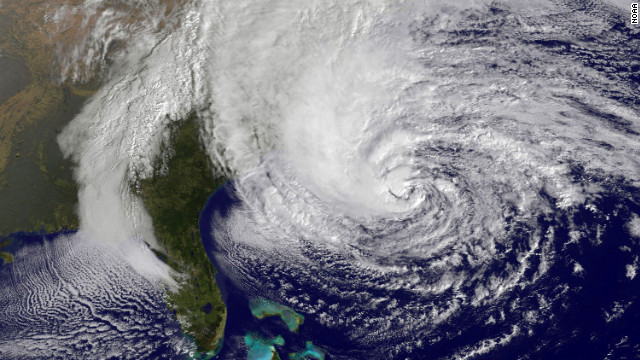
Hurricane Sandy is a Category 1 storm with a maximum wind speed of 86 mph. It is currently moving to the north at 20 mph.

Live Video app for Facebook by Ustream
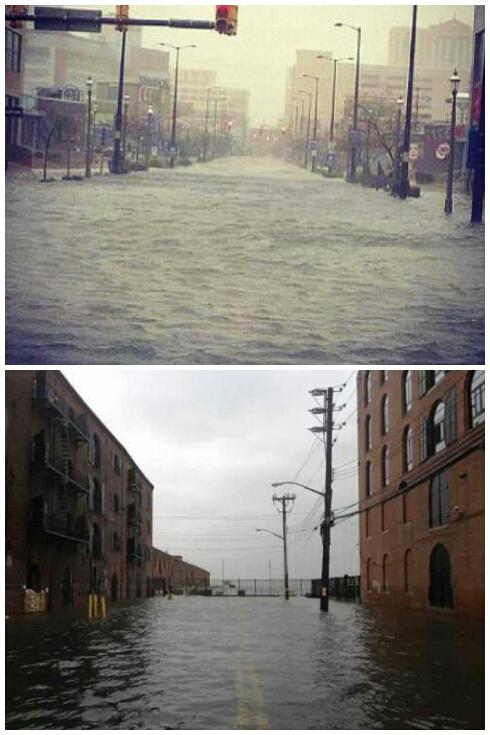
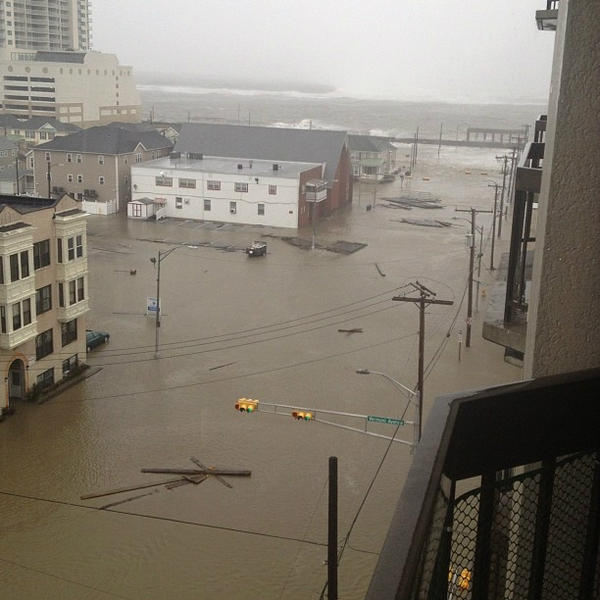
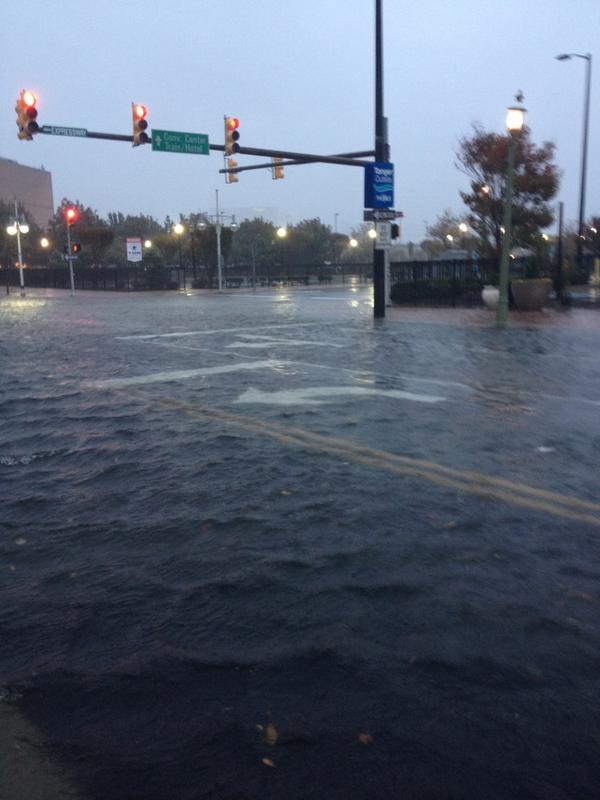
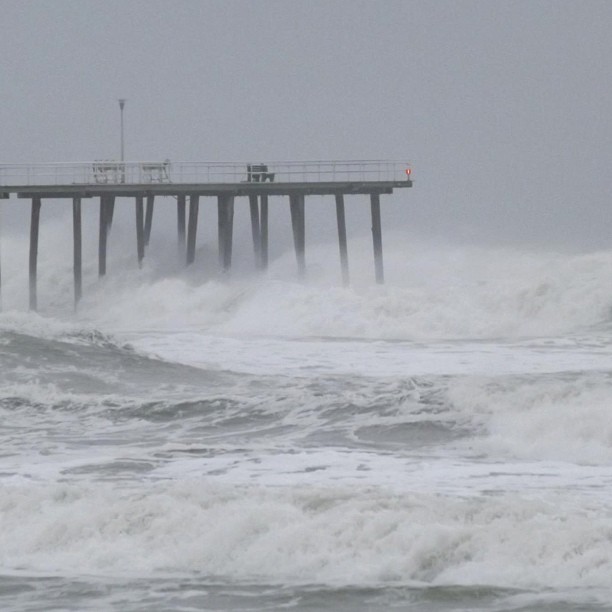
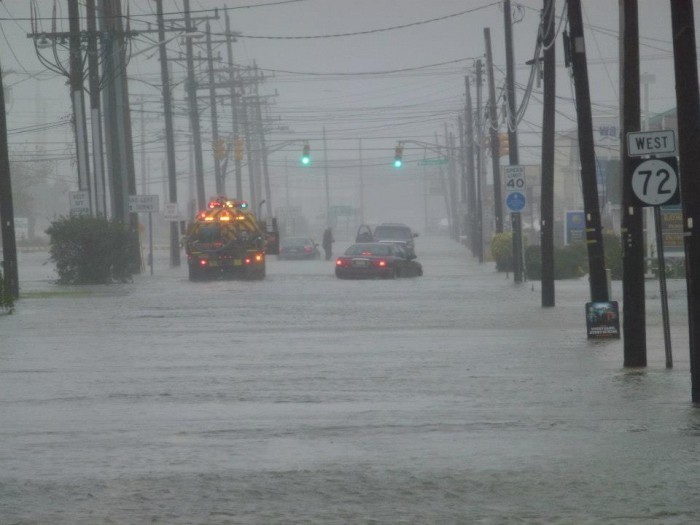
As Hurricane Sandy battered coastal New Jersey on Monday morning, Atlantic City felt some of its worst effects, with floodwaters surging through the streets and emergency responders facing mounting calls to evacuate residents who tried to ride out the storm. Pounding waves have already broken up sections of the Atlantic City boardwalk, according to photos posted to social media and discussion on police and fire scanners.
"Be advised that there are heavy timbers floating in Atlantic Avenue," a first responder alerted dispatchers on the Atlantic City police and fire scanner at 10 a.m. Willie Glass, Atlantic City's public safety director, told the Associated Press that "most of the city is under water."
The National Weather Service station in Mt. Holly, N.J., warned early Monday morning that the storm was poised to make a direct strike on New Jersey and cause devastation up and down the state. "This is an extremely dangerous situation for our area," forecasters wrote.

Obama declares New Jersey a disaster area

http://www.pressofatlanticcity.com
President Obama has declared New Jersey a disaster area, hours before Hurricane Sandy is expected to make landfall in South Jersey. Flooding from this morning’s high tide exceeded major levels throughout the region, nearing 8.3 feet in Atlantic City and 8.8 feet in Cape May, tying a record set in 1985 from Hurricane Gloria. Atlantic City authorities have made numerous water rescues in the city as residents, particularly in the Inlet section, Back Maryland and near Gardner’s Basin found their homes flooded with water at least three feet deep in places. Gov. Chris Christie ordered the state to close the Garden State Parkway south of the Atlantic City Expressway (Exit 38) due to flooding along the road and at numerous exits. Roads into barrier islands also are under water and some residents who stayed on barrier islands now are reconsidering their decisions. Brigantine Police told residents in a news release that they may have a brief window this afternoon to escape the island, but that was not certain. About 70 percent of the residents there stayed despite a mandatory evacuation order, police said. Police told residents that they need to prepare to shelter in place for the duration of the storm. Sandy still has winds of 85 mph and a continued strengthening of the system means it will be the most intense storm of the modern era to make landfall in the Northeast United States, according to the National Weather Service. The tide at Atlantic City remained at more than 8 feet, which is the threshold for major flooding, for more than an hour and a continued increase of onshore wind speeds may mean that water might not drop very far in the back bays, the weather service said. Forecasters have likened the effects of Sandy to those of the famous March Storm of 1962, which lasted five successive high tides. Reports of the ocean breaching dunes are increasing, including on Long Beach Island and in Cape May. Atlantic City patrol officers are working 12-hour shifts, driving Public Works trucks to navigate the city's streets. Fairmount and Arctic avenues were impassible, police said. Police and fire personnel will continue to help with rescues, Public Safety Director Willie Glass said. Rather than report to the Cape May County Police Academy today, the city's eight police recruits reported to the police compound to assist in whatever way they are needed, police said. “We’re breaking new ground here. (The water) will go places it never has gone before,” said Gary Szatkowski, a senior meteorologist with the National Weather Service in Mount Holly, Burlington County. “No one has seen it in their lifetime.” Gov. Chris Christie asked President Barack Obama on Sunday for a pre-landfall disaster declaration, which would help speed up relief efforts through the Federal Emergency Management Agency. Christie also mobilized the National Guard to assist local authorities. FEMA Administrator Craig Fugate said on a morning conference call that the agency already is mobilizing supplies and personnel to begin the relief effort as soon as conditions allow, but warned that residents throughout the region, including those inland, will contend with extended power outages and need to be prepared to be on their own for three days. Transportation throughout the state also will be at a standstill as NJ Transit suspended all operations, as did private bus carriers. Other than essential emergency personnel, nearly all state, local and county offices, along with courts and schools, are closed Monday and likely Tuesday. Atlantic City Electric warned that outages could take days to restore and the utility would not be issuing restoration time estimates until the preliminary damage assessment is conducted, which won’t occur until the storm has passed. Forecasters predict up to 12 inches of rain could fall across South Jersey and inland flooding could be extensive, especially along major river systems. On Sunday evening, buoys in the Atlantic Ocean recorded wave heights nearing 40 feet, and forecasters predicted waves near shore could reach 16 feet, with breakers on shore reaching up to 12 feet high. Szatkowski told residents who were thinking of staying to talk to anyone who lived through the March Storm of 1962 and ask whether they’d live through that same storm again. He wrote in a heart-felt plea to residents along the shore to consider loved ones and that if they thought he overhyped the storm, that they could call him Friday to yell at him. “Think about the emergency responders who will be unable to reach you when you make the panicked phone call to be rescued,” he wrote. “Think about the rescue/recovery teams who will rescue you if you are injured or recover your remains if you do not survive.” Ann Kooperman, who was 10 years old during the 1962 storm and lived on the bay side of North Tallahassee Avenue in Atlantic City at the time, said she is staying at her Ventnor Heights home that is directly on the Intracoastal Waterway. Kooperman’s husband, Steve, built the house at an elevation of 14 feet, so she is not concerned about water in the house. “My daughter asked us to come over (to Egg Harbor Township) and even cleaned a room for us. I thought it’s just going to be as bad over there with the trees. I’m more afraid of the trees than I am of flooding,” Kooperman said. “I’m a born and bred bay rat.” However, Kooperman said, if she were living on the beach block, her plans would be different: “If I was on the beach block, I’d be long gone.” While building codes and beach replenishment have added a level of strength to the islands’ infrastructure in places since 1962, the sea level also has risen about six inches and, Szatkowski warned, no building standard could stand up to the erosive power of the water if it begins to cut into the island and creates a new inlet, as occurred on Long Beach Island in 1962. “Even the best constructed home, if that’s where Mother Nature decides to start scouring a new inlet, that’s the danger when you get that much water moving,” he said. “You’re going to see some erosion beyond anything you can imagine.

Flooding rescues under way as Sandy threatens 'catastrophe' of a lifetime

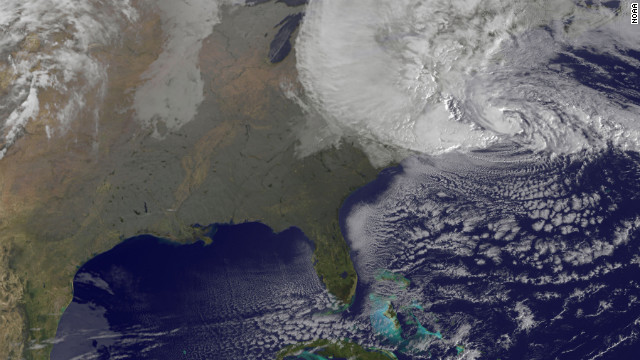
People stranded in flooding after ignoring evacuation orders were being saved Monday morning as Hurricane Sandy took aim at the Mid-Atlantic coast, bringing some of the nation's busiest cities to a standstill. Dramatic rescue efforts were under way in Oak Orchard, Delaware, a community along the Indian River Bay and a part of the state that was under a mandatory evacuation over the weekend. Officials across the Eastern Seaboard had implored residents to obey evacuation orders, emphasizing that local authorities could be put in danger if they tried to save them.
New Jersey Gov. Chris Christie put it most bluntly: "Don't be stupid. Get out!" Still, some didn't leave. Delaware Gov. Jack Markell said the National Guard and local fire and police officials were rescuing people in his state early Monday. It's just one of the scenes that make Sandy seem straight out of a disaster blockbuster: A killer storm takes aim at one of the most populated regions of the country."This is the most catastrophic event that we have faced and been able to plan for in any of our lifetimes," Connecticut Gov. Dan Malloy warned. An expected storm surge at midnight could raise water levels to 11 feet above normal high tide, bringing "the potential to cause unprecedented damage." Mass transit grinds to a halt
Along the Eastern Seaboard, hundreds of thousands of people have been forced from their homes. New York City landmarks are eerily empty. The nation's capital is emptied of government workers. Much of the region was settling into paralysis, bracing for what's to come. From North Carolina to Maine, forecasters warned that Sandy was likely to collide with a cold front and spawn a "superstorm" that could generate flash floods, snowstorms and massive power outages. About 50 million people, from Virginia to Massachusetts, are expected to feel the effects of Sandy. "It could be bad," said U.S. Coast Guard Rear Adm. Steven Rattior, "or it could be devastation." And the impact isn't limited to the East Coast. Wave heights in Lake Michigan could reach 28 feet Monday night and 31 feet by Tuesday, the National Weather Service said.Sandy already proved its deadly wrath, claiming at least 67 lives, 51 in Haiti alone, as it smashed through the Caribbean last week. Federal, state, and local U.S. officials have been working hard to bang out the message that Sandy is dangerous.
Newark Mayor Cory Booker told CNN early Monday: "My biggest concern is just people not taking it seriously and not taking the proper precautions. We still have some time for people to get ready. ... We anticipate there could be many days without power afterward."At 8 a.m., Sandy, a Category 1 hurricane, was 265 miles southeast of Atlantic City, New Jersey, and about 310 miles south-southeast of New York City, the center said. Maximum sustained winds were at 85 mph, and Sandy was moving north-northwest at about 20 mph. Hurricane-force winds extended outward 175 miles from the center, and tropical storm-force winds reached 485 miles. The center is expected to reach the coast Monday evening and make landfall between 8 p.m. and 2 a.m. on the Delmarva Peninsula -- an area occupied by parts of Delaware, Maryland and Virginia -- or Jersey Shore. By the time it reaches the coast, Sandy may not officially be a hurricane, but its widespread effects will be the same either way, CNN meteorologist Dave Hennen warns. But even with the storm hundreds of miles offshore, officials were warning of Sandy's life-threatening, storm-surge flooding portions of the Mid-Atlantic, including low-lying areas of New York and New Jersey.Michelle Franchaise of Ocean Gate was among the tens of thousands in New Jersey ordered to leave their coastal communities Sunday. She and more than 180 others hunkered down at an emergency shelter in Toms River, New Jersey, to ride out the storm. She selected one of the 250 green cots that lined the floor. "I'm very concerned when I see the map, and I see how big it is," she said. "I think I'm in good hands here. I think I'm safe." At least 60 people at the Toms River shelter brought their pets. "The cops came around and were like, 'If you don't leave, you're going to be arrested,' " one woman said while cradling one of four kittens she brought with her. "I couldn't leave without them."By early Monday, the city that never sleeps bedded down after shuttering its bus and train lines, closing schools and ordering about 400,000 people out of their homes in low-lying Manhattan and elsewhere. The process of halting subway service in New York began Sunday night. Other mass transit systems are doing the same by suspending their services Monday, including Washington's Metro service and Southeastern Pennsylvania Transportation Authority trains and buses in and around Philadelphia.In Sea Bright, New Jersey, Yvette Cafaro scrawled a plea on the plywood that covered up her burger restaurant: "Be kind to us Sandy." The seaside area largely dodged last year's Hurricane Irene, and Cafaro is hoping for, but not expecting, another reprieve. "Everything that we've been watching on the news looks like this one will really get us," she said. "We're definitely worried about it. ... Hopefully, she'll spare us." After filling his trunk with sandbags Sunday in Cranston, Rhode Island, resident Steve Pacheco said he had done what he could by clearing Halloween decorations and other items from his yard. Still, for all his preparation, he admitted that Sandy made him nervous. "I don't want to go through this again," Pacheco told CNN affiliate WPRI-TV in Providence. The price tag for potential wind damage alone is estimated between $2.5 billion and $3 billion, according to the Federal Emergency Management Agency. The estimate doesn't take into account potential flooding and other damage, though the federal government pre-emptively declared states of emergency in a number of locales to help states cope with Sandy and its aftermath.Officials have canceled classes Monday for more than 2 million public school students in districts such as New York, Philadelphia, Boston and Baltimore, while numerous universities as well as federal government offices in Washington and government offices in states like New Jersey were closed. The U.S. stock exchanges will be closed Monday and possibly Tuesday, announcements that followed soon after New York declared a state of emergency Sunday. The last time the New York Stock Exchange closed for a weather event was in 1985, during Hurricane Gloria. And in 1969, a snowstorm also brought the exchange to a halt. Sandy has even managed to put the presidential election on the back burner, turning campaign plans upside down. Politicos from both sides said it is still too early to tell what effect the storm will have on the presidential race, though the access to voting centers will be a concern if the storm persists until Election Day. "I don't think anybody really knows," top Obama adviser David Axelrod said on CNN's "State of the Union." "Obviously, we want unfettered access to the polls because we believe that the more people come out, the better we're going to do, and so to the extent that it makes it harder, you know, that's a source of concern. But I don't know how all the politics will sort out." Virginia's Republican governor said Sunday that his state would take measures to ensure residents are able to vote despite obstacles the storm might bring.Then there are the travel nightmares that the storm has and will continue to cause -- with thousands of flights called off, Amtrak train runs scuttled and hundreds of roads and highways expected to flood. "This is not a typical storm. It could very well be historic in nature and in scope and in magnitude because of the widespread anticipated power outages, flooding and potential major wind damage," Pennsylvania Gov. Tom Corbett said, speaking of his state but just as well about many others in the Mid-Atlantic and Northeast. "Essentially, this is a hurricane wrapped in a nor'easter."Janie Lambert of Hughesville, Maryland, stopped for a look Sunday at the beach at the Pax River Naval Station along the Chesapeake Bay. The typically calm surf churned violently, pushed by winds so powerful that it nearly knocked her off her feet when she got out of her car to videotape it. "We made it safely home," she said. "But I know this is only the beginning of several scary days ahead."

Malala Yousufzai status updates 10/29/2012

Malala Yousufzai spent a restful weekend at the Queen Elizabeth Hospital Birmingham surrounded by her family, who arrived in the UK last week. She continues to make good progress and is grateful for the 5,000 messages of support that have been posted via the Trust’s website.

Video: Atlantic City Braces for Hurricane Sandy

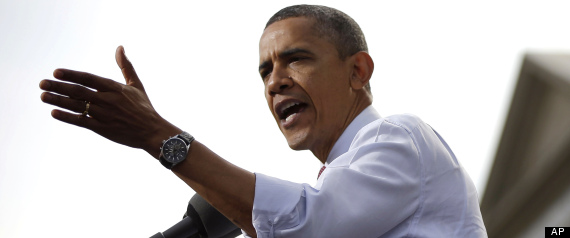
PRESIDENT OBAMA: Take Sandy 'very seriously'

PPP has full confidence on CEC

President of Pakistan People's Party Central Punjab Mian Manzoor Ahmad Wattoo has said that the PPP government has full confidence on the Chief Election Commissioner that he will conduct next general elections impartially. Talking to the party workers in Chichawatni he said that Nawaz Sharif and Shahbaz Sharif should quit politics on account of their involvement in election rigging in 1990.

FM Khar heads to Cairo on three-day visit

Pakistan’s Foreign Minister Hina Rabbani Khar on Monday departed on a three-day official visit to Cairo where she will meet the top leadership of the newly formed Egyptian government.
During her three days in Cairo, Foreign Minister Khar is scheduled to meet the newly elected President of Egypt Mohammad Morsi as well as other key figures of the Egyptian government. The meetings are aimed at strengthening of ties between the two Muslim countries, while cooperation in other areas will also be discussed. Mohammad Morsi, a former leader of the powerful Muslim Brotherhood party from which he stood down after his election, became Egypt’s first civilian and democratically elected president a year after former President Hosni Mubarak – who governed Egypt for 30 years – was ousted in a popular uprising. Foreign Minister Khar’s meeting with President Morsi will mark Islamabad’s first steps at bilateral ties with the newly formed Egyptian government.

12 burnt in Peshawar factory fire

At least 12 workers at a chipboard factory sustained severe burns as the factory they were working in caught fire on Monday. According to police, the fire erupted when workers were cleaning the machines with petrol. Ten workers burnt in the fire were shifted Hayatabad Medical Complex where after receiving initial treatment they were moved to the Khyber Teaching Hospital. Three workers are said to be in critical condition.


Malala’s Revolution !!!

The men who attempted to kill 14-year-old Malala Yousafzai on October 9 knew what she represented. Her active involvement since the age of eleven in campaigning for the rights of girls in her region to be educated was well known.
Malala’s efforts, while applauded by the West and some segments of Pakistani society, were deeply resented by the obscurantist forces that go by the name of the Taliban, which in Pakistan calls itself Tehrik-e-Taliban Pakistan. Their choice of name is an ironic one, for Taliban, an Arabic word, means those seeking to be educated, whereas the Taliban’s principal aim is to keep Muslim societies backward so that they can be persuaded to adopt a seventh-century version of Islam. Education, particularly of women, stands in the way of achieving this goal. But the attack on Malala will, most likely, have an effect that is opposite to that intended by those who carried it out.Several religious leaders joined the chorus of condemnation that followed the attack on Malala. In a sign of unity, a council of Sunni Muslim scholars in the eastern city of Lahore issued a fatwa, signed by 50 clerics, saying that the justifications cited by the girl’s attackers were “deviant” and had no basis in Islamic law. The Taliban seem to have been taken aback by the public and media reaction to the attack. Dawn, Pakistan’s largest-circulation English-language newspaper, reported that Hakimullah Mehsud, the Pakistani Taliban’s leader, had ordered his foot soldiers to target media organisations in Karachi, Lahore, Rawalpindi, and Islamabad in response. Several TV channels had been extremely critical of the Taliban’s assaults on Pakistani society. The extremists wanted to silence the majority that was waking up to the existential threat that radical Islam poses to their country. There is a widespread belief that Pakistani women are doing poorly when it comes to obtaining education. That impression is correct to some extent. The overall literacy rate for women is undoubtedly low — much lower than that for men. But male education and literacy in Pakistan is not very high, either. Although Pakistan is a signatory to the United Nations Millennium Development Goals, which include attainment of universal literacy for both boys and girls by 2015, the country is far from achieving the target, with literacy rates of 70% for boys and only 45% for girls in 2010. That said, over the 17-year period from 1993 to 2010, the number of girls enrolled in primary education increased from 3.7 million to 8.3 million. This implies a rate of growth of 6.7% a year, about 2.5 times the rate of increase in the number of girls entering the primary-school age cohort. But, even with this growth rate, girls still accounted for just 44.3% of the total number of enrolled students in 2010. It is in higher education that Pakistani women have made extraordinary progress in recent years. Their share of total college enrollment has increased from 36% to 57% over the last couple of decades, rising from less than 15,000 in 1993 to 4,36,000 in 2010. The proportion of women receiving higher education is approaching the 60% mark, owing to an impressive 28% annual rate of growth in their enrollment numbers in 2010, up from a 20% increase in 1993. Although a very large number of girls drop out after primary school, the number completing higher education is now large. This year, roughly 7,50,000 women will graduate from Pakistan’s institutions of higher learning. If the current rate of growth is maintained, by 2015 the number of women completing higher education could exceed 1.5 million a year. Had Malala died, she eventually would have been forgotten — another victim of the war that the extremists are waging in Pakistan. Her death would have added just one more individual to the tens of thousands who have already been killed in terrorist attacks across the country. Malala’s survival — and possibly even full recovery — provides a vibrant symbol for a troubled country. She will begin to be identified with the change that is already underway. It is not often recognised that women in Pakistan — at least those of a certain class — are receiving the kind of education that enables them to enter the modern sectors of the economy or to become entrepreneurs. In education, numbers make a revolution. The extremists understand that all too well.

Pakistan has the ability to protect Malala when she returns

Interior Minister Rehman Malik has said that Malala Yousafzai’s family will be under guard when they return to Pakistan after her treatment and the government will pay for it.
In an interview with CNN in London, Malik said that the teenage activist had been offered security thrice before her shooting, but her father had refused. He said that she would be given security when she returns to Pakistan. Malik said that this will require a cordon of female officers to surround Malala and one of male officers to surround the female contingent. “I assure to the world community that when she goes back, we do have the ability to protect her.” The interior minister also said that Malala and her parents can stay in the UK for as long as needed, “until she is fully rehabilitated”. Police looking for 3 suspects Malik said that police in Pakistan was searching for three suspects believed to be involved in Malala’s shooting. He said that the suspects were two youths who were involved in the shooting and a man who is believed to have driven them to the scene. He said the two were brought to Swat by a man identified as 23-year-old Ataullah Khan, who is the primary suspect. The interior minister said one of the youths had distracted the driver of the vehicle Malala was travelling in, while the other had asked a bystander to identify her. “Obviously they had done their homework. They had seen the vehicle of Malala going up and down, and accordingly they acted on that.” Police have said that they are tracking down Khan, who was a student of a master’s degree in chemistry. He had studied for his Bachelor of Science degree in physics at Jahanzeb College in Swat. Malik also rejected calls from some to bring in the army to bear on the militants, stating that a military solution was not the solution. He said that Malala was the pride of Pakistan and that “we would love her to come back”.

Sunday, October 28, 2012

Hurricane Sandy takes dead aim at Jersey Shore

Hurricane Sandy threatened to make a direct hit on the Jersey Shore near Atlantic City late Monday in what a meteorologist called a "once-in-50-years" storm that would disrupt the lives of millions of East Coast residents between Delaware and Long Island.
Already Sunday, the advancing storm had forced the evacuation of Shore towns, grounded hundreds of flights at Philadelphia International Airport, promoted SEPTA to suspend mass transit, and led school officials across the region to cancel classes. Governors in Pennsylvania, New Jersey, and Delaware all declared states of emergency. Caravans of power-company trucks from Southern states were barreling toward the Northeast on I-95 to be in position to assist with anticipated power outages from 70 m.p.h. wind gusts that officials warned could be widespread and last for days.
The storm could wobble or weaken, but both the National Hurricane Center and Accuweather predicted it would make landfall just north or just south of Atlantic City, which like some other towns already was starting to flood Sunday from high surf. Officials across the region - from the Shore to Philadelphia, to the heart of Pennsylvania - warned of a huge, destructive weather mass with drenching rains and high sustained winds that could bring down power lines and topple trees. The threat of flooding stretched west to Harrisburg. Rain could turn to snow in the mountains of Western Pennsylvania. Most of the Philadelphia region's economy will grind to a halt. Taxi services, malls, universities, and government agencies have announced one- or two-day closures. At the airport, all flights are canceled for Monday. On Sunday, people waited in lines for gasoline and supermarkets ran short of peanut butter, bread, and water. A major threat was storm surges that could erode beaches and damage property. "This is a storm surge you'll see once in 50 years. That's the kind of thing that's coming," said Jack Boston, expert senior meteorologist with Accuweather. Philadelphia can expect gusts of near hurricane-force Monday night and rain of four to eight inches between Monday and Wednesday. Boston described Hurricane Sandy as a "hybrid between a nor'easter and a hurricane" because of its size. Gov. Corbett declared a state of emergency and said at a news conference that 1,600 National Guard troops were prepared to lend assistance in the event of a disaster. "We are prepared for the worst and hope for the best," he said. Gov. Christie said all schools in Gloucester, Salem, and Mercer Counties would be closed Monday and Tuesday. He ordered closure of state offices and suspension of NJ Transit services. Delaware Gov. Jack Markell proclaimed a "level-one driving warning" to limit motorists on roadways. "If there's not a critical need for you to be on the roads, stay off of them," Markell said. "I encourage employers to think seriously about following the state's lead and allowing nonessential employees to remain home." School, transit, and city officials in the Philadelphia area were taking nothing for granted as Sandy bore down. Mayor Nutter said he spoke with President Obama on Sunday about the storm and the mayor pleaded with Philadelphia residents in river-prone neighborhoods to seek safety in city-run shelters or with family members. He announced that city government would be closed Monday. "The intensity is not lessening," the mayor said. "It's actually strengthening. Every concern that we've laid out for the past couple of days is in fact real." Nutter said extra police and fire personnel would be on duty through the storm and that roads needed to be clear for them. "If you don't need to be out tomorrow, please stay home," he said Sunday. City trash will not be picked up Monday. City residents with Monday pickup days were asked to keep their trash for an extra week. The city opened three shelters at 4 p.m. Sunday, and residents seemed to be heeding the mayor's alarm. Between 4 and 5 p.m., about two dozen people streamed into West Philadelphia High, dragging small suitcases and carrying bags. Cots with blankets filled the shelter area, and bottled water and food arrived soon after the shelter opened. Members of the media were not allowed into the shelter, with the city's Office of Emergency Management and Red Cross personnel citing concerns about adding to the individual trauma. The School District of Philadelphia said it would close schools Monday, and Catholic schools will be closed Monday and Tuesday. Dozens of suburban districts in Pennsylvania and South Jersey also canceled sessions. Alex Klein, a junior at University of Pennsylvania majoring in urban studies, said he and his five roommates ran to the grocery store to stock up for the storm when they heard the university had canceled classes Monday and Tuesday. They already had jugs of water on hand from a delivery service. They had stocked up on flashlights, batteries, food, and candles. "Everyone has exams coming up, and Thanksgiving isn't far away," Klein said. "If worse comes to worst, we'll just study. We've got candles." While government officials were quick to respond to the threat, so were businesses and retail stores Sunday. All of the region's major malls, including King of Prussia, said they would not open Monday.In Center City, building owners planned to put up maintenance staff in hotels overnight so that high-rise towers could be open Monday morning. PATCO said Sunday night that bridges - Walt Whitman, Betsy Ross, Commodore Barry, and Ben Franklin - would remain open unless winds grew dangerously high. Officials will monitor weather reports closely, he said. Many municipalities issued their own storm warnings. In Bucks County, Lower Makefield Township declared a state of emergency beginning at 6 a.m. Monday and said that nonessential cars and trucks are prohibited on the town's roads and nonessential businesses are to close. In nearby Yardley, just yards from the Delaware River, Eben Copple, executive chef at the Yardley Inn, vowed: "We are going to continue as if things are normal. We are not expecting deliveries [on Monday], so we'll rewrite our menu to accommodate for the storm. But that's OK, we'll make do." In Royersford, Montgomery County, residents along the Schuylkill were asked to voluntarily evacuate before Sandy hits, County Commissioner Josh Shapiro said at a news conference. Residents in other county areas, including Pottstown, Mont Clare, Norristown, Conshohocken, Glenside, and Whitemarsh were being urged to consider evacuating. Despite the storm anticipation, Sunday seemed just another fall day for some. The Eagles played - and lost - at the Linc. A regatta went ahead on the Schuylkill. Ellen Carver, codirector of the Head of the Schuylkill Regatta, said only one race was stopped because of the wind. "Other than that it was a wonderful day of racing," Carver said. Elsewhere, residents were stocking up on bread and nonperishables and filling up gas tanks. At Wegmans in Cherry Hill, crowds were steady all day, said merchandising manager Amanda Mancini. Despite the rough weather ahead, the store planned to keep regular hours - 6 a.m. until midnight. "We have ice. As of this moment we have water. I can't guarantee we're going to have water in the next 10 minutes," Mancini said just after dark. The store was out of batteries and flashlights but had plenty of groceries - she wasn't worried they were going to run out, Mancini said. But there was definitely a run on certain items. "We've sold a lot of potato chips, a lot of cookies. Lots of peanut butter and jelly," Mancini said. At the Whole Foods on South Street, a cashier said they had run out of gallon-size bottles of water. "We still have a good bit of one-liters and the smaller bottles," he said. The store was also sold out of eggs. Karen Muldoon Geus, a Peco spokeswoman, said the utility had 300 line crews and 150 tree crews on standby. Utilities from Chicago, Tennessee, Kentucky, Mississippi, and Louisiana were dispatching crews to assist. Peco had positioned trailers near flood-prone areas to act as operations centers during power restoration activities, she said. "We expect if we get a direct hit, the storm will result in a multiday restoration effort," Geus said. In Camden County, authorities announced they had ordered all county parks closed at 2 p.m. Streets emptied in Sea Isle City and Ocean City as flooding began at 11 a.m., with some main roads in Sea Isle completely impassable. Traffic clogged the Garden State Parkway early Sunday, with tolls waived for residents on their way to the mainland. As weather services focused on Atlantic City as Hurricane Sandy's landfall, the casino town quickly emptied out on Sunday, with hundreds of residents and vacationers lining up at the city's convention center to board buses for emergency shelters. Casinos closed shop as early as noon. Some vacationers said they had planned to wait out the storm at the blackjack tables and the Trump Plaza but were turned away. Waiting to board a bus outside the convention center, Tamika Brooks, of Atlantic City, stood behind a long line of residents trying to get out of the city. She said she had no idea where the bus was taking her, but wanted to heed Christie's mandatory evacuation order. "I'm not worried," she said, laughing. "Right now I just want to go to sleep - I've been up since 5

NJ Governor: 'Don't Try to Be a Hero'

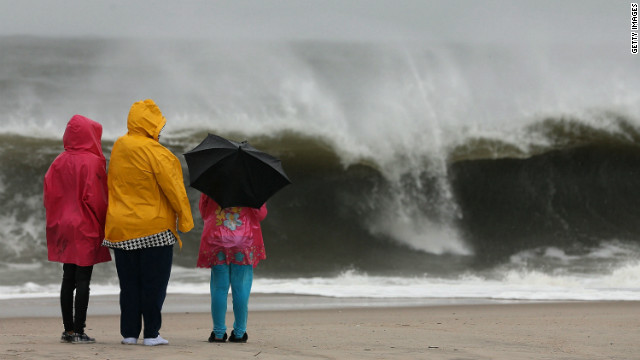
Massive and dangerous Hurricane Sandy has grown to record size as it barrels northeastwards along the North Carolina coast at 10 mph. At 8 am EDT, Sandy's tropical storm-force winds extended northeastwards 520 miles from the center, and twelve-foot high seas covered a diameter of ocean 1,030 miles across. Since records of storm size began in 1988, only one tropical storm or hurricane has been larger--Tropical Storm Olga of 2001, which had a 690 mile radius of tropical storm-force winds when it was near Bermuda (note: I earlier reported this was a subtropical storm, as per the original NHC advisory, but it was later re-analyzed as a tropical storm.) Sandy has put an colossal volume of ocean water in motion with its widespread and powerful winds, and the hurricane's massive storm surge is already impacting the coast. A 2' storm surge has been recorded at numerous locations this morning from Virginia to Connecticut, including a 3' surge at Virginia's Chesapeake Bay Bridge Tunnel and Sewells Point at 9 am EDT. Huge, 10 - 15 foot-high battering waves on top of the storm surge have washed over Highway 12 connecting North Carolina's Outer Banks to the mainland at South Nags Head this morning. The highway is now impassable, and has been closed. The coast guard station on Cape Hatteras, NC, recorded sustained winds of 50 mph, gusting to 61 mph, at 5:53 am EDT this morning. In Delaware, the coastal highway Route 1 between Dewey Beach and Bethany Beach has been closed due to high water. Even though Sandy is a minimal Category 1 hurricane, its storm surge is extremely dangerous, and if you are in a low-lying area that is asked to evacuate, I strongly recommend that you leave.Sandy was a brutal storm for the Caribbean, the storm's death toll now stands at 65. The death toll is highest in Haiti, with 51 deaths. Prime Minister Laurent Lamothe told the Associated Press that "This is a disaster of major proportions. The whole south is under water." Approximately 8 - 10" of rain (200 - 250 mm) fell in the capital of Port-au-Prince. Eleven people were killed in Cuba, where 35,000 homes were damaged or destroyed. Sandy is also being blamed for 1 death in Jamaica, 1 in Puerto Rico, and 1 in the Bahamas. Sandy has a rather unusual structure, with the strongest winds on the southwest side of the center, but a larger area of tropical storm-force winds to the northeast of the center. Most of the storm's heavy thunderstorm activity is on the storm's west side, in a thick band several hundred miles removed from the center, giving Sandy more the appearance of a subtropical storm rather than a hurricane. Satellite loops show that the low-level center of Sandy is no longer exposed to view, and heavy thunderstorms are increasing in areal extent near the center, due to a reduction in wind shear from 35 - 40 knots last night to 25 - 30 knots this morning. Wind shear is expected to drop another 5 knots today, which may allow the storm to build an increased amount of heavy thunderstorms near its center and intensify by 5 - 10 mph over the next 24 hours. The NOAA Hurricane Hunters noted this morning that Sandy had a partial eyewall on the west through SE sides of the center, and the storm may be able to build a nearly complete eyewall by Monday morning. By Monday afternoon, though, Sandy will be moving over cool 25°C waters, which should slow down this intensification process. However, the trough of low pressure that will be pulling Sandy to the northwest towards landfall on Monday will strengthen the storm by injecting "baroclinic" energy--the energy one can derive from the atmosphere when warm and cold air masses lie in close proximity to each other. Sandy should have sustained winds at hurricane force, 75 - 80 mph, at landfall. Sandy's central pressure is expected to drop from its current 951 mb to 945 - 950 mb at landfall Monday night. A pressure this low is extremely rare; according to wunderground weather historian Christopher C. Burt, the lowest pressure ever measured anywhere in the U.S. north of Cape Hatteras, NC, is 946 mb (27.94") measured at the Bellport Coast Guard Station on Long Island, NY on September 21, 1938 during the great "Long Island Express" hurricane. The latest set of 00Z (8 pm EDT) and 06Z (2 am EDT) computer model runs are in agreement that Sandy will make landfall between 10 pm Monday night and 4 am Tuesday morning in New Jersey.

Obama calls on residents to heed orders ahead of Hurricane Sandy

http://www.rte.ie
President Barack Obama has warned that Hurricane Sandy is a "serious and big storm" and called on East Coast residents to heed the orders of state and local officials to protect themselves from its onslaught. President Barack Obama has warned that Hurricane Sandy is a "serious and big storm" and called on East Coast residents to heed the orders of state and local officials to protect themselves from its onslaught. Mr Obama was speaking after a briefing at the federal government's storm response centre in Washington. He said officials had assured him that they had all the resources they needed in place, and he stressed that "it is important for us to respond big and to respond fast" to the hurricane's onslaught. "We're going to cut through red tape and we're not going to get bogged down in a lot of rules," said President Obama, who was having to juggle both is re-election bid and his efforts to stay on top of the storm's impact just nine days before Election Day. Earlier today, New York Mayor Michael Bloomberg ordered city schools to be closed on Monday and the evacuation of 375,000 residents who live in at risk areas ahead of Hurricane Sandy. The city's subway, bus and train services will be suspended from 7pm this evening. Mr Bloomberg said that areas of the city from City Island to Coney Island to Battery Park City were under mandatory evacuation because of approaching Hurricane Sandy. He said during a press conference that the mandatory evacuation applies to people in Zone A, which covers coastal areas. Weather forecasters have warned that Hurricane Sandy will affect a large area of the US east coast. However, forecasters said it was too early to pinpoint where the storm, which has the potential to be the biggest to hit the mainland, would make landfall. Residents have scrambled to buy supplies before the storm arrives on Monday night. On its current projected track, Sandy is most likely to make US landfall between Delaware and the New York/New Jersey area, forecasters said. However, the Miami-based National Hurricane Center said it could not yet predict the precise point. "It is still too soon to focus on the exact track ... both because of forecast uncertainty and because the impacts are going to cover such a large area," the NHC said. While Sandy's winds are not overwhelming for a hurricane, its width is what has made it exceptional. Hurricane force winds extend 165km from its centre, while its lesser tropical storm-force winds reach across 1,125km. Sandy could have a brutal impact on major cities in the target zone, including Boston, New York, Baltimore, Washington DC and Philadelphia. The storm could cause the worst flooding Connecticut has seen in more than 70 years, said the state's governor, Dannel P Malloy. Sandy was located about 420km south-southeast of Cape Hatteras, North Carolina, with top sustained winds of 120km/h early this morning. Forecasters said Sandy is a rare, hybrid "super storm" created by an Arctic jet stream wrapping itself around a tropical storm, possibly causing up to 30cm of rain in some areas, as well as heavy snowfall inland. Sandy killed at least 66 people as it made its way through the Caribbean, including 51 in Haiti, mostly from flash flooding and mudslides. The White House said US President Barack Obama took part in a call with US Homeland Security Secretary Janet Napolitano and Federal Emergency Management Agency Administrator Craig Fugate to discuss preparations for Sandy. The approaching storm forced a change of plans for both presidential candidates ahead of the election on Tuesday 6 November. Mr Obama has cancelled a campaign appearance in Virginia tomorrow and another stop in Colorado on Tuesday, and will instead monitor the storm from Washington. Republican challenger Mitt Romney cancelled a trip to Virginia set for today, when the state is expected to begin feeling Sandy's impact, and will go instead to Ohio. Some flights to US from Ireland cancelled The Dublin Airport Authority has said a number of transatlantic flights have been cancelled on Monday and Tuesday. Passengers with plans to travel stateside in the next two days are advised to contact their airline or airline's website before travelling to Dublin Airport. Aer Lingus has cancelled its flights to and from New York on Monday due to the severe weather anticipated. The following flights have been cancelled: EI-105 Dublin to New York and EI-104 New York to Dublin EI-111 Shannon to New York and EI-110 New York to Shannon EI-109 Dublin to New York and EI-108 New York to Dublin The airline has apologised for the disruption and has asked those scheduled to travel to visit its website.

Video: Mayor Bloomberg Announces Evacuations Ahead of Hurricane Sandy

Hurricane Sandy expected to bring massive power outages

Utility companies are positioning workers for expected outages from the superstorm along the East Coast. Hurricane Sandy: Utility companies prepare for powerful storm By Adrienne LaFrance Digital First Media WASHINGTON - Utility companies along the East Coast had thousands of workers ready to respond late Sunday as Hurricane Sandy headed north packing rain and winds that were expected to knock out power to millions of people. Speaking from the Federal Emergency Management Agency headquarters in Washington on Sunday, President Barack Obama said people in the storm's path will have to be "vigilant for a couple of days," according to a White House transcript. "Don't anticipate that just because the immediate storm has passed that we're not going to have some potential problems in a lot of these communities going forward through the week," Obama said. Consolidated Edison Co. of New York, which provides power for some nine million people in and around New York City, was prepared to shut down service in some areas to minimize damage from possible flooding. "We expect a lot of outages because of the wind and rain knocking trees into power lines," ConEd spokesman Michael Clendenin said. "But also, because of the expected storm surge, the low-lying areas that have underground electrical equipment could be susceptible. If we see flooding going on with seawater, de-energizing will make for a faster restoration. If we didn't do it, you could be looking at weeks." In New Jersey, officials said residents should be prepared to live without electricity for more than a week. Gov. Chris Christie cautioned those who are flouting warnings, urging citizens not to be cynical about the forecasted severity of the storm. "We have to be prepared for the worst here," he said. "We're in for a bit of a haul." Officials in New Jersey, which is expected to be hit hard when the storm makes landfall Monday, said the state is better prepared to respond to Hurricane Sandy after improvements made in the wake of last year's Hurricane Irene. Public Service Electric and Gas says it spent $28 million trimming trees near power lines, and more than doubled voltage capacity so that power lines can better withstand lightning strikes and storm damage. The utility now has 1,000 workers in the state, ready to hunker down for the duration of the storm, according to a spokesman. "That's split between linemen for restoration of lines and tree removal workers," PSE&G spokesman Paul Rosengren said. "That's probably the largest contingent we're ever had hunkered." A PECO spokeswoman in Philadelphia said the utility had called up hundreds of back-up workers from Illinois, Kentucky, Louisiana, Mississippi and Tennessee. "We do expect, given the severity of all the forecasts, that this is going to be a multi-day event," PECO's Karen Muldoon Geus said. "Safety is absolutely paramount. We tell our customers, 'Please stay away from downed wires. Always assume that PECO's equipment is energized, even if there's an outage.'" In Washington, D.C., Potomac Electric Power Co. said it is "aggressively executing" its emergency response plan and anticipating potentially "devastating damage" and outages lasting several days. Officials in the district also began distributing sandbags at area high schools. By Sunday afternoon, 400 additional crews were en route to Washington, a spokesman for PEPCO said. Officials in Delaware don't expect Hurricane Sandy to be as devastating in their region as it could be in New Jersey and New York, but they're still anticipating major disruption. "We're basically on standby waiting for something to happen," Delaware Electric Cooperative spokesman Jeremy Tucker said. "We're ready. We're just waiting."

New York subway to shut down as Sandy nears

The subway in the city that never sleeps will shut down Sunday night as officials brace for the impact of Hurricane Sandy.
New York's Metropolitan Transportation Authority will suspend subway service at 7 p.m., Gov. Andrew Cuomo said. The last commuter railroad trains will also leave at that time. And bus service will stop at 9 p.m., he said. "The storm is coming ... and now it is time to take action," Cuomo told reporters. "A situation like this, you don't want to be overly panicked and overly prepared, but you want to be prudent and you want to do what is necessary." It's rare for New York's massive transit network -- the largest in North America, with nearly 4.3 million people every day riding the subway alone -- to grind to a halt.
But Cuomo said the move was a necessary step, because it isn't safe to operate trains in high winds, and equipment could also become damaged. "We don't want to encourage people being up and about," he said. "We want people staying in their homes. Be prepared and stay at home." The storm is expected to cause massive flooding and widespread power outages when it hits the East Coast, in full, late Sunday and into next week. But before that happens, transportation companies and government officials are allowing -- and, in some cases, urging -- people to plan for the worst. A number of airlines, for example, are allowing customers to change their flight plans without paying any fees due to Sandy. Delta will let those ticketed to fly between Sunday and Wednesday, in and out of airports in 15 states and the District of Columbia, to reschedule by November 4. United's offer applies to travel to-and-from 29 airports, for the same dates. East Coast braces for 'superstorm' Other airlines, such as American, are offering a similar process, with slight variations. And at least in U.S. Airways' case, the weather is already keeping airlines busy: The airline apologized to customers on its Twitter feed for long waits to get through to agents due to a high call volume tied to Sandy. Amtrak announced Saturday that it will cancel some of its train runs on Sunday to and from Richmond and Newport News, Virginia; Chicago and Washington; Miami and New York; and Washington and New York. In addition, a train scheduled to run Monday between Washington and Chicago will also remain in the station. "Passengers are encouraged to travel on earlier available trains on Sunday," Amtrak said in a news release. "Additional cancellations might be necessary in the coming days as this major storm moves north." Meanwhile, New Jersey is taking steps to shut down NJ Transit bus, rail and Access Link service on Monday -- much as it did last year for 36 hours due to Hurricane Irene. "By beginning this important process, NJ Transit will be better able to support the state's response to Hurricane Sandy by freeing up buses or other resources that may be needed for hurricane relief," Department of Transportation Commissioner James Simpson said in a press release. For all the potential headaches at airports, train stations and bus terminals, the type of transportation affected first and most directly by Sandy may be boating. All along the East Coast, meteorologists and officials have warned people to steer clear of the seas because of potentially perilous high winds and large waves tied to the storm. Pam and Bob Haigh, a Rhode Island couple, were surprised -- given how late it is in the hurricane season -- that Sandy has delayed their plans to sail from Maryland to the Florida Keys. But they know that this isn't the first time that Mother Nature has affected travel plans -- nor will it be the last. "We've got a surprise, so we'll just ride it out," Pam Haigh said. "There's not much else we can do."

Obama Hurricane Response: President Balancing Storm With Campaigning

President Barack Obama has spent months trying to balance his re-election bid with running the government.
Now, just when his campaign needs him the most, with little more than a week before the election, his official job is beckoning. Republican challenger Mitt Romney, too, faces questions about how to conduct his campaign as a superstorm charges toward the East Coast. But as president, it's Obama who oversees the federal government's preparations for the looming storm and it's Obama who will bear the responsibility for any missteps. With that in mind, Obama scrapped campaign events Monday night and Tuesday morning. He planned to return to the White House late Monday to monitor the storm and the government's response. "This is an example, yet again, of the president having to put his responsibilities as commander in chief and as leader of the country first, while at the same time he pursues his responsibilities as a candidate for re-election," Josh Earnest, a White House spokesman, told reporters traveling with Obama to a campaign event Saturday in New Hampshire. Still, ripping up Obama's strategically planned travel schedule was something his Chicago-based campaign was loath to do unless absolutely necessary. In the tight race, the candidates have few opportunities left to blitz through the most competitive states, trying to build momentum and make a final pitch to undecided voters. The president's handling of the storm could sway those late-breaking voters. If Obama is perceived as a strong leader who shows command in a crisis, some undecided voters may be compelled to back the president. But a botched response or a sense that he's putting politics over public safety could weaken his support at a point in the race where there's little chance to reverse course. "I think that the president of the United States is the commander in chief. The American people look to him, and I'm sure he will conduct himself and play his leadership role in a fine fashion. So I would imagine that might help him a little bit," said Arizona Sen. John McCain, who lost to Obama in 2008. "But I'm not sure it will affect votes. People have been exposed to this very long campaign," he said on CBS' "Face the Nation." Obama advisers say they've learned the lessons from President George W. Bush's widely criticized response to Hurricane Katrina. Bush was seen as ineffective and out of touch, and his presidency never recovered. That's why Obama's team has moved quickly throughout the year to avoid the impression that the president was shirking his responsibilities, even as the campaign ramped up. When separate crises struck Colorado this summer – destructive wildfires and a mass shooting at a movie theater – Obama hastily arranged trips to meet with victims and their families. When a hurricane barreled through the Gulf Coast ahead of the Democratic Convention, the president added a stop in New Orleans to his preconvention itinerary. But those decisions were far easier than what's facing Obama's team. Back then, there was time to add or reschedule trips. Now, with just nine days until Election Day, time is a precious commodity and canceling trips may mean never having the chance to make them up. Hurricane Sandy was expected to hit the East Coast late Monday, then combine with two winter weather systems as it moves inland, creating a hybrid superstorm. At least four battleground states are likely to be hit: New Hampshire, North Carolina, Ohio and Virginia. Obama plans to spend every day between now and Nov. 6 on the road in most of those states and others, though his schedule does call for him to be back in Washington some nights. In canceling Obama's event Monday in Virginia, aides also considered the optics of urging thousands of people to venture out to a political rally in the midst of a raging storm. Still, it was clear Obama's team was working hard to ensure that the president could keep campaigning as long as possible before he was needed back in Washington. His departure for Florida, where he'll hold an event with Bill Clinton, was moved up from Monday morning to Sunday night in order to get ahead of the storm. Even though Monday's late event in Virginia was scrapped, Obama and Clinton planned to squeeze in an evening rally in Youngstown, Ohio, before the president was to return to the White House. Romney canceled three events in Virginia on Sunday and planned to spend the day campaigning with running mate Paul Ryan in Ohio. If bad weather keeps people in hard-hit battleground states from going to the polls, it could mess up the campaigns' carefully crafted get-out-the-vote efforts. Jennifer Psaki, Obama's campaign spokeswoman, said the Democratic ticket was urging people to vote early when they can, especially if it helps them get to the polls before the storm. "Safety comes first," she said. "And that's the case with early voting as well." ____

Films from Afghanistan on social issues screened at South Asian Film Festival in Goa

Films from Afghanistan, based on the life of women and children in the country, were screened at the ongoing seventh South Asian Film Festival here over the weekend.With an aim to bring together all the nations and to promote peace and harmony through the medium among the countries, South Asia Foundation screened films from Afghanistan, which showcased the plight of the women and children of Afghanistan. A film 'We Are Postmodernism' was also screened at the festival. The film is based on the life of a 14-year-old girl, who begs for money on the street with her mother. A boy about the same age gives them a coin every day he passes by, pushing his bicycle. One day the mother dies. The girl now begs alone for money, wearing her mother's burqa. The young boy passing by this time gives the girl a flower instead of a coin. A the director of 'We Are Postmodernism', Alka Sadat said such platforms give them the opportunity to showcase the real picture of their country to the world and they also get the chance to interact with filmmakers from other nations. "We can speak about my country to a lot of people through this festival. In Afghanistan, people saw or watch terrible things on their television about Taliban, tourists being attacked. So, it's good for us to make film and speak about what's going on in Afghanistan, about the real things in Afghanistan. We get the opportunity to meet filmmakers and other people and listen about the situation of other country," said Sadat. Enthralled by the films, Sanjay, a visitor, described it as a good experience and the movie depicted the pathetic condition of children and women in Afghanistan. "The movie was very interesting. It's very sad to see how people are treated in Afghanistan, the kids specially and it's a pathetic state. The way the director has actually focused on the kids and the way the kids are living a sad life. It's very shocking to see such images," said Sanjay. During the extravaganza, more than 40 films from South Asian countries will be screened including 'Singham', 'Rajneeti' and 'Ye Saali Zindagi'. Films from Afghanistan, Bangladesh, Bhutan, India, Nepal, Pakistan and Sri Lanka will also screened. Famous personalities from the entertainment world as well as political leaders are attending the ongoing film festival. The seventh edition of festival commenced in Panaji city on October 24 and it concludes on October 30.

British woman, held in Pakistan on drug charges, has baby

Reuters
A British woman, held in Pakistan on charges of drug smuggling, has been sent back to prison with her newborn daughter after giving birth in a hospital, a British legal group said Sunday. Khadija Shah, 25, is being held on charges of trying to smuggle heroin worth nearly $5 million onto a flight to Britain. She gave birth to her baby girl Malaika a few weeks ago but was returned from hospital to Adiala prison near the capital Islamabad. The birth was not reported until Sunday. The baby has had no immunizations and has already had to be hospitalized when she developed severe diarrhoea in the unsanitary prison, said British legal group Reprieve. "To keep a baby behind bars is truly barbaric. Baby Malaika is weak and suffering from terrible health problems while Khadija faces execution. No mother would wish this scenario on their worst enemy," Reprieve investigator Sultana Noon said in a statement. Shah has two other young children. After a period of incarceration when their mother was arrested in May this year, they were freed into the care of a relative. Mothers are frequently imprisoned with their children while their cases are heard in Pakistan's congested legal system. Criminal cases can take years to complete.

New Pakistan outreach could aid Afghan peace deal

Pakistan has increased efforts to reach out to some of its biggest enemies in Afghanistan, a significant policy shift that could prove crucial to US-backed efforts to strike a peace deal in the neighboring country. The target of the diplomatic push has mainly been non-Pashtun political leaders who have been at odds with Pakistan for years because of the country’s historical support for the Afghan Taliban, a Pashtun movement. Many of the leaders fought against the Taliban when the fundamentalist Islamic group seized control of Afghanistan in the 1990s with Pakistan’s help, and have accused Islamabad of maintaining support for the insurgents following the US-led invasion in 2001, allegations denied by the government. Many experts agree that Pakistan continues to see the Taliban as an ally, albeit a shaky one, in countering the influence of archenemy India in Afghanistan. But they also say Islamabad no longer believes the insurgents can take over the country or wants them to, a common misperception in the West. ”A Taliban victory on the other side of the border would give a huge boost to domestic militants fighting the Pakistani state,” said Zahid Hussain, a journalist who has written extensively about Islamabad’s war against the Pakistani Taliban. Pakistan is also worried that unrest in Afghanistan following the withdrawal of most foreign troops in 2014 could provide the Pakistani Taliban with greater space to establish sanctuaries across the border. The Afghan and Pakistani Taliban are allies but have focused on different enemies. The Afghan Taliban have battled local and foreign forces in Afghanistan, while the Pakistani Taliban have mainly waged war against Islamabad. Pakistan’s concerns have led it to conclude that a peace agreement that includes all Afghan groups is in its best interests, and contact with its traditional foes among the non-Pashtuns is necessary to achieve that goal, said Moeed Yusuf, South Asia adviser for the United States Institute of Peace. ”I think the fundamental point here is that there is a serious realization among some people who matter in Pakistan that they can’t continue to put all their eggs in the Taliban basket because it is too shaky,” said Yusuf. ”This is a major shift, and a shift that I think everybody should welcome.” The outreach comes as Pakistan, Afghanistan and the US have stepped up efforts to breathe new life into the Taliban peace process, which has been hamstrung by distrust among all the parties involved. The US and Pakistan recently set up working groups to identify which Taliban leaders would be open to reconciliation and to ensure those holed up on Pakistani territory would be able to travel to the site of talks. Pakistan and Afghanistan have been in discussions to revive a joint commission set up to discuss the peace process. Pakistan is seen as key to a peace deal because of its ties with the Taliban, and there is hope that Islamabad’s increased engagement with non-Pashtuns in Afghanistan will facilitate the process. ”I think one of Pakistan’s realizations is that if you want to play a bigger role to reconcile all these groups, you need to reach out to every group,” said Rahimullah Yousufzai, a Pakistani journalist and expert on the Taliban. ”They will be pushing the Taliban to share power with all these people, but it won’t be easy because the Taliban aren’t known to share power and the US doesn’t want to give them a major share.” Islamabad’s historical support for the Taliban and other Pashtuns in Afghanistan, who make up about 40 per cent of the population of 30 million, is partly rooted in the sizable number of Pashtuns who live in Pakistan. The ethnic group has always been seen as the best bet for furthering Pakistan’s interests in the country. Pakistan first advertised its overtures to non-Pashtuns in Afghanistan in February when Foreign Minister Hina Rabbani Khar met with a range of ethnic Tajik, Uzbek and Hazara leaders during a visit to Kabul. Prime Minister Raja Pervaiz Ashraf followed suit in July when he traveled to Afghanistan and invited the group to the opening of the new Pakistani Embassy in Kabul. There have also been less publicized contacts by Pakistan’s ambassador to Kabul, Mohammad Sadiq, and the country’s army and intelligence service, according to Pakistani and Afghan officials. Khar said the policy shift had been in the works for a while but was like a steering a large ship in a new direction. ”You’re not able to do it immediately,” said the foreign minister. Pakistan’s powerful army is the true arbiter of the country’s Afghan policy, but experts expressed doubt that the Foreign Ministry would have pushed ahead without the support of the generals, who have historically had the closest relationship to the Taliban. One key Afghan leader who has met with the Pakistanis, Abdullah Abdullah, said he appreciated the country’s recent attempt to reach out because it was done publicly. The influential politician, who was runner-up to Afghan President Hamid Karzai in the 2009 election, said Pakistani intelligence officials contacted him in previous years, but he refused to speak with them because he did not believe communication should be carried out in secret. ‘I see a lot of good in reaching out, in engagement, in dialogue,’ said Abdullah, who is half Pashtun but draws much of his support from the Tajik community. The outreach has rattled the Taliban, who have warned Pakistani officials that they can’t trust the non-Pashtuns, Yousufzai said. Pakistan will have to overcome significant distrust among the non-Pashtuns. The government has old ties to some of the leaders, who worked with Pakistan in the 1980s to push the Soviets out of Afghanistan, but Islamabad’s subsequent support for the Taliban created a huge amount of bad blood. Despite that, the Pakistanis are hopeful. ‘The Pakistani side’s view of Afghan negotiations is that you kill on one day and kiss on the next, so while this will be very tough, they think that it’s not entirely out of the realm of possibility that they may actually get somewhere,’ said Yusuf, the South Asia analyst.

New India FM for stronger Pakistan ties

According to media reports, India's new External Affairs Minister Salman Khurshid
said on Sunday that it would be his endeavour to reinforce the country's ties Pakistan. Interacting with media after his appointment as foreign minister, Khurshid said: "There are completely different perspectives on Pakistan and China. China is in that sense we are clearer about where we stand with China. We have had differences historically. I believe that with the passage of time and emergence of a new economic order in the world has brought China and India far closer together, working together but the potential of growth between China and India, I think is enormous." Earlier on Saturday, Khurshid's predecessor S.M. Krishna had observed that over the years he had seen a positive shift in the relationship of Pakistan and China with India. Khurshid also raised concerns over the political scenario in Pakistan. "As far as Pakistan is concerned, Pakistan has been an extremely troubled situation in a very troubled part of the world and it is a neighbour and that is a concern for us as well. I think the convergence between India and Pakistan today is on issues that for long we insisted, those issues which were a major concern to India both in terms of our security and our dignity. Many of those issues have now emerged in Pakistan itself and have become a concern for Pakistani establishment. So if there was ever, ever a convergent point on tackling these issues between India and Pakistan, it is there today," he said. Khurshid said: "We want to be able to look at possible roots towards being able to work more closely together, be able to understand each other's problems and to the extent that we can solve each other's problems mutually and by convergence of opinion on both our countries. I think it is something that we should work towards." The government announced a major cabinet reshuffle on Sunday, where 22 federal ministers, including junior ministers, were sworn in.

Aseefa Bhutto spends Eid with Malala

Aseefa Bhutto Zardari spent Eid with Malala’s family here on Friday.Accompanied by Pakistan High Commissioner for UK Wajid Shamsul Hasan, Aseefa travelled from Oxford Brooks University, where she is currently studying, to Birmingham to meet Malala’s parents and inquire after their daughter’s health.She spent about two hours with the family and hoped that Malala would soon recover.While strongly condemning the attack she said that this kind of brutal act could not be done by Muslims and those who had done it were not Muslims.On this occasion, Aseefa said that the whole of Pakistan was standing with Malala, who had become a symbol of peace, enlightenment and women empowerment. She also conveyed the full support of President Asif Ali Zardari to the family.During the meeting the senior officials of Queen Elizabeth Hospital were present while Medical Director Dr Dave Rosser briefed Aseefa about Malala’s health status.Malala’s father thanked Aseefa and the High Commissioner for being with his family on Eid Day.

Bahrain police 'continue to torture detainees'

Human Rights Watch has accused Bahrain's police of continuing to beat and torture detainees, including minors. The report comes nearly six months after an independent inquiry prompted the government to pledge reforms. The country insists it is committed to putting the recommendations of its own report into the handling of protests in 2011 into practice. More than 40 people died in last year's unrest and 1,600 were arrested. According to the Human Rights Watch (HRW) report policemen regularly take young men to secluded places and beat them for up to two hours before transferring them to a police station. Boy 'beaten' Some said they had been threatened with rape if they did not reveal where activists were hiding the petrol bombs that are regularly hurled at police. The report said treatment inside police stations had improved significantly in the last six months, but it also warned that unlawful police behaviour on the streets may well make young protesters even more desperate and determined to confront their government. The campaigning group said it had interviewed 14 young males, including seven children. It said five of the beatings had happened in April alone. "Bahrain has displaced the problem of torture and police brutality from inside police stations to the point of arrest and transfer to police stations," said Nadim Houry, deputy Middle East director at HRW. On Sunday, there were reports that a 13-year-old was being held in custody for assaulting a police officer and taking part in a street gathering in a village south of the capital, Manama. According to his lawyers, quoted by AFP news agency, the boy was "beaten and tortured" at a police station where he was still being held. The HRW report comes a few weeks after Amnesty International also warned that the country's reforms had only scratched the surface. In November, the Bahrain Independent Commission of Inquiry (BICI) report acknowledged numerous human rights abuses and systematic torture of detainees as security forces put down anti-government protests. In response, King Hamad promised lessons would be learned and laws would be reformed to protect freedom of speech and other basic rights.

Saudi Arabia takes bulldozer to Islam's history

Three of the world’s oldest mosques are about to be destroyed as Saudi Arabia embarks on a multi-billion-pound expansion of Islam’s second holiest site. Work on the Masjid an-Nabawi in Medina, where the Prophet Mohamed is buried, will start once the annual Hajj pilgrimage ends next month. When complete, the development will turn the mosque into the world’s largest building, with the capacity for 1.6 million worshippers. But concerns have been raised that the development will see key historic sites bulldozed. Anger is already growing at the kingdom’s apparent disdain for preserving the historical and archaeological heritage of the country’s holiest city, Mecca. Most of the expansion of Masjid an-Nabawi will take place to the west of the existing mosque, which holds the tombs of Islam’s founder and two of his closest companions, Abu Bakr and Umar. Just outside the western walls of the current compound are mosques dedicated to Abu Bakr and Umar, as well as the Masjid Ghamama, built to mark the spot where the Prophet is thought to have given his first prayers for the Eid festival. The Saudis have announced no plans to preserve or move the three mosques, which have existed since the seventh century and are covered by Ottoman-era structures, or to commission archaeological digs before they are pulled down, something that has caused considerable concern among the few academics who are willing to speak out in the deeply authoritarian kingdom. “No one denies that Medina is in need of expansion, but it’s the way the authorities are going about it which is so worrying,” says Dr Irfan al-Alawi of the Islamic Heritage Research Foundation. “There are ways they could expand which would either avoid or preserve the ancient Islamic sites but instead they want to knock it all down.” Dr Alawi has spent much of the past 10 years trying to highlight the destruction of early Islamic sites. With cheap air travel and booming middle classes in populous Muslim countries within the developing world, both Mecca and Medina are struggling to cope with the 12 million pilgrims who visit each year – a number expected to grow to 17 million by 2025. The Saudi monarchy views itself as the sole authority to decide what should happen to the cradle of Islam. Although it has earmarked billions for an enormous expansion of both Mecca and Medina, it also sees the holy cities as lucrative for a country almost entirely reliant on its finite oil wealth. Heritage campaigners and many locals have looked on aghast as the historic sections of Mecca and Medina have been bulldozed to make way for gleaming shopping malls, luxury hotels and enormous skyscrapers. The Washington-based Gulf Institute estimates that 95 per cent of the 1,000-year-old buildings in the two cities have been destroyed in the past 20 years. In Mecca, the Masjid al-Haram, the holiest site in Islam and a place where all Muslims are supposed to be equal, is now overshadowed by the Jabal Omar complex, a development of skyscraper apartments, hotels and an enormous clock tower. To build it, the Saudi authorities destroyed the Ottoman era Ajyad Fortress and the hill it stood on. Other historic sites lost include the Prophet’s birthplace – now a library – and the house of his first wife, Khadijah, which was replaced with a public toilet block. Neither the Saudi Embassy in London nor the Ministry for Foreign Affairs responded to requests for comment when The Independent contacted them this week. But the government has previously defended its expansion plans for the two holy cities as necessary. It insists it has also built large numbers of budget hotels for poorer pilgrims, though critics point out these are routinely placed many miles away from the holy sites. Until recently, redevelopment in Medina has pressed ahead at a slightly less frenetic pace than in Mecca, although a number of early Islamic sites have still been lost. Of the seven ancient mosques built to commemorate the Battle of the Trench – a key moment in the development of Islam – only two remain. Ten years ago, a mosque which belonged to the Prophet’s grandson was dynamited. Pictures of the demolition that were secretly taken and smuggled out of the kingdom showed the religious police celebrating as the building collapsed. The disregard for Islam’s early history is partly explained by the regime’s adoption of Wahabism, an austere and uncompromising interpretation of Islam that is vehemently opposed to anything which might encourage Muslims towards idol worship. In most of the Muslim world, shrines have been built. Visits to graves are also commonplace. But Wahabism views such practices with disdain. The religious police go to enormous lengths to discourage people from praying at or visiting places closely connected to the time of the Prophet while powerful clerics work behind the scenes to promote the destruction of historic sites. Dr Alawi fears that the redevelopment of the Masjid an-Nabawi is part of a wider drive to shift focus away from the place where Mohamed is buried. The spot that marks the Prophet’s tomb is covered by a famous green dome and forms the centrepiece of the current mosque. But under the new plans, it will become the east wing of a building eight times its current size with a new pulpit. There are also plans to demolish the prayer niche at the centre of mosque. The area forms part of the Riyadh al-Jannah (Garden of Paradise), a section of the mosque that the Prophet decreed especially holy.. “Their excuse is they want to make more room and create 20 spaces in a mosque that will eventually hold 1.6 million,” says Dr Alawi. “It makes no sense. What they really want is to move the focus away from where the Prophet is buried.” A pamphlet published in 2007 by the Ministry of Islamic Affairs – and endorsed by the Grand Mufti of Saudi Arabia, Abdulaziz al Sheikh – called for the dome to be demolished and the graves of Mohamed, Abu Bakr and Umar to be flattened. Sheikh Ibn al-Uthaymeen, one of the 20th century’s most prolific Wahabi scholars, made similar demands. “Muslim silence over the destruction of Mecca and Medina is both disastrous and hypocritical,” says Dr Alawi. “The recent movie about the Prophet Mohamed caused worldwide protests... and yet the destruction of the Prophet’s birthplace, where he prayed and founded Islam has been allowed to continue without any criticism.” Mecca and Medina in numbers 12m The number of people who visit Mecca and Medina every year 3.4m The number of Muslims expected to perform Hajj (pilgrimage) this year 60,000 The current capacity of the Masjid an-Nabawi mosque 1.6m The projected capacity of the mosque after expansion

Israeli PM praises extremely friendly ties with Saudi Arabia

Israeli Prime Minister Benjamin Netanyahu has revealed the existence of “friendly and strong” relations between Israel and Saudi Arabia, APA reports quoting Press TV. In an interview published on YouTube, Netanyahu said there were friendly and strong relations between Israel and Saudi Arabia in different fields. The Israeli premier added that Tel Aviv and Riyadh have common economic and political interests in the Middle East. In May, a report by Tel Aviv University said Saudi Arabia was Israel’s last hope and defense line, describing the Saudis as Tel Aviv’s last chance to protect its political interests in the Arab world. The report said most of Israel’s allies in the region have collapsed and cannot play a significant role in the Arab world, adding that Saudi Arabia is the only country that stands against the Islamic Republic of Iran and thus it is Tel Aviv’s last line of defense against Tehran. The report noted that the Al Saud family is very important to Israel because Saudi Arabia is very actively working in countries such as Yemen, Egypt, Iraq, and Lebanon to reduce Iran’s influence in those countries. Moreover, in emails leaked by WikiLeaks and obtained by the Beirut-based newspaper Al-Akhbar, it was revealed that Saudi Arabia had reached out to the Mossad, which assisted the kingdom with "intelligence collection and advice on Iran." According to a source quoted in the emails, "Several enterprising Mossad officers, both past and present, are making a bundle selling the Saudis everything from security equipment (to) intelligence and consultation."

‘Saudi Arabia Funds Mossad Anti-Iran Operations’

An article posted by a former CBS News producer Barry Lando claims that none other than Saudi Arabia helps fund Israeli Mossad operations against Iran. "A Strange Alliance: Are the Saudis Bankrolling Israel's Mossad?" appears on his blog. Lando’s source is named only as “a friend, with good sources in the Israeli government.” He wrote, “The head of Israel's Mossad has made several trips to deal with his counterparts in Saudi Arabia-one of the results: an agreement that the Saudis would bankroll the series of assassinations of several of Iran's top nuclear experts that have occurred over the past couple of years. “The amount involved, my friend claims, was $1 billion dollars. A sum, he says, the Saudis considered cheap for the damage done to Iran's nuclear program.” Lando admitted that “the tale sounds preposterous” but added, “On the other hand. it makes eminent sense. The murky swamp of Middle East politics has nothing to do with the easy slogans and 30-second sound bites of presidential debates.” Israel and Saudi Arabia have at least one thing in common: neither country wants to allow Ahmadinejad to obtain nuclear capability. Lando noted that the claim of the strange alliance “also makes perfect sense, that, in retaliation for the cyber attacks on their centrifuges, the Iranians reportedly launched their own cyber attack on a Saudi state-owned target: Saudi Aramco, the world’s most valuable company.” Aramco’s computer system suffered a massive cyber attack in August, and American intelligence officials have blamed Iran. “A report earlier this year by Tel Aviv University cites Saudi Arabia as the last hope and defense line for Israel,” Lando wrote. “With most of Israel’s traditional allies in the region sent packing or undermined by the Arab Spring, the Saudis are the Jewish State’s last chance to protect its political interests in the Arab world.” Lando has long experience on Iran. He recently wrote a book called "Web of Deceit: The History of Western Complicity in Iraq, from Churchill to Kennedy to George W. Bush.” He charged on Counterpunch earlier this year that Israel, the United States and Iran do not understand each other’s motives while “their advisors are engaged in an incredibly dangerous three-way game of blind man's bluff.” He said he personally ran into American ignorance in 1980 when he was producing '60 Minutes'. “I was struck by the total inability of Americans—even at the highest level—to understand the emotions and history that drove the hatred of all things American that had exploded in Iran with the fall of the Shah,” Lando wrote. “Just up West 57th street from CBS News, for instance, was a huge billboard with the diabolical image of Khomeini glowering down on New York. I suggested we do a report to give Americans a better idea of what was driving Iran’s revolutionaries and their violent feelings against the United States…. “I stitched together a tough report with Mike Wallace based on a series of interviews in New York and Washington.’ Former Secretary of State Henry Kissinger was charged by one interviewee “for turning a blind eye to the excesses of the Shah, and refusing to have any contact with the opposition groups.” Lando also reported that classified U.S. documents exposed by Iran “showed that American diplomats based in Teheran had warned Washington months earlier of the threat of a possible hostage-taking – particularly if the U.S. allowed the despised Shah to come to America for medical treatment, as the U.S. ultimately did. Those warnings had been completely ignored by Washington.” However, before the program was broadcast, President Jimmy Carter called the president of CBS News “to try to convince him not to broadcast the report. It would, he said, undermine U.S. negotiations with Iran at a very delicate time.” CBS did not agree to back down but agreed to change the report’s title from “Should the U.S. Apologize?” to a more neutral “The Iran File.” “It was difficult to understand how our report could upset the hostage negotiations,” wrote Lando. “We were not revealing any secrets to Iran. The Iranians already knew well the role of the U.S. in their own history. The people we were informing were 20 million Americans — who didn’t understand what was really roiling Iran. “And still don’t.”

Saudi women and IDs

My face is my existence
My face is my human identity, the proof of my very existence. Wake up, women of the Arab Peninsula, rebel against being non-existent,” Tweeted activist Lama al-Zahrani in support for the recent decision in Saudi Arabia making it compulsory for women to carry state IDs on them. “Unfortunately,” she told NOW, “when the Shura Council issued the ruling, some judges and other sheikhs who are well-known in media circles were opposed to it.” This is because an official ID would bear an actual photo of its female holder. However, Zahrani believes that the sheikhs’ objection to the photo IDs is merely a pretext, the main problem being fear that women will break free of their male dominance.
Nawwara, another Saudi activist, agreed, saying, “There are concerns regarding the autonomy of women, as they fear we will have more demands. Others, still, want to exploit women [who don’t have state picture IDs]. For instance, a father may take a loan or buy and sell stocks in his daughter’s name using the family [identification] card, and leave her to handle the repayment. In other cases, a brother may seize his sister’s inheritance by bringing in a woman wearing a niqab, claiming that she is his sister and having her sell her share of inheritance.” Zahrani says that she knows from personal experience that the law is not being implemented and that picture IDs are merely useful with regard to social matters when divorced and widowed women get alimony. As for other parts of life, an ID is not enough, as a woman is required to bring along a male “identifier” or guardian whenever she leaves the house. “The problem is that we mix customs, traditions and laws, and men’s opportunism plays a part in that,” says Saudi lawyer and legal counselor Abdullah al-Aazzaz. “Being a patriarchal society, we ban women from gaining their autonomy under the pretext of protecting them while, in truth, we seek to repress or dominate them. A brother or father may lie to a woman and tell her he cannot open a bank account using her ID and she’d believe that, whereas this is not true.” As for passports, a Saudi woman cannot obtain one or even travel if she is not accompanied by her guardian. Nawwara was luckier than others, as her father decided to grant her a license to travel for as long as her passport is valid. This is not the case for most guardians, who stipulate that any trip abroad should have their prior approval. “She who does not have an identifier is done for. It is truly a shame for a 15-year-old to have the right to be your identifier and guardian,” Nawwara says. This does not hold true for trips to Gulf countries. Saudi women are, at last, allowed to go to Gulf countries using their IDs rather than their passports and if any woman wants to go to any other state from there, she does not need the approval of an identifier or guardian. The state ID decision caused major turmoil on social media, as many hailed it as a gradual step toward granting Saudi women the right to travel. “Women are more aware of their rights thanks to the internet. Many issues pertaining to women’s rights are being discussed on Twitter, which is displaying a noticeable increase in female traffic,” Zahrani says. “Female jurists have a clear influence in raising Saudi society’s awareness and showing it what is happening, which induced change – no matter how small – in society’s vision of women.” “The concept of women has changed. Instead of being referred to as mothers and wives, they are now seen as a woman with their own existence and spirit.”