Sunday, October 28, 2012

New York subway to shut down as Sandy nears

The subway in the city that never sleeps will shut down Sunday night as officials brace for the impact of Hurricane Sandy.
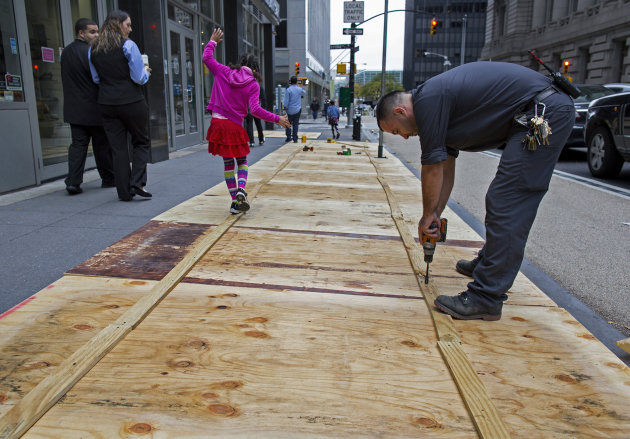
New York's Metropolitan Transportation Authority will suspend subway service at 7 p.m., Gov. Andrew Cuomo said. The last commuter railroad trains will also leave at that time. And bus service will stop at 9 p.m., he said. "The storm is coming ... and now it is time to take action," Cuomo told reporters. "A situation like this, you don't want to be overly panicked and overly prepared, but you want to be prudent and you want to do what is necessary." It's rare for New York's massive transit network -- the largest in North America, with nearly 4.3 million people every day riding the subway alone -- to grind to a halt.
But Cuomo said the move was a necessary step, because it isn't safe to operate trains in high winds, and equipment could also become damaged. "We don't want to encourage people being up and about," he said. "We want people staying in their homes. Be prepared and stay at home." The storm is expected to cause massive flooding and widespread power outages when it hits the East Coast, in full, late Sunday and into next week. But before that happens, transportation companies and government officials are allowing -- and, in some cases, urging -- people to plan for the worst. A number of airlines, for example, are allowing customers to change their flight plans without paying any fees due to Sandy. Delta will let those ticketed to fly between Sunday and Wednesday, in and out of airports in 15 states and the District of Columbia, to reschedule by November 4. United's offer applies to travel to-and-from 29 airports, for the same dates. East Coast braces for 'superstorm' Other airlines, such as American, are offering a similar process, with slight variations. And at least in U.S. Airways' case, the weather is already keeping airlines busy: The airline apologized to customers on its Twitter feed for long waits to get through to agents due to a high call volume tied to Sandy. Amtrak announced Saturday that it will cancel some of its train runs on Sunday to and from Richmond and Newport News, Virginia; Chicago and Washington; Miami and New York; and Washington and New York. In addition, a train scheduled to run Monday between Washington and Chicago will also remain in the station. "Passengers are encouraged to travel on earlier available trains on Sunday," Amtrak said in a news release. "Additional cancellations might be necessary in the coming days as this major storm moves north." Meanwhile, New Jersey is taking steps to shut down NJ Transit bus, rail and Access Link service on Monday -- much as it did last year for 36 hours due to Hurricane Irene. "By beginning this important process, NJ Transit will be better able to support the state's response to Hurricane Sandy by freeing up buses or other resources that may be needed for hurricane relief," Department of Transportation Commissioner James Simpson said in a press release. For all the potential headaches at airports, train stations and bus terminals, the type of transportation affected first and most directly by Sandy may be boating. All along the East Coast, meteorologists and officials have warned people to steer clear of the seas because of potentially perilous high winds and large waves tied to the storm. Pam and Bob Haigh, a Rhode Island couple, were surprised -- given how late it is in the hurricane season -- that Sandy has delayed their plans to sail from Maryland to the Florida Keys. But they know that this isn't the first time that Mother Nature has affected travel plans -- nor will it be the last. "We've got a surprise, so we'll just ride it out," Pam Haigh said. "There's not much else we can do."

Obama Hurricane Response: President Balancing Storm With Campaigning

President Barack Obama has spent months trying to balance his re-election bid with running the government.
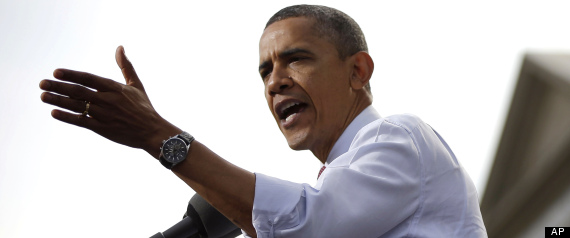
Now, just when his campaign needs him the most, with little more than a week before the election, his official job is beckoning. Republican challenger Mitt Romney, too, faces questions about how to conduct his campaign as a superstorm charges toward the East Coast. But as president, it's Obama who oversees the federal government's preparations for the looming storm and it's Obama who will bear the responsibility for any missteps. With that in mind, Obama scrapped campaign events Monday night and Tuesday morning. He planned to return to the White House late Monday to monitor the storm and the government's response. "This is an example, yet again, of the president having to put his responsibilities as commander in chief and as leader of the country first, while at the same time he pursues his responsibilities as a candidate for re-election," Josh Earnest, a White House spokesman, told reporters traveling with Obama to a campaign event Saturday in New Hampshire. Still, ripping up Obama's strategically planned travel schedule was something his Chicago-based campaign was loath to do unless absolutely necessary. In the tight race, the candidates have few opportunities left to blitz through the most competitive states, trying to build momentum and make a final pitch to undecided voters. The president's handling of the storm could sway those late-breaking voters. If Obama is perceived as a strong leader who shows command in a crisis, some undecided voters may be compelled to back the president. But a botched response or a sense that he's putting politics over public safety could weaken his support at a point in the race where there's little chance to reverse course. "I think that the president of the United States is the commander in chief. The American people look to him, and I'm sure he will conduct himself and play his leadership role in a fine fashion. So I would imagine that might help him a little bit," said Arizona Sen. John McCain, who lost to Obama in 2008. "But I'm not sure it will affect votes. People have been exposed to this very long campaign," he said on CBS' "Face the Nation." Obama advisers say they've learned the lessons from President George W. Bush's widely criticized response to Hurricane Katrina. Bush was seen as ineffective and out of touch, and his presidency never recovered. That's why Obama's team has moved quickly throughout the year to avoid the impression that the president was shirking his responsibilities, even as the campaign ramped up. When separate crises struck Colorado this summer – destructive wildfires and a mass shooting at a movie theater – Obama hastily arranged trips to meet with victims and their families. When a hurricane barreled through the Gulf Coast ahead of the Democratic Convention, the president added a stop in New Orleans to his preconvention itinerary. But those decisions were far easier than what's facing Obama's team. Back then, there was time to add or reschedule trips. Now, with just nine days until Election Day, time is a precious commodity and canceling trips may mean never having the chance to make them up. Hurricane Sandy was expected to hit the East Coast late Monday, then combine with two winter weather systems as it moves inland, creating a hybrid superstorm. At least four battleground states are likely to be hit: New Hampshire, North Carolina, Ohio and Virginia. Obama plans to spend every day between now and Nov. 6 on the road in most of those states and others, though his schedule does call for him to be back in Washington some nights. In canceling Obama's event Monday in Virginia, aides also considered the optics of urging thousands of people to venture out to a political rally in the midst of a raging storm. Still, it was clear Obama's team was working hard to ensure that the president could keep campaigning as long as possible before he was needed back in Washington. His departure for Florida, where he'll hold an event with Bill Clinton, was moved up from Monday morning to Sunday night in order to get ahead of the storm. Even though Monday's late event in Virginia was scrapped, Obama and Clinton planned to squeeze in an evening rally in Youngstown, Ohio, before the president was to return to the White House. Romney canceled three events in Virginia on Sunday and planned to spend the day campaigning with running mate Paul Ryan in Ohio. If bad weather keeps people in hard-hit battleground states from going to the polls, it could mess up the campaigns' carefully crafted get-out-the-vote efforts. Jennifer Psaki, Obama's campaign spokeswoman, said the Democratic ticket was urging people to vote early when they can, especially if it helps them get to the polls before the storm. "Safety comes first," she said. "And that's the case with early voting as well." ____

Films from Afghanistan on social issues screened at South Asian Film Festival in Goa

Films from Afghanistan, based on the life of women and children in the country, were screened at the ongoing seventh South Asian Film Festival here over the weekend.With an aim to bring together all the nations and to promote peace and harmony through the medium among the countries, South Asia Foundation screened films from Afghanistan, which showcased the plight of the women and children of Afghanistan. A film 'We Are Postmodernism' was also screened at the festival. The film is based on the life of a 14-year-old girl, who begs for money on the street with her mother. A boy about the same age gives them a coin every day he passes by, pushing his bicycle. One day the mother dies. The girl now begs alone for money, wearing her mother's burqa. The young boy passing by this time gives the girl a flower instead of a coin. A the director of 'We Are Postmodernism', Alka Sadat said such platforms give them the opportunity to showcase the real picture of their country to the world and they also get the chance to interact with filmmakers from other nations. "We can speak about my country to a lot of people through this festival. In Afghanistan, people saw or watch terrible things on their television about Taliban, tourists being attacked. So, it's good for us to make film and speak about what's going on in Afghanistan, about the real things in Afghanistan. We get the opportunity to meet filmmakers and other people and listen about the situation of other country," said Sadat. Enthralled by the films, Sanjay, a visitor, described it as a good experience and the movie depicted the pathetic condition of children and women in Afghanistan. "The movie was very interesting. It's very sad to see how people are treated in Afghanistan, the kids specially and it's a pathetic state. The way the director has actually focused on the kids and the way the kids are living a sad life. It's very shocking to see such images," said Sanjay. During the extravaganza, more than 40 films from South Asian countries will be screened including 'Singham', 'Rajneeti' and 'Ye Saali Zindagi'. Films from Afghanistan, Bangladesh, Bhutan, India, Nepal, Pakistan and Sri Lanka will also screened. Famous personalities from the entertainment world as well as political leaders are attending the ongoing film festival. The seventh edition of festival commenced in Panaji city on October 24 and it concludes on October 30.

British woman, held in Pakistan on drug charges, has baby

Reuters
A British woman, held in Pakistan on charges of drug smuggling, has been sent back to prison with her newborn daughter after giving birth in a hospital, a British legal group said Sunday. Khadija Shah, 25, is being held on charges of trying to smuggle heroin worth nearly $5 million onto a flight to Britain. She gave birth to her baby girl Malaika a few weeks ago but was returned from hospital to Adiala prison near the capital Islamabad. The birth was not reported until Sunday. The baby has had no immunizations and has already had to be hospitalized when she developed severe diarrhoea in the unsanitary prison, said British legal group Reprieve. "To keep a baby behind bars is truly barbaric. Baby Malaika is weak and suffering from terrible health problems while Khadija faces execution. No mother would wish this scenario on their worst enemy," Reprieve investigator Sultana Noon said in a statement. Shah has two other young children. After a period of incarceration when their mother was arrested in May this year, they were freed into the care of a relative. Mothers are frequently imprisoned with their children while their cases are heard in Pakistan's congested legal system. Criminal cases can take years to complete.

New Pakistan outreach could aid Afghan peace deal

Pakistan has increased efforts to reach out to some of its biggest enemies in Afghanistan, a significant policy shift that could prove crucial to US-backed efforts to strike a peace deal in the neighboring country. The target of the diplomatic push has mainly been non-Pashtun political leaders who have been at odds with Pakistan for years because of the country’s historical support for the Afghan Taliban, a Pashtun movement. Many of the leaders fought against the Taliban when the fundamentalist Islamic group seized control of Afghanistan in the 1990s with Pakistan’s help, and have accused Islamabad of maintaining support for the insurgents following the US-led invasion in 2001, allegations denied by the government. Many experts agree that Pakistan continues to see the Taliban as an ally, albeit a shaky one, in countering the influence of archenemy India in Afghanistan. But they also say Islamabad no longer believes the insurgents can take over the country or wants them to, a common misperception in the West. ”A Taliban victory on the other side of the border would give a huge boost to domestic militants fighting the Pakistani state,” said Zahid Hussain, a journalist who has written extensively about Islamabad’s war against the Pakistani Taliban. Pakistan is also worried that unrest in Afghanistan following the withdrawal of most foreign troops in 2014 could provide the Pakistani Taliban with greater space to establish sanctuaries across the border. The Afghan and Pakistani Taliban are allies but have focused on different enemies. The Afghan Taliban have battled local and foreign forces in Afghanistan, while the Pakistani Taliban have mainly waged war against Islamabad. Pakistan’s concerns have led it to conclude that a peace agreement that includes all Afghan groups is in its best interests, and contact with its traditional foes among the non-Pashtuns is necessary to achieve that goal, said Moeed Yusuf, South Asia adviser for the United States Institute of Peace. ”I think the fundamental point here is that there is a serious realization among some people who matter in Pakistan that they can’t continue to put all their eggs in the Taliban basket because it is too shaky,” said Yusuf. ”This is a major shift, and a shift that I think everybody should welcome.” The outreach comes as Pakistan, Afghanistan and the US have stepped up efforts to breathe new life into the Taliban peace process, which has been hamstrung by distrust among all the parties involved. The US and Pakistan recently set up working groups to identify which Taliban leaders would be open to reconciliation and to ensure those holed up on Pakistani territory would be able to travel to the site of talks. Pakistan and Afghanistan have been in discussions to revive a joint commission set up to discuss the peace process. Pakistan is seen as key to a peace deal because of its ties with the Taliban, and there is hope that Islamabad’s increased engagement with non-Pashtuns in Afghanistan will facilitate the process. ”I think one of Pakistan’s realizations is that if you want to play a bigger role to reconcile all these groups, you need to reach out to every group,” said Rahimullah Yousufzai, a Pakistani journalist and expert on the Taliban. ”They will be pushing the Taliban to share power with all these people, but it won’t be easy because the Taliban aren’t known to share power and the US doesn’t want to give them a major share.” Islamabad’s historical support for the Taliban and other Pashtuns in Afghanistan, who make up about 40 per cent of the population of 30 million, is partly rooted in the sizable number of Pashtuns who live in Pakistan. The ethnic group has always been seen as the best bet for furthering Pakistan’s interests in the country. Pakistan first advertised its overtures to non-Pashtuns in Afghanistan in February when Foreign Minister Hina Rabbani Khar met with a range of ethnic Tajik, Uzbek and Hazara leaders during a visit to Kabul. Prime Minister Raja Pervaiz Ashraf followed suit in July when he traveled to Afghanistan and invited the group to the opening of the new Pakistani Embassy in Kabul. There have also been less publicized contacts by Pakistan’s ambassador to Kabul, Mohammad Sadiq, and the country’s army and intelligence service, according to Pakistani and Afghan officials. Khar said the policy shift had been in the works for a while but was like a steering a large ship in a new direction. ”You’re not able to do it immediately,” said the foreign minister. Pakistan’s powerful army is the true arbiter of the country’s Afghan policy, but experts expressed doubt that the Foreign Ministry would have pushed ahead without the support of the generals, who have historically had the closest relationship to the Taliban. One key Afghan leader who has met with the Pakistanis, Abdullah Abdullah, said he appreciated the country’s recent attempt to reach out because it was done publicly. The influential politician, who was runner-up to Afghan President Hamid Karzai in the 2009 election, said Pakistani intelligence officials contacted him in previous years, but he refused to speak with them because he did not believe communication should be carried out in secret. ‘I see a lot of good in reaching out, in engagement, in dialogue,’ said Abdullah, who is half Pashtun but draws much of his support from the Tajik community. The outreach has rattled the Taliban, who have warned Pakistani officials that they can’t trust the non-Pashtuns, Yousufzai said. Pakistan will have to overcome significant distrust among the non-Pashtuns. The government has old ties to some of the leaders, who worked with Pakistan in the 1980s to push the Soviets out of Afghanistan, but Islamabad’s subsequent support for the Taliban created a huge amount of bad blood. Despite that, the Pakistanis are hopeful. ‘The Pakistani side’s view of Afghan negotiations is that you kill on one day and kiss on the next, so while this will be very tough, they think that it’s not entirely out of the realm of possibility that they may actually get somewhere,’ said Yusuf, the South Asia analyst.

New India FM for stronger Pakistan ties

According to media reports, India's new External Affairs Minister Salman Khurshid
said on Sunday that it would be his endeavour to reinforce the country's ties Pakistan. Interacting with media after his appointment as foreign minister, Khurshid said: "There are completely different perspectives on Pakistan and China. China is in that sense we are clearer about where we stand with China. We have had differences historically. I believe that with the passage of time and emergence of a new economic order in the world has brought China and India far closer together, working together but the potential of growth between China and India, I think is enormous." Earlier on Saturday, Khurshid's predecessor S.M. Krishna had observed that over the years he had seen a positive shift in the relationship of Pakistan and China with India. Khurshid also raised concerns over the political scenario in Pakistan. "As far as Pakistan is concerned, Pakistan has been an extremely troubled situation in a very troubled part of the world and it is a neighbour and that is a concern for us as well. I think the convergence between India and Pakistan today is on issues that for long we insisted, those issues which were a major concern to India both in terms of our security and our dignity. Many of those issues have now emerged in Pakistan itself and have become a concern for Pakistani establishment. So if there was ever, ever a convergent point on tackling these issues between India and Pakistan, it is there today," he said. Khurshid said: "We want to be able to look at possible roots towards being able to work more closely together, be able to understand each other's problems and to the extent that we can solve each other's problems mutually and by convergence of opinion on both our countries. I think it is something that we should work towards." The government announced a major cabinet reshuffle on Sunday, where 22 federal ministers, including junior ministers, were sworn in.

Aseefa Bhutto spends Eid with Malala

Aseefa Bhutto Zardari spent Eid with Malala’s family here on Friday.Accompanied by Pakistan High Commissioner for UK Wajid Shamsul Hasan, Aseefa travelled from Oxford Brooks University, where she is currently studying, to Birmingham to meet Malala’s parents and inquire after their daughter’s health.She spent about two hours with the family and hoped that Malala would soon recover.While strongly condemning the attack she said that this kind of brutal act could not be done by Muslims and those who had done it were not Muslims.On this occasion, Aseefa said that the whole of Pakistan was standing with Malala, who had become a symbol of peace, enlightenment and women empowerment. She also conveyed the full support of President Asif Ali Zardari to the family.During the meeting the senior officials of Queen Elizabeth Hospital were present while Medical Director Dr Dave Rosser briefed Aseefa about Malala’s health status.Malala’s father thanked Aseefa and the High Commissioner for being with his family on Eid Day.

Bahrain police 'continue to torture detainees'

Human Rights Watch has accused Bahrain's police of continuing to beat and torture detainees, including minors. The report comes nearly six months after an independent inquiry prompted the government to pledge reforms. The country insists it is committed to putting the recommendations of its own report into the handling of protests in 2011 into practice. More than 40 people died in last year's unrest and 1,600 were arrested. According to the Human Rights Watch (HRW) report policemen regularly take young men to secluded places and beat them for up to two hours before transferring them to a police station. Boy 'beaten' Some said they had been threatened with rape if they did not reveal where activists were hiding the petrol bombs that are regularly hurled at police. The report said treatment inside police stations had improved significantly in the last six months, but it also warned that unlawful police behaviour on the streets may well make young protesters even more desperate and determined to confront their government. The campaigning group said it had interviewed 14 young males, including seven children. It said five of the beatings had happened in April alone. "Bahrain has displaced the problem of torture and police brutality from inside police stations to the point of arrest and transfer to police stations," said Nadim Houry, deputy Middle East director at HRW. On Sunday, there were reports that a 13-year-old was being held in custody for assaulting a police officer and taking part in a street gathering in a village south of the capital, Manama. According to his lawyers, quoted by AFP news agency, the boy was "beaten and tortured" at a police station where he was still being held. The HRW report comes a few weeks after Amnesty International also warned that the country's reforms had only scratched the surface. In November, the Bahrain Independent Commission of Inquiry (BICI) report acknowledged numerous human rights abuses and systematic torture of detainees as security forces put down anti-government protests. In response, King Hamad promised lessons would be learned and laws would be reformed to protect freedom of speech and other basic rights.

Saudi Arabia takes bulldozer to Islam's history

Three of the world’s oldest mosques are about to be destroyed as Saudi Arabia embarks on a multi-billion-pound expansion of Islam’s second holiest site. Work on the Masjid an-Nabawi in Medina, where the Prophet Mohamed is buried, will start once the annual Hajj pilgrimage ends next month. When complete, the development will turn the mosque into the world’s largest building, with the capacity for 1.6 million worshippers. But concerns have been raised that the development will see key historic sites bulldozed. Anger is already growing at the kingdom’s apparent disdain for preserving the historical and archaeological heritage of the country’s holiest city, Mecca. Most of the expansion of Masjid an-Nabawi will take place to the west of the existing mosque, which holds the tombs of Islam’s founder and two of his closest companions, Abu Bakr and Umar. Just outside the western walls of the current compound are mosques dedicated to Abu Bakr and Umar, as well as the Masjid Ghamama, built to mark the spot where the Prophet is thought to have given his first prayers for the Eid festival. The Saudis have announced no plans to preserve or move the three mosques, which have existed since the seventh century and are covered by Ottoman-era structures, or to commission archaeological digs before they are pulled down, something that has caused considerable concern among the few academics who are willing to speak out in the deeply authoritarian kingdom. “No one denies that Medina is in need of expansion, but it’s the way the authorities are going about it which is so worrying,” says Dr Irfan al-Alawi of the Islamic Heritage Research Foundation. “There are ways they could expand which would either avoid or preserve the ancient Islamic sites but instead they want to knock it all down.” Dr Alawi has spent much of the past 10 years trying to highlight the destruction of early Islamic sites. With cheap air travel and booming middle classes in populous Muslim countries within the developing world, both Mecca and Medina are struggling to cope with the 12 million pilgrims who visit each year – a number expected to grow to 17 million by 2025. The Saudi monarchy views itself as the sole authority to decide what should happen to the cradle of Islam. Although it has earmarked billions for an enormous expansion of both Mecca and Medina, it also sees the holy cities as lucrative for a country almost entirely reliant on its finite oil wealth. Heritage campaigners and many locals have looked on aghast as the historic sections of Mecca and Medina have been bulldozed to make way for gleaming shopping malls, luxury hotels and enormous skyscrapers. The Washington-based Gulf Institute estimates that 95 per cent of the 1,000-year-old buildings in the two cities have been destroyed in the past 20 years. In Mecca, the Masjid al-Haram, the holiest site in Islam and a place where all Muslims are supposed to be equal, is now overshadowed by the Jabal Omar complex, a development of skyscraper apartments, hotels and an enormous clock tower. To build it, the Saudi authorities destroyed the Ottoman era Ajyad Fortress and the hill it stood on. Other historic sites lost include the Prophet’s birthplace – now a library – and the house of his first wife, Khadijah, which was replaced with a public toilet block. Neither the Saudi Embassy in London nor the Ministry for Foreign Affairs responded to requests for comment when The Independent contacted them this week. But the government has previously defended its expansion plans for the two holy cities as necessary. It insists it has also built large numbers of budget hotels for poorer pilgrims, though critics point out these are routinely placed many miles away from the holy sites. Until recently, redevelopment in Medina has pressed ahead at a slightly less frenetic pace than in Mecca, although a number of early Islamic sites have still been lost. Of the seven ancient mosques built to commemorate the Battle of the Trench – a key moment in the development of Islam – only two remain. Ten years ago, a mosque which belonged to the Prophet’s grandson was dynamited. Pictures of the demolition that were secretly taken and smuggled out of the kingdom showed the religious police celebrating as the building collapsed. The disregard for Islam’s early history is partly explained by the regime’s adoption of Wahabism, an austere and uncompromising interpretation of Islam that is vehemently opposed to anything which might encourage Muslims towards idol worship. In most of the Muslim world, shrines have been built. Visits to graves are also commonplace. But Wahabism views such practices with disdain. The religious police go to enormous lengths to discourage people from praying at or visiting places closely connected to the time of the Prophet while powerful clerics work behind the scenes to promote the destruction of historic sites. Dr Alawi fears that the redevelopment of the Masjid an-Nabawi is part of a wider drive to shift focus away from the place where Mohamed is buried. The spot that marks the Prophet’s tomb is covered by a famous green dome and forms the centrepiece of the current mosque. But under the new plans, it will become the east wing of a building eight times its current size with a new pulpit. There are also plans to demolish the prayer niche at the centre of mosque. The area forms part of the Riyadh al-Jannah (Garden of Paradise), a section of the mosque that the Prophet decreed especially holy.. “Their excuse is they want to make more room and create 20 spaces in a mosque that will eventually hold 1.6 million,” says Dr Alawi. “It makes no sense. What they really want is to move the focus away from where the Prophet is buried.” A pamphlet published in 2007 by the Ministry of Islamic Affairs – and endorsed by the Grand Mufti of Saudi Arabia, Abdulaziz al Sheikh – called for the dome to be demolished and the graves of Mohamed, Abu Bakr and Umar to be flattened. Sheikh Ibn al-Uthaymeen, one of the 20th century’s most prolific Wahabi scholars, made similar demands. “Muslim silence over the destruction of Mecca and Medina is both disastrous and hypocritical,” says Dr Alawi. “The recent movie about the Prophet Mohamed caused worldwide protests... and yet the destruction of the Prophet’s birthplace, where he prayed and founded Islam has been allowed to continue without any criticism.” Mecca and Medina in numbers 12m The number of people who visit Mecca and Medina every year 3.4m The number of Muslims expected to perform Hajj (pilgrimage) this year 60,000 The current capacity of the Masjid an-Nabawi mosque 1.6m The projected capacity of the mosque after expansion

Israeli PM praises extremely friendly ties with Saudi Arabia

Israeli Prime Minister Benjamin Netanyahu has revealed the existence of “friendly and strong” relations between Israel and Saudi Arabia, APA reports quoting Press TV. In an interview published on YouTube, Netanyahu said there were friendly and strong relations between Israel and Saudi Arabia in different fields. The Israeli premier added that Tel Aviv and Riyadh have common economic and political interests in the Middle East. In May, a report by Tel Aviv University said Saudi Arabia was Israel’s last hope and defense line, describing the Saudis as Tel Aviv’s last chance to protect its political interests in the Arab world. The report said most of Israel’s allies in the region have collapsed and cannot play a significant role in the Arab world, adding that Saudi Arabia is the only country that stands against the Islamic Republic of Iran and thus it is Tel Aviv’s last line of defense against Tehran. The report noted that the Al Saud family is very important to Israel because Saudi Arabia is very actively working in countries such as Yemen, Egypt, Iraq, and Lebanon to reduce Iran’s influence in those countries. Moreover, in emails leaked by WikiLeaks and obtained by the Beirut-based newspaper Al-Akhbar, it was revealed that Saudi Arabia had reached out to the Mossad, which assisted the kingdom with "intelligence collection and advice on Iran." According to a source quoted in the emails, "Several enterprising Mossad officers, both past and present, are making a bundle selling the Saudis everything from security equipment (to) intelligence and consultation."

‘Saudi Arabia Funds Mossad Anti-Iran Operations’

An article posted by a former CBS News producer Barry Lando claims that none other than Saudi Arabia helps fund Israeli Mossad operations against Iran. "A Strange Alliance: Are the Saudis Bankrolling Israel's Mossad?" appears on his blog. Lando’s source is named only as “a friend, with good sources in the Israeli government.” He wrote, “The head of Israel's Mossad has made several trips to deal with his counterparts in Saudi Arabia-one of the results: an agreement that the Saudis would bankroll the series of assassinations of several of Iran's top nuclear experts that have occurred over the past couple of years. “The amount involved, my friend claims, was $1 billion dollars. A sum, he says, the Saudis considered cheap for the damage done to Iran's nuclear program.” Lando admitted that “the tale sounds preposterous” but added, “On the other hand. it makes eminent sense. The murky swamp of Middle East politics has nothing to do with the easy slogans and 30-second sound bites of presidential debates.” Israel and Saudi Arabia have at least one thing in common: neither country wants to allow Ahmadinejad to obtain nuclear capability. Lando noted that the claim of the strange alliance “also makes perfect sense, that, in retaliation for the cyber attacks on their centrifuges, the Iranians reportedly launched their own cyber attack on a Saudi state-owned target: Saudi Aramco, the world’s most valuable company.” Aramco’s computer system suffered a massive cyber attack in August, and American intelligence officials have blamed Iran. “A report earlier this year by Tel Aviv University cites Saudi Arabia as the last hope and defense line for Israel,” Lando wrote. “With most of Israel’s traditional allies in the region sent packing or undermined by the Arab Spring, the Saudis are the Jewish State’s last chance to protect its political interests in the Arab world.” Lando has long experience on Iran. He recently wrote a book called "Web of Deceit: The History of Western Complicity in Iraq, from Churchill to Kennedy to George W. Bush.” He charged on Counterpunch earlier this year that Israel, the United States and Iran do not understand each other’s motives while “their advisors are engaged in an incredibly dangerous three-way game of blind man's bluff.” He said he personally ran into American ignorance in 1980 when he was producing '60 Minutes'. “I was struck by the total inability of Americans—even at the highest level—to understand the emotions and history that drove the hatred of all things American that had exploded in Iran with the fall of the Shah,” Lando wrote. “Just up West 57th street from CBS News, for instance, was a huge billboard with the diabolical image of Khomeini glowering down on New York. I suggested we do a report to give Americans a better idea of what was driving Iran’s revolutionaries and their violent feelings against the United States…. “I stitched together a tough report with Mike Wallace based on a series of interviews in New York and Washington.’ Former Secretary of State Henry Kissinger was charged by one interviewee “for turning a blind eye to the excesses of the Shah, and refusing to have any contact with the opposition groups.” Lando also reported that classified U.S. documents exposed by Iran “showed that American diplomats based in Teheran had warned Washington months earlier of the threat of a possible hostage-taking – particularly if the U.S. allowed the despised Shah to come to America for medical treatment, as the U.S. ultimately did. Those warnings had been completely ignored by Washington.” However, before the program was broadcast, President Jimmy Carter called the president of CBS News “to try to convince him not to broadcast the report. It would, he said, undermine U.S. negotiations with Iran at a very delicate time.” CBS did not agree to back down but agreed to change the report’s title from “Should the U.S. Apologize?” to a more neutral “The Iran File.” “It was difficult to understand how our report could upset the hostage negotiations,” wrote Lando. “We were not revealing any secrets to Iran. The Iranians already knew well the role of the U.S. in their own history. The people we were informing were 20 million Americans — who didn’t understand what was really roiling Iran. “And still don’t.”

Saudi women and IDs

My face is my existence
My face is my human identity, the proof of my very existence. Wake up, women of the Arab Peninsula, rebel against being non-existent,” Tweeted activist Lama al-Zahrani in support for the recent decision in Saudi Arabia making it compulsory for women to carry state IDs on them. “Unfortunately,” she told NOW, “when the Shura Council issued the ruling, some judges and other sheikhs who are well-known in media circles were opposed to it.” This is because an official ID would bear an actual photo of its female holder. However, Zahrani believes that the sheikhs’ objection to the photo IDs is merely a pretext, the main problem being fear that women will break free of their male dominance.
Nawwara, another Saudi activist, agreed, saying, “There are concerns regarding the autonomy of women, as they fear we will have more demands. Others, still, want to exploit women [who don’t have state picture IDs]. For instance, a father may take a loan or buy and sell stocks in his daughter’s name using the family [identification] card, and leave her to handle the repayment. In other cases, a brother may seize his sister’s inheritance by bringing in a woman wearing a niqab, claiming that she is his sister and having her sell her share of inheritance.” Zahrani says that she knows from personal experience that the law is not being implemented and that picture IDs are merely useful with regard to social matters when divorced and widowed women get alimony. As for other parts of life, an ID is not enough, as a woman is required to bring along a male “identifier” or guardian whenever she leaves the house. “The problem is that we mix customs, traditions and laws, and men’s opportunism plays a part in that,” says Saudi lawyer and legal counselor Abdullah al-Aazzaz. “Being a patriarchal society, we ban women from gaining their autonomy under the pretext of protecting them while, in truth, we seek to repress or dominate them. A brother or father may lie to a woman and tell her he cannot open a bank account using her ID and she’d believe that, whereas this is not true.” As for passports, a Saudi woman cannot obtain one or even travel if she is not accompanied by her guardian. Nawwara was luckier than others, as her father decided to grant her a license to travel for as long as her passport is valid. This is not the case for most guardians, who stipulate that any trip abroad should have their prior approval. “She who does not have an identifier is done for. It is truly a shame for a 15-year-old to have the right to be your identifier and guardian,” Nawwara says. This does not hold true for trips to Gulf countries. Saudi women are, at last, allowed to go to Gulf countries using their IDs rather than their passports and if any woman wants to go to any other state from there, she does not need the approval of an identifier or guardian. The state ID decision caused major turmoil on social media, as many hailed it as a gradual step toward granting Saudi women the right to travel. “Women are more aware of their rights thanks to the internet. Many issues pertaining to women’s rights are being discussed on Twitter, which is displaying a noticeable increase in female traffic,” Zahrani says. “Female jurists have a clear influence in raising Saudi society’s awareness and showing it what is happening, which induced change – no matter how small – in society’s vision of women.” “The concept of women has changed. Instead of being referred to as mothers and wives, they are now seen as a woman with their own existence and spirit.”

No Solution to Bahrain's Crisis as long as al-Khalifa Remains in Power

Member of Bahrain's Islamic Action Society Rashid al-Rashid said the critical conditions in his country would continue as long as the al-Khalifa rulers remain in power, noting the siege of the al-Akr town as an instance of aggravating conditions in Bahrain. Speaking to FNA on Sunday, al-Rashid said the siege of al-Akr and the brutal collective punishment of Bahrain's people by the al-Khalifa regime have made it impossible to settle the current crisis as long as the regime is in power. He described the siege of the town as a milestone in Bahrain Revolution and a dangerous development in the country. The Bahraini political activist also said that the current situation sends the signal that "talks between the nation and the al-Khalifa regime is impossible". The Al-Khalifa regime sponsored by the US and Persian Gulf neighboring states is struggling to force people to accept its legitimacy and has refused to take any step for a political solution, he added. Al-Akr, South of Manama, has been under siege for 10 days as the government is adopting collective punishment against the residents of the town and using bombs and poisonous gas against citizens passing along the streets. Bahrain's police and security forces have surrounded al-Akr and cut the roads and transfer of food supplies to the town after a bomb attack on October 18 allegedly killed one policeman and injured another one following clashes between protesters and the Saudi-backed security services. Bahrain's al-Vafa al-Islami stream has condemned the al-Akr siege, and underlined, "The Bahraini regime's story about the killing of a policeman in al-Akr village is an excuse to assume the extensive deracination of people as permitted." Anti-government protesters have been holding peaceful demonstrations across Bahrain since mid-February 2011, calling for an end to the al-Khalifa dynasty. Violence against the defenseless people escalated after a Saudi-led conglomerate of police, security and military forces from the Persian Gulf Cooperation Council (PGCC) member states - Saudi Arabia, Kuwait, the United Arab Emirates, Oman and Qatar - were dispatched to the tiny Persian Gulf kingdom on March 13, 2011, to help Manama crack down on peaceful protestors. Tens of protesters have been killed by the al-Khalifa's security forces, hundreds have gone missing and thousands of others have been injured since the start of the Islamic Awakening in the tiny Persian Gulf country.

Saudi Arabia must stop prosecuting protesters: HRW

Human Right Watch (HRW) has urged Saudi Arabia to stop prosecuting protesters, saying the Saudi government has punished the peaceful demonstrators instead of addressing their concerns.
Deputy Middle East director at HRW, Joe Stork, said on Sunday that the Saudi government uses the judicial systems against the protesters. “The sentences handed to these men are part of a wider effort to target and harass activists across the country,” Joe Stork said. HRW called on Saudi Arabia to end the Specialized Criminal Court, saying the lack of clear and predictable criminal law violates international human rights principles prohibiting arbitrary arrest and guaranteeing fair trials. “Saudi authorities detain and punish individuals for doing nothing more than peacefully expressing legitimate grievances,” Stork said. “The Saudi government should stop using the judicial system to punish peaceful dissidents, and recognize that peaceful assembly is not a crime.” Earlier Amnesty International had called on Saudi authorities to stop excessive use of force against anti-regime protesters in the country. “The Saudi authorities must end their repeated moves to stifle people’s attempts to protest against the widespread use of arbitrary detention in the country,” Amnesty International’s Middle East and North Africa Director Philip Luther said on October 16. “The right of people to peaceful protest must be respected and the security forces must refrain from detaining or using excessive force against people who exercise it.” On October 11, the Saudi Interior Ministry warned people against staging demonstrations in the kingdom in support of the prisoners and pledged to deal “firmly” with those participating in such protest rallies. Saudi authorities are facing a rise in protests against arbitrary detentions and widespread demands for the release of political prisoners. According to the Saudi Civil and Political Rights Association, there are about 30,000 political prisoners in the kingdom. Since February 2011, protesters have held demonstrations on an almost regular basis in Saudi Arabia, mainly in the Qatif region and the town of Awamiyah in Eastern Province, primarily calling for the release of all political prisoners, freedom of expression and assembly, and an end to widespread discrimination. However, the demonstrations have turned into protests against the repressive Al Saud regime, especially since November 2011 when Saudi security forces killed five protesters and injured many others in the province.

Presidential debate: Romney endorses Obama

EDITORIAL
Monday's presidential debate, the third and last between President Obama and Gov. Mitt Romney, featured a forceful and articulate defense of Obama's foreign policy. That was no surprise. What was surprising was that it came from Romney.
That seemed to annoy the president — who was prepared to rebut his opponent's previous, more bellicose pronouncements. But the ever-shifting Republican nominee tacked even closer to the moderate middle than he did in the debate devoted to economic policy. Once Romney intimated that he might keep U.S. troops in Afghanistan past NATO's 2014 deadline. No more. Now he agrees with Obama that it is feasible to transfer combat responsibilities to the Afghans by that point. On Iran, Romney emphasized economic sanctions rather than the threat of a military attack, effectively endorsing Obama's approach. On Syria, Romney disappointed some of his neoconservative supporters by forswearing direct U.S. military intervention or the establishment of a no-fly zone. There was no call for returning U.S. forces to Iraq, though Romney continued to accuse Obama of bungling negotiations aimed at keeping a small residual force there.Yes, there were nuances of difference. Obama says the U.S. won't allow Iran to develop a nuclear weapon, while Romney continued to describe the red line as "nuclear capability." And Romney didn't discard his more sweeping indictments of Obama's foreign policy. He dusted off his canard that the president had conducted an "apology tour" through the Middle East. To be clear: Obama has not apologized for American influence; every time Romney says otherwise, he reinforces the many reasons to distrust his honesty. Even Romney's rhetoric was less blustery in the debate than it has been on the campaign trail. A viewer who hadn't tuned into the campaign before Monday night might have wondered what all the shouting was about. Both candidates support withdrawal from Afghanistan, a careful courtship of Syrian opposition forces, the continued targeting of suspected terrorists by drones, and the leveraging of military aid to induce Egypt and other nations where Islamists are ascendant to respect the rights of women and religious minorities. Both want to engage China in trade, but press it to play fair. If Romney believes in a thoughtful and centrist foreign policy, which he hadn't until Monday night, it would argue for his candidacy. But if that vision is attractive — and it is — why not stick with the president who is already pursuing it?

PRESIDENT OBAMA: Weekly Address: Protecting the American People with New Wall Street Reforms

Huge Hurricane Sandy bears down on East Coast

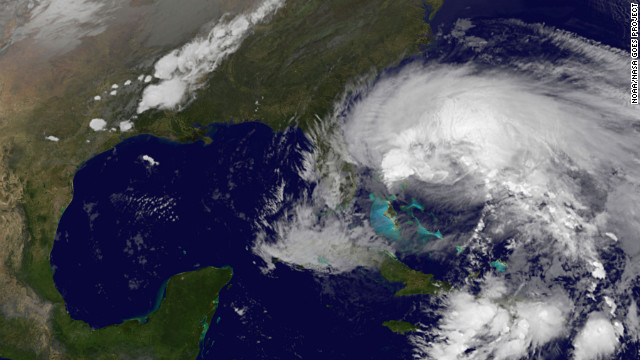
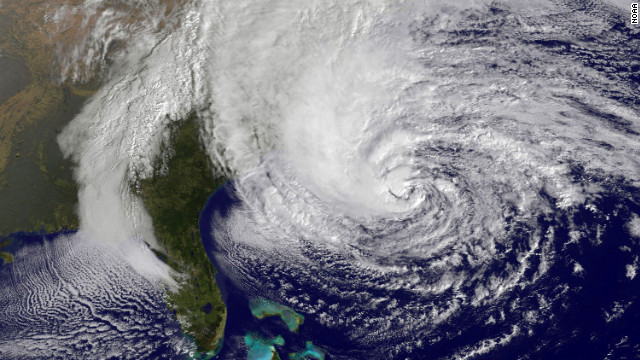
Hurricane Sandy could be the biggest storm to hit the United States mainland when it comes ashore on Monday night, bringing strong winds and dangerous flooding to the East Coast from the mid-Atlantic states to New England, forecasters said on Sunday. Sandy could have a brutal impact on major cities in the target zone like Boston, New York, Washington, Baltimore, Philadelphia, one of the most densely populated regions of the country and home to tens of millions of people. "The size of this alone, affecting a heavily populated area, is going to be history making," said Jeff Masters, a hurricane specialist who writes a blog posted on the Weather Underground (www.wunderground.com).
Forecasters said Sandy was a rare, hybrid "super storm" created by an Arctic jet stream wrapping itself around a tropical storm, possibly causing up to 12 inches of rain in some areas, as well as heavy snowfall inland. Government officials in several states in Sandy's path faced tough decisions on emergency plans, including mandatory evacuations in vulnerable coastal areas, and residents scrambled to buy supplies before the storm comes ashore on Monday night. New Jersey Governor Chris Christie ordered the state's casinos to close by 4 p.m. and began preparations in case the state had to shut down its bus and rail systems. On its current projected track, Sandy is most likely to make landfall between in the New York/New Jersey area and head inland to Philadelphia and Pennsylvania, forecasters said. EXCEPTIONALLY WIDE STORM Forecasters at the National Hurricane Center in Miami said it was too early to predict precisely where the storm would make landfall but the impact would be felt far from the center. While Sandy's 75 mph winds were not overwhelming for a hurricane, its width made it exceptional. Hurricane-force winds extended 175 miles from its center while its lesser tropical storm-force winds spanned 1,040 miles in diameter. It was not expected to strengthen but was expected to broaden. In New York City, officials discussed whether to shut the subway system on Sunday in advance of the storm, which could bring the country's financial nerve center to a standstill. At high tide, the storm could bring a surge of seawater up to 11 feet above normal levels to Long Island Sound and New York Harbor. "Given the large wind field associated with Sandy, elevated water levels could span multiple tide cycles, resulting in repeated and extended periods of coastal and bayside flooding," the forecasters said. The storm could cause the worst flooding Connecticut has seen in more than 70 years, said the state's governor, Dannel P. Malloy. Sandy was centered about 260 miles southeast of Cape Hatteras, North Carolina, early on Sunday, the hurricane center said. The storm was moving over the Atlantic parallel to the U.S. coast at 10 mph, but was forecast to make a tight westward turn toward the U.S. coast on Sunday night. Tropical storm conditions were spreading across the coast of North Carolina on Sunday morning and gale-force winds are forecast to begin affecting Washington, New York and southern New England by Monday. In Brussels, European air traffic control agency Eurocontrol warned of disruption to flights to and from Europe from Sunday evening. RECORD BREAKER Sandy could be the largest storm to hit the United States, according to the National Oceanic and Atmospheric Administration's (NOAA) website. Sandy killed at least 66 people as it made its way through the Caribbean islands, including 51 in Haiti, mostly from flash flooding and mudslides, according to authorities. The approaching storm forced a change of plans for both presidential candidates ahead of the November 6 election. The White House said President Barack Obama canceled a campaign appearance in Virginia on Monday and another stop in Colorado on Tuesday, and will instead monitor the storm from Washington. Republican challenger Mitt Romney rescheduled campaign events planned for Virginia on Sunday and was flying to Ohio instead. All along the U.S. coast, worried residents packed stores, buying generators, candles, food and other supplies in anticipation of power outages. Some local governments announced schools would be closed on Monday and Tuesday. "They're freaking out," said Joe Dautel, a clerk at a hardware store in Glenside, Pennsylvania. "I'm selling people four, five, six packs of batteries - when I had them."

Pakistan: Writers, artists must help end human rights violations: HRCP

The Express Tribune
Human Rights Commission of Pakistan (HRCP) Secretary General IA Rehman has said that the writers and artists will have to play their role in efforts to end the human rights violations and to promote the philosophy of non-violence in the country. Addressing a seminar organised by the HRCP on Wednesday, Rehman said HRCP will host meetings on developing opinions on policies for safeguarding human rights, adding that the commission will engage writers and journalists in policy discussions on human rights situation in the country. He said that the planned conventions will see writers and media persons of divergent views engaged in dialogue on the parameters of human rights, as difference of opinion helps grow positive thinking.

Human Rights commission of Pakistan demands immediate release of Down’s syndrome child

http://www.brecorder.com
The Human Rights commission of Pakistan demands immediate release and protection of 11-year old Christian girl who was accused of blasphemy. According to the some reports, the girl was carrying a shopping bag to dispose of used pages when she was stopped by someone who asked her to show what she was carrying. Burnt pages of Holy Quran were allegedly found in the bag. Local clerics alerted and soon a charged mob gathered outside the Rimsha’s house. The 11-year old girl who is suffering from Down’s syndrome is held in jail in Rawalpindi. Blasphemy laws have been misused against religious minorities and unfounded allegations have led to violent attacks against the minorities. This act will not only affect the safety of the minorities living in Pakistan but also create the great fear and panic in different religious sectors. The Human Rights commission appeal to take all the measures to provide security to the little girl who is seriously ill and to the minorities so that they feel secure living in a so-called independent country.

Magnitude 5.2 earthquake jolts parts of Pakistan

An earthquake of magnitude 5.2 on the Richter scale struck a number of areas across Pakistan including most of Khyber Pakhtunkhwa, Northwestern tribal region, and Punjab, Geo News reported Sunday. According to reports, the seismic activity shook the areas around 5:00 PM in the evening, spreading panic among the people, however no loss of life or property was reported. Meteorology Department said the epicenter was somewhere in the rugged mountains of Afghanistan-Tajikistan border area 300 kilometer from Gilgit Baltistan. The tremors were felt in the federal capital Islamabad, Rawalpindi, Sargodah, Chiniot, Mirpur Azad Kashmir, Hangu, Battagram, Rawalakot, Balakot, Khyber Agency, Dera Ismail Khan, Peshawar, Mardan, Lower Dir, North Waziristan, Nowshera, Charsadda, Swat and Hazara division.

Malala Yousafzai status updates

The medical team caring for Malala Yousufzai say they are pleased with her progress, almost two weeks after she arrived at the Queen Elizabeth Hospital Birmingham. Malala is being looked after by staff from the Queen Elizabeth and Birmingham Children’s hospitals and remains in a stable condition.

Karachi factory fire intensifies

A fire that broke out in the chemical warehouse of a plastic bag manufacturing factory in Karachi’s Gulbai area engulfed the entire factory on Sunday as the intensity of blaze increased , DawnNews reported. Fire tenders reached the spot from across the city. Fire tenders of the Air force and Army had also been deployed and were making efforts to put the fire out. The fire that begun late on Saturday rendered the structure of the building hollow causing large portions of the five-story building to collapse and had spread to an adjoining factory in the vicinity. Two production units along with chemicals and other raw materials worth millions were reduced to ashes as a result of the fire. Fire brigade officials declared the fire as a third-degree hazard. Citizens Police Liaison Committee chief Ahmed Chinoy said that it was difficult to immediately bring the fire under control as there was a lack of equipment and resources, as the nature of fire was not normal. He added that water was not useful in extinguishing the fire and that additional fire retardant foam had been sought. Chinoy further said that the firemen were trying their best to contain the fire and to stop it from spreading to other areas. Rescue and fire teams were concerned about the fire spreading to the basement of the factory which contained drums of inflammable and explosive chemicals and were instructed to maintain a distance from the fire site keeping in view the fear of an explosion. Smoke billowing from the fire was visible from miles away. Some fire experts suggested that attempting to put out the fire with water was useless as chemical fires can only be extinguished using a special kind of a fire retardant foam. A large number of people had gathered to spectate the site of fire. In another unrelated incident a warehouse storing wooded goods caught fire in Orangi Town area of Karachi. Fire tenders were dispatched to the location to put out the fire.

Major fire in Karachi chemical factory

A major fire broke out at a chemical factory in Pakistan's port city of Karachi late Saturday night and was yet to be brought under control till Sunday afternoon, Geo News reported. Smoke billowing from the fire was visible from miles away. Over 15 fire tenders were pressed into service after the inferno was reported in the city's Gulbai area. The fire also engulfed two adjacent buildings. Many blasts were reported intermittently in the five-storey building due to storage of chemical while several parts of it were collapsed. Teams of Pakistan Air Force and Army have also been deployed to douse the fire, Dawn reported Sunday. No loss of life was reported in the incident till afternoon. Some fire experts suggested attempting to put out the fire with water was useless as chemical fires could only be extinguished using a special kind of a fire retardant foam.

Nowshera shrine blast kills at least 5

Emergency has been declared in District Headquarter Hospital of Nowshera. Five people killed while sixteen injured in an explosion outside a shrine of Ziarat Kaka Sahib located in district Nowshera. The injured people have been shifted to District Headquarter Hospital of Nowshera where emergency has been declared. According to Dunya TV, several injured people who were in critical condition were shifted to lady reading hospital of Peshawar. The SHO Nowshera Kalan said that it was a remote control bomb which was planted at about 30 feet away from the main gate of the shrine. Meanwhile, it is learnt that proper security arrangements were not made at Ziarat Kaka Sahib. The area was cordonned off soon after the incident and an investigation has been started.

Obama Cancels Some Campaigning to Monitor Storms

ABC OTUS News
The White House has announced President Obama is cancelling some of his campaign travel Monday as Hurricane Sandy is expected to veer on to the East Coast. The president is getting out of Washington, D.C., Sunday, earlier than planned, to beat the disruptions expected in air travel. He is scheduled to speak at rallies in Orlando, Florida, and Youngstown, Ohio, two places outside the region braced for the impact. The White House says a Monday evening rally in Northern Virginia near Dulles airport is being cancelled. That area is expecting high winds and heavy rains. The President has also dropped Tuesday morning travel to Colorado Springs. Spokesmen for the White House and for the Obama campaign say campaigning is appropriate despite the approaching storm, but they said his roles as president and as commander in chief come first. President Obama has instructed federal emergency planners to offer assistance to states and local governments, but the White House emphasizes that during natural disasters, all decisions about preparedness and evacuations are made by local officials, not by the federal government.

Superstorm could impact 60 million people in US

Forget distinctions like tropical storm or hurricane. Don't get fixated on a particular track. Wherever it hits, the rare behemoth storm inexorably gathering in the eastern U.S. will afflict a third of the country with sheets of rain, high winds and heavy snow, say officials who warned millions in coastal areas to get out of the way. "We're looking at impact of greater than 50 to 60 million people," said Louis Uccellini, head of environmental prediction for the National Oceanic and Atmospheric Administration.
As Hurricane Sandy barrelled north from the Caribbean — where it left nearly five dozen dead — to meet two other powerful winter storms, experts said it didn't matter how strong the storm was when it hit land: The rare hybrid storm that follows will cause havoc over 800 miles from the East Coast to the Great Lakes. "This is not a coastal threat alone," said Craig Fugate, director of the Federal Emergency Management Agency. "This is a very large area." President Barack Obama was monitoring the storm and working with state and locals governments to make sure they get the resources needed to prepare, administration officials said. New Jersey Gov. Chris Christie declared a state of emergency Saturday as hundreds of coastal residents started moving inland and the state was set to close its casinos. New York's governor was considering shutting down the subways to avoid flooding and half a dozen states warned residents to prepare for several days of lost power. Sandy weakened briefly to a tropical storm Saturday but was soon back up to Category 1 strength, packing 75 mph winds. It was about 275 miles south-southeast of Cape Hatteras, N.C., and moving northeast at 14 mph as of 2 a.m. Sunday. Forecasters said the storm was spreading tropical storm conditions across the coastline of North Carolina, and they were expected to move up the mid-Atlantic coastline late Sunday. Experts said the storm was most likely to hit the southern New Jersey coastline by late Monday or early Tuesday. Governors from North Carolina, where heavy rain was expected Sunday, to Connecticut declared states of emergency. Delaware ordered mandatory evacuations for coastal communities by 8 p.m. Sunday. Christie, who was widely criticized for not interrupting a family vacation in Florida while a snowstorm pummeled the state in 2010, broke off campaigning for Republican presidential nominee Mitt Romney in North Carolina on Friday to return home. "I can be as cynical as anyone," Christie said in a bit of understatement Saturday. "But when the storm comes, if it's as bad as they're predicting, you're going to wish you weren't as cynical as you otherwise might have been." The storm forced the presidential campaign to juggle schedules. Romney scrapped plans to campaign Sunday in the swing state of Virginia and switched his schedule for the day to Ohio. First lady Michelle Obama cancelled an appearance in New Hampshire for Tuesday, and Obama moved a planned Monday departure for Florida to Sunday night to beat the storm. He cancelled appearances in Northern Virginia on Monday and Colorado on Tuesday. In Ship Bottom, just north of Atlantic City, Alice and Giovanni Stockton-Rossini spent Saturday packing clothing in the backyard of their home, a few hundred yards from the ocean on Long Beach Island. Their neighbourhood was under a voluntary evacuation order, but they didn't need to be forced. "It's really frightening," Alice Stockton-Rossi said. "But you know how many times they tell you, 'This is it, it's really coming and it's really the big one' and then it turns out not to be? I'm afraid people will tune it out because of all the false alarms before ... (but) this one might be the one." A few blocks away, Russ Linke was taking no chances. He and his wife secured the patio furniture, packed the bicycles into the pickup truck, and headed off the island. What makes the storm so dangerous and unusual is that it is coming at the tail end of hurricane season and the beginning of winter storm season, "so it's kind of taking something from both," said Jeff Masters, director of the private service Weather Underground. Masters said the storm could be bigger than the worst East Coast storm on record — the 1938 New England hurricane known as the Long Island Express, which killed nearly 800 people. "Part hurricane, part nor'easter — all trouble," he said. Experts said to expect high winds over 800 miles and up to 2 feet of snow as far inland as West Virginia. And the storm was so big, and the convergence of the three storms so rare, that "we just can't pinpoint who is going to get the worst of it," said Rick Knabb, director of the National Hurricane Center in Miami. Officials are particularly worried about the possibility of subway flooding in New York City, said Uccellini. New York Gov. Andrew Cuomo told the Metropolitan Transportation Authority to prepare to shut the city's subways, buses and suburban trains by Sunday, but delayed making a final decision. The city shut the subways down before last year's Hurricane Irene, and a Columbia University study predicted that an Irene surge just 1 foot higher would have paralyzed lower Manhattan. Up and down the Eastern Seaboard and far inland, officials urged residents and businesses to prepare in big ways and little. On Saturday evening, Amtrak began cancelling train service to parts of the East Coast, including between Washington, D.C., and New York. Airlines started moving planes out of East Coast airports to avoid damage and adding flights out of New York and Washington on Sunday in preparation for flight cancellations on Monday. The Virginia National Guard was authorized to call up to 500 troops to active duty for debris removal and road-clearing, while homeowners stacked sandbags at their front doors in coastal towns. At a Home Depot in Virginia Beach, employee Dave Jusino said the store was swamped with customers. "We have organized chaos, is what I call it," Jusino said. "We organize a group of 10 associates, give them certain responsibilities and we just separate the lines, organize four customers at a time, load up their cars and get them out the door and then take the next customers." Utility officials warned rains could saturate the ground, causing trees to topple into power lines, and told residents to prepare for several days at home without power. "We're facing a very real possibility of widespread, prolonged power outages," said Ruth Miller, spokeswoman for the Pennsylvania Emergency Management Agency. Warren Ellis, who was on an annual fishing pilgrimage on North Carolina's Outer Banks, didn't act fast enough to get home. Ellis' 73-year-old father managed to get off uninhabited Portsmouth Island near Cape Hatteras by ferry Friday. But the son and his camper got stranded when high winds and surf forced the ferry service to suspend operations Saturday. "We might not get off here until Tuesday or Wednesday, which doesn't hurt my feelings that much," said Ellis, 44, of Amissville, Va. "Because the fishing's going to be really good after this storm." Last year, Hurricane Irene poked a new inlet through the island, cutting the only road off Hatteras Island for about 4,000. In Connecticut, the Naval Submarine Base in Groton prepared to install flood gates and pile up sandbags to protect against flooding while its five submarines remain in port through the storm. Lobsterman Greg Griffen in Maine wasn't taking any chances; he moved 100 of his traps to deep water, where they are less vulnerable to shifting and damage in a storm. "Some of my competitors have been pulling their traps and taking them right home," said Griffen. The dire forecast "sort of encouraged them to pull the plug on the season." In Muncy Valley in northern Pennsylvania, Rich Fry learned his lesson from last year, when Tropical Storm Lee inundated his Katie's Country Store. In between helping customers picking up necessities Saturday, Fry was moving materials above the flood line. Fry said he was still trying to recover from the losses of last year's storm, when he estimates he lost $35,000 in merchandise. "It will take a lot of years to cover that," he said. Christie's emergency declaration will force the shutdown of Atlantic City's 12 casinos for only the fourth time in the 34-year history of legalized gambling here. The approach of Hurricane Irene shut down the casinos for three days last August. Atlantic City officials said they would begin evacuating the gambling hub's 30,000 residents at noon Sunday, busing them to mainland shelters and schools. Tom Foley, Atlantic City's emergency management director, recalled the March 1962 storm when the ocean and the bay met in the centre of the city. "This is predicted to get that bad," he said. Eighty-five-year-old former sailor Ray Leonard said if he had loved ones living in the projected landfall area, he would tell them to leave. Leonard knows to heed the warnings. He and two crewmates in his 32-foot sailboat, Satori, rode out 1991's infamous "perfect storm," made famous by the Sebastian Junger bestseller of the same name, before being plucked from the Atlantic off Martha's Vineyard, Mass., by a Coast Guard helicopter. "Don't be rash," Leonard said in a telephone interview Saturday from his home in Fort Myers, Fla. "Because if this does hit, you're going to lose all those little things you've spent the last 20 years feeling good about."

Hawaii in path of tsunami after 7.7 earthquake strikes western Canada

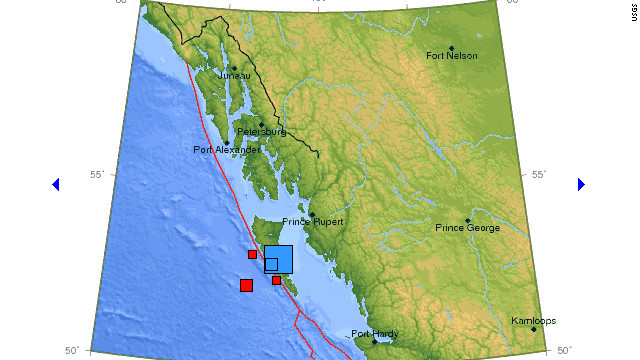
Sirens blaring across parts of Hawaii urged residents to seek higher ground, as a tsunami -- triggered by a sizable 7.7-magnitude earthquake in western Canada -- headed toward them. Waves between 3 and 7 feet are expected to lash the islands, beginning about 10:28 p.m. local time Saturday (4:28 a.m. Sunday ET), the Pacific Tsunami Warning Center said. "Basically this tsunami is pointed right at us," said Gerard Fryer, senior geophysicist at the center. The impact could last for hours. "It's not just one wave, it's a succession of waves," Fryer said. "We are recommending coastal evacuation."But he noted that the tsunami will not be as significant as the devastating quake and tsunami that killed thousands in Japan in March 2011.The tsunami was spawned by an earthquake in western British Columbia, prompting a local tsunami warning and sending some residents toward higher ground. "A (magnitude) 7.7 is a big, hefty earthquake -- not something you can ignore," Fryer said. "It definitely would have done some damage if it had been under a city." Instead, the quake struck about 139 kilometers (86 miles) south of Masset on British Columbia's Queen Charlotte Islands. No major damage was reported. The Alaska Tsunami Warning Center issued a warning for western British Columbia from Vancouver to the southern panhandle of Alaska. Canadians as far as Prince Rupert on mainland British Columbia felt the quake. Tanya Simonds said she felt like her house was "sliding back and forth on mud," but didn't see any damage from the tremor. Shawn Martin was at a movie theater when the quake struck. "It just felt like the seats were moving. It felt like someone was kicking your seat," he said. Martin said more than hundred cars headed toward a popular intersection in the city known for its higher ground. Fryer said he expects Hawaiians to also seek higher ground due to the expected "significant flooding." "The rest of the Pacific does not have to worry, but Hawaii does," he said.

Saturday, October 27, 2012

Punjab govt has links with terrorists, claims KP Governor

GEO TV
Khyber Paktunkhwa Governor Barrister Masood Kausar Saturday claimed that the Punjab government has connections with terrorists. Talking to media after a ceremony held here at Governor House, Barrister Masood said that the Punjab is a large province and it should help the Khyber Pakhtunkwa while acknowledging the issues prevailing in the province. He said that it is unfortunate that various Madrasah in Punjab are scaling up terrorism, adding that Punjab government have links with terrorists. The governor said that Supreme Court in Asghar Khan Case verdict has shown mirror to many people.

Pakistan: No terror attacks on Eid a success for govt: Malik

Interior Minister Rehman Malik said the fact that no terrorism related incidents occurred in the country on Eidul Azha, was a success on the part of the government, DawnNews reported. Speaking to the media, he apologised for the inconvenience to the general public due to the closure of mobile phone services. The interior minister also said that the closure of mobile services today helped prevent terrorists from carrying out attacks. During his talk to the media, Malik also said that if Youtube barred access on its website to anti-Islamic material, then there is a possibility of the site being reopened.

Malala: Medical status updates Saturday 27 October

Malala Yousufzai’s condition today was described as stable following another comfortable night at the Queen Elizabeth Hospital Birmingham, under the care of her medical team from the Queen Elizabeth and Birmingham Children’s hospitals.

Romney, Obama could split popular and electoral college vote, polls suggest

Most polls at this moment suggest GOP nominee Mitt Romney is in the lead nationally, but surveys in the nine or so swing states are registering a narrow advantage for President Obama. So here’s a prospect worth contemplating: What if Romney carries the popular vote, but Obama regains the presidency by winning 270 votes or more in the electoral college? “I think it’s a 50/50 possibility — or more,” said Mark McKinnon, who was a political strategist for former president George W. Bush. “If the election were held tomorrow, it wouldn’t just be a possibility, it would be actual,” added William A. Galston, a senior fellow at the Brookings Institution, who also served as a policy adviser to former president Bill Clinton. That kind of split decision between the electorate and the electoral college would mark the fifth time in American history — and the second time in a dozen years — that the person who occupies the White House was not the one who got the most votes on Election Day. What has never happened before is an incumbent president being returned to office after the majority of the electorate voted to throw him out. Every modern president to be re-elected — Dwight D. Eisenhower, Richard M. Nixon, Ronald Reagan, Clinton, George W. Bush — has gotten a bigger share of the vote in their second bid for office than their first, and with it, a chance to claim a mandate. A win in the electoral college that is not accompanied by one in the popular vote casts a shadow over the president and his ability to govern. If Obama is re-elected that way, “the Republican base will be screaming that Romney should be president, and Obama doesn’t represent the country,” McKinnon predicted. “It’s going to encourage more hyperpartisanship.” Veterans of the Bush White House understand that problem well. Bush was never able to shake the accusations of some Democrats that he had “stolen” the 2000 election in a recount of Florida votes that required a U.S. Supreme Court decision to determine the winner. Then-Vice President Al Gore had won the popular vote that year by 500,000 votes. “A close election is a polarizing event, and a discrepancy between the popular outcome and the electoral vote only adds to the polarization,” said Karen Hughes, who served as a counselor to Bush. “It rubs a raw nerve even rawer.” And that kind of split decision may well happen more often in the future, if the nation’s political system remains both deeply and closely divided. Polarization amplifies the quirkiness of the electoral college system by encouraging the candidates to ignore the nation’s biggest population centers, except for fundraising purposes, and to devote their energies to winning over that narrow slice of voters who live in states where the Election Day outcome is in doubt. The electoral college is an artifact of an era when the lack of organized political parties and the difficulties of travel and communication prevented candidates from waging a national campaign. Given those impediments, the Founding Fathers were leery of a direct popular vote as a means of gauging the popular will. But they also did not want to give Congress the power to select a president. So they set up a process by which each state would be allocated a number of electors, equal to the total of its House members and senators. If that system yet again produces a president who does not also win the popular vote, it will raise new questions about whether the electoral college should be abolished — something that would require a constitutional amendment. For now, however, both campaigns are so fixated on winning the battleground states that they are not giving much thought to the prospect of an electoral college victory that is not accompanied by a popular-vote mandate. Obama’s strategists, for instance, say they have not conducted a single national poll and have had no conversations about how to deal with the political fallout from a split decision. However, the Obama campaign this week began airing an ad in the battleground states reminding voters of the trauma of the 2000 Florida recount that awarded its electoral votes — and the presidency — to Bush. Ironically, Gore’s campaign had actually been bracing for the opposite outcome that year, recalled Tad Devine, who was a top strategist for the Gore campaign. Bush had such a huge lead in his home state of Texas that Gore’s team figured that state alone would add a percentage point to his popular vote — and potentially put him over the top in the popular vote without giving him the electoral college. That might also have been the case four years later, had Democratic nominee John F. Kerry succeeded in carrying Ohio, a state that is once again at the center of electoral college calculations. In either instance, Devine said, “we would have claimed victory and said, ‘This is the Constitution.’ We wouldn’t have hesitated a second.” Hughes recalled that Bush spent much of his early presidency trying to bind the wounds of the disputed 2000 election. After the Supreme Court declared him the president-elect, the then-governor of Texas made his first speech from the Democratic-controlled chamber of the state House in Austin. Once in Washington, Bush made a point of inviting Democrats such as the late Sen. Edward M. Kennedy (D-Mass.) to the White House for movie nights, and he celebrated the 100th day of his presidency by throwing a picnic on the White House lawn for members of Congress. One of his first big legislative initiatives was the No Child Left Behind education law, which won bipartisan support. “We made those decisions very deliberately, as a sign of healing and to bring the country together,” Hughes said. If one candidate carries the popular vote, but the other wins the electoral college tally, the prospects for a drawn-out recount are high in swing states where the results are close. But an even bigger problem would arise after that, as the new president — whoever he is — tries to govern and forge consensus on how to tackle a host of major problems. An election in which the popular will is thwarted is “the worst of all possible outcomes,” Galston said. “We are in a situation now where the government of the United States needs to regain its capacity to act after this election. We are facing some risks that are both serious and imminent.”

Obama earns Powell backing

US President Barack Obama headed to the polls Thursday to cast an early ballot ahead of elections on Nov. 6. Obama was also given a boost in his bid to keep the White House when former Secretary of State Colin Powell gave the president his support.President Barack Obama cast his ballot for the Nov. 6 election on Thursday in his hometown of Chicago and encouraged others who could vote before Election Day to follow his example. Obama, who was a U.S. senator from Illinois before becoming president, went to an early-voting facility to show his driver’s license before making his pick for president. “I’m just glad I renewed my driver’s license,” the president said after a poll worker asked to see his photo ID. When he handed it over, she studied it closely.“For all of you who have not yet voted early, I just want everybody to see what an incredibly efficient process this was,” he said to journalists afterward. It was the first time a U.S. president had cast his vote early. Scenes of presidential candidates and their spouses voting on Election Day are typically a ritual that ends a long campaign season. First lady Michelle Obama has already cast her vote. The president has said, with mock relief, that she voted for him. Both Obama and Republican rival Mitt Romney are stressing early voting more than ever, encouraging their backers to take advantage of opportunities in many states as a means of increasing turnout. But Obama’s team says statistics show he is benefiting the most from early turnout. Obama campaign spokeswoman Jen Psaki said the campaign’s early-voting margins were ahead of where they were in 2008 and beating Romney. The president was winning the early vote in the battleground states of Iowa, Ohio and Wisconsin, and had a 15- to 35-point lead among those who have already cast their votes. “This is a major part of our on-the-ground program and focus, and we hope that having the president do this today will send a message to people across the country, in states where early vote is an option, that this is something they should do, too,” Psaki told reporters on Air Force One. “He has a busy life; many American people have busy lives - picking up their kids, taking their kids to soccer, working double shifts. And this is a great option to participate in the process,” she added. Obama’s stop in Illinois - which he is expected to win easily - was part of a two-day, eight-state marathon campaign trip that included Iowa, Colorado, California, Nevada, Florida, Virginia and Ohio. The president encouraged people at rallies throughout the trip to vote early if they could.

Obama plans immigration reform while issue remains divisive

When President Barack Obama’s interview with the Des Moines Register editorial board was published on Wednesday, it made headlines not just because of a brief controversy over whether it should be on or off the record — the president ultimately allowed the entire conversation to be on the record — but also because of Obama’s unexpected focus on immigration. Obama told the editorial board that he was confident he could pass immigration reform in 2013 if he wins reelection. Yet he has not emphasized this issue on the campaign trail, and Reuters/Ipsos polling may explain why: It’s an issue that evokes strong and largely negative responses from the broad population of likely voters. Since July, 58 percent have said they thought American immigration policy is headed in the wrong direction. At the same time, support for comprehensive immigration reform is a top issue for one of the president’s key support groups, Hispanic voters. “Since this is off the record, I will just be very blunt,” the president told the newspaper. “Should I win a second term, a big reason I will win a second term is because the Republican nominee and the Republican Party have so alienated the fastest-growing demographic group in the country, the Latino community.” Obama said he would press for immigration reform in his second term because “it’s the right thing to do and I’ve cared about this ever since I ran back in 2008.” After several failed attempts to get the DREAM Act through Congress, Obama in mid-June took executive action that allows hundreds of thousands of undocumented immigrants who were brought into the United States as children to remain in the country. This policy was included in proposed versions of the DREAM Act. According to Reuters/Ipsos polling since then, 63 percent of likely voters have said most undocumented immigrants should be deported, with a few exceptions, versus 29 percent who believe they should be allowed to stay, with some exceptions. Fifty-three percent of likely voters believe the federal government should design immigration laws. Paradoxically, in a related question, 62 percent agreed that states “have the right to make laws governing immigration within their borders.” Arizona and Alabama are among the states that have enacted stringent laws, and such measures have support among likely voters: During the summer, almost three-quarters of respondents favored criminal penalties if an undocumented immigrant should “apply for, solicit, or otherwise perform work in the United States,” while 71 percent favored “state laws requiring law enforcement officers to check the immigration status of any person they suspect is in the United States illegally.” Meanwhile, 64 percent supported state laws permitting officers to arrest those who cannot produce immigration documentation.

Ohio Poll: Obama 49%, Romney 47%

A new poll taken after the final presidential debate indicates President Barack Obama has a slight edge over Republican challenger Mitt Romney in Ohio. Forty-nine percent of likely voters in the state back Obama, compared to 47% who support Romney, according to the American Research Group survey released Friday. The margin falls well within the sampling error, meaning the race is statistically tied in the Buckeye State, a crucial battleground in the 2012 presidential race. Also in the poll, one percent of respondents said they prefer another candidate, while three percent said they are undecided. ARG surveyed 600 likely voters in Ohio between October 23 and October 25. The poll has a sampling error of plus or minus eight percentage points.