M WAQAR..... "A man's ethical behavior should be based effectually on sympathy, education, and social ties; no religious basis is necessary.Man would indeed be in a poor way if he had to be restrained by fear of punishment and hope of reward after death." --Albert Einstein !!! NEWS,ARTICLES,EDITORIALS,MUSIC... Ze chi pe mayeen yum da agha pukhtunistan de.....(Liberal,Progressive,Secular World.)''Secularism is not against religion; it is the message of humanity.'' تل ده وی پثتونستآن
Saturday, October 27, 2012
Worst storm in 100 years: East Coast waits in terror for Frankenstorm
Some Americans may have to think twice about going trick-or-treating this year. A massive storm is expected to hit the East Coast during the days leading up to Halloween, which meteorologists anticipate will cost at least $1 billion in damages.
The “Frankenstorm” may bring high winds, heavy rain, extreme tides and even snow to some states. The storm will evolve from a collision between Hurricane Sandy, which has already swept through Haiti and Cuba and is now heading north, and a winter storm coming from the west. Government forecasters say there is a 90 percent chance that the hurricane will make landfall on the East Coast.
The two weather systems are predicted to collide in New York or New Jersey Tuesday morning, bringing those states about 5 inches of rain and winds close to 40 mph. Forecasters say it could be the worst US storm in 100 years. Chuck Watso, director of research and development at Kinetic Analysis Corp., announced Thursday that it may cost more than $5 billion in damages.
“It’s pretty much the worst case scenario with the potential for historic coastal flooding, copious amounts of rain, and damaging winds,” Jason Samenow of the Capital Weather Gang wrote in the Washington Post.
“It’s definitely something that everyone should be watching,” Nelson Vaz, a meteorologist with the National Weather Service, told the Wall Street Journal. “A storm that maintains its strength, coming in to central New Jersey would focus the storm surge in the New York harbor area.”
Forecasters have compared the predicted weather system to the 1991 Perfect Storm, also known as the Halloween Nor’easter, which had winds blowing at 75 mph and cost more than $200 million in damages. This year’s storm will fall during a full moon, which will cause the tides to rise 20 percent higher than normal even without the storm surge.
Utility companies are preparing for the worst. In the Washington area, Pepco is gathering help from power companies in other parts of the US to gain additional assistance in the case of fallen power lines or power outages. Other companies are canceling their employees’ days off to have them available for help.
Baltimore Gas and Electric spokesman Robert Gould told the Post that he expects to see “a couple hundred thousand outages or more” when the Frankenstorm makes its appearance.
Amtrak has expressed concern that fallen trees and debris could make it difficult for trains to keep running between Washington and Boston.
As power companies, airports, rail lines and supermarkets are undergoing emergency preparations for a potentially record-breaking storm, residents of the Northeast may have to forego their Halloween plans.
“It’s looking like a very serious storm that could be historic,” Jeff Masters, meteorology director of the forecasting service Weather Underground, told the Associated Press. “Mother Nature is not saying, ‘Trick or treat.’ It’s just going to give tricks.”
"Super storm" Sandy heads toward U.S. northeast coast
http://www.reuters.comHurricane Sandy was downgraded on Saturday morning but remained highly menacing as it pulled away from the Bahamas, making a slow path toward the U.S. northeast coast where it threatens to become one of the worst storms in decades. The late-season storm has been dubbed "Frankenstorm" by some weather watchers because it will combine elements of a tropical cyclone and a winter storm and is forecast to reach the U.S. coast close to Halloween. Forecast models show it will have all the ingredients to morph into a so-called "super storm", stirring memories of the 1993 'Storm of the Century', whose impact in the United States was particularly destructive. Governors in states along the U.S. East Coast declared emergencies on Friday, with officials urging residents to stock up on food, water and batteries. The U.S. Navy ordered all ships in the Norfolk, Virginia, area, including a nuclear-powered aircraft carrier, out to sea to ride out the approaching storm. "We're expecting a large, large storm," said Louis Uccellini, director of the National Oceanic and Atmospheric Administration's Center for Environmental Prediction. "The circulation of this storm as it approaches the coast could cover about the eastern third of the United States." Sandy battered the Bahamas southeast of Florida on Friday after causing widespread destruction in eastern Cuba a day earlier. The storm was expected to crawl northward on Saturday and Sunday and then turn toward the U.S. coast. On its current projected track, Sandy could make landfall on Monday night or Tuesday somewhere between North Carolina and southern New England, forecasters said. The storm has the potential to cause widespread power outages and to unleash flooding and even dump snow as far inland as Ohio. It also threatens to disrupt air travel along the U.S. East Coast. Early Saturday morning, Sandy was about 350 miles southeast of Charleston, South Carolina, packing sustained winds of 70 miles per hour (110 km per hour), just below hurricane strength according to the Saffir-Simpson scale of storm intensity. It had picked up a little speed overnight but was still moving slowly over the Atlantic at 10 mph, the U.S. National Hurricane Center said. PRESIDENTIAL ELECTION Sandy was forecast to speed up over the weekend as it moved parallel to the U.S. coast, possibly strengthening into a Category 1 hurricane again on Sunday. Despite being downgraded, the storm continued to grow in size with tropical force winds extending 450 from its center, forecasters said. Coming in the final weeks before the U.S. presidential election on November 6, the storm was presenting a challenge to the campaigns of U.S. President Barack Obama and his Republican challenger Mitt Romney. Romney canceled a rally scheduled for Sunday evening in Virginia Beach, Virginia, while President Obama's re-election campaign announced that Vice President Joe Biden had also canceled a Saturday trip to Virginia Beach. Ahead of the election, millions of Americans are taking advantage of early voting arrangements to cast their ballots. State officials said they had put in place contingency plans in case Sandy caused extended power outages or other problems that could disrupt voting. In New York City, officials were considering shutting down the country's largest mass transit system because they were worried the storm's impact could cause flooding or high winds that might endanger subways and buses. Much of Florida's northeast coast was under a tropical storm warning and storm watches extended up the coast through South Carolina. Along North Carolina's Outer Banks, which jut out into the Atlantic, vacationers in large camper trailers and motor homes streamed off the barrier islands. Many forecasters are warning that Sandy could be more destructive than last year's Hurricane Irene, which caused billions of dollars in damage across the U.S. Northeast. Sandy's powerful winds and rains were blamed for 41 deaths in several Caribbean countries, including 11 in Cuba. Most were killed by falling trees and building collapses. In eastern Cuba, the authorities continued clearing streets in the historic city of Santiago which was struck on Thursday by 110-mile-per-hour winds.
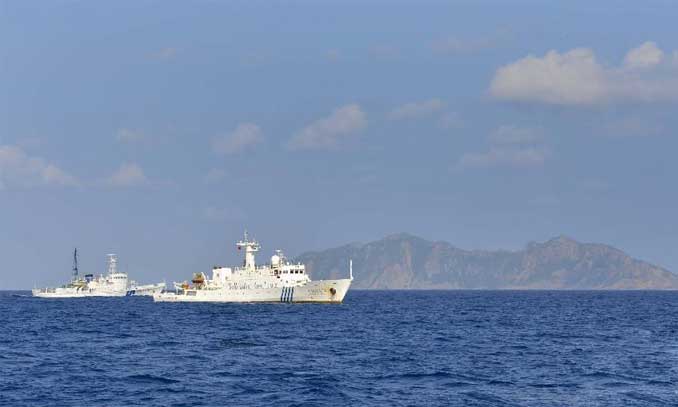
Japan's heavy input in Diaoyu Islands futile
Japan decided on Friday to urgently purchase additional hardware, including 1,000-ton patrol vessels and helicopters that can fly in rough weather, in light of the normalization of patrol and law enforcement missions by Chinese ships in waters around the Diaoyu Islands. The procurement signals that maritime confrontation between the two countries could continue to escalate.
But China won't be frightened. Japan's provocative moves, including "nationalizing" the Diaoyu Islands, have shaken up the situation. China is bound to deal with Japan's provocation with a brand-new attitude that won't be changed, regardless of how high Japan raises the stakes.
If the two countries engage in a confrontation based on strength over the island issue, Japan is destined to lose; Chinese society is confident on this. Japan's ludicrous "nationalization" move stirred up unprecedented counterstrikes by China. If Japan becomes more aggressive over the Diaoyu Islands issue, the countermeasures from China will only grow stronger.
The normalization of Chinese law enforcement and patrol missions near the Diaoyu Islands has changed the political reality of this issue. Chinese maritime surveillance ships have entered the 12-nautical-mile zone around the Diaoyu Islands, which has already broken down Japan's so-called control of the islands.
Japan must behave more cautiously in the future. The increase of Japanese forces in this area will inevitably lead to greater input from the Chinese side. If Japanese dare land on the islands at will, they need to prepare for further action by China. Chinese law enforcement personnel may land and catch those infringing on Chinese territory. Japan should not think such a day is far away.
It's not that China wants a war with Japan over the Diaoyu Islands. The Chinese still hold a peaceful attitude, but do not dare fight with Japan over the island issue. Today, the Chinese are confident they have adequate capacity to check Japan whenever necessary.
Japan needs to learn a valuable lesson to thoroughly rid its arrogance toward China that has lasted for over a century, and give up its misunderstanding that China can infinitely tolerate its provocation. The Diaoyu Islands issue presents a window of opportunity for China to bring about change. Japan has already lost the moral ground and momentum over the island issue.
It's naïve that Japan thinks it can reverse the dynamics by buying several larger patrol vessels, as such expenditure will prove futile due to Japan's declining forces. China is gradually consolidating its stance over the Diaoyu Islands issue, which has proven successful and should be firmly continued. Only by facing a resolute, powerful neighbor will Japan watch its manner.
China says no concession on territorial sovereignty
China says it will take forceful measures in response to any moves that challenge the country’s bottom-line on sovereignty. Chinese Vice Foreign Minister Zhang Zhijun issued the warning at a press briefing he gave to Chinese and foreign journalists in Beijing on Friday.
He called on Japan to face historical facts on the issue of the Diaoyu Islands.
Chinese Vice Foreign Minister Zhang Zhijun began with a statement saying the Diaoyu Islands are China’s inherent territory historically and legally. He said the Diaoyu Islands had not been an issue and there had been no dispute overr the sovereignty over Diaoyu Islands in the first place. It was only because Japan illegally seized and occupied the islands in 1895 that the current dispute came into being.
With regards to Japan’s so-called "purchase" of the islands, Zhang responded by saying no transaction is allowed over the sale of even one inch of the territory or anything on it.
Zhang also warned that if Japan cannot face up to history, it will never stand up morally or psychologically.
He underlined that in contact and consultations at all levels, the Chinese government has stated its solemn position on the issue and strong determination to safeguard territorial integrity. China has urged Japan to have a correct reading of the situation, abandon any illusion and face up to reality. Japan should correct its mistake with credible steps and make real efforts so that the current problem will be handled properly.
Vice foreign minister Zhang Zhijun told the journalists that China has to uphold principles and bottom line in handling its relationships with Japan. China will never make any concession on issues regarding territorial sovereignty. He said should anyone want to challenge China’s bottom line on the issue of sovereignty, China will have no alternative but to respond forcefully so as to remove disturbance and obstacles and move steadily on the path of peaceful development.
U.S. economy picks up steam before Election Day

U.S. economic growth gained momentum to a moderate pace in the third quarter of this year, triggering starkly opposite responses from the Obama administration and the Republican presidential campaign.
U.S. gross domestic product (GDP) grew at an annual rate of 2 percent in the third quarter, a welcome acceleration from 1.3 percent in the second quarter and was the thirteenth straight quarter of economic growth, said U.S. Commerce Department in a report Friday.
The latest rate was slightly better than market expectations, but far from robust enough to make a significant dent in the high unemployment rate hovering at 7.8 percent.
The increase of the nation's real GDP in the third quarter primarily reflected positive contributions from personal consumption expenditures (PCE), federal government spending, and residential fixed investment, the department said in its last such report before the Nov. 6 presidential election day.
Real personal consumption expenditures rose 2 percent in the third quarter, compared with an increase of 1.5 percent in the second quarter, reported the department.
Personal consumption accounted for about 70 percent of the total economic activity in the world's largest economy.
Real residential fixed investment gained 14.4 percent in the third quarter, compared with an increase of 8.5 percent in the second quarter. Real federal government consumption expenditures and gross investment rose 9.6 percent in the third quarter, in contrast to a decrease of 0.2 percent in the second quarter, noted the report.
The key economic numbers came less than two weeks before the election day across the nation, and Democratic and Republican campaigns were interpreting the data in their favor.
The latest economic numbers were "discouraging" news, said Republican presidential nominee Mitt Romney at a campaign event in the Midwestern U.S. state of Iowa Friday, adding that U.S. President Barack Obama had promised that U.S. economic growth rate would have reached 4 percent by now.
"Slow economic growth means slow job growth and declining take- home pay," said Romney.
Romney restated his five-point jobs plan to create 12 million new jobs in the coming four years through measures such as cutting taxes, reducing government regulations, and boosting oil and gas exploration and development.
Together with other economic indicators, this report provided further evidence that the economy was moving in the right direction, Alan Krueger, chairman of the White House Council of Economic Advisers, on Friday said in a blog article after the release of the data.
To strengthen economic growth and spur job creation, Obama has proposed to Congress a plan to help state and local governments retain and hire teachers and first responders, bolster the construction sector, modernize the nation's infrastructure, and give small businesses tax cuts to encourage hiring, stressed Krueger, Obama's top economic advisor.
Why China-bashing dominates U.S. presidential elections

For many years, China has always been a heatedly-discussed topic in U.S. presidential elections. The three rounds of presidential debates between Obama and Romney made no exceptions. In the first debate, Romney referred to China for three times in regard to domestic economy and trade, advocating that the United States should bash China in trade and not balance expenses and deficits through Chinese loans. In the second debate, Obama asserted that the U.S. could not fall behind China in development of new energy, accusing Romney of investing the company which produces the equipment for China to monitor Americans. In the final debate, how to cope with challenges brought by China’s rise has become a separate topic.
All presidential candidates have debated over China and took a tough stance in the past 30 years. However, no matter how tough they are, the China-bashing remarks in the elections are “irresponsible”. No matter who wins the election, every U.S. president unexceptionally attaches great importance to the China-U.S. relations. In other words, China-bashing is nothing but a topic which aims to attract the public attention. Recurrence of the topic indicates the dramatic elements of foreign relations in the U.S. presidential election. Therefore, analysts believe that instead of taking too seriously what candidates say during the election about China, we should pay more attention to how they cope with the China-U.S. relations after the election.
It is against the background of universal concern for livelihood and economy among the voter that the candidates pay close attention to China and its influence on the U.S., demonstrating that China has an increasing impact on the U.S. politics and economy. According to the opinion poll by a U.S. organization, two-thirds of the U.S. citizens believe that the U.S. and China maintain good relations and 55 percent advocates that the United States should establish strong and stable relations with China. Therefore, given the importance of China-U.S. relations, whoever becomes the U.S. president cannot execute negative China policies and the complexity of bilateral relations determines that the U.S. will never be too close to China.
AFGHANISTAN: Winter planning aims to save lives
After last year’s Afghan winter - the harshest in 15 years - killed dozens of displaced children in urban settlements, government and aid agencies in Afghanistan are preparing themselves for the coming winter.
As of 30 September 2012, the UN Refugee Agency (UNHCR) reported 445,856 persons internally displaced due to conflict. Many of these live in informal settlements in and around Kabul, but their numbers can be hard to track.
The UN Office for Coordination of Humanitarian Affairs (OCHA) is compiling data on the size of the settlements, where the deaths occurred, to scale up its winter assistance stocks accordingly, the deputy head of the Afghanistan office, Arnhild Spence, told IRIN.
The Afghan National Disaster Management Authority is in the process of collecting and consolidating data on preparedness measures which the various line ministries are undertaking in the provinces.
Natural hazards (from floods, to droughts to avalanches) are recurrent in Afghanistan, making the poorest Afghans - not only residents of informal urban settlements, but also those in mountainous, avalanche-prone areas of the northeast, central highlands and east - even more vulnerable.
The government has transferred 90 million Afghanis (US$1.6 million) to each of the country’s 34 provinces to deal with the possible emergency situation during the winter, according to Afghanistan Humanitarian Country Team winterization preparedness status update on 22 October 2012.
The UN Refugee Agency (UNHCR), in coordination with the Afghan authorities and other aid agencies, is planning to distribute blankets, plastic sheets, charcoal, and warm clothes to 240,000 people in less-accessible rural areas where internally displaced persons (IDPs) and refugees who have returned from Pakistan and Iran are living in difficult conditions in isolated remote communities, according to spokesperson Mohammad Nader Farhad.
The Afghan Red Crescent Society is establishing four disaster response units, with about 3,300 volunteers assigned, to provide assistance during winter emergencies.
As the 2012-13 cold season begins, OCHA says 13 provinces are at a high or very high risk of an extreme winter.
Still, Spence said, “we are expecting a slightly less harsh winter than last year in Afghanistan, which was exceptionally cold.”
“Preventable tragedy”
In an open letter on 18 October, a coalition of 30 NGOs, including Amnesty International, the Norwegian Refugee Council, and the Agency Coordinating Body for Afghan Relief called for urgent assistance for vulnerable displaced people, pointing to the death last year of at least 100 people - mostly children - in Kabul’s settlements alone.
“What happened last year was a preventable tragedy, and should act as a sharp reminder that emergency assistance must be provided immediately, before the winter arrives,” said Polly Truscott, deputy director of Amnesty International’s Asia-Pacific Programme.On 22 October, the national IDP task force, which brings together government and aid partners, met in Kabul to discuss among other things preparations for winter assistance for the displaced. Another coordination forum, the Kabul Informal Settlement Task Force, has agreed to meet every month from now throughout the winter to better respond to the needs of the displaced.
Thanks to increasing acceptance by donors that a response is needed to the plight of urban IDPs, and thanks also to the work of aid agencies, the condition of IDPs has slightly improved compared to two years ago, Nassim Majidi, co-director of Samuel Hall Consulting, a research and consulting organization based in Kabul, told IRIN. But she said their housing - mud homes and tents - was still not adapted to Kabul’s harsh winter conditions. Accusations that community leaders are not distributing relief items properly have not helped, she added. “Families are naturally very worried about the upcoming winter.”
The Ministry of Refugees and Repatriations is drafting a national IDP policy, planned to be released in March 2013. Aid agencies say it is an important step in acknowledging the scope of the IDP problem and expanding attention beyond Kabul and its informal urban settlements to the needs of IDPs nationwide. Amnesty says what is needed now is urgent action.
“We urge the Government of Afghanistan, international donors and relevant humanitarian organisations to immediately launch a winter assistance campaign to help ensure adequate planning and preparedness to safeguard the lives of hundreds of thousands of IDPs across Afghanistan over the next few critical months,” the open letter said.
Afghans: Taliban kill 5 civilians grabbed off bus
Associated PressPolice say Taliban militants have pulled five Afghan civilians off a bus in eastern Afghanistan and shot them dead. Ghazni province Deputy Police Chief Mohammad Hussain says the insurgents stopped the bus Friday as it was driving in Andar district on the main road headed south to Kandahar city. He says they pulled out five people and killed them on the spot. Police recovered the bodies Saturday from the roadside. Hussain says it is not yet clear if the victims were specifically targeted by the insurgents.
Afghan President Condemns Mosque Attack
http://www.rferl.orgAfghan President Hamid Karzai said those responsible for a suicide bomb attack outside a mosque in the north of the county were "enemies of Islam and humanity." Forty one people died and more than 50 were wounded in the attack on October 26 in Maymana, capital of northern Faryab Province. Many of the casualties were senior regional officials, celebrating a major Muslim holiday. No one claimed responsibility. The NATO-led coalition's commander, U.S. General John Allen, also condemned the attack. The attack was the latest in a series of deadly strikes in recent weeks against Afghan army, police, and government officials. Earlier, Karzai repeated his call for the Taliban to join the government in an address to mark Eid al-Adha. Elsewhere, the Taliban claimed responsibility for the deaths of two U.S. service members in southern Oruzgan Province the day before.
Kabul Cards: there's life beyond Taliban
Afghanistan is usually associated with suicide bombers and large-scale violence. But in an attempt to showcase the multi-faceted civilian life largely ignored by the international media, three young women, Sahar Fetrat (16), Sadaf Fetrat (20) and Nargis Azaryun (19)
carried hand-held cameras to document their daily life in Kabul and made a film, Kabul Cards, that was screened at the Mumbai Film festival.
“We want to explain to the world that Kabul, Afghanistan, is a very normal place to live in,” says Nargis. “All the things written and said about Afghanistan in the international media are about explosions and the Taliban. That’s not the whole reality. There’s a big civilian life over there and we feel that should be reflected too.” She adds, “Whenever we’ve spoken to any foreigner about Afghanistan, they say, ‘Oh, the terror place. The Taliban.’ All documentaries usually made in and about Afghanistan focus only on one issue — terrorism and women. But problems exist all over the world. Why can’t they show the happier side of Afghanistan? A coin has two sides.”Saher adds that Afghanis have a very active and normal daily life. “With this film we want to show that there are people in Afghanistan who are fighting to reduce challenges and problems,” she says. “Street harassment of women is a big issue in Kabul, but there are organisations helping us.”
Says Sadaf, “It’s not bad living there. The international media is horrible about Afghanistan. People study there, there are universities and I don’t think we’ve missed out on anything. There’s a rich culture back home.”
It wasn’t as difficult as you might believe for three young women in Kabul to make a film and then travel abroad to promote it.
“Our parents aren’t educated, but they understand us and our initiative,” says Sadaf. “They’re glad we’re doing this.” Nargis adds, “My father is a doctor and my mother is a working woman. They encouraged me to pursue this dream.”
Nawaz Sharif only paid Rs 51,318 in Income Tax
Reacting to a statement by Nawaz Sharif that his family had paid Rs 92 crore as taxes in the year 1990, Chairman PTI said that this is a deliberate attempt at misleading the people.
Talking to Shafqat Mahmood, Secretary Information PTI, from New York, where he is on a visit, Khan said that as per FBR records the declared income of Nawaz Sharif for the year 1990-91 was only two lacs forty nine thousand five hundred and thirty seven (Rs 249,537). On this income he paid Rs fifty one thousand three hundred and eighteen (51,318) as income tax. Shahbaz Sharif in the same year 1990-91 said Imran Khan had an income of Rs 271,638 on which he paid Rs 53,482 as income tax. Thus, both brothers in total paid Rs One lac four thousand and eight rupees as income tax in the year they took money from Younas Habib.
Where has the figure of ninety two crores that Nawaz Sharif family have supposed to paid as tax come from, asked Imran Khan? There are two notable features of the misleading statement by Nawaz Sharif, according to Chairman PTI. First he is mixing together Sales Tax, Central excise duty or other corporate taxes that companies pay. They are not paid by individuals but by corporations. There is no way of verifying whether Sharif family companies paid this amount of corporate tax or not. What is equally mystifying said Imran Khan is that if indeed the Sharif companies had paid Rs 92 crores as corporate taxes, why are the incomes of Nawaz Sharif and Shahbaz Sharif so meagre.
They have both declared approximately Rs five lacs as their combined income for the financial year 1990-91. If their family owned companies were paying such heavy amounts in corporate taxes, where has the income gone? Chairman PTI Imran Khan said that after flip-flopping on the issue of investigation by FIA with Ch Nisar criticising the Supreme Court, Sharif is now ready for investigation by it. This is a good development but it is important that FIA’s terms of reference be wide enough to allow a thorough probe into irregularities in the Mehrangate Scandal. While Nawaz Sharif is calling Younas Habib a criminal, was it not the first Sharif government that gave him a licence to launch Mehran Bank, asked Mr. Khan? It also needs be investigated that did Mehran Bank soon after its inception give Rs 20 crore to the house of Sharif that is still unpaid?.
Youth pressure Malik to open YouTube in Pakistan
http://www.thenewstribe.comFederal Interior Adviser Abdul Rehman Malik has hinted at opening of YouTube in Pakistan saying ‘there is an immense pressure on me’. “There is an immense pressure on him to resume YouTube,” he said while talking with media. “When I open my Twitter, there is a flood of messages to resume YouTube in Pakistan,” the adviser. YouTube was closed over a month ago after release of a derogatory video about Prophet Muhammad. He viewed that if there was a filthy book in a library then only book is removed from the library as it’s not appropriate to close down the whole library. “If there is any anti-Islamic content then it should be removed.”
ANP fears: Judge’s remark can harm federation
Strongly reacting to the Lahore High Court chief justice’s remarks about construction of controversial Kalabagh Dam, Awami National Party has said that the observations could jeopardise harmony among the federating units.
“Does the high court want to convey message of Takht-i-Lahore to three smaller provinces by passing remarks in support of Kalabagh Dam,” said ANP provincial chief Senator Afrasiab Khattak while speaking at a press conference here on Friday.
Flanked by provincial ministers and party MPAs, Mr Khattak termed Kalabagh Dam a dead issue and said that assemblies of three federating units had already rejected this contentious project.
“I request the high court to stop hearing the case because this is not a legal or constitutional issue,” he maintained. He said that Kalabagh Dam was a technical and political issue and one province wanted to take away smaller provinces share from Indus River.
He said that ANP had rendered sacrifices for the independence and supremacy of judiciary and still supported free judiciary.
However, remarks of LHC in favour of Kalabagh Dam had created unrest. At least LHC should not hear this case, he added.
Media quoted Chief Justice LHC Justice Umar Ata Bandial as saying that objections of Khyber Pakhtunkhwa and Sindh to the dam’s construction were mere political.
Senator Khattak said that observations of the chief justice would trigger controversies among the federating units. “Kalabagh is a matter of life and death for us and we will not allow anybody or institution to sink our civilisation, lands and drown people of the province,” he said.
He recalled that devastating floods which caused widespread damages to Khyber Pakhtunkhwa in 2010 was an eye opener for the nation and after that nobody should talk in favour of Kalabagh Dam.
He urged the government to execute work on non-controversial power generation projects like Diamer Bhasha and Katzara dams. He opined that Khyber Pakhtunkhwa had a potential to generate up to 40,000MW electricity offering the federal government and Wapda to build small dams in northern parts of the province to overcome power crisis in the country.
When asked whether ANP would take Kalabagh issue to the Council of Common Interests (CCI), Senator Khattak replied that three elected assemblies had rejected this project and there was no need to take it to CCI. He dispelled the impression that Kalabagh was only an issue among the political parties not provinces.
He said that incumbent Prime Minister Raja Pervez Ashraf when he was minister for water and power had stated that Kalabagh project had been buried forever. He claimed that technical experts had also raised reservations about the project because it was not suitable for power generation.
Asghar Khan case: Clash of the titans
BY: Lal Khan
The mushrooming of madrassas and centres of fanatical indoctrination created a large segment of youth who are trained and envenomed to kill and maim in the name of religionThe ruling of the Supreme Court in the Asghar Khan case has laid bare the burgeoning intrinsic conflicts between and within the most vital institutions of the state, the titans, the political executive, military establishment and the judiciary. The judgement reprimands the ISI for doling out millions to the rightwing and religious politicians and parties to forge the Islamic Jamhoori Ittehad (IJI) to defeat the PPP in the 1990 elections. The verdict names Generals heading the army and the ISI as perpetrators of this act. This is unprecedented in the country’s history and shows the process of internal dissent, organic decay and erosion of the state due to the crumbling economy and disintegrating society due to the crisis of Pakistani capitalism. The state that is trying to impose it is now itself being afflicted by the ramifications of this diseased system. With a pathetic growth rate of less than two percent and record deficits from the budget to trade, the state of the official or the formal economy is a looming disaster. According to a latest study of the FBR, “The informal economy has already gone beyond $ 100 billion, which is more than half of the total economy...this black economy has been growing at the rate of nine percent from 1977 to 2000. It grows along with growth in corruption, speed money, smuggling, narcotics, government contracts and tax evasion.” The growth of the black economy in the subsequent years in all probability would be much higher. The Economic Survey of Pakistan, 2011-2012 says the following: “The informal economy plays an important and sometimes controversial role. It provides jobs but in many cases, they are low paid. This economy employs 73.8 percent of Pakistan’s total labour force and hence is the largest employer in the country.” While the bulk of the economy is unauthenticated, non-documented and unaccounted for, the formal economy is afflicted by spiralling imperialist debt servicing, the military and the state apparatus. Less than 10 percent of the GDP is for health, education, infrastructure, running of the government, etc. Even if the black economy is not in the state’s control, it does play a crucial role in the policies of the state and the politics of the ruling classes. In a situation of social stagnation, this black money decides party manifestos and policies. It buys political power and status, popularity through the media, cosy posts in the state apparatus, lucrative contracts and deals, loyalties and affiliations, law and justice through astronomical fees of the top lawyers and what not. Without its eradication, a healthy bourgeois democratic society cannot materialise. But the reality is that the nascent Pakistani bourgeoisie was historically so belated and in such economic and financial underdevelopment that it neither had the means nor the will to complete the national democratic revolution. The rates of profit they yearned for could not be achieved under a normal capitalist regime through manufacturing, mechanised agriculture or even the services sector. Hence, the intrusion of criminality and plunder of the state resources in businesses was a necessity for the debilitated Pakistani capitalism to sustain the privileges and profits of the corrupt and intransigent ruling classes. In other words, these illicit methods of generating black money were inevitable in the evolutionary patterns and methods of capitalism in the country. But now the reality is that the ‘informal’ economy has become a malignant tumour in the body politic of Pakistan. It has metastasised to such an extent that it is enmeshed with the capitalist system itself and cannot be bifurcated from it. Although the economic catastrophe is the most crucial factor in the decline of society, the social decay is nauseatingly conspicuous in the degeneration of art, culture, ethics, morality, attitudes, behaviour, manners and social relations of our tragic society. One of the most lucrative beneficiaries of the black money is the mullah aristocracy and the fundamentalist outfits. They are also the most ardent defenders of the parasitic economic edifice. Even the official figures reveal that it was the late 1970s when the tumour began to rapidly grow. However, the Dr Frankenstein of the monster was none other than US imperialism. The Afghan jihad was financed by the narcotics trade and other criminal acts designed in its strategy by the CIA. The ISI was merely its executioner that later became the possessor of the dirty money that has now permeated the country’s economy and society. The social and political implications have been devastating. The neo-Islamic fundamentalism evolved around the dollar jihad of black money. The mushrooming of madrassas and centres of fanatical indoctrination created a large segment of youth who are trained and envenomed to kill and maim in the name of religion. The social life of not just women and minorities has been traumatised but the entire society is suffering from the suffocation of religious subjugation. The reality is that the social hegemony of reactionary obscurantism is fragile and has very little mass support. They are in a tiny minority of the 190 million inhabitants of this land. The social existence of the tiny minority is only due to the rotten economic and social policies of the liberal and secular political elite, which is voted in by the masses for a change but once in power, carries on with the devastating capitalist policies that further pummel the lives of the already impoverished masses. When weakened, they revert to religion without the slightest hesitation. The despair and dread that ensues retards the class struggle and a vacuum evolves where these mercenaries of black capital wreak havoc on the lives of ordinary people. However, the vicious cycle is now convulsing the state with intrinsic conflicts exploding and dragging society into a downward spiral. The socio-economic conditions will only deteriorate in the perspective of a worsening crisis of capitalism. But the conflicts within the state apparatus can also converge on to class lines as the contradictions on this basis in its edifice are sharper than ever before. Nevertheless, the class revolt in the state will only erupt when the class struggle in society reaches a stage where a revolutionary victory becomes a real possibility. Fredrick Engels said more than a hundred years ago that after a century, mankind will be faced by clear choices: socialism or barbarism. The working classes have no other option but to fight to overthrow this system for their salvation and the survival of civilisation.
SC verdict in Asghar Khan Case proves Nawaz Sharif became PM by stealing polls
RADIO PAKISTANFormer Prime Minister Syed Yousuf Raza Gilani has said that the Supreme Court verdict in Asghar Khan Case has proved that Nawaz Sharif became prime minister in 1990 by stealing the general elections. Talking to newsmen after offering prayers in Multan‚ he said there exists no political cell in the Aiwan-e-Sadr as was working in 1990. Gilani said there is no reason to postpone the general elections‚ which will be held on time.
President Zardari asks nation to pledge for country's progress
http://www.brecorder.comPresident Asif Ali Zardari has asked the nation to work unitedly for the progress and prosperity of the country with adopting the true spirit of sacrifice, brotherhood, religious tolerance and renouncing hatred and prejudice. "We should remember on this auspicious occasion of Eid ul Azha, the sacrifices of the people rendered in the war against terrorism to defend the country," said the President in his message on the occasion of Eid ul Azha being celebrated in the country on Saturday. The President said the country today is facing the challenges of terrorism, extremism, sectarianism and target killing and there is a need to inculcate unity, brotherhood, will for sacrifice, religious tolerance, and high qualities to face these challenges. He said on the blessed occasion of Eid-al-Azha, "I want to congratulate my countrymen, pray for their security, safety, for their happiness and prosperity." The President said, "Eid-al-Azha reminds us of the great sacrifice, completely following the orders of Almighty Allah, and unprecedented acceptance of Hazrat Ibrahim (AS) and Hazrat Ismail (AS) that has established such an everlasting example of submission to the will of God." The President said the sacrifice inculcates spirit of giving everything in the name of Allah to seek His blessing. He said sacrificing animals to follow the Sunnah of Hazrat Ibrahim (AS) is infact a pledge to give away everything in the name of the Lord and it has become a base to follow the fear of God that is the real aim of living a life. He said, "On this auspicious day we pledge that we will prefer obeying the commands of God over the dearest and nearest worldly belongings and will not hesitate to render any sacrifice in order to please Him". President Zardari further said, "I pray to Almighty Allah that He protects us and give Pakistan peace, tranquility, progress and prosperity." The President said, "We should also remember in our Eid celebration all those brothers and sisters, who are suffering due to natural calamities and living a life without basic needs of life." He said, "May Allah give us the strength to include the real spirit of sacrifice in our daily lives''.
Friday, October 26, 2012
Russia wants answers on NATO post-2014 Afghan mission
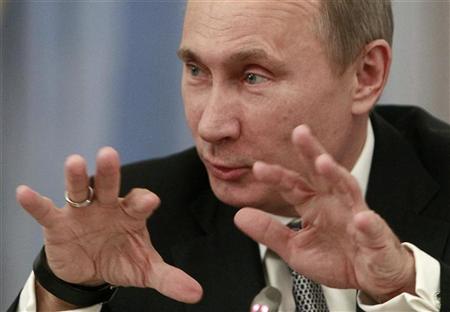
Russia wants to know more about the scale and scope of NATO's post-2014 mission in Afghanistan before deciding whether to keep cooperating with the Western alliance, an envoy for President Vladimir Putin said on Thursday.
Moscow, NATO's Cold War-era foe and still a frequent critic, fears instability in Afghanistan after the pullout of most foreign troops by the end of 2014 may spill over into ex-Soviet Central Asia and threaten Russia's own southern borders.
The former Soviet Union sent troops into Afghanistan in 1979 and withdrew its forces by early 1989 after a disastrous war.
Moscow supported the U.S.-led invasion after the September 11, 2001 al Qaeda attacks and has allowed transit of supplies for NATO's International Security Assistance Force (ISAF), including through a new hub in the city of Ulyanovsk.
But Zamir Kabulov, Putin's special envoy for Afghanistan, told Reuters that Russia wanted "full clarity" on the combat capabilities of the post-2014 mission and reiterated a threat to withdraw cooperation unless the alliance receives approval from the U.N. Security Council, where Moscow holds veto power.
"At the end of the day NATO is a military bloc. If a military-political group appears in the neighborhood of Russian territory, without our consent and with tasks unknown to us, this is problematic. A mandate is indispensable," Kabulov said.
"Our current cooperation with NATO is based on the current NATO mandate from the U.N. Security Council. And we will only cooperate with such missions as have a mandate for which we have also voted," he told Reuters in an interview.
NATO aims to hand security responsibility to Afghans in 2014 and revamp its mission into a training and advisory one.
Russia's acting ambassador to NATO said this month that Russia would stop cooperating over Afghanistan post-2014 if no Security Council resolution authorizing the new mission is secured. A NATO official said it would be helpful but stopped short of saying it was essential.
Kabulov, a former ambassador to Kabul, said Moscow wanted more information about foreign forces in Afghanistan after 2014.
"The Americans say various things. Generally they say it will be a training mission, but then it becomes clear that there will be special forces, combat groups that will engage in combat in case of necessity," he said.
"We need full clarity on the capacities they will have, what that is supposed to be. Because such a strong network of foreign military bases in the region provokes questions."
REGIONAL WORRIES
NATO has not yet given details on how many troops it wants to deploy in Afghanistan post-2014 but Kabulov questioned the ability of a limited force to ensure stability when tens of thousands of ISAF troops have not managed to do that.
"And if they are not there for this purpose, then what for? This is our question and we are asking for a clear answer," he said. "Imagine several thousand instructors sitting in a base and suddenly being attacked by the Taliban. What will they say, 'Don't shoot, we are instructors'?"
He added any final decision on cooperation with NATO in Afghanistan was in the hands of Putin, whose term ends in 2018.
After the Soviet experience in Afghanistan in the 1980s, Russia ruled out sending soldiers to aid the United States and NATO this time around.
Kabulov said Moscow was ready to supply Kabul with arms, including air-defense systems, any time.
"NATO itself does nothing without air coverage in Afghanistan. Why should the Afghan army not have that? No modern army can do without it ... We are ready for this, but there have been no detailed talks about it yet," he said.
Kabulov said he saw the overall situation in Afghanistan deteriorating and said NATO failed to meet its goals there, but admitted things were better now than before ISAF was launched.
"If destabilization becomes a regional phenomenon, which has already happened in practice in many ways, then obviously Russia will have to redirect large resources from domestic development to safeguard its national interests and security. We would not like that," he said in his office at Russia's Foreign Ministry.
On October 5 Putin secured a new 30-year lease on a military base in Tajikistan, Russia's main line of defense against radical Islamists and drug trafficking from Afghanistan.
"We are ready to cooperate with NATO on Afghanistan not because we like NATO, not at all, but because it corresponds with our own interests. This is a very pragmatic approach, nothing personal," he said.
Obama votes early in Chicago
U.S. President Barack Obama cast his ballot early in Chicago at his home state of Illinois Thursday afternoon. It was the first time that a sitting U.S. presidential nominee voted early in person.
With only 12 days left in the presidential race, Obama stepped into a polling station at around 4:20 p.m. local time, signed forms, showed his driver's license and made his choice at a touch- screen machine, according to White House Press Office.
"I can't tell you who I voted for, but I very much appreciate everybody here," said Obama after he cast early ballot, an effort to encourage the early voting drive of the president's reelection campaign.
"But all across the country we're seeing a lot of early voting.. .If something happens on Election Day, you will have already taken care of it," said Obama.
The Obama campaign has embarked on an early voting drive, as dozens of states have started early voting procedures. The president has used his campaign appearances to call on supporters to do so.
"The President will be early voting today in Chicago. This is the first time a sitting President is early voting in person," said Jen Psaki, spokeswoman for the Obama campaign, during Thursday's press gaggle aboard Air Force One en route Richmond Virginia.The Obama campaign said early voting has been crucial to its get-out-the-vote efforts, trying to outperform the Republican presidential ticket on the ground particularly in key swing states.
"This is a major part of our on-the-ground program and focus, and we hope that having the President do this today will send a message to people across the country, in states where early vote is an option, that this is something they should do, too," said Psaki.
"This afternoon, I'm casting my ballot in my hometown of Chicago," wrote an email by the Obama campaign sent to supporters earlier Thursday, "I'm told I'll be the first sitting president to take advantage of early voting."
The email also noted that effectively getting people out to vote, of which early voting is a huge part, would be even more critical in this year's "extremely tight race" than four years ago.
Psaki also told reporters that the Obama campaign has so far out-performed in key states compared to their own in 2008 and ahead of Republican challenger Mitt Romney right now.
Last week, U.S. first lady Michelle has already cast her absentee ballot, another form of casting ballots ahead of Nov. 6 other than early voting in person.
In her twitter account, Michelle Obama published a photo of her holding an absentee ballot, with the words "I just dropped my absentee ballot in the mail - I couldn't wait for Election Day!"
Following Michelle's move, Obama also announced through his official twitter account that he would vote early on Oct. 25 in person.
Obama, currently on a two-day blitz campaign tour across eight states, holds advantage over Romney in early voting numbers. A Time Magazine poll released Thursday showed the incumbent led Romney two-to-one among respondents in top battleground Ohio who say they have already voted.
International vote monitors warn Texas
International election monitors took a dim view on Wednesday of Texas' threat to prosecute them if they observe voting in the state a bit too closely on November 6.
The exchange pitted the Vienna-based human rights watchdog Organization for Security and Cooperation in Europe against Texas Attorney General Greg Abbott, who warned the OSCE not to interfere with polling in state elections.
"The threat of criminal sanctions against OSCE/ODIHR observers is unacceptable," Janez Lenarcic, director of the OSCE's Office for Democratic Institutions and Human Rights (ODIHR) monitoring arm, said in a statement.
"The United States, like all countries in the OSCE, has an obligation to invite ODIHR observers to observe its elections."
Abbott told Reuters on Wednesday that he is considering legal action against the group if it doesn't concede that it will follow the state's laws.
"They act like they may not be subject to Texas law and our goal all along is to make clear to them that when they're in Texas, they're subject to Texas law, and we're not giving them an exemption," he said.
Abbott is skeptical about why the group wants to look at elections in Texas.
"Our concern is that this isn't some benign observation but something intended to be far more prying and maybe even an attempt to suppress voter integrity," he said.
In a letter on Tuesday to the Warsaw-based ODIHR, Abbott had noted that OSCE representatives were not authorized by Texas law to enter a polling place.
"It may be a criminal offense for OSCE's representatives to maintain a presence within 100 feet of a polling place's entrance. Failure to comply with these requirements could subject the OSCE's representatives to criminal prosecution for violating state law," he added.
He cited reports that OSCE monitors had met with organizations challenging voter identification laws. Texas' voter ID law was blocked earlier this year by a federal court, and Abbott has said he will appeal to the U.S. Supreme Court.
"The OSCE may be entitled to its opinions about Voter ID laws, but your opinion is legally irrelevant in the United States, where the Supreme Court has already determined that Voter ID laws are constitutional," Abbott wrote.
Texas Secretary of State Hope Andrade also wrote to the United Nations-affiliated OSCE/ODIHR on Tuesday, saying that it's key for Texans to understand that the organization has no jurisdiction over the state.
Republican Texas Governor Rick Perry tweeted on Tuesday: "No UN monitors/inspectors will be part of any TX election process; I commend @TXsecofstate for swift action to clarify issue."
The 56-member OSCE routinely sends monitors to elections and noted November's elections would be the sixth U.S. vote that ODIHR has observed "without incident" since 2002.
For next month's elections it has a core team of 13 experts from 10 OSCE countries based in Washington and 44 long-term observers deployed across the country, it said.
Lenarcic had shared his "grave concern" about the threat of Texas prosecutions with U.S. Secretary of State Hillary Clinton, the OSCE said.
"Our observers are required to remain strictly impartial and not to intervene in the voting process in any way," Lenarcic said. "They are in the United States to observe these elections, not to interfere in them."
International vote monitors must follow Texas law, state tells Clinton
ReutersTexas' attorney general warned Secretary of State Hillary Clinton on Thursday that international election monitors planning to observe balloting in the state were not above Texas law. Republican Attorney General Greg Abbott's letter to Clinton was the latest move in his campaign to ensure that the Vienna-based human rights watchdog Organization for Security and Cooperation in Europe did not mess with Texas. "It appears that OSCE is under the misimpression that the State Department can somehow help its representatives circumvent the Texas Election Code," Abbott wrote. "Texas law prohibits unauthorized persons from entering a polling place — or loitering within 100 feet of a polling place's entrance — on Election Day. OSCE monitors are expected to follow that law like everyone else." In a letter on Tuesday to the Warsaw-based Office for Democratic Institutions and Human Rights, the OSCE's monitoring arm, Abbott had warned that failure to follow Texas law could subject OSCE representatives to criminal prosecution. Janez Lenarcic, director of the monitoring arm, told Clinton on Wednesday about its "grave concern" with Abbott's letter, saying the threat of criminal sanctions was unacceptable and unprecedented. The 56-member OSCE routinely sends monitors to elections. For the November 6 U.S. elections, it has a core team of 13 experts from 10 OSCE countries based in Washington and 44 long-term observers deployed across the country, it said. State Department spokeswoman Victoria Nuland noted that the OSCE had sent observers to U.S. general elections since 2002. The OSCE has assured Clinton and Texas authorities that OSCE observers are committed to following all U.S. laws, Nuland said. "To my knowledge it's the only state that came forward and said, 'Please reassure us, that you're gonna follow our state electoral law.' And they have now been reassured," Nuland told a news briefing in reference to Texas. But in his letter to Clinton, Abbott took issue with Lenarcic's assertion to the secretary of state that Abbott's threat of criminal sanctions contradicted commitments made by the United States, including in the 1990 OSCE Copenhagen document. "The fact that representatives of the United States joined the U.S.S.R, Yugoslavia, Romania, and other OSCE member-nations in signing a document at a 1989 conference in Copenhagen has absolutely no bearing on the administration of elections or laws governing elections in the State of Texas," Abbott wrote. He added that the OSCE was not above the law. Abbott told Reuters on Wednesday he was considering legal action against OSCE if it did not concede that it would follow the state's laws
Obama gets briefing on Hurricane Sandy
Associated PressPresident Barack Obama has been briefed on Hurricane Sandy and the White House is urging people in the storm's path to listen to local officials and monitor weather reports. The White House says the president was briefed on the storm late Wednesday and again Thursday morning. Spokesman Jay Carney says federal emergency management officials have been working with local officials to prepare. Carney says citizens living along the Eastern Seaboard should monitor weather reports and listen to local officials in the days ahead. Obama will continue to receive updates on the storm. The hurricane is currently a Category 2 storm, bringing heavy rain and wind to the Caribbean. It could affect a large swath of the Northeast and the Mid-Atlantic early next week.
6,000 PU students still without laptops
Thousands of students of Punjab University who were registered in the first phase of laptop distribution are still without laptops, Pakistan Today has learnt. Students from over 70 departments of the Punjab University were registered by the Punjab government during the first phase of the laptop distribution ceremony that was held on March 23 this year. Students of evening and replica were registered according to the same criteria which the Punjab government had announced. Even then the students are still without laptops as the officials concerned continue to beat about the bush. The names of the students are also registered on the website. Some students also held protests but to no avail. “We sent all the documents to the department and the delay is on their end,” a PU official said, adding that the department had even sent a reminder three times.
“I keep getting calls and SMSes from the chief minister but what is the point if I haven’t got the laptop,” said Huma Ejaz, a student from the Mass Communication Department.
Another student from the Sociology Department said that he and his friends had even held a protest and the Punjab government had promised that they would be given their laptops but nothing had been done so far.
Mohsin Ali, another student, said that “these laptops are just a political game and the Punjab government has distributed them to get votes.”
“Punjab government is just trying to overcome the issue through the Punjab Youth Festival as they are not taking us seriously,” another student said.
“Officials have told us that there is a shortage of laptops so the students will have to wait,” an official of the PND Department of the Punjab University said. Repeated attempts were made to contact Education Minister Mujtaba Shuja-ur-Rehman but he could not be contacted.
Sharif brothers to be provided B-Class prison in Sindh
Sindh Information Minister Shajeel Memon has said that Nawaz Sharif and Shahbaz Sharif will be provided B-Class if they came in Sindh's jail as prisoners.
In a statement, the minister said that they (PPP) would also conduct anti-dengue spray in the jail's barrack for both the brothers. "We hope they will not cry this time to disturb the other prisoners."
He alleged that Nawaz Sharif had disrespected the mandate of 180 million people to remain in the power by getting illegal money.
Moreover, Provincial Information Minister Sharjeel Memon has demanded of Election Commission of Pakistan to disqualify Nawaz Sharif for involvement in rigging the general elections held in 1990.
In a statement, Sharjeel Memon said that the court ruling in Asghar Khan Case has proven that Nawaz Sharif insulted the mandate of the 180 million people because he had a greed for power.
He stated that Nawaz Sharif and Shahbaz Sharif are no more 'Sadiq' and 'Ameen', as they rigged the polls by receiving an amount and lost their integrity.
When Malala fell, Pakistan stood up for her
The response of Pakistan to the shooting of the schoolgirl Malala Yousafzai was a "turning point" for the country, her father said Friday at the British hospital.
“When she fell, Pakistan stood and the world rose. This is a turning
point," a clearly emotional Ziauddin Yousafzai told journalists.
He said Malala, 15, was recovering "at an encouraging speed" in the Queen Elizabeth Hospital in Birmingham, where she was brought from Pakistan on October 15.
"She is not just my daughter, she is everybody's daughter," her father said.
He thanked the doctors at the hospital in the city in central England, saying: "She got the right treatment, at the right place, at the right time.
"She is recovering at an encouraging speed and we are very happy."
At one point, Ziauddin had to stop and compose himself as he recalled how in the aftermath of the shooting he asked his brother-in-law to make arrangements for a funeral because he did not believe Malala would survive.
When asked how he felt when he and his family saw Malala for the first time since they arrived in Britain on Thursday, he said: "I love her and last night when we met her there were tears in our eyes out of happiness.
"We all cried a little bit."
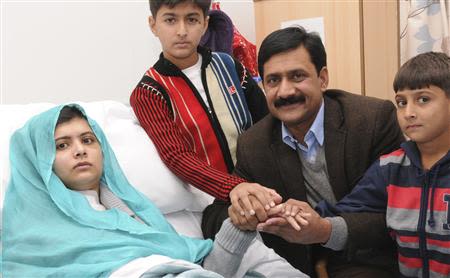
Malala's mother and two brothers have also come to Birmingham, where the girl is being treated in the highly specialised hospital where service personnel who are seriously injured in Afghanistan are taken.
He said her mother was too camera-shy to attend the media briefing, but pictures released by the hospital showed the family gathered around Malala's bed. Malala was wearing a pale green head covering.
Malala has received thousands of goodwill messages from around the world.
Doctors have said a bullet grazed her brain and came within centimetres of killing her, travelling through her head and neck before lodging in her left shoulder.
She requires reconstructive surgery, but she must first fight off an infection in the path of the bullet and recover her strength, which could take months.
Her skull will need reconstructing either by reinserting bone or using a titanium plate.
Malala will "rise again".
ReutersThe father of a Pakistani girl shot in the head by the Taliban for advocating girls' education said on Friday she would "rise again" to pursue her dreams after hospital treatment. Malala Yousufzai, 15, was flown from Pakistan to Britain for specialist treatment after the October 9 attack, which drew widespread international condemnation. The father Ziauddin Yousufzai and other family members arrived in Britain on Thursday to help her recovery. "They wanted to kill her. But she fell temporarily. She will rise again. She will stand again," he told reporters, his voice breaking with emotion. Malala has become a powerful symbol of resistance to the Taliban's efforts to deny women education. Public fury in Pakistan over her shooting has put pressure on the military to mount an offensive against the radical Islamist group. "When she fell, Pakistan stood ... this is a turning point," her father said. "(In) Pakistan for the first time ... all political parties, the government, the children, the elders, they were crying and praying to God." The Taliban have said they attacked her because she spoke out against the group and praised U.S. President Barack Obama. A cheerful schoolgirl who wants to become a politician, Malala Yousufzai began speaking out against the Pakistani Taliban when she was 11, around the time when the government had effectively ceded control of the Swat Valley to the militants. She has been in critical condition since gunmen shot her in the head and neck as she left school in Swat, northwest of Islamabad. She could be at risk of further attack if she went back to Pakistan, where Taliban insurgents have issued more death threats against her and her father since she was shot. "It's a miracle for us," her father said. "She was in a very bad condition ... She is improving with encouraging speed." British doctors say Malala has every chance of making a good recovery at the special hospital unit, expert in dealing with complex trauma cases. It has treated hundreds of soldiers wounded in Afghanistan. Dave Rosser, the hospital's medical director, said she would be strong enough to travel back to Pakistan in a few months' time but it was unclear whether the family would choose to do so. "She's certainly showing every intention of keeping up with her studies," Rosser added. Malala's father said he and his family cried when they were finally reunited with her on Thursday. "I love her and of course last night when we met her there were tears in our eyes and they were out of happiness," he said, adding that Malala had asked him to bring school textbooks from Pakistan so she could study. "She told me on the phone, please bring me my books of Class 9 and I will attempt my examination," he said. "We are very happy ... I pray for her."
Malala recovering fast in UK: father
Reuters
The father of a Pakistani girl who was shot in the head by the Taliban for advocating girls' education said on Friday his daughter was recovering fast in the British hospital where she is undergoing treatment. Malala Yousufzai was flown from Pakistan to the British city of Birmingham to receive treatment after the October 9 attack which drew widespread international condemnation. Her father, Ziauddin Yousufzai, and other family members flew to Britain on Thursday to help their daughter's recovery. "It s a miracle for us ... She was in a very bad condition," he told reporters. "She is improving with encouraging speed. "We are very happy ... I pray for her."
Look unto yourself: Raja Riaz to Shahbaz
Pakistan TodayLeader of the Opposition in Punjab Assembly Raja Riaz on Thursday said that Punjab Chief Minister Shahbaz Sharif, instead of removing rubbish from politics of country, should face accountability regarding Asghar Khan case verdict. In a statement, Riaz said that Supreme Court’s decision has exposed the fake mandate of Sharif brothers in 1990. He said that all awards including introducing corruption in politics, establishing “Lota factory”, horse trading and using public resources for personal and political gains, go to PML-N. The opposition leader in Punjab Assembly said that Sharif brothers depend on politics of “Changa Manga”, and had stolen public mandate by constituting IJI and now were ruling through horse trading. Raja Riaz urged the Sharif brothers to first appear before Federal Investigation Agency (FIA) to provide details of money acquired from ISI in 1990 for hatching conspiracy against PPP to defeat it in general elections.
Pakistan: Minority money, Muslim Haj
Not only has the misuse of funds at the Evacuee Trust Property Board (ETPB), allocated for the specific use of the minorities, been reported - but it has also been found that these stolen funds were ironically used to pay for Umra and Haj! This was disclosed by National Harmony Minister of State Akram Masih Gill during his testimony to the Public Accounts Committee during its meeting on Wednesday. He said that the tenure of the ETPB Chairman, Ashraf Hashmi, had expired, but he continued to hold charge. Mr Gill’s question, about the validity of any Haj or Umra performed with money meant for minority welfare, remains unanswered. What a shame that this money, apportioned for the upkeep and maintenance of minority places of worship, should be stolen, in defiance of the very teachings of Islam, to fund Islamic pilgrimages! This censure also applies to parts of the money spent on development in the Rahimyar Khan constituency of the minister of state, during the Musharraf era. This should go beyond the Committee’s stricture that this was abuse of authority. Both examples not only need investigation and affixing of guilt, but also highlight the misuse of supplementary grants, in a way which makes a mockery of the budgeting process, and of parliamentary oversight over public expenditure.
Though the example of reappropriation of funds came to the Committee from the ETPB, this particular abuse is prevalent across the whole of government, and thus deserves more attention than before. Any money a department is unable to spend under a particular head should be carried forward, and not conveniently reappropriated to some other head. The provision for supplementary grants of this sort was supposed to be so as to allow emergency spending, but it represents a violation, indeed defiance, of the budgeting process, because it allows spending of government money on things that have not been approved by the Assembly.
The government gets such supplementary budgets passed using the same threat as it uses for the budget itself: its own fall. This makes the Committee all the more important as a means of accountability. It is the Committee which has a major role in holding the Executive to account, and it must not limit itself to pointing out abuses, but also of ensuring that they are investigated thoroughly.
PML-N’s defeat in next elections now certain
THE NEWSSindh Minister for Information Sharjeel Inam Memon has claimed that in the wake of the Supreme Court verdict in the Asghar Khan case, the defeat of the Nawaz League in the next general elections seems certain. In a statement issued here on Wednesday, he said that Nawaz Sharif and the PML-N had now been fully exposed before the masses. Memon was of the view that for the sake of power, Sharif had “humiliated the mandate of the people in the 1990 general elections”. He also appealed to the Election Commission to “disqualify Mian Nawaz Sharif”. The PPP minister said that Sharif and his brother Shahbaz Sharif were no longer “Sadiq and Ameen”.
Malala Yousufzai visited by family
The family of Malala Yousufzai, who was shot in the head by the Taliban, have visited her in hospital after arriving in Britain, a spokeswoman said Friday.
The 14-year-old’s mother, father and two brothers arrived in the city of Birmingham in central England on Thursday and went straight to see her at the Queen Elizabeth Hospital.
“Her mum, dad and her two brothers are here in the UK,” a spokeswoman for the hospital told AFP.
“They visited last night.”
After flying into Britain’s second city, they were given a police escort through Birmingham to the hospital.
In an attack which outraged the world, Malala was shot on a school bus in the former Taliban stronghold of Pakistan’s Swat valley on Oct 9 as a punishment for campaigning for the right of girls to an education.
On Oct15 she was flown from Pakistan to Birmingham in a medically-induced coma, and taken to the highly specialised hospital where staff have extensive experience of treating British soldiers seriously wounded in Afghanistan.
The hospital said Malala was still comfortable and continued to respond well to treatment.
She has received thousands of goodwill messages from around the world since she was attacked.
The bullet, which grazed her brain and came within centimetres of killing her, travelled through her head and neck before lodging in her left shoulder.
It will take weeks to months for Malala to defeat an infection in the bullet track and recover her strength enough to face surgery.
Her skull will need reconstructing either by reinserting bone or using a titanium plate.
Malala inspiration for Pakistani students
The courage of Malala Yousafzai
has renewed the determination of Pakistani students to learn despite the poor state of education in the country, undermined by poverty and under attack from militants.
The 15-year-old is recovering in a British hospital after militants shot her in the head in a cold-blooded murder attempt for daring to promote the right of girls to go to school.
The October 9 attack came in Malala's hometown Mingora in Swat, part of Pakistan's restive northwestern province Khyber Pakhtunkhwa, where insurgents bitterly opposed to a secular curriculum -- and girls' education in particular -- have destroyed hundreds of schools in recent years.
Militants have destroyed four schools in the last week alone, according to officials -- two on Wednesday in Mohmand tribal district and two more in Khyber Pakhtunkhwa.
The provincial government says more than 700,000 students have been affected, though casualties are low as most school attacks happen at night when students are at home.
"The insurgents mostly target girl's schools and order both teachers and students to stay inside their homes as per their version of Islamic teachings or face dire consequences," said provincial information minister Iftikhar Hussain.
Naseem Begum, a teacher at the government-run Islamia Collegiate girls' high school in Peshawar, the main city of Khyber Pakhtunkhwa, told AFP the destruction of schools and the attack on Malala had frightened parents.
But students at the school said they were inspired by Malala, who rose to prominence with a blog for the BBC chronicling life under militants, who terrorised the picturesque Swat valley from 2007 until an army offensive in 2009.
"It is disappointing that militants are destroying schools," Saba Riaz, a final year student, told AFP.
"Such attacks are disturbing but Malala has given us courage to fight for the cause of education."
Her friend Razia Khan agreed: "Girls will never be scared by such attacks. In any case we will continue our studies, even if they are destroying schools or attacking girls like Malala."
But it is not only militancy that schools in Pakistan have to contend with.
The nuclear-armed nation's spending on education is tiny -- less than 2.5 percent of GDP, according to the UN children's agency UNICEF. Only nine countries in the world spend less on education.
Pakistan's official literacy rate is 58 percent, with less than half of women able to read and write, yet in 2011-12 the government's spending on defence was more than 10 times greater than education.
The country of 180 million people languishes near the bottom of the world literacy list at 159 out of 184 countries categorised by the UN Development Programme.
A recent UNESCO report said at least 5.1 million Pakistani children are out of school -- 63 percent of whom are girls.
Pakistan Social and Living Standards Measurement (PSLM), a government survey, found gender disparity in education across the country, but most severe in Khyber Pakhtunkhwa and Balochistan provinces.
In Kohistan district of Khyber Pakhtunkhwa just six percent of students are girls, and in Balochistan's Dera Bugti the figure falls to one percent.
Poverty is also a factor. More than a fifth of the population is classed as poor by the government, though activists believe the figure could be closer to 30 percent.
"People are getting poorer, that is making us more illiterate and more hungry. The girl child becomes the first casualty of poverty and illiteracy," said Tauseef Ahmed Khan, of Karachi's Urdu University.
Free and compulsory education is a right of Pakistani children enshrined in the constitution, but for many parents a child at school is a child not earning money -- an estimated 3.3 million under 14 years of age in Pakistan work.
"A poor family prefers to send a boy to school. Most families think educating girls is wasting money, which can be saved and spent on their marriage," Zohra Yousuf, who heads the independent Human Rights Commission of Pakistan (HRCP), said.
Girls often leave school young to join their parents in cottage industries and most poor girls are married off as teenagers.
But some parents are determined that their own children should have a different future, and see Malala as a hero.
Mother-of-four Azra Shabbir, now 32, was just 14 when her father married her off, forcing her to leave school and work with her husband in a shoe factory.
"I have two girls, both are in college like their brothers. I want to see them literate, see them prosper no matter how much hard work I have to do for this," she said with a glint of hope in her eyes.
"Our poverty haunts us, but we can fight against it, like Malala did," she smiled.
CM HOTI:Serving the people in challenging and difficult situation is itself a test
Chief Minister Amir Haider Khan Hoti has said that ruling during normal circumstances was easy but serving the people in challenging and difficult situation was itself a test.
He said that God has chosen followers of Bacha Khan for leading the nation in testing times which was an honour for us.
He turmed unity among the nation, sincere party workers as great asset and we can’t separate ourselves from the people regardless of the circumstances.
He was addressing a people gathering at Mohabatabad Mardan which was chaired by ANP District President Farooq Akram Khan.
Provincial Vice president Engr. Abbas Khan, District General Secretary Imran Mandoori, Coordinator Javed Yousafzai and party office bearers and large number of party worker were also present on the occasion. Dozens of political workers announced association to ANP on the occasion.
The CM welcomed the new party workers and termed their decision congruent to prevalent circumstances.
He said that confronting challenges and turmoils can be overcame through unity.
He said that betraying the motherland was unfortunate but people revered it were indeed fortunate.
He said that protection and sincerity to our motherland was our belief.
He said that several areas including Mardan were denied of development during the past 60 years, added, it’s high time to remove these injustices and deprivation and to leave no stone unturned in this connection.
He said that Mohabatabad was symbol of backwardness some four years back but now due to link roads establishment of schools and Health Centers have turned it to a developed area.
He said that Rs.73 million have been spent on drains while Rs.10 Million has been consumed on installation of 50 Hand Pumps. He also approved funds for installation of additional hand pumps and drains. He said that Rs. 27 million will be spent on scheme of flood protection under public Health Engineering and irrigation Departments.
The CM said that currently we were confronting two types of elements: one which intentionally want to fulfill their agenda through terrorism and other which was enticed for this purpose.
He said that the latter discussed element can be rehabilitated through education and without education solution to problems was difficult.
He said that present government has concentrated both on worldly and religious education and the youth of Mardan were acquiring knowledge in institutes like Abdul Wali Khan University and Bacha Khan Medical College while 5 new colleges for Girls in Mardan were under process.
He said that three primary schools at Mian Kali, Krugh and Khas Krugh in Union Council Mohabatabad were near to completion while girls middle school upgraded to higher level and its additional room were under construction.
He said that 45 million rupees have been spent in education sector in the said union council while a BHU costing Rs.40 million was under construction. He said that local funeral place will be completed at a cost of Rs.3 million.
He said that Rs.240 million has been spent in roads sector that included several link roads and a road from main road to Krugh.
He said that all these development initiatives were not favor upon the people rather it was their right and my prior responsibilities.
He said that he will continue serving mosques and will keep it above politics which aimed at pleasing Allah only.
He said that he will fulfill the resolve of collective service to Mardan that require people cooperation.
Regarding Swabi incident the CM said that nothing can separate him from the people.
He said that man is mortal and fear is enemy of human being.
He said that no injustice will be made to affectees of Ring Road.
Earlier Haji Hameed Khan, Azizullah, Sardar Khan, Rajab Khan, Wasim Khan, Jawad Hussain, Israrullah, Abdul Samad, Imtiaz Ali, Salar Khan, Khial Bacha, Fazil-e-Haq, Nadeem Khan, Zar Gul Khan, Awr Haji Perdil Khan have announced affiliation to ANP. The CM offered them ANP red caps.
Hashim Khan presented the welcome address and Nawab Khan presented tributes to services of the Chief Minister for development of Mardan.
Meanwhile the Chief Minister was apprised of situation regarding developmental schemes and problems confronting the people during his weekly meeting with MPAs at his office on Thursday.
Federal Minister for Railway Haji Ghulam Ahmed Bilour also met the Chief Minister and discussed matters of mutual interest.
Those meeting the Chief Minister included Senior Minister Rahimdad Khan, Provincial Ministers and MPAs hailing from different political parties.
Pakistani Media: A camp-follower
EDITORIAL:THE FRONTIER POSTDo our media too have to be a camp-follower of the political class, and not independent opinion leaders that they pretend to be? What indeed is the point in hosting talk shows so incessantly on the Supreme Court’s verdict on the Asghar Khan case and in featuring politicians as panelists, as are engaged various television networks so zestfully over these days. The political strands may have every vested interest to play up or play down the verdict in their own lights. They may have every motive to twist or slant it to serve their own political ends. But what interest could the networks have in bringing the shouting political panelists on the show again and again? The people at least are least interested in this circus when they know for sure what stance each and every political strand has taken on the verdict. They have heard and read it too often and can easily anticipate what a particular panelist was going to say even before he opens his lips. Or do the anchorpersons think that a PML (N) participant in their show by some quirk of miracle would confess that the Sharif Brothers had taken the money and then apologise? Or the PPP participant would concede that the facts were still to be established and full truth was still to be known? Why indeed are the networks so hell-bent on boring the viewers ad nauseam with the trite? Had their anchors been any imaginative they would have invited instead experts and legal minds to analyse the verdict objectively and dwell on its implications for the democracy project? That would have been both informative and educative. What they are putting out now is not even entertaining. Why really have the networks stooped so low? Why have they surrendered so grandly to be leaders and have submitted so slavishly to be mere hangers-on? These are virtually election times. The elections are almost on our head. And had the networks so desired, they could have guided and led the entire stump talk. The politicos across the spectrum remain enmeshed in politics even now. What have they in their plans for the people remains unknown. They do not speak of it. Had the networks been smart, they would have nudged them and diverted the entire political talk to this direction. Their anchors would have invited the partisans to their shows and asked them what have their parties chalked out for the people’s welfare and the country’s advancement. They could have quizzed them what are their plans for jobs creation and to address the galloping unemployment. What are their economic programmes, industrial policies and agricultural growth plans? What measures their parties contemplate for generating and augmenting revenues, what taxation formulas have they planned out and what segments would they focus on to create new taxpayers? What energy policy would they follow? Above all, what are their schemes for poverty alleviation? And what strategy would they adopt to face up to the menace of surging extremism and terrorism in the country? To put it in short, there are hundred and one such-like questions that the anchorpersons could have asked. The outcome would definitely have been a political discourse less about politics and more about nation-building. But playing vassals to the political class, the media networks have forfeited this lead role. Had indeed our media taken a leaf out of the book of their counterparts of the open polities, they would have been better off. There, the media networks are not mere cheerleaders. They are in effect real opinion leaders. It is the political class that takes a cue from them, not the vice versa. Here, the media have fallen to take a cue from the political class and play the ball it rolls out. And yet the self-assuming anchors and the commentariat lay the claim of being the pace-setters of the political discourse. They all need imperatively to revisit their act. Even now they can redirect the entire election discourse. Only they have to abandon what interests the political class and focus on what interests the mass of the people. But are we asking for too much? Perhaps.
Suicide bomber kills 40 at Afghan mosque during Eid
A suicide bomber killed at least 40 people in a mosque in Afghanistan's relatively peaceful north on Friday as worshippers gathered for prayers marking the Muslim Eid al-Adha holiday, police officials said.
The attack in Maimana, capital of Faryab province, also wounded 40, regional police chief General Abdul Khaliq Aqsai said, pinning the blame on the Taliban. A Taliban spokesman said they were investigating to find out who was responsible.
"The suicide bomber detonated explosives when our countrymen were congratulating each other on the Eid holiday," said Lal Mohammad Ahmadzai, spokesman for the police in the Afghan north, adding that almost half of the dead were police.
He said Aqsai appeared to be the target. "As soon as the police chief got in his vehicle, the bomber detonated his explosives," Ahmadzai said
About 20 bodies, some in police uniform, lay in front of the mosque's gates as smoke billowed above.
The attack, at around 9 a.m. local time on the first day of Eid, came just before President Hamid Karzai repeated his call for the Taliban to join the government.
"If you (Taliban) want to come to the government, you are welcome. You have rights as an Afghan and as a Muslim," he said in a speech marking Eid in the capital, Kabul.
Kabul and Washington have been seeking separate peace negotiations with the Taliban as the 2014 deadline looms for most foreign troops to leave.
Karzai condemned the mosque attack in a statement.
Violence is intensifying across the country 11 years into the NATO-led war, sparking concerns over how the 350,000-strong Afghan security forces, often the target of the Taliban, will manage once most foreign troops leave.
The Taliban, in a statement released to media on Friday, said two Afghan soldiers were behind the attack in western Farah province on Thursday that killed one Italian soldier.
One of them later joined the Taliban, the statement said, along with the policeman who killed two U.S. soldiers in southern Uruzgan province on Thursday.
That attack was the latest insider attack, when Afghan security forces turn their weapons on their foreign mentors and partners. At least 54 members of the NATO-led force have been killed this year so far in insider attacks, which have been eroding trust between Kabul and its western backers.
Malala attack plot hatched in Afghanistan
Attaullah Khan, the prime suspect in the shooting of Malala Yousafzai,
planned his attack following a meeting with Mullah Fazlullah in Kunar province of Afghanistan, well-placed security officials told The Express Tribune.
According to the officials, Khan is one of two main suspects in the attack which involved a larger group of 12 people. With the main suspects still at large, officials say six facilitators of the attack have been arrested so far.
Officials said they were on the trail of Khan, 23, prime suspect, who is a resident of Swat. Officials add that Khan is pursuing a master’s degree in chemistry in Peshawar. He completed his Bachelor of Science degree in physics at Jahanzeb College in Swat.
The school’s principal, Alam Zeb, condemning the attack, said that Khan had given school officials three or four dates of birth. Zeb said that he was surprised to hear that a former student of the college may have been involved in the gruesome attack on the 14-year-old girl.
In addition to arresting six men, all of them from Swat, the police have also arrested Khan’s mother, brother and fiancée. The suspect’s relatives have not been accused of involvement in the attack but may provide clues to Khan’s whereabouts, a senior official added.
Malala, who spoke against the Taliban, was shot in the head on October 9, 2012, while on her way home from school. The Tehreek-i-Taliban Pakistan (TTP) spokesperson Eshanullah Ehsan claimed responsibility for the attack.
Internationally recognised for a blog about the horrors of life under the Taliban and a campaign for the right to an education, Malala is the highest-profile target of militants in Swat for more than three years.
Homebound
Malala Yousafzai, who is currently recovering in the United Kingdom, will return to Pakistan, her father said on Thursday.
Talking to the media, Ziauddin Yousafzai has dispelled the notion that the family would seek asylum abroad.
“I first laughed at it because all of our sacrifices, my personal (sacrifices), or this attack on my daughter, cannot have such a cheap purpose that we would go to some other country and
live the rest of our life there,” he said.
Malala’s father spoke alongside Interior Minister Rehman Malik in Islamabad. Malik promised that the government would protect Malala upon her return. “Even while sitting there, she is taking care of her schooling,” as she asked her father to bring books when he goes to Britain, said Malik.
Earlier, Khyber-Pakhtunkhwa Information Minister Mian Iftikhar met doctors treating Malala at the Queen Elizabeth Hospital.
Iftikhar said that Malala was receiving the ‘best care in the world’. He said the hospital has the most appropriate expertise and experience to treat the injured teenager. (with additional input from news desk)
Malala Yousafzai status updates
The medical team caring for Malala Yousufzai at the Queen Elizabeth Hospital Birmingham said today that she was still comfortable and continued to respond well to treatment.
Subscribe to:
Posts (Atom)