by Shiraz ParachaThe postponement of Russian President Vladimir Putin’s visit to Pakistan is a tragedy and conspiracy against President Asif Ali Zardari and the PPP government. This conspiracy is similar to the one that was hatched in 1951 when the then Pakistani Prime Minister was advised not to accept the Soviet invitation. Instead of visiting the Soviet Union Prime Minister Liaqat Ali Khan went to the United States. Pakistan is still paying the price of Liaqat Ali Khan’s that political and strategic blunder. Sixty one years later, the visit of Vladimir Putin, the first by any Russian President, could be a turning point in Pakistan’s foreign policy. Political and economic benefits of such a shift would be significant for Pakistan. Pakistan could become a key transit country for the east-ward flow of energy from Russia and Central Asia. Russia is interested in investing in Pakistan’s energy and infrastructure sectors. Several long-term agreements were to be signed during the Putin’s visit. For defense purchases Pakistan is dependent on the West. The United States can cripple Pakistan’s defense capabilities anytime. President Putin visit would also open doors for multi-dimensional cooperation between Russia and Pakistan in defense sector. Russia is opposed to NATO presence in Afghanistan and Russian leadership is extremely concerned that under NATO nose there has been big surge in narcotics production in Afghanistan. Russians are aware that the 1980s’ Afghan Jihad was funded by drug money that came from drug production in Afghanistan. They are also links between terrorism and drug trafficking. Russia fears that extremist and insurgents operating in different parts of Russia and Central Asia get financial support from Afghanistan. President Putin considers Pakistan a major player in Afghanistan and wants to develop a strategic partnership with Pakistan with regards to Afghanistan. Since 2000, strong, shrewd and stubborn Putin has posed a challenge to Western designs in the region. In the West Putin is portrayed as an autocrat and oppressor, who is enemy of freedom and democracy. In Russia, however, President Putin is extremely popular. People in other former Soviet States also like him and his policies. To a large majority of the Russian public Putin has brought prosperity and stability. He is seen as a symbol of Russian pride. Some consider Putin a true successor of Peter the Great, the father of modern Russia. Vladimir Putin entered mainstream Russian politics in 1999 and became the first elected President of the country in 2000. Since then he is in-charge of Russia. The Russian strongman can stay in the office until 2024 (if he wins 2018 presidential elections). This possibility is West’s worst nightmare. Putin’s use of energy and natural resources as foreign policy tool, his opposition to NATO eastward expansion and U.S hegemony, and his support for countries such as Iran and Syria has made him a villain in the eyes of Western leaders and the Western media. Some Arab countries also feel uncomfortable that Russia is emerging as a new leader of world energy supplies. Russian support for Iran and Syria is a source of tension between Moscow and Arabs rulers. Since the Cold War era Russia has uneasy relations with Saudi Arabia and some Arab Sates. A section of the Russian security establishment believes that there is an Arab link behind the increase of extremism in former Soviet States. Under Putin the Russian government has brought peace in Chechnya and has dealt with extremists with iron hand. In Pakistan, President Asif Ali Zardari has introduced a gradual shift in his country’s foreign policy. He is focusing on building relations with Russia and Central Asian states and has taken Pakistan’s relations with China to a new level of understanding. President Zardari has also adopted a new approach towards India. Interestingly, Pakistan’s military appears to be supporting the new direction of the country’s foreign policy. New confidence building efforts between Pakistan and Russia are the most important change in both countries’ foreign policies. It is a monumental development that will have long-lasting positive effects on the entire region, Nevertheless, this new path is full of dangers. The surprise postponement of President Putin’s already scheduled visit to Pakistan shows that building bridges between Russia and Pakistan is not easy. The delay in Putin’s visit has certainly damaged President Asif Zardari’s plans to sign key agreements with Russia before the elections and make history. But the postponement of the visit is bad for Pakistan, too. The next Pakistani government may not be enthusiastic in improving relations with Russia. Leading Pakistani politicians such as Nawaz Sharif, Imran Khan and leadership of Islamic political parties support the Saudi camp. President Zardari, on the other hand, came with a new vision of bringing Pakistan closer to Russia, Iran and Central Asia. President Putin decision to delay his visit is based on intelligence reports that the Russian leader could be target of an attack because his foreign enemies have influence and access in Pakistan. Such intelligence reports could be a conspiracy to sabotage Russia-Pakistan relations and deprive President Zardari of a historic opportunity. But the loss is bigger than that. A golden opportunity may have been missed to steer Pakistan out of its disastrous dependence on Western and Saudi camp.
M WAQAR..... "A man's ethical behavior should be based effectually on sympathy, education, and social ties; no religious basis is necessary.Man would indeed be in a poor way if he had to be restrained by fear of punishment and hope of reward after death." --Albert Einstein !!! NEWS,ARTICLES,EDITORIALS,MUSIC... Ze chi pe mayeen yum da agha pukhtunistan de.....(Liberal,Progressive,Secular World.)''Secularism is not against religion; it is the message of humanity.'' تل ده وی پثتونستآن
Tuesday, October 2, 2012
Pakistan: Postponement of Putin visit
Monday, October 1, 2012
Japan must not misuse international law
Japanese Prime Minister Yoshihiko Noda talked about the role of the "rule of law" in peaceful settlement of disputes in the general debate of the 67th U.N. General Assembly on Sept. 26, in an attempt to find excuse for Japan's provocation of disputes over territorial land and sea with the international law. Obviously, Noda referred to the Diaoyu Islands issue, though he did not say it directly.
Instead of making introspections on the Diaoyu Islands issue, the Japanese government still tries to make full use of the United Nations as a platform to "justify" its violation of norms of international law, infringement upon China's sovereignty and challenging the postwar international order. The move is self-deceiving and absurd.
After ignoring historical facts and violating norms of international law, the Noda administration proposes to solve the Diaoyu Islands issue through the international law hypocritically. After the Second World War, the Diaoyu Islands and the affiliated islets have returned to China according to the international law. Japan's current stance on the Diaoyu Islands issue is a blatant denial of victory of the World War against fascism and serious challenge of the postwar international order and such international legal documents as Cairo Declaration and Potsdam Proclamation, which will be strongly condemned by the international community.The escalation of the Diaoyu Islands issue is inseparable from the tolerance of right-wing forces by Noda administration. It uses domestic right-wing forces to "nationalize" the Diaoyu Islands, an inherent part of China's territory, which seriously violates China's sovereignty and disregard the international law and postwar international order.
The United Nations is the most authoritative and universally-recognized inter-governmental international organization. The international law and Charter of the United Nations are important foundations for dealing with state-to-state relations and peaceful settlement of international disputes, as well as are widely accepted and observed by the international community. It is really absurd and ridiculous that the Japanese government, which does not respect the international law in bilateral relations, seeks to use the international law to justify its illegal action.
The Diaoyu Islands and its affiliated islets are an inherent part of China's territory and China has indisputable sovereignty. If Japanese government attempts to solve the dispute through the international law, it must face up to the history, obey international legal principals and suspend all the moves of violating sovereignty and territorial integrity of other countries.
China must advance reform, stick to opening-up, says premier
China must steadfastly advance institutional reforms in economic, political, cultural, social and other fields and stick to the opening-up policy, Premier Wen Jiabao said on Saturday.
Addressing a reception marking the 63rd anniversary of the founding of the People's Republic of China, Wen said "there is still a long way to go" before China become a modern socialist country that is prosperous, strong, democratic, culturally advanced and harmonious.
President Hu Jintao, senior leaders Wu Bangguo, Jia Qinglin, Li Changchun, Xi Jinping, Li Keqiang, He Guoqiang, Zhou Yongkang and more than 1,200 Chinese and foreign personages were present at the reception.
"We must promote socialist democracy and rule of law, uphold social equity and justice, improve the educational and moral standards of our people and achieve freedom and all-round development of the people," said the premier.
"While recognizing achievements, we must always keep a cool head," he said, noting that China has witnessed tremendous changes since its founding and especially since the launch of reform and opening up, as well as this year has witnessed new progress in China's reform, opening-up and modernization endeavors.
The country is in an important period of strategic opportunities for development, Wen said, stressing that the power of reform and opening-up as well as the persevering spirit of the Chinese nation will lead China to a brighter future.
As to the 18th National Congress of the CPC, the premier said that it will be an important meeting "for us to build on past achievements and open up new prospects for future development."
He stressed that "we will unswervingly follow the basic line of the Party and stay committed to the path of socialism with Chinese characteristics."
Wen also reiterated the government's policies on Hong Kong, Macao and Taiwan, vowing to maintain long-term prosperity and stability of Hong Kong and Macao and to promote peaceful development across the Taiwan Strait.
On foreign affairs, the premier said that China will pursue an independent foreign policy of peace and firmly safeguard national sovereignty and territorial integrity.
VIDEO: Reports of romance with Bilawal all rubbish, says Hina's husband
Pakistan Foreign Minister Hina Rabbani Khar's husband industrialist Feroz Gulzar has described as "rubbish" a Bangladeshi tabloid's report that Hina was involved in a romantic relationship with PPP chairman Bilawal Bhutto. Feroz Gulzar, speaking to The News, a daily newspaper from Islamabad, said this appeared to be part of a campaign to malign his spouse and create disharmony in their matrimonial life. Hina's husband said, there was no premise for such a trash and for the reason, he could not offer any comment on the so-called social media gossip. An industrialist by profession, Feroz Gulzar is fond of horses and riding.
ICC Women’s T20: Pakistan snatch one-run victory against India
http://www.thenewstribe.comPakistan Women’s team on Monday defeated India by a run in low scoring thrilling game of the International Cricket Council (ICC) Women’s World T20 played here at Galle International Stadium. In reply to Pakistan’s 98 runs, India were managed to score 97 runs for the lost of eight wickets in 20 overs. Team India needed 3 runs on the last ball of the game but N Niranjana was run out while running for the third run. Nida Dar played key role in the winning by taking three wickets for just 12 run in her four overs while Bismah Maroof took two wickets. Earlier, Pakistan won the toss and elected to bat first. They managed to score only 98 runs for the lost of nine wickets. Skipper Sana Mir and middle order batswomen Nain Abidi showed some resistance against Indian bowling attack. Sana Mir was the top scorer with 26 runs and Nain Abidi made 25. India’s Rasanara Parwin, Jhulan Goswami and Anuja Patil took 2 wickets each. Pakistan will take on South Africa in a play-off match on October 3.
Afghan suicide bomber kills civilians and ISAF soldiers
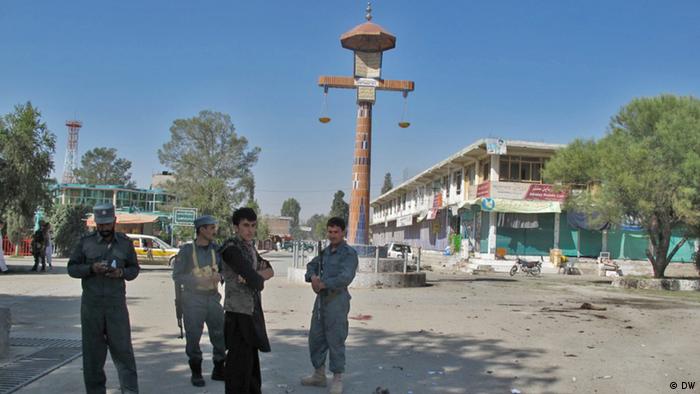
(dpa, Reuters, AFP)A suicide bomber on a motorcycle has killed more than a dozen people near a market in Afghanistan's eastern city of Khost, including three NATO soldiers and their translator. More than 60 other people were wounded. The office of Khost's governor said the dead also included four Afghan policemen, including the commander of a rapid reaction unit. It said the blast occurred in Khost's Adalat Square. Taliban insurgents in an online message claimed responsibility for Monday's blast. NATO's US-led International Security Assistance Force confirmed the deaths of its three soldiers and the translator but has not yet disclosed their nationalities. The personnel were on foot patrol when attacked. NATO has more than 100,000 troops, including a German deployment, in Afghanistan fighting the Taliban insurgency. A NATO pull-out is scheduled by the end of 2014 with newly trained Afghan forces due to take over security.The Khost bombing follows a firefight on Saturday in the eastern province of Wardak where three Afghan soldiers, a US serviceman and a civilian contractor were killed. The incident was initially described as an "insider attack" but NATO's Lieutenant General Adrian Bradshaw later said it could "possibly have involved insurgent fire." The Afghan defense ministry said it had sent a delegation to investigate. At least 51 foreign soldiers have been killed so far this year in "insider" attacks by Afghan soldiers, up from 35 in all of 2011.
Punjab CM’s rapid bus project leaves citizens thirsting for water
Residents of Ichhra, Samanabad, Rehmanpura and Shama have been facing serious problems related to water supply owing mainly to the Bus Rapid Transit System (BRTS) project that is underway on Ferozepur Road.
Residents complained that water supply remains disconnected most of the time.
In Ichhra, the situation is worse where supply has not been restored since the month of Ramadan.
“There are no men in my house and I have to go fetch water from my neighborhood mosque myself,” said Haneefa, a 56-year-old widow, adding that the government should have made a better plan.
Other residents and traders from Ichhra voiced similar complaints. They said that even though they had filed many complaints regarding the issue, not a single government official or the area’s public representatives had visited the area.
“We have been running from pillar to post to get our water woes registered with the authorities concerned but all our pleas have fallen on deaf ears. The WASA officials blame the bus project for frequent suspension of water and say they are helpless because it is the chief minister’s own project,” said Sheikh Ahmed, a resident of Shahdin Scheme area of Ichhra.
Sajid Malik, a resident of Rehmanpura, added to the list of complaints when he told Pakistan Today that his area often received water that was contaminated with sewage water.
He said that they had approached MPA Hafiz Mian Nauman regarding the issue whose only effort was providing a single water tank for the area but even that tank was providing polluted water.
Another resident of Rehmanpura, Khalid Raza, told Pakistan Today that the water pipes supplying water to his area were connected to the main pipe from the opposite end. As a result when water was full in all other pipes, it flowed back towards the pipe supplying to his area. “If the other pipes are not full, we don’t get water,” he said, adding that it meant his area got water only from 10pm to midnight during 24 hours. He added that polluted water was causing serious diseases like cholera.
Raza also criticized the role of MPA Mian Nauman. “There has been zero effort on Mian Nauman’s part to do something about this serious situation. Only if our MPA lived in his constituency he would know the misery of living without water,” he said.
An engineer from the Al Barka Construction Company that was given the contract for the BRTS told Pakistan Today on the condition of anonymity that it was the responsibility of WASA officials to provide them a map of the underground water pipes.
“We carried out drilling according to our plan, how were we supposed to know the exact location of the water pipes?” he said.
“The authorities want the BRTS completed on time and that is the main focus right now. These side issues can wait for later,” said a WASA engineer, adding that the officials had been barred from talking to the press.
“The Punjab government did not make a backup plan for such crisis situation and since BRTS was being flashed all over the media, nobody is ready to take care of these side issues,” he said. “It is a trade off. Elections are near and the government has to finish this project to increase its vote bank.”
WASA Ichhra Sub-Division sources said that the SDO had even registered a formal complaint with the Ichhra Police Station against the project contractors for damaging WASA pipelines but no action has been taken so far.
They said that the WASA officials were trying their best to mitigate the suffering of the residents but frequent damaging of the WASA water pipelines was worsening the situation.
Pakistan Today made repeated attempts to contact MPA Mian Nauman but each time his secretary refused to put the call through to him.
Baloch families losing hope in Pakistan
Pakistan Peoples Party (PPP) chairman Bilawal Bhutto Zardari, while speaking about the situation in Balochistan, said that Baloch families are losing hope in Pakistan.
“We have to stop living in denial’ and cannot let the province bleed like this; we have to take historic measures to address the underlying causes of the challenges in Balochistan,” The News quoted Bilawal, as saying.
“Where Musharraf treated the people of Balochistan as enemies of the state’ we see them as an integral part of the state of Pakistan. Unlike the military dictator’ we have not been afraid to stand up against the superpower and shut down the supply routes in protest and permanently shut down the Shamsi Air Base to the Americans,” he added.
Bilawal also said that during the tenure of the PPP government’ the economy has withstood the global economic catastrophe’ natural disasters and the menace of terrorism, despite many challenges.
Balochistan: RESCUE AND RELIEF FOR FLOOD AFFECTED PEOPLE
More than 0.8 million people are serious affected in rains and floods in three major districts of canal irrigated region of Naseerabad and Jhal Magsi where hundred people lost their lives during the past two weeks. The affected people claimed that they had received food and some eatables 15 days after the disaster lashed the region one again in two years. It is a serious charge as the Government was busy in change of guards posting Commissioner and Deputy Commissioner a few days before the relief operations started. The Pakistan Army extended its rescue operations from nearby Jacobabad and Rajanpur Districts to Naseerabad Division on Balochistan using several helicopters and about a dozen boats to take the marooned people to the safer places or higher ground. It is the second disaster that had lashed Naseerabad Division and Jhal Magsi in two years time. The Government failed to come to the expectations of the affected people during the 2010 rains and floods and the affected people are still shelter less and having no means of livelihood for the past two years. The level of disaster was much greater in 2010 than during the current year as more people were affected and destruction of property, livestock, household belongings and poultry was great. We thought that the Government and its agencies are better organized this time serving the people in a more efficient manner. But it was a complete disappointment that the Government is handling the task single handedly disallowing the NGOs to provide relief to the affected people presumably for political reasons. Some Government leaders thought that the Government earned a bad name and the NGOs were praised for their marginal work, both in relief and rehabilitation fields. There role was zero in rescue operations as they had no means and manpower to undertake massive rescue operation. Only Army can do the job and even the district administration is helpless in natural disaster. With the creation of National Disaster Management Authority, hopes were raised that the State will be better organized and equipped to deal with floods, rains, earthquakes, cyclones and even in manmade disaster. But it is a distant dream of some people that NDMA and PDMA will perform all the jobs relieving the Army and defence forces from jobs of rescue and relief operations in case of natural or manmade disasters. We have suggested in these columns in the recent past that the Government should establish several major disaster management centers in Sibi, Dera Murad Jamali, Khuzdar, Turbat, Kharan, Loralai and Awaran where all equipment should remain available and the police and Levies forces be trained in rescue and relief operation at the local level. There should be technical training for the personnel from Police, Levies and Balochistan Constabulary even at the District level to meet the future challenges.
More action needed on Pak sanctuaries
The top US commander in Afghanistan has said that the situation in Afghanistan is better than it was, but more needed to be done about the sanctuaries in Pakistan.
In an interview with CBS Television on Sunday, General John Allen
maintained that the sanctuaries are a policy issue between the US and Pakistani governments to work out. “I’m not going to be able to wage war in Pakistan,” the general added.
Responding to a question, Gen Allen said he is ‘mad as hell’ about insider attacks in Afghanistan following a firefight between NATO troops and their Afghan allies that killed five people in the latest incident.
ISAF commander General John Allen told CBS that insider attacks were unacceptable. “I’m mad as hell about them, to be honest with you,” he said. “We’re willing to sacrifice a lot for this campaign, but we’re not willing to be murdered for it.”
Gen Allen said that just as homemade bombs had become the signature weapon of the Iraq war, he believed that in Afghanistan, “the signature attack that we’re beginning to see is going to be the insider attack”.
At least 51 coalition troops have been killed in such assaults this year - about 15 per cent of all NATO deaths - and the top ISAF general has described them as ‘the signature attack’ of the Afghan war. The scale of the insider assaults is unprecedented in modern warfare, and has seriously undermined trust between NATO coalition forces and their Afghan allies in the joint effort against Taliban insurgents.
Asked if he could explain the increase in such treacherous attacks, the general replied “Well, I’m mad as hell about them, to be honest with you. We’re going to go after this. It reverberates everywhere across the United States.”
The murder will continue, predicted Allen. “The enemy recognises this as a vulnerability,” he said. The Taliban claim to be behind the attacks. One of its commanders told CBS “These are Taliban attacks. This is part of our new military strategy; we have people in the Afghan police and the army.”
“There are many groups that have Al-Qaeda members. We can’t do this without them,” the Taliban commander said. Besides teaching them to make IEDs, he said they are weapons experts. “When our weapons break, they are the ones who repair them.” Talking to the CBS, Afghan President Hamid Karzai said that he is saddened by these attacks and takes responsibility to correct them.
But he was disappointed with the fact that Pakistan is still a sanctuary for foreign fighters 11 years after 9/11. He further said Arabs and Chechens are present on the Afghan battlefield, still able to kill US and Afghan soldiers. “Name them Al-Qaeda, name them Haqqani, name them Taliban. They’re still there,” he added. “I know that a lot of innocent people die every day. The question is what have we done wrong that they are still able to hurt and damage people?... That is the question that I have engaged with the United States almost daily.”
Gen Allen said the situation in Afghanistan is better than it was, but more needs to be done about the sanctuaries in Pakistan. “The relationship that we have between ISAF forces and the Pakistani military has improved dramatically.”
Drone strike kills three militants in Miranshah
http://www.brecorder.comA drone strike targeting a vehicle killed at least three militants in a restive Miranshah tribal region near the Afghan border on Monday, security officials said. The strike took place in the Khaider Khel area of Mir Ali district, 30 kilometres (18 miles) east of Miranshah, the capital of North Waziristan tribal region. "Drones fired four missiles on a militant vehicle, killing three rebels," a security official told AFP. He said that several drones were flying in the area at the time of the attack. Another security official confirmed the attack and casualties and said the identities of the militants killed in the strike was not immediately clear.
Pakistan: In twist, Muslims accused of blasphemy
Associated PressPakistan's blasphemy laws may be used to punish Muslims suspected of ransacking a Hindu temple, an intriguing twist for a country where harsh laws governing religious insults are primarily used against supposed offenses to Islam, not minority faiths. The blasphemy laws, sections of which carry the death penalty or life imprisonment, have drawn renewed international scrutiny this year after a young Christian girl in Islamabad was alleged to have desecrated the Muslim holy book, the Quran. A Muslim cleric now stands accused of fabricating evidence against the girl, who has been freed on bail and whose mental capacity has been questioned. Police officer Mohammad Hanif said Sunday the anti-Hindu attack took place Sept. 21. The government had declared that day a national holiday — a "Day of Love for the Prophet" — and called for peaceful demonstrations against an anti-Islam film made in the U.S. that has sparked protests throughout the Muslim world. Those rallies took a violent turn in Pakistan, and more than 20 people were killed. Hanif said dozens of Muslims led by a cleric converged on the outskirts of Karachi in a Hindu neighborhood commonly known as Hindu Goth. The protesters attacked the Sri Krishna Ram temple, broke religious statues, tore up a copy of the Bhagavad Gita, a Hindu scripture, and beat up the temple's caretaker, Sindha Maharaj. "The attackers broke the statues of (Hindu deities) Radha, Hanuman, Parwati and Krishna, and took away the decorative gold ornaments," Maharaj said. "They also stormed my home and snatched the gold jewelry of my family, my daughters." Maharaj and other Hindu leaders turned to the police, who registered a case against the cleric and eight other Muslims. But none of the suspects had been found as of Sunday, police said. Officials said the case against the attackers was registered under Section 295-A of the blasphemy laws, which covers the "outraging of religious feelings." That section of the law can apply to any religion and carries a fine or up to 10 years imprisonment. The Asian subcontinent's British rulers originally framed blasphemy laws partly to prevent violence between Muslims and Hindus. Muslim-majority Pakistan was carved out of India in 1947, and under the military rule of Gen. Muhammad Zia ul-Haq, a fervent Islamist, the statutes covering blasphemy were toughened in the 1980s. Area police chief Jaffer Baloch said authorities were simply considering the Hindus' complaint under the relevant section of the law. Islam's Prophet Muhammad "teaches us to respect others' religions so that ours shall also be respected," he said. "Like us, Hindus have their own faith and religion and they do have sentiments for their Bhagavad and gods." Human rights activists say Pakistan's blasphemy laws are too broad and vague, and are often used by people who are trying to settle scores with rivals or target religious minorities, who make up 5 percent of Pakistan's 180 million people. Although many Muslims are accused of insulting Muhammad or other acts deemed blasphemous, minorities are disproportionately represented among the defendants, rights groups say. Hindus and Christians are among prominent minorities who fear the blasphemy laws. Also frequently blamed for blasphemy are Ahmadis, who consider themselves Muslims but are reviled as heretics by mainstream Muslims. Pakistan is not known to have actually executed anyone for blasphemy, and while courts often set the accused free on technical grounds or other reasons, many extremists have killed people who were let go by judges. Even speaking out against the blasphemy laws can put people in danger. Two prominent politicians, including the sole Christian member of the federal Cabinet, were assassinated in 2011 for urging reform of the law. The politicians, Punjab province Gov. Salmaan Taseer and Minister for Minorities Shahbaz Bhatti, had spoken out in defense of Asia Bibi, a Christian sentenced to death in 2010 for allegedly insulting Islam's Prophet Muhammad. Bibi, whose case prompted international criticism, is believed to be the first woman condemned to die under the statute and remains in prison. The laws retain broad support in Pakistan, where Islamic conservatism is on the rise alongside extremism and Muslims are highly sensitive about their faith. Taseer's killer, for instance, was hailed as a hero in many quarters. Thousands of people rallied to support him, and lawyers showered him with rose petals. Many human rights activists, partly out of their own security concerns, have tempered their demands: years ago, they used to call for the blasphemy laws' repeal, but now they say the laws should be reformed to prevent misuse. Even leaders of minority religious groups have often said they support the law but simply do not want to see it abused. Although there's no sign that the weak civilian government plans to amend the law, the case of the Christian girl has brought some hope that sentiments about it may change. Even some Islamist clerics sympathized with the girl, whose age has been said to be 14 or younger and who may be developmentally disabled. Witness claims that a Muslim cleric stashed pages of a Quran in the girl's bag to make it seem as if she burned them have added to the sympathy for her. The cleric is accused of planting the evidence to push Christians out of the neighborhood and is now being investigated for blasphemy himself. He denies any wrongdoing.
Flood-ruined Balochs
Had it to be a provincial minister to remind the Balochistan MPAs and his cabinet colleagues that the rain flooding has ruined their Baloch compatriots in eastern Balochistan and that they have to do their part for their relief? In a passionate appeal, Minister Jan Ali Changezi asked them to chip in with a part of their funds. And quite a hefty sum it is, running into billions of rupees that these excellencies have divvied up between themselves on the pretext of development of their constituencies. And what was their response? Promptly they instead adopted a resolution calling upon the federal government to provide Rs. 15 billion for the succour and rehabilitation of the flood-devastated people. What a hypocrisy! And what an insensitivity!
But why has the Baloch commoner become such a disposable nonentity in Balochistan? The flooding has left in utter ruins the districts of Naseerabad, Jaffarabad, Dera Bugti, Jhal Magsi and Musakhel. And the worst hit are the rural folks, who have suffered casualties in scores. Their villages in dozens and homes in thousands have been wiped out. Their cattle in hundreds have been swept away. Hundreds of thousands of them are still stranded in flood waters. And the flooding has washed off neatly standing crops over a sprawling land of 700,000 acres. By every reckoning, this is a colossal catastrophic devastation. Yet it has touched no hearts among the province’s elites and has become no part of any six-points of the eminences impersonating as the Baloch leaders.
Why indeed has the Baloch commoner become such an orphan that even his most painful woe goes wholly ignored and unmourned by those who pose themselves to be the voice of the Baloch people? The present provincial assembly is stocked up with a bevy of sardars, self-styled nationalists and holy clerical fathers, who all, barring a few, also make up the incumbent provincial ministry. Yet no cries of compassion or sympathy for these woe-begone flood-battered have oozed out of the assembly chambers or the government corridors. Only the military is seen engaged in rescue and relief works. The provincial administration seems to have taken upon itself the job of only blurting out the statistics of flood damages. It has left the flood-battered largely to fend for themselves.
And if those in the provincial ministry and assembly are so neglectful of these distressed flood-devastated, those sitting outside posing to be the real champions of the Baloch people have just turned a blind eye to this great human tragedy. They are acting as if not a disastrous flooding is devastating the eastern Balochistan but just a water pipeline has burst out in some city part. They are wholly mum, mouthing not even a word of concern, leave alone compassion or sympathy, over the doleful plight of the flood-battered. They are deafeningly vocal over the missing persons phenomenon, but keeping their tongues tied over the unenviable predicament of the flood-ruined, which is no lesser, if not more, painful.
Maybe, they see no profit in dwelling upon the catastrophe of the flood-battered. In any case, they could be excused. Their humanitarianism, after all, is, quite evidently, very selective and very motivated. They only cry over the missing Balochs. But cry not for the Balochs murdered by the insurgent groups in terrorist or vindictive strikes. They spare no tear at all even for the Baloch children and women killed or maimed in the insurgents’ landmine and IED blasts. Obviously, they think killing of the Baloch people by the insurgent groups is kosher and heroic. Or, maybe these groups have some soft niches among the elitist class passing itself as the real leadership of the Baloch people and their true voice.
Be that as it may, why the people, say, in Punjab and Khyber-Pakhtunkhwa are so inert in coming to the aid of their fellow Baloch compatriots in distress? Why no relief truck convoys of theirs are making a beeline to the flood-battered eastern Balochistan? Why no relief goods collection centres for the flood-ruined Balochs have come up in every nook and cranny of their two provinces? If the Baloch sardars, touting themselves up as the leaders of Baloch people, and if the self-styled Baloch nationalists, posing themselves to be the true voice of the Baloch people, are so apathetic to this huge humanitarian catastrophe, do they also have to be? And if the political elites, the civil society and the relief agencies of their provinces are wholly unconcerned about this Baloch catastrophe, do they also have to be? Their flood-hit Baloch compatriots are in a very pathetic condition. And they must move wholeheartedly to come to their rescue.
Sunday, September 30, 2012
Bilawal Bhutto's speech in New York
Source:http://www.facebook.com/PakistanPeoplesPartyOfficial/posts/388934664512921
Bismillah Rehman Raheem Assalom-O-Alaikum Jiyay BhuttoIt is truly a pleasure for me to be here today to address our patriotic Pakistanis living abroad. I know how you feel, being so far from our country, having been forced to live in exile myself along with my mother Shaheed Mohtarma Benazir Bhutto. I know you can force me out of Pakistan but you can never take the passion for Pakistan out of me. Most of you were first forced into exile during our country’s darkest dictatorship in the 1980s. Even though the dictator’s state had given up on you, you never gave up on Pakistan, and now have become the life blood of the Pakistani economy. In fact, it is under this PPP government that overseas remittances have increased from $6 billion, from when we replaced Musharraff’s dictatorship, to almost $13 billion under our democratic government. The PPP has always, and will always, stand by our oversees Pakistanis. We are committed to insuring your right to vote in elections. We are committed to the idea that dual-nationals should be able to participate in all our country’s civic matters, and that includes the right to contest elections. No unelected people have the right to question the loyalty of anyone elected by the people of Pakistan. You must have your voices heard in the next election. If they don’t let you run, if they don’t let you vote, speak to your family and friends in Pakistan, come back to Pakistan yourselves, and support the Party that has not given up on your voice and your vote. Ladies and gentlemen, some just talk change. Others actually cause it. And I am proud that my Party is transforming Pakistan and building its future. It has been a long and difficult journey but it is still incomplete. I want you to know that once again, the Pakistan Peoples Party is making history. It may not be the story that you watch on your television screens or the news you read about in the papers, but it is the transformation of Pakistan that is taking shape on the ground beneath our feet. The ground beneath our feet is shifting. Our people are paying an enormous price, in blood, sweat and tears, sacrificing collectively to create a new, modern and equitable future for our children and the generations yet to come. Despite all the conflict and challenges, let me remind you that Pakistan is making its first constitutional and peaceful transfer of power in ALL its history. We have transformed a dictatorship into a democracy, we have restored the supremacy of parliament, we have stripped our constitution of the illegal powers usurped by military dictators, we have nourished a thriving civil society and restored one of the freest presses in the world. No one thought it could happen, but almost five years after my mother’s martyrdom and the election of a new government, democracy in Pakistan is strong, growing, and laying the groundwork for a very different nation than we have ever known. Others have promised change. Our PPP government has delivered it. We have been accused of not fulfilling any of our promises. We have achieved more than we ever have in the past. The restoration of the 1973 constitution has been part of our election manifesto since 1986 and it is not until this government that we have finally achieved this goal. We have devolved power to the provinces, thus decentralizing government and bringing it closer to the people. What this means is that the provinces have both the resources and the responsibility as key stakeholders in governmeny. This is democracy bringing the once remote state closer to your doorstep. My friends, as we meet together tonight, Pakistan is undergoing the first peaceful transition of power in its 66 year history. A powerful and independent election commission which my mother fought for, my father has delivered, to oversee free, fair and transparent elections. Roti, Kapraa, Makkan has been our slogan every since the PPP’s first election. We have done more during this government than ever before. Our government has created the first social safety net for the poor in our nation’s history, this too implementing my mother’s dream in my mothers name. Today, the women of our households are being empowered within their families, thereby improving society as a whole. We have passed more legislation for women in this parliament than in all past parliaments combined. From domestic violence to property rights, the women of Pakistan are being protected by the law, by our government. This is an enormous accomplishment that will not only take women to the path to empowerment, but will benefit their children. Some of these laws are already beginning to have effect on the ground: the Sexual Harassment at the Workplace law, for instance, has been used by victims in both the private sector as well as government departments, to stop the abuse of women at the workplace. This is no abstract law, it has started to mean something on the ground, and we need your support to make all the new laws a daily reality in people’s lives. And while we are on the subject of human rights, let me remind you that we lead by example, and have been the only government not to hold people in prison for their political allegiances. Ladies and Gentlemen, poverty in Pakistan is a stain on our collective conscience. To be a prosperous society we must seek to eliminate poverty. If we look at the history of poverty in Pakistan, we see the crushing truth that through no fault of the child, through the accident of birth, the girl born into poverty has virtually no chance to escape. This is grossly unfair, as our masses are our biggest asset. The landmark Benazir Income Support Program gives a monthly stipend to women of the households of the poorest of the poor allowing them to provide food, clothing and shelter for themselves and their families. In Pakistan the gap between rich and poor is enormous. Any successful society seeks to close this chasm, increase social mobility and sustain a strong middle class. The richest Pakistanis can take advantage of the opportunities their wealth affords them to start businesses and expand their wealth even further. But it is not just rich people who have great ideas. Our country is full of people who have great ideas and they should all be afforded the same opportunities. The Waseela-e-Haq program, started by your party’s government, helps the poorest people turn these great ideas, their dreams, into a reality. It provides micro loans to the poorest Pakistanis who want to start their own businesses. The loans are targetted not only to the poorest people but also to identifiable business lifting not only the poor people and their families but also their communities out of poverty. With Pakistan’s booming population, there’s no shortage of people ready, willing and able to work. They just lack the skills to do so. That is where the Waseela-e-Rozgar program, started by your party’s government, comes in. It aims to provide full vocational and technical training to the poorest Pakistanis, empowering them with the skills they need to find work, earn an honest wage and in doing so help themselves, their families and our economy. A healthy economy needs a healthy population. The Waseela-e-Sehet program, started by your party’s government, provides health and life insurance to the poorest Pakistani. Our goal is to insure that no one is denied the healthcare they need just because they cannot afford it. That life and death should be a matter of fate not a matter of wealth. Our life insurance program provides a protective cushion for families at the most difficult point in their lives, so that the loss of a loved one, the loss of the breadwinner no longer means that desperate families are left alone to fend for themselves. There are heartbreaking examples of young children running the street stalls their fathers used to run, before they were killed in suicide attacks. This is a devastating reality this program will help to change. Poor children are doomed to live the same impoverished life as their parents because they don't have access to education. Their parents can’t afford to send them to school because they need them to start working as early as possible and help with the household income. The Waseela-e-Taleem program, started by your party’s government, strikes a deal with the parents of poorest Pakistanis: You commit to sending your children to school and we will help you financially. By doing so, the PPP aims to end the vicious cycle of generational poverty. On the economic front, the PPP to came into power amidst the worst global recession in recent history. It is our government’s policies that prevent certain collapse. Our economy has withstood this global economic catasrophe, natural disasters, and the menace of terrorism. Unlike even the world’s greatest economies we did not have to bail out a single bank. While Europe falls into a double dip recession with negative economic growth, despite external shocks that led to fiscal deficit, Pakistan has against all odds managed to have an annual GDP growth rate of almost 4%. Our exports crossed an historic benchmark of $25 billion this year. It is the PPP’s economic policies that helped achieve this. It is our agricultural policy that has transformed Pakistan from a wheat importer to a wheat exporter. For example, by increasing the wheat support price we empowered our farmers to grow more wheat. We have literally gone from being unable to feed ourselves, we had to import wheat, to being able to feed not only ourselves but also the world by exporting our surplus wheat. This is just one of many policies that have led to a boom in our agricultural economy. In the last 2 years our agricultural policies have enabled our farmers to earn an additional income of approximately Rs. 800 billion. The global escalation in the price of oil and food affects the daily life of the average Pakistani. The PPP has tried its best to limit the impact on the common man while at the same time maintaining our fiscal responsibilities to the economy as a whole. We see inflation as one of our most pressing issues, once again because of the effect it has on the common man. Despite the enormous economic challenges we face, your government has more than halved inflation from its peak at 25% to 11%. This means the cost of everyday goods for the average Pakistani are cheaper than they otherwise would have been. We face huge economic challenges. However, it is also time we as Pakistanis showed some economic patriotism. Especially when we have so many factors working against us from terrorism to national disasters to global economic crisis, it is our duty to point out how successful we have been. For example, I bet you have never heard this fact. Bloomberg News has recently rated the Karachi Stock Exchange the 4th best performing in the world. Not in South Asia, not in Asia, not in the East, but in the world! Can you imagine if this was any other government at any other time this fact, this indicator of the health of our economy, would be ignored by our own Pakistani media? It is time for some economic patriotism. It is time to put our differences aside. We welcome constructive criticism. However, it is also our duty as Pakistanis to unite and highlight the good, not just the bad. The PPP’s commitment to the labourers of Pakistan is second to none. We are committed to the strengthening of unions, while all others are committed to their dismemberment. We’ve regularized 12,000 contract employees, we’ve increased government employees salaries by more than 125% in the last four years. One of our proudest achievements is the Benazir Employees Stock Option scheme which gives a share of all state-owned enterprises to the employees working for these companies. This makes workers joint owners of the companies they work for. This gives them a stake in the company. Shares worth many billions of rupees have been given to more than half a million employees. We truly are the only party that is on the side of the workers and not captive to special interests who seek to profit from our national assets at the expense of the hard working people who have devoted their lives to these companies. Time and time again we have sought to do just that, give the power back to the people. This is the foundation we are laying. My mother’s policy of reconciliation gives everyone that voice in the system, gives the smaller provinces an equal stake in the federation. Some of the genuine grievances of the smaller provinces can now be addressed, and as this new structure takes root, the local needs of the people can be addressed in a real sense. As desperate as the situation in Balochistan is today, with every missing person and with every dead body, we realize a Baloch family loses hope in Pakistan. We have stopped living in denial, and we cannot let the province bleed the way it has. We have taken historic measures to address the underlying causes of the challenges in Balochistan. Where Musharraf treated the people of Balochistan as enemies of the state, we see them as an integral part of our state of Pakistan. We have a long way to go in addressing all the wrongs done to them, but at least we’ve started the process. There will be no going back. One of the first acts of our government was to apologize to the people of Balochistan for the wrongs done to them. We then passed legislation that has changed the equation, and that means instead of the federation solely benefitting from the resources, there is redistribution of the resources, where the localities, the province, and its people now have a share. In addition, the Balochistan package the government has passed addressed Balochistan’s sense of discrimination and brings it to par with the other provinces in terms of funds, employment and infrastructure. This year, the share of the Balochistan in the new NFC has been more than 95 billion rupees as opposed to less than 40 billion rupees before our government took power. There is no short term solution, but for the first time in our history, we have made the necessary structural change to address the long term challenges that is necessary for a prosperous, peaceful and stable Balochistan that plays its rightful, integral part in Pakistan. It is an immense task ahead of us, but our government is committed to seeing it through. The sense of deprivation and discrimination also exists in the minority communities of Pakistan. Pakistan itself was founded as a land where the Muslims of India could live in peace and security, free from the worry of being second-class citizens. We, in turn, must protect the minorities within our own borders. Law and order should protect the Christian, the Hindu and any minority faith. Our government stands shoulder to shoulder with all minorities. Our model of citizenship is an inclusive one. We have passed legislation, such as the Human Rights Commission, which is designed to serve as a watchdog group to protect and fight for their rights wherever they may be infringed upon. We have increased minority representation in Parliament to make their voices heard on the national stage. Our Party has always been the party for equal rights, and it our party that produces men of the caliber of Shaheed Salmaan Taseer and Shaheed Shahbaz Bhatti, men who knew the dangers and risks they faced but raised their voices and sacrificed their lives for the most vulnerable in our society, following in the footsteps of Shaheed Mohtarma Benazir Bhutto. For in a diverse society such as ours, we cannot tolerate discrimination against ANY faith. I join the unanimous chorus of condemnation of a vile, hateful, blasphemous video that has unfortunately incited violence across the Muslim world. We know Islam teaches that murder of one innocent is the murder of all humanity. When our Prophet (peace be upon him) was the messenger of peace, love and harmony - how can we pretend to defend his honor with death and destruction? Surely those of us that protest peacefully are the true followers of Islam. The unity of all major political parties in Pakistan on this issue is inspirational. That we can stand united in our protest, united in our condemnation of violence, united in our condemnation of this hateful video - fills me with hope. I do wish this unity existed for the threats we face from within. As Muslims and Pakistanis we are often quick to unite against perceived threats to our religion from external forces but are divided when it comes to threats against our country and religion from within. I believe that all major political parties in Pakistan have called for international legislation that restricts hate speech and criminalises incitement to violence. How can we expect the world to act when we don’t act on hate speech and incitement of violence that occurs in our own country? The incitement of violence, the distortion of facts, the purely fictional interpretation of Islam used to harm innocents goes unpunished. This must end. It is my belief this environment is being created by the enemies of Pakistan to orchestrate a genocide of our fellow Shia Muslims. The whole nation must stand united against this menace. We fly the Shia Alaam above Bilawal House as a symbol of my family’s and my party’s solidarity with our Shia brothers and sisters. Our beloved founder, Quaid-e-Azam Muhammad Ali Jinnah was a Shia himself and it is his vision for a pluralistic, peaceful society that our party wants to make reality. We are the only political party that has consistently stood on the right side of history, opposed every dictatorship and committed to democracy every step of the way, and fought for democratic rule in Pakistan. We believe a truly independent and impartial judiciary is a fundamental component to a democratic Pakistan. That is why we respect the majesty of justice and accept the rulings of our Supreme Court, despite reservations. The PPP has stood shoulder to shoulder with the lawyer community in our quest for the restoration of an independent judiciary. We did not sacrifice the lives of our workers, we did not come this far in ending military dictatorships forever only to succumb to judicial dictatorships. We will not violate the Vienna Convention and we will not violate the Constitution of Pakistan. If this Court sees it fit to do so, if the courts insist on putting the grave of Shaheed Mohtarma Benazir Bhutto on trial, to repeat the mistakes of history, refuse to redeem themselves from the role they have played in the judicial murder of Shaheed Zulfiqar Ali Bhutto, the ultimate decisions will lie in the court of the people and the courts of history. The Pakistan People’s Party must set the precedent for democratic governments to come and will therefore continue to follow the principles of democracy and the principles of justice, whether we agree or disagree with the Supreme Court’s decisions. While we can agree to disagree on whether justice is being done, we must all agree a basic principle of justice is that justice should not only be done but it should be seen to be done. The judiciary in Pakistan will never build its reputation as a truly independent and impartial judiciary if there are to be double standards. It is highly inappropriate, for instance, that in the case of the Chief Justice’s own son the investigator, the prosecutor and the judges who will hear the case are cherry picked by the court. My hope is that the Court will find its rightful role and carry out its duties in such a way that it restores its institutional credibility. If the Court cannot or will not, we the people must call for the judicial reforms needed in a mature democracy. Our democracy also faces the challenge of governing while combating the threat of terrorism. We lost our leader Shaheed Mohtarma Benazir Bhutto to this fight, we’ve lost our party workers to this fight, we’ve lost our soldiers, our innocent men women and children but we will not lose our country to this fight. When we came into power the extremists had taken over our beautiful Swat Valley. The government’s strategy of dialogue, deterrence and development was successful and as a result, we have regained Swat from terrorists. Those planning a peace march into Waziristan should visit the now thriving marketplaces in Swat, which were once the bloody squares where the terrorists hung the bodies of innocent civilians in their hateful campaign of death and destruction. Ladies and Gentlemen, this is our war. When our soldiers are fighting and dying for our country, abducted and beheaded by the Taliban, when our people are in schools, markets, mosques, buses, going about their daily lives and being brutally killed, how then, can one say this is not our war? We too oppose drone strikes. We will fight this war on our terms and not at the dictation of any foreign power. Unlike the military dictator before us, who took orders from a single phone call, we have taken ownership of our foreign policy. Our Parliament conducted a full review of our foreign policy, giving the people’s approval to our actions. Unlike the military dictator before us, we have not been afraid to stand up to superpowers. We shut the supply routes in protest, we permanently shut Shamsi Air Base. There are politicians who now paint themselves as the guardians of our sovereignty but were the same politicians in power when the government took directions from a single phone call, opened the supply lines in the first place and granted use of Shamsi Air Base. Why do they protest now if they would not protest then? I did not come here to deliver a speech full of rhetoric and slogans. I come here to outline what your party has accomplished, against all odds and expectations, and what we have yet to do and will do inshallah. We must remain familiar with our history, sensible in our present and always hopeful for our future. I firmly believe there is nothing wrong with Pakistan that cannot be fixed by what is great about Pakistan. Pakistan Zindabad.
Ind vs Pak: India crush Pakistan by 8 wickets
The Times of IndiaRavichandran Ashwin and Yuvraj Singh set it up with a superb display of spin bowling before Virat Kohli took centrestage with an unbeaten 78 as an inspired India thrashed arch-rivals Pakistan by eight wickets to keep their title hopes alive in the ICC World Twenty20 on Sunday. Scorecard | Match in Pics Ashwin (2/16) and Yuvraj (2/16) snapped up four wickets between themselves as Pakistan were shot out for a meagre 128 in 19.4 overs. Lakshmipathy Balaji also complemented the 'spin twins' with impressive figures of 3/22 in 3.4 overs. Kohli, who has been Pakistan's nemesis in the past, hit a scintillating unbeaten 78 off 61 balls as India won with three overs to spare. The Delhi lad hit nine boundaries and two sixes to take the team home in the high-voltage contest watched by a capacity crowd. However, Pakistan are still ahead in terms of net run rate of -0.426 which is shade better than India's -0.452. Had India won with 20 balls to spare, they would have been No. 2 in the group. India will now have to defeat South Africa in their last group-2 match on Tuesday to make it to the semifinals. India's unbeaten record against Pakistan in ICC World Cups has thus been kept intact having beaten them five times in the 50-over version and thrice in the T20 format. Kohli started with a thickish outside edge off Raza Hasan for a boundary but then played some lovely strokes. A backfoot cover drive off Saeed Ajmal and lovely cover drive off Yasir Arafat were glorious strokes. He also lofted Shahid Afridi over long-off for a six. Whether driving on the up or playing off his hips, Kohli was a treat to watch. Virender Sehwag, on the other hand, was happy to play the second fiddle during the 74-run partnership for the second wicket but did play a lovely lofted shot off Umar Gul's bowling. Pakistan captain Mohammed Hafeez's decision to bat first on a slow Premadasa track failed to produce the desired result as Ashwin and Yuvraj frustrated the opposition batsmen by maintaining superb line and length. Ashwin, who operated from round the wicket, had superb figures of two for 16 from four overs while Yuvraj also had identical figures but from three overs. The duo snapped four Pakistan wickets for only 32 runs in seven overs and it was the reason why Hafeez and Co could not reach a respectable total. Lakshmipathy Balaji also complemented the 'spin twins' with impressive figures of 3/22 in 3.4 overs. The only notable partnership was of 47 runs between Shoaib Malik and Umar Akmal. Malik was the top scorer with 28 before he gave an easy catch to Rohit Sharma. Last match's hero Umar Akmal played a pull shot off an Ashwin delivery but couldn't clear Suresh Raina in the deep. India versus Pakistan matches are never short of drama and this match was also not an exception. Zaheer Khan's first over saw him bowl three wide deliveries and then being square driven by Imran Nazir for a boundary before Virender Sehwag dropped the opener at first slip. Irfan Pathan started off the collapse by removing Nazir who had shuffled a long way but the umpire thought that left-arm seamer's incoming delivery would have hit the stumps. Nazir stood his ground for a while before leaving. To everyone's disbelief, Shahid Afridi walked in at No 3 and smashed the first delivery from Pathan over his head and then another boundary off the bowler through the cover region. However, with the former Pakistan captain, opposition teams always fancy a chance and Balaji bowled a short one which Afridi tried to pull it over mid-wicket boundary but was caught by Suresh Raina at the boundary ropes. Afridi made only 14. Yuvraj then got into the act as he removed left-hander Nasir Jamshed and wicketkeeper-batsman Kamran Akmal in quick succession to reduce Pakistan to 49 for four. Both hurried onto their shots. Jamshed tried to play a slog-sweep which was smartly taken by Dhoni while Kamran tried an expansive cover drive of an arm ball only to give the Indian captain his second catch. Pakistan captain Hafeez scratched around for 28 balls for his 15 before he dragged one onto his stumps off part-timer Virat Kohli's bowling. Umar and Malik then got together to conjure a partnership but Ashwin dismissed both of them in quick succession to end Pakistan's chances of a big score.
Bahrain Faces Riots After Boy Dies in Protest
Riot police officers in Bahrain fired tear gas and stun grenades on Saturday in clashes with protesters who broke away from a funeral procession for a 17-year-old boy killed the day before during street battles with the security forces.Thousands of mourners took part in the funeral march, chanting antigovernment slogans and waving Bahraini flags. Later, smaller groups of several hundred demonstrators broke away and hurled stones at police units. There were no immediate reports of injuries.
The death of the boy late Friday could stir more tensions between the forces backing the Sunni-led monarchy and groups from Bahrain’s Shiite majority who are seeking a greater voice in the country’s political affairs.
More than 50 people have died, including protesters and police officers, in almost 20 months of political turmoil in Bahrain, an island nation in the Persian Gulf and the headquarters of the United States Navy’s Fifth Fleet.
The Shiite-led protests are aimed at breaking the Sunni minority rulers’ monopoly on power in Bahrain. They started in February 2011 and were inspired by other Arab Spring revolts against authoritarian governments in the region.
Bahrain’s largest Shiite political bloc, Al Wefaq, said the security forces killed the boy, Ali Hussein Niema, 17, when they fired birdshot — used often by the riot police in Bahrain — during street clashes on Friday in the village of Sadad, southwest of the capital, Manama.
Last month, a 16-year-old boy was also shot and killed during a protest.
Bahrain’s Interior Ministry confirmed that one person had been killed in what it described as a terrorist attack on a security patrol that included firebombs thrown at the police.
Bangladesh Muslims torch Buddhist shrines
Crowds of angry Muslims attacked Buddhist shrines, torching some of them, over the weekend in Bangladesh to protest after a photo of a partially burned Quran was posted on Facebook, police said Sunday.
The protesters chanted anti-Buddhist slogans, blaming the burning of the Muslim holy book on a Buddhist boy, district police superintendent Saleem Jahangir said.
The boy is tagged in the photo but did not post it himself, Jahangir said. The boy's account has been deleted and police are not naming him.
Police sent extra officers to restore calm in Cox's Bazaar, a town south of the capital Dhaka on the coast, said Jahangir.
"Now the situation is under control," he said.
The south Asian nation is about 90% Muslim, the Pew Forum on Religion & Public Life estimated in its 2011 survey of the global Muslim population.
It is less than 1% Buddhist.
Actual or reported Quran burning has led to violence in Pakistan and Afghanistan.
Relatively peaceful Bangladesh was one of many countries that saw demonstrations recently against the online video "The Innocence of Muslims," which portrays the prophet Mohammed as a womanizer and child abuser.
US and Afghan forces clash, leaving 5 dead
Associated PressA firefight broke out between U.S. forces and their Afghan army allies in eastern Afghanistan Sunday, killing two Americans and three Afghan soldiers and pushing the number of U.S. troops killed in the long-running war 2,000. The fighting started Saturday when what is believed to have been a mortar fired by insurgents struck a checkpoint set up by U.S. forces in Wardak province, said Shahidullah Shahid, a provincial government spokesman. He said the Americans thought they were under attack from a nearby Afghan army checkpoint and fired on it, prompting the Afghan soldiers to return fire. The Afghan Defense Ministry said the gunbattle was the result of a "misunderstanding" between international forces and Afghan soldiers manning a checkpoint in the Sayd Abad district. NATO's International Security Assistance Force, commonly referred to as ISAF, provided a different account. "After a short conversation took place between (Afghan army) and ISAF personnel firing occurred which resulted in the fatal wounding of an ISAF soldier and the death of his civilian colleague," the coalition said in a statement. It said the three Afghan soldiers died "in an ensuing exchange of fire." NATO did not say whether it considered this an "insider" attack on foreign forces by Afghan allies. There has been rising tide of such attacks in which Afghan soldiers or police assault their international allies. The killings pose one of the greatest threats to NATO's mission in the country, endangering a partnership key to training up Afghan security forces and withdrawing international troops. While it may be days before it becomes clear who fired on whom first, the incident illustrates how tense relations have become between international troops and their Afghan allies. Officials on both sides went into damage control mode, arguing that Saturday's violence did not mark a new low in Afghan-U.S. relations and urging patience while investigators tried to figure out exactly what had happened. The deputy commander of NATO's military force in Afghanistan, British Lt. Gen. Adrian Bradshaw, called a last-minute news conference in Kabul to address the incident, even though he had few details to give. He said the initial report of an insider attack should be amended to note that the incident "is now understood possibly to have involved insurgent fire," and tried to stress that relations between international troops and their Afghan allies "are very strong and very effective." A spokesman for the Afghan Defense Ministry, Gen. Zahir Azimi, also sought to downplay the incident. "In a misunderstanding shooting broke out between Afghan army and ISAF forces. As a result of the shooting, three army soldiers were killed, three other soldiers were wounded and number of ISAF forces were killed and wounded," Azimi said in a statement. One U.S. official confirmed that the service member killed was American, while another confirmed that the civilian was also American. The officials spoke on condition of anonymity because the nationality of the dead had not yet been formally announced. The number of American military dead reflects an Associated Press count of those members of the armed services killed inside Afghanistan since the U.S.-led invasion on Oct. 7, 2001. In the south meanwhile, three Afghan police officers were killed when insurgents attacked a checkpoint in Helmand province Sunday morning, provincial police spokesman Fareed Ahmad said.
PML-N made Punjab bankrupt
Deputy Prime Minister and PML central leader Chaudhry Pervaiz Elahi said on Saturday circumstances in Punjab would have been different if the PML-N government had concentrated more on improving the lot of poor people, control lawlessness and set the education system right instead of getting the IRI survey done in its favour.
Talking to party leaders at his residence on Saturday, he said the popularity of political parties was judged by masses’ support on elections day and not by survey reports as people voted on the basis of performance and not on surveys. He said such surveys were also made before the 2008 elections but contrary to survey reports, the PML secured maximum votes in Punjab and was number two in Pakistan in terms of cotes bagged.
He alleged the PML-N had made Punjab financially bankrupt and according to a report of State Bank of Pakistan, Punjab was heavily indebted despite his PML government had left the province with Rs 100 billion surplus.
He said the growth rate during his tenure in 2007 was 8 per cent whereas it was only 1.8 per cent in 2012. He said another report of State bank said his government had utilised 98 per cent of development funds whereas the Shahbaz Sharif government used only 43 percent.
He alleged the PML-N government had wasted billions of rupees on fake and flop schemes like Sasti roti, Tandoor, Ashiana Housing, Laptop, Danish Schools and Lahore Metro Bus. He said where one would find good performance when doctors, nurses, teachers and low-paid employees were protesting on roads for their rights while the crime rate had increased by 33 percent.
The Problem With Mengal’s Six Points
The Baloch HalSoon after his much-hyped return to Pakistan, Sardar Akhtar Mengal, Balochistan’s former chief minister and the president of the Balochistan National Party (B.N.P.), has submitted six points before the Supreme Court as a minimum Baloch demand for deescalating tensions in his native province. Mengal has dramatized the situation by emulating Shiek Mujib-ur-Rehman, the founder of Bangladesh, whose Six Points eventually culminated in Pakistan’s dismemberment in 1971. Before we analyze Mengal’s six-point demands, the sad news is that the Pakistani security establishment categorically rejected Mengal’s proposal within 24 hours of his submission and the country’s Interior Minister, Rehman Malik, has warned Mengal not to speak against Pakistan or “defame our country’s armed forces”. The intelligence agencies told the Supreme Court that they did not run or sponsor any death squads, as pointed out by the former chief minister, nor was any missing person in their custody. A joint response submitted by Chief Secretary Balochistan at the Supreme Court on behalf of the civil and military authorities also argued, contrary to Mengal’s statement, that all political parties in Balochistan enjoyed ‘full freedom’ and did not face any kind of official restrictions. Here is what Mengal has proposed in his six points. 1. All covert and overt military operations against the Baloch should immediately be suspended. 2. All missing persons should be procured before a court of law. 3. All proxy death squads operating under the supervision of Inter Services Intelligence (ISI) and Military Intelligence (MI) should be disbanded. 4. Baloch political parties should be allowed to function and resume their political activities without any interference from intelligence agencies. 5. Persons responsible for inhuman torture, killing and dumping of dead bodies of the Baloch political leaders and activists should be brought to justice. 6. Measures should be taken for the rehabilitation of thousands of displaced Baloch living in appalling condition. Almost all of the above-mentioned demands have been repeatedly made by Baloch nationalists, human rights groups such as the Amnesty International, Human Rights Watch, and local and international media in order to build peace in Balochistan. In fact, B.N.P. had made some of these demands as early as 2005 in front of the Parliamentary Committee on Balochistan. Even the Pakistan People’s Party-led government, without consulting the B.N.P. and other Baloch nationalists, promised in the text of the Aghaz-e-Haqoo-e-Balochistan Package in November 2009 to resurface and release the missing persons. The promise was never kept. There has never been a dearth of recommendations on Balochistan nor will there ever be. What has hindered conflict resolution is the lack of political will on the part of the Pakistani security establishment, the federal and provincial governments. That situation has not changed and we do not see an atmosphere where such idealistic demands could willingly be implemented. Two of Pakistan’s top opposition leaders, former Prime Minister Nawaz Sharif of the Pakistan Muslim League and Imran Khan of the Pakistan Justice Movement, have publicly endorsed Mengal’s six points. Mr. Sharif and Mr. Khan have both spoken in support of Mengal’s demand not because they passionately feel for the rights of the Baloch people but because they are both staunch rivals and getting ready for upcoming general elections. We have been urging Mr. Sharif and Mr. Khan not to confine their love and concern for the Baloch people to mere media statements. They should practically launch long-marches in Punjab, as was done for the restoration of Chief Justice in 2008, to coax the army to halt its kill and dump operations in Balochistan. Only Mr. Sharif can pressurize the Pakistan army because the bulk of the army comes from the Punjab province. Likewise, Mr. Khan has passionately campaigned against drone strikes but hardly bothered to take out a march to Dera Bugti or Gwadar in support of thousands of Balochs who have been killed or disappeared during the current conflict. Mengal treats the Supreme Court as the ‘last hope’ for the Baloch people. This is a false expectation. The Supreme Court cannot resolve a dispute that requires basic constitutional changes and parliamentary protection. Pakistan’s Supreme Court has become very controversial and is believed to be a tool in the hands of the country’s army to destabilize the democratic government. Thus, a very strong Supreme Court is as dangerous for the Baloch as a strong Pakistani army. For instance, can one imagine a scenario if controversial judges like Justice (Javid Iqbal or Justice Sharif (who have respectively presented wrong statistics about the number of missing persons or settlers killed in Balochistan) are in position to hear Balochistan’s case? Given the past experiences, we do not think that Islamabad’s policies will change in near future. After all, what will convince the Chief Justice to punish security personnel responsible for whisking away young Baloch boys and killing them if video footage and testimony by members of the Balochistan Assembly and senior police officers fail to convince him? At the end, he can’t do much for himself or for Mengal because both of them do not wear a military uniform.
Mengal’s Political Blunder
Editorial:The Baloch HalThe unilateral decision of former Balochistan Chief Minister Sardar Akhtar Mengal to return to Pakistan to support the country’s Supreme Court will hurt Baloch interests. Sardar Mengal, who heads the Balochistan National Party (BNP), certainly has a democratic right to make his own decisions but his actions will tarnish the international image of the Baloch nationalist movement. At a time when the United Nations sent a Working Group in Balochistan to investigate the cases of enforced disappearances and also come up with recommendations criticizing the Pakistani military, this was not the right step for a senior Baloch leader to express faith in the Pakistani Supreme Court. Balochs have reached some steps away from a next U.N. intervention or decision on Balochistan but Sardar Mengal’s return will provide the United Nations a reason to step aside and treat Balochistan as Pakistan’s “internal issue”. At this point, the Baloch interest lies in internationalizing the issue so that more international human rights groups and representatives of the media observe transparency in resolving the Balochistan conflict according to the wishes of the Baloch people. With such a dramatic decision, one is compelled to doubt the depth and clarity of B.N.P.’s political vision for Balochistan. The B.N.P. had previously asked for provincial autonomy for Balochistan but subsequently hardened its stance and began to ask for the right to self-determination. People seek the right to self-determination when they fully lose confidence in a state. Expression of trust in the Pakistani Supreme Court completely disqualifies B.N.P.’s plea for international intervention in Balochistan. 2012 was a glorious year in Balochistan’s history when the nationalist movement made extraordinary achievements. In February, the United States Congress held a hearing on Balochistan and members of the U.S. Congress, both from the Democratic Party and the Republican Party, supported the Baloch right to self-determination. On March 27th, these congressional friends of Balochistan addressed a press conference in Washington DC’s National Press Club to once again reiterate their support for the Baloch people’s right to self-determination. As the Baloch issue gained more international attention, the United Nations also sent a Working Group to probe the cases of missing persons. With his return, Sardar Mengal has made Islamabad’s job easier: to shut down all doors for future U.N. interventions in Balochistan. Because, as understood from Sardar Mengal’s decision, Pakistani institutions can internally manage the Balochistan imbroglio. We agree with the Baloch Students Organization (BSO-Azad) that Sardar Mengal’s action amounts to joining hands with those who are responsible for killing the Baloch people. The Supreme Court has been bluffing with the Baloch people. While this court has remained in place for ages, the first disappearances (in the ongoing insurgency) began in early 2000. A decade after the initial disappearances, this Supreme Court has not been able to punish a single official for their illegal action. There is an enormous wealth of evidence that proves the security establishment’s involvement in brutal actions against the Balochs. The Chief Justice has been using the Baloch missing persons as a political card but failed to deliver. It does not make much sense when Mr. Mengal says that the Supreme Court is last hope for the Balochs. How can one trust the Pakistanis when their executive and legislative branches of government have made no confidence building measures to appease the Baloch? While the issue of the missing persons is the most sensitive and critical one, it is not the sole bone of contention between Balochistan and Islamabad. Balochistan’s problem is not as narrow as the issue of human rights. Balochistan’s is a much more complicated political vendetta which cannot be resolved only by addressing human rights issues. However, if Islamabad genuinely addresses the issue of human rights then it should be considered as a confidence building measure to start dialogue on other outstanding political issues. Balochs have been receiving bullet-riddled dead bodies even during the visit of the working group. The so-called Pakistani liberal politicians like Senator Raza Rabbani have gone public to express their anti-Baloch intentions by brazenly announcing that the United Nations would not be allowed next time to send another mission on Balochistan. When Pakistani politicians and opinion makers unite against the Baloch people, our leadership must also learn the art of putting forward Baloch demands without mincing words. We do not fully know the details of Sardar Mengal’s understanding with the Pakistani government that culminated in ending his four-year self-imposed exile. We consider it a political blunder by B.N.P. which may offer it some temporary benefits but any contacts with Pakistan at this point will harm the broader Baloch interest. While some Baloch parties criticized Sardar Mengal in 2006 for not consulting them while quitting parliamentary seats in protest against Nawab Bugti’s killing, he now deserves his share of criticism for making another decision without consulting other key stakeholders. B.N.P. is going to isolate itself and end up getting itself recognized among soft pro-Establishment parties like the National Party or the Jamori Watan Party.
Bilawal Bhutto: EC a great achievement of Govt
THE NEWSPakistan People’s Party Chairman Bilawal Bhutto Zardari has said that the setting up of a non-controversial election commission was a great achievement of the government, while efforts were afoot in favour of the dual nationality holders, Geo News reported. Addressing USA International Convention here, Bilawal Bhutto condemning the anti-Islam film demanded that the strings of such hate campaign must stop. He said that Islam was a religion of peace and those protesting peacefully against the blasphemous film were the real followers. Speaking on Balochistan's situation, Bilawal Bhutto said that his party considers Baloch people part and parcel of Pakistan. He said that historic actions have been taken for meeting the challenges in Balochistan. The share of Balochistan in national resources has been doubled through the NFC Award. Bilawal Bhutto said no one has the right to doubt the patriotism of Pakistanis residing abroad. Efforts were afoot that Pakistanis holding dual nationality could participate in the country’s affairs. He said PPP believes in independent judiciary and, as such, it sacrificed in supporting the lawyers’ movement.
‘Pakistan may lose major share in textile export this year’
http://www.brecorder.comPakistan may lose its major share in textile exports and suffer negative growth during the current fiscal year, as about 20-25 industries face closures or are being diverted to neighbouring countries such as India, Turkey, Bangladesh and Sri Lanka. Sources said on Saturday that because of sky-rocketing prices of inputs, limited availability of basic inputs of textile units such electricity and gas, inconsistent government textile policies and worsening law and order situation had forced many textile mill owners to either to close down their units or to shift their businesses to nearby countries where the cost of doing business was comparatively less than Pakistan. “During the past fiscal year, 15 percent of the total number of textile units of Pakistan shut down completely, while during 2012-13, 20-25 percent of the rest of textile mills are likely to divert to the other South Asian countries”, sources added. “You can well imagine the rapidity at which the situation is worsening…just during the past month and a half, six hosiery processing factories have shut down in Karachi while some mill owners from the Faisalabad region also shut down their factories mainly because of the energy crisis”, sources disclosed. “Unfortunately, most of the times untimely delivery of our textile products to buyers abroad due to power crisis has resulted in considerable reduction in overall textile exports. Even our old clients are now hesitant to place orders for our textile products due to delays in delivery and comparatively high costs”, sources lamented. During the last fiscal year, the textile sector added $ 12.35 billion to the national exchequer against the export target of $ 16 billion while the target set for 2012-13 is $ 12-13 billion. Chairman All Pakistan Textile Mills Association (APTMA), Mohsin Aziz, while talking to the Business Recorder, said that prolonged electricity load-shedding and shortage of gas are key factors in the decline of overall productivity of textile sector , adding that the government has failed to resolve the crisis. “The Indian government’s decision to allow Pakistani investment on its soil would also trigger capital flight from Pakistan because of deteriorating law and order and energy crisis,” the APTMA chief argued. The decision by India to relax the ban on investments from Pakistan was made in April 2012 while Pakistan had never imposed restrictions on investments by Indians.
Bhagat Singh’s revolutionary legacy
DAILY TIMES: BY LAL KHANBhagat was a fervent torchbearer of the proletarian struggle. He rejected the prejudices of caste, creed, nationality, race, gender, and, of course, religion This September 28 marked the 105th birth anniversary of one of South Asia’s iconic revolutionaries, Bhagat Singh. His heroic struggle for a revolutionary change and overthrow of the British Raj through a militant struggle has been a source of inspiration for generations. Bhagat was executed by the imperialist despots in the wee hours of March 23, 1931 at the tender age of 23, but he had left a mark in the annals of history of the class struggle in the region. His urge to understand Marxist theory and passionately educate his comrades in prison and during intense activities to develop as revolutionary cadres is a hallmark of his relentless struggle. Although he has been dubbed as a nationalist and anarchist by historians and analysts of the elite and the reformists, Bhagat was none of that at the end of his short but eventful life. Even when he was called from his death cell for the gallows, he was reading Lenin’s State and Revolution. The sort of independence that was achieved after a bloody partition, in which 2.7 million innocent souls perished, would have repulsed Bhagat Singh. The independence sought by him and his comrades of the Hindustan Socialist Republican Association (HSRA) was spelt out in one of his epic speeches during the peak of their struggle. It has been portrayed superbly in Raj Kumar Santoshi’s brilliant film, The Legend of Bhagat Singh. He says, “We don’t want independence! We don’t want independence where the English rulers are replaced by the local elites. We don’t want freedom where this wretched system of exploitation and slavery continues. We are striving for an independence that would transform the whole system thorough revolutionary socialism.” Bhagat Singh, who was initially a diehard follower of Mohandas Gandhi, had revolted against him when the latter had called off agitation against the British after the killing of some policemen in a clash with a procession of youth and workers demanding the eviction of the imperialist rulers from India. Bhagat was deeply influenced by the Bolshevik revolution of 1917 in the Soviet Union and he diligently studied the works of Marxism and contemporary revolutionaries. Through his experience, he came to the conclusion that Gandhi’s politics was to preserve the system imposed by the British colonialists rather than its overthrow. He had also read The Programme of the Communist International, which was adopted at the second congress and published in September 1920. On the Indian situation the Programme stated, “Tendencies like Gandhi’s in India, thoroughly imbued with religious conceptions, idealise the most backward and economically most reactionary forms of social life. They see the solution of the social problem not in proletarian socialism, but in a reversion to these backward forms, preaching passivity and repudiating the class struggle, and in the process of the development of the revolution, they become transformed into an openly reactionary force. Gandhi’s, more and more, is becoming an ideology directed against mass revolution. It must be strongly combated by communism.” Gandhi later came out in his true colours, revealing on the side of which class he really was. On January 15, 1948, he stressed the ownership of the capitalists and the landlords: “I will never be a participant in snatching away the properties from their owners and you should know that I will use all my influence and authority against the class war.” Bhagat, on the other hand, was a fervent torchbearer of the proletarian struggle. He rejected the prejudices of caste, creed, nationality, race, gender, and, of course, religion. One of his most celebrated works is his pamphlet: Why I am an atheist. There is an intense and controversial debate going on, especially in India, on Gandhi’s role in the conviction and execution of Bhagat Singh along with his comrades Raj Guru and Sukhdev. However, on Bhagat’s execution, Gandhi remarked in his characteristic hypocrisy, “The government certainly had the right to hang these men. However, there are some rights which do credit to those who possess them only if they are enjoyed in name only.” Gandhi and the British viceroy Lord Irwin signed the Gandhi-Irwin Pact on March 5, 1931, and yet the executions were carried out just weeks after the signing of the pact. There was immense anger and sorrow throughout the subcontinent at these executions. Just after this brutality, the annual convention of the Congress at Karachi resulted in Subhash Chandra Bose and the left taking over the leadership of the Congress despite Gandhi’s efforts. There were violent demonstrations against Gandhi at the convention. The New York Times reported at the time, “A reign of terror in the city of Cawnpore in the United Provinces and an attack on Gandhi by the youth outside Karachi was amongst the answers of the Indian extremists today to the hanging of Bhagat Singh and two fellow assassins.” Revolutionaries are always pronounced by the imperialist media as extremists and assassins. But Bhagat Singh was extremely popular in the subcontinent. Sir Horace Williamson, Director of the Intelligence Bureau, wrote about Bhagat’s popularity years after the executions, “His photograph was on sale in every city and township and for a time (Bhagat Singh) rivalled in popularity of Mr Gandhi himself.” Although the aims, objective, ideology and ideals of his struggle have been distorted, tarnished and caricatured by the intelligentsia of the capitalist status quo, the truth cannot be concealed forever. At a seminar organised by the Punjabi University Research Scholars Association (PURSA) at the Patiala University on September 25, 2012, the main speaker, Professor Balkar Singh said, “Bhagat Singh sacrificed everything for socialist revolution...His thinking was relevant today as it was during his lifetime and he qualified to be placed among people like Lenin and Che Guevara.” After 65 years of so-called independence, the masses of the subcontinent are worse off. There is excruciating misery and deprivation through which the vast majority of the population is made to suffer by capitalist exploitation and repression. The system the British Raj imposed is very much there. Without its overthrow the emancipation of the oppressed massed can never be achieved. Bhagat Singh’s revolutionary legacy is a beacon of light for the revolutionary workers and youth of the region in struggle today. This revolutionary mission can ultimately be accomplished by the creation of a voluntary socialist federation of South Asia. The writer is the editor of Asian Marxist Review and International Secretary of Pakistan Trade Union Defence Campaign.
Pakistan: Putin’s visit
THE FRONTIER POSTIslamabad has long been saying it cherishes the desire and talking a lot of making a “paradigm shift” in its foreign policy and also took a few steps to come closer to China-Russia dominated Shanghai Cooperation Organization (SCO) as an associate member. But they were not sufficient enough for Russian President Vladimir Putin to pay his first official visit to Pakistan. And thus, a languid and incompetent administration has lost a rare opportunity of not only downsizing the country’s heavy reliance on the West but also getting closer to the dynamically emerging bloc which the future of the world belongs to. Pakistan’s overwhelming population, if asked, would vote for a change in foreign policy which has time and again sent shock waves to the country’s vital interests. The Russian president was due here for the first time to open the door to a new era of Pakistan and East coming closer to each other besides entering the SCO as a full member. Mr Putin’s focal person for relations with Pakistan and Afghanistan Zamir Kabulov told an Indian newspaper that Islamabad talked a lot of rhetoric with little progress towards “meaningful cooperation”. Russia-Pakistan relations have been on the rise in recent years but economic ties between them have still lagged behind the desired level. The two countries finalized three memorandums of understanding at a meeting of the Pakistan-Russia Inter-Governmental Commission earlier this month and they were to be signed during President Putin’s planned trip. The MoUs relate to expansion of Pakistan Steel Mills and cooperation in energy and education sectors. Russia thinks that the MoUs are largely a reiteration of agreements signed last year during President Asif Ali Zardari’s visit to Moscow. Russia’s main concern is Pakistan’s slow progress towards major projects in the energy sector, including Central Asia-South Asia electricity transmission from Kyrgyzstan and Tajikistan to Afghanistan and Pakistan (CASA-1000), and construction of rail tracks and motor roads from Tajikistan to Pakistan to create new trade routes in the region. Russia also showed interest in the Iran-Pakistan gas pipeline project and Mr Putin also pledged an investment of $500 million in CASA-1000 and offered to finance and build other projects. But no headway is seen in these schemes. Another factor that might have contributed to Mr Putin “delaying” his visit to Pakistan is that Russia smells rat in its objectives in Afghanistan as Pakistan seems closer to Washington whims in the region and Moscow thinks that a sustainable resolution of Afghanistan’s issue is possible only with the active involvement and this may not be forthcoming because of Pakistan’s foreign policy which is unnecessarily aligned to the west, particularly the United States. No wonder if Washington may be influencing Islamabad not to come closer to Moscow because Pakistan has the unfortunate ability of yielding to such pressure. For how long Pakistan would want to be left high and dry in the hour of need, is a decision the political leadership has to take and transform it to the new emerging global realities?
Pakistan: 15th polio case surfaces
The total number of polio cases in Khyber-Pakhtunkhwa has reached 15 after the government confirmed the virus in a 15-month-old boy.
Bilal, son of Adalat Khan, resides in Village Sangu on the border of Bara, Khyber Agency. His twin on the other hand is an active and healthy child.
“Village Sangu borders the volatile Bara sub-division and this family had initially refused to inoculate their children. The twins were administered the drops this year on the National Immunisation Days in July,” said K-P Expanded Programme on Immunisation Deputy Director Dr Janbaz Afridi.
He added that the boy was on bottle-feed and has a history of frequent chest infections. “He is a resident of an area where security problems are at their worst,” he said.
This is the third case reported this year from Peshawar, while two each were reported from Charsadda, Mardan and Lakki Marwat. One case each has been confirmed in Tor Ghar, Hari Pur, Shangla, Swabi, Kohat and Karak.
With the detection of this new polio case, the figure of such cases in the country has reached 38 compared to 122 that were reported until September 2011 last year.
The government has decided to run a two-week anti-polio campaign in all districts for the next five months to stop the spread of polio virus.
K-P Chief Minister Amir Haidar Khan Hoti and Chief Secretary Ghulam Dastagir Akhtar have shown serious concerns over emergence of new cases in a meeting held on September 16 with a World Health Organization official.
Subscribe to:
Posts (Atom)