M WAQAR..... "A man's ethical behavior should be based effectually on sympathy, education, and social ties; no religious basis is necessary.Man would indeed be in a poor way if he had to be restrained by fear of punishment and hope of reward after death." --Albert Einstein !!! NEWS,ARTICLES,EDITORIALS,MUSIC... Ze chi pe mayeen yum da agha pukhtunistan de.....(Liberal,Progressive,Secular World.)''Secularism is not against religion; it is the message of humanity.'' تل ده وی پثتونستآن
Thursday, September 27, 2012
Light bulb moment for wireless internet
There are 15 billion light bulbs on the planet. Why not harness them for internet access? See how Li-Fi works.
Li-Fi, a method of transmitting data wirelessly using LED, the answer to the world's problem of congested bandwidth?
Pakistan agrees with objective of drones, but they are illegal: Khar
Pakistan does not disagree with what drones are trying to achieve by targeting terrorists but they remain unlawful and illegal, said Foreign Minister Hina Rabbani Khar on Thursday.
She added that Pakistan is working with the US government on resolving this issue.
While refusing to comment on the Wall Street Journal’s story on drones during a talk at the Asia Society in New York, Khar said that the drone strikes are a reason why the US is unpopular in Pakistan.
“In the case of drones, it is like choosing to win a battle at the cost of the war. Because these are battles, you get one terrorist; you get two terrorists, fine. But are you winning the war?,” Khar questioned.
In response to a question regarding the bounty announced by Railway Minister Ghulam Ahmed Bilour against the filmmaker of an anti-Islam film, the foreign minister said that the government and the Bilour’s Awami National Party (ANP) have disassociated themselves from the call. She added that ANP chief Asfandyar Wali too was surprised at minister’s statements.
When asked about the violence that erupted in response to the anti-Islam movie, she said that the violence on the streets “embarrassed” her.
“This is not what Islam teaches us,” said Khar, adding that there is a need to have a debate on how to handle issues like the blasphemous film rather than just condemning it.
Talking about Afghanistan, Khar said that Pakistan had committed to spending $300 million on the future of Afghan children, adding that given the limited resources Pakistan has, this investment is a sign of Pakistan’s intent.
The foreign minister pointed out that she had visited Kabul at least four times during her tenure – more than her predecessor.
Elaborating on Pakistan’s foreign policy vis-à-vis India and Afghanistan, Khar said they were building confidence in the relationships. She said that Kashmir remains a core issue and that the Kashmiri people deserved same rights as everyone else.
Acknowledging that she is a foreign minister who belongs to a privileged background, Khar said in future, she would like to see a Pakistan where any man or woman could become foreign minister regardless of their background.
Christian parliamentarian threaten to migrate from Pakistan if security not ensured
Parliamentarian Saleem Khursheed Khokhar has submitted an application to the Hon’ble Chief Minister Sindh,the Inspector General of Police, Karachi, D. I. G. South, Karachi and SSP, Security Zone, Karachi for foolproof security.
The Hon’ble Chief Minister, Government of Sindh, Karachi. Excellency,I would like to reiterate that my entire family members including my sons and daughters have been extended death threats and subjected to criminal harassment by the unknown extremists / terrorists to the extent that one of my sons namely Kalson Aamir Khokhar was kidnapped and brutally beaten up and was extended death threats by the unknown terrorists and militants. In this respect an FIR was lodged of his kidnapping in Police Station Gulshan-e-Iqbal Karachi. Thereafter the unknown terrorists attack my residence situated in Essa Nagri (Christian Colony), Gulshan-e-Iqbal, Karachi of which I had already informed your Excellency and so far no arrest has been made. In this respect an FIR was lodged in Police Station PIB, Karachi. Soon after the aforesaid incident, the unknown militants / terrorists, once again attack the adjacent Church St. Luke’s, Church of Pakistan and my house was also attacked. In this incident, three young Christians Boys was brutally injured by gun shot of the unknown militants. In this respect an FIR was lodged in Police Station PIB, Karachi. As you are aware Sir, I have been extended death threats by the unknown extremists and terrorists of which an FIR has also been lodged in P. S. Clifton on the intervention of Law Minister, Government of Sindh. This is to inform you with heavy heart that one of my colleagues Mr. Atta Muhammad Malik, former MPA Sindh has been shot dead on 22-09-2012 in target killing by the unknown terrorist at Mehmoodabad. Since he was close associate of the undersigned and recently he participated in a Seminar and Press Conference along with me on forced conversions, forced marriages as well on problems of religious minorities in Sindh and Pakistan. It is also pertinent and mention here that four young Christians have also been shot dead by the terrorists at Essa Nagri, Gulshan-e-Iqbal, Karachi in the period of one month. In the recent past, Mr. Shahbaz Bhatti, Former Federal Minister on Minorities Affairs, Government of Pakistan was brutally murdered by the Militants at Islamabad who vocally voiced the grievances of religious minorities and similarly on 21-09-2012 my close colleague and former MPA Malik Muhammad Atta was shot dead as mentioned above, I and my family extremely feel in secure in the wake of death threats extended to me and my family. In this respect, I have been trying to meet with you personally to apprise you of this prevailing situation and i have also sent good numbers of letters to your good self, Federal Minister Interior, Government of Pakistan, Inspector General of Police Sindh, but so far fool proof security has not been provided to the undersigned as directed by the Hon’ble Chairman Pakistan Peoples Party Mr. Bilawal Bhutto Zardari. For the safety reasons, I am confined mostly within the four walls of my residence or I have to discretely leave the country for abroad so as to safe my and my family’s life and come back when required. It is humbly requested that the undersigned may please be given personal hearing and provide proper / fool proof security without further delay for which I shall be obliged. Looking forward to see you soon. With kind regards, Sincerely Yours, Saleem Khursheed Khokhar MPA Sindh President APMA Sindh Copy to: 1) The Inspector General of Police, I. I. Chundrigar Road, Karachi. 2) The D. I. G. South, Karachi. 3) The SSP, Security Zone, Karachi.
Balochistan situation worse than Kashmir
Sardar Akhtar Mengal has said Balochistan situation is worse than that in Kashmir and Palestine.
During a Supreme Court hearing Sardar Mengal alleged that the agencies were responsible for the situation in Balochistan.
He further said that he had appeared in the court only to discuss the missing persons issue adding that without the resolution of the missing persons issue the 65-year-old political issue cannot be resolved.
The nationalist leader said that the province had undergone five military operations and no one was answerable so as to what was the fault of the innocent victims. He also claimed that during the military rule every attempt was made to suppress the political voice of the Baloch people.
Mengal said that attempts are being made to eliminate the genuine leadership of the Baloch people replacing them with artificial leadership who were manufactured in factories and that federal and provincial lawmakers never visited the rural areas of the province and remained confined to the ministerial secretariat.
The former chief minister further said that the nationalist leadership was being specifically targeted adding that the heirs of the late Nawab Akbar Khan Bugti were not even allowed to attend his funeral.
Sardar Akhtar Mengal told the Supreme Court that if an order was issued to rehabilitate the Baloch, displaced since 10 years, then that would be a step forward.
Giving his remarks Chief Justice Iftikhar Chaudhry said that the ‘Death squads’ of ISI and MI agencies should be abolished.
The Supreme Court of Pakistan (SC) has sought the response from the civil and military leaderships in the Balochistan law and order and missing persons case.
The Supreme Court on Thursday resumed the hearing on the law and order situation in Balochistan, which was attended by Baloch nationalist leader Sardar Akhtar Mengal,who is a former chief minister of the province.
A three-member bench of the SC comprising Chief Justice Iftikhar Muhammad Chaudhry, Justice Jawad S Khawaja and Justice Khilji Arif Hussain resumed the hearing of petition regarding worst law and order situation in the province filed by Balochistan High Court Bar Association.
Chief Justice Iftikhar Chaudhry said that the court had issued 60 orders during the 68 hearings on the case but no practical steps were taken.
The court also told the chief secretary of the Balochistan to deliver Sardar Akhtar Mengal’s message to federal and provincial leadership and sought from him a written reply on the issue on the next hearing.
The chief justice further told the chief secretary to discuss the issue with the president, Director General (DG) of the Inter Services Intelligence (ISI) and DG Military Intelligence (MI) and to inform the court in writing as to what steps are being taken to resolve the issue.
Furthermore, the chief justice said in his remarks that the missing persons would be recovered and that the court would go to any extent, if needed, to achieve the purpose.
All overt and covert operations must be put to an end and the displaced Baloch should be rehabilitated, added the chief justice in his remarks.
Chaudhry also said that FIRs would be lodged against those held responsible and the cases would heard in the high courts rather than the lower courts.
The former chief minister told the court that the issue of missing persons is very critical in the province and the roots to the problem can be found in the 65-year political history of the province adding that every government deceived the people of Balochistan and the issue has gone beyond the control of agencies reaching foreign elements.
Flooding Maroons 500,000 in Balochistan; 2,000 Houses Destroyed
THE BALOCH HALFlooding in the province of Balochistan has left at least half a million people marooned, besides destroying over 2,000 house, Chief Secretary of Balochistan Babar Yaqoob Fateh said on Saturday. Torrential rains and flash floods in Naseerabad and Jaffarabad districts have caused damage, destroyed standing crops on thousands of acres completely washed away road network. “Dera Allah Yar, Dera Murad Jamali, Sohbat pur, Manjopur, Manjoshori areas are still under two to six feet of water, increasing the plight of the thousands of families living in these areas,” he said while talking to reporters at the Provincial Disaster Management Auhtority’s office in Quetta. Yaqoob said that he had contacted his counterpart in Sindh and asked him not to divert water from Jacobabad towards Balochistan as it would worsen the situation in the country’s largest province. “We are in contact with the Sindh government to avoid more losses in Balochistan,” he said. The provincial official said that losses caused by the flash floods and hill torrents in northern and southern Balochistan were so huge that the provincial government alone could not cope with the calamity. “International humanitarian organisations, federal government and philanthropists should come forward and assist us in the relief and rehabilitation process,” Babar said. Expressing concern over the spread of water-borne diseases and scarcity of food and potable water, he said that provincial government was fighting the challenge by utilising all its available resources. He said that PDMA, provincial government, Army and FC were engaged in the rescue and relief operation as six Army helicopters and 18 boats were shifting the flood-affected families to relief camps set up in the Naseerabad and Jaffarabd districts.
Aussie sheep ‘buried alive’ in Pakistan
Livestock exporter Wellard says it was unable to stop the cruel slaughter of Australian sheep in Pakistan amid claims some were buried alive.
Pakistani newspapers say some sheep from a shipment of 21,000 that was recently rejected from Bahrain on health concerns had been inhumanely slaughtered en masse in Pakistan, where they were forwarded on to.
More health concerns were raised there, sparking a cull, despite Perth-based livestock exporter Wellard and Sheepmeat Council of Australia insisting the animals had a clean bill of health.
ABC radio on Thursday reported about 7000 of the sheep had been stabbed and clubbed to death - and some had been buried alive - and a further 3000 were not accounted for.
Various reports said an employee of Pakistani importer PK Livestock had videoed the slaughter on a mobile phone.
The Department of Agriculture, Fisheries and Forestry said it was looking into the reports.
Wellard said Sindh Livestock Department officials undertook the culling after local police forced employees and stockmen from PK Livestock to leave an abattoir.
"Because they had been removed from the site by police, Wellard and PK Livestock staff were unable to prevent the cull from occurring," Wellard said in a statement.
"We are concerned by the Sindh Livestock Department slaughter method because it is inconsistent with Wellard's animal welfare ethos and our multi-million dollar annual investment in improving animal welfare."
Wellard said it was concerned by "the fabricated health concerns" used as a reason to kill the livestock.
The company said the culling stopped on Saturday when it was granted a court injunction.
Animals Australia said the reports were disturbing.
Its campaign director Lyn White said the events in the Middle East in the past month had proved that exported animals faced unacceptable risks.
"What Australian sheep have endured in Pakistan is unforgivable but the reality is that the only way to ensure such a terrible situation is never repeated is to end our participation in this cruel and unnecessary trade," White told AAP.
Pak not to exclude Prez immunity from Swiss letter
Pakistan appears headed for another political crisis as the ruling PPP has decided not to exclude the clause of Presidential immunity from a letter to be sent to Swiss government on reopening graft cases against President Asif Ali Zardari despite the Supreme Court's objection to it.The apex court on Wednesday set October 5 deadline for law minister Farooq Naek to finalise the letter to be sent to Swiss authorities to revoke an earlier communication of 2007 that had closed the graft cases against Zardari.
The court reportedly wants the draft letter to make no mention of the President's immunity from criminal proceedings under Article 248 of Pakistan's Constitution.
However, the government has no intention of following this instruction, sources told PTI.
Former premier Yousuf Raza Gilani has hinted that the Pakistan People's Party-led government is not going to remove a reference to the President's immunity from the new draft of the letter to be sent to Swiss authorities.
"I will oppose it if the President's immunity is ignored in the (revised draft of the) letter. The President has immunity under the Constitution. I followed the Constitution and refused to write the letter," said Gilani, who was convicted of contempt and disqualified by the apex court in June for refusing to revive the cases against Zardari.
The Supreme Court has been pressuring the government to reopen the cases against the President since December 2009, when it struck down a graft amnesty that benefited Zardari and over 8,000 others.
Identifying "Presidential immunity" as the basic issue in writing the letter to the Swiss authorities, Gilani said the PPP-led government should not compromise on the President's immunity in the draft letter to be submitted to the apex court on October 5.
"I will support the government in writing the letter if the President's immunity is not compromised," he said.
Information minister Qamar Zaman Kaira too made it clear the PPP is sticking to its principled position, saying there would be no compromise on the immunity of the President in the revised draft.
The Supreme Court has made it clear that if the revised draft is not submitted on October 5, contempt proceedings will be initiated against Prime Minister Raja Pervez Ashraf.
"In such a scenario, I think we are heading towards a political crisis and a second Prime Minister may lose his office if the court does not give the government a middle path (to resolve the problem)," a senior PPP leader, who did not wish to be named, said.
President Zardari & Karzai desire to a Long Term Strategic Partnership
This was agreed at a trilateral conference held in New York attended by the leaders of Pakistan‚ Afghanistan and Britain
President Asif Ali Zardari and Afghan President Hamid Karzai have affirmed their desire to conclude a long term strategic partnership agreement by next year to cover all areas of bilateral relationship including Pakistan's support for the Afghan peace process.
This was agreed at a trilateral conference held in New York attended by the leaders of Pakistan‚ Afghanistan and Britain.
Ambassador Masood Khan told media that it has also been decided that Chairman Afghan High Peace Council Salahuddin Rabbani will visit Pakistan before Eid-ul-Azha to further promote interaction with all the stakeholders to ensure peace‚ progress and prosperity in the region.
He said it is an important development in way forward towards Afghan peace process.
Masood Khan said Foreign Ministers of Pakistan and Afghanistan will meet very soon for the follow up and detailed discussion on Pak-Afghan relations.
The two foreign ministers will also finalize roadmap for the promotion of strategic dialogue and success of the Afghan-led and Afghan-owned reconciliation process.
He said all other issues including cross border infiltration would be discussed at the meetings of core groups and by the two foreign ministers in detail.
Afghan Activists honored in 'alternative Nobels'
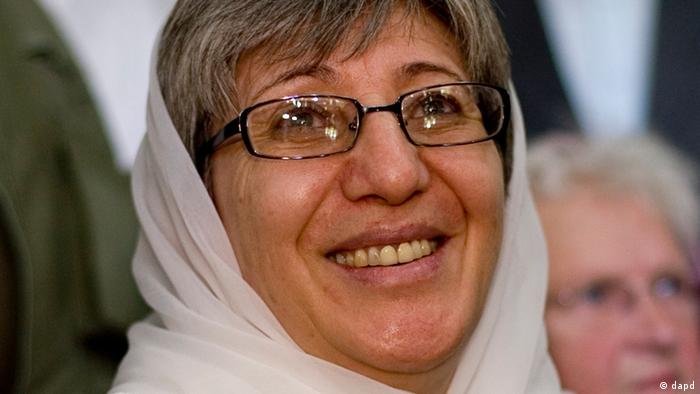
Afghan doctor Sima Samar has been awarded the Rights Livelihood Award for her dedication to human rights. Other recipients of the "alternative Nobel" include scholar Gene Sharp and Britain's Campaign Against Arms Trade.
Four activists were awarded Sweden's prestigious 2012 Right Livelihood Award on Thursday their work promoting human rights, conservation and combating the global arms trade.
Sima Samar, 55, was honored by the jury "for her longstanding and courageous dedication to human rights, especially the rights of women, in one of the most complex and dangerous regions in the world."
A medical doctor by training, Samar (pictured above) became Afghanistan's first minister of women's affairs in 2001. She was forced to resign six months later after criticizing Shariah law in an interview in Canada, but went on to become the head of the Afghanistan Independent Human Rights Commission. She also served as UN special rapporteur on human rights in Sudan from 2005 to 2009.
Her Shuhada Organization currently runs 71 schools and 15 clinics and hospitals in Afghanistan.
Samar shares the 150,000 euro ($195,000) cash prize in part with American political theorist Gene Sharp, 84, who was described as the "the world's foremost expert on non-violent revolution."
He was celebrated for "developing and articulating the core principles and strategies of non-violent resistance and supporting their practical implementation in conflict areas around the world."
In the past Samar and Sharp have both been touted as potential winners of the Nobel Peace Prize.
Honorary prize awarded
The third award went to the British-based Campaign Against Arms Trade (CAAT), which also won a 50,000 euro share of the prize. The organization was credited for its "innovative and effective campaigning against the global trade in arms."
An honorary prize was also awarded to Turkish businessman and environmentalist Hayrettin Karaca, who co-founded an international movement that combats soil erosion and protects natural habitats. The 90-year-old was described by the jury as "the grandfather of the Turkish environmental movement.
The Right Livelihood Award was created by Swedish-German philanthropist Jakob von Uexkull in 1980 after the Nobel Foundation behind the Nobel Prizes refused to create awards honoring efforts in environmental and international development.
The donor-funded prize is designed to "to honor and support those offering practical and exemplary answers to the most urgent challenges facing us today."
Thursday's winners were chosen from 122 nominations from 52 countries. Their awards are due to be presented at a ceremony in the Swedish parliament on December 7.
WFP Pakistan Begins Food Distributions To Flood-Affected In Sindh; Funds Urgently Needed To Gear Up
The United Nations World Food Programme (WFP) has begun food distributions to tens of thousands of people affected by monsoon floods in Sindh province, with plans to gear up operations to reach the most severely affected areas of Balochistan.
A one-month food ration is being distributed to some 10,000 families in Jacobabad district of Sindh, where some areas are under 2.5 metres (8 feet) of water, drawing upon limited available stocks of food. WFP plans to reach a further 10,000 families in Balochistan later this week.
With road access limited due to the flood waters, WFP has deployed 16 motorboats to reach some of the worst affected communities.
However, any assistance beyond this first phase will require additional funding from donors and WFP is seeking urgent donations of US$15 million.
“We could scale up our response to reach up to 250,000 families – that’s 1.7 million people,” said WFP Pakistan Country director Jean-Luc Siblot. “But that would mean using food stocks earmarked for relief to the displaced population in the northwest of the country and these would have to be replenished by December – that means funding is needed now.”
The WFP food basket consists of dietary staples of fortified wheat flour, pulses, vegetable oil and iodized salt, as well as High Energy Biscuits and specialized ready-to-use supplementary food for small children.
Pakistan’s National Disaster Management Authority has estimated that up to 4.5 million people have been affected by severe flooding in Sindh, Balochistan and Punjab, following heavy rains earlier this month. However, not all of these may require food assistance. A Multi-sector Initial Rapid Assessment has been carried out in the affected areas and the results, expected shortly, will give a clearer indication of the needs of those affected.
The disaster has already caused the deaths of up to 400 people, destroyed houses and hundreds of thousands of acres of crops.
Many of the districts affected, particularly in Sindh and Balochistan, were already struggling to recover from the floods of 2010 and 2011, with communities particularly vulnerable to the effects of this latest shock.
___________________________
New Food Fortification Partnership to Reach 15 Million Afghans with More Nutritious Foods
www.wfp.orgA partnership between WFP, GAIN and the Afghan Ministry of Public Health will see essential vitamins and minerals added to staple foods including wheat flour and vegetable oil. Afghanistan’s Ministry of Public Health, the Khalifa Bin Zayed Al Nahyan Foundation (KBZF), the Global Alliance for Improved Nutrition (GAIN) and the World Food Programme (WFP) have launched a partnership that will reach approximately 15 million Afghans with nutritionally fortified wheat flour, vegetable oil and ghee. The partnership aims to reduce the prevalence of vitamin and mineral deficiencies among the general population and vulnerable groups such as children under five and women of reproductive age, through a project supporting the Government’s Nutrition Action Framework to address malnutrition. The project will bring on board the largest vegetable oil producers and wheat flour millers exporting to or producing in Afghanistan while equipment and nutrient blends will be provided to industry along with training in quality assurance. “The contributions of KBZF, GAIN and WFP are much appreciated - in these difficult times of recovery, the project will strengthen the health of our people and our economy,” said Dr. Suraya Dalil, the Minister of Public Health in Afghanistan. “As the main donor to the project, we are excited to see local ownership across sectors and look forward to achieving the results and milestones we have set,” said Mr. Mohammed Haji Al Khoori, Executive Director of KBZF, an independent entity based in Abu Dhabi with the mission of delivering humanitarian aid and services to poor populations. “Access to good nutrition is a human right that no individual should be denied. We are pleased to support this national initiative that will make a real difference in the everyday lives of millions by engaging multiple partners across different sectors,” said Marc Van Ameringen, Executive Director of GAIN. GAIN is providing financial support and technical expertise to produce the fortified foods, monitor their quality, create demand and develop technical guidelines for fortification. Louis Imbleau, WFP Afghanistan Country Director and Representative added, “Chronic malnutrition, especially among women and children, is a terrible burden for the people of Afghanistan, both in terms of health and economic productivity. Micronutrient fortification is a cost-efficient intervention that can really help tackle this problem.” WFP, the world’s largest humanitarian organization fighting hunger worldwide, is the key agency supporting overall program implementation in Afghanistan.
‘Zardari forcefully projected Pak in UNGA’
Special Assistant to the prime minister and PML-Q secretary-finance Imtiaz Ranjha on Wednesday lauded the bold and strong message sent to the world community by President Asif Ali Zardari reflecting sentiments of the nation over the anti-Islam movie. Talking to the APP, Ranjha said that the president’s address to the UNGA would help the western nations understand the feelings of the Muslims over the sacrilegious video and the demand of bringing the culprits involved in production of the film to justice was a brave move.
“The people on streets are happy that the President strongly condemned the acts of incitement of hate against the faith of billions of Muslims and Holy Prophet (Peace Be Upon Him) and urged the international community to punish the elements involved in desecration on the basis of religion,” he said. He said that the international community now must not become silent spectators and should criminalize such acts that destroy the peace of the world and endangered world security by misusing `freedom of expression’.
Ranjha said it was heartening to note that the president urged the international community to join hands to end poverty, to ensure equal rights to all peoples, to protect the weak who pursue justice and fairness for all people to ensure peaceful settlement of international disputes. Ranjha said that the president also asked the world to give an end to the “do more” mantra against Pakistan vis-a-vis war against terror and rather told the world leaders how much Pakistan had paid for the war against terrorism during past ten years.
He said the bold and frank speech by the president reflected that Pakistan wanted to cooperate with the world community for resolving all regional and global problems and rather it was leading the onslaught against extremists and terrorists. He hoped that the address by the president would help the world leaders understand how much democratic order had been strengthened in Pakistan and the democratic government was successful in resolving major issues regionally and globally.
Meanwhile Khyber Pakthunkhwa Senior Minister, Rahimadad Khan said on Wednesday that President Asif Ali Zardari address to the United Nation General Assembly (UNGA) has reflected the wishes and aspirations of billions of muslims and Pakistani nation and termed it historic in the prevailing situation. Paying rich tributes to President Asif Ali Zardari for his historic and foresighted address before the comity of nations in the UNGA, the Senior Minister told APP that the President has won the hearts and minds of people by strongly condemning the acts of incitement of hate against the faith of billions of muslims and Holy Prophet Muhammad (SWA) and urged the international community to punish the elements involved in desecration on the basis of religion.
The President has asked the international community not to be become silent observers and should criminalize such acts that destroy world peace and endangered world security by misusing ‘freedom of expression.” Rahimad Khan said the anger of Muslims against anti-Islam movie is very natural and the President has boldly conveyed their feelings and concerns to the world community.
The Minister said the third world countries were confronted with problems of poverty, delay in justice and illiteracy that need to be tackled. He said the President has urged the international community to join hands to end poverty, ensure equal rights to all people, and protect the weak and vulnerable and pursue justice and fairness for all people to ensure peaceful settlement of international disputes.
The President has called upon the United Nations and especially those nations represented at UN who are actively engaged in the region, for international collective action to combat the menace of drug trade. He said the President address was appreciated by all and sundry and a guideline for ensuring peace, stability and progress of the world
'Kashmir is symbol of UN's failure'
Addressing the United Nations General Assembly (UNGA) in New York, Pakistan President Asif Ali Zardari once again brought up the Kashmir issue saying that the ongoing territorial dispute of Kashmir was a result of failure of the UN system. Zardari further condemned the anti-Islam film that has sparked protests around the world and called on world leaders to criminalise such acts. He also said that Pakistan had paid its fair dues in the fight against terrorism, rebuking claims by the U.S. that the South-Asian country could do more.
Australian sheep issue: Iran voices concern over meat import from Pakistan
http://www.brecorder.comThe much debated and unresolved issue of importing infected sheep from Australia has started falling heavily on the country’s economy as Iran has shown its concerns over meat import from Pakistan. Iran which is the major importer of meat from Pakistan, is much concerned about the fresh development about the health of animals imported from Australia, sources told Business Recorder. Through letters and emails, the concerned authorities and importers from the neighboring country have started asking exporters and government agencies here about the quality of meat being imported to Tehran. A ban or restriction on imports may be imposed if the issue was not resolved immediately, sources feared. The reactions were as a result of reports suggesting the recently imported Australian sheep were infected with contagious bacteria. This was the first reaction made by international buyers of Pakistani meat. Pakistan, sources feared, may also face same reaction from other Middle Eastern countries affecting the over all live stock and meat industry. Pakistan was exporting meat (beef, mutton and camel meat) worth over $ 125 million during the last couple of years. The meat industry was facing currently major crisis since a growth in exports of the value added products were recorded previously. According to sources at Ministry of National Food Security and Research over 9,500 exotic animals, 318,768 semen doses and 4,300 embryos of high yielding animals have been imported last year. According to sources, over $ 60 million worth of frozen meat was being exported to Gulf countries after processing from eight slaughterhouses. Five of these are in Lahore and three in Karachi. The country had exported about 23,855 tonnes of meat worth $ 74.4 million during 2008-09. It had also exported around 94,000 animals to Afghanistan, amounting to $ 12.35 million. In 2008-09, meat production stood at 2.242 million tonnes. Though India was the leading meat exporter of the region, but it was not exporting beef, leaving a large potential market to Pakistan that should be exploited by country’s exporters. Pakistan Meat Processor Exporter Association had earlier estimated that annual beef production of the country was 1.549 million tonnes, mutton 0.587 million tonnes and poultry production was 0.106 million tonnes. Beef contributes almost 50 percent of total meat exports of the country, while mutton’s share was around 23 percent and poultry was 17 percent.
President Zardari's address to UN
Daily TimesPresident Asif Ali Zardari’s expectantly awaited address to the UN General Assembly (UNGA) presented Pakistan’s case to the world community articulately, clearly, and without pulling any punches. He started by calling on the UN and world community to act against blasphemy and incitement of hatred, a reference to the recent furore over the film insulting to Prophet Mohammad (PBUH). He urged the international community not to remain silent observers and move to criminalise acts that destroy the peace of the world and endanger world security by misusing the right of freedom of expression. The president then went on to underline his oft-repeated desire for Pakistan to become the recipient of trade access and concessions, not aid. In this context, the president thanked the EU for its recognising the value of trade for Pakistan. He then went on to spell out the vision of a South Asia that becomes interconnected and the vehicle for a new regional narrative that helps bind and bring closer all the countries of the region and beyond through trade ties and economic cooperation. He mentioned the outreach to Afghanistan (the Transit Trade Agreement) and India (trade and economic cooperation) to emphasise the point. He appealed to the world to stop the refrain of ‘do more’ directed at Pakistan, arguing that this was an insult to the 7,000 soldiers and policeman and over 37,000 civilians killed in the struggle against terrorism, besides denigrating the suffering of the living. He also made a poignant reference to slain federal minister Shahbaz Bhatti and the president's friend Salmaan Taseer, Governor of Punjab, at the hands of extremists and terrorists. But he reserved his profoundest comments for Benazir Bhutto, his wife, mother of his children, and a visionary leader who had warned against the danger posed by the extremist mindset. President Zardari delineated the global challenges of poverty, injustice and climate change, amongst others, challenges that Pakistan will tackle in consonance with the global community. He supported the right of the Palestinian people to their own state and argued the case for their recognition by the UN. Pakistan’s prominent role in UN peacekeeping and its engagement with needed reform in a democratic direction for the world body found mention in the president’s address. The Kashmiri people’s inalienable right of self-determination through peaceful means was underlined. Terrorism and its nexus with the burgeoning drugs trade, which has gone up 300 percent in the last decade and funds most of the terrorist groups operating in Pakistan, Afghanistan and elsewhere was highlighted in the president’s remarks, calling on the global community for a concerted struggle against these twin menaces. While President Zardari eloquently and succinctly summed up Pakistan’s positions on the burning issues of the day, it may be politic to ask why it is that we are unable to escape the incessant drone demanding ‘do more’. The basic reason is that both in fact and in international perception, Pakistan is seen as the ‘mother’ of the Taliban against whom the ISAF forces are engaged in battle in Afghanistan. Pakistani soil continues to be used for safe havens for the Taliban and affiliated groups for their insurgency inside Afghanistan. Pakistan is therefore essentially pressed to deny these extremists and terrorists the luxury of a safe rear area to which they retreat, recuperate and relaunch their attacks inside Afghanistan. Pakistan has prevaricated for long on fulfilling this demand. Although the chorus of ‘do more’ has become more muted over time, the suspicions harboured against Pakistan as the main backer of the Taliban continue to linger. So long as Pakistan does not reconsider, if not abandon, its ‘unholy’ alliance with the Taliban extremists, it will find it heavy going in the world community and perhaps not to be able to get rid of the dreary repetition of the ‘do more’ mantra.
Russian president postpones Pakistan visit
The Express TribuneRussian President Vladimir Putin has postponed his visit to Pakistan, saying that he has other engagements scheduled on the same dates, the Pakistani foreign office said on Thursday. However, Express News reported that he postponed his trip due to security concerns. According to a press release issued by the Pakistani foreign office, the quadrilateral summit between Pakistan, Russia, Tajikistan and Afghanistan which was scheduled for October 2 and 3 has also been postponed. In a letter to President Asif Ali Zardari, Putin expressed his eagerness to “jointly enhance efforts to further develop Russian-Pakistani ties” and “advance mutually beneficial trade and economic projects.” The Russian president wrote, “I am confident that in future we shall be able to find opportunities for arranging our personal meeting. We shall always be happy to receive you in Russia”. The new dates for the summit will be sorted out after seeking availability of the participating leaders through diplomatic channels.
Wednesday, September 26, 2012
President Obama's Speech at Clinton Global Initiative
BY:Malika Saada SaarAfter stepping off the podium at the United Nations, President Obama made a historic commitment -- to combating modern day slavery. Not just in remote corners of the developing world. But here in this country as well. Many of the slaves in America today are girls. Born in this country. Hidden in plain view. You see these girls around you. They are the lost girls, standing around bus stops, hanging out by runaway youth shelters, or advertised online. Here in D.C., they are right in front of you. At the Motel 8 or the Marriott, at McDonald's or the bars on U Street and Adams Morgan. According to the FBI, there are currently an estimated 293,000 American children at risk of being exploited and trafficked for sex. Forty percent of all human trafficking cases opened for investigation between January 2008 and June 2010 were for the sexual trafficking of a child. And while the term trafficking may conjure images of desperate illegal immigrants being forced into prostitution by human smugglers, 83 percent of victims in confirmed sex trafficking cases in this country were American citizens. The average age of entry into commercial sexual exploitation for these children is between the ages of 12 and 14. They are abducted or lured by traffickers who prey on their trust. They are routinely raped, beaten into submission, and sometimes even branded. When they try to run away, the traffickers torture and or gang rape them. They are girls like Jackie, who ran away from an abusive home at 13 only to be found alone and hungry by a trafficker who promised to love her like a father/boyfriend/Prince Charming. He sold her to at least six different men every night. When she begged him for food or rest, he beat her. Many of these girls come out of a broken foster care system. Of the trafficking victims in Alameda County, Calif., 55 percent were from foster youth group homes. In New York, 85 percent of trafficking victims had prior child welfare involvement. And in Florida, the head of the state's trafficking task force estimates that 70 percent of victims are foster youth. T was born into the foster care system and trafficked at the age of 10 by a trafficker to men all over California, Washington, Oregon and Nevada. As T explained: In most of my 14 different placements in foster care homes, I was raped, and attached to a check. I understood very early that I could be raped, cared for, and connected to money. It was therefore easy to go from that to a pimp -- and at least the pimp told me that he loved me. And when I was under the control and torture of a pimp, child welfare was never there to help me, even though I was a child being abused. Young girls like T and Jackie are the new commodities that traffickers and gangs are selling. It is less risky and more profitable to sell girls than crack cocaine or meth. The U.S. government spends 300 times more money each year to fight drug trafficking than it does to fight human trafficking. And the criminal penalties for drug trafficking are generally greater than the ones usually levied against those who traffic in girls. Legally, men who purchase girls for sex are no different than men who snatch children off the street to violate them. Both are rapists. No child is permitted to have sex with an adult, much less sell her body -- the law says she can't consent. Yet arresting these perpetrators of child rape is rare, and prosecution is even rarer. In most cases, these men are politely referred to as "Johns" and set free. According to the international anti-trafficking organization Shared Hope, very few buyers of prostituted children are arrested or prosecuted in the United States. In fact, when an arrest is made, it is often the child who ends up behind bars. Most girls in detention, whether they are arrested for prostitution or for running away from foster care, are actually victims of trafficking and sexual violence. Both T and Jackie, and girls like them, were repeatedly arrested and detained for prostitution, despite being children who were forced to sell their bodies. This must be the only time the abused child is incarcerated for the abuse perpetrated against her. That's the problem -- these girls are not considered victims. Here in D.C., and across the U.S., we have the same child sex slave markets as in Cambodia, the Philippines, and India. Girls are sold to the very same types of men, and they are tortured in almost identical manners if they attempt to leave. Yet these girls, the girls from Southeast D.C. or South Central L.A., are seen as the "ho," the bad girl, the hooker. It is time to really see these girls and help them. Hopefully, the plans the president outlined will help these girls too -- because no girl in America, in the 21st century, should be for sale.
Americans say Obama's ads are more honest

In an election season that has produced reels of negative ads and dizzying spin, more Americans find that President Barack Obama's ads remain honest, giving his campaign a 12-point lead over that of his Republican opponent, Mitt Romney, according to the Yahoo!/Esquire poll.
Many Americans appear to agree with Romney pollster Neil Newhouse's statement that "We're not going to let our campaign be dictated by fact-checkers," though perhaps not in the way the Romney campaign would like. Among the general population, 42 percent found that the president's ads stick to the truth, while only 30 percent said the same about Romney's campaign ads.
As for which side's ads contained outright lies, Americans view Romney and Obama as neck and neck. The margin of error for the survey, conducted shortly after the two national political conventions, is plus or minus 4 percentage points.But the sad truth is that two-thirds of Americans fully expect politicians to lie, as a rule of thumb. Most who hold that expectation are bothered by it.
In his interview with "60 Minutes" Sunday evening, Romney complained that the president and his supporters distort the facts to fit their narrative. But 60 percent of those surveyed found that Romney's refrain—that Obama has "failed" America in his first term—is too harsh an appraisal, with only 36 percent calling it a justified claim.
The poll was conducted among a random national sample of 1,002 adults from Sept. 7 to Sept. 10. The respondents were contacted by landline and cellular telephone.
Training Afghan Allies, With Guard Firmly Up
When American military advisers fly into Afghan Army outposts like the one nestled on the floor of this forested valley, they keep their body armor on and their weapons loaded.
Their guard was up even though they were there for a day of training Afghan soldiers without once leaving the confines of a fortified base — even when chatting with the Afghan officers over a lunch of goat meat and yogurt.
Afghan soldiers and police officers have gunned down 51 American and allied troops so far this year, and now no one is taking chances. The advisers’ extreme caution lays bare the steep challenge ahead after the official end of the American troop “surge” on Friday and as the mission shifts toward the next chapter of the war: preparing the Afghans to fight on their own.
“They come here and they look like they are going to fight us,” said Sgt. Abdul Karim Haq, 25, an Afghan soldier at the outpost. “They are always talking down to us like we are little children.”
American military leaders say they have little choice as insider killings have become a prevalent cause of death. Attacks by Afghan forces against Western soldiers and Marines this month led to new precautions over where and when joint operations and training sessions happen. At the same time, a video and cartoons mocking the Prophet Muhammad are stoking outrage and violence against Americans across the Muslim world.
In the field, where small teams of American advisers are now working with Afghan units, even minor misunderstandings are treated as potentially violent confrontations.
When a pair of Afghan soldiers decided to take a nap in a guard tower in which the Americans had taken up a position at this outpost, the coalition advisory team commander, Capt. John Chung, 28, sent his interpreter to hustle out the Afghans with an admonishment to “be gentle. No trouble, you know what I mean.”
Aside from a fear of being gunned down, the advisers said they were more vigilant because they also doubted the ability of Afghan soldiers to secure the base from an insurgent attack.
“Exhibit A,” one adviser noted about the Afghans’ nap in the guard tower.
“I think we need to be ready for everything. Maybe it’s coming from inside, or maybe it gets in here from the outside,” said the adviser, a young soldier who did not want to be identified for fear of damaging his career. “I mean, sleeping in a tower? There are a lot of reasons to be careful out here.”
By here, he meant behind high walls that American soldiers had built near Bad Pakh, in eastern Afghanistan, just a few years ago and guarded until handing the outpost over to the Afghan Army in March. Once home to Americans, it is now treated by them as another dangerous place in a hostile country.
And for good reason, judging by comments from Afghan soldiers here and elsewhere in the country.
Abdul Hanan, 20, a soldier also based in the east, was blunt. “We would have killed many of them already,” he said, “but our commanders are cowards and don’t let us.”
He said the Americans treat the Afghans roughly, cursing at and bullying them. “We like the Americans’ heavy weapons, but we don’t like their soldiers,” he said.
He and other soldiers nonetheless acknowledged what the Pentagon’s own public reporting makes clear: the Afghans are not ready to fight without American help, and the United States is eager to see that they still get it.
American forces may be dwindling, but “there’s still going to be an insurgency here,” said Brig. Gen. David G. Fox, the top adviser north of Kabul. The advisers’ brief is to “make sure the Afghans can take it on themselves.”
Despite a decade-long, $33 billion allied effort to build the military and the police, Afghanistan’s security forces “continue to confront challenges, including attrition, leadership deficits and limited capabilities in staff planning, management, logistics and procurement,” according to an April review of Afghan security by the Pentagon.
The army was improving, the report said, pointing to the fact that 13 of the Afghan Army’s 156 battalions were now rated by the coalition as “independent with advisers,” up from one in 2011. The ranking is the highest given by the coalition.
Yet the report readily acknowledged that its own figures were suspect. This year the coalition stopped using officers independent of its training command to validate ratings, and the change “has resulted in the recent increase in ‘independent with advisers’ units,” it said.
Persistent corruption and organized crime networks within the security forces also risk undermining rising public esteem for the army and the police, and could “pose a threat to the transition process,” it said.
The police, in particular, have a reputation for brutality and corruption. In Bagh-e-Pol, a village near the southern city of Kandahar, the police chief, Abdul Wali, boasted that he and his men often beat people suspected of being members of the Taliban so badly that “sometimes he loses an arm, sometimes he loses a leg.”
Mr. Wali’s American advisers smiled uncomfortably as he explained in an interview that he did not need a trial to know who deserved a beating.
Senior American and European officials say privately that problems within the Afghan forces have reinforced internal doubts about Afghanistan’s long-term stability.
As one Western official put it, American and European talk of the transition in Afghanistan being “conditions based” is really about the conditions in America and Europe, where majorities no longer support the war.
The immediate result is that coalition resources are diminishing fast, though senior American officers said scarcity could have its advantages. With less to give to the Afghans, who for years looked to coalition forces for everything from clean drinking water to air cover, they will have to learn to fend for themselves.
But that does not include Western assets like surveillance drones, attack helicopters and medical evacuation helicopters, which will remain in Afghanistan for some time, officials say.
Advisers flew into Bad Pakh last month to teach the Afghans how to load wounded soldiers into an American medevac helicopter. Time permitting, they also planned mortar practice.
But when the Americans flew out 10 hours later, the training day had gone much like three previous ones held here in the past two months: the helicopter never showed. It was either down for maintenance or called away for a more pressing mission. The advisers never got a clear answer why.
Mortar practice also had to be scratched when it turned out the Afghans were missing the sight for their sole mortar tube.
With plenty of time to talk, the Afghans told stories about life without the Americans. Their first big test came in June when a patrol ran out of ammunition after being ambushed by the Taliban, who killed one soldier and captured another, said Sgt. Maj. Ghulam Jilani, 45, the senior Afghan enlisted soldier at the base.
The Americans had pulled out three months earlier, and the Afghans quickly determined that a rescue mission was too risky without the air cover and surveillance once readily provided by their now-departed allies.
So, Sergeant Major Jilani said, they got their man back the “Afghan way.” They rounded up fighting-age men from a nearby village and took them back to the base. The villagers basically became hostages.
“We made sure everyone knew: ‘Give us the soldier back and we’ll free the men,’ ” Sergeant Major Jilani said.
By dusk, the district governor had brokered a trade.
Without American backup, “we could only do what these village people would understand,” Sergeant Major Jilani said. “Why should there be any objections to this method? We did not shoot the men.”
AG Qadir sanguine over progress in NRO Implementation case
Attorney General of Pakistan Irfan Qadir Wednesday said the president of the state enjoys immunity and the matter involving the letter is expected to be resolved soon.
Talking to media outside the premises of Supreme Court (SC), he said there should be no clash between the state institutions.
The immunity of the president is recognized in the Constitution; hence, it is not needed to be sought from the court, he said answering a question if the government will solicit immunity.
Zardari : Pakistan wants trade, not aid
DAILY TIMESAddressing the UN General Assembly late on Tuesday, President Asif Ali Zardari stressed that Pakistan sought trade rather than aid, thanking the European Union member states for recognising the value of trade to Pakistan. “By granting trade concession to Pakistan, the EU has sent a positive message. The trade concessions will help us revive the economy and fight terrorism,” he added. President Zardari started his speech by expressing strong condemnation “for the acts of incitement of hate against the faith of Muslims of the world and Prophet Muhammad (PBUH)”. He said the international community must not become silent observers and should criminalise acts that destroy the peace of the world and endanger world security by misusing freedom of expression. Urging the world community to refrain from the ‘do more’ mantra, the president said no country and its people had suffered more in the struggle against terrorism than Pakistan. He said drone strikes and civilian casualties added to complexity in Pakistan’s battle for hearts and minds through the struggle. “To those who say we have not done enough, I say in all humility: please do not insult the memory of our dead, and the pain of our living. Do not ask of my people, what no one has ever asked of any other peoples. Do not demonise the innocent women, and children of Pakistan. And please, stop this refrain to do more.” He said the growing regional pivot in Pakistan’s foreign policy reflected its democratic policy-making. By normalising trade relations, he said, “we want to create a regional South Asian narrative. This narrative will provide an environment that will mutually benefit the countries of our region. One of them is the tendency to respond to failure through blame. Pakistan does not blame others for the challenges it faces. We believe we should look for win-win solutions. Regional cooperation and connectivity will bring us closer and bind us together”. He said Pakistan’s hosting of a quadrilateral summit next month and signing of the Afghan-Pakistan Transit Trade Agreement were proof of its commitment to regional connectivity. Zardari said further there were enormous challenges globally. He said, “We must work to end poverty, protect the planet, and mitigate climate change, ensure equal rights to all peoples, and protect the weak and vulnerable, pursue justice and fairness for all people, pursue the peaceful settlement of international disputes, save our current and future generations from the horrors of war.” He added Pakistan was proud of going above and beyond the call of duty in fulfilling its international responsibilities. On the Palestine issue, the president said Pakistan supports the rights of the Palestinian people and an independent Palestinian state, adding, “We also favour the admission of Palestine as a full member of the United Nations.” Speaking on terrorism, President Zardari said Pakistan had lost over 7,000 soldiers and policemen, and over 37,000 civilians in fight against the menace. He also spoke about the assassinations of minority affairs minister Shahbaz Bhatti and Punjab governor Salmaan Taseer (whom he called his friend), as well as former premier Benazir Bhutto, saying Pakistan had lost them all to the extremist mindset. He said terrorism and extremism had destroyed human lives, torn social fabric, and devastated the economy. Zardari said terrorist activities within the region and around the world were funded and fuelled by the unrestricted production and sale of illegal drugs, adding Pakistan had pursued an ambitious agenda to control the menace. Talking about South Asia, Zardari spoke about the ever-strengthening ties between Pakistan and China, and engagements to deepen friendship with Afghanistan. “A brighter Afghan future will only be possible when the search for peace is Afghan-owned, Afghan-driven and Afghan-led. Pakistan will support in every way possible, any process that reflects Afghan national consensus.” Zardari also said Pakistan would continue to support the right of the people of Kashmir to peacefully choose their destiny in accordance with UN resolutions. agencies
Putin warns against double standards in fighting terrorism, extremism

Moscow stood against double standards in dealing with extremism and terrorism, Russian President Vladimir Putin said Wednesday.
Terrorists deserve tough treatment, Putin said, adding that, in fighting terrorists, the cultural values and religious feelings of peoples should be respected.
"It is necessary to mount joint efforts to counter terrorism threats and extremism wherever they occur -- in Libya, Iraq, Yemen, Syria, Egypt, Afghanistan," Putin told a meeting with foreign ambassadors, adding double standards should not be applied.
Meanwhile, Russia strongly opposed violent approaches toward "regime change" in hot spots around the world, especially in the Middle East and North Africa, Putin said.
Inciting violence with the aim of toppling governments could only lead to stalemates, as the vicious circle of "violence breeds violence" could never end, Putin said.
Karachi: Another Shiite killed, 6 killed in last 24 hours
According to our correspondent, another Shiite, Zahid Hussain Zaidi, was shot dead in Karachi, making him the 6th Shiite to be killed in the last 24 hours at the hands of Sipah-e-Sahaba extremists.
Furthermore, the Shiite was targeted in Golimar Jaffaria near Rizvia where he lived. Syed Zahid Hussain Zaidi was repeatedly shot and therefore died on the spot. The martyr’s body has been moved to the Abbasi Shaheed Hospital.
This martyr was the 6th Shiite to be killed in the past 24 hours. 4 of the 6 where killed in Karachi and 1 in Quetta.
Pakistan‚ Afghan‚ UK vow to bring peace, prosperity
Pakistan‚ Afghanistan and UK have vowed to continue cooperation for peace and stability in region.
This was stated by President Asif Ali Zardari‚ Afghan President‚ Hamid Karzai and British Prime Minister David Cameron at a trilateral conference in New York on the sidelines of UN General Assembly annual session on Wednesday.
In his opening remarks‚ President Asif Ali Zardari stressed the need for concrete efforts to promote education in the region to overcome extremism. He said boosting economic and trade activities are also of vital importance to curb this menace. He said by providing employment to the youth‚ they can be saved from going into the hands of extremists.
President Zardari said that special emphasis will have to lay on economic growth for speedy socio-economic development of the people which is also important for peace.
Asif Ali Zardari urged the need for solid steps to eliminate drug trafficking saying that it is main source of income for the terrorists. However‚ he said‚ concerted and joint efforts will have to be made by all stakeholders to flush out terrorists from the region and bring peace in the region.
The President said Pakistan which is hosting over two point five million Afghan refugees wants their respectable repatriation and urged the partners in war against terrorism to extend cooperation in this regard.
He said Pakistan wants durable peace in Afghanistan which is also imperative for peace in Pakistan. He said Pakistan is extended all possible cooperation for peace and stability in Afghanistan.
British Prime Minister David Cameron in his remarks assured full cooperation from his country to Pakistan and Afghanistan for bringing peace and stability in the region.
Afghan President Hamid Karzai said that they want strong partnership with the international community to promote economic activities in his country instead of getting aid.
President Asif Ali Zardari and British Prime Minister David Cameron also held a separate meeting in New York on Wednesday.
Both the leaders discussed ways to enhance bilateral cooperation in various fields particularly in trade and economy besides reviewing regional situation. They also discussed possible steps to gear up efforts to bring peace and stability in the region.
Pakistan: Violence and hooliganism: In the name of religion
By: Dr Qaisar RashidPrior to any such announcement, the government could have consulted the religious and political parties and transferred the responsibility for protest management to them Pakistanis are not lesser Muslims. A peaceful protest against a sacrilegious movie would have perhaps meant that Pakistanis were compromised Muslims. What Pakistanis proved on September 21 (last Friday) was that if Arabs in their countries could turn the anti-movie protest into acts of violence by razing property and devouring human lives, Pakistanis were equally capable of doing the same. A protest against the irreverent movie that ends up in destroying public and private property and claiming human lives is unjustified. Such a violent act and associated hooliganism is no service to the cause of Islam. Nevertheless, the government faltered on three counts. First, the government’s decision to declare Friday a national holiday to let people demonstrate against the blasphemous movie was a call in haste. Prior to any such announcement, the government could have consulted the religious and political parties, besides the representatives of civil society, and transferred the responsibility for protest management to them. In an effort to keep all on board, instead of Friday, any other day could have been selected for the peaceful display of Pakistanis’ feelings. Second, it is known that in the subcontinent, Muslims are very sentimental about the inviolability and holiness of the symbols and personalities of religion. Here, sentiments mean that emotional attachment carries more weight than sagacity. Against this backdrop, harbouring expectations from the protestors to perform rational acts while giving vent to their surging anger against the movie, its maker or the land where it was made, was itself a preposterous idea. Hence, before announcing the decision of a national holiday, the government should have come up with a comprehensive plan to manage the viciousness of reactive crowds, instead of leaving the space open for letting anything happen. Third, the government should have declared whether or not it would allow the participants to get their protest registered with the US authorities in Pakistan. Even if it is accepted that the turning of a protest into an act of violence was a phenomenon not to compete with the rage of the Arabs, the protest was revealing in at least seven ways. First, the protest showed that there was a link between the religious thinking of people and violence. The broader question is, does the religion of Islam teach violence to articulate one’s feelings and let violence be a way of life? Second, the protest showed that when people were angry and in the streets, they tended to lose the sense of distinction between what to do and what not to do. It is not known what purpose setting police mobiles on fire served. These vehicles were meant for protecting the same people from robbers and criminals. The absence of these vehicles is bound to enhance the vulnerability of the people to crime of all sorts. Third, the protest showed that the protestors had lost all sense of proportion. That is, the protestors could not decide whether the protest was against the government of Pakistan or against the movie. Similarly, the protestors could not decide whether the protest was against banks and petrol pumps or against the moviemaker. Further, the protestors failed to judge how setting a fellow citizen’s car on fire could send a message to the US to penalise the maker of the movie in question. Fourth, the protest showed that any gathering of protestors could turn into a mob that had a tendency of dispensing justice on its own. Such a mob remains leaderless and directionless. That is how mob mentality is lethal: An uncontrolled fury that can be unleashed on anyone and anything but the offenders remain unaccountable. The trend portends much trouble for Pakistan in the future. Fifth, the protest showed that violence was fast becoming a way of life in Pakistan. People thought that resorting to violence was the only recourse to be heard. In the past, the callous disregard of the government towards the genuine demands of the people also promoted this kind of thinking. Hence, if violence is the language used to convey one’s message to those who matter, it means Pakistan is degenerating and its tall claims about the rising literacy level are a farce. Sixth, the protest showed that the number of marginalised people in society is mounting. Whenever the marginalised found a chance to avenge their marginalisation, they would not squander any such opportunity. These marginalised people may be semi-illiterate people who are clueless in which age they are living; these marginalised people may be semi-skilled people who are jobless and find insufficient economic solace in society; these marginalised people may be religiously educated people who feel themselves irrelevant to society; and these marginalised people may be politically redundant people who do not see their future attached to the progress of Pakistan. Seventh, the protest showed that the number of disgruntled people was increasing in society. Some consider that the contest, in the name of a protest, was between the haves and have-nots of society. The have-nots did not fail to snap at a chance to seek revenge for their haplessness and equal the score by depriving several people of their legitimate property. Some consider that uncontrolled urbanisation led to the migration of illiterate rural people to urban areas who unleashed their uncontrolled fury on urban property and urban symbols in the name of protest. Some consider that the ignorant portion of the much averred ‘youth bulge’ showcased its worth during the protest. Some consider that the deprived of society waged a personal vendetta against the country in the name of protest. The government should urge the US government to review its laws to differentiate between what is freedom of speech and what is a sacrilegious act.
Peshawar: Rs30mn for repair of church
Chief Minister Khyber Pakhtunkhwa Amir Haider Khan Hoti inspected the church in Mardan that was set ablaze by miscreants in guise of protestors on last Friday.
The chief minister announced Rs 30 million for repair and reconstruction of the church.
The chief minister said that elements burning the church to ashes were involved in conspiracies of damaging religious harmony. He said that all these conspiracies will be thwarted with unity and concord.
He said Islam taught the message of peace and tranquility and grants fall freedom to followers of other religious to practice their religion. He said that followers of other religions have equal right over Pakistan.
He said that people responsible for the incident will meted with exemplary punishment.
He was addressing the Christian community in premises of the church at Mardan on Tuesday.
MNA Himayat Ullah Mayar, MPAs Asif Bhatti and Haji Ahmad Khan Bahadar, ANP District President Farooq Akram Khan, General Secretary Imran Manduri, district authorities, Ulemas and large number of Christian’s brother were also present on the occasion.
NATO: 2 service members killed in Afghanistan
Associated PressA suicide attack on a NATO patrol in eastern Afghanistan killed two service members in the U.S.-led coalition on Wednesday, NATO and Afghan officials said. The attack included small-arms fire, rocket-propelled grenades and a man wearing a vest laden with explosives, said Jamie Graybeal, a spokesman for the coalition. The coalition gave no other details, but Din Mohammad Darwesh, a spokesman in Logar province, said the suicide bomber, who was on foot, struck the international soldiers as they were patrolling a section of Pul-i-Alam, the provincial capital. The nationalities of the soldiers killed were not disclosed. So far this year, 285 NATO service members have been killed in Afghanistan.
Stabilizing Afghanistan a major diplomatic challenge

Zhou Yongkang, a member of the Standing Committee of the Political Bureau of the CPC Central Committee and top Chinese security official, made a brief visit to Afghanistan Saturday.
This marked the first trip made by a senior Chinese leader to the country since 1966.
It is no surprise that there is heated analysis over this latest trip among foreign observers.
Many are speculating about the long-term ambitions of Beijing, believing that the emerging power is seeking a larger role in post-NATO Afghanistan and is looking for greater influence in Kabul as the US and NATO are scheduled to withdraw their troops by 2014.
The anxiety around China's role in this region is growing increasingly apparent as the 2014 deadline approaches.
On the one hand, the US and its allies call for China to play a bigger role and help the US-led NATO to keep regional security.
On the other hand, they worry that their influence might be replaced due to China's growing presence in this region.
Within China, there is also heated debate over the role that China should play in this neighboring war-torn country. But it is generally agreed that the deterioration of the Afghan domestic situation will benefit nobody; for China, the stability of its northwestern bordering regions will be directly influenced and overseas Chinese in the region will face greater security problems.
Historically, Afghanistan has been a nightmare for many big powers.
As a neighbor of Afghanistan, China has a keen interest in the security of this region. How to help Afghanistan walk out of the shadow of long-term wartime chaos poses a big challenge to China's diplomacy.
During this latest trip to Kabul by Zhou Yongkang, China and Afghanistan signed economic and security deals that aim to help peace-building and reconstruction in Afghanistan and protect the security of China's own projects in the country.
China has a good opportunity to boost its global image and fulfill its international responsibilities.
While many Western strategists stick to their mentality of dominating world politics, China is making pragmatic moves to safeguard the interests of not only itself, but also the whole region.
Shireen Mazari resigns from PTI
http://www.thenewstribe.comIn what appeared to be a big-blow to the Imran Khan’s Pakistan Tehreek-e-Insaf (PTI), its senior leader and one of the old guards Shireen Mazari has resigned from the party. She said that the party’s membership drive was hijacked by ‘big money’ and that compromised the party elections “Party program has been taken over by ‘big money,” she posted on social networking site twitter. “The think tanks were isolated from policy formulation. Party created compromised policies PTI has changed its principles and brought in intermediaries Not leaving PTI for any other party, purely based on political issues” she wrote. “I regretfully resign as people had real hopes with PTII felt it better to resign after the Rajanpur incident. There were many differences between me and the party recently PTI didn’t need political names after the Lahore Jalsa. People supported PTI due to their ideology,” she added. “I didn’t ask for any high post, purely out of commitment to ideology.I have given in my resignation from PTI. In a press conference here on Wednesday, she said that the PTI was a youth party, but the way they treated her daughter on twitter, abusing her over my remarks, was unacceptable. “I did not disrespect the leader, I have great respect for Imran Khan, but he made a grave mistake”. “I am not raising allegations against IK’s character, but the party principles have been foregone.I support a culture of change that PTI promised, but the party is internally blocking change”. “I am ready to serve PTI again if the party lives up to its principles.”My resignation is not based on personal differences rather on policy and governance issues.”
BALOCHISTAN ASSEMBLY RESOLUTIONS MISPLACED
The Balochistan Assembly, in recent days, passed two controversial resolutions which are not in the interests of the people of Balochistan. It may be in the interest of the Ministers and a group of vested interests but not the poor people of Balochistan who are denied basic amenities for the past six decades. Representative democracy failed to defend the legitimate interests of the poor people of Balochistan as MPAs and Ministers served their personal interests and the people did not share the fruits of development or the Government spending.
The first resolution passed in support of the smugglers and terrorists as they are the real beneficiaries of the smuggled luxury vehicles from Afghanistan which were used in terrorist activities and committing serious offences against the civil society, if not the State. In case of the ordinary people and fond of pomp and show by riding luxury vehicles smuggled from Afghanistan should pay the taxes which are insignificant comparing the value of the luxury vehicles. The ordinary people should pay the taxes to the public exchequer and regularize their registration and got a valid registration number plate. In such a way, the own will be accountable in case of an accidents and committing other offences and police could trace him and his vehicle through the registration number plates. There is no room in the civil society to allow luxury vehicles, all smuggled from Afghanistan, to ply the vehicles on the roads and without any registration number plate or no tax paid to the State. The Members should withdraw their resolution as it was totally uncalled for and misplaced in the given circumstances. More than 60,000 smuggled vehicles could not be regularized without paying taxes and proper registration of vehicles with the concerned authorities.
The second resolution pertains to building desalination plant around Gwadar to beat back the water crisis in the port city. It is also totally uncalled for and misplaced as desalination plants should be built as last resort when the Government and society used the surface water is available in the seasonal rivers around Gwadar. The Ankara Kaur Dam was wrongly designed and built by dishonest NESPAK engineers and architect. As per original design, the dam should be silted up in half a century. But the dam is filled with silt in 15 years. It is fault of engineering and nature should not be blamed. If it stored more water with proper designing, there would have been no water crisis in Gwadar. Dr Fauzia Marri had rightly opposed the idea and resolution as there are five or six sites are available for building dams storing more water, more than the need of the port city. First the Ankara Kaur Dam should be desilted and raised on the pattern of Mangla Dam; more dams should be built on River Sawar and River Dasht in the downstream near Sunt-i-Sar which should be used for water storage for Gwadar city only or a green belt around Gwadar. Balochistan Coast is rich in water resources and that can be tapped to meet the future needs of the port cities of Gwadar, Pasni, Ormara, Jiwani and other smaller fishing stations. It is a wrong idea to build desalination plants at this stage before using or tapping the available surface water in the seasonal rivers. There are six major seasonal rivers; one of them is perennial, available for storing water for commercial and agricultural use. The State of Pakistan had already wasted more than Rs six billion on building desalination plants during the past seven years. Not a single drop of water is provided to the people of Gwadar from the desalination plants built by the BDA and others. The Prime Minister should immediately dispatch his Inspection Team to probe the massive corruption of billions by the Ministers and officials in building desalination plants around Gwadar for the past seven years. Corruption should not be condoned and the corrupt should be taken to task for embezzling the resources of the poor people of Balochistan.
Pak-Afghan FMs review progress on APTTA
APPForeign Minister Hina Rabbani Khar and her Afghan counterpart Zalmay Rassoul Wednesday reviewed progress on the Afghanistan-Pakistan Transit Trade Agreement (APTTA) and expressed commitment of their respective governments to fully implement the agreement. A statement by the Foreign Office said the meeting on the sidelines of the UN General Assembly session at New York said they also discussed the issue of cross-border infiltration and resultant shelling, and the importance of working closely to effectively address border management issue. Foreign Minister Khar underlined the importance of peace and stability in Afghanistan, and reiterated Pakistan's full support for an Afghan-owned, Afghan-driven, and Afghan-led reconciliation process, a press release by the Foreign Office from New York said.
Political reforms, uplift projects to benefit Fata
FRONTIER POSTGovernor Barrister Masood Kausar said that tribal people would benefit from the political reforms and on-going development projects in FATA. He said this in a meeting with Chairman PRCS FATA Engineer Ghani Gul Mehsood at Governor House on Tuesday. The chairman, Ghani Gul briefed the Governor about the performance of PRCS in FATA. He said that the hard work of the staff had resulted in establishment of new PRSC branches in Mohmand Agency and Bajaur Agency to work for the welfare and betterment of the people. He said that staff members were always ready to provide facilities in case of any emergency situations anywhere in FATA. He further said that they had started a programme for the rehabilitation of the displaced triabals. The Governor stated that every possible effort would be made and for the progress and prosperity of tribal people. He said that political reforms and developmental projects would ensure better education system and more business and employment opportunities for the people of FATA. He further said that the support of national and international organizations would help in completing these development programmmes.
ZARDARI: Do not ask Pakistan to do more on terror
Pakistan’s President Asif Ali Zardari declared Tuesday before the United Nations that his country had suffered enough in its fight against extremist terror and should not be asked to do more.
“No country and no people have suffered more in the epic struggle against terrorism than Pakistan,” he insisted.
“To those who say we have not done enough, I say in all humility: Please do not insult the memory of our dead, and the pain of our living. Do not ask of my people what no one has ever asked of any other peoples,” he said.
“Do not demonize the innocent women and children of Pakistan. And please, stop this refrain to ‘do more’.”
Beginning his address to the UN General Assembly with a denunciation of the recent American-made movie trailer and French cartoons that insulted the Prophet Mohammed (PBUH), he demanded that such material be banned worldwide.
Then, speaking next to a photograph of his late wife — Pakistani politician Benazir Bhutto, who was murdered by militants — he set about defending the Pakistani people’s record in the war on violent extremism.
Zardari said regular US drone strikes against targets in his country made his task of selling the fight against terror to his people harder, as did the massive increase in Afghan drug exports since the US-led invasion.
“There are a lot of questions that are asked of Pakistan these days,” he said, his voice rising as he warmed to his theme.
“I am not here to answer questions about Pakistan. The people of Pakistan have already answered them. The politicians of Pakistan have answered them. The soldiers of Pakistan have answered them,” he declared.
“We have lost over 7,000 Pakistani soldiers and policemen, and over 37,000 civilians,” he added. “And I need not remind my friends here today, that I bear a personal scar.”
Pakistan has long been seen as a safe haven for myriad armed groups, whether Taliban fighting along the Afghan border, domestic extremists or Kashmiri Muslims bent on capturing Indian-held territory.
“I remember the red carpet that was rolled out for all the dictators,” he said. “These dictators and their regimes are responsible for suffocating and throttling Pakistan, Pakistan’s institutions and Pakistani democracy.
“I remember the jailing of Pakistan’s elected leaders. I remember the 12 years I myself spent in prison. And I remember the billions provided by the international community to support those dictatorships,” he said.
“My country’s social fabric, its very character has been altered. Our condition today is a product of dictatorships.”
Zardari’s government has often been accused in the West of not doing enough to fight armed extremism, and since bin Laden was found — in a garrison town near the capital — some in Washington have called for aid to be cut.
Pakistan must repeal its blasphemy laws
Let Us Build PakistanIn Pakistan, proceedings in the now infamousblasphemy case of Rimsha Masih, a 14-year-old, mentally disabled Christian girl, took a turn for the better after the powerful Muslim Ulema Councilbacked her against the accuser. Last Saturday, Rimsha, jailed since August 16, was released on bail pending a court investigation into whether there is any evidence that she actually did burn pages of a Qur’an while sweeping out an Islamabad neighborhood school. Rimsha was taken away from jail in an armored vehicle to a helicopter, demonstrating the extent of the threat of violence from Pakistani extremists. Rimsha Masih will not be in the courtroom for the trial, which is scheduled to start tomorrow, September 14. With luck, she and her family who, as her lawyer points out, still remain in mortal threat from vigilantes, will be kept protected and enabled to start their lives anew, whether in another location in Pakistan or abroad. Many in Islamabad and Washington alike breathed a collective sigh of relief at the news of her bail. Emerging reports that a property dispute likely underlies the accusation and that the pages burned were not from a Qur’an at all but from a children’s religious textbook deepen this feeling. But if we exhale thinking an atrocity has been averted, we do so at our own peril. While Rimsha has been freed, Pakistan itself faces a grave danger from the corrosive criminal blasphemy law regime — to its fragile democracy and rule of law, and to its historically pluralistic society. The case’s resolution or even any ensuing reforms short of repeal cannot spare the country from the extremism that this law’s mere existence feeds. Rimsha’s case is one of thousands brought since the 1980s when the laws were adopted as part of the Islamization championed by the brutal dictatorship of General Zia-ul-Haq, and it is all too typical. It exposes many of the injustices inherent in such laws, which carry harsh penalties of life imprisonment for allegations of desecrating a Qur’an, or possibly death for insulting Islam’s Prophet Mohammad, his companions or family members. In most cases individuals, found by human rights organizations to commonly have ulterior motives, have initiated these charges. The laws are as vague as they are harsh. Intent to commit an act of blasphemy is not required. Illiterates, children and the mentally ill, like Rimsha, have all been put on trial for desecrating Qur’anic pages they could not read. They provide that an offense against the prophet can be committed by “any imputation, innuendo or insinuation, directly or indirectly” — in other words, unwittingly. Testimony, even the bare accusation itself, is often the only evidence, and in such cases is weighted more in court if it comes from a male or a Muslim than from a female or a non-Muslim. Under just such circumstances, Asia Bibi, a Christian mother of five from a village outside Lahore, was convicted in 2010 and remains on death row. The upshot is that Pakistan’s Christians, Ahmadiyas, Hindus and Shiite Muslims are disproportionately accused of blasphemy. But members of the Sunni majority are also victimized. Educators who advocate religious reforms are vulnerable to blasphemy charges brought by their extremist students. One is Dr. Mohammad Younas Shaikh, a professor of Islamabad’s medical college, who reportedly told a student that Mohammad was neither a prophet nor a Muslim before he was forty. An anti-blasphemy vigilante group, the Movement for the Finality of the Prophet, brought charges and also incited a mob that threatened to burn down the college and the local police station. After three years of legal proceedings, he was acquitted and fled to Europe. Another, Punjab Governor Salmaan Taseer, was not so fortunate; for criticizing the blasphemy law, he was murdered in broad daylight last year, as was Minorities Minister Shahbaz Bhatti, a Christian. The law empowers extremists within the society. They invoke it to enflame sectarian sentiment, raise an angry mob, determine what can be said, and thus leverage their own political power. Blasphemy laws are often justified as necessary for social harmony, but they do the opposite. Rimsha’s case stands apart because of significant protest it stirred nationally and internationally and the arrest of its provocateur, local mosque leader Khalid Chisti, whose inflammatory threats nevertheless frightened some six hundred Christian neighbors from their homes, trapped presidential advisor Paul Bhatti inside the Ministry of Harmony, and continues to worry her lawyers. One rumor, one accusation of a Qur’an desecration over a mosque loudspeaker, can trigger the torching of an entire area as happened in Gojra in 2009, when forty houses were razed and seven Christians were burned alive. Pakistan’s blasphemy laws are incompatible with its aspiration of being a modern, democratic, Muslim state respected by the international community. Instead of allowing this travesty in the name of religion to continue, Pakistan needs to revisit the ideas of its founder Muhammad Ali Jinnah, who declared on the eve of independence, “You are free; free to go to your temples, you are free to go to your mosques or to any other places of worship in this state of Pakistan. You may belong to any religion or caste or creed – that has nothing to do with the business of the state.”
Subscribe to:
Posts (Atom)