Daily TimesPresident Asif Ali Zardari’s expectantly awaited address to the UN General Assembly (UNGA) presented Pakistan’s case to the world community articulately, clearly, and without pulling any punches. He started by calling on the UN and world community to act against blasphemy and incitement of hatred, a reference to the recent furore over the film insulting to Prophet Mohammad (PBUH). He urged the international community not to remain silent observers and move to criminalise acts that destroy the peace of the world and endanger world security by misusing the right of freedom of expression. The president then went on to underline his oft-repeated desire for Pakistan to become the recipient of trade access and concessions, not aid. In this context, the president thanked the EU for its recognising the value of trade for Pakistan. He then went on to spell out the vision of a South Asia that becomes interconnected and the vehicle for a new regional narrative that helps bind and bring closer all the countries of the region and beyond through trade ties and economic cooperation. He mentioned the outreach to Afghanistan (the Transit Trade Agreement) and India (trade and economic cooperation) to emphasise the point. He appealed to the world to stop the refrain of ‘do more’ directed at Pakistan, arguing that this was an insult to the 7,000 soldiers and policeman and over 37,000 civilians killed in the struggle against terrorism, besides denigrating the suffering of the living. He also made a poignant reference to slain federal minister Shahbaz Bhatti and the president's friend Salmaan Taseer, Governor of Punjab, at the hands of extremists and terrorists. But he reserved his profoundest comments for Benazir Bhutto, his wife, mother of his children, and a visionary leader who had warned against the danger posed by the extremist mindset. President Zardari delineated the global challenges of poverty, injustice and climate change, amongst others, challenges that Pakistan will tackle in consonance with the global community. He supported the right of the Palestinian people to their own state and argued the case for their recognition by the UN. Pakistan’s prominent role in UN peacekeeping and its engagement with needed reform in a democratic direction for the world body found mention in the president’s address. The Kashmiri people’s inalienable right of self-determination through peaceful means was underlined. Terrorism and its nexus with the burgeoning drugs trade, which has gone up 300 percent in the last decade and funds most of the terrorist groups operating in Pakistan, Afghanistan and elsewhere was highlighted in the president’s remarks, calling on the global community for a concerted struggle against these twin menaces. While President Zardari eloquently and succinctly summed up Pakistan’s positions on the burning issues of the day, it may be politic to ask why it is that we are unable to escape the incessant drone demanding ‘do more’. The basic reason is that both in fact and in international perception, Pakistan is seen as the ‘mother’ of the Taliban against whom the ISAF forces are engaged in battle in Afghanistan. Pakistani soil continues to be used for safe havens for the Taliban and affiliated groups for their insurgency inside Afghanistan. Pakistan is therefore essentially pressed to deny these extremists and terrorists the luxury of a safe rear area to which they retreat, recuperate and relaunch their attacks inside Afghanistan. Pakistan has prevaricated for long on fulfilling this demand. Although the chorus of ‘do more’ has become more muted over time, the suspicions harboured against Pakistan as the main backer of the Taliban continue to linger. So long as Pakistan does not reconsider, if not abandon, its ‘unholy’ alliance with the Taliban extremists, it will find it heavy going in the world community and perhaps not to be able to get rid of the dreary repetition of the ‘do more’ mantra.
M WAQAR..... "A man's ethical behavior should be based effectually on sympathy, education, and social ties; no religious basis is necessary.Man would indeed be in a poor way if he had to be restrained by fear of punishment and hope of reward after death." --Albert Einstein !!! NEWS,ARTICLES,EDITORIALS,MUSIC... Ze chi pe mayeen yum da agha pukhtunistan de.....(Liberal,Progressive,Secular World.)''Secularism is not against religion; it is the message of humanity.'' تل ده وی پثتونستآن
Thursday, September 27, 2012
President Zardari's address to UN
Russian president postpones Pakistan visit
The Express TribuneRussian President Vladimir Putin has postponed his visit to Pakistan, saying that he has other engagements scheduled on the same dates, the Pakistani foreign office said on Thursday. However, Express News reported that he postponed his trip due to security concerns. According to a press release issued by the Pakistani foreign office, the quadrilateral summit between Pakistan, Russia, Tajikistan and Afghanistan which was scheduled for October 2 and 3 has also been postponed. In a letter to President Asif Ali Zardari, Putin expressed his eagerness to “jointly enhance efforts to further develop Russian-Pakistani ties” and “advance mutually beneficial trade and economic projects.” The Russian president wrote, “I am confident that in future we shall be able to find opportunities for arranging our personal meeting. We shall always be happy to receive you in Russia”. The new dates for the summit will be sorted out after seeking availability of the participating leaders through diplomatic channels.
Wednesday, September 26, 2012
President Obama's Speech at Clinton Global Initiative
BY:Malika Saada SaarAfter stepping off the podium at the United Nations, President Obama made a historic commitment -- to combating modern day slavery. Not just in remote corners of the developing world. But here in this country as well. Many of the slaves in America today are girls. Born in this country. Hidden in plain view. You see these girls around you. They are the lost girls, standing around bus stops, hanging out by runaway youth shelters, or advertised online. Here in D.C., they are right in front of you. At the Motel 8 or the Marriott, at McDonald's or the bars on U Street and Adams Morgan. According to the FBI, there are currently an estimated 293,000 American children at risk of being exploited and trafficked for sex. Forty percent of all human trafficking cases opened for investigation between January 2008 and June 2010 were for the sexual trafficking of a child. And while the term trafficking may conjure images of desperate illegal immigrants being forced into prostitution by human smugglers, 83 percent of victims in confirmed sex trafficking cases in this country were American citizens. The average age of entry into commercial sexual exploitation for these children is between the ages of 12 and 14. They are abducted or lured by traffickers who prey on their trust. They are routinely raped, beaten into submission, and sometimes even branded. When they try to run away, the traffickers torture and or gang rape them. They are girls like Jackie, who ran away from an abusive home at 13 only to be found alone and hungry by a trafficker who promised to love her like a father/boyfriend/Prince Charming. He sold her to at least six different men every night. When she begged him for food or rest, he beat her. Many of these girls come out of a broken foster care system. Of the trafficking victims in Alameda County, Calif., 55 percent were from foster youth group homes. In New York, 85 percent of trafficking victims had prior child welfare involvement. And in Florida, the head of the state's trafficking task force estimates that 70 percent of victims are foster youth. T was born into the foster care system and trafficked at the age of 10 by a trafficker to men all over California, Washington, Oregon and Nevada. As T explained: In most of my 14 different placements in foster care homes, I was raped, and attached to a check. I understood very early that I could be raped, cared for, and connected to money. It was therefore easy to go from that to a pimp -- and at least the pimp told me that he loved me. And when I was under the control and torture of a pimp, child welfare was never there to help me, even though I was a child being abused. Young girls like T and Jackie are the new commodities that traffickers and gangs are selling. It is less risky and more profitable to sell girls than crack cocaine or meth. The U.S. government spends 300 times more money each year to fight drug trafficking than it does to fight human trafficking. And the criminal penalties for drug trafficking are generally greater than the ones usually levied against those who traffic in girls. Legally, men who purchase girls for sex are no different than men who snatch children off the street to violate them. Both are rapists. No child is permitted to have sex with an adult, much less sell her body -- the law says she can't consent. Yet arresting these perpetrators of child rape is rare, and prosecution is even rarer. In most cases, these men are politely referred to as "Johns" and set free. According to the international anti-trafficking organization Shared Hope, very few buyers of prostituted children are arrested or prosecuted in the United States. In fact, when an arrest is made, it is often the child who ends up behind bars. Most girls in detention, whether they are arrested for prostitution or for running away from foster care, are actually victims of trafficking and sexual violence. Both T and Jackie, and girls like them, were repeatedly arrested and detained for prostitution, despite being children who were forced to sell their bodies. This must be the only time the abused child is incarcerated for the abuse perpetrated against her. That's the problem -- these girls are not considered victims. Here in D.C., and across the U.S., we have the same child sex slave markets as in Cambodia, the Philippines, and India. Girls are sold to the very same types of men, and they are tortured in almost identical manners if they attempt to leave. Yet these girls, the girls from Southeast D.C. or South Central L.A., are seen as the "ho," the bad girl, the hooker. It is time to really see these girls and help them. Hopefully, the plans the president outlined will help these girls too -- because no girl in America, in the 21st century, should be for sale.
Americans say Obama's ads are more honest

In an election season that has produced reels of negative ads and dizzying spin, more Americans find that President Barack Obama's ads remain honest, giving his campaign a 12-point lead over that of his Republican opponent, Mitt Romney, according to the Yahoo!/Esquire poll.
Many Americans appear to agree with Romney pollster Neil Newhouse's statement that "We're not going to let our campaign be dictated by fact-checkers," though perhaps not in the way the Romney campaign would like. Among the general population, 42 percent found that the president's ads stick to the truth, while only 30 percent said the same about Romney's campaign ads.
As for which side's ads contained outright lies, Americans view Romney and Obama as neck and neck. The margin of error for the survey, conducted shortly after the two national political conventions, is plus or minus 4 percentage points.But the sad truth is that two-thirds of Americans fully expect politicians to lie, as a rule of thumb. Most who hold that expectation are bothered by it.
In his interview with "60 Minutes" Sunday evening, Romney complained that the president and his supporters distort the facts to fit their narrative. But 60 percent of those surveyed found that Romney's refrain—that Obama has "failed" America in his first term—is too harsh an appraisal, with only 36 percent calling it a justified claim.
The poll was conducted among a random national sample of 1,002 adults from Sept. 7 to Sept. 10. The respondents were contacted by landline and cellular telephone.
Training Afghan Allies, With Guard Firmly Up
When American military advisers fly into Afghan Army outposts like the one nestled on the floor of this forested valley, they keep their body armor on and their weapons loaded.
Their guard was up even though they were there for a day of training Afghan soldiers without once leaving the confines of a fortified base — even when chatting with the Afghan officers over a lunch of goat meat and yogurt.
Afghan soldiers and police officers have gunned down 51 American and allied troops so far this year, and now no one is taking chances. The advisers’ extreme caution lays bare the steep challenge ahead after the official end of the American troop “surge” on Friday and as the mission shifts toward the next chapter of the war: preparing the Afghans to fight on their own.
“They come here and they look like they are going to fight us,” said Sgt. Abdul Karim Haq, 25, an Afghan soldier at the outpost. “They are always talking down to us like we are little children.”
American military leaders say they have little choice as insider killings have become a prevalent cause of death. Attacks by Afghan forces against Western soldiers and Marines this month led to new precautions over where and when joint operations and training sessions happen. At the same time, a video and cartoons mocking the Prophet Muhammad are stoking outrage and violence against Americans across the Muslim world.
In the field, where small teams of American advisers are now working with Afghan units, even minor misunderstandings are treated as potentially violent confrontations.
When a pair of Afghan soldiers decided to take a nap in a guard tower in which the Americans had taken up a position at this outpost, the coalition advisory team commander, Capt. John Chung, 28, sent his interpreter to hustle out the Afghans with an admonishment to “be gentle. No trouble, you know what I mean.”
Aside from a fear of being gunned down, the advisers said they were more vigilant because they also doubted the ability of Afghan soldiers to secure the base from an insurgent attack.
“Exhibit A,” one adviser noted about the Afghans’ nap in the guard tower.
“I think we need to be ready for everything. Maybe it’s coming from inside, or maybe it gets in here from the outside,” said the adviser, a young soldier who did not want to be identified for fear of damaging his career. “I mean, sleeping in a tower? There are a lot of reasons to be careful out here.”
By here, he meant behind high walls that American soldiers had built near Bad Pakh, in eastern Afghanistan, just a few years ago and guarded until handing the outpost over to the Afghan Army in March. Once home to Americans, it is now treated by them as another dangerous place in a hostile country.
And for good reason, judging by comments from Afghan soldiers here and elsewhere in the country.
Abdul Hanan, 20, a soldier also based in the east, was blunt. “We would have killed many of them already,” he said, “but our commanders are cowards and don’t let us.”
He said the Americans treat the Afghans roughly, cursing at and bullying them. “We like the Americans’ heavy weapons, but we don’t like their soldiers,” he said.
He and other soldiers nonetheless acknowledged what the Pentagon’s own public reporting makes clear: the Afghans are not ready to fight without American help, and the United States is eager to see that they still get it.
American forces may be dwindling, but “there’s still going to be an insurgency here,” said Brig. Gen. David G. Fox, the top adviser north of Kabul. The advisers’ brief is to “make sure the Afghans can take it on themselves.”
Despite a decade-long, $33 billion allied effort to build the military and the police, Afghanistan’s security forces “continue to confront challenges, including attrition, leadership deficits and limited capabilities in staff planning, management, logistics and procurement,” according to an April review of Afghan security by the Pentagon.
The army was improving, the report said, pointing to the fact that 13 of the Afghan Army’s 156 battalions were now rated by the coalition as “independent with advisers,” up from one in 2011. The ranking is the highest given by the coalition.
Yet the report readily acknowledged that its own figures were suspect. This year the coalition stopped using officers independent of its training command to validate ratings, and the change “has resulted in the recent increase in ‘independent with advisers’ units,” it said.
Persistent corruption and organized crime networks within the security forces also risk undermining rising public esteem for the army and the police, and could “pose a threat to the transition process,” it said.
The police, in particular, have a reputation for brutality and corruption. In Bagh-e-Pol, a village near the southern city of Kandahar, the police chief, Abdul Wali, boasted that he and his men often beat people suspected of being members of the Taliban so badly that “sometimes he loses an arm, sometimes he loses a leg.”
Mr. Wali’s American advisers smiled uncomfortably as he explained in an interview that he did not need a trial to know who deserved a beating.
Senior American and European officials say privately that problems within the Afghan forces have reinforced internal doubts about Afghanistan’s long-term stability.
As one Western official put it, American and European talk of the transition in Afghanistan being “conditions based” is really about the conditions in America and Europe, where majorities no longer support the war.
The immediate result is that coalition resources are diminishing fast, though senior American officers said scarcity could have its advantages. With less to give to the Afghans, who for years looked to coalition forces for everything from clean drinking water to air cover, they will have to learn to fend for themselves.
But that does not include Western assets like surveillance drones, attack helicopters and medical evacuation helicopters, which will remain in Afghanistan for some time, officials say.
Advisers flew into Bad Pakh last month to teach the Afghans how to load wounded soldiers into an American medevac helicopter. Time permitting, they also planned mortar practice.
But when the Americans flew out 10 hours later, the training day had gone much like three previous ones held here in the past two months: the helicopter never showed. It was either down for maintenance or called away for a more pressing mission. The advisers never got a clear answer why.
Mortar practice also had to be scratched when it turned out the Afghans were missing the sight for their sole mortar tube.
With plenty of time to talk, the Afghans told stories about life without the Americans. Their first big test came in June when a patrol ran out of ammunition after being ambushed by the Taliban, who killed one soldier and captured another, said Sgt. Maj. Ghulam Jilani, 45, the senior Afghan enlisted soldier at the base.
The Americans had pulled out three months earlier, and the Afghans quickly determined that a rescue mission was too risky without the air cover and surveillance once readily provided by their now-departed allies.
So, Sergeant Major Jilani said, they got their man back the “Afghan way.” They rounded up fighting-age men from a nearby village and took them back to the base. The villagers basically became hostages.
“We made sure everyone knew: ‘Give us the soldier back and we’ll free the men,’ ” Sergeant Major Jilani said.
By dusk, the district governor had brokered a trade.
Without American backup, “we could only do what these village people would understand,” Sergeant Major Jilani said. “Why should there be any objections to this method? We did not shoot the men.”
AG Qadir sanguine over progress in NRO Implementation case
Attorney General of Pakistan Irfan Qadir Wednesday said the president of the state enjoys immunity and the matter involving the letter is expected to be resolved soon.
Talking to media outside the premises of Supreme Court (SC), he said there should be no clash between the state institutions.
The immunity of the president is recognized in the Constitution; hence, it is not needed to be sought from the court, he said answering a question if the government will solicit immunity.
Zardari : Pakistan wants trade, not aid
DAILY TIMESAddressing the UN General Assembly late on Tuesday, President Asif Ali Zardari stressed that Pakistan sought trade rather than aid, thanking the European Union member states for recognising the value of trade to Pakistan. “By granting trade concession to Pakistan, the EU has sent a positive message. The trade concessions will help us revive the economy and fight terrorism,” he added. President Zardari started his speech by expressing strong condemnation “for the acts of incitement of hate against the faith of Muslims of the world and Prophet Muhammad (PBUH)”. He said the international community must not become silent observers and should criminalise acts that destroy the peace of the world and endanger world security by misusing freedom of expression. Urging the world community to refrain from the ‘do more’ mantra, the president said no country and its people had suffered more in the struggle against terrorism than Pakistan. He said drone strikes and civilian casualties added to complexity in Pakistan’s battle for hearts and minds through the struggle. “To those who say we have not done enough, I say in all humility: please do not insult the memory of our dead, and the pain of our living. Do not ask of my people, what no one has ever asked of any other peoples. Do not demonise the innocent women, and children of Pakistan. And please, stop this refrain to do more.” He said the growing regional pivot in Pakistan’s foreign policy reflected its democratic policy-making. By normalising trade relations, he said, “we want to create a regional South Asian narrative. This narrative will provide an environment that will mutually benefit the countries of our region. One of them is the tendency to respond to failure through blame. Pakistan does not blame others for the challenges it faces. We believe we should look for win-win solutions. Regional cooperation and connectivity will bring us closer and bind us together”. He said Pakistan’s hosting of a quadrilateral summit next month and signing of the Afghan-Pakistan Transit Trade Agreement were proof of its commitment to regional connectivity. Zardari said further there were enormous challenges globally. He said, “We must work to end poverty, protect the planet, and mitigate climate change, ensure equal rights to all peoples, and protect the weak and vulnerable, pursue justice and fairness for all people, pursue the peaceful settlement of international disputes, save our current and future generations from the horrors of war.” He added Pakistan was proud of going above and beyond the call of duty in fulfilling its international responsibilities. On the Palestine issue, the president said Pakistan supports the rights of the Palestinian people and an independent Palestinian state, adding, “We also favour the admission of Palestine as a full member of the United Nations.” Speaking on terrorism, President Zardari said Pakistan had lost over 7,000 soldiers and policemen, and over 37,000 civilians in fight against the menace. He also spoke about the assassinations of minority affairs minister Shahbaz Bhatti and Punjab governor Salmaan Taseer (whom he called his friend), as well as former premier Benazir Bhutto, saying Pakistan had lost them all to the extremist mindset. He said terrorism and extremism had destroyed human lives, torn social fabric, and devastated the economy. Zardari said terrorist activities within the region and around the world were funded and fuelled by the unrestricted production and sale of illegal drugs, adding Pakistan had pursued an ambitious agenda to control the menace. Talking about South Asia, Zardari spoke about the ever-strengthening ties between Pakistan and China, and engagements to deepen friendship with Afghanistan. “A brighter Afghan future will only be possible when the search for peace is Afghan-owned, Afghan-driven and Afghan-led. Pakistan will support in every way possible, any process that reflects Afghan national consensus.” Zardari also said Pakistan would continue to support the right of the people of Kashmir to peacefully choose their destiny in accordance with UN resolutions. agencies
Putin warns against double standards in fighting terrorism, extremism

Moscow stood against double standards in dealing with extremism and terrorism, Russian President Vladimir Putin said Wednesday.
Terrorists deserve tough treatment, Putin said, adding that, in fighting terrorists, the cultural values and religious feelings of peoples should be respected.
"It is necessary to mount joint efforts to counter terrorism threats and extremism wherever they occur -- in Libya, Iraq, Yemen, Syria, Egypt, Afghanistan," Putin told a meeting with foreign ambassadors, adding double standards should not be applied.
Meanwhile, Russia strongly opposed violent approaches toward "regime change" in hot spots around the world, especially in the Middle East and North Africa, Putin said.
Inciting violence with the aim of toppling governments could only lead to stalemates, as the vicious circle of "violence breeds violence" could never end, Putin said.
Karachi: Another Shiite killed, 6 killed in last 24 hours
According to our correspondent, another Shiite, Zahid Hussain Zaidi, was shot dead in Karachi, making him the 6th Shiite to be killed in the last 24 hours at the hands of Sipah-e-Sahaba extremists.
Furthermore, the Shiite was targeted in Golimar Jaffaria near Rizvia where he lived. Syed Zahid Hussain Zaidi was repeatedly shot and therefore died on the spot. The martyr’s body has been moved to the Abbasi Shaheed Hospital.
This martyr was the 6th Shiite to be killed in the past 24 hours. 4 of the 6 where killed in Karachi and 1 in Quetta.
Pakistan‚ Afghan‚ UK vow to bring peace, prosperity
Pakistan‚ Afghanistan and UK have vowed to continue cooperation for peace and stability in region.
This was stated by President Asif Ali Zardari‚ Afghan President‚ Hamid Karzai and British Prime Minister David Cameron at a trilateral conference in New York on the sidelines of UN General Assembly annual session on Wednesday.
In his opening remarks‚ President Asif Ali Zardari stressed the need for concrete efforts to promote education in the region to overcome extremism. He said boosting economic and trade activities are also of vital importance to curb this menace. He said by providing employment to the youth‚ they can be saved from going into the hands of extremists.
President Zardari said that special emphasis will have to lay on economic growth for speedy socio-economic development of the people which is also important for peace.
Asif Ali Zardari urged the need for solid steps to eliminate drug trafficking saying that it is main source of income for the terrorists. However‚ he said‚ concerted and joint efforts will have to be made by all stakeholders to flush out terrorists from the region and bring peace in the region.
The President said Pakistan which is hosting over two point five million Afghan refugees wants their respectable repatriation and urged the partners in war against terrorism to extend cooperation in this regard.
He said Pakistan wants durable peace in Afghanistan which is also imperative for peace in Pakistan. He said Pakistan is extended all possible cooperation for peace and stability in Afghanistan.
British Prime Minister David Cameron in his remarks assured full cooperation from his country to Pakistan and Afghanistan for bringing peace and stability in the region.
Afghan President Hamid Karzai said that they want strong partnership with the international community to promote economic activities in his country instead of getting aid.
President Asif Ali Zardari and British Prime Minister David Cameron also held a separate meeting in New York on Wednesday.
Both the leaders discussed ways to enhance bilateral cooperation in various fields particularly in trade and economy besides reviewing regional situation. They also discussed possible steps to gear up efforts to bring peace and stability in the region.
Pakistan: Violence and hooliganism: In the name of religion
By: Dr Qaisar RashidPrior to any such announcement, the government could have consulted the religious and political parties and transferred the responsibility for protest management to them Pakistanis are not lesser Muslims. A peaceful protest against a sacrilegious movie would have perhaps meant that Pakistanis were compromised Muslims. What Pakistanis proved on September 21 (last Friday) was that if Arabs in their countries could turn the anti-movie protest into acts of violence by razing property and devouring human lives, Pakistanis were equally capable of doing the same. A protest against the irreverent movie that ends up in destroying public and private property and claiming human lives is unjustified. Such a violent act and associated hooliganism is no service to the cause of Islam. Nevertheless, the government faltered on three counts. First, the government’s decision to declare Friday a national holiday to let people demonstrate against the blasphemous movie was a call in haste. Prior to any such announcement, the government could have consulted the religious and political parties, besides the representatives of civil society, and transferred the responsibility for protest management to them. In an effort to keep all on board, instead of Friday, any other day could have been selected for the peaceful display of Pakistanis’ feelings. Second, it is known that in the subcontinent, Muslims are very sentimental about the inviolability and holiness of the symbols and personalities of religion. Here, sentiments mean that emotional attachment carries more weight than sagacity. Against this backdrop, harbouring expectations from the protestors to perform rational acts while giving vent to their surging anger against the movie, its maker or the land where it was made, was itself a preposterous idea. Hence, before announcing the decision of a national holiday, the government should have come up with a comprehensive plan to manage the viciousness of reactive crowds, instead of leaving the space open for letting anything happen. Third, the government should have declared whether or not it would allow the participants to get their protest registered with the US authorities in Pakistan. Even if it is accepted that the turning of a protest into an act of violence was a phenomenon not to compete with the rage of the Arabs, the protest was revealing in at least seven ways. First, the protest showed that there was a link between the religious thinking of people and violence. The broader question is, does the religion of Islam teach violence to articulate one’s feelings and let violence be a way of life? Second, the protest showed that when people were angry and in the streets, they tended to lose the sense of distinction between what to do and what not to do. It is not known what purpose setting police mobiles on fire served. These vehicles were meant for protecting the same people from robbers and criminals. The absence of these vehicles is bound to enhance the vulnerability of the people to crime of all sorts. Third, the protest showed that the protestors had lost all sense of proportion. That is, the protestors could not decide whether the protest was against the government of Pakistan or against the movie. Similarly, the protestors could not decide whether the protest was against banks and petrol pumps or against the moviemaker. Further, the protestors failed to judge how setting a fellow citizen’s car on fire could send a message to the US to penalise the maker of the movie in question. Fourth, the protest showed that any gathering of protestors could turn into a mob that had a tendency of dispensing justice on its own. Such a mob remains leaderless and directionless. That is how mob mentality is lethal: An uncontrolled fury that can be unleashed on anyone and anything but the offenders remain unaccountable. The trend portends much trouble for Pakistan in the future. Fifth, the protest showed that violence was fast becoming a way of life in Pakistan. People thought that resorting to violence was the only recourse to be heard. In the past, the callous disregard of the government towards the genuine demands of the people also promoted this kind of thinking. Hence, if violence is the language used to convey one’s message to those who matter, it means Pakistan is degenerating and its tall claims about the rising literacy level are a farce. Sixth, the protest showed that the number of marginalised people in society is mounting. Whenever the marginalised found a chance to avenge their marginalisation, they would not squander any such opportunity. These marginalised people may be semi-illiterate people who are clueless in which age they are living; these marginalised people may be semi-skilled people who are jobless and find insufficient economic solace in society; these marginalised people may be religiously educated people who feel themselves irrelevant to society; and these marginalised people may be politically redundant people who do not see their future attached to the progress of Pakistan. Seventh, the protest showed that the number of disgruntled people was increasing in society. Some consider that the contest, in the name of a protest, was between the haves and have-nots of society. The have-nots did not fail to snap at a chance to seek revenge for their haplessness and equal the score by depriving several people of their legitimate property. Some consider that uncontrolled urbanisation led to the migration of illiterate rural people to urban areas who unleashed their uncontrolled fury on urban property and urban symbols in the name of protest. Some consider that the ignorant portion of the much averred ‘youth bulge’ showcased its worth during the protest. Some consider that the deprived of society waged a personal vendetta against the country in the name of protest. The government should urge the US government to review its laws to differentiate between what is freedom of speech and what is a sacrilegious act.
Peshawar: Rs30mn for repair of church
Chief Minister Khyber Pakhtunkhwa Amir Haider Khan Hoti inspected the church in Mardan that was set ablaze by miscreants in guise of protestors on last Friday.
The chief minister announced Rs 30 million for repair and reconstruction of the church.
The chief minister said that elements burning the church to ashes were involved in conspiracies of damaging religious harmony. He said that all these conspiracies will be thwarted with unity and concord.
He said Islam taught the message of peace and tranquility and grants fall freedom to followers of other religious to practice their religion. He said that followers of other religions have equal right over Pakistan.
He said that people responsible for the incident will meted with exemplary punishment.
He was addressing the Christian community in premises of the church at Mardan on Tuesday.
MNA Himayat Ullah Mayar, MPAs Asif Bhatti and Haji Ahmad Khan Bahadar, ANP District President Farooq Akram Khan, General Secretary Imran Manduri, district authorities, Ulemas and large number of Christian’s brother were also present on the occasion.
NATO: 2 service members killed in Afghanistan
Associated PressA suicide attack on a NATO patrol in eastern Afghanistan killed two service members in the U.S.-led coalition on Wednesday, NATO and Afghan officials said. The attack included small-arms fire, rocket-propelled grenades and a man wearing a vest laden with explosives, said Jamie Graybeal, a spokesman for the coalition. The coalition gave no other details, but Din Mohammad Darwesh, a spokesman in Logar province, said the suicide bomber, who was on foot, struck the international soldiers as they were patrolling a section of Pul-i-Alam, the provincial capital. The nationalities of the soldiers killed were not disclosed. So far this year, 285 NATO service members have been killed in Afghanistan.
Stabilizing Afghanistan a major diplomatic challenge

Zhou Yongkang, a member of the Standing Committee of the Political Bureau of the CPC Central Committee and top Chinese security official, made a brief visit to Afghanistan Saturday.
This marked the first trip made by a senior Chinese leader to the country since 1966.
It is no surprise that there is heated analysis over this latest trip among foreign observers.
Many are speculating about the long-term ambitions of Beijing, believing that the emerging power is seeking a larger role in post-NATO Afghanistan and is looking for greater influence in Kabul as the US and NATO are scheduled to withdraw their troops by 2014.
The anxiety around China's role in this region is growing increasingly apparent as the 2014 deadline approaches.
On the one hand, the US and its allies call for China to play a bigger role and help the US-led NATO to keep regional security.
On the other hand, they worry that their influence might be replaced due to China's growing presence in this region.
Within China, there is also heated debate over the role that China should play in this neighboring war-torn country. But it is generally agreed that the deterioration of the Afghan domestic situation will benefit nobody; for China, the stability of its northwestern bordering regions will be directly influenced and overseas Chinese in the region will face greater security problems.
Historically, Afghanistan has been a nightmare for many big powers.
As a neighbor of Afghanistan, China has a keen interest in the security of this region. How to help Afghanistan walk out of the shadow of long-term wartime chaos poses a big challenge to China's diplomacy.
During this latest trip to Kabul by Zhou Yongkang, China and Afghanistan signed economic and security deals that aim to help peace-building and reconstruction in Afghanistan and protect the security of China's own projects in the country.
China has a good opportunity to boost its global image and fulfill its international responsibilities.
While many Western strategists stick to their mentality of dominating world politics, China is making pragmatic moves to safeguard the interests of not only itself, but also the whole region.
Shireen Mazari resigns from PTI
http://www.thenewstribe.comIn what appeared to be a big-blow to the Imran Khan’s Pakistan Tehreek-e-Insaf (PTI), its senior leader and one of the old guards Shireen Mazari has resigned from the party. She said that the party’s membership drive was hijacked by ‘big money’ and that compromised the party elections “Party program has been taken over by ‘big money,” she posted on social networking site twitter. “The think tanks were isolated from policy formulation. Party created compromised policies PTI has changed its principles and brought in intermediaries Not leaving PTI for any other party, purely based on political issues” she wrote. “I regretfully resign as people had real hopes with PTII felt it better to resign after the Rajanpur incident. There were many differences between me and the party recently PTI didn’t need political names after the Lahore Jalsa. People supported PTI due to their ideology,” she added. “I didn’t ask for any high post, purely out of commitment to ideology.I have given in my resignation from PTI. In a press conference here on Wednesday, she said that the PTI was a youth party, but the way they treated her daughter on twitter, abusing her over my remarks, was unacceptable. “I did not disrespect the leader, I have great respect for Imran Khan, but he made a grave mistake”. “I am not raising allegations against IK’s character, but the party principles have been foregone.I support a culture of change that PTI promised, but the party is internally blocking change”. “I am ready to serve PTI again if the party lives up to its principles.”My resignation is not based on personal differences rather on policy and governance issues.”
BALOCHISTAN ASSEMBLY RESOLUTIONS MISPLACED
The Balochistan Assembly, in recent days, passed two controversial resolutions which are not in the interests of the people of Balochistan. It may be in the interest of the Ministers and a group of vested interests but not the poor people of Balochistan who are denied basic amenities for the past six decades. Representative democracy failed to defend the legitimate interests of the poor people of Balochistan as MPAs and Ministers served their personal interests and the people did not share the fruits of development or the Government spending.
The first resolution passed in support of the smugglers and terrorists as they are the real beneficiaries of the smuggled luxury vehicles from Afghanistan which were used in terrorist activities and committing serious offences against the civil society, if not the State. In case of the ordinary people and fond of pomp and show by riding luxury vehicles smuggled from Afghanistan should pay the taxes which are insignificant comparing the value of the luxury vehicles. The ordinary people should pay the taxes to the public exchequer and regularize their registration and got a valid registration number plate. In such a way, the own will be accountable in case of an accidents and committing other offences and police could trace him and his vehicle through the registration number plates. There is no room in the civil society to allow luxury vehicles, all smuggled from Afghanistan, to ply the vehicles on the roads and without any registration number plate or no tax paid to the State. The Members should withdraw their resolution as it was totally uncalled for and misplaced in the given circumstances. More than 60,000 smuggled vehicles could not be regularized without paying taxes and proper registration of vehicles with the concerned authorities.
The second resolution pertains to building desalination plant around Gwadar to beat back the water crisis in the port city. It is also totally uncalled for and misplaced as desalination plants should be built as last resort when the Government and society used the surface water is available in the seasonal rivers around Gwadar. The Ankara Kaur Dam was wrongly designed and built by dishonest NESPAK engineers and architect. As per original design, the dam should be silted up in half a century. But the dam is filled with silt in 15 years. It is fault of engineering and nature should not be blamed. If it stored more water with proper designing, there would have been no water crisis in Gwadar. Dr Fauzia Marri had rightly opposed the idea and resolution as there are five or six sites are available for building dams storing more water, more than the need of the port city. First the Ankara Kaur Dam should be desilted and raised on the pattern of Mangla Dam; more dams should be built on River Sawar and River Dasht in the downstream near Sunt-i-Sar which should be used for water storage for Gwadar city only or a green belt around Gwadar. Balochistan Coast is rich in water resources and that can be tapped to meet the future needs of the port cities of Gwadar, Pasni, Ormara, Jiwani and other smaller fishing stations. It is a wrong idea to build desalination plants at this stage before using or tapping the available surface water in the seasonal rivers. There are six major seasonal rivers; one of them is perennial, available for storing water for commercial and agricultural use. The State of Pakistan had already wasted more than Rs six billion on building desalination plants during the past seven years. Not a single drop of water is provided to the people of Gwadar from the desalination plants built by the BDA and others. The Prime Minister should immediately dispatch his Inspection Team to probe the massive corruption of billions by the Ministers and officials in building desalination plants around Gwadar for the past seven years. Corruption should not be condoned and the corrupt should be taken to task for embezzling the resources of the poor people of Balochistan.
Pak-Afghan FMs review progress on APTTA
APPForeign Minister Hina Rabbani Khar and her Afghan counterpart Zalmay Rassoul Wednesday reviewed progress on the Afghanistan-Pakistan Transit Trade Agreement (APTTA) and expressed commitment of their respective governments to fully implement the agreement. A statement by the Foreign Office said the meeting on the sidelines of the UN General Assembly session at New York said they also discussed the issue of cross-border infiltration and resultant shelling, and the importance of working closely to effectively address border management issue. Foreign Minister Khar underlined the importance of peace and stability in Afghanistan, and reiterated Pakistan's full support for an Afghan-owned, Afghan-driven, and Afghan-led reconciliation process, a press release by the Foreign Office from New York said.
Political reforms, uplift projects to benefit Fata
FRONTIER POSTGovernor Barrister Masood Kausar said that tribal people would benefit from the political reforms and on-going development projects in FATA. He said this in a meeting with Chairman PRCS FATA Engineer Ghani Gul Mehsood at Governor House on Tuesday. The chairman, Ghani Gul briefed the Governor about the performance of PRCS in FATA. He said that the hard work of the staff had resulted in establishment of new PRSC branches in Mohmand Agency and Bajaur Agency to work for the welfare and betterment of the people. He said that staff members were always ready to provide facilities in case of any emergency situations anywhere in FATA. He further said that they had started a programme for the rehabilitation of the displaced triabals. The Governor stated that every possible effort would be made and for the progress and prosperity of tribal people. He said that political reforms and developmental projects would ensure better education system and more business and employment opportunities for the people of FATA. He further said that the support of national and international organizations would help in completing these development programmmes.
ZARDARI: Do not ask Pakistan to do more on terror
Pakistan’s President Asif Ali Zardari declared Tuesday before the United Nations that his country had suffered enough in its fight against extremist terror and should not be asked to do more.
“No country and no people have suffered more in the epic struggle against terrorism than Pakistan,” he insisted.
“To those who say we have not done enough, I say in all humility: Please do not insult the memory of our dead, and the pain of our living. Do not ask of my people what no one has ever asked of any other peoples,” he said.
“Do not demonize the innocent women and children of Pakistan. And please, stop this refrain to ‘do more’.”
Beginning his address to the UN General Assembly with a denunciation of the recent American-made movie trailer and French cartoons that insulted the Prophet Mohammed (PBUH), he demanded that such material be banned worldwide.
Then, speaking next to a photograph of his late wife — Pakistani politician Benazir Bhutto, who was murdered by militants — he set about defending the Pakistani people’s record in the war on violent extremism.
Zardari said regular US drone strikes against targets in his country made his task of selling the fight against terror to his people harder, as did the massive increase in Afghan drug exports since the US-led invasion.
“There are a lot of questions that are asked of Pakistan these days,” he said, his voice rising as he warmed to his theme.
“I am not here to answer questions about Pakistan. The people of Pakistan have already answered them. The politicians of Pakistan have answered them. The soldiers of Pakistan have answered them,” he declared.
“We have lost over 7,000 Pakistani soldiers and policemen, and over 37,000 civilians,” he added. “And I need not remind my friends here today, that I bear a personal scar.”
Pakistan has long been seen as a safe haven for myriad armed groups, whether Taliban fighting along the Afghan border, domestic extremists or Kashmiri Muslims bent on capturing Indian-held territory.
“I remember the red carpet that was rolled out for all the dictators,” he said. “These dictators and their regimes are responsible for suffocating and throttling Pakistan, Pakistan’s institutions and Pakistani democracy.
“I remember the jailing of Pakistan’s elected leaders. I remember the 12 years I myself spent in prison. And I remember the billions provided by the international community to support those dictatorships,” he said.
“My country’s social fabric, its very character has been altered. Our condition today is a product of dictatorships.”
Zardari’s government has often been accused in the West of not doing enough to fight armed extremism, and since bin Laden was found — in a garrison town near the capital — some in Washington have called for aid to be cut.
Pakistan must repeal its blasphemy laws
Let Us Build PakistanIn Pakistan, proceedings in the now infamousblasphemy case of Rimsha Masih, a 14-year-old, mentally disabled Christian girl, took a turn for the better after the powerful Muslim Ulema Councilbacked her against the accuser. Last Saturday, Rimsha, jailed since August 16, was released on bail pending a court investigation into whether there is any evidence that she actually did burn pages of a Qur’an while sweeping out an Islamabad neighborhood school. Rimsha was taken away from jail in an armored vehicle to a helicopter, demonstrating the extent of the threat of violence from Pakistani extremists. Rimsha Masih will not be in the courtroom for the trial, which is scheduled to start tomorrow, September 14. With luck, she and her family who, as her lawyer points out, still remain in mortal threat from vigilantes, will be kept protected and enabled to start their lives anew, whether in another location in Pakistan or abroad. Many in Islamabad and Washington alike breathed a collective sigh of relief at the news of her bail. Emerging reports that a property dispute likely underlies the accusation and that the pages burned were not from a Qur’an at all but from a children’s religious textbook deepen this feeling. But if we exhale thinking an atrocity has been averted, we do so at our own peril. While Rimsha has been freed, Pakistan itself faces a grave danger from the corrosive criminal blasphemy law regime — to its fragile democracy and rule of law, and to its historically pluralistic society. The case’s resolution or even any ensuing reforms short of repeal cannot spare the country from the extremism that this law’s mere existence feeds. Rimsha’s case is one of thousands brought since the 1980s when the laws were adopted as part of the Islamization championed by the brutal dictatorship of General Zia-ul-Haq, and it is all too typical. It exposes many of the injustices inherent in such laws, which carry harsh penalties of life imprisonment for allegations of desecrating a Qur’an, or possibly death for insulting Islam’s Prophet Mohammad, his companions or family members. In most cases individuals, found by human rights organizations to commonly have ulterior motives, have initiated these charges. The laws are as vague as they are harsh. Intent to commit an act of blasphemy is not required. Illiterates, children and the mentally ill, like Rimsha, have all been put on trial for desecrating Qur’anic pages they could not read. They provide that an offense against the prophet can be committed by “any imputation, innuendo or insinuation, directly or indirectly” — in other words, unwittingly. Testimony, even the bare accusation itself, is often the only evidence, and in such cases is weighted more in court if it comes from a male or a Muslim than from a female or a non-Muslim. Under just such circumstances, Asia Bibi, a Christian mother of five from a village outside Lahore, was convicted in 2010 and remains on death row. The upshot is that Pakistan’s Christians, Ahmadiyas, Hindus and Shiite Muslims are disproportionately accused of blasphemy. But members of the Sunni majority are also victimized. Educators who advocate religious reforms are vulnerable to blasphemy charges brought by their extremist students. One is Dr. Mohammad Younas Shaikh, a professor of Islamabad’s medical college, who reportedly told a student that Mohammad was neither a prophet nor a Muslim before he was forty. An anti-blasphemy vigilante group, the Movement for the Finality of the Prophet, brought charges and also incited a mob that threatened to burn down the college and the local police station. After three years of legal proceedings, he was acquitted and fled to Europe. Another, Punjab Governor Salmaan Taseer, was not so fortunate; for criticizing the blasphemy law, he was murdered in broad daylight last year, as was Minorities Minister Shahbaz Bhatti, a Christian. The law empowers extremists within the society. They invoke it to enflame sectarian sentiment, raise an angry mob, determine what can be said, and thus leverage their own political power. Blasphemy laws are often justified as necessary for social harmony, but they do the opposite. Rimsha’s case stands apart because of significant protest it stirred nationally and internationally and the arrest of its provocateur, local mosque leader Khalid Chisti, whose inflammatory threats nevertheless frightened some six hundred Christian neighbors from their homes, trapped presidential advisor Paul Bhatti inside the Ministry of Harmony, and continues to worry her lawyers. One rumor, one accusation of a Qur’an desecration over a mosque loudspeaker, can trigger the torching of an entire area as happened in Gojra in 2009, when forty houses were razed and seven Christians were burned alive. Pakistan’s blasphemy laws are incompatible with its aspiration of being a modern, democratic, Muslim state respected by the international community. Instead of allowing this travesty in the name of religion to continue, Pakistan needs to revisit the ideas of its founder Muhammad Ali Jinnah, who declared on the eve of independence, “You are free; free to go to your temples, you are free to go to your mosques or to any other places of worship in this state of Pakistan. You may belong to any religion or caste or creed – that has nothing to do with the business of the state.”
Tuesday, September 25, 2012
Chinese FM urges Japan to ‘correct’ errors over Diaoyu
During a "candid and in-depth" exchange of views over the Diaoyu Islands, the Chinese foreign ministry asked Japan to abandon any illusions it holds, and face up to the ramifications caused by its mistakes, which should be corrected with credible steps.
China will not tolerate any unilateral action taken by Japan that infringes on China's territorial sovereignty, Vice Foreign Minister Zhang Zhijun was quoted as saying Tuesday by the Xinhua News Agency when meeting his Japanese counterpart Chikao Kawai in Beijing.
Zhang urged the Japanese side to recommit itself to the consensus and understanding reached between the two countries' leaders, so that bilateral relations could be put back on track toward a sound and stable footing.
The two sides agreed to maintain consultative discussions over the Diaoyu Islands, according to a statement.
Liu Jiangyong, an expert on Japanese studies with Tsinghua University, said Tuesday that Zhang's remarks indicated fractured bilateral relations would not be eased unless Japan abandoned its decision to "nationalize" the islands.
"China's assertion on the Diaoyu Islands is of great strategic significance," said Liu.
According to Japanese media, Japanese Foreign Minister Koichiro Gemba had planned to seek talks with his Chinese counterpart Yang Jiechi on the sidelines of the UN Assembly to ease the mounting tensions.
Besides diplomatic consultations, the Chinese government also stepped up countermeasures against Japan Tuesday by releasing a white paper on the Diaoyu Islands in Chinese, English and Japanese.
The white paper, entitled "Diaoyu Dao, an Inherent Territory of China," was released Tuesday by China's State Council Information Office, asserting China's resolve in safeguarding its sovereignty and territorial integrity.
Liu said the white paper, as the most comprehensive and authoritative document issued on the Diaoyu Islands so far, had provided important access to the historical facts for people in China, Japan and other countries and regions.
"Japan's official documents show that from the time of the fact-finding missions to Diaoyu Dao in 1885 to the occupation of the islands in 1895, Japan consistently acted in secrecy without making its moves public. This further proves that Japan's claim of sovereignty over Diaoyu Dao does not have legal effect under international law," the white paper reads.
Despite the Japanese government's efforts to cool the tensions, it has filed an objection at the United Nations over China's application to amend maritime maps, NHK World reported Monday.
China's envoy to the UN Li Baodong filed a copy of the Chinese government's Diaoyu Islands baseline announcement to the UN on September 13, according to Xinhua.
Former Japanese Prime Minister Yukio Hatoyama declined China's invitation Tuesday to visit Beijing on the 40th anniversary of the normalization of diplomatic ties between the two countries, according to Kyodo News.
More signs of the impact on China-Japan relations have started to surface in the economic sector.
Flights to Japan in September and October have either been canceled or reduced by Chinese airlines, including Air China, China Hainan Airlines and China Southern, Xinhua reported. China Eastern Airlines and Juneyao Airlines have postponed their plans to open new routes to Japan.
According to Kyodo News, Japan's largest airline, All Nippon Airways, announced that about 37,000 seats of flights between China and Japan had been canceled between September and November by last Friday, including 10,000 from Japan to China, and 27,000 in the opposite direction.
Japan Airlines said about 15,500 seats had been canceled as of Monday.
Toyota Motor Corp announced Tuesday it would reduce its production of automobiles bound for the Chinese market due to plunging sales in the wake of anti-Japan protests in China, Kyodo News reported.
According to Taiwan media, about 100 fishing boats from Taiwan that had sailed to the waters of the Diaoyu Islands to demonstrate sovereignty claims Monday decided to finish their protests at 9 am and return to Yilan (or Ilan) at noon on Wednesday.
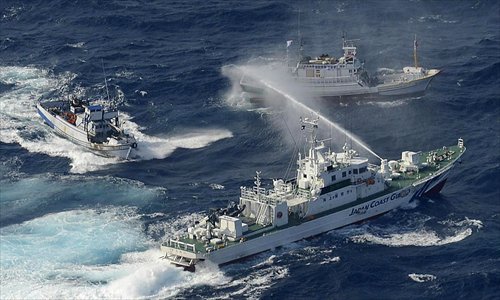
The boats pressed forward to an area about three nautical miles from the islands while evading water cannons from the Japanese vessels, according to the report.
Taiwan leader Ma Ying-jeou reiterated his support Tuesday for the fishermen's protests, calling on Japan to respect Taiwan fishermen's rights in their traditional fishing areas, local media said. Ma also said he hoped the US would stay neutral in sovereignty issues relating to the Diaoyu Islands.
Madrid demo, 22 arrested, 32 injured
Spanish police have fired rubber bullets to break up a demonstration near the parliament in central Madrid and have arrested 22 protesters.
Late on Tuesday, the police fired rubber bullets and used batons to disperse thousands of demonstrators who had massed at the Plaza de Neptuno square near the lower house of parliament to protest against the austerity measures adopted to address the financial crisis.
The police said 22 people had been arrested and at least 32 injured, including four officers.
Television images showed police brutally beating protesters and dragging them away. Some demonstrators were bloodied as they were hauled off.
The demonstration, dubbed "Occupy Congress" by the organizers, drew an estimated 6,000 people from all walks of life tired of nine straight months of harsh economic austerity measures introduced by Prime Minister Mariano Rajoy’s government.
"My annual salary has dropped by 8,000 euros and if it falls much further I won't be able to make ends meet," said Luis Rodriguez, a firefighter who joined the demonstration.
The Spanish economy, the fourth-largest in the 17-nation eurozone, is suffering from the aftershocks of a real estate bust that has devastated not just banks but families as well.
Battered by the global financial downturn, the Spanish economy collapsed into recession in the second half of 2008, taking with it millions of jobs. Unemployment is approaching 25 percent.
The worsening eurozone debt crisis has increased Spain's financing costs and the country is seeking a European Union bailout similar to the one Greece received.
On June 9, eurozone finance ministers agreed to lend 100 billion euros to Spain to save its teetering banks, which means more debt will be added to Madrid's already massive debt burden.
Economists say Spain has entered into a second recession. The country has imposed unpopular austerity measures and economic reforms in an effort to persuade its lenders that it is serious about decreasing its overblown deficit to 6.3 percent of gross domestic product in 2012 and 4.5 percent in 2013.
President Obama at the U.N.
The anti-American violence in the Muslim world demanded a firm push back from President Obama, who finally delivered it on Tuesday in the last United Nations General Assembly speech of his term.
Since the protests, attacks and flag burnings erupted two weeks ago over an anti-Islam video made in California, administration officials have condemned its crude depiction of the Prophet Muhammad and explained that the government had nothing to do with it. Mr. Obama made a similar point at the United Nations.
But he also gave a full-throated defense of the First Amendment right that, in this country, protects even hateful writings, films and speech. “We do so because in a diverse society, efforts to restrict speech can quickly become a tool to silence critics and oppress minorities,” Mr. Obama said. He added that “the strongest weapon against hateful speech is not repression; it is more speech — the voices of tolerance that rally against bigotry and blasphemy, and lift up the values of understanding and mutual respect.”
Mr. Obama was right to deliver that message, however foreign it is in much of the Muslim world. The assembled leaders applauded when Mr. Obama said he accepts that, as president, people will call him “awful things every day” and that he will defend their right to do it. But a number of Islamic leaders have recently revived a push for an international ban on blasphemy, which would move in exactly the wrong direction.
Mr. Obama’s more pragmatic challenges to Arab Spring countries trying to build new democratic societies may have more impact. He said all leaders must speak against violence and extremism out of obligation to United Nations norms as well as self-interest. “Burning an American flag does nothing to provide a child an education,” he said, and popular outrage can be turned as easily against Muslim leaders, ethnic groups and tribes as America.
Mr. Obama also bluntly warned that the politics of anger could damage international cooperation. The United States intends to stay engaged with the struggling Muslim democracies, even after the killing of the ambassador to Libya and three other Americans on Sept. 11. But efforts to deepen trade, economic and other ties “depend on a spirit of mutual interest and mutual respect,” he said.
Six weeks before the election, the speech to an audience of world leaders in the United Nations General Assembly hall was as much a domestic political appeal as anything else. President Obama used the commanding venue of the General Assembly to offer a reasonable defense against Mitt Romney’s incoherent critique of his response to the revolutions in Libya, Egypt, Tunisia and Yemen and to Iran’s nuclear program.
There were two fairly big omissions in Mr. Obama’s visit to the General Assembly. He spoke only briefly on areas that need more debate in this campaign — the Israeli-Palestinian conflict, the Syrian civil war, Afghanistan and Iraq. And while it’s reasonable for Mr. Obama to be in campaign mode, just like Mr. Romney, he is the president. He could have used some of his time in New York to meet privately with world leaders, as presidents usually do.
It’s not like he doesn’t have a lot to talk to them about.
Bill Clinton: I don't trust Ahmadinejad
As demonstrators make their views known outside the Iranian president's hotel in New York, former U.S. President Bill Clinton tells CNN he doesn't trust his claims on weapons
په ماشومانو د پوليو او دنورو واکسينونوتطبيق زموږ د ټولو مسووليت دى .
http://www.bakhtarnews.com.af
د واکسين دتطبيق په ورځوکې که چيرې ضروري کار هم لرئ، د خپلو ماشومانو د ژوندانه او سلامتيا په خاطر هغوى دواکسين دتطبيق کارکوونکو ته بوځئ او دپوليو واکسين پرې تطبيق کړئ . دغه ټکې دافغانستان داسلامي جمهوريت جمهور رييس حامدکرزي تيره شپه دخپلې پنځلس ورځني راډيويي وينا په ترڅ کې بيان کړ اوزياته يې کړه: په همدې اوونۍ کې دماشومانو دګوزڼ يا دپوليو د واکسيناسيون دمنې دکمپاين لومړۍ دوره پيل شوه او دغه کمپاين ما په خپله دڅو ماشومانو په خوله کې د واکسين دڅانګو په څڅولو سره پيل کړ . جمهور رييس وويل: تر پنځه کلني پورې په ماشومانو کې دماشومتوب ددورې ناروغى موجودې وي، که چيرې واکسين نه شي په دغو ناروغيو اخته کيږي خو له نيکه مرغه دغه ټولې ناروغي واکسين لري اوموږ د واکسين دتطبيق له لارې کولى شو له دغو ناروغيو څخه وژغورو . حامدکرزي څرګنده کړه: دماشومتوب د دورې ډيره خطرناکه ناروغى دماشومانو دګوزڼ يا فلج ناروغى ده، که چيرې ميندې ، پلرونه يا مشران تر پنځه کلني پورې په خپلو ماشومانو د پوليو واکسين تطبيق نه کړي، هغوى دګوزڼ په ناروغى اخته کيږي چې عواقب يې خطرناک دى. پوليو ماشومان معيوبوي او ماشومان د ژوندانه ترپايه پورې له دغه معيوبيت څخه ځوريږي . جمهور رييس دعالمانو، دجوماتونوله امامانو، سپين ږيرو، قومي مشرانو اودهيواد دټولو سيمو له ښوونکو څخه وغوښتل چې دپوليو واکسين په تطبيق کې دې له روغتيايي کارکوونکو او رضاکارانو سره چې په همدې مقصد د دوى سيمو او کليو ته ورځي، مرسته وکړي اوکورني دې دې ته وهڅوي چې په خپلو ماشومانو دپوليو واکسين تطبيق کړي . حامدکرزي له طالبانو څخه هم وغوښتل چې دواکسين دتطبيق مخه ونه نيسي، دلته زه طالبانو ته خطاب کوم او هغوى ته وايم چې په کليو اوبانډو کې دې دواکسين دتطبيق خنډ نه شي، ځکه دهر راز واکسين په تطبيق کې خنډ دهيواد دبچيانو ژوند له جدي خطر سره مخامخ کوي . په ماشومانو دپوليو او دنورو واکسينونو تطبيق زموږ د ټولو مسووليت دي . جمهور رييس دخپلې دغې راډيويي وينا په پاى کې په دې ترڅ کې له ټولو کورنيو څخه يې وغوښتل چې هيڅکله په ماشومانو دپوليو واکسين تطبيق هير نه کړئ؛ وويل: که چيرې له هلوځلو سره سره موبيا هم ونه کړاى شول په ټاکلې ورځ په خپلو ماشومانو دپوليو واکسين تطبيق کړئ په دې صورت کې له ډيل پرته په سملاسي ډول خپل ماشوم ډير نږدې کلنيک ته بوځئ او واکسين څاڅکې پرې تطبيق کړئ .
Obama condemns violence tied to anti-Muslim film
Associated Press
President Barack Obama is condemning an anti-Muslim film and the violence in the Middle East that has followed its release, saying there is "no speech that justifies mindless violence." Obama says in a speech Tuesday before the U.N. General Assembly that "there are no words that excuse the killing of innocent" and "no video that justifies an attack on an embassy." Obama says the video "is an insult not only to Muslims, but to America as well." The president was speaking in the aftermath of violent protests in the Middle East and North Africa connected to the release of an anti-Muslim video produced in the United States. Four Americans were killed in Libya, including U.S. Ambassador Chris Stevens, along with more than 50 others in the violence.
Afghans want peace, but they are caught between forces they can't control

Britain and the US must establish a credible exit strategy or more innocent people will die in pointless acts of violenceOn a visit to Afghanistan earlier this month, I spent an afternoon at Skateistan, a project in Kabul that offers some of the poorest children in the world a chance to be children. They come to Skateistan to play, skate and learn. What struck me about these kids was their display of both childish playfulness and a kind of maturity you can only get with years of experience. Fourteen-year-old Khorshid embodied both of these qualities. When I met her – just a few days before she was killed by a suicide bomber – she approached me with a smile and asked if I could skate. When I said no, she immediately offered to show me how. As I tentatively got on the skateboard, propped up by Khorshid and Madina, her friend and fellow skater, she told me not to be scared. This is the reality of people living in Afghanistan. Ordinary people tread the line between life and death every day. When they go out for work, or to buy groceries or to pick up their children from school there is a chance they will die on the way there or on the way back. Eleven years after international troops entered Afghanistan to "liberate" Afghans from the tyranny of the Taliban, Afghans still live in a state of war. There are some things that have changed in the past decade. Returning to Afghanistan after 20 years living abroad, I was glad to see that Kabul, almost completely destroyed by two decades of war, is now rebuilt. The roads are paved and all around you see evidence of industry. Mobile phone companies are advertising their services on giant billboards on the side of the roads and posh supermarkets have sprung up all over Kabul to cater for its expat and foreign populations. There is a bustling rhythm of life in Kabul. But all around there is also sinister evidence of violence. Security checkpoints sit every few hundred metres on streets. You can always hear the roar of military helicopters and planes and for me perhaps the most poignant sign of insecurity was that few women were out on the streets. They don't feel safe and you can't blame them. Suicide attacks, unheard of before 2001, have become a regular occurrence in Kabul. Attacks seem to be completely random and often it is just civilians who perish. Despite this terrible fear and violence that people experience on a daily basis, there is an even greater worry that preoccupies Afghans now. Many believe that the departure of Isaf troops will prompt another bloody civil war. No one is certain of his or her fate after 2014. Talking to Kabulis about the exit of international troops reminded me more of doomsday prophecies you might read about in cult literature than anything else. Even the children at Skateistan were talking about it. When I interviewed Madina, Khorshid's friend, about her life and her future, she talked about her hope for a peaceful Afghanistan where she could go to school and pursue skateboarding. What became clear to me from my interactions there and with other ordinary Afghans is that there is no ideology or group that Afghans feel so strongly about as to warrant them to fight. In fact, many feel that there isn't a single party that represents them or caters for their everyday needs. There is a profound sense of fatigue that comes from being in the middle of powerful forces that they can't control. After three decades of war the Afghan people I spoke to want peace. For this to happen, it is imperative that 2014 does not bring another gory conflict to Afghanistan. But it seems the British government is in danger of limiting its exit strategy to a public relations campaign. If there is going to be peace and stability in Afghanistan, the British and the US administrations must work to create a clear and robust framework for exiting Afghanistan. This must include a viable strategy for negotiating with the Taliban and clear terms for power sharing after the troops leave. Afghanistan needs a credible plan for how to continue reconstruction and the building of its economy; and it must include a plan B: what would happen if parties didn't keep to their end of the bargain. If Afghanistan is left without a realistic plan for peace, it will further jeopardise an already unstable region, threaten our own security and more children like Khorshid will die in brutal and pointless acts of violence.
Punjab govt failed to maintain law & order
Chaudhry Pervez Elahi said criticised Punjab govt over violent protests on Friday. Deputy Prime Minister Chaudhary Pervez Elahi lashed out at Punjab government saying that the provincial government has completely failed to maintain law and order situation. He was addressing a ceremony in connection with 31tst death anniversary of Chaudhary Zahoor Elahi in Gujrat on Tuesday. During his addresss, Pervez Elahi said that federal government always got success with the support of the people and in the coming elections the masses will also support it. Elahi said that the government is committed to fulfill the people s expectations and a number of steps have been taken for the uplift of common man.
33pc Pakistanis living below poverty line: Study
According to conservative estimates, 33 percent of Pakistanis are living below poverty line. This was the finding of report "Clustered Deprivation: District Profile of Poverty in Pakistan" launched by Sustainable Development Policy Institute (SDPI) here on Monday.
The study conducted by SDPI fills the backlog created by failure of governments to provide poverty estimates for the last 5 years which has created a huge policy vacuum in Pakistan.
Even provinces, in post 18th amendment scenario, failed to provide poverty data, analysis and strategies and initiatives in this critical dimension.
Speaking at the launch, expert called upon federal and provincial governments to immediately release poverty statistics and revisit policies to address acute poverty in Pakistan.
The event also featured a distinguished lecture on "Rediscovering our Common Wealth" by Emeritus Professor, University of Bath, UK.
Briefing participants on poverty estimates identified in study, Arif Naveed, Senior Research Associate, SDPI said, according to conservative estimate, 33 percent of household are living below the poverty line in Pakistan with numbers amounting to 58.7 million people.
"Balochistan is the poorest of all provinces with 52 percent population living below poverty line, followed by Sindh with 33 percent, Khyber Pakhtunkhwa with 32 percent and Punjab with 19 percent", the report reveals. Refereeing to 46 percent rural poverty compared with 18 percent urab poverty, the author said, report identifies stark inequalities over the incidence of poverty across regions, between provinces and within each province.
The author said that instead of traditional consumption based assessment, the report employs, Multidimensional Poverty Index which is the most comprehensive technique to measure poverty and uses education, health, assets and living conditions as indicators. This gives a theoretically rich data spread across the regions and districts in Pakistan, he added.
Highlighting education and health as major drivers, the report calls for greater investments on human development and equitable distribution of public resources across the regions. Arif Naveed urged upon government to adopt multidimensional framework to assess human welfare and revisit rural development strategies in view of higher rates of poverty in rural area.
Chairing the session, Dr Abid Qaiyum Suleri, Executive Director, SDPI said, poverty should not remain merely a number game for government but requires deliberate measures and paradigm shift to invest on human development. Referring to absolute poverty in conflict ridden Balochistan and Fata, he said, "when poverty and food security take an identity be its ethnic, religious or provincial, it leads to disintegration and destruction of social fabric of society". He cited statistics from this latest SDPI report using multidimensional poverty index and SDPI's Food Security Report 2009 and said, Both of these reports confirmed that out of 20 most poor districts in Pakistan, majority are from Balochistan.
Dr. Geof Wood, Emeritus Professor, University of Bath, UK gave a special philosophical lecture on "Rediscovering our Common Wealth" at the occasion. The lecture discussed the issue of sustainability and reflected upon the question that, why should humans care about others not just in the present but in the future as well? He argued that sustainability and long term wellbeing is an equality issue. He said, human's personal sense of wellbeing is reliant upon those around us. Likewise, in the future, the wellbeing of our descendants will depend upon the wellbeing of their contemporaries.
Dr Wood speculated on the possibility that mankind may run out of technological responses to solving climate change and other related problems such as food security.
This he said, calls for an urgent global social contract for sustainable behaviour. This means precautionary principle in our behavior and sacrifice present consumption for the sake of future, he added. Geof Wood concluded that in the present context of global capitalist crisis, the world may be ready for more regulation to modify present excesses.
IMPRESSIVE FEDERAL HELP FOR BALOCHISTAN
The Prime Minister of Pakistan, Raja Pervez Ashraf, had paid a flying visit to the flood devastated areas of Balochistan in Naseerabad Division and made a personal assessment about the losses suffered by the people. According to some reports, more than 100 people lost their lives and over 0.7 million people affected by the flash floods and torrential rains. Most of the people ere rendered homeless and score of them lost their household belongings cattle, livestock and poultry. However, the losses in terms o livestock were small comparing to the floods of 2010 which devastated the entire area and people are yet to recover from the shock of floods of 2010. It was a great natural disaster Balochistan faced in decades. Balochistan is facing the ninth natural disaster during the current decade which included rains, floods, earthquakes, cyclones.
With this background, the Prime Minister paid a flying visit to the flood affected areas of Naseerabad Division and made personal assessment about the damages besides the officials briefed him about the extent of devastation in the rains and floods. Thousands of houses were washed away, basic infrastructure destroyed, more than 0.7 people were forced to seek refuge to high grounds to save their lives. The agricultural land is devastated and standing cotton and paddy crops are under several feet of water which is not humanly possible to drain it out in weeks and months. Thus the losses suffered by the people and also the losses in economic terms are estimated to over Rs 20 billions. During the 2010 floods and torrential rains, the economic losses were estimated at Rs 100 billion and there was no matching grant and financial help from the Federal Government. Even the friendly countries were not allowed to provide help to the flood affected people of Naseerabad Division in 2010.
This time, there is a changed attitude from the Government of Pakistan as the Prime Minister had announced a package of Rs 2.6 billions for rebuilding the basic infrastructure, repairing roads, bridges and plugging the breaches in the canal. For providing food and other necessities of life to the flood affected, the Prime Minister had allocated Rs 600 million as grant to feed the people. It is a generous help from the Federal Government for the first time as dozens of boats and six helicopters are still engaged in rescue operations taking the marooned people to safer places. The Prime Minister announced Rs four hundred thousands each as compensation to the family who lost a member in the floods. The Prime Minister also asked the NDMA to provide tens of thousands of tents to the flood affected so that they should get some shelter in this natural disaster. The Prime Minister had also issued instructions to the authorities to complete all the on-going development projects of Balochistan on priority basis. He specifically mentioned the construction o basic infrastructure and completion of the Kachhi Canal, the most prestigious irrigation project of Balochistan. Earlier, the Pakistan Army provided ration, flood to the affected people and established a field hospital providing treatment to the affected people at a large scale.
In the meantime, the Provincial Government and the local administration made sustainable efforts to rescue and provide relief to the affected people. The Chief Minister Nawab Raisani had issued instructions to the MPAs and Ministers of the area to use their MPA fund for providing relief to the affected people. The Provincial Government had been using its meager resources in providing relief to the people in Naseerabad Division where flash floods and rains played havoc with the local economy. The Chief Secretary remained on his toes during the entire crisis regularly informing the Prime Minister about the level of devastation by floods and rains in Balochistan and sought urgent Federal help to mitigate the human sufferings.
Balochistan: 3 DIED FOR NOT GETTING PROPER FOOD
Three people died reportedly after not getting appropriate food in Sohbatpur area of Jaffarabad district which was badly affected during recent torrential rains and floods while flood affectees strongly protested slow pace of relief activities by blocking Balochistan –Sindh Highway.
According to sources, three people Sohail Ahmed, Noor and Gul in Panorsari in Subatpur had fallen weak after not getting adequate food and potable water for the past few days and died on Monday. “Deceased did not get medical treatment since a large number of people in Panorsnari, Goth Murad Ali Khosa, Mehopur and other areas are still trapped without food and water”, they sources said, adding that if relief activities were not accelerated more people would be affected of different diseases and starvation.
Meanwhile, hundreds of flood affected people staged a demonstration in Dera Murad Jamali against slow pace of relief activities in flood hit Naseerabad and Jaffarabad districts.
The protestors blocked Balochistan- Sind Highway by burning used tyres.
Protestors were shouting slogans against local administration and provincial government.
The police fired several shells of tear gas and fired gunshots in the air to disperse the protestors due to which some protestors, including a local journalist who which covering the demonstration sustained injuries.
Balochistan- Sindh Highway remained closed for several hours causing immense difficulties for the motorists.
Local leaders, strongly criticized police for firing tear gas on flood affectees who were protesting peacefully and demanded of IG Police Balochistan for action against them.
Balochistan’s Floods:Neglecting the distressed
FRONTIER POSTIf one is to learn how to neglect the distressed, he or she is only to watch the act of this nation’s political elite and the grandees of all other hues and stripes. It is for days that flash flooding has been playing havoc with Balochistan’s three districts of Neseerabad, Jaffarabad and Jhal Magsi. The flooding has left them in utter ruins and devastation. Yet the flood-battered of the area are still to surface any compellingly on the radars of the political elite and the self-styled champions of the Baloch people. Mercifully, the prime minister has taken time out to pay them a whistle-stop visit. He has also unfolded for them a special relief package worth Rs.2.6 billion, which though makes not even a mentionable patch on the colossal loss they have suffered from this disastrous flooding. And it isn’t any clear either what would come of this package, given the notoriety the ruling oligarchy led by chief minister Nawab Aslam Riasani in the province has earned for playing ducks and drakes with the public money with impunity for personal enrichment and gains. But at least the prime minister has visited the area, even if belatedly. The other political eminences posing to be the real voice of the people of Pakistan and their true representatives have just not bothered to do even that much, even for form’s sake. They have been addressing rallies, leading protests and demonstrations and what not in every nook and cranny of the country. It is only the flood-devastated areas and their deeply distressed residents that have evaded their interest rigidly. It is the army which is actively engaged in rescue and relief efforts. The provincial administration itself is more conspicuous for its absence than presence in the relief operations. And, quite appallingly, the destroyed area is still to figure on the itinerary of Riasani, that is, if at all he is still present in Quetta and is not on his fond junkets outside the seat of his office. Not even once have his flood-battered people seen of him, whereas it is he who should have been leading the operations personally to rescue them from their distress and provide them every possible relief vigorously. But what is most stunning of all is the muteness of the self-touted champions of the Baloch people. They claim to be the voice of the Baloch people. Yet that voice is totally silent on this Baloch catastrophe. They are so tirelessly voluble about the missing persons. But is this calamity that has befallen the Baloch people any lesser, if not more, horrendous? Scores of residents have just been swept away by the stormy waves, with their fates unknown. Hundreds of thousands of people are still stranded in the flood waters. A lot more have been rendered homeless, with all their belongings, including cattle, having been wiped out. And yet their tragic woe has touched no heart among the so-styled Baloch nationalists. Is it because those eminences see no politics to play in their grief or no brownie points to pick up from talking of their catastrophe? Or, is it that tribal affiliations have overwhelmed a colossal human tragedy? After all, while the grandees of this nationalist clan were making a beeline to the visiting UN rights team “to unburden their hearts”, why none has cared to even speak of the woe of the flood-battered, what to talk of visiting them and sharing their travails? This calamity of the Baloch people has indeed been a great exposer. It has exposed the elites across the spectrum for what they really are: a tribe of imposters, charlatans and opportunists, no friends of the people but mere sharks. Be it the political eminences or the nationalist grandees, they all are the co-travellers, ruthlessly poaching on the human beings to promote their trades. The flood-battered will somehow tide over their distress sooner or later. But the infamy that this tribe has earned by neglecting them will be hard to redeem for times to come, so heartlessly apathetic has it been to their colossal catastrophe.
Zardari: Pak paid biggest price for conflict in Afghanistan
Hindustan TimesPointing that Pakistan has paid the biggest price for conflict in Afghanistan, President Asif Ali Zardari told US secretary of state Hillary Clinton that peace and stability in his country were tied to a peaceful and stable Afghanistan. Zardari met US secretary of state Hillary Clinton in New York on Monday on the sidelines of the 67th session of the UN General Assembly.According to a news release issued by Pakistan's mission to the UN, Zardari and Clinton had an in-depth conversation on the way forward in bilateral relations. The two discussed the situation in Afghanistan and how Pakistan and the US could cooperate in helping bring peace and stability in the war-torn country. "No country has paid a higher price for the conflict in Afghanistan than Pakistan," the release quoted Zardari as saying. He said Pakistan was prepared to do everything in its power to help an Afghan owned and Afghan led reconciliation process, the release said. He conveyed to Clinton that peace and stability in Pakistan were tied to peace and stability in Afghanistan. Clinton reiterated the desire of US government to continue working with Pakistan for further strengthening bilateral relations and for peace, stability and socio-economic development of the region. Zardari, who will address the 193-member General Assembly on Tuesday, was accompanied by foreign minister Hina Rabbani Khar and Pakistan's Ambassador to the US Sherry Rehman. The two leaders also reviewed recent developments in bilateral ties including the opening of the Ground Lines of Communications, high level contacts between the two sides and signing of MOU on the upgradation of the Peshawar Torkham road. "We should build on the positive momentum," the Pakistani President told Clinton. The supply routes into Afghanistan were reopened by Pakistan after Clinton had in July offered her "deepest regrets" for the deadly cross border attack by NATO last November that had killed 24 Pakistani soldiers. Pakistan had closed the crucial supply routes following the attack and had demanded the Washington apologise for the NATO attack. The air raid had brought ties between the two countries to new lows after relations soured following the US raid in Pakistan's Abbottabad town in May that had killed al Qaeda leader Osama bin Laden.
Subscribe to:
Posts (Atom)