M WAQAR..... "A man's ethical behavior should be based effectually on sympathy, education, and social ties; no religious basis is necessary.Man would indeed be in a poor way if he had to be restrained by fear of punishment and hope of reward after death." --Albert Einstein !!! NEWS,ARTICLES,EDITORIALS,MUSIC... Ze chi pe mayeen yum da agha pukhtunistan de.....(Liberal,Progressive,Secular World.)''Secularism is not against religion; it is the message of humanity.'' تل ده وی پثتونستآن
Friday, September 21, 2012
Pakistani leaders play religious card as protests boil
Pakistan shut down Friday in a government-sanctioned protest over a film made in the United States that mocks the Prophet Mohammad, highlighting the power of religious parties to shape the political agenda.
Protesters incensed by the film and inspired by influential Pakistani religious parties set fire to a motorway toll booth just outside the capital and a cinema in the northwestern city of Peshawar in images broadcast live on television.
Pakistan's government, wary of widespread frustration over its failure to provide basic services, declared Friday a day of protest over the film in an apparent bid to exploit anger which has inspired violent protests in several Muslim countries.
Critics say this approach is typical of a government that many describe as ineffective in the face of tough challenges; from a stubborn Taliban insurgency to chronic power cuts, which have frequently triggered protests.
Others said calling for the "day of Love for the Prophet" was a shrewd political move for the embattled government.
"Our heart is crying bloody tears. We can bear everything but disrespect to our Prophet and Koran," said Akbar Saeed Farooqi, spokesman for a religious organization that helped organize demonstrations.
The government can use all the help it can get. Prime Minister Pervez Raja Ashraf is under pressure from an increasingly assertive Supreme Court to reopen corruption cases against the president.
The court removed his predecessor for failing to do so.
Political strife has often distracted civilian leaders and the military, which has ruled the country for more than half of its 65-year history, is seen as the most efficient and decisive institution in times of crisis.
Many of the parties orchestrating the protests oppose Pakistan's alliance with the United States, which has only recently begun to recover from a number of setbacks.
In Washington, Pakistan Foreign Minister Hina Rabbani Khar met U.S. Secretary of State Hillary Clinton on Friday, and both pledged to work to overcome strains on everything from U.S. drone strikes to the future of Afghanistan policy.
"It is important that we are able to build on the positives," Khar said in brief remarks before the meeting, noting that the past 16 months had been "very, very difficult."
The government's critics condemned the national holiday as a capitulation to religious rabble-rousers in a young democracy still struggling to define the place of religion in public life.
Pakistan, a nuclear-armed nation of 180 million people, is overwhelmingly Muslim. Pakistan was carved out of India as a land for Muslims in 1947.
For decades, leaders invoked Islam to legitimize their rule and politics is often influenced by religious parties who don't score big votes in polls but can whip up anger on the streets.
"All it takes is a couple hundred people and a pile of rocks and you're on TV," said Husain Haqqani, a former Pakistani ambassador to the United States. "The religious parties hold the government hostage."
"OBSESSED WITH POLITICS"
The ruling Pakistan People's Party (PPP) was set up as a centre-left, progressive party with secular leanings but, like most political forces in Pakistan, it has played to the religious parties when under pressure.
The PPP and its opponents have started jockeying for advantage ahead of a general election expected next year and that would appear to explain why it is tapping into anger fuelled by clerics over the film, instead of trying to calm it.
"The Pakistan People's Party has become so obsessed with domestic politics and getting re-elected they have forgotten what kind of relationship they want with the outside world," said columnist Mehreen Zahra-Malik.
Religious parties fared poorly in the last election. But orchestrating protests is an easy way for them to flex political muscle and ensure they can forge alliances with more powerful parties.
Lawmaker Ayaz Amir said the government had proclaimed the holiday to undercut the religious parties, an attempt to show it too has Islamic credentials.
"The government has stolen a march on them," he said.
He said it made sense for the government to try to defuse protesters' anger by giving them an outlet instead of ordering police to shut down rallies and risk alienating people.
Most demonstrations in the day's immediately following coverage of the film were small and peaceful. Few people had heard of the film.
Then religious groups began running advertisements on television demanding Muslims sacrifice their lives for the Prophet's honor. Signs went up demanding the film-maker be shot.
Once protests reach critical mass, it's dangerous for people to oppose them. In Hyderabad city, a cleric directed a mob to attack the house of a shopkeeper who had refused to join a protest, police said.
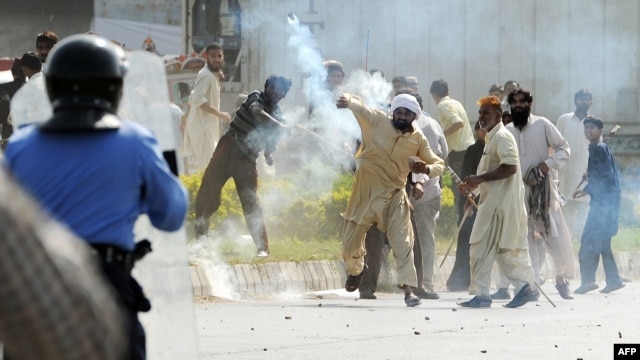
On Thursday, protesters threw stones, smashed cars and burnt a police post in the heart of Islamabad as they tried to force a path to the U.S. embassy.
Few protesters interviewed by Reuters had seen the film, yet the government seems to think it can capitalize on the mounting anger in a country where a perception the United States is out to get Muslims fuels anti-American feeling.
In a speech to dignitaries marking the holiday, Ashraf appeared to play up those fears about the West.
"This was a deliberate premeditated attack based on bias, hatred and prejudice," he said of the amateurish film.
23 Pakistanis killed during protests
PRESS TVThe death toll from Pakistan's protests against a US-made anti-Islam film and sacrilegious cartoons of the Prophet Mohammad (PBUH) in France has risen to 23, Press TV reports. Clashes broke out between enraged protesters and security forces in at least five Pakistani cities on Friday, with police firing tear gas and live rounds to disperse the crowds. Hundereds of people were also wounded in the violence. In the capital Islamabad, protesters marched towards the capital’s diplomatic headquarters, demanding the expulsion of the US and French ambassadors to the country. Thousands more marched on US consulates in the cities of Lahore and Karachi. In the northwestern city of Peshawar, protesters set two cinemas on fire and attacked several other buildings.
Pakistani violence 'not in defense of the Prophet'
Deutsche Welle
Thomas BärthleinThere have been violent protests in a number of countries over a controversial anti-Islamic film, among them Pakistan. South Asia expert Thomas Bärthlein tells DW what he has experienced in the past few days there. DW: In the past few days, a number of people have been killed in Pakistan in violent protests. How have you experienced the situation there? Thomas Bärthlein: The situation in Islamabad is calming down now. The last I heard from an eyewitness near the diplomatic enclave was that about 300 demonstrators were throwing stones at police and trying to get into the enclave where the American embassy is situated. But the police have them under control, attacking the demonstrators with tear gas and pushing them back. The rest of the city is very calm. Nobody is going out in the streets. The government had declared a public holiday today and all the shops are closed. It's a bit of an eerie atmosphere in the city. You have lived in the country for over a year now and you speak the language. What do you say about the climate against Westerners in the country? Has it changed? I don't feel threatened personally. I got information about a French journalist who was in the middle of all these protests - he was apparently attacked. But I can't confirm that right now. But normally you feel safe in Islamabad. I myself was caught up in one hotel, the Serena Hotel, yesterday for three hours when protesters surrounded the hotel. They apparently tried to enter and the security there told us one of their demands was that they hand over the foreigners - the Americans in the hotel - which, of course, the hotel personnel did not. The hotel fought back against these protesters. After the incident last night, we escaped and lots of people in Pakistan who knew I was in that hotel were very concerned. They called me and asked how I was doing. In general, as a Westerner I am welcome in this country. Who are the protesters going out on the streets? They are definitely a small group and they are very well organized. They are mostly young people, like people from the radical student organizations of the Islamist parties which themselves are small parties, but they are well organized and they can call these crowds onto the streets rather quickly. Apparently, yesterday in the protests in Islamabad there was a big contingent of people from Rawalpindi from the Jamaat-ud-Dawa, one of the well-known extremist or terrorist groups, and the Lashkar-e-Taiba, who are also allegedly responsible for the Mumbai attacks in India. These people are hardcore militants or they are very radical young people who like to let off steam. They've become very destructive over the last two days. They are not getting access to the American consulates or the American embassies; they just destroy about everything that comes their way. They attacked and destroyed little shops in Peshawar today, they destroyed petrol pumps and cinemas in Karachi. They ransacked the chamber of commerce in Peshawar. All of this is not in any way in line with defending the Prophet of Islam. It's just an outlet for them to express frustration and anti-Americanism. The Pakistani government itself called for protests against the video. But they also said the protests should be peaceful. Do you think it has been a mistake to call for the protests? It seems like that now. They had an official meeting with the prime minister addressing the gathering this morning protesting against the video that was made in the United States and they tried to call on people to remain peaceful in their protest. I think I can understand their approach to some extent because they didn't want to be sidelined, they didn't want to become targets themselves, as being seen as less Islamic than the radical groups. They also called in the US ambassador for protests today. They wanted to show that they are also upset about this but then also help keep the protests peaceful. Of course, that's very difficult if you don't allow the people to march before the US consulates and the US embassies, which is where they want to go. In the end it's still the police who are being attacked. Most of the people who were killed today were policemen and it's kind of difficult in a way - by declaring a holiday and declaring their support for the protesters' agenda, the government also gave them justification for doing all of this. Overall, I would think this strategy has backfired, it has not been as successful as they wanted. What kind of long-term consequences to you expect this will have for the United States and Pakistan? From this particular episode I don't expect any big political fallout because the Americans know there is a lot of anti-Americanism in the country. It is a question of security. I was told yesterday that many diplomats actually left Islamabad and went to Lahore for the weekend. Because clearly they were not fully confident that the diplomatic enclave here in Islamabad, which is heavily guarded and which still seems relatively safe, they did not feel a guarantee that they would be safe within this diplomatic enclave. I think it is possible that for some time to come, if these things don't die down quickly, there will be added security concerns for the embassy but they already have very high security and they will probably continue doing their job otherwise. Because as I said, it is not really new information to them that they are not really popular in Pakistan. Thomas Bärthlein is an expert on South Asia and currently works in Islamabad, Pakistan.
19 Reported Dead as Pakistanis Protest Muhammad Video
Violent crowds furious over an anti-Islamic video made in the United States convulsed Pakistan’s largest cities on Friday, leaving up to 19 people dead and more than 160 injured in a day of government-sanctioned protests.
It was the worst single day of violence in a Muslim country over the video, “Innocence of Muslims,” since protests began nearly two weeks ago in Egypt, before spreading to two dozen countries. Protesters have ignored the United States government’s denunciation of the video.
Friday’s violence in Pakistan began with a television station employee dying from gunshot wounds during a protest in the northwestern city of Peshawar, then was amplified through armed protests in the southern port city of Karachi that left between 12 and 14 people dead, Pakistani news media reported.
By nightfall Geo, the leading television station, was reporting 19 deaths around the country.
Less violent protests occurred in other Muslim countries but were exacerbated by the publication of cartoons depicting the Prophet Muhammad in a French satirical weekly.
In Bangladesh, several thousand Islamist activists took to the streets of the capital, Dhaka, waving banners and burning a symbolic coffin for President Obama that was draped with the American flag. “Death to the United States and death to French,” they chanted.
Local television networks reported that a mobs ransacked and burned an Anglican church in Mardan in northwestern Pakistan. A statement by The Bishop of Peshawar the Rt. Rev. Humphrey Peters said that newly installed computers were stolen before the church was set on fire. There were no reports of killings or injuries to the Christians.In Tunisia, the government invoked emergency powers to outlaw all demonstrations; American diplomatic posts in India, Indonesia and elsewhere closed for the day.
France closed embassies and other institutions in 20 countries while, in Paris, some Muslim leaders urged their followers to heed a government ban on weekend demonstrations.
“There will be strictly no exceptions. Demonstrations will be banned and broken up,” said Manuel Valls, the French interior minister.
In Pakistan, the streets erupted from early morning in Peshawar, where protesters burned two movie theaters. Two people, including the television employee, Muhammad Amir, were killed.
Mr. Amir’s employer broadcast graphic footage of hospital staff giving him emergency treatment shortly before he died, which other Pakistani journalists condemned as insensitive and irresponsible.
Some protesters tried to reach the city’s heavily guarded American Consulate, which has a strong Central Intelligence Agency component. By evening, hospital officials said at least five people were dead and more than 50 injured.
After Friday Prayer, more severe violence erupted in Islamabad, Lahore, Rawalpindi, Multan and Karachi, where normally bustling streets were instead filled with clouds of tear gas and the sound of gunfire.
Protesters in Karachi burned effigies, stoned a KFC and engaged in armed clashes with the police that left 14 people dead and more than 80 wounded by evening.
Peaceful protests had been approved by Pakistan’s government which declared Friday a national holiday, the “Day of Love for the Prophet Muhammad,” as part of an effort to either control, or politically capitalize on, rage against the inflammatory video, which depicts the Prophet Muhammad, the founder of Islam, as a sexually perverted buffoon.
“An attack on the holy prophet is an attack on the core belief of 1.5 billion Muslims. Therefore, this is something that is unacceptable,” said Prime Minister Raja Pervez Ashraf in an address to a religious conference Friday morning in Islamabad.
Mr. Ashraf called on the United Nations and international community to formulate a law outlawing hate speech across the world. “Blasphemy of the kind witnessed in this case is nothing short of hate speech, equal to the worst kind of anti-Semitism or other kind of bigotry,” he said.
But chaotic scenes in the streets outside suggested that if the government had aimed to harness public anger on the issue, it had dismally failed.
In contrast, the day passed off peacefully in neighboring Afghanistan where officials had been preparing for the protests for days. Clerics at major mosques in the capital, Kabul, acceded to official requests that they preach peace, or another topic entirely; police officers set up a cordon of check posts to search cars, and no street violence occurred.
A senior American official in Kabul said his Afghan counterparts had worked hard to mute the impact of the video through the week. That was, in part, a product of their prior experience with what he called “a desecration or religious event.”
In Pakistan, however, extremist groups, many of them officially banned by the government, were at the forefront of the upheavals. Karachi marchers included members of Sipah-e-Sahaba Pakistan, a banned Sunni sectarian group, Harkat-ul Muhahideen, which has fought against Indian troops in Kashmir, and Tehrik-e-Ghalba Islami, a faction of another sectarian group.
In Islamabad, Sipa-e-Sahaba Pakistan activists led a march toward the heavily guarded diplomatic enclave, where Western missions had closed for the day. They clashed for hours with police officers outside the five-star Serena Hotel, before eventually being pushed back.
Meanwhile in Lahore, activists from the banned Lashkar-e-Taiba, whose leader Hafiz Saeed is subject to a $10 million United States government bounty, led protesters toward the American Consulate, which had its perimeter defenses breached earlier in the week.The devastation caused by the protests belied their relatively small size. The largest street mobs were estimated to have between 5,000 and 10,000 people — less than would typically attend a mainstream political rally, or even a high-profile funeral in some parts of the country.
Instead most Pakistanis drifted home after Friday Prayer, apparently keen to avoid the trouble. Still, many analysts questioned the government’s decision to give free rein to the marchers.
“Pakistan is a conservative but not a radicalized society,” said Cyril Almeida, a writer with the English-language Dawn newspaper. “But when the radical fringe is bold enough, it can hold society hostage. And that’s what happened today.”
The government tried to control the momentum of unrest by cutting off cellphone coverage in large cities for most of the day and, in Islamabad, sealed all exits to the city after Friday Prayer.
That left most Pakistanis stuck at home, many relying on e-mail and social media sites, like Twitter, to voice their frustrations. “We are not a nation. We are a mob,” said Nadeem F. Paracha, a cultural commentator with Dawn newspaper, on Twitter.
Imran Khan, the cricket hero turned conservative politician, addressed one of the Islamabad protest rallies, and used to occasion to condemn American drone strikes in the northwestern tribal belt.“There is no end to this war,” he said.
The State Department spent $70,000 on Urdu-language advertisements that were broadcast on several television channels, dissociating the United States government from the inflammatory video.
The Ministry of Foreign Affairs summoned the American chargé d’affaires, Ambassador Richard Hoagland, and requested that he have “Innocence of Muslims” removed from YouTube. It seemed a quixotic request, as YouTube had already been entirely blocked in Pakistan for several days previously.
In a statement, Mr. Hoagland said he had told Pakistani officials that the video represented “a deeply insensitive decision by a single individual to disseminate hatred" and did not reflect American values.
The protests largely abated by nightfall, allowing main roads in most cities to reopen, as hospital staff continued to tend to the injured. The government expressed some frustration at the day’s events.
“What kind of a love for the Prophet is this where people are burning and looting?” said Qamar Zaman Kaira, the information minister, in a television interview, before berating the media for giving excessive coverage to the trouble.
“You should stop giving live coverage of protests,” he said testily as he spoke to a news presenter.
Alan Cowell contributed reporting from Paris; Julfikar Ali Manik from Dhaka, Bangladesh; Alissa J. Rubin from Kabul, Afghanistan; Salman Masood from Rawalpindi, Pakistan, Zia Ur-Rehman from Karachi, Pakistan, and Waqar Gilani from Lahore, Pakistan.
Pakistan Protests:15 killed,dozens injured,property destroyed.
Death toll from nationwide anti-Islam film protests rises to 14, dozens injured
Angry and violent protests plunged Pakistan into chaos on Friday as at least 14 people were killed and scores others were injured in addition to widespread damage to private and public property in nationwide protests against a blasphemous, anti-Islam film.
Fuming protestors fought pitched battles with police and law enforcing agencies in Peshawar, Islamabad, Karachi, Lahore and several other cities of Pakistan. Most of the protests were violent despite repeated calls to hold peaceful rallies by the government, political leaders and religious scholars.
KARACHI
At least 10 people, including two policemen, were killed and over three dozens wounded as violent protests erupted in Karachi after Friday prayers against a US film mocking the Holy Prophet (PBUH).
Angry crowd set ablaze three cinemas, two bank branches, four police mobiles, eight vehicles and a fast food restaurant in the city.
Three police mobiles, which were stationed outside Chief Minister House in Red Zone were torched.
In addition, protests were witnessed in Baloch Colony, Sohrab Goth, Sultanabad and other areas of the metropolis.
A loud explosion was heard near Native Jetty bridge. The stone-pelting agitators smashed window panes of several vehicles and blocked Shara-e-Faisal for traffic by setting tires on fire.
Police and protesters continued to clash in many areas, resulting in 10 casualties.
PESHAWAR
According to reports, four people, including a worker of a private TV channel, were killed and 60 others wounded in Peshawar in clashes and incidents of firing in the city. Two policemen and four protesters were also reported killed in Karachi taking the total death toll in violent protests to 14.
Angry protesters in Peshawar burnt three cinema houses while four cinemas were also torched in the country’s financial hub Karachi.
ISLAMABAD/RAWALPINDI
In Islamabad, police resorted to aerial firing and shelling to prevent the protesters from entering Red Zone. Two helicopters kept hovering over the Red Zone as part of special security measures.
PTI Chairman Imran Khan also led a rally of supporters in Islamabad against the sacrilegious film produced in the US mocking the Holy Prophet (PBUH).
Khan appealed to demonstrators to hold peaceful protests and avoid damaging public and private property. Violence was witnessed on Faizabad, where police and protesters clashed throughout the day, leaving many people injured.
Five vehicles, including three polic mobiles, were torched in Rawalpindi.
ELSEWHERE
Violent protests are also reported from elsewhere in the country including Rawalpindi and Faisalabad despite call for peaceful demonstrations by the government and religious scholars.
Police fired rubber bullets on protestors at Faizabad Bridge. Several policemen and protesters were injured in the clash.
These protests came on Yaum-e-Ishq-Rasool (S.A.W.W.) which is being observed countrywide today on call by the federal government.
Elsewhere in the country, the devotees of the Holy Prophet Mohammad (PBUH) are out on roads in every city to partake in rallies and processions to register love for their beloved Prophet (PBHU).
Nawabshah is witnessing complete shutter-down strike with citizens on the roads en messe to observe Yaum-e-Ishq-Rasool (S.A.W.W.).
Rallies were also taken out in different areas of Khairpur and Dadu. The business activities are closed in Muzaffarabad with processions being taken out in different areas of the city.
In Sargodha also, complete shutter-down strike is in progress and participants of different rallies gathered at Shaheen Chowk and set tires on fire.
The devotees of the Holy Prophet (PBUH) are also registering their protest in Jhang against the anti-Islam movie.
Earlier today, Prime Minister Raja Pervez Ashraf said the blasphemy against the Holy Prophet (PBUH) is unacceptable under any circumstances.
"The anti-Islam movie has harmed the sentiments of all Muslims including me," he asserted, adding the issue does not pertain to the freedom of expression as it was intended to provoke the feelings of Muslims.
It is quite natural for Muslims to be roused in rage over disrespect to the Holy Prophet (PBUH), adding the malice-mongering elements targeted the most-respected personality of the world.
But he urged Muslims to keep their protests peaceful as harming someone or damaging someone's property who has nothing to do with the film is not in accordance with the teachings of Islam.
He also reminded people that attacking foreign consulates is also not permitted according to Islamic teachings.
Different political and religious parties also held rallies today. The main procession was organised by Jamiat Ulema-e-Pakistan and Jamat-e-Ahle-Sunnat at Numaish Chowrangi.
The rally under the aegis of Ahle Sunnat Wal-Jamaat was held at Lasbela Chowrangi.
Other parties including the MQM, Tehreek-e-Insaf also took out rallies side by side with the traders organizations across the country.
Three killed as Pakistanis clash with police in rally over anti-Islam film
Three people have been killed and another 14 injured on Friday in clashes at Pakistani protests against an anti-Islam film. The government previously declared the day a public holiday, named “The Day of Love."
The violence has left two police officers in Karachi and a driver working for a private TV station in Peshawar dead.
This comes after Pakistani anti-US protesters have torched two cinemas in the northwestern city of Peshawar.
RT correspondent Paula Slier reports there is a standoff between police and protesters trying to reach the US embassy in Islamabad, and that the army has been called in. Throngs are pelting stones at officers, who in turn teargas them as they attempt to storm the embassy.
“What we’re witnessing is the spark to the fire that is seeing tens of thousands of people take to the streets in these cities to hold the US responsible for what they say is the worst attack ever on Islam,” Slier said.
All this is amid the Day of Love, officially dedicated to honoring the Prophet. The government calls for peaceful protests, but the rallies have already turned violent.
Shops, markets, petrol stations have been closed in Pakistan, and transport is likely to be halted over concerns that new protests will be held, RT’s Paula Slier tweets.
Mobile service has been suspended in 15 Pakistani cities, and won’t resume until at least 6pm (13:00 GMT).
The Pakistani government has blocked YouTube and declared a holiday in the country, which has been gripped by violent protests.
On Thursday, thousands tried to besiege the American embassy, with police using teargas and batons to disperse the protesters. Most of them were students, officials said.
Two killed in anti-Islam film protests
A policeman was shot dead on Friday, bringing to two the number killed during a day of protests condemning an anti-Islam film, officials said. The policeman was killed and two others wounded in an exchange of fire with protesters in Karachi, police official Mohammad Shakeel said. Thousands took to the streets in Karachi to condemn the anti-Islam film". A driver for a local television station died after being shot in the northwestern city of Peshawar earlier on Friday. Scuffles broke out when protesters tried to march towards the US consulate, throwing stones at police and trying to remove shipping containers that blocked the road, police said. Officers fired off tear gas shells and fired into the air to disperse the crowd, but three policemen were wounded by gunfire from an unknown direction, Shakeel said. "They were shifted to hospital where one of our constables died," he added. In the northwestern city of Peshawar, a TV station employee also died Friday after being shot when protesters set alight and ransacked a cinema. "He was shot in the chest. He was put on a ventilator after surgery but could not survive," said Doctor Mukhtar Khan, head of the Lady Reading Hospital. Interior Minister Rehman Malik said he had ordered an investigation into the man's death and repeated government calls for protests to remain peaceful.
Syrian president welcomes dialogue with opposition
Syrian President Bashar al-Assad
says talks with the opposition groups are the sole solution to the unrest that has engulfed the Middle Eastern country for more than 18 months.
“The door to dialogue is open -- only talks with the opposition will solve the crisis," the Egyptian paper Al-Ahram Al-Arabi on Thursday quoted Assad as saying in an interview whose full text is to appear on Friday.
Assad added that “change cannot be achieved through foreign intervention.”
The Syrian leader noted that the foreign-backed insurgents fighting against his government will be finally defeated.
"The armed groups exercise terrorism against the state. They are not popular within society ... they will not be victorious in the end".
He also said he was "neither optimistic nor pessimistic" about the mission assigned to international mediator Lakhdar Brahimi, whom he met on Saturday.
On Tuesday, Iranian Foreign Minister Ali Akbar Salehi expressed opposition to foreign intervention in Syria and called for a peaceful ‘Syrian solution’ to the crisis.
He said following a Cairo meeting with his Turkish and Egyptian counterparts that more talks were needed to agree on a plan which meets the demands of all sides.
Western states have been calling for Syrian al-Assad to step down. However, Russia and China are strongly opposed to the drive to oust Assad.
The Syrian government says that the chaos is being orchestrated from outside the country, and there are reports that a very large number of the armed militants are foreign nationals, mostly from Egypt, Algeria, Saudi Arabia, and Afghanistan.
پښور مظاهرې:یو مړ ۷ ژوبل،سینماو ته اور ورته شوی
http://www.mashaalradio.comپه پاکستان کې د هغه امریکايي فلم پرضد مظاهرې روانې دي، چې پکې د اسلام ستر پيغمبر ته سپکاوی شوی دی. نن سهار په راولپنډۍ، اسلام اباد، لاهور، کراچۍ، پيښور او نورو لویو و وړو ښارونو کې پيل شوې مظاهرې په وقفه ييز ډول دوام لري. مظاهره کوونکیو د امريکا پرضد شعارونه ورکول او ددې هیواد له حکومته يې د فلم د جوړوونکي او اداکارانو عدالت ته راکښلو غوښتنه کوله. د پاکستان دولت د همدې پيښې په تړاو نن په ټول هیواد کې عمومي رخصتي اعلان کړې. په عین حال کې د پاکستان په ګڼو برخو ورځنۍ چارې په ټپه ولاړې دي، مارکیټونه، دتیلو او ګازو ستیشنونه، ښاري او بار وړونکي ترانسپورت بند دی . همداشان له سهار وختي راهیسې د پيښور، کوټې، کراچۍ، لاهور او اسلام اباد په ګډون په پنځلسو ښارونو کې د مبایل شبکې هم بندې دي. د دې هیواد سرکاري راډیو د کورنیو چارو وزارت له قوله ویلي، چې د مبایل شبکې د دوی په امر بندې کړل شوې دی، چې ترهګر په ورانکارو فعالیتونو کې ترې ګټه وانخلي. له سهاره پیلو شویو مظاهرو د جمعې تر لمانځه وروسته زور واخیست، چې په ځینې ښارونو کې په تاوتریخوالي هم واوښتې. ترټولو خونړۍ او زیانموونکې مظاهرې په پيښور کې شوې دي، چې په نتیجه کې يې د یوه نجي تلویزیون یو خبريال وژل شوی او اووه تنه مظاهره کوونکي پکې ټپيان شوي دي. همداشان مظاهره کوونکیو دوه سینماوې وسوځولې، او ګڼ شمیر نجي املاکو ته يې سخت زیان واړاوه. بلخوا په راولپنډي کې هم یوشمیر سرکاري او نجي املاکو ته زیان اړول شوی دی. بلخوا حکومت وايي، د هرډول تاوتریخوالي د مخنیوي په هدف يې په پيښور اوکراچۍ کې د امريکا کونسلګريو ته تلونکې ټولې لارې تړلي او ګڼ شمير امنيتي سرتیري يې ځای پر ځای کړي دي. له دې وړاندې د پنجشنبې پر ماښام د اسلام اباد د حساسو سیموچې د جمهوري ریاست ماڼۍ، عظمی صدارت او بهرني سفارتونه پکې واقع دي امنیت پوځ ته سپارل شوی. د جماعت اسلامي، جمعیت علمای اسلام، تحریک انصاف او په لسګونو نورو لویو او وړو سیاسي ومذهبي ډلو د جمعې تر لمانځه وروسته د پراخو مظاهرو ترسره کول اعلان کړی دی او له خپلو پلویانو يې غوښتي، چې د اسلام له ستر پيغمبر سره د مینې څرګندونې په هدف دې په دغو مظاهرو کې ګډون وکړي. همداشان د جمعې په خطبو کې ملا امامانو ددغه فلم پرضد ویناوې وکړې او له پاکستانه يې غوښتنه کوله چې ددې پيښې په غبرګون کې دې له امريکا سره هر ډول سفارتي اړيکې پرې کړي. د دغه امریکايي فلم پرضد د مظاهرو دغه لړۍ به نه یواځې نن بلکې په راتلونکیو ورځو کې هم روانه وي، خو یوشمیر علماوو د سرکاري او نجي تلویزیونونو له لارې پر خلکو غږ کړی، چې له هرډول تاوتریخوالي او نجي و سرکاري املاکو ته له زیان رسولو دې ډډه وکړي.
Pakistan TV channel says driver killed in protest
APA Pakistani TV reporter says his driver was killed when police fired to disperse protesters of an anti-Islam film who were torching a cinema in the northwest city of Peshawar. Kashif Mahmood says he was sitting with the driver, Mohammad Amir, in their vehicle covering the protest when police opened fire Friday. He said three bullets hit the vehicle, including one that critically wounded Amir. He later died at a hospital. The TV channel ARY showed footage of Amir at the hospital as doctors tried to save him. It also showed the windshield of the vehicle shattered by several gunshots. Police could not immediately be reached for comment.
Pakistani protesters clash with police on Muslim "Day of Love"
Demonstrators clashed with police in the Pakistani city of Peshawar on Friday as anger over insults to the Prophet Mohammad boiled over despite calls from political and religious leaders across the Muslim world for peaceful protest.
Western diplomatic missions throughout the Muslim world tightened security, with some closing down on expectation of big protests after Friday prayers.
An anti-Islam film made in America has enraged Muslims and led to days of protests across the Muslim world while cartoons mocking the Prophet Mohammad published in a French magazine on Wednesday were expected to compound the anger.
Egypt's highest Islamic legal official said on Thursday Muslims should follow his example of enduring insults without retaliating.
But the call looked unlikely to calm the outrage.
"An attack upon the Holy Prophet is an attack on the whole 1.5 billion Muslims. Therefore, this is something unacceptable," Pakistani Prime Minister Raja Pervez Ashraf said in a speech to politicians, religious leaders and others.
Pakistan has declared Friday a "Day of Love for the Prophet Mohammad".
Protesters took to the streets of the Pakistani city of Peshawar, an old frontier town on the main road to Afghanistan, and torched a cinema and clashed with riot police who tried to disperse them with teargas.
At least five protesters were hurt, a doctor at the city's main hospital said.
In the capital, Islamabad, about 1,000 stone-throwing protesters clashed with police as they tried to force their way to the U.S. embassy on Thursday and the government shut down mobile phone services in more than a dozen cities as part of security arrangements ahead of protests expected on Friday.
The U.S. embassy in Pakistan has been running television advertisements, one featuring Secretary of State Hillary Clinton, saying the government had nothing to do with the film.
The U.S. and French embassies were closed on Friday in Jakarta, capital of Indonesia, which has the world's biggest Muslim population, and diplomatic missions in the Afghan capital, Kabul, were on lock-down.
Police in Kabul said they had been in contact with religious and community leaders to try to prevent violence.
"There are some angry demonstrators who will encourage people to violence," senior police officer Mohammad Zahir told Reuters. "There will also be Taliban influence in demonstrations too and they may attack the U.S. and other embassies."
"ENDURE INSULTS"
The cartoons in France's Charlie Hebdo satirical weekly have provoked relatively little street anger, although about 100 Iranians demonstrated outside the French embassy in Tehran.
Western embassies tightened security in Sanaa, fearing the cartoons could lead to more unrest in the Yemeni capital where crowds attacked the U.S. mission last week over an anti-Islam film made in America.
In Tunisia, the birthplace of the Arab Spring revolts, the Islamist-led government decreed a ban on protests planned on Friday against the cartoons. Four people died and almost 30 were wounded last week when protesters incensed by the movie about the Prophet Mohammad stormed the U.S. embassy.
An Islamist activist called for attacks in France to avenge the perceived insult to Islam by the "slaves of the cross".
Mu'awiyya al-Qahtani said on a website used by Islamist militants and monitored by the U.S.-based SITE intelligence group: "Is there someone who will roll up his sleeves and bring back to us the glory of the hero Mohammed Merah?"
He was referring to an al Qaeda-inspired gunman who killed seven people, including three Jewish children, in the southern French city of Toulouse in March.
Condemning the publication of the cartoons in France as an act verging on incitement, Egypt's Grand Mufti Ali Gomaa said on Thursday it showed how polarized the West and the Muslim world had become.
Gomaa said Mohammad and his companions had endured "the worst insults from the non-believers of his time. Not only was his message routinely rejected, but he was often chased out of town, cursed and physically assaulted on numerous occasions.
"But his example was always to endure all personal insults and attacks without retaliation of any sort. There is no doubt that, since the Prophet is our greatest example in this life, this should also be the reaction of all Muslims."
In Libya, where militias that helped overthrow Muammar Gaddafi still wield much power, the foreign minister offered a further apology for U.S. ambassador Christopher Stevens' death to visiting U.S. Deputy Secretary of State William Burns on Thursday.
Stevens and three other Americans died in an attack on the U.S. consulate in the eastern city of Benghazi by gunmen among a crowd protesting against the film that denigrated the Prophet.
Anti-Islam film: Cinema houses in Peshawar burnt
Angry protestors in Peshawar burnt two cinema houses in the city following which police resorted to shelling to disperse the crowd, SAMAA reports on Friday.
According to details, demonstrators were protesting against the anti-Islam film but the protest turned violent as protestors burnt a cinema on G T Road while another one located nearby was also torched.
Voilents protests are also reported from elsewhere in the country including Rawalpindi and Faisalabad despite call for peaceful demonstrations by the government and religious scholars.
These protests came on Yaum-e-Ishq-Rasool (S.A.W.W.) which is being observed countrywide today on call by the federal government.
Protests are likely to intensify after Friday prayers. Meanwhile, Islamabad adminstration has imposed section 144 in the city to avoid any untoward incident.
Khar, Kerry for mutual respect
Foreign Minister Hina Rabbani Khar and John Kerry, a key US Senator, Thursday underscored the need for building mutual trust to overcome the strains in the relationship between the two countries.Hina, who arrived here Tuesday on a four-day visit, said she had ‘frank’ discussions with Kerry (chairman of the Senate Foreign Relations Committee), and the committee members, reaffirming that Pakistan wanted Islamabad-Washington ties to be based on mutual respect.Pakistan’s Ambassador to the United States Sherry Rehman accompanied the foreign minister to the meeting at the Capitol Hill. Speaking to reporters, Hina reiterated Pakistan’s commitment to peace and security in Afghanistan.“I am encouraged by the frank and honest discussion that we had. I think it is important to have discussion because we had too much mistrust and fears which have inhibited the course of our relations in the past.”She voiced the hope that the “frank and honest discussions,” between the two sides would help “open up new opportunities in pursuing our joint interests.” The people of Pakistan, she said, wanted mutual respect in realigns with the United States and to pursue goals as a sovereign people.“If the US stated objective is peace and stability in Afghanistan and the region then the two countries are pursuing which is also in Islamabad’s interest and a core goal - a peaceful and stable Afghanistan.”The foreign minister emphasised that a peaceful Afghanistan was prerequisite for peace and stability in Pakistan.Underscoring the need for promoting tolerance amidst the unrest triggered by the anti-Islam film, Hina warned fringe elements could force a great wave of chaos. “Islam is a religion of peace and the messenger of Islam Muhammad (PBUH) is the messenger of peace.”Standing alongside the foreign minister, Senator Kerry described the panel’s meeting with Hina as a “positive step” towards trust building, which he added, takes time.Kerry opposed moves by some Congressmen to cut off all aid for Pakistan, arguing that does not provide the way forward in the relationship.“Walking away is simply not the option, and we are not going to do that.,” he said firmly.But, he added, Congress wants assurances from Pakistan that the countries will work together towards common goals and to foil terrorism plans to make both countries safer.“We need to renew and reaffirm our mutual commitment to working together in order to make both our countries safer.”The Democrat from Massachusetts strongly condemned the sacrilegious contents in an anti-Islam film, which has been made in the United States and whose circulation on the Internet has led to widespread protests in the Islamic world. He said there is room for protests (against the film) but no room for violence and taking lives.On Pakistan-US bilateral relations, Kerry, a former presidential candidate noted that the members of foreign relations panel had “a very frank, extensive, extremely productive” conversation with Pakistan’s chief diplomat.He acknowledged the efforts of Pakistan’s ambassador to the United States Sherry Rehman and the foreign minister towards improving the bilateral relations.“We are working hard to get this relationship back on track (after a difficult year) because we know the importance of the relationship.”“We are grateful to Pakistan for reopening the supply routes for our troops in Afghanistan.”He also appreciated Pakistan’s key counterterrorism cooperation, particularly against al-Qaeda militants along the Afghan border and intelligence sharing in the fight against terror. The US, he said, is also “very appreciative of the swift response in recent days by Pakistani security (apparatus) to help protect the American consulates” in the face of demonstrations.
Karachi: Diseased sheep dump in urban area protesed
Citizens have taken a strong exception to the dumping of culled Australian sheep in the middle of the residential area in the metropolis, Geo News reported.
According to reports, locals resorted to protest when the livestock department was busy disposing of around 3,000 imported sheep suffering from deadly disease in a small farm they were hidden.
Earlier, it was reported that around 3,000 of the 22,000 sheep had been relocated to a secret farm away from the main herd.
Authorities tracked that splinter herd to a secret farm and launched the culling and dumping process in the same place.
Realizing it could lead to health hazards, local residents raised voice against the livestock department’s carelessness demanding of the government to dump the diseased sheep elsewhere.
On the other hand, Deputy Director Livestock Department Sindh, Abdul Hafeez Shaikh, told Geo News the sheep found suffering from anthrax were burnt before dumping, so they posed no threat to population living around the dumping site.
A investigation is underway over the hustling of these 3,000 Australian Merino sheep.
Afghanistan warns Pakistan over cross-border shelling
Afghanistan has called on Pakistan to halt cross-border shelling, warning the UN Security Council that the attacks could jeopardise already tense relations between the two countries.
A UN envoy meanwhile said that there were a growing number of “uprisings” against the Taliban in areas of Afghanistan under the group’s control.
Afghanistan’s Foreign Minister Zalmai Rassoul said Thursday that attacks from Pakistan into his country were “a matter of deep and serious concern” and had caused “unprecedented anger and frustration among Afghans.”
Afghanistan has accused Pakistan of staging repeated shelling barrages across the poorly policed border into Kunar province.
“We reiterate our call for an immediate and complete end to these acts, which have taken the lives of dozen of Afghans, mainly civilians, while leaving many wounded,” Rassoul told the 15-nation council during a meeting.
He said the Afghan government was in contact with Pakistan to end the attacks “holistically and resolutely.”
Rassoul said that Afghanistan wants “close and fruitful relations” with its neighbour, which has frequently been accused of backing Taliban militants seeking to overthrow President Hamid Karzai’s government.
Pakistan in turn says groups of Pakistani Taliban sheltering in Afghanistan have infiltrated the border to resume attacks on its security forces.
The UN special representative in Afghanistan Jan Kubis meanwhile told the meeting that “reports of uprisings against the Taliban in various parts of the country are a new development requiring greater analysis”.
He added, however, that the causes of the new violence are “complex”.
“Desire for local communities to have security and justice led them to taking the situation into their own hands. There is a risk of even greater fragmentation of the security environment,” Kubis said.
“Many of these localised conflicts would appear to be resistance to the Taliban, but not necessarily in support of a greater government presence.”
Kubis told reporters that most of the “uprisings” were in the south of Afghanistan and could be a protest against Taliban policies against, for example, schools.
“This is an invitation to the government to increase support for the communities, to increase the delivery of law and order, to increase delivery of government services,” he added.
A US-led international force of some 110,000 troops are in Afghanistan helping the Karzai government fight Taliban insurgents. The force is due to leave by the end of 2014.
Bacha Khan University inauguration: War on terrorism is our war, says ANP chief
The Express TribuneThe war on terror is our own war and we cannot withdraw from it at this crucial juncture, said Awami National Party (ANP) chief Asfandyar Wali Khan. He added that if the country pulls out now there will be negative repercussions for future generations. While speaking on Thursday at the inauguration ceremony of Bacha Khan University in Charsadda, he said: “The ANP’s popularity graph has increased manifold and they will sweep the next elections in the province.” The provincial government led by ANP took over the reins of power at a crucial time and is not afraid of the enemies of the Pakhtun, he added. By establishing universities across the province, the government is dedicated in its focus on education and ridding the province off extremism and terrorism, Khan said. He criticised the Pakistan Peoples Party-Sherpao chief, Aftab Ahmad Khan Sherpao, for not doing anything while serving as chief minister twice. He neglected his own constituency as well, Khan added.
PRESIDENT ZARDARI TO ADDRESS UN
The President of Pakistan, Mr. Asif Ali Zardari, had left for London on a three-day private visit to UK and on his way to the United States where he will address the UN General Assembly on September 25 next. Definitely, the President of Pakistan will touch national and international issues and discuss in detail the region security situation informing the world about the ground realities prevailing in the region. Besides delivering his important speech at the UN General Assembly, the President will meet the world leaders on the sidelines of the UN activities and exchanged views on world and regional affairs. Pakistan is one of the biggest stakeholders of the international peace and order and committed to play its destined role in making the world a better place to live amid acts of terrorism, wars and regional conflicts. In addition to it, Pakistan is the big victim of the world terrorism and lost more than 35,000 people, including soldiers and officers of the defence forces of Pakistan.
The visit to USA by the President of Pakistan is important
for this country breaking its increasing isolation in world diplomacy and explaining the point of view of the Government of Pakistan on world issues, including bilateral issues of Kashmir and problems with the neighbouring countries. Being a seasoned politician, President Asif Ali Zardari will use this visit in improving the economy of the country rechannelizing economic and financial assistance for major economic projects, including building huge dams and big power plants overcoming the power crisis in the country.
U.S. "surge" troops out of Afghanistan
REUTERSThe last of the 33,000 'surge' troops ordered into Afghanistan by President Barack Obama in 2009 have withdrawn from the country, returning the American presence to pre-surge levels, a senior U.S. defense official said on Friday. The surge in American troops was designed to push back the Taliban and create space for NATO forces to build the Afghan army to a point where it could take over Afghanistan's security, allowing for an eventual Western drawdown. The completion of the surge withdrawal had been expected by the end of September. Obama has trumpeted ending the war in Iraq and winding down the war in Afghanistan as he seeks re-election on November 6. The return of U.S. forces to pre-surge levels comes as NATO commanders wrestle with an upswing in "insider attacks" by Afghan forces turning their guns on Western troops. NATO announced this week it was scaling back some joint operations with Afghan troops as a result, raising questions about Obama's plan to stabilize the country ahead of the expected withdrawal of most combat troops by the end of 2014.
Thursday, September 20, 2012
iPhone 5: The wait is over

For the most devoted Apple aficionados, it's been a long week.
But as Thursday night becomes Friday morning around the world, some of those diehards who spent hours waiting in line were being greeted with open doors at Apple stores and other retailers selling the new iPhone 5.
Announced September 12, the iPhone 5 features a bigger screen, lighter and slimmer frame, faster processor and, for the first time, 4G LTE wireless connections.
If a handful of tech writers were unimpressed with the specs, that didn't translate into lack of consumer interest.
Apple took 2 million pre-orders for the phone in the first 24 hours they were available last week, and some analysts think it could sell more than 10 million by Monday.
That first-day total was double the number of iPhone 4S pre-orders the company took last year, and an initial Friday shipping date was quickly pushed back. People who pre-order the phone now, or did so in the past few days, could be waiting more than three weeks for their phones to ship.
For those who opted to get personal, the doors at Apple retail stores open at 8 a.m. local time Friday in the United States, Australia, Canada, France, Germany, Hong Kong, Japan, Singapore and the UK. The phone will roll out to 22 more countries on September 28.
The most popular single smartphone since the existence of such a device, the iPhone has sold more than 244 million units around the world since then-CEO Steve Jobs unveiled it six years ago.
According to research firm IDC, the iPhone and its iOS operating system make up 16.9% of the worldwide smartphone market, coming in behind the cluster of phones running the Android operating system, which account for 68.1% of the world's smartphones.
The iPhone 5 is 18% thinner and 20% lighter than the current version, the iPhone 4S. It has a 4-inch screen, measured diagonally, compared with a 3.5-inch screen on previous versions of the phone. It is the same width as the iPhone 4S but taller, and the iPhone 5 is made entirely of glass and aluminum.
US spends $70,000 on Pakistan ad denouncing anti-Muslim film
http://www.nbcnews.com/The U.S. has bought $70,000 worth of air time on seven Pakistani television channels to air an ad showing President Barack Obama and Secretary of State Hillary Clinton denouncing the anti-Islamic video that has sparked violent protests in the Middle East and North Africa.In the 30-second ad that began running Thursday, Obama says, "Since our founding the United States has been a nation that respects all faiths. We reject all efforts to denigrate religious beliefs of others."
Visit NBCNews.com for breaking news, world news, and news about the economy
Clinton appears after Obama and says, "Let me state very clearly that the United States has absolutely nothing to do with this video. We absolutely reject its contents. America's commitment to religious tolerance goes back to the very beginning of our nation."The ad is subtitled in Urdu, the main Pakistani language.A U.S. seal is also displayed in the video. The comments by Obama and Clinton are from previous public statements and were not taped specifically for the ad. "It is common and traditional to have to buy air time on Pakistan TV for public service announcements," State Department spokeswoman Victoria Nuland said.Enforced disappearances can't be justified under any circumstance: UN group
Pointing that no nature of national emergency could be used to justify enforced disappearances, the UN Working Group on Enforced or Involuntary Disappearances on Thursday pressed the government and the judiciary to fulfill their duty to thoroughly investigate the enforced disappearances and bring the perpetrators to justice.
The group, addressing a press conference on concluding its 10-day trip said that there was a “declared will” of government in Pakistan to tackle issue of enforced disappearances but what it termed, “serious challenges remain.”
The Working Group’s head Olivier de Frouville, and Member, Osman El-Hajj acknowledged security challenges being faced by Pakistan.
However, the experts said according to the 1992 Declaration for Protection of All Persons Against Enforced Disappearances, no circumstances whatsoever, whether a threat of war, a state of war, internal political instability or any other public emergency, may be invoked to justify enforced disappearances.
Frouville pointed out that there is acknowledgement that enforced disappearances have occurred and still occur in the country. He said during the visit, the Group received information on cases of enforced disappearances and studied the measures adopted by State to prevent and eradicate enforced disappearances, including issues related to truth, justice and reparation for the victims of enforced disappearances.
“We note that cases continue to be reported to national authorities, but there are controversies both on figures and on the nature of practice of enforced disappearances,” he observed. To date, the Commission of Inquiry on Enforced Disappearances still has more than 500 cases in its docket in the entire Pakistan. They added that some sources in Balochistan gave them a figure of 14000, while the government maintains the figure of missing persons is below hundred. They noted that the number of officially registered allegations may not be reflective of the real situation, rather is an indication of the existence of the phenomenon.
Frouville though welcomed the role played by the judiciary to shed light on the phenomenon of enforced disappearances in Pakistan and to trace missing persons. He said the relatives of disappeared persons have right to know the truth about fate and whereabouts of their loved ones and added it is responsibility and duty of the State to thoroughly investigate all allegations of enforced disappearances and bring the perpetrators to justice.
The US Expert underlined the need to reinforce the Commission of Inquiry on Enforced Disappearances, as well as to ensure the oversight and accountability of law enforcement and intelligence agencies, and to provide protection for victims and witnesses.
Suggesting a solution, Frouville said that one important challenge that Pakistan needs to overcome is the absence of a provision qualifying enforced disappearances as an autonomous crime, and lack of subsequent reparation measures and social assistance programmes for relatives of the disappeared.
The two members of the Working Group had held meetings with state authorities, civil society organisations and relatives of disappeared persons in Islamabad, Lahore, Karachi, Quetta and Peshawar during their ten day visit. However, a number of Pakistan officials refused to meet them including the Chief Justice of the Supreme Court, and the IG FC in Balochistan.
He said Working Group also welcomes the ratification by Pakistan of the International Covenant on Civil and Political Rights and of the Convention against Torture. It calls on the government to ratify the Convention for the protection of all persons against enforced disappearances.
Answering a question, he said the Group undertook its visits in a spirit of dialogue and cooperation which aims at formulating constructive recommendations.
The UN Expert said the analysis of the information received during and prior to the visit will be considered in the preparation of the report which will be presented to Human Rights Council at a session in 2013.
Protests are as mindless as anti-Islam film
To say that I am upset by the copycat violent protests spreading around the Arab and Muslim world would be an understatement. I want to protest against the protesters.
The mindless and criminal actions of a few in Libya, Egypt, Tunisia, Yemen and elsewhere, which have already led to the deaths of innocents, threaten to do a great deal of harm and seem never to make a sensible point.
Like many other Muslims, I suspect, I have wrestled with the most appropriate response to that 14-minute trailer of trash produced by extremist, criminal -- yes, the "producer" apparently has a criminal record -- filmmakers in California. I have come down on the side of sanity.For sure, as a Muslim, I am offended by those who recklessly and purposely denigrate my faith and those who share my faith. Certainly, some of the protesters represent the unemployed, the abused and the just plain forgotten in Arab and Islamic states that have been ruled by autocrats enjoying the patronage of Western governments.
It is also an obvious point for anyone living in this part of the world that virulent anti-Americanism is a driving force for what is happening today. U.S. policy in the region has bequeathed a fatal breakdown in trust between successive American administrations and Arabs and Muslims. An unjust and illegal Iraq war, a "war on terror" that spawned a whole new drone industry, Washington's double standards in promoting human rights in the region and its unflagging support for Israel in spite of an expanding occupation in Palestine have all contributed to that legacy.
As Arab states undergo a historic transformation, this breakdown in trust is having a devastating effect as the Obama administration wrestles with the right thing to do. Arabs, with the notable exception of most Libyans, give the U.S. very little credit for what it is doing and complain, as in Syria and Bahrain, about what it is not.
But absolutely none of the above should justify the violent protests sweeping the globe.
Instead, the violence of the protests has undermined our legitimate pain in the eyes of billions across the globe. The protests have reinforced those who seek to portray Muslims as wide-eyed extremists and Islam as an inherently intolerant, violent faith.Worse still, they have detracted the attention of the world from the continuing slaughter in Syria. Last month was reportedly the most violent on record in all the Middle East's recent conflicts -- more so even than Iraq at the height of its civil war. Many Syrians on social media and elsewhere are asking themselves, rightfully, where are the protesters when Syrian President Bashar al-Assad and his regime continue to kill more than 150 men, women and children a day? And when his supporters continue to chant "There is no God but Bashar"?
If we are not careful, these protests could encourage the world to forget the so-called Arab Spring and turn away from the struggle for dignity, justice and opportunity that has driven people to demand change. Surely, that is the hope of their biggest supporters -- a mix of former regime elements, al Qaeda offshoots, other jihadists and Salafi political parties.
It is no coincidence that the protests first took root in weakened states, such as Egypt, Libya and Tunisia, which are in the early stages of democratic transitions. While not all the protesters may know it, their actions are helping those who want to derail those transitions.
That is why new governments in these countries must show zero tolerance for the violent challenge posed by these protesters. As they must surely know, they are engaged in a battle for the soul of their societies. There must be no hesitation, no equivocation and no nuance in dealing with such violent aggression.
In particular, President Mohamed Morsy of Egypt, an Islamist leader from the Muslim Brotherhood party, has to demonstrate the clear moral leadership that is required to steer his country to calmer waters. For many, his response to date and that of the Muslim Brotherhood has been troubling, illustrating both a lack of understanding of the United States and a desire to appease the demonstrators. It has shown a lack of confidence.
Morsy must realize that he is the president of Egypt, not simply a leader of the Brotherhood's Freedom and Justice Party -- from which he actually resigned on taking office just a few months ago. The economy and international reputation of his country is suffering great damage, which he must urgently reverse. Although opinions about him are sharply divided, Morsy has the legitimacy to rally his people. He has the responsibility to insist on safeguarding the rule of law, without restricting new democratic freedoms.The protesters must realize that we cannot continue to go through this kind of turmoil every time an ill-meaning hate-peddler decides to mock our faith. The idiocy and recklessness of the people behind "Innocence of Muslims" are without question. Sadly, those who continue to protest violently against them are acting just as stupidly.
Pakistan: anti-film ads feature Obama, Clinton
New advertisements on Pakistani television that show the U.S. Embassy seal are condemning an anti-Islam video that was produced in the United States and triggered protests and riots in many countries.
The television ads feature clips of President Barack Obama and Secretary of State Hillary Rodham Clinton during press appearances in Washington in which they condemned the video. Their words were subtitled in Urdu.
A caption on the ad reads: "Paid Content."
The advertisements, which appeared Thursday, end with the seal of the American Embassy in Islamabad, the Pakistani capital.
An embassy spokeswoman declined comment.
Also Thursday, hundreds of protesters angry about the movie clashed with security officials in Islamabad.
State Department warns Americans not to travel to Pakistan
REUTERS
U.S. citizens should avoid travel to Pakistan, the State Department said on Thursday in a fresh warning that follows numerous protests, demonstrations and rallies in Pakistan that U.S. officials said are likely to continue. The department advised Americans to put off any non-essential travel to the country and "strongly urged" those who are already there to avoid protests and large gatherings. "The presence of al-Qaida, Taliban elements, and indigenous militant sectarian groups poses a potential danger to U.S. citizens throughout Pakistan," the State Department said in a statement.
Pakistani PM seeking spiritual advice
Indiatimes.comIt is "no surprise" that Pakistani Prime Minister Raja Pervez Ashraf has sought spiritual advice on political matters, said a leading daily which pointed out that neighbouring India too "evolves into one huge crystal ball" during election time. An editorial in the Dawn on Thursday said that "spiritual advice sought by our prime minister on matters presumably political should come as no surprise". "Not only is Raja Pervez Ashraf following in the footsteps of his predecessors and political contemporaries, the example of world leaders like Ronald Reagan, whose wife is known to have regularly consulted an astrologer on her husband's public activities, is also before him," it said. The daily added: "Indian politicians too are deeply influenced by the pronouncements of these gurus, and come election time, the whole country evolves into one huge crystal ball." It noted that in Pakistan leaders from Benazir Bhutto to "lesser political mortals like Imran Khan are reported to have consulted pirs and spiritual gurus on their life choices and strategies...." "Black goats, astrologers, numerologists, holy men have all figured in the lives of our leaders. "But at the end, we are left with that niggling thought: How would Pakistan have fared without the occult intervening every now and then in our national life," it wondered. Admitting that the realities of politics are harsh in Pakistan, it said: "The Machiavellian games of rivals, the ever-hovering shadow of an external player, etc don't make matters easy for the wavering politicians". "However, that uncertainty might be quelled if political leaders were to place their faith in the institutions of democracy as firmly as they do in their spiritual gurus." It went on to say that over the years, "it is institutions such as parliament and judiciary all over the world that have weathered the storm of wars, rivalries, dissent and external threats to emerge more powerful than any soothsayer". "In Pakistan, these institutions are still at a nascent stage, but believing in them would not only strengthen the pillars of state, they would also impart some measure of confidence to an insecure public," the daily added.
Pakistan Army called in for security of Diplomatic Enclave in Islamabad
RADIO PAKISTAN REPOTArmy called in for security of Diplomatic Enclave in Islamabad The step has taken after demonstrators protesting against anti Islam film tried to force their way into the diplomatic enclave in the federal capital Army has been called in for the security of the diplomatic enclave in Islamabad. The step was taken after demonstrators protesting against anti Islam film tried to force their way into the diplomatic enclave in the federal capital and clashed with police. Police used teargas and batons to try to keep demonstrators away from restricted enclave that houses government offices and embassies. The government lined up containers to cordon off the enclave. Police say most of the demonstrators are students who are trying to make their way to the American embassy‚ but police were holding them back. Protesters also set on fire police check posts near a five star hotel in Islamabad. Protest against the blasphemous film continues across the country. Students of Dow University of Engineering held a rally in Karachi against the film maker. Violent protesters in Quetta‚ set on fire a cinema house. Rallies were also taken out in Khyber Pukhtoonkhwa and FATA. Various religious‚ political‚ trade and students organisations held protest demonstrations in front of Press club and US consulate in Peshawar. PPPP organised a public rally which started from Hashtnagri and culminated at Qissa Khawani Bazaar. Addressing the rally‚ speakers strongly condemned the blasphemous movie and demanded to the government to evolve a joint strategy with other Muslim countries to raise the issue at the United Nations.
Pakistani protesters clash with police over film
Hundreds of Pakistanis angry at an anti-Islam film that denigrates the religion's prophet clashed with police in the Pakistani capital Thursday, the most violent show of anger in a day that saw smaller demonstrations in Indonesia, Iran and Afghanistan.
The vulgar depiction of Islam's Prophet Muhammad in an American-made movie has angered Muslims across the world, with many taking to the streets to rally against the film. In recent days, the decision by a French satirical magazine to release cartoons crudely depicting the prophet has added to the tension.
In Pakistan, a crowd of more than 1,000 people tried to make their way to the U.S. Embassy inside a guarded enclave that houses embassies and government offices.
Riot police used tear gas and batons to keep stone-throwing demonstrators away from the enclave, and hundreds of shipping containers were lined up to cordon off the area. Some protesters were students affiliated with the Islamist hardline Jamaat-e-Islami party.
The demonstrations are expected to grow in Pakistan on Friday, the traditional day of prayer in the Muslim world. The Pakistani government has called a national holiday for Friday so that people could come out and demonstrate peacefully against the film.
That decision drew rare words of praise from the Pakistani Taliban, which is usually at war with the government.
A spokesman for the militant group said it welcomed the decision but also thought the government should expel all American diplomats.
Violence over the amateurish movie, which portrays the prophet as a fraud, womanizer and child molester, has left at least 30 people in seven countries dead, including the American ambassador to Libya. Two people have died in protests in Pakistan.
In Indonesia, the U.S. consulate in the country's third-largest city of Medan shut its doors Thursday for a second day because of demonstrations.
About 50 students from an Islamic university gathered in Makassar, the capital of South Sulawesi province in Indonesia. They burned tires and forced a McDonald's restaurant to close. The door was later covered with a sign saying, "This must be closed as a symbol of our protest of the 'Innocence of Muslims' made in the U.S.," referring to the title of the film.
In Iran, hundreds of students and clerics gathered outside the French embassy in Tehran to protest the publication of the caricatures of the Prophet Muhammad in the French weekly.
Protesters chanted "Death to France" and "Down with the U.S." and burned the flags of the United States and Israel. The demonstration ended after two hours.
In Kabul, a few hundred people demonstrated in the downtown area against the film, chanting ant-American slogans before dispersing peacefully.
All bilateral issues to be discussed in Hina-Clinton meet
State Department spokesperson, Victoria Nuland has said Foreign Minister Hina Rabbani Khar and Secretary Clinton are likely to discuss a full range of bilateral issues in their forthcoming meeting while declining to comment as to how important the issue of Haqqani network will be during these discussions.
“Well, I’m not going to rack and stack the issues. They’re all important, but you know that we’ve been very intensively focused on our concerns about the Haqqani network. We’ve been continuing to encourage further squeezing by the Government of Pakistan on the Haqqani network, and we have now made a full designation, as the Secretary announced a week ago”, she said while referring to the designation of Haqqani network as a foreign terrorist organization.
The spokesperson, however, acknowledged that the overall security cooperation was coming back to normal after a tense period. “I’m expecting that the full range of issues we have with Pakistan – bilateral, regional, etc – will be covered, including our continuing effort to get our counterterrorism activities back up and running fully”, she maintained.
When asked about Ambassador Grossman’ s recent visit to Pakistan, she said that he covered the full range of issues in his meetings with Pakistani leadership and reported the same to Secretary Clinton. “We’ll try to build on that conversation going forward. Let me just remind that the Secretary and Foreign Minister Khar have had a very strong relationship ever since Foreign Minister Khar took office”, she recalled.On the expectations from the next round of meetings of both dignitaries, she said that this was an effort to revive the relationship.
“They have both rolled up their sleeves to try to stabilize and strengthen the relationship, and I think this is a good opportunity, obviously, for them to take stock of where we are and continue to try to move forward”, she stressed. She also declined to offer any details whether there was any plan in the pipeline to revive Pak-US strategic dialogue on the sidelines of the forthcoming UN General Assembly session.
When asked about the closure of US Consulates in Pakistan after protests broke out in response to a religiously sensitive video targeting Muslims, she conceded that the US Consulates General in Lahore, Karachi, and Peshawar were closed Tuesday for public services. “But the Embassy in Islamabad is open, although we suspended visa services. Again, we do that to keep crowds down around the mission”, she added.
“We did see protests throughout the country, and despite violence in some cities, they have now been dispersed. All of our official American personnel in Pakistan are safe and accounted for. And we are continuing to work with the Government of Pakistan on the security”, the spokesman said adding that they were not concerned about the security as such.
Pakistan: Medicine shortage due to ephedrine scam
This winter, the country would have to brace itself for shortages in cold and cough medications as the delay in allocation of ephedrine has hit the manufacturing side.
The federal government on Wednesday told Dawn that the lingering high-profile ephedrine scam had affected the timely quota allocation of the drug to local and multinational companies.
The ephedrine scam is one of the biggest political scandals in recent times and involves a son of former Prime Minister Yousaf Raza Gilani and then federal health minister Makhdoom Shahbuddin.
“The government has finally released the much-needed ephedrine quota to national and multinational companies, so they can manufacture the necessary medications to cure winter illnesses,” a senior ranking official who was part of the meeting on the issue told Dawn.
According to the official, the ephedrine quota was released after scrutiny by the Anti-Narcotics Force (ANF).
“Earlier, the Ministry of Regulations and Services would look after quotas, but now the ANF is issuing the quota,” said Federal Minister Firdaus Ashiq Awan.
The minister observed: “The companies were using the ephedrine quota before as well but with the delay in allocations, the entire chain of production has been affected. Import of material will take at least two to three months, and the shortage of flu and cough medications is a concern for us.”
Minister Awan was of the view that ideally the ephedrine quota should have been issued in January this year to give companies time to meet the production of deadlines.
An industry expert said that ephedrine is a controlled chemical manufactured with the approval of the government, and is used in popularly prescribed brands such as Coughcole, Triaminic, Panadol, Sincos, Arenic and Telfast during winter.
When enquired about the quantity of ephedrine released by the government, the expert replied: “I have no clue about the quantity released to the companies.”
Meanwhile, when Dawn contacted ANF spokesman Col Akhtar Abbas, he said: “The quota has been issued as per the approval of a committee headed by the secretary of the Ministry of Narcotics Control.”
The members of the committee working for allocation of ephedrine quota are none other than representative of director-general of the ANF, joint secretary of the Ministry of Narcotics Control, joint secretary of Regulations and Services Division, and the chief executive officer of the Drug Regulatory Agency of Pakistan (DRAP).
“This time the quota has been allocated on merit after complete scrutiny by the ANF. Previously, the director general health of the defunct health ministry would allocate the quota without any monitoring which led to ephedrine scam,” he maintained.
The spokesman claimed that ANF’s job is to only allocate the quota since the head of the DRAP is the technical advisor to the committee.
“Our job is to scrutinise quota allocation and have complete observations as to how much and who is using it. The DRAP’s job is to give us a list of companies to whom we issued ephedrine on merit,” said Col Abbas.
Inspectors Certified Pakistani Factory as Safe Before Disaster
A prominent factory monitoring group heavily financed by industry gave a clean bill of health to a Pakistani apparel plant last month, just weeks before a fire engulfed the premises and killed nearly 300 workers, many of them trapped behind locked exit doors.In August, two inspectors who visited the factory, Ali Enterprises in Karachi, to examine working conditions gave it a prestigious SA8000 certification, meaning it had met international standards in nine areas, including health and safety, child labor and minimum wages. The two inspectors were working on behalf of Social Accountability International, a nonprofit monitoring group based in New York that obtains much of its financing from corporations and relies on 21 affiliates around the world to do most of its inspections.
Weeks later, a fire swept the plant on Sept. 12, trapping hundreds of workers in a building with barred windows and just one open exit, resulting in one of the worst industrial disasters in history — one that killed nearly twice as many workers as the landmark Triangle shirtwaist factory fire of 1911 in New York.
The Karachi tragedy is a huge embarrassment to the factory monitoring system, in which many Western garment and electronics companies rely on auditing groups to provide a coveted seal of approval to their low-cost suppliers in the developing world.
As the blaze spread — much as the Triangle fire did a century earlier — some workers were forced to leap from upper-floor windows, suffering serious injuries; many more died of smoke inhalation and from searing temperatures inside the building. A German discount textile chain has said its jeans were being manufactured in the plant at the time.
The calamity has led to bitter recriminations in Pakistan, where textile exports play a vital role in a faltering economy. For international rights campaigners, the fact that the factory had been certified by a respected Western organization made clear the failings of a controversial 15-year-old industry initiative.
“The whole system is flawed,” said Scott Nova, executive director of the Worker Rights Consortium, a monitoring group based in Washington that is financed by American universities. “This demonstrates, more clearly than ever, that corporate-funded monitoring systems like S.A.I. cannot and will not protect workers.”
Social Accountability International said it had suspended work in Pakistan with the RINA Group, an Italian company that carried out the Ali Enterprises audit on its behalf. It added that it was engaged in a broad review of its entire certification process.
“We’re trying to find out what went wrong,” Eileen Kohl Kaufman, executive director of Social Accountability International, said in an interview. “It’s unimaginably horrible. The only thing we can hope for is clear answers so as to show how to take preventive action.”
The three owners of the Ali Enterprises factory, who fled Karachi in the hours after the fire broke out, appeared this week at a courthouse in Larkana, 200 miles to the northeast. The State Bank of Pakistan has frozen the owners’ bank accounts, which hold more than $5 million, according to news media reports. Their passports have been confiscated, and they may face criminal charges.
On Monday, a two-person government commission of inquiry started investigating the circumstances around the fire. It has already uncovered evidence of gross failings in Pakistan’s regulatory system, which is riddled with corruption, political interference and poor management.
During a hearing on Tuesday, electrical safety inspectors struggled to define the rules and regulations of their own department. One said they had formally stopped doing factory inspections in 2003.
Records showed that the Ali Enterprises factory had officially registered just 250 workers even though in reality as many as 1,000 people worked there, said Mirza Ikhtiar Baig, senior adviser on textiles to the prime minister. “There is an urgent need to review our safety features,” he said.
But the disaster has also revived scrutiny of the procurement policies of the Western companies that have their clothes made in factories like Ali Enterprises.
In a statement about the fire, Social Accountability International said, “The enormity of this tragedy points to endemic issues in the apparel industry for decent working conditions.”
The SA8000 certification, which was begun in 1997, is central to the work of Social Accountability International, whose stated mission is “to advance the human rights of workers around the world,” and which is supported by companies like Gap; Gucci, in Italy; and Groupe Carrefour, in France, as well as representatives of some labor rights groups.
Based on International Labor Organization and United Nations standards, the group says on its Web site that the certification has “improved the lives of over 1.8 million workers in over 3,000 factories, across 65 countries and 66 industrial sectors.”
But Richard M. Locke, a professor of political science at the M.I.T. Sloan School of Management who has written extensively about monitoring, said the Ali Enterprises fire suggested that such claims were exaggerated.“Even after a decade or more of such private monitoring efforts, these programs — no matter how well funded or designed or how well trained their auditors are — simply do not in and of themselves produce sustained and significant improvements in labor standards in most supply chain factories,” Professor Locke said.
The RINA Group, which carried out the Ali Enterprises audit, has performed 540 factory certifications for Social Accountability International, according to the the international organization’s Web site, including nearly 100 in Pakistan.
Although Ali Enterprises was a well-established textiles plant, largely in the supply of denim products, so far just one of its Western customers has come forward publicly: the German textile discount chain KiK, which operates 3,200 stores in Germany, Austria and six Eastern European countries.
KiK — an acronym for Kunde ist König, which means the customer is king — has previously faced criticism for its supply-chain practices in Bangladesh.
In an e-mail, a company spokeswoman told European labor rights activists that it had obtained three independent audits of Ali Enterprises. The factory failed to meet fire safety standards during a 2007 check, but those problems were remedied by the time of a subsequent check in December 2011, she said.
KiK said it had started a relief fund for the families of the dead and injured workers in conjunction with other Western producers that use the plant. But the identities of those producers remain a mystery.
One reporter found a pair of jeans bearing the Diesel brand on the factory’s premises after the fire, but Diesel has denied any links to the plant.
In recent years, many factory monitors have come under criticism. For instance, various audits of Foxconn, which assembles iPhones and iPads for Apple in China, have been heavily criticized for failing to stop child labor, illegal amounts of overtime and dangerous conditions.
Ms. Kaufman of Social Accountability International said the two inspectors spent four days at the Karachi plant. She noted that because this was an initial audit for certification, the plant’s managers had been warned of the visit. She said future inspections would have been without advance notice.
Tessel Pauli, coordinator for the Clean Clothes Campaign, a European antisweatshop group, criticized the audit process.
“Workers are often told what to tell the auditor,” she said. “The inspections are announced, and there is time to do things like open exit doors that other times are locked.”
After the Ali Enterprises fire, some surviving workers said they had been warned of a visit by inspectors and coached to lie about their working conditions, under threat of dismissal.
Rehman Malik once again among disqualified MPs
The Supreme Court on Thursday ruled that members of the parliament (MPs) holding dual nationalities were not eligible to hold any public office and declared all such lawmakers as disqualified.
A three-member bench of the Supreme Court of Pakistan headed by Chief Justice Iftikhar Muhammad Chaudhry announced the verdict.
The bench announced that 11 MPs including Senator Rehman Malik, PML-N MNA Muhammad Jamil Malik, PPP MPA Dr Amna Buttar, MNA Zahid Iqbal, MNA Farah Naz Ispahani, MPA Muhammad Akhlaq and MPA Dr Ahmad Ali Shah have been found ineligible from being members of Majlis-e-Shoora (Parliament) and Provincial Assemblies because of their disqualification under Article 63(1)(c) of the Constitution.
All the Members of the Parliament/Provincial Assemblies noted above had made false declarations before the Election Commission while filing their nomination papers and as such appear to be guilty of corrupt practice in terms, the bench stated.
The court remarked that Rehman Malik is directed to refund all monetary benefits drawn by him upto 11.7.2012 for the period during which he occupied the public office in the same manner as directed in the case of other Parliamentarians noted above.
The Election Commission was directed to initiate legal proceedings against the lawmakers who had violated their oaths.
The apex court directed the ECP to examine the cases of the Parliamentarians and the members of Provincial Assemblies, individually, by obtaining fresh declaration on oath from all of them.
New sacrilegious cartoons: France braces for backlash
The Express TribuneA French magazine added fuel to the fire on Wednesday by publishing sacrilegious cartoons of Prophet Muhammad (PBUH) as France stepped up security at its embassies and banned demonstrations on its own soil. The French government, which had urged the satirical weekly, Charlie Hebdo, not to print the cartoons, said it was shutting embassies and schools in 20 countries as a precaution on Friday, fearing protests after Friday prayers. However, Prime Minister Jean-Marc Ayrault said anyone offended by the cartoons could take the matter to the courts but made it clear there would be no action against the weekly. “We are in a country where freedom of expression is guaranteed, including the freedom to caricature,” he said. Leaders of the Muslim community in France – the largest in western Europe – said an appeal for calm would be read out in mosques across the country on Friday but also condemned the magazine for publishing ‘insulting’ images. The Vatican’s official daily Osservatore Romano said that the images could throw ‘fuel on the fire’. Arab League Secretary-General Nabil Elaraby called the caricatures outrageous but said those who were offended by them should “use peaceful means to express their firm rejection.” Similarly, Tunisia’s ruling religious party, Ennahda, condemned what it called an act of “aggression” against the Prophet (PBUH) but urged Muslims not to fall into a trap intended to “derail the Arab Spring and turn it into a conflict with the West”. Charlie Hebdo’s defence On the other hand, French Foreign Minister Laurent Fabius criticised the publication of the cartoons as a provocation. “We saw what happened last week in Libya and in other countries such as Afghanistan,” Fabius told a regular news conference. “We have to call on all to behave responsibly.” But Charlie Hebdo’s editor, Stephane Charbonnier rejected the criticism. “We have the impression that it’s officially allowed for Charlie Hebdo to attack the Catholic far-right but we cannot poke fun at fundamental Islamists,” he said. “It shows the climate. Everyone is driven by fear, and that is exactly what this small handful of extremists who do not represent anyone want: to make everyone afraid, to shut us all in a cave,” he told Reuters. YouTube extends film curb to Saudi Arabia Meanwhile, YouTube said on Wednesday it extended its restrictions on a video sparking unrest in the Islamic world to Saudi Arabia, saying it is among countries where the film is considered illegal. YouTube parent Google said in a statement that the “Innocence of Muslims” film would be restricted “in countries where it is considered illegal by local authorities; that is, to date, India, Indonesia. Malaysia and Saudi Arabia.” YouTube last week restricted access to the film in Egypt and Libya after unrest in those countries, and has been adding countries to the list. Some others, including Pakistan and Sudan, have blocked access themselves. Wednesday’s announcement came a day after Saudi Arabia threatened to block YouTube in the kingdom if Google did not respond to a request to deny access to the video.
Subscribe to:
Posts (Atom)