M WAQAR..... "A man's ethical behavior should be based effectually on sympathy, education, and social ties; no religious basis is necessary.Man would indeed be in a poor way if he had to be restrained by fear of punishment and hope of reward after death." --Albert Einstein !!! NEWS,ARTICLES,EDITORIALS,MUSIC... Ze chi pe mayeen yum da agha pukhtunistan de.....(Liberal,Progressive,Secular World.)''Secularism is not against religion; it is the message of humanity.'' تل ده وی پثتونستآن
Tuesday, September 18, 2012
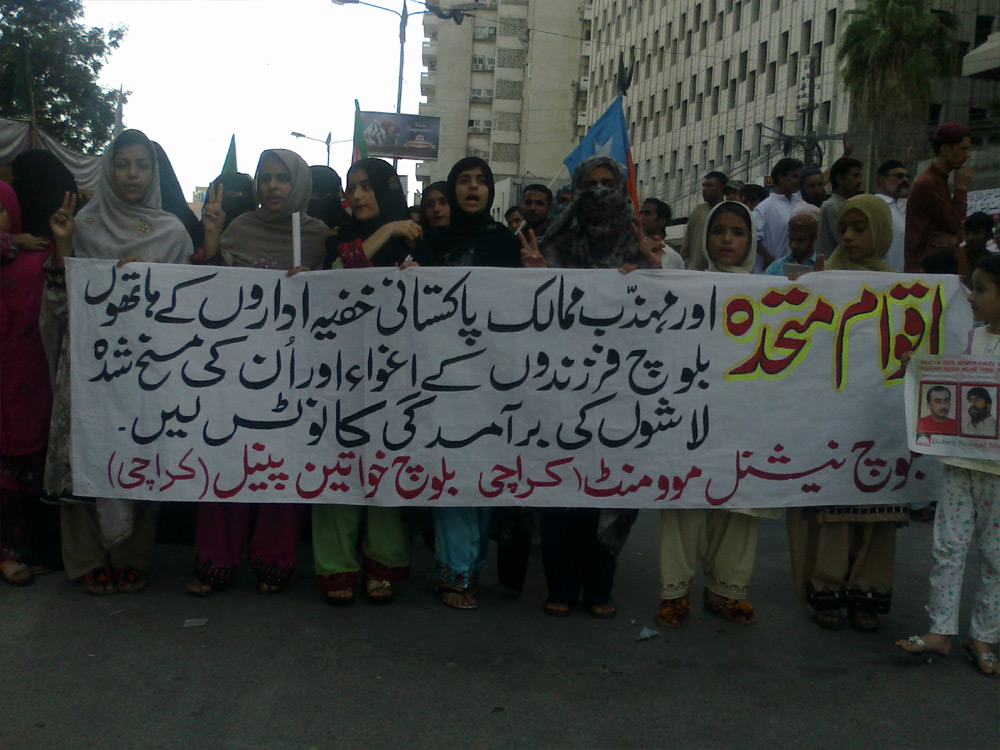
UN panel rekindles hopes for relatives of missing Baloch
For years, human rights groups had hoped that there might be an international outcry over a little-known epidemic of abductions, torture and murder in the Pakistani province of Balochistan where the local Baloch stand alienated and disillusioned with Pakistan’s establishment.
Now, the relatives of the missing are placing their faith in a visiting UN team to highlight allegations that security forces are waging a campaign of mass disappearances aimed at silencing calls for Baloch independence.
The Pakistani establishment has often blamed a ‘foreign hand’ behind the call for separation and independence but on several occasions its civilian government has accepted its failure to improve the lives of ordinary people in Balochistan while heavily relying on the province’s resources.
Even Pakistan’s Chief Justice of the Supreme Court, Iftikhar Muhammad Chaudhry, who had launched a rare move by the judiciary to hold the military to account over the disappearances, declined to meet the UN team.
He had warned this month that the province was a “volcano ready to explode” and said it was dangerous for outsiders to review Pakistan’s internal affairs.
Since a popular movement by lawyers that helped reinstate the chief justice after his suspension by former military ruler Pervez Musharraf, there hasn’t been much progress in the case of missing persons that the Supreme Court continues to hear.
“How many will they kill?” said Yusuf Baluch, who found the mutilated body of his son, Asif, last year, several months after he was taken away in Karachi.
Overshadowed by a US-funded campaign against Taliban militants on the northwestern frontier with Afghanistan, the conflict between separatists and the state in Balochistan receives scant outside attention except in February this year when the National Assembly unanimously passed an opposition-sponsored resolution to condemn a US Congressional hearing on Balochistan.
The resolution stated that the initiative would jeopardise Pak-US ties, which were particularly strained at the time. The foreign office soon echoed the lawmakers’ stance by lodging a formal protest with the US.
On the other hand, the military has repeatedly denied committing abuses and has blamed the killings on an array of militant groups active in the resource-rich province that borders both Afghanistan and Iran.
But human rights groups have gathered extensive evidence from relatives of the disappeared that raises serious questions over the conduct of the security establishment.
Re- kindled hopes
The arrival of the UN delegation last week kindled hopes in the province that the disappearances would finally start to gain global attention, but stirred controversy in Islamabad.
“If the UN has taken the pains to send a team to Pakistan, it means the world now knows what’s going on,” said Asif Baloch, a former student activist. “At least the news is out.”
The delegation was sent by a panel on enforced disappearances set up by the Geneva-based United Nations Commission on Human Rights and arrived in Pakistan last week.
Led by a French law professor, the team’s mission is primarily to gather information on cases of disappearances and serve as a conduit between relatives and the government.
Nevertheless, families of the missing gathered ahead of its arrival in Balochistan’s provincial capital, Quetta, on Saturday to urge the UN to take action to bring their loved ones home.
Even as the delegation began its tour of Pakistan, news of more disappearances reached Quetta.
On Wednesday, two days after the UN mission arrived in Islamabad, residents in southern Balochistan alleged security forces had taken away two more men in vehicles.
Baloch National Voice, a monitoring group, said another 14 men were detained at a military checkpoint on Friday. The bodies of six of them, all bearing gunshot wounds, have since been discovered, the group said. It added that the dead men had been blindfolded and their hands tied behinds their backs.
More than 300 bodies dumped
Parents and siblings of the missing have accused intelligence agencies of abducting people in many parts of Pakistan, but nowhere is the phenomenon more acute than in vast, sparsely populated Balochistan.
More than 300 bodies have been found discarded by roadsides or abandoned on waste-ground in the province since early 2011, according to New York-based Human Rights Watch. Many of the remains bear cigarette burns, broken limbs or other evidence of torture.
Baloch activists say the grisly trail is evidence of a state-backed “kill-and-dump” policy designed to intimidate separatist guerrillas and their sympathisers. The activists say several thousand people are still missing, though provincial authorities put the figure at several dozens.
Security forces deny committing abuses and say insurgents sometimes don military uniform before kidnapping people.
Major-General Obaidullah Khattak, head of the Frontier Corps, the main security agency in Balochistan, remains the only senior security officer who appeared before the Supreme Court to answer questions over the situation upon being summoned. The court has however not been satisfied with his explanations.
“Criminals must be acted against and brought before the law,” Khattak said in a recent interview in Quetta.
Army officers say the separatists have killed hundreds of what are termed “settlers” from other parts of Pakistan, in particular Punjab.
Suspicion among the military elite
A region of bone-dry desert and barren hills endowed with reserves of copper, gold and natural gas, Balochistan has witnessed waves of revolt by nationalists.
While the Baloch separatists’ goal of independence seems a remote prospect, Balochistan nevertheless exhibits a litany of state failure, alienation, corruption and missed economic opportunities that present a microcosm of Pakistan’s wider woes.
In Islamabad, the UN mission has sparked suspicion among the military elite, who are sensitive to any suggestion of interference in Balochistan.
Concern among lawmakers that the UN visit may threaten Pakistan’s sovereignty prompted Foreign Minister Hina Rabbani Khar to assure the National Assembly last week that the team had been invited by the government and had no investigative powers.
Punjab: Flood victims caught in intra PML-N rivalries
The Express TribunePolitical rivalry within Punjab has left scores of flood victims in the southern part of the province stranded for the last 48 hours as relief efforts in the region remained suspended on Sunday and Monday. Differences between Pakistan Muslim League-Nawaz’s (PML-N) top leadership and the party’s representatives from the area, the Khosa family, have hampered relief activities in the flood-stricken DG Khan region where hill torrents have devastated two districts and displaced tens of thousands of people. According to sources in the PML-N, a top dignitary of the province’s ruling party forbade the local administration from giving any truck of relief items to the Khosa family for distribution in the region – in fact directing that they be given to a rival family. Consequently, a bruising back-and-forth between the two influential sides began. According to well-placed sources, the Khosa family declared the top leaders of the party persona non grata in DG Khan — for flood relief activities or otherwise. Sources revealed that after hearing of this action, Hamza Shahbaz Sharif – the chief minister’s son – decided to cancel his visit to DG Khan which was scheduled for Monday. Resultantly, DG Khan District Coordination Officer (DCO) Iftikhar Saho and DG Khan Commissioner Tariq Mehmood halted the distribution of relief items to the Khosas starting Sunday. DCO feels the heat The local administration has allegedly stocked up on the distribution items at the Baloch Military Police (BMP) Lines in DG Khan. Official sources in DG Khan revealed that Punjab’s former chief minister Sardar Dost Muhammad Khan Khosa arrived at the BMP and demanded that DCO Saho hand over the trucks of relief items for distribution – but he was told that there was no authorisation in this regard. Using local political influence, Khosa forced the DCO to give him 10 trucks full of relief items from the Lines. Meanwhile, the DCO called Senator Sardar Zulfiqar Khan Khosa who reached the area to contain the heated situation — but to no avail. DCO Saho and the commissioner then contacted the chief minister who directed them to stop the Khosa family from interfering in the affairs of the flood relief distribution and asked his son Hamza to visit the area.But after the Khosa family’s ‘threats’, Hamza cancelled his trip. New appointment On Monday, Chief Minister Shahbaz Sharif appointed independent MPA Sardar Amjad Farooq Khan Khosa – who is said to have his own clashes with the Khosa family – as the head of the distribution of flood items and directed the concerned staff to “tackle the Khosa family with iron hands”. When contacted, none of the concerned officials, including the DCO, commissioner, members of the Khosa family or MPA Amjad, were available to comment on this development. Punjab government’s spokesman Senator Pervez Rashid maintained his ignorance of the issue and PML-Ns’ Punjab General Secretary Raja Ashfaq Sarwar refused to comment on it either.
Pakistan: Those who want clash between institutions are disappointed
Federal Minister for Information and Broadcasting Qamar Zaman Kaira said that those who want clash between the institutions are disappointed after the Supreme Court adjourned the NRO case till September 25th. Kaira happily said that Prime Minister presented the government’s stance before the court. ‘We will follow the court’s orders’ he added while talking with media outside the SC. Earlier, Prime Minister Raja Pervez Ashraf told the court that the federal government has directed the Law Ministry to withdraw a letter written, by the ex-attorney general Malik Qayyum, to the Swiss authorities for the withdrawal of graft cases against the president. Responding to a question‚ the Information Minister said the stance of the former Prime Minister Syed Yusuf Raza Gilani was the right one and the present decision in the case has been taken keeping in view the current situation. He said “we should not struck up in the past and instead look towards the future.”
Veena Malik's raunchy photoshoot for ‘Supermodel’
DAILY TIMESActress Veena Malik looked stunning during a very bold photoshoot she did for her upcoming movie ‘Supermodel’, which is produced by Ravi Ahlawat and directed by Navin Batra. Veena looked extremely raunchy and racy in a black bikini with shorts, which she pulled off with utter zest and game. “Today, I’m very much feeling like a supermodel myself. The photoshoot, which I have done reflects the glamorous part of being a supermodel,” Veena said. With her shapely long legs and washboard abs, the flawless lass is seduced the camera with her dazzling deep eyes, and one couldn’t help but comment on her enigmatic beauty and uber-styled looks. Director Navin Batra said, “When I was thinking about a supermodel, Veena was the one who come to my first. Veena was perfect for the role and she has worked in the film.” ‘Supermodel’ is Veena’s third upcoming movie, in which she journeys from being a middle-class girl to a super star. She will be sharing screen space with Bollywood actor Ashmit Patel in the film. Ravi Ahlawat, the producer of the movie said, “Veena was my first ever choice for ‘Supermodel’. She has done justice to the role.”
From the hills of Baluch
The varied aromatic and delectable tastes from Baluchistan take you on a route through the hilly region and bring it right to your platter. Here’s how you can get wrapped in the foil of a delicious experience
Though all Indian cuisines are very close to my heart and soul, one of the cuisines that I relish and love to dabble in is one that has many flavours and ingredients that are reminiscent of the Baluch tradition.
Despite sharing the border with Afghanistan, Iran and Pakistan and with a strong cultural semblance with that of her neighbours, what intrigues me is the distinct Baloch food in contrast to many other cuisines of the bordering regions.
Though Baluchistan is one of the four provinces of Pakistan, it has a unique identity both in terms of its inhabitants and cuisines.
The Baluch people are predominantly warriors, therefore, the food takes into consideration the lifestyle, so it is mostly meat, flavoured with a great variety of subtle, mild aromatic herbs and spices.
Every region’s climate plays a vital role in the making of a cuisine. Baluchistan is no exception. The hot days and cold nights have led to the preparation of refreshing Murakkat ie. shorbas and hot and cold kebabs. The beauty of the cuisine lies in its simplicity of presentation and complex culmination of spices.
A few of the signature cold kebabs are Kharbooze Ki Potli Mein Mast Zaika, Thande Thande Tandoori Jhumke Tandoor (cooked king prawns in a classic Afghani marinade) and Tandoori Raan ke Nazuk Parchey (spit roasted whole leg of mutton thinly sliced).
Traditionally cooked chargrilled kebabs, steamed kebabs, Patte Patte Mein Jhinga, Tandoori Khayaal (delicately cooked lobster marinated with spices) are some regional favourites.
With Love From Australia:Diseased livestock
PakistanIT is indeed a relief that the Sindh government has begun to cull thousands of infected sheep that were brought into the country from Australia. However, it is safe to assume that if it were not for the hue and cry raised by the media, the meat from these sheep may easily have ended up on our dinner plates. Health officials said the culling was necessary as the infections — the animals were infected with foot-and-mouth disease, among other ailments — could have spread to local livestock. The episode raises questions primarily regarding government oversight, or lack thereof, when it comes to the import and export of livestock. For instance, why were the sheep, imported by a private concern, allowed into the country when they had already been rejected by Bahrain? Also, the authorities must explain why the animals were released before being properly examined in quarantine and why they were kept with healthy animals. The stakeholders’ urge to cut corners and the government’s willingness to look the other way has cost Pakistan’s livestock, fisheries and agriculture sectors dearly. For example, the European Union has banned the import of Pakistani seafood since 2007 due to concerns about the lack of hygienic handling of the catch in local harbours. Fruit export has also suffered due to local exporters’ failure to meet international standards. All this amounts to shooting ourselves in the foot. While importing diseased animals, presumably for local consumption, is tantamount to playing with people’s lives, ignoring safety and hygiene standards for export products translates to shutting ourselves out of foreign markets. The government needs to ensure livestock raised in the country for export or animals brought in for local consumption are healthy not only in the interest of public health, but also to prevent Pakistani exports from being labelled as unfit for consumption.
Female suicide bomber hits foreigners on Kabul bus
At least 12 people are dead, including 9 foreigners, after a suicide bomber targets a vehicle near the airport in Kabul
Afghans reject US-favored administrative detention
http://www.bellinghamherald.comAn Afghan judicial panel ruled Monday that administrative detention violates Afghan law, potentially thwarting a U.S. plan to hand over Afghan detainees that American officials believe should continue to be held without a trial. President Hamid Karzai's office announced in a statement that a top-level judicial panel met earlier in the day and decided that the detention of Afghan citizens without a court trial "has not been foreseen in Afghan laws" and therefore could not be used.The U.S. government has long held Afghans captured in operations inside the country without trial, arguing that they are enemy combatants and therefore can be detained for as long as their release might pose a danger to the international coalition. Afghan laws have come into play only since the signing of a deal in March in which the U.S. agreed it would hand over all Afghan citizens to the Afghan government - acceding to a key Karzai demand to pave the way for a pact allowing for the long-term presence of U.S. forces in the country. But the United States has also argued that it cannot risk the release of some high-value detainees to the notoriously corrupt Afghan court system. Even though the deadline for the handover passed on Sept. 10, the Americans are still holding more than 600 Afghans in their custody. A U.S. official confirmed that the transfer of detainees had paused because of the dispute. The official was not authorized to give a public statement and so spoke on condition of anonymity. Aimal Faizi, a spokesman for Karzai, said the judicial ruling followed a vigorous effort by the Americans to persuade the Afghans to adopt administrative detention. He said the topic was discussed Sunday during a contentious meeting between Karzai and the U.S. special envoy to Afghanistan and Pakistan, Marc Grossman. "This was the intention, that administrative detention would be respected by Afghans," Faizi said. After the meeting, Karzai issued a statement lashing out at the Americans. "The continued holding of Afghans in American custody runs in contradiction with the spirit of mutual friendship and the provisions of the bilateral strategic partnership agreement," the statement said. It accused the United States of violating the March pact by continuing to hold some prisoners. In an emailed response, the U.S. embassy in Afghanistan said they were still committed to abiding by the memorandum of understanding, or MOU. "Ambassador Grossman made clear in his discussion with the president that the United States fully respects Afghan sovereignty. There is no question of our commitment to fully implement the MOU in recognition of Afghan sovereignty and the need to protect the security of Afghan civilians, Afghan national security forces and coalition forces," the statement said. Faizi said now that the judicial panel has ruled, Karzai expects the remaining prisoners to be transferred to Afghan control "as soon as possible." "We should respect the agreements signed between the two countries," Faizi said. He declined to say what Karzai would do if the U.S. continued to refuse to hand over the detainees by a certain date. He did add, however, that Karzai was demanding that the U.S. government provide more details about specifically what it hoped to get out of the next pact up for negotiations - a U.S.-Afghan security agreement that is supposed to get into the finer details of how U.S. troops will operate in the country, what type of bases they will have and what legal authority they will answer to. A failure to come to such an agreement in Iraq prompted the swift withdrawal of U.S. forces from that country. "We need to know the specifics of the security agreement," Faizi said. "We would like to know what the American government wants from us." The New York-based Open Society Foundations said in a report issued earlier this month that the U.S. is worried that the Afghan government will either release dangerous detainees or forward their cases to the messy Afghan system. The Afghan government agreed to embrace an internment system when it first signed the accord in March, but top Afghan officials and legal experts then started to argue that it violated the Afghan constitution, according to the report. The U.S. began detention operations at Bagram Air Field in early 2002. For several years, prisoners were kept at a former Soviet aircraft machine plant converted into a lockup. In 2009, the U.S. opened a new detention facility next door. The number of detainees incarcerated at the prison, now called the Parwan Detention Facility, has swelled from about 1,100 in September 2010 to 3,110 in the spring of this year. More continued to be added after the memorandum was signed.
NATO force orders teamwork with Afghans cut back
In the most sweeping response yet to “insider” shootings that have killed 51 Western troops this year, the NATO force has ordered a halt to joint patrols and other field operations by Afghan and foreign troops unless specifically approved by a regional commander, military officials said Tuesday.
The move is a dramatic blow to what had been the centerpiece of the Western exit strategy, which was for foreign troops to train Afghan police and soldiers in the field, so that Afghan forces would be ready to take the lead in fighting the Taliban by 2014.
Under the new directive, Afghan and NATO troops will continue to share joint bases, but contact between them will be limited to officers at the battalion level, mainly in the form of planning sessions and meetings, military officials said.
The order was given Sunday by Lt. Gen. James Terry, who heads the Joint Command of NATO’s International Security Assistance Force, or ISAF, on the same day that four American troops were shot and killed by Afghan police. The NATO force did not publicize the directive other than to provide copies in response to specific queries from news organizations.
Maj. Adam Wojack, an ISAF spokesman, acknowledged that the change would have a “huge” effect in the field. Until now, up to 80% of operations were “partnered” ones involving Western and Afghan troops.
He said the directive was prompted not only by insider shootings, which have accounted this year for about 15% of the NATO force’s fatalities, but also by an anti-Islam video that has triggered protests across the Muslim world, including a violent demonstration in Kabul on Monday.
“There’s a lot of tension out there,” he said, describing the directive as “a pretty major measure to mitigate risks.”
Exceptions to the directive would have to be approved by regional commanders, most of whom are two-star generals. Previously, lieutenants were authorized to give the go-ahead for patrols and other joint operations.
Pak PM agrees to reopen graft cases against Zardari
indiatimes.comIn a setback to President Zardari, Pakistan Prime Minister Pervez Ashraf has told the Supreme Court that the govt will open the graft cases against President Zadari. The Pak PM told SC that he has instructed authorities to revoke former AG's letter asking for closure of graft cases against the President in Switzerland. The Supreme Court has asked the govt to revoke the letter in two to three days. The Pakistan apex court has adjourned the case till September 25 and exempted the Prime Minister from personal appearance. At the last hearing on August 27, a five-judge bench accepted Ashraf's plea for more time to address the issue of reopening the cases against Zardari and gave him three weeks. Ashraf is the second premier to appear in the apex court to face a contempt charge for refusing to revive the cases against Zardari in Switzerland. His predecessor, Yousuf Raza Gilani, was convicted of contempt and disqualified in June. The Supreme Court has been pressuring the government to revive the cases against the president since December 2009, when it struck down a graft amnesty issued by former military ruler Pervez Musharraf that benefited Zardari and over 8,000 others. The government has refused to act, saying the president enjoys immunity in Pakistan and abroad.
SC gives govt 7 days to write Swiss letter
Dunya TVPrime Minister Raja Pervaiz Ashraf appeared in SC for the second time in NRO implementation case. Prime Minister Raja Pervez Ashraf on Tuesday told the Supreme Court that he was willing to revoke the Attorney General s letter that had asked for the closure of graft cases against the President. PM Ashraf directed Law Minister Farooq H. Naek to withdraw the application forwarded to the Swiss authorities by then attorney general Malik Qayyum. The graft cases were shelved in 2007 after Malik Qayyum wrote letters to the Swiss authorities following the promulgation of the NRO. The Supreme Court, however, in December 2009, declared the ordinance unconstitutional and ordered the reopening of cases against the politicians. The cases that had been closed by Malik Qayyum`s letter can now be reopened by the Swiss authorities if they choose. Further, the prime minister while requesting the court to adjourn the case until end of September, informed that he needs more time to draft the letter. The court said that the powers of withdrawing the letter should be delegated to the Law Ministry by tomorrow and directed the government to write the letter to Swiss authorities by September 25. The apex court also exempted the prime minister from appearing in the next hearing. In April 2012, Syed Yousuf Raza Gilani was thrown from the PM s chair by an order of the SC that found him guilty of contempt of court for failing to reopen the cases against Zardari. Ashraf too was charged with contempt of court after repeated failure to implement its order.
10 dead, including 9 foreigners, in Kabul attack
http://www.brecorder.comAt least 10 people, nine of them foreigners, were killed Tuesday when a suicide bomber blew himself up on a major highway leading to the international airport in Kabul, security officials said. An Afghan official said nine foreigners and an Afghan were killed, and two Afghan policemen wounded. "The foreigners were from a private company working at the airport," the official told AFP, speaking on condition of anonymity because he was not authorised to speak to the media.
Prime Minister Raja Pervez in the dock as show-cause hearing resumes
DAWN.COMThe Supreme Court on Tuesday resumed the hearing in the show-cause notice for contempt of court over the NRO implementation case, DawnNews reported. A five-judge bench of the apex court, headed by Justice Asif Saeed Khosa, was hearing the case. A Supreme Court bench had issued a show-cause notice to Prime Minister Raja Pervez Ashraf for not implementing its orders in the NRO case of writing a letter to the Swiss authorities to reopen graft cases worth $60 million against President Asif Zardari. 09: 56: Justice Khosa directed that the matter of the letter be resolved by Oct 2. 09: 51: Justice Khosa instructed the prime minister to write the letter to Swiss authorities following four steps: The prime minister would authorise someone in writing to write the letter, the content of the letter should satisfy the court, subsequently the letter is sent and lastly the court is informed once the letter is sent. 09: 44: The prime minister concluded his arguments in the court. 09: 40: The prime minister requested the court to exempt him from court appearances. 09: 39: The prime minister said he was experiencing pressure from different quarters and questions were being asked, adding that, the matter should be resolved. 09: 37: The prime minister further said that if the court cooperates, the matter could be resolved amicably. 09: 35: During the hearing, the prime minister told the court that he had asked the federal law minister to withdraw the letter sent to Swiss authorities by former attorney general Malik Qayyum for the closure of graft cases against President Asif Ali Zardari. 09: 15: Prime Minister Raja Pervez Ashraf arrived in the courtroom along with his counsel Wasim Sajjad for the hearing. 09: 12: Prime Minister Ashraf was also seen busy in consultation with Law Minister Farooq H Naek in the courtroom. Naek had accompanied the prime minister on his arrival at the court’s premises. 09:01: Earlier today, the prime minister had arrived at the the Supreme Court’s premises for the case’s hearing. 09:00: The prime minister was expected to apprise the court of the government’s decision over the issue of writing a letter to Swiss authorities for reopening grafts case against President Zardari, sources told DawnNews. 08: 56: Sources moreover said that the government had devised a middleway to write a letter to Swiss authorities. 08: 45: Leaders from the Pakistan People’s Party (PPP) and its coalition allies had arrived earlier at the court. The leaders present at the court included Chaudhry Shujaat Hussain of the Pakistan Muslim League-Quaid (PML – Q), Muttahida Qaumi Movement’s (MQM) Farooq Sattar, PPP’s Firdous Ashiq Awan and Awami National Party’s Minister for Railways Haji Ghulam Ahmed Bilour. The leaders stressed upon finding a middle-ground on the issue of the letter. 08:30: A large number of media and security persons were present at the Supreme Court premises. Strict security measure were witnessed at court room number four and entry into the area was prohibited hours before the prime minister’s arrival. 08:25: Islamabad’s red zone area was sealed for the public due to security concerns. Earlier on Monday, the ruling PPP and it coalition allies had decided in a meeting chaired by President Zardari that Prime Minister Ashraf would appear before the court in the show-cause notice for contempt of court over the NRO implementation case to apprise it of his government’s stance on the issue of the letter. Prime Minister Ashraf and former prime minister Yousuf Raza Gilani, who was sent packing by the apex court in the same case, also attended the meeting. The leaders of coalition parties had reiterated their support for the prime minister and decided to accompany him to the court.
KABULI VEHICLES: CAMPAIGN SHOULD CONTINUE
The Government should continue the present campaign against the smuggled Kabuli vehicles which are being used by the terrorists, smugglers and criminals merely because there is no record of registration with the Government. For the past many days, there is a blessing with least pollution and no congestions on the main roads even during the peak hours merely because the smuggler Kabuli vehicles are off the roads. Even the Traffic police officials were found relaxed at the main commercial centre saying that there is no traffic jams in and around Mizan Chowk. There is no congestion. There is no arrogant owner of Kabuli vehicles insulting the traffic policemen publicly when asked not to park their vehicles in no parking zone. In some cases, the Traffic Police cops were abused as we personally witnessed on the roads. One can judge the huge number of smuggled Kabuli vehicles that had provided relief to the people by remaining off the road. The owners are interested merely because they were cheap and smuggled and there were no taxes and no duty paid to the Government. The Public Exchequer suffered huge financial losses because the border security guards allowed or ignored the smuggling of Kabul vehicles for their personal petty gains. The Government should tighten the border security and should not allow the smugglers to smuggle in imported goods, including vehicles from Afghanistan for better prices.
We suggest that the Government should conduct raids the places where the smuggled Kabuli vehicles are kept by their owners. There are not on the roads. Only a few naïve people are bringing their smuggled Kabuli vehicles on road thus they are caught by the police and Excise officials.
Pakistan: Import of infected Australian sheep
Pakistan's Prime Minister Raja Pervez Ashraf has directed the government of Sindh to hold inquiry into the import of large number of infected sheep at Port Qasim, Karachi and identify the persons responsible for this illegal act.
The prime minister has desired that findings of the inquiry may be communicated for his consideration within seven days.
Sindh government officials decided on Sunday to cull more than 21,000 imported Australian sheep and the process of killing the animals and burying them started late in the night in Razzakabad area amid tight security.
The government took the decision after reports from a second laboratory also confirmed that the animals were diseased.
The culling began in the presence of livestock and local government officials. "We have culled about 150 sheep so far. The step has been taken after the animals were found suffering from highly contagious diseases. Infections could spread in our environment if the animals were allowed to live," Dr Abdul Hafeez Shaikh, representing the livestock department at the site near the private farm in Razzakabad where the animals had been kept, said.
The animals, he said, were being buried in a 15-foot deep ditch after being slaughtered.
Referring to the latest report submitted by the Tandojam Central Veterinary Diagnostic Laboratory, provincial Livestock and Fisheries Secretary Syed Abid Ali Shah said it showed that the sheep had got foot-and-mouth disease, besides having bacterial infection as had earlier been indicated in a lab report by the Sindh Poultry Vaccine Centre.
"There is no option left but to cull all animals in public interest because two laboratory reports have confirmed that they are diseased. Preparations are under way for the culling that will begin soon," he said, adding that the remains would be buried deep at the same place.
"That means these animals are a grave risk to public health because we don't have this virus in our environment right now, nor the lab facilities required to detect it.
"The spread of new viruses is a major health hazard across the world which is why developed countries have stringent rules and regulations to protect their environment," he said.
Rains, floods kill 262 in Pakistan
http://statesman.com.pkA total of 262 people have been reported killed and 815 injured so far this year as torrential monsoon rains and flash floods wreak havoc throughout the country, National Disaster Management Authority (NDMA) said Monday. Over 70,000 houses have also been reportedly damaged, with 51,027 partially and 19,465 completely damaged, said the official statistics which are updated until Sept 16. Approximately 3,883 villages, spreading over an area of over 1,345,531 acres, have been affected by the torrential rains. DawnNews reported that most casualties were reported in Sindh province, according to the data, with 106 people killed and 361 injured, and a total of approximately 273,000 people affected by the torrential rains. At least 58 people were killed and 272 injured in Punjab due to rain related accidents, with over 857,000 people affected in total in the province. Torrential rains and flooding killed 39 people and injured about 35 others in Khyber Pakhtunkhwa, with 104 houses damaged. Meanwhile, 25 people were killed in Balochistan. Kashmir region recorded 31 deaths, while 3 people were reported killed in Islamabad region. INP ADDS: Heavy rains in upper parts of Khyber Pakhtunkhwa, Lahore, Faisalabad, Sargodha, Rawalpindi and Islamabad on Monday badly affected normal life as roads and low lying areas were flooded with water. Heay shower lashed parts of KP including Peshawar, Mardan, Swat, Dir, Bajaur and Abbottabad. According to the Pakistan Meteorological Department, many districts of Khyber Pakhtunkhwa, upper Punjab and Balochistan will receive more rain during next 12-hour. The rain which started in Rawalpindi and Islamabad around 1:00am continued for more than four hours. Nullah Leh which passes through Rawalpindi was flooded and the water level was recorded at 11.8 feet. Islamabad received 115 mm of rain while Okara received maximum of 117 mm. The rain affected smooth flow of traffic in the big cities as roads were flooded with water. According to reports, hill torrents of Koh-e-Suleman played havoc in Sothern Punjab as all the streams and nullahs were flowing over their embankment. Reports say that rural areas of Rajanpur districts were under feets of water. There was a 100 feet wide breach in Kadra canal that flood hundreds of acres of land. Met office said that Chenab and Jhelum rivers could witness high flood during the next twenty four hours. In Balochistan Jafferabad has been worst affected by rain and flood. One report said that water level at Jafferabad bypass was between 12 to 15 feet inundating vast areas and with rains in southern Punjab the water level was rising.
PM Raja to appear before SC in NRO implementation case today
RADIO PAK
The Spokesman said PM Raja Pervez Ashraf will appear before the Supreme Court in NRO implementation case on Tuesday He said coalition partners will accompany the Prime Minister to the Supreme Court as a mark of solidarity. The coalition partners reiterated their full support to the government.

Monday, September 17, 2012
US should introspect root cause of 'Benghazi tragedy'
U.S. ambassador to Libya Christopher Stevens and another three diplomats were killed in an anti-U.S. protest in Benghazi, Libya on the night of Sept. 11.
This is the first U.S. ambassador who has been killed on duty since 1979. The violent act against diplomatic personnel evoked strongest condemnation from international community.
The direct cause of the violent attack is a U.S. anti-Islamic film which insults the Prophet Muhammad. Egypt and other Islamic countries also join the anti-U.S. protests. Obviously, the violent attack reveals the drawbacks of U.S. policy in the Middle East.
More than one year ago, the North Atlantic Treaty Organization (NATO) members insisted on using military attacks to promote the regime change in Libya. Many analysts warned that as the complex internal conflicts in Libya has existed for a long time, the external military intervention might lead to a chaotic situation in the country.
Now, the death of U.S. diplomatic personnel in Benghazi highlights the fragile security situation and severe internal conflicts in Libya. Many "liberated" Libyans do not have any gratitude to the United States as expected.In fact, the condition generally exists in the Middle East. The biased, two-sided and contradictory U.S. policy in the Middle East has sowed seeds of calamity. After the 9/11 attacks, the U.S. government have taken all kinds of measures, including implementation of "Greater Middle East Initiative" by means of war. However, the people in Middle East believe that the United States attempts to maintain its strategic interests and influence in the region.
The anti-U.S. protests and incidence of violence show that the U.S. military intervention policy will bring huge negative effects. The U.S.-led wars in Iraq and Afghanistan have brought great pains to the people of the two countries.
Currently, the United States and some other countries are trying to enforce regime change in Syria, providing support to Syrian oppositions and appealing to more direct military intervention. However, what consequences will the external military intervention bring? The tragedy in Benghazi is thought-provoking.
The death of the U.S. diplomat deserves strongest condemnation, but it is equally and even more important for the United States to self-examine the root cause of the tragedy.
Suicide bombing in Afghan capital, leaving casualties
A suicide car bomb went off in early Tuesday morning in Afghan capital of Kabul, leaving casualties, the police said.
"A suicide bomber targeted a minibus carrying foreign nationals along a main road from Kabul airport to Kabul inter- continental hotel, leaving at least nine foreigners dead," a police official told Xinhua anonymously.
The blast occurred at around 6:45 a.m. local time Tuesday morning.
Meantime, a local TV channel Tolo News also reported that nine foreigners were killed in the suicide bombing that went off near an Afghan intelligence agency building in airport road.
No group has claimed responsibility for the attack so far.
Obama's lead over Romney narrows to 5 points
ReutersPresident Barack Obama's lead over Republican Mitt Romney narrowed to 5 percentage points in a Reuters/Ipsos poll released on Monday, from a high of seven points in the week after the Democratic National Convention. With just 50 days before the November 6 election, Obama led the former Massachusetts governor by 48 percent to 43 percent among likely voters in the online poll conducted September 12-17. In a similar poll last Thursday, he led by 48 percent to 41 percent. "My takeaway is that it's pretty decent news for Obama that his bump is sustaining so long and he may be turning the post-convention bump into a lead," said Ipsos pollster Julia Clark. In a shift in recent days, Americans also gave a small edge to Obama on the crucial topics of jobs and the economy, as they feel less nervous about economic conditions. Thirty-seven percent of registered voters thought Obama had a better plan for the economy, compared with 34 percent who favored Romney on the issue. Obama led 36 percent to 35 percent on the issue in a poll released last Thursday. Forty percent backed Obama on jobs and employment, compared with 36 percent who favored Romney. "This is a bit of a shift," Clark said. The two candidates had been tied or Romney was slightly ahead on the economy since May, but that has changed to give Obama a small edge in the wake of the convention. "People are not really quite as nervous about the economy as they were a couple of months ago," Clark said. However, more of the registered voters surveyed picked Romney as the candidate who would best deal with the federal government's budget deficit, at 34 percent, to 29 percent for Obama. They gave Obama large leads when asked who would handle issues including healthcare (12 percentage points) and taxes (13 points), as well as Medicare (16 points) and Social Security (13 points. The precision of the Reuters/Ipsos online polls is measured using a credibility interval. In this case, the poll has a credibility interval of plus or minus 4.1 percentage points for all respondents. For the 591 likely voters surveyed, it was 4.8 percentage points.
China's car makers cut corners to success
China keeps getting better at making cars. One reason: It's getting better at cutting corners. Zhejiang Geely Holding Group Co, one of China's biggest car makers, conducted 20 to 25 crash tests when it developed its popular Panda model, engineers involved in developing the car told Reuters. Global car makers typically conduct 125 to 150 crash tests for each new model. By relying more on computer simulations, Geely saved at least 200 million yuan ($31.57 million) and two years in development time on the Panda, the engineers said.
Paring back on crash tests, skimping on frills, simplifying designs, using cheaper materials and, in a departure for the industry, outsourcing most of their design and engineering are having a profound effect on the cost bases of China's dozens of car makers. Some are now able to sell cheap and cheerful small cars for about 40,000 yuan ($6,350) - less than half the price of a plain vanilla Toyota.
Ten years ago, no discerning Chinese consumer would have bought China-designed cars. Not only were such vehicles accused of being illegal counterfeits of foreign models, but their quality and safety were also mistrusted.
Now, despite their homely looks, some indigenous models are striking a balance between no-frills affordability and acceptable quality. In China, it is the age of the good-enough car - and that has potentially significant implications for the world auto industry.
Models such as the Panda and the Great Wall Haval H3 are becoming popular not only in China but increasingly so in emerging markets, from Indonesia to Egypt and Ukraine. They are driving China's auto exports to record levels, even as growth in China's auto market slows down.
GETTING TRACTION ABROAD
Exports of Chinese-produced vehicles are forecast by China's auto association to hit one million vehicles this year from 849,500 vehicles last year. Some automotive analysts are predicting a 50 percent increase to 1.25 million vehicles.
Some executives at big foreign manufacturers say China's new model of creating good-enough cars poses a serious challenge to the way the international industry operates.
"This is a warning shot to the established engineers who have told their management time and time and again that this is the minimum cost they can achieve with their existing design and production methodology," says Shiro Nakamura, a top Nissan Motor Co. executive and the company's chief designer. "Now the Chinese are saying they can cut another 30, 40 percent of the cost."
It normally takes four to five years for established players like General Motors Co and Toyota Motor Corp to come up with a new car from the ground up. Chinese manufacturers can now do so in just two and half years by deploying an abbreviated design process.
"Perhaps the Chinese achieve their low cost by sacrificing quality standards," says Nakamura. "But in many ways their way also points to ‘over quality' or ‘waste' we have built into our conventional design process over the years."
THE COPY CATS
The Chinese approach is a product of the extraordinarily fast rise of its auto industry. As the country opened up to the West, car makers were faced with relatively poor customers at home and sophisticated products made abroad. Global automakers could sell their pricey cars to rich Chinese, but local Chinese automakers had to come up with cheap cars for the masses.
Rapid growth in the economy spurred the creation of more than 100 registered automakers across China by the early 2000s - but they lacked expertise. Their solution in coming up with affordable cars was simple: copy the designs of foreign makers.
"Around 2000, China began embracing an approach it described as ‘reverse-engineering.' It was essentially a fancy word for copying," says Dai Ming, a senior engineer at CH-Auto Technology Corp, an independent design and engineering company based in Beijing. "The problem with those copied cars was that the Chinese were able to emulate the shape of a foreign car, but not its soul."
Chinese car makers tended to sift through a foreign vehicle to identify expensive, non-critical features and functions to skimp on or eliminate, such as a door that closes with a proper "thump," as well as power windows and passenger-airbags. The result was often dubious quality and durability. After a few years of use, bumpers and door handles would start falling off.
Dai says of the typical cheap knock-off model: "It didn't drive well like the foreign car, either, and in some cases it was a safety hazard on the road."
OUTSOURCING DESIGN
A clutch of design firms is driving the advances in affordability and quality in the industry, including CH-Auto, where Dai works; IAT Automobile Technology Co. of Beijing; and TJ Innova Engineering & Technology Co. of Shanghai.
China's indigenous automakers are so new many have not had time to groom their own engineers, and their best engineers are usually occupied more with manufacturing than design. Companies thus often outsource product design and development to outside engineering houses filled with Chinese engineers trained overseas.
Automotive analysts say these houses are responsible for helping engineer seven to eight out of every 10 cars China's indigenous car makers sell here. By using the same few design and engineering firms, Chinese car makers have effectively created a shared pool of home-grown automotive technology.
CH-Auto, for instance, has helped design an array of cars over the past decade, each time gaining fresh expertise, which it deploys for its next project - in most cases for a different company. CH-Auto was established in 2003 by a small group of jobless Chinese engineers who had trained with Beijing Jeep, a now-defunct joint venture set up initially by Beijing Automotive Industry Holding Co. and American Motors Corp.
CH-Auto and its rivals say they have moved beyond aping foreign designs. Instead of copying the shape of a component or an entire foreign car, they try to match its performance as well - often successfully - even as they improvise and simplify the original design to cut costs. The aim is to make cars affordable to China's emerging middle class, people who are earning 50,000 to 60,000 yuan a year ($7,900-$9,500).
"It's not copying. It's not that simple anymore," said Wang Kejian, president of CH-Auto, a former Beijing Jeep engineer who was trained for a time in Detroit by Chrysler. "Since Chinese car makers have no accumulated vehicle design technology or know-how, we have to develop our own by studying foreign cars and use local parts suppliers to approximate the components and the cars."
HALF THE COST
Geely Automobile, which owns Swedish carmaker Volvo, turned to CH-Auto around 2005 for help on a project that led to the Panda, now one of China's most popular small cars. CH-Auto was responsible for the exterior styling and engineering the underpinnings. The rest was handled by Geely, according to the two companies.
CH-Auto and Geely made a clear departure from copying with the Panda. To be sure, they still selected a car to emulate or bench-mark - in this case, the Aygo, a "city car" that Toyota produces in Czech Republic and has been selling in Europe since 2005.
But instead of simply producing a fake Aygo, engineers at CH-Auto first studied and tested the Aygo and its components - often with the help of three-dimensional digital scanners - to collect data on their design and performance. Then they tried to manufacture components by adapting parts made in China to match desired functions and performance. If suitable local parts weren't available, they worked with suppliers to create new ones by simplifying the scanned Aygo designs.
The purpose was "not to copy but approximate the Aygo," Dai said.
PANDA'S UNDERPINNINGS
One example is the Panda's chassis. The under-body carriage, which the suspension and wheels are attached to, is key to how a vehicle handles corners on the road.
The Aygo, which starts at 6,462 pounds (about $10,000) in Britain, has a relatively sophisticated under-body structure formed in a single piece by using a process called "hydroforming," in which pressurized water is used to shape metal. For the Chinese this was a problem.
CH-Auto and its chassis suppliers have no proven know-how in hydroforming. And the light-weight steel that Toyota uses for the Aygo's under-body carriage was too pricey for Geely to use in a car to be sold in China.
Geely and CH-Auto's solution was to use cheap "everyday" steel commonly available in China, Dai said. Geely and CH-Auto divided the Panda's chassis frame into two pieces - upper and lower units - to simplify their structure so they could be easily stamped rather than using the more expensive hydroforming method. Then Geely welded those two pieces to create a chassis frame for the car.
"The problem was our solution compromised the Panda's NVH," Dai says, using the acronym for noise, vibration and harshness, the key attributes of drive feel.
Dai's engineers tweaked the Panda's suspension, adjusting the so-called rubber bushes, or isolators, to make them softer to better absorb shocks and vibrations.
Despite using cheaper materials and processes, Geely and CH-Auto were able to largely match the performance of the Aygo's platform in terms of the vehicle handling and NVH, which Dai says was confirmed by a third-party testing company. More important, by tweaking the design and using cheaper materials and manufacturing processes, Geely and CH-Auto were able to produce a platform for the Panda with "roughly half" the Aygo's cost, according to Dai.
ELIMINATING "MAJOR RISKS"
Despite the advances in design, safety standards in Chinese-made cars still lag those of U.S. and European manufacturers, in part because its government doesn't impose as stringent a body of safety requirements.
What's more, Chinese car makers ignore what they consider minor, non-critical risks, such as using far fewer crash tests with dummies.
"If the client only gives me two-and-a-half years to design a car, then I can only eliminate major risks. And the smaller risks, well, there's nothing we can do," says CH-Auto's president Wang.
China does have vehicle safety standards, and any automaker launching a new car needs to meet them. But there is no required number of crash tests.
Geely and CH-Auto do not want to do as much crash-testing as global automakers because creating prototype cars costs up to 2 million yuan a car ($316,000), CH-Auto's Wang said.
A Geely spokesman, Victor Yang, would not say how many crash tests Geely conducted on the Panda. But Yang noted that the Hangzhou-based automaker conducted "more than what's typically performed in China." For cars being developed today, it routinely conducts more than 70 crash tests, Yang says.
By contrast, an established global player such as Toyota routinely tests a new car by crashing it a "minimum 120 to 150 times," according to a Toyota chief engineer who spoke on condition of anonymity. If the car is sold in many different markets around the world, Toyota crashes even more cars, he said.
THE ROAD AHEAD
Nevertheless, the Panda is a watershed product for both Geely and CH-Auto. The car's stylized exterior - featuring a Panda-eyed grill and tail lamps in the shape of paws - was considered cute and timely when launched in 2008 to coincide with the Beijing Olympics.
The exterior contrasted with the car's highly utilitarian interior, including exposed screws and a plasticky dashboard. The 1.3-liter, 86-horsepower motor pulls the Panda from a standstill to 100 kilometers an hour in an unthrilling 13.1 seconds. Nor is the Panda, like other no-frills Chinese cars, ready to meet the stringent safety regulations of Europe and America.
But there is one very eye-catching thing about the car: its price. A new Panda starts around 40,000 yuan ($6,400) in China and about 5,000 euros ($7,400) abroad.
After the Panda, CH-Auto's business began booming. It developed or helped develop a slew of cars and sport-utility vehicles for Changfeng, an automaker affiliated with Japan's Mitsubishi Motors. The Changfeng projects then led to deals with Jiangling Motors Co. and Chongqing Changan Automobile Co., as well as Beijing Auto.
One of CH-Auto's upcoming models is a Beijing Auto vehicle based on technology the company purchased from the now defunct Saab of Sweden.
CH-Auto also has a major contract from Dongfeng Motor Co. — the 50-50 joint venture between Nissan and Dongfeng Motor Group Co. The team will develop a subcompact car based on the Nissan March (known as the Micra in Europe) to buttress a new "indigenous" brand called Venucia launched in China earlier this year.
The advent of the good-enough car is emboldening Chinese automakers to build up their own product development capabilities to rely less on CH-Auto and other independent engineering houses.
Geely, one of China's top indigenous car makers, is expected to sell about 370,000 cars in China and 90,000 abroad this year. By 2016 the company forecasts its export volume will hit as high as 300,000 or possibly 400,000.
"My vision," said Geely Chairman Li Shufu, "is to sell outside China the same number of cars we sell within China."
Rimsha case: Court reserves verdict on delay in challan
The court of the additional sessions judge in Islamabad reserved its judgment over Monday’s hearing in the blasphemy case against Rimsha Masih.
A ruling over today’s hearing was to be issued later.
Senior civil judge Amir Aziz issued an order for the investigation to be conducted by an officer of the superintendent of police (SP) rank.
The investigating officer (IO) on the case told the court that the police’ s inspector general (IG) had constituted an investigative team headed by a senior superintendent of police (SSP) and that the case’s investigation had been completed.
The IO asked the court for more time to submit the charge sheet in the case.
Rao Abdul Rahim, the counsel for the accuser, reminded the court that the police had already asked for more time to submit the challan and that the court had directed for an incomplete challan to be submitted during its previous hearing.
Another lawyer for petitioner told the court that his client, Hammad Malik, was being threatened by the IG and other officers at the police station.
The lawyer requested the court to restrain the police from harassing his client again and again and also requested for the bail of blasphemy-accused Christian girl to be cancelled.
The complainant’s counsel alleged that the police had not constituted an investigating team yet and demanded the names of the officers constituting the team to be disclosed.
The prosecutor presented the court with the names of the officers included in the investigating team upon request.
‘US will think twice before supporting Islamic radicals’
The recent outbreak of violent anti-American protests in the Muslim world will make US politicians think twice before supporting Islamic radicals, political analyst and ex-jihadist Tawfik Hamid said in an interview with RT.
The US has funded Islamists groups throughout the world for decades, and the death of the American ambassador to Libya is just one more example of how militants backed by radical Islamic ideology will eventually turn their weapons against their patrons in Washington.
In this light, Hamid believes that the idea of toppling Syria’s President Bashar Assad and replacing him with rebels known to have connections to Al-Qaeda should no longer seem like such a winning idea to the West.
RT: What do you think of the events in the Arab world right now?
Tawfik Hamid: I see an expression of radicalism in the form of attacking embassies and killing ambassadors, and expressing this violence in the radical ways of thinking that proliferated in the last few decades in the Muslim world. It is expressing itself in this form as it also expressed itself in Afghanistan in beheading people. But that is a different kind of violence. It is based on the same thinking of accepting the use of violence to suppress others, and preventing them from saying their opinion or preventing them from saying things that you perceive as insulting.
RT: Do you think it is happening especially in the countries that have gone or are still going through transition?
TH: The general underlying cause is religious principles, that whoever says a bad word against the Prophet Muhammad must be killed, which is not in the Koran but it is one of the mainstream beliefs in some Islamic books. Also, the excess of love for Prophet Muhammad makes Muslims feel that [in case of] any insult towards him, they have the responsibility to defend him. Especially according to Islamic traditional teaching that sinners go to hell, and that the Prophet Muhammad is the one who will intercede to bring them from hell to paradise. It is not gold that will do this, it is the Prophet Muhammad’s intercession. So, there is an excessive emotional feeling toward the Prophet Muhammad because of this.
This is an underlying factor. But there are local reasons as well, in Egypt for example. In Egypt, you have the role model of Essam Sharaf, one of the former Prime Ministers after the revolution, who actually celebrated the young man who took the flag of the Israeli embassy and burned it while a mob surrounded the embassy. Instead of punishing him and considering him a criminal for such an act, for attacking the Israeli embassy, [Essam Sharaf] actually celebrated him in the media. This is providing a very bad role model.
In Libya, the situation is different: You have many well-trained radicals who have military power in their hands, who can make the decision to attack the embassy based on the movie [the US-made anti-Islamic movie ‘Innocence of Muslims’], or based on a prior arrangement.
RT: A lot of people, even US officials, are saying that this was a pre-planned attack and that the film may have nothing to do with this. Do you agree to this?
TH: It is a possibility, I cannot deny that it is one of the possibilities. But also, there is the possibility that this movie incited excessive hatred and a desire to use violence against the US. And [an attack] could then be easily implemented, because there are well-trained fighters with weapons, even artillery. So, it is not that difficult, if you have been fighting Gaddafi for more than a year, to take weapons and go attack the embassy. Both possibilities are valid.
RT: The groups that attacked the US embassy were funded and trained by the US – in some cases – during the revolution in Libya. Do you think that the US did not see this coming? Especially after what happened in Afghanistan back in 1970s to 1980s, and now we see the results with the Taliban?
TH: I think people do not learn from history very well. It is one of the problems of humans: They don’t learn from history and they follow advice without really going into enough depth of understanding of culture and mindset, the religious things. Some of these [Libyan] radicals who were probably supported by NATO may have access to such weapons, because when Gaddafi’s government and the whole system collapsed they had easy access. Really, there is a big problem in dealing with Middle East issues.
RT: Do you think the US expected the democracy that they were promising to Libyans and Egyptians and other nations in the Arab world, that this will be the result of the democracy they were promising?
TH: Obviously not. You see [US Secretary of State] Hillary Clinton, for example, clearly saying that ‘how can this happen in the country that we helped to get freedom?’ They are really shocked. The Americans and NATO helped them expecting that they will reciprocate by at least showing some liberties and respect for others, at least for America. But they underestimated the threat of radical Islam – as they did in Iraq. And the main factor in this threat is ideology. If you don’t deal with this ideology, you cannot win this game.
If you focus on two things, democracy and military power, it is like if someone who knows how to change a tire of a car thinks that fixing a complex electronic component of the car can be done by changing tires. No, it will not. You need to go to a completely different dimension here. That is to deal with religious ideology, whether you admit it or not – you have to deal with it.
RT: Especially because a lot of people were telling the US [the militants] are with Al Qaeda. In your articles you do talk about this.
TH: I’m one of the people who clearly stated that if you want to implement a democracy – avoid the ‘sudden democracy’ syndrome. It will bring the Islamists to power, and we will suffer
RT: Would you say that the US simply does not understand the nature of the Arab world? The fact is, the democracy they wanted to impose is a complete failure right now.
TH: There are [American] people who understand, and people who do not understand, and it depends on the balance of powers in certain times in history when the decisions are being taken. Unfortunately I don’t think the decisions taken here are very correct.
RT: Do you think the US will change its strategy in the Arab world and the countries going through transitions, in light of what is going on?
TH: Yes, absolutely. For example, there will be many voices that will start questioning if removing [Syrian President Bashar] Al-Assad is a good idea or not. Supporting the rebels can ultimately bring extreme radicals [to power in Syria], who will become enemies to America and attack it. It doesn’t work the way people think. The Libyan example of the killing of the ambassador in such a way, and the spread of the reaction in several Islamic societies, will make many people think twice before supporting rebels against Al-Assad. I cannot say it will be a game change in this respect, but I can say it will make many people think twice about the issue of supporting the rebels against Al-Assad.
RT: But will they actually make decisions that are different from those made before? Will they reconsider their strategy?
TH: It is likely; there is a 60 percent possibility that decisions may have some changes or modifications, especially now that the Syrian issue is hot. I know it was a policy to remove Al-Assad but I think with the Libyan issue it will make the voices of the people, who were against Assad’s removal, more prominent and better heard.
But it is very hard to guarantee an outcome, because it depends on different powers and ultimate intentions; it is not something where you can easily say ‘it will change’.
RT: How do you see relations between the US and the countries that are going through transition, Libya and Egypt in particular, especially after the latest protests?
TH: It will certainly create a new way of thinking in relations with these people. I think it might affect [American] donations that go to Egypt. The [US] Congress is supposed to allow $1 billion donations to support Egypt. I believe many people in Congress will think twice whether this is appropriate, without having guarantees from [current President of Egypt Mohamed] Morsi that he will really respect the values of democracy. The problem is that many societies understand democracy as just a ballot, while the West understands democracy as transparency, freedom of speech and respect for minorities. There are two completely different understandings of the same word. In the West, it is understood as these values, but elsewhere in the world it is understood as the majority suppressing the minority and dominating everything.
RT: If Congress is going to reconsider its aid to Egypt for preconditions – isn’t that another form of conditions the Arab world is sick and tired of, and the reason for the protests?
TH: I think if you’re giving donations, you have a full right to put conditions on it, because it is extremely unwise to give someone donations and at the end they will promote an ideology of hatred to you that can ultimately cause you damage. So, when the US is giving someone donations on that high level, it is fair to insist on certain conditions.
RT: Would you say the US will start working on its relations with the Arab world, with the peoples instead of governments?
TH: I think they will become more aware of fighting radical ideology, they cannot just ignore it. It is not simply a military solution, or using democracy to solve the problem.
Iranian, Pakistani presidents discuss Syria
During a telephone conversation on Sunday, Iranian President Mahmoud Ahmadinejad and Pakistani President Asif Ali Zardari held talks on bilateral cooperation and regional issues, including the Syrian crisis.
Ahmadinejad said that a group should be established to contact the Syrian government and the opposition in order to help restore calm and peace in the crisis-hit country.
In reference to the 16th Summit of the Non-Aligned Movement (NAM), which was held in Tehran from August 26 to 31, the Iranian president said that NAM is an independent movement and has enormous potential.
He added, “But the organization and bodies needed to pursue and implement agreements have not been formed.”
He also underlined the need for making the preparations necessary to implement the agreements made during the NAM summit in Tehran and hold a consultative meeting between the member states of the movement on the sidelines of the 67th Session of the United Nations General Assembly, which will open at the UN Headquarters in New York on September 18.
The Pakistani president also called for the establishment of a group to contact the conflicting sides in Syria.
Elsewhere in his remarks, Zardari praised Iran for its successful hosting of the NAM summit and called for the establishment of executive structures for the movement.
Balochistan’s Duty
THE BALOCH HALBALOCHISTAN has historically held the centre wholly responsible for the province’s underdevelopment and economic backwardness. But now the province cannot absolve itself of responsibility, as it has received unprecedented funds under the seventh National Finance Commission (NFC) award and more autonomy after the passage of the 18th Amendment. What it still lacks, however, is political will. The 18th Amendment and the NFC award empowered the provinces and altered the flow of funds to them. Balochistan got increased fiscal space and powers to improve its socio-economic condition. It is now largely responsible for the delivery of goods and services and it should be held accountable for its poor performance in this regard. Under the seventh NFC award, Balochistan’s share in the divisible pool increased to 9.1 per cent from the earlier 5.1 per cent; the province received Rs83bn in 2010-11 compared to Rs29bn in 2009-10. It also won Rs120bn in gas development surcharge arrears outstanding since 1954, to be paid in annual instalments of Rs12bn. The increase in funds from the divisible pool, the retrospective increase in the well-head gas price and the reimbursement of gas arrears helped raise revenue receipts by 95 per cent to Rs116bn in 2010-11. In addition, the 18th Amendment fulfilled Balochistan’s long-standing demand for provincial autonomy. It devolved 17 ministries and shifted several subjects to the domain of joint decision-making between the provinces and the federation. But how has Balochistan handled these additional responsibilities? There is still a big question mark against the performance and capacity of the Balochistan government, as there has been no improvement in the delivery of goods and services to the people. With the increased revenue, the provincial government seems to have done little more than purchase a new aeroplane and increase discretionary funds to Rs300m this year for each legislator to spend in his constituency. Meanwhile, the province’s economic potential remains untapped. For economic planners, it represents a bonanza in the shape of its natural endowments and geostrategic location. What have the economic managers in Quetta done to tap the huge development potential of key sectors including agriculture, mining and fisheries? Setting priorities for budgetary allocations for different sectors is the key area where prudence and foresight are needed. For instance, the water-starved province badly needs a mega development plan for water resources as its groundwater table is persistently declining. Similarly, the gas reserves at Sui, the country’s single largest gas-producing field, are falling by five per cent each year and may be exhausted by 2022. Gas revenue is the major source of the province’s income, and discovery of new gas wells should be the top priority of the provincial government, which it does not seem to be. The province did give higher priority to education in the previous and current years’ budgets. Yet the bulk of the education budget was allocated for the release of salaries for teachers and for building schools to benefit the construction mafia. How many technical training centres and quality educational institutions has the provincial government planned or set up? The province will remain in the underdevelopment trap until and unless its human resources are developed and its institutional capacity improved. The province’s own revenue generation is currently estimated at only around Rs5bn, of which only a paltry amount comes from taxes. The government has not yet taken any new measures to broaden the province’s revenue base, which could reduce its dependence on the centre. It has no money, for example, to bear the financial costs of its legal fight against international miners over the Reko Diq copper and gold deposits. For this it is again looking to the federal government, which has refused to pay the Rs450m fees for legal experts to fight the international arbitration case filed by Tethyan Copper Company. How will the Balochistan government pay damages if the international court rules against it when it is unable to pay even the fees for legal experts? At the same time, what we have also witnessed in the last two years is an unprecedented increase in the size of the province’s budget. The Rs152bn budgetary outlay for 2010-11 was almost double that of 2009-10. The Rs172bn budget for the current fiscal includes development expenditures of Rs36bn and non-development expenditures of Rs144bn. But Balochistan’s remote rural areas still appear to be stuck in the Middle Ages, with residents using donkey-run fans in the hot summer in Naseerabad and Dera Murad Jamali, travelling on camels in Jhal Magsi, and burning wood and coal for fire during the chilling cold in the northern areas of the province. This under-utilisation of the development budget reflects poor fiscal planning and management due to lack of institutional and human capacity. Fiscal and physical targets do not match. The province lacks a strong, efficient and well-coordinated institutional framework for its development. A key issue is the law and order situation, which is also the responsibility of the provincial government. Had it taken effective measures, the security situation would not have worsened to the level it now is in the province. And it was the failure and inaction of the provincial government that gave the military establishment a chance to interfere in the Balochistan situation. With its increased fiscal space the province should be able to meet its development needs adequately, but efficient management of resources is badly needed. The government needs to mobilise all its energies to improve the law and order situation and then utilise resources to speed up the industrialisation process in the province in order to cope with its economic problems.
Zardari convenes allied parties meeting today
President Asif Ali Zardari has convened allied parties meeting in Islamabad today.
President Asif Ali Zardari will chair the meeting of allied parties which will be held at the Aiwan-e-Sadr today.
The meeting will review present political situation in the country, Sindh Local Government Act, 2012 and the upcoming general election and setting up of caretaker government.
ANP will attend the meeting while Pir Pagara has decided not to participate in the meeting.
President Asif Ali Zardari on Sunday held telephonic conversation with Pir Pagara. Both the leaders discussed political situation of the country.
PPP not afraid of elections
Federal Minister for Information and Broadcasting Qamar Zaman Kaira said on Sunday that PPP was a political force and such like forces do not afraid from elections.
While talking to media, Kaira said that election was not a play of dolls that should be held on anybody’s desire. Elections would be held on time.
Regarding sacrilegious movie, Kaira said that the whole world should protest on the blasphemous film. He said that protest was the right of Muslims and this should be peaceful.
Speaking on the occasion, PPP Punjab president Imtiaz Safdar Warraich said that the constitution of Pakistan does not allow to write a foreign court for the trial of the President of Pakistan as President was enjoying immunity under article 248, he added.
Federal Minister for Religious Affairs Khurshid Ahmed Shah said that opposition had been demanding elections for the last four years but it would not be held on its demand.
To a question, he said that consultation would be made with opposition leader and other political parties on caretaker setup.
Differences deepen in PTI Khyber Pakhtunkhwa
Differences came to the fore in Pakistan Tehreek-i-Insaf (PTI) Khyber Pakhtunkhwa as rival groups in the party chanted slogans against each other on the arrival of its Chairman Imran Khan here on Sunday.
Supporters of Asad Qaiser and Pervez Khattak chanted slogans against each other at the residence of the local PTI leader Haji Saleem Khan.Sources said that both Asad Qaiser and Pervez Khattak were present on the occasion but they didn’t try to calm down their supporters. The two PTI leaders are contesting election for the provincial president of the party. Asad Qaiser represents the old guard in the PTI and was its former provincial president while Pervez Khattak is a newcomer in the party. There are other candidates also for the office of the provincial president.
Imran Khan, who was invited to attend a luncheon arranged by Haji Saleem Khan, appeared uneasy on the occasion, but he didn’t say anything publicly. The PTI chief attended the luncheon and left the venue without addressing the gathering.
PESHAWAR in filth: Sewerage, garbage collection remains dysfunctional
Only one-third of the 90 tonnes of garbage produced in Peshawar is disposed every day, while the rest accumulates in 140 dumps around the city, spreading fumes and increasing disease. Residents of Peshawar are facing awful civic conditions due to a lack of water and a proper sanitation system. Urban areas also lack the necessary mechanism of disposing waste material. The situation worsens when it rains, clogging the faulty sewerage and turning roads into rivers. Peshawar is administratively divided into 92 union councils and four towns. Officials complained about insufficient funding, understaffing and outdated machinery. Corruption within the staff also contributes to the lack of cleanliness in the city. Some of the worse affected areas where garbage and sanitation issues exist includes Shaikabad, Gulbhar, Ganggate, Kohati, Bhanamari, Kakshal, Tehkal and Charsadda road. The Express Tribune found in its investigation that the state of corruption in the civic body, often referred to as Dabba Mulazimeen or proxy attendance, is widespread. The practice involves the clerk or the municipal inspector registering a staffer’s attendance, allowing the employee to collect a salary without actually showing up for work. In return, the clerk or the inspector gets a share of the employee’s salary. The district coordination officer froze the salaries of 189 staffers because of their absence from work. However, hundreds of other employees engaged in the practice remain on the government payroll. The previous government had imported machinery from China but they remain out of service due to lack of maintenance. The situation is worst in Town-I, which covers the walled city and the adjacent low-lying areas. The town consists of 25 union councils and is the most populated area. More than 3,000 employees, including 758 cleaners, 215 sewerage line workers, and more than 46 garbage collectors work in the town. It also suffers from corruption due to high absentee rates among staffers. Out of the 85 dumps installed, 15 are broken while the rest lack maintenance. Large piles of filth remain there for weeks, and residents add to the garbage by disposing it in public spaces. Government position The provincial government claims it is pursuing multimillion projects to resolve sanitation issues, including the Municipal Service Delivery Project with the assistance of USAID. An official familiar with the matter said that USAID has provided $86 million. Sutra Juwand (clean life), another similar project, also awaits for final approval by the Khyber-Pakhtunkhwa chief minister. Sources said that the commissioner of Peshawar, Tariq Jamil, would be the acting managing director of the project. However, little has been done in the past four and half years by the Awami National Party-led government.
Pakistan: Ban is not enough
http://www.brecorder.comA press report points out that as many as 45 organisations, a large majority of them sectarian outfits, have been banned since 2001. Anyone familiar with the activities of extremist groups spewing hate propaganda and killing innocent people knows that the actual number of those engaged in the activity is much smaller - not more than a handful. After every ban, the same people reinvented their identities under new names. Which explains why there is such a large list of organisations proscribed during the last 11 years; and also the reason violence perpetrated by sectarian extremists has continued to increase rather than decrease during this time. Such bans clearly are useless unless accompanied by effective curbs on the concerned organisations' activities and freezing of their assets. So far there is no evidence of that happening. In fact, in some instances provincial and federal government leaders have been accusing one another of hobnobbing with sectarian extremists. The truth of the matter is that the big mainstream parties have been reluctant to take on these elements choosing instead, in some instances, to elicit their support to make electoral gains. The consequences have been disastrous vis-a-vis peace and security of ordinary citizens. No one is safe in any part of the country. It is about time federal and provincial governments put their heads together to formulate a joint strategy aimed at banishing the menace of sectarian terrorism. The present report makes it abundantly clear that merely banning a militant organisation will not help; it must be backed by a well thought-out policy to eliminate the sources that nourish violent extremism.
Australian sheep infected with harmful bacteria sent to Pakistan
Cull 21,000 infected sheep: officialTo cull housands of Australian sheep after they were found to be infected with harmful bacteria, the city's top administration official said on Sunday. "The provincial live stock ministry ordered 21,268 sheep which arrived from Bahrain to be culled after laboratory tests showed bacterial presence of salmonella and actinomyces in them," Roshan Shaikh told AFP. The animals arrived some 10 days from the Gulf state, which had in turn imported them from Australia and refused to accept them after finding they were infected, Haleem Adil Shaikh, an advisor to provincial chief minister said. "A importer brought these sheep to Pakistan but we also ordered them to be culled after receiving report based on laboratory tests," he added. Five years ago, Pakistan culled thousands of chickens after they were found infected with H5N1 (birdflu) virus.
Pakistan journalists' choice: Face death, or jail
Associated PressThe telephone call to local journalists generally comes in the late evening. The voice on the other end is harsh. He has a statement he wants printed, and he prefaces it with a terse order: "Report our messages without making any changes or we will kill you." The messages they deliver warn of upcoming violence or assassinations, sometimes naming an intended victim, or claim responsibility for atrocities already committed. The calls come from Sunni militants notorious for violence against minority Shiites or members of secessionist groups that routinely blow up police stations and attack government facilities in the southwestern Pakistani province of Baluchistan. But the late-night calls put the journalists in a bind. If they don't print the messages, they could be killed. If they do print them, they could face three years in prison under Pakistan's anti-terrorism laws. It's no surprise which risk they'd rather run. At least 20 journalists have been killed in Baluchistan the past six years, their bullet-ridden bodies sometimes found stuffed into sacks. "If you are a journalist here in Baluchistan you have a choice: Either a bullet in the head or a jail sentence," said Ashiq Butt, a stocky bureau chief with the News Network International (NNI), a Pakistani news agency that feeds its reports to newspapers. But authorities are putting pressure from their side as well, trying to stem spiraling violence in the province. Last month, the Baluchistan provincial government for the first time charged 21 news organizations, their owners and several journalists under the anti-terrorist law, which provides for three years in jail if convicted of carrying messages, reports or information supplied by outlawed militant groups. The charge sheet filed by the government accused the news organizations of "spreading panic." Pakistan is one of the most dangerous places in the world to work as a journalist, according to the U.S.-based Committee to Protect Journalists. In the last six years 41 journalists have died violently in Pakistan, although 12 of those deaths are still under investigation to determine whether their deaths were linked to their jobs as journalists, according to the CPJ site. Many of the multiple militant groups and armed factions in Pakistan — such as Lashkar-e-Janghvi, behind many slayings of Shiites — operate with impunity, with police too weak to take much direct action against them. So they are only emboldened to threaten journalists into being their mouthpieces. "If I want to live in this city I have to write what they say," Butt said. The statements can often be cruel and explicit, detailing those who have been killed, he said. Sunni militants' messages are laced with vitriolic attacks against the minority Shiite Muslims they revile as heretics. Just last week, he was called by a member of the violent Baluchistan Liberation Army, a self-declared secessionist group fighting for an independent state for ethnic Baluchis against what they see as domination from ethnic Punjabis. The group has already claimed responsibility for the deaths of three journalists. The caller had a message and added, use it verbatim or die. Butt did exactly that, publishing the statement, "The Punjabis have captured our lands and we will kill the Frontier Corps and Police . . . We will continue our struggle until Baluchistan is liberated from Pakistan." Aryan Khan, another journalist in the Baluchistan capital Quetta, said Lashkar-e-Janghvi militants even dictate the language newspapers and broadcasters should use in their normal news reports whenever they report on the death of a Shiite, whether in an attack or from natural causes. Rather than the respectful, euphemistic terms usually used by Urdu-language press for a person's death, "they say we should use the same word we use if an animal dies," he said. In recent years Pakistan's Baluchistan province has been shattered by relentless bloodletting by the separatists and by Sunni militant killings and suicide bombings against Shiites. Human rights activists and international aid workers operating in Baluchistan have also been attacked. The international Red Cross suspended its operations in May after one of its workers was killed in Quetta. "For us Baluchistan has become a source of great concern," said Bob Dietz, Asia Program Coordinator for the Committee to Protect Journalists. "The situation in Baluchistan looks set to continue for a long time — the issues are deep seated and don't lend themselves to easy solutions. For media support groups, the region has emerged as a new front line." Escalating violence is making vast parts of Baluchistan inaccessible, said Dietz. That, he contended, seems to suit the government. "The government seems to be quite happy that there is little or no independent monitoring of the situation," he said. He also criticized the Baluchistan provincial government for laying charges against journalists and news organizations covering both sides in the conflicts ravaging the region. In an interview in Quetta, provincial police chief Omar Ibne Khitab justified the charges, saying the anti-terror law was clear. He also said his force does not have the equipment to trace the threatening telephone calls to journalists and locate the culprits. The Human Rights Commission of Pakistan issued a report last month criticizing the government for inaction on what? as well as national media outlets for neglecting coverage of events in Baluchistan. The report said local journalists feel threatened from all sides and neglected by the government. "Journalists in the field felt threatened from the security forces, militants and insurgents," said the report released Aug. 30. "If they said one thing they were traitors to one side and if they did not they were traitors to the other side. From within the HRCP's heavily guarded office, Shamsul Mulk said rights workers risked their lives investigating the killings of journalists as well as the circumstances surrounding the disappearance of scores of people, many linked to the separatist movement. Many rights workers have left the organization out of fear for their lives. "I wouldn't be here if there wasn't a guard outside the door," he said. "People are afraid. They are not even attending our meetings anymore."
Subscribe to:
Posts (Atom)