M WAQAR..... "A man's ethical behavior should be based effectually on sympathy, education, and social ties; no religious basis is necessary.Man would indeed be in a poor way if he had to be restrained by fear of punishment and hope of reward after death." --Albert Einstein !!! NEWS,ARTICLES,EDITORIALS,MUSIC... Ze chi pe mayeen yum da agha pukhtunistan de.....(Liberal,Progressive,Secular World.)''Secularism is not against religion; it is the message of humanity.'' تل ده وی پثتونستآن
Tuesday, September 4, 2012
For Afghan Girl, Going To School Is Act Of Bravery
In Afghanistan, girls are required by law to go to school. However, many of them never do.
Death threats, acid attacks and bombings by Taliban militants and other extremists lead many parents who support female education to keep their daughters at home.
Sometimes, it's the families themselves who stand in the way. School officials in conservative communities say relatives are often more interested in marrying off their daughters or sisters than in helping them get an education.But some girls, like 18-year-old Rahmaniya, are fighting back.
The 10th-grader in the southern city of Kandahar province says the moments she savors most in her life are those she spends learning.
Rahmaniya, whose last name is being withheld to protect her, says she didn't dare go to school until her father passed away five years ago. He had vowed to disown her if she tried to get an education.
These days, the slight girl with big brown eyes dreams of going to college to study journalism.
But she adds that it's hard to think about the future when her older brother keeps threatening to stab her to death with a knife he carries in his pocket.
"Several times he has beaten me up," she says. "He tells me, 'You go ahead and go to school, and I'll throw acid on you like the Taliban. I'll go to the Taliban, and they'll protect me if I do this in this land of infidels where girls go to school.' "
Driven Into Hiding
Rahmaniya believes her brother's anger is rooted in jealousy, since he quit school a long time ago.
Her family, like many in Kandahar, is also struggling to make ends meet, and the teen says her brother wants her to marry. In Afghanistan, dowries bring in a lot of cash for the bride's family.
"But I don't want to get married, at least not before I finish my studies," Rahmaniya says.Her brother's insistence that she wed is something Rahmaniya says she uses against him.
She explains that when he threatens to blind or maim her, she reminds him that disfiguring her will make it impossible to find a husband.
Still, the threats and beatings have driven Rahmaniya into hiding. She moves every few days from one sympathetic relative's house to another to avoid being found by her brother.
Societal Taboos, Taliban
Last week, her mother agreed to help plan her daughter's escape to a women's shelter in Kabul so she could continue her studies in safety.
The plan fell apart when Rahmaniya's mother caved in to family pressure that her daughter marry a relative.
The mother says the man will allow Rahmaniya to attend school after they wed. But her daughter believes that's a lie and refuses to marry the relative.
Saying she feels trapped, Rahmaniya begins to cry.
"If it wasn't a sin to commit suicide, I would," she says. "Life has become very bitter."
Ehsanullah Ehsan, who is director of the Kandahar Institute of Modern Studies, where some 800 girls go to school, says Rahmaniya's case is not unique. He adds that societal taboos are oftentimes as problematic for his students as the Taliban.
"There are many other threats ... extremist threats, warlord threats, tribal lord threats, family honor threats, because still there are families in which education is an honor problem. So these women who are coming here, they are brave to come here for an education," he says.
Ehsan says that bravery has translated into a brighter future for many young women; 300 of his graduates have gotten jobs in Kandahar.
But Rahmaniya says she doesn't want to stay in Afghanistan.
She says she yearns to go abroad, but that she's found no one who can help her.
Koreans ready for joint ventures in agriculture
South Korean investors on Monday showed interest for joint ventures in agriculture sector, as Pakistani mangoes have great demand in South Korean markets.A delegation of South Korean investors, led by Lee Jae Ho, visited Islamabad Chamber of Commerce and Industry (ICCI) for B2B meetings with Pakistani entrepreneurs having common interest in various fields. Speaking on the occasion, Lee Jae Ho identified a number of areas for mutual co-operation and said that there is a need for enhanced trade ties between Pakistan and South Korea as current volume of trade stood around $1.5 billion which is not up to the mark.Korean investors said that Pakistan and South Korea need to improve their commercial and economic relations to promote bilateral trade and investment by taking advantage of new business opportunities.Yassar Sakhi Butt, President ICCI, said that Pakistan being an agricultural country has an agricultural and canal infrastructure second to none and agriculture continues to play a central role in our economic growth, feeding domestic industry as well as an important source of foreign exchange earnings.He said that South Korea being an important trade partner and having advanced expertise in the field of agriculture could assist us in setting up joint ventures along with latest technology transfers and introduction to latest agriculture practices, saying that Korean investors could earn lucrative profits in Pakistan.Yassar Sakhi Butt said that Pakistan is home to a diverse number of tourist attractions which include very beautiful landscapes, ancient civilizations like Indus Valley and Gandhara civilization as well as Buddha sculptures. Therefore, tourism also offers huge business opportunities to foreign investors, he added.ICCI President urged the Korean investors to bring their capital and technology to Pakistan, establish joint ventures, share their experience and expertise, earn good profits and contribute to further strengthening bilateral trade and economic relations between Pakistan and South Korea.
Rimsha, a test case to correct misuse of blasphemy laws
BY: Ansar AbbasiRimsha case speaks volume of the failure and inefficiency of the Islamabad police but its latest turns and twists have made it a perfect study case that can help prevent misuse of the blasphemy law in the country. Though it is for the courts to judge the facts of the case, the latest evidence reported by the media against Imam Masjid Khalid Jadoon allegedly shows him stage-managing the whole episode to get the area vacated from Christian community. Here is a test for the police, prosecution and the courts to make Khalid Jadoon, if he is proven guilty, an example for others, which on the one hand would help deter people from registering fabricated cases of blasphemy against anyone and, on the other, pave the way to devise a foolproof procedure for registration of FIR under this law. However, because of the failure of the police or owing to the fraudulence of a person like Khalid Jadoon, there is no reason to support the west-led campaign to quash the blasphemy law. Certain NGOs and some voices in the media, it is expected, would try to fuel the Rimsha case to target the blasphemy law as per the western agenda. Reports are also making rounds in the capital that some NGOs are in contact with some western embassies to get Rimsha fly outside Pakistan along with her family as soon as she is released so that the anti-blasphemy law campaign is fuelled globally against Pakistan and Islamic laws. The facts of the case as reflected in the media so far confirm that the Islamabad police did not properly investigate the case before booking the eleven-year old Rimsha in the blashphemy case. It is said that police was under pressure to register the case despite its findings otherwise. Why was it done and under whose pressure? The Islamabad police needs to answer the question to help expose the real culprit behind this episode. Under the law such a case could only be registered following SP-level investigation but in this case seriously flawed investigation is apparently done with ulterior motives. Why did not the police discover before the registration of the FIR what is revealed now after media had highlighted the case? Just recently police have found three witnesses including the Moazan of the same mosque to expose the alleged dirty role of Khalid Jadoon but who would answer the basic question as to why in such a loose case an eleven-year girl was booked under extremely serious charges of blasphemy. Some heads must roll in the Islamabad police if the government is really interested to avoid resurfacing of such a flawed case. Religious scholars should also put their heads together to issue an edict for the person like Khalid Jadoon, who according to his Moazan had fabricated the evidence by adding a page of Quran that he had torn himself, in small plastic bag already containing burnt papers, to make it a perfect blasphemy case against the young girl. According to the Moazam, Khalid Jadoon was of the view that it would help get the area vacated from the Christian community.It is a shame that a person, who is an Imam masjid and should have been a model for others, has touched such lows of immorality and criminality. Such elements deserve to be given serious punishment for misusing an Islamic law to target the minority members of an Islamic society.
‘PML-N is only about politics of revenge’
Leader of the opposition in Punjab Assembly Raja Riaz has said that Pakistan Muslim League-Nawaz (PML-N) Chief Nawaz Sharif desires to crush his opponents before general elections and the first phase of his tactic has been initiated.
Addressing a press conference along with Pakistan People’s Party (PPP) MPA Shaukat Basra here on Monday, he said the PML-N leadership had asked police authorities to implicate cases against PPP and PML-Q leaders in fake cases.
He added that the N-League was following the policy of political revenge against him and other leaders’ part of the opposition benches in Punjab assembly.
Raja said that emperors of Raiwind were worried about their rule as they had not paid any heed towards the problems of the masses.
Pakistan: Soaring food prices
Soaring food prices in the international markets have been a major cause of concern for policymakers all over the world in recent months. Obviously, multilateral financial institutions cannot remain indifferent to such a negative development and have to lead the way for redefining policy priorities. Expressing alarm over the situation, the World Bank said on 30th August that drought in the US and European crop centres had sent global food prices soaring by 10 percent last month, raising a food security threat to the world's poorest people.
The surge in prices due mainly to the devastating heatwave across the central US, which produces the largest crops of corn (maize) and soybeans, places in danger millions around the world, especially in countries greatly dependent on imported grains. From June to July 2012 (in just one month), the prices of both corn and wheat jumped by 25 percent while those of soybeans soared by 17 percent, topping their previous record highs in June, 2008. The price of other key global staple, rice, was four percent lower, however. The World Bank's food price index was six percent higher than a year earlier and one percent higher than the February 2011 peak.
Region-wise, Africa and the Middle East, according to World Bank President Jim Yong Kim, were particularly vulnerable together with people in certain other countries where prices had gone up abruptly. These countries generally have large food import bills; food consumption constitutes a large share of their average household spending, and they have limited fiscal space and comparatively weaker protective mechanisms. Domestic prices in these regions had already experienced sharp increases even before the global shock due to seasonal trends, poor harvests and conflicts in certain areas. It was also observed that the diversion of corn to produce ethanol bio-fuel - which takes upto 40 percent of US corn production - was also a key factor behind a sharp rise in corn prices which had also indirectly tightened the market of its substitute, wheat, and raised its price.
As highlighted by the World Bank, there is no denying the fact that dangerously soaring food prices are threatening the well-being of millions of people around the globe, particularly in those countries which are already poor and have weak protective mechanisms to face such kinds of sudden shocks. In certain cases, the crisis could even become a matter of life and death and lead to social and political chaos. The average or poor households in the developed countries could also face problems but they can be shielded by certain adjustments in fiscal policies by the respective governments, and volunteer groups which usually become quite active in such situations. A very sad aspect of the crisis is that there are no initiatives at international levels to help reduce the severity of its impact and alleviate the sufferings of those who have been badly hit by soaring grain prices. The G20 has decided to wait for September's US crop report before deciding whether to take action on food prices or think about some other measures. The lack of any initiative from the Group of 20 leading economies to address the soaring food prices on an urgent basis is really depressing, to say the least. They should have given proper attention to the matter before food prices threatened to spiral out of control and push more people into hunger. The multilateral financial institutions would obviously not take any concrete measures and extend credit facilities in suitable cases unless the G20 calls upon them to do so. The UN Food and Agricultural Organisation's Chief has, however, asked Washington to rescind its mandate for fuel producers to use ethanol in gasoline and other fuel products to ease pressure on corn prices but it seems to have no effect on US policymakers. In the meantime, millions of people continue to slip into starvation bed, perhaps hoping that the world leaders would realise the gravity of the situation and come to their rescue. We could only hope and pray that their expectations are fulfilled and their agony alleviated, sooner rather than later. Experience suggests that humankind is normally not devoid of compassion, especially at such critical junctures. Fortunately, Pakistan is not very much affected by this crisis due mainly to self-sufficiency in food crops. Occasional exports of wheat could fetch higher level of foreign exchange in a soaring global market.
Pakistan: Afghan refugees
The deadline issued by the Khyber Pakhtunkhwa government last week that unregistered Afghan nationals should return to Afghanistan within three days (by Aug 31, 2011) looks like a joke for many because it was not implementable going by all previous records. Pakistan continues to be the home of about three million Afghans who fled their country during the 1980s Soviet Union (now defunct) invasion of Afghanistan and settled in many parts of Pakistan. Their biggest concentration, said to be more than two-thirds, is Khyber Pakhtunkhwa. Those designated as refugees are under the protection and care of the United Nations High Commission for Refugees (UNHCR), and provided legal status by the government of Pakistan to remain in the country until the end of 2012. Some one million unregistered Afghan nationals have been living in Pakistan illegally and 60 per cent of them reside in KP alone. Only Peshawar has their population of around 400,000. What happened to the provincial government’s warning is obvious; no-one from illegal refugees left. How can a government seek the return of such refugees, no matter they are legal or illegal, in three days when most of them have settled their business, purchased property and are pursuing their full socio-economic life for nearly three decades.
On the other hand the federal government, in consultation with the UNHCR and Afghanistan, has extended till December 31, 2012 the stay of 1.7 million Afghan refugees who have been registered and are in possession of the Proof of Registration cards. It has also been agreed that the provincial government would not send bonafide Afghan refugees. The refugees are not only Afghans, they are also nationals of Central Asian countries, including Tajikistan and Uzbekistan who, in some cases, disguised themselves as Afghan nationals. Besides KP, they also settled in the Federally Administered Tribal Areas (FATA) while several thousand have also spread out to Sindh, Punjab and Balochistan. One reason why are they returning, is uncertainty about the future of their country particularly after the withdrawal of foreign armies; they fear Afghanistan might plunge into another civil war subsequently.
What, however, appears behind the panic-stricken decision of the KP government is that its leadership and officialdom may have been frustrated with more frequent terrorist attacks in Peshawar and elsewhere across the province and suspected the Afghans and other nationals’ hand behind them. Although the ultimatum had no response, a crackdown on refugees is expected any time after the passage of the deadline. However, it is not going to be an easy sailing as the past record shows. For example, the UNHCR sent back some 20,000 of them last year with subsistence money. Most of them returned. District administration Peshawar gave them a deadline on April 25 this year seeing their return by May 25 this year. After the expiry of the deadline, only a few Afghans illegally staying in Peshawar left for Afghanistan.
Pakistan:...Terrorist Malik Ishaq and the state
The scourge of Pakistan’s Shia community, Malik Ishaq of the banned Lashkar-e-Jhangvi (LeJ) — an offshoot of ‘renamed’ Sipah-e-Sahaba Pakistan (SSP), which is in a legal penumbra of state ban — has been arrested upon his return from Saudi Arabia, where he could have gone to perform a religious ritual but could also have touched base there with the ‘donors’ who finance the massacre of the Shia in Pakistan. The charges against him of hate speech followed by sectarian killings are quite serious. He was acquitted of the same category last year and let out of jail after remaining there for 14 years.
He was wanted in connection with a case at a housing colony under Section 295-A (deliberate and malicious acts intended to outrage religious feelings of any class by insulting its religion or religious beliefs) of the Pakistan Penal Code. The speech was against the Shia sect in Kamahan village on August 9 and he had avoided arrest by going underground. He had done this in many places in the country; in Chiniot, an incident of firing on a mosque followed a speech by Ishaq.
Police officers don’t want to be named when they offer information about Ishaq, even the bit about Ishaq leaving the country without informing the police — in violation of the Anti-Terrorism Act. Clearly, the officers are scared of getting killed by SSP activists as well as the state hierarchy, which is alleged to have a ‘special relationship’ with him as a warrior of the sectarian organisations based in Punjab. One officer let it be known that “Ishaq had remained in touch with a couple of provincial ministers”. The man was involved in over 40 cases relating to sectarianism and terrorism in which 70 people, most of them Shias, were killed.
He is now being reported as a member of the SSP, probably to remove him from the heat produced by a recent video released by his LeJ gang announcing that almost all of the Shia killed so far in the length and breadth of the country were its victims. The LeJ proudly claims affiliation with the Afghan Taliban led by Mullah Omar — who the world says is living in Karachi — and al Qaeda, whose Egyptian leader Aiman al Zawahiri the world suspects could also be living somewhere in Pakistan. This means Ishaq is a part of the elements that have blown Pakistan’s internal sovereignty to smithereens and could be ruling the streets of Karachi.
In February 2012, a spokesperson for the Jamaat-ud-Dawa (JuD), Yahya Mujahid, told this newspaper that Ishaq was present on the stage of a Difa-e-Pakistan Council (DPC) rally in Multan. An ex-ISI boss, Hamid Gul, who attended the rally denied that Ishaq was present on the occasion and charged that a photo revealing the truth was actually a ‘doctored one’. The DPC held long marches at great expense to the JuD’s chief Hafiz Saeed — with American bounty on him — to protest against the reopening of the Nato supply route and was rumoured to be supported by elements within the ‘deep state’. After the final retirement of ISI chief General Shuja Pasha and after the excessively threatening posture of the non-state actors in the DPC, the policy of fielding the extremists was modified, throwing the DPC in an eclipse which could actually be a lull before a big terminal storm in luckless Pakistan.
Malik Ishaq is today the symbol of the state’s surrender to terrorists. He has re-embraced the SSP because it represents one of the centres of power spawned by the state policy of proxy jihad. Provincial governments are vying with one another to reach a modus vivendi with these power centres to save their politicians from being assassinated. In Punjab, where such a new ‘relationship’ has been set up to ‘sanitise’ the elections in south Punjab, police chiefs are in the habit of blaming terrorism committed by these centres of power on Israel and India. Malik Ishaq is a challenge to Pakistan’s sovereignty that Pakistan may be reluctant to face.
I can pass off as a Pakistani: Kareena Kapoor
Bollywood superstar Kareena Kapoor and her fiance Saif Ali Khan talk to Dawn.com about playing a Bollywood, Pakistan and their marriage.
Plight of IDPs of Khyber Agency
BY: MUHAMMAD FAROUKSECURITY operations in the Khyber Agency against the militants have led to the displacement of 68,274 families. It is a humanitarian crisis in Khyber Paktunkhwa. Among the displaced people, 50 per cent are children. Health and educational services are vital along with nutritional support, access to safe drinking water and sanitation for the displaced people. Access to basic amenities continues to be a biggest challenge for the displaced families residing in camps. Over 90 per cent are staying off camp with host communities. Movement from the conflict zone to safe areas is vital for children who are facing threats of being captured or killed by armed groups. It is also vital that psychological measures are taken to assist children to cope with the impact of the conflict and displacement. A proactive approach should be taken to address physical and mental issues and to alleviate children’s sufferings. Off the camp, IDPs are residing in rented homes or with host families in Nowshera and Peshawar. Mostly women and children with conservative culture are uncomfortable to live in camps and they are also unable to access relief services. There is an immediate need to increase relief efforts with provision of water, sanitation and hygiene, maternal and child health, nutrition, education protection since a large number of IDPs are residing off camps. Education for displaced children is foremost. Social mobilisation activities must be enhanced to identify out-of-school children and ensure their timely enrolment at schools. Psychosocial support is important for the well-being of distressed children. Child- friendly learning spaces for off-camp IDPs can provide a unique opportunity for learning while playing different games to lessen disabilities. Children can conceptualise their potentials while learning and playing and get rid of stress and trauma of displacement. Unicef and Save the Children are major humanitarian agencies working for children. But reports indicate the limited funding for emergency humanitarian needs of the IDPs in host communities. Keeping in view the prevailing security issues in Fata, the repatriation is not predictable in the near future. Even IDPs living with host communities say that they don’t expect to go home within the next 12 months. The funding gap will reduce the ability of humanitarian agencies to deliver lifesaving aid to the affected population, especially for the critical needs of IDPs’ children living in host communities for education, health and protection. The current state of services for IDPs shows limited arrangements due to funding scarcity. It is imperative to assist humanitarian agencies working for off-camp IDPs. The media must highlight the plight of victims of displacement to draw the attention of the authorities and donor agencies.
Karzai shows true colors
BY: Peter Hartcher Sydney Morning Herald political and international editorHamid Karzai's criticism of Australian troops on the weekend was an intolerable attack from an intolerable leader. First, it appears that the President of Afghanistan was wrong on the facts. About 60 Australian troops and 80 Afghan National Army soldiers jointly conducted a night raid on the village of Sola in the Tarin Kowt district of Oruzgan Province on Friday night, according to Australian officials. They were searching for the Afghan soldier who had betrayed his army and colleagues by turning his gun on the Australian troops who had been training his unit. The turncoat, a sergeant named Hekmatullah, killed three Australians from 3RAR and wounded two others. Advertisement It was the latest in an escalating series of attacks from within. The military parlance for them is ''green on blue''; green represents Afghan forces and blue international forces. In the course of the raid, the Australians detained about a dozen Afghans, shot and killed two - a village elder and his son - held one other and released the rest. Karzai ''condemned'' the Australian pursuit mission as ''not authorised'', according to a statement issued by his office. He announced a ''full and all-out probe'' into the ''violation''. The Karzai statement said that the two villagers killed by the Australians were not insurgents - they ''had no relationship with the government or militants''. So was the operation ''not authorised''? The International Security Assistance Force, the formal name for the NATO-led coalition, said in a statement that ''the operation was planned and executed in co-ordination with Afghan officials, including approval by the Oruzgan provincial governor''. An ISAF spokesman, Adam Wojak, said the local police chief, Matiullah Khan, had also been informed. So it seems Karzai was misinformed. The Australian Defence Minister, Stephen Smith, said yesterday that it was a misunderstanding. If we accept that, we still have to wonder why Karzai would so vociferously condemn the raid and announce an inquiry that was plainly prejudged. On the face of it, Karzai was not acting in good faith. And then there is the identity of the village man taken prisoner and the two shot dead. ISAF says Khan positively identified the dead men as insurgents. And ISAF said that the man kept in detention ''is confirmed to be an IED [improvised explosive device] emplacer and was previously involved in kidnapping, murder and attacks on [the] Afghan National Security Forces. At the time of his capture, he was attempting to support and move the insider threat shooter who killed three Australian soldiers and wounded two on [August] 29''. There can be legitimate disagreement over the definition of an insurgent. And the killed Afghans were members of the Popalzai tribe, the tribe to which Karzai belongs, so perhaps that was a factor in his reaction. But overall, we're left with the distinct impression that Karzai is more interested in political posturing than in seeking the facts or in pursuing the Afghan turncoat. This is the same man who stole the 2009 presidential election. His challenger withdrew in protest. The international coalition accepted the result with a straight face. But one US diplomat working in the United Nations at the time, Peter Galbraith, spoke out in disgust, saying that the election had been a ''train wreck'', that as many as 30 per cent of Karzai's votes were fraudulent and that the UN had helped cover up the stolen election to protect Karzai. The UN sacked Galbraith in response. And this is the same Karzai who presides over one of the most outrageously corrupt regimes on the planet. The declared value of cash being carried out of Afghanistan through airports last year was $US4.6 billion ($4.45 billion) last year. The amount that went undeclared is anyone's guess. And this is in a country with a national government budget of $4.8 billion a year. ''Afghan officials believe many of the brick-sized stacks of $100 bills stuffed into boxes, bags and suitcases by Dubai-bound passengers belong to drug lords or criminal cartels,'' reported the Financial Times. Or top officials. A former Karzai vice-president, Ahmad Zia Masood, was once stopped at Dubai Airport carrying $US52 million out of Afghanistan in cash, according to a cable published by WikiLeaks. He was allowed to go without questioning. Foreign governments and aid agencies take the money in to help Afghanistan; Afghan leaders take it out again to enrich themselves. The New York Times reports matter-of-factly that ''the extensive web of Karzai family members have leveraged the President's position to put them at the centre of a new oligarchy of powerful Afghan families''. All of this, plus much more, makes Karzai an intolerable figure. He adds insult to the injury suffered by the men and women from around the world who fight and die in a 50-nation effort to turn this benighted country from ungoverned terrorist training camp to governed territory. So should Australia quit this intolerable government and its intolerable President in this intolerable shooting zone called Afghanistan? The tactic of the Afghan turncoat troops, the green-on-blue attacks, is like the terrorism the Afghan mission was conceived to address. It's tempting to say that Australian forces should leave now. It would certainly save the lives of some Diggers. But to pull out now, after 11 years, and two years before the declared Australian and international timeline, would be a serious blow to Australia's national credibility, as the Minister for Foreign Affairs, Bob Carr, has pointed out. It would mean Australia was a country that could not keep its international commitments, a country that could be panicked by a handful of terrorists, a country that shrugs its shoulders after a decade of considered policy and the deaths of 38 of its soldiers and says it was all just a waste of time. To stay on and fight in Karzai's Afghanistan is intolerable. To make a panicked exit now is even more so. Read more: http://www.smh.com.au/opinion/politics/pulling-out-even-more-intolerable-than-karzai-20120903-25add.html#ixzz25TOa7txn
Minorities in Pakistan: Living in fear
By Shahzad RazaMehrabad is a sprawling village of haphazard dwellings and a diverse population not too far from the affluent sectors of the federal capital Islamabad. Most of the people living below poverty line in Islamabad's slums are Christians by faith. Many of them are garbage pickers or sweepers, or do other menial jobs. They are often humiliated and looked down upon. In August, a Christian girl from the village was accused of desecrating the Holy Quran by burning pages from the Noorani Qaida. "There is no way Rimsha could have done it deliberately, or someone else from among the local Christians could have asked her to do so," said a local police official. The 11-year-old girl suffering from Down's syndrome has been in Adiala Jail since August 17. Officials say she has been locked up to guarantee her safety, because emotionally charged fanatics are out to kill her. Mehrabad is a 10-minute drive from Kohsar Market, where late Punjab governor Salmaan Taseer was killed by his bodyguard Mumtaz Qadri in January 2011 after he had called for a fair trial of a Christian woman accused of blasphemy. It is also a 10-minute drive from the neighbourhood in which Minority Affairs minister Shahbaz Bhatti was gunned down two months later. The two incidents shook the Christians of Islamabad.The village represents an urban-rural divide. For many who live there, electricity is a precious commodity. Others use wild bushes and garbage to make fire. The people of Mehrabad can be broadly divided into two categories - the natives and the settlers. The natives own land and are comparatively well off. The settlers are people who came to Islamabad for economic opportunity and cannot afford to live in the developed sectors of the federal capital. There are 11 legal and four illegal slums in Islamabad which accommodate a large number of Christians. Many Christian women work as maids in nearby houses, and men are mostly daily wagers. They say they can deal with economic disparity, but not with religious discrimination. In the preliminary investigation, police authorities have cleared Rimsha Masih. Officials believe the girl had no idea what she was burning to make fire. Given the economic and social conditions of the area's Christians, the officials say they would not dare do such a thing on purpose. After the accusation was made, scores of angry men led by a local cleric gathered outside Christian houses. Cleric Hafiz Khalid Chishti claims he saved the girl from being lynched by the crowd. But he believed the 11 year old girl was of sound mind and burned the pages of Noorani Qaida deliberately. He called her act 'a conspiracy' but failed to elaborate what objectives she or other Christians would achieve by infuriating thousands of Muslim natives. During a Friday sermon, the cleric had provoked the worshippers to "wake up and protect" the Holy Quran. Several hundred Christians have lived in Mehrabad for the last 10 years. Over that period, they developed some semblance of a peaceful coexistence with their Muslim neighbours. They were not stopped from converting one of the houses into a church, but the Muslims complained against the playing of music during the mass. While the Rimsha Masih case was discussed in the Vatican, in the power corridors of Washington, and the conference halls of the United Nations, the civil society of Islamabad remained more or less indifferent. Rights activist Dr Farzana Bari admits. "We are living in a state of terror. The civil society in Pakistan is getting weaker and weaker. To express opinion on such sensitive matters is rather difficult," she explained. The belief that it is justified to kill in the name of religion is spreading fast in the Pakistani society, she feared. She argues the controversial blasphemy law is misused, often to settle personal vendetta. "Even the trial is unfair. The judges are very careful and don't decide the blasphemy cases, consequently the victims languish in jails for years and years." The People's Party government has also not been able to take a tough stance against religious intolerance and persecution. Perhaps it is preoccupied with dealing with other challenges threatening its survival.President Asif Ali Zardari has taken personal interest in the Rimsha Masih case, but there are many others buried under files in police and court records. Days after the blasphemy allegation made headlines, another horrible incident took place in Faisalabad. The mutilated body of Samuel Yaqoob, a Christian boy, was found on Eid day. Reports said the boy's lips and nose had been cut off and his stomach was removed. The police are investigating whether the boy was accused of blasphemy. On July 3, an angry mob burned a man alive in Bahawalpur after he was accused of desecrating the Quran. Police failed to protect the suspect and some of them were beaten up. Later, they registered a case against 2,000 people. On 15 April, 80-year old Iqbal Butt was shot dead by a cleric in Sheikhupura on similar allegations. The cleric who killed Butt had earlier accused him of blasphemy. The court had acquitted Butt.
Monday, September 3, 2012
Don't trust NAB, ask Scotland Yard to probe Arsalan Iftikhar
Asma Jahangir, the former president of the Supreme Court Bar Association (SCBA), on Monday criticised the role of the Supreme Court and its decision to form a one member commission to further investigate the Dr Arsalan Iftikhar case, suggesting the Court instead turn to foreign investigation agencies if it did not trust state institutions.
Talking to reporters at the Lahore High Court premises, Jahangir alleged that the Supreme Court was not meeting the requirements enshrined for delivering justice in the case against Dr Arsalan Iftikhar, son of Chief Justice of Pakistan.
She also rejected the appointment of Dr Shoaib Suddle, the officer tasked by the SC to investigate the case after barring the NAB from investigating into the matter. Jahangir alleged the apex court wanted to facilitate the investigations by appointing Suddle since he enjoyed close ties with Dr Iftikhar. Suddle could therefore, not be trusted to conduct a transparent investigation.
“The Supreme Court should ask the Scotland Yard to conduct the investigation of Dr Arsalan Iftikhar case if it has no confidence in the national institutions”, she said.
She added that Suddle was also known to be a regular attendant of Dr Iftikhar’s events. Therefore, he could not be expected to conduct a transparent investigation into the case.
While maintaining that the law of benefit of doubt should be given to Dr Iftikhar, it should be treated equally for everyone.
Criticising the court’s decision, she said if there were any questions over the National Accountability Bureau’s (NAB) investigating team, then the team could have been changed instead of changing the investigating authority.
August 30, the Supreme Court had accepted a review petition against its own earlier order, appointing Federal Tax Ombudsman Dr Mohammad Shoaib Suddle as the one man-commission to probe the controversial case regarding a business deal worth Rs342 million between Dr Arsalan Iftikhar and business tycoon Malik Riaz.
Hilary Clinton Decries Violence in Northwestern Pakistan
Secretary of State Hillary Rodham Clinton, on an Asian tour, is condemning a suicide bomber for ramming his car into a U.S. government vehicle in northwestern Pakistan, injuring two Americans.
Clinton, in the midst of an Asian tour, says at the outset of a news conference in Jakarta that she wants to "very clearly condemn the attack on our consulate personnel in Peshawar, Pakistan."
Clinton adds, "We pray for the safe recovery of both American and Pakistani victims and once again we deplore the cowardly act of suidice bombing and terorrism that has affected so many around the world."
Clinton was in Indonesia's capital Monday to offer U.S. support for a regionally endorsed plan to ease rising tensions by implementing a code of conduct for all claimants to disputed islands.
Labor Day: A Changed US Holiday
http://www.voanews.com/Americans are celebrating the Labor Day holiday, a moment born as a salute to the nation's unionized workers that now has often morphed into a day of family gatherings marking the unofficial end of summer. The first Monday in September became an official U.S. holiday in 1894 to celebrate a “wokingman's holiday,” and through the decades the country's industrialized centers often staged large parades honoring unionized factory workers. But with the growth of technology and the globalization of the world economy, the U.S. labor movement has declined sharply. Many benefits sought by unions over the years, such as the basic five-day work week and employer-paid health care and vacations, have long been enshrined in much of the U.S. workplace. Many U.S. corporations still actively oppose unionization of their workforces. Only about one-in-eight U.S. workers belongs to a union, about half the rate of 30 years ago. Many of union members work for local, state and federal governments in white-collar jobs, not in the gritty factories where the labor movement started. The U.S. Labor Day is often celebrated as a day off from work with family picnics and outings, and in some communities it is the last day before children head back to classes for the start of a new school year on Tuesday.
Afghan situation after 2014 remains challenging
"I'm a tailor. I've owned this tailor shop for eight years," said Sayed Jalal, who moved his small shop from Peshawar, Pakistan to Kabul eight years ago. "This was initially a small shop, but year after year, my business gets better. Now I own two other shops and have several workers working for me. The business is very good nowadays."
Although the business is good, this shop-owner still feels concerned about his future. When asked about his prospect for post- 2014, he said, "I am a little worried about the future as the U.S. and NATO forces are getting ready to withdraw from Afghanistan. I am not optimistic and like many Afghans."
"I am concerned that there might be another civil war after the pull out of the foreign forces at the end of 2014," explained Sayed. "We are afraid maybe Taliban would make a comeback and we would lose all progresses that were gained over the past 10 or 12 years."
Sayed is not the only one that shares this concern. Amrullah Aman, a retired Afghan National Army general and a defense expert, told Xinhua, "If the world community once again leaves Afghanistan at lurch, it would plunge into chaos and thus all the progress we had made over the past 10 years would end in fiasco and the country will once again become the terrorists sanctuary which eventually threats the security of U.S. and the world."
According to Aman, Afghan security forces haven't been ready in terms of equipment and capabilities. After coalition forces withdraw from Afghanistan in 2014, the Taliban insurgents would grow more active, worsening the currently fragile security situation.
"If Taliban come back to power, it will be very difficult to work here as a tailor," said Sayed. "Because Taliban would not leave young men and women to wear new cloth and walk across the city."
For others, the return of Taliban means they must once again engage in battle. "If Taliban returns, I would pick up arms and fight them once again." Abdul, a local driver, told Xinhua.
In the past 10 years after Taliban regime was toppled, Afghanistan has made huge progress in all fields. Statistics from Afghan government and United Nations Assistance Mission in Afghanistan (UNAMA) shows that Afghan economy kept an annual growth rate of 8 percent while annual income per capita increased to 520 U.S. dollars in the past 9 years. Education, especially for girl students, has been greatly improved. The development of communication and energy industries also picked up paces.
For the post-war reconstruction, the international community has offered huge amount of aid to Afghanistan. Figures from Oxfam, an international NGO, show that, although Afghanistan has made tremendous progress in terms of medical care and education, this Central Asian country is still one of the poorest countries in the world, with almost 97 percent of its GDP comes from foreign agencies in this country. Therefore, after foreign troops withdraw from Afghanistan in 2014, Afghan economy may very likely experience a huge blow.
"Recently, and particularly since this summer, the housing business has gotten worse in comparison with the last year and the year before," said Gul Rahman, a real estate dealer in Kabul. "To be frank, there is a 50 percent decrease in the rental price for foreigners, international and non-governmental organizations agencies compared with the previous years. Why the price is cut? Because people think that majority of the aid organizations and foreign agencies are leaving the country as international aid is declining in Afghanistan."
The prices of houses also dropped off at about 30 percent, according to Gul, because the investors are also not sure that the situation in the country gets better in future. They are afraid when the foreign forces leave the country, there will be no safe environment for their business.
Their fear are not baseless, since the internal security situation in Afghanistan is still unstable after 10 years that Taliban regime was toppled. Peace and enduring security is still a dream for most Afghan people, causing many in Afghanistan to find their way out of the war-torn country.
Homayon Shoib, a local correspondent in Afghanistan, has been working as a reporter for foreign news agencies in southern province of Kandahar since 2002. With the security situations get worse day by day, especially after Ahmad Wali Karzai, the then Governor of Kandahar province and brother of Afghan president Hamid Karzai, was assassinated in July, 2011, Shoib moved to the relative peaceful city of Kabul to continue his work.
"I have had a difficult time when I was working in Kandahar office. Mostly, or to be frank in daily basis, I had covered hundreds of unpleasant incidents in the south over that period of time," Shoib told Xinhua. "One day I covered news about a huge blast in a dog fighting ground where hundreds of people were gathering to watch the dog fighting and the blast left over 200 people killed and injured."
Like many Afghans who have worked for foreigners, Shoib decided to leave the country after 2014, out of the fear of Taliban's possible return. "I am a little afraid about the future, because I know, if the support of international community for Afghanistan decline, the situation here will be worse since this war-torn country still needs the help to stand on its feet," concluded Shoib.
Why 2013 will be a year of crisis
Prediction: 2013 will be a year of serious global crisis. That crisis is predictable, and in fact has already begun. It will inescapably confront the next president of the United States. Yet this emerging crisis got not a mention at the Republican National Convention in Tampa. We'll see if the Democrats do better.
The crisis originates in this summer's extreme weather. Almost 80% of the continental United States experienced drought conditions. Russia and Australia experienced drought as well.
The drought has ruined key crops. The corn harvest is expected to drop to the lowest level since 1995. In just July, prices for corn and wheat jumped about 25% each, prices for soybeans about 17%.These higher grain prices will flow through to higher food prices. For consumers in developed countries, higher food prices are a burden -- but in almost all cases, a manageable burden.Americans spend only about 10% of their after-tax incomes on food of all kinds, including restaurant meals and prepackaged foods. Surveys for Gallup find that the typical American family is spending one-third less on food today, adjusting for inflation, than in 1969.
But step outside the developed world, and the price of food suddenly becomes the single most important fact of human economic life. In poor countries, people typically spend half their incomes on food -- and by "food," they mean first and foremost bread.
When grain prices spiked in 2007-2008, bread riots shook 30 countries across the developing world, from Haiti to Bangladesh, according to the Financial Times. A drought in Russia in 2010 forced suspension of Russian grain exports that year and set in motion the so-called Arab spring.
Since the days of Gamal Abdel Nasser, the Egyptian government has provided subsidized bread to the population. A disk of round flat bread costs about a penny. In the later 2000s, however, the Mubarak government found it could not keep pace with surging grain costs.
As Egypt's population doubled from 20 million in 1950 to 40 million in 1980 and now more than 80 million, Egypt has gained first place as the world's largest wheat importer. The price rises of 2007-2010 exceeded the Mubarak government's resources. Cheap bread vanished from the stores. Discontent gathered. In the August 18 issue of the British magazine The Spectator, John R. Bradley, an Arabic-speaking journalist long resident in Egypt, described what happened next:
"The conversations of tiny groups of Cairo's English-speaking elites, and their Western drinking companions, were a world apart from talk among the Egyptian masses. ... The main hope of those who poured into Tahrir Square was shared by the revolutionaries in Tunisia: that sudden and radical change would miraculously mean affordable food."
And if food prices surge again? China is especially vulnerable to food cost inflation. In just one month, July 2011, the cost of living jumped 6.5%. Inflation happily subsided over the course of 2012. Springtime hopes for a bumper U.S. grain crop in 2012 enabled the Chinese central bank to ease credit in the earlier part of the summer. Now the Chinese authorities will face some tough choices over what to do next.
The Arab Spring of 2011 is sometimes compared to the revolutions of 1848. That's apter than people realize: the "hungry '40s" were years of bad harvests across Europe. Hungry people are angry people, and angry people bring governments down.
Will 2013 bring us social turmoil in Brazil, strikes in China or revolution in Pakistan? The answer can probably be read in the price indexes of the commodities exchanges -- and it is anything but reassuring.
Egypt state TV gets 1st veiled news anchor
.....WELCOME TO ISLAMIST REGIME.....Move reflects shift in official media since overthrow of Hosni Mubarak, subsequent rise of Islamists A veiled anchorwoman read the news on Egypt's state television for the first time on Sunday, reflecting a shift in official media since the overthrow of Hosni Mubarak and the subsequent rise of Islamists. Fatma Nabil made her first appearance on the Channel 1 midday broadcast, wearing a black suit and a cream-colored scarf or hijab covering the hair and neck.Until the revolution that toppled President Hosni Mubarak last year and brought a Muslim Brotherhood president to power, women in Islamic headscarves and particularly full-face veils had been kept firmly out of the media. Women who wore hijab were allowed to work in Egypt's Radio and Television Union as long as it was off-camera.But new Islamist Information Minister Salah Abdel Maqsud told a private satellite channel on Saturday he could see no reason why a woman in hijab could not present the national news. "Finally the revolution has reached" Egyptian media, Nabil told the Muslim Brotherhood's daily newspaper, Freedom and Justice. The 2011 uprising opened the way for the long-banned but powerful Brotherhood, as well as other Islamist movements, which won a crushing victory in parliamentary elections. President Mohamed Morsi resigned from the Brotherhood – Egypt's largest and most organized political force – when he was elected president in June. Most Muslim women in Egypt wear the hijab, which covers the hair. The niqab, which covers the entire face, is also becoming more popular on the country's streets.
Syrian crisis: clash between strategic interests of foreign powers
A Syrian parliamentarian said the 17-month-old crisis in Syria is not an internal conflict between the spectra of Syrian people, but a clash over the strategic interests between regional and international powers.
In a recent interview with Xinhua, Khaled Aboud said the war is between Syria, Russia, Iran and other allies on one side, and the United States, Europe, Israel and Arabs on another side.
Iran and Russia "don't play a role" in the Syrian crisis, but were dragged into the fighting over interests, "which happened to be in Syria's favor," according to Aboud.
Aboud charged that the United States has used several "tools" in its engagement with the Syrian side, including economic, political and diplomatic sanctions. He noted that the United States has now moved toward another tactic, which is "creating a group of tools on ground to confront the state by violence."
In order to achieve the latest tactic, Aboud said, the United States needed to create another part in order to make the conflict seems realistic between the Syrian state and the opposition.
Aboud said the United States supports only the opposition that totally rejects the regime, while at the same time questions and regards as "not national" those opposition that went toward reconciliation with the regime and engaged with the regime in forming a new government.
On the UN Supervision Mission in Syria, Aboud contended that the mission has been formed to create a political backdoor for the United States in case it failed to topple the regime using the tools that it has been using such as sanctions, and fanning the flames of fighting on ground.
On the future of the Syrian crisis, Aboud expressed optimism that "we are heading towards arranging the Syrian table and a settlement."
He made a connection between a possible settlement and the regional visit of Saeed Jalili, Secretary of Iran's Supreme National Security Council, expecting that it would prepare the settlement table for the confronting parties in the Syrian issue.
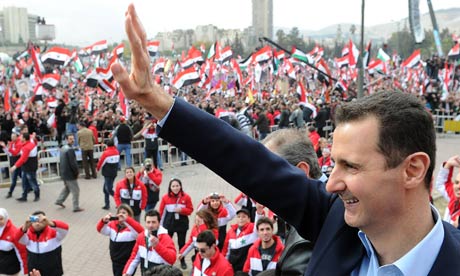
“Why I support Bashar al-Assad”
As fighting in Syria grows fiercer and the death toll continues to mount, President Bashar al-Assad still enjoys support from parts of the Syrian population. We spoke to a number of people who continue to rally behind the embattled leader.
There’s no easy political solution to ending more than 17 months of conflict in Syria, a feat made complicated partly because of deep divisions within the international community. While Western countries have called for Assad to step down, Russia, China and Iran – which all back the Syrian regime – continue to advocate for negotiations between the Syrian government and opposition forces. More than 25,000 Syrians, the vast majority of whom are civilians, have been killed since the beginning of the conflict, according to the Syrian Observatory for Human Rights (SOHR), while a further two million have been forced to flee their homes.
In a report published on August 15, a panel appointed by the UN Human Rights Council found that there was enough evidence to believe that the Syrian government and pro-Assad forces had committed “crimes against humanity”. The report examined several incidents, including a May 25 Houla massacre, where 108 people – including 49 children – were slaughtered. Opposition forces have also been accused of war crimes, though not on the same scale as the Assad regime.
Because the Observers Team has repeatedly given opposition activists the opportunity to shed light on atrocities committed by government forces, we felt it was important to also give Assad’s supporters a chance to express their views.
“I prefer Assad to the jihadists”Louaï, 40, is a film editor. I support Bashar al-Assad because I am against the opposition. The only chance this country has of getting out of this crisis is if the opposition stops using violence and takes a seat at the negotiation table without any preconditions [the Syrian National Council, an opposition organisation, has said they will only enter negotiations if Assad quits power]. I am not opposed to a transfer of power, but it can’t happen without Assad. He is the only one capable of finding a solution. Those who are fighting the regime did not take up arms to fight for democracy, they are simply trying to take over power. The Free Syrian Army is made up of jihadist Salafists, many of whom have come from abroad to wreak havoc in our country. “I worry when I look at what is going on in countries that have recently had revolutions” Personally, when I look at what is going on in countries where revolutions have spurred regime change, like in Tunisia where Salafists are now trying to impose their law through violence, I find the prospect of an opposition victory in Syria is worrisome. Jaramana, where I live [about 10 kilometers or six miles outside the capital Damascus], was the calmest city in Syria until three days ago, when a car bomb exploded near a funeral convoy. Here, different communities – Christians, Sunnis, Alawites, Druze – have always lived in complete harmony. I am Shiitte, and my wife is Christian. Our peaceful coexistence, however, is now under threat. I doubt that the jihadists will adhere to democratic values and from attacking Syrians with different beliefs if they succeed in overthrowing the government.
“Assad has undertaken democratic reforms”Nourane, 30, lives in Damascus. We must not forget that Assad was responsible for launching democratic reforms. He abolished the state of emergency [in a bid to appease opposition factions, the government adopted a series of reforms in April 2011 that brought an end to the state of emergency, abolished the Supreme State Security Court and implemented a new constitution based on political pluralism (February 26, 2012)]. I voted democratically for his reelection [Assad was reelected president in May, 2007 with 97.62 percent of the vote. The election was widely believed to be fraudulent] and for the new constitution. Should the opposition really have the right to remove an elected president? We cannot blame Assad for all of Syria’s problems. Mistakes are often made by local officials, as the president cannot be everywhere at once. Remember that the crisis started in March, 2011 in Deraa. Government forces had opened fire on protesters who were advocating the release of several teenagers that had been arrested for spray painting slogans of the Egyptian Revolution. That is what originally set things off. But we forget that the president dismissed and sanctioned the governor of Derra, Faisal Kalthoum, who was responsible for imprisoning the teenagers and opening fire on protesters. The president even made an effort to address the issue by meeting with Derra’s clan chiefs. We are all against corruption and bureaucracy, and in favour of greater liberties in Syria. But we do not want these people, who are massacring the Syrian people in the name of freedom. The president has already tried to put in place exactly these kind of reforms [faced with mounting tensions, Assad announced in February of last year plans to reduce taxes, create 67,000 government jobs, and his intention to fire hundreds of civil servants accused of corruption].
Russia, U.S. differ on Assad's future: Russian FM
Russia and the United States shared common goals on solving the Syrian crisis but differed on the future of President Bashar al-Assad, Russian Foreign Minister Sergei Lavrov said Monday.
Ahead of his participation at the Asia-Pacific Economic Cooperation (APEC) summit in Russia's Far Eastern city of Vladivostok, Lavrov told local media Moscow and Washington did not "contradict each other in principle" on Syria.
Both of the two countries wanted to see a peaceful transition via intra-Syria negotiations while "respecting the sovereignty, independence, unity and territorial integrity of the country," RIA Novosti news agency quoted Lavrov as saying.
However, the two sides held different views on whether President Assad should go and how, said the senior Russian diplomat.
Lavrov called for the crisis to be solved at the negotiating table by the Syrian people, calling the intention to dictate the future of Syria by outsiders as "counterproductive."
The Russian minister is expected to meet with U.S. Secretary of State Hillary Clinton on the sidelines of the APEC summit.
Lavrov said Saturday that the Western approach of demanding external interference and the resignation of Assad as a precondition of negotiations was rather unrealistic.
He reiterated Russia's stance, saying Moscow "was not backing any regime or any individuals" in the Syrian crisis.
Meanwhile, those "players" who spurred the opposition to fight the Syrian authorities did not care about the interests of the Syrian people and were guided by their own "geopolitical considerations," said Lavrov.
Obama eyes future with convention speech
The Greek columns may be banished and the "hope" and "change" signs gone, but President Barack Obama's
pitch to American voters at the Democratic National Convention this week will have echoes of his 2008 speech, when he cast himself as a visionary leader in touch with the nation's priorities.
Dogged by a sluggish economy and in a tight race with Republican rival Mitt Romney, Obama will use his time in the spotlight on Thursday to focus on education, tax cuts for those making less than $250,000, energy, immigration and social issues, his advisers indicated.
By talking in more specific terms than Romney did last week, Obama's team hopes to draw a contrast between the two men.
The president's team believes that Romney missed a big chance during the Republican convention to lay out a blueprint for fixing the U.S. economy.
Romney called for fewer government regulations and lower taxes but offered few details in a speech that emphasized his biography and amounted to a rebuttal of months of attacks from Obama's team. The Obama campaign has cast the former private equity executive as an aloof tycoon who is out of touch with middle-class America.
Unlike the former Massachusetts governor, Obama needs no re-introduction to the American public, his campaign advisers say.
So as Romney's campaign casts Obama as a failure in improving the economy, the president - trying to become the first since World War II to be re-elected with an unemployment rate above 8 percent - will argue that he has better ideas to help the country recover from the recession that began under Republican George W. Bush.
"This Thursday night, I will offer you what I believe is a better path forward - a path that grows this economy, creates more good jobs, strengthens the middle class," Obama said in a preview of his remarks at a campaign stop in Iowa. "The good news is, you get to choose which path we take. We can take their path or we can take the path that I'm going to present."
Obama's team aims to fill the nearly 74,000-seat Bank of America stadium in Charlotte, North Carolina, where the president will deliver his speech, and produce a populist feel that contrasts with Romney's convention.
RECAPTURING MOMENTUM
With tens of thousands in the stadium and millions watching on television, the prime time speech will be Obama's most prominent opportunity to date to make his case for re-election.
Advisers and outside analysts said the president will use the opportunity to highlight elements from his campaign speeches: his support of a bailout that saved the U.S. auto industry, ending the war in Iraq, presiding over the death of Osama bin Laden, and championing women's rights.
"Most Americans aren't hearing his stump speech except in little bits and pieces," said Jeff Shesol, a former speechwriter for Bill Clinton who worked on convention speeches in 2000, 2004, and 2008.
"He absolutely shouldn't come up with a brand new message, a brand new take on who he is, where he comes from, what he's been doing and what he plans to do in the next term," Shesol said.
Obama vaulted onto the national stage as an Illinois state senator in 2004, when he gave a well-received address for the Democratic presidential nominee that year, Massachusetts Senator John Kerry.
Four years later in Denver, Obama delivered his own acceptance speech, drawing criticism from Republicans for the setting - a stage adorned with faux Greek columns. Still, Obama basked in the energy of a huge stadium crowd, a symbol of the momentum that helped propel him to victory that year.
A lot of that momentum is gone now.
Unemployment is at 8.3 percent, raising questions about whether Obama can match the huge support he received among minorities and young people four years ago.
Meanwhile, new Republican-backed voter ID laws in several states could undermine turnout for minority and low-income voters in particular, as they are among the groups most likely to have difficulty obtaining the required identification.
MAKING HIS CASE
In Charlotte, Obama will have some significant help in making his case.
His popular wife, Michelle, former president Bill Clinton and others will offer testimonials with forward-looking themes.
Clark Judge, a former speechwriter for Republican President Ronald Reagan, said Obama was unlikely to dwell on the themes of "hope" and "change" because that would require him to defend promises he did not keep from 2008.
"The problem with doing too much of that is he's then got to explain failure, and I'm not sure that they want to get into that," Judge said. He added that he expects Obama to keep on attacking Romney's plan to revamp Social Security and Medicare, popular safety net programs for the elderly.
Obama's advisers watched the Republican convention closely but said they will not change their plans for Charlotte in response.
"In terms of rebutting Republicans or altering what we're going to achieve (this) week, really, there's no impact" on the Democrats' convention strategy, said Obama deputy campaign manager Stephanie Cutter. "I think the American people are smarter than that."
David Axelrod, Obama's chief campaign strategist, said Romney's speech was filled with "snarky lines" and "gauzy reminiscences of the past." He said Obama's address would be markedly different.
"This speech is going to reflect the thinking of a leader who has great confidence in this country and a ... clear sense of what we need to do to continue to repair the damage that was done by the recession and to reclaim the economic security that many Americans have lost," Axelrod said.
Blasphemy case: Still no bail for Rimsha
The Express TribuneA young Pakistani Christian girl accused of blasphemy in a case that has prompted international concern will stay in jail until at least Friday, after a bail hearing on Monday was adjourned. Rimsha has been in custody since being arrested in a poor Islamabad suburb, Mehrabadia, two and a half weeks ago, accused of burning papers containing verses from the Holy Quran, in breach of Pakistan’s strict blasphemy laws. Judge Muhammad Azam Khan adjourned the case until September 7 because of a lawyers’ strike, following a request from the lawyer for Rimsha’s neighbour Hammad Malik, who filed the original complaint against her. Police on Saturday arrested Hafiz Mohammed Khalid Chishti, the imam of the mosque in Rimsha’s area who first submitted the burnt papers as evidence against her, after his deputy told the police that he had tampered with the evidence. Chishti’s deputy Maulvi Hafiz Mohammad Zubair and two others, Mohammad Shahzad and Awais Ahmed, told a magistrate the cleric added pages from the Holy Quran to the burnt pages brought to him by a witness to beef up the case against her. A medical report last week said Rimsha appeared to be around 14 years old, which would make her a minor, and had a mental age below her true age, but the court has yet to decide whether to accept the assessment. Some reports have said Rimsha has Down’s Syndrome and her case has prompted concern from Western governments and anger from rights groups, who warn the blasphemy legislation is often abused to settle personal vendettas.
No American killed in Peshawar blast: US embassy
The US embassy in Islamabad Monday denied reports that two Americans had been killed in a suicide car bomb attack in Pakistan s northwestern city of Peshawar.
An embassy spokesman said they had no reports of any Americans killed in the blast, after provincial information minister Mian Iftikhar Hussain said two had died.
"The blast killed two Americans. This is a dangerous move from the terrorists -- they want to terrorise the foreigners," Mian Iftikhar Hussain told AFP, adding that two Americans were also wounded in the blast.
Police have recovered a half-burnt US passport from a car badly damaged in the blast, officials said.
The blast took place near residential quarters for the US consulate and foreign aid organisations, senior police officer Tahir Ayub said, adding that at least five people were killed.
"The car targeted was a US consulate vehicle," one intelligence official said.
PPP to continue working for people's welfare
Pakistan People's Party is taking solid measures to improve the life of common man by providing all the basic necessities of life. Member of the PPP central executive committee Ch. Manzoor Ahmed said this while addressing a gathering after inaugurating Sui gas connections here in Gulberg colony on Monday. He assured the public gathering that PPP led government was making efforts to ease out power crisis. However, he criticised that Nawaz Sharif government disbanded the project initiated by former Prime Minister Benazir Bhutto to create 40,000 MW electricity with the cooperation of France. Ch Manzoor further criticised PML-N for politicising the loadshedding situation. However, he re-affirmed his party's resolve to continue working for democracy in the country and people's welfare.
Pakistani cleric faces possible blasphemy charge
http://www.boston.comPakistani police say they are investigating whether a Muslim cleric who allegedly tried to frame a Christian girl for blasphemy should be charged with insulting Islam himself. Police officer Munir Jafferi says officials registered the blasphemy case against Khalid Chisti on Monday. Police arrested Chisti on Saturday after a member of the cleric’s mosque accused him of stashing pages of a Quran in a Christian girl’s bag to make it seem like she burned the Islamic holy book. He has denied the allegation. Jafferi says Chisti could be sentenced to life in prison if he is convicted of desecrating the Quran. The Christian girl’s lawyer, Tahir Naveed Chaudhry, says his client will remain in prison until at least Friday after her bail hearing was delayed for the second time Monday.
Car bomb hits US vehicle in Pakistan
Journalist Shaukat Paracha reports on an explosion in Peshawar, Pakistan, in which an American vehicle was targeted.
Afghan refugees
The problem with being a refugee anywhere is that sooner or later — and it could be a lot later — it will be time to go home. The Afghans living in Pakistan, still the largest population of refugees anywhere in the world, now face the difficulty of leaving what for many is ‘home’ and returning to their own country — which for many is not home at all. Broadly speaking, Afghan refugees in Pakistan fall into two categories: registered and unregistered. Many of them are second-generation and were born here. Those that remain are mostly in Khyber Pakhtunkhwa, but they are scattered across the entire country to a greater or lesser degree. There may be as many as three million, and Pakistan has decided it is time for them to go home. Those that wanted to go home already have, which leaves a significant population of Afghans who have little or no desire to return to their home country.
Those registered have a valid status only until December 31 2012, those unregistered have no status whatsoever. The Khyber Pakhtunkhwa government had directed all unregistered Afghans to leave by August 31, a deadline now past. The statement is unequivocal in saying that all Afghans, registered and unregistered have to leave by December 31 2012 and a humanitarian crisis is before us. There are reports that other provinces have already been moving to clear their Afghan refugee populations, deporting them via Torkham. Those with businesses — and there are many — are being advised to pack up, liquidate their assets and move back whence they came. The statement flies in the face of that made by the United Nations High Commission for Refugees (UNHCR) last month. The UNHCR was quick to deny a report in a foreign newspaper that Pakistan was planning to repatriate the Afghans by the end of the year, a denial now clearly at variance with ground realities. There is going to be no happy or tidy end to the story and persuading — or forcing — nearly three million people back across the border in the next four months is going to be a huge logistical task. The government and the UNHCR need to be reading off the same page which is apparently not the case at the moment; and a joint statement defining the true nature and future of Afghan refugees in Pakistan would be greatly welcomed. This issue must be handled with maturity and with proper planning and resources else it turns into a major source of disturbance and violence in an already troubled situation.
US to fund Torkham road reconstruction
DAWN.COMThe US government has agreed to finance construction of Peshawar-Torkham Highway, which serves as main supply route for Nato forces in Afghanistan. According to an official statement issued here on Sunday, the US government will provide Rs5.60 billion for construction of the 45-kilometre road. Khyber Pakhtunkhwa Governor Barrister Masood Kausar has directed the quarters concerned to start work on this vital project immediately. The project, to be started this year, will be completed within 18 months. The statement said that Frontier Works Organisation, a subsidiary of army, would construct the road as National Highway Authority (NHA) would work as executing agency. To ensure timely completion of the project, Fata Secretariat would play a lead role. Work on the highway will be started on war footing as staff has been hired for the purpose. The statement said that principal agreement with United States Assistance for International Development (USAID) had been reached and an accord with the donor agency would be signed in the second week of September. After the agreement, work would be starred on the much delayed project immediately. The USAID is already helping Khyber Pakhtunkhwa government in Expansion and Refurbishing of Ring Road Project and provided Rs2 billion for the scheme that according to officials would be completed soon. Construction of Peshawar-Torkham Highway is perhaps the first major development project to be financed by the US government following melting of ice after Salala attack for which Islamabad was demanding an apology from Washington for killing its 24 officers and soldiers. The government said that transportation of supplies for Nato forces in Afghanistan was damaging road network, asking the US to rehabilitate those major highways. Officials said that roughly 10,000 small and heavy vehicles were passing through Peshawar-Torkham Highway daily. The construction of highway that passes through Khyber Agency and also serves as a trade route for Afghanistan and Central Asian Republics has been under consideration since 2001. Work on the project could not be started because of financial constraints. An official said that NHA had already completed PC-1 and conducted environmental impact assessment survey of the project. He said that the government had allocated Rs120 million for land acquisition. Initially it was planned to construct an alternate dual carriageway between Peshawar and Torkham that was to pass through Malagori and Loi Shalman. Asian Development Bank had made commitment to bear 60 per cent of the total cost of the project and Pakistan government pledged 40 per cent share. Pre-feasibility study of the proposed carriageway was carried out in 2007-08 while detailed survey was dropped. Sources in NHA that carried out pre-feasibility survey said that estimated length of the carriageway was 90 kilometres through Malagori and Shalman, while distance of existing Peshawar-Torkham Highway was about 50 kilometres.
Peshawar: Two Americans killed in blast
Two Americans were killed in a suicide car bomb attack targeting a US consulate vehicle in Peshawar on Monday, the provincial information minister said.
"The blast killed two Americans. This is a dangerous move from the terrorists -- they want to terrorise the foreigners," Mian Iftikhar Hussain told AFP, adding that two Americans were also wounded in the blast.
Afghan commanders defy night operations
Frontier postAfghan commanders have refused more than a dozen times within the past two months to act on U.S. intelligence regarding high-level insurgents, arguing that night-time operations to target the men would result in civilian casualties, Afghan officials say.The defiance highlights the shift underway in Afghanistan as Afghan commanders make use of their newfound power to veto operations proposed by their NATO counterparts.For much of the past decade, NATO commanders have dictated most aspects of the allied war strategy, with Afghan military officers playing a far more marginal role. But with the signing of an agreement last month, Afghans have now inherited responsibility for so-called night raids - a crucial feature of the war effort.To Afghan leaders, the decisions made by their commanders reflect growing Afghan autonomy from Western forces as NATO draws down, and prove that Afghan forces are willing to exercise more caution than foreign troops when civilian lives are at stake, The Washington Post reported."In the last two months, 14 to 16 [night] operations have been rejected by the Afghans," said Gen. Sher Mohammad Karimi, the top Afghan army officer. "The U.S. has said, 'This operation better be conducted. It's a high-value target.' Then my people said, 'It's a high-value target. I agree with you. But there are so many civilian children and women [in the area].' "Many of the rejected night operations are later conducted once civilians are no longer in the vicinity of the targets, Karimi said.U.S. officials point to progress they have made in their own efforts to reduce civilian casualties, and say that while the Afghans occasionally choose not to act on American intelligence, night operations are nonetheless frequently conducted. Americans continue to provide logistical support and backup, U.S. officials say, using their aircraft to deposit Afghan soldiers at the targets."The Afghans are the ones who give final say on whether or not the mission gets conducted. That's how the process works now," said a U.S. official who spoke on the condition of anonymity to discuss a sensitive issue. "The operational tempo hasn't been affected by this. I don't think there's been a night when they haven't conducted a good number of operations."But the resistance to American guidance on night operations represents the clearest indication to date that Afghan military commanders are heeding a directive from President Hamid Karzai last month. Just a day after signing a 10-year bilateral agreement with the United States, Karzai said Afghan soldiers should discard questionable information provided by the U.S. military. "If you have any doubt about an American intelligence report, do not conduct any operation based on it," he told officials at the Interior Ministry.The Afghan president grew even more disenchanted over the last week, when separate NATO airstrikes killed 18 civilians in Logar, Kapisa, Badghis and Helmand provinces, according to Afghan officials. The president and his advisers said the attacks raise questions about the newly minted partnership agreement."Karzai signed the strategic pact with the United States to avoid such incidents and if Afghans do not feel safe, the strategic partnership loses its meaning," said a presidential statement.In the past, such complaints would have been unlikely to affect military operations. But the transition to greater Afghan control of security has left Karzai and his military in a stronger position to stymie the American strategy.The transition will continue in the coming months. This summer, a number of districts and provinces will be formally entrusted to Afghan security forces, the third round of regional transitions. In September, Afghans will assume responsibility for the U.S. military prison at Bagram, with about 3,000 detainees.In the past, Western officials questioned whether Karzai's opposition to night raids and other U.S.-led operations was politically driven - aimed at proving to his people that he was capable of resisting American demands.Now, with more transitional milestones looming, Afghan political and military leaders say their growing responsibility has made the issue of civilian casualties even more delicate."Most of the people will say, 'I don't blame the foreigners if they kill us, but why do you kill me?' " Karimi said. "We have to be concerned. We have to have people on our side."Each time civilians are killed in either a NATO or Afghan operation, Karzai or one of his advisers calls the Defense Ministry for an explanation. Karimi said the president's involvement in military affairs centers largely on reducing civilian casualties rather than on dictating troop levels or strategy.NATO officials say they have greatly reduced the number of civilians killed in operations in recent years. The United Nations last year attributed 400 civilian deaths to NATO and Afghan forces, a slight decrease from 2010."We have significantly improved attention to detail when it comes to targeting," a U.S. official said.Human rights organizations say they fear that the methods and institutions developed by NATO to both track and prevent civilian casualties will not be replicated by the Afghan security forces."Right now, Afghan forces don't have systems in place to prevent and respond to civilian casualties they may cause. International forces evolved their thinking over a decade, realizing they needed a civilian casualty tracking team and policies to investigate civilian harm caused by their own forces," said Sarah Holewinski, executive director of the Campaign for Innocent Victims in Conflict. "Without those systems in place, verbal commitments from the Afghan government to not harm civilians are likely to fall flat as Afghan forces take over."
Smith contradicts Karzai over deadly Afghan raid
Defence Minister Stephen Smith has directly contradicted claims by Afghanistan's president Hamid Karzai that a deadly Australian raid on suspected insurgents was carried out without proper approvals.
Two men - identified by the Afghan government as 70-year-old imam Haji Raz Mohammad and his 30-year-old son Abdul Jalil - were killed during the raid, which was carried out as part of the search for a rogue Afghan soldier who shot dead three Australians last week.
Twelve other people were detained during Friday night's raid in Uruzgan province, although 11 have since been released.Mr Karzai has issued a statement strongly condemning the deaths, describing Australia's actions as a "unilateral military operation" that was carried out "without any prior coordination or approval of the provincial authorities".
"The President condemns the operation as a breach of the Memorandum of Understanding signed between Afghanistan and NATO on the special military operations," the Afghan government statement says.
But Mr Smith has strongly rejected the accusations, saying the partnered raid was fully authorised by the Uruzgan chief of police and the local governor.
Mr Smith said the raid involved 60 Australian Defence Force personnel and 80 Afghan National Army soldiers, and the two men who were killed have been confirmed as insurgents by both Australian and Afghan sources.
"The statement which has been issued by president Karzai's palace over the weekend in Kabul that this operation was not authorised is wrong," Mr Smith told reporters in Perth this morning.
"That is not factually correct, and this point has been made strongly by Australia's ambassador to Afghanistan to palace and presidential officials."
The raid was part of a wider search for rogue Afghan soldier Hek Matullah, who killed three Australians in a so-called green on blue attack last week.
Lance Corporal Stjepan Milosevic, Sapper James Martin and Private Robert Poate were shot dead, and two other Australians were wounded, when Matullah turned his gun on them at a patrol base in Uruzgan province last Wednesday.
The shooting has heightened concerns among coalition forces about the threat of insider attacks, and has prompted the International Security Assistance Force (ISAF) to suspend training for 1,000 Afghan Local Police recruits.
ISAF says the move is a "precautionary measure" that will allow for an intensive re-vetting process to take place for the 16,300 current members of the local police force.
Australian troops are not involved in training Afghan police, and so are not affected by the suspension.
The 11,000 members of the recently inaugurated Afghan National Army Special Operations Division are also having their vetting status checked, but are continuing to carry out their duties.
Mr Smith says that means partnered operations between Australian and Afghan forces will continue.
The bodies of the Brisbane-based soldiers are now returning to Australia, along with those of two other diggers who died in a helicopter crash the same day.
Matullah is still at large but is being hunted by Coalition and Afghan troops.
A suspected insurgent leader who is accused of helping him evade the manhunt was captured during the raid.
In a statement posted online, the International Security Assistance Force said: "The insurgent leader who was detained by the combined Afghan-Coalition operation in Uruzgan early on Saturday morning is confirmed to be an "IED emplacer" and was previously involved in kidnapping, murder and attacks on Afghan National Security Forces".
"At the time of his capture, he was attempting to support and move the insider threat shooter who killed three Australian soldiers and wounded two on Aug[ust] 29."
Afghanistan condems Australian military for killing alleged civilians
http://www.radioaustralia.net.auAfghanistan's President Hamid Karzai has condemned the Australian military over a raid in which two Afghan men were killed. Australian soldiers had been searching for the rogue Afghan sergeant who shot dead three Australian soldiers last week, and during their mission they captured a suspected insurgent leader who is thought to have helped the killer to escape. The Australian Defence Department says the two men who died during that operation were also suspected insurgents, but villagers have told the media they were civilians. The bodies of the five soldiers who died last week in the deadliest day for Australian forces since Vietnam are returning home. They were farewelled by their comrades in a ceremony at Tarin Kowt. Capturing Sergeant Hek Matullah, the Afghan soldier suspected of shooting Lance Corporal Stjepan Milosevic, Sapper James Martin and Private Robert Poate, remains a high priority. Sergeant Hek Matullah escaped from the patrol base straight after the killings and he's suspected to have been aided by the Taliban. After an extensive search Australian troops aided by Afghan forces have detained a suspected insurgent they say helped with the escape. But the raid has come at a cost. Two Afghan men were killed by Australian troops. The ADF says all the proper rules of engagement were followed but Afghanistan's president Hamid Karzai is furious. Local reports say those killed were a 70 year old Imam and his son. It's also been reported that the Australian troops detained a number of locals, including a woman, during the operation. President Karzai says the Australian forces acted unilaterally and he wants a full inquiry into the situation. The latest incidents have highlighted the problems "green on blue" killings are causing for western forces in Afghanistan. At least 45 Western soldiers have died at the hands of Afghan allies this year. Now ISAF has suspended the training of new recruits to the Afghan local police. NATO spokesman Colonel Thomas Collins: THOMAS COLLINS: As you know we've had a problem here with some security challenges. Eventually there will be a tightening of the vetting procedures across the force and we've already begun working with the Afghan government on how we can make the vetting process better. MICHAEL EDWARDS: Complaints about Afghan local police range from corruption within its ranks to allegations its members rape and kill innocent civilians. Heather Barr from Human Rights Watch in Afghanistan says it's a program with a range of serious problems. HEATHER BARR: First is with the vetting, which is the issue that's come up today and has finally caused a reaction. There are also serious problems with the command and control structures for the Afghan local police as well as in terms of accountability mechanisms for what's in place when something goes wrong. MICHAEL EDWARDS: ISAF has high hopes that the Afghan local police will be an effective force against the Taliban at a local level after 2014. But Heather Barr is sceptical that it can be turned into an efficient and reliable counterbalance to the insurgents. HEATHER BARR: It's really difficult to repair a program at this stage and especially with this 2014 deadline looming. So it's certainly big news that the US has seen that there are issues and is working to resolve them. But it's frustrating indeed that it took so long and that there are so many abuses and lives that have been lost in the process. MICHAEL EDWARDS: ISAF says it could take a couple of months before training of Afghan local police recruits resumes. It says training of other Afghan security forces - including the army - continues.
Peshawar: Car bomb hits US vehicle, 3 killed
Three people died while five others injured with a blast in a UNO van on Peshawar University Road.
Police say a car filled with explosives rammed into a U.S. government vehicle in northwest Pakistan, killing three people and wounding ten others.
Police officer Pervez Khan says the vehicle was attacked in the northwest city of Peshawar on Monday after it left the U.S. Consulate.
Khan said some of the wounded were foreigners. The identities of those killed were unclear.
The attack occurred in an area of Peshawar hosting several foreign organizations, including the United Nations.
Local TV footage showed an SUV at the site that was completely destroyed and burned.
U.S. officials could not immediately be reached for comment.
Subscribe to:
Posts (Atom)