Sunday, September 2, 2012

Pakistan: State against minorities

BY: Chaudhry Faisal Hussain
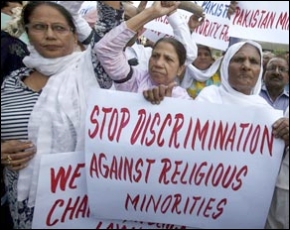
THE concept of a Muslim state vis-à-vis its minorities, as envisaged by those that oversaw the creation of Pakistan and the members of the first Constituent Assembly, is hardly understood today. In his Aug 11, 1947 speech, Mohammad Ali Jinnah delivered a message of freedom to not just Muslims but also the minorities living in the country.
Assuring them of equal status, he said famously: “You are free; you are free to go to your temples, you are free to go to your mosques or to any other place or worship in this state of Pakistan. You may belong to any religion or caste or creed — that has nothing to do with the business of the state.… We are starting in the days where there is no discrimination, no distinction between one community and another, no discrimination between one caste or creed and another. We are starting with this fundamental principle: that we are all citizens, and equal citizens, of one state.” Following this vision, the first Constituent Assembly adopted the Objectives Resolution which said that “adequate provision shall be made for the minorities to profess and practise their religions and develop their cultures.”
It added that there would be “guaranteed fundamental rights, including equality of status, of opportunity and before law, social, economic and political justice, and freedom of thought, expression, belief, faith, worship and association, subject to law and public morality”. There were meant to be “adequate provisions … to safeguard the legitimate interests of minorities and backward and depressed classes”. Was it sufficient to merely pass a resolution and include the rights of minorities in the constitution while doing little to actually put such ideals into practice? What steps did the state take to make the nation aware of the rights of those who are in fewer numbers? The hard fact is that constitutions or laws cannot change societies or deliver on intentions unless they have social acceptance and the full backing of the state. This is what has led Pakistan to the current pass in terms of its minorities. The bitter reality is that the state machinery has, since its creation, miserably failed to protect minorities’ rights. While on the one hand governments have been enacting rosy-looking legislation, on the other they have failed in practice to create a consensus policy agenda on minorities’ status within Pakistan that would create a more conducive national mindset. In fact, they have remained involved in painting and treating minorities as unequal. Article 5 of the constitution states that loyalty and adherence to the constitution is the basic responsibility of every Pakistani citizen. Not only does the constitution extend equality to citizens regardless of caste or creed, under Article 36 it also imposes upon citizens and the government the responsibility of safeguarding the legitimate interests of minorities. This includes due representation in the federal and provincial services as well as social and economic justice and equality for minorities in the eyes of the law. Practically, however, minorities are disempowered. Contrary to the Quaid-i-Azam’s vision and constitutional bindings, the state has been unable to ensure minorities’ vibrant participation in state affairs. How many non-Muslims have been promoted to higher bureaucratic posts? How many non-Muslim police chiefs or chief secretaries and secretaries have there been during the past 65 years? How many members of minority communities have been inducted into the Pakistan Army and promoted to top ranks? What additional qualities do our Muslim politicians possess so that the prime minister and president of Pakistan can be chosen from amongst them, and amongst them alone? At the moment, there is not one judge from the minorities amongst the superior judiciary in any of the four provinces, the Islamabad High Court or the Supreme Court. Does Article 36 of the constitution not apply to the courts? Pakistan needs reminding that its proud judicial history includes people such as Justice A.R. Cornelius and Justice Dorab Patel. The buck doesn’t stop with the state. A lack of tolerance of other sects and belief systems has seeped into not just the minds of state functionaries, but also of private citizens. The extent to which most of the population is discriminatory towards minorities is nothing short of amazing. The electronic, print and social media, too, particularly in Urdu and the regional languages that most of the citizenry taps into, have by and large served to entrench intolerance and foment religious hatred. Cases involving minorities or religious matters, especially allegations of blasphemy, are often misreported or reported with sensationalist overtones. An issue as serious as sectarian killings is treated as newsflashes to be followed by spice-laden gossip masquerading as informed analysis. The sum effect of such influences was encapsulated in the murder in broad daylight of a governor in office by a man on his own security detail. Where does the answer lie? A reasonable place to start is the education sector: everyone should have access and the curriculum should be cleansed of anything that gives rise to prejudice against religious or other minorities. Religious and sectarian tolerance needs to be taught as a school subject and in military and judicial academies. Concurrently, Pakistan needs strict state action whenever cases of forced conversions come up and in incidents of religious and sectarian hatred. The state must adopt basic measures and teach people how to live in harmony in the true sense with people belonging to other castes and creeds.

'Afghan Taliban comeback will be bad for Pakistan'

South Asian News Agency (SANA)
United Kingdom High Commissioner in Pakistan Adam Thompson has said that the return of Taliban in Afghanistan will be a bad news for Pakistan. He said that the point of view of UK on drone strikes clear, adding that this is matter between Pakistan and US and UK want to see good relations between Pakistan and US. In an interview with a private TV channel, Thompson said Afghan people had experienced Taliban atrocities in the past and if Taliban make a comeback there, it would be bad for them and for Pakistan as well. “Pakistan is a key partner in Afghanistan peace and we would like to contribute in a political settlement of Afghan issue in a positive way,” he said. To a question he said United States had its own stakes in the region and its own policies and priorities. Though we are allies but we have our own priorities, he added. Emphasizing the importance of peace and stability in Afghanistan he said Pakistan can play a key role in it. “We cannot claim to understand Afghans as closely as Pakistanis can,” he said, adding UK would love to contribute in the process of Afghan peace positively. He said UK forces will be withdrawn from Afghanistan in 2014. Dispelling the impression of UK involvement in Balochistan he said it was a fantasy. When asked some Baloch separatist leaders were living in UK and operating from there, he said all kinds of foreigners live in Britain and British government has nothing to do with their political affiliations. He categorically said that Britain would never like to harm Pakistan in any way. “Impression that UK is associated with Balochistan separatists is only a fantasy,” he said. Thompson said United Kingdom was helping Pakistan in various sectors. He strongly rejected the impression the UK was in anyway linked with Balochistan unrest. He said he always tried to convince the British community that Pakistan was not as scary a place as portrayed in the international media. Thomson said United Kingdom was helping Pakistan in education sector more than any other country, both on primary and higher education level. “We prefer Pakistan in education to any other state,” he said, adding there is research collaboration between UK and Pakistan universities.

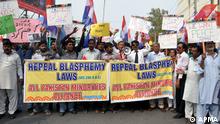
Islamic conspiracy theory revealed in Rimsha Masih blasphemy case

http://www.pakistanchristianpost.com
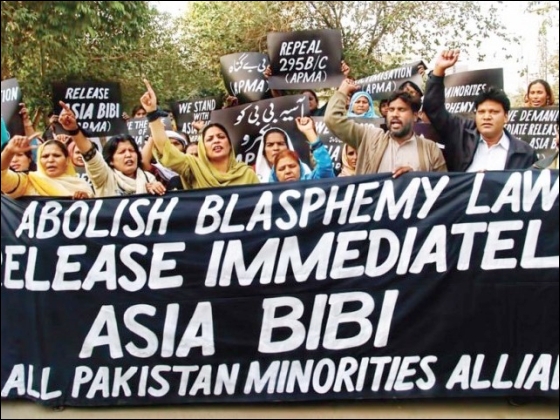
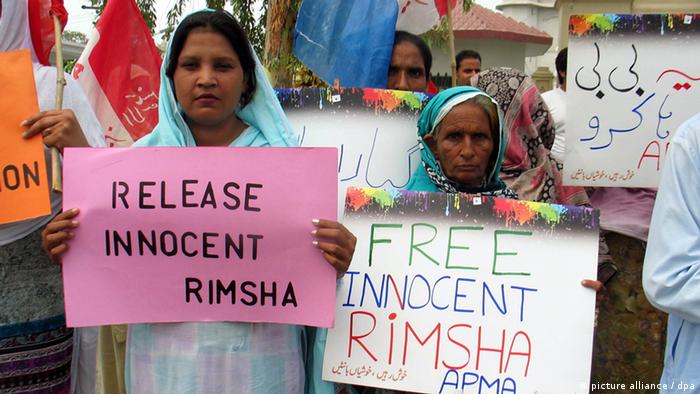
Dr. Nazir S Bhatti, President of Pakistan Christian Congress PCC have paid homage to Hafiz Mohammad Zubair on takeing a very daring step to come forward to reveal truth in Rimsha Masih blasphemy case to upheld true Hafiz Mohammad Zubair to told media after recording his statement before area magistrate “The Imam of a Mosque in Mehrabad, a slum of capital city Islamabad, Khalid Jadoon, manipulated the evidence against Rimsha Masih case of blasphemy”                                                                                                  The Imam of mosque in Mehrabad slum of Islamabad urged Mohammad Ammad to lodge a complaint in Ramna Police Station on August 17, 2012, that a Christian girl have set on fire pages of Holy Quran and committed blasphemy, The Ramna Police Station Islamabad, lodged a report under Section 295 B PPC against minor disabled girl Rimsha Masih. The complainant Mohammad Ammad with collaboration of Imam Khalid Jadoon, announced on mosque loudspeaker to punish blasphemer Rimsha Masih on which area Muslim women attacked Christian girl and his mother and tortured them while Muslim men started burning homes of Christians and a Church on which hundreds of Christians fled from area to save their lives.
Minor disabled Christian girl was rescued by Police and charged under blasphemy on report of Islamic cleric and sent to Adiala jail Rawalpindi on 14 days judicial remand. Hafiz Mohammad Zubair (Who teaches Quran in mosque to children) told media “Ammad, the complainant in the case, handed over the ashes of Quranic verses to the Imam of the mosque Khalid Jadoon, who also added more verses to it and put in trash where Rimsha Masih have thrown her home garbage” The Ramna Police arrested Imam Khalid Jadoon today after statement of Hafiz Zubair and other eye witnesses and a new turn took in Rimsha Masih blasphemy case in Pakistan. The eyewitness further said in his statement that he himself along with two more Motakif protested against the manipulation of the evidences. He said that he and other eyewitnesses had asked Khalid Jadoon to present the real evidences against Rimsha. Meanwhile, the religious scholar Tahir Ashrafi has asked the Ulema as to what kind of punishment Imams like Khalid Jadoon deserved. Dr. Nazir Bhatti urged Pakistan government to immediately announce procedural amendment in lodging FIR in blasphemy cases as this Islamic law is being widely misused to settle personal scores in Pakistan against Christians and Ahamadiyya communities.

President Zardari: Govt can no more afford persistent load shedding

Radio Pakistan
The President has directed concerned departments to take coordinated steps to end electricity and gas load-shedding
President Asif Ali Zardari has urged Ministries of Petroleum‚ Finance and Water and Power to work in unison and take concerted and coordinated steps to end electricity and gas load shedding in the country. He was chairing a meeting in Karachi on Sunday to review current energy situation and the progress on various measures being taken to overcome the power shortage in the country. The President said the government can no more afford persistent loashedding as it was adversely impacting the country's economy. The President directed that he should regularly be updated about the power situation adding that the government accords high priority to improve energy situation before up-coming elections. He said local bodies elections will be held this year at all cost before general elections. He said a bill relating to local body system will be passed by the Sindh Provincial Assembly within two months. President Zardari said PPP will form alliance with the allied parties to contest the up-coming general elections hoping that it will again emerge as the majority party and form new government at centre and the provinces. He said PPP has given sacrifices for democracy and it will continue policy of reconciliation to further strengthen it. Minister for Water and Power Chaudhry Ahmad Mukhtar briefed the meeting about the latest power situation in the country and said that various immediate measures taken by the government resulted in reducing the supply and demand gap. He informed the meeting that the power situation is steadily improving and expressed the hope that with the rising water levels in reservoirs as a result of recent rains‚ the situation will improve further. Chairman WAPDA briefed the meeting on various hydel power projects. The meeting was briefed about the progress made so far in the construction of Diamir Bhasha Dam and the efforts being made to garner finances for the project. The meeting was informed that Tarbela Dam was likely to be filled soon while Mangla Dam has been filled to a level of over 1180 feet against a level of 1230 feet. Advisor to PM on Petroleum‚ Dr. Asim Hussain briefed the meeting about the availability of gas and fuel for the power generation.

Obama leadership saved auto plants

http://news.yahoo.com
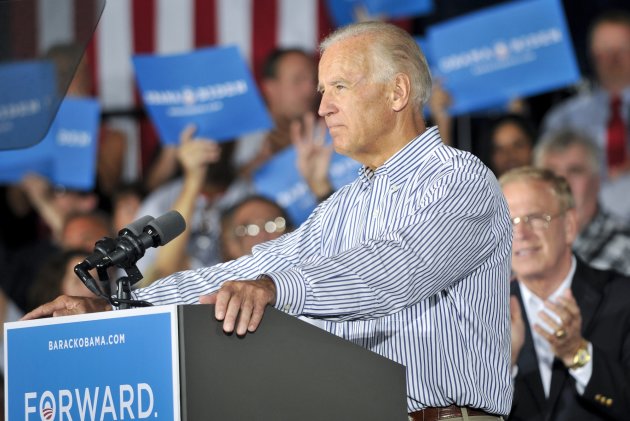
Vice President Joe Biden
mounted the Democratic counterpoint to the Republican presidential ticket Friday, drawing attention to the Obama administration's rescue of the auto industry and portraying GOP presidential challenger Mitt Romney as a foe of government efforts to save jobs. Laying out President Barack Obama's indictment of Republican polices, Biden said that Rep. Paul Ryan, Romney's running mate, has voted in Congress for measures that caused massive federal debts, including two wars, a prescription drug benefit and tax cuts for the wealthy that were not paid for. "They call their plan new, bold and gutsy," Biden told about 200 supporters in a union hall. "There is nothing gutsy about giving another trillion dollars in tax cuts to millionaires; there is nothing bold about turning Medicare into a voucher system. There is nothing bold about kicking 19 million kids and elderly off of Medicaid with no place else to go." Biden spoke about two miles from the sprawling GM plant in Lordstown in an event meant to emphasize the importance of the auto bailout to Ohio. The recoveries of GM and Chrysler have been recurrent themes in Obama's re-election campaign, particularly in states such as Michigan and the battleground of Ohio. Biden criticized Romney for opposing a taxpayer rescue of GM and Chrysler. "What they didn't acknowledge is Governor Romney's position was 'let Detroit go bankrupt,'" he said, quoting the headline on a 2008 Romney opinion piece in the New York Times. Ryan campaign spokesman Brendan Buck responded that Obama inherited a troubled economy but has made it worse. "Like many towns across America, Janesville, Wis., is still waiting for the recovery the president promised," Buck said, referring to Ryan's hometown, where a GM auto plant was idled in 2008. Biden's remarks came as Romney and Ryan left their Republican National Convention in Tampa seeking the votes of former Obama supporters who have grown disenchanted with his presidency. Obama traveled to Texas on Friday, where addressed military families on the second anniversary of the end of combat operations in Iraq.

How world opinion kidnapped by West's 'int'l community' rhetoric

Since the Industrial Revolution in Britain, the self-centered way of thinking that long formed in Western powers has been swelling with the constantly consolidated powers. One of the performances is that some Western politicians often make improper comments in the name of "international community" when they talk about the international affairs or in the Western media reports. In their eyes, they are the "international community." For example, the European and American media including the French media often make speeches on behalf of the international community, suggesting implementing more stringent sanctions on the Syrian authority, and criticize Russia and China who have a different stance on the Syrian issue in the name of "international community" for their "running counter to the international community" and "failing to join them to manage the world." In their opinion, China and Russia which have a population of over 1 billion are not included in the "international community." Moreover, Western media always criticize and attack China in the name of "international community." The author of the article has worked in Europe for more than 20 years and can often see and hear how the Western media accuse, distort and even demonize China for no reason. They criticize any things that they think "offending, untrue and disobedient" in the name of "international community." As what a very popular word in France has said, "It does not need to consider the facts and justices to criticize China because it is the 'right politics' to do so." Due to such misleading opinions, many innocent Westerners began misunderstanding China and giving birth to a bias against the state, regarding it "an oddity in international community". Thereby, some people certainly will get anxious and question about the rapid development of China. Now, the Western media dominates the international opinion, so the phenomenon of deceiving and misleading the world public opinion in the name of "international community" may have to continue for some time and is difficult to be corrected. Therefore, we must keep a clear mind about the "international community" quoted by Western media and distinguish the true "international community" from the false one.

Stop the terrorists, Pakistan tells Kabul

The Times of India
Interior Minister Rehman Malik has told the Afghan government to stop terrorists from entering Pakistan, a media report said on Sunday. Stressing that terrorists had again started their activities in Khyber Pakhtunkhwa, Quetta and Karachi after Eid, Malik said Saturday that forces wanting to destabilise Pakistan would never succeed. The Dawn newspaper quoted him as saying that attempts were being made to instigate sectarian violence in Pakistan by killing innocent people. The minister said the Taliban come into Pakistan from Afghanistan, and urged Afghan President Hamid Karzai to take effective steps to stop them from crossing over. The Taliban even had the capacity to carry out a major terrorist act in Islamabad.

Pakistani imam accused of framing Christian girl

Deutsche Welle
Police in Pakistan have arrested a Muslim cleric on charges of planting evidence against a young Christian girl detained under the country's anti-blasphemy law. The girl is accused of burning verses from the Koran. Pakistani police on Sunday said that Hafiz Mohammed Khalid Chishti had been arrested after his assistants turned him in for allegedly trying to frame the young Christian girl.Chishti supposedly added pages from the Koran to the pages that the young Christian girl, Rimsha Masih, allegedly burned. He filed the original evidence against Masih and serves as the imam at the mosque in her poor Islamabad suburb, Mehrabad. "Witnesses complained that he had torn pages from a Koran and placed them in her bag which had burned papers," police official Munir Hussain Jafri told the Reuters news agency.
'Conspiracy, not a mistake' Chishti claims that he originally received reports from villagers that Rimsha had burned Koranic verses and subsequently turned the girl in to police in order to avoid a violent incident. "People were demanding to burn their house," he said. "But I went to police and called them to avoid a major incident." Chishti has claimed that Rimsha was aware of what she did and had confessed. "She did it knowingly, this is a conspiracy and not a mistake," he said. "She confessed to what she did." Anti-blasphemy law Rimsha was arrested on August 16 on blasphemy charges after she was allegedly caught holding burnt pages of Koranic verses in public. There are conflicting reports regarding Rimsha's age and mental state. She is reportedly between 11 and 14 years old. Some media reports say she has Down's Syndrome. Under Pakistan's blasphemy law, anyone who defames Islam or the Prophet Mohammad commits a crime and can face the death penalty. Convictions under the law are common, but the death penalty has never been used in a blasphemy case. Critics of the law say it is often used to settle personal vendettas. Interreligious tension The reports that Rimsha had violated the anti-blasphemy law sparked anger among Muslims in Mehrabad, leading to public demonstrations demanding her punishment. Many Christians initially fled the suburb for fear of reprisals. Pakistani President Asif Ali Zadari had previously said that he took "serious note" of the case and called for the interior minister to submit a report on it. Zadari's government has been criticized by Western nations for not reforming the anti-blasphemy law. Pakistan's population of 190 million people is 95 percent Muslim, with a small minority population of Hindus and Christians.

Archbishop Desmond Tutu the 'moral compass'

Nelson Mandela once called Archbishop Desmond Tutu 'South Africa's moral compass' and he is. The other day he refused to share platform with Tony Blair, Labour Party's longest-serving prime minister - if that is a credit anymore - accusing him of prompting illegal and immoral invasion of Iraq in 2003. Blair's support for the US-led invasion was basic on doctored information, therefore "it would be inappropriate and untenable for the Archbishop to share a platform with Blair, according to Nobel Prize-winning priest". Ironically, however, the one-day conference was on 'leadership which could not be separated from morality'. Indeed, Blair's participation as speaker was a joke with history, for he was the principal inciter of the campaign to dislodge Saddam Hussain accusing the Iraqi leader of possessing weapons of mass destruction (WMD). That was never the case as after destruction in a surprise attack by Israeli airforce Iraq had permanently jettisoned its nuclear ambitions. But the oil-thirsty and pro-Israel governments in the West were out to capture Iraqi oil by hook or by crook. Having failed to convince international opinion that a minor explosion near Baghdad was 'incident in one of the Iraqi nuclear facilities' they led Saddam Hussain on to invade neighbouring Kuwait and then punished him for the adventure. But a clear victory over Saddam was required, hence the Blair's conspiratorial role and his fabricated information over Iraqi WMD stockpiles - so eagerly lapped up by the then US military chief General Colin Powell. And for the hypercritical gloss over invasion touted as a move to bring democracy to the people of Iraq, how much of it is on the ground at the cost of a quarter of a million lives and lingering instability and insecurity. One would have expected Blair was not invited to the moot given its high-sounding rubric of moralising the world leaderships. No other country in modern history has suffered at the hands of colonial oppression as of Archbishop Tutu's South Africa. And the natives' struggle against the notorious 'apartheid' policy of the colonial masters was perhaps the longest. But it was also a saga of human endurance and tolerance; it produced men like Mandela and Tutu who decided to overlook the gloomy past for a better future both for the South Africa's European and non-European segments of population. But for the Truth and Reconciliation Commission created by Bishop Tutu and others on both sides of the racial divide the 'apartheid' would have been still there taking its bloody toll. So sincere the effort on his part was that the sinners walked in without shame and embarrassment to confess their crimes and helped obtain a people at peace with their conscience. That moral compass of South Africa is the need of the hour in many parts of the world where ethnic, racial and sectarian conflicts are now raging in full fury causing immense human pain and misery. Instead of coming to the leadership conference Blair should have come to Tutu's Truth and Reconciliation Commission and confessed his crime of consigning millions of innocent Iraqis to unending war - that may have lost its military dimension but not of the Blair mischief that tends to foment insecurity and violence. Iraq today has a semblance of democracy, but it's definitely more volatile and unsafe than under the undemocratic rule of Saddam Hussain. And what kind of that war was that in the end removed from the scene one of the United States' strongest allies against its regional nemesis, Iran. Archbishop Tutu has indeed deserved world's praise for his frank 'no' to what was once known as 'Bush's poodle'.

Peshawar: Failed administrations

The thugs have struck Peshawar for the umpteenth time and yet again lethally, exacting a heavy toll on innocent lives as before. At least 11 people lay dead on the spot while another 17 were wounded, several of them critically. But where is the administration and what its security apparatus is doing? The wicked terrorists carried their deadly arsenal of explosives on a double-cabin vehicle. Obviously, that combustible vehicle had not travelled through some underground tunnel. Irrefutably, it had plied on the city's public thoroughfares in the full public view. And yet quite appallingly it went undetected and without being intercepted all the way when most of the city roads are cluttered with check posts and security barricades.This speaks volumes how meanly are the administrations failing in facing up to the monstrosity of terrorism and how culpably are their security apparatuses putting up a demeaning show of incompetence and feebleness in meeting the challenge of terrorists. After every terrorist strike, you hear the top echelons of the administration making a brave talk. Never ever would they bow down before the terrorists, they chant. But who wants them to bow down. The citizens want them to stand up and take firm steps to deal with the thugs, which they do not. They merely talk, not act. Almost the whole of the country is in the lap of terrorism and extremism and the state is virtually at war with the practitioners of this vile thuggery.But from the act of all the administrations, both the federal and the provincial, you don't get the sense if they are feeling to be in a condition of war. No strategies have they evolved to fight out this menace, even as it palpably makes up the biggest internal threat to the nation's security and the country's stability. No action plans have they put in place to take on the terrorist thugs proactively and aggressively, to snuff out the extremist outfits operating freely and finish off their lairs and sleeper cells in the urban centres. Karachi has veritably become a killing field, where no less than half a dozen people minimally are done in brutally every day in targeted killings and terrorist attacks. Quetta knows not when it would be free, if at all, from the butchery of roaming thuggish guns and the murderers for pleasure. Punjab has become the huge den of extremist and sectarian outfits, while the Khyber-Pakhtunkhwa lives on in the lengthening shadows of terrorism perpetrators and suicide bombers unremittingly. But as yet none of the provincial administrations has an answer to this rampaging monstrosity of terrorism and extremism. The only answer they have is that they would not bow down before the terrorists. But the people give a damn if they bow down or not. They want riddance from a monstrosity which is bloodying them horribly. And they are flabbergasted as much at the inertness of these administrations as at the ineptitude and incompetence of their subordinate security apparatuses. If the top echelons of these out-of-the-depth administrations are entertaining the citizens with a brave talk hogwash, their security apparatuses are amusing them with their own theatrics. After every terrorist assaults, they appear on the scene to cordon off the hit spot and harass the innocent citizens instead of going after the thugs. And instantly they start giving out the weight of the explosives used as if their task is only to give this information, not to prevent the terrorist strike.Certainly, the time has come that the administrations should get out of their stupors and get their acts together. Visibly, terrorists are in ascendancy, feeling no inhibitions at all in striking whatever they want, wherever they want and whenever they want. Palpably, they fear no resistance from the administrations and their security apparatuses; they indeed meet no such challenge in carrying out their devilish tasks. If it continues like this, the state will be in retreat everywhere and they will be on the offensive everywhere. The ultimate consequences of this nerve-wrecking phenomenon can well be imagined. The military cannot fight terrorists everywhere. Urban terrorism is fought out primarily by the civilian administrations and their security apparatuses everywhere the world over. And so has it to be here in this land, too. For a change, the civilian administrations have to pull up their socks and get cracking on their security apparatuses to do this fighting. Otherwise, we will have a Peshawar, Quetta or Karachi every other day to the nation's ultimate great gore.

Balochistan killings: Death toll rises to 8, strike observed

Another victim who was admitted in hospital in the aftermath of a firing incident that killed seven Hazaras succumbed to his injuries, taking the death toll to eight, Express News reported Sunday. A shutter-down strike is being observed in Quetta against the targeted sectarian killings carried out in different parts of Balochistan. The strike was called by Hazara Democratic Party, chief of the Hazara tribe Sardar Saadat and Azadari Council. Different political and trade unions also backed the strike. Special security arrangements have been done in order to avert any untoward incident. On Saturday, seven members of the Hazara community were killed in two apparently coordinated drive-by shooting incidents on the outskirts of the provincial capital. Gunmen riding on motorcycles had fired a volley of gunshots at a bus stop in the Hazar Ganji neighbourhood near a vegetable market, while in a separate incident, two intending pilgrims from the Hazara community were killed, while they were waiting at the bus stop to catch a bus for the Pak-Iran border town of Taftan. Soon after the first attack, a heavy contingent of police and paramilitary Frontier Corps cordoned off the area and mounted a manhunt for the killers. The senseless killings sparked violence in some neighbourhoods of the city where members of the Hazara community took to the streets. Protesters went berserk, allegedly barged into houses and harassed residents.

US halts some Afghan forces training after attacks

The U.S. military has halted the training of Afghan government-backed militias for at least a month in order to redo the vetting of new recruits after a string of attacks by Afghan soldiers and police on their international allies, officials said Sunday. There have been 34 insider attacks this year — at least 12 in August alone — that have killed 45 international troops, throwing doubt on the ability of Afghan and coalition forces to live and work together during a key time in the transition to Afghan control of security. One of the pillars of the international troop drawdown is for allied forces to hand over responsibility for the country's security to Afghans by the end of 2014. Lt. Col. John Harrell, a spokesman for U.S. special operations forces in Afghanistan, said the pause in training affects about 1,000 trainees of the Afghan Local Police, a militia backed by the government in Kabul. "The training of the ALP recruits has been paused while we go through this re-vetting process, to take a look at this process to see if there's anything that we can improve," Harrell said. "It may take a month, it may take two months, we don't know." Afghan Local Police forces that have already been trained will continue to operate, and the government will continue to recruit new members, Harrell said. Col. Tom Collins, a spokesman for the international military coalition in Afghanistan, also said there was no set date for the training of the local police to resume. The pause in training for the government-backed militias was first reported by the Washington Post. Harrell said the Americans last month also put a two-week pause on operations by the Afghan special forces last month to re-vet those soldiers for any potential ties to insurgents. He did not say whether any suspicious links were uncovered. The international forces in Afghanistan have been revisiting both security for their forces and re-examining the backgrounds of the Afghan forces in the wake of the recent attacks on international troops. The Post also reported that training of special operations forces had been halted, but a spokesman for the NATO training mission in Afghanistan, or NTM-A, which oversees this training said there has been no such pause. "There has been no halt in training with NTM-A assets as they relate to special forces," said Maj. Steve Neta of the Canadian military. He also said no other training programs involving the traditional military or police have been halted for re-vetting. The head of the Afghan special operations forces said there has been no pause to the training of his forces. The program to train Afghan special operations forces had already been on break for the Muslim holy month of Ramadan and had been scheduled to restart in mid-September. "It will continue. It is not ended at all. After the 15th of September we restart," Brig. Gen. Sayed Karim said. The most recent insider attack attack took place last week when an Afghan army soldier turned his gun on Australian soldiers, killing three of them. Over the weekend, the U.S.-led NATO coalition traded barbs with President Hamid Karzai over a joint operation carried out by Afghan and Australian troops to catch the insurgents responsible for the shooting in Uruzgan province. In the attack, an Afghan soldier opened fire on Australian soldiers, killing three and wounding two, according to the Australian military. He later fled. In a statement issued late Saturday, Karzai's office condemned an operation by international troops to go after the shooter, describing it as unilateral and saying it resulted in the deaths of a 70-year-old man his 30-year-old son. Karzai's office said the operation took place without the coordination or approval of provincial authorities and violated an agreement that calls on Afghan troops to lead night raids. The U.S.-led international coalition responded by saying that Afghan officials approved and supported the strike. Prior to the two most recent attacks, coalition authorities said they believed that 25 percent of this year's attacks had confirmed or suspected links to the Taliban, which sometimes has infiltrated the ranks of the Afghan army and police and in other cases is believed to have coerced or otherwise persuaded legitimate members of the Afghan forces to turn on their coalition partners. ___

Saturday, September 1, 2012

No court can summon Zardari till he is President

Senior PPP leader Senator Chaudhry Aitzaz Ahsan has said that as long as Asif Ali Zardari is President, no court can summon him and there was no question of his summoning in the Lahore High Court for holding two offices. In an interview, Chaudhry Aitzaz Ahsan said that there has been no change in PPP policy regarding writing of letter to the Swiss officials and according to his (Aitzaz) opinion, Prime minister Raja Pervez Ashraf would meet the same fate as was faced by Syed Yusuf Raza Gilani. He said President Asif Ali Zardari enjoys immunity under the constitution. Regarding constitution of a two member bench in the Lahore High Court he said under the constitution neither the President can be issued any notice nor summoned. Aitzaz Ahsan said that democracy has been restored in the country after numerous and great sacrifices and no step should be taken which could be dangerous for democracy. He said all institutions of the State including the Judiciary should remain within their constitutionally mandated limit.

Free advice for Imran Khan

BY:Irfan Husain
FAMOUSLY, and to much acclaim from his devoted fans, Imran Khan has declared that he will end corruption in either 19 or 90 days, depending on which version you believe. But in either case, he is sure he will root out this evil in a very short period. In this desire, he is in good company: Ayub Khan, Yahya Khan, Zia and Musharraf all promised to clean up the system. We all know how that went for them and for us. It’s not that I doubt Imran Khan’s intentions, or that I would like to see him fail should the improbable happen, and he actually comes to power. As a Pakistani, there’s nothing I would rather like to see than a country free of corruption. But as somebody who has spent most of his working life in the bureaucracy, I can say with some authority that the whole system is now so steeped in venality that I doubt any one ruler has the power to eradicate it in a single lifetime. And this is not the cynic in me speaking, but the practical ex-civil servant. I know Imran Khan is surrounded by many bright advisers, but this column is intended as a free input into his ongoing policymaking exercise. Let me start with a personal example. After I took early retirement from the civil service to head a private university whose lovely campus was nearing completion on the outskirts of Karachi, the electrical contractor complained that a provincial inspector was demanding a bribe to issue a certificate. Without this piece of paper, we could not get power from the grid. I happened to have a friend who was a provincial minister, so I called her to report this complaint. In a couple of days, she rang back to say that she had had the inspector transferred to Thatta, and I passed on the good news to the contractor. A day later, he came to me in a state of great distress, and asked me to have the transfer cancelled. When I asked him why, he replied that the inspector’s successor and friends in other departments would make it impossible for him to work in the area. “The bureaucracy’s a mafia,” he explained. “You target one member, and the rest of the gang goes for you.” In the event, I refused to call my friend again, and have no idea how things worked out for the contractor. Here’s another example: when I took over as accountant general Sindh in the mid-1980s, I was aware the office had a reputation for corruption, especially in its pension section. After immediately changing the entire staff there, I put an ad in the newspapers announcing that an officer would record any complaints between 11 and 12 every day. Often I would join the officer as we waited for complaints to come pouring in. In one month, not a single person came forward. Disappointed and puzzled, I discussed this failure with colleagues. One of them explained, as though to a naïve child, that people knew that if they complained against an official, they would incur the ire of all his colleagues. They would then settle scores after my tenure ended. These are only some of the realities of corruption. Our businessmen are fond of sitting in their drawing rooms and cursing crooked officials. What they leave unsaid is that mostly, they benefit from this system as they pay bribes to either speed up their cases, or cut corners that allow them to make greater profits. In short, they are partners in crime with the officials they bribe. And corruption is not restricted to the state sector. Senior executives of large corporations are well aware of how their procurement staff skim off a percentage on the items they buy. Bank managers are not above charging clients a percentage of the loans they disburse. Elected members of well-known clubs are known to make money on contracts and kitchen expenses. The military is Pakistan’s biggest department in terms of money spent, and given the size of defence contracts, the alleged bribes in this area are huge. But the opaque nature of these transactions, and the clout of those in charge, makes it difficult to quantify the extent of the graft. At the field level, I have heard of at least one commanding officer of a battalion who regularly siphoned off a part of his unit’s food allowance. Turning to political corruption, the rules of business make it difficult for ministers to accept payoffs without the connivance of the bureaucrats reporting to them. Thus, if a minister demands (or is offered) a bribe for a contract, it is his underlings who will have to make the case and sign the agreement. Thus, politicians have every incentive to ensure they have pliable officers in their departments. It is this deepening corruption, as well as its social acceptance, that has caused such demoralisation in the higher echelons of the bureaucracy. Incidentally, when Imran Khan says he will clean up the system when he comes to power, does he think his party will win at the centre and the provinces simultaneously? He needs to remember that the sprawling provincial bureaucracies do not fall under Islamabad’s control. One problem Imran Khan and his team do not seem to have grasped is that low government salaries are one of the prime factors behind the widespread corruption. If I am honest, I will have to concede that I was easily able to resist temptation because I had only one child to educate, and my parents did not need my financial support. Also, my writing brought in a little extra income to pay for books. Most civil servants do not fall into this narrow category. None of this is to suggest that it is impossible to at least reduce corruption, but it needs a sustained effort, not just empty slogans. Over the years, we have heard plenty of those. Somehow, the bureaucracy needs to be trimmed as it is far larger than our needs. And pay scales need to be brought into step with financial and social reality. Above all, we must realise that corruption is a fact of life in the developing world. Even industrialised countries have their share of it. So a sense of proportion is needed while tackling this ancient evil.
The writer is the author of Fatal Faultlines: Pakistan, Islam and the West.

Pakistan's Judiciary One-man commission

EDITORIAL
The Supreme Court (SC) two-member bench hearing the Arsalan Iftikhar versus Malik Riaz Hussain case has come up with a most surprising judgement regarding the investigation into the alleged Rs 342 million business deal between the two parties. It may be recalled that when these allegations against the son of Chief Justice (CJ) Iftikhar Mohammad Chaudhry surfaced some months ago, and the SC, taking suo motu notice, constituted a three-member bench headed by none other than the CJ himself to hear the case, this caused considerable consternation amongst legal circles and the public regarding the appropriateness of the CJ heading a bench in a case involving his own son. Wisdom mercifully quickly set in when adverse opinion was voiced against this decision, and the CJ wisely, albeit belatedly, decided to recuse himself from said bench. On June 14 the residual two-member bench had announced a reserved judgement referring the matter to the Attorney General (AG) to set the state machinery in motion for an investigation into the matter. The AG then wrote to the National Accountability Bureau (NAB) to initiate the investigation. NAB constituted a Joint Investigation Team (JIT) for the purpose. Prima facie this seems perfectly reasonable, legal, and within the rules. The SC however, in its latest judgement on August 30 has found grave flaws in the procedure adopted by the AG. He has been put on notice by the bench to explain his handling of the matter, which in the court’s opinion went far beyond the scope of its June 14 order. The SC has also castigated the AG for not revealing before the bench that he had at some point represented Malik Riaz Hussain in his professional capacity as a lawyer. It should also be recalled that the SC had stopped the JIT from proceeding in the case on the grounds that the senior police officers who had been inducted into the JIT, SP Faisal Bashir Memon and DSP Tahir Malik, stood accused by the court of in one case providing undue ‘protocol’ to Malik Riaz Hussain on the occasion of his appearance before the SC, and generally of submitting false, dishonest or deliberately misleading statements during the proceedings or inquiries ordered by the court. On this basis, the SC wants disciplinary action taken against these officers. Not only that, the SC labels NAB ‘biased’, therefore unable to conduct the probe free of the perception of partiality or lack of competence. The case investigation has therefore, including all the record in NAB’s possession, been transferred by the SC to a one-man commission comprising Dr Shoaib Suddle. Now issue can be taken with this judgement at a number of levels and on a number of contentious decisions contained therein. First and foremost, the SC seems to have taken recourse to speculative opinion about NAB’s bias or competence before the fact has been established in any reasonable manner. The AG’s representing one party professionally is hardly conclusive proof of bias. The judgement’s castigation of the police officers in question seems to be based purely on behaviour or ‘body language’ evident in video evidence placed before the court by Arsalan’s lawyers taken from the SC’s CCTV cameras. The placing of this video evidence by a party to the case aroused a great deal of concern even then as to how one party could get hold of internal SC footage not normally available to any member of the public. Second, did the footage establish beyond reasonable doubt or at least contention that the police officers betrayed bias or sympathy towards the other party, Malik Riaz Hussain? Could it not be argued, for example, that they were simply showing courtesy to one of the litigants or even ensuring their safety? On the other hand, the setting up of another (one-man this time) commission to investigate will again become controversial just as the setting up of the Memo Commission by the SC troubled many legal minds. Fingers may now be pointed that this is another case of the SC assuming to itself the powers of an investigation agency, which it is not mandated to do, and which is the exclusive preserve of the executive. Such commissions of inquiry are normally set up by the government under the Commissions of Inquiry Act. This new ‘jurisprudence' by the apex court is bound to arouse controversy, possibly face legal challenges, and reinforce the opinion that holds that the SC is either unable, or seen to be unable, to do impartial justice in a case involving the CJ’s son. For this negative perception, the SC has no one to blame but itself.

Former diplomats hail President Zardari's speech at NAM Summit

RADIO PAKISTAN
Former diplomats say the President effectively highlighted Pakistan's viewpoint on regional and international issues Former diplomats appreciating President Zardari's speech at NAM Summit said the President effectively highlighted Pakistan's viewpoint on regional and international issues. Talking to PTV‚ they said NAM summit provided an opportunity to Pakistani leadership to interact with international community‚ which will definitely help the country to further promote trade and economic ties. Ex-ambassador Iqbal Ahmad Khan said Pakistan invited world leaders for investment and trade to help cope with the issue of poverty‚ which is root cause of terrorism in the region. Ex-ambassador Shahid Amin said that NAM Summit provided an opportunity to Pakistani leadership to hold meetings with world leaders to further improve relations. He said meeting between Indian and Pakistani leadership in Tehran on the sidelines of NAM is significant for bilateral relations. Replying to a question‚ he said Pakistan reiterated its viewpoint that it wants stable and peaceful Afghanistan in its neighborhood and supports diplomatic efforts for durable and peaceful solution to Afghan issue.

PAK PREPARES TO HAND OVER GWADAR PORT TO CHINA

Pakistan has reached an agreement with Singapore’s PSA International to transfer operational control of their Gwadar deep-water port to a Chinese company, The Financial Times reported. The port, which was built in part with a loan from China, is close to the Strait of Hormuz and the Pakistan-Iran boarder, and as such the deal will be closely watched by the US. The port, which was also built by China Harbor Engineering Company, had a total investment of US$248 million, US$198 million of which came from China. PSA began running the port five years ago as part of a 40-year contract. Part of the reason for the transfer has been Pakistan’s inability to follow through on some of its promises to PSA, including building a road to the port to aid in service operations

Over 900 Pakistani Hindus eligible for Indian citizenship

Officials in India’s western state of Rajhasthan say around 919 Pakistani Hindus there have become eligible to apply for Indian citizenship, according to a report published by the Deccan Chronicle on Friday. The administration from Rajhasthan’s Jodhpur area says the Pakistanis have become eligible for Indian citizenship after spending seven years in the country. The people included in the list are those Pakistanis who had traveled to India prior to December 31, 2004 and refused return to their home country. “As per our record, these 919 Pakistani Hindu nationals have completed seven years of their stay in India, the basic eligibility to apply for citizenship,” the newspaper quoted additional magistrate of Jodhpur, Rajendra Singh Rathore. “We have asked them to follow the procedure and if they fulfill all conditions, including fees, they will be granted citizenship.” The news follows media reports earlier this month of hundreds of Pakistani Hindu nationals from Sindh allegedly migrating to India on concerns of religious persecution and security fears. A committee was formed by President Asif Ali Zardari to look into the reports of mass migration. However, the committee rejected the claims that members of the minority community were leaving Sindh. Hindu Singh Sodha, president of the Seemant Lok Sangthan, an organisation for Hindus from Pakistan settled in India, told the BBCUrdu that the list issued by the Indian government was “too short”. “According to our information, there are 7,000 Pakistani Hindus in Rajasthan, who came from Pakistan on valid travel papers and refused to return,” he said. In March 2005, Indian authorities had granted citizenship to over 8,000 Pakistani Hindu nationals settled in Rajasthan and Gujarat states. According to reports, the Hindus included those who had came to India on valid travel papers from Pakistan, citing ill-treatment on religious grounds as the reason for their refusal to go back.

Wrong politics of Nawaz isolates PML-N

FRONTIER POST
Provincial Minister for Information Sharjeel Inam Memon has said that judiciary can do nothing without democracy. Constitution and judiciary are performing their role because of democracy, if there is not democracy in the country, there may not be independent judiciary and it would never be restored. This is wrong perception that democracy exists because of judiciary. This he said in a statement issued here on Friday. He said Pervaiz Musharraf took off his uniform after NRO and Nawaz Sharif's return to Pakistan was the out come of NRO and he was getting benefit of NRO. Although in agreement there was a condition that Nawaz Sharif would not be able to come in Pakistan before ten years but he came because of NRO. He also said that followers of Shaheed Zulfiqar Ali Bhutto gave the country constitution in its original shape. PCO Judges took oath to be loyal with Parvaiz Musharraf now they should be loyal with constitution of Pakistan. PCO Judges have become stigmatized for the country. Supreme Court Bench have given a verdict with objectionable remarks regarding deputation but they have forgotten a person named Arsalan Iftikhar Choudhry son of Iftikhar Muhammad Chaundhry who was a medical officer and he got deputation in home department then FIA and then got training in Police. This is a point of lament and it should be considered by those who believed in true democratic norms and wanted justice irrespective of status. He added. He said, 'PML (N) has isolated itself politically, the reason of this isolation is that PML (N) has negative approach towards issue, while Pakistan Peoples Party is the Political Party which respects the masses and follow democratic ethics. Provincial Minister said that Nawaz Sharif was working on anti democratic agenda. He should work to strengthen the democracy in the country and avoid to criticise the government for nothing. Sharjeel Memon requested all democracy loving forces to take notice of anti democratic behaviour of Sharif brothers.

PML-Q supports South Punjab and Hazara provinces: Elahi

www.pakistantoday.com
Deputy Prime Minister Parvez Elahi said that the government is struggling for the creation of a Southern Punjab province on an administrative basis. He said this while talking to the National Assembly Deputy Speaker Faisal Karim Kundi who called on him at his residence on Friday. The two leaders exchanged views regarding the prevailing political situation in the country and the next general elections. Parvez said that in order to remove backwardness and a sense of deprivation in the people of Southern Punjab, they had provided record funds during their tenure and powers were devolved down to the lowest level. He said that theirs was the first national party which had approved the resolution for the Southern Punjab province and then on May 5, 2010 a grand rally under his leadership was carried out in Multan. He said that with the creation of the new province, problems of the people of Southern Punjab would be resolved immediately and effectively. He said that along with the Southern Punjab province, they were also in favor of making a Hazara province and Pakistan Muslim League-Quaid would continue its efforts in this regard.

Seven shiites Killed in Quetta

Gunmen shot dead seven shiite muslims in two separate incidents in Pakistan's troubled southwestern province of Baluchistan on Saturday, police said. The incidents took place near Quetta, the capital of the oil and gas rich province, which is plagued by target killings and violence. "Four gunmen riding two motorbikes, intercepted a bus near Hazarganji area, pulled five shiite vegetable sellers off the vehicle and shot them dead," senior local police official Wazir Khan Nasir told AFP. He said in a second incident, two motorbike riders sprayed bullets at two shiites in Hazarganji area, on the outskirts of Quetta, killing both of them. Another local police official Mukhtar Musakhel confirmed the incident and casualties. Nobody has so far claimed responsibility for the attacks.

US drone strike kills 5 militants in Pakistan

Associated Press
U.S. drones fired a barrage of missiles at a vehicle and a house in a Pakistani tribal area bordering Afghanistan Saturday, killing at least five suspected militants, Pakistani officials said. The strikes in the North Waziristan tribal area were the first since news that a top commander of the powerful Haqqani militant network was killed in a drone strike late last month, also in the tribal region. Two intelligence officials, speaking on condition of anonymity because they are not authorized to brief the media, said U.S. drones fired seven missiles at targets in the village of Degan in an area of North Waziristan close to the Afghan border. They said the area is dominated by anti-American militant commander Hafiz Gul Bahadur, but they did not know whether the men killed belonged to his group. Bahadur's faction is alleged to have been involved in frequent attacks on U.S. troops in Afghanistan, but generally shies away from carrying out operations inside Pakistan. Several recent drone strikes have killed militants affiliated with Bahadur's group. The CIA-run drone program is controversial in Pakistan. Many Pakistanis call it an infringement on the nation's sovereignty and maintain that it causes a high number of civilian casualties, a charge the U.S. denies. Washington maintains the program is a necessary and effective tool in combatting militants. A drone strike a week ago in North Waziristan killed Badruddin Haqqani, one of the sons of the founder of the Haqqani network. The U.S. has blamed the group for a number of high-profile attacks in Afghanistan and considers it one of the key factors in undermining security there. Badruddin was considered the organization's day-to-day operations commander, and was labeled as a terrorist by the U.S. State Department, along with his father and two of his brothers. The presence of the mostly Afghan Haqqani network in North Waziristan has been a major source of friction between Pakistan and the U.S. The Obama administration has repeatedly demanded that Pakistan prevent the group from using its territory to launch attacks in Afghanistan, but Islamabad has refused — a stance many analysts believe is driven by the country's strong historical ties to the Haqqani network's founder, Jalaluddin Haqqani. North Waziristan, where many of the U.S. drone strikes occur, is the one tribal area where Pakistani forces have yet to carry out a military offensive against militants. The U.S. has been pushing Islamabad to move against militants in the area but so far, there's been no sign the Pakistani military is preparing to launch a major offensive. Meanwhile, a group of gunmen on motorcycles in the southwestern province of Baluchistan killed seven Shiite Muslims, as violence against the minority sect continues to escalate. Senior police officer Wazir Khan Nasir said four gunmen riding two motorcycles stopped a local bus near the central vegetable market of Quetta, the capital of Baluchistan. The gunmen identified seven people belong to the Shiite Hazara community, forced them off the bus and shot five of them dead. Two tried to run away but the gunmen chased them down and killed them in a nearby street, Nasir said. Hazaras are an ethnic group found in Afghanistan and Pakistan and are predominantly Shiite. They've often been persecuted by Sunni hardliners who consider Shiites to be heretics. There was no immediate claim of responsibility for the attack. Baluchistan is the scene of an insurgency by nationalist groups who demand more rights and a greater share of the income generated through natural gas and minerals extracted from the province. Islamist militants and the al-Qaida-affiliated sectarian group Lashker-e-Jhangvi is also operating in the province.

Pakistan 'blasphemy' girl case adjourned

AFP
A young Pakistani Christian girl accused of blasphemy must wait until at least Monday to learn if she will be given bail, after a judge adjourned her case on Saturday amid doubts over legal paperwork. Rimsha has been in custody since she was arrested in a poor Islamabad suburb more than two weeks ago accused of burning papers containing verses from the Koran, in breach of Pakistan's strict blasphemy laws. Judge Muhammad Azam Khan adjourned the case to Monday and asked police to investigate a bail application made on Rimsha's behalf after prosecutors claimed paperwork had not been signed by the girl or her mother. Speaking to reporters outside the court, Rimsha's lawyer Tahir Naveed Chaudhry accused prosecutors and lawyers for her accuser of delaying tactics. "The medical report has declared her an underage person with low IQ. How can she commit blasphemy? She is innocent and should be released," he said. A medical report earlier this week said Rimsha appeared to be around 14 years old, which would make her a minor, and had a mental age below her true age, but the court has yet to decide whether to accept the assessment. Some reports have said Rimsha has Down's Syndrome and her case has prompted concern from Western governments and anger from rights groups, who warn the blasphemy legislation is often abused to settle personal vendettas. Blasphemy is a very sensitive subject in the Pakistan, where 97 percent of the 180 million population are Muslims, and allegations of insulting Islam or the prophet Mohammad often prompt a furious public reaction.

Blasphemy case evokes fear in Pakistan Christian town

http://news.yahoo.com
For Rafia Margaret, the case of a young Pakistani Christian girl accused of blasphemy rekindled horrifying memories of the day a furious mob smashed through her front door and torched her house. On August 1, 2009 Margaret, then aged 28, had just finished breakfast at home in the Punjab town of Gojra when she heard the announcements over the mosque loudspeakers urging Muslims to attack the Christian quarter. Minutes later an angry crowd massed outside her modest one-storey house in the Korian area of the town baying for revenge after rumours spread that Christians had desecrated a Koran. As the pack swelled still further and violence erupted, she ran to her roof to judge the seriousness of the situation while her mother and ailing father sought refuge in a Muslim neighbour's house. The sight of the tall, elegant girl on the roof enraged the mob still further and they began attacking her door. "I was terrified, so frightened I couldn't think. I thought I was going to lose everything. I don't know how I did it, but I managed to climb over to the Muslim neighbour's house where my parents were hiding," she said. "Just as I got there, they entered our home and set it on fire. My father had had heart surgery a few days earlier and when he went back and saw his house burned down, he died," she told AFP, weeping. The Muslim mobs razed a total of 77 houses in Gojra, which lies 50 kilometres (30 miles) from the industrial hub of Faisalabad and had never before seen tensions between its 495,000 Muslims and 35,000 Christians. Seven members of a family were killed in the violence. The terror of that day came flooding back to Margaret two weeks ago when angry crowds massed in a poor Islamabad suburb to demand punishment for Rimsha, a young Christian girl accused of burning papers containing verses from the Koran. Rimsha, aged 14 and mentally subnormal according to a medical report, was arrested on blasphemy charges on August 16 and has been held in prison ever since. "When I heard a Christian girl had burnt the Koran in Islamabad, I felt unsafe in my home. I thought they might come to attack us again," said Margaret. "Whenever something happens between Muslims and Christians across the country, I'm frightened that somebody might attack my house and our colony to take revenge," she said. Blasphemy is an extremely sensitive subject in Pakistan, where 97 percent of the 180 million population are Muslims. Even unproven allegations of insulting Islam or desecrating the Koran can prompt anger and even violence. Last month a 2,000-strong mob stormed a police station in central Pakistan to seize a mentally disturbed man accused of burning the Koran and beat him to death before burning his body. And last year two leading politicians were assassinated after raising their voices against the blasphemy legislation, which includes the death penalty for insulting the prophet Mohammad. In Korian, the focal point of the violence in 2009, newly built red-brick houses with freshly painted walls and street lights have turned the village into a model town. But Shamaun Masih's children, who witnessed the rampage in 2009, are still traumatised. "They always start weeping whenever they see something unusual. They still remember that violence. When they heard about Rimsha's case, they reacted as if it happened here... and they were scared of a fresh attack," he said. Three years on from the Gojra carnage, Margaret's house has been rebuilt along with 75 others. Compensation of 500,000 rupees ($5,200) was paid to the families of the dead and 100,000 rupees to those who lost their homes, but the people responsible for the bloody rampage went free. The main witness of the case, Almas Hameed, who lost seven relatives and reported the case to police, fled the country with the rest of the family. His house was the only one of those torched in the violence that has not been rebuilt, and notices summoning him to court as a witness remain pasted to his front door. Christians are among Pakistan's most marginalised minorities, with many impoverished and trapped in dirty, menial jobs. The new houses built for Christians in Korian have created further jealousy among Muslims in the area. "They mock us now, saying we have got new houses but one day they will also be destroyed," said Khaliq Barkat, the priest of the local church. As Rimsha goes into her third week in prison and her family hide for fear of violent reprisals, Margaret doubts Pakistan's Christians and Muslims will ever live in true harmony. "I don't think it will ever come to an end. There is lack of wisdom and knowledge among our people. We need to learn to tolerate each other," she said, wiping away tears.

Clinton to decide soon on Pakistan group blacklisting

AFP
US Secretary of State Hillary Clinton said she will meet an obligation to decide in coming days whether the Pakistan-linked Haqqani network should be considered terrorists. US lawmakers have pressed Clinton to blacklist the group, which is blamed for grisly attacks in Afghanistan, but some US officials have warned such a step could dramatically set back already fraught ties with Pakistan. Clinton, visiting the Cook Islands for a Pacific island summit, said that she would abide by legislation by Congress that requires her to state by September 9 whether the Haqqani network met the criteria of a terrorist group. "I'm aware that I have an obligation to report to Congress. Of course we will meet that commitment," Clinton told a joint news conference with New Zealand Prime Minister John Key. Clinton declined comment on which way she is leaning but said that the United States was already "putting steady pressure" on the Haqqani network. "That is part of what our military does every single day along with our ISAF partners," she said, referring to the NATO-led force in Afghanistan. "We are drying up their resources, we are targetting their military and intelligence personnel, we are pressing the Pakistanis to step up their own efforts," she said. Before stepping down as the top US military officer last year, Admiral Mike Mullen said that the Haqqani network had become a "veritable arm" of Pakistan's Inter-Services Intelligence agency. The State Department has designated certain members of the Haqqani network as terrorists but has resisted blacklisting the entire group. The United States has slowly been rebuilding cooperation with Pakistan, which was severely set back after US forces found and killed Osama bin Laden living last year near the military's main academy. The Senate and House of Representatives in resolutions have both urged the State Department to blacklist the group, which would make it a crime in the United States to provide any financial or other support to the Haqqani network. Technically, however, Clinton is only asked to declare whether the Haqqani network meets the criteria of a terrorist group and is not being forced to make an actual decision on the designation. US officials have linked the Haqqani network to some of the most sensational attacks in Afghanistan including a June assault on a hotel near Kabul that killed 18 people and a siege last year of the US embassy.

"I'll vote for Obama"

"I used to be a Republican, but I voted for Obama
in the last (2008) election because I like Obama's approach," said Karen Dunne, a retired U.S. school teacher, "I think Republicans should take the blame for a lot of what's wrong now, because they don't like banking regulations.
"They (the Republicans) are obstinate and they don't even try to come to the table," Karen, and her husband Jimmy Dunne, told Xinhua in a recent exclusive interview. Karen and Jimmy, 78, said that they will vote for President Barack Obama in the coming general elections in November this year as they believed that the U.S economy will continue to improve under Obama. Both Jimmy and Karen, who taught in a Methodist pre-school before retiring four years ago, discussed how Obama's years in office, together with a slow economic recovery from recession, have been felt in their lives. "The last four years have impacted me and my family. I see the value of my (investment stock) assets went down from the period of 2008 to 2011, but they've been coming back up since then," said Jimmy. "We've noticed the price of gas went up since Obama took office, but that's coming down now." Like many Democrats, Karen and her husband see Republicans -- and Republican presidential candidate Mitt Romney's race partner Paul Ryan's plan to end Obama's Patient Protection and Affordable Care Act and reduce Medicare benefits -- as a threat to the government-sponsored health care on which they rely. Despite the fact that their own Medicare coverage would be exempt from Republican-proposed cuts affecting people age 55 and below, they see a pattern of what they say are that party's political injustices to seniors. "Republicans will take away your health care," said Jimmy. " Under a Romney administration, both healthcare and Social Security programs would be cut back."How the next four years play out depend entirely on which administration is chosen by voters to be at its helm, said Jimmy, also West Houston Democratic Club president and a retired math teacher. He said that the U.S. economy is experiencing slow but steady growth in the housing market and auto industry and he expects those areas to continue to improve under Obama. "If Obama is re-elected, he will continue to tweek the healthcare program and continue to pull the military out of Afghanistan and Iraq. I expect that if Romney is elected, we'll see tax cuts for only the top 2 percent. Romney would get rid of the affordable healthcare bill he calls Obamacare. Under Vice President Ryan, the economic system would be more unfair than what we have now." "One of the biggest ways Republicans want to impact the government is by defunding Social Security and Medicare, programs they call socialism or entitlements, but then they won't deal with the issues," Karen said. "Under President Romeny, they would dismantle Obamacare, put it under control of private interests that would create individual policies that a lot of people can't afford," Jimmy said. "Romney would increase spending on military and defense when we don't need to have these bases all over the world with troops in Germany and South Korea." "My son is still out of work," said Karen. "He's been out of work for a few years now because he worked for a housing developer when the housing industry went bottoms up. I blame that on the Bush administration." "I want to see more fairness in taxation. Republicans lean toward taxation of the middle class, but they should let the Bush tax cuts expire. Obama wants to end them just for people making under a certain amount," Jimmy said. "The wealthy have a big advantage, having a capital gains tax rate of only 15 percent." He said that he's not totally satisfied with Obama's leadership during the last four years, particularly as it concerns " unnecessary" wars in Iraq and Afghanistan and in failure to close the prison at Guantanamo Bay, Cuba. But he said that his fears for the nation's possible future under Romney far outweigh any concerns about Obama. Karen, a 1964 graduate of Texas Christian University, is also worried that a Republican government in control of the White House would undercut the already underfunded U.S. Food and Drug Administration's food protection services. She cited the "huge amounts of money" corporations can now funnel to their favored political candidate since the U.S. Supreme Court's 2010 Citizen's United vs. Federal Election Commission decision allowing for unlimited spending on advertising not connected to, or coordinated with, political campaigns. The couple believed the top priority for the next four years will be job creation and economic growth to get the United States moving again.

Clinton says Pacific big enough for US, China

Secretary of State Hillary Clinton
said that the South Pacific was big enough for both the United States and China but urged the Asian power to ensure it distributes its growing aid fairly.
Clinton vowed that the United States would remain committed to the South Pacific "for the long haul" and offered new aid as she became the first US secretary of state to take part in an annual summit in the vast but sparsely populated region. Her visit comes as several island states forge closer ties with China, which according to Australia's Lowy Institute has pledged more than $600 million in low-interest and mostly strings-free loans to the South Pacific since 2005. Clinton, who will visit Beijing next week for talks on the often fractious relationship between the world's two largest economies, played down rivalries in the South Pacific during the summit in the tiny Cook Islands. "We think it is important for the Pacific island nations to have good relationships with as many partners as possible and that includes China and the United States," Clinton told reporters. Amid criticism that China's open wallet has undermined international pressure for democracy in Fiji and other nations, Clinton said: "Here in the Pacific, we want to see China act in a fair and transparent way". Clinton, in an address to the 15-nation Pacific Islands Forum, said that all nations had "important contributions and stakes" in the security and prosperity of the region. "I think, after all, the Pacific is big enough for all of us," she said, in a line she used repeatedly during her visit. Chinese state media have accused Clinton of seeking to "contain" the rise of the Asian nation through her latest tour of the region. But Vice Foreign Minister Cui Tiankai sounded a conciliatory note during the Pacific Islands Forum, saying Thursday that China was in "in this region not to seek any particular influence, still less dominance. "We're here to be a good partner for the island countries, we're not here to compete with anyone," he told reporters. Cui said that China was willing to work with other countries but added: "It will not mean that China will have to change its foreign aid policy. We are not changing it." Any potential US attempt to contest China's role would also be fraught with difficulties as several nations in the region have embraced China, with Samoa's leader saying in June that the Asian power was a greater friend. Prime Minister Henry Puna of the Cook Islands welcomed the renewed US interest in the region but made clear the region would not distance itself from China. "We have a very close relationship with the People's Republic of China and I make no bones about it," he told reporters. "They've been very good to us," Puna said. "There is certainly room for both in the Pacific." Clinton said she spoke at length with New Zealand's Prime Minister John Key, who encouraged her trip to the summit, about the role of China. Clinton said that the United States would welcome greater coordination with China on aid as well in protecting water resources and disaster relief. Clinton announced $32 million in new aid projects, mostly to help Pacific islands plan ways to adapt to climate change -- a major concern for low-lying nations that fear being swamped by rising sea levels. "We are increasing our investments," she said. "And we will be here with you for the long haul." But the United States ended its main aid programmes in the South Pacific in 1994, resuming assistance only recently under President Barack Obama, leading some in the region to conclude that the United States was not interested. The Obama administration has pledged a new focus on Asia, including shifting the bulk of the US Navy to the Pacific, as it sees a vital interest in a US role in shaping the future of the fast-growing and often turbulent region. Clinton, during visits to China, Indonesia and Brunei, is expected to address rising tensions in the South China Sea where a number of Southeast Asian nations have accused Beijing of growing assertiveness.

The NATO dilemma in Afghanistan

http://www.dw.de
Experts agree that NATO has to learn and understand the history of the Afghanistan conflict to find a solution to the country's problems. If not, they will only go from being the hunters to the hunted. Who are our friends and who are our enemies? These questions seem to be of vital importance at the moment in NATO's Afghanistan strategy. This year so far, there have been attacks nearly every week on international troops by Afghan security forces. By the end of August, 45 soldiers had died in such attacks. The radical Islamist Taliban and their helpers have been planning for around three years to infiltrate the Afghan army and police – apparently with success, South Asia expert Konrad Schetter told DW. "Their main strategy is to destroy communication and interaction between the international forces - the representatives of NATO - and the Afghans, and thus destroy the trust between Afghan and international security forces." Damage control Damaged cooperation between Afghan security forces and their international allies would make the formation of a stable security apparatus impossible in the country. The Afghan army and police are still in the process of reconstruction. From 2014 onward, after international troops have left Afghanistan, they are supposed to entirely take over responsibility for the country's security. But before it can do that, Afghan security forces have to receive intensive training from their NATO partners. Joint operations against insurgents can be seen as one part of the training. But this so-called "partnering strategy" don't seem to be possible, according to Schetter. "The training of Afghan soldiers is now being conducted with wooden rifles. They are trying to demilitarize Afghan soldiers on all levels. But training on wooden rifles can only get you so far - it is more difficult to re-enact serious situations than with real weapons and ammunition." NATO countries are faced with a dilemma: "they know that they have to train and build up Afghan security forces but up to now, they have not had a strategy for minimizing the influence of insurgents on them," Schetter explained. 'Ungrateful partners' In addition, the Afghan government did not seem to have understanding for current problems the international forces are facing in Afghanistan, Afghan military expert Assadullah Walwalgi told DW. "President Hamid Karsai and the Afghan government are not helping their partners one bit with their anti-American strategy. The President himself has been blaming the country's problems on the US and international security forces for years. You don't even need the Taliban to create anti-Western sentiment among the Afghan security forces and population." President Hamid Karzai likes to refer to the radical Islamist Taliban as his "brothers." He feels deserted and humiliated by the Obama administration. Afghanistan's friends in Washington were, to put it mildly, very reserved, after Karzai was reelected in 2009. The difference of opinion, according to Walwalgi, is the best ammunition for the insurgents. "The insurgents and their helpers know that the citizens of the NATO states are definitely not ready to sacrifice their soldiers and an endless amount of money for a state that does not show any gratitude." Learning from mistakes Walwalgi also criticized the governments of NATO countries. He accused them of acting like armatures even after over 10 years of war. He said they had to understand that the conflict was taking place on three levels: the national, regional and international levels. And only a solution that represented all three could bring lasting peace to Afghanistan. He also said that NATO had only itself to blame if it did not want to learn from the history of the country and it should not be surprised if it failed. Schetter said ignorance would have drastic consequences. "There are a number of instances in which the history of Afghanistan is ignored. Instead examples are taken from the war in Kosovo. That shows how little NATO and the entire international intervention does not really understand Afghanistan."

Moscow slams Romney for tough words on Russia

Russian President Vladimir Putin's spokesman Friday criticized U.S. Republican presidential nominee Mitt Romney for his tough words on Moscow. The former Massachusetts governor on Thursday night accepted Republican Party's nomination to run against President Barack Obama in the coming election. In his prime-time speech, Romney vowed to take tougher stance on relations with Russia and Putin if he wins the presidential race. Commenting on Romney's speech, Putin's spokesman Dmitry Peskov said that U.S.-Russia relations should not be hijacked by the election debates. During previous official meetings at various levels, Moscow and Washington have reached consensus that "it was inadmissible for the bilateral ties to fall victim to the pre-election debates," RIA Novosti news agency quoted Peskov as saying. President Putin has said several times Russia was interested and would continue to be willing to develop bilateral ties with the U.S. side, Peskov added. Local experts said Romney's comments on Russia was similar to that of the former George W. Bush administration during the second presidency. A possible victory of Romney in the upcoming November election would not seriously damage the bilateral ties, Alexei Pushkov, head of Russia's State Duma Committee of International Affairs told local media. After Russia's accession to the World Trade Organization (WTO) in August, Moscow does not need much support of Washington. Meanwhile, the U.S. needs Russia's support on Iran, Afghanistan, nuclear nonproliferation and many other international issues. The deteriorated bilateral ties would cost the U.S. much more than Russia, Pushkov said.

Suicide bombing kills at least six Afghans at NATO base

AFP
A suicide bombing at a large NATO military base in central Afghanistan killed at least six Afghan civilians around dawn Saturday, officials said. A spokesman for NATO's International Security Assistance force said there were no ISAF casualties. "A suicide bomber on foot detonated near the gate of the base in Sayedabad, Wardak province, opening the way for a truck suicide bombing that followed him," provincial government spokesman Shahiddullah Shahid told AFP. "Together they have killed six local civilians, wounded four civilians and two intelligence personnel. There might be other casualties as well but I don't have information about them," he said. A witness said a small bazaar near the base was "totally destroyed" by the huge explosion. Many civilians work on or near NATO bases and bazaars often spring up to cater for them. A spokesman for Taliban insurgents claimed responsibility for the attack in a text message to AFP. The United Nations says 1,145 civilians were killed and 1,954 wounded in the war in the first six months of this year, with the United Nations blaming 80 percent of the deaths on insurgents. NATO has some 130,000 troops in Afghanistan fighting the insurgents alongside government forces.

Ban Ki-moon defends Iran visit, says pushed for change

United Nations Secretary-General Ban Ki-moon
has defended his controversial visit to Iran, saying on Friday that he had used this week's trip to push hard for human rights and transparency from Tehran over its nuclear programme. "I believe in the power of diplomacy and I believe in dialogues and I believe in engagement. This is exactly what I did during my visit to Tehran," Ban told Reuters on a stopover in Dubai before flying back to U.N. headquarters in New York. While conceding he had not always been satisfied with the responses of Iranian leaders he spoke to this week, he rejected accusations by the United States and Israel that he had been playing into Tehran's hands by attending an international summit which Iran used to raise its diplomatic profile. "I think that it should not have been controversial," he said. "As a secretary-general of the United Nations, I have a mandate to engage with all the member states of the United Nations." Making the first visit by a U.N. chief to Iran since his predecessor travelled there six years ago, Ban attended the summit of the Non-Aligned Movement, a group of 120 mostly developing nations. Among these were senior ministers from Syria's embattled government who, he said, agreed to consider his request for greater access for international aid workers. Isolated by international economic sanctions imposed over its nuclear programme, and unpopular among many states for its support of President Bashar al-Assad in Syria's civil war, Iran used the NAM summit to present an image of diplomatic power - to its own people, as well as the rest of the world. Before the summit, Washington made clear that it wanted Ban to boycott the event. "Iran is going to manipulate this opportunity and the attendees to try to deflect attention from its own failings," a State Department spokeswoman said. Israeli Prime Minister Benjamin Netanyahu also urged Ban to cancel, calling his trip a "big mistake", Israeli media said. Netanyahu sees Iran, and a nuclear programme which Tehran insists is for civilian use, as a threat to Israel's existence. CRITICISM Ban appeared to go out of his way in Tehran to avoid being seen as endorsing Iranian policies. On Thursday, he discomfited his hosts by publicly denouncing as "outrageous" Iranian threats against Israel and claims that the Holocaust never took place. In public comments later, he urged the Iranian leadership to release opposition leaders and political activists to create the conditions for free expression and open debate. Ban's criticism may have had little effect on public opinion within the country, however. Local media reported his comments selectively, focusing on references to Iran's importance in the world and generally omitting critical remarks. However, Ban said on Friday that he had also used meetings with Iran's Supreme Leader Ayatollah Ali Khamenei and President Mahmoud Ahmadinejad to push for change in the country: "I made a very strong push on the nuclear issues and when it came to human rights issues, again I made it quite clear," he said. Ban said he had told Iranian leaders that they had a responsibility to do more to assure the world that their nuclear programme was for solely peaceful purposes. The leaders' responses were not always satisfactory, he added. "In some questions they were trying to explain their positions, particularly when it comes to nuclear issues," he said. "They were not giving me any concrete answers." On human rights, Ban said he pressed Iran to permit more freedom of expression, strengthen women's rights and move toward democracy. He said he had brought up some specific human rights cases: "I expect some positive actions may be taken," Ban said without elaborating. He also visited Tehran's School of International Relations to discuss with teachers and students what the country should do "if the Iranian government really wants to have a full integration into the international community, as a responsible member of the United Nations". While there he urged the authorities to release opposition leaders and political activists to create the conditions for free expression and open debate ahead of next year's presidential election. Mirhossein Mousavi and Mehdi Karoubi have been held incommunicado since February last year. The two leaders -- who alleged the 2009 re-election of Mahmoud Ahmadinejad was rigged -- had called for a rally in support of uprisings in the Arab world. Ban said he used the Tehran summit to lobby others governments which attended to support Algerian diplomat Lakhdar Brahimi, who is due this Saturday to replace Kofi Annan as the U.N.-Arab League mediator trying to end the war in Syria. He asked Syrian Prime Minister Wael al-Halki and Foreign Minister Walid al-Moualem, also attending the summit, to allow international aid workers more access in order to ease a humanitarian crisis affecting hundreds of thousands: "They told me they would consider this matter favourably," Ban said.

Russia's Putin calls for Stalin-style "leap forward"

http://news.yahoo.com
Russia needs a "leap forward" to rejuvenate its sprawling defense industry, President Vladimir Putin

said on Friday, harkening back to the ambitious industrialization carried out by Soviet dictator Josef Stalin in the run-up to World War Two. "We should carry out the same powerful, all-embracing leap forward in modernization of the defense industry as the one carried out in the 1930s," Putin told his Security Council, without mentioning Stalin by name. Stalin, who ruled the Soviet empire with an iron fist for 27 years, is blamed for the death of about six million people but also is praised by many Russians for winning the war and industrializing the country. Putin made renewed industrialization a priority during his third term in the Kremlin which started in May amid the largest protests of his 12-year rule. He conceded that the defense industry, once the heart of the Soviet economy, was in tatters. "Unfortunately, many of our enterprises are technologically stuck in the previous century," Putin said, complaining about poor discipline at plants working on state defense orders. In the 1930s Soviet leaders transformed a rural country devastated by civil war into an industrial superpower, using terror and executions to impose strict discipline at new plants built across the vast country. Putin's top defense industry official Dmitry Rogozin posted on his Facebook page a copy of a 1940 letter from Stalin to gun factory managers and accompanied it with a sarcastic warning: "Such methods of improving discipline also exist". Stalin's letter to the managers said: "I give you two or three days to launch mass production of machinegun cartridges... If production does not start on time, the government will take over control of the plant and shoot all the rascals there." "Of course, it was a joke," Rozogin told reporters regarding his posting but added that failures would not be tolerated. "Our satellites are falling, our ships are sinking, we had seven space failures in the last 18 months but not a single plant felt the consequences," he said after the council session. "The culprits should come on stage. The country should know them." Putin plans to spend $680 billion in the next eight years to modernize the military, with the bulk of the money going to 1,350 defense plants which employ about 2 million Russians. Many defense sector workers backed Putin during the election. He sees the sector as a new growth driver for the stagnating economy which can help wean Russia off its dependency on energy. He promised to open up the sector to private businesses. Putin's critics argue that the arms industry is too backward and corrupt to be given such money and point to numerous recent failures and delays such as space satellite crashes or failed test launches of new intercontinental missiles.