M WAQAR..... "A man's ethical behavior should be based effectually on sympathy, education, and social ties; no religious basis is necessary.Man would indeed be in a poor way if he had to be restrained by fear of punishment and hope of reward after death." --Albert Einstein !!! NEWS,ARTICLES,EDITORIALS,MUSIC... Ze chi pe mayeen yum da agha pukhtunistan de.....(Liberal,Progressive,Secular World.)''Secularism is not against religion; it is the message of humanity.'' تل ده وی پثتونستآن
Saturday, August 18, 2012
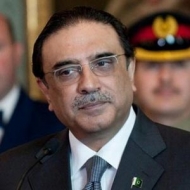
Zardari calls to frame law to prevent forced conversion
Pakistan President Asif Ali Zardari has directed the Sindh government to frame a draft law to amend the Constitution to prevent the forced conversion of minority communities in the southern province.
During a meeting held in Karachi on Thursday, Zardari directed Sindh chief minister Qaim Ali Shah to form a committee under provincial law minister Ayaz Soomro to prepare the draft law to amend the constitution. Elected representatives and leaders of the Hindu Panchayat will be included in the committee, The Express Tribune quoted its sources as saying.
The President made the decision after he was briefed about the concerns of Hindus by his sister Faryal Talpur, a lawmaker of the ruling Pakistan People's Party, and chief minister Shah. "The reports of the mass migration of Hindus to India are merely speculative but people of the Hindu community are insisting that a law is made against forced conversions," Shah was quoted as saying by the sources.
Zardari directed Talpur and Shah to visit Jacobabad and meet representatives of the Hindu community before the draft law is framed. The President recently formed a committee of three parliamentarians headed by federal minister Maula Bux Chandio to meet the Hindu community across Sindh following reports of their mass migration to India due to forced conversions, kidnapping for ransom and extortion demands.
A member of the Sindh cabinet familiar with the latest developments said: "If any case of conversion is reported without the consent of a girl and her parents, the (police station chiefs) would frame charges of kidnapping against the people involved."
Pakistanis stage protest against recent Shia killings
Pakistanis have gathered
outside the parliament building in the capital, Islamabad, to voice their anger at the targeted killings of Shia Muslims in various parts of the country.
The demonstrators assembled in front of the country’s parliament on Friday following a march on the International Quds Day and called on Islamabad to take stronger action to stem the rising tide of violence against Shia Muslims.
The protest came after gunmen dragged the Shia passengers off a bus in the northwestern district of Mansehra on Thursday and killed them at point blank range. Several others were injured during the attack. The victims were going from Rawalpindi to Gilgit -- a heavily-Shia-populated area.
Meanwhile, on the same day, at least three more Shia Muslims were killed by armed men in the city of Quetta in the southwestern Pakistani province of Balochistan.
Following the attack, the UN Secretary-General Ban Ki-moon strongly condemned the killing of Shia Muslims in northern Pakistan.
In a released statement on Thursday, Ban's spokesman Martin Nesirky said the UN leader slammed the “appalling” attack.
Also on Thursday, hundreds of Pakistani people took to the streets in the southern city of Karachi to slam the violence against Shia Muslims across the country.
Kohat tunnel closed to foreign travellers
Dawn.comThe Khyber Pakhtunkhwa government has banned travel of foreigners from Peshawar to southern districts of the province and tribal and semi-tribal regions through Kohat tunnel. Besides, security at the tunnel has been beefed up and all those intending to travel through it must carry their computerised national identity cards. The standard operating procedure (SOP) in this regard was announced by Home and Tribal Affairs Department, Peshawar, on Friday. It stated that travel of foreigners from Peshawar to Kohat, Hangu, Karak and Bannu districts, and North and South Waziristan agencies through Kohat tunnel had been banned, as for this they would have to pass through the restive Darra Adamkhel, a Frontier Region (FR) of Kohat district, and onwards through Kohat tunnel. Similar restriction is also meant for all those Pakistani staff members working with any international or local NGO. The restraint is also applicable in case of other remaining five FRs i.e FR Peshawar, FR Bannu, FR Lakki, FR Tank and FR Dera Ismail Khan as well as the seven tribal agencies, including Bajaur, Mohmand, Khyber, Orakzai, Kurram, North Waziristan and South Waziristan. However, the people will have to obtain prior permission from the Home and Tribal Affairs Department so that necessary NOC and proper security arrangements could be made for them well in advance. Ban on travel through Kohat tunnel is in addition to the restriction already imposed for 10 districts for visiting foreign tourists, diplomats, foreign missions, expatriates and Pakistani staff members working in NGOs and INGOs with regard to entire seven districts forming Malakand Division, including Swat, Lower Dir, Upper Dir, Shangla, Buner, Malakand and Chitral and three southern districts of Hangu, Tank and Dera Ismail Khan. The home department advisory clarified that all ambassadors/foreign missions/diplomats/embassies’ officials intending to visit the aforementioned specific areas were advised to route their written requests through the federal ministry of foreign affairs, Islamabad, so that it should reach the provincial government’s home department, Peshawar, a fortnight or at least 12 working days in advance, enabling it to process it and obtain security clearance from the quarters concerned and to make proper security/ protocol arrangements for the visiting foreigners/dignitaries. The government has asked the foreigners/expatriates and Pakistani staff working for NGOs/INGOs to route their written requests for visiting the abovementioned areas through their respective organisations. For visiting the rest of the districts of Khyber Pakhtunkhwa, all categories of foreigners might forward their written requests to the home and tribal affairs department, Peshawar, at least five working days prior to their visits so that proper arrangements could be made for their visit. Meanwhile, to thwart any threat to strategic Kohat Friendship Tunnel two extra army units and sniffer dogs have been deployed there, turning it into a nuisance for a large number of people proceeding to their hometowns for celebrating Eid, sources told Dawn in Kohat on Friday. The National Highway Authority and security forces have also renewed their request to people to keep their identity cards and papers of vehicles with them for easy passage through the tunnel. The security forces have forbidden travel through the tunnel for those people who did not possess CNIC. The sources said that this time the authorities had also not opened the hilly track between Darra Adamkhel and Kohat to ease traffic at the tunnel. They said that the villages close to the hilly track on Darra Adamkhel side were still infested with militants, who could cause harm to passengers.
GILANI RETALIATES AGAINST SUPREME COURT VERDICT
The former Prime Minister Syed Yusuf Raza Gilani had strongly retaliated against the Supreme Court of Pakistan asking the Court not to sack another Prime Minister. Addressing a news conference, he said that the PPP would retaliate and protest against such a decision if repeated. The party reserved the right to mass agitation to mobilize public opinion against the judges what he said their biased opinion against the PPP and the Party Chief Asif Ali Zardari. The warning indicated that Syed Yusuf Raza Gilani and other top PPP leaders will lead the anti-Supreme Court protests in all parts of Pakistan. He had complained that the sitting Supreme Court had taken up all the PPP specific cases on top priority basis ignored cases against other political leaders and parties and he cited the Air Marshal Asghar Khan Case in which ISI had distributed money among the politicians and parties to defeat the PPP in the 1991 elections by forming all alliance in the name of IJI.
The former Prime Minister also suggested that the Executive Order of the Prime Minister reinstating the Judges should be referred back to the Parliament for approval as was the case of NRO. He was of the opinion that dispatching Mian Nawaz Sharif and his family to Jeddah on a charter plane from Attock Fort was also a NRO and the Supreme Court ignored the NRO that benefited the PML-N chief and his family.
Syed Yusuf Raza Gilani suggested to the PPP to agitate and resist vigorously if the Supreme Court tries to remove another Prime Minister is removed. He advised the Prime Minister not to appear before the Supreme Court as he had committed a mistake to give honour to the Court. The Prime Minister enjoys complete immunity under Article 248(1) and there is no need to appear before the court.
If the Supreme Court sends elected Chief Executives home there is no need of holding elections, Yusuf Raza Gilani told journalists at the news conference.
He was of the opinion that the Supreme Court got a chance to reverse its decision while hearing the review petition filed by the Government. It can reverse the process of confrontation between the PPP or the Government and the Supreme Court.
Similar opinion had been given by other PPP leaders, including Senator Abidi, Sharjeel Memon and other leaders from the Punjab Province criticizing the verdict and anti-PPP role of Supreme Court in politics. A former Chief of the International Crisis Management Cell and a former Judge of the Indian Supreme Court had leveled serious allegations against the Supreme Court claiming that it was highly politicized verdict and the Court had crossed all limits.
We hope that both sides will observe restrain and avoid confrontation in the interest of political stability and continuation of the democratic process by avoiding strong stand against each other. PPP is the most popular political party of the people to this date and other parties had no match to its popularity, to say the least. There is a chance that the PPP may return to power if fresh elections are held as political opponents had failed to perform well. The Opposition parties are not playing their political cards well and they are yet to attract the attention of the common people from the remote corners of Pakistan.
To us, Mr. Asif Ali Zardari is still the most powerful political personality in the country to this date if somebody likes it or not. He had already outwitted all his political opponents and most of them were clean bold. The decision makers should keep in this mind while planning action against the PPP, its Government or leaders. Zardari had managed to control the entire PPP and its militant cadre and the PPP workers will respond to the call from President Asif Ali Zardari. Or he may use Syed Yusuf Raza Gilani is the fit man for the fit job to agitate if it was decided to protest its point.
Pakistan: Shia killings on the rise
Thursday’s execution-style killing of Shia citizens in Mansehra district and the killing of Hazaras in Quetta were only the latest incidents in what is now a clear trend: targeting innocent members of the sect — not necessarily members of any political or religious organisation — and killing them for no reason other than their religious affiliation. The Mansehra attack had a particularly disturbing aspect to it, with passengers made to show their identity papers and those suspected of being Shia, on the basis of their names or tribal affiliations, being picked out and killed. Like other recent sectarian killings in Balochistan, Kohistan and Orakzai, the approach used resembled ethnic cleansing in its chilling focus on identifying and killing innocent citizens simply because of their membership to a particular community. And while the Hazara community under attack in Balochistan is relatively small and powerless, the same is not true of Shia communities elsewhere in the country. If not arrested, this trend could well spiral out of control, turning the issue into a much larger conflict.
Meanwhile, where is the outrage from the security forces and politicians? We know these groups are willing to launch aggressive messaging campaigns when they wish to. Take, for example, the army’s response to Salala, the PML-N’s reaction to the government’s refusal to write the ‘Swiss letter’, the ruling party’s defensive posture on threats to democracy or the PTI’s campaign against drone strikes. And while it is unclear what judicial activism can achieve in such cases beyond raising their profile, where is the judiciary that otherwise takes suo moto notice of everything from the price of sugar to violence in Karachi? As each of these groups tries to focus on topics they think will boost their populist or nationalist credentials, the campaign to eradicate a minority community continues to receive less official attention than it should.
Beyond the messaging failure, little appears to have been done to confront the physical danger. Providing security escorts to pilgrims’ buses and changing the routes Shia travellers take has not been enough. Whether combating the problem is a matter of improving intelligence-gathering to prevent attacks, pre-emptively going after the groups that are carrying them out, improving policing in vulnerable areas or other intelligence or security measures, further delays are inexcusable. The state needs to demonstrate what it is doing to combat this threat. If not, Pakistan may as well give up any pretence of being a state for anyone other than its majority religious community.
Pakistan: Upsurge of terrorism
Undoubtedly, a wave of gloom and heightened concerns pervades the country. What could be more disconcerting than to see Kamra airbase being attacked by terrorists saboteurs; learn of some two dozens bus passengers being ruthlessly gunned down in the shadow of Babusar Top while run-of-the mill targeted killings remain unabated during the last week of Ramazan. That the upsurge of deadly violence was coincidental to the holiest of all nights, Lailatul Qadr, there is reason to believe that forces long engaged in destabilising Pakistan have raised the ante as if going for the last push against this country.
Of course, we were being kept informed of heightened incidence of terrorism but it's beyond one's comprehension and the authorities were fully prepared and appropriately geared to meet the challenge. But even then all this has happened, creating doubts about the government's capacity to effectively meet the challenge.
The latest was the fourth strike on the Kamra aeronautical complex which also houses an airbase and this was not the first time innocent Shia travellers have been waylaid on their way to Gilgit and Skardu. But it appears that preparations to stall the threatened attacks fell short of the required strength and determination and terrorists could claim victory though not complete. Yes, at Kamra all the attackers were killed but they were there to get killed, as death is of no consequence to them. Enough of lessons have been learnt from such incidents; we have to go for action.
And that action has to be not only on the battle front; it has to be on the tables of authorities that are tasked to ensure peace and tranquility in the country. The truth is that insofar as an effective response to counter terrorism is concerned the task is assigned to law enforcing outfits and intelligence agencies, as other organs of state and government departments by and large stay clear of any reasonability to fight-back the demons of terrorism. And even among the concerned agencies and departments the required liaison is missing - so much so that there are reports of them not sharing operational intelligence. If the top leadership is left only with issuance of letters of condemnation and condolences following the happenings the parliament too is marginally involved. In the instant case, there was forewarning of an impending terrorist activity in the area and yet the attack occurred.
The terrorists launched themselves from the nearby village. It is therefore a security necessity that there should be a buffer-zone around such high security institutions and civilian population, be it an urban slum or a village. The country is beset with the heightened phase of terrorism for more than a decade now but the government has yet to come up with a comprehensive legislation to deal with this threat in an effective and meaningful manner.
The terrorists are treated like criminals under the ordinary law; investigation often lack the right direction while prosecution suffer from serious faults and lacunae particularly in the absence of witnesses, who prefer to disappear quickly. So there are only a few convictions, and known terrorists return to their business much sooner than later.
We know that the elite are more concerned with their future than of the country, and are expending their energies to return to same green meadows. But that is too myopic a thinking; with the country descending in the vortex of uncertainty and chaos, they too have no future. They are expected to moderate their political ambitions and give some time to Pakistan. Equally disappointing, however, is the role of country's religious leadership.
The land and people who constitute Pakistan have never been absolutely free of sectarian tensions and off and on there have been sectarian clashes. But never were they so tense and bloody as now. They need to sit together and think of a way to get out these marshes infested with cannibal crocs. If, God forbid, this boat sinks everyone will get sucked down by suctions caused by the vessel going down.
For the political and religious leaderships there are also some detectable signs to read and analyse to see if there is some external force that would benefit from a weakened and isolated Pakistan. Intriguingly enough, weirdly coincidental to the Kamra incident, the foreign media, particularly the Indian and the American, were rife with stories that the airbase housed nuclear arsenal that terrorist wanted to snatch.
That these reports almost echoed US Defence Secretary Leon Panetta's similar concerns is an alarming development which underscores the need for a deeper investigation into this incident. Of course, the US government has promptly modified its perception and said it has no reason to believe that terrorists could access to Pakistan's nuclear weapons.
Interestingly, such an assertion and a retraction has been made by American officials earlier also. Though the Foreign Office has rejected these reports and the PAF spokesman put paid to propagandists by saying no airbase in the country houses nuclear weapons the fact cannot be denied that efforts are afoot to question Pakistan's capacity and capability to keep its nuclear assets safe from falling into the wrong hands.
Pakistan: Response to terrorism
EditorialThe assault on the Pakistan Air Force Base Minhas in` Kamra may be a reminder that our security apparatus has serious flaws, but the quick and timely action taken by the base defenders prevented bigger damage. The counter-attack by the Quick Response teams of the base suggests they were on alert to deal with any untoward incident in the light of an intelligence report a few days before the attack. This is not the first attack on a sensitive military target. The attacks on GHQ (Rawalpindi) and PNS Mehran (Karachi) and three different attacks on Kamra since 2007 are a series of similar events. These provide conclusive evidence that the state is at war with the terrorists who wish to impose their narrow vision of religion on Pakistan through force of arms. It came as no surprise that the Tehreek-i-Taliban Pakistan (TTP) claimed responsibility for the attack. After all they have openly declared war on the state. COAS General Ashfaq Pervez Kayani the other day sent a clear message of terror looming large over national security, implying the enemy is within. The statement of US Defence Secretary Leon Panetta expressing concern about the safety of Pakistan’s nuclear weapons in the wake of the Kamra attack may be part of long standing western worries that the arsenal could fall into the wrong hands. But the US State Department, through its spokesperson Victoria Nuland, came to Islamabad’s rescue and supported the foreign office’s contention that Pakistan’s nuclear arsenal is secure and under a proper command and control system. Panetta continues in his self-assumed role of ‘bad cop’, while State continues to pour oil on troubled waters in its avatar as the ‘good cop’ vis-à-vis Pakistan. Where the security forces seem to have learnt lessons from previous attacks and thwarted the assault on Minhas Airbase with minimum losses, the attack on buses in the Babusar Top area of Mansehra district, where 25 people were killed after being identified as Shias, shows that the law enforcers of the country are way behind the curve on terrorism generally, and sectarian terrorism in particular. Obviously a number of such incidents have occurred in the northern areas previously with an identical modus operandi, but after the usual fuss in the immediate aftermath of such tragedies, the authorities become lax over time and the buses revert to plying without any security arrangements. The terrorists meanwhile wait out the initial flurry of the security forces and as soon as they see that it is back to business as usual, launch their own unique ‘enterprise’. Time and again lack of coordination among the intelligence, law enforcement and security agencies has been discussed in the light of the need to set up an overarching body that would manage and oversee coordination and collaboration among different agencies, ranging from the armed forces to the civilian setup, and from the federal government to the provinces, to ensure a concerted national effort against the various types and forms of terrorism, ranging from those who are waging war on the state directly (e.g. the TTP) to those involved in an indirect assault on state and society through sectarian murder. A country that has been ravaged by militancy, terrorism and sectarian conflict cannot sit sanguine on the issue of security lapses and the legal loopholes that allow terrorists to wriggle through the judicial system and return as free persons to their nefarious activities. This is tantamount to a self-inflicted invitation to threats, violence and instability. We are sitting on a volcano, and the enemy we are faced with is difficult to squash because of its scattered nature, with no central command structure that may lend itself to concerted action. Most groups in the field of terrorism are small, largely operationally autonomous entities that bite like the flea and then vanish. All the more reason for a centralised intelligence and operational database under coordinated command if the challenge is to be met.`
US drone attack kills five in North Waziristan
The drone fired two missiles on a compound in Shuwedar village in North Waziristan.
A US drone strike Saturday killed at least five suspected militants in a remote Pakistani tribal town near Afghanistan border, security officials said.
The drone fired two missiles on a compound in Shuwedar village in the troubled North Waziristan region.
"US drones fired two missiles into a militant compound. At least five militants were killed," a security official told AFP.
Local intelligence officials confirmed the attack and casualties.
The attack came as people in the deeply religious region celebrated the Muslim festival of Eid al-Fitr, they said.
Attacks by unmanned American aircraft are deeply unpopular in Pakistan, which says they violate its sovereignty and fan anti-US sentiment, but US officials are said to believe the attacks are too important to give up.
Friday, August 17, 2012
Where is Punjab govt’s security? 876 guards for Nawaz Family
Pakistan Medical Association (PMA), while condemning the acid attacks on nurses at Mayo Hospital, said that Punjab government’s security arrangements at public hospitals has been put to question in the light of this sad incident.
PMA Central Joint Secretary Dr Shahid Malik, in a press statement, also added that the negligent attitude of the police and health department on the matter was unacceptable. PMA has demanded a high level enquiry probe in the matter and an immediate fix of the security lapse. PMA also demanded of the Punjab Chief Minister Shahbaz Sharif to install walk-through gates at all emergency wards, provide metal detectors and ban the entry of the unrelated people inside the hospitals.
On the other hand Nawaz family has 876 security personnel to protect them
http://www.thenewstribe.comSharif Family, one of the most politically influence families in the country, and ministers of Punjab province have deputed 876 security personnel to protect their homes, offices and family members. These security personnel giving round the clock security duty are from police and Elite Force. The cost of their salaries, vehicles and other expenses is millions of rupees annually to national wealth. “But the other scene in the province is hundred of incidents of roberies, terrorism and kidnappings are being held everyday making the law and order situation bad to worse,” security officials told. Over 100 of security personnel are deputed only for the protection of head of Pakistan Muslim League Nawaz Sharif and his family. “They are basically responsible for protection of Nawaz Sharif, Captain Safdar, son in law of Nawaz, Mariam Nawaz, Hussain Nawaz, Kulsoom Nawaz and kids of the family,” the sources revealed. “Any movement of these persons means consumption of official resources and such scenes are common in Raiwind, the area where house of Sharif family is situated,” they added. They say security guards for Chief Minister of Punjab Shahbaz Sharif and his family inlcuding Hamza Shahbaz, Salman Shahbaz and Nusrat Shahbaz are in addition to guards of Nawaz family. “Deploying government personnel on personal protection is creating a VIP culture in the province,” the sources said. “To improve law and order situation in the province, it would be better for Sharif family to withdraw their guards or at least decrease the number to minimum.”
India and Pakistan mark 65 years of freedom
The republics of India and Pakistan were created in 1947 when the British Raj pulled out of the subcontinent. In what became the largest known population transfer in history, India was split along religious lines and an estimated 14 million Hindus, Muslims and Sikhs migrated across the newly formed borders. Both countries looked to the future with hopes that political stability and economic prosperity would lead to a stronger and more positive relationship. As they prepare to mark the 65th anniversary of their independence, Al Jazeera's Sohail Rahman looks at how the two nations have fared.
Pakistani judiciary and foreign media
Pakistan is going through a judicially hyperactive era, wherein the judiciary has proved to be the only active state institution. While it has its positive impacts, the honourable judiciary at the same time has created some negative impressions among the international analysts, who observe its decisions as a third party independent observer. And, perhaps, can provide a righteous opening as an independent onlooker of the events.
After analysing several articles published in different foreign newspapers and journals, one can safely conclude that they consider the activism of Pakistani judiciary a political move. The Times of India, for instance, published an article, entitled Tussle between the judiciary and government in Pakistan, written by Omer Farooq Khan on July 12, 2012. He wrote: “Observers believe that the drama over the letter is part of a wider power struggle between the judiciary and executive. The government says that Chief Justice Chaudhry has dramatically expanded his judicial powers to persecute President Asif Zardari and oust his government. The Chief Justice insists that he is merely holding corrupt and inept politicians to account…….’If the current stalemate between the judiciary and government continues the military will be compelled to jump into the fray, but it would be difficult for the men in uniform to clear the mess’…….”
Next, Umar Cheema, Associate Lecturer at the Australian National University College of Law, in his column posted on Al-Jazeera’s website on July 20, has opined: “The court’s decision was subsequently subjected to severe criticism in the international press as well as by Pakistan’s liberal intelligentsia in leading English language publications; the court’s action was portrayed as essentially anti-democratic and ‘political’ in nature. The international response to this action is understandable. Every event with political consequences is analysed solely in the light of likely impact on the ‘war on terror’ or the Nato involvement in Afghanistan. As such, any manner of instability in Pakistan is problematic…….It is Pakistan’s liberal intelligentsia that is asking the court to play politics in the narrow sense by deciding cases in accordance with calculations of likely impact on electoral processes, rather than on the basis of its established course.”
The Saudi Gazette in its July 26 publication maintains: “The crisis has roiled Pakistan’s political system for months, distracting attention from what many Pakistanis believe are more pressing problems, such as the country’s ailing economy and fight against the Taliban.”
In the same vein, The Guardian termed the disqualification of the former Prime Minister, Syed Yousuf Raza Gilani, as “judicial coup.” Justice Justice Markandey Katju has clarified that “if the Constitution collapses in Pakistan, Chief Justice Iftikhar Mohammad Chaudhry will be responsible.” Certainly, there are many other international analysts, who hold the same opinion.
So, it is time that the judiciary clarified its position. The Supreme Court has itself stated that “there is no holy cow in the country”, then why it has refused to give the details of the accounts of the judiciary on technical grounds that the funds for the judiciary comes from federal consolidated fund? Against this backdrop, it would have been more appropriate if the Supreme Court’s Registrar had come forward in order to secure its moral grounds.
Secondly, in the Arslan Iftikhar cast when NAB’s joint investigation team called upon the Registrar, he refused to appear before it on the technical ground/pretext that he is an officer of Grade 22 and cannot obey the order of a lower graded officer. This was, indeed, unexpected, keeping in view the fact that the court, itself, had ordered the investigation. Arsalan has already refused to cooperate with it, thus the case is not proceeding further. The question, however, remains: why is he causing hurdles in the investigations. I am not blaming anyone, but as an observer I need answers to my questions.
At this point of time, it is appropriate that any case that undermines the honourable judges or the Supreme Court should be decided as soon as possible, and technicalities should not impede the process of investigation because every Pakistani wants to see an unbiased and taint-free judiciary.
Veena Malik's new avataar grabs eyeballs
http://timesofindia.indiatimes.comVeena Malik first religious show Astagfar has reached highest TRP ever. The show created a positive response across the world. People across the globe appreciated Veena Malik's new Avatar in the show. Around 3 crore viewers watch the first show of "Astagfar" and has received a fabulous waku doki response. Veena Malik said, "It was a very great moment for me that people across the globe has appreciated me and they accepted my show. The show has touched the heart of people which is shown by TRP rating." After so many outrages worldwide the show goes on air and gained the highest TRP ever. Veena's show has breaken all the past records with an unprecedented success. This show is more about connecting with audiences. The superb success of the show can now be termed as a historical success after its big leap on the small screen.
Similarities between PML-N & PTI
IMRAN TALIB FAKE KHAN AND NAWAZ SHARIF LOHAR,BOTH SUPPORT HARDLINE ISLAMIST,TALIBAN AND BOTH ARE SUPPORTED BY PAKISTANI ESTABLISHMENT(MILITARY)AND JUDICIARY.FOLLOWING ARE SOME OTHER SIMILARITIES REPROTED IN ''THE NEWS''. Pakistan Muslim League-Nawaz (PML-N) and Pakistan Tehreek-e-Insaf (PTI) locked in a relentless verbal bout, indicating how poles apart are their approaches. Yet quite surprisingly, they both have some striking similarities as well. Politically speaking, the PML-N and PTI both spare no occasion to unleash attack on the former military ruler ex-president General Pervez Musharraf and the incumbent regime, though of late, they mostly target each other’s leadership. Now, the leaders of both parties want the Supreme Court to decide whether Nawaz is corrupt or Imran, after having almost exhausted their energies on the subject through media conferences and television talk shows. Taking lead, Imran has already announced to sue PML-N’s Khawaja Asif for his corruption charges against him. On the issue of general election, again these two parties share unanimity: they want early elections after seeing back of this PPP-led ruling coalition, which they allege, has failed to deliver on any front, holding it responsible for most of the crises Pakistan faces today. There is again a similarity in their political strategy to welcome in their folds, herds of those who remained a key part of Musharraf regime: though it is said the PTI took lead in opting for this line of action to boost its electoral prospects, welcoming several ‘electables’. These two parties have proved through their actions that for them political expediency is the short-cut to achieving ‘objectives’. Well over 100 politicians, who remained a part of the PML government during 2002-2007,some of them so close to the ex-military ruler, are today associated with the PTI. Few of these are Jehangir Tareen, Khurshid Mehmood Kasuri, Sikandar Bossan, Dr Shahzad Waseem, Faiz Tamman, Awais Leghari, Jamal Leghari, GG Jamal, Ishaq Khaqwani, Shahid Akram Bhinder, Malik Amin Aslam, Farooq Amjad Mir and Aila Malik. Khaqwani was perhaps the only exception, who would openly disagree over some of the then government policies from the PML platform. Past is past. They all today sit with Imran, who, used to obediently listen to sermons of Musharraf yesterday: how will Imran succeed in changing the rotten political system in Pakistan with this lot is anybody’s guess. Feeling a direct threat from the PTI, PML-N leadership, which had declared in categorical terms that those who were part of Musharraf’s PML regime, would never be accommodated in the party again, received with open arms many in recent months: they include even Amir Muqam, an erstwhile close friend of Musharraf, who had once proudly announced to have been gifted a pistol from him for his safety. There is a long list of the PML leaders, who jumped on to the PML-N bandwagon: some of these are; Tariq Azeem, Tahir Iqbal, Zahid Hamid, Sumera Malik, Safdar Shakir, Saima Akhtar Bharwana, Naeem Hussain, Ghulam Murtaza Maitla, Mansoor Hayat Tamman, Azeem Chaudhry and his spouse Asiya Azeem. Azeem was one of the leading characters as chief organiser behind the formation of the PML over a decade ago, mostly consisting of PML-N faces. Moreover, his wife remained MNA on women reserved seats. Sumera, Tariq Azeem, Tahir Iqbal are among those, who also served in the cabinet during Musharraf rule. Around 45 PML forward bloc is also a part of PML-N, which has also developed a special relationship with PML-Like-Minded that includes Salim Saifullah, Humayun Akhtar and others. With this lot of ex-comrades of Musharraf, the PTI and PML-N want to change the status quo and combat corruption. On apolitical front, the PML-N and PTI leaders share commonality in the form of having their (two each) sons abroad: Imran has his two sons-Sulaiman Khan and Qasim, living in London with their maternal grandmother; while Nawaz Sharif too has two sons-Hasan Nawaz and Hussain Nawaz abroad, doing business. Imran’s sons during school vacation days, visit their father in Pakistan, spend some days with him at his sprawling Bani Gala residence, playing with their cricket legend father. Like the PTI chairman, Nawaz Sharif loves cricket so much. But his sons don’t play cricket. Let’s wait some more similarities between these two may come up in the weeks and months to come.
Pakistan: Survival of state lies in democracy
http://www.sananews.netPrime Minister Raja Pervez Ashraf has said that decision about future government will only be made by people of Pakistan through a free, fair and transparent election there is no need to fear of any consequences, adding that PPP would accept the decision of people through votes and it is true democracy. Addressing the ceremony of cheques distribution amongst the deserving families under the Benazir Income Support Program here on Friday, he said we will go into the court of the people and their decision will be fully endorsed. The Prime Minister said he believes the survival of this country only lies in democracy, free and fair elections and in respecting the aspirations of the people. Prime Minister Pervez Ashraf said that the development of the consensus on the election of the Chief Election Commissioner was the first step towards the holding of free elections. Other phases will also be completed with the same spirit and intent. He said nobody should have any confusion or concerns on the matter. Turning to the different initiatives launched by Benazir Income Support Program, the Prime Minister said programs like Waseela Haq Waseela-e-Sehat and insurance scheme have been launched to help the oppressed segments of the society stand on their own feet. He said the program launched on the name of Shaheed Benazir Bhutto has become a role model for the entire world as it is providing financial assistance to the deserving people on merit irrespective of their party affiliation. He expressed the confidence that the future governments will continue with this program for the betterment of the poor families. Pervez Ashraf said that around one hundred thousand families are getting help from this program. He said currently six million people are benefiting from this program and it will be further expanded with completion of poverty survey. Under this program, an education program is being launched with the financial assistance of the UK for the education of three million poor children. He was confident the program will bring revolution in the lives of the people. The Prime Minister further said that almost half of the population of Balochistan is benefiting from various schemes of Benazir Income Support Program. He said Balochistan is the largest province of Pakistan as far as its geography is concerned and future of the country lies in that province. Later the Prime Minister distributed checks of one hundred and fifty thousand rupees among women selected under Waseela Rozgar Program. He also distributed debit cards and Life Insurance Certificates among various participants.
Judiciary expelled one Gilani, public elected second Gilani
Former Prime Minister Yousuf Raza Gilani has said that judiciary expelled one Gilani but the public elected second Gilni; public’s decision is incredible in comparison to the judiciary’s verdict over court contempt, SAMAA reported on Friday.
Yousuf Raza Gilani said in his address at a ceremony in Multan this day that the PPP has never entered from back door in power.
He expressed gratitude to voters for success of son in by-polls while terming public’s decision incredible than judiciary’s verdict.
All those works will be completed in Southern Punjab which were started during my tenure, assured the former prime minister to the people on the occasion.
“Judiciary’s verdicts are at their place but people and history’s decisions use to be different,” Yousuf Raza Gilani added, saying apart from being in power or not, we would continue serving people.
Pakistan provides military flights for civilians as 20 more Shias massacred

After latest incident of civilians from Muslim minority being pulled off bus on major road and shot, Pakistan lays on flights to capitalA series of sectarian massacres on one of Pakistan's most important roads has forced the government to lay on military flights for Shias travelling to and from the country's capital. The decision to allocate C-130 Hercules transport planes for the use of civilians travelling between Islamabad and the north-eastern provincial capital of Gilgit follows the killing on Thursday of 20 Shias. In the third such incident on the road in six months, the victims were pulled off a bus some 100 miles north of Islamabad by armed men, lined up and shot. Local officials said the up to a dozen people wearing army uniforms had stopped the bus before mounting their attack. "After checking their papers, they opened fire and at least 20 people are reported to have been killed," said Khalid Omarzai, administration chief of Mansehra district. Pakistan is struggling to deal with a rising tide of sectarian violence and extremist Sunni militant groups who do not regard members of the Shia sect as true Muslims. The prime minister's office said the flights were a temporary measure as the country heads towards the Islamic holiday of Eid al-Fitr. "Normally people would travel by roads but because of the situation people are no long prepared to use it," a spokesman for Raja Pervaiz Ashraf, the prime minister, said. The road is critical for connecting Gilgit-Baltistan, the mountainous province that borders China, with the rest of the country. With stunning scenery and access to some of the world's highest mountains, it was once popular with international tourists travelling the Karakoram Highway. But Gilgit and its surrounding area have been repeatedly hit by appalling sectarian violence. In February 18 Shias were forced off a bus travelling to Gilgit and killed. And in April nine travellers were shot dead in a town 60 miles from the city. And in another attack on Thursday a bomb appeared to target a bus carrying Shia students to an anti-Israel rally in Karachi, the megacity on the country's southern coast, which is also frequently racked by sectarian killings. Police said one man was killed and 11 were wounded as the bus travelled to the protest held annually at the end of the fasting month of Ramadan. Many analysts have criticised the Pakistani government for not doing enough to suppress anti-Shia groups. The government and military are often reluctant to launch crackdowns in the Sunni-majority country, in which radical groups enjoy mainstream support from the public.
Clue of every crime points out North Waziristan
http://www.thenewstribe.comInterior Minister Rehman Malik has said that clue of every crime points towards North Waziristan and criminals form Sindh, Punjab and Balochistan are sheltered here. Speaking to media on Friday, he said that politicians should refrain from doing Taliban Branded Politics, referring to Sheikh Rashid’s latest speech. Malik said that four terrorists who attacked airbase in Kamra had been identified. He said that that sensitive installations located near populated areas would be shifted. To a question, the minister said that families of Naran bus attacks victims would be compensated. Malik said that after the passage of 18th amendment security had become provincial.
PPP concerned over CJP’s ‘political’ statement
DAILY TIMESPakistan People’s Party (PPP) Secretary General Senator Jahangir Badr on Thursday expressed concern over the reported statement attributed to Chief Justice of Pakistan (CJP) Iftikhar Muhammad Chaudhry regarding the people’s disappointment with the government. Badr said that such political statements attributed to the chief justice did not seem appropriate, adding that as long as Justice Chaudhry was the chief justice of Pakistan, he could not associate himself with politics. The judges of superior courts could participate in politics after two years of their retirement, he said. The PPP leader said his party respected the judiciary, adding that it was the right of the people to elect their representatives. It was also their right to exercise their opinion by casting vote in favour or against any political party in the election, he said.
Pakistan: Militants in mosques
By:Ershad MahmudThe recent terrorist attack on the airforce base in Kamra reminds me of last Friday’s prayers wherein I strongly realised that the present peace is fragile and violence can revisit us anytime in the days ahead. As luck would have it, I incidentally bumped into a mosque to offer prayers and experienced the unexpected. The mosque, which is just a couple of miles from Pakistan’s military headquarters, was filled with worshippers but the sermon was not delivered by the local imam. Instead a young and fairly well-built man was addressing the people from the pulpit. After listening to him a little I thought that he would make a traditional anti-American diatribe where the United States is roundly criticised for all the evils bedevilling the Muslim world. But he suddenly took a turn to enliven the last two decades of the previous century of ‘jihadi’ activism. A returnee from the battlefront in Paktia, Afghanistan, he flaunted his heroics of ‘jihad’ against the USA-led Nato forces. Chest-thumping he claimed that he had killed several ‘enemies’ in his two years service, he boasted of several successes against the US forces. In his words, the Taliban are winning the battle in Afghanistan and the US has been forced to run for its life. This young ‘mujahid’ sent us into a state of déjà vu when he asked the worshippers to spare at least one of their sons for the holy ‘jihad’ as this was the ripe time to inflict maximum destruction on the enemy which is on the run. So they could win the final round. He promised his group had arrangements in place for military training of such aspirant ‘jihadis’. Not quite long ago this was the routine practice in Pakistani mosques. He cleverly appealed to the collective emotion of the people by bringing in the case of Aafia Siddiqui, an American-educated Pakistani woman who was sentenced to 86 years by the US court for terror charges. He told the audience that ‘mujahedeen’ had taken oath not to rest till she was released from the US prison. Probably the financial crunch had forced this man to fall back on the old tactics of raising funds during Friday prayers in Pakistani mosques. He made an appeal to the people that the Taliban needed huge financial resources to continue this war as a small operation would require huge financial input. He convincingly asked everyone to contribute as much as they could. Pointing towards his colleagues at the gate, who were combing their long beards with their fingers, the speaker said that they would collect the charity and facilitate the recruitment. At the end of the prayers I noticed people queuing up at the gate to contribute whatever they could for ‘jihad’. It was a baffling experience for me as I was of the view that radical activism in such a way was a thing of the past, at least in urban centres. The government has taken several steps to dismantle the infrastructure of these groups and open activism is banned. There are also programmes for de-radicalisation of militant youth in order to rehabilitate them and bring them back into mainstream society. However, it seems that the state has largely failed to stop these groups from routine activities of raising funds and recruiting fresh blood in the name of jihad in Afghanistan. This is just one example and there are surely more but one wonders if the top guns at the policy level know of such development. As this personal experience shows, counterinsurgency efforts have not yet produced the desired results and need close introspection at the top level. Such brazen escapades of ‘jihadism’ in mosques in the centre of the country fly in the face of Pakistan which vehemently rejects any mention of Pakistan being used by terror groups for terror activities in Afghanistan. Straight denial and negligence of such activities will not do it good. Sherry Rehman, Pakistan’s ambassador to the US, had to face embarrassment recently in a public meeting at Washington when she criticised the coalition forces for not being able to stop Afghan terror groups from intruding into Pakistan’s territory and attacking the army and civilians alike. An American official slapped her with a counter question as to why her country was not doing anything to stop infiltration of terror groups into Afghanistan in the first hand. How could Pakistan expect Afghanistan or the US to do what they have been asking it to do for a very long time? Although this is not an excuse but the Pakistani state is fast becoming an ineffective state and has failed to establish the rule of law in the country. The government’s ability to police and timely gather intelligence seems flawed as well, and not much has been delivered. These groups know and exploit this weakness and thus take advantage of it. A comprehensive counterinsurgency strategy should be adopted and seriously implement which should also target mosque committees warning them of consequences if banned outfits are allowed to go about their activities. This is a critical time for Pakistan to put its house in order and eschew any negligence or tolerance of such radical groups.
The writer is Islamabad-based freelance journalist and consultant. www.ershadmahmud.com
Pakistani film Lamha wins awards at New York Film Festival
http://www.brecorder.comPakistani feature film Lamha bagged two awards at the New York City International Film Festival (NYCIFF). Lamha (publicized as Seedlings in English internationally), won the Best Feature Film award and its leading lady Amina Sheikh won the Best Actress in Leading Role award in a late night ceremony at the Angelika Film Center, New York. Lamha, starring Mohib Mirza, Amina Sheikh and Gohar Rasheed is a production of Meher Jaffri and Summer Nicks while a new talent Mansoor Mujahid directed the venture. The film was nominated in five categories including Best Actor in Leading Role (Mohib Mirza), Best Actor in Supporting Role (Gohar Rasheed), Best Score, Best Original Screenplay (Summer Nicks) and Best Director (Mansoor Mujahid). The movie was one of the 100 films out of 3,000 film entries to be screened at the festival. The film’s premiere at the festival, on August 10, was a sold out affair at the Tribeca Cinema.
Bomb hits bus carrying Shiites killing 1, Pakistan says
A senior Pakistani government official says a bomb hit a bus carrying Shiite Muslim students in the southern city of Karachi, killing one person.
Roshan Ali Shaikh says Friday's attack also wounded 11 people. Shaikh is the top administrative official in Karachi.
The attack came a day after Taliban gunmen in northern Pakistan forced 20 Shiites off buses, lined them up and killed them.
Pakistan has faced a growing wave of sectarian killings at the hands of Sunni extremists over the past year.
Shaikh says the Shiite university students were on their way to an anti-Israel rally that is held every year at the end of the Muslim holy month of Ramadan.
Read more: http://www.foxnews.com/world/2012/08/17/bomb-hits-bus-carrying-shiites-killing-1-pakistan-says/#ixzz23oKlO3zS
Another Afghan police attack kills 2 US troops
A newly recruited Afghan village policeman opened fire on his American allies on Friday, killing two U.S. service members minutes after they handed him his official weapon in an inauguration ceremony. It was the latest in a disturbing string of attacks by Afghan security forces on the international troops training them.
Later Friday, an Afghan soldier turned his gun on foreign troops in another part of the country and wounded two of them, a spokesman for the NATO coalition said.
The attacks in the country's far west and south brought to seven the number of times that a member of the Afghan security forces — or someone wearing their uniform — has opened fire on international forces in the past two weeks.
Such assaults by allies, virtually unheard of just a few years ago, have recently escalated, killing at least 36 foreign troops so far this year. They also raise questions about the strategy to train Afghan national police and soldiers to take over security and fight insurgents after most foreign troops leave the country by the end of 2014.
The NATO-led coalition has said such attacks are anomalies stemming from personal disputes, but the supreme leader of the Taliban boasted on Thursday night that the insurgents are infiltrating the quickly expanding Afghan forces.
Friday's deadly attacker in the far western province of Farah was identified as Mohammad Ismail, a man in his 30s who had joined the Afghan Local Police just five days ago.
He opened fire during an inauguration ceremony attended by American and Afghan forces in the Kinisk village, the Farah provincial police chief Agha Noor Kemtoz said.
"As soon as they gave the weapon to Ismail to begin training, suddenly he took the gun and opened fire toward the U.S. soldiers," Kemtoz said.
Ismail was shot and killed as the coalition and Afghan forces returned fire, the police chief said.
A spokesman for the international coalition force, Jamie Graybeal, confirmed that two American service members were killed Friday by a member of the Afghan Local Police.
The ALP is different from the national police and represents a village defense force under the Ministry of Interior that is being trained by international forces, including U.S. special forces.
Graybeal gave no other details on the Farah attack other than confirming the shooter had been killed.
Kemtoz, the police chief, said the attack took place about 8 a.m., after the U.S. forces arrived in the village to train the local police. He said one Afghan National Police officer was also seriously wounded in the shooting.
Later Friday, an Afghan army soldier fired on coalition troops in the southern province of Kandahar. Two of the international troops were wounded but none was killed in that shooting, Graybeal said. He added that the soldier was shot and died later Friday of his wounds.
So far in 2012, there have been 29 attacks reported on foreign troops by Afghans they are training, compared to 11 attacks in 2011, according to an Associated Press count, and five attacks in each of the previous two years.
Seven such attacks have come in the past two weeks alone, with six American troops killed last Friday in two separate shootings in Helmand province in the south and another American killed a few days previously on a U.S. base in Paktia province in the east.
The trend raises questions about potential resentment by Afghans after more than a decade of international presence since the American-led intervention to oust the Taliban regime from power for harboring the al-Qaida terrorist leadership after the Sept. 11, 2001 attacks in the U.S. The insider attacks also renew concern that insurgents may be infiltrating the Afghan army and police, despite intensified screening.
Insurgent infiltration or recruitment was behind only about 10 percent of this year's reported attacks on coalition forces by Afghan allies, Graybeal said earlier this week, citing investigations into attacks before those of the past week.
Graybeal insisted the deadly violence is relatively small scale compared to the nearly 340,000 Afghan security forces now being trained.
The international coalition has said that Afghan forces are increasingly able to lead operations and already have started to assume responsibility for security in areas of the country that are home to 75 percent of the Afghan population.
However, the Taliban have been quick to seize on the increasing number of attacks as a sign of Afghan rejection of foreign forces and the insurgents' own successful recruitment.
The group's supreme leader Mullah Mohammad Omar said Thursday night that the insurgents "have cleverly infiltrated in the ranks of the enemy" and were successfully killing a rising number of U.S.-led coalition forces.
In an email to media organizations, Omar said the plan to transfer responsibility to Afghan forces by the end of 2014 is a "deceiving drama" that the international community has orchestrated to hide its defeat.
The Taliban leader's message came on the same day that a U.S. military helicopter crashed during a firefight with insurgents in a remote area of southern Afghanistan, killing seven Americans and four Afghans in one of the deadliest air disasters of a war now into its second decade.
The Taliban claimed they gunned down the Black Hawk.
Obama better for world economy: poll
Twice as many business executives around the world say the global economy will prosper better if incumbent U.S. president Barack Obama
wins the next election than if his Republican challenger Mitt Romney does, a poll showed on Friday.
Democrat Obama was chosen by 42.7 percent in the 1,700 respondent poll, compared with 20.5 percent for Romney. The rest said "neither".
The result was different among respondents in the United States, where a slim majority thought Romney would be better for their businesses than Obama.
Obama maintains a seven-point lead over Romney among registered voters in the race for the November 6 presidential election, despite the fact Americans are increasingly pessimistic about the future, according to a Reuters/Ipsos poll conducted last week.
The FT poll was conducted before Romney picked Wisconsin Congressman Paul Ryan as his vice presidential running mate at the weekend, a move that could dramatically shift the election debate between two sharply contrasting views of government spending and debt.
Romney's choice for running mate gave him no immediate boost to his White House prospects, a Reuters/Ipsos poll suggested on Monday.
Saudi shame on Islamic world
As the Organisation of Islamic Cooperation (OIC) concludes its emergency summit in Mecca this week with the suspension of Syria, its member states should now consider amending the body’s name - to the Organisation of Islamic Cooperation with United States Imperialism (OICUSI).
For the OIC stands as a violation of every principle it is supposed to represent. In calling for this conference with its flagrantly politicised agenda, Saudi Arabia emerges as the shame of the Islamic world.
Admittedly, the acronym OICUSI is a bit clunky, but it would be far more truthful than the present OIC. The 57-member organisation, founded in 1969, represents some two billion Muslims worldwide and is charged with “promoting solidarity among members and upholding peace and security”.
Far from promoting solidarity and peace, the OIC has shown itself to be a political instrument serving the geopolitical interests of Washington and its allies in the destruction of Syria and their designs for entrenching hegemonic control over the Middle East. That control is all about exploiting the resources of the region to enrich Western corporations and banks, paying off elite rulers and impoverishing the mass of people.
Of course the Syrian people want reform and more democracy. But they won’t achieve that so long as Saudi Arabia and the other Western proxies remain on their thrones of deception colluding with the foreign enemies of the people.
Just at the hour when the people of Syria are desperately in need of international solidarity and peace, the OIC delivers a kick in the teeth.
In this way, the OIC is following in the disgraceful footsteps of the 21-member Saudi-dominated Arab League, which suspended Syria last November.
These sanctions against Damascus are based on the entirely bogus claim fomented by Washington and the former colonial powers London and Paris that the conflict in Syria stems solely from repression and violence perpetrated by the government of President Bashar Al Assad against his people. This propaganda narrative turns reality completely on its head. The violence in Syria over the past 17 months has largely stemmed from armed groups that are supplied, directed and infiltrated by the Western powers in collusion with Turkey, Saudi Arabia, Qatar and Israel.
The US-led axis is attempting to tear Syria apart by fuelling sectarian bloodshed between Sunni and Shia Muslims, and between Muslims, Christians, Druze and Kurds. The desecration of Islam is particularly vile. Mosques have been turned into sniper posts to fire on civilians, and whole villages have been massacred - the throats of children slit - by so-called Holy Warriors.
These jihadists, who have gravitated to Syria from Britain, Libya, Tunisia, Egypt, Yemen, Iraq, among other countries, are directed by Washington, London and Paris in time-honoured fashion of these powers’ criminal involvement with Islamic fundamentalists under the catch-all nom de guerre of Al Qaeda. They are weaponised by Saudi Arabia, Qatar and Israel; they are trained and based by Turkey and Jordan. And their brains are weaponised by Saudi Wahhabism, with all its intolerant pathological hatred to anyone who opposes its tyranny and Western objectives.
In the context of the Organisation of Islamic Cooperation, this conspiracy of terror and mass murder should be matter of diabolical shame for member states Saudi Arabia, Qatar, Turkey and Jordan. These supposedly Islamic countries are colluding with the Western powers and their criminal Zionist proxy in the murder of Muslims and other Syrians in the service of imperialist domination of the Middle East.
Saudi Arabia in particular is seen as abusing its historic role as custodian of the holy Islamic centre of Mecca to further a despicable political agenda. By calling the extraordinary meeting of the OIC in Mecca - supposedly to discuss the violence in Syria - Saudi Arabia is covering its blood-soaked hands with a mantle of religious sanctity.
By contrast, Iran’s delegation to the OIC conference, headed by President Mahmoud Ahmadinejad, stood out as upholding the principles of the organisation. Iran rightly pointed out the basic injustice that the Syrian government was not even invited to the Mecca conference to hear the charges being levelled against it, and to have the opportunity to defend itself against such charges. One shouldn’t be surprised by the absence of jurisprudence for Syria at the Saudi-orchestrated event. After all, thousands of ordinary Bahrainis are being dragged through military courts in Saudi-backed Bahrain solely on the basis of trumped up prosecutions with no right to defend themselves either.
Iran’s foreign minister Ali Akbar Salehi noted at the beginning of the three-day conference: “Every country, especially OIC countries, must join hands to resolve this issue in such a way that will help the peace, security and stability in the region.”
He warned: “By suspending [Syria’s] membership, this does not mean you are moving towards resolving an issue. By this, you are erasing the issue.”
Unfortunately, Salehi’s sound advice was ignored. With typical Wahhabist attitude of no discussion, no explanation, the Saudi-hosted conference ended with the formal suspension of Syria from the OIC. The heavy-handed conclusion achieves what it was meant to: to not give Syria a fair hearing, to further isolate the country in the eyes of the world, to conceal the violent involvement of Saudi Arabia, Turkey, Qatar and Jordan in the destruction of Syria, and to give political cover for their imperialist masters in the dismemberment of Syria.
The Mecca summit has all the signs of a tawdry show trial, shamefully under the banner of Islam, conducted, of all places, in the holy city. Current OIC chief is Turkish national Ekmeleddin Ihsanoglu. He said the decision to suspend Syria sent “a strong message” to Damascus.
A statement issued at the end of the summit said participants had agreed on “the need to end immediately the acts of violence in Syria and to suspend that country from the OIC”.
The suspension was “also a message to the international community stating that the Muslim world backs a peaceful solution [in Syria], wants an end to the bloodshed and refuses to let the problem degenerate into a religious conflict and spill over into the wider region,” the OIC chief Ihsanoglu added.
Absolutely not true. First, if the OIC was serious about “ending immediately the acts of violence in Syria” then it would have suspended the memberships foremost of Saudi Arabia, Qatar, Jordan and Turkey - the instigators of so-much bloodshed, terrorism and crimes against humanity in Syria that are inflaming the region.
Second, on the claim that “the Muslim world backs a peaceful solution in Syria”, it should be noted that the Geneva accord agreed by the UN Security Council at the end of June, which calls for an inclusive political dialogue in Syria, has been continually violated by the Western, Arab, Turk, Israeli backers of the Jihadist terror army assailing that country.
Indeed, Russia’s foreign minister Sergei Lavrov says these parties have sabotaged the Geneva accord.
At the OIC summit, Saudi Arabia and Turkey in particular have arrogated the banner of the Muslim world, when in truth they are the unseemly standard bearers for imperialist butchery in the Middle East.
In this holy month of Ramadan, where faith, compassion and truth before God is supposed to be adhered to more than ever, the Saudi OIC conference is truly an abomination of all that is supposedly represented by “Islam/peace”.
Bahraini forces attack al-Quds Day protesters
Saudi-backed Bahraini forces have attacked demonstrators who were staging a protest to mark the international al-Quds Day in support of the Palestinian resistance against Israel.Protesters in Bahrain took to streets on Friday to mark the international al-Quds Day. They held the rallies despite a government ban.
Quetta: IT UNIVERSITY DISCRIMINATING BALOCH, PAKHTUN STUDENTS
When the IT University was established in Quetta, it was deliberately handed over to the Mafia with a specific task to discriminate the Baloch and Pakhtun students from remote areas of Balochistan. They were denied admission on the pretext of merit of the mega cities which is a fraud in Balochistan. Balochistan had its own system of representative merit working successfully for the past six decades in which top and brilliant students from all the districts of Balochistan are given chance of admission, right of higher education keeping in view the backwardness of the area where the Government had failed to provide facilities at par with Quetta.
Since aliens and their agents control the University from day one, they were implementing the task to keep poor and bright students from remote regions away from the IT University and the students from Quetta alone should monopolize admission or chance to get IT education and others are barred from it. It is surprising that the Government of Balochistan took no action against the University and allowed the University administration, mainly the biased Vice-Chancellors, to discriminate the Baloch and Pakhtun students from Marri, Bugti tribal territories, Zhob, Barkhan, Sherani, Kech, Awaran, Naushki, Chagai, Kharan, Bolan, Sibi, Kalat, Khuzdar, Lasbela and some other remote parts. All these districts have representative students, all bright and position holders, in the Medical Colleges, Engineering Universities of Pakistan and other professional colleges on the basis of district merits which the IT University is denying the same right.
Secondly, there is zero representation of Baloch students, teachers and members of the administrative staff because of the discrimination and the official policy to keep Baloch away from the IT University. The Government of Balochistan should take notice and reverse all the discriminatory laws, regulations and policies against the Baloch students on their own homeland. The first step should be that the biased Vice-Chancellor is removed immediately and a highly professional and IT expert should replace it for efficient working of the University. The money, resources and land is of the Baloch people and they are discriminating the Baloch students denying them admission in rightful number. There is no need of any University or institution on the Baloch mainland in which Balochs are discriminated. The silence and inaction on the part of the Provincial Government is surprising. The Government had failed to protect the Baloch rights, Baloch interests and Baloch institutions and still claims that it is representing the Baloch majority as their representative. The Government should perform in areas where the majority population is discriminated by vested interests at the behest of the aliens and their agents. They should not be given a free hand and the Government should check the anti-people activities of vested interests that manipulated the things and occupied important positions in the IT University which they don’t deserve at all.
3 SHIA GUNNED DOWN IN QUETTA
http://dailybalochistanexpress.com
3 GUNNED DOWN IN SECTARIAN VIOLENCE IN QUETTAThree persons belonging to the Hazara Community were gunned down on Arbab Karam Khan Road of provincial capital on Thursday. According to the police, they belonged to the Hazara Tribe and were on way in rickshaw when unknown armed men ridding the motorcycle opened fire on them near the Farooq Floor Mills of Arbab Karam Khan Road in the limits of Saryab Police Station. As a result, a man was killed on the spot and two others sustained serious bullet wounds. The rescue team rushed to the spot and the deceased and injured persons were taken to the Civil Hospital where two of the injured succumbed to their injuries before reaching the hospital. The deceased were identified as twenty five years old Khadim Husan and Abdul Ali 25. The third victim of the target killing could not be identified at the time of filing this report. “The firing victims were Shia and belong to be the Hazara Tribe. It is the case of Sectarian targeted killing,” Police said. No organization had claimed the responsibility of the killing of three Hazara tribesmen. Normally, armed men from the Lashkar-i-Jhangvi claimed the responsibility in the past for target killing of Shia and Hazara Tribesmen. The case has been registered against the unknown persons and investigation is underway.
US acknowledges Pak sacrifices
Commander of US Central Command (CENTCOM) General James Mattis
has acknowledged the sacrifices made by the Pakistani military in their fight against violent extremists. He made the acknowledgement after concluding successful meetings with Pakistani leaders. General Mattis held talks with Chief of Army Staff General Ashfaq Parvez Kayani, Secretary of Defense Lt Gen (Retd.) Asif Yasin Malik and other senior military officials on a wide range of issues including militant network activities and measures to improve cross-border cooperation, according to US embassy spokesperson. General Mattis acknowledged the sacrifices made by the Pakistani military in their fight against violent extremists.
He made the acknowledgement after concluding successful meetings with Pakistani leaders.
General Mattis held talks with Chief of Army Staff General Ashfaq Parvez Kayani, Secretary of Defense Lt Gen (Retd.) Asif Yasin Malik and other senior military officials on a wide range of issues including militant network activities and measures to improve cross-border cooperation, according to US embassy spokesperson.
General Mattis acknowledged the sacrifices made by the Pakistani military in their fight against violent extremists, and offered his condolences for the nearly 5,000 Pakistani military personnel who have lost their lives in support of the cause.
He reaffirmed the importance of the US-Pakistan security relationship – not only to ongoing operations in Afghanistan but also to regional stability.
They agreed to continue to meet periodically to further common objectives on cross-border cooperation and regional security.
World must respect Syrian sovereignty: Zardari
The Express TribuneA day after Syria was booted out of the 57-memember Organisation of Islamic Cooperation (OIC), Muslim leaders continue to deliberate on the fate of the conflict-ridden Arab state. Addressing the Emergency OIC meeting in the Saudi city of Makkah on Thursday, President Asif Ali Zardari called for an immediate end to the bloodshed in Syria. Emphasising the policy of non-interference he urged the international community to respect Syria’s sovereignty and territorial integrity. He said, “Pakistan desires that Syria must forge its own destiny in accordance with the aspirations of its people and we must respect Syria’s sovereignty and territorial integrity.” Calling for an immediate end to the bloodshed in Syria, the president also appealed to all sides in Syria to declare ceasefire during Eid-ul-Fitr. Referring to neighbouring Afghanistan President Zardari urged the Muslim heads of states to support Pakistan in appealing various factions in Afghanistan to join the reconciliation process. He said that Pakistan has been seriously affected by the unrest in Afghanistan adding that the fallout of the Mujahideen resistance to the former Soviet Union continues to haunt Pakistan. Reiterating Pakistan’s support to Afghan-led reconciliation process, the president said that peace and stability in Afghanistan was vital for the peace and stability of Pakistan. “Indeed, it is vital for peace and stability of the region and the world,” the president remarked. He said that there were more than three million Afghan refugees in Pakistan and expressed the hope that the Afghan refugees will soon return to their homeland to rebuild their country. Commenting on Pakistan’s commitment to a just and peaceful resolution of the Kashmir dispute, in accordance with the UN Security Council Resolutions, he expressed the hope that Pakistan’s engagement with India will be result-oriented. Speaking about the large-scale genocidal killings of the Rohingya Muslims in Myanmar, he called upon OIC to use its offices for promoting a process of protecting the life and property of the Muslims in that country. “We are passing through a period of upheaval and turmoil and historical forces have brought mankind face to face with new challenges,” he said. President Zardari also proposed the OIC to consider sending a Special Mission comprising heads of states and governments to conflict-ridden areas that affect the Muslims.He said that terrorism continues to haunt Muslim societies and has distorted the face of Islam. “The war on terrorism has spread like a contagion and has so far cost the Pakistan more than 40,000 citizens, over 6,500 security personnel, destruction of infrastructure, nose-diving of production and growing unemployment,” adding that there was a need to collectively fight against the forces that encourage the militancy. While reiterating Pakistan’s support and complete solidarity with the Muslim nations, the president concluded his speech, hoping that the summit will reinforce Islamic solidarity to overcome the challenges faced by the Muslim world.
Terrorist attack on Minhas base at Kamra
We will not forgiveThe terrorist attack on the Minhas base at Kamra during the night of 27th of Ramazan revealed the hollowness of the propaganda of the Tehreek-i-Taliban (TTP), which has accepted responsibility, that it is in any way concerned with the interests of Pakistanis and the Pakistani state. These false prophets, sanctimonious and self-appointed, will not be forgiven, nor forgotten. Especially since the TTP spokesman Ehsanullah Ehsan has said, “We are proud of it.” The assault re-emphasises the threat Pakistan continues to face from the plague of militancy, as well as the gaping chasm between intelligence reports which even appeared in newspapers a few days ago and the ability of the guerrilla trained terrorists to gain not just proximity, but entry, into an airforce facility. At the same time, it is a matter of satisfaction and pride that the Pakistan Air Force, aided by the Army and the Police, put up a valiant defence and for that it deserves special commendation. The special commendation is not enough for us to do justice to the gratitude we feel for Sepoy Asif, who was the first to challenge the attackers, and laid down his life, before the reports of his gun alerted the rest of the defenders to the call of duty. Air Commodore Muhammad Azam, who led the defence, was injured. Nine TTP terrorists, including their commander, had been shot dead. According a private TV channel, one of the rockets fired by the attackers, who were armed with RPGs and automatic weapons, hit and inflicted light, but repairable damage to an I-L 78 cargo plane, although the militants’ real target was a spy plane. The report also says that three suspects have been taken into custody. A meeting chaired by Air Chief Air Marshal Tahir Rafique Butt decided to form an investigation committee. Any further existing loopholes in security must be identified immediately and plugged. Apparently, the attack was not a reaction to the recent reports that Pakistan had agreed to launch a military operation in North Waziristan, as TTP’s spokesman said it had long been in planning. However, the terrorist raid lends support to opponents as well as supporters of armed action against the militants, whether in North Waziristan or elsewhere. The supporters would argue that the daring attempt at such a sensitive location reflects the growing courage and might of terrorists that could only be effectively addressed by the use of force. On the other hand, the opponents would maintain that the military operation would antagonise the whole of the tribal belt that contributes large numbers in defence of the western side of the border. Today brought the further depressing news of Pakistani travelers shot dead in Gilgit, after being dragged out of their bus and identified as Shia. Such barbarism on our soil, on our watch, is unacceptable. Be they Shia, Sunni, Chrstian, Hindu, Sikh or any other religion, Pakistanis stand together for each other. There is no doubt in our hearts. Now is the time we must join hands and protect each other, for those who would see us torn apart seem to be determined to do so. The army chief’s prescient warning that the army on its own could not eliminate the menace of terrorism bears repeating. No matter how reluctant Pakistanis feelings towards the Afghan war, let there be no mistake that when Pakistan is attacked, be it Kamra, or be it the targeting of Shia travellers in Gilgit, Pakistan does not forget and will not forgive. We are one and we will persevere.
UN chief ‘appalled’ by Pakistan sectarian killings
UN leader Ban Ki-moon was “appalled”by the sectarian killing of 20 Shia Muslims who were dragged off a bus in Pakistan on Thursday, his spokesman said.
“The secretary general expresses his outrage over such deliberate attacks on people due to their religious beliefs in Pakistan,” said a statement released by UN spokesman Martin Nesirky which strongly condemned the attack.
Terrorists ambushed four buses, pulled out the passengers and shot at least 20 of them dead in the Babusar Top area of Mansehra district on Thursday.
Before killing the passengers, the assailants had checked their identity cards and shot them because they were Shia.
“More than 50 terrorists wearing commando uniform intercepted a convoy going from Rawalpindi to Gilgit-Baltistan before 7am, hauled off passengers from four vans, identified them through their national identity cards and shot 19 of them dead,” District Coordination Officer Dr Amber Ali Khan said.
He said several CNICs had been found at the place in the mountain range where the attack had taken place.
“This attack appears to be similar to the one carried out in Harban area of Kohistan in February and almost all the victims belonged to the Shia community,” he said.
It was the third attack of its kind in six months.
Brutal massacre of Shia in Pakistan
EDITORIAL :Toning up counter campaignThe brutal massacre of 25 Gilgit-bound bus passengers and the thuggish assault on the Kamra airbase once again underscores chillily how deeply flawed and inadequate is the state’s counter-terrorism action. Bluntly, these shattering episodes leave no doubt about it that terrorists still have an upper-hand and the state is in retreat in the face of their unrelenting thuggery. But what else could it be when the state has not come up with any comprehensive coordinated counter-terrorism strategy worth the name so far, even as the country is visibly in the lap of a multi-dimensional terrorism? The kind of concern, action and coordination that such a vile phenomenon should elicit from the state is just not perceptible on any of the official corridors. At best, various state agencies and arms seem working disjointedly and that too for firefighting, not weeding out this scourge from its roots. There indeed is a strange sort of hiatus marking the act of the whole security apparatus to counter terrorism and overcome it. No strategy is in evidence. No action plan is perceptibly in execution. It is all chaos, whereas terrorists are palpably well organised, having forged mutual links, with their tentacles now spreading out to the underworld as well. Fighting out terrorism is always a long a haul. Wherever it springs up it defies leaving soon. And the way things are going on, in our case this long haul is surely going to be infinite unless the state changes its act. At the risk of being repetitive, this government had had hammered out a fairly comprehensive counter-terrorism strategy soon after its debut but only to forget all about it in no time. That poor thing is simply gathering dust on some obscure official shelf. Even the national counter-terrorism authority that was supposed to be the nodal agency of all national counter-terrorism efforts is a long forgotten enterprise. Now one even hears of it not. Nor is anything known about the legislative bill aiming at plugging off holes in the anti-terrorism law that enable terrorism suspects to get off the hook in the courts. Even the army chief has bemoaned the absence of such a counter-terrorism regime. Yet there is no anxiety in the official circles to bring about such a legal regime to deal effectively with the suspects. Statedly, the legislative bill was objected to by two senators of the right-wing clan to whom its own religiosity comes uppermost and the nation’s security only at best secondarily. The bill is lying wholly unattended on some Senate floor now for more than three years. With such an insouciance overwhelming the state apparatus to a virtual condition of utter prostration and emasculation, the less said about the state’s counter-terrorism action the better. Wherever successful counter-terrorism campaigns have been waged, it is always by combining the state’s civil power with its military power. While the military fights out terrorists on mountains and in caves, it is the civil power that takes on the urban terrorism. But that combination arguably doesn’t obtain in our case. While the military is battling terrorists in the field, the civilian security apparatus is leaving urban terrorism almost unchallenged. Not only terrorists are harbouring freely their sleeper cells in cities and towns, the outlawed extremist outfits too are operating there without any obstructions and impediments. Worryingly enough, even the military’s operational preparedness and vigilance to grapple with terrorists leaves much to be desired. The ease with which terrorists have assaulted Kamra and earlier Karachi’s Mehran naval base and Rawalpindi’s GHQ sets the mind at great unease. There indeed is an imperative need to tone up the state’s entire counter-terrorism action. But that can happen only if the state takes the menace of terrorism very seriously and acts accordingly. It is not the lip service that matters. What really makes the difference is the action, not rhetoric. And if even now the government keeps sitting on its haunches and does nothing concrete, not even the elections will be of any avail. The vile thugs are visibly in ascendancy and will keep the state hostage to their wickedness and thuggery. The government must wake up and act before it is too late. Already, it is very late.
Subscribe to:
Posts (Atom)
