Tuesday, August 7, 2012

Feudalism continues to haunt Pakistan

BY:Dr Saulat Nagi
Daily Times
The state, being a representative of the capitalist class, develops the means to protect the dominance of capital by maintaining its hegemony over the means of production The tide is turning and history is unfolding and redefining itself for those who just two decades ago euphorically interred it forever. The rule of capitalism, the grand finale of the cold war, after causing lethal blows to humankind, has come full circle only to be condemned as a system based on greed and expropriation. Despite a lack of familiarity with its dynamics, humanity has come to realise the anarchy and brazen appropriation inherent in it. Hence, unrelenting protests are unleashing everywhere. Its apologists are unconvincingly advocating the introduction of accountability. For a system based on greed to embrace accountability as one of its tenets is nothing but an expression of marked naivety. While all of this is happening, in Pakistan the prevalent mode of production remains a subject of controversy. However, this ambiguity is not Pakistan-specific. In fact, it plagues most of the Third World. In the post-colonial era, the emerging nation-states inherited a strong state structure from their colonial rulers, but socio-economic development remained uneven largely due to longstanding oppression. This paved the way for co-prevalence of different modes of production within the same state. In Pakistan too, multiple modes of production exist in simultaneity. Balochistan is groaning under tribal ties. The conditions are hardly congenial for cultivation, albeit the land has the capacity to feed at least its people provided the means are available. Mining, a very primitive though still an extremely lucrative industry, is in the doldrums due to insurgency for which the high-handedness and villainy of the state are equally to blame. In the Khyber Pakhtunkhwa, Gilgit Baltistan and FATA, besides other pre-capitalist modes of production, trade in the form of smuggling continues to dominate. Sindh and southern Punjab, the centres of power, have large landholdings, whereas in the central and northern parts of Punjab, the land has undergone multiple divisions. By 1999, 88 percent of cultivated land in Pakistan was in farm size below 12.5 acres with just over half the total farms less than five acres in size. But the question remains: who holds how much land? The answer is that only 2.5 percent of the households own 48 percent of the land, whereas only 37 percent of the rural households own any land. The two land reforms conducted by the ruling elite of Pakistan were as farcical as their conviction to empower the people. Around 4.5 percent of the cultivable land was resumed by Ayub Khan and an even smaller amount was distributed. Bhutto’s reforms actually increased the holdings of his own class, hence it was a very conscious decision that sent a clarion call of reunion to his annoyed class. While Ayub had fixed the landholding ceiling at 36,000 units per family, Bhutto changed it to 15,000 units per person, i.e. 150 acres. This way, even a small family of, say, three people could hold up to 45,000 units of land. It was an exercise in deceit, reinforcing the power of the feudal elite and its iron-fisted control on the execution of social functions, which they continue to exercise with impunity. According to Engels, “It is the execution of social functions which is the basis of political supremacy.” Feudalism apart from being an economic relationship is a structure of power too, given that feudal landholding is not only a source of income, but also a symbol of power. In Pakistan, even the weak bourgeoisie imitating the feudal manifests its hegemony not through the machine, but through land. The bulk of our agricultural sector is still subjected to feudal sway. The salient features of this mode include bonded labour; the miserable condition of the hari (land worker); the coercive behaviour of the feudal; the political rule of the Junker class; a subsistence economy and the continued process of its simple reproduction. Pakistan is certainly an integral part of the global capitalist economy. To be a part of that is one thing, to have a capitalist mode of production is another. Bhutan, or for that matter, Nauru (a tiny country in the Australian continent that has neither an official capital nor a currency of its own), is also a part of the same globalised economy. After all, there is a consumer class in these countries as well and they relish Coca Cola just as much. Can the economies of such states be categorised as capitalist? Prior to the British Raj, the subcontinent had a despotic Asiatic mode of production named jagirdari (estate ownership). India was fettered by feudalism after the peasant war of 1857 when the British Empire decided to create its hegemony by allotting land to its loyalists on permanent basis. However, an agrarian social structure that existed in medieval France, or the particular feudal formation that existed in Western Europe during the 15th century — forms considered to be ideal feudalism — never developed in the Indian subcontinent. This does not mean that the peasants in Pakistan are not subjected to pre-capitalist exploitation and the domination of the landholding class; nor does it follow that the relation between a hari and a landlord is bourgeois just because Pakistan is a part of the world capitalist market and relations here are predominantly financial. The thesis on the development of the capitalist mode of production in Pakistan is bleary. If we accept the premise that in Pakistan a change in the means of production has already taken place, then it leaves a quandary unresolved: why such a change has not been followed by alteration in the relations of production (a necessary change in the workers’ relations with the conditions of production)? Technology may have taken over, but without ameliorating the condition of peasants. Any change in relations would have heralded the end of primitive accumulation and guaranteed an expropriated but free worker. The old bonded relations and the private jails would have become a story of the past. The state, being a representative of the capitalist class, develops the means to protect the dominance of capital by maintaining its hegemony over the means of production. Had the modes of production been predominantly capitalist, at least the Pakistani state would had ensured a permanent supply of electricity and gas to the industrial class even at the cost of the ordinary folk. However, in this case both the classes are sailing in the same boat. Due to an anaemic bourgeoisie, the working class is frail. That is why religion — a passive residue of social formations eclipsed by history — remains a dominant force. Pakistan is a capitalist socio-economic formation of the periphery. Its ruling class is composed of pre-capitalist landowners. Their political and economic power has the backing of the army and clergy. One wonders, despite the insistence of the IMF, which otherwise has the last laugh in our affairs, not to mention the dismal economic squalor that we wallow in, land-tax has never been imposed on this parasitic class. Unlike India, we do not even have any class-conscious peasantry that can challenge this aristocratic hierarchy. The Maoist phenomenon may be a diversion from classical Marxism, but it still carries a shimmer of hope. In India, at least, they do not end up elevating pirs as premiers. If this ruling class alongside the dominant mode of production is not feudal, then what species does it deserve to be named after?
The writer is based in Australia and has authored books on socialism and history. He can be reached at saulatnagi@hotmail.com

Afghan capital,Roadside blast kills eight

The bomb was placed under a bridge and the blast occurred at around 7 a.m. A militant detonated a remote-control bomb Tuesday morning, killing at least eight Afghan civilians who were traveling in a bus just northwest of the Afghan capital, police said. The bomb was placed under a bridge and was detonated when the bus traveled over the span, said Mohammad Zahir, the criminal director for Kabul police. Five other people were wounded in the bombing, which occurred at around 7 a.m. in Paghman district of Kabul province as Afghans were making their way to work. "The person who pushed the button on the remote-controlled bomb was captured by villagers who saw him running," said Abdul Razaq, an Afghan police official in the Kabul area. Initial reports were that the bus was ferrying government employees to an Afghan ministry, but those reports could not be confirmed. Police speculated that the bomber might have been targeting a bus full of government workers, but blew up a civilian bus by mistake.

Monday, August 6, 2012

DRONES ARE ''LIFE SAVERS'' STUPID...!!!

BY: Mwaqar
Drama Queen of Pakistani politics, Imran Talib Fake Khan is going to stage a new drama,this time he is going to demonstrate against unmanned predators conducting airstrikes in Pakistan.Drama Queen is going to lead a 100,000-strong rally from various parts of the world to Waziristan in its protest against remotely-controlled airstrikes in Pakistan’s tribal region,this is a wrong choice and will endanger many people, but In Pakistan, Politicians don't think about the consequences.Although I am sure that Imran Talib Fake Khan and his top party men would be getting fool proof protection from all militant groups including Al Qaida who are stationed in NWA.I am not sure whether this (mis)adventure would translate into more votes for PTI,but one wonders who is sponsoring this march…your guess is as good as mine, desperate Khan, I bet won’t be able to stop the Drones, but just another political gimmick to get his vote bank stronger. Unfortunately Pakistanis are very Simple,they can be fooled by these idiots easily,it will be just another political stunt by imran fake khan and his jihadi buddies sponsored by their big bosses in the GHQ.Majority of locals in Waziristan support the attacks and see the drones as their ‘liberators’ from the clutches of Taliban and Pakistan’s Intelligence agencies. The people of Waziristan are suffering a brutal kind of occupation under the Taliban and al Qaeda. It is in this context that they would welcome anyone, Americans, Israelis, Indians or even the devil, to rid them of the Taliban and al Qaeda.We need to wake up to the reality that the enemy has grown very strong in the years we temporized and tried to do deals with them. Clearly, we need allies in this fight. Howling at the moon is not going to get us the cooperation we so desperately need. A solid case can be made for more drone attacks, not less.Most people in FATA think, the drone attacks were accurate and did not lead to anti-American sentiment and were effective in damaging the militants. In addition the locals wanted the Pakistani forces to also target the militants but the problem is the Pakistani forces play double game and don’t target many jihadi groups who are on ISI payroll, locals usually appreciate drone attacks when they compare it with the Pakistan Army’s attacks.So instead of protesting against life savers,pro-taliban Imran fake khan should protest against his buddies in the ranks of Taliban,Opposition to American policies in the region does not mean, however, that the people of FATA embrace either Al-Qaeda or the Taliban. More than three-quarters of FATA residents oppose the presence inside their region of Al-Qaeda and over two-thirds the Pakistan Taliban (60 percent oppose the Afghan Taliban led by Mullah Omar).But the problem is,Pakistani Govt does not have any writ in those areas,Pakistani security forces are living in denial and not taking strong action against these religious Islamist who are making lives of poor Pashtoons miserable then there is only one option left and that is Drone strikes in that region where Islamist hiding in their rat holes. If you happen to talk to the people from the Federally Administered Tribal Areas (FATA), you will find that most of them actually favour drone attacks, because lets accept it, most of the time they do manage to get the enemies who have disrupted their peace.Drone strikes are very successive against these ignorant militants, it is undeniable that many lives are being saved by eliminating terrorists one after the other.Drones are doing a better job than Pakistani military.The fact is,The tribal people fear the Pakistan Army’s aerial bombardment in FATA. The IDPs from all over FATA accuse the Pakistan Army of deliberately bombing innocent civilians while avoiding Taliban centres,so this means,Drone strikes are better. The rising support for Imran Khan, especially among the youth, might be a good thing but the way Imran Khan has been supporting the Taliban and tribal justice is dangerous for future politics in Pakistan. This all seems like Imran will disappoint the people ,the youth and there will be no change in Pakistan

LOHAR Sharif brothers to be summoned BY NAB

Sharif brothers to be summoned if NAB reference restored: Judge
Judge Abdul Haq says that Sharif brothers will be summoned if reference was restored. The judge of Rawalpindi’s accountability court, Chaudhry Abdul Haq, heard the application of chairman NAB for reopening of corruption references against Sharif brothers. The three references, under consideration, include the alleged corruption cases of Hudaibia paper mills, Ittefaq Foundry and Raiwind farm. During the proceedings, Sharif brothers’ lawyer Chaudhry Hassan said that the reference doesn’t qualify to be heard. After hearing to the arguments, Chaudhry Abdulhaq said that the accused can be declared proclaimed offender if he doesn’t appear bedore the court in criminal proceedings. Adjourning the hearing till September 15, the court directed all the respondents to prepare arguments for the case.

Polio virus found in test of sewage samples from Rawalpindi, other cities

Sewage samples from Rawalpindi and Lahore in Punjab, Sukkur and Hyderabad in Sindh and Peshawar in Khyber Pakhtunkhwa have shown presence of polio virus, the World Health Organisation (WHO) has informed through a press release issued here on Sunday. Poliovirus has also been found in sewage water samples collected from Gaddap Town, Karachi, after a gap of about four months. Gaddap Town is one of the country’s key poliovirus reservoirs where a lot of efforts were made over the last six months to reach every child during every polio campaign. However, during the last campaign in mid-July, all children could not be reached due to deteriorated security situation and incidents targeting polio workers. Similarly, sewage samples from Baldia Town, Karachi, have also shown the presence of polio virus for the first time this year after 12 samples did not have poliovirus earlier this year. Pakistan has reported 27 polio cases this year so far; 13 from Fata, 6 from Khyber Pakhtunkhwa, 3 each from Sindh and Punjab and 2 from Balochistan. These polio cases come from 15 districts. Recent unfortunate facts are the banning of polio campaigns in North and South Waziristan Agencies, depriving more than 200,000 children of polio vaccination. This is in addition to Bara Tehsil of Khyber Agency, which has been inaccessible to vaccination teams since September 2009. It is pertinent to mention that 10 of the 13 polio cases in Fata this year have been reported from Bara. If the recently imposed ban on polio vaccination is not reversed and access in Bara is not gained, the goal of the National Emergency Action Plan will be at serious risk, WHO has warned.

The Baloch youth

THE FRONTIER POST
Amazingly, at this point in time when everything about the Balochistan problem is being talked out, what is not being talked about is what in fact must be spoken the most: the commoner Baloch youth. He is the jewel of a human being, bubbling with enormous talent, vitality and energy, but living suppressed in the captivity of the sardars and in the indifference of the state. But whenever luckily he has broken this unbreakable shackle, he has proved his tremendous mettle to turn out into an acknowledged doctor, engineer, lawyer, civil servant, diplomat and general of sterling quality. Such a promising youth in fact is he. Yet he is being laid to waste by the conspiracy of his circumstances. He needs to be protected, nourished and promoted. But he has no patrons. To help him fructify his huge wealth of innate talent and energy, he should have the opportunities to grow and advance. But he remains largely denied of them — even now. To make up for this denial over the past six decades or so, education up to the university level should have been made free for him. But what to talk of this, he doesn’t have access even to adequate schooling. Can you imagine that even at this time there are as many as 1,000 schools in the region that are simply ghost schools that exist merely on papers, not on the ground. And amazingly not even those self-styled champions of the Baloch people have made an issue of it. Indeed, while they tire not of chanting of Baloch ownership of the province’s natural resources, never ever have they asked for a top-class university of mineralogy in Balochistan to produce trained Baloch engineers to run the crucial sector of mineralogy indigenously. Nor have they ever asked for technical institutes to produce skilled and semi-skilled manpower locally for the sector. Isn’t it shameful that the initiative to this end has been taken by the army, not by the overbearing sardars, the self-touted Baloch nationalists or the civilian administration of the province? To them, the ownership of natural resources in reality only means the ownership by sardars to their own fullest benefit, not of the commoner Balochs and their youths. Couldn’t the billions of rupees that have over these years poured into the provincial treasury from the centre be spent on laying out first-class educational facilities in diverse fields and disciplines for the commoner Baloch youth, rather than landing in privileged private pockets? This much for the concern of tribal sardars by inheritance, the so-called Baloch nationalists and the provincial civil administrations for the Baloch people and the commoner Baloch youth. But no better has ever been the centre under successive military and civilian rulers. It has been ever out to mollycoddle collusive sardars and chieftains and local power-wielders and ever spurning of the Baloch commoners, particularly their youth. Can anyone deny in all honesty that the Balochistan package of this PPP-led central government too is all tuned to fattening the financial and muscle powers of the local power-wielders and power-brokers, not to emancipate and empower the commoner Baloch youth to become a fuller human being and give vent to his potentials to advance in life and make a mark on the national scene? When Pakistan came into being, all the candidates from then East Pakistan who qualified in the first examination of central superior services were taken in, irrespective of quota to make up for the near absence of officers of that area in those services in the pre-partition days. Why never ever has a similar treatment been given to the common Baloch youths? Not even once, not even now? Lately, the army has lowered its criterion for recruitment of Baloch youths to its ranks and the officer corps. But no such relaxation has been made by the civilian leadership for recruiting the Baloch youth to the civil services or civilian jobs. In the given conditions, if some unsuspecting Baloch youths fall prey to the poaching of foreign agencies or the overseas-based dissidents, who is to blame if not the state itself? Let all and sundry know that for the state’s raw deal, the common Baloch youth is very disgruntled, very angry and in a very nasty mood. It is he who needs to be cajoled, pacified and appeased, not the scions of sardars working on aliens’ agendas. Invest in him to be a proud Pakistani. Give him the opportunities to grow and flourish. In it lies the real key to the Balochistan problem. Everything else is a mere ruse.

Gunmen kill NATO driver in Pakistan

Gunmen on Monday killed a driver of a
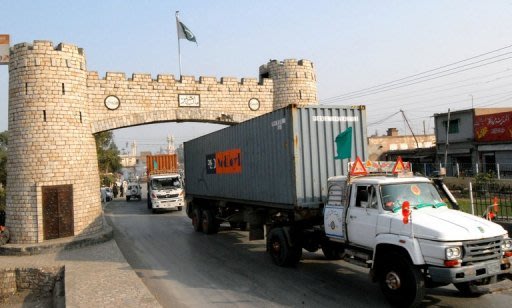
NATO supply truck in Pakistan's northwestern tribal belt on the Afghan border, according to officials. It was the second fatal shooting in two weeks in the Jamrud area in Khyber district, where Taliban and local Islamist militia are active. After the first shooting on July 24, Pakistan closed the Torkham border crossing, the quickest route from Pakistan's port of Karachi to the Afghan capital, for nine days. "Three gunmen in a jeep fired at a NATO truck, killing its driver," local government official Bakhtiar Khan told AFP. NATO traffic was suspended for a few hours after the incident. Sameen Jan, a doctor at the local hospital, said the driver was shot twice, once in the head and once in the chest. Pakistan reopened the Torkham crossing on Saturday, having signed a deal with the United States last Tuesday allowing NATO convoys to travel into Afghanistan until the end of 2015. Islamabad in July lifted a seven-month blockade on NATO goods passing overland through Pakistan, imposed after botched US air raids killed 24 Pakistani troops in November.

Sunday, August 5, 2012

Al Saud betrays, fools Muslim Ummah: Political analyst

A political analyst says the repressive regime of Al Saud betrays and fools the Saudi citizens and the entire Muslim world, Press TV reports. “What they (Saudi regime) are doing is they are betraying the common Muslims in the name of Mecca and Medina, and their sacredness,” said Syed Ali Wasif, the president of Society for International Reforms and Research in Washington, in an interview with Press TV on Sunday. “The sacredness of Mecca and Medina is being used by the Saudi regime to fool around, to fool the Saudi citizens and to fool the Muslim Ummah and the international community at large.” Since February 2011, protesters have held demonstrations on an almost regular basis in Saudi Arabia, mainly in the Qatif region and the town of Awamiyah in the oil-rich Eastern Province, primarily calling for the release of all political prisoners, freedom of expression and assembly, and an end to widespread discrimination. However, the demonstrations have turned into protests against the Al Saud regime, especially since November 2011, when Saudi security forces killed five protesters and injured many others in the Eastern Province. On August 3, Saudi security forces killed 18-year-old Hussain Yousef al-Qallaf in Qatif. Wasif stated that the anti-regime protesters in Saudi Arabia “are under a single leadership, under a single banner and they are moving ahead in the right direction to oust the Saudi regime in that region.” According to Human Rights Watch, the Saudi regime “routinely represses expression critical of the government.”

Visa Scandal: Abid Chaudhry sent to jail on 14 days remand

Olympic Visa scandal accused Abid Chaudhry was ordered to be sent to jail by a local Court in Lahore on 14 days physical remand. These instructions were given by the COurt on Saturday. Earlier on Saturday, Federal Investigation Agency (FIA) officials appeared in the Court along with Abid Chaudhry. The FIA was granted a 2 day physical remand of Abid Chaudhry on Thursday. The FIA officials informed the Court that their investigation had concluded. After receiving the information, the Court ordered a 14 day judicial remand of the accused and further instructed the concerned officials to take him to jail. With respect to the passport scandal, a two-member FIA team would be leaving for London on Tuesday in order to investigate the matter, sources stated. According to sources, the team would be led by Muazzam Jaa and it would travel to London in order to record the statement of Asad Ali aka Mohammad Ali, the main character of the scandal.

Pakistan ‘Immune’ govt not to write letter

Sindh Information Minister Sharjeel Inam Memon, coming hard against the recent verdict of superior judiciary of striking down the new contempt of court law, has said that parliament is supreme, so no institution can declare null and void any of its legislation. Addressing a hurriedly-called press conference at Sindh Secretariat on Saturday, Sindh Information Minister declared that present judiciary was restored because of NRO of a dictator Pervez Musharraf, who quit as chief of army staff due to contract with Shaheed Benazir Bhutto, which paved way for restoration of superior judiciary. Flanked with leaders of the Peoples Lawyers wing of ruling PPP, he counted the history of cases and said that the PPP and its leadership always victimised under baseless political cases and not received justice in past from the present judiciary. He said that though the PPP never received justice from the courts, but it will continue its respect and regards for the judiciary. Mouthpiece of PPP-led Sindh government said that the PPP workers and lawyers sacrificed their lives in the struggle for the independence of judiciary and rule of law. “We don’t want confrontation among the national institutions as every institution must stay in its constitutional limits.” The PPP accepted the decision of disqualification of elected Prime Minister Yousuf Raza Gilani with protests, but will continue raising the voice for our rights, he said. Everyone knows that the legislation and amendment in the constitution was the only right of parliament, which could not be snatched by any institution neither it could be given this constitutional right to any other, he declared. PPP leader said that case being heard in the Supreme Court and NRO had connection. He said that the PPP was loser in the NRO, and all others including Nawaz Sharif and other parties were the beneficiaries of it. He termed the signing of NRO by Shaheed Benazir Bhutto as wise move, which paved way for quitting of Pervez Musharraf as the army chief, holding of new general elections in the country. Even, the restoration of judiciary and return of Mian Nawaz Sharif in the country was because of NRO, he claimed, adding that Pervez Musharraf would remain as army chief if NRO was not come. Memon questioned that all the agreements and cases of the Nawaz Sharif was pardoned under NRO than why the judiciary insisting for reopening of trial of grave of Shaheed Benazir Bhutto through reopening of the Swiss case as Asif Ali Zsardari was already completed his term in the jail of 11 years despite baseless and political cases under the regime of the Nawaz Sharif. He declared that constitution of Pakistan allows immunity for the President of Pakistan Asif Ali Zardri, so present government will never write letter to the Swiss government for reopening of the fake cases. He further questioned that when 8,000 other cases of rape, murder and other crimes was also involved in the NRO, but why the Supreme Court was not asking for reopening of these cases. Why Supreme Court is in hurry of reopening one case, in which the President has got immunity by the constitution, he questioned. He advised the superior judiciary to wait for one and half year when Asif Ali Zardari completes its tenure as President. He further said that money laundering cases against President Zardari was baseless, which was not proved by Nawaz Sharif during its regime as President remained behind the bars for 11 years political victimisation. Emphasize from the superior judiciary for reopening of one case is aimed to create a crisis in the country, he alleged, declaring that PPP will not let to create such situation and will not write the letter against its own President. To a question, he said that PPP was ready to sacrifice 1,000 prime ministers for safeguarding the constitution of Pakistan. Memon assured that PPP will continue its policy of restraining about judiciary and its decisions, adding that the PPP will not follow the policy of attacking the Supreme Court like the Nawaz Sharif government did in the past. He alleged that that the superior judiciary has ‘soft corner’ for Nawaz Sharif as not a single case was being opened against him and other parties. He questioned that why the accountability for PPP leadership. He underlined the need for accountability of each and everyone including judges, who validated the military rulers under the ideology of necessity. During the press conference of the Sindh information minister, a video was played on the multimedia, in which PML-N leaders was trying to climb on the walls of Supreme Court building. Another video clip was played, in which Awami Muslim leader Shaikh Rashid was allegedly saying that Chaudhry Iftikhar (CJ) had visited his Lal Haveli a number of times to get some ‘favour’. Raising questions on behalf of public, he asked for clarification of reports that all commercial deals of Arslan Iftikhar done at the house of his father Chief Justice Chaudhry Iftikhar’s official home. Besides, he asked for clarification that why the Supreme Court has blocked the investigation into alleged corruption cases against CJ’s son Arslan Iftikhar. Information minister further asked that when over 100 PCO judges was removed or resigned, why one PCO (CJP) was holding the office. He declared that the PPP never bow before any unconstitutional steps or blackmailing and will protect its right of rule to complete its five years term of the government. He said that PPP was the symbol of unity for four provinces, so it would foil all conspiracies.

Developing FATA: Split over local govt regulation 2012

The Express Tribune
With elections looming in the near future, tribal elders and various political party leaders are still divided over the government’s introduction of the Federally Administered Tribal Areas (Fata) Local Government Regulations 2012. The Fata Secretariat had sought proposals from local legislators for the introduction of a local government (LG) system in the Fata. A pilot project in this regard was started almost ten days ago in Bajaur Agency. The Express Tribune had asked various local political leaders, parliamentarians and tribal elders for their views on the coalition government devised draft of the LG system. Pakistan Peoples Party (PPP) National Assembly member (MNA) Akhunzada Chittan said that the party backs the move and demands the election mechanism be based on adult franchise and the party system. He lamented, however, that the funds allocated for the tribal areas had not been utilised properly and were instead being diverted for the development of other sectors across the country. Chittan hoped leaders elected under the LG system would help solve problems that continued to plague the region. He suggested setting up a Fata council to decide the future of the tribal areas. Senator Hilal Rehman urged the need to discard decades-old draconian laws and introduce a proper judicial system. He said the council should keep a strict check on financial matters and supervise the execution of welfare projects across the tribal belt. Rehman further suggested that tribal leaders and representatives be taken into confidence before introducing any legislation. Zahir Shah Safi, a political reformer and tribal lawyer, told The Express Tribune that elections should be held on union and tehsil levels before merging Fata with Khyber-Pakhtunkhwa (K-P) or keeping the region independent, and Fata councils should have the final say on the decision. He supported the setting up of a municipal system in Bajaur Agency’s Khar headquarters. President of the Awami National Party’s (ANP) Mohmand Agency chapter, Nisar Mohmand said their party supports the plan. He added that it should not follow the Nazim-based system introduced by Pervez Musharraf. “The regulation should be like that of the provincial LG system.” He opposed the Fata council, however, saying the time was ripe to merge the tribal areas with K-P. Mohmand criticised the role of political agents in the process and stressed the need to reduce the political administration’s role and make the process more result oriented. Tribal elder and Halemzai peace committee leader Muhammad Ali Halemzai also opposed the plan and called upon the stakeholders to forge unity for the restoration of peace. He said normalcy was necessary to implement any regulation and introduce a new setup. He wished for the tribal areas to be brought at par with other parts of Pakistan in terms of peace, development, rules and regulations.

Pakistan: Downcast, disheartened and hopeless

EDITORIAL
The common man's status of mental health is getting low increasingly - and greatly characterised by pessimism - and a growing sense of inadequacy. In other words, he's in a state of low spirits caused by loss of hope or courage. There is no gainsaying while the people in Pakistan strongly believe that democracy and rule of law are sine qua non for the country to make progress they fail to elect equal to the task leadership. Not too late after the elected representatives take seats in assemblies their real worth starts coming to light, with media and gossip exposing how blatantly they exploit the people's mandate for their personal gains. Almost on a day-to-day basis the scandals surrounding their murky deals make headlines in the media, and with that the people's enchantment with their democratic choice begins losing its luster. At the end of the day if and when the system is wrapped up on a note of 'dear countrymen' the people pour unto the streets and distribute sweets. Given the judiciary's repeated commitment to uphold the constitution and the waning interest of the 'guardians of state' for a 'patriotic' action this time we hope the pattern will undergo a change. The chances are that the coming electoral exercise would throw up better political leadership. Nonetheless, abundant caution has to be exercised to ensure that the pre-election ambience doesn't get nasty enough, a vulnerability to which as suggested by the recent PML (N)-PTI tit-for-tat sword rattling the parties can succumb. Having received quite a bit of negative flak over the alleged accumulation of Rs 50 billion worth of foreign assets owned by a son of Nawaz Sharif the PML (N) has launched a matching counterattack. At a press conference on Wednesday, one of its leaders, Khwaja Asif, accused Imran Khan of committing 'money-laundering and gambling on charity funds' meant for the Shaukat Khanum Memorial Hospital. Imran Khan hasn't taken it lying; he immediately called the media persons to tell them that there is no truth in what the PML (N) was saying. This is match of accusations and counter-accusations. Unless there is a professional probe there is no way to find the veracity in these personal attacks. However, the fact remains that in this crossfire helplessly caught is the cancer treatment hospital that is serving humanity with great dedication. We wish both sides had shunned the path of personal attacks, for these not only tend to cast political leadership in bad light they also cause a lot of collateral damage which hurts the public cause in many ways. If there is a case that a politician or his party feel should be investigated and culprit brought to justice in that case the courts should be approached and meanwhile wait for the court orders. Being public leaders they all live in glass houses as people know them through and through, accusations or no accusations by the opponents. What they can do and shall do for the betterment of people if elected that is of interest to the people. These are not the ordinary times in the life of an average Pakistani, caught as he is in the eye of a swirling storm of corruption, high inflation, deepening poverty and unrelenting fear of insecurity. In the larger context, he finds the country beset with serious existential threats stemming from terrorism, sectarianism and lawlessness. Rightly then his love-affair with political option is badly jilted given his experience that successive political governments could not deliver. Obviously, the man in the street would like to hear something positive, pragmatic on his problems instead of watching dirty linen of political opponents being washed in public. Since most of players in the political field are old hands and people are well aware of their capacity or otherwise to deliver it is all the more necessary for them to trying at inventing an entirely new culture for the national politics. Yes, the past political performance of elected governments was never up to the mark and it is also admitted that not many hands are clean either. But with a grim and uncertain future standing in front of us the past performance is no more an issue; the issue relevant to our times is what these contenders for national power can do to turn over this page and write a new paragraph that aptly rhymes with people's hopes and aspirations. They must not ignore the fact that people are increasingly feeling downcast, disheartened and hopeless.

Pakistan: Threat from within

Editorial:DAILY TIMES
Five senior military officers have been convicted by a court martial for having links with a banned outfit, Hizbut Tahrir (HT). They received from five to eighteen months’ rigorous imprisonment. Brigadier Ali Khan, the main protagonist, had been actively pursuing the cause of HT of indoctrinating military personnel to foment a rebellion against the alleged pro-US military and civilian leadership of the country. Following the killing of Osama bin Laden by the US forces in Abottabad in early May last year, Ali Khan expressed his displeasure to the COAS over the failure of the Pakistan army to prevent the killing of OBL. This led to a probe into Khan’s activities by the army’s Special Investigative Branch, and he was finally arrested on May 6, 2011. Though this is not the first time the military has prosecuted officers on disciplinary grounds, the invasion of Islamic extremism into the rank and file of the armed forces makes this case sensitive and a test case for future reference. The state of denial on the involvement of extremist elements in the assassination attempts on Musharraf, the attack on the Mehran naval base in Karachi, and the storming of GHQ in Rawalpindi should end now. HT is not the only Islamist outfit having influence in Pakistan. This is a widespread phenomenon with its tentacles spread over the length and breadth of the country and even into the defence and security services. Mumtaz Qadri, the assassin of Governor Salmaan Taseer, is one example, hardened by extremist Islamist views and averse to any other interpretations of Islam. It is about time the government, taking cognizance of the situation, launches an across-the-board crackdown on the extremist elements in our society. One of the major intelligence or tactical failures of Pakistan has been its inability to stop the ‘banned’ organisations from operating in the country. Banned, yet they have been allowed to operate with different names. Unless we cut the umbilical cord, i.e. the operational, financial and tactical alliances of the religious outfits within and without, the ban would remain a farce. The glory of Islam that HT and other Islamic organization are idealising and for which the return to a Caliphate is seen as the only alternative, is an ideology out of touch with present day realities. Therefore any attempt towards that end would end up as a non-starter, given the present state of and divisions in the Muslim world. HT’s bellicose anti-western imagery coupled with promoting anti-state sentiments, especially within the armed forces of Muslim countries, belies its claim of being non-violent. That is why the organisation should not be allowed to disarm opponents by its declarations of non-violence and be dealt with as a dangerous and insidious threat.

Demonstrators voice support for Bahraini revolution at Saudi Embassy in Berlin

A demonstration has been held outside the Saudi Arabian Embassy in Berlin to protest against the Saudi intervention in Bahrain and to express solidarity with Bahraini revolutionaries. The protesters, who gathered outside the embassy on Saturday, also called for the establishment of democracy and freedom in the Persian Gulf kingdom. The demonstrators waved Bahraini flags and held up pictures of slain Bahraini activists and demanded the immediate withdrawal of Saudi troops from the country. The protesters also called for the release of all political prisoners held in Bahraini prisons, including Bahrain Center for Human Rights President Nabeel Rajab. Since mid-February 2011, thousands of anti-government protesters have been staging regular demonstrations in the streets of Bahrain, calling for the Al Khalifa royal family to relinquish power. On March 14, 2011, troops from Saudi Arabia and the United Arab Emirates invaded the country to assist the Bahraini government in its crackdown on peaceful protesters. According to local sources, scores of people have been killed and hundreds arrested in the crackdown. Amnesty International and other human rights groups have repeatedly criticized Riyadh for helping the Bahraini regime’s efforts to quash popular protests in the island nation.

Saturday, August 4, 2012

Pakistan resumes Nato supply into Afghanistan

Pakistan on Saturday resumed Nato supplies, allowing 14 containers to cross into Afghanistan from its northwestern border at Torkham, officials said. Pakistan had temporarily stopped Nato supplies over security concerns on July 24 after gunmen attacked a convoy of Nato trucks, killing a driver, in the town of Jamrud on the outskirts of the main northwestern city Peshawar. “The Nato supplies have been resumed from today and we sent 14 containers” for international troops in Afghanistan,” a local administration official told AFP on condition of anonymity because he is unauthorised to speak to media. A local intelligence official also confirmed resumption of supplies and the departure of 14 Nato containers to Afghanistan. A senior local customs official, Ubaidullah Khan, however, put the figure of containers, which left for Afghanistan, at seven, adding that they carried food stuff and clothes.

What Afghan girls risk by going to school

Terrorists will stop at nothing to keep Afghan girls from receiving an education. "People are crazy," said Razia Jan, founder of a girls' school outside Kabul. "The day we opened the school, (on) the other side of town, they threw hand grenades in a girls' school, and 100 girls were killed. "Every day, you hear that somebody's thrown acid at a girl's face ... or they poison their water." There were at least 185 documented attacks on schools and hospitals in Afghanistan last year, according to the United Nations. The majority were attributed to armed groups opposed to girls' education. "It is heartbreaking to see the way these terrorists treat ... women," said Jan, 68. "In their eyes, a women is an object that they can control. They are scared that when these girls get an education, they will become aware of their rights as women and as a human being." Despite the threat of violence, Jan continues to open the doors of her Zabuli Education Center, a two-story, 14-room building where 354 area girls are receiving a free education. "Most of the (local) men and women are illiterate," Jan said. "Most of our students are the first generation of girls to get educated." Seven small villages make up Deh'Subz, where the school is located. Though Deh'Subz is not Taliban-controlled, Jan has still found it difficult to change the deep-rooted stigma against women's education.On the evening before the school opened in 2008, four men paid her a visit. "They said, 'This is your last chance ... to change this school into a boys' school, because the backbone of Afghanistan is our boys,' " Jan recalled. "I just turned around and I told them, 'Excuse me. The women are the eyesight of Afghanistan, and unfortunately you all are blind. And I really want to give you some sight.' " Jan has not seen the men since. "You can't be afraid of people," she said. "You have to be able to say 'no.' Maybe because I'm old, the men are kind of scared of me, and they don't argue with me." The Zabuli Education Center teaches kindergarten through eighth grade. Without her school, Jan says, many of the students would not be able to receive an education. "When we opened the school in 2008 and I had these students coming to register, 90% of them could not write their name. And they were 12- and 14-year-old girls," Jan said. "Now, they all can read and write." Jan's school teaches math, science, religion and three languages: English, Farsi and Pashto. It recently added a computer lab with Internet access. "They can touch the world just sitting in this house," Jan said. "The knowledge is something that nobody can steal from them." To shield the students from attacks, Jan has built a new stone wall to surround the school. She also employs staff and guards who serve as human guinea pigs of sorts. "The principal and the guard, they test the water every day," Jan said. "They will drink from the well. If it's OK, they'll wait. ... Then they'll fill (the) coolers and bring it to the classroom." Jan says she is so scared of poisoning that school staff members accompany children to the bathroom and make sure the children don't drink water from the faucet. Additionally, the day guard arrives early each morning to check for any gas or poison that might be leaked inside the classrooms. The guard opens doors and windows and checks the air quality before any children are allowed to enter. "People are so much against girls getting educated," Jan said. "So we have to do these precautions." Born in Afghanistan in the 1940s, Jan traveled to the United States in 1970 to attend college. Much of her family was killed or fled Afghanistan during the Russian invasion. She stayed in the U.S., raised a son and opened a small tailoring business. She became an American citizen in 1990. Jan was always involved in various philanthropic efforts and community organizations in Duxbury, Massachusetts. She worked for many years to forge connections between Afghans and Americans. Then the events of September 11 shook her to the core. "I was really affected personally by what happened to the innocent in the U.S.," she said. "It's something that you cannot imagine for a human being to do to other human beings." Almost overnight, Jan turned her small store into a workshop and launched an exhaustive campaign to help victims, first responders, U.S. soldiers and Afghan children. Jan and community volunteers sent 400 homemade blankets to rescue workers at ground zero and assembled and shipped nearly 200 care packages for U.S. troops in Afghanistan. When she heard that U.S. soldiers needed shoes to distribute to Afghan children, Jan and her volunteers sent them more than 30,000 boxes of shoes. Still, in the back of her mind was a bigger dream. On a visit to her homeland in 2002, she noticed that women and girls were struggling from years of Taliban control. "I saw that the girls had been the most oppressed," she said. "The Taliban regime was very brutal, brutal in the way that the woman had no place in their book. The woman had no right. No say in anything." Jan said that while her life in America was fulfilling and rich, her dream was "to do something for Afghanistan and to educate the girls." So in 2004, she began searching for land on which to build a school. In 2005, she began fundraising through her Massachusetts-based nonprofit, Razia's Ray of Hope. Then, on a visit to Afghanistan, Jan was able to negotiate with the Ministry of Education to secure the land where the Zabuli Education Center now stands. "After five years now, (the men) are shoulder to shoulder with me, which is such a great thing," Jan said. "It's unbelievable how much they are proud of the girls." The school is entirely free. Jan says it costs $300 to teach each girl for an entire year. Those fees are covered by donations to her nonprofit.Although she isn't there every day of the week, Jan spends as much time at the school as possible. She meets with her students' fathers and grandfathers two or three times a year to address any issues and make sure she still has their buy-in. She also deals with community elders and locals to ensure that the school has local support. Jan, who takes no money for her work with the school, believes the education her students receive will benefit not only future generations of Afghan women but the country as a whole. "My school is very small. It's nothing big. But for this to start here, I think it's like a fire. And I think it will grow," she said. "I hope that one day these girls ... will come back and teach, because I'm not going to be there all my life. I want to make this school something that will last 100 years from now."

Obama's Birthday Party With a Price Tag

By JODI KANTOR President Obama is turning 51 on Saturday, with just three months until Election Day. So he will celebrate in true political fashion: spending “downtime,” as an e-mail invitation put it, at a party at his Chicago home with a bunch of strangers who made campaign donations to be there. That party, on Aug. 12, will mark another milestone in the transformation of the president and his wife, who once tried to limit the role of politics in their lives and now seem to be increasingly giving themselves over to it. Even some longtime Obama fund-raisers expressed surprise over the party’s site: the Obamas have limited their schmoozing hours in Washington, sequester themselves while on vacation and seldom invite many outsiders into the White House living quarters. Until now, they have kept their Chicago home mostly sacrosanct, allowing only limited photographs of the interior. The party raises questions about how far the Obamas will go in mortgaging their personal appeal for political gain in the months ahead. In poll after poll, voters give Mr. Obama higher marks as a person — a trustworthy leader, a committed father — than as a steward of the economy. Aside from their house, how much of themselves are the Obamas willing to offer up? Consider the shift in Mr. Obama’s birthday celebrations since he arrived in office in 2009. That year, with re-election still distant, Michelle Obama gave him an entirely private surprise party at Camp David, Md., with a few old friends. His 2010 party was splashier, a basketball tournament that made news because of the professional and college stars who played. A year later, he celebrated his 50th birthday with a fund-raising gala at Chicago’s Aragon Ballroom, where Jennifer Hudson sang “Happy Birthday.” To scrape up extra dollars, the Obama campaign sold commemorative birthday merchandise, including party hats. Even the private party he gave at the White House mixed old friends with allies who might assist in his re-election fight, like Tom Hanks and the Rev. Al Sharpton. Every year, some Obama supporters have gathered all over the country to “celebrate” his birthday — that is, to share his message and sign up converts. But in the coming days, they will hold no fewer than 1,000 birthday-themed events, from North Carolina (knocking on 51 doors) to California (calling 51 voters). Birthday fund-raisers are a familiar tactic that may have reached an apotheosis in 1962, when Marilyn Monroe sang to President John F. Kennedy at a Madison Square Garden rally attended by 15,000 people and broadcast on television. In 1996, President Bill Clinton filled Radio City Music Hall for a 50th-birthday fund-raiser that brought in $10 million. But the one at the Obamas’ home will have a specific 2012 spin, reflecting the illusion of intimacy on which campaigns now thrive. In recent years, win-a-visit-with-Barack (or Mitt or Ann or Joe, or Sarah Jessica Parker or Marc Anthony) sweepstakes have become a signal fund-raising tactic for both sides. A recent Obama event at George Clooney’s home demonstrates why: The campaign collected $15 million, according to organizers. Less than half of that came from the Hollywood types who paid $40,000 a ticket; the rest came from a sea of supporters who made small donations and entered an online contest to win seats. The formula has proved so lucrative that Mitt Romney’s campaign advertised the chance to be introduced to Mr. Romney and his vice-presidential nominee: a contest to meet a political partner who does not yet exist. Aside from harvesting new e-mail addresses, the contests allow the campaigns to “drive their small-dollar contributions off their big-donor contributions,” said Anthony Corrado, a campaign finance expert at Colby College. Months after winning the Clooney contest, Karen Blutcher, 45, a communications manager for a utility company in St. Augustine, Fla., still sounded thunderstruck that she had met the president and mingled with stars. “The entire event was a lifelong memory,” she said in an interview. A warning to this month’s lucky winner: The celebration at the Obama home will be considerably less cozy than the e-mailed invitations suggest. The event is not a social gathering; it is one of four fund-raisers that Mr. Obama will race through that day in Chicago. Despite a gracious invitation that the first lady e-mailed to supporters, she is not planning to attend, a campaign official said. Donors may dream of tinkling the keys on the family piano or leafing through private photos, but much of the action will take place in the backyard. The finalists will be chosen at random, but the contest winners will be selected as reality show contestants are, to make sure their stories fit. (Ms. Blutcher comes from a hotly contested state and supports Mr. Obama’s health care overhaul because she has a son with special needs.) Even the promise of being allowed in the Obamas’ house is a bit of a mirage: the first family rarely spends nights there anymore, and many Chicago friends predict they will never move back in. Also — and the campaign does not play up this bit of fine print — charging money to enter contests is illegal. So the legions of contestants who reached into their own pockets may not know it, but they could have entered free.

OBAMA: Fostering strong U.S. economy starts with strong middle class

Fostering a strong U.S. economy started with building a strong U.S. middle class, and economic fairness was critical to the nation's recovery, U.S. President Barack Obama said here on Friday.
Speaking at the White House after the release of the latest job report, Obama stressed that the last thing the nation should do in the weak economic recovery is tax increase on middle class families. Flanked by middle-class Americans, Obama said "if we want to keep moving this country forward, these are the folks who are going to get us there." Obama said the nation continued to create jobs last month, evidence of the ongoing economic growth. "We've now created 4.5 million new jobs over the last 29 months, and 1.1 million new jobs so far this year," he noted. U.S. unemployment rose 0.1 percentage point from June to 8.3 percent in July, while the non-farm sector added 163,000 new jobs across the country last month, the U.S. Labor Department reported Friday. However, Obama stressed that there were still too many Americans looking for jobs, adding that "we've got more work to do on their behalf -- not only to reclaim all the jobs that were lost during the recession, but also to reclaim the kind of financial security that too many Americans have felt was slipping away from them for too long." "When families have the security of knowing that their taxes won't go up, they're more likely to spend, and more likely to grow the economy," said Obama, who has geared up his reelection bid. Obama criticized Republican lawmakers' efforts to extend Bush- era tax cuts for the wealthiest Americans next year, noting that middle class families should not pay more taxes while the wealthiest Americans could pay less. "Instead of the middle class paying more, we should ask the wealthiest Americans to pay a little more, a modest amount, so that we can reduce our deficit and still make investments in things like education that help our economy grow," he added.

Teenage protester shot dead in Saudi Arabia's Qatif

An 18-year-old Saudi protester has died of his injuries, a day after he was shot in the chest by security forces in the eastern part of the country, Press TV reports. According to the Saudi interior ministry, Hussain Yousef al-Qallaf, who succumbed to his wounds on Saturday, was among a number of young protesters who clashed with regime forces in the Qatif region of the oil-rich Eastern Province on Friday. The ministry claimed that the protesters shot and killed a policeman and injured another as they were patrolling the area, but did not provide further details about the incident. Saudi Arabia’s oil-rich Eastern Province has been the hub of a growing anti-monarchy sentiment. In a demonstration on Friday, protesters demanded the release of teenage activist Muhammad al-Shakhouri and other political activists. Shakhouri was injured and arrested on July 27 and now is in a military hospital in the city of Dhahran. The Saudi authorities say Shakhouri had been among the 23 most wanted men in Qatif. He was protesting the detention of prominent cleric Sheikh Nemr al-Nemr when he was detained. Sheikh Nemr was injured and arrested by Saudi security forces of the Al Saud regime while driving from a farm to his house in Qatif on July 8. Since February 2011, protesters have held demonstrations on an almost regular basis in the Kingdom's east, mainly in Qatif and Awamiyah. The demonstrators called for the release of all political prisoners, freedom of expression and assembly, and an end to widespread discrimination.

Bahraini, Saudi People to Stage Concurrent Rallies on Sunday

farsnews.com
The Bahraini and Saudi people are due to stage concurrent rallies in different parts of Bahrain and the Eastern Saudi Qatif region on Sunday to show their outrage at their tyrannical rulers and call for the freedom of political prisoners. The Sunday protests are due to be held under the title of "The Nation Will never Compromise" in the Saudi Qatif region and 50 regions across Bahrain. The organizers of the rallies have announced that the main goal behind the demonstrations is supporting and announcing solidarity with the Bahraini and Saudi dissident leaders who are experiencing harsh pressures and tortures in prison. Anti-government protesters have been holding peaceful demonstrations across Bahrain since mid-February 2011, calling for an end to the Al Khalifa dynasty's over-40-year rule. Violence against the defenseless people escalated after a Saudi-led conglomerate of police, security and military forces from the Persian Gulf Cooperation Council (PGCC) member states - Saudi Arabia, Kuwait, the United Arab Emirates, Oman and Qatar - were dispatched to the tiny Persian Gulf kingdom on March 13, 2011, to help Manama crack down on peaceful protestors. So far, more than 69 people have been killed, hundreds have gone missing and thousands of others have been injured. Also, since February 2011, Saudi protesters have held demonstrations on an almost regular basis in Eastern Provinces, mainly in the Qatif region and the town of Awamiyah, calling for the release of all political prisoners, freedom of expression and assembly, and an end to widespread discrimination. However, the demonstrations have turned into protests against the Al Saud regime, especially since November 2011, when Saudi security forces killed five protesters and injured many others. The Saudi interior ministry issued a statement on March 5, 2011, prohibiting "all forms of demonstrations, marches or protests, and calls for them, because that contradicts the principles of the Islamic Sharia, the values and traditions of Saudi society, and results in disturbing public order and harming public and private interests." In June, Saudi King Abdullah bin Abdulaziz Al Saud ordered the country's security forces to go on a state of high alert due to what he called a "turbulent situation" in the region. According to Human Rights Watch, the Saudi regime "routinely represses expression critical of the government".

Bahrain: Arrest and Ill-treatment of Human Rights Defender Zainab Al-Khawaja

Human rights activist Zainab Al-Khawaja was yet again arrested last night when she was protesting alone in Al Qadam roundabout. Zainab decided to protest despite her entire leg being in a caste due to the leg injury she sustained not long ago when security forces shot her with tear gas canisters at a close range, resulting in the injury, refer to http://www.bahrainrights.org/en/node/5354. After the arrest last night, Zainab was verbally assaulted by a police officer, who right before making sectarian and gender related insults, was very kind due to a camera being present. Al-Khawaja left the room in protest, demanded to know his name and refused to cooperate until given so she can file a complaint. The head of the police station asked Zainab if she would go voluntarily or he will “do what’s necessary”. Al-Khawaja asked if he was threatening her. Female police asked the head of the police station what they should do in case she refuses to give a blood sample, he reportedly responded “stick the needle in her neck”. Alkhawaja was then handcuffed, dragged on the ground and down the stairs, after which she was placed inside a police vehicle. She was then moved to the Fort Prison Hospital where a blood sample was taken, and then moved to Isa Town Detention Center. Until arriving at the final destination Zainab was kept in handcuffs despite her serious leg injury. When Zainab called her family today she reportedly sounded exhausted and severe of pain. This is one of many times in which Zainab Al-Khawaja has been arrested for merely practicing her right to protest, refer to http://www.bahrainrights.org/en/node/5227. The BCHR and GCHR call on the Government of Bahrain to: 1. Immediately release Zainab Al-Khawaja and drop all charges against her, as it is believed that these measures have been taken against her solely due to her legitimate and peaceful work in the defense of human rights, and the exercise of freedom to peaceful assembly and freedom of expression in accordance to the Universal Declaration of Human Rights; 2. Immediately and unconditionally release all prisoners of conscience and activists including leading human rights defender Abdulhadi Al-Khawaja and GCHR/BCHR Director Nabeel Rajab. 3. Drop all charges against human rights defenders held on 'politically motivated' charges. 4. Guarantee in all circumstances that all human rights defenders in Bahrain are able to carry out their legitimate human rights activities without fear of reprisals, and free of all restrictions including judicial harassment. The GCHR and BCHR call your attention to the rights and fundamental freedoms guaranteed in the United Nations Declaration on the Right and Responsibility of Individuals, Groups and Organs of Society to Promote and Protect Universally Recognized Human Rights and Fundamental Freedoms” in particular to Article 5 (b) which states that: “For the purpose of promoting and protecting human rights and fundamental freedoms, everyone has the right, individually and in association with others, at the national and international levels: (b)To form, join and participate in non-governmental organizations, associations or groups;” Article 6 (c) “Everyone has the right, individually and in association with others: (c) To study, discuss, form and hold opinions on the observance, both in law and in practice, of all human rights and fundamental freedoms and, through these and other appropriate means, to draw public attention to those matters” and to Article 12.2, which provides that “the State shall take all necessary measures to ensure the protection by the competent authorities of everyone, individually and in association with others, against any violence, threats, retaliation, de facto or de jure adverse discrimination, pressure or any other arbitrary action as a consequence of his or her legitimate exercise of the rights referred to in the present Declaration”.

Pak-Iran Border and Baloch Traders’ Woes

The Baloch Hal
By Muhammad Akbar Notezai
The Pak-Iran trade gate, Zero-Point, is Pakistan’s only single official legal border crossing into Iran. It is 600 kilometers from the provincial capital, Quetta, situated in Taftan, a town in district Chaghi District. Besides, the Zero-Point trade gate, Iran built a 10-feet high concrete thick wall reinforced with steel rods along its own shared border with the Balochistan province which is stretching from Taftan to Mand in Turbat district. According to Iranian authorities, the fence is built to prevent illegal border crossings, drug trafficking, terror attacks and unlawful transportation into Iran . It is true that largely opium, hashish, heroin and morphine etc. is all smuggled into Iran but, on the other hand, Iranian fuel is also abundantly smuggled into Pakistan. Across the border the Baloch people are densely populated. After the construction of the fence, Iran has divided the Baloch people economically, politically, culturally and socially. That is why the Balochs in Pakistan and Iran are fully cut off from each other although they have a fundamental right to interact and mingle with each other. Kachkol Ali Baloch, the former leader of the opposition in Balochistan Assembly, raised voice against the construction of the said fence, saying that Balochs on both sides of the border were not taken into confidence while constructing the wall. It was, he rightly argued, made against the will of the Baloch people. He had also tabled a resolution in the provincial assembly but no one in the federal government paid head to his legislative move. Since 2003, the Iranian authorities have shut down the Zero-Point on at least four different occasions. Iran justifies its moves by citing terror attacks, bomb explosions and suicide attacks in its Balochistan province. Jundullah, a Sunni militant group led by Abdul Malik Regi, was allegedly responsible for these attacks who, according to Iranian authorities, had sanctuaries in Pakistan’s Balochistan province. Therefore, they kept closing the Zero-Point gate each time for six to seven months, depriving the local traders and populations of their livelihood. Incredibly, Zero-Point remained closed after the execution of Abdul Malik Regi in Iran. Traders are in utter confusion regarding the closure of Zero-Point. Ali Raza Rind, a senior local journalist of district Chaghi, said, “Iranian authorities unilaterally decide whether to open or close the border. Neither they consult Pakistan nor do they negotiate with the local Baloch tribal chiefs while making such important decisions about the Zero-Point. Sadly, local traders are in trouble from both sides because the Frontier Corps (F.C.) personnel also compel the traders to bribe them. Consequently, the problems of local traders and people are compounding instead of decreaseing. While in the past goods from Iran were imported in large quantities, the supply has recently declined. The Iranians have enforced very stringent regulations on the border although goods are still being exported in a large quantity in Iran from the Pakistani side of the border. It is beyond understanding why Pakistani authorities are silent on this key issue and playing the role of a silent spectator? They should pay immediate attention to this serious issue. As this writer spoke to an old trader at Taftan border, he said angrily, “We have been enduring harsh and strict treatment from both sides of the border authorities. Sometimes, they physically assault us without any reason. The Zero-Point gets closed due to violence inside Iran but we frequently have to bear the brunt of it over here. There is no one to seriously address this issue. ” The residents of Taftan, on their part, are deprived of basic necessities of life. They are so poor that they often send their children to work on the border. Mega projects like Saindak and Reko Diq, are situated a few kilometers from Taftan but these projects barely offer any benefits to the people of Balochistan. Labors in Taftan are compelled to work all the day under the sun in return of low very wages. The labors face same hardships as the local traders and the other citizens do in Taftan border area. It is the government’s responsibility to resolve the problems of traders and local people on priority basis so that they continue earning a livelihood without much stress.

Pakistan to be among top 30 research conducting countries by 2018

PPI
An international forecast for research output has shown that Pakistan will be among top 30 countries of the world. Scimago, an independent research organization and an international evaluation and ranking platform, has projected in its recent publication how the world will perform in research by 2018 based on their past performance. The top 50 countries are included in the forecast, says a press release received from HEC on Thursday. China, as expected, becomes the number one country in the world by 2018 in terms of research output, however three countries which stand out and show the most drastic increase in numbers and rankings are Iran, Malaysia and Pakistan. Iran moves ahead from number 19 to number 4, Malaysia from 30 to 13, and Pakistan from 43 to 27. The expected output of research in Pakistan moving up 16 notches, which is the second highest increase worldwide, is primarily due to the innovative higher education policies and reforms taking place in Pakistan under the Higher Education Commission (HEC). During the last few years, in addition to quality reforms, there has been a strong resurgence of research and innovation. In particular, there is a significant growth in the number of PhDs awarded out of Pakistani universities. The numbers speak for themselves. In the first 55 years since Pakistan’s independence, a total of 3281 PhDs were awarded at Pakistani universities. However, since the establishment of the HEC in 2002, over 4000 PhDs have been awarded to-date, which is more than what was awarded in the previous 55 years. There is a renewed focus on engineering and technology, agriculture, biological sciences, business education and social sciences, which are relevant subjects important for the socio-economic development of Pakistan. There is a zero tolerance policy on plagiarism, where every research paper, thesis and dissertation must be scrutinised by anti-plagiarism software before submission. All thesis and dissertation must be evaluated by at least two foreign referees in academically advanced countries in the relevant area of research. Despite having very limited funds, HEC supports many research initiatives through different types of grants, including split PhDs, post-doctoral fellowships, foreign faculty programmes, hosting conferences and to present papers anywhere in the world, to name only a few.

Central Punjab too slipping out of PML-N’s hands?

daily times
The recent Pakistan Muslim League-Nawaz’s (PML-N) tirade against Pakistan Tehreek-e-Insaf (PTI) Chairman Imran Khan is a renewed attempt to settle the score for damaging the former’s image in its stronghold – the central Punjab. Although, the veracity of allegations levelled by PML-N hawks Khawaja Asif and Nisar Ali Khan is yet to be confirmed, the party has declared the PTI its archrival, at least for the next general elections. In the central Punjab, as many as 100 National Assembly seats (including reserved seats for minorities and women) and over 200 Punjab Assembly seats are at stake. The PML-N which had been accused of playing Punjab card since early 90s in national politics had in fact reduced to the central Punjab. The party bitterly failed in the southern Punjab and managed to hold power riots under the patronage of the Punjab government in Faisalabad, Lahore, Gujranwala and Rawalpindi, the most populous urban centres with millions of people involved in cottage industry and which were the ultimate source of electoral strength for the party since 90s. The worries of the party multiplied when the PTI managed to stage a successful rally in Lahore in October last year while the PML-N could gather only couple of thousand people in its ‘Go Zaradri, Go’ rally in Gowalmandi – the constituency of PML-N President Nawaz Sharif. The Lahore show, which was culmination of PTI mass-contact campaign during those days in districts surrounding provincial metropolis put the last nail in the coffin of PML-N. The Lahore show shook the PML-N badly, particularly after seeing a dull response to its organised rally at Bhaati Gate, yet the hawks in the party appeared to have seen no reasons and instead of addressing skyrocketing prices, black marketing, profiteering and hoarding. Its policy to blame the PPP-led federal government for all ills proved futile. The PTI, on the other hand, kept the PML-N its prime target, seeking appeal for its slogans against the Sharifs and other leaders of the PML-N working in urban centers of the province. A PML-N leadership visibly irked over the PTI’s making it the ultimate choice of political targeting got annoyed with it yet failed to get out of Imran Khan’s target list. The PML-N tried in the recent past to come to terms with the PTI as it contacted the party for consultation over the nomination of the new chief election commissioner and promised to take it on board at the time of the formation of the caretaker government. But the PTI continued chasing the PML-N like a shadow and brought the latter to a point of unprecedented mud slinging which is likely to blacken its face too because it had many skeletons in its cupboard too. On condition of anonymity, a senior PML-N leader from Rawalpindi believed that the party’s politics of using the shoulders of judiciary to further its politics seemed to have lost the steam the day when the Supreme Court on the call of PTI chief decided to hear the Mehran Gate scandal. He said the PML-N had realised that banking heavily on the judiciary had not just weakened the PPP, but also harmed the party’s political interest too. The PML-N leader said the party had almost shun the politics of using the judiciary for political gains against the advice of hawks in the party. According to him, doves in the PML-N argued that sailing with the PPP for democratic transition would be the only choice left since the PTI had gained much political ground against it than any other political party in Punjab and Khyber Pakhtunkhwa. Another PML-N leader from Lahore conceded that the power riots in urban centres were based on exploitation of general sentiments of the masses and was not the handiwork of party’s organisations. He said that the hawkish policy of the party had been ruining its hard- earned image of saviour of democratic system in the country. With general elections around the corner, the party needed to address the problems that fall in its domain rather than accusing the PPP of all the evils, he added.

PTI-PML(N) ‘Test series’ continues

PTI chief says Nawaz involved in $417 million corruption * Throws Nawaz challenge for a one-on-one debate
The blame game between Pakistan Muslim League-Nawaz (PML-N) and Pakistan Tehreek-e-Insaf (PTI) continued on Friday with PTI chief Imran Khan claiming that PML-N chief Nawaz Sharif was involved in $417 million corruption and challenging him to answer his 11 questions on TV. The questions, which he put forward in a press conference, pertained to Nawaz and his family’s alleged corruption. He said the PML-N chief owed Pakistani nation satisfactory answers to the questions he had raised. He asked why Sharif had not filed a lawsuit against author Raymond Decker, who in his book had held him responsible for a corruption of $417 million. Questioning Sharif over “negligible” tax payments while having property worth billions of rupees in the United Kingdom and Raiwind, he accused the PML-N chief of defaulting on bank loans worth Rs 6 billion. “Sharif family borrowed this money and never returned it,” he claimed. How much national exchequer was spent on Raiwind's palatial infrastructure, he asked. “Where did Sharif get money to purchase apartments in Mayfair area of the Great Britain?” Khan asked, adding that the property was estimated at Rs 6 billion. “Where did you get funds to build your Raiwind empire, worth billions of rupees?” he continued. He also raised questions about the funds Nawaz had got to launch Jeddah Steel Mills in Saudi Arabia while in exile.

Pakistan: Discarded Jalozai IDPs

EDITORIAL: THE FRONTIER POST
One thought that at least the Peshawar High Court’s order would drill a bit of humanity in the stony hearts of the FATA officialdom and soften them up somewhat for the woebegone internally displaced tribal families, living miserably in the Jalozai camp amid official neglect and indifference. The venerable court had directed that electric fans must be provided to the IDPs in the Jalozai and other camps to alleviate their suffering in this severe summer heat. But according to the media reports, the Jalozai residents still stay bereft of this amenity. Indeed, not even power line has been laid for running the fans. Why really is the FATA hierarchy so callous to these unfortunate IDPs? What sin is it that they have committed that this hierarchy is so vengefully out to punish them so heartlessly? Or, is it that this hierarchy thinks they are the children of a lesser god, who need the treatment of perishable worms, not of human beings? Why indeed has it discarded them so shabbily and so cruelly? Has nobody in the hierarchy any time at all for them? Is the KP governor too preoccupied with receiving and giving protocols to take out some time for them, who in reality are his sole charge in every manner? Not once has he visited them, even for form’s sake. He in fact is still to imbibe that his primary job is not to grace prize-giving ceremonies but to be with his people in adversity. And his subordinate bureaucrats seem believing that their job is only to ride sleek SUVs and pass time in their plush air-conditioned offices and comfortably-fitted homes, not to visit the distressed IDPs. Indeed, they mince no words in proclaiming impudently that these grief-stricken human beings are none of their responsibility, as they are living in camps located not in the tribal territory but in settled area of Khyber-Pakhtunkhwa province. Of course, they could get away with such loathsome baloney when their chief, the KP governor, himself is so unmindful of these literally discarded IDPs. But has any of those dudes an idea of how with their inhuman behaviour they are losing on potential ambassadors of goodwill in droves? For an effective fight against militancy and insurgency, a sympathetic public on the side of the state security forces is unarguably an indispensable must. But when these inhumanly-treated IDPs return to their homes, will they not be carrying with them sentiments of bitterness, hostility and scorn against the state? And will this poison they not inject in the minds and hearts of their kith and kin at home? Verily, this could only be the worst thing to happen at this point in time when the military is still engaged in the pacification operations in various parts of the tribal areas. The military has certainly cleared many an area of the militants. But remnants of militancy still persist even in the cleared areas and remain to be tackled to pacify the still-troubled spot, as also to bring security, peace and normality to the region. This entails that a favorable tribal public must be solidly on the side of the state security forces to take on the militant rumps triumphantly. For this, the FATA hierarchy should have been in the forefront in consolidating the military gains by launching into massive rehabilitation and development works in the cleared areas to win the local populace’s hearts and minds and thereby marginalise and isolate the militants. But this inept and incompetent hierarchy has taken a backseat on this count on the obscene excuse that the military has itself sidelined it from the rehabilitation and reconstruction effort. But which military is it that has stopped this stupid hierarchy from looking the IDPs of tribal areas in Jalozai and other camps in KP? Some heads must roll. But who will set the ball rolling when the KP governor himself is so indifferent to these distressed IDPs? Whatever it is, the FATA hierarchy from top to bottom is not playing truants to the IDPs alone, they are in effect playing with the nation’s solidarity and integrity. By the way, where is the FATA secretariat spending the billions of rupees that it has got in the budget for the development of the tribal areas and the progress and wellbeing of its residents?

Baluchistan-TARGETING DOCTORS FOR RANSOM MONEY

Kidnapping of moneyed people, businessmen or professionals is nothing but the complete breakdown of law and order. Simply the Government had failed to protect life, honour and dignity of the citizens. It is the basic obligation of the Government and the State to protect its citizens against the enemies in case of foreign aggression and also from the criminals. The Government is unable to fulfill this constitutional obligation to this date and hundreds of people are being kidnapped for ransom money. Most of them well to do people, judges of the subordinate courts, lawyers, doctors, professionals and businessmen. The most vulnerable section of our society—the Hindu shopkeepers and small scale businessmen in the remote corners of the Province are the most favourite target of the criminals. For this, a powerful section of our society is also encouraging violence against this vulnerable section of our traditional society. This forced some to migrate to India, others to Sindh and major cities and human settlements of the country. In a planned manner, they are being harassed. The minority community had no complaints against the dominating Baloch society in the history spread over to centuries and now it had become a recent tradition and during the past few years the number of cases increased manifold. However, the most favourable targets are doctors and members of the minority community, mainly small and medium size businessmen of rural Balochistan and the criminals and their patrons among the influential people are encouraging their kidnapping. In a week’s time, two prominent doctors were waylaid, kidnapped and taken to unknown destinations presumably for ransom. Surgeon Bangulzai returned with no credible information that he had paid the ransom money to this captors or not. It is not known to us. Rather it will never come on the record if he had paid the ransom money for obvious reasons. Now Dr Ghulam Rasool Kakar was kidnapped. He was whisked away leaving behind his car presumably to destroy the footprints of the kidnappers in which direction they had gone. In case of Dr Bangulzai, doctors in Quetta and elsewhere observe complete strike and registered their strong protest against kidnapping by closing down OPDs and suspending treatment at wards, canceling routine operations in all the major hospitals of Quetta, Mastung, Naushki and Kalat. Now a similar situation had developed and the doctors announced complete boycott of the OPD suspending routine operations and emergency cases to register their protest. Ironically, the Government and the administration are unmoved and it seems that the rulers are unconcerned over the kidnapping for ransom cases targeting doctors. It is facts that over half a million people are directly affected if the doctors boycott the OPD in all the major hospitals. In other words, the whole of Balochistan is shaken up as half a million denied health care facility merely because the Government failed to trace and bust the gangs of criminals operating on some black spots, including Quetta. Kidnapping ICRC doctor was most surprising. The British national doctor was kidnapped probably making the ICRC the real target and not the doctor for ransom money, some observers thought. However, many doctors were killed; some other members of the NGOs had been slain merely because their relatives could not pay ransom money. The Government of Pakistan can arrange hefty some of money not once but twice for Somali pirate seeking release of some Pakistani captives on the insistence of MQM, an ally of the PPP Government. Pakistanis are first holding talks with the Somali pirates and paying ransom money to the criminals through MQM men and no Government in the world is holding talks with the Somali pirates. If they Government can arrange money for paying ransom to the Somali pirates, then it should do the same for the Pakistani criminals and pay them ransom money in return of release of all captives, if the Government is reluctant to take firm and decisive action against the kidnappers. At least, there will be no flight of capital from Pakistan by paying ransom money to Pakistani criminals supported by their influential and powerful patrons who desire to become billionaires over night.

Friday, August 3, 2012

Pakistani parents in 'honor' murder

Shafilea Ahmed's parents are found guilty of what has been described as her 'honor murder.' CNN's Atika Shubert reports.

Imran throws 11 flaming questions at Nawaz

Imran Khan challenges Main Nawaz Sharif to have a debate with him at any forum. Pakistan Tehrik-e-Insaf chief Imran Khan in a press conference Friday asked PML-N chief Mian Nawaz to answer his 11 questions to the nation. He accused PML-N chief of defaulting on bank loans worth Rs6 billion rupees. “Mian Nawaz Sharif borrowed this money and never returned it back”, he alleged. After giving details of his own assets to the media Imran Khan asked Mian Nawaz Sharif to explain certain facts. Imran said Nawaz Sharif should answer these questions to the public. The 11 question Imran asked are as under: 1. Raymond Baker, an international renowned author, wrote in his book that Nawaz Sharif did corruption worth $417 million. The book says that Nawaz Sharif took a commission of $160 million from Daewoo for the motorway which was recently made. If Baker had made a false allegation, then why did you not initiate a case against him? 2. You bought four apartments in Mayfair worth more than Rs1 billion. Now their value has gone up to Rs4.5 billion. Where did you get the money from? 3. In 1994, you stated your income as Rs150,000 and you gave a tax of Rs14,000. If this is your income, then how did you buy a property in Mayfair? 4. You took a loan from Al Taufiq Bank worth $30 million and then you defaulted it. They took you to court and attached your property. From where did you get the money to pay back those $30 million? 5. Ishaq Dar gave an affidavit saying that Nawaz Sharif did money laundering by opening a fictitious account by the name of Qazi family in London. The BBC did a film on that too. 6. You took a loan worth Rs6 billion from Pakistani banks and you had them defaulted. Did you return back the loan? 7. You have a 1,700 acre land in Raiwind. Where did you get the money from to buy that land? 8. Where did the people’s tax money go? How much of the tax money was put into Raiwind? 9. Your whole family has properties in London. You want to do government in Pakistan but your children’s properties are lying abroad. You should own it like I owned it right now. 10. You planted a steel mill in Jeddah of $150 million. Your tax return does not show that you have enough income to plant a mill. 11. You froze your foreign accounts in 1998, but tell us, how much money did you transfer abroad the night before? Khan further clarified the accusations against Shaukat Khanum Hospital and said that whatever investment was done did not face any loss. “Bluechip company guaranteed us that they will bear the loss and we will get the profit. Our party’s senior leader will read out the email to you.” He added that all his assets as well as of his senior party leaders will be made public on his website within a few days. He also promised to expose Leader of the Opposition Chaudhry Nisar Ali Khan. He said he was ready to have an open debate with Nawaz Sharif, adding Nawaz should come forward and speak himself instead of using his handpicked employees to talk.

Balochistan poetess, lecturer receives life threats

The Express Tribune News
Renowned Balochistan poetess and lecturer at Sardar Bhadur Khan Women University, Nusheen Qambrani, came under attack by unknown armed men on Qambrani Road late last night who threatened to kidnap and kill her daughter, the police confirmed. Qambrani told the media that for the last four days, unknown men in a car bearing no number plate had been visiting her house when she was present. “They threatened my domestic workers and my family, and said that they wanted to kill me,” Qambrani said, adding that she does not know who the men were or what they wanted. She claimed that the same people have threatened her several times in the past, and was confused as to who would be unhappy with her since she was only a lecturer. Qambrani appealed to the government to take notice of the threats. Meanwhile, a large number of women staged a protest outside the Quetta Press Club on Wednesday condemning the attack on Qambrani. The protesting women were carrying placards, banners and chanted slogans against the government. They urged the judiciary to take a suo motu notice and hold a high-level investigation to identify the culprits. Qambrani is the daughter of famous Baloch intellectual, late Prof Nadir Qambrani, who had spent his youth years in self-exile in Afghanistan. On his return, he had joined the Balochistan University as a lecturer till his retirement. Last year Balochistan University’s Prof. Saba Dashtiyari was killed by unknown men.

Asfandyar Wali calls on President

President of Awami National Party Asfandyar Wali Khan
called on President Asif Ali Zardari at presidency on Thursday and discussed matters of mutual interest. He remained with the President for some time and also discussed current situation in the country as well as coalition matters.

Dr Arsalan used CJP House’s address for commercial deals

Daily Times
According to reliable sources, Dr Arsalan Iftikhar Chaudhry was using the official address of Chief Justice House, Islamabad, for commercial purposes. He was even using this address for his company with the name and style F.E.A. (Pvt) Ltd. Huge amounts, reportedly over Rs 300 million, were deposited in the account of this company owned by Arsalan Iftikhar with the correspondence address of Chief Justice House. It is a matter of concern that how an account could be opened in the name of a private limited company with the address of Chief Justice House. This is a clear violation of Know Your Customers (KYC) instructions of the State Bank of Pakistan, which are required to be religiously followed by all banks and financial institutions of the country. Legally and morally, it cannot be comprehended as to how the official residence of the Chief Justice of Pakistan can be used for commercial deals. The huge amounts which reportedly were credited as a matter of routine since 2009 in the accounts of Arsalan Iftikhar also raises the question as to why not a single Suspicious Transaction Report (STR) was ever generated. Bankers are under a legal obligation to report all unusual or large transactions to NAB as well as Financial Monitoring Unit (FMU) of the State Bank of Pakistan, which deal with anti-money laundering matters. Under ordinary circumstances, it is the normal practice for the banks to immediately report to the State Bank of Pakistan any transaction that is not commensurate with the financial status of the account holder. In the Arsalan Iftikhar case, it has been widely reported that the present net worth of the Chief Justice’s son is Rs 900 million. It is however relevant to note that until 2007, he was merely a Grade-17 government officer who was totally dependent on his salary or his father. However, no report was ever sent to the State Bank of Pakistan about the sudden surge and accretion in Arsalan Iftikhar’s accounts. This was indeed a phenomenal growth and extremely rare. This non-reporting can either be considered as a great favour to Arsalan by the bankers or they were afraid because the address given for these accounts was the official residence of the Chief Justice of the Islamic Republic of Pakistan. Against this backdrop, a new case is likely to emerge under the Anti-Money Laundering Act 2010 unless the State Bank, FIA, NAB and other agencies opt to keep their eyes shut for obvious reasons. Whether or not the Supreme Court of Pakistan will take suo motu notice of such acts of Arsalan will be seen in the coming days, especially when the criminal inquiry against him has come to a grinding halt on the orders of the apex court. The bankers nevertheless have violated anti-money laundering laws and may now face penal consequences for ignoring Arsalan’s accounts. Will anyone touch Arsalan? Only the Supreme Court can tell.

Kohat tunnel not repaired since 2008

The National Accountability Bureau, on Wednesday, submitted its preliminary report into Kohat tunnel, where lighting and exhaust systems had not been repaired since a vehicle-borne suicide attack on August 29, 2008 damaged it. Due to the malfunctioning of the exhaust system passengers using the tunnel risked health hazards, since carbon monoxide stayed inside the almost two-kilometre-long tunnel, built with the cooperation of Japan. Peshawar High Court Chief Justice Dost Muhammad Khan took suo motu action against the authorities for not repairing the damaged tunnel in the last four years and blaming the attack on Taliban militants. The NAB provided necessary details regarding the tunnel, including its daily revenue through toll tax, as an estimated 20,000 vehicles used it on daily basis. A representative from the company managing the tunnel told the court that both lighting and exhaust systems would be installed by September 15. On this assurance, the court adjourned the hearing till September 18. Chief Justice Dost Muhammad Khan said, "It is unfortunate that no amount is kept for the maintenance of the tunnel while it is earning Rs 2.5 million a day."