M WAQAR..... "A man's ethical behavior should be based effectually on sympathy, education, and social ties; no religious basis is necessary.Man would indeed be in a poor way if he had to be restrained by fear of punishment and hope of reward after death." --Albert Einstein !!! NEWS,ARTICLES,EDITORIALS,MUSIC... Ze chi pe mayeen yum da agha pukhtunistan de.....(Liberal,Progressive,Secular World.)''Secularism is not against religion; it is the message of humanity.'' تل ده وی پثتونستآن
Friday, July 20, 2012
Political solution in Syria hard to achieve amid escalating violence
The long-lasting violence in Syria is gaining momentum recently as severe military showdown is now taking place in several areas in the heart of the capital Damascus, a snub to all political solutions as each party of the conflict is determined to demolish the other by force.
The showdown started Sunday afternoon between regular troops and armed rebels in several neighborhoods of Damascus, which has relatively kept a distance from the violence elsewhere.
The military confrontation came as the armed rebels announced the commencement of the "great battle of Damascus" in a bid to bring down the government's stronghold.
The intensity of the clashes ramped up Wednesday after the rebels managed to blast a meeting room grouping top Syrian officials and cronies to the Syrian President Bashar al-Assad. The killed officials are defense minister, his deputy and assistant vice-president.
The meeting was also attended by many other figures, some of whom were injured, including the interior minister.
The defense ministry pledged to hit back hard and cut the hands of those who dare to undermine the security of the country, as the armed rebels Free Syrian Army claimed responsibility for the blast and vowed to stage more assaults.
Moreover, the rebels said they will not back down, buoyed by their success in hitting many officials in one hit.Media reports said dozens have been killed over the five-day deadly conflict in and around the capital.
While the military confrontation is on the rise, calls for dialogue sound like a sweet but far fetched dream given the gravity and the volatility of the situation, which has been complex from the very beginning of the national upheaval. Moreover, the West-backed Syrian opposition in exile refused to accept the concept of dialogue, damping all efforts in that regard.
The broad-based opposition contended that a dialogue with a “criminal regime" is of no avail, saying the dialogue would be plausible if it only discussed the way of handing the power over to the revolutionaries.
The anti-government movement has gained momentum after the United States and its Western allies lined up behind the opposition, promising them support and emboldening them to refuse dialogue with the current leadership.
The United States has slapped Syria with many rounds of sanctions and called repeatedly on Assad to renounce power, while at the same time rendering support to the opposition, a tactic which has met discontent by Russia, which called on the West to practice pressure on the opposition to hold talks with the Assad administration to iron out differences and craft a political solution to end the crisis.On Thursday, Russia and China vetoed a West-backed resolution in the UN Security Council, which called on the Syria government to pull out troops from populated areas within 10 days or face non- military sanctions. However, the draft resolution were to be adopted under chapter 7 of the UN Charter, which would open doors for a military response if the Syrian government failed to implement the resolution.
Thursday's meeting of the UN Security Council left the future of the UN Supervision Mission in Syria (UNSMIS) unclear as the mission's mandate ends on July 20.
The head of the mission, Maj. Gen. Robert Mood, left Syria on Thursday and headed back to Geneva.
Before his departure, Mood stressed that the situation in Syria is not on track for peace given the escalation of violence over the past few days.
"It pains me to say, but we are not on the track for peace in Syria and the escalation of violence we have witnessed in Damascus over the past few days is a testimony to that," Mood said.
Mood lambasted the military confrontation as it would only increase the suffering of the Syrian people and would not be conducive in ending the conflict.
"I, as a soldier, know more than many that the decision in favor of peace is harder than that of war," Mood said, adding that "it is the fabric of a society that will be deeply damaged by war, and greatly enhanced by the prevalence of peace."
Mood said the government and opposition must make concessions, otherwise the there will be days of suffering for the Syrians, an appeal that seems difficult to take place in the near future.
Western efforts to force Syria resolution through UNSC is doomed and dangerous

The UN Security Council failed, for the third time, to adopt a Western resolution on Syria on Thursday after a double veto from Russia and China, further exposing the profound divisions among key council members on how to end the escalating violence in the Middle East country.
China's stance on the Syria issue is consistent and clear. The country has long called for an immediate end to all kinds of violence and worked hard with other countries to pave the way for a political solution to the 16-month long crisis.
The latest draft, backed by Britain, the United States and some other countries, threatens to impose sanctions against the Syrian government without exerting enough pressure on the increasingly violent opposition groups.
Given to the unbalanced nature of the draft and the Western envoys' intransigence in the negotiations, no one has really expected the document to get anywhere. It is doomed from the very beginning.
Unfortunately, some Western countries hastily pushed for a vote on the immature draft, which, if adopted, will only lead to more violence in Syria.
Western diplomats rushed to point fingers at Russia and China after the resolution was defeated, but they have only themselves to blame for trying to force such an ill-considered draft through the Council.
Besides, the Western diplomats displayed arrogance and inflexibility when responding to other Council members' concerns during the negotiations, ultimately leading to the failure of their efforts.
It is safe to say the resolution is dead, but the damage has been done.
The West, by pushing for sanctions against the Syrian government, sent a clear signal to the armed opposition groups that politicians in London and Washington are only interested in tieing the hands of Damascus, while the violent operations of the anti-government forces would be tolerated and even encouraged.
For the UN Security Council, its credibility has been further damaged as major powers are locked in fierce internal bickering.
The Western attempt to force the draft resolution through the Council has also poisoned the atmosphere among key council members.
Instead of taking up a confrontational approach, major Western powers should work with Russia and China to support the peace-making efforts of UN-Arab League joint special envoy Kofi Annan.
The mandate of the U.N Supervision Mission in Syria, which expires on Friday, should be renewed as soon as possible to give peace efforts another chance.
Council members should also enhance coordination and display flexibility so as to convey an unified message to all concerned parties in Syria. Only through this way can the Council find an effective resolution to the crisis and secure its own credibility.
The future of Syria should only be decided by the Syrian people. Any outside intervention, if driven by geopolitical ambitions, will only further complicate the situation and lead to more bloodshed in the conflicts-torn country.
World remains divided on Syria as UNSC fails to pass resolution again
• Russia and China on Thursday, for the third time, vetoed a Western-proposed draft resolution. • Susan Rice, U.S. ambassador to the UN, told the UNSC that it "utterly failed" on Syria. • Ban Ki-moon said that he is disappointed at the UNSC's failure to adopt the resolution.The world seems to be still clogged up in their divide on how to solve the chronic and tumult crisis in Syria as a UN draft resolution was killed again on Thursday. Russia and China on Thursday, for the third time, vetoed a Western-proposed draft resolution, which threatens non-military sanctions by quoting Chapter VII of the UN Charter if the Syrian government fails to pull out troops and heavy weapons from populated areas. The two countries explained after the vote that the resolution was "biased" and "seriously problematic," and went against the consensus that was reached by the Action Group members at a meeting in Geneva late last month. China's permanent representative to the UN Li Baodong said on Thursday the resolution "would not help resolve the Syrian issue, but instead would only derail the issue from the track of political settlement...undermine regional peace and stability, and ultimately impair the interests of the people in Syria and the region at large." He said UN-Arab League joint envoy Kofi Annan's mediation work is "an important and realistic way" to achieve for the political solution to the Syrian issue, yet the vetoed text has seriously disrupted Annan's efforts. Li slammed the draft's sponsoring countries for being too rigid and arrogant to listen to other nations' reasonable concerns, and revise the document. China has all along been trying to play a "positive and constructive" part on the Syrian crisis in terms of supporting a smooth extension of the mandate of UNSMIS (the UN Supervision Mission in Syria), and Annan's mediation efforts. Russian UN envoy Vitaly Churkin also believed that resolution has targeted "exclusively at the Syrian government, counter the spirit of Geneva's document and does not reflect the reality in the country today." Churkin noted Moscow has also drafted a resolution to bring the UNSC members together, back Annan's work and to extend the mandate of UNSMIS. "We believe that the continued confrontation in the Security Council to be useless and counterproductive," said Churkin, adding that for this reason Russia would not submit its own draft for a vote. Churkin also suggested the Council adopt a brief, depoliticized resolution on a technical extension of UNSMIS' mandate for a specific period of time with a view to "preserving the useful potential" of the mission. Susan Rice, U.S. ambassador to the UN, told the UNSC that it "utterly failed" on Syria. "We will intensify our work with a diverse range of partners outside the Security Council to bring pressure to bear on Assad regime and to deliver assistance to those in need," she said. British foreign secretary William Hague on Thursday warned of increasing violence in Syria after the draft resolution was vetoed, saying the situation on the ground is "desperately serious" and "getting worse by the day." "What is happening in Syria is a tragedy for its entire people and a threat to international peace and security," Hague said. Also on Thursday, UN Secretary-General Ban Ki-moon said in a statement that he is disappointed at the UNSC's failure to adopt the resolution. It said that the vote was disappointing as it comes at a time when more resolve and pressure were needed to achieve the goals endorsed by the Council, of a full cessation of violence to protect civilians and of facilitating a Syrian-led political transition leading to a democratic political system. "The hour is grave. The international community has a collective responsibility to the Syrian people," said the statement. The statement also noted that the secretary-general, together with the the international envoy Kofi Annan and the UN as a whole, will spare no efforts in the search to end the violence and human rights violations, and to bring about a peaceful and democratic transition headed by the Syrians. "The secretary-general reiterates his urgent call upon all sides to cease violence in all its forms, and move toward a peaceful, Syrian-led political transition," it added. Annan on Thursday also expressed his disappointment over the Security Council's failure to reach a new agreement on Syria. His spokesperson Ahmad Fawzi said the the envoy is disappointed that at this critical stage the UNSC could not unite and take the strong and concerted action he had urged and hoped for. "He believes that the voice of the Council is much more powerful when its members act as one," Fawzi said.
Swat University joins hands with two UK institutes
The Express TribuneA Pakistani and two British universities have joined hands to benefit from each other’s experiences, exchange knowledge and promote understanding. The University of Swat has signed a memorandum of understanding with Leicester and Brunel universities to enable the exchange of faculty staff and students for academic and training purposes, said a press release issued by the university on Thursday. University of Swat Vice-Chancellor Dr Muhammad Jahanzeb Khan signed both the MoUs during his official visit to the United Kingdom. “Such linkage are no doubt, essential for university students and create a conducive environment for collaborative work in the field of higher education,” he said while talking to The Express Tribune. “The step will go a long way in the field of higher education and for the economic growth for the country,” he added. The academic circles in the valley have appreciated the move, dubbing it a positive step for the future of the newly-born university. “Exchange programmes are not only essential for students’ development but also indispensible for their intellectual growth and maturity,” commented Murad Ali, an educational expert. He opined that local students will benefit from orientation and exposure at foreign universities. “Such exchanges are instrumental in personality development. As students learn about traditional values and diversity of other countries, they get motivated,” Abdul Qayum, a professor at Jahanzeb College told The Express Tribune. “People learn from one another by human contact, they engage in discussions on various topics which change perceptions. This lends them an opportunity to widen their vision about different cultures and viewpoints of people.
Afghan forces take over security of Kandahar
Afghan security forces on Wednesday (July 18) officially took over security of Kandahar City and three districts of Kandahar province from foreign forces in the third phase of security transfer.
In this connection a ceremony was held inside the base of 205th Attal Corps in Kandahar which was attended by Defence Minister General Abdul Rahim Wardak, Head of Independent Directorate of Local Governance (IDLG) Abdul Khaliq Farahi, Governor Kandahar Toryalay Wessa, provincial police chief, members of parliament and provincial council, tribal elders and a large number of government officials.
Defence Minister Abdul Rahim Wardak said on the occasion that the government had proposed security transfer to Afghan forces long ago, however, the proposal was accepted three years back and the process of transfer of security responsibilities to Afghan forces started.
Had this proposal been accepted at that them, the whole country would now be in the control of Afghans, he said.
Head of IDLG Abdul Khaliq Farahi also addressed the ceremony and urged foreigners not stop assistance to civilian sector and help the government in raising capacity of the government departments and officials.
Governor Toryalay Wessa and other participants emphasized on strengthening intelligence agencies, equipping and training of Afghan forces.
Security of Uruzgan province was also transferred to Afghan forces yesterday.
Tribesmen rise up against Afghan Taliban
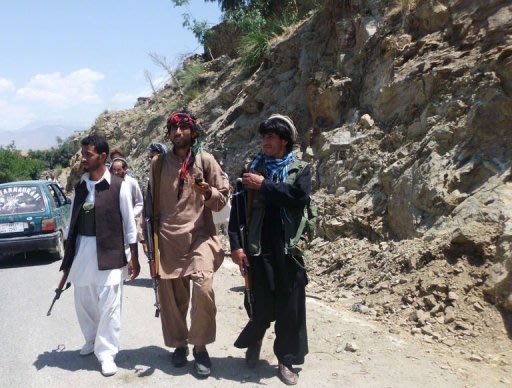
About 200 tribesmen gathered in an eastern Afghan town this week to mark what they said was an uprising against Taliban insurgents -- the latest in a series of such moves, officials say.
Analysts caution that the so-called uprisings could be attempts by local militia leaders to reassert their authority ahead of the 2014 withdrawal of NATO troops supporting the government of President Hamid Karzai.
Or they could be orchestrated as part of a government strategy, they say.
But on Wednesday, in the central bazaar of Alishing, a farming district in eastern Laghman province, the tribesmen -- some carrying AK-47 rifles or rocket-propelled grenades -- made their intentions clear.
"We're fed up with the Taliban and their brutal aggressions against our people," a tribal elder among the protesters, Ghulam Rasoul, told AFP at the scene.
"We're standing up against them and will not allow them to oppress our people and kill our people," the turbaned elder said.
Laghman provincial administration spokesman Sarhadi Zwak told AFP that Alishing's revolt was the latest in a series of similar moves across the province northeast of Kabul.
And since mid-May, self-armed tribal militia have secured several villages in Ghazni province's Andar district south of the capital, a senior interior ministry source told AFP.
They were keeping the Taliban at bay and helped reopen dozens of schools the insurgents had closed, he said on condition of anonymity.
Although at an early stage, the revolts have worried the insurgents.
"Taliban fighters used to control most of the provinces, but now they are losing ground in areas like Helmand, Kunduz and more recently Kandahar, Zabul and Ghazni," a mid-level Taliban source told AFP in Pakistan.
"They lost ground to tribal militias because they don't let people access basic services, especially school," said the source, who belongs to the militants' political wing and travels regularly between Pakistan and Afghanistan.
"That is what happened in Ghazni two months ago," he said.
At the demonstration in Alishing, tribal elder Noor Zaman told AFP: "The Taliban are insulting our elders, they are killing our elders, we decided to end this.
"Today we have gathered to tell the Taliban that they are no longer welcome in our village. If they try to enter our village again we will kill them," Zaman said.
The Taliban Islamists, who were in power between 1996 and 2001, are waging an insurgency they call "jihad", or holy war, to bring down the Western-backed Kabul government, which is supported by some 130,000 NATO troops.
But the US-led coalition is gradually withdrawing troops and increasingly handing responsibility for security to Afghans ahead of 2014.
"As the NATO troops are preparing to withdraw, the Taliban have started to expand their activities in the country," said analyst and author Waheed Mujda, a former official in the Taliban regime.
"The more they expand the more it becomes difficult for them to control their commanders and they and their soldiers have in some areas harassed and angered local communities.
"The uprisings are not purely by [ordinary] people -- in most parts they are being led by some former jihadi commanders who see this as a chance for themselves to come back to power."
Abdul Waheed Wafa, the director of the Afghanistan Centre at Kabul University, said it was too early to call the moves an uprising.
"It's too early to give it a name. We don't yet know if it's really an uprising by the people or an intelligence strategy or a government project," Wafa said.
"But whatever it is, if it's not managed properly, it could turn into anything: it could turn into a popular revolution against the Taliban or a crisis within the crisis. It needs to be managed by the government," Wafa said.
The interior ministry official agreed that the uprisings were on a small scale so far, but said the government hoped they would expand.
Pakistan: The curse of July ’77
Written by Lal KhanThis year July 5 marked the 35th anniversary of the military coup in Pakistan that toppled the democratic government of Zulfiqar Ali Bhutto in the pitch darkness of the night. This coup was led by General Ziaul Haq who deposed the first PPP government and imposed the most vicious and tyrannous military dictatorship in the country’s history. During the 11 nightmarish years of martial law, the masses of Pakistan suffered the torments and brutalities inflicted in the name of Islam. Thousands were publically lashed and incarcerated in prisons and notorious torture cells. Hundreds were hung on the gallows and innumerable perished in several massacres. In Sindh, the army killed thousands to crush the movement of 1983. In the Colony Textile Mills, in Multan, 133 workers were gruesomely slaughtered by direct firing. Zia was enjoying a wedding feast of the owner’s daughter in a plush villa nearby. Women were specially targeted with draconian Islamic laws like the Hadood Ordinance in which the rape victims were to be flogged for adultery. This barbaric dictatorship was imposed in connivance with US imperialism and was supported by them throughout its vindictive rule. Domestically, the religious parties and the conservative right wing supported it. Jamaat-e-Islami was part of the regime and shared power with Ziaul Haq. Pakistan in this period was transformed into a frightful society where relentless state repression and ruthless obscurantism crushed the masses. The state and the religious vigilantes monstrously intruded into the private lives of citizens. Hypocrisy, deceit, selfishness, treachery and malice became social norms. Islamic fundamentalism was propped up by the state and supported by the US to crush the resistance against the dictatorship. However, there were heroic and determined struggles launched against this despotic dictatorship by the workers and youth. Enormous sacrifices were made. But since its fall not much has changed for the masses. Instead, the social and economic conditions have worsened in many ways. There are important lessons to be learnt from this traumatic experience the oppressed classes had to endure for more than a decade of suffering and gloom. The late 1960s witnessed one revolutionary movement after another. The revolutionary movement of 1968-69 in Pakistan had not only challenged Ayub’s military dictatorship but also the system and state it was protecting. The masses wanted jobs, food, education, healthcare, housing – in other words, an end to their misery and exploitation. Zulfiqar Ali Bhutto and the PPP provided an answer in the form of a programme of revolutionary socialism as opposed to “national or people’s democratic revolution” offered by our brothers and sisters of the left. This programme was synonymous with the fundamental aspirations of the masses in revolt. The intensity of the upheaval was so severe that it threatened the existence of capitalism itself. The region’s ruling classes initially tried to diffuse it through the elections of December 1970 and then even had to instigate a war and the breakup of Pakistan to quell the revolution. The pressure of the uprising and the fear of the revolution were still there and the military had to hand power to Bhutto at the end of 1971 who immediately initiated a rapid programme of the most radical reforms in the history of the country. Unfortunately, the PPP was not a Bolshevik party and hence, it lacked the cadre network and structures to replace the institutions of the bourgeoisie state. In spite of widespread nationalizations, the foreign corporate sector and several other sections of the commanding heights of the economy were left in private hands. The left within the party was slowly purged, land reforms were jeopardised by the bureaucracy of the bourgeois state and, instead, landlords penetrated the party. The old state apparatus remained intact and began to revive its despotic role. This was seen in the aggression of the army in Baluchistan in1974 under the PPP government. In the last analysis, capitalism was not abolished and its burgeoning crisis exploded in hyper-inflation that destabilised and ultimately led to the demise of the PPP government. It culminated in the assassination of Zulfiqar Ali Bhutto on the gallows in April 1979. The ruling classes who had been bruised by Bhutto’s reforms struck back with a bloody vengeance. In his last book, written in his death cell, If I am assassinated, which has acquired the status of his last testament, Bhutto wrote, “I am suffering this ordeal because I sought an honourable and equitable via media [middle road] of conflicting interests... the lesson of this coup d’état is that a via media, a modus vivendi, a compromise is a utopian dream. The coup d’état demonstrates the class struggle is irreconcilable and it must result in the victory of one class over the other. Obviously, whatever the temporary setbacks, the struggle can lead only to the victory of one class.” Paradoxically, the PPP leaders that emerged in the aftermath of Z A Bhutto’s assassination rebuked the founding chairperson’s last testament and the lessons he had drawn in life and death. The regimes of bourgeoisie democracy that followed after Zia’s demise did not change the fundamental policies and the capitalist/feudal system. To preserve and protect this system the ruling classes had imposed the Zia dictatorship that inflicted horrendous atrocities upon the toiling masses. It is not just his odious legacy that prevails in today’s Pakistan but the majority of politicians are former protégés of Ziaul Haq. The irony is that the PPP’s former prime minister, foreign minister and numerous other turncoats imposed in the hierarchy of today’s PPP are products of the nefarious Zia regime. This has resulted in the crushing of society. While the rich accumulate obscene quantities of wealth, thousands of working people fall below the poverty line every day. Corruption, nepotism and crime dominate the political spectrum. The military that became a mercenary force in waging imperialist wars during the Zia era is now indulged in the process of primitive accumulation. Zia initiated religious bigotry and terrorism has become a festering wound on the body politic of Pakistan. This bestial frenzy is being financed by the black capital generated by the narcotics trade that had an income of $30 billion this year, according to UNICEF. Hence, even after his physical elimination, the basic characteristics of Zia’s policies are very much intact. This reflects the real nature of Pakistani capitalism. In these excruciating times, the ruling class through the media is trying to restrict mass consciousness in the conflicts between different sections of the elite and various forms of bourgeois political superstructures. The most destructive feature of a military dictatorship is that it pushes mass consciousness backwards and illusions in a democratic setup of the elite develop in society that undermine the class struggle. Exploitation and agony persists. The harrowing conditions that are tormenting society can only be eradicated when this appalling system is abolished by the redemption of the 1968-69 revolution through a socialist victory, otherwise these revolutions cannot be victorious. The writer is the editor of Asian Marxist Review and International Secretary of Pakistan Trade Union Defence Campaign. He can be reached at ptudc@hotmail.com
A.Qadir Gilani's victory assertion of people's final verdict
http://www.brecorder.comPresident Asif Ali Zardari has said that the electoral victory of Abdul Qadir Gilani in the sandy land of the saints will reverberate in the annals of time as a stark reminder to everyone that it is the people and people alone who pronounce the final verdict and are not afraid of overturning all other judgments. This he said in his felicitation message to Abdul Qadir Gilani, son of former Prime Minister Syed Yusuf Raza Gilani, on his victory in the bye-election in NA 151 Multan. According to unofficial results, Abdul Qadir Gilani secured 64628 votes and won the election with a lead of over four thousand votes. In his message, the President termed the victory as vindication of former Prime Minister Yusuf Raza Gilani and the PPP and recognition of the sacrifices of Gilanis for upholding the constitution, democracy, and the Party and their services to the people of the area. The President termed the peoples verdict as ultimate in this world transcending all other judgments. The President also felicitated former Prime Minister Syed Yusuf Raza Gilani saying that the Party joined him in celebrating his personal vindication. The President said that he was confident that as a member of the National Assembly, Abdul Qadir Gilani following in the footsteps of his father and the Party's leaders will uphold the constitution, serve the cause of democracy and Party and serve the masses.
President Zardari: Parliament is supreme, has mandate to legislate
President Asif Ali Zardari
on Thursday said the president is part of parliament under the Constitution and he (as president) interacts and meets parliamentarians since parliament is his constituency. He added that no law barred the president from meeting his constituents. He also declared that he would not quit on the wishes of the conspirators and that parliament was sovereign and had the mandate to legislate.
President Zardari said this while addressing a reception hosted by the Sindh chief minister Syed Qaim Ali Shah at the CM House here. Party Chairman Bilawal Bhutto Zardari was also present. It was a grand party meeting and members of the PPP central committee belonging to Sindh, federal and provincial ministers, members of the national and provincial assemblies, members of the PPP Sindh executive committee and executive committee members of all the districts were invited to attend the meeting.
The president asked the party leaders and workers to fear no one, as he is the symbol of the federation while the PPP is the largest political party and believes in serving the people.
President Zardari said he has nominated a PPP worker as prime minister of the country and it was his policy to selecthard working and dedicated workers to serve the nation and the people.
He said parliament is sovereign and has the mandate to legislate while 1,500 elected members of the assemblies have elected him as president. The party, he said, is ready for elections, which will be held as per schedule.
The president said he is the follower of the late ZA Bhutto and the PPP is a revolutionary party. He said anti-people forces were spending money for their projection in the media but they could not weaken the PPP.
Zardari said some elements were trying to blackmail him like they blackmailed the late Benazir Bhutto but they will fail in their attempts.
He said Bilawal Bhutto is now leading the party and he will soon actively participate in politics. He directed the party workers to start their election campaign and contact the masses. President Zardari declared that all political forces are with the PPP and claimed that Punjab, southern Punjab in particular, is the PPP’s bastion.
He said the population of Karachi is 30 million and people from all over the country have come to the city. He said gangs of criminals also reside in this mega city and the government is trying to strengthen the police and the law enforcement agencies to control law and order.
The president said that Karachi, being the hub of economic activity, is also suffering because of the fast changing situation at the international level.He told the workers that neither the PPP nor its leadership is weak and the party is bringing in new cadres for a better future.
He concluded his speech with slogans of ‘Jeay Bhutto’ and ‘Pakistan Khappe’.Earlier Sindh Chief Minister Syed Qaim Ali Shah told the gathering that the PPP is not afraid of any long march and declared that party can launch a train march under the leadership of Asif Ali Zardari.
Commerce Minister Makhdoom Amin Fahim, Agha Siraj and others also spoke on the occasion and expressed full confidence in the leadership of President Asif Ali Zardari. Agencies add: The president said that for the stability and smoothness of the system, it was necessary that every state institution respected the mandate of other institutions. He said that in developing democracies some institutions might at times appear to be overstepping their mandate but this was part of the evolutionary process and should not be a matter of concern.
The president said that the Pakistan People’s Party had pursued the politics of reconciliation and had always been taking along other political forces. He said no conspiracies or propaganda could weaken or deter the PPP from pursuing the people-oriented agenda.
The president said, “Our detractors cannot even understand the basics of the philosophy of Quaid-e-Awam.” He has read and learnt the entire philosophy of Shaheed Zulfikar Ali Bhutto and has the courage to follow his path, he added.
“I have lived in all those cells where Shaheed Zulfikar Ali Bhutto was confined. I have seen him in my childhood and I still remember all of his speeches and whatever conspiracies were hatched against him,” the president said.
He said that the conspiracies that were hatched against Shaheed Zulfikar Ali Bhutto are being hatched against him. The president said that those who wanted to restrict the political forces would not succeed.
He asked the Sindh chief minister to create more employment opportunities in the province on an urgent basis as people were asking for jobs. The president said the Benazir Income Support Programme (BISP) is a success story and has earned worldwide acclaim for its transparency and objectivity. He said he has advised the BISP chairperson to adopt an innovative approach to make the programme more effective.
PPP braces for two momentous days next week
With the Supreme Court scheduled to take up a number of petitions challenging the Contempt of Court Act of 2012 on July 23 and the NRO implementation case on July 25, PPP leaders are busy contemplating their response to the two cases.
Sources close to some senior PPP leaders said a debate was going on in the party over whether to adopt a hard line or follow its policy of going by the book and let the judiciary keep on issuing anti-PPP judgments.
In the recent past the party has held more than one sitting to discuss its future course of action. The latest one was held on Tuesday at the presidency, co-chaired by President Asif Ali Zardari and Prime Minister Raja Pervez Ashraf.
The PPP sources said that while the party hawks wanted a direct confrontation with the judiciary and protests against any future court judgment against the PPP and its leaders both in and outside parliament. But the likes of Senator Raza Rabbani are cautioning the party against any confrontation with the judiciary.
The sources said President Zardari was yet to give his opinion on the issue.
But, according to them, the dominant mood in the party was aggressive and some leaders were not happy that the ouster of Yousuf Raza Gilani was accepted without putting up a fight.
“When everyone of us sitting in the party believes that the courts are not impartial when it comes to the cases involving the PPP and its leaders, there is nothing wrong in protesting against court decisions on the streets,” said a PPP leader.
The Tuesday meeting was informed that there was every possibility the SC would strike down some provisions of the Contempt of Court Act which provided immunity to the president and the prime minister against contempt charges and the right to appeal for a convict or one accused of contempt.
Senior Lawyer Salman Akram Raja told Dawn that if the court chose to strike down some provisions or the whole law the government would have to accept the decision. However, if the court only interpreted it the PPP could take it back to parliament and get its own interpretation passed by amending the law.
He said the PPP government actually wanted to drag its feet on the NRO implementation case “and I believe the government after passing the new law will manage to do so.”
Barrister Zafarullh Khan said if the government and the judiciary had a difference of opinion on interpretation of a law, parliament could go for its amendment to explain the way it wanted. However, he said, under the Constitution it was only the SC which had the right to interpret a law.
According to a senior PPP office-bearer, by passing the new law on contempt of court, the government had sent its message loud and clear that it did not want the apex court to touch the president and prime minister on contempt charges. Now, he said, the ball was in the SC court and let the judges decide on the law.
The PPP sources said that in the first place the party believed this time the court would not send the new prime minister packing and give him time. Otherwise, he said, “this time party’s response will be different”.
Talking to reporters, Attorney General Irfan Qadir said the contempt of court cases could not add to the respect and dignity of the judiciary.
He argued that whenever judges would issue wrong decisions they would be ridiculed because the judiciary was not above the law.
He said the court decisions should be acceptable to both parties.
He said the SC should refer the matter to parliament with its interpretation and parliament would accept its positive recommendations.
He warned that there would be a crisis in the country if the court annulled the Contempt of Court Act.
Mr Qadir said there should be harmony among institutions for smooth functioning of the system.
The PPP sources said the government intended to invoke the new law in its response to the SC on the NRO implementation case.
‘Nawaz promotes politics of provincialism’
Daily TimesSindh Revenue Minister Jam Mahtab Hussain Dahar has said that Nawaz Sharif has conservative approach and his politics revolves around provincialism while Pakistan People’s Party (PPP) is a federal party that has deep roots in all provinces, including Azad Kashmir and Gilgit Baltistan. This he said while talking to various delegations here at his office on Thursday. Dahar said that whenever Nawaz visited Sindh, he did nothing but increased the problems of the people and did only verbosity. He advised Sharif Brothers to learn politics from a common worker of PPP who never left party in lurch. Dahar said: “People of Pakistan will never support those so-called politicians who enter into secret pacts and leave the country. The history of PPP is a history of martyrs and we believe in serving the masses in all circumstances.” He said that the workers and leaders of PPP are the backbone of the party and the people of Pakistan have elected us. “Our first priority is to provide basic facilities to the people,” he added. The minister said that the four and half years of our government were a clear proof that we had provided relief to the people in our tenure. “Thousands young men were given jobs on merit. More than one lakh young men had been provided technical training skills in order to enable them to earn respectable livelihood in the society,” Dahar added. On this occasion members of the delegations informed the provincial minister about their problems and he assured them that the problems would be solved soon.
Pakistan: KILLED... 'Because they were Shia’
EDITORIAL:www.dailytimes.com14 Shia passengers killed in a roadside bomb attack in Orakzai Agency point to a new pattern of sectarian killings across the tribal Agencies, which is cause for serious concern. The Parachinar Shia tribes of Kurram Agency are no strangers to long-standing sectarian differences that often erupt in episodes of violence, but the latest round of attacks, particularly this Orazkai incident, indicates an unprecedented blueprint, one that betrays logistical improvisation. Historically, Kurram has been the ideal staging post for all sorts of covert operations into Afghanistan. Its strategic ‘Parrot’s Beak’ enclave provides by far the most convenient infiltration point into Afghan territory. Hence its tactical significance, be it for mujahideen waging holy war against the Soviets, or al Qaeda/Taliban elements crossing over to disrupt NATO/ISAF forces. And whenever indoctrinated jihadists have passed through there, their Salafist tendencies have sought fit to engage in genocidal pogroms against the native Shia tribes. Of course, crushing a community they so openly oppose also serves to intimidate other potential pockets of resistance. Should continuing signs of unrest in Kurram, and now the obvious spillover in neighbouring Orakzai, be a fallout of the same proxy-sponsoring tendencies of the intelligence agencies, then there is an extremely disturbing, potentially existential, problem confronting Pakistan that the country ignores at its peril. Furthermore, intelligence chatter indicates that renewed attacks might spring from the move of the Haqqani network to the area, which is even more disturbing. Apparently no longer able to deflect pressing US demands for an offensive in North Waziristan to pursue the Haqqanis, elements in military intelligence saw fit to move them to Kurram and Orakzai, fearing a unilateral external hit. That their presence would embolden indigenous Taliban elements is natural, as the sectarian flare-up in normally non-controversial Orakzai seems to indicate. It may well be that the Haqqani hand in the recent violence is indirect, with those strengthened by their presence seeing fit to carry out their own agenda. Still, the responsibility must first be placed on the Haqqani network, then, and more seriously, on the sponsors that got him there. On an even more alarming note, with the US House of Representatives now urging the State Department to officially declare the Haqqanis terrorists, Pakistan may not be far from being sanctioned for failure to dismantle this network specialising in IEDs, targeted killings and genocide. As things stand, Islamabad must urgently undertake a number of steps to bring a semblance of normalcy to the situation. One, it must take official notice of targeted victimisation and murder of the Shia minority, especially in the tribal Agencies. This must include ending their isolation and ensuring protection along the Kurram-Kohat highway, which has been the target of Shia slaughter for far too long. Two, it must immediately order a detailed investigation into the present situation in Orazkai-Kurram, especially with regard to Haqqani’s movements. Three, it must investigate, expose and eliminate all forms of official clandestine help to elements like the Haqqanis, who are in violent revolt against secular society and should have no place in a progressive state. Four, it must brush up its own information outreach. Militants seem to leverage the media muscle far more effectively, be it the Mulla-FM of Swat, use of the internet or serious publications and fliers. Even in Orakzai, the Taliban openly took responsibility for the attack that killed, among others, two eleven-year-old and one three-year-old children, “because they were Shia”. They also vowed more attacks, with the government mum as usual. Eager elements in our security establishment are reminded that sheltering forces that, directly or indirectly, facilitate pitiless slaughter on our home soil for some sort of strategic gambit amounts to cutting off one’s nose to spite the face. Already sectarian violence has spread from its more usual centres to the Agencies. This is a self-defeating strategy that must be abandoned.
Nawaz's hypocrisy
EDITORIAL:THE FRONTIER POSTWho can quibble with Mian Nawaz Sharif's pronouncement that for democracy strong political parties are a must? But strength and vibrancy come to political parties from their representative character and internal democracy. Can he in all honesty say this of even his own party? Aren't political parties that we have the fiefdoms of dynasties or personalities? Apart from admirable exception of Jamaat-e-Islami, isn't nomination not election their rule? Even the rising political star is as yet to establish if it is going to be any different with his political formation. So with what face could MNS speak of strong political parties when he is keeping his own under his thumb so autocratically? Can indeed he cite even one example from any world democracy where a non-elected politician could become the leader of his legislative party? Yet, after the 2008 election, he anointed himself the leader of the PML (N) parliamentary party, even though he was not even an elected member of the National Assembly, and appointed his younger sibling Shahbaz Sharif leader of the party in the Punjab Assembly, though he too was not yet elected to that legislative house. This much for his belief in strong political parties for the sustenance of a democratic order. But, then, we are no democracy in reality. It is just charlatans of his ilk who are branding democracy what actually is plutocracy pure and simple. A rule of the people for the people and by the people we definitely are not. A rule of the elite for the elite and by the elite we verifiably are. It is a clutch of elites that holds the nation's entire politics in its hands as its captive. They dominate the political parties, over which they rule and reign as little emperors. To hoi polloi, these are closed preserves. They can enter them, at best, as errand boys and foot soldiers, to beef up their political monarchs' public rallies and have their heads smashed by police lathi charge in protest processions and demonstrations their moguls stir up. The ladder to go up in the party hierarchy is just out of bounds to them. It is only in a real democracy that a grocer's daughter, an ordinary school teacher and a small-town lawyer can rise to pinnacles in the party as well as in the state. Not here. It is only some scion, sibling or lackey of the party supremo who alone can perform that feat in our plutocracy. And MNS is further advised to his own good not to dwell too much on his past. Our people may be an enslaved citizenry for the most part. But no nincompoops they are. They know what is what. He cannot mislead them into believing that his past was glorious when they know from one to all that it was all fraught, stinking unbearably foul. His was no institution-building era. It was a period of institution-demolition. He brawled with the nation's top judge, toyed with the terrible idea of throwing him behind the bars even if for an overnight, instigated revolt against him and saw him being ousted from his office. More horribly, in a case quite fit to go down in the Guinness Book of World Records, he scored a first-ever hit with his party goons physically attacking the Supreme Court, the nation's highest seat of justice, and driving the panicked honourable judges to run for their lives. That sigma he cannot wash off even with the oceanic waters of the Atlantic, what to talk of his self-touted pivotal role in the dysfunctional judges' restoration, particularly when his talk is all sham. All the credit of that restoration indisputably goes to the dysfunctional judges' own steadfastness of as well as the courageous protest campaign of the lawyers. Indeed, when the judges and the black coats were braving the wrath of the military dictator and the lawyers were having their heads broken by his ferocious lathi-wielding cops, MNS was nowhere on the scene. He was then cooling his heels in the cool climes of London, mounting such spurious political shows as the All Parties Democratic Movement, which of course he ditched later on by participating in the 2008 under the dictator's rule, contrary to his staged jamboree's vow. Little wonder, none in the legal fraternity seems endorsing his self-professed pivotal role in dysfunctional judges' reinstatement. Indeed, his second stint "of heavy mandate" in power was a saga of a parliament having been turned into mere rubber-stamp and a cabinet into a sheer formality. It was a select kitchen cabinet of ministers and bureaucrats, on whose shoulders he rode to rule autocratically. And had he had his way, he would have transformed this country into a theocracy, with himself perched on it as its lifelong Amirul Momineen, a law unto himself. There in fact is so much foul about his past that one is dissuaded away from buying even his mantra of being a reinvented democrat and a lover of judiciary and the rule of law.
Thursday, July 19, 2012
PPP wins Multan vote battle
Long Live BhuttoismDismissed PM Yousaf Gilani’s son Abdul Qadir Gilani wins against independent candidate. According to the unofficial results Abdul Qadir Gilani bagged 64,628 votes and Shoukat Hayat Boson got 60,532 votes. Shoukat Hayat Boson was an independent candidate but he enjoyed the support of PML-N, PTI and Jamaat-e-Islami. All eyes were focused today on Multan NA-151 elections, as its result could determine the future political trends in the country. NA-151 seat was vacated after the Supreme Court of Pakistan disqualified former PM Syed Yousaf Raza Gilani. It was virtually a contest between PPP on the one side and all political forces on the other. The main candidates were the former prime minister’s son Abdul Qadir Gilani who represented Pakistan People’s Party and Shaukat Hayat Khan Bosan, who enjoyed the informal support of both Pakistan Muslim League-N, JI Pakistan and Pakistan Tehrik-i-Insaaf. PTI President Javed Hashmi and Vice Chairman Shah Mehmood Qureshi also used their influence in the favour of the independent candidate Bosan. Other candidates contesting the by-election were Abdul Mateen Qureshi, Dr Aleem Chaudhry, Mehr Ghulam Shabbir Sial, Shehla Shaheen Advocate, Muhammad Husnain Khan Bosan, Muhammad Amil Yousuf Jutt, Muhammad Abbas and Nawaz Muhammad Iqbal Khan. The seat fell vacant when the former prime minister, Yousuf Raza Gilani was declared disqualified by the Supreme Court of Pakistan.
Pakistan: Three million Afghans to be expelled by December
The Express TribuneAuthorities have declared that they are unwilling to extend the stay of almost three million Afghans residing in Pakistan beyond December 2012. In an exclusive interview with The Express Tribune on Monday, Habibullah Khan, the secretary for the Ministry of States and Frontier Regions (Safron), a body that deals with Afghan refugees, said that Pakistani and Afghan agencies are negotiating among each other on the repatriation of 2.7 million refugees. Official statistics show that 1.7 million Afghans residing in Pakistan hold legal documents issued by local authorities. While around one million are residing here without any legal documentation. It is reported that authorities are planning to launch a crackdown to expel all illegal refugees that the country hosted for over three decades. “One million illegal refugees would be treated under the Foreign Act of 1946,” he said. “We plan to expel all the illegal refugees from the start of next year…there is no way that we can extend their stay here.” Pakistan and Iran have been hosting refugees since the 1979 Russian invasion. The countries prepared a roadmap for the repatriation at a conference held in Geneva in May this year. The three countries have been running the repatriation programme for Afghan refugees with the financial and technical assistance of the United Nations High Commission for Refugees (UNHCR). Statistics show there had been a consistent decline in the number of individuals returning to Afghanistan under a programme of voluntary repatriation assisted by the United Nations High Commission for Refugees (UNHCR). As many as 4.6 million Afghan refugees have been repatriated under the programme since it started in 2002. The registered population living in Pakistan comprises 52.6% males and 47.4% females. Eighty-five per cent Afghans are Pakhtuns hailing from Nangarhar, Kabul, Kunduz, Logar, Paktia, Kandahar and Baghlan areas while the rest are Uzbeks and Tajiks. Khyber-Pukhtunkhwa (K-P) hosts the largest of the refugee populace estimated at around 62.1%, followed by 20.3% in Balochistan, 11% in Punjab, 4.2% in Sindh, 2% in the federal capital and 0.4% in Azad Jammu and Kashmir (AJK). The official figures revealed only 40.6% Afghans live in the villages or camps set up for the refugees while 59.4% are settled across Pakistan in both the rural and urban areas and earn livelihood through means other than funding by the United Nations. In a survey conducted, 56% of the returnees are reported to be Pakhtuns. 26% of the refugees prefer Kabul as their most favoured destination followed by 20% who opted for Nangarhar. According to Khan, Pakistan would allow students, vulnerable persons like unattended widows and orphans and some businessmen to stay here on their visa until they finish their pressing assignments. Khan added that the Afghan authorities have expressed willingness to receive as many refugees from Pakistan as they can and hoped most would be leaving the country within the given deadline.
Britain, Pakistan back bid for Afghan peace
Afghan efforts to negotiate with the Taliban need Islamabad's help to be successful, the leaders of Afghanistan, Britain and Pakistan emphasised on Thursday, following three-way talks in Kabul.
British leader David Cameron and Afghan President Hamid Karzai met Pakistan's new Prime Minister Raja Pervez Ashraf for the first time, as British and NATO combat troops prepare to leave Afghanistan in 18 months' time.
Karzai has long sought to negotiate with the Taliban, who have been fighting for a decade to topple his Western-backed government, but the militia has in public refused to deal with his administration, branding it an American puppet.
Earlier this year, the militia also announced that it had abandoned contact with US officials in Qatar aimed at securing a prisoner swap.
During the talks, Karzai reiterated the "urgency" of a political solution. His office said Ashraf and Cameron reaffirmed support for such a process, "led and owned by Afghans, facilitated by Pakistan and other regional countries".
Relations between Afghanistan and Pakistan traditionally suffer from distrust and mutual blame for the Taliban violence that plagues both countries.
Kabul has repeatedly asked Islamabad to assist efforts to broker a peace deal with the Taliban, whose leaders have traditionally had close ties to Pakistan.
But it remains unclear to what extent Pakistan controls core Taliban leaders and to what extent it can facilitate a peace process.
Pakistan's oldest newspaper, Dawn, on Thursday counselled Pakistan to "begin to match its claims and demands with what it can actually deliver".
"It will need to demonstrate at least a genuine effort to try to persuade the Taliban (which) it does have contact with, to talk to the Afghan government and the US -- and turning over prisoners could be a first step," the newspaper wrote.
It was Ashraf's first visit to Kabul since being elected after his predecessor was dismissed last month for contempt of court.
An Islamabad government official said he would raise the issue of cross-border attacks on Pakistan from Afghan territory and press for increased security measures to prevent such incursions in the future.
Afghanistan shares a disputed and unmarked 2,400-kilometre (1,500-mile) border with Pakistan, and Taliban and other Al-Qaeda-linked militants have carved out strongholds on either side.
According to the joint statement released by Kabul, the three leaders "reiterated their strong commitment to working together to eliminate" terrorism, which "poses the gravest threat to regional and international security".
"They also emphasised the importance of peace in Afghanistan for the peace and security of Pakistan," it said.
Cameron warned the Taliban at a joint news conference with Karzai earlier that the international community would continue to support the Afghan government after NATO troops pull out in 2014.
A NATO conference in Chicago and a donor conference in Tokyo had recently shown the West's commitment to the war-torn country, he said.
"I think this sends a very clear message to the Taliban, that you cannot wait this out until foreign forces leave in 2014, because we will be firm friends and supporters of Afghanistan long beyond then.
"So now is the time for everyone to participate in a peaceful political process in Afghanistan."
Karzai said the peace process was "the most important goal that we pursue", adding that Thursday's talks were "to see how we could intensify the Pakistan role in the Afghan peace process".
Cameron also signed a deal to build an officers' training academy modelled on Britain's Sandhurst as Afghan forces take increasing responsibility for the fight against Taliban insurgents.
Britain has around 9,500 troops in Afghanistan, making it the second-largest contributor to NATO's US-led 130,000-strong International Security Assistance Force.
Asked about reductions in troop numbers, Cameron said it would be done gradually, from 9,500 to 9,000 this year.
"I don't want to see some cliff edge. I'm confident we are going to have a staged reduction and deliver a safe and secure situation."
Putin and Obama agree to disagree on Syria
http://rt.comIn a telephone call between Presidents Vladimir Putin and Barack Obama, the leaders expressed the coinciding view that a political solution must be reached for ending the violence in Syria, while admitting that differences between them remain. "Differences in approaches remain (between Washington and the Kremlin) concerning the practical steps in achieving a settlement," presidential spokesman Dmitry Peskov told reporters following the Putin-Obama call. The Russian and American leaders spoke after a bomb attack Wednesday killed four high-ranking members of President Bashar al-Assad's inner circle. The attack came one day before the UN Security Council is set to vote on whether to extend the mandate of the UN observer mission in Syria, which expires on Friday. The unarmed UN observers were granted 90 days to monitor the situation on the ground in Syria, evaluating the implementation of Kofi Annan’s six-point peace plan. Russia and the US have competing views on how to extend the 300-member UN mission. Moscow is opposed to imposing sanctions against Syria, saying that to do so would be tantamount to supporting the aims of the rebels. Meanwhile, Moscow, imploring the West not to take sides in the Syria crisis, continues to practice what it preaches as Foreign Minister Sergey Lavrov met with prominent Syrian opposition activist Michel Kilo in Moscow on July 9. The negotiation process continued two days later when Lavrov met with Abdel Basset Sayda, the head of the oppositional Syrian National Council (SNC). Presidential aide Yuri Ushakov told reporters on Thursday that Russia's position "boils down to the thesis that pressure must be applied not only to Syrian authorities but to the opposition forces as well.” On the topic of the bomb blast in Damascus on Wednesday that killed four high-ranking officials, Ushakov said Russia reaffirmed its firm position that it "condemns terrorist attacks, whoever commits them." Concerning the conversation between Putin and Obama, the White House stressed the need for a coordinated political approach to ending the violence. "The two presidents noted the growing violence in Syria and agreed on the need to support a political transition as soon as possible that achieves our shared goal of ending the violence and avoiding a further deterioration of the situation," the White House said. Peskov said the conversation showed that Putin and Obama "have a coinciding view of the general situation in Syria (and agree) on the end goal of reaching a settlement." "President Obama also took the opportunity to express condolences on the tragic loss of life resulting from flooding in southern Russia earlier this month and reiterated the US readiness to provide assistance if needed," the White House statement said.
Violence troubles Saudi Arabia and Bahrain
THORN IN THE SIDE:Saudi Shias feel they are treated as second-class citizens ANGER is rising in Saudi Arabia's Eastern Province after security forces arrested and wounded one of the government's harshest critics, a Shia cleric called Nimr al-Nimr. Two young men were shot dead in the protests that followed. This takes the total number of Saudis killed since the start of the Arab spring a year and a half ago to ten, all from the Shia minority that makes up about a tenth of the country's 27 million-odd people. Sheikh Nimr has long been a thorn in the side of the ruling family. A warrant for his arrest was first issued in 2009 after he said that if Saudi Shias were not allowed to "live with dignity", the eastern provinces should secede from the kingdom. Such talk is particularly inflammatory, since most of Saudi Arabia's oilfields are in the east. Yet he was not actually arrested. Security forces may have been mindful of the fact that some households in his town, Awamiyeh, were known to have stashes of guns smuggled in from Yemen and Iraq. Recently, however, the sheikh had again irked the ruling Al Saud family with a speech marking the death of the long-standing interior minister, Prince Nayef, who had also recently become the crown prince, as well as having been in charge of the religious police since 1975. The prince was hardly beloved by Saudi Arabia's Shias, who saw him as more hostile towards them than his gentler half-brother, King Abdullah. Saudi Shias feel they are treated as second-class citizens in a state that embodies a puritanical Sunni version of Islam. But the interior ministry dismisses unrest in the Eastern Province as "foreign meddling", a charge invariably laid against Iran, though Saudi Shias tend to revere Saudi or Iraqi clerics rather than Iranian ones. Prince Nayef was also a driving force behind last year's Saudi-led military intervention in neighbouring Bahrain, where protesters mainly from the Shia majority had been massing on the streets to demand more rights. The late prince's long-standing deputy and half-brother, Prince Ahmed bin Abdel Aziz, who has replaced him, is not generally seen as a bringer of change. But some Shia leaders look more hopefully to Prince Nayef's son, Muhammad, the deputy interior minister, who is admired in Western government circles for pioneering a rehabilitation programme for captured or surrendering jihadists. Sheikh Nimr told his followers in a posting on YouTube to celebrate Prince Nayef's death. Some young Shias even held parties. The sheikh said he was not afraid of being arrested and would even be willing to die if it helped his people to earn some dignity. The police soon responded, injuring him during his arrest. As pictures of his bloodied white robes circulated on social networking sites, young Saudi Shias took to the streets to shout for him and clashed with the police. Some Shia elders wish the sheikh had held his tongue. After all, it was too soon for changes at the interior ministry in the wake of Prince Nayef's death to have taken effect. And some Sunni dissidents sigh that the government thrives on the sort of provocative statements issued by Nimr, whom the Sunni majority in Saudi Arabia already finds easy to demonise. The arrest of the Saudi sheikh came two weeks after Bahrain's Saudi-backed security forces wounded another popular Shia cleric, Ali Salman, who was raked with birdshot as he addressed a clutch of flower-holding protesters outside his home. This peaceful gathering was unlicensed, so it was technically a crime. But the sheikh's shooting was likewise a response to a speech he had made a few days earlier, when he said that Bahrain's Shias had yet to display half of their power and could bring thousands onto the streets, dressed for death, at the drop of a fatwa. Salman's political group, Wefaq, won 45 per cent of the vote in parliamentary elections in 2010, enjoying roughly the same level of support as Egypt's powerful Muslim Brotherhood or the Islamists that won a general election in Tunisia. Yet Bahrain's government routinely dismisses it as a group of traitors in thrall to Iran. The Saudis say much the same of their eastern Shias. Pointing a finger at foreign plots is easier than accepting the need for reform at home. Read more: Violence troubles Saudi Arabia and Bahrain - Columnist - New Straits Times http://www.nst.com.my/opinion/columnist/violence-troubles-saudi-arabia-and-bahrain-1.109585#ixzz214NCN1xr
The great U.S. wealth gap could cause a social conflict
Zbigniew Brzezinski, former national security advisor to President Carter, says the rich are getting richer beyond any reasonable proportion and consequently the U.S. may be heading toward a social conflict.
Saudi Arabia world's third laziest nation - study
http://www.arabianbusiness.comSaudi Arabia's population is the third most slothful in the world, new research has found, with 68.8 percent of adults failing to do enough physical exercise to keep themselves healthy. Only in Malta and Swaziland do adults exert themselves less than Saudi Arabia, and women in the Gulf state are the world’s least inactive females, according to data published in the Lancet medical journal. Kuwait and the UAE also rank in the top ten with 64.5 percent and 62.5 percent of adults respectively not meeting the recommended level of activity. Malta is the laziest country in the world with 71.9 percent of the population deemed inactive, while in Swaziland the proportion is 68.3 percent. Nine eastern Mediterranean countries featured in the list with those over 15-years old in Libya considered the most active of the region (45.8 percent inactive), ahead of Lebanon (46.8 percent), Iraq (58.4 percent) and the UAE (62.5 percent).
Mitt Romney Taxes For 2010 Not Fully Disclosed
Mitt Romney has not released his full tax records from 2010, including key documentation connected to his Swiss bank account.
Although President Barack Obama and an increasing number of Republican politicians have called on Romney to release tax returns from years prior to 2010, the public criticism has so far failed to note that Romney has not disclosed all of his tax documents for 2010 itself -- the only year for which the GOP presidential nominee has presented any final tax forms.
Romney released his 2010 tax return in January of this year, a document that first informed voters about the existence of his Swiss bank account and financial activities in Bermuda and the Cayman Islands. But people who own foreign bank accounts are required to file a separate document with the IRS that provides additional details on such overseas bank holdings, and Romney has not released that form to the public.
The Romney campaign did not respond to HuffPost's request to view the document.
Tax experts say it is almost certain that Romney did file the form, known as a Report on Foreign Bank and Financial Accounts, or "FBAR" in accountant slang. The penalty for not filing an FBAR can be severe, and the IRS would have expected to receive the form since Romney listed the Swiss bank account on his tax return. Listing the account on his tax return and then failing to file the subsequent FBAR would have been asking for a hefty fine, and would probably have heightened IRS scrutiny of prior tax filings.
Nevertheless, Romney's omission of the form from the earlier disclosure raises questions for tax policy experts about the function of his Swiss bank account, and whether or not Romney used other offshore bank accounts that did not generate interest.
"The campaign has never told us why he had a Swiss bank account," said Rebecca Wilkins, senior counsel for federal tax policy at Citizens for Tax Justice, a nonprofit tax reform group. "It just looks bad."For individuals seeking to game the U.S. tax code, Swiss bank accounts are only useful when used illegally. Swiss accounts are prized by global elites for their extreme levels of secrecy. That secrecy has allowed thousands of American taxpayers to stash income from offshore companies in a Swiss account, shielding it from the IRS.
Romney, however, disclosed his Swiss bank account to the IRS in 2010, meaning that at least for 2010, the account was of no use to avoid paying taxes.
But Swiss bank accounts have other benefits. By serving as a curtain between Romney's U.S. accounts and his foreign holdings, Romney's Swiss account could shield many financial activities from American scrutiny. Hypothetically, any politically unpopular investments, clever and complex asset sales designed to lower Romney's tax bills or other activities would be far more difficult to decipher.
Romney may not have engaged in any of those activities, but his as-yet-unreleased 2010 FBAR would make it easier to determine whether or not he did.
Although Romney's campaign declined to comment for this article, in January, Brad Malt, the manager of Ann Romney's blind trust, told reporters the Romneys had an account with Swiss bank UBS worth about $3 million, which generated roughly $1,700 in interest. Malt said the account was set up for "diversification" in 2003 -- a claim that puzzles tax and investment experts, who note that all of the investment options available in Switzerland are available in American accounts. Malt said the account was closed in 2010.
But Romney would only have had to report offshore bank accounts that generated interest on his tax returns. Other accounts that simply executed transactions and forwarded the money along to U.S. accounts would not have to be reported on the tax return. They would, however, have to be listed on the FBAR form Romney has not released to the public.
That Romney's disclosed account was with Swiss bank UBS has also raised eyebrows. In 2008, a whistleblower at the bank informed the IRS of thousands of accounts being operated by American clients to avoid paying U.S. taxes. For Americans, the coveted Swiss secrecy suddenly became a legal liability.
So much information was turned over to the IRS that it would have been extremely difficult for the agency to pursue cases against every offender. So the IRS established a special tax amnesty program, which allowed those who voluntarily turned themselves in to remain anonymous and pay limited penalties. Thousands of citizens have since come forward.
"It's unclear why he would have valued the Swiss bank account secrecy, and it wouldn't have enabled him legally to avoid U.S. tax," said Daniel Shaviro, a tax professor at New York University School of Law. "This is why there's speculation that he was into the amnesty program."
But Shaviro and other tax experts note that one of the principal benefits of the amnesty program is its anonymity. Nobody who received amnesty from the IRS would ever have to tell the public they'd held a Swiss bank account. Any politician who had received amnesty could have simply shut down their account and washed his or her hands of any political liability. And once the IRS was aware of the account, maintaining it would have had no tax benefits.
"The fact that they never said why he had it is just really bizarre to me," said Wilkins.
Why Asians want to move to the U.S.
By Diego Laje and Corinna Liu, CNNAspiring Hong Kong musician Annabelle Cheng wants to be in America. "I think (Hong Kong) is a city that can be defined by business," said Cheng, who recently graduated from Baptist University in Hong Kong with a degree in religion and philosophy. "But the cost of living in a dynamic city is that you don't have your personal space." Living conditions in this crowded and hectic enclave are part of the reason Cheng wants to relocate to the U.S. "I really need that amount of time and space to think, to meditate, to get inspiration," said Cheng, who plans to save and apply for a post-graduate music program in the U.S. in two years. Cheng isn't alone. Despite the rising fortunes of Asia, the Pew Center released a report last month that shows Asians have surpassed Latinos as the largest group of immigrants to the United States. And university is often a gateway to residency: around half of Asian immigrants have a bachelor's degree or higher, compared to 13% of Hispanics, according to the report. "There have been many thousands upon thousands of Chinese students attracted to the U.S. for studies," said Yeung Yue-Man, Emeritus Professor at the Chinese University of Hong Kong who specializes in development patterns. "This trend has been gathering pace for the last two decades since the Chinese have become better off than before, they have the means and they can afford the high tuition." China leads overseas applications to American university graduate programs, followed by India and South Korea, according to a report by the Council of Graduate Schools. Sean Luo first came to the U.S. in 2000 as a graduate student after working for a Chinese state-run telecommunications company. After earning his degree, he decided to stay. He attained permanent residency in 2006 and now runs his own telecommunications company in Los Angeles. "No matter who you are, chances (in the United States) are equal for everyone," said Luo, adding that as a first-generation American, there have been difficult adjustments. "For cultural reasons, it's not easy to get into the mainstream social circle." Although he occasionally thinks of returning to China, the growing cost of living and uncertain political climate keep him in the U.S. "Asian countries are the most populous, has more competition and less resources," Luo said. "We are just being rational to immigrate to the countries where there are less people and more resources." One entrepreneur who moved his family to Los Angeles said that he moved to give his children better educational opportunities. "China is not the best place to raise kids," said the 40-year-old man, who wants to remain anonymous so as not to jeopardize his business and family in China. As for himself, he left China feeling insecure in a society where government has the final say in everything. "Individuals should be protected by laws and everyone's commitment to obey laws," the entrepreneur said. "Everyone minds their own business here. Very few people like to judge others." It's a common reason for China's wealthy class to emigrate, he said. About half the Chinese millionaires polled last year said they are thinking of emigrating, with North America the top destination, according to a November Hurun Research Institute and Bank of China report. Another source of Chinese immigrants is investment. "In real estate, the recent Chinese [immigrants] are quite well off, they want to find places where they can park their investment," Yeung said. "U.S. cities have become quite attractive to Chinese investors to buy property," Yeung said. Cheng, the Hong Kong musician, says she has a lot of American friends coming to Hong Kong to look for opportunities. "At the moment, the economy in the U.S. is quite bad, compared to Hong Kong," Cheng said, "so I'm going to wait ... I think in two years the economy will boom again." Still, Cheng believes her prospects are greater across the Pacific. "This is more possible in the U.S. than in Hong Kong," Cheng said.
Zardari writes to Indian PM, hails cricket ties resumption
Pakistan President Asif Ali Zardari has written a letter to Prime Minister Manmohan Singh expressing hope that the resumption of cricketing ties after five years will be a confidence building measure. Zardari on Wednesday sent the letter to Manmohan Singh welcoming cricket relations, reported Dawn.
The BCCI on Monday invited PCB to play three One-dayers and two Twenty20 Internationals in December-January, a move that would see the arch-rivals clashing in a bilateral series after a five-year gap
The resumption of cricket matches would add to positive atmosphere witnessed by the two countries, said Zardari.
The letter said: “You would recall that in my recent visit to India, we discussed resumption of cricket ties between Pakistan and India. I am glad to learn that the cricket boards of Pakistan and India have agreed to resume cricket matches after a gap of five years."
“I am sanguine that cricket matches between our two countries would prove to be a formidable confidence building measure and a way forward towards encouraging people-to-people contacts," the letter added.
Militants Destroy 22 NATO Trucks in Afghanistan
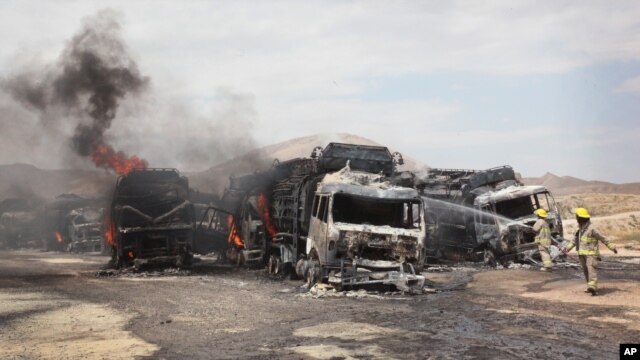
http://www.voanews.comTaliban says it detonated a bomb Wednesday in northern Afghanistan that destroyed at least 22 trucks carrying supplies to NATO forces. The bomb exploded in Samangan province and caused the fuel tankers and supply vehicles to catch fire. Afghan officials say the trucks were parked overnight and were on their way from Uzbekistan to NATO forces in southern Afghanistan. NATO was forced to rely more heavily on the northern route into Afghanistan after Pakistan shut down its NATO supply lines for nearly seven months following a coalition airstrike that killed 24 Pakistani soldiers. Few trucks have so far crossed the Afghan border since Pakistan reopened the supply lines earlier this month. Meanwhile, authorities say nine Afghan soldiers were killed in southern Afghanistan when insurgents attacked their post in the Washer district of Helmand province. British Prime Minister David Cameron met with Afghan officials and British troops stationed in Helmand during a trip to Afghanistan Wednesday. Britain has some 9,500 troops stationed in the country. In the east, NATO says a bomb attack killed two of its soldiers Wednesday. Two other soldiers were wounded in a helicopter crash in western Afghanistan. The coalition says it is investigating the cause of the crash.
Afghan and Pakistan in joint fight
British Prime Minister David Cameron called on Afghanistan and Pakistan on Thursday to make a joint effort against insurgents in the two countries' border zone. He also expressed confidence that Afghan forces will be able to hold their own after the majority of foreign troops leave at the end of 2014.
Cross-border fighting and the stalled Afghan peace process were the main topics of discussion at a three-way meeting in Kabul between Pakistani Prime Minister Raja Pervaiz Ashraf, Afghan President Hamid Karzai and Cameron.
The British, U.S. and Afghan governments have long criticized Pakistan for not doing enough to stop cross-border attacks. Many insurgents groups are based in safe havens in Pakistan's lawless tribal areas along the Afghan border. Islamabad also charges that insurgents cross the border from the Afghan side and attack Pakistani security forces.
"The terrorists that are trying to wreck Afghanistan are by and large the same terrorists that are trying to wreck Pakistan," Cameron said. "We should be together in one single fight."
Britain's involvement could help America's effort to push Pakistan to crack down on the safe havens and also to use its connections with some Taliban leaders to promote peace talks. Relations between Pakistan and the United States have been rocky at best, with their lowest point coming late last year after American airstrikes killed 24 Pakistani soldiers near the border.
Britain also sees the border areas as a main base for terrorists planning attacks against the West, although Cameron said that less than half of terrorist plots against Britain now originate from Pakistan's border regions — down from two-thirds as recently as 2010. Three men were charged Wednesday in London with travelling to Pakistan for terrorist training.
"We are making progress, and this is our fight as much as your fight and the Pakistanis' fight," Cameron said.
Pakistan's Ashraf, who took office last month, and Karzai were also holding separate talks together.
His spokesman, Akram Shaheedi, said the prime minister also plans to push the Afghan government to stop militants from its country from infiltrating Pakistan.
Ahead of the visit, Shaheedi said Pakistan supports peace talks with the Afghan Taliban, but the outcome should not adversely affect the country.
The Taliban has refused peace talks with Karzai, calling him a puppet of the United States. Instead, they have held talks directly with American officials. They broke off talks earlier this year, saying the U.S. reneged on a promise to release Afghan prisoners from Guantanamo Bay. The talks have so far shown no signs of restarting.
Pakistan is seen as key to breaking this impasse because of its historical ties with the Taliban.
"The peace process is the most important of our pursuits for Afghanistan. It remains the highest priority," Karzai said.
Karzai said having talks among the leaders of Pakistan, Afghanistan and Britain was Cameron's idea and that there had been minister-level meetings among representatives of the three countries.
"Today is the first time that we are sitting at the high-level of the leaders," Karzai said. "The purpose of the meeting is to find an effective way to battle against terrorism and what role Pakistan can play now in the security situation in the region and the peace process."
The Kabul talks marked the end of Cameron's two-day visit to Afghanistan, intended to guide decisions on how fast Britain will withdraw its 9,500 troops before international forces leave by the end of 2014.
In separate talks with Karzai, Cameron discussed the drawdown. He also planned to stress the need for "credible, inclusive and nationwide" presidential elections in 2014, his spokeswoman said, on customary condition of anonymity in line with policy.
Cameron also met in Kabul with the top U.S. commander in Afghanistan, Gen. John Allen, who gave him a positive message on the country's overall security picture as they discussed recent violence in northeastern Afghanistan.
Allen said the process of handing security duties to local forces was progressing well, though the Afghan army still needs to improve its command and control capabilities, Cameron's spokeswoman said.
Cameron rejected claims Afghanistan could be mired in violence once foreign troops withdraw, insisting local forces are prepared to handle insurgents.
Taliban fighters should "be in no doubt that there is a very clear and strong plan to transfer lead security responsibility from very capable (NATO-led) ISAF forces, including British forces, to very capable Afghan forces," he said.
"I am content that they will be able to defeat an insurgency and that Afghanistan will have a secure future," Cameron added. "Of course we would make even further progress if there were to be successful political talks and if the insurgency was to come to an end on that way."
Although fighting has not abated in the south, it has escalated in the east where coalition forces have focused their efforts against insurgents.
NATO said two of its service members were killed by roadside bombs in eastern Afghanistan. It provided no other details, but the killings brought the death toll among foreign troops to 27 so far this month and 242 this year. In other violence on Thursday, a roadside bomb in northwestern Faryab province killed eight civilians and wounded six others, a spokesman for the governor said. They were in a mini-bus headed on a shopping trip one day ahead of the start of the holy month of Ramadan.
Cameron also discussed the issue of "green-on-blue" killings on Wednesday in Helmand, southern Afghanistan, where British forces are mainly based. The term refers to the targeting of NATO troops by Afghan members of the security forces. There has been a rash of such killings in the last years.
He and Karzai also signed an agreement for 90 British military officials to staff an Afghan army officer training academy to be opened near Kabul. A total of 30 Danish, Australian and New Zealand soldiers also will staff the center, due to open before international forces leave at the end of 2014.
"I believe this is an important step for the Afghan people, this means having a stronger Afghan army, which is better trained, equipped and skilled," Karzai said.
___
Peshawar roads in total chaos
Dawn.comChaotic traffic in the provincial capital is causing road users a lot of stress but the relevant authorities have yet to put in place a reliable, effective traffic management system. Soon after its formation, the Khyber Pakhtunkhwa government announced construction of 11 overhead bridges and underpasses to manage traffic, but work could begin on two overhead bridges and two underpasses only. Work on two overhead bridges on GT Road and Courts Road has disrupted the entire traffic system to the misery of motorists, who usually cover a distance of 15 minutes in one hour during rush hours. However, traffic police are pessimistic about traffic management in view of the construction of two main overhead bridges in the city. Some traffic sergeants deployed on different roads told Dawn that overhead bridges or flyovers could bring positive change to traffic system but the problem was very complex in Peshawar mainly due to massive roadside encroachments and presence of illegal vehicles on the roads. They said a strong will was required to resolve the problem as local politicians didn’t let police take action against those responsible for messy traffic. “We launched campaigns against illegal vehicles, horse-driven carts and encroachments in collaboration with the relevant town municipal administrations but had to abandon them due to political interference,” a police officer said. He said four years ago, the government had announced 11 projects, including overhead bridges and underpasses, but it avoided them and work was initiated simultaneously on the two overhead bridges, two underpasses on University Road, sewerage lines and footpaths in different areas, which caused problems to motorists and pedestrians as well. For effectively controlling traffic chaos, the officer stressed the need for increasing traffic police manpower, closure of illegal bus and wagon stands, removal of encroachments, specification of designated bus stops, removal of illegal vehicles from Peshawar and grant of full authority to police to proceed against rule violators. According to the Regional Transport Authority (RTA) officials, no action against thousands of illegal vehicles plying the city roads was the major reason for traffic jams. They said despite a decision, the government could not restore the magisterial powers of the transport department to check traffic violations but all powers were with police officials, who generated money by not taking action against traffic rule breakers. However, RTA secretary Naseem Bacha told Dawn that the authority regularly examined route permits with transporters and responded to overcharging complaints. He said currently, there were 526 permit holder buses, 1146 minibuses on Peshawar roads but the actual number of vehicles might be higher. “The taxis with permit are 3,065 and 10626 auto-rickshaws only in Peshawar but the actual number is around 50,000,” Mr Shah said, adding that the rest of all rickshaws illegally plied the roads. The SSP traffic said police were doing best to regulate the traffic but the ongoing construction work had its impact on movement of the vehicles, saying traffic engineering had main role in the system. Peshawar Development Authority deputy director Shakeel said work on the Arbab Sikandar Khan Khalil overhead bridge at Gulbahar had been in progress and would be opened for traffic on August 14. He said its stipulated time was 24 months but the PDA completed it almost in 14 months. He said work on the Mufti Mehmood overhead bridge near Khyber Pakhtunkhwa Assembly was also in progress and it would be completed until December 2013. He said there were some hurdles near Radio Pakistan building and Livestock Department, saying after completion of the projects, major issues of traffic in Peshawar would be solved. He said the groundbreaking ceremony of another overhead bridge at Phase III Hayatabad would be held on August 14, while two underpasses were also being constructed for pedestrians on Tehkal and Abdara roads. In charge of PDA traffic engineering Siraj Anwar said his department had planned the construction of overhead bridges after finalisation of their feasibility reports but the most important thing for solution to the problems was political will. He said enforcement of laws was basic things but there seemed no enforcement of traffic rules in Peshawar. Mr Siraj suggested that encroachments, illegal vehicles, especially auto-rickshaws, be removed for smooth flow of traffic.
Afghan refugees: Incentives fail to expedite repatriation of Afghans
Despite offering incentives, repatriation process of Afghan refugees is going with slow pace as around 41,000 individuals of total 1.7 million registered Afghans have returned to their country under the UNHCR’s facilitated voluntary repatriation programme so far this year.
However, UNHCR spokesperson Duniya Aslam Khan said that last year total 35,000 refugees had returned in the same period. She said that there were multiple factors owing to which refugees did not want to go back to their country. Security situation and tribal feuds were major factors, she said.
The UN agency said in a press release issued here Wednesday that of the total returned Afghans from Pakistan this year, 23,664 refugees went back from Khyber Pakhtunkhwa, 8,578 from Balochistan, 2,883 from Sindh and 5,916 from Punjab, including Islamabad.
Nearly one third of these refugees have returned to their homes in northern Afghanistan, particularly the provinces of Baghlan, Jowzjan, Balkh and Takhar.
About 26 per cent of the repatriated Afghans went to the eastern provinces of Kunar, Nangarhar and Laghman. There were also a significant number of Afghans returning to Ghazni, Kabul, Logar and Parwan provinces in central Afghanistan.
To facilitate return of Afghan refugees, UNHCR operates three voluntary repatriation centres in Pakistan with two in Khyber Pakhtunkhwa. The press release said that UNHCR was also helping communities in Pakistan that hosted large numbers of refugees. The UN agency said that 3.7 Afghans had returned from Pakistan since 2002.
“Refugees Affected and Housing Areas (RAHA) was designed to enable the local communities, which have hosted refugees, to benefit from the support to ensure that the extra burden on social services and utilities does not result in a lower standard of living for the residents of those villages and towns that have so generously welcomed Afghan refugees,” it said.
The spokesperson said that the UN agency was taking certain steps to expedite voluntary repatriation process from Pakistan. She said that it had been decided that return programme would not suspended in the upcoming winter and would continue throughout the year.
The Balochistan tangle
As the acutely disturbing situation in Balochistan fails to get any better, it arouses widespread concern across the country. Official circles, political as well as military, judicial authorities, the media and intellectuals and even the common citizens, are getting increasingly worried about the shape of things to come. Reports of a foreign hand at work, discontented chieftains stirring trouble while sitting abroad, the militants who have sought refuge from the army action in Fata and other vested interests wanting to keep the pot boiling – these are, indeed, confusing reports that demonstrate how complex the situation is. There has been a lot of talk about these challenges and the sense of deprivation of the local population being the cause of disturbances and, of course, of solutions. Yet hardly does it seem that the issue has been thought through. Beyond asserting that the problem calls for a political approach and not an armed action, nothing of substance that could really turn the corner has happened.
On Tuesday, both Prime Minister Raja Pervaiz Ashraf and Director-General Military Operations Maj-General Ashfaq Nadeem Ahmad, went to the National Defence University to address the participants of a workshop on “Balochistan situation – Perceptions and realities and the way forward”. Mr Ashraf’s apprehension that the sore might spread to the country at least created the feeling that he realized the urgency with which the issue needed to be tackled. His intuition appears to be guiding him correctly as he invited the disaffected elements to come forward and talk over their grievances to the government, telling them “The entirety of Pakistan is yours.” Like quite a few other government functionaries, including former Interior Minister and now Advisor Rehman Malik, the Prime Minister also referred to the Balochistan woes as “foreign abetted”. Yet, it is evident that the government has been unable to prove or come to grips with the troublemakers. And one reason why the local rogue elements do not lend credence to the official utterances is that the previous commitments have shown little of benefit coming to the ordinary man. Be it the President’s apology, the Haqooq-e-Aghaz-Balochistan Package or the Gwadar Port, there has been no change for the better in his life. Unless radical steps are taken to give him affordable facilities of education, health, travel, etc. there is little scope of any reconciliation occurring.
The DG MO has conveniently denied that any military operation was going on in the province and advocated a political solution. At the same time, he asserted, contrary to the evidence that the Supreme Court says it possesses, that most of the missing persons were either in Ferrari camps or in Afghan jails. Before anything else this confusion, perhaps, needs to be clarified.
14 Shia killed in Orakzai
Daily TimesA bomb blast killed 14 passengers, including a woman and three children, on board a pick-up in Orakzai on Wednesday, officials said, adding that the vehicle was carrying Shia passengers. "It was a remote-controlled bomb planted on the road. The bomb exploded near a pick-up van carrying passengers," senior administration official Zakir Hussain said of the incident in Sepoy village, Orakzai district. Shias have been targeted in the region for a long time, with Taliban militants exploiting Sunnis’ sentiments to gain influence in this strategic region, experts say. Eight people were killed on the spot and six died in hospital in the nearby city of Kohat, Hussain told Daily Times by phone. The dead included three women, two 11-year-old boys and a three-year-old girl, he said. All the victims were part of the same clan or same extended family. "It was a militant attack, the aim was to create panic in the area by killing ordinary people," Hussain said. He said that the victims were Shias, but ruled out a sectarian motive because it happened in a Shia-controlled area. Doctor Muhammad Naeem of Kohat District Hospital confirmed the toll and said an 11-year-old boy with serious injuries was transferred to Peshawar for specialist care. Meanwhile, a faction of the Pakistan Taliban claimed responsibility for the bomb attack, a spokesman for the group said. "We targeted them because they were Shias, and they are enemies of Islam," Muhammed Afridi, spokesman for the Darra Adam Khel faction of the Pakistan Taliban told Reuters by telephone. Sunni militants loyal to al Qaeda and the Taliban have carried out high-profile attacks on members of the Shia community in the past. "This appears to be part of a series of attacks by militants against one particular sect," said Khushal Khan, a senior government official in Orakzai. Orakzai is one of seven districts in the tribal belt on the Afghan border that is home to Taliban and al Qaeda strongholds. Washington has dubbed the area the most dangerous region on Earth. The government ordered the military to move against the militants in Orakzai two years ago, however, the situation still remains unstable there and Taliban continue to target Shias on the main Kurram-Kohat highway through Orakzai.
Subscribe to:
Posts (Atom)