Saturday, July 14, 2012

Pakistan: Govt being targeted unnecessarily

Daily Times
Raja laments dictators ruled country for years but no one stopped them from unconstitutional actions Country’s future lies in increasing hydropower generation
Prime Minister Raja Pervez Ashraf on Saturday said that dictators ruled the country for more than 10 years in one go, but no one stopped them from their unconstitutional actions, but an elected government was unnecessarily being targeted. Addressing a function after inaugurating 72MW Khan Khwar Hydropower Project in Bisham, the prime minister asked the opposition parties to shun differences and come forward for holding of free, fair and transparent elections in the country. Election is the only process to reach the power corridors, he said, adding that he did not have differences with any opposition party and all should make collective efforts for holding free and fair elections. He said no effort should be made to destabilise the government, stressing the need for collective efforts to steer the country out of present crisis. He said that a consensus chief election commissioner had been appointed because “we do not want any hanky panky in the polling process.” He said that he had never made any effort to manipulate the elections rather “we are victims of conspiracies”. Some people had been giving time and date for the departure of the government but all such speculations fizzled out with the passage of time, he said, adding that he was sincere in establishing cordial relations with the opposition parties. He said that all the hydropower projects, including Neelum-Jhelum, Dober, Kohala and Dasu, would be taken up for overcoming the energy crisis. The future of the country lies in increasing hydropower generation, he said, adding that work on the Thar Coal Project had already been initiated. The prime minister, referring to the energy crisis, said that demand for power was increasing whereas the previous regimes did not add a single unit to the national grid, leading to the present situation. He said whenever the PPP came to power it had to face tremendous challenges, which it faced with courage and determination. He referred to the electricity crisis in 1993 when Benazir Bhutto was in power. In order to overcome the crisis, she had given the task to the independent power producers (IPPs), but that programme was subjected to criticism, he added. Resultantly, the investors stopped investment in the IPPs, while some investors were put behind bars, he added. However, he said, Benazir Bhutto government managed to add 4,000MW to the national grid through IPPs. Had the IPPs not been introduced, the country would have been in severe power crisis until now, he said. The prime minister said that there should be no politicking on the matters of national interest and propaganda that damages the country, should be avoided. After Mangla, Tarbela and Ghazi Barotha (initiated by BB), which other scheme in the hydropower sector has been initiated, the prime minister questioned. “I also want to install a tent in Thar area for the execution of coal project,” he said, adding that “we do not believe in hollow slogans, we all are patriotic people”. Meanwhile, Raja took an aerial view of the Tarbela Lake and hoped that waterpower generation would improve with increased inflow of water in the lake. At Shangla, the prime minister was briefed by the WAPDA chairman that the inflow of water in Tarbela had risen to 218,000 cusecs and with rising temperatures it seemed that the dam would fill soon.

Pakistan:PM inaugurates 72MW Khan Khwar project

Khan Khwar power project will add 72 megawatt of electricity to the national grid. Prime Minister Raja Pervez Ashraf inaugurated the seventy-two megawatt Khan Khwar Hydropower project at Bisham in Khyber Pakhtunkhwa on Saturday. Addressing the inaugural ceremony‚ he said the Government is focusing on hydropower generation projects to produce inexpensive and environment friendly power. He said with the completion of Khan Khwar Hydropwer project‚ seventy-two megawatt electricity has been added to the national grid. The Prime Minister said the demand of power is increasing 8 to 10 percent annually and we will have to meet this challenge to plug the demand and supply gap. Governor Khyber Pakhtunkhwa Barrister Masood Kausar‚ Chief Minister Ameer Haider Khan Hoti and Minister for Water and Power Chaudhry Ahmad Mukhtar also attended the ceremony. On this occasion the Prime Minister was briefed about the salient features of the project which has started power generation on an experimental basis. The project costing about eleven billion rupees has been constructed on the Khan Khwar right bank tributary of Indus River in District Shangla. Main components of the project include a forty-six meters high and 112 meters long dam‚ about five kilometers long tunnel‚ a power house and a switchyard. The project has been connected with the national grid through 132 and 220 kilovolts transmission line constructed for three high-head hydropower projects. Khan Khwar Hydropower project is a part of energy generation plan of Water and Power Development Authority that is being executed on priority basis to meet the growing demand of electricity in the country.

Romney: 'I Believe in America,' but Bank in Switzerland

Lee A. Saunders
"I believe in America" has become one of Mitt Romney's favorite catch-phrases. "I believe in America," he says in speeches, interviews and debates. In a recent four page fundraising letter, Romney writes, "I don't apologize for America because I believe in America," and mentions at least six other times that, yes, he "believes in America." When I hear that Romney line I'm reminded of the opening scene in The Godfather. The camera is focused on the face of the undertaker Bonasera, who has come to ask Don Corleone's help in revenging an attack upon his daughter. Bonasera begins his speech with these words: "I believe in America. America has made my fortune." Romney's fortune was made buying companies, building up their debt, bankrupting them and walking away with millions of dollars in personal profit. He was a corporate raider, a Wall Street vulture. As the head of Bain Capital, he implemented the so-called "destructive power of capitalism." In other words, he spent his career destroying companies and communities -- not to mention the lives of workers -- in order to make massive amounts of money for himself and his cronies. Mike Earnest certainly knows it. He worked for Ampad, a paper company in Marion, Ind. After Romney's firm acquired the company, Earnest was asked to build a 30 foot stage in the company's warehouse. Days later, Romney's colleagues from Bain came out and used the stage to announce that everyone was fired. "Mitt Romney made over a hundred million dollars by shutting down our plant, and devastated our lives," Earnest says. "Turns out that when we built that stage, it was like building my own coffin." Romney fired people to build something different: a monumental personal fortune. His worth is estimated to be $250 million, and he's created a trust fund for his five sons that is said to be worth at least $100 million. A mystery company he controls in Bermuda is among several that Romney has never fully disclosed. The company recently posted $1.9 million in earnings, although previously Romney's campaign had said the value of the asset was less than $1,000. How many assets of less than $1,000 produce nearly $2 million in earnings? Something is very fishy. The Associated Press reports that Romney has failed to report at least 20 investment holdings on federal reports. At least seven were foreign investments. Why has Romney been hiding these holdings? What is he hiding now? Earlier this year, Romney told an audience in Maine: "I have not saved one dollar by having an investment somewhere outside this country." Only the release of several years of tax returns would let us know if he is telling the truth, or if, as usual, he is distorting reality. The American people deserve to see Mitt Romney's tax returns. Not because we're jealous of his wealth or because we have a problem with success. No, we need to see his tax returns because he needs to be accountable and transparent. The voters have a right to know how he's made hundreds of millions and what he has done with them. We know from the limited amount of information he released under pressure earlier this year that serious questions have been raised about Romney's remarkably high income and his ridiculously low tax rate. We learned that Romney had investments in off-shore tax havens like the Cayman Islands, along with a Swiss bank account. Why would a man who says he believes in America need a Swiss bank account? How many millions did he stash there before closing it down two years ago? What were the tax implications? While educators, nurses, correction officers and home care workers paid taxes on every dime they earned, was Romney hiding money in tax havens to shelter his income from taxes? These are serious questions that require honest answers. Only his tax returns can provide them. His tax rate averaging 14 percent is lower than the rate paid by the average American, thanks to tax laws that are written to help the wealthy while socking it to the middle class. Romney doesn't want to fix those laws, in fact he wants even more tax breaks for the wealthy, and he doesn't mind if those tax cuts rip open a bigger deficit. All he cares about is making sure that the folks at the top of the pyramid aren't required to pay their fair share. And what about Romney's IRA? Like all Americans, Romney's contributions to his IRA were limited by law. In the 15 years he worked at Bain, he was able to contribute $2,000 a year into the IRA and up to $30,000 per year in a different kind of plan that the company may have used. How then did the value of his IRA grow to $102 million? That's right, he has an IRA valued at $102 million. Something more than compound interest must be at work here, because it is difficult to see how the account could have grown to $1 million, yet alone $102 million. How it grew to such a size is a Romney secret. He's not saying. I think we all deserve an answer. We need to see his tax returns. When you open to the first page of Mario Puzo's novel The Godfather, the first words you read are by the French writer Balzac: "Behind every great fortune there is a crime." Maybe Mitt Romney really does have a reason to keep his tax returns secret. We'll never know until we see them.

Solar Storm Barreling Toward Earth This Weekend

The space weather forecast for Earth looks a bit stormy this weekend, but scientists said not to worry. A solar storm was due to arrive Saturday morning and last through Sunday, slamming into Earth's magnetic field. Scientists said it will be a minor event and they have notified power grid operators, airlines and other potentially affected parties. "This isn't the mother of all anything," said forecaster Joe Kunches at the government's Space Weather Prediction Center in Boulder, Colo. "We don't see any ill effects to any systems." The storm began Thursday when the sun unleashed a massive flare that hurled a cloud of highly charged particles racing toward Earth at 3 million mph. It was the sixth time this year that such a powerful solar outburst has occurred; none of the previous storms caused major problems. In severe cases, solar storms can cause power blackouts, damage satellites and disrupt GPS signals and high-frequency radio communications. Airlines are sometimes forced to reroute flights to avoid the extra radiation around the north and south poles brought on by solar storms. In 1989, a strong solar storm knocked out the power grid in Quebec, causing 6 million people to lose electricity. Juha-Pekka Luntama, a space weather expert at the European Space Agency, said utility and navigation operators "will certainly see something but they will probably find ways to deal with any problems" from the incoming storm. The storm is part of the sun's normal 11-year cycle of solar activity, which is supposed to reach peak storminess next year. There's a bright side to stormy space weather: It tends to spawn colorful northern lights as the charged particles bombard Earth's outer magnetic field. Shimmering auroras may be visible at the United States-Canada border and northern Europe this weekend, Kunches said.

PML-N Leader Aijaz Dyal Involve In Illegal Weapons Smuggling.

Suicide Bomb Attack At Afghan Wedding Party

A suicide bomber has blown himself up at a wedding party in Afghanistan, killing at least 22 people. Up to 40 others were injured in the attack - one of the most deadly in the country for months. The assailant apparently walked into the wedding reception for the daughter of MP Ahmad Khan Samangani and detonated his explosives. Mr Samangani, who had been a mujahideen chief who fought against the Soviets in the 1980s, and against the Taliban during their rule in the late 1990s, was among the dead. Reports suggested the bomber had hugged the MP, an ethnic Uzbek, before blowing himself up. The Taliban has denied responsibility for the attack in Aybak, the capital of the northern Samangan province. A number of high-ranking officials attended the wedding party, including the provincial chief of intelligence and an Afghan National Army division commander - both were killed in the bombing. Among the injured was General Sayed Ahmad Sameh, a western regional commander for the Afghan National Police, and who is also a relative of Mr Samangani. An official who was helping provide security for the event said most of the guests had gathered on the second and third floors of the three-story wedding hall when the explosion occurred. "Suddenly, the attacker, who was among the guests... got very close to Samangani. He detonated his suicide vest," the security official said. "It was a big explosion. There were bloody bodies all around the first floor. The explosion was so strong. There were people even on the third floor who were wounded." Mr Samangani became a member of parliament last year and was considered a key leader in northern Afghanistan.

Who is causing security issues in East Asia?

East Asia is moving toward a new security order, but outside intervention has added uncertainty to this process. How should we view the current security situation in East Asia? Who is causing security issues in the region? The two questions can help us think thoroughly, correctly understand the security situation in East Asia, and promote regional development and prosperity more confidently. East Asia is undergoing historic changes, and enjoys rising international status. The overall security situation in the region is peaceful and stable, though for historical and practical reasons it still faces certain problems and challenges. Although the South China Sea issue has been constantly hyped up, the sea is in fact totally free and safe for navigation. Both East Asian countries and outside powers have all benefited from freedom and safety of navigation in the South China Sea. Territorial disputes and freedom of navigation in the sea are two completely different matters. China adheres to resolving disputes over territorial and maritime rights and interests with neighboring countries through bilateral negotiations. From the Diaoyu Islands dispute to the standoff over Huangyan Island, China has shown enough patience while firmly safeguarding its own core interests. China seeks to deepen win-win cooperation and further promote friendly ties with other Asian countries. It invested nearly 20 billion U.S. dollars in Asia in 2011 alone, lifting regional economic cooperation to a new level. China's growing influence in East Asia is nor China’s fault nor a threat to other countries.

Bahraini protesters condemn Al Khalifa regime ban on opposition rallies

Bahraini protesters have condemned the Al Khalifa regime for imposing a ban on opposition rallies, blocking the streets in the villages of Dair and Sitra using burning tires, Press TV reports. Since the early hours of Saturday, protesters have started flooding the streets in several villages. Saudi-backed regime forces fired tear gas to disperse the protesters. No injuries have been reported yet. Amnesty International has criticized Bahrain for banning opposition rallies, urging Manama to allow peaceful protests. Although Bahraini authorities claim that the move is aimed at preventing disruption to traffic and street violence, the opposition describes it as a new attempt to silence them. Opposition groups, including al-Wefaq party, have called for rallies across the country to protest the ban. On Friday, Bahraini forces also fired tear gas and rubber bullets to break up a rally in the northwestern village of Bani Jamrah. Similar protest demonstrations were also held in several other villages, including Sitra and Daih. In Daih, Bahraini demonstrators expressed solidarity with Saudi anti-regime protesters and called for the immediate release of top Saudi Shia cleric Sheikh Nemr al-Nemr. Bahrainis have been staging demonstrations since mid-February 2011, demanding political reform and a constitutional monarchy, a demand that later changed to an outright call for the ouster of the ruling Al Khalifa family following its brutal crackdown on peaceful protests. Scores of people have been killed and many others have been injured in the Saudi-backed crackdown on peaceful protesters in Bahrain. Bahrainis hold King Hamad bin Isa Al Khalifa responsible for the death and arrest of protesters.

Swat Summer Festival: Beautiful weather, free-flowing river and a festival of fun

The Express Tribune
About 10,000 tourists are attending the five-day Swat Summer Festival that started in Kalam Valley on Thursday.
The tourists, who seemed to be awe-inspired by the lush-green valley, could be seen enjoying the event that featured several entertaining activities such as horse racing. The pleasant weather enhanced the experience, making for an ideal day of leisure. “This place is so beautiful I don’t even have words to describe it,” said Mrs Shahzad, who had come with her family from Islamabad. For many, this is the first time they have been to Swat. They were quite taken in by the beauty on offer. “This place is truly a paradise. I’ve never been so close to nature before. The weather is amazing and the people are nice and hospitable. I’m having the time of my life,” said one such visitor. With the tourists enjoying the festival, local hoteliers and businessmen seem to be making the most out of the situation as well. With a sudden inflow of tourists, hotels have been fully booked and people could be seen camping near the Swat River. “All hotels were fully occupied so we have hired a tent instead. It’s a completely new experience for us,” said Akbar Niazi, a tourist from Multan. Kalam Hotel Association General Secretary Rehmat Din Siddiqui said, “Nearly 15,000 people in Kalam were left unemployed by the floods and militancy during which we suffered a great deal. Now that conditions have improved, we are thankful to the Pakistan Army and the provincial government for pulling off such a huge event.” Khyber-Pakhtunkhwa Chief Minister Ameer Haider Hoti, the chief guest, was “impressed” with the attendance, which “sends a clear message of peace to the whole world”. He also said that the government has approved an amount of Rs6 billion for the construction of Kalam Road. Malakand Division General Officer Commanding Major General Ghulam Qamar appreciated the government’s cooperation in organising the event. Giving credit to the army engineers, he said the Mahodand Lake is accessible for all sorts of vehicles for the first time in history. He also added that they plan to develop a tourists resort at the site to promote tourism.

Moody’s downgrades Pakistan’s credit rating

The Express Tribune
This is one of the few advantages of the Pakistani financial system not being intertwined with global capital markets: the downgrading of the country’s sovereign credit rating by Moody’s is unlikely to become an immediate crisis, or have any serious short-term impact on the economy. Moody’s decision to downgrade Pakistani government bonds from B3 to Caa1 comes as a surprise to most analysts, many of whom feel that the decision does not take into account recent improvements in the country’s macroeconomic stability – most notably the rapprochement with Washington – and falling international oil prices. Nonetheless, a downgrade is a downgrade, and the consequences are something the economy will now have to live with; especially since Moody’s has made it clear that they have no intention of revising Pakistan’s rating upwards anytime soon. The most immediate impact is likely to be minimal: both the government of Pakistan as well as large Pakistani corporations borrow negligible amounts from international capital markets. The cost of borrowing will most definitely go up, but given the fact that Pakistan’s rating is already well into ‘junk’ territory, the one-notch downgrade is unlikely to make a massive difference. Nor are international investors in Pakistan’s bond markets likely to be affected by this downgrade for one simple reason: there aren’t any. Pakistani investment bankers in the Middle East, as well as Pakistani asset management companies based in Karachi, have been trying to get international institutional investors to buy Pakistani rupee-denominated government bonds for at least the past five years, and have had almost no success. While the yields on Pakistani treasury bills are much higher than the meagre rates on offer in most other parts of the world, their credit rating was too low even before this downgrade for institutional players to be interested. Institutional investors are mindful of the average rating of their overall portfolio. Many are not even allowed by their own rules to invest in junk-rated bonds. Even if buying Pakistani bonds would push up their yields, their average rating would be dragged too far down for it to be worth it. The real damage to Pakistan’s economy is likely to come from the problems of perception of having that low a credit rating. The last time Moody’s decided this low a credit rating – after Pakistan’s nuclear tests in 1998 – the country’s economy was in a bad shape. Foreign investment slowed to a trickle and the rupee plunged over 40% in the following two years. Some analysts worry that that may happen again. “It will likely add to the pressure on the Pakistani rupee, which is already down 5% since January,” said Burj Capital, an investment bank, in a note issued to clients. Yet that is unlikely to happen. With the resumption of NATO supplies, Washington will once again resume Coalition Support Funds payments, which in turn will likely stabilise the rupee. The real concern about the downgrade should come not from the announcement, but what led to it: the government of Pakistan’s persistent inability to pay its bills on time; the short attention spans of politicians who are too busy playing power games to actually govern the country; and the absolute unwillingness of virtually anyone in the country to pay their taxes. There are many ways to fix the state of the economy, and most of them do not rely on Washington doling out money to Islamabad. But they do require Islamabad to speak the truth to its people: that the era of wasteful, untargeted, distorting subsidies is over and everybody needs to start paying their taxes. If we do that, even an investment grade rating is not out of the question; though one suspects that we may have to wait quite a while before that happens.

Pakistan: Doctors strike in a sick system

by Lal Khan
The latest strike of the young doctors has not only shaken the healthcare system in the Punjab but has laid bare its extreme decay and the callousness of the ruling elite towards the wellbeing of ordinary people. There have been a series of doctors’ strikes in the recent period particularly in the Punjab. Above all this exposes the rapid decline of the living conditions of professionals and the pauperisation of the once relatively prosperous middle classes. Burgeoning inflation, the rising cost of living, has made it difficult for especially young doctors to make ends meet. In its customary reactionary role the bourgeois media portrayed the doctors as the baddies. It shaped so-called public opinion by instilling malice into the social mindset against the striking doctors and then used it to ridicule the strike and protect the ruling elite and their rotten system that are really to blame for this wretched healthcare system. In the absence of an experienced leadership and with the isolation of the strike, the doctors were forced into a compromise under the enormous pressure of the situation that the media and the propagandists of the ruling classes had brought to bear on them. The judiciary was quick to play its role as an institution of the state to protect the status quo and its verdict, true to form, was against the strike. The military was called in by Shahbaz Sharif to bolster its dwindling image and once again present it as the saviour of society. These institutions have hardly ever in the country’s history carried out successfully the duties assigned to them. However, at the same time, they are very keen to play roles that are not related to their profession as they amass huge bounties by intervening in civilian affairs. Whereas the armed forces have failed to stop the drone strikes, they are used to break a strike where the young doctors were striving for wages of a liveable existence and demanding a structure for their jobs. The police and other repressive agencies of the state once again exhibited their real character as the custodians of this exploitative system. Their brutalities against the doctors exercising their fundamental right could be seen on the television screens. These incarcerations and atrocities are a clear proof of the nature of the present state and which class it is there to protect and who to crush when there is a slightest hindrance to the process of looting and plunder on which this system is based. One of the main arguments used by the stooges of the ruling class was the constant reminder of the ancient Greek Hippocratic oath that physicians have had to take for centuries and which has become a ritual in the medical profession. This was really pathetic in a society and in an epoch where everywhere in the state and society such oaths are meant to be broken. Their validity, authenticity and credibility have eroded almost to extinction. In a society drenched in corruption and crime it is the norm rather than the exception for the political elite in power to break oaths to the top brass of the state institutions. Those who were yelling at the young doctors about going against their Hippocratic Oath are themselves involved in massive corruption and coercion of society. The doctors were struggling with their backs to the wall. They only came out on strike when they had exhausted all other means to attain their minimum demands. The real cause of this devastation of the health sector is the failure of the state to grant the people their fundamental right to decent healthcare. According to a UNDP report 82 percent of the Pakistani population is forced into non-scientific medication. More than half a million women die every year during childbirth due to lack of basic obstetric facilities and 1132 children die every day on average due to hunger and deficiency of paediatric care. Pakistan’s budget allocation to the health sector is probably the lowest in the world. And the conditions in the rural areas are even worse. Instead of developing heath facilities successive regimes after Z.A. Bhutto’s government in the 1970’s that spent 42.3 percent on healthcare facilitation, have only eroded the state health system. With the free market reforms and aggressive “neo-liberal” economic policies, the vultures of private capital have intruded into the health sector. It is one of the most profitable enterprises and chains of private hospitals and clinics have sprung up since the 1980’s. The plight and salaries of the young doctors in the private sector are even worse. The commercialisation of healthcare has deprived large sections of society of proper treatment. They simply cannot afford scientific medication. A putrefying society, where filth and garbage are piling up due to the decaying sanitation infrastructure, exasperates the spread of diseases and infections. But there is also a stringent class divide amongst the doctors. The senior doctors and the established practitioners are making lucrative profits and accumulating enormous wealth. Not only do these senior doctors leech off the patients, they also receive huge ‘incentives’ from the pharmaceutical companies and the mushrooming laboratories. It has become a norm to write excessive prescriptions and tests that are mostly unnecessary, because they enhance the profitability of the corporate drug industry. This class contradiction also came out clearly when these established doctors, who always try to lure the patients from the public hospitals to their private clinics, acted as strike breakers supporting the right-wing conservative government. The reality is that health education and other basic necessities are not a preference of the present rulers and the political elite. Almost all mainstream political parties had a contemptuous attitude towards the doctors’ strike. Even if the rulers wanted to impart universal health to all the citizens there is no room for this in the present economic system. In a crisis-ridden capitalism the lust for more profits is accentuated even further and every sector of society is targeted to fulfil this insatiable lust. The doctors have to learn the lessons that they are also part of the working class. They will have to shed all the prejudices of profession and institution. If other sectors of the proletariat had joined in the strike the outcome would have been different. The whole of society is suffering from the calamities produced by this rotten system. It will; be the working classes who will have to rise in a united class struggle to overthrow this system and end misery, poverty, deprivation and exploitation.

Lahore killings KP complains of lapses in security

The Khyber Pakhtunkhwa cabinet on Friday expressed sorrow over the killing of the province’s trainee prison wardens in Lahore and declared arrangements for their stay and security in Punjab’s capital inadequate. Speaking at a news conference after the cabinet meeting, senior provincial minister Rahimdad Khan said Chief Minister Ameer Haider Hoti had announced compensation of Rs3 million each for the said wardens’ families. He said the cabinet had directed the provincial chief secretary and secretary of the provincial home department to stay in contact with the government of Punjab to do ‘the needful.’ “The deceased wardens were our children and we think there is no room for negligence,” he said, adding that the cabinet observed that top priority should have been given by the Punjab government to the dispatch of the bodies to Khyber Pakhtunkhwa.According to the minister, Chief Minister Hoti apprised the provincial cabinet about his administration’s handling of the crisis and said he remained in contact with his counterpart in Punjab. The minister said the cabinet took exception to the arrangements made for the stay and security of the trainees in a private hostel during their training in Lahore. “The government of Punjab was required to make foolproof arrangements for our trainees. The cabinet held that there were security lapses and gaps that should have been avoided,” he said. Mr Rahimdad said the cabinet decided to extend compensation to the slain wardens in line with the provincial government’s policy that covered the personnel of the provincial police who fall victim to terrorist attacks. “Even though the dead wardens were not on official duty, their families would get Rs3 million compensation each in recognition of their sacrifice,” he said. The minister said the cabinet also offered condolences to the Khyber Pakhtunkhwa’s seven coal miners, who were gunned down in Balochistan on Thursday and decided to extend Rs100,000 compensation to the families of each of the victims. According to him, the chief minister directed the provincial chief secretary to work out an incentive package for extending financial assistance to the aggrieved families of the slain coal miners. Also, he said, the cabinet discussed the provincial government’s annual development programme for the current fiscal and examined progress on important development initiatives, including Begum Nusrat Bhutto Oncology Services, introduction of modern agriculture practices in the province and provision of interest free loans to industries. Mr Rahimdad said the cabinet discussed and approved the eligibility criteria for those qualifying to benefit from the government’s Rs 1 billion initiative of distributing 25,000 computer laptops among the youth with 16 years of education. “Participants were briefed about the provincial government’s new initiative meant to promote girls education in underdeveloped Torghar and Kohistan district,” he said. The minister also said in Torghar, 250 girl students from grade-I to grade-V would be provided with monthly stipend of Rs1500 each for five years, while eligibility of scholars would be determined on merit. He said the government would spend Rs241 million in five years to promote girls education in Torghar and Kohistan districts. Mr Rahimdad said the cabinet reviewed the plan to set up an oil and gas company in the provincial public sector and approved the industries department’s proposed plan of lending Rs1 billion to the manufacturing sector. The minister said the cabinet also approved the proposal of waving five per cent mark up against loans taken under the Hunermand Rozgaar scheme to encourage skilled workers. “The waiver will apply to all those, who will repay loans in time,” he said.

NAB reopens 3 cases against Nawaz

Dunya Tv
Chairman NAB has requested an Accountability Court to reopen 3 cases against Nawaz Sharif. According to Dunya News the chairman Friday issued formal request to an Accountability Court to start proceeding regarding three cases against Mian Nawaz Sharif. The cases pertain to Hodybia Paper Mills, Ittefaq Foundry and understatement of assets. The cases have been pending with the trial court since 2001. According to sources it is expected that more cases against the Sharif Brothers will be reopened in the coming days.

Friday, July 13, 2012

Mammoth task awaits as US prepares to quit Afghanistan

http://www.smh.com.au
Even with the recent re-opening of critical supply routes from Pakistan, the US military confronts a mammoth logistical challenge to wind down the war in Afghanistan, where it must withdraw nearly 90,000 troops and enormous depots of equipment accumulated over the past decade. Assuming Pakistan doesn't seal its border again, US and NATO commanders still face the prospect of pulling out at least a third of the cargo from northern Afghanistan on a winding, makeshift network of railways and roads that cross the former Soviet Union. Those routes carry strategic risks of their own. Access to transit lines depends on the whims of several authoritarian central Asian leaders as well as the Russian President, Vladimir Putin, a long-time nemesis of NATO. Moreover, the cost of shipping goods along the northern routes is about triple that of the much shorter Pakistani lines. The only other option for departing landlocked Afghanistan is by air - an even more expensive alternative, costing up to 10 times as much as the Pakistani ground routes. Advertisement US military logisticians are preparing to bring home 100,000 shipping containers stuffed with materiel and 50,000 wheeled vehicles by the end of 2014, when the United Nations and NATO combat operations are scheduled to cease. The US military has increasingly relied on the supply lines that cross the former Soviet Union to deliver cargo into Afghanistan since those routes opened in 2009. After Pakistan sealed its border in November in protest at a US airstrike that killed 24 of its soldiers, the US military shifted about 60 per cent of its supplies to the northern routes, with the remainder arriving in the war zone by air. Although delivery disruptions were largely avoided, the move cost about an extra $US100 million a month. The importance of the northern routes will become even more acute when the traffic is reversed. By the end of September, 23,000 US troops are scheduled to withdraw from Afghanistan, along with a commensurate amount of materiel. At first, Russia and several central Asian countries approved deals that let the Pentagon and NATO deliver ''non-lethal'' supplies - no ammunition or armoured vehicles - into Afghanistan, but provided no mechanism to withdraw the equipment. They also opened their airspace for planes carrying troops. The deals ''focused on the needs of entry and didn't address the needs of exiting'', a central Asia specialist at the Carnegie Endowment for International Peace, Martha Brill Olcott, said. ''All of this changed after Pakistan closed down.'' Over the past several months, the administration of the US President, Barack Obama, and NATO have signed two-way transit deals with many of the former Soviet republics. But negotiations continue over a host of side issues. ''These countries know it's the last chance, it's the last negotiation, so they're going to squeeze very hard,'' Alexander Cooley, a Barnard College professor and expert on US military relations in central Asia, said. ''They can escalate their demands in the confidence that this is a one-off transaction.'' Even with Pakistan re-opening its border, the northern routes are seen as a vital hedge against a change of heart. From the north, there are two primary ways out of Afghanistan: by rail into Uzbekistan or by road into Tajikistan. Both are authoritarian countries with checkered human rights records. Beyond that, shipping convoys - which are run by private companies - must cross Kazakhstan or Kyrgyzstan, with most of the land routes then entering Russia before zig-zagging to ports in Siberia or on the Baltic Sea. Negotiating with the central Asians has often been as difficult as with Pakistan, US and NATO officials said. The countries distrust, compete with and often try to sabotage each other while seeking to exact more concessions from Washington and its allies. ''They all want to play against each other,'' a senior NATO official said. The Secretary-General of NATO, Anders Fogh Rasmussen, said last month the alliance had forged agreements with Kazakhstan, Kyrgyzstan and Uzbekistan to allow for the withdrawal of equipment. A NATO spokeswoman declined to release details of the accords, such as transit fees, but acknowledged that weapons and ammunition were still prohibited cargo on the northern land routes. NATO remains in talks with Russia about establishing an air hub in the city of Ulyanovsk - Lenin's birthplace - that would accept rail shipments from central Asia and then load the containers onto Europe-bound cargo planes. Vice-Admiral Mark D Harnitchek, a senior US military logistician who was instrumental in setting up the northern routes, said he was confident the network would remain reliable during the withdrawal. ''If you were going to design a system to come into Afghanistan, you wouldn't do it from the north, but it's proven to be robust,'' Vice-Admiral Harnitchek, the director of the Defence Logistics Agency, said last week. ''Those countries have all been remarkably co-operative.'' But many haven't hesitated to exploit their bargaining power to make special demands. In April, for example, military officials from Kyrgyzstan asked Marine General James Mattis, the head of the US Central Command, if the Pentagon would donate drones after its departure. Meanwhile, Uzbekistan has sought to capitalise on its status as the only country with a rail link to Afghanistan by seeking a 50 per cent surcharge on shipments leaving the war zone - insisting on a premium on what its neighbours earn. ''Everybody wants to up the prices,'' Ms Olcott said. ''The Kazakhs complain that the Uzbeks get much better terms.'' She said the same rivalries have emerged when Washington has sought to pay with used military equipment instead of cash. ''The Uzbeks complain about the Tajiks, or the Kazakhs about Kyrgyzstan, that it will just give them weapons they can effectively use against their neighbours, or against trouble in their own country.'' Read more: http://www.smh.com.au/world/mammoth-task-awaits-as-us-prepares-to-quit-afghanistan-20120713-221b1.html#ixzz20WGgO61R

PPP not to go for caretaker set-up if Pak PM is removed by SC

The ruling Pakistan People's Party will not go in for a caretaker set-up if the Supreme Court removes Prime Minister Raja Pervez Ashraf, like his predecessor Yousuf Raza Gilani, for not reopening graft cases against the President, a media report today said. set-up for the next general elections even if Prime Minister Ashraf is removed by the apex court," a senior unnamed PPP leader was quoted as saying by the Dawn. Information Minister Qamar Zaman Kaira said the situation was vague at the moment and it was not easy to comment on "ifs and buts". He ruled out the possibility of early elections and a caretaker set-up. "We have so far not even thought about a caretaker set-up," Kaira said. Yesterday, the apex court gave the premier time till July 25 to approach Swiss authorities to reopen graft cases against President Asif Ali Zardari, who is also the chief of the PPP. The court had earlier convicted former premier Gilani of contempt and disqualified him after he refused to revive the corruption cases. Sources in the PPP told the Dawn that President Zardari and heads of parties in the ruling coalition discussed the situation after the Supreme Court's decision setting July 25 as the deadline for the Prime Minister to reopen the graft cases. Information Minister Kaira said the PPP is holding consultations with parties in the ruling coalition to frame a line of action in the wake of the Supreme Court's decision. The Prime Minister's spokesman, Fawad Chaudhry, said the government would appeal against the apex court's order. The ruling coalition had also decided that the government will not write to Swiss authorities even if Prime Minister Ashraf is removed like Gilani. A source quoted Zardari as saying: "I have three more candidates for the Prime Minister's office if Raja Pervez Ashraf is removed". The PPP-led coalition is hopeful that Ashraf will continue to serve as head of the government for three or four months even if the contempt of court law is revoked. The Supreme Court has been pressuring the government to reopen the cases since December 2009, when it annulled a graft amnesty issued by former President Pervez Musharraf that benefited Zardari and over 8,000 others. The government has refused to act, saying the President enjoys immunity within Pakistan and abroad. The President yesterday signed into law the Contempt of Court Bill of 2012 after it was adopted by both houses of Parliament. The law is aimed at protecting top government functionaries from contempt proceedings and countering the Supreme Court's efforts to pressure the premier to reopen the graft cases in Switzerland. PML-Q spokesman Kamil Ali Agha said his party believed both the judiciary and the government should exercise restraint. Otherwise, the whole system will be derailed, he said. Agha too said the government did not intend to go in for a caretaker set-up even if the current premier had to leave his office. Legal experts believe the new contempt of court law cannot be revoked before July 25, when the apex court can take action against the premier. "I think it will not be so easy for the court to revoke the new law in 13 days," Justice (retired) Tariq Mehmood said. He said the law is likely to continue to exist till July 25 and it would be difficult for the apex court to remove Prime Minister Ashraf.

Pakistan: Coal reserves

Editorial:
An Asian Development Bank report titled Climate Risk and Adaptation in the Electric Power sector concluded that climate change and modification of rainfall and temperature patterns can and does affect hydropower output through (i) surface water evaporation, (ii) reduced runoff due to drought, (iii) increased runoff due to flooding, and (iv)silting. A look at how climate change has impacted on Pakistan's hydroelectricity generation reveals the truth behind the study. There has been much mention in Pakistan that hydropower is the cheapest form of electricity generation. There is no doubt that this is a truism. However, two facts as they relate to Pakistan's energy sector need to be acknowledged. First and foremost, construction of mega dams has been subjected to considerable political controversy over time which partly explains why there have been no mega dam projects for decades. The controversy cannot be dismissed as political posturing for the simple reason that most dams are now accepted to have inbuilt negative ecological features as well as in terms of displacement of indigenous communities that account for multilaterals as well as several bilateral donors refusing to extend credit for their construction. Thus only those countries that have sufficient capital have been tempted to build mega dams and China's Three Gorges dam as well as Narmada Dam India's most controversial dam project, are an example. Pakistan as a case in point does not have the financial resources to build a large dam independent of foreign investment - investment that is not forthcoming at present also because of the state of the economy and the ongoing law and order problems. And secondly, the energy mix in Pakistan has dramatically changed from heavy reliance on indigenous sources of fuel, mainly water, to importing fuel for electricity generation. At present, generation of each fuel is as follows: (i) installed hydel capacity is 6463 MW (with Tarbela the largest contributor with 3478 MW) or 33 percent of total generation. However, supply fluctuates quite dramatically because of climate change notably due to floods or drought or, indeed, due to the annual closure of canals for maintenance; (ii) thermal accounts in Wapda system for 4811 MW, KESC thermal accounts for 1260 MW and IPPs 7070 MW, giving a total of 63 percent of total generation. The fuel used, furnace oil, has been witnessing a steady increase in its international price which accounts for electricity getting more expensive each quarter. There are, of course, other reasons as well including failure to implement reforms in the power sector targeted to contain the circular debt to sustainable levels as well as transmission and distribution losses but the cost of fuel is a major reason for rising cost of electricity in Pakistan; and (iii) nuclear energy accounts for 812 MW. The foregoing reveals that there is a need to support indigenous fuel sources to ensure that electricity price remains competitive in the region that would allow our manufacturing sector to compete internationally and provide the needed support to our balance of payment position (BoP). Thar coal reserves, as is well known, have the potential to meet not only our energy shortfall in the short term but also in the long term as well as ensure that the generation cost is much lower than what the country pays for thermal generation. Additionally, Thar coal is not politically controversial though it has become controversial amongst technical experts. Samar Mubarakmand has proposed underground coal gasification (UCG) which some other experts who challenge his credentials as a coal expert maintain that this process will contaminate ground water thereby negatively impacting on the people living in the area as well as have security implications given that Thar coal was an important area during the wars with India. The result has been a stalemate which one would hope the government does focus on with the objective of speedily resolving it given the continuing energy crisis in the country.

Malala Yousafzai:‘Gulmakai’ the future of Pakistan

“The only way to power is politics, and the only way to politics is education,” repeated the girl from Mingora, Swat who was among thousands of others whose lives were threatened by the Taliban in 2009, merely for seeking education. Today, Malala Yousafzai
is a beacon of hope for thousands of other girls who dare to dream of education and ambition. At the 8th International Conference on Women Leadership held in Islamabad last week, Yousafzai was given the excellence award in the category of “The Future of Pakistan”. “I could not believe when I heard them calling me the future of Pakistan. I am highly encouraged by this award. I need appreciation and encouragement to complete a long and tough journey that is ahead,” she said upon receiving the award. The world looked at the miseries of Swat through this beautiful pair of eyes, and realised the pain through the words that came out of her which she penned under the name of ‘Gulmakai’. The innocence in her writing represented those bereavements which many adults were unable to describe. Gulmakai’s diary was first published on BBC Urdu’s website in 2009. Aged 15, Malala is now studying in the 9th grade. “Swat is peaceful now. But I don’t understand the fact that why the government is not showing any interest in rehabilitating the people who suffered the displacement. They are not even building the schools for us. It’s just the Pakistan Army with the cooperation of UAE government, which is helping recover Swat from the horrific aftermath of Talibanisation,” she exclaims with a mix of sorrow and anger. Accompanying Yousafzai at the conference, her parents believe that their daughter has a long way to go. “Death is inevitable. Every person has to die at some point, whether there is terrorism or not. This does not mean that we should stop walking on the path of truth. My husband and my daughter both have proven that no terror can hinder the way of truth. She is making us proud since the day she was born,” her mother states. Forty-three year old Ziauddin is the proud father of Yousafzai, who heads the Khushal Khan School and College in Swat (for boys and girls). He was the spokesman of the National Jirga in Swat at the time of Talibanisation when Abdul Hai Kakar, then a correspondent of BBC, reached out to him and asked him to find a female teacher in Swat who could write about the cruelties of Taliban. To his disappointment no one agreed to do so. “My only daughter, Malala was just 11 years of age when I first asked her to write about Swat and the Talibanisation in 2008. She did it. Not for the sake of her father’s wish, but for the sake of the safety and peace of her land. No one was willing to write the inside stories, the cruelty, the terror and the sufferings of the people of Swat because of the life threats by Taliban. She used the pseudonym, and I remember the first time I saw someone print the diary, I could not tell them that it’s my daughter who has written this. Today, I am happy that the world knows who Gulmakai is!” Yousafzai’s ambition doesn’t end with obtaining education. She wants to be a politician when she grows up. “Democracy is the best rule. This country needs new leaders. I want to study the law and I dream of a country in which education prevails and no one sleeps hungry. That would be my kind of country.” The conviction in her voice, truly matches the title awarded to her. One can see her sparkling eyes witnessing the bright future of Pakistan.

Pakistan: Contempt of court bill

EDITORIAL:Daily Times
The government appears to be gearing up for a political response to the Supreme Court’s (SC’s) insistence on the letter to be written to the Swiss authorities regarding reopening the case against President Asif Ali Zardari. That is why the Contempt of Court Bill 2012 has been passed post haste by the National Assembly on July 9, the Senate just two days after, and signed into law by the president the same evening, in anticipation of the NRO case hearing on July 12. The PML-N expectedly registered its protest and eventually walked out of the Senate against the bill. The PPP’s legal stalwarts, Raza Rabbani and Aitzaz Ahsan, as in the case of the Dual Nationality bill, have expressed reservations about the contempt bill too. Aitzaz felt that at least two sections of the bill need correction, otherwise there is a likelihood that it would be struck down by the SC. He did state on the floor of the house that the contempt law had been misused against Yousaf Raza Gilani. He also argued that the contempt law contradicted the fundamental right of freedom of expression. Raza Rabbani pleaded for harmony and maturity, given the internal and external challenges facing the country. In that spirit, he said, the government and judiciary must avoid a tussle. Senator Haji Adeel of the ANP criticised the judiciary, saying only time would tell which of the courts’ decisions were correct and which were wrong. Wise words and passionate, but developments in the court seem destined to overtake the efforts of the government. In its hearing of the NRO implementation case on Thursday, the SC rejected the Attorney General’s (AG) reply that the SC’s notice/letter had been brought to the attention of the new prime minister, who had asked the Law Ministry to advise him on the matter, which could take some time. The AG’s plea for the case to be postponed until after the court’s vacations was rejected in favour of an order that the prime minister must write the letter if he wished to avoid Gilani’s fate. It instructed the AG to have the order to write the letter implemented and a written report to that effect presented to the SC by July 25. After the proceedings, the AG stated that if the court’s order were constitutional, it would be implemented. That suggests another impasse, since he left unsaid what would happen if the order were considered by the government to be unconstitutional, as in Gilani’s case. The SC once again reiterated its view that if someone claimed immunity under the provisions of the constitution (Article 248 in the context of the president), he/she would have to apply to the court for it. That may open another Pandora’s box if the court finds differently from a plain reading of Article 248. The government’s response to the insistence of the SC that the letter be written has now taken on political dimensions, not purely legal. It seems government circles are quite prepared for the eventuality that the court may strike down the contempt law just passed, which provided immunity from contempt to the president, prime minister, ministers and chief ministers, on the ground of being discriminatory. They may see this as helpful in focusing public attention on the court’s consistent attempts to show through its orders that it sees parliament as subject to the provisions of the constitution, with the SC the only forum to decide on interpretation of those provisions. Political observers see in this continuing executive and parliament versus judiciary clash all the necessary conditions for a derailment of the democratic dispensation once again. Certainly, going by the country’s history, that is not a thought beyond the bounds of possibility. However, as each truncation of democracy has by now amply demonstrated, such abortion of the democratic process has brought nothing but grief to the country in the past, and is unlikely to bring anything else but more grief in the future, should such an eventuality come to pass. The watchword should have been restraint on all sides and by all institutions of state, but that seems like a lost, forlorn plea under the obtaining circumstances.

Blast near ANP rally venue in Quetta kills 4, injures 10

The Express Tribune News
Four people were killed and 10 others were injured when a blast took place outside the venue for the Awami National Party (ANP) rally in Kuchlak, Express News reported on Friday. The rally, set to begin after Friday prayers, was being attended by the by the party’s provincial president. Cars standing nearby were also destroyed. According to reports, the bomb was planted in a cycle that was standing a few feet away from the stage. “At least four people, including a young girl, were killed and eight others wounded when the bomb planted on a bicycle went off,” local police official Wazir Khan Nasir told AFP. Police personnel confirmed the death and injuries and began efforts to cordon off the area. Eyewitnesses said there was one little girl among those injured. No rescue teams were able to reach the scene due to the location and people began rescue efforts on their own. The injured were shifted to the Civil Hospital.

Thursday, July 12, 2012

Strong earthquake hits Pakistan

A 6.1 magnitude earthquake struck large swathes of Pakistan, including Punjab,Khyber Pakhtunkhwa and Northwsestern tribal region on Thursday. According to reports, the tremors shook the areas around 30 seconds, spreading panic among the people. Residents came out of their houses, reciting verses from the holy Quran. Chief Meteorologist Muhammad Riaz told that the quake was recorded 6.1 magnitude on the Richter scale while it was centered in Hindu Kush region about 357 kilometers from Islamabad . TV reports said the tremors were felt in Islamabad, Lahore, Faisalabad, Sargodah, Dera Ismail Khan, Rawalpindi, Peshawar, Mardan, North Waziristan, Swat, Hangu, Battagram, Nowshera an Hazara division. No loss of life and property have been reported from the affected areas so far. The tremors were also felt in parts of Afghanistan, media reports said. According to the met office the quake was centered at Hindu Kush region some 350 milometers north of Islamabad, Pakistan’s capital city.

Pakistan hockey team leaves for London Olympics

http://www.thenewstribe.com
Pakistan hockey team left for London Olympics on Thursday. The players will be joining a training camp in Birmingham, prior to the Olympic contests. The 18-member national team, until July, 22 will be training itself at the Cannock hockey club and will play practice matches against the host club and Scotland teams. “We have made good preparation for the Olympics. We are hopeful for better contest in the event,” Akhtar Rasool, the head coach of the team told reporter at Lahore airport. Skipper Sohaib Abbas said that the event would be tough task, adding that their first target would be to qualify for the semi-final. Pakistan squad: Sohail Abbas (skipper), Imran Shah, Imran Butt (Goal Keeper), Mohammad Irfan, Syed Kashif Shah, Mohammad Imran, Mohammad Rizwan Junior, Fareed Ahmed, Rashid Mahmood, Mohammad Tauseeq, Waseem Ahmed, Shafqat Rasool, Rehan Butt, Mohammad Rizwan Senior, Mohammad Umer Bhatta.

Acute Malnutrition among Children in Balochistan

The Baloch Hal
by Yousaf Ajab
The people of Balochistan suffer because of disasters either brought by the nature or human beings. The absence of planning for disasters risk reduction or emergency based support ratifies lack of interests of authorities. It seems the official functionaries are only interested in Balochistan’s resources, not the Baloch people. The monsoon rain and floods in 2011caused not only loss of agriculture, livestock but the high death toll also shocked the local population. Thousands of people became internally displaced. Though the torrential rains are over now, their impact is still too strong. The impact of the floods is writ large on the faces of women and children. One year has passed since the heavy torrential rains broke all the past records, leaving tens of thousands of people homeless. In February 2012, the United Nations and Pakistan appealed for additional $440 million for flood affected-areas of Sindh and Balochistan. The monsoon flood and rainfall in 2011 also caused great disaster in Kalat. The rains washed away thousands of houses or partially damaged a large number of populations over there. . Forty-five percent of the population in Kalat was struck where rains severely devastated 145 villages. The rains also played havoc with livestock, agriculture, and infrastructure. In this situation, women and children are suffering from extreme malnutrition. Pregnant women and children receive inadequate food. A nongovernmental organization, the Human Prosperity Organization (H.P.O) implemented the project of Community Management of Acute Malnutrition (C.M.A.M) in six union councils (U.Cs) of Kalat District. In March, with the partnership of the World Food Program (W.F.P), the project provided food assistance to flood affected families especially to improve the nutritional status of moderately malnourished mothers and children through public health system. This project also included static and mobile facilities at community locations.The project objective is to stabilize and improve the nutritional status of malnourished pregnant and lactating women and children (6-59 months) in flood-affected areas of District Kalat. Currently, H.P.O. is facilitating 937 Pregnant and Lactating Women (P.L.W), 1135 Moderate Acute Malnourished (M.A.M) children and 341 Sever Acute Malnourished (S.A.M) children. The High Energy Biscuits (H.E.B), are provided for the siblings of The S.A.M children. The P.LWs are provided oil after every two month and Wheat Soya Blend W.S.B on monthly basis. The M.A.M. children are being distributed H.E.B and Supplementary Plumpy after every fifteen day. The provision of food to the poor and acute malnourished children and women is somehow resulting prolific and the registered beneficiaries are curing. The project coordinator CMAM program Mr. Mujeeb says that in the flood affected areas we have registered thousands of children and women who are malnourished, however due to limited quantity commodities .we are unable to facilitate every one. “No doubt, the affected people of flood and rain belong to poor families, the children and women rely on the oil, H.E.B, and W.S.B” said C.M.A.M’s Project Coordinator. It is need of the time to continue the above mentioned projects to overcome hunger and the catastrophic impact of disasters in Balochistan. We can find thousands of affected people who need to be facilitated in health, education, agriculture and livestock. The international and national N.G.O.s can play a significant role in this regard.Though the flood by now seems to be a part of the history, the impact it has left behind will remain there for coming years. The role of nongovernmental organizations in flood relief activities can never be underestimated. They reduced the chances of a bigger humanitarian crisis in Balochistan during the floods. Yet, they still have to play a more proactive role in flood affected districts of Kalat, Khuzdar, Naseerabd, Sibi, and Jaferabbd and in other parts of Balochistan .To work for sustainable results in health, education and development sectors, it is necessary for international organization to work with local organizations because experience proves that local organization have deep roots and reliable linkages with the communities. They have a better understanding of the local problems and also demonstrate a stronger commitment with the area and the people.

Pakistan judges order new PM to reopen graft cases, risking conflict

Pakistan's Supreme Court on Thursday ordered Prime Minister Raja Pervez Ashraf to re-open corruption cases against President Asif Ali Zardari, the latest twist in a long-running confrontation between the judiciary and the government. Pakistan's previous prime minister, Yusuf Raza Gilani, was disqualified from his job by the Supreme Court last month after he was convicted of contempt of court for failing to restart work on the cases against the president, who also heads the ruling Pakistan People's Party (PPP). The Supreme Court asked Ashraf, who replaced Gilani, to submit a report on compliance with its orders by July 25. "Failing which, the court may initiate any appropriate action in accordance with the law," Justice Asif Khosa said, reading out the court's order. Another showdown between judges and politicians could lead to further instability in Pakistan, which can ill afford more crises in the face of myriad challenges including a Taliban insurgency, a struggling economy, and widespread poverty. Thousands of corruption cases were thrown out in 2007 under an amnesty law passed by former military ruler Pervez Musharraf, paving the way for a return to civilian rule. Two years later, the Supreme Court ruled that agreement illegal, and ordered the re-opening of money laundering cases against Zardari. The government has refused to obey that order, arguing that Zardari has immunity as the head of state. Zardari denies any wrongdoing, and says the cases were politically motivated. Earlier on Thursday, hours before the Supreme Court was due to resume proceedings in the case, Zardari signed into law a controversial bill exempting senior officials from contempt of court charges, in an apparent attempt to shield Prime Minister Ashraf from the charges faced by his predecessor. Opposition parties have threatened to challenge the new law, saying it is against the spirit of the constitution.

Bahrain urged to free imprisoned activist

http://www.bikyamasr.com
Bahrain must immediately release a prominent human rights activist and prisoner of conscience sentenced to three-month’s in prison following his conviction for libel, after the authorities took exception to a post he made on
Twitter, Amnesty International said today. Nabeel Rajab, the President of the Bahrain Centre for Human Rights, was arrested on 9 July, just hours after a court in the capital Manama sentenced him for libel following a complaint made against him by the people of al-Muharraq area, north of Bahrain, for “publicly vilifying the al-Muharraq people and questioning their patriotism with disgraceful expressions posted via social networking websites”. “Nabeel Rajab’s imprisonment is the latest example of how, despite government promises to introduce reforms following its violent crackdown on protesters in 2011, few improvements have been seen on the ground. It’s clear that repression of freedom of expression is continuing with impunity in Bahrain,” said Ann Harrison, Amnesty International’s Middle East and North Africa Deputy Programme Director. “Like many others in Bahrain, Nabeel Rajab is a prisoner of conscience, jailed solely for peacefully exercising his right to freedom of expression. He should be released immediately and all other charges or convictions against him dropped or overturned. The authorities must also act to ensure that all human rights defenders are able to carry out their work without fear of reprisal.” The charges against Rajab related to a 2 June tweet addressing the Prime Minister, Shaikh Khalifa Bin Salman Al Khalifa, following his visit to the area. Rajab wrote: “Khalifa: Leave the al-Muharraq alley ways, their sheikhs and their elderly, everyone knows that you have no popularity there; and if it was not for their need for money they would not have come out to welcome you – when will you bow out?” Rajab was arrested on 6 June following complaints about the tweet from several people of al-Muharraq. He was charged with libel on 14 June and released on bail on 27 June. Rajab is now held in al-Jaw prison, in Manama. He has already served 21 days of his three-month sentence. His lawyer has lodged an appeal which is scheduled to be heard on 18 July. Rajab still faces three further court cases. In November 2011, a report by the Bahrain Independent Commission of Inquiry (BICI), set up by the king, Shaikh Hamad bin ‘Issa Al Khalifa, concluded that the authorities had committed gross human rights violations with impunity, including excessive use of force against protesters, widespread torture and other ill-treatment of protesters, unfair trials and unlawful killings. The report urged the government to establish an independent body to oversee the implementation of the BICI’s recommendations; to usher in legislative reforms to ensure laws are in line with international human rights standards; to bring to account those responsible for abuses; to release all prisoners of conscience and to conduct investigations into allegations of torture. So far the government has done very little. Reforms have been piecemeal and have failed to provide real accountability and justice for the victims. Violations continue to be committed against those who oppose the Al Khalifa family’s rule. Several demonstrations in June were reportedly suppressed by excessive force. On 27 June, another activist, Zainab al-Khawaja was hit on her thigh by a tear gas canister shot at very close range while she was documenting incidents during a demonstration in Buri village, south-west of Manama calling for greater respect for the right to peaceful protest. She told Amnesty International the injury left her with a fractured bone and 17 stitches. Fellow activist Said Yousif Almuhafdah, who works for the Bahrain Centre for Human Rights and who was also present during the attack, filed a complaint in a police station and was told an investigation into the incident would be launched. Meanwhile, the government is refusing to release scores of prisoners who are incarcerated simply because they called for meaningful political reforms, and is also failing to address the Shi’a majority’s deep sense of discrimination and political marginalization. Last month, during an official visit to the UK, Bahrain’s Minister of Interior Lt-General Shaikh Rashid bin Abdullah Al Khalifa, insisted that there were no detainees held in Bahrain on account of their opinions but only people “who had committed acts punishable under the law”. The Bahraini Penal Code contains vaguely worded provisions that can be used to criminalize the legitimate exercise of freedom of expression, association and assembly. Rajab is facing trial on charges of taking part in an “illegal gathering” and “disturbing public order’ during an anti-government protest in Manama on 6 February. The next hearing for this case is scheduled for 26 September 2012. Another ongoing trial relates to charges of “illegal gathering” brought against him on 6 June. The next session of this hearing is due to take place on 16 July. Rajab is also appealing against his 28 June conviction of “insulting a national institution” (the Ministry of Interior) in his tweets. The appeal is due to be heard on 27 November.

Jailed for tweeting in Bahrain

More than a dozen security officials, their faces covered with black ski masks, converged on human rights activist Nabeel Rajab’s Manama home on Monday and forcibly placed him under arrest, according to his family. Police cars surrounded the house while a helicopter hovered overhead. His arrest came after the 5th lower criminal court convicted Rajab of libel and sentenced him to three months in prison. “They want to stop him from talking – they are really arresting him for criticizing the prime minister,” Nabeel’s wife Sumayya Rajab told The Media Line. “This is not fair. Killers are left outside the jail, and he is being jailed for a tweet.” She said Nabeel was allowed a short telephone conversation from jail. He asked for a blanket, clothes and toiletries, but when they arrived at the prison, guards refused to accept the items. Rajab heads the Bahrain Center for Human Rights. He has a popular Twitter account with more than 158,000 followers. On June 2, Rajab posted six tweets criticizing Bahraini Prime Minister Khalifa bin Salman Al Khalifa, who has been the unelected Prime Minister of Bahrain since 1971, accusing Al Khalifa of corruption and calling on him to step down. Several members of the government, including Adel Dlaifle, the former officer of the national security apparatus, who is accused of allegedly torturing political activists and has threatened Rajab personally, accused Rajab of libel. The punishment for libel is almost always a fine and Rajab’s lawyer appealed the sentence. Rajab has already been detained twice: for three weeks last month, and for more than three weeks in May. “It’s bad to have my Dad in prison, but we are proud of him,” his son Adam Rajab, 14, told The Media Line. “We want a good government and we want democracy. The prime minister has been here for 42 years. It’s time for him to leave.” Rajab’s wife Sumayya said that even her 10-year old daughter, Malak, tried to confront the security officers who came to arrest her father. “We are not afraid of you or your gun,” she told them, according to Sumayya. “But you must be afraid if you are covering your face.” Last year, there were large demonstrations in Bahrain against the ruling government, similar to popular demonstrations in Egypt and Tunisia. Activists called it the “Pearl Revolution,” since it centered around the Pearl roundabout in Bahrain’s capital Manama. Rajab has been a key activist in the demonstrations in which 50 people were killed. Saudi Arabia sent in troops to help the Bahraini government quash the uprising. There are also growing sectarian tensions in Bahrain, where King Hamad bin Khalifa, and his uncle the prime minister are Sunni Muslims, while the majority of the populace are Shi’ite. The split dates back to a feud over who would succeed the Prophet Mohammed in the 7th century. Shi’ites in Bahrain say they face widespread discrimination. They are not allowed to work in the police or serve in the army, and pro-Shi’ite websites are blocked by the government. “In my office, only Sunnis are promoted, even if they don’t have any qualifications,” Rajab’s wife Sumaya, who works as a secretary in the Ministry of Transportation said. “Three months ago I stopped going to work in protest and now I have a case with a lawyer.” The international community has failed to intervene, or even criticize, the government of Bahrain. The King is seen as an important Western ally, and the US Fifth Fleet makes its home in Bahrain. Rajab’s colleagues say his arrest is meant as a message to other activists. “They arrested him to send a message to all activists that you will get arrested like him if you talk to the media,’ Sa’id Yousif, the head of documentation at the Bahrain Center for Human Rights told The Media Line. “Every day we have protests but journalists are banned from entering Bahrain.” He said that although martial law has not been officially imposed by the government, security forces act as if it has been. “Every night they raid homes without warning and set up checkpoints,” he said. “They are trying to round up activists and anyone who speaks to the media is interrogated.” The Bahrain Center for Human Rights strongly condemned Rajab’s arrest. “We believe strongly that his arrest is part of an ongoing campaign of judicial harassment against him in order to prevent him from continuing his legitimate and peaceful human rights work,” the Center said in a statement. Nabil Rajab’s family says they know he will survive the ordeal of prison and emerge even stronger. “He is very strong and can manage himself in any situation,” said Sumayya. “We just want freedom.”

Al Saud regime kills Shia protesters to scare Sunnis: Analyst

The oppressive regime of Al Saud believes that if it kills one Shia, then ten Sunnis will consequently be scared to join the popular uprising in the kingdom, a political analyst tells Press TV. “The Saudi government is trying to escalate the clashes or the killings in Qatif in Eastern Province because they believe in their minds that if we kill one Shia, we scare 10 Sunnis,” said Ali al-Ahmed, director of the Institute for [Persian] Gulf Affairs, in an interview with Press TV on Wednesday. “This is making history that thousands of people are protesting in Saudi Arabia,” Ahmed stated. He added that the people of Saudi Arabia are “revolting and the revolt is spreading very soon across the country.” The political analyst made the comments a few days after Saudi security forces opened fire on demonstrators in the Qatif region of Eastern Province, killing three people and injuring several others on July 8. “The absence of international condemnation of their (Saudi regime) killing of young people is sick.” Since February 2011, protesters have held demonstrations on an almost regular basis in Saudi Arabia, mainly in Qatif and the town of Awamiyah in Eastern Province, calling for the release of all political prisoners, freedom of expression and assembly, and an end to widespread discrimination. However, the demonstrations have turned into protests against the Al Saud regime, especially since November 2011, when Saudi security forces killed five protesters and injured many others in Eastern Province. Similar demonstrations have also been held in the capital, Riyadh, and the holy city of Medina over the past few weeks.

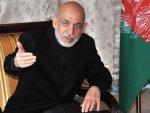
Afghan president calls on Taliban to drop weapons

Afghanistan's president
called on the Taliban Thursday to relinquish their weapons, saying that the group and its leader should join the political process. The call by Hamid Karzai was the latest peace appeal to the Taliban and Mullah Mohammed Omar. All past requests have been ignored by the insurgency — which refuses to directly engage the government. "Mullah Mohammad Omar can come to any part of Afghanistan he wants to. He can open political office for himself but he should drop the gun," Karzai said at a nationally televised news conference held at the presidential palace. Mullah Omar has been on the run since the U.S. invasion in late 2001, and his Taliban have been fighting the U.S.-led coalition and Afghan government for more than a decade. The militant group has refused peace talks with Karzai, calling him a puppet of the United States. Instead, they have held talks directly with American officials. They broke off talks earlier this year, saying the U.S. reneged on a promise to release Afghan prisoners from Guantanamo Bay. The talks have so far shown no signs of restarting.

New polio case emerges in Quetta

The Express Tribune
A new case of polio emerged from the Sabzal Road area of Muslimabad in Quetta after family of a twenty three-month-old girl refused to administer her with anti-virus drops citing religious reservations — raising the number of affected children in the province to three this year. UNICEF Media Officer Massoma Qurban told The Express Tribune that the baby identified as Mehrma, daughter of Agha Abdul Karim, was infected with the polio virus. “The virus has been detected from a child and she had never been vaccinated in her life,” he said. Qurban revealed that the child did not receive polio vaccines because her family refused to administer the drops citing religious reservations. The last polio case from Quetta was detected on January 6, 2012 — with 14 polio cases having been reported from the areas in 2011. Balochistan, in total, identified 18 polio cases during the same period last year compared to three this year. According to sources, the child’s uncle Abdul Qayum Agha, prayer leader of a local mosque, denied polio vaccines to his niece. “At least 20 houses of the colony are obeying him and denying polio vaccines to their children,” sources said. They added that polio teams were not being allowed to operate in the colony – Sabzal Road is one of the largest slum localities of Quetta – for the last four years on religious grounds. Meanwhile, Balochistan’s Expanded Programme on Immunisation (EPI) head Dr Yusuf Bizenjo said that at least 200 children of the nearest areas will be affected because of ineffective administration of the anti-virus drops. “Denying polio vaccines to the children will cause many problems very soon,” Dr Bizenjo said.

Zardari signs contempt of court amendment bill

The Express Tribune
President Asif Ali Zardari gave his consent to the controversial contempt of court amendment bill on Thursday, Express News has reported. The bill will provide immunity from contempt proceedings to high office holders, including the prime minister, president, chief ministers, federal and provincial ministers as well as governors. It had earlier been passed by the National Assembly on Monday and the Senate on Wednesday. The move is key given that Prime Minister Raja Pervaiz Ashraf’s reply is due on whether he would be following the court directives on writing a letter to Swiss authorities to reopen graft cases against President Asif Ali Zardari and his late wife, former prime minister Benazir Bhutto. The cases had been closed earlier under the controversial NRO, which was struck down by the court as void ab initio in 2009.

Husain Haqqani’s life in grave danger

dawn.com
The Supreme Court on Thursday heard the memo case, DawnNews reported. A nine-judge bench, headed by Justice Mian Shakirullah Jan, heard the case on the controversy after the Memo Commission held that Pakistan’s former ambassador to US Husain Haqqani was the architect of the memo sent to former US military chief Admiral Mike Mullen seeking US intervention to avert a possible overthrow of the government by the military. During the hearing, petitioner Barrister Zafarullah said Haqqani was still in the United States and had not returned to Pakistan to appear before the bench despite being summoned. Moreover, the court inquired Haqqani’s counsel Asma Jahangir as to why her client had not appeared for the hearing. Asma said the court’s directives had been delivered to Haqqani, adding that her client’s life was in “grave danger”.The counsel should request the government and not the court to provide security to Haqqani, Justice Tariq Pervez said. “Haqqani was being provided security when he was useful…we contacted the government regarding his security but have not been given a reply,” Asma said. She moreover said she had received a letter from Haqqani which she later read out to the court. The letter said that sections of the media had portrayed Haqqani as a turncoat and that PTI chairman Imran Khan and Sheikh Rasheed had labelled him as a traitor to the country. On that, Justice Pervez inquired as to why the counsel was making public the correspondence between herself and her client. Making this letter public is what my client wants, Asma told the bench. Asma moreover requested the court to review its directive of summoning Haqqani in the given circumstances. Allowing Haqqani three days to file an application for exemption from appearing before the court, the bench adjourned the hearing to an unspecified date. Earlier on June 29, the court had asked Haqqani and US businessman of Pakistani origin Mansoor Ijaz, a central character in the scandal, to appear before it on Thursday. “I will not risk my life until the circumstances that have put my life in jeopardy have changed,” Haqqani said in the letter addressed to the Supreme Court.

ANP not to tolerate violation of women's rights

The Provincial President ANP, Senator Afrasiab Khan Khattak said that the party has protected rights of women on every platform in every era and will continue efforts for the purpose in future. He expressed these views while addressing a meeting of women vice presidents from different districts of Khyber Pakhtunkhwa here in Chief Minister's House on Wednesday. Provincial general secretary ANP, Khyber Pakhtunkhwa Arbab Mohammad Tahir Khan Khalil, provincial secretary information, Malik Ghulam Mustafa and member provincial assembly, Yasmin Zia were also present on the occasion. Women office bearers briefed the provincial president on problems faced by them at district level. Senator Afrasiab Khattak vowed that violation of the rights of women would not be tolerated in any circumstances. He said that the rights of women will be provided full protection both at organizational and government levels and directed all districts presidents to ensure the participation of women in their district level meetings and giving weigh to their opinion both in the utilization of developmental funds and activities of social welfare to remove the sense of deprivation amongst them. He told all women office bearers of ANP to come to Bacha Khan Markaz incase of any complaint or grievance through letters. For the redressal of their grievances, he said they will contact district office bearers. The provincial president ANP said that women are more than half of the national population and they cannot be kept out of the political process. He said the resolution of the problems faced by the women pre-requisite for guaranteeing their participation in political process.

Pakistan: The judges are no caliphs

Daily Times
BY:Dr Mohammad Taqi
The religiously charged sermons, heavy doses of Persian poetry and anecdotes about figures and events from Islamic history have become a staple of the Supreme Court judges A few days ago the National Assembly’s Public Accounts Committee (PAC) expressed its intention to revisit the policy of handing out plots to judges and bureaucrats and to scrutinise the accounts of the Supreme Court of Pakistan (SC). The PAC made public lists containing names of those who had obtained one or more plot. The lists included names of several judges and the current registrar of the SC. Even if nothing else comes out of it, the PAC and its chairperson Nadeem Afzal Gondal, MNA, have successfully flayed the last shreds of the caliphs of Islam pretence that the apex court has adopted of late. The religiously charged sermons, heavy doses of Persian poetry and anecdotes about figures and events from Islamic history have become a staple of the Supreme Court judges in their assorted judgments in high profile. Nowhere was this attempt to present themselves as the reincarnation of the greats of Islamic history more evident than the Chief Justice of Pakistan (CJP) Iftikhar Mohammad Chaudhry’s initial attempt to preside over the case against his son, Dr Arsalan Iftikhar, who was facing charges of mega-corruption. Thankfully, CJP Iftikhar Chaudhry did eventually recuse himself from the case but not before making a dramatic appearance in court with the Holy Quran reportedly displayed on his rostrum. The idea ostensibly was to invoke the imagery of the justice of the second rightly guided caliph of Islam, Syedna Umar Farooq (RA), who had not only presided over a judgment against his son, Abu Shahma, but punished him with lashes. Abu Shahma is said to have died during the punishment and the remaining lashes were delivered on his grave per Syedna Umar Farooq (RA)’s orders. However, it seems that the honourable judges of the Supreme Court only wish to invoke Hazrat Umar (RA) as their role model when they are firmly in command of the proceedings — whether against their family or others. When it comes to emulating Hazrat Umar (RA) in offering themselves for public accountability, the judges would rather remain lesser mortals like us, relying on the law supposedly shielding them from scrutiny by the PAC. The Supreme Court refused to send its registrar to appear before the PAC, saying per media reports: “The Supreme Court is not part of the government and the rules only empower the PAC to examine accounts showing misappropriation of money granted by the National Assembly. Since the sum allocated to the SC is charged expenditure on federal consolidated funds, it is not in principle granted by the assembly.” The SC was alluding to the Article 68 of the constitution, which states, “No discussion shall take place in Majlis-e-Shoora (Parliament) with respect to the conduct of any Judge of the Supreme Court or of a High Court in the discharge of his duties.” But receiving residential plots beyond one’s employment or retirement remuneration package can hardly be categorised as something done in the line of duty. The inimitable attorney-writer Saroop Ijaz has dealt deftly and in detail with the legal and constitutional problems with the SC’s flimsy plea in his column, ‘Our right to know’, in an English contemporary. But as our honorable judges are immensely fond of Islamic history and poetry, let me paraphrase for them an episode from Syedna Umar (RA)’s era recorded by his biographer and poet, Shibli Naumani, in the poem Adl-e-Farooqui ka aik waqia (an episode of Umar Farooque’s justice). One day, Hazrat Umar, while giving a sermon in the mosque, asked the congregation if they would obey him if he ordered them. A common man got up and said he refused to obey because he had plundered from the war bounty and was not fit to be the caliph thus. The man alleged that Caliph Umar (RA), who was a tall man, had taken for himself two pieces of cloth from the bounty to make the dress he was wearing that day, while everyone else has received just one piece. Now Syedna Umar (RA) had the option of shutting the man up under some pretext or other but instead opted not do so. Instead, he asked his son to stand up and bear witness. The son informed the congregation that indeed one sheet of cloth would not have been enough to make his father’s dress and that was why he gifted his share of the bounty, i.e. his sheet of cloth, to Hazrat Umar (RA). The accuser withdrew his allegation and renewed his allegiance to Caliph Umar (RA). The honourable judges of the superior judiciary wielding the false shield of Article 68 are clearly no caliphs!

SWAT: Saidu Sharif airport ready to become operational

The Express Tribune
After almost six years, the Saidu Sharif Airport in Swat has been renovated and is ready to re-open. Established in 1978, the airport, which handled two daily flights from Islamabad and Peshawar, was closed during militancy in Swat valley. “The airport has been renovated and we have informed PIA. The service will resume as soon as they provide us a flight schedule,” Civil Aviation Authority (CAA) Public Relations Officer Pervez George told The Express Tribune on Wednesday. Authorities say about 1,000 people from Swat travel abroad every day. Most of them used to take a flight from Saidu Sharif to catch their international flights. Ahmad Shah, a travel agent, explained that travelling via road is cumbersome because of the high number of check points. “The passengers end up missing their flights. So to avoid such a situation, they normally leave ahead of time and stay at hotels. This not only wastes time but also costs more.” Majority of the business commodities, he added, are imported to Swat from Punjab. For this, traders and business communities have to travel 12 hours by road, which is both time-consuming and risky. “As many as 14 buses carrying businessmen and traders daily travel to Lahore. But often, they get robbed on the way. The business community is facing a tough time due to the grim situation of security and delay in transportation,” he added. The owner of another travel agency, Zahir Shah, said, “There is dire need of air services from Swat to Lahore.” He said that as Lahore has an international airport, other business communities working abroad will prefer the route for foreign travel. Tourism is considered to be the backbone of the economy in Swat, but deteriorating roads and issues of insecurity has reduced the number of tourists to half. “Majority of tourists visit Swat from Punjab and Sindh. They have to travel on rough roads. The airport will ease their burden and boost tourism in the region,” Shah added. The valley is one of the largest producers of fruit but according to Fruit and Vegetables Association Swat, half of their harvest goes to waste owing to slow transportation. “As we have no freezing facilities for storing fresh fruit, half of the stocks get wasted. An air cargo service will benefit local farmers and dealers,” Zamin Khan, a fruit dealer, said.

Terrorist attack kills 9 in Lahore

Gunmen shot dead nine police and prison staff as they slept on Thursday, the second attack on security forces since Islamabad reopened a NATO supply corridor. Police said the dawn attack, in which 10 gunmen stormed a residential property housing officers from the northwest who were in the city for training, bore the hallmarks of a similar assault on an army camp on Monday. The killings raise fears of a fresh wave of violence in Punjab that will be vital in upcoming general elections, and which for the past year had seen a lull in attacks blamed on Taliban-linked insurgents. Punjab police chief Habibur Rehman said the attackers came on three motorcycles and one car, armed with Kalashnikov rifles and hand grenades. They then stormed the building in the densely populated area of Ichra, where up to 35 police and prison staff were sleeping early Thursday. "Nine people have died so far in this attack," Rehman told reporters at the scene. Rescue workers wrapped bodies in white sheets and survivors sobbed over the deaths of their colleagues as bullet casings lay discarded outside the two-storey grey building, television footage showed. Lahore city police chief Aslam Tareen told AFP that nine people were also wounded. There was no immediate claim of responsibility, but police blamed the "same gang" who killed seven security personnel at an army camp in Punjab's district of Gujrat, 150 kilometres (100 miles) southeast of Islamabad, on Monday. "All defunct organisations are working in close cooperation with each other" to attack security forces, Rehman told reporters. A senior security official told AFP that in Monday's attack it was "highly likely" that the gunmen belonged to a banned organisation in league with the Taliban. Considered Pakistan's cultural capital and close to the Indian border, Lahore is a city of eight million that in 2010 suffered a string of high-profile bombings blamed on Taliban and Al-Qaeda.