Tuesday, June 26, 2012

Afghans sing again—of love and war

DAWN.COM
In a country where music was silenced in the name of God for five years, the beat is back and even rock shares the airwaves with the romantic strains of traditional Afghan songs. The Taliban, who banned all music as sinful while they were in power between 1996 and 2001, are now waging an insurgency against the Western-backed government—but they can’t stop the music. They have even developed an acapella style of their own, chanting religious poems to the glory of suicide bombers and their fighters waging war on government forces and some 130,000 Nato troops. The Central Asian nation has an ancient tradition of songs built on its rich culture of poetry, ranging from war, heroism and epic tales of life in this harsh land, to delicate love stories. But there is a vast difference between traditional lyrics and those of the Taliban. Traditional: “Last night I stole a quick glance at your moon-like face through your dark hair,” goes a famous Afghan song performed in the 1970s by celebrity Abdul Rahim Sarban. “Your half-open crimson dress was prettier than a hundred roses in the garden… a narcissus shies away before the beauty of your seducing eyes.” Taliban: “The youth is out on a fedayee (suicide) mission, his heart filled with passion for his religion. “The youth is out on fedayee mission, the angels are watching him, the paradise houris (pure companions) are watching when the suicide bomber strikes.” Even in the new forms of pop and rock, imported along with the Nato troops, the war is never far away. In a makeshift studio in their apartment in west Kabul, four young men have formed a band called Morcha (Ants), which they describe as Afghanistan’s first rock band. Vocalist Shekib Musadeq, drummer Shafiq Najafi and two bass players Hassanzada and Behroz Shujahi gather daily for practice, rocking their building—and their neighbours—with Western beats. “Music has been part of the people’s life ever since history remembers,” says Hassanzada. He describes their lyrics as “neither about love, nor Taliban hatred” but about current realities in their war-shattered country: a deadly insurgency, corruption, the illicit drugs trade and natural disasters. “Fifteen died in Helmand, the drought ended in Herat… Nato conducted a rapid air strike on a wedding party,” the band sings against the beat of drum and bass guitar while practising for a big concert in Kabul. “The Taliban peace plan on the president’s desk, the elders of Paktika endorsed it… The headlines from Afghanistan, thanks to the world are all about these.” But love songs accompanied by traditional tabla drums and elegant, lute-like rubab strings, remain a staple of the old style: “I’m a worshipper of flowers, drunk without drinking (because) tonight I’m with a flower,” sings Sarban. And in a country where many women still wear the all-enveloping blue burqa that was enforced by the Taliban, lyrics are not short of erotic elements. “I still smell your scent in my bed, feeling your sweet lips all over me,” sang the late Ahmad Zahir, who was nicknamed “Afghanistan’s Elvis”. The Taliban, who shunned modernity while in power, now use video and the Internet to get their message across. As a background to a video posted on their website showing dozens of Taliban fighters attacking a US military base in Paktika province, they chant: “The lion cubs can’t be tamed… you’ll be crying, lost, unable to find your way home, your child will never see you again… leave our home before it’s too late or Afghanistan will become your second Vietnam.” The Taliban chants are sometimes used as mobile phone ring tunes across southern Afghanistan, the heartland of the insurgency—where they can be a passport through any trouble with the militants. But the rest of the range of musical styles can be heard on dozens of radio and television channels, and drifting though open car windows as drivers negotiate the chaotic streets of the once silent capital, Kabul. Abdul Satar Qasimi, a professional rubab player and singer who runs a musical instrument shop in Kabul’s “Musician Street”, says Western-style music has pushed many classical performers to the sidelines. Qasimi, 45, fled to Pakistan when the Taliban took Kabul in 1996, and his music store was destroyed by the militants. He returned after the Taliban were toppled in a US-led invasion in late 2001. “Now music has flourished but not for us. More and more people are listening to the new music, rock, pop and all these new forms of music,” he said.

President, PM condemn attack on Aaj TV office

AAJ TV
President Asif Ali Zardari and Prime Minister Raja Pervaiz Ashraf condemned the attack on Aaj TV office late on Monday. The President made an official statement condemning the miserable event in which two employees of Aaj TV were injured. Prime Minister Raja Pervaiz Ashraf, along with his condemnation, stated that proper measure would be taken to provide protection to media personnel within the country. The PM further ordered the apprehension of the miscreants by the earliest possible time. Chief Minister Qaim Ali Shah on the contrary, has ordered a detailed investigation into the horrible incident further ensuring that security would be provided at the Aaj TV office.

Gunmen open fire on Pakistan television station

Gunmen opened fire on a local television station in Pakistan's largest city, injuring a guard and an employee, police and TV officials said late Monday evening. "Four men on two motorcycles attacked our station in Karachi with automatic guns," Rashid Mehmood, local Aaj News TV's director of news told AFP. "They also damaged some cars and fled," he said, adding that the guard's injuries were serious. Police official Asghar Ali confirmed the report. "The two injured men have been shifted to a local hospital and we are on the lookout for the culprits of the attack," he said. Mehmood said there had been no threats made from any militant group to the television station. "We had no threat whatsoever, from any militant group," he said. Ehsanullah Ehsan, spokesman for the Pakistani Taliban, claimed responsibility for Monday's attack, threatening that the militants could attack again if coverage of their stance "is not given equal to that of government and the army". "We should be given the coverage equal to what media gives to the government and the army," he said. "We had called the Aaj News TV and asked them to hear us as well, but they turned down our plea. "We have attacked them today and can go far if our stance is kept unheard." The shooting was the second attack on Aaj TV in five years. The channel was previously attacked amid a frenzy of political violence in May 2007.

Pakistan: Micro-finance credit bureau

State Bank of Pakistan has been stressing the importance of micro-finance for the last few years. On Wednesday, the 20th June, 2012, it went a step further by setting up micro-finance-exclusive credit information bureau (MF-CIB) in its organisational structure to give a boost to the micro-finance sector. Highlighting the importance of this sector in Pakistan's economy, Governor, SBP, Yaseen Anwar stated that the bureau would help micro-finance banks and micro-finance institutions in developing a robust risk management system, which in turn would reduce the risk of multiple borrowings and loan defaults. As such, the MF-CIB would open access to credit for millions of potential poor borrowers and reduce the credit risk cost of the lenders, besides lowering the loan price for borrowers. At present, even the creditworthy borrowers of micro-finance institutions face difficulties in accessing larger loans due to non-availability of their history of past loans and timely repayments to a micro-finance institution. The MF-CIB could facilitate the "graduation" of such livelihood-based workers into small entrepreneurs. SBP, according to the Governor, had played a sterling role in the development of micro-finance sector as an alternative to conventional banking to serve the lower end of the market. Financial inclusion, which was a core component of SBP's financial sector development strategy, envisages transferring the financial market into an equitable system with efficient market-based financial services to the otherwise excluded - poor and marginalised - population, including women and young people. Pakistan had one of the lowest financial penetration levels in the world, with 56 percent adult population totally excluded, and another 32 percent informally served. We totally agree with the basic idea of State Bank establishing the MF-CIB but are also aware of its limitations. As in the case of existing credit bureau in the SBP, the new bureau would also certainly serve a very useful purpose by identifying the habitual loan defaulters in the micro-finance sector. The raising of red flag in these cases would not only help the micro-finance institutions in refusing loans to applicants with a dubious history but would also oblige these institutions to open access to potential creditworthy borrowers who could play a really useful role in reviving economic activities in the country. The opening of MF-CIB, could also have an indirect impact on alleviation of poverty and creation of more employment opportunities. Since the ratio of loan default in micro-finance in Pakistan is usually higher than in conventional lending, the establishment of such a facility in the SBP was of course long overdue. However, while commending the usefulness of MF-CIB, it needs to be kept in view that State Bank, as a matter of policy, should not be so much concerned about equitable distribution of credit or helping the poorer or marginalised sections of society. While assistance to the poor is a noble idea, it is the proper management of fiscal policy which should carry the burden of a welfare regime and ensuing equity, bank credit must be facilitated to flow to business activities which yield the highest returns to ensure its use in an optimal fashion. Also, the situation, at present, demands that the State Bank must continue to concentrate on ensuring price stability and persuading the government to borrow less from the banking system in order to spare more resources for the private sector credit expansion including for the micro-finance sector. Nobody can refute the importance of micro-finance in the country's economy and the need to remove impediments to its free flow but the nation will be served better if the State Bank continues to accord priority to its primary responsibility of reducing inflationary pressures on the economy and checking sub-optimal use of bank credit.

Polio vaccination banned in South Waziristan

The Express Tribune
In yet another setback to the polio eradication campaign in the country, the Mullah Nazir group in Wana subdivision of South Waziristan banned polio vaccination in the agency on Monday till the United States halts all drone strikes in the tribal region. According to the Taliban pamphlets distributed in Wana, Western powers were running a spy network in the region in the garb of immunisation. The leaflet went on to cite the example of Dr Shakil Afridi, the doctor who helped the CIA hunt down Osama bin Laden by conducting a fake polio vaccination programme in Abbottabad. Earlier, warlord Hafiz Gul Bahadur banned the administration of oral polio vaccine to children in North Waziristan, also demanding cessation of US drone attacks. The pamphlet went on to compare polio drops to sugar-coated poison, adding that Western powers had never been loyal to Muslims. “If they [the United States and its allies] were so sincere with the Muslims, then why did they bomb us so mercilessly,” the pamphlet said. The distributed message also gauged US sincerity, questioning why two million children had suffered in Iraq due to the lack of medicines in the 90s, referring to US sanctions on the Saddam Hussein regime. Furthermore, the leaflet also discussed the psychological effect drone strikes have had on children in the tribal region. “On the one hand, they are killing innocent children in drone strikes, while on the other hand they are saving their lives by vaccinating them … it’s like a wolf in sheep’s clothing,” the pamphlet said. The decision to ban polio vaccination was taken by the higher council of North Waziristan Mujahideen, according to the pamphlet, which also warned all polio teams to bring their campaign to a close or accept responsibility for any future mishap. A local resident, requesting anonymity, told The Express Tribune, that the pamphlet requested parents to avoid the vaccination of their children till drone strikes continued in Waziristan. There has been no official reaction from the political administration or security forces till the filing of this report.

Pakistan: Govt schools facing shortage of books

Frontier Post
Despite the lapse of three months government schools in Dir Lower are still facing shortage of course books for students. Talking to local journalists here on Monday, school teachers and parents complained that schools in the district needed course books. They said that new academic session had been started since April, 8 but required books had not been provided to schools despite repeated demands. "Whenever we contacted school administration we were told that books are coming," said a father, adding that still his son needed three course books. The Khyber Pakhtunkhwa government had provided free of cost course books to students of state run schools in the province in March, sources told, adding that the government had stopped supply of some books after the opposition especially religious parties protested against changes in Islamic studies and other books. The schools' administration had been asked to send its report about shortage, sources said, adding that majority of high schools both male and female had the shortage of three books and they had sent the report to the EDO education office well in time but to no avail. The parents said that their children had been without books for three months how they would be able to appear in examination, they asked and demanded of the Khyber Pakhtunkhwa government to ensure immediate supply of books to schools in Dir Lower.

GWADAR WITHOUT WATER, ANKARA KAUR DAM RESERVOIR DRIED

Balohistan’s future economical and port city is facing the problem of drinking water and the Ankara kaur Dam is empty now which was build in 1993. Thanks the wrong and defective designing and architect by the NESPAK. Balochistan National Party (BNP- Awami) leader Kahuda Babar told this scribe that leaders from federal government had always made tall claims that Gwadar is on its way for development but they cant see the local people of the Gwadar are facing acute shortage of drinking water. “The Ankara Kaur Dam is empty now there is no more water is available for drinking. If the positive steps are not taken than there will be the loss of a large number of the human life,” he said and adding that the former district Government had taken the water issue and they made the tube wells for local people but it is not fulfilling the full demand of the port city. He demanded from the federal government to take immediate steps in this issue and bring water from Mirani Dam. If these steps are not taken than the Gwadar city will be a ghost town in near future and people search for water or migrate to other human settlements. The Ankara Kaur Dam, built in 1993 and stretching over an area of 17,000 acres, remains the sole source of water supply to the local inhabitants. The crisis worsened in 2006 as population increased following construction of the Deep Water Port. Gwadar town and Jiwani are constituting 50 per cent of the total population of Gwadar district, they rely on the Ankara Kaur Dam reservior for all their water needs. Residents of the other three coastal towns of Pasni, Ormara and Sunt Sar are dependent upon seasonal rivers for meeting their demand. The citizens decried the utter failure of authorities to come up with a viable solution to the problem. “There are always making tall claims about developing Gwadar city, but in reality we are deprived of basic necessities,” says a local journalist Dilshad Diyani. “The government is doing nothing except making false claims. Gwadar has been suffering from an acute water shortage for the past decade, but no concrete steps have been taken to overcome this problem.” The incumbent provincial government, however, remains optimistic that they can overcome the crisis. “We have taken up this issue with the Chief Minister who visited Gwadar recently. He not only approved several water projects but also directed authorities concerned to expedite their efforts,” says Hamal Kalmati, Provincial Minister for Fisheries, elected to the Provincial Assembly from Gwadar. According to Kalmati, the Balochistan government has approved Rs 4 billion for Shadi Kaur Dam and another Rs 2 billion for Sawar Dam, both of which are currently under construction. To avert the crisis in the short term, a plan to connect Gwadar with the Mirani Dam in Kech district is also being done round the clock. However, according to Kalmati, the political administration in Kech is against the move. The crisis of water for Gwadar was expected when the wrong planning and designing of the Ankara Kaur Dam was prepared by the NESPAK. The storage are of the Dam had silted up in less than 25 years while it was designed for half century. The Government should start desilting the storage ground of the dam and also carrying out raising the dam on the pattern of Mangla Dam, local engineers and independent economists suggested.

Pakistan: Time to Rethink

EDITORIAL:DAILY TIMES
With the removal of PM Gilani retrospectively from office on June 19, the fate of dozens of orders passed and decisions made by him from April 26, when he was convicted for contempt of court, hung in the air. This constitutional vacuum had the potential to destabilize the democratic process already rocked by the unprecedented rift between the judiciary and the executive. The void was therefore hurriedly filled by the passing of the Validation Ordinance 2012 by President Zardari, with the insight to mitigate the destabilising factors as soon as possible. Providing legal cover to the Budget 2012-13 passed by Gilani’s government was the biggest challenge facing the government. Similarly the appointments and confirmation of some judges and protocols signed with foreign countries needed a legal shield to keep the wheels of the state moving. A petition has already been filed in the Supreme Court for declaring void all the acts by Gilani after his disqualification on April 26 and putting his name on the exit control list. The detailed judgment of the three-member bench that declared Yousuf Raza Gilani defunct is still awaitedj it may or may not protect all the legal acts of Mr Gilani between April 26 and June 19. However, given the charged political atmosphere, the ordinance was deemed urgent for the continuity of state business. Many believe that the statement issued by the Chief Justice on June 23 about parliament not being allowed to enact any law repugnant to the constitution, fundamental rights and Islamic provisions, geared up the government for the swift issuance of the Ordinance. Exercising extra caution, the Presidential Ordinance hence restrains the courts, including the Supreme Court, from accepting any challenge against it. Chances are that the forces bent on seeing the back of the government may still challenge the Ordinance, creating a new fissure in the political set up. The removal of Gilani was unprecedented given the role of the judiciary rather than parliament in sacking him. The controversial letter to the Swiss authorities seems to have acquired outsized importance against the grave issues afflicting the country. Now that the polity appears to be inching towards new elections, spanners in the works, whether coated in judicial activism or other approaches may derail democracy rather than allowing it a chance to survive. There is no gainsaying the fact that the government has performed poorly. Nevertheless, the politics of rift and stigmatization would further complicate the situation. Until now the PPP has remained unprovoked by the orders of the court in the case of Yousuf Raza Gilani and has amicably acceded to his removal. This time round, however, chances are that if Raja Pervez is implicated in the letter issue, the PPP would pursue the legal fight to the finish. This might open up a new saga of confrontation, harming the cause of the judiciary as well as democracy. No one doubts the importance of freeing the nation from the clutches of corruption and holding politicians accountable, but that should not be done at the cost of political stability carrying huge economic costs. Should the CJ revisit his statement that he issued on Saturday: “No one can claim supremacy over and above the law,” the political temperature would come down leaving some breathing space to think clearly. Widely seen as the last hope by many in the country to close the door to any extra-constitutional development, it is fervently believed that in the wake of any attempt to oust the present set up unconstitutionally, the CJ would always throw his support behind the constitution.

Karachi peace top priority

Prime Minister Raja Pervaiz Ashraf has said that peace in Karachi was a government priority and vowed to solve all other problems with the help of allies. The prime minister was speaking to the media following his visit to MQM headquarters Nine Zero and his meeting with Pir Pagara at Kingri House on Monday where he thanked them for the support in his election. Raja reiterated that parliament was supreme and the major problems facing the country were the energy crisis and law and order that he hoped would be solved soon. “The parliament is the mother of all institutions and if all state institutions continue to work within their ambit, there will be no instability in the country,” the prime minister said. Raja added that he would continue his predecessor Yousuf Raza Gilani’s policies formulated in consultation with the allies. To a question about his future, he said “I am here till Allah’s will and wish of the PPP and the allied parties. I got the coveted post because it is Allah’s will and I will stay here till He wills so.” Raja Pervaiz Ashraf said he would do his best to follow the vision of Zulfikar Ali Bhutto, Benazir Bhutto and President Asif Ali Zardari and would take along all the allied parties to serve the masses. “We believe in love for all and hatred for none.“ About the last night attack by Afghan militants in Upper Dir that led to the killing of several Pakistani security personnel, he said the government had strongly protested and he would also talk to Afghan President Hamid Karzai about the incident. The PM was welcomed by large gathering of MQM’s workers at Nine Zero, flowers petals were showered on the PM and slogans were raised in the favor of the PM. MQM chief Altaf Hussain, speaking over the telephone during Raja’s visit to Nine Zero, welcomed the new prime minister. He said he was happy that Pervaiz Ashraf was not born with a ‘silver spoon’ but was “also a worker (like him). This has happened for the first time in Pakistan that a worker has become a prime minister”. Defending Raja Pervaiz Ashraf’s tenure as the power minister, Altaf said that Raja was misguided and misled by others but all the blame was put on him. He hoped that the new PM had learnt from past mistakes and in his six months in power, he will put all his capabilities to good use. “He will take such courageous decisions that people won’t have any reservations, but they will rather appreciate him later.” He asked the prime minister to work for the country and not just his party. He advised him to initiate talks in Balochistan to address the law and order situation. “I also want to advise those sitting in the mountains of Balochistan to prepare for talks as this will be beneficial for you as well as the country”. After seeking permission from the prime minister to go off-topic, Altaf said he would like to ask famous astrologist ‘Mamu’ to explain the strange coincidence of coming into power of people who share their names. First it was former president Pervez Musharraf, then the current Chief of Army Staff Ashfaq Pervez Kayani and now the newly elected Prime Minister Raja Pervez Ashraf, noted Altaf. Altaf said President Zardari had experienced a tough time during his four and a half years in office and anyone else in his place would have lost hope. “With patience, he accepted all Supreme Court orders. His prime minister, Gilani was disqualified, and with a heavy heart he removed former ambassador to US Husain Haqqani. The Supreme Court also suspended his wife’s membership. Rehman Malik was also suspended from his Senate seat. But the president maintained patience.” “By accepting Gilani’s disqualification, the president had avoided confrontation,” the MQM chief said, adding that army, judiciary and parliament should work within their ambits. “The trend of institutions working outside their jurisdiction is dangerous,” Altaf said. He stressed that individuals who looted the nation should be boycotted, saying this could only happen if democracy is not derailed. He appealed to the opposition not to engage in anti-democracy politics. Altaf called upon the opposition to join hands with the ruling parties to steer the country out of the crisis. On the issue of National Reconciliation Ordinance (NRO), Altaf Hussain invited all opposition parties to gather at one place and have a debate with him on the issue. “If they beat me over it, I’ll leave politics forever,” he challenged. He added that those holding dual nationalities help in strengthening the country’s economy. During Raja’s visit, MQM central leader Farooq Sattar said that holding of transparent general election is necessary to strengthen democracy in the country. The PM held a meeting with Rabta committee of MQM and discussed the law and order situation of the city. The PM assured the MQM that the federal government would take every possible measure to bring peace in Karachi, adding that the centre was ready to work with MQM to restore peace in the city. Earlier, the PM also visited Kingri House to meet the PML-F chief Pir Sahib Pagara on Monday to personally thank the spiritual leader of Hur Jamaat for his support in his election as prime minister. Sindh Chief Minister Qaim Ali Shah, Governor Dr Ishratul Ebad Khan and Senior Interior Advisor Rehman Malik accompanied the PM to Kingri House and MQM headquarter. The prime minister and Pir Pagara agreed to sustain the ongoing reconciliatory policy in the interest of country and Sindh. Pir Pagara said he would continue alliance of his party with the government which was agreed by his father. Karachi peace top priority, says Raja

Monday, June 25, 2012

POLIO: Over 3,000 children given expired polio drops

The Express Tribune
Over 3,000 children – below the age of five years – have been immunised with expired polio vaccines in Shakai Valley, about 30km north of Wana Bazaar in South Waziristan Agency, an official of the political administration has revealed. Senior official Aslam Jawed, who seized the expired polio vaccines in Shakai himself, told The Express Tribune: “During the June 14 and 15 polio campaign, 200 polio vials which contained expired polio drops were given to children in Sanga, Manthoi, Mandatta and Landi Noor areas of Shakai. Each vial was used to administer drops to 15 to 18 children. In total at least 3,000 children have been given the expired polio vaccine.” Jawed further said that the expired vials were seized and submitted along with a report to the office of the assistant political agent of Wana Sub-division, adding that the expiry date written on the vials was May, 2012. When contacted, the assistant political agent’s office confirmed to The Express Tribune that a report about the expired polio vials has been received. It was revealed that the office will launch an investigation to find out the reasons behind the ‘serious’ incident. Effects on children The expired drops seemed to have affected a number of children. Regarding his son’s health, Muhammad Nawaz Khel, resident of Landi Noor, Shakai said that on June 14 a polio team came to his house and his two year and nine month old son, Shah Zeb, was given the expired polio drops. That night Zeb’s temperature started rising rapidly and early in the morning he had to be shifted to the Noor Muhammad Medical Clinic in Wana Bazaar. “Doctors at the clinic told us that he has developed a chest infection,” the father said. Khel added: “In the morning we came to know that children in other houses of Landi Noor were also suffering from high fever. But we never thought that they were getting sick because of the polio vaccination. “We are willing to immunise our children but we do not want to kill them by giving them expired vaccines. An investigation should be launched to find out how this could happen.” Meanwhile, South Waziristan Agency Surgeon Shar Zali Khan was contacted several times for comments but to no avail. Sources said that government departments at first tried to keep this incident a secret. But days later it became public knowledge as stricken children were brought to clinics in Shakai and Wana Bazaar. South Waziristan is one of the seven tribal agencies where the polio virus has not been eliminated. Earlier, polio virus (P-1) was confirmed in a four-year-old in Panj Gena, Tehsil Birmal, Wana sub-division.

POLIO: Swat FM radio to promote polio vaccination

DAWN.COM
A local organisation will air programmes on FM radio to promote immunisation and protect children against vaccine-preventable ailments in three selected union councils of Swat. “The Awakening,” which recently won one of five projects awarded by the Canada’s Sandra Rotman Centre, is trying to reach the people, who were inaccessible in the past, for vaccination. “A local cleric has banned vaccination after Shakil Afridi’s alleged fake campaign in Abbottabad. We have formed a delegation of respected scholars to convince him and allow immunisation,” Irfan Hussain Babak, director of The Wakening, said. He said that alongside radio programmes from Da Aman Awaz (Voice of Peace) radio, they had employed local women, who were visiting houses in the three union councils including Islampura, Sangota and Kokorai to hold sessions with mothers and educate them about significance of vaccination. Mr Babak said that four programmes would be on air early next month from the local radio to provide detailed information to the listeners regarding immunisation and its benefits. “Each programme will be of one-hour duration during which live questions will be taken from the callers and answered by officials concerned. Prevention of disease through vaccination will be the main message we want to send across the community,” he said. Vaccination experts from executive district health office will be invited to the programmes to make them more informative and interesting for the people. Mr Babak said that there were misconceptions about vaccination in Swat as the area remained under the influence of Taliban between 2007 and 2009. “We want do away with these misconceptions and create demand for vaccination against eight diseases,” he said. He said that their people suffered greatly over the years and child mortality rate from the preventable diseases was high. Most of the people lived in mountains and they didn’t know about vaccine and its impact on children health, he said. He said that his organisation had formed village health committees. “We are also planning to hold stage dramas in schools during the four-month project. We are targeting mothers because they are the ones, who really take interest in health and wellbeing of their children,” he added. Mr Babak said that the programmes on radio were planned to reach those areas where local clerics were opposed to vaccination. Efforts would be made to sensitise mothers that vaccination would save their children from host of ailments, he added. “If we educate women regarding the importance of vaccination, we can achieve 100 per cent coverage,” he said. Mr Babak said that Swat district recorded 22 polio cases when it remained under the Taliban in 2009 as they didn’t allow vaccination and considered it a plot by the US to make the recipients infertile and impotent. Taliban propagated against vaccination and stopped parents from immunising their children against the disease, he said. After defeat of Taliban, Swat had not recorded any case but still virus was in circulation in few of the target 25 villages, he said.

Pakistan's power play intensifies

After sacking one PM, the crusading head of the judiciary sets his sights on the new premier.
Political turmoil is nothing new to the people of Pakistan. But last week they experienced something unprecedented. A sitting prime minister was disqualified by the Supreme Court, the man proposed to replace him was forced to stand aside after a court issued a warrant for his arrest, and a controversial alternative candidate was eventually elected for what most observers say will be a curtailed term. The disqualification of Yousaf Raza Gilani by the Supreme Court and his replacement by the former power minister Raja Pervez Ashraf took Pakistan into further choppy waters at a time when it is facing challenges on multiple fronts. The economy is struggling, its relationship with the US is fraught and there is a crippling power shortage that has sparked angry riots in many cities. "We want peaceful ties with our neighbours Afghanistan, Iran and India. We desire good relations in our region on the basis of the philosophy of peaceful co-existence," Mr Ashraf declared on Friday evening in his first address in the parliament. "As a responsible nation, Pakistan will continue to play its role as an enabler and facilitator of peace and stability in the region and the world." But the former power minister's term as premier is unlikely to be peaceful. The judiciary, headed by the assertive Chief Justice, Iftikhar Chaudhry, will most likely confront Mr Ashraf, as it did Mr Gilani, demanding that he write to the authorities in Switzerland and ask them to reopen an old corruption inquiry against President Asif Ali Zardari. The man nicknamed "Rental Raja" by Pakistan's media also faces allegations that he received kickbacks during his term as power and water minister and he has already been questioned by anti-corruption investigators. Aware that elections must be held before next March, and that forces beyond its control could ensure they take place sooner, Mr Zardari's Pakistan Peoples Party (PPP) is readying itself for more turbulence. The weeks ahead will be crucial for the party and for Mr Zardari, who appears to be looking to a second term as president. In both national and provincial contests, the party will face a stiff challenge from Nawaz Sharif's Pakistan Muslim League-N and from the former cricketer Imran Khan and his Pakistan Tehreek-e-Insaf, both of which have been benefiting from Mr Zardari's deep unpopularity. "They need to get every vote in the national and provincial assemblies to secure his future. He is looking for a second term," said Farzana Shaikh, an expert on the country at London's Chatham House. "There is a great deal at stake." Analysts say the drama last week underscores a recurring fault line within Pakistan and the constant challenging for power between various institutions – elected politicians, the military and the judiciary. The issue of an arrest warrant for Mr Zardari's initial choice to replace Mr Gilani, the textiles minister Makhdoom Shahabuddin, on the day he filed his nomination papers, suggests the military, which heads the anti-narcotics force that is investigating him, is also in the current fray. "The clashes highlight the fact that organisations are fighting for more powers for themselves and that Pakistan is still in the process of evolving institutions. This is quite usual in periods of transition," said Ejaz Haider, a leading commentator. "The judiciary has its own place within the constitution which cannot be denied it on the argument that it is not elected and therefore must kowtow to an elected government. The legal and political sovereigns are out of joint, and that is the underlying reason for the current tussle." The clash between the PPP and Mr Chaudhry's Supreme Court dates back to 2009, when Mr Zardari refused to reinstate the deposed chief justice in the face of a lawyer-led movement for judicial independence backed by the opposition and a cross-section of the media. Mr Zardari was forced to capitulate after a march threatened his government's stability. At the time, the army chief, General Ashfaq Parvez Kayani, also made a discreet intervention, in an effort to avert total chaos. Mr Zardari's reluctance was ascribed to a fear that Mr Chaudhry would revive old the corruption charges against him – a fear that has now been realised. The PPP says the charges against Mr Zardari are politically motivated. Once back in the Chief Justice's chair, Mr Chaudhry's popularity continued to rise. In a country where the political class is widely seen as inept, distant and venal, there are few places for Pakistanis to rest their hopes. The army is still tainted by decades of military dictatorship that failed to live up to breathlessly touted promises of a different, more efficient form of government. Mr Chaudhry has been seen as a crusader against corruption and abuse. Never before in Pakistan's history have as many senior government officials been summoned to court to justify their actions. Even the powerful military intelligence agencies have been grilled over their notorious human rights abuses, in particular the "disappearance" of political dissidents in the restive south-western province of Baluchistan. But despite welcome efforts to shake off the court's pliant past, now there is growing criticism that it is overstepping its mandate, assuming a political role, and, at times, positioning itself as an alternative government. Some say its decision to sack Mr Gilani was more about politics than the law. As the country struggles to see a civilian elected government complete a full, five-year term, Pakistan's stunted democracy has suffered another setback. The voters have never had the opportunity to rid themselves of an unpopular prime minister, and have been denied that opportunity once again. Traditionally, it was the army that often made the move to rid itself of supposedly troublesome politicians. Three military coups since the 1950s have each led to around a decade of generals in power. More often, civilian leaders were shunted aside by subtler means, such as a palace coup, in which the army's proxy president would dismiss a government on dubious grounds. Now, as then, it is unaccountable institutions that have arrogated to themselves the right to represent the will of the people of Pakistan over their elected representatives. This time, there's also a dark element of intrigue. Mr Gilani's sacking comes as a scandal unfolds involving the Chief Justice's son, a government-connected billionaire and other shady characters. The billionaire claims that Arsalan Chaudhry extorted £2m in cash and expensive holidays from him. Supporters of the Chief Justice cry foul, but don't deny his son's involvement. Instead, they say that the son was being suborned as part of an elaborate attempt to lure the Chief Justice into a trap that would make his downfall inevitable. Either way, questions abound about the Chief Justice's involvement, knowledge or complicity. Mr Chaudhry hasn't proceeded in an entirely dispassionate manner. He decided to summon both the billionaire, Malik Riaz Hussain, and his own son to the Supreme Court, without any wariness of an obvious conflict of interest. The verdict against Mr Gilani, which came just days later, is being seen, against this backdrop, as carrying an element of revenge. The prospect now is of an intensifying clash that could further unsettle Pakistan's weak and faltering democracy. Some conspiracy theorists whisper that the powerful army is looking on with gratification, plotting to gently bring down the government and install a caretaker set-up of assorted technocrats for the next few years. But Pakistan's politicians are unlikely to accept their fate so easily. Mr Zardari has won a reputation for cunning and brinkmanship. He is not going to let his power quietly drain away. And the opposition, led by the former prime minister Nawaz Sharif and Mr Khan, the former cricketer, are in no mood to see their political gains slip into the hands of a non-political coterie. Whatever the outcome, Pakistan will certainly not be dull for the next few months.

A Cruel and Unusual Record

By JIMMY CARTER
THE United States is abandoning its role as the global champion of human rights. Revelations that top officials are targeting people to be assassinated abroad, including American citizens, are only the most recent, disturbing proof of how far our nation’s violation of human rights has extended. This development began after the terrorist attacks of Sept. 11, 2001, and has been sanctioned and escalated by bipartisan executive and legislative actions, without dissent from the general public. As a result, our country can no longer speak with moral authority on these critical issues. While the country has made mistakes in the past, the widespread abuse of human rights over the last decade has been a dramatic change from the past. With leadership from the United States, the Universal Declaration of Human Rights was adopted in 1948 as “the foundation of freedom, justice and peace in the world.” This was a bold and clear commitment that power would no longer serve as a cover to oppress or injure people, and it established equal rights of all people to life, liberty, security of person, equal protection of the law and freedom from torture, arbitrary detention or forced exile. The declaration has been invoked by human rights activists and the international community to replace most of the world’s dictatorships with democracies and to promote the rule of law in domestic and global affairs. It is disturbing that, instead of strengthening these principles, our government’s counterterrorism policies are now clearly violating at least 10 of the declaration’s 30 articles, including the prohibition against “cruel, inhuman or degrading treatment or punishment.” Recent legislation has made legal the president’s right to detain a person indefinitely on suspicion of affiliation with terrorist organizations or “associated forces,” a broad, vague power that can be abused without meaningful oversight from the courts or Congress (the law is currently being blocked by a federal judge). This law violates the right to freedom of expression and to be presumed innocent until proved guilty, two other rights enshrined in the declaration. In addition to American citizens’ being targeted for assassination or indefinite detention, recent laws have canceled the restraints in the Foreign Intelligence Surveillance Act of 1978 to allow unprecedented violations of our rights to privacy through warrantless wiretapping and government mining of our electronic communications. Popular state laws permit detaining individuals because of their appearance, where they worship or with whom they associate. Despite an arbitrary rule that any man killed by drones is declared an enemy terrorist, the death of nearby innocent women and children is accepted as inevitable. After more than 30 airstrikes on civilian homes this year in Afghanistan, President Hamid Karzai has demanded that such attacks end, but the practice continues in areas of Pakistan, Somalia and Yemen that are not in any war zone. We don’t know how many hundreds of innocent civilians have been killed in these attacks, each one approved by the highest authorities in Washington. This would have been unthinkable in previous times. These policies clearly affect American foreign policy. Top intelligence and military officials, as well as rights defenders in targeted areas, affirm that the great escalation in drone attacks has turned aggrieved families toward terrorist organizations, aroused civilian populations against us and permitted repressive governments to cite such actions to justify their own despotic behavior. Meanwhile, the detention facility at Guantánamo Bay, Cuba, now houses 169 prisoners. About half have been cleared for release, yet have little prospect of ever obtaining their freedom. American authorities have revealed that, in order to obtain confessions, some of the few being tried (only in military courts) have been tortured by waterboarding more than 100 times or intimidated with semiautomatic weapons, power drills or threats to sexually assault their mothers. Astoundingly, these facts cannot be used as a defense by the accused, because the government claims they occurred under the cover of “national security.” Most of the other prisoners have no prospect of ever being charged or tried either. At a time when popular revolutions are sweeping the globe, the United States should be strengthening, not weakening, basic rules of law and principles of justice enumerated in the Universal Declaration of Human Rights. But instead of making the world safer, America’s violation of international human rights abets our enemies and alienates our friends. As concerned citizens, we must persuade Washington to reverse course and regain moral leadership according to international human rights norms that we had officially adopted as our own and cherished throughout the years. Jimmy Carter, the 39th president, is the founder of the Carter Center and the recipient of the 2002 Nobel Peace Prize.

A Rare Glimpse of the Real Iran

BY:NICHOLAS D. KRISTOF

Putin arrives in Israel to discuss West's standoff with Iran

Haaretz.com
Russian President Vladimir Putin arrived in Israel on Monday morning on an official state visit. Putin heads a large entourage comprised of government ministers, advisers and journalists. The 300-person delegation arrived in four planes. Israeli officials are hoping to recruit Russia's government to join their efforts against Iran's nuclear program. They also want to encourage a number of security and economic initiatives. Foreign Minister Avigdor Lieberman is expected to greet the Russian contingent this morning at Ben-Gurion Airport. The visitors will head straight to Netanya, where Putin will dedicate a monument memorializing Red Army soldiers, an initiative sponsored jointly by him and Prime Minister Benjamin Netanyahu. The Russian leader is expected to receive a warm welcome there. President Shimon Peres will be the main Israeli representative at the dedication ceremony. He is expected to praise the Soviet Union's actions against Nazi Germany, as well as the current Russian government's efforts to promote peace between Israel and the Palestinians."Israel owes a deep debt of gratitude to Russia and the Russian army for its decisive role in the liberation of camps and the triumph over Nazi Germany," Peres will declare. "Today as well, Israel views Russia as a lighthouse, as a state that plays an important role in the advance of peace in the Middle East, and a state that takes steps to improve the world while battling terror." Putin will travel from Netanya to Jerusalem, where he will meet with Netanyahu at his official residence. The prime minister cancelled his participation in the Netanya event because of a cast on his leg. Joining the two for lunch will be two Likud members: Public Diplomacy and Diaspora Affairs Minister Yuli Edelstein, and coalition chairman Zeev Elkin. Edelstein and Elkin traveled with Netanyahu to Moscow in February 2010; they will serve as translators during the meeting with Putin, and also be on hand to express support for the prime minister's intentions to evacuate the Beit El's Ulpana neighborhood. Also invited to the lunch meeting with Putin are Lieberman, Defense Minister Ehud Barak and Vice Prime Minister Shaul Mofaz. In the evening, Putin will meet with Peres. He will be received at that meeting by an Israel Defense Forces honor guard, and by children who are both Hebrew and Russian speakers; Putin will be welcomed in both languages. Peres is expected to bring up the issue of Iran's nuclear program, and to stress Teheran's effort to assemble nuclear weapons. "The combination of nuclear weapons and a fanatical political leadership poses a genuine threat to the peace of the world as a whole," Peres will state. Putin will then partake in a festive dinner at the President's House, to which top Israeli and Russian security and diplomatic officials are invited. The event will feature an artistic tribute to Russia, in which performers from the bilingual Gesher troupe will sing Russian songs that have Israeli adaptations. The performers are expected to encourage Peres and Putin to join the singing. Tomorrow Putin will visit Bethlehem and Jordan.

Buddha attacked by Taliban gets facelift

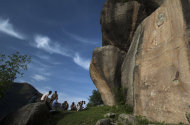
When the Taliban blew the face off a towering, 1,500-year-old rock carving of Buddha in northwest Pakistan almost five years ago, it fell to an intrepid Italian archaeologist to come to the rescue. Thanks to the efforts of Luca Olivieri and his partners, the 6-meter (nearly 20-foot)-tall image near the town of Jahanabad is getting a facelift, and many other archaeological treasures in the scenic Swat Valley are being excavated and preserved. Hard-line Muslims have a history of targeting Buddhist, Hindu and other religious sites they consider heretical to Islam. Six months before the Sept. 11, 2001 attacks, the Taliban shocked the world by dynamiting a pair of 1,500-year-old Buddhist statues in central Afghanistan. The Jahanabad Buddha, etched high on a huge rock face in the 6th or 7th century, is one of the largest such carvings in South Asia. It was attacked in the fall of 2007 when the Pakistani Taliban swarmed across the scenic Swat Valley. The army drove most of them out two years later, but foreign tourists who used to visit the region still tend to stay away. Olivieri himself had to leave in 2008 after more than two decades of tending to the riches dating back to Alexander the Great and the Buddhist, Hindu and Muslim invaders who followed. The 49-year-old head of the Italian Archaeological Mission in Pakistan returned in 2010 and is back at work. Taliban militants climbed ropes to insert explosives in holes drilled into the face and shoulders of the Jahanabad Buddha, said Olivieri. The explosives in the shoulders failed to detonate, but the others blew off most of the face above the lips and cracked other parts of the carving and surrounding rock. Olivieri and his team began work this month on fixing the cracks and what's left of the face. A full reconstruction is impossible because detailed documentation and fragments of the face are lacking. "Whatever you do in the absence of perfect data is a fake," said Olivieri, who says he has wanted to be an archaeologist since age 6 and still brings a youthful exuberance to his work even as his beard grows gray. Arriving as a university student in 1987, he was fascinated by Swat, once an important center of Buddhist culture and trade. The monk credited with introducing Buddhism to Tibet, Padmasambhava, was born in Swat. In more recent decades, the area was known as "the Switzerland of Pakistan," popular with religious tourists from China, Japan and South Korea, and the hope is that restoration of the Jahanabad Buddha will spark a revival of tourism here. Olivieri's mission is funded by the Italian government, which works with local Pakistani antiquities authorities. It has uncovered over 120 Buddhist sites among Swat's soaring hills and rushing rivers. Of roughly 200 Buddhist rock carvings in Swat, the Jahanabad Buddha was among the few to survive with its face intact for so long, said Olivieri. Most were defaced centuries ago by Muslim invaders who, like the Taliban, consider Buddha a false idol. Maulana Shamsur Rehman, a leading Islamist politician in Swat, says the attack on the Buddha should never have happened. Islam preaches freedom and protection for followers of all religions, he told The Associated Press, and "in line with Islamic rules, nobody should have an objection to the repair work on the Buddha statue." In 2001, militants damaged the excavated ruins of a 7th century Hindu temple in Swat overlooking a stronghold conquered by Alexander in the 4th century B.C. Unable to protect the temple, the Italian mission had to rebury it. Ironically, the site that Olivieri was most worried about during the Taliban's violent reign in Swat was an Islamic one — the roughly 1,000-year-old Udegram Ghaznavid mosque, the third oldest in Pakistan. He feared the militants would occupy and damage it, but that never happened. Pakistani security officials say the Taliban are again trying to infiltrate Swat, but militants are not the only threat to the archaeological sites. Looters are perhaps a bigger problem. Many relics looted from Swat are in private and public collections around the world. In December police arrested several men in Swat and seized a roughly one-meter-(three-foot) tall, 1,800-year-old Buddhist statue that could have fetched tens of thousands of dollars on the international antiquities market. The Italian mission has posted guards at the most important sites and is also training them to become guides by teaching them English, first aid and basic conservation techniques, said Olivieri. The mission opened in 1955 in an office provided by the Wali of Swat, the one-time princely ruler of the territory. To furnish a taste of home, its first draftsman painted a mural of Rome's Spanish Steps in the dining room. The feeling of glimpsing Italy in the wilds of Pakistan's northwest continues today. There's espresso in the morning and Italian olive oil on the dining room table. A Fiat Campagnola jeep shipped from Italy in 1955 is due to end up in a museum in Swat. ____

Peshawar: UNESCO mobile-based literacy programme: 2500 students to be accommodated

United Nations Educational,Scientific and Cultural Organization (UNESCO) would give basic literacy skills to 2500 students in third phase of its literacy programme, designed to use mobile phone both for learning and communication. Under the programme, launched in collaboration with cell phone operator, Mobilink, their skills would be improved by communicating with teachers through SMS based interactive lessons. As a value addition, the third phase will also enable 100 participating teachers to coordinate with supervisors and report on student progress via data enabled SIMs provided by Mobilink. According to UNESCO here on Sunday, Mobile Based Literacy programme is a unique initiative that utilises mobile technology to improve literacy for female students, aged between 15 to 25 years in rural and deprived areas. The current phase also extends its outreach to learners in KP and Punjab through 100 learning centers. When contacted Country Representative UNESCO said three years back UNESCO started piloting mobile literacy project and through that small project we have expanded the use of mobile phones for more than communication, now its also an active tool of information, education and knowledge in Pakistan. The UNESCO official said through this project UNESCO has made 1500 adult female not just literate but also made them connected to the world and empowered them to a degree where they feel empowered citizens, which we count as great achievement. Another 2500 rural adult females will be made literate through this current phase. The official said this programme uses use mobiles as a tool for delivering educational materials to participating students. As part of the program, students and teachers are provided with mobile phones to improve on reading and writing skills, with two way interaction through SMS, the official said and added teachers will also be able to monitor and record progress of their students using a unique mobile software, developed by Mobilink for the programme. Mobilink official was also appreciative of the programme and said earlier phases provided great results, reaching out to 1500 female students and hoped to achieve more in third phase.

Tirah nearly falls to Taliban

There have been multiple operations, of different sizes, in Khyber agency between 2008 and 2011. Two of the biggest were those of 2008 and 2009. And yet, on June 11, newspapers reported that Tirah valley in Khyber agency had ‘fallen’ to the Taliban, forcing local families to move to surrounding areas, adding to the thousands of internally displaced people (IDPs) in the region. Tirah valley has ‘almost’ fallen to the Taliban, corrected one journalist when asked about what happened. It is reported that the Taliban have established control over approximately sixty per cent of the valley. However, the journalist also explained that around 1800 families have moved from Tirah to Jamrud, another sub-division of Khyber agency, “and this is not normal, people used to move in the other direction,” he added. Analysts and those on the scene reveal that the debacle in Tirah is a result of minimal military presence – without support, the local people were not able to put a strong front against militant groups finding abode in Tirah valley. Linked to Kurram and Orakzai in the South and Afghanistan on the West, the over 100-kilometre long Tirah is a beautiful valley in Khyber agency (with a small part extending into Orakzai). It has a rough terrain and hardly any road network. “The Tariq Afridi led Taliban were ejected out of Dara Adamkhel in 2009 after a military operation in the Dara (2008-2009) and made their way to Orakzai and Tirah valley. Initially, the local people gave them space out of fear or because they were forced to,” explained Ibrahim Shinwari, a seasoned journalist of the area. However, as the Kukikhel tribe – the native tribe inhabiting areas of Tirah and neighbouring Jamrud– realised the suffering they were facing because of the presence of the Taliban, the whole tribe started putting up a united resistance, added Mr Shinwari. Since the Taliban were not in any mood to face opposition, they launched into a direct clash, and “given the fact that the local people did not have as many resources as the Al-Qaeda backed, larger Taliban,” the Kukikhel faced defeat. Tirah valley remains an area where there is no military presence at the moment. However, this has not always been the case. After 9/11, military forces and frontier forces had moved in to establish posts and stop infiltration of Al-Qaeda members into Pakistan from Afghanistan but they all left by 2004 and 2005 “for unknown reasons,” according to journalists. “Part of the reason that Tirah has been left alone”, as Brig (retired) Shah Mehmood, a defence analyst pointed out, “is the difficulty of an operation in this area”. “The army makes occasional forays but cannot launch a full-fledged operation that requires artillery because there are no road networks – Tirah valley is a very large area and it will have to be a very large operation to secure it. It will need at least two divisions,” he added. Looking at the bigger picture, Tirah valley – that has historically never really come under the government’s control, is facing the consequences of the military operations in surrounding areas and might become another safe haven as Taliban feel the squeeze at other fronts. Towards the east, Bara and Jamrud are undergoing smaller operations (ongoing since 2011 according to Mansur Khan Mehsud) and remain points of contention. Khyber agency has faced various operations since 2008 but of the three sub-divisions of Khyber – Bara, Jamrud and Landi Kotal – only Landi Kotal can be called safe. Orakzai, in the south, is undergoing a major operation in which, according to Brig Mehmood, the reports coming out show that foreign militants who had found refuge in Pakistan are getting targeted. “If these foreign militants are actually getting killed, then this is really meaningful. There has been news of an Algerian and even a Maldivian getting killed and that shows that progress is being made,” he said, “but this is a mountainous area so the army moves very slowly, often on foot, so progress remains slow.” Outside Tirah A local journalist, when asked about living conditions in Bara, said that day to day life is miserable: “Small operations mean that they will put a curfew in 10 villages and then try to flush out militants,” so on daily basis, people have to face curfews, constant security checks from the government forces and insecurity from these militants. “The writ of the state has not been established, there is hardly any political presence. Government offices, health units, schools, all these essentials remained closed in many areas,” explained Mr Shinwari. “When they started the operation in 2009, over 600 government employees resigned and even though they claim that more than half have returned in different areas, there are no signs of a political administration and there have been ongoing attacks on peace forces,” he added. The general agreement among observers is that this is a failure to hold onto areas that were cleared of militants. The army has gone into areas, cleared them out such that militants leave with the IDPs and move into other areas and at the end, the situation does not improve. “They make check posts and declare an area clear but two or three days later we hear that someone has been publicly prosecuted or that deserters were killed or something like that,” expressed Ibrahim Shinwari. On the other hand, Brig Mehmood defends this saying: “Bara hasn’t seen a full scale operation. In other areas, the army has gone in, launched an operation and maintained presence and are making progress, but in Bara the only attempt has been to scare off local militant groups for ten or fifteen miles when the likes of Lashkar-e-Islam increase the frequency of kidnappings for ransom and other crimes,” explained Brig Mehmood. And the military has adopted a version quite similar. Journalists who have talked to the military about the latest development in Tirah reveal that as far as the army is concerned, this was not unexpected. As operations continue in surrounding areas, they expected that the Taliban will move into the untouched Tirah valley, and in fact the army has expressed that Tirah developing into a refuge for militants group can be a problem considering its proximity to Peshawar so the probability is that they will engage the area eventually. For now, the army believes that it has enough hold on the plains of Bara to ensure that there is no penetration from there. But local observers are not happy about the progress in the region. “Look at the surrounding areas, none of the tribal areas is secure because the army has not been able to hold control.The only successful operations have been in Swat and Malakand where the army brought proper brigades and settled in the cantonment and maintained presence,” said one journalist, concluding, “if they have the will, they have to maintain presence.”

Despite US concern, surveillance of foreigners continues in KP

Despite concern by senior officials of the US and other countries over security checks on their diplomats, the law enforcers in Khyber Pakhtunkhwa are continuing with their surveillance of all the foreigners travelling to the troubled areas without prior permission, a source told The News. On the directives of the federal government, the provincial government has imposed ban on the entry of all foreigners, including diplomats, to the sensitive areas such as Malakand and Kohat divisions as well as towns located on the Durand Line. “The authorities are to continue with the policy and allow only those diplomats or foreigners who have obtained prior permission from the Ministry of Foreign Affairs to visit specific areas. Those not having the “no objection certificate” (NOC) should be returned respectfully to Islamabad,” a source said. The US State Department recently expressed concern over stopping of its diplomats by the security forces in Peshawar and other areas of the country, terming it harassment of their officials. The report said the official Pakistani obstructionism and harassment has increased to the point where it is significantly impairing mission operations and programme implementation. The document, which was issued after a February fact-finding tour of the US diplomatic missions in Islamabad, Karachi, Peshawar and Lahore, has made 32 formal recommendations for improving the security and working conditions of the embassy staff. The Khyber Pakhtunkhwa Home and Tribal Affairs Department recently issued directives to the police not to allow any vehicle being used by the diplomats if they move into a prohibited area. The country has been divided into open and prohibited areas for foreign diplomats and their families. The diplomats are allowed to move into the prohibited areas after obtaining permission from the concerned authorities through the Ministry of Foreign Affairs. The police have been directed to politely ask the diplomats to surrender arms, if any, in their possession. The security personnel at the Peshawar Toll Plaza on the Motorway had stopped two diplomatic vehicles carrying six persons, including three US officials, and allowed them to go after seizing arms from them on June 4. The two vehicles were returning to Peshawar from the University of Malakand in Chakdarra in Lower Dir district for which the US authorities claim that they had obtained an NOC. The authorities at the police checkpost objected to the presence of arms in the cars, bearing registration numbers (QJ-679 and ST-476) and refused to let the occupants go until these were handed over to them. Three foreigners and three Pakistani nationals were travelling in the two vehicles. The negotiations continued for a couple of hours as the occupants of the vehicles refused to hand over the arms to the personnel of the law-enforcement agencies. They were taken to the Chamkani Police Station where US Consul General Marie Richards and senior police officials arrived to settle the issue. A case was later registered against the three Pakistani nationals.

Khyber Pakhtunkhwa areas near border off-limits to foreigners

The Khyber Pakhtunkhwa government has advised foreign missions and non-governmental organisations to obtain permission from the ministry of foreign affairs for the visit of their employees to the province to avoid unpleasant incidents. According to the instructions issued by home and tribal affairs department on Sunday, the areas of the province close to border have also been declared out-of-bound for the staff of foreign missions, including ambassadors, and employees of international non-governmental organisations (INGOs). “Visits to areas close to the international border shall not be allowed, interaction/interview with political and religious personalities as well as common people of the area, too, are not allowed,” according to the ‘standard operating procedure’ (SOP) of the home department, underlying criteria for the foreigners’ visit to Khyber Pakhtunkhwa. The department, according to an official press release, has also instructed the Provincial Disaster Management Authority (PDMA) and Provincial Reconstruction, Rehabilitation and Settlement Authority (PaRRSA) to comply with the fresh SOP. “Our job is to facilitate the home department’s instructions, requiring foreigners to get No Objection Certificate (NOC) before visiting parts of Khyber Pakhtunkhwa where PDMA and PaRRSA are conducting a host of development projects with the help of foreign donors,” PDMA spokesman Adnan Khan, when contacted, told Dawn. The employees of foreign missions as well as local and foreign staff of Pakistani and INGOs have been required to seek permission before visiting Malakand division, district Tank in Dera Ismail Khan division and district Hangu in Kohat division. “Instructions have been issued to PDMA and PaRRSA that all foreigners including ambassadors, diplomats, officials of embassies, foreign consulates, consulates general in Pakistan and even Pakistani staff members working for INGOs and NGOs are advised to route their requests in black and white through the ministry of foreign affairs,” according to the home department’s SOP. PDMA and PaRRSA have been required to coordinate with the foreign staff visiting any of the seven districts of Malakand division, including Swat, Dir Upper, Dir Lower, Shangla, Buner, Malakand and Chitral. “Once they are allowed to enter the aforementioned specific areas, the foreigners must ensure that they are not in possession of any illicit weapons, explosive material or any objectionable material, e.g. maps, books, pamphlets, periodicals, posters, etc,” underlines the SOP. It adds that the visitors would not be allowed to preach about any religion, and visits to the restricted areas and installations will not be allowed. The department has also prohibited photography of sensitive and restricted areas. Similarly, NOCs or permission from the ministry of information and broadcasting will be required for documentary filmmaking on any topic in any of the above mentioned districts of Khyber Pakhtunkhwa. The department has advised the foreign missions, federal ministries, provincial government departments and international and local NGOs to ensure fulfillment of pre-requisite requirements. They have been asked to provide information, including name and designation of the visiting persons, their passport numbers and nationality details, CNIC numbers in case of Pakistanis, purpose of their visit, detailed schedule of their visits, specific area they would want to visit, plans, cites to be visited, places where they would stay at night, exact timings of their arrival and exit from the visiting areas, mode of conveyance and the registration number, colour and types of their vehicles and names of their drivers with their CNIC numbers. The foreign missions would also be required to clearly mention the diplomatic status of the foreigners planning to visit. “These written requests should reach preferably by postal service or by fax to the home and tribal affairs department during office hours a fortnight in advance to enable the department to process it for security clearance and to make proper foolproof security cover/escort/protocol arrangements for the visiting dignitaries,” according to the press release. However, it bars carrying of illicit arms and weapons by the visitors. According the PDMA spokesman, his organisation received the home and tribal affairs department’s instructions a few days ago and the officials concerned have been asked to coordinate visits by foreigners and representatives of INGOs to Malakand and southern parts of the province. “NOCs for their (foreigners and INGOs’ representatives) travels to Malakand or any other part falls under the jurisdiction of the home and tribal affairs department, whereas, NGOs and foreign organisations are required to seek NOC from district coordination officer concerned for carrying out development projects in any of the flood-affected and militancy-hit areas in the province,” said Mr Khan. The home and tribal affairs department has advised the foreign missions and INGOs that non-fulfillment of its requirements would render it unable to facilitate their visits to any of the seven northern and three southern districts of the province.

Violence against women on the rise 353 cases reported in 2011

frontier post
Incidents of violence, torture, kidnapping, killing of women in Khyber Pakhtunkhwa have increased even after governmental and nongovernmental organizations’ (NGO) efforts, a survey report said on Saturday.According to a survey by an international NGO, some 353 case of violence against women were reported in 2011 in the province. The cases included violence, torture, rape, kidnapping, honor killings etc.Report said that in 2010, the reported incidents in the province were 317.A helpline was also set up to decrease such incidents but there was no decline in such incidents, it said.

Quetta carnage

EDITORIAL:THE FRONTIER POST
So routine is now thuggish carnage in Quetta in the face of the provincial administration's deafening inaction that the residents of Balochistan's metropolis seem resigned they have to live with it in times to come. Otherwise, the Saturday's terrible bakery slaughter would have triggered such an angry outcry that the administration would have been cowering to save its skin from an outraged public. But nothing of the sort happened. The residents took it as yet another violent bloodshed. And the administration as usual sat pretty, as if it was all calm and quiet in the metropolis. Indeed, it is now since times even hard to recall that Quetta is in the grip of this horrific bloodletting, and is also well on the way of acquiring all the frightening trappings of a Karachi in bloodbath. Bluntly, this gruesome slaughter of the innocent is no lesser heartrending than the incidence of missing persons and mutilated bodies inflicting the province. It indeed is more ubiquitous and more barbaric. Prowling gunmen come swooping, fell numerous innocents in their targeted shootings and vanish unidentified and uncaught. They target individuals; they take on congregations; they target civilians; they take out police cops; they come on bikes; they come riding cars; they kill and maim and then disappear with their deadly weapons. And the administration is just looking on, presenting just a spectacle of helplessness, if not outright unconcern. As this holocaust has been going on now for months on end, it doesn't appear even to have bothered to know who are the perpetrators of this wholesale butchery. At times, some insurgent groups claim responsibility; at times, some rabid sectarian outfit owns up a thuggish assault. But most of the times these grisly massacres are going unclaimed. But whatever it is, the perpetrators have obviously their sleeper cells right inside the capitals where their masterminds, financiers, handlers and guides plot out their vile act. How comes they all stay safe and secure in their lairs without their nestling places being busted and demolished along with them? The provincial administration certainly has its own elaborate network of intelligence units and spooks under the umbrella of its CID department. What are they doing? Sitting just on their haunches, watching all this horrific bloodshed going on listlessly? Why has the administration not tasked its intelligence hounds to seek out the sleeper cells of the thugs, find out their lairs and smoke them out? And if it has, why no heads are rolling out there when this hideous bloodletting is continuing without any let-up at all? And if this carnage is beyond the pale of the provincial security network to stop, why has the Balochistan ruling hierarchy not sought the assistance of the federal agencies? And why have the federal top echelons not themselves offered and provided this assistance whereas the provincial capital of the province is caught up so evidently in a raging bloodbath? Or, are both the provincial and the federal hierarchies itching to have yet another Karachi on their hands? Both must take sense and understand what is in the making. Quetta is just slipping out of the hands of the provincial security apparatus and falling fast in the lap of the thugs of all hues and stripes. The criminals are stalking there. The sectarian demons are prowling there. The insurgents are roaming there. The kidnappers are blithely engaged in their devilish trade of abducting people for ransom. And hired guns are doing a roaring business of murdering and maiming the innocent for a price. All this is more than evident. Yet the incumbent provincial hierarchy first just slept over this fearsome phenomenon. And when in the face of the people's taunts and shrill, it woke up at long last, it woke up only sleepily. Not yet is it fully awake while the time is running fast and the city is sinking deeper into a bloody morass. Will it come fully alive to the fragile security situation of Quetta only when it has spun out of total control irretrievably? When indeed will it wake up to its bounden responsibility to the residents to give them security of life and safety of property? Will chief minister Nawab Aslam Riasani ever understand that his primary job is to govern and administer his province, not to pass time in Islamabad, Lahore or Karachi? His seat of power, Quetta, is in flames and he is still to demonstrate if he is any pushed about it. What an irony! And what a pity!

Pakistan: Time for hard choices

Daily Times
Hardly a day in the office and Prime Minister Raja Pervez Ashraf is faced with the spectre of the NRO case, impelling him to undo the stance taken by his predecessor and write that letter to the Swiss authorities. Two petitions, one in the Supreme Court Lahore’s registry and another in the Sindh High Court, have been filed to take up the issue against the new premier for opening graft cases against the president. The Prime Minister has so far not given any statement to this end; he too would obviously stand on the grounds taken by his former colleague, Yousuf Raza Gilani. On assuming office the PM immediately called an energy conference as a first step to find a solution to the issue of load shedding. On a short term basis the premier has asked the Petroleum Ministry to provide 28,000 tons of furnace oil to power generating units, to add 1,200 MW to the national grid. In a similar order 15 MMcfd of gas would be given to a generation plant in Faisalabad to generate another 65 MW of electricity. The meeting that went on for seven hours also decided to deprive the industrial and CNG sector of gas for one more day to reduce load shedding. Two committees have been constituted, one for Punjab and the other for Sindh, to hold talks with the stakeholders to implement the curtailment programme. No long term energy plan could be developed, that perhaps require more serious deliberations, provided the PM and his cabinet is given the space and time to do so. With the applications against the premier already filed and the Supreme Court set to hear the NRO case on June 27, the chances are that the judicial conundrum would consume the energy needed to settle other pertinent issues that have taken the country by storm. Besides holding a conference on the energy crisis on his first day in office, the PM, in his penchant to reconnect to the people of his rank, the middle class, threw open the doors of the Prime Minister’s House for ordinary people to meet him. Overwhelmed by gratitude over the support of his allies who voted him into office; Raja Ashraf went to meet Chaudhry Shujaat, the President of PML-Q at his residence and thanked him for his party’s support. The pleasantries were punctuated with assurances by the PM of fulfilling the promises that the PPP had made to the PML-Q to reciprocate its support. Another important directive issued by the PM on his first day in office was about enhancing the security of the Supreme Court that has been demanded by the latter recently. There are many issues that would be taken up by the PM in the days to come but in the cacophony of the NRO case there seems little hope for smooth sailing. This brings the country to a new fix where neither democracy nor the stature of the judiciary could be maintained and upheld. In their effort of cutting each other to size, the country would be robbed of important decisions to resolve multiple crises facing it, the paramount being the energy crisis. One had hoped that the dust of the crisis would settle with the ouster of Prime Minister Gilani. Though the calling of new elections seems a viable option, now that the government is not interested to call it a day before completing its full tenure, it is time for sagacity to return at least to the sane minds to let democracy move on. Unless a chance is given, how would the government perform? Being embroiled in cases would further undermine the capacity of the government to make things work for the people. Let the government pass through the acid test to see if in these few months it could live up to the expectations of the people. Otherwise the ballot would decide their fate. For the sake of democracy that has only tentatively set foot on Pakistani soil, let there be a reason to celebrate it by not letting history repeat itself.

PPP to continue politics of reconciliation

Prime Minister Raja Pervez Ashraf on Sunday said the Pakistan People’s Party (PPP) believed in politics of reconciliation and not confrontation, adding anarchy would benefit no one. Talking to reporters after visiting the mausoleums of Quaid, Zulfikar Ali Bhutto and Benazir Bhutto, Ashraf vowed to hold elections in a free, fair and transparent manner so that no one could raise a finger at the government. Ashraf said the PPP leadership was well aware of the hardships faced by countrymen due to the energy crisis and solid steps were being taken to bring betterment in the power supply situation. He said anti-democracy elements thought democracy would derail after Yousaf Raza Gilani was disqualified, but another PPP activist replaced him which disappointed the opponents. The prime minister was of the view that democracy could not be wrecked and it would continue as his party would continue struggle for the purpose with same commitment and sincerity. He said he belonged to the middle class and his appointment as prime minister had proved that the PPP was a party of poor and it worked for their welfare. Ashraf said the PPP was desirous of strengthening national institutions, including judiciary, as it was in the larger interest of the country and its people. He said the country would progress if everyone followed the principles of unity, faith and discipline. He said the PPP and allied parties were committed to promoting politics of reconciliation in line with the vision of Benazir Bhutto. Asked about law and order in Karachi, the prime minister said the city was the jugular vein of Pakistani economy and his priority was to restore peace to the city along with dealing with the energy crisis. He said he had spoken to the governor and chief minister and they were committed to controlling crimes and taking action against those indulging in crimes. About the restoration of NATO supplies, he said the government wanted to have good relations with all countries, including the US, on an equal basis and dignity. He said decision about the restoration of supplies would be taken in line with the recommendations of parliament. While addressing a meeting of PPP leaders in Karachi, the prime minister said that their destination was not achieving power but to implement the philosophy of Zulfikar Ali Bhutto. “People are well aware of every conspiracy being hatched against the Pakistan People’s Party,” Ashraf said, adding that his government would be paying special attention to the energy crisis and the law and order situation. The new prime minister said he would decide on writing the letter to Swiss government in the light of the constitution. He said he did not want any clash between different institutions and the matter of writing letter to the Swiss government would be decided according to the law of the land. Raja Pervaiz also met Sindh Governor Ishratul Ebad and discussed with him the matters related to Sindh province.

ANP should not be compared with MQM

The Express Tribune
Awami National Party (ANP) Sindh chapter chief Senator Shahi Syed on Sunday said that ANP has no competition with the Muttahida Qaumi Movement (MQM) and it should not be compared with the latter. “We are the followers of Ahmed Shah Abdali and our goal is to carry on the non-violence philosophy of Bacha Khan, so we should not be compared with an outfit like MQM.” He was speaking at a rally of ANP Sindh at the KPT ground Keamari. The rally was organised by ANP Keamari chapter activists who had recently joined the party after leaving the Pakistan Peoples Party. Hundreds of Pashtuns carrying red flags came to Keamari to attend the rally. Shahi Syed’s convoy was welcomed with Pashtun music and flower petals, when it entered the ground. Syed in his speech repeatedly stressed on the need of education for the Pashtuns of Karachi, “get your children educated, we don’t want to see our children carrying guns and suicide jackets.” He reminded that Khan Abdul Ghaffar Khan popularly known as Bacha Khan faced the British with the polity of non-violence, when others were holding swords and guns. “If anyone opts for gun, it will be violation of Bacha Khan’s philosophy.” He appealed to the Pashtuns not to settle their tribal vendettas in Karachi. “We are already blamed that every Talib is a Pashtun. Don’t settle your family feuds in Karachi, as this city is vital for the economic survival and stability of the Pushtuns, so keep it peaceful.” He lashed out at the Taliban for affecting 25 million people of Khyber-Pakhtunkhwa and FATA. “Forty thousand of our women gave birth in camps due to you people (Taliban). You should be ashamed of yourself and your acts, which you are doing in the name of religion,” said Syed, when he switched to Pashto on the demand of the crowd. Speaking about ANP and PPP coalition, Syed said that they will remain PPP’s partners, but the PPP should treat ANP like they treat MQM, “we have supported PPP unconditionally and we will do so in the future but they should think that if they can visit Nine Zero day and night, they should also visit Mardan House, which is a centre of Karachi’s Pashtuns.”

Sunday, June 24, 2012

KARACHI: Politics mix with violent crime in Pakistan's Karachi

Relaxing in his luxurious four-storey home, Uzair Baloch has high hopes of breaking into Pakistani politics despite the 63 warrants out for his arrest. "People will give me votes, God willing," said Baloch, as his muscular bodyguards eyed the surrounding slum streets. Murder, torture and extortion allegations would bar most people around the world from seeking public office. Not in Pakistan's commercial capital, Karachi, where men like Baloch thrive amid gang wars and ethnic, sectarian and political violence. He's confident of winning a legislative seat in a general election due early next year. In some ways, instability in the city of 18 million poses a graver security threat to U.S. ally Pakistan than the headline-grabbing Taliban insurgency in the north. Karachi is home to Pakistan's main stock market. It handles all of the cash-strapped country's shipping. The city also generates most of Pakistan's tax revenue - and some of the country's most wanted men. Police say Baloch, whose father was kidnapped and killed by gangsters, has spent years building a business empire through extortion, kidnapping and drugs. He also made powerful friends in political parties in a city long split along sectarian and ethnic lines. Karachi is dominated by the Muttahida Quami Movement, originally set up by mohajirs, Muslims who fled to Pakistan from India at the time of partition. The Awami National Party seeks to challenge them, claiming to represent an influx of millions of ethnic Pashtuns from the strife-plagued northwestern region along the Afghan border. "HUMAN SHIELDS" The country's ruling Pakistan People's Party (PPP) is the smallest player in Karachi. Despite arrest warrants for Baloch dating back to 2009, he's held news conferences and repeatedly appeared at PPP rallies. That all changed in recent months after Baloch publicly criticized the PPP. He believes that prompted police to go after him. But the operation proved disastrous. Last month, thousands of officers attempted to seize control of his stronghold in the Lyari slum but were ambushed by gunmen with rocket-propelled grenades and armor-piercing bullets. Five policemen and about 20 civilians were killed, police say. A legislator's house was set on fire. But no fugitives were arrested. Chaudhry Aslam, a chain-smoking, pistol-packing bearded policeman journalists have dubbed "Pakistan's toughest cop," is charged with going after figures like Baloch. He denies the arrest attempt was politically motivated, and says Baloch's tactics made it impossible to nab him. "He used human shields. That is why we could not arrest him before," said Aslam at a police barracks, where armored vehicles sit in the parking lot and rocket-propelled grenades are stacked in a bathroom. Baloch denies any link to violence. Residents disagree. In one notorious incident, his supporters showed up at the giant Sher Shah scrap yard, witnesses said. Picking their way past the disemboweled car engines littering the oily alleys, traders point to areas where the killers gunned down a dozen men who refused to pay protection money. This week, two brothers were shot in broad daylight less than 50 meters from a police post in the yard. Now, police are stationed just outside the office of market association president Malik Dehelvi. He is still too scared to name the killers. "I am afraid," Dehelvi said, his meaty hand touching the loaded pistol kept on his desk. Colleagues show scraps of paper and phone messages demanding protection money. "The groups who ask for extortion, they can't run it on their own. Obviously there's a party behind it," said Dehelvi. While the Taliban are attacking the state, violence in Karachi was caused by groups inside the state itself, said Kamran Bokhari, vice-president of Middle Eastern & South Asian Affairs with global intelligence company Stratfor. NO-GO ZONES "Democratic forces are unable to deal with the violence because they are involved in it," he said. "It's the political mainstream that is engaged in this kind of violence." Political parties mark their turf with ragged flags strung from lamp posts in crumbling neighborhoods where children too poor to afford a football kick around an empty plastic bottle. Shopkeepers slam down their metal shutters whenever trouble looms. Some areas, like much of Baloch's stronghold of Lyari, are a no-go zone even for police. Baloch blames his former PPP allies for failing to tackle Lyari's hardships, and portrays himself as a Robin Hood figure. "There's no teachers in the schools, no doctors in the clinics," Baloch told Reuters in an interview. "I pay hospital bills when people don't have money ... I tell people, 'as long as I am alive, I will be here for you'." Muhammad Rafique, who represents Lyari in the provincial assembly on behalf of the PPP, has appeared with Baloch at several rallies. He is careful not to criticize his former supporter but insists Baloch had no formal position in the party. "If criminals have taken over politics, how can gentlemen survive?," he said. His own family home lies behind a heavily guarded roadblock. It's easy to see why Rafique is so concerned about Karachi's violence. At police headquarters, officers drag out a sweating, manacled prisoner with a black bag over his head. Kaleem Siddiqui is a confessed killer - $750 a hit, he said. "We charged more if they wanted us to mutilate the bodies in a certain way," he said. "I killed for the money ... (but) I know a lot of people who kill others for politics." Sometimes politicians hired gunmen like himself, he said. Other times they used their own. The police, underfunded, out gunned and widely seen as corrupt, can do little. Karachi only has 30,000 officers. They're not properly trained to gather evidence or prepare cases, said regional prosecutor general Shahadat Arwan. The lack of a witness protection program means few will testify. Baloch, who says all cases against him are politically motivated, is confident he will never end up behind bars. "They made cases against me so they can stop me. They know in the coming election people are with me. People say whatever Uzair Baloch says, we will do this," Baloch said, as a visiting government official looked on. "Even if they kill me," he said, "there are thousands more Uzairs out there."

“Bangladesh Envoy in India slams Pakistan”

Bangladesh envoy to India has attacked Pakistani army, saying its “selfish corporate mindset” may lead to a nuclear confrontation with India, a view endorsed by BJP leader LK Advani- reports the PTI. In his latest blog posting, Advani quotes a pamphlet written by high commissioner Ahmad Tariq Karim to say that in “its obsession with matching India tit-for-tat in missiles and nuclear race”, Pakistan has “failed to address more fundamental problems related to societal development within its own orders, and has gone pretty nigh bankrupt in the process”. Advani mentions a recent meeting with Bangladesh envoy Ahmad Tariq Karim who later sent him a 19-page pamphlet written by him on Pakistan. In the pamphlet, Karim cites seven “deadly sins” of Pakistan which were responsible for the political problems and weak democracy in the neighbouring country. These, according to Karim, are doctrines of Islamic invincibility over Hindus, West Pakistani superiority over inferior Bengalis (Bangladeshis), its indispensability as a strategic ally of the US, too much emphasis on relations with China and Iran, a belief that majority of Kashmiris want to join Pakistan, and that defence of East Pakistan lay in the plains of Punjab (Pakistan). Agreeing with the views, Advani said, “In totality this pamphlet adds up to a very perceptive summing up of all that has gone wrong with Pakistan in the three score years since its foundation.” He further adds, “In the preamble to this pamphlet Karim warns that the selfish corporate mindset of the Pakistan military establishment ultimately may lead to a nuclear confrontation with India.” Karim’s paper also makes a plea to the international community in general and to Saarc in particular to deploy measures that would encourage the return of democracy to Pakistan as soon as possible.

Pakistan: ‘Yes Prime Minister’

Editorial:Daily Times
Like an unexpected ‘jolt’ to the nation, Pakistan’s former minister for energy and power, Raja Pervez Ashraf, is now its 25th prime minister (PM). He has been sworn in and has brought a new cabinet with him: 27 ministers and 11 ministers of state have taken their oaths. It may be a new cabinet and it may have a new head but most of these ministers are the same old faces carrying forward the same old agendas and tasks. The first thing that really strikes one about this transition of power from one PM and his cabinet to the other is how smoothly the whole process went. We in Pakistan are not used to such a rare occurrence whereby all major political players set their differences and petty squabbles aside to allow progress and democratic norms to prevail. While the new PM is not without his detractors — opposition leader Nawaz Sharif thinks Raja Pervez is a “tragedy” for the country and extra-parliamentary force Imran Khan rallied his supporters in Hyderabad by calling the new PM’s election a “shame” for the country — the fact of the matter remains that the unprecedented disqualification of Yousaf Raza Gilani did not become cause for our political and military forces to set the democratic course adrift nor did it make way for violence one feared might erupt due to the PPP’s angry supporters. For democracy to continue half embattled and half bruised in Pakistan, it is of the utmost importance that the exalted institution of the judiciary be a major player in seeing the political process through. For this it must be seen as practicing some restraint. If democracy is not allowed to go through its initial highs and lows everyone suffers, including the judiciary. Under the military rule of General Musharraf it was the courts that saw upheaval and turmoil, with its restoration being unthinkable under the general’s dictatorship. For the judiciary to assume the mantle of activism, as is being viewed by many quarters, it risks turning itself into an autocrat of sorts. The precedent set by the highest court of the land in the dismissal of PM Gilani was a first in this country and probably a first anywhere else in the world, with the courts taking on the role of the legislature. The courts have set June 27 as the next date for the resumption of the NRO case, a mere five days after Ashraf’s appointment, showing that Gilani’s dismissal has not satiated the courts just yet. The PPP is not one to go down without a fight. It is a party that has seen two of its leaders killed in the game of politics. If the Supreme Court keeps summoning and disqualifying PMs, the only institution to lose its credibility will be the courts. There is only so much intervention a public that is so far divided on the issue will stomach before it changes its opinion about the objectives of the court. This will lend the PPP a sympathetic light in time for the upcoming elections, which many predict may come before March 2013. There are too many flip sides to this coin so every player must tread carefully. The PM’s first public announcement has been to assure the people that the energy crisis is at the top of his list of priorities along with rectifying the law and order situation and fixing the economy. This is rhetoric and the Pakistani people are not going to believe it so willingly this time considering that it is coming from the man who promised that load shedding would end once and for all in December 2009, the same man who has been smeared by the courts as receiving kickbacks in the rental power project. Only if this PM delivers, no matter how long he remains in office, will the government be able to gain the favour of the people in any perceived confrontation of the judiciary and executive.