 There have been multiple operations, of different sizes, in Khyber agency between 2008 and 2011. Two of the biggest were those of 2008 and 2009.
And yet, on June 11, newspapers reported that Tirah valley in Khyber agency had ‘fallen’ to the Taliban, forcing local families to move to surrounding areas, adding to the thousands of internally displaced people (IDPs) in the region.
Tirah valley has ‘almost’ fallen to the Taliban, corrected one journalist when asked about what happened. It is reported that the Taliban have established control over approximately sixty per cent of the valley.
However, the journalist also explained that around 1800 families have moved from Tirah to Jamrud, another sub-division of Khyber agency, “and this is not normal, people used to move in the other direction,” he added.
Analysts and those on the scene reveal that the debacle in Tirah is a result of minimal military presence – without support, the local people were not able to put a strong front against militant groups finding abode in Tirah valley.
Linked to Kurram and Orakzai in the South and Afghanistan on the West, the over 100-kilometre long Tirah is a beautiful valley in Khyber agency (with a small part extending into Orakzai). It has a rough terrain and hardly any road network.
“The Tariq Afridi led Taliban were ejected out of Dara Adamkhel in 2009 after a military operation in the Dara (2008-2009) and made their way to Orakzai and Tirah valley. Initially, the local people gave them space out of fear or because they were forced to,” explained Ibrahim Shinwari, a seasoned journalist of the area.
However, as the Kukikhel tribe – the native tribe inhabiting areas of Tirah and neighbouring Jamrud– realised the suffering they were facing because of the presence of the Taliban, the whole tribe started putting up a united resistance, added Mr
Shinwari.
Since the Taliban were not in any mood to face opposition, they launched into a direct clash, and “given the fact that the local people did not have as many resources as the Al-Qaeda backed, larger Taliban,” the Kukikhel faced defeat.
Tirah valley remains an area where there is no military presence at the moment. However, this has not always been the case.
After 9/11, military forces and frontier forces had moved in to establish posts and stop infiltration of Al-Qaeda members into Pakistan from Afghanistan but they all left by 2004 and 2005 “for unknown reasons,” according to journalists.
“Part of the reason that Tirah has been left alone”, as Brig (retired) Shah Mehmood, a defence analyst pointed out, “is the difficulty of an operation in this area”.
“The army makes occasional forays but cannot launch a full-fledged operation that requires artillery because there are no road networks – Tirah valley is a very large area and it will have to be a very large operation to secure it. It will need at least
two divisions,” he added.
Looking at the bigger picture, Tirah valley – that has historically never really come under the government’s control, is facing the consequences of the military operations in surrounding areas and might become another safe haven as Taliban feel the squeeze at other fronts.
Towards the east, Bara and Jamrud are undergoing smaller operations (ongoing since 2011 according to Mansur Khan Mehsud) and remain points of contention. Khyber agency has faced various operations since 2008 but of the three sub-divisions of Khyber – Bara, Jamrud and Landi Kotal – only Landi Kotal can be called safe.
Orakzai, in the south, is undergoing a major operation in which, according to Brig Mehmood, the reports coming out show that foreign militants who had found refuge in Pakistan are getting targeted.
“If these foreign militants are actually getting killed, then this is really meaningful. There has been news of an Algerian and even a Maldivian getting killed and that shows that progress is being made,” he said, “but this is a mountainous area so the
army moves very slowly, often on foot, so progress remains slow.”
Outside Tirah
A local journalist, when asked about living conditions in Bara, said that day to day life is miserable: “Small operations mean that they will put a curfew in 10 villages and then try to flush out militants,” so on daily basis, people have to face curfews, constant security checks from the government forces and insecurity from these militants.
“The writ of the state has not been established, there is hardly any political presence. Government offices, health units, schools, all these essentials remained closed in many areas,” explained Mr Shinwari.
“When they started the operation in 2009, over 600 government employees resigned and even though they claim that more than half have returned in different areas, there are no signs of a political administration and there have been ongoing attacks on peace forces,” he added.
The general agreement among observers is that this is a failure to hold onto areas that were cleared of militants. The army has gone into areas, cleared them out such that militants leave with the IDPs and move into other areas and at the end, the situation does not improve.
“They make check posts and declare an area clear but two or three days later we hear that someone has been publicly prosecuted or that deserters were killed or something like that,” expressed Ibrahim Shinwari.
On the other hand, Brig Mehmood defends this saying: “Bara hasn’t seen a full scale operation. In other areas, the army has gone in, launched an operation and maintained presence and are making progress, but in Bara the only attempt has been to scare off local militant groups for ten or fifteen miles when the likes of Lashkar-e-Islam increase the frequency of kidnappings for ransom and other crimes,” explained Brig Mehmood.
And the military has adopted a version quite similar. Journalists who have talked to the military about the latest development in Tirah reveal that as far as the army is concerned, this was not unexpected.
As operations continue in surrounding areas, they expected that the Taliban will move into the untouched Tirah valley, and in fact the army has expressed that Tirah developing into a refuge for militants group can be a problem considering its proximity to Peshawar so the probability is that they will engage the area eventually.
For now, the army believes that it has enough hold on the plains of Bara to ensure that there is no penetration from there.
But local observers are not happy about the progress in the region. “Look at the surrounding areas, none of the tribal areas is secure because the army has not been able to hold control.The only successful operations have been in Swat and
Malakand where the army brought proper brigades and settled in the cantonment and maintained presence,” said one journalist, concluding, “if they have the will, they have to maintain presence.”
Monday, June 25, 2012
Tirah nearly falls to Taliban
There have been multiple operations, of different sizes, in Khyber agency between 2008 and 2011. Two of the biggest were those of 2008 and 2009.
And yet, on June 11, newspapers reported that Tirah valley in Khyber agency had ‘fallen’ to the Taliban, forcing local families to move to surrounding areas, adding to the thousands of internally displaced people (IDPs) in the region.
Tirah valley has ‘almost’ fallen to the Taliban, corrected one journalist when asked about what happened. It is reported that the Taliban have established control over approximately sixty per cent of the valley.
However, the journalist also explained that around 1800 families have moved from Tirah to Jamrud, another sub-division of Khyber agency, “and this is not normal, people used to move in the other direction,” he added.
Analysts and those on the scene reveal that the debacle in Tirah is a result of minimal military presence – without support, the local people were not able to put a strong front against militant groups finding abode in Tirah valley.
Linked to Kurram and Orakzai in the South and Afghanistan on the West, the over 100-kilometre long Tirah is a beautiful valley in Khyber agency (with a small part extending into Orakzai). It has a rough terrain and hardly any road network.
“The Tariq Afridi led Taliban were ejected out of Dara Adamkhel in 2009 after a military operation in the Dara (2008-2009) and made their way to Orakzai and Tirah valley. Initially, the local people gave them space out of fear or because they were forced to,” explained Ibrahim Shinwari, a seasoned journalist of the area.
However, as the Kukikhel tribe – the native tribe inhabiting areas of Tirah and neighbouring Jamrud– realised the suffering they were facing because of the presence of the Taliban, the whole tribe started putting up a united resistance, added Mr
Shinwari.
Since the Taliban were not in any mood to face opposition, they launched into a direct clash, and “given the fact that the local people did not have as many resources as the Al-Qaeda backed, larger Taliban,” the Kukikhel faced defeat.
Tirah valley remains an area where there is no military presence at the moment. However, this has not always been the case.
After 9/11, military forces and frontier forces had moved in to establish posts and stop infiltration of Al-Qaeda members into Pakistan from Afghanistan but they all left by 2004 and 2005 “for unknown reasons,” according to journalists.
“Part of the reason that Tirah has been left alone”, as Brig (retired) Shah Mehmood, a defence analyst pointed out, “is the difficulty of an operation in this area”.
“The army makes occasional forays but cannot launch a full-fledged operation that requires artillery because there are no road networks – Tirah valley is a very large area and it will have to be a very large operation to secure it. It will need at least
two divisions,” he added.
Looking at the bigger picture, Tirah valley – that has historically never really come under the government’s control, is facing the consequences of the military operations in surrounding areas and might become another safe haven as Taliban feel the squeeze at other fronts.
Towards the east, Bara and Jamrud are undergoing smaller operations (ongoing since 2011 according to Mansur Khan Mehsud) and remain points of contention. Khyber agency has faced various operations since 2008 but of the three sub-divisions of Khyber – Bara, Jamrud and Landi Kotal – only Landi Kotal can be called safe.
Orakzai, in the south, is undergoing a major operation in which, according to Brig Mehmood, the reports coming out show that foreign militants who had found refuge in Pakistan are getting targeted.
“If these foreign militants are actually getting killed, then this is really meaningful. There has been news of an Algerian and even a Maldivian getting killed and that shows that progress is being made,” he said, “but this is a mountainous area so the
army moves very slowly, often on foot, so progress remains slow.”
Outside Tirah
A local journalist, when asked about living conditions in Bara, said that day to day life is miserable: “Small operations mean that they will put a curfew in 10 villages and then try to flush out militants,” so on daily basis, people have to face curfews, constant security checks from the government forces and insecurity from these militants.
“The writ of the state has not been established, there is hardly any political presence. Government offices, health units, schools, all these essentials remained closed in many areas,” explained Mr Shinwari.
“When they started the operation in 2009, over 600 government employees resigned and even though they claim that more than half have returned in different areas, there are no signs of a political administration and there have been ongoing attacks on peace forces,” he added.
The general agreement among observers is that this is a failure to hold onto areas that were cleared of militants. The army has gone into areas, cleared them out such that militants leave with the IDPs and move into other areas and at the end, the situation does not improve.
“They make check posts and declare an area clear but two or three days later we hear that someone has been publicly prosecuted or that deserters were killed or something like that,” expressed Ibrahim Shinwari.
On the other hand, Brig Mehmood defends this saying: “Bara hasn’t seen a full scale operation. In other areas, the army has gone in, launched an operation and maintained presence and are making progress, but in Bara the only attempt has been to scare off local militant groups for ten or fifteen miles when the likes of Lashkar-e-Islam increase the frequency of kidnappings for ransom and other crimes,” explained Brig Mehmood.
And the military has adopted a version quite similar. Journalists who have talked to the military about the latest development in Tirah reveal that as far as the army is concerned, this was not unexpected.
As operations continue in surrounding areas, they expected that the Taliban will move into the untouched Tirah valley, and in fact the army has expressed that Tirah developing into a refuge for militants group can be a problem considering its proximity to Peshawar so the probability is that they will engage the area eventually.
For now, the army believes that it has enough hold on the plains of Bara to ensure that there is no penetration from there.
But local observers are not happy about the progress in the region. “Look at the surrounding areas, none of the tribal areas is secure because the army has not been able to hold control.The only successful operations have been in Swat and
Malakand where the army brought proper brigades and settled in the cantonment and maintained presence,” said one journalist, concluding, “if they have the will, they have to maintain presence.”
Despite US concern, surveillance of foreigners continues in KP
 Despite concern by senior officials of the US and other countries over security checks on their diplomats, the law enforcers in Khyber Pakhtunkhwa are continuing with their surveillance of all the foreigners travelling to the troubled areas without prior permission, a source told The News.
On the directives of the federal government, the provincial government has imposed ban on the entry of all foreigners, including diplomats, to the sensitive areas such as Malakand and Kohat divisions as well as towns located on the Durand Line.
“The authorities are to continue with the policy and allow only those diplomats or foreigners who have obtained prior permission from the Ministry of Foreign Affairs to visit specific areas. Those not having the “no objection certificate” (NOC) should be returned respectfully to Islamabad,” a source said.
The US State Department recently expressed concern over stopping of its diplomats by the security forces in Peshawar and other areas of the country, terming it harassment of their officials.
The report said the official Pakistani obstructionism and harassment has increased to the point where it is significantly impairing mission operations and programme implementation. The document, which was issued after a February fact-finding tour of the US diplomatic missions in Islamabad, Karachi, Peshawar and Lahore, has made 32 formal recommendations for improving the security and working conditions of the embassy staff.
The Khyber Pakhtunkhwa Home and Tribal Affairs Department recently issued directives to the police not to allow any vehicle being used by the diplomats if they move into a prohibited area.
The country has been divided into open and prohibited areas for foreign diplomats and their families. The diplomats are allowed to move into the prohibited areas after obtaining permission from the concerned authorities through the Ministry of Foreign Affairs. The police have been directed to politely ask the diplomats to surrender arms, if any, in their possession.
The security personnel at the Peshawar Toll Plaza on the Motorway had stopped two diplomatic vehicles carrying six persons, including three US officials, and allowed them to go after seizing arms from them on June 4. The two vehicles were returning to Peshawar from the University of Malakand in Chakdarra in Lower Dir district for which the US authorities claim that they had obtained an NOC.
The authorities at the police checkpost objected to the presence of arms in the cars, bearing registration numbers (QJ-679 and ST-476) and refused to let the occupants go until these were handed over to them.
Three foreigners and three Pakistani nationals were travelling in the two vehicles. The negotiations continued for a couple of hours as the occupants of the vehicles refused to hand over the arms to the personnel of the law-enforcement agencies.
They were taken to the Chamkani Police Station where US Consul General Marie Richards and senior police officials arrived to settle the issue. A case was later registered against the three Pakistani nationals.
Khyber Pakhtunkhwa areas near border off-limits to foreigners
 The Khyber Pakhtunkhwa government has advised foreign missions and non-governmental organisations to obtain permission from the ministry of foreign affairs for the visit of their employees to the province to avoid unpleasant incidents.
According to the instructions issued by home and tribal affairs department on Sunday, the areas of the province close to border have also been declared out-of-bound for the staff of foreign missions, including ambassadors, and employees of
international non-governmental organisations (INGOs).
“Visits to areas close to the international border shall not be allowed, interaction/interview with political and religious personalities as well as common people of the area, too, are not allowed,” according to the ‘standard operating procedure’ (SOP) of the home department, underlying criteria for the foreigners’ visit to Khyber Pakhtunkhwa.
The department, according to an official press release, has also instructed the Provincial Disaster Management Authority (PDMA) and Provincial Reconstruction, Rehabilitation and Settlement Authority (PaRRSA) to comply with the fresh SOP.
“Our job is to facilitate the home department’s instructions, requiring foreigners to get No Objection Certificate (NOC) before visiting parts of Khyber Pakhtunkhwa where PDMA and PaRRSA are conducting a host of development projects with the help of foreign donors,” PDMA spokesman Adnan Khan, when contacted, told Dawn.
The employees of foreign missions as well as local and foreign staff of Pakistani and INGOs have been required to seek permission before visiting Malakand division, district Tank in Dera Ismail Khan division and district Hangu in Kohat division.
“Instructions have been issued to PDMA and PaRRSA that all foreigners including ambassadors, diplomats, officials of embassies, foreign consulates, consulates general in Pakistan and even Pakistani staff members working for INGOs and NGOs are advised to route their requests in black and white through the ministry of foreign affairs,” according to the home department’s SOP.
PDMA and PaRRSA have been required to coordinate with the foreign staff visiting any of the seven districts of Malakand division, including Swat, Dir Upper, Dir Lower, Shangla, Buner, Malakand and Chitral.
“Once they are allowed to enter the aforementioned specific areas, the foreigners must ensure that they are not in possession of any illicit weapons, explosive material or any objectionable material, e.g. maps, books, pamphlets, periodicals, posters, etc,” underlines the SOP.
It adds that the visitors would not be allowed to preach about any religion, and visits to the restricted areas and installations
will not be allowed.
The department has also prohibited photography of sensitive and restricted areas.
Similarly, NOCs or permission from the ministry of information and broadcasting will be required for documentary filmmaking on any topic in any of the above mentioned districts of Khyber Pakhtunkhwa.
The department has advised the foreign missions, federal ministries, provincial government departments and international and local NGOs to ensure fulfillment of pre-requisite requirements.
They have been asked to provide information, including name and designation of the visiting persons, their passport numbers and nationality details, CNIC numbers in case of Pakistanis, purpose of their visit, detailed schedule of their visits,
specific area they would want to visit, plans, cites to be visited, places where they would stay at night, exact timings of their arrival and exit from the visiting areas, mode of conveyance and the registration number, colour and types of their vehicles and names of their drivers with their CNIC numbers.
The foreign missions would also be required to clearly mention the diplomatic status of the foreigners planning to visit.
“These written requests should reach preferably by postal service or by fax to the home and tribal affairs department during office hours a fortnight in advance to enable the department to process it for security clearance and to make proper foolproof security cover/escort/protocol arrangements for the visiting dignitaries,” according to the press release.
However, it bars carrying of illicit arms and weapons by the visitors.
According the PDMA spokesman, his organisation received the home and tribal affairs department’s instructions a few days ago and the officials concerned have been asked to coordinate visits by foreigners and representatives of INGOs to Malakand and southern parts of the province.
“NOCs for their (foreigners and INGOs’ representatives) travels to Malakand or any other part falls under the jurisdiction of
the home and tribal affairs department, whereas, NGOs and foreign organisations are required to seek NOC from district coordination officer concerned for carrying out development projects in any of the flood-affected and militancy-hit areas in the province,” said Mr Khan.
The home and tribal affairs department has advised the foreign missions and INGOs that non-fulfillment of its requirements would render it unable to facilitate their visits to any of the seven northern and three southern districts of the province.
Violence against women on the rise 353 cases reported in 2011
frontier postIncidents of violence, torture, kidnapping, killing of women in Khyber Pakhtunkhwa have increased even after governmental and nongovernmental organizations’ (NGO) efforts, a survey report said on Saturday.According to a survey by an international NGO, some 353 case of violence against women were reported in 2011 in the province. The cases included violence, torture, rape, kidnapping, honor killings etc.Report said that in 2010, the reported incidents in the province were 317.A helpline was also set up to decrease such incidents but there was no decline in such incidents, it said.
Quetta carnage
EDITORIAL:THE FRONTIER POSTSo routine is now thuggish carnage in Quetta in the face of the provincial administration's deafening inaction that the residents of Balochistan's metropolis seem resigned they have to live with it in times to come. Otherwise, the Saturday's terrible bakery slaughter would have triggered such an angry outcry that the administration would have been cowering to save its skin from an outraged public. But nothing of the sort happened. The residents took it as yet another violent bloodshed. And the administration as usual sat pretty, as if it was all calm and quiet in the metropolis. Indeed, it is now since times even hard to recall that Quetta is in the grip of this horrific bloodletting, and is also well on the way of acquiring all the frightening trappings of a Karachi in bloodbath. Bluntly, this gruesome slaughter of the innocent is no lesser heartrending than the incidence of missing persons and mutilated bodies inflicting the province. It indeed is more ubiquitous and more barbaric. Prowling gunmen come swooping, fell numerous innocents in their targeted shootings and vanish unidentified and uncaught. They target individuals; they take on congregations; they target civilians; they take out police cops; they come on bikes; they come riding cars; they kill and maim and then disappear with their deadly weapons. And the administration is just looking on, presenting just a spectacle of helplessness, if not outright unconcern. As this holocaust has been going on now for months on end, it doesn't appear even to have bothered to know who are the perpetrators of this wholesale butchery. At times, some insurgent groups claim responsibility; at times, some rabid sectarian outfit owns up a thuggish assault. But most of the times these grisly massacres are going unclaimed. But whatever it is, the perpetrators have obviously their sleeper cells right inside the capitals where their masterminds, financiers, handlers and guides plot out their vile act. How comes they all stay safe and secure in their lairs without their nestling places being busted and demolished along with them? The provincial administration certainly has its own elaborate network of intelligence units and spooks under the umbrella of its CID department. What are they doing? Sitting just on their haunches, watching all this horrific bloodshed going on listlessly? Why has the administration not tasked its intelligence hounds to seek out the sleeper cells of the thugs, find out their lairs and smoke them out? And if it has, why no heads are rolling out there when this hideous bloodletting is continuing without any let-up at all? And if this carnage is beyond the pale of the provincial security network to stop, why has the Balochistan ruling hierarchy not sought the assistance of the federal agencies? And why have the federal top echelons not themselves offered and provided this assistance whereas the provincial capital of the province is caught up so evidently in a raging bloodbath? Or, are both the provincial and the federal hierarchies itching to have yet another Karachi on their hands? Both must take sense and understand what is in the making. Quetta is just slipping out of the hands of the provincial security apparatus and falling fast in the lap of the thugs of all hues and stripes. The criminals are stalking there. The sectarian demons are prowling there. The insurgents are roaming there. The kidnappers are blithely engaged in their devilish trade of abducting people for ransom. And hired guns are doing a roaring business of murdering and maiming the innocent for a price. All this is more than evident. Yet the incumbent provincial hierarchy first just slept over this fearsome phenomenon. And when in the face of the people's taunts and shrill, it woke up at long last, it woke up only sleepily. Not yet is it fully awake while the time is running fast and the city is sinking deeper into a bloody morass. Will it come fully alive to the fragile security situation of Quetta only when it has spun out of total control irretrievably? When indeed will it wake up to its bounden responsibility to the residents to give them security of life and safety of property? Will chief minister Nawab Aslam Riasani ever understand that his primary job is to govern and administer his province, not to pass time in Islamabad, Lahore or Karachi? His seat of power, Quetta, is in flames and he is still to demonstrate if he is any pushed about it. What an irony! And what a pity!
Pakistan: Time for hard choices
Daily TimesHardly a day in the office and Prime Minister Raja Pervez Ashraf is faced with the spectre of the NRO case, impelling him to undo the stance taken by his predecessor and write that letter to the Swiss authorities. Two petitions, one in the Supreme Court Lahore’s registry and another in the Sindh High Court, have been filed to take up the issue against the new premier for opening graft cases against the president. The Prime Minister has so far not given any statement to this end; he too would obviously stand on the grounds taken by his former colleague, Yousuf Raza Gilani. On assuming office the PM immediately called an energy conference as a first step to find a solution to the issue of load shedding. On a short term basis the premier has asked the Petroleum Ministry to provide 28,000 tons of furnace oil to power generating units, to add 1,200 MW to the national grid. In a similar order 15 MMcfd of gas would be given to a generation plant in Faisalabad to generate another 65 MW of electricity. The meeting that went on for seven hours also decided to deprive the industrial and CNG sector of gas for one more day to reduce load shedding. Two committees have been constituted, one for Punjab and the other for Sindh, to hold talks with the stakeholders to implement the curtailment programme. No long term energy plan could be developed, that perhaps require more serious deliberations, provided the PM and his cabinet is given the space and time to do so. With the applications against the premier already filed and the Supreme Court set to hear the NRO case on June 27, the chances are that the judicial conundrum would consume the energy needed to settle other pertinent issues that have taken the country by storm. Besides holding a conference on the energy crisis on his first day in office, the PM, in his penchant to reconnect to the people of his rank, the middle class, threw open the doors of the Prime Minister’s House for ordinary people to meet him. Overwhelmed by gratitude over the support of his allies who voted him into office; Raja Ashraf went to meet Chaudhry Shujaat, the President of PML-Q at his residence and thanked him for his party’s support. The pleasantries were punctuated with assurances by the PM of fulfilling the promises that the PPP had made to the PML-Q to reciprocate its support. Another important directive issued by the PM on his first day in office was about enhancing the security of the Supreme Court that has been demanded by the latter recently. There are many issues that would be taken up by the PM in the days to come but in the cacophony of the NRO case there seems little hope for smooth sailing. This brings the country to a new fix where neither democracy nor the stature of the judiciary could be maintained and upheld. In their effort of cutting each other to size, the country would be robbed of important decisions to resolve multiple crises facing it, the paramount being the energy crisis. One had hoped that the dust of the crisis would settle with the ouster of Prime Minister Gilani. Though the calling of new elections seems a viable option, now that the government is not interested to call it a day before completing its full tenure, it is time for sagacity to return at least to the sane minds to let democracy move on. Unless a chance is given, how would the government perform? Being embroiled in cases would further undermine the capacity of the government to make things work for the people. Let the government pass through the acid test to see if in these few months it could live up to the expectations of the people. Otherwise the ballot would decide their fate. For the sake of democracy that has only tentatively set foot on Pakistani soil, let there be a reason to celebrate it by not letting history repeat itself.
PPP to continue politics of reconciliation
 Prime Minister Raja Pervez Ashraf on Sunday said the Pakistan People’s Party (PPP) believed in politics of reconciliation and not confrontation, adding anarchy would benefit no one. Talking to reporters after visiting the mausoleums of Quaid, Zulfikar Ali Bhutto and Benazir Bhutto, Ashraf vowed to hold elections in a free, fair and transparent manner so that no one could raise a finger at the government. Ashraf said the PPP leadership was well aware of the hardships faced by countrymen due to the energy crisis and solid steps were being taken to bring betterment in the power supply situation. He said anti-democracy elements thought democracy would derail after Yousaf Raza Gilani was disqualified, but another PPP activist replaced him which disappointed the opponents. The prime minister was of the view that democracy could not be wrecked and it would continue as his party would continue struggle for the purpose with same commitment and sincerity. He said he belonged to the middle class and his appointment as prime minister had proved that the PPP was a party of poor and it worked for their welfare. Ashraf said the PPP was desirous of strengthening national institutions, including judiciary, as it was in the larger interest of the country and its people. He said the country would progress if everyone followed the principles of unity, faith and discipline. He said the PPP and allied parties were committed to promoting politics of reconciliation in line with the vision of Benazir Bhutto. Asked about law and order in Karachi, the prime minister said the city was the jugular vein of Pakistani economy and his priority was to restore peace to the city along with dealing with the energy crisis. He said he had spoken to the governor and chief minister and they were committed to controlling crimes and taking action against those indulging in crimes. About the restoration of NATO supplies, he said the government wanted to have good relations with all countries, including the US, on an equal basis and dignity. He said decision about the restoration of supplies would be taken in line with the recommendations of parliament. While addressing a meeting of PPP leaders in Karachi, the prime minister said that their destination was not achieving power but to implement the philosophy of Zulfikar Ali Bhutto. “People are well aware of every conspiracy being hatched against the Pakistan People’s Party,” Ashraf said, adding that his government would be paying special attention to the energy crisis and the law and order situation. The new prime minister said he would decide on writing the letter to Swiss government in the light of the constitution. He said he did not want any clash between different institutions and the matter of writing letter to the Swiss government would be decided according to the law of the land. Raja Pervaiz also met Sindh Governor Ishratul Ebad and discussed with him the matters related to Sindh province.
ANP should not be compared with MQM
The Express TribuneAwami National Party (ANP) Sindh chapter chief Senator Shahi Syed on Sunday said that ANP has no competition with the Muttahida Qaumi Movement (MQM) and it should not be compared with the latter. “We are the followers of Ahmed Shah Abdali and our goal is to carry on the non-violence philosophy of Bacha Khan, so we should not be compared with an outfit like MQM.” He was speaking at a rally of ANP Sindh at the KPT ground Keamari. The rally was organised by ANP Keamari chapter activists who had recently joined the party after leaving the Pakistan Peoples Party. Hundreds of Pashtuns carrying red flags came to Keamari to attend the rally. Shahi Syed’s convoy was welcomed with Pashtun music and flower petals, when it entered the ground. Syed in his speech repeatedly stressed on the need of education for the Pashtuns of Karachi, “get your children educated, we don’t want to see our children carrying guns and suicide jackets.” He reminded that Khan Abdul Ghaffar Khan popularly known as Bacha Khan faced the British with the polity of non-violence, when others were holding swords and guns. “If anyone opts for gun, it will be violation of Bacha Khan’s philosophy.” He appealed to the Pashtuns not to settle their tribal vendettas in Karachi. “We are already blamed that every Talib is a Pashtun. Don’t settle your family feuds in Karachi, as this city is vital for the economic survival and stability of the Pushtuns, so keep it peaceful.” He lashed out at the Taliban for affecting 25 million people of Khyber-Pakhtunkhwa and FATA. “Forty thousand of our women gave birth in camps due to you people (Taliban). You should be ashamed of yourself and your acts, which you are doing in the name of religion,” said Syed, when he switched to Pashto on the demand of the crowd. Speaking about ANP and PPP coalition, Syed said that they will remain PPP’s partners, but the PPP should treat ANP like they treat MQM, “we have supported PPP unconditionally and we will do so in the future but they should think that if they can visit Nine Zero day and night, they should also visit Mardan House, which is a centre of Karachi’s Pashtuns.”
Sunday, June 24, 2012
KARACHI: Politics mix with violent crime in Pakistan's Karachi
 Relaxing in his luxurious four-storey home, Uzair Baloch has high hopes of breaking into Pakistani politics despite the 63 warrants out for his arrest.
"People will give me votes, God willing," said Baloch, as his muscular bodyguards eyed the surrounding slum streets.
Murder, torture and extortion allegations would bar most people around the world from seeking public office.
Not in Pakistan's commercial capital, Karachi, where men like Baloch thrive amid gang wars and ethnic, sectarian and political violence. He's confident of winning a legislative seat in a general election due early next year.
In some ways, instability in the city of 18 million poses a graver security threat to U.S. ally Pakistan than the headline-grabbing Taliban insurgency in the north.
Karachi is home to Pakistan's main stock market. It handles all of the cash-strapped country's shipping. The city also generates most of Pakistan's tax revenue - and some of the country's most wanted men.
Police say Baloch, whose father was kidnapped and killed by gangsters, has spent years building a business empire through extortion, kidnapping and drugs.
He also made powerful friends in political parties in a city long split along sectarian and ethnic lines.
Karachi is dominated by the Muttahida Quami Movement, originally set up by mohajirs, Muslims who fled to Pakistan from India at the time of partition.
The Awami National Party seeks to challenge them, claiming to represent an influx of millions of ethnic Pashtuns from the strife-plagued northwestern region along the Afghan border.
"HUMAN SHIELDS"
The country's ruling Pakistan People's Party (PPP) is the smallest player in Karachi. Despite arrest warrants for Baloch dating back to 2009, he's held news conferences and repeatedly appeared at PPP rallies.
That all changed in recent months after Baloch publicly criticized the PPP. He believes that prompted police to go after him. But the operation proved disastrous.
Last month, thousands of officers attempted to seize control of his stronghold in the Lyari slum but were ambushed by gunmen with rocket-propelled grenades and armor-piercing bullets.
Five policemen and about 20 civilians were killed, police say. A legislator's house was set on fire. But no fugitives were arrested.
Chaudhry Aslam, a chain-smoking, pistol-packing bearded policeman journalists have dubbed "Pakistan's toughest cop," is charged with going after figures like Baloch.
He denies the arrest attempt was politically motivated, and says Baloch's tactics made it impossible to nab him.
"He used human shields. That is why we could not arrest him before," said Aslam at a police barracks, where armored vehicles sit in the parking lot and rocket-propelled grenades are stacked in a bathroom.
Baloch denies any link to violence. Residents disagree.
In one notorious incident, his supporters showed up at the giant Sher Shah scrap yard, witnesses said.
Picking their way past the disemboweled car engines littering the oily alleys, traders point to areas where the killers gunned down a dozen men who refused to pay protection money.
This week, two brothers were shot in broad daylight less than 50 meters from a police post in the yard. Now, police are stationed just outside the office of market association president Malik Dehelvi.
He is still too scared to name the killers.
"I am afraid," Dehelvi said, his meaty hand touching the loaded pistol kept on his desk. Colleagues show scraps of paper and phone messages demanding protection money.
"The groups who ask for extortion, they can't run it on their own. Obviously there's a party behind it," said Dehelvi.
While the Taliban are attacking the state, violence in Karachi was caused by groups inside the state itself, said Kamran Bokhari, vice-president of Middle Eastern & South Asian Affairs with global intelligence company Stratfor.
NO-GO ZONES
"Democratic forces are unable to deal with the violence because they are involved in it," he said. "It's the political mainstream that is engaged in this kind of violence."
Political parties mark their turf with ragged flags strung from lamp posts in crumbling neighborhoods where children too poor to afford a football kick around an empty plastic bottle.
Shopkeepers slam down their metal shutters whenever trouble looms. Some areas, like much of Baloch's stronghold of Lyari, are a no-go zone even for police.
Baloch blames his former PPP allies for failing to tackle Lyari's hardships, and portrays himself as a Robin Hood figure.
"There's no teachers in the schools, no doctors in the clinics," Baloch told Reuters in an interview. "I pay hospital bills when people don't have money ... I tell people, 'as long as I am alive, I will be here for you'."
Muhammad Rafique, who represents Lyari in the provincial assembly on behalf of the PPP, has appeared with Baloch at several rallies.
He is careful not to criticize his former supporter but insists Baloch had no formal position in the party.
"If criminals have taken over politics, how can gentlemen survive?," he said. His own family home lies behind a heavily guarded roadblock.
It's easy to see why Rafique is so concerned about Karachi's violence.
At police headquarters, officers drag out a sweating, manacled prisoner with a black bag over his head. Kaleem Siddiqui is a confessed killer - $750 a hit, he said.
"We charged more if they wanted us to mutilate the bodies in a certain way," he said. "I killed for the money ... (but) I know a lot of people who kill others for politics."
Sometimes politicians hired gunmen like himself, he said. Other times they used their own.
The police, underfunded, out gunned and widely seen as corrupt, can do little. Karachi only has 30,000 officers.
They're not properly trained to gather evidence or prepare cases, said regional prosecutor general Shahadat Arwan. The lack of a witness protection program means few will testify.
Baloch, who says all cases against him are politically motivated, is confident he will never end up behind bars.
"They made cases against me so they can stop me. They know in the coming election people are with me. People say whatever Uzair Baloch says, we will do this," Baloch said, as a visiting government official looked on.
"Even if they kill me," he said, "there are thousands more Uzairs out there."
“Bangladesh Envoy in India slams Pakistan”
 Bangladesh envoy to India has attacked Pakistani army, saying its “selfish corporate mindset” may lead to a nuclear confrontation with India, a view endorsed by BJP leader LK Advani- reports the PTI.
In his latest blog posting, Advani quotes a pamphlet written by high commissioner Ahmad Tariq Karim to say that in “its obsession with matching India tit-for-tat in missiles and nuclear race”, Pakistan has “failed to address more fundamental problems related to societal development within its own orders, and has gone pretty nigh bankrupt in the process”.
Advani mentions a recent meeting with Bangladesh envoy Ahmad Tariq Karim who later sent him a 19-page pamphlet written by him on Pakistan. In the pamphlet, Karim cites seven “deadly sins” of Pakistan which were responsible for the political problems and weak democracy in the neighbouring country.
These, according to Karim, are doctrines of Islamic invincibility over Hindus, West Pakistani superiority over inferior Bengalis (Bangladeshis), its indispensability as a strategic ally of the US, too much emphasis on relations with China and Iran, a belief that majority of Kashmiris want to join Pakistan, and that defence of East Pakistan lay in the plains of Punjab (Pakistan).
Agreeing with the views, Advani said, “In totality this pamphlet adds up to a very perceptive summing up of all that has gone wrong with Pakistan in the three score years since its foundation.” He further adds, “In the preamble to this pamphlet Karim warns that the selfish corporate mindset of the Pakistan military establishment ultimately may lead to a nuclear confrontation with India.”
Karim’s paper also makes a plea to the international community in general and to Saarc in particular to deploy measures that would encourage the return of democracy to Pakistan as soon as possible.
Pakistan: ‘Yes Prime Minister’
Editorial:Daily TimesLike an unexpected ‘jolt’ to the nation, Pakistan’s former minister for energy and power, Raja Pervez Ashraf, is now its 25th prime minister (PM). He has been sworn in and has brought a new cabinet with him: 27 ministers and 11 ministers of state have taken their oaths. It may be a new cabinet and it may have a new head but most of these ministers are the same old faces carrying forward the same old agendas and tasks. The first thing that really strikes one about this transition of power from one PM and his cabinet to the other is how smoothly the whole process went. We in Pakistan are not used to such a rare occurrence whereby all major political players set their differences and petty squabbles aside to allow progress and democratic norms to prevail. While the new PM is not without his detractors — opposition leader Nawaz Sharif thinks Raja Pervez is a “tragedy” for the country and extra-parliamentary force Imran Khan rallied his supporters in Hyderabad by calling the new PM’s election a “shame” for the country — the fact of the matter remains that the unprecedented disqualification of Yousaf Raza Gilani did not become cause for our political and military forces to set the democratic course adrift nor did it make way for violence one feared might erupt due to the PPP’s angry supporters. For democracy to continue half embattled and half bruised in Pakistan, it is of the utmost importance that the exalted institution of the judiciary be a major player in seeing the political process through. For this it must be seen as practicing some restraint. If democracy is not allowed to go through its initial highs and lows everyone suffers, including the judiciary. Under the military rule of General Musharraf it was the courts that saw upheaval and turmoil, with its restoration being unthinkable under the general’s dictatorship. For the judiciary to assume the mantle of activism, as is being viewed by many quarters, it risks turning itself into an autocrat of sorts. The precedent set by the highest court of the land in the dismissal of PM Gilani was a first in this country and probably a first anywhere else in the world, with the courts taking on the role of the legislature. The courts have set June 27 as the next date for the resumption of the NRO case, a mere five days after Ashraf’s appointment, showing that Gilani’s dismissal has not satiated the courts just yet. The PPP is not one to go down without a fight. It is a party that has seen two of its leaders killed in the game of politics. If the Supreme Court keeps summoning and disqualifying PMs, the only institution to lose its credibility will be the courts. There is only so much intervention a public that is so far divided on the issue will stomach before it changes its opinion about the objectives of the court. This will lend the PPP a sympathetic light in time for the upcoming elections, which many predict may come before March 2013. There are too many flip sides to this coin so every player must tread carefully. The PM’s first public announcement has been to assure the people that the energy crisis is at the top of his list of priorities along with rectifying the law and order situation and fixing the economy. This is rhetoric and the Pakistani people are not going to believe it so willingly this time considering that it is coming from the man who promised that load shedding would end once and for all in December 2009, the same man who has been smeared by the courts as receiving kickbacks in the rental power project. Only if this PM delivers, no matter how long he remains in office, will the government be able to gain the favour of the people in any perceived confrontation of the judiciary and executive.
Saturday, June 23, 2012
Yousuf Raza Gilani's sacking is bad news for Pakistan

BY:Mohammed Hanif
Pakistan's judiciary is starting to care less for the rule of law than the sound of its own sermonising voice. Which suits the militaryIn the past, Pakistan's supreme court has hanged an elected prime minister on trumped-up charges, sentenced another to life imprisonment and forced several career politicians into exile. So the disqualification of the prime minister, Yousuf Raza Gilani, on contempt-of-court charges should be seen as a step forward. Nobody died, right? The Pakistan Peoples' party and its coalition partners now have another prime minister in the shape of Raja Pervez Ashraf. Pakistan's supreme court will thump its chest and say we have proved that the law is the same for a commoner and a king. Pakistan's all-powerful army will say: look, no hands. So why are Pakistan's human rights activists calling it a judicial coup and warning us that the whole democratic facade is about to be pulled down? Political decisions used to be made in the Pakistani army's HQ. But the action has shifted to court one of the supreme court, in full view of the public, with judgments framed and delivered like soundbites for the primetime news. Since being restored to his job after being sacked by President Musharraf in 2009, the chief justice, Iftikhar Chaudhry, has been betraying an evangelical streak in his pronouncements. Maybe he feels that, with a country full of self-righteous zealots, he needs to adapt their tone. Or perhaps he is one. He doesn't wait for the petitioners to come to the court, he watches TV and acts on his own cognizance. Even the half of Pakistan that can't read or write will tell you what a suo motu is. We have already been quoted Khalil Jibran and the Persian poet Hafiz, and, it seems, a verse from the Qur'an or a hadith is only ever a suo motu notice away. When the chief justice took suo motu notice of allegations of his own son's corruption he turned up in court waving a copy of the Qur'an and insinuating comparisons with himself and the second caliph, Umar. Last year the chief justice took suo motu notice against the country's most famous television actress for possessing a bottle of wine. Elsewhere, one of his sidekicks wondered aloud that if one day Pakistan's parliament were to legalise gay marriages, would the supreme court sit quietly and watch? This court is not as much in love with the rule of law as with the sound of its own sermonising voice. It has also mastered the art of selective justice. The same supreme court that has been sitting on an ISI corruption case for 15 years, the same judiciary that can't look a retired general in the eye or force a serving colonel to appear in court, feels it perfectly constitutional to send a unanimously elected prime minister home. There are not many tears being shed over Gilani. Looking at his record, many would say that he should have stayed home in the first place. But what is the point of clamouring for democracy if we can't elect imperfect people – slightly less competent and way more corrupt than our average traffic cop – to lead us? There are many ways of getting rid of a prime minister (though the old-fashioned way of voting them out has never been tried in Pakistan) but no simple way of telling the country's highest judge, restored to his job as a result of a popular movement, that he has begun to sound like that dictator who sent him home. In Pakistan, generals often confuse access to private golf courses with the country's security. Senior bureaucrats consider it their right to name roads and villages after their grandfathers. Mullahs always fall back on God to justify their greed. Political leaders believe that democracy makes it mandatory to groom sons and daughters to take over their political parties. It's not surprising that senior judges have started to believe that respect for them is the same thing as respect for the rule of law. Pakistanis are being forced to choose between Gilani's right to rule without doing a thing for his people, and a supreme court judge's right to send him home. And people are refusing to choose. For a few days the country lacked a prime minister and a cabinet. And nobody really missed them. The alarm being raised by pro-democracy people in Pakistan is that the whole system is about to be derailed. The supreme court's reckless pursuit of government politicians could pave the way for a caretaker setup that will suit the military establishment. The military, indeed, sulking after a series of humiliations at home and abroad, is watching from the sidelines. Some would say it's even gloating at the prospect of civilian institutions cutting each other down to size, traditionally its job. There was a time in Pakistan when people joked: why hire a lawyer when you can buy a judge? Now you can't buy them because they are too busy shopping for a place in history
Pakistan's new prime minister faces formidable challenges
 Pakistan's new prime minister, Raja Pervez Ashraf
 , formally assumed office on Saturday and is facing countless and tough challenges ahead, with the most formidable ones being the energy crisis, corruption, dealing with independent judiciary, aggressive opposition groups and the revival of normal relationship with the United States.
Ashraf took over three days after the country's Supreme Court ruled that his predecessor, Yusuf Raza Gilani, is disqualified from holding office. He was convicted of contempt of court for refusing to re-open corruption cases against President Asif Ali Zardari.
The new prime minister in his maiden speech to parliament Friday evening offered talks with the opposition to deal with the country's difficult problems, but opposition leaders dismissed any possibility of reconciliation and called for fresh parliamentary polls.
Ashraf faces internal and external problems and the most challenging issue remains corruption cases that he himself and several key leaders of his ruling Pakistan Peoples Party (PPP) are presently facing.
Shortly before his election as new prime minister, Pervez Ashraf received a strong message from the Supreme Court that it is set to resume next week hearing of a controversial amnesty law, which has been the major reason for Gilani's exit.
The apex court scrapped the National Reconciliation Ordinance in 2009 and reopened all corruption cases including those against President Asif Ali Zardari and nearly 8,000 people, mostly politicians.
The Supreme Court pressed Gilani to reopen cases against President Zardari, but he refused to accept the court's repeated orders. Gilani's refusal to write to Swiss authorities for reopening of corruption cases against President Zardari showed him the door and now the new prime minister will have to receive the same court's orders.
A petition, seeking orders to be issued to the new prime minister to write to Swiss authorities, was filed in a Pakistan court on Saturday. But President Zardari has categorically said no PPP prime minister would write to Swiss authorities, which means Ashraf's refusal will also deprive him of his prime ministerial position.
Ashraf himself is facing charges of receiving kickbacks in a rental power project and is currently defending himself in the Supreme Court of Pakistan. He has also been accused of buying foreign property with illegal money.
The Supreme Court declared him involved in the rental power project scam and asked the anti-corruption department to start investigation against him. He would now be a soft target for the judiciary, media and the opposition because of corruption charges against him.
The opposition, the Pakistan Muslim League N, the second largest political party of the country after the PPP, has already announced to move court against the new premier.
The fast growing corruption in government departments, unemployment and price hikes are other alarming challenges for the new prime minister.
To the new premier, the energy crisis might be the most formidable challenge as the country is facing a power shortfall of thousands of megawatts, which has recently caused violent riots.
When Ashraf was minister for water and power (2008-2011), he had promised to end power outage, but he had never been successful and the shortage was recorded at nearly 8,000 mw this month.
The new prime minister mentioned power crisis in his maiden speech in the National Assembly Friday evening. But he did not offer any immediate solution, which means the problem will haunt him. As there is no immediate solution in the offing, the electricity crisis may worsen as demand would increase in the coming two months in summer.
The new prime minister also faces the problem of armed militants, terror attacks and sectarian terrorism.
Sensing the problem, Prime Minister Ashraf appealed to the militants to lay down arms and join the national mainstream of society, but the militants have rejected similar appeals from the former prime minister. The militants have stepped up attacks in recent weeks, which clearly show their mood. So there is no immediate solution to the problem.
Now defense analysts are advising the government to establish writ in border regions, especially in North Waziristan, ahead of the withdrawal of foreign troops from Afghanistan.
The United States has welcomed the new Pakistani prime minister and vowed to work with him at a time when relationship is at its lowest ebb in years. All efforts to normalize relations between the two close allies have not yet produced any results. The main hurdle is seen as the U.S. refused to apologize for the killing of 24 Pakistani soldiers in a NATO air strike in November last year.
The fresh refusal came from the U.S. Secretary Defense Leon Panetta on Friday when he said that Washington will not tender apology. At the same time a U.S. report suggests that American diplomats in Pakistan are being harassed. Pakistan denied the charges.
On the other hand, Pakistan is unwilling to reopen the supply line for NATO forces in Afghanistan unless the U.S. accepts its demands including the U.S. apology and payment of tax on NATO trucks.
The new Pakistani prime minister in his Friday parliament speech briefly mentioned Pakistan's wish to have dignified relations with the United States.
The much needed peace and reconciliation in neighboring Afghanistan is key to Pakistan's stability and the U.S. and Kabul seek Islamabad's active role to facilitate the process by convincing the Afghan Taliban to join the peace process.
Pakistan on a number of occasions have promised to help in the peace process, but President Hamid Karzai's administration now wants Pakistan takes practical steps as the Afghan endgame is set to be started. Realizing Pakistan's role, Ashraf touched on Afghanistan in his maiden parliament address.
Although Pakistan and India are talking to resolve long- standing disputes, the new prime minister will face the challenge as how to restore the trust of India to make the dialogue process fruitful. Ashraf vowed good relationship with India and said Pakistan will continue talks with India, a positive sign sent across the border.
In foreign relations, the prime minister referred exclusively to Pakistan's historic and time-tested relations with China and praised Beijing for siding with Islamabad in all difficult times. Ashraf's comments on China received applause in parliament at a time when Islamabad is struggling to put on track its relations with the United States.
U.S. :Negotiators closing in on student loan deal

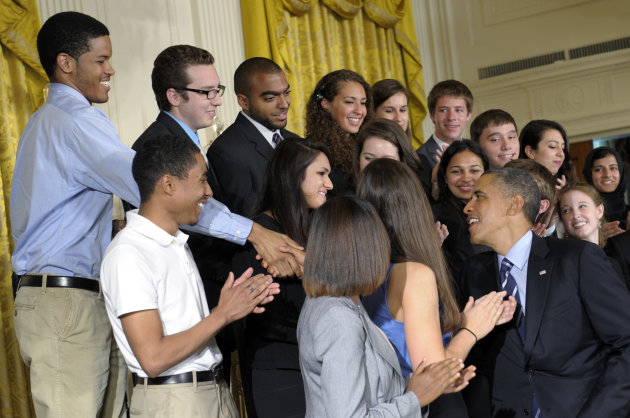
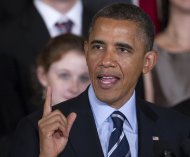 Congressional bargainers appeared to be closing in on a compromise that would head off a July 1 doubling of interest rates on federal loans to 7.4 million college students and end an election-year battle between President Barack Obama and Congress.
Senate aides from both parties said Friday the two sides were moving toward a deal on how to pay the measure's $6 billion price tag, the chief source of partisan conflict.
The goal is to push legislation through Congress next week so the current 3.4 percent interest rate on subsidized Stafford loans can be preserved for another year. A 2007 law gradually reduced interest rates on the loans but required them to balloon back to 6.8 percent this July 1 in a cost-saving maneuver.
 On another front, the two sides were also close to an agreement to overhaul federal transportation programs, according to House and Senate aides from both parties. Negotiations were expected to continue through the weekend, with votes expected next week on either a major transportation bill or an extension of current programs, said the aides, who spoke on condition of anonymity to discuss details of the talks.
Obama said Saturday in his weekly radio and Internet address there was "no excuse for inaction."
"Right now, we are seven days away from thousands of American workers having to walk off the job because Congress hasn't passed a transportation bill. We are eight days away from nearly seven and a half million students seeing their loan rates double because Congress hasn't acted to stop it," Obama said. "This makes no sense."
For weeks, Obama has ridiculed Republicans for not moving quickly to prevent student loan interest rates from doubling, a stance that Democrats have hoped will boost his support among young voters who broadly backed him in the 2008 election. With college costs and student debt growing steadily, the issue ties directly into concerns about the economy and jobs that polls show dominate voters' worries.
Though some rank-and-file GOP lawmakers have opposed letting the government set the rates, Republican presidential challenger Mitt Romney and GOP congressional leaders have backed the one-year extension. The remaining dispute has been over how to pay for it.
Republicans have accused Obama of creating a phony issue and drawing out the battle in an attempt to reap political points. In late May, they proposed several options to pay for the measure, all of which were culled from budget savings Obama himself had proposed in the past, but they said the White House was ignoring them.
"Even though the White House refuses to respond to our bipartisan approach, Senate Democrats are finally working with us, and a solution is within reach — despite the president's failure to act," said Don Stewart, spokesman for Senate Minority Leader Mitch McConnell, R-Ky.
The talks have involved aides to McConnell and Senate Majority Leader Harry Reid, D-Nev. Democrats said the White House has been kept abreast of the talks, while Republicans said House Speaker John Boehner, R-Ohio, has been kept informed but hasn't participated in the negotiations.
According to Democratic aides, negotiators are approaching a deal to cover the bill's costs by charging companies more to insure pensions and changing rules so companies take fewer tax deductions for their pension contributions. Reid proposed both of those ideas this month.
They said additional money would come from a list of options McConnell has offered, probably one to limit federal subsidies of undergraduates' loans to six years. The government does not begin charging interest on Stafford loans until after students graduate, which can take longer than six years.
"While we're not there, we're well down the road. I think we can get something done," Reid told reporters Thursday. He said McConnell and Boehner "are compromising just as we are and hope we can get something done."
If allowed to double, the higher 6.8 percent rate would apply only to new subsidized Stafford loans for undergraduates approved starting on July 1 and would not affect existing loans.
According to the Education Department, 7.4 million students are expected to get new Stafford loans in the year beginning July 1, with each borrowing an average $4,226. A doubling of interest rates would add about $1,000 to the costs of the average loan, which students typically pay off over 10 or more years.
The Federal Reserve Bank of New York said last month that student loan debt grew this year to $904 billion, even as other types of consumer debt were falling.
___
Bahrain opposition leader injured in protest
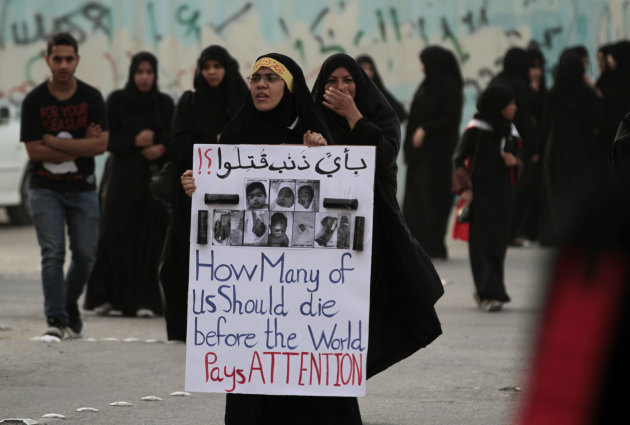 Bahraini riot police fired tear gas, stun grenades and rubber bullets Friday, injuring the head of the Shiite majority's main political bloc while trying to break up protests in the country's capital, the opposition said.
Al Wefaq's secretary-general Sheik Ali Salman told The Associated Press he was hit in the shoulder and back by either a tear gas canister or stun grenade during demonstrations in Manama, which are common following Friday prayers. He had red welts on his skin but seemed otherwise in good health. Al Wefaq had earlier said that rubber bullets had caused the injury.
He said he was leading about 40 protesters on the way to a march when they encountered police who ordered them to disperse and then started firing into the crowd.
Hassan al-Marzooq, another opposition leader, was hit in the neck by a rubber bullet, an Al Wefaq statement said. He has since been taken to a private hospital in the capital for treatment.
Salman said the leaders had been intentionally targeted, the first time that the Bahrain security forces had done so.
"More violations will complicate our efforts for reconciliation and a meaningful dialogue," he said. "We continue our democratic demands and call for universal human rights principles through peaceful assemblies. It is the people's right."
Bahrain has experienced near daily protests for 16 months caused by an uprising by the kingdom's Shiite majority seeking greater political rights from the Western-backed Sunni monarchy.
The country's rulers have crucial support from neighboring Saudi Arabia, but are under pressure from their U.S. allies to reopen dialogue with Shiite opposition factions. A new government initiative for talks is expected to be announced soon. But main Shiite groups have already signaled that negotiations are futile unless the ruling dynasty agrees to give up its near total control of government affairs in the strategic island, which is home to the U.S. Navy's 5th Fleet.
Opposition groups had requested a permit to hold Friday's protest but said they were denied one by authorities. They attempted to march anyway to the site of a historic Shiite mosque, sparking several hours of clashes with riot police. Along with the protest leaders, Al Wefaq said scores were injured from inhaling tear gas during several hours of clashes.
Security forces closed roads leading to the protest site and protesters responded by lighting fires along the roadside.
Twenty dead in Taliban siege of Afghan hotel; NATO blames Haqqanis
 Elite Afghan police backed by NATO forces ended a 12-hour siege on Friday at a popular lakeside hotel outside Kabul, leaving at least 20 dead after Taliban gunmen stormed the lakeside building, bursting into a party and seizing dozens of hostages.
The night-time assault on the hotel with rocket-propelled grenades, suicide vests and machine guns again proved how potent the Islamist insurgency remains after a decade of war.
The commander of NATO forces in Afghanistan said the attack bore the signature of the Taliban-linked Haqqani group that he said continued to operate from Pakistan, a charge that could further escalate tensions with Islamabad.
General John Allen's comments come days after U.S. Defense Secretary Leon Panetta said Washington was at the limits of its patience with Pakistan over the existence of militant networks including the Haqqanis.
Pakistan says it is doing everything it can to fight militants on its side of the border and accuses Afghanistan of trying to shift the blame for its failure to combat the insurgency.
At the hotel, terrified guests jumped into the lake in the darkness to escape the carnage, Afghan officials and residents said. Up to 300 people had been inside the hotel when the attack began.
Afghan interior ministry spokesman Sediq Sediqqi said 12 to 15 civilians, two hotel guards and a policeman were killed in the gunbattle at the Spozhmai hotel, overlooking Qargha Lake. Five attackers were also killed.
The attack, quickly claimed by the Afghan Taliban, again showed the ability of insurgents to stage high-profile raids even as NATO nations prepare to withdraw most of their combat troops by the end of 2014 and leave Afghans to lead the fight.
"Afghan National Security Forces and coalition military sources acknowledge that this attack bears the signature of the Haqqani network, which continues to target and kill innocent Afghans and blatantly violate Afghan sovereignty from the safety of Pakistan," General Allen said in a statement.
Blood was splattered over the hotel floor and the crumpled body of a man lay in the garden. Women and children were among the wounded.
"We heard a heavy explosion from a rocket-propelled grenade. We tried to escape, but we were surrounded by suicide bombers. We hid ourselves behind a tree until morning. God protected us," said Abdullah Samadi, 24.
The gunmen, Samadi said, had been closely watching their prisoners and searching for illegal stocks of wine.
"Around dawn they came closer to us and we had to jump in the water. We were there until 9 a.m. and then the situation got better and we slowly, slowly swam toward security forces," he said.
Sediqqi said the Taliban were using civilians as human shields to defend themselves and held about 50 people hostage late into Friday morning.
Elite Afghan quick-response police backed by NATO troops freed at least 35 hostages in an operation that only began in earnest after sunrise to help security forces avoid civilian deaths in night-time confusion.
The Taliban complained wealthy Afghans and foreigners used the hotel, about 10 km (6 miles) from the center of Kabul, for "prostitution" and "wild parties" ahead of the Friday religious day holiday.
Launching their annual offensive this spring, the Taliban threatened to attack more government officials and rich Afghans, but the hotel assault was one of few in which multiple hostages were taken since the start of the war, now in its 11th year.
President Hamid Karzai said attacking a place where people went for picnics was a sign of defeat for the enemies of Afghanistan.
"This is a crime against humanity because they targeted children, women and civilians picnicking at the lake. There wasn't even a single soldier around there," said General Mohammad Zahir, head of the Kabul police investigation unit.
Television pictures showed several people wading out of the lake onto a balcony and clambering over a wall to safety.
NATO attack helicopters could be seen over the single-storey hotel building and a balcony popular with guests for its sunset views, while a pall of smoke rose into the air.
NEW FACE OF INSURGENCY?
Soldiers and police fanned out around the hotel at dawn, arriving in cars and armored Humvee vehicles and taking cover behind trees flanking the lake and a nearby golf course.
Qargha Lake is one of Kabul's few options for weekend getaways. Restaurants and hotels that dot the shore are popular with Afghan government officials and businessmen, particularly on Thursday nights.
Guests at the Spozhmai must pass through security checks before entering the hotel, where tables with umbrellas overlook the water, but security is relatively light for a city vulnerable to militant attacks.
Violence across Afghanistan has surged in recent days, with three U.S. soldiers and more than a dozen civilians killed in successive attacks, mostly in the country's east, where NATO-led forces have focused their efforts during the summer fighting months.
NATO commanders, halfway into the process of transferring security responsibility to Afghan forces, are racing through training for the Afghan army and police, including holding basic literacy classes for recruits.
Well-planned assaults in Kabul in the past year have raised questions about whether the Taliban and their al Qaeda-linked Haqqani network allies have shifted tactics to embrace attacks on landmarks, foreigners and Afghanistan's elite, extending a guerrilla war once primarily waged in the countryside.
Balochistan: Attack on BUITEMS Bus
EDITORIAL: The Baloch HalIn yet another tragic act of terrorism in Quetta on Monday, June 18, at least five students of the Balochistan University of Information Technology, Engineering and Management Sciences (BUITEMS) were killed while around 60 people were injured. The attack was caused by a remote-controlled bomb which was fixed in a car parked on the roadside. Until the writing of this editorial, no group has accepted responsibility for the attack. The local police say they are investigating the tragic episode. Considering the police department’s failure in the past to probe such unfortunate assaults, it is very unlikely to come across reliable findings regarding Monday’s blast from the police department. Authorities in Balochistan find it easy to get away from responsibility by simply blaming ‘outside forces’ for causing instability in the province. That is a shortcut to find exemption from one’s responsibilities but not an appropriate response to questions raised in the aftermath of such attacks. We believe the enemy lies within us but such blatant denial amounts to encouraging and patronizing enemies of humanity. According to reports, all of the dead students belong to the Hazara ethnic community. This then takes us back to the ongoing cycle of the gruesome violence directed at the Hazaras for several years now. There has been an extraordinary upsurge in violence from the Sunni militant groups against the largely peaceful Hazara community in the past few months. The perpetrators are hard to catch because of their nastily creative skills. Each attack on the Hazaras is designed in a new and unique way by making it hard for the local police to act on the basis of learnt lessons from previous incidents. Although there have been a few serious attacks on buses carrying Hazara pilgrims to Iran, killing dozens of innocent people, an attack on a student bus is unprecedented. The killing of students triggered protests in front of the Quetta Press Club from students who called upon the government to punish the elements responsible for this dark episode. There is an urgent need for the government to fulfill its responsibility of protecting people’s lives. Sunni militant groups which have been attacking Hazaras have a clear strategy and a clearly defined goal. Not only do they want to terrify the Hazaras by such brutal assaults, but they want to make sure that the Hazaras remained tightly confined to their towns. They want to restrict the Hazara men from going to markets and attending schools. We have said it a number of times before that the State should play its role in protecting people’s right to religious and political freedom and also the right to assemble. At micro-level, the intention of the blast may have been to punish the Hazara students, such attacks set an extremely dangerous trend in our society. Irrespective of nature and demands of the ongoing conflicts in Balochistan, we strongly urge all stakeholders to refrain from attacking our educational institutions and students in their conflicts. The state of education has abysmally declined in the recent times in Balochistan for a number of reasons. Yet, we sincerely hope that issues like religion and politics do not perturb students’ academic years. The government must act swiftly to bring justice to the families of those students who were killed in Monday’s attack.
POLIO: Call for help: Going beyond the limitations of polio and social norms
Published In The Express TribuneThough he walks with crutches,
 Taimur Sajid’s ideals stand tall. He was diagnosed with polio at the tender age of one but chose to fight the odds keeping him from following his goals.
Currently pursuing an Economics degree at Jahanzeb College in Swat, the 22-year-old wants to lead a dignified life. For this reason, he has appealed to the president of Pakistan and humanitarian organisations to assist him in getting treatment. Besides the financial resources, he lacks a social support system to help overcome the crippling disease.
To his dismay, some conservative groups in his native Faizabad village consider polio vaccination “an anti-Muslim tactic to control and decrease the Muslim population”. However, Taimur hopes to eradicate the polio virus by steering clear of such myths. “To consider vaccination anti-Islamic is just absurd,” he said.
Back when his parents found out about his disease, the concept of polio inoculation was unheard of. Even his grandmother was not in the favour of vaccination. “My grandmother openly rejected the idea. She also discouraged my parents from getting me vaccinated,” he said. However, his parents now repent over their decision that has left him crippled in one leg, he said.
Despite disability, he wants to further his education and harness his sporty side. “I love cricket and can bat well. Though several times, I’ve had difficulty in carrying out my routine activities but I never let it upset me. I will complete my education and will get masters degree in my field,” he said, his eyes brightening up as he talked about his future plans.
“I hate to be dependent on others and want to stand on my own feet finishing my studies. I aim to bust the myths floating around about polio immunisation,” he said.
Taimur has consulted a physiotherapist in the Orthopedic Medical Centre in Lahore, who reinforced his hope of returning to a normal life. After conducting a detailed checkup, the doctor told him that his disability was curable with two surgeries. “But I can’t afford the sugeries, which cost about Rs300,000.”
He added, “If the government of Pakistan or any humanitarian organisation help me by sponsoring my surgeries, I will walk like normal people .and realise my dream of getting rid of crutches.”
PAKISTANI ESTABLISHMENT & THE PPP GOVERNMENTS
 It had been proved beyond doubt that the Pakistani establishment has zero tolerance for any PPP Government at any stage of Pakistani history. The recent and past decisions of the Supreme Court of Pakistan and off and on remarks of the judges during the proceedings of various cases confirmed this belief. In any case, the PPP is the most popular party of the people of Pakistan whether the establishment likes it or not. The Pakistani establishment will have to live with it permanently developing a durable tolerance to any PPP rule. Similar zero tolerance is for the Awami National Party with its political base in KPK and the Balochistan National Party with its base in Balochistan and both the parties are treated at par with the PPP at the Centre and Sindh. To be precise, the PPP, ANP and BNP are truly Pakistani nationalist parties and believed in Pakistani patriotism which the establishment refuses to accept to this date. In Sindh, the MQM is promoted, financed and supported by the establishment to remain a check and counterweight to the PPP, mainly in the urban centres. The MQM had been allowed to retain guns and bully all its constituents when elections are held so that it should emerge as the second largest of most powerful gun wielding party in Karachi.
Almost all the Supreme Court decisions against the PPP Government and officials were deplorable as it proved to be a destabilizing factor in politics at this crucial juncture when the country is facing challenges from all corners and the PPP is the only hope to provide a smooth sail. Other political parties in the Opposition are Jihadis and disliked by the world community for obvious link with the Jihadi elements undermining international order, peace and security. It will be a complete disaster for Pakistan if the establishment tried to impose the Jihadi parties, led by PML-N, and in the next elections as the world may not tolerate such elements in power in Pakistan in the backdrop of perennial conflicts with Afghanistan and India.
Presumably, the Establishment is losing patience in facing hostile attitude from the US Administration which is increasing pressure on Pakistan to surrender to its terms in Afghanistan, support the US strategy in Afghanistan and surrender its own design making it backyard of the security of Pakistan in the shape of strategic depth. It is the main cause of conflict between Pakistan and the US and Washington is rallying round other countries, mainly India and inducting India into the new Afghan strategy keeping Pakistan out in the game for ever. The dispute with Pakistan had forced the US to keep its military presence till 2024. Naïve political and military leaders thought that US will again abandon Afghanistan on the pattern of 1989 when Soviets withdrew the Red Army Contingents. They had mistaken and now it is clear that the US forces are here in the region on permanent basis dealing with both Pakistan and Iran, the two neighbouring countries US believed are hostile to US interests in the region. The massive US naval presence on Baloch gulf should be an eye opener for all naïve people who claimed that the US stood defeated in Afghanistan and the US forces are on the run. We have to accept the ground realities and develop or repair our relations with US keeping in view the interests of the people of Pakistan. The US stand is ground tough with every passing day and any adventure on the part of the Pakistani establishment, through its proxies, can be disastrous for the country and its security. Before the situation goes out of hand, we must make efforts to repair our relations with the US and also with all neighbouring assuring sovereign equality in international relations in the interest of regional peace and security.
LOHAR CHIEF MINISTER JOINS STREET PROTESTS!

EDITORIAL:CHIEF MINISTER JOINS STREET PROTESTS!The PML had ruled Punjab for five times in recent decades and still the Chief Executive of the Province is behaving irresponsibly not only by encouraging street violence rather joining personally the street protests and more than once. It is unusual that how a Provincial Government can main order, protect lives and property of the citizens when the disorderly crowd resort to rampage attacking public property and destroying houses of the elected members of the National Assembly. It is happened in our country only, particularly in the Province of Punjab where democratic traditions had never taken roots, and such a situation is unheard in any other part of the world that the provincial chief executive is joining street agitation instead of calming down the enraged and unruly crowd preventing them from unruly behaviour. Interestingly, there is no forum in our country to make the Chief Minister accountable. The superior courts are hostile to the Federal Government and friendly to the Punjab Government for unknown reasons. Strong remarks had been passed against the Governments in KPK and Balochistan by the superior courts and not against the Punjab Government. We have to change this culture of strong likes and dislikes and treat all concerned at par and without any discrimination. Pakistan is facing serious challenges and stood completely isolated in the world community at the moment and even our close allies are reluctant to back us in this crucial stage of our history. There is a need to treat all people of Pakistan at par and there should be no discrimination against any one. At the same time, Pakistan is facing the worst economic crisis and the US sanctions are about to come on one pretext or the other making situation more grim and dangerous. The constant economic downturn had made the thing worst for the Government and the people forcing prolonged load shedding. The load shedding is not confined to Punjab and the textile city of Faisalabad where protest is strong because multi-billionaires are not making enough money because of load shedding. We in Balochistan are also facing 22 hours of load shedding and hardly there is hue and cry from Balochistan. The tycoons demand power and gas without any interruption so that they should continue to earn billions at the cost of the poor people of Pakistan. They are patronizing the street agitation, violence on the streets with the support and patronage of the Punjab Chief Minister. The move is to topple down the Government and forced early elections as conspirators from behind the scene wanted it and they want to dislodge the PPP Government before it completes the constitutional tenure. The removal of Prime Minister from the office and disqualifying him for five long years is part of the game. Even the next Prime Minister Makhdoom Shahabuddin will not be allowed to rule for months and he too will face the demand to write a letter to Swiss authorities against the sitting President of Pakistan and bring him to disrepute the world over. We hope that the forces out to destabilize the Government will stop their game as it will destabilize Pakistan itself at this crucial stage when it is stood completely isolated in the world community. Unstable Pakistan is not in the interest of the people and it will serve the purpose of enemies of Pakistan, to say the least. It should be an eye opener to all concerned that the US had inducted India in its Afghanistan strategy asking Indians to train the Afghan security forces and play a greater replacing the past role of Pakistan in helping Afghanistan. The recent move to repair ties with India may not work properly because of the US interests in the region and Washington may not permit India to repair its relations with Pakistan for strategic reasons.
US ‘mulls’ new covert raids in Pakistan
Frustrated with frequent attacks on Americans in Afghanistan, the US military and intelligence officials are considering launching secret joint US-Afghan commando raids into Pakistan to hunt down the militants.
According to media reports, the idea has been consistently rejected because the White House believes the chance of successfully rooting out the deadly Haqqani network would not be worth the intense diplomatic blowback from Pakistan that inevitably would ensue.
Members of the Haqqani tribe have been targeted by pilotless US drone aircraft, but sending American and Afghan troops into Pakistan would be a serious escalation of the hunt for terrorists and potentially the final straw for Pakistan, already angered over what it sees as US violations of its sovereignty. The latest round of debate over whether to launch clandestine special operations raids into Pakistan against the Haqqanis came after the June 1 car bombing of Forward Operating Base Salerno in eastern Afghanistan that injured up to 100 US and Afghan soldiers, according to three current and two former US officials who were briefed on the discussions. The officials spoke on condition of anonymity to describe the still-evolving debates.
The officials told the Associated Press that recent discussions of clandestine ground attacks have included General John Allen, the senior US commander in Afghanistan, as well as top CIA and special operations officials. Allen’s spokesman, Navy Cmdr. Brook DeWalt, said Allen “has not and does not intend to push for a cross-border operation.” The White House and the CIA declined to comment for this story. Pentagon spokesman George Little said the US was still focused on US-Pakistan cooperation.
“The key is to work together with Pakistan to find ways of fighting terrorists who threaten both the United States and Pakistan, including along the Afghan-Pakistan border, where extremists continue to plot attacks against coalition forces and innocent civilians,” he said. The officials say Allen expressed frustration that militants would attack and then flee across the border in Pakistan, immediately taking shelter in urban areas where attacking them by missile fire could kill civilians. The officials say options that have been prepared for President Barack Obama’s review included raids that could be carried out by US special operations forces together with Afghan commandos, ranging from air assaults that drop raiders deep inside the tribal areas to hit top leaders to shorter dashes only a few miles into Pakistan territory.
The shorter raids would not necessarily be covert, as they could be carried out following the US military principle known as “hot pursuit” that military officials say entitles their forces to pursue a target that attacks them in Afghanistan up to 10 kilometers (6.2 miles) inside a neighboring country’s territory.


Pakistan officials 'hindering' US diplomats
 Rising obstruction of US envoys by officials in Pakistan is "significantly impairing" the work of US personnel there, a state department report says.
The findings said interference by Pakistani officials reached "new levels of intensity" in 2011.
The US raid on Osama Bin Laden's compound and a Nato air strike that killed 24 Pakistani soldiers were identified as turning points.
Recent months have seen a marked deterioration of US-Pakistan relations.
Pakistan withdrew military co-operation in the wake of the deadly November air strike, and correspondents say it marked a change in relations between the two countries.
The report, by the state department's inspector general, acknowledged that the Pakistani government had previously interfered with US officials on its soil.However, it said the problem had become much worse and recommended that the issue should be taken up by the US with Pakistan at the highest levels of government.
"Official Pakistani obstructionism and harassment, an endemic problem in Pakistan, has increased to the point where it is significantly impairing mission operations and program implementation," the state department review said.
It described the harassment as "deliberate, wilful and systematic" and said examples of the obstruction included delays in getting visas, holding up shipments for construction projects and aid programmes, and surveillance of employees.
The report also claimed US officials were being singled out more than other international diplomats.
"While other diplomatic missions have experienced similar treatment, the United States is clearly the principal target," the report said.The report was based on visits to the US missions in the Pakistani cities of Islamabad, Karachi, Peshawar, and Lahore.
It describes the raid on Bin Laden's compound as a double embarrassment for the government, saying it was evidence of "both Pakistani government incompetence and its inability to detect or defend against a military intervention".
"Events of the past year have rocked the US-Pakistani relationship and fundamentally altered the assumptions on which US engagement with Pakistan has been based since 2009," it added.
Pakistan: Elections but then what?
EDITORIAL: THE FRONTIER POSTAs the nation has fallen into political straits, calls are coming out from certain quarters for snap general elections. But what for? None of the callers is explaining this. Certainly, not a single heart would weep on the street if the entire gaggle of incumbent rulers, both at the centre and in the provinces, goes packing, so inept, so incompetent and so ineffective has it demonstrated it to be. But if the snap poll is merely for a change of faces, then what is the point in having it at all? It would be a sheer meaningless expensive venture without which the polity indeed would be quite well off. But if it is for a change in substance, then nothing like it. Nonetheless, that is where lies the rub. None of the callers gives the sense if this is what has actually prompted his call. And none tells the masses what it would be after the snap polls. They all remain focused on recounting the collapses, foibles and failures of the incumbents. But of this the masses need no telling at all when they are the ones who actually are bearing all the brunt of the incumbents' betrayal of the electorate. On this count, the masses are indeed far more informed than are the callers of snap polls because of their personal experiences and observations of their daily lives. What the masses need to know is what would be on offer for them if the snap elections throw up new faces. Do the callers have some firmed up plans in their bags to tackle their problems of bread and butter that the incumbents have so spectacularly failed to handle any gratifyingly? And on that score they find the slate of each and every caller all empty. None of them shows even the slightest inkling if at all he has done any homework in this regard. It is only rhetorical chants and vague promises that they all dish out on this plane. No concrete plan or idea they speak out. Indeed, Nawaz Sharif, for one, stays stuck in the past primarily, with the future attracting him only to throw up some empty slogans here and there. And even about past he is blatantly untruthful. He would have his listeners believe that his rules were a golden era, forgetting that he cannot befool the people as that generation, most of it still in the prime of life, that lived through his atrocious rules is yet alive. And it knows what his rules actually were. Those were no lesser the times of horrible assailments on judiciary, sidelining of the parliament, emasculating of the ministerial cabinet, ruling the country through a kitchen cabinet, and the mad pursuit of stinking practice of filthy cronyism, favouritism and nepotism. Corruption in high places too was having the heady days in those times. Nawaz indeed has much explaining to do for his past. In the popular eye, he is no saint he is painting himself to be. His fawning party acolytes and a fondling section of properly palmed-off media may be projecting him as a political giant. But in the popular estimation, he is just a dwarf, a mere mediocre politico, no icon at all. Yet if he wants to impress the masses as a reinvented democrat and a reinvented reformer, he must leave his past behind and talk of the future specifically in terms of concrete plans and ideas for the country's economic rejuvenation, the amelioration of the people's lot and tackling of their nagging woes, the uplift of the nation's dignity and stature in the world community. No slogans would do. And Imran Khan must understand that Pakistan is not just judiciary but many more things. It is a country peopled with 180 million citizens with varied hopes, aspirations and expectations, all with varied needs, wants and demands, and all wanting urgently the means to live fuller human lives meaningfully. And corruption alone is not their problem, particularly when it has seeped down in the veins of the country's body politic so incisively as to have become part and parcel of the national life. The people's problems are not only multifarious but in multitudes. They go much beyond corruption, which is just a part of the huge malaise that afflicts our polity so hurtfully. Khan must comprehend the mind-boggling complexities and intricacies of the afflictions blighting this country's masses horrendously, think out the ways and means to address those ailments, and speak out the specific cures in detail. His current discourse shows not insight; it shows only mere superficiality. Indeed if the protagonists of snap polls do no homework, they too would be caught unprepared for the ticklish job of governing this now-difficult country as have been the incumbents. This holds good as much for Khan as for Nawaz; indeed, for that matter, for the whole lot of those grandees squatting in the opposition camp, crying "Snap Elections".
Khyber Pakhtunkhwa gears up for education reforms
DAILY TIMESAll political parties were unanimous on Friday in discussing the steps to improve literacy rate in Khyber Pakhtunkhwa, where three million children, including two million girls, never admitted to any school. Half of the children who go to primary schools drop out in the initial years, said a press release issued by the British high commissioner, who “united” the political forces in Islamabad to get support for educational reforms. The event in Islamabad on Friday was hosted by British High Commissioner Adam Thomson. Delegates were briefed on the ambitious “Khyber Pakhtunkhwa Education Reform Roadmap” by Sir Michael Barber, a world-renowned education expert and the UK Department for International Development’s Special Representative for Education in Pakistan. The roadmap is a partnership between the UK’s Department for International Development and the government of Khyber Pakhtunkhwa. “It aims to ensure every child in the province goes to school and receives a good quality education.” Speaking at the cross-party briefing in Islamabad, Thomson said: “Despite all the challenges, Khyber Pakhtunkhwa has proved to be an excellent partner. “Today our focus is on education. I would like to urge you all here today to think about what more you can do to make universal primary education a reality in Khyber Pakhtunkhwa and support the Education Reform Roadmap. All of us here today must pledge to continue to make education a top priority,” he said. Sir Michael met with Khyber Pakhtunkhwa Chief Minister Ameer Haider Khan Hoti in Peshawar on Thursday to review progress on the Education Reform Roadmap.
Coup fears return to Pakistan
 Always on the boil, the melting pot of conspiracy theories that is Pakistan is now boiling over. Suspicion that “hidden hands” were at work in ousting Syed Yusuf Raza Gilani from office — reportedly voiced by none other than the former Prime Minister at a closed-door meeting — has given way to fears that the democratically elected government is being encircled. When an arrest warrant was issued against Makhdoom Shahabuddin, the first choice for replacing Mr. Gilani, coup talk returned to Pakistan full steam.
Many found the timing of the warrant suspect. The case had been pending for sometime. To add to this, the Anti-Narcotics Force (ANF) — which is investigating this case — is headed by a serving Army officer. For a country all too familiar with military takeovers under one pretext or the other, it was enough to set alarm bells ringing. Television anchorperson, Farrukh Pitafi, reflected the exasperation of many when he tweeted: “Bhai, takeover kar lo (you might as well take over)”.
The ingredients were all there, raising the spectre of the 1990s when politicians sparred often enough and so bitterly that it was easy to play one against the other, the revolving door change of governments ending with Pervez Musharraf’s takeover that lasted a decade.
Despite the iconic aura it has gained since 2007 and the harsh words it has used against the military in a couple of cases, the superior judiciary’s past has not been forgotten. Every military intervention was validated by the judiciary and the present pantheon includes judges who had validated Gen. Musharraf’s coup. That has only added to the apprehensions of a nation several times bitten.
The Dawn’s editorial articulated these fears about the arrest warrant: “Given the uncanny timing of yesterday’s developments, we cannot rule out the possibility that there are forces working behind the scenes to prevent Pakistan’s fledgling democracy from weathering the current crisis.”
Since the new PM-designate, Raja Pervez Ashraf, also has a fair share of cases against him, the joke in town was that efforts were on to dig up dirt onQamar Zaman Kaira, the “cover candidate” introduced into the fray by the Pakistan People’s Party (PPP).
In any case, no one expects the new premier to have an easy run. As the search for candidates for premiership was on, the bottom line was that only those willing to be disqualified for five years need apply. It is amply clear that the PPP is determined not to write to the Swiss authorities to reopen graft cases against President Asif Ali Zardari. Among the first tasks awaiting the new man in would be the Supreme Court order asking that the letter be sent. Or go the Gilani way.
Halo fades
But the PPP too is determined to hang in for the remainder of its term, which ends in March 2013, despite calls from political opponents to call it quits. Ironically, the man who selects the new Prime Minister is the same person as the court’s real target in the government-judiciary standoff – President Zardari. So, expect more of the same in coming months The two have been eyeball to eyeball since the President dragged his feet over the reinstatement of Justice Chaudhry from 2008 to 2009. Mr. Gilani got caught in the crossfire, as the judiciary stood tall over an inefficient government bogged down by controversies.
Some of the halo around the judiciary – that harks back to the lawyers’ movement for the reinstatement of judges removed by Gen. Musharraf — has faded in recent weeks with the Chief Justice’s son, Arsalan Chaudhry, being accused of taking millions from a property tycoon for influencing cases. More than the accusations, the manner in which the Court handled that case has dented its image.
Writing in The News, lawyer Babar Sattar said the judiciary had “squandered a vital opportunity to salvage its reputation as a neutral arbiter of the law” with its judgment in the case.
The court’s decision to disqualify Mr. Gilani has also drawn its fair share of criticism, not out of any love or appreciation for the PPP-led dispensation but because of what it portends for Pakistan’s fledgling democracy.
Expressing disappointment, The Dawn editorial said: “Legally there might have been a case against the Prime Minister, but it was best for the supreme judiciary not to have waded so deep into such obviously political waters.”
Questioning the decision to ask the Election Commission to notify Mr. Gilani’s disqualification instead of just referring the matter to it, The Dawn noted: “By doing so, it has both disrupted an existing democratic set-up and set a worrying precedent for the future.”
Ever critical of the judiciary for turning a blind eye to the plight of Ahmadis and extremism, Lahore-based lawyer Yasser Latif Hamdani wrote in his blog: “We are increasingly descending into a state which resembles the dystopia of Judge Dredd. It is now important to acknowledge that we are no longer a democracy but a judocracy, where the whim and will of an unelected presiding officer of the apex court has more power than 180 million people. Perhaps it is time to dispense with the pretence of parliament, prime minister and president and constitutionally empower the Chief Justice to act as all three….”
Earlier, Hamdani, who had participated in the movement for the Chief Justice’s restoration, had written an open letter to him urging him to step down given the allegations levelled against his son, saying “Ceaser’s wife is no longer above suspicion.”
He is not alone. Many leading lights of the movement including Asma Jehangir and Munir Akram have spoken out even earlier about the manner in which Justice Chaudhry took up cases that were more about politics than contested points of law.
To many an analyst, the superior judiciary is now attempting to do what traditionally the military — again a non-elected state institution — assigned for itself: clean up Pakistani politics and society. But, according to political analyst Hasan Askari Rizvi, “if the expanded role of non-elected institutions offered a credible solution, Pakistan’s politics should have been very organised and systematic after four periods of direct and indirect military rule.”
For now, the coup talk may be just that — talk — but as all institutions continue to jockey for space and power in what is essentially the nascent phase of an evolving democracy, any attempt to upset the apple cart will arouse suspicion. On this count at least, Pakistan cannot be accused of crying wolf too often. And, the military and the judiciary do not have history on their side.
Subscribe to:
Posts (Atom)