The Express TribuneFour months have passed since spurious medicines at the Punjab Institute of Cardiology (PIC) claimed the lives of 165 patients and affected another 700 in Lahore – yet not a single person has been indicted in what was arguably the greatest medical tragedy in the country’s history. Data available with The Express Tribune shows that the compensation process is still pending. While compensation cheques for Rs500,000 were distributed to the relatives of 116 deceased patients, cases of 38 patients are still being verified, and the addresses of the remaining 11 are said to be incomplete. The unofficial death toll is said to be around 200; and more than 1,500 patients are said to have been affected by the faulty medicines distributed free of cost by PIC to poor patients. In January 2012, heart patients approached different hospitals with similar symptoms of low platelet count, darkening complexion and bleeding. Health authorities tried to downplay the matter at first, but the issue later escalated to a major health crisis. Preliminary investigations showed that a drug named Isotab, contaminated with anti-malarial chemical Pyrimethamine, had caused the deaths. However, authorities have little to show in way of preventive measures taken to avert any such crisis in the future. A senior doctor at the PIC admits that “it seems everybody has forgotten about the PIC drug-related deaths.” Of efforts taken in wake of the incident, the doctor, requesting anonymity, says: “A lot has changed since then, but only on paper. The on-ground situation remains the same. The judicial inquiry report is yet to be released and no mechanism has been put in place to check that medicines are not contaminated with hazardous chemicals.” PIC’s chief executive Dr Bilal Zakaria, who was appointed after the drug fiasco, claims to have taken some precautionary steps. “It is now mandatory for PIC to purchase medicines only from pharmacies that have at least three branches in a city. We have also asked the companies to submit a report of all the non-active ingredients in the medicines.” Dr Zakaria maintains that a Drug Regulatory Authority (DRA) has a major role to play in keeping a check on pharmaceutical companies. However, though the president has issued an ordinance in this regard, a regulatory authority is yet to be established. PIC’s former head Dr Muhammad Azhar, who was removed from his post after the tragedy, differs in opinion from Dr Zakaria. Dr Azhar feels the conditions at PIC have deteriorated further. “If the government cannot make a unique system, it should copy the mechanisms put in place by the USA and the UK.” “In Pakistan, there are above 55,000 registered medicines while in the USA there are just 5,000 and in the UK only 2,200. The government should just copy their lists to avoid any such catastrophe in the future.” Pakistan Pharmaceutical Manufacturer’s Association (PPMA) Chairman Dr Riaz Ahmad said the issue of giving licenses to manufacturers will now be decided by the DRA after the passage of the 18th Amendment. The Punjab chief minister’s special assistant on health Khwaja Salman Rafique is quick to evade the blame. He says the provincial administration has given its consent and it is now up to the federal government to make the DRA functional. A senior official at the health department expressed his dissatisfaction over the inaction against Efroze Chemical Industries, the company that manufactured Isotab. “The company has been sealed but hasn’t paid any damages to the families of those who died due to the faulty drug.” Advocate Azhar Siddiq, who filed a petition in the Lahore High Court regarding the case, said: “The report of the judicial inquiry is expected soon. I am hopeful that the inquiry, headed by Justice Ijazul Ahsan, will hold the perpetrators responsible.” A young boy who lost his father due to the faulty medicine doesn’t know who to blame. “If the culprits in this case are not brought to justice, I will believe the government killed my father.”
Wednesday, June 20, 2012
LAHORE:PIC tragedy: Four months on, spurious drugs case remains in cold storage
Punjab govt instigating violent protests
 Pakistan Tehreek-e-Insaf (PTI) Central Information Secretary Shafqat Mahmood said on Tuesday that the Punjab government was responsible for the loss of lives during the violent protests against load shedding.
In a press statement, he said that protests against load shedding were justified but it was the responsibility of the provincial administration to ensure that they remained peaceful.
Three people have died as a result of violent protests in Kamalia and Chichawatni.
He added that the Pakistan Muslim League-Nawaz (PML-N) is actively instigating violent protests as several leaders of the party have led a number of such protests.
He claimed that the protesters have often been directed to attack political opponents and PTI supporters amongst others have been victims of such violent attacks in Vehari and Faisalabad.
He questioned the partisan role of law enforcement agencies in facilitating such attacks on political opponents as no arrests have been made in any of the incidents. Media footage has shown law enforcers standing as silent spectators while violent protesters have looted and destroyed banks, CNG stations, shops, cars and other private and public property, he added.
Shahbaz should be booked for loss of life, property
PAKISTAN TODAYPakistan Muslim League Quaid (PML-Q) President Chaudhry Shujaat Hussain has said that PML-N and Shahbaz Sharif were engaged in politics in the name of load shedding protests and a FIR should be lodged against them for the loss of human life and property during demonstrations. He was talking to reporters after meeting former Khanewal nazim Ahmad Yar Heraj and his brother Muhammad Yar Heraj following an attack on their house in Khanewal on Tuesday. Shujaat said the attacks on the houses of Ahmad Yar Heraj and Riaz Fatiana had been carried out at the instance of the provincial government and Shahbaz Sharif and it did not suit the chief minister to “supervise” such destructive activities in the province. The PML president said whatever Shahbaz Sharif was doing under the garb of load shedding protests in Punjab did not merit his office and position. He said the registration of an FIR against Chief Minister Shahbaz Sharif, the provincial government and local administration was essential for the loss of human lives and public properties. Shujaat said the chief minister was issuing instructions to the administration and police that people indulging in violence and destructive activities should not be stopped, adding that if any officer tried to control the protest and riots locally, he was admonished by the chief minister. Shujaat said arson of trains, looting and attacks on petrol stations indicated that all these activities were the result of connivance between the government and local administration. He said the PML-Q would expose the “achievements” of PML-N in the provincial assembly. Meanwhile, PML-Q senior leader and Senior Minister Parvaiz Elahi had a telephonic conversation from London with Ahmad Yar Heraj and condemned the attack on his house. He said an FIR for looting and plundering, setting ablaze of public property and loss of precious life in Punjab would be gotten registered against the so-called chief of the province Shahbaz Sharif.
Pakistan: A judicial coup?
Editorial:The Express TribuneThe Supreme Court, in claiming to represent the will of the people, has removed from power the people’s representative, saying that he stood disqualified from being a member of parliament and hence the office of the prime minister since April 26 — the day he was found guilty of contempt. Support for the decision may not be unanimous mainly because of recent developments, especially where the Honourable Court was dragged into the Arsalan Iftikhar matter and how it chose to — itself — remove it from the allegations citing that Malik Riaz had himself admitted that he had never received any favours from the court. The procedure to remove a prime minister from office is clear: he can be voted out by parliament or the speaker of the National Assembly can send a reference to the Election Commission. So the view, that with this verdict, the apex court has played the role of judiciary, legislature and executive, may find some takers. Also, one must wonder why didn’t the seven-member bench that ruled in the contempt case in April not make matters clear, and that if the intention was to leave the matter to parliament then why wasn’t the speaker’s ruling left unscrutinised. The passage of almost two months since that verdict and Tuesday’s decision may well give ammunition to some people who may claim that the Honourable Court is perhaps trying to deflect attention from the Arsalan Iftikhar case. Furthermore, there will be people, and not entirely from within the PPP, who may consider whether yesterday’s verdict is, in effect, a judicial coup. Of course, all of this is not to say that Yousaf Raza Gilani or the PPP is without blame. The crisis could have been avoided by simply writing to the Swiss authorities or he could have resigned on April 26. Of course, the other view is that the apex court could have let the matter rest after being told by the government that under the Constitution, the president enjoyed immunity. Of course, it has to be said, with the utmost of deference and respect, that often times, the apex court has not shown the same assertiveness to military dictators that it has shown to elected civilians/governments. Perhaps this is now changing, with the court’s renewed interest in the missing persons’ case and Asghar Khan’s petition. But one would like this interest to be sustained in order to show tangible results.
'Gilani's disqualification linked to CJ's son case'
 Leaders of the ruling Pakistan People's Party believe that the allegations of corruption levelled against Chief Justice Iftikhar Chaudhry's son have some link to the Supreme Court's decision to disqualify Prime Minister Yousuf Raza Gilani.
Arsalan Iftikhar, the son of the Chief Justice, has been accused of receiving payments of over Rs. 342 million from property tycoon Malik Riaz Hussain to influence cases in the apex court.
The tycoon has acknowledged making the payments in a statement submitted to the Supreme Court, which directed authorities to take action against Iftikhar and Hussain.
"Since the Chief Justice's son case surfaced, the case to disqualify the Prime Minister was suddenly taken up by the Supreme Court and we had the decision regarding Gilani’s disqualification," senior PPP leader Usman Salim Malik told PTI.
A three-judge bench headed by the Chief Justice yesterday disqualified Gilani as a member of parliament due to his conviction of contempt for refusing to reopen graft cases against President Asif Ali Zardari.
The apex court also overruled the National Assembly Speaker's decision not to disqualify Gilani following his conviction in April.
Malik said after the corruption case involving the Chief Justice's son, it seemed as if the apex court was in a hurry to "punish" Gilani.
"As the Speaker's ruling cannot be challenged at any forum, the court's decision leaves several questions unanswered. Only time will reveal the real motive behind the decision of the bench led by the Chief Justice in Gilani’s case," he said.
"It is a biased decision as the courts have always targeted PPP governments. We reject this verdict and the masses will give a befitting reply to it in the next election," Malik said.
PPP secretary general Jehangir Badar said it was not the first time that such a decision had been given against a PPP leader by the judiciary.
He said since the corruption allegations against Iftikhar came to the limelight, the PPP was expecting something "unusual".
Badar said: "And the inevitable happened."
He added: "Conspiracies had been hatched against the PPP since it came to power in 2008. PPP workers are dejected and disappointed over the apex court's decision but they will continue their struggle to strengthen democracy."
Badar said the PPP could organise countrywide protests against the "unfair and biased" verdict but it would show restraint for the sake of democracy.
"We do not want a clash of institutions," he said.
Malik contended that the judiciary had given nine years to military ruler Pervez Musharraf, who violated the constitution, but never allowed PPP governments to complete their terms.
"There are different standards of justice for the Sharif brothers (PML-N leaders Nawaz and Shahbaz Sharif) and the Bhuttos. The judiciary in the past restored the Sharifs while it sent the PPP Prime Minister packing," said another PPP leader who did not want to be named.
Gilani's special assistant Chaudhry Aslam Gill said the apex court had already made up its mind to send the premier home.
"No legal arguments have any value when a judge has already made up his mind in a case," he said.
Prime Minister's disqualification

EDITORIALIN disqualifying a sitting, democratically elected prime minister, the Supreme Court has taken an extraordinary — and unfortunate — step. This whole story could have played out very differently, in ways much less disruptive to the nascent democracy this country is trying to build, if the SC had steered clear of a course of action that has now brought the judiciary, parliament and the executive in direct confrontation with each other. At a number of junctures the court could have avoided pursuing the contempt of court case as doggedly as it did, especially considering that the larger issue — corruption — was a matter involving the president, not the prime minister. Legally there might have been a case against the prime minister, but it was best for the supreme judiciary not to have waded so deep into such obviously political waters. Even at a later stage, it could have let the speaker’s ruling — which has the backing of a parliamentary resolution — stand. If that was not possible, it could have declared her ruling unacceptable and referred the matter to the Election Commission rather than simply asking that body to issue a denotification. Even if the outcome had ultimately been the same, at least the court would not have taken on the role of directly disqualifying an elected prime minister. By doing so, it has both disrupted an existing democratic set-up and set a worrying precedent for the future. But the damage has been done. And the PPP has an important choice to make. The party should now take the high moral ground and focus on the system rather than the individual. There are disruptive options: refusing to accept the order, for example, or delaying the matter by using the constitution to argue that the president can ask the prime minister to continue in office until a new one is appointed. For the sake of preserving the system, if the party has reservations against the judgment it should express these, perhaps even through a strongly worded parliamentary resolution, have Mr Yousuf Raza Gilani step aside and parliament elect a new prime minister as soon as possible. Indications are that the ruling coalition has already embarked on this course. But it is still deeply unfortunate that matters have come to this stage; completing the five-year tenure of both an elected government and its chief executive would have been a much-needed win for Pakistan. What is critical now is that elections are held, whether early or on time and as free and fair as possible, so that the final judgment can be left to the people’s court.
Pakistan media link 'judicial coup' to CJ's son's case

 The Supreme Court's decision to disqualify the Prime Minister has pitted state institutions against each other at a time when the country is grappling with several challenges and raised questions about a "judicial coup" overseen by the top judge, the Pakistani media said today.
Sections of the media questioned the apex court's ruling that declared Yousuf Raza Gilani ineligible for the post of premier, with commentators asking why the judiciary had acted almost two months after the Prime Minister was convicted of contempt for refusing to revive graft cases against President Asif Ali Zardari.
The news of Gilani's ouster dominated the front pages of Pakistani dailies, with The News headlining its report, "Out you go Mr PM".
The headline in the influential Dawn newspaper read, "Prime minister is sent packing".
In an editorial titled 'A judicial coup?', The Express Tribune questioned the timing and the reasoning behind the Supreme Court's decision.
The daily said, "The view, that with this verdict, the apex court has played the role of judiciary, legislature and executive, may find some takers".
The Tribune cautioned that there would be people, and "not entirely from within the (ruling Pakistan People's Pary), who may consider whether yesterday's verdict is, in effect, a judicial coup".
A three-judge bench headed by Chief Justice Iftikhar Chaudhry yesterday disqualified Gilani in response to several petitions that had challenged National Assembly Speaker Fehmida Mirza's decision not to disqualify the premier following his conviction of contempt.
The court ruled that the post of premier had been vacant since April 26, when another seven-judge bench had convicted Gilani of contempt for refusing to reopen graft cases in Switzerland against Zardari.
However, commentators noted that the Supreme Court had acted days after real estate tycoon Malik Riaz Hussain, known for his ties with political parties and the military, had acknowledged that he paid over Rs 342 million to the Chief Justice's son Arsalan Iftikhar to influence cases in the apex court.
Some commentators contended the apex court was trying to divert attention from the allegations against the top judge's son.
"Support for the decision may not be unanimous mainly because of recent developments, especially where the Honourable Court was dragged into the Arsalan Iftikhar matter and how it chose to – itself – remove it from the allegations citing that Malik Riaz had himself admitted that he had never received any favours from the court," the editorial in the Tribune said.
The passage of almost two months since Gilani's conviction and his disqualification "may well give ammunition to some people who may claim that the Honourable Court is perhaps trying to deflect attention from the Arsalan Iftikhar case", the editorial added.
The Dawn, in an editorial titled "PM's disqualification", said the Supreme Court had taken "an extraordinary -- and unfortunate -- step".
The apex court's action had "brought the judiciary, parliament and the executive in direct confrontation with each other".
"Legally there might have been a case against the prime minister, but it was best for the supreme judiciary not to have waded so deep into such obviously political waters," the editorial cautioned.
The apex court could have declared the Speaker's decision not to disqualify the premier unacceptable and referred the matter to the Election Commission, it said.
The News daily, which has backed the Chief Justice in his standoff with the government, said in its editorial that the Supreme Court's ruling was "inevitable".
It added, "Contrary to the claims by many, the ouster of the prime minister and his cabinet has not shaken the democratic system".
The media further said the ruling-PPP now had to make some tough decisions to ensure that political, economic, strategic and security policies are not affected at a time when the country is grappling with an economic downturn and strained ties with the US.
The News called for "extreme restraint and political maturity and vision" on the part of all players while the Dawn said the PPP "should now take the high moral ground and focus on the system rather than the individual".
The Express Tribune pointed out that the apex court "has not shown the same assertiveness to military dictators that it has shown to elected civilians (and) governments".
Tuesday, June 19, 2012
Pakistan: Virtual judicial coup
EDITORIAL:DAILY TIMESThe Supreme Court’s (SC’s) verdict on the petitions challenging the ruling of the Speaker of the National Assembly (NA) that rejected the argument that Prime Minister (PM) Yousaf Raza Gilani stood disqualified after being convicted and sentenced for contempt of court has pronounced that he does stand disqualified, not only from the premiership, but from membership of parliament as well. Not just that, the SC in its short order has laid down that he cannot stand for election for five years. To that end, the SC has sent instructions to the Election Commission (EC) to issue a notification to that effect. Meantime the PPP’s Central Executive Committee (CEC), which happened to be meeting when the verdict was announced, revealed its decisions on the crisis through a press conference by PPP leaders. The gist of the CEC’s decisions was that despite having reservations about the SC’s verdict, they had accepted the court’s finding that the conviction and sentencing till the rising of the court of Gilani for contempt on April 26 meant that he was no longer the PM, and with retrospective effect, had been removed on and since that date. The PPP has appealed to its workers and supporters to remain calm and restrained, despite the fact that the verdict is bound to inflame opinion in the PPP and allied camp. The CEC has empowered party Co-chairperson President Asif Ali Zardari to take whatever decisions he thinks fit regarding a replacement for Gilani. The intriguing question of course is whether the new PM will suffer the same pressure from the SC to write the letter to the Swiss authorities regarding President Asif Ali Zardari that the court was insisting on Gilani writing, and refusal to comply with which had attracted the contempt conviction for the former PM. In that case, the looming confrontation between state institutions, which began as a confrontation between the judiciary and the executive, could expand to now a confrontation between the judiciary and parliament as well. After all, the SC’s verdict overruling the Speaker of the NA too has set an unprecedented example, one that will reverberate in our jurisprudence for a long time to come. Questions have also been raised whether all the decisions and acts of the former PM since April 26 to date stand. The most important of these acts was the passing of the budget. It is possible that the detailed judgement may throw more light on this matter. Normally, courts are mindful that retrospective judgements should not disrupt things done and transactions closed to an extent that causes greater difficulties. Yousaf Raza Gilani was unanimously elected PM after the 2008 elections, arguably in the context of the assassination of Benazir Bhutto in end 2007, a tragedy that led to widespread unrest and riots, especially in Sindh. The sympathy factor had a great deal to do with the results of the 2008 elections in which, despite garnering only a plurality, the PPP was the only party in a position to form a coalition government. The other factor that worked in favour of the consensus that surrounded Gilani’s election as PM was the relatively good relations at the time between the PPP and the main opposition party the PML-N. By 2009, those relations had already soured to the point where the coalition saw the departure of the PML-N and its open opposition to the seeming reluctance of the PPP to restore Chief Justice of Pakistan Iftikhar Mohammad Chaudhry and the deposed superior judiciary. Since then, the impression has been unmistakable that the SC has tilted more against the incumbent PPP than in any other direction, even resorting to picking and choosing which cases to hear on a priority or fast track basis. This has invited criticism of the judiciary for alleged bias. True or not, such criticism may well find a fresh lease of life after the SC, in an unprecedented verdict, has deposed a sitting PM. Such ‘treatment’ at the hands of the judiciary is likely to resurrect the party’s memory of past injustices at the hands of the judiciary, the most poignant example being the case of Z A Bhutto. This verdict will have legal as well as political implications. Whether our nascent democratic system will survive these fresh storms can only be left to the imagination at this point
Afghanistan:Students treated in latest Afghan fainting incident
 More than 100 Afghan students, most of them girls, were treated in hospital on Tuesday following the latest in a series of mass fainting incidents in schools in the war-torn country, officials told AFP.
The students, aged between nine and 17, felt weak and dizzy after smelling a strange odour at their high school in the central city of Bamyan, and many fainted, the head of the provincial hospital Mohammad Hamid Nazim told AFP.
"There is no life-threatening case among the students -- most of them have been discharged from the hospital, and eight others are still being treated," Hamid said.
The incident was confirmed by the deputy provincial governor of Bamyan, Mohammad Asif Mobalegh, who said 116 school children, most of them girls, fell ill.
Hamid said he thought there were signs of poisoning, but he did not have the equipment needed to confirm this.
Afghan officials regularly accuse Taliban insurgents, who banned schooling for girls while in power from 1996 to 2001, of poisoning school wells or using "gas" or "toxic powder" against the girls.
None have died, however, and no traces of poison have been found in blood samples, officials say.
Experts suggest that a phenomenon known as mass hysteria -- against a background of conflict -- could be behind the episodes.
Coalition partners entrust Zardari to nominate next PM
The Express TribuneAll coalition partners of the ruling Pakistan Peoples Party (PPP) met under the chairmanship of President Asif Ali Zardari and handed him the mandate to decide on a candidate for election as the new Prime Minister of Pakistan, Express News reported. The emergency meeting was called after the Supreme Court of Pakistan declared Prime Minister Yousaf Raza Gilani ineligible to hold office. Gilani will not be a member of parliament following the verdict, and his name was also removed from the Press Information Department website. “The Election Commission shall issue a notice of disqualification and the president is required to take necessary steps to ensure continuation of democratic process,” said Chief Justice Iftikhar Muhammad Chaudhry. The election commission subsequently issued a notification declaring Gilani’s membership of the National Assembly as null and void. The coalition partners said that since the previous Prime Minister belonged to the PPP, the next one too should be from the PPP. Disqualified Prime Minsiter Gilani too attended the meeting. Earlier, Express News reported that Senior PPP leader Ahmed Mukhtar said that he heard the party may be nominate him for the post of prime minister. “I’m not sure about the party’s decision but if the party considers me for the position of prime minister, I would duly serve the country,” he said.
Babar Awan criticizes PM's advisers
Pakistan People’s Party (PPP) Senator Babar Awan said on Tuesday that the people responsible for advising Prime Minister Gilani to not appeal against the conviction in the contempt of court case would be soon unveiled, Geo News reported.
He was speaking to the media after a case hearing outside the Islamabad High Court.
Babar Awan said after the chief executive case ruling, no client would forget the lawyer who charged Rs100. He said that in this amount, it is only possible to purchase petrol to reach the Adiala Jail.
He further said that it appears as if there would be a huge upset in the Supreme Court Bar elections this time around.
The Senator added that he is more interested in advocacy rather than politics.
President Zardari cancels Russia visit to consult allies
 The Pakistan People’s Party on Tuesday said that, though it has reservations on the Supreme Court’s ruling disqualifying Yousuf Raza Gilani as prime minister, it will announce its future strategy after consulting its coalition partners.
“Though we have reservations about this judgement, we will take advice from the allied parties and legal experts and will then chalk out a strategy for the future,” PPP leader Qamar Zaman Kaira told reporters following a meeting of the party’s Central Executive Committee (CEC) held in at the Presidency.
President Asif Ali Zardari has also cancelled his visit to Russia in a bid to contain the domestic crisis sparked by the apex court’s disqualification of his prime minister, said his spokesman.
The president summoned coalition parties to meet later Tuesday to decide how to respond after holding emergency talks with leaders in his party.
Zardari was due to attend the June 20-22 St Petersburg International Economic Forum but would now hold talks with coalition partners “to consider the situation (at home) and formulate a course of action,” his spokesman Farhatullah Babar said.
No pardon for Gilani
Senior PPP members appealed for calm as isolated protests were held around the country, in a sign that the party was perhaps most likely to decide on electing an alternative prime minister rather than contesting the court ruling.
“The central executive committee has advised all party workers to remain calm and show patience and not to protest against the verdict,” Kaira told reporters after the emergency CEC meeting.
Asked whether the PPP was considering a presidential pardon for Gilani, the information minister said “no such suggestion is under consideration”.
PPP secretary general Jehangir Bader said the party executive committee had given Zardari “complete authority… to take any decisions after taking advice from the allied parties”.
Britain: 7mn working adults struggle to survive
A recent study has revealed that almost seven million adults of working age in Britain “face money woes” finding it difficult to feed themselves and their families.
An Experian study for The Guardian has revealed that about 3.6 million households are not able to live on their income and are struggling to feed themselves because they have no assets or savings to fall back on.
“What's shocking about this is that these are people who want to work and are working but who, despite putting their faith in the politicians' mantra, find themselves in another cul-de-sac. Recent welfare cuts and policy changes make it difficult to advise these people where they should turn to get out of it - it really is genuinely shocking”, said Frank Field, Britain’s former welfare minister.
The research study revealed that 2.2 million children live in families which are financially struggling while one or both parents work in a low or middle-income job.
“What is clear and this research shows, is that the existing system doesn't help those families who strive to do the right thing”, said a spokesperson for the Department for Work and Pensions.
This comes as the research only investigated those who fell outside the most deprived. Moreover, another study by the Trades Union Congress (TUC) showed that long-term youth unemployment in Britain increased by 78 percent over the past decade.
Obama immigration shift a hit with voters
http://news.yahoo.com
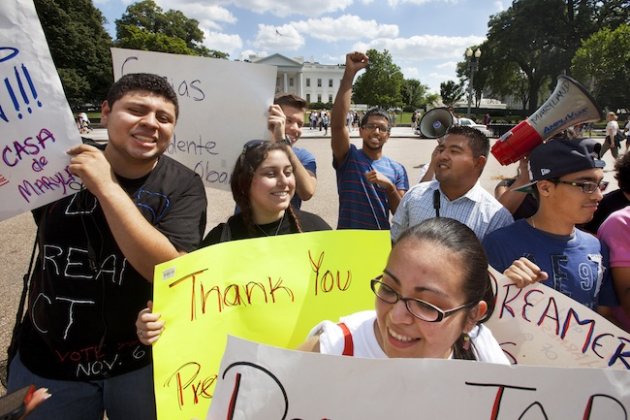 President Barack Obama's high-profile shift on immigration last week — announcing plans to grant temporary legal status to as many as 800,000 undocumented people brought to American soil as children — has the overwhelming support of likely voters in a new Bloomberg poll released Tuesday.
Sixty-four percent of them — and 66% of independents, the frequently up-for-grabs voters thought to decide elections — support the president's decision. The White House has forcefully (and rather implausibly) denied that Obama sought political gain from his announcement. But as recently as March 2011, he had said publicly that he lacked the power to halt such deportations.
The Bloomberg survey found that just 30 percent of likely voters disagreed with the president's plan. Fifty-six percent of likely Republican voters opposed it, while 86% of Democrats supported it. Just 26% of independents sided with the Republican majority in the poll.
The results surely cheered Obama's reelection campaign, which has been working to reassemble the victorious coalition that powered his history-making 2008 win — but faces an uphill fight in the face of deep pessimism about the economy.
The poll, which had an error margin of plus or minus 3.6 percentage points, also showed that immigration was the top issue of just four percent of voters — the sputtering recovery tops that list in every survey of public opinion.Obama enjoys a lopsided advantage over Republican rival Mitt Romney among Latinos. But while they are the fastest-growing voting bloc, and could decide the outcome in pivotal battleground states like Colorado, Florida and Nevada, Latinos have the lowest voter registration numbers of any major ethnic group in the United States. That means the president must energize them enough to register — and then encourage them to show up on November 6.
The challenge — and the stakes — are evident in Florida. A whopping 638,000 Latinos there are eligible to vote but have not registered, according to a recent report by the Obama-aligned Center for American Progress think tank in Washington. That's enough to make the difference in the Sunshine State.
Both Romney and Obama are due to visit Florida this week to address the National Association of Latino Elected and Appointed Officials (NALEO) at the group's annual conference. The former Massachusetts governor will speak Thursday, followed by Obama on Friday.
Gilani no more Prime Minister

 Yousaf Raza Gilani left PM House in a car without flag after he was disqualified as PM by the SC.
The picture of Yusaf Raza Gilani has been removed from the website of the National Assembly of Pakistan while PM s and ministers profiles have also been removed from PID website. Meanwhile, the Election Commission of Pakistan received the copy of detailed verdict of the SC.
The Supreme Court of Pakistan disqualified Prime Minister Yousuf Raza Gilani from office Tuesday in a stunning move throwing the country into fresh turmoil just months before expected general elections.
The Supreme Court made the move after convicting Gilani on April 26 of contempt in a highly politicised case for refusing to ask Switzerland to reopen a multi-million-dollar graft investigation into President Asif Ali Zardari.
Although the ruling itself is unlikely to bring down the government, it could hasten the date of the next election unless the Pakistan People s Party and its fractious coalition members can agree on a consensus, interim prime minister.
"Yousuf Raza Gilani has become disqualified from being member of the parliament," said the order read by chief justice Iftikhar Muhammad Chaudhry.
"He has also ceased to be the prime minister of Pakistan with effect from the same date (April 26) and office of the prime minister shall be deemed to be vacant accordingly," it said.
"The president of Pakistan is required to take necessary steps under the constitution to ensure continuation of the democratic process through parliamentary system of government in the country," Chaudhry read.
Zardari immediately convened emergency talks among top leaders in his main ruling Pakistan People s Party (PPP) and then summoned heads of coalition parties to the presidency for further talks on Tuesday night.
Officials were tight-lipped on how the president would respond, saying only that the series of meetings was being called to "assess the situation".
Gilani, Pakistan s first sitting prime minister to be convicted, has faced down widespread calls from the opposition to quit while he has been insisting that only parliament can remove him from office.
Members of his government have been accusing judges of over-stepping their reach and of trying to bring down Gilani and Zardari before February 2013, when the administration would become the first in Pakistan to complete a full five-year term.
Under the constitution, anyone convicted of defaming or ridiculing the judiciary is barred from being an MP.
The matter of disqualification fell first to the speaker of parliament, Fehmida Mirza, a member of the PPP who on May 24 said conviction for contempt was not a charge that meant he should be disqualified under the constitution.
Gilani subsequently decided not to appeal against his conviction in a move interpreted as an effort not to antagonise the court into disqualifying him.
But senior opposition politicians, including cricket legend Imran Khan and former prime minister Nawaz Sharif, challenged the ruling.
The allegations against Zardari date back to the 1990s, when he and his late wife, former premier Benazir Bhutto, are suspected of using Swiss banks to launder $12 million allegedly paid in bribes by companies seeking customs inspection contracts. The Swiss shelved the cases in 2008 when Zardari became president.
Gilani has always insisted Zardari has full immunity as head of state and last month said that writing to the Swiss would be a violation of the constitution.
Kabul accuses Pakistan over suicide attack
Afghan authorities on Tuesday said “regional spy agencies” were behind a rare suicide attack targeting Shia Muslims that killed more than 80 people in a veiled reference to Pakistani intelligence.
 Attorney General Eshaq Aloko said two men had been arrested over the December attack, which struck a crowd of worshippers on Ashura in Kabul.
President Hamid Karzai blamed Pakistani sectarian extremist outfit Lashkar-e-Jhangvi for the atrocity, which was unprecedented on such a holy day, and urged Islamabad to act.
Aloko said the attack was planned in Pakistan’s northwestern city of Peshawar, by “regional spy agencies” aimed at “provoking sectarian violence”.
“Although the Jhangvi group claimed responsibility, it was masterminded by some spy agencies in our neighbouring countries,” Aloko said.
Afghans blame Pakistan for fuelling much of the violence in their country, where the Taliban are leading a 10-year insurgency against the government and 130,000 Western troops.
The prosecutor said one of those arrested came from Afghanistan’s Nangarhar province, which borders Pakistan’s militant-infested tribal belt, and was paid 10,000 Pakistani rupees ($100) to bring two suicide attackers to Kabul.
“One attacker blew himself up, the second fled the area,” Aloko said.
He said the two arrested men both confessed over the plot and the case was now closed.
The explosion happened at the entrance to a riverside shrine, where hundreds of Shias had gathered.
The Taliban denied responsibility for the attack, the deadliest in the Afghan capital in three years.
“The case is closed for us now. We have completed our investigation, and the case will be sent to the court,” Aloko said.
Polio vaccination ban: Militants put thousands of children at risk
The Express TribuneOver 16,000
 children below the age of five will miss their polio vaccines in the North Waziristan tribal region following a ban announced by a powerful local warlord on vaccination campaigns in the region.
Hafiz Gul Bahadur, the alleged host of the deadly Haqqani network of Afghan Taliban, said last week that the top shura of militants has decided to ban the vaccination drive which, they believe, was a cover for US spies.
The move will seriously impact polio eradication efforts in Pakistan, which is among the three countries where polio is still prevelant, with 197 fresh cases reported last year.
Health officials believe that the Federally Administered Tribal Areas, or Fata, has become the reservoir of the disease because of its difficult terrain and reservations of local tribesmen about the vaccine.
A three-day vaccination drive kicked off on Monday in ‘high-risk’ agencies of Fata, which include Khyber, Bajaur, Mohmand and lower and central subdivisions of Kurram agencies. The target is to immunise 777,012 children below the age of five against the crippling disease.
A health official confirmed that North Waziristan Agency will be skipped. “North Waziristan was on the list until today. But now we have taken it off due to the threat from Hafiz Gul Bahadur,” Shahibzada Khalid, the deputy director of Expanded Programme on Immunisation (EPI) Fata cell, told The Express Tribune.
Khalid categorised North Waziristan as a ‘high-risk’ area and said that if the ongoing vaccination drive was not carried out in the region, thousands of children will be at risk. “The virus may also spread to other agencies and neighbouring districts of Khyber-Pakhtunkhwa,” he added.
Health officials, however, believe they might find a way out of the dilemma. “All stakeholders, including the government, World Health Organisation (WHO) , NRDF and UNICEF are trying to find a safe way to vaccinate children in North Waziristan,” said Dr Muhammad Azam, the focal person for the Fata polio monitoring cell.
The tribal regions of South Waziristan, Orakzai and Upper Kurram are ‘low-risk’ areas and hence not on the list of regions to be covered during the ongoing campaign. Health authorities have formed 2, 451 mobile, 195 sedentary and 79 transit teams to undertake the task.
So far this year, 22 fresh polio cases have been confirmed in the country – nine in Khyber Agency and one each in North and South Waziristan agencies.
In March this year, the WHO had warned that if the polio virus was not contained, Pakistan could face serious consequences, including travel and visa restrictions, from the international community.
President Zardari invites Presidents of Russia, Afghanistan, Tajikistan for summit
 President Asif Ali Zardari has invited the Presidents of Russian Federation, Afghanistan and Tajikistan to participate in the 4th Quadrilateral Summit which would be hosted by Pakistan.
The 4th Quadrilateral Summit between Russia, Afghanistan, Tajikistan and Pakistan will be held in Islamabad on September 26-27 2012.
Spokesperson to the President Senator Farhatullah Babar said that the President has also invited the President of the Russian Federation Vladimir V. Putin to undertake a bilateral visit on the eve of the Quadrilateral Summit.
MASSIVE KILLING IN KARACHI
 It is a matter of serious concern that more than 750 people lost their lives in target killing in Karachi during the first few months of the current year. To be precise, the gangs are known to the Government and its security agencies and still the Government is unmoved to stop the senseless killing of innocent citizens in the streets of Karachi. More than ten people are being killed in a day in r3ecent days in Karachi and the police and the security agencies are not chasing the killers for unknown reasons. Recently, the people are kidnapped at gunpoint and taken hostage, tortured and killed and their bodies thrown to the public places. It is a serious trend that different communities are at war and they allowed escalating the tension to all areas of Karachi. Even, footballer players are not allow to undergo routine practice in playground and they are chased away by the armed thugs wielding guns at the public place and the state agencies are turning a blind eye to this trend. Similarly, the business activities had come to a complete halt following a murder of a MQM activist and in revenge dozens of people from a particularly killed spread scare in all parts of Karachi to suspend the routine business and trade.
The only solution to the problems of killings and particularly ethnic cleansing of non-Mohajir communities is that all the armed groups should be disarmed and they be deprived of their weapons collected since the 1985 trouble in Nazimabad. MQM is the dominating group and it should be disarmed first. If the leaders do it voluntarily, it is better. Otherwise, the security agencies should do the job disarming the MQM gangs first and others will automatically surrender their weapons voluntarily, it is hoped. More than 90 percent terrorists and target killers caught by the police and other security agencies belonged to the MQM indicating the love for violence by the MQM top brass to keep Karachi and its people hostage at gun point. In the ultimate analysis, it is not in the interest of MQM and its Urdu speaking people to continue violence against the other communities as a final united front will demolish their military might. Thus, it is advised the MQM should disarm all its militants and gangs, mainly target killers first and show the way to others to disarm later. The Government in power should use its influence on MQM to disarm the armed gangs and target killers in the larger interest of peace in Karachi and rest of Pakistan.
Punjab rulers responsible for loss of life, says Kaira
Frontier PostMinister for Information and Broadcasting Qamar Zaman Kaira said on Monday that the Punjab rulers were instigating the people against the federation and they were personally responsible for the loss of life and damage to the public and Pakistan People's Party leaders and workers' property. He was talking to media persons at Faisal Mosque after attending funeral prayers in absentia for Saudi Crown Prince Nayef bin Abdulaziz Al Saud, who died on Saturday. While replying to a question, he said no doubt that loadshedding during past couple of days had increased, but that was no justification for attacking the public property and property of the PPP leaders. "Loadshedding is being done in all four provinces, but violent protest demonstrations are being held only in the Punjab. The Punjab police has become silent spectator, and the provincial rulers and the administration are not only part of the protest but they are instigating the people". Kaira said that the PPP through the 18th Amendment has tried to end the sense of deprivation among the smaller provinces but the rulers in the Punjab are fanning hatred to get petty political gains. He said that there was 800 mw low head hydro power potential in the Punjab but not a single mega watt has been produced so far. The minister said that 200 mega watt electricity will be added in the system from wind sector and 600 mw will be added from the same sector next year. He said that some Independent Power Plants (IPPs) are commissioned only on gas and their closure due to shortage of gas has added to loadshedding problem. He said that the incumbent govern was paying the price of the decisions of its predecessors which could not prepare proper energy policy and diverted gas towards CNG sector. Replying questions about the deceased Saudi crown prince he said the entire nation was praying for his soul. Kaira said that Saudi Arabia is brotherly country of Pakistan which has always supported Pakistan on all forums of the world. The minister said that the Saudi Arabia and Pakistan enjoy historic relations and the place where we have offered the funeral prayer is also a gift of the Saudi government to the people of Pakistan. To a question, he said that Fauzia Wahab was central leader of the PPP whose services would be remembered for long. He said that the PPP has lost a hard working parliamentarian and the National Assembly has lost a dedicated member. He said that the deceased PPP leader fought the case of the party and the poor masses in a very efficient manner. Replying to a question, Kaira said that the doctors belong to noble profession and work in unusually difficult conditions, however, if their negligence proved in the death of Fauzia Wahab, action will be taken against the responsible.
Pashto singer Ghazala Javed gunned down in Peshawar
Dawn.ComProminent Pashto singer Ghazala Javed and her father were gunned down by unidentified persons at Dabgari area here on Monday night. Family members of the deceased told police that Ms Javed had gone to a beauty parlour along with her father Mohammad Javed. Unidentified motorcyclists sprayed them with bullets when they came out of the parlour, they said. The bodies were shifted to mortuary for autopsy from where they were taken to a police station by police and Farhat Bibi, a sister of Ms Javed. An official of Shah Qabool police station told Dawn that they were collecting details of the occurrence and could not say anything with accuracy as to who was behind the crime. He said that Farhat Bibi might be complainant in the case and it was not known as to who she would charge. Hailing from the scenic Swat valley, Ms Javed married around two years ago Jehangir Khan, a native of Peshawar. However, last year, differences emerged between the couple following which she left residence of her husband and started living with her father. The singer had also filed a suit for dissolution of her marriage in Swat. She got fame few years ago and her audio and video CDs and cassettes were selling like hot cake not only in Khyber Pakhtunkhwa but also in Middle East where Pashtuns work in large number. Following her marriage, Ms Javed had stopped singing, but recently she resumed attending private functions.
Monday, June 18, 2012
NATO supply routes: K-P governor warns of isolation
The Express TribuneA top government functionary dropped the clearest hint yet on Sunday that Pakistan may reopen Nato supply routes for US-led foreign forces stationed in Afghanistan. “We cannot oppose Nato nor can we live a secluded life in this world,” Khyber-Pakhtunkhwa Governor Barrister Masood Kausar told reporters in Peshawar. The governor was speaking to the media during a visit to the Hayatabad Medical Complex to enquire after the health of Saturday’s Landi Kotal blast victims. He added that the government would have to take a decision over the Nato supply lines. Governor Kausar’s statement came against the backdrop of reports that the United States is getting increasingly impatient over the delay in the resumption of supply lines. A diplomatic source disclosed that the United States is pushing the embattled government to reopen the land routes at the earliest, as it fears that uncertainty hanging over the rule of Prime Minister Yousaf Raza Gilani might delay the process for months. “This is certainly an issue of concern for us,” said a source referring to the ongoing legal battle over the fate of Premier Gilani. The apex court is currently examining multiple petitions that challenge the ruling of National Assembly Speaker Dr Fehmida Mirza, who refused to disqualify the prime minister after he was found guilty of contempt of court. Legal experts believe that this week is crucial, as the three-member bench, headed by Chief Justice Iftikhar Muhammad Chaudhry, asked the premier’s lawyer Aitzaz Ahsan to complete his arguments soon. In what appears to be anticipation of a possibly adverse decision, Premier Gilani has called off his trip to Brazil for an international environmental conference. Foreign Minister Hina Rabbani Khar will represent Pakistan at the conference instead. Gilani’s move to opt out of the conference is attributed to ongoing cases in the apex court. The US urgency stems from the fact that Nato supplies may remain blocked for months if the prime minister is disqualified by the Supreme Court. A Pakistani official familiar with the development has confirmed that there had been intense efforts in recent weeks by Islamabad and Washington to break the deadlock in ties. The official, speaking on condition of anonymity, told The Express Tribune that Washington wanted to see the government take a decision before any judgment by the Supreme Court. He said the agreement on technical details related to taxes and transit fees Pakistan intends to impose on Nato trucks passing through the country had already been reached. “The matter rests with the political leadership of the two countries,” said the official. However, an American official pointed out that it was up to the Pakistani government to take the decision. “We have conveyed what we wanted to,” the official added. A crucial meeting of the Defense Committee of the Cabinet (DCC) is expected to review the situation this week to take a final decision. But officials from the two sides, though hopeful of a breakthrough, are not sure if the decision on the resumption of Nato supplies is imminent.
Zardari to visit Russia to attend Int’l Economic Forum
President Asif Ali Zardari will pay a three-day official visit to Russia from June 20-22 to participate in the Saint Petersburg International Economic Forum (SPIEF).
President Zardari will join other world leaders in the Russian historic city of St. Petersburg at the annual gathering of leading decision-makers from across the globe to identify key economic challenges and engage in finding solutions.
With this year’s theme ‘Effective Leadership’, the President will highlight the issues affecting the global economy and the increasing role of emerging economic powers in shaping regional and global agendas.
Sources said President Zardari will also take part in the panel discussion titled ‘Leadership that works’ and will stress to minimize the global financial crisis and find ways to strengthen energy security, regulate financial markets, and introducing large-scale reforms.
He will also present Pakistan’s point of view on the global economic model for the twenty-first century that can withstand geopolitical challenges and meet the interests of all countries.
The President during his stay will hold talks with his Russian counterpart Vladimir Putin besides meeting several other world leaders and dignitaries on the sidelines of the Forum.
He will also interact with the presidents and CEOs of the leading international business companies to seek investment in Pakistan, particularly in energy sector.
The SPIEF will debate important topics including global energy outlook, the Eurasian economic integration, international global energy award, banking in the 21st century and investment in human capital.
Sunday, June 17, 2012
KHYBER-PAKHTUNKHWA:34 dead in two KP bomb attacks

 Thirty-four people were killed and more than 70 sustained injuries in two separate bombings in Landi Kotal and Kohat on Saturday.
In the first incident, 27 people became victims of terror strike at a market in the Landi Kotal town of Khyber Agency.
Assistant Political Agent Khalid Mumtaz Kundi said unidentified persons had parked an explosives-laden pickup truck at Ranghar Bazaar located on the Charbagh Road, which exploded at 10:55 am.
Soon after the incident, security forces rushed to the scene and cordoned off the area.
Two schoolgoing children were also among the victims, while 65 people, including a local journalist Ashrafuddin Pirzada, were injured in the bombing. The wounded were rushed to the Agency Headquarters Hospital Landikotal, from where five seriously wounded were referred to a hospital in Peshawar.
No organisation or individual has so far claimed responsibility for the deadly attack; however, it is stated that the vehicle terminal owned by the anti-militant Zekha Khel tribe was the main target, as it openly opposes the Mangal Bagh-led banned outfit Lashkar-e-Islam.
According to the local administration, 25 shops, three vehicles and other nearby buildings were damaged in the terror strike. Moving scenes were witnessed in the hospital as people were searching their beloved ones.
Later, a remote-controlled bomb attack on a police mobile killed seven people including four policemen, as they were patrolling Dhoda Road. At least 10 policemen were injured in the attack. An additional SHO was also among the dead. Three more injured are reported to be in critical condition
Bahrain police shoot 5-year-old in chest, eye
http://bikyamasr.comBahrain police have shot a five-year-old boy in the left eye and chest, reports said. The shooting occurred last Wednesday evening in the Dair village, a suburb of Muharraq, during a police crackdown on protesters. The boy was hit by birdshot, activists said. The young boy was then transferred to the Salmaniya Hospital for treatment, and doctors are still waiting to see whether the boy will lose his eyesight in the eye. The ABNA news agency reported the father said his son was conscious, but could not see out of his injured eye. Activists who were with the child in the hospital said that they were banned from speaking to the child’s father about the incident after the instructions of officer Yousef Mulla Bkheit “who is renowned for his torturing of the prisoners and assaulting them sexually,” the report said. The activists said that the family wanted to take the child to a private hospital, however, officer Bkheit refused. They said that the father’s body was full of bird shots pellets as well. They reported that police told him to move otherwise they would fire at him, when he turned to carry his child they fired on both of them. The man who was still in shock said: “It didn’t occur to me they would fire at an old man and his little child, we were only selling fish.” He confirmed that they fired on them on purpose. They fired twice at them. The activists said that the father’s and child’s blood covered their fish box where they were selling fish at the side of the road. The activists said the boy Ahmed Nahham was the youngest citizen whose eyes were fired at. Wefaq society, a leading opposition group, called on human rights organizations and groups to save Ahmed Nahham five-year old boy who was targeted by Bahrain police by bird gunshots along with his injured father who was with him during the incident. Wefaq statement explained that Ahmed was from Dair village that suffered the savage barbaric attack waged by the police. It added that police carried Ahmed away with them, nobody knew about his injury.
The plight of Manal al Sharif: a Saudi woman trying to drive to work
http://www.albawaba.comOne year ago today around 40 women in Saudi Arabia drove their cars, daring to claim their right and breaking the ban. Today, the Right to Dignity Campaign, known as “Women2Drive”, will present a petition to the King to change this draconian prohibition. It is signed by at least 760 people. While there is no law against it, many have been arrested since last year only to be freed when they signed a statement saying they would never drive again, Shaima Jastania was sentenced to 10 lashes for it only to be overturned by King Abdullah Bin Abdul Aziz, and the interior minister formally banned driving right after that day. Two women have even sued the government because they refuse to grant them driving licences. It was Manal Al Sharif, the Saudi woman who started the Women2Drive Campaign
 . As an employee of Aramco, the world’s biggest oil company owned by the kingdom, at the information protection management division, she was only one of only two women.
Part of her job benefits, included living in an Aramco employee town, in which, Saudi citizens enjoy a small amount of freedom. There are golf courses, cinemas, and, surprisingly, women drivers. Yes, women are permitted to drive inside the compound.
One day, trying to come home from a doctor’s appointment in a neighbouring town, Manal could not find a cab and her brother’s phone was turned off. She started walking. Men drove by with the windows down, hurling insults and lewd comments at her. One car even slowed down and doubled back to intercept her. On that day Manal feared for her life.
After hearing from coworkers the next day that there was no law against women driving, she asked herself, as reported by Women’s ENews, “I have a car and a driver’s licence. Why can’t I drive outside of Aramco?”
As Manal began to speak out and gain recognition for her activism, she was invited to various rights conferences outside of the country. Aramco time and time again denied her time off to attend the events. When she asked for permission to travel to Oslo last month to participate in the Oslo Freedom Forum, she was refused, and in consequence, she resigned. Manal closed her Oslo speech with the following line: “the rain starts with a single drop.”
On May 10 the Oslo Freedom Forum published Manal’s speech on YouTube. Since then, the video has been viewed more than 315,000 times, mostly from viewers inside the Arab peninsula.
Some YouTube users have downloaded the original video from the Oslo Freedom Forum’s YouTube channel and re-posted copies with misleading subtitles and commentary, portraying Manal as a traitor to Saudi Arabia and an enemy of Islam. As a result, Manal has been the target of thousands of attacks — on YouTube, Twitter, blogs, online news sites, and even print media in Saudi Arabia.
Saudi cleric Shaikh Abdul Aziz Al Tarifi recently issued a fatwa declaring Manal a “hypocrite” — thereby questioning her status as a Muslim and placing her under further risk.
Manal lost her job, the mortgage on her house, her job prospects for the future, and, if she chooses to leave Saudi Arabia to find work, she may also lose custody of her six -year-old son.
In Saudi Arabia there is no public transportation. On average, Saudi women pay upwards of one-third of their salaries to drivers. There are more than one million private drivers.
Saudi Arabian women risk arrest as they defy ban on driving
http://www.todayonline.comWomen in Saudi Arabia have been arrested and jailed for defying a ban on driving. Now they want men to join them in the passenger seat as they get behind the wheel. In the past year, they have lost jobs, friends, social standing, reputations and they have been imprisoned, shunned and - in a few cases - even received death threats. But women in Saudi Arabia were this weekend preparing once again to risk arrest and even flogging to drive cars in defiance of the country's ban. It was on June 17 last year that about 100 women took part in the first demonstration organised by underground civil disobedience campaigns Women2Drive and I Will Drive My Own Car. Many were arrested and jailed. One woman's sentence of 10 lashes was revoked only after the king intervened. It was the largest mass action since November 1990, when 47 Saudi women were arrested after demonstrating in cars. On Wednesday, two founders of the movement, Ms Manal al-Sharif, 33, and Ms Najla Hariri, 45, posted an open letter with 600 signatories to King Abdullah, appealing once more for an end to the ban on women driving. The letter said: "Our initiative is not aimed at violating laws." Today, women with international driving licences are being urged to flout the ban, but to make sure they do it respectfully, wearing the legally required full Islamic dress and displaying a picture of the king. Campaigners want men to show their support by travelling in the passenger seat with their wives, mothers, and sisters. They are also asking women to flood the traffic department with driving licence applications. "We only want to enjoy the right to drive like all women over the world," Ms Hariri told the Observer. "It is really hard for women to take such a stand for the right of driving," she said. It was in May last year that Ms Hariri, fed up with having to find a male relative to ferry her and her children around, began to drive herself. After hearing about Ms Hariri driving on Facebook, Ms al-Sharif, a divorced mother, followed suit a few days later, posting a video of herself on YouTube. Ms Al-Sharif was imprisoned by the religious police for more than a week. This month, Ms Al-Sharif was unable to join four other Arab women in Washington to receive a Vital Voices Leadership Award from an organisation founded by Hillary Clinton. "The main reason for not being at the awards was (concern) for my family's safety after receiving death threats from insane people," Ms al-Sharif tweeted. A year after she won recognition for defying the ban, Ms al-Sharif has been forced to resign from her job at Saudi's government-owned Aramco oil company and has lost her housing. Family members have left the country out of fears for their safety. \Meanwhile, a campaign called My Guardian Knows What is Best for Me - which opposes calls for a more liberal approach to women's rights, including women driving - has been started by a group of Saudi women. That means the high personal price that is being paid by Ms Hariri, Ms al-Sharif and other women could be for nothing if apathy stops women driving in Saudi. "I am very happy with the attention that we draw to our right to drive and I thank God that so many men are supporting us," said Ms Hariri. "I can't say women are afraid, but of course they are worried - worried equally about the police and about their families. "I hope that June 17 this year will bring us some good news regarding driving, because society's awareness is so much better now and there is wider understanding that there is an alternative here," she said. "All of us have the dream that our country can and will become a supportive community for women, where men and women are treated equally."
Bahraini regime forces attack anti-regime protesters
Anti-regime protesters in Bahrain have been attacked once again by the country’s Saudi-backed forces as the demonstrators continue to insist on their demands.
In the capital city of Manama, forces fired tear gas and rubber bullets at the protesters, who called for an end to the long-time rule of the Al Khalifa regime.
The Sheikhdom has been the scene of anti-regime demonstrations since February 2011. The Manama regime forces have been cracking down on the protests ever since.
The rallies continue across the kingdom despite a ban on public gatherings and the regime crackdown.
Scores of people have been killed and many others have been arrested during the revolution.
Bahrainis hold King Hamad bin Isa Al Khalifa responsible for the death and arrest of protesters.
Taliban ban anti-polio drive in Pakistan tribal area
Pakistani militants in a Taliban and Al-Qaeda infested tribal region Saturday banned anti-polio vaccination teams, to protest US drone strikes saying the attacks were killing civilians.
"Anti-polio vaccination teams will not be allowed to administer polio drops among children in North Waziristan," local warlord Gul Bahadur said in a statement.
Bahadur, who is allied with Afghan Taliban fighting US-led troops across the border, said the ban will remain effective until the US stops drone attacks in the tribal region.
"On the one hand they are killing innocent women, children and old people in drone attacks and on the other they are spending millions on vaccination campaign," the statement distributed in the region's main town Miranshah said.
It said "the day and night US drone flights in Waziristan are causing mental illness in the local population which is more dangerous than polio."
Residents said people would respond to the call as Bahadur commands influence in the region.
Pakistan's northwestern tribal region, known as a hotbed of Taliban and Al-Qaeda militants, is witnessing increasing drone strikes amid a stalemate in US-Pakistan talks to end a blockade on NATO supplies crossing into Afghanistan.
Pakistan shut NATO supply lines in anger over US air strikes on a border post on November 26 that killed 24 Pakistani soldiers.
The statement, citing the case of Pakistani doctor Shakeel Afridi jailed for helping the CIA find Osama bin Laden, also slammed the immunisation campaign saying that it may be used for espionage purposes.
Afridi was arrested after US troops killed bin Laden in May 2011 in the northwestern town of Abbottabad where he set up a fake vaccination programme in the hope of obtaining DNA samples to identify the Al-Qaeda leader.
He was sentenced to 33 years in jail on May 23.
Pakistani authorities whipped up anti-American sentiment after the bin Laden raid calling the drone strikes a violation of national sovereignty.
But US officials consider the attacks a vital weapon in the war against Islamist extremists, despite concerns from rights activists over civilian casualties.
UN High Commissioner for Human Rights Navi Pillay recently called for a UN investigation into US drone strikes in Pakistan, questioning their legality and saying they kill innocent civilians.
Saturday, June 16, 2012
China launches spaceship with first female astronaut
xinhuanet.com
 China launched Saturday Shenzhou-9 spacecraft with the country's first female
 astronaut aboard.
Shenzhou-9, atop an upgraded Long March-2F carrier rocket, blast off from the Jiuquan Satellite Launch Center in northwestern China at 6:37 p.m. Saturday.
A see-off ceremony was held at the center hours before the launch. Wu Bangguo, the country's top legislator, attended the ceremony and extended wishes to the three astronauts.
 "The country and the people are looking forward to your successful return," he said.
The first Chinese woman in space Liu Yang, 33, is joined by commanding officer Jing Haipeng and Liu Wang, who has been selected as an astronaut trainee since January 1998.
Main tasks of the Shenzhou-9 mission include the manual docking procedure conducted between the Shenzhou-9 and the orbiting space lab module Tiangong-1.
China succeeded in the automated rendezvous and docking between unmanned Shenzhou-8 spacecraft and Tiangong-1 last year.
A successful manual docking will demonstrate a grasp of essential space rendezvous and docking know-how, a big step in the country's manned space program to build a space station around 2020.
Liu, a People's Liberation Army (PLA) major, was a PLA Air Force pilot with 1,680 hours of flying experience and deputy head of a military flight unit before being recruited as an astronaut candidate in May 2010.
After two years of training, which shored up her astronautic skills and adaptability to space environment, Liu excelled in testing and was selected in March this year as a candidate for the Shenzhou-9 manned space mission.
"Female astronauts generally have better durability, psychological stability and ability to deal with loneliness," Wu Ping, spokeswoman for China's manned space program, said.
More than 50 female astronauts from seven countries have gone into space to date. The longest space flight by female astronauts lasted 188 days.
BALOCHISTAN BUDGET—AN ATTEMPT TO STREAMLINE ECONOMY
The Provincial Government has presented it last budget of its five-year tenure pending general elections sometime next year. The budget is generally welcomed as a good budget for the province with some reservation about the leakages of funds and misuse of official powers by some sections of the ruling coalition. Again it is record development budget with the commitment from the Minister in-charge to monopolize the development spending and not to disclose to the media about the details or reviews of the past development spending. It is good news that the Provincial Government had proposed massive spending on solar power meeting the growing energy needs of Balochistan. Some Rs 888 millions had been allocated for solar homes and Rs 3.5 billion allocated for this sector. The Chief Minister Secretariat and the Governor’s House will be switched over to solar system ensuring round the clock power supply to import centres of power in Balochistan. It is far better to provide solar system to the entire provincial secretariat, the real centre of administrative power in this province. Special funds should allocate for providing solar system for the Civil Secretary ensuring round-the-clock power supply to the Secretariat. We had earlier suggested in these columns that the entire village electrification programme of the Government should be converted and solar system be used as it is more feasible for this vast province of Pakistan. The Grind system is a failure and every village should have small power house based on solar energy instead of taking costly and lengthy transmission line to all corners of Balochistan. For this simple reason, the village electrification system has failed and now a day there is no electricity thus Government is resorting to massive load shedding of 22 hours a day in major parts of Balochistan.
The second import decision is to allocate fund for making Reko Dik Project operational at the earliest since there is no chance that the consortium of two international firms are unable to make it function following a dispute with the provincial Government. Reko Dik is the most prestigious project and it remain corruption and scandal free in the interest of poor people of Balochistan. All corrupt, vested interests and dishonest people should be kept far away from the project so that it is implemented at the earliest. Reko Dik will guarantee a sizeable income to Balochistan taking it out from the perennial financial and economic crisis, once its start production. The project had been delayed for more than two decades as vested interests were involved and corrupt and dishonest people in the Government did not implement it on priority basis. Now time has come that the Government should not delay it further. Help from brotherly Iran can be sought in establishing a refinery for separation of copper from gold disallowing the import of blister copper to outside world.
Finally, the subsidy on agriculture tube wells is totally misplaced keeping in view the depleting water table in areas from owners are given subsidy for indiscriminate withdrawal of sub soil water. There is no justification for subsidy to a small area of Balochistan and denying to the rest of Balochistan. It is discriminatory and uncalled for. In total, the Government is providing a subsidy of Rs seven billion while the entire product of fruits, including apple value less than Rs One billion, to say the least. The Government should stop this subsidy as it was stopped to wheat subsidy for the last couple of year. Let the growers make their own economics viable with subsidy and plan their agriculture land on this basis. No public money should be provided for a man made disaster for drying up the subsoil water making whole of Balochistan a huge desert sooner or later. We hope that the Government will end the shortsighted policy of subsidy to agriculture tube wells merely because the owners had a political clout in the present Government.
Pakistan: The menace in media
Editorial:Daily TimesThe events of the last week that have come to be known as ‘FamilyGate’ and ‘BahriaGate’ have given rise to a new gate yesterday: MediaGate. In a document printed on a Bahria Town letterhead, 19 journalists and media personnel have allegedly received kickbacks and bribes from Malik Riaz. On the heels of that startling but so far unsubstantiated document, the latest storm on social, print and electronic media unleashed after behind the scenes footage of a private TV channel found its way to YouTube. All hell broke loose as the ‘friendly’, personal talk/arguments between the interviewee and the interviewers were caught on tape and leaked on the internet. As the drama takes a public shape, the ‘tarnished’ channel in order to clear its name as two of its most prominent anchors face public and media condemnation, the response as expected is allegations of the unsavoury manipulation by a rival TV channel. There are a few things to be said about this. These allegations are a slap in the face of journalism in Pakistan and an insult to the 65-year struggle it took for good people to establish a free media in Pakistan. It wasn’t always like this: personal. As the latest media scandal upset the public’s sensibilities who hold certain individuals as a beacon of hope for Pakistan’s media as perpetrators of truth, it has also tarnished the country’s image abroad, making a spectacle of itself. The phenomenon of a ‘planted’ interview as it hollows out the credibility of the media, coupled with the allegation that certain prominent journalists are on the payroll of a certain businessman is a very serious development. It is now the duty of these 19 journalists to come clean on these allegations. For the most part, the media has never been subjected to accountability — whether it comes to incorrect facts or journalistic ethics. The owners and PEMRA turn a blind eye. Owners are driven by profits, swept up in a rat race of ratings. Most anchors and journalists have received no formal training and have a non- professional attitude. Their shooting to fame overnight empowers them, thus becoming a double-edged sword when they use it for ‘illicit’ acts, based on greed and an ugly rush to make professional advances. Started by TV anchors hurling allegations at each other on air, is this what airtime is meant to be used for? The CJP’s son’s alleged corruption charges are revealed by some anchors from a major media house; then it escalates and engulfs many, snowballing into the revelation of the list of 19 journalists, including the ones who presented the scoop. Why is this happening? Generally speaking, society has thrown all codes of ethics and morality out of the window. The clamour about alleged corruption in the media is the latest reflection of this virtually universal affliction in society. Journalists do not descend from the heavens, they are products of this very society, hence exhibiting a reckless behaviour that has become so commonplace it is considered a norm. Professionalism was to be the bedrock of the free media, but unfortunately not so anymore apparently if the example of the black sheep in the field is anything to go by . A multitude of inexperienced or unscrupulous journalists, after overnight excessive importance, have made a mess of a hitherto respectable profession. In the age of social media, whose power is an unfiltered double-edged sword, unsavoury results are sometimes produced as a result of an unlimited capacity to express yourself without fear or favour. It is some kind of accountability in itself, going into areas that old media could not venture into as easily. The latest development should serve as an example: it is time to look inwards. Breaking news is a tricky business; the ratings’ race is unchartered territory, which could lead to conscious and tacit victimisation of individuals and organisations. It is time journalists accepted responsibility for the huge task resting on their shoulders vis-à-vis the authenticity and veracity of what they present. A culture of corrections, explanations, and apologies must be incorporated. The ability to accept an error has been thrown out of the window in today’s rat race of ratings. A system of concrete reprimands and censure must be implemented. In that regard, the suo motu notice taken by the Supreme Court could apply a corrective, emhasising the importance of a proper system of veracity checks and balances.
No one could save Sharif brothers from money laundering case
www.sananews.netAfter the suspension of his Senate membership and subsequent reassignment as Adviser to the Prime Minister on Interior, Rehman Malik on Monday criticised the Sharif brothers in strong words and asked Shahbaz Sharif to keep up practice of jumping, adding that he will come in Lahore and will decide who will dance. He said that if I am IG of liars then the Shahabaz Sharif is the Super Daku, adding I advise Shahbaz to improve good governance instead of indulging in blame game. Speaking to media representatives at Karachi’s Jinnah International Airport, Malik referred to the duo as backstabbers. Malik also referred to the Pakistan Muslim League – Nawaz’s election symbol and said that “the lion roars, it does not jump from one place to another”. He summarised Nawaz Sharif’s political history dating from the time of his allegiance with General Ziaul Haq to the time when he separated from Chaudhrys. He said that the Sharifs jumped to Junejo League after leaving General Zia and later on they stabbed in the back of Maulana Samiul Haq in IJI and later formed PML-N and stabbed the Chaudhry Shujahat. He accused the Sharif brothers of causing a political upheaval and of staging a rebellion against the federation. Rehman also accused them of financial corruption. He said that the proofs of corruption of Shahbaz Sharif are with international agencies and he could save himself at any cost, adding that still he not disclosing any new corruption scandal against Sharifs, adding that the Sharifs will have to face the case of 32 million dollars money laundering case. He said that instead of approaching anyone the Sharifs could not save themselves from this case. He said that I had not said anything about the Nawaz Sharif but he himself thought that I have said anything against him. When asked about Karachi’s law and order situation, Malik hailed the performance of the provincial government and said that how PML-N leaders hatched conspiracies against democracy while sitting in Dubai I will expose this, adding that the Punjab government did not produced a single unit of electricity during past four years, adding that billions of rupees were wasted in Rasti Roti scheme and lap top schemes. He said that Shahbaz Sharif should focus on improving the good governance in the province instead of setting up camp at the Minar-e-Pakistan. He said that why Shahbaz Sharif has not taken any notice against the MS of Services Hospital Lahore over the fire eruption incident and death of 10 children, adding that if Shahbaz would have been performing his duties rightly this incident would have not been happened, adding that due to presence of Shahbaz at Minar-e-Pakistan the administration of Punjab is not working properly, adding if Shahbaz will not take not of Services Hospital tragedy then I will exercise powers of interior advisor and would form judicial commission for the investigations of the incident. He said that he was the first man who took the notice of the rape incident of five women in Dera Ghazi Khan. Replying the question on the new spree of target killings in Karachi, Rehman Malik said that Karachi was a big city and was therefore harder to manage. He also said that in the case of Karachi, one political group was trying to suppress another which was resulting in the chaos. He said that there was good governance in Sindh, adding that the petty issues of Karachi would be solved soon. He said that according to the 18th amendment to control the law and order situation is the responsibility of the provincial government, adding that the interior ministry will provide every possible support to the provincial government.
‘Life threats to Asma curb on freedom’
The Joint Action Committee for People’s Rights has raised deep concerns over threats to noted human rights worker Asma Jahangir.
“Life threats to Asma Jahangir are curbs on all those voices that are being raised for the rule of law, constitution, justice, peace and democracy in Pakistan, which is a cowardice way to oppress the truth, but such tactics could not be allowed and will be dealt boldly,” said the speaker of the moot held at Aiwan-e-Iqbal on Friday.
People from different sectors of civil society, including IA Rehman, Imtiaz Alam, Khaled Ahmad, Roubeena Sahgal and Farooq Tariq, spoke on the occasion.
The speakers condemned the threats to the human rights activist and former president of Supreme Court Bar Association, Asma Jahangir. On the occasion, they said such malpractices must be stopped and all the institutions must function within their limits.
They questioned whether it was a crime if Asma raised her voice for people’s sufferings or talked about democracy, peace and justice.
Demanding probe into the very threats and publicising the findings of the factors involved, the speakers also highlighted the various aspects of the struggle and activism of Asma Jahangir for the past four decades. A protest rally was also organised at the end of the meeting.
It is pertinent to mention here that Asma Jahangir has been receiving life threats recently over some of her views in favour of democracy and real freedom of judiciary.
Khyber Agency: 14 killed in Khyber Agency explosion
DunyaNewsAt least 14 people have been killed in blast in Landi Kotal area of Khyber Agency.A bomb ripped through a market area in a northwest tribal town near the Afghan border on Saturday, killing at least 14 people and wounding more than 30, officials said. The blast took place in the main bazaar of Landi Kotal town in Khyber tribal district, local administration official Arshad Khan said. The bodies and the injured people have been taken to the nearby hospital.The law enforcement agencies have cordoned off the area and an initial investigation into the blast has also been initiated.So far, the nature of the blast is not known.
Friday, June 15, 2012
Saudi women urged to flout driving ban
 Activists on Friday urged women to get behind the wheel for Sunday's first anniversary of the Women2Drive campaign, which resulted in the arrest of people defying Saudi Arabia's ban on women drivers.
"The key to ending the ban imposed on women driving in Saudi Arabia starts with women themselves," said a statement from the Women2Drive initiative, received by AFP.
It urged "women who hold driving licences (from abroad) to drive on the anniversary day, June 17, and document their acts."
It also urged men to get in the passenger seat and support their wives, mothers, or sisters who decide to flout the ban in the act of protest.
The statement called on women to flood the traffic department with applications for driving licences, knowing that women will not get such permits, and then to write to the head of the department to complain.
Nearly 600 people petitioned King Abdullah on Wednesday to allow women to drive in the only country in the world they are banned from doing so.
The petition urged the monarch of the ultra-conservative kingdom to "encourage women who have obtained driving licences from neighbouring countries to begin driving whenever necessary."
They also called on the king to "establish driving schools for women and (begin) issuing licences."
The petition thanked the king, a cautious reformer, for giving women the right to vote in municipal elections set to take place in 2015, saying "our initiative is not aimed at violating laws."
"We only want to enjoy the right to drive like all women over the world," said the petition signed by Manal al-Sherif, the icon of an Internet campaign launched last year urging Saudi women to defy the ban.
Many women have driven since the campaign was launched last year and many have been arrested and forced to sign a pledge that they will never drive again, activists say.
One group of defiant women drove cars last June in response to calls for nationwide action to break the ban.
The campaign, which spread through Facebook and Twitter, was the largest mass action since November 1990, when 47 Saudi women were arrested and punished after demonstrating in cars.
No law specifically forbids women in Saudi Arabia from driving, but the interior minister formally banned women from doing so after that protest.
Women with the financial means hire drivers, but others depend on the goodwill of male relatives to get around.
Pakistan:Strict action ordered against Pakistani chief justice's son, realtor
 Pakistan's Supreme Court has ordered strict action in a bribery case involving Chief Justice Iftikhar Muhammad Chaudhry's son and a real estate tycoon.
Wrapping up the case, a two-member bench ordered Attorney General Irfan Qadir to take strict action against the chief justice's son Arsalan Iftikhar, real estate tycoon Malik Riaz and the latter's son-in-law Salman Ali Khan, Dawn reported.
Justice Jawad S. Khawaja read out the short order after Thursday's proceedings.
"It is our expectation that he (the Attorney General) will set the machinery of the case in motion so that all those who may have committed any illegal acts, including Malik Riaz Hussain, Dr. Arsalan, Salman Ali Khan etc are pursued and brought to book with the full force and rigor of the law," the 14-page order read.
Not only was the Pakistan Supreme Court's credibility questioned, the bench said, but allegations were also levelled against the chief justice and the judiciary.
It added that bribery is a sin, and both givers and takers of bribes were sinners.
On Tuesday, Riaz had detailed before the court the alleged payments he made to Arsalan Iftikhar over the past three years, including for his foreign visits, stay at high-end hotels in London and Monte Carlo, and picking up his gambling losses.
About the reasons for taking the suo motu notice of the case, the Bench stated that such a notice was necessary to counter the erroneous perception about the Supreme Court being created due to media reports.
The court ruled that Riaz attempted to "buy justice" through bribery, and that he had grown into a habit of buying everything with money. He fuelled kcepticism and raised doubts on the apex court's credibility.
White House to halt deportation of young illegal immigrants
YAHOO NEWS
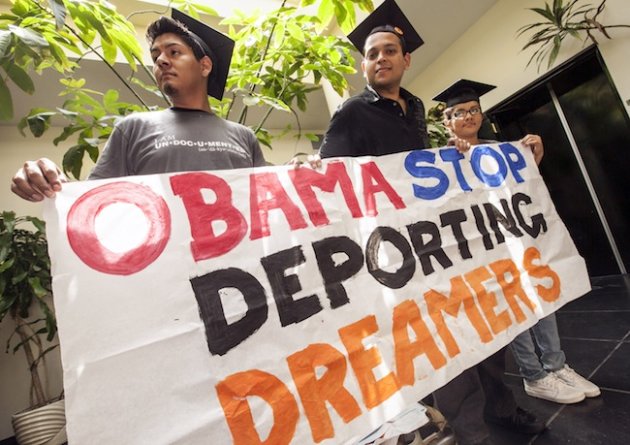 The White House will halt the deportation of as many as 800,000 young illegal immigrants and in some cases give them work permits, in a sweeping new initiative announced by the Department of Homeland Security.
People under 30 who entered the country illegally or overstayed their visas when they were under the age of 16 will be immune from deportation if they have not committed a significant misdemeanor or felony and have graduated from a U.S. high school or joined the military. They can apply for a renewable two-year work permit that won't provide a path to citizenship but will allow them to work legally in the country. Applicants will have to prove they've lived in the country for five consecutive years.
Homeland Security Secretary Janet Napolitano told reporters on Friday that she believed the move "is the right thing to do," and will help the agency focus on deporting criminals. "It is not immunity, it is not amnesty," she said. "It is an exercise of discretion so that these young people are not in the removal system."
Young people will have to proactively apply and pay for the temporary legal status at a local United State Citizenship and Immigration Services office. If the deferred status is granted, they can apply for a work permit.
"I wouldn't say we are encouraging people to step forward," an Obama administration official told reporters. "We are making a process available and people can make their own decision."
President Obama will address the change in a speech at 1:15 pm.
Young people who were brought into the country illegally or overstayed their visas as children are commonly referred to as "Dreamers," referencing the title of a decade-old bill that would have given them legal status if they joined the military or attended college. The Dream Act passed the House nearly two years ago, but was blocked by Republicans in the Senate. Opponents of the bill have argued that it would encourage more people to enter the country illegally, while supporters say it helps people who were brought up as Americans and whose lack of status is not their own fault become full members of society.
President Obama has faced criticism from the crucial Hispanic electorate for ramping up deportations under his tenure and for failing to deliver on his campaign promise to pass comprehensive immigration reform within his first year in office. Several times in the past year, Obama has told Hispanic audiences who asked him why he did not issue an executive order halting deportations of some classes of immigrants that such a move would be legally impossible. "There are enough laws on the books by Congress that are very clear in terms of how we have to enforce our immigration system that for me to simply, through executive order, ignore those congressional mandates would not conform with my appropriate role as President," Obama told one Dreamer who asked him why he couldn't halt young people's deportations in July. It's unclear what made him change his mind.
"We've been hearing all sorts of things from the White House, that it's not legally possible, that it's not politically possible," said Erika Andiola, a 25-year-old Arizona-based Dreamer and advocate who has met with administration officials on the subject. "I can't even believe it. We've been working for this for so long."
The move may generate enthusiasm among many Latinos: 85 percent of registered Latino voters said in a Latino Decisions poll that they support the Dream Act. The president enjoys a strong lead among Hispanic voters over Mitt Romney, but a lack of enthusiasm among these voters could mean they stay home on Election Day in swing states like Nevada, Colorado and Florida. During the primary, Mitt Romney said he would veto the Dream Act, but in recent weeks he has seen open to a proposal by Sen. Marco Rubio to grant Dreamers a worker permit but not a path to citizenship.
Republicans have rushed to criticize the move as an executive overreach. "This decision avoids dealing with Congress and the American people instead of fixing a broken immigration system once and for all," wrote Sen. Lindsay Graham, one of the few Congressional Republicans who supports immigration reform.
Dunya News workers vow to counter conspiracies
 An orchestrated campaign was launched against Dunya TV by nefarious elements.
Talking to Dunya News, senior politicians and journalists revealed that certain insignificant media groups in league with nefarious elements launched a well-thought out conspiracy against Dunya News and its workers to thwart media-group’s swift progress.
Dunya newspaper is in the offing and its popularity has threatened the vested interests.
Thousands of Dunya News workers have vowed to valiantly defeat this conspiracy.
Rana Azeem - the president of Punjab Union of Journalists - said that those involved in such anti-media propaganda would not succeed in their cause.
"Dunya News achieved exemplary success in short span of time" he added.
PPP s deputy parliamentary leader in the Punjab Assembly Shukar Basra said Dunya News raised its voice against the dictators and always kept public interest in view.
PML-Q leader Chaudhry Zaheeruddin vowed to support Dunya News and asked its administration to continue serving the masses through unbiased reporting.
He also said that the matter should be taken to the court and those involved in the conspiracy should be brought to justice.
PML-N leader Ayaz Amir said leaked off-air footage of the program is being used by various media groups as a tool to fuel anti-Dunya News sentiments.
Inamullah Niazi, member of PTI said that leakage of the footage was a violation of privacy law.
Subscribe to:
Posts (Atom)