M WAQAR..... "A man's ethical behavior should be based effectually on sympathy, education, and social ties; no religious basis is necessary.Man would indeed be in a poor way if he had to be restrained by fear of punishment and hope of reward after death." --Albert Einstein !!! NEWS,ARTICLES,EDITORIALS,MUSIC... Ze chi pe mayeen yum da agha pukhtunistan de.....(Liberal,Progressive,Secular World.)''Secularism is not against religion; it is the message of humanity.'' تل ده وی پثتونستآن
Saturday, May 19, 2012
Police: 3 terror suspects at NATO summit were plotting to hit Obama's campaign HQs
Three men charged with conspiring to commit domestic terrorism during the NATO summit were plotting to attack President Obama's Chicago campaign headquarters, the Chicago mayor's home and police stations, authorities said Saturday.
A police investigation that began early this month revealed that the three suspects are "self-proclaimed anarchists" and members of the "Black Bloc" group who traveled together from Florida to Chicago to commit violence as a protest against the NATO summit, authorities said in a statement.
Afghanistan: Interior Ministry Defends Local Police Against Accusations of Human Rights Violations
TOLONEWSThe Afghan Local Police (ALP) are violating human rights in several areas of the country, the Afghan Independent Human Rights Commission (AIHRC) said in a report released Saturday. AIHRC chief Sima Samar released the report saying that the local police have sometimes created more unrest in the areas under their control. "Some powerful figures sought the creation of the local police, but they have violated human rights in some districts," Samar said. Samar said that in some areas, the ALP were as troublesome as illegally armed groups. "You can't distinguish the ALP from other illegally armed groups," she said. Samar questioned the need for the largely local and illiterate force at all. "What is the need of a local police force if we have more than 250,000 in the army and a police force beyond 2014. Their [ALP] role for after 2014 should be clarified," she said. Afghanistan's Ministry of Interior (MOI), which oversees the ALP, rejected the claims saying that while the local police had been involved in 13 known human rights violations last year, all of these cases were prosecuted. "The local police have only been involved in 13 cases of human rights violations in some parts of the country, for which the perpetrators were prosecuted," MOI spokesman Sediq Sediqqi said. "Local police have been effective in bringing security to the districts under their control. They are a threat to insurgents." Around 13,000 local police have been assigned in 66 districts, and have found to be effective in fighting insurgents, he added. Their number is rise to 30,000 at the end of 2014 when the Nato-led combat troops are set to leave Afghanistan, according to the MOI.
Hollande seeks G8 backing against Merkel's austerity
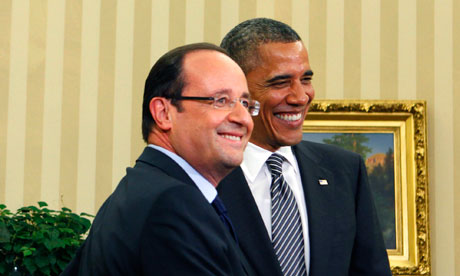
“An alliance for growth” was French daily newspaper Le Monde's depiction of the historic first meeting between new president François Hollande and his American counterpart Barack Obama.
Echoed by many other French media outlets, Le Monde's Saturday edition headline reflected the gaining momentum of Hollande‘s call to move away from austerity in tackling the ever-worsening eurozone crisis.
He was buoyed by the backing he received from Obama calling for a "strong growth agenda in Europe" as the two heads of state met for the first time at the White House on Friday.
"Even if the wording was general, it was important for Hollande," Le Monde said. "The head of state now has a heavyweight ally in his condemnation of austerity policies."
The new alliance, forged in a meeting lasting little over an hour, is a happy beginning for Hollande heading into this weekend’s G8 summit meeting of the world’s most powerful leaders at Camp David.World leaders echo Hollande's call
France's new president has long insisted the gloom hanging over Europe’s economies can only be lifted if harsh belt-tightening policies demanded by Germany are complimented by measures to kick-start the eurozone’s ailing economies.
Following Obama’s ringing endorsement of Hollande’s ideas, British Prime Minister David Cameron, who met with Hollande for the first time on Friday evening, was the next to align himself with the French president, suggesting the two shared the same views on growth.
"There is no conflict between austerity and growth," Cameron told reporters. "You need to have a strong deficit reduction program in order to get growth. President Hollande believes that, and I believe that."
Cameron did, however, set up a future clash with Hollande over the Frenchman’s promise to introduce a Tobin Tax on financial transactions, saying he would not support the move.
European Commission chief Jose Manuel Barroso also echoed Hollande’s call for more job-creating measures to help Europe out of the mire.
"We need to take action for growth while staying the course in terms of putting our public finances in order. Stability and growth go together. They are two sides of the same coin," he said.
Italy’s prime minister Mario Monti has already come out in support of growth measures to tackle a crisis that appears to be reaching a breaking point, with Greece heading toward an election that could throw its eurozone membership into question.
Merkel in danger of being isolated
When Hollande made a pre-election promise to tear up the European Union's fiscal pact, of which his predecessor Nicolas Sarkozy was so proud, it set the Socialist on course for a clash with German Chancellor Angela Merkel. She insisted Europe must continue to take the poison when it comes to austerity.But the sands now appear to be shifting in Hollande’s favour. Instead of the Frenchman looking like he's in over his head, it is his German counterpart who appears more likely to cut a lonely figure at Camp David.
"Germany is absolutely isolated," said Domenico Lombardi, a senior fellow at the Brookings Institution think tank, in an interview with Reuters news agency.
Lombardi said the dire situation of Greece has shifted the focus of the debate and heightened the need for a different solution to the crisis.
Even Obama sensed the growing pressure on Merkel, commenting she must have "things on her mind" after she responded to his greeting with a resigned shrug of her shoulders.
Hervé Favre, in an editorial for French paper La Voix du Nord, said with Obama’s backing Hollande could now “pile the pressure on Angela Merkel”.
After Camp David, Hollande’s crash course in diplomacy will continue at a two day NATO summit on Sunday and Monday where Afghanistan, Syria and Iran will all be on the agenda.
The French president then returns to Europe, where he will once again come face to face with Merkel at a European Summit in Brussels on May 23. After this weekend, it's possible he'll go into that meeting with his head held high.
Zardari to meet Karzai, Nato chief on summit sidelines
President Asif Ali Zardari arrived here on Saturday to attend the Nato summit and hold meetings with world leaders on bilateral and regional issues, especially peace and security in Afghanistan and the region.
Foreign Minister Hina Rabbani Khar and Foreign Secretary Jalil Abbas Jilani are part of the delegation, which will assist the president during the summit. Pakistan’s Ambassador to the United States Sherry Rehman is already in Chicago, spearheading diplomatic efforts ahead of the summit.
President Zardari will meet Nato Secretary General Anders Fogh Rasmussen, who had extended an unconditional invitation to him to attend the summit.
The bilateral engagements on the margins of the May 20-21 summit, scheduled so far, also include President Zardari’s meetings with his Turkish and Afghan counterparts, and the Prime Minister of Australia.
The White House had earlier said that so far there was no plan for a separate bilateral meeting between US President Barack Obama and President Zardari, our correspondent in Washington reported.
Briefing journalists on the two-day conference, US National Security Adviser Tom Donilon had noted that leaders from 61 countries would attend the summit and President Obama could not have bilateral meetings with all of them.
“There’s not a plan at this point to have a separate bilateral meeting with President Zardari, but President Obama will see him during the course of the sessions that we have in Chicago,” he said.
President Zardari will brief world leaders about Pakistan’s position on peace and security efforts in the region.
On the eve of the summit, Ambassador Sherry Rehman spelled out Islamabad’s position on various issues, including the November 26, 2011 cross-border strikes.
In an interview with CNN she said Pakistan has always had a role in the region and the alliance’s summit presented an opportunity to redefine it.
“This unconditional invitation to Pakistan is a very positive development. We don’t want interference in Afghanistan, but want to support peaceful security transition, which can also bring stability in Pakistan”, she said.
Nato Secretary General Anders Fogh Rasmussen, while giving details of the summit to the press, said that future capabilities and strengthening partnerships would be at the top of the agenda of the Chicago Summit.
He said that the summit would be an important meeting for the alliance. “This will be a summit of commitment to complete transition in Afghanistan and to support Afghans achieve a stable future”.
Besides US President Obama, the summit is being attended by important world leaders, including German Chancellor Angela Merkel and British Prime Minister David Cameron.
The summit is expected to set the course for the alliance’s future engagement in Afghanistan and the participants will discuss the role of International Security Assistance Force’s (Isaf) mission.
Obama hosts G8, NATO leaders
U.S. President Barack Obama and other world leaders are set to address a host of pressing economic and military security issues this weekend as the United States hosts a high stakes Group of Eight summit outside Washington and a NATO summit in Chicago.
Education important for progress, prosperity: Gilani
Prime Minister Syed Yusuf Raza Gilani on Saturday highlighting the importance of educational facilities for the people, said education, especially in the fields of science and technology, was very important for the progress and prosperity of the country and the welfare of the nation.
Addressing the third Convocation of Virtual University here, Prime Minister Gilani said, "The 21st Century is a century of knowledge, creativity and innovation and only those nations will call the shots on political and economic landscape that will be leaders in the field of knowledge and education."
The Prime Minister announced the establishment of 30 more campuses of Virtual University throughout the country, including the Federally Administered Tribal Areas (FATA), Azad Jammu and Kashmir (AJK) and Gilgit-Baltistan.
He also announced "IT Awards" of Rs 20 million to help the talented students from the remotest and backward areas of the country.
The Prime Minister said broadband centres would be established at all the union councils of the country to provide 30,000 jobs to the students this year.
He said the Federal Government had already spent 22 billion rupees on the development of IT infrastructure and broadband connectivity.
He also announced an allocation of Rs 17 billion more for strengthening broadband connectivity in other unserved areas of the country.
Gilani said PAK-SAT would provide one hour free transmission facility to the Virtual University.
He also directed for provision of land for the construction of Central Campus of the Virtual University in Islamabad and ordered the Capital Development Authority to submit a report in that regard within two weeks.
The Prime Minister also directed the Minister for IT to expedite the matter of 3G technology.
He said that technology would not only bring about a revolution, but also create employment opportunities and ensure more development.
He said he had already directed the Finance Minister to create 100,000 jobs in the coming budget 2012-13.
The Prime Minister said the Pakistan People's Party (PPP) had not come to power through backdoor and it was governing the country with the support of people.
He said some forces were bent upon obstructing the PPP's successful development programmes and removing the Prime Minister through unconstitutional means.
"However, they will fail in their unfair and unconstitutional drive as we have come to power through a public mandate and will continue to serve the masses," he added.
Gilani's security staff, Punjab Police scuffle in Lahore
The Express Tribune News Network.The Government of Punjab after withdrawing the protocol of Prime Minister Yousaf Raza Gilani has now started to create issues on his security as well. A scuffle between Gilani’s staff and Punjab Police personnel is said to be the first move on the part of the provincial government to convey a message to the centre: ‘You cannot move without getting approval from the Punjab government’. A brawl between the security staff and police personnel erupted over the issue of access to the stage where the prime minister was seated as chief guest. Gilani was attending the convocation of Virtual University at Expo Center in Johar Town, where he distributed certificates among the participants. SP Sadar Police Division Athar Waheed said that Station House Officer (SHO) of PS Mustafa Town, Muneer had been stopped by a constable part of the prime minister’s security team. He said that he was also not allowed to go near the stage, claiming that both he and the SHO were insulted by the security team and harsh words had been exchanged. A member of the Punjab police and the security team scuffled inside for 15 minutes after Gilani left the venue, and were joined by their colleagues later. The man from the prime minister’s security team was identified as Talat. SP Waheed said he had offered that Talat apologise to the SHO and local police, but he had refused and had instead suggested that he be taken to the police station. The SP then ordered the policemen to take Talat to the police station, adding that an FIR will be lodged against him if he does not apologise. The SP said that he is the one responsible for security of the venue and the whole system would be destroyed if he is not respected. SP Athar Waheed is a renowned police officer who has openly expressed his inclination with Pakistan Muslim League – Nawaz (PML-N). During the Long March, Waheed – who was posted as SP Gujranwala – had refused to crackdown against PML-N workers. Later, he had resigned in protest. PML-N chief Nawaz Sharif and Punjab Chief Minister Shahbaz Sharif had openly applauded Waheed’s action and had vowed that he would be honoured once they were in power. Security parameters According to security protocol, the premier has been given P2 security under the Blue Book. P2 (Pakistan) is the highest level security in which three cordons are made. Before the arrival of the prime minister, local police under supervision of the SP or DPO searched the venue and area through the Special Branch, Bomb Disposal Squad, metal and explosive detectors and sniffer dogs. After the police checked the venue, security staff of the prime minster had arrived and declared the venue clear. The Chief Security Officer of the prime minister belongs to the Army and is equal to a Major. However, it is the local SP or DPO who are responsible of overall security affairs of the prime minister. Three cordons The prime minister is provided with three security cordons – inner, middle and outer. The inner cordon comprises of the prime minister’s security, middle is provided by the Special Branch and the outer is handled by local police. The incident took place between the inner and outer cordons, as the security staff insisted that the police was not allowed to enter the inner cordon, while SP Waheed said that he had the right to visit all cordons. Tit for tat? Sources in PML-N said that during Nawaz Sharif’s visit to Sindh on May 15 and 16, the provincial government had withdrawn bullet proof vehicles and security, and that the PML-N media office had also issued a protest statement. The second action from the Pakistan Peoples Party (PPP) coalition government came when Interior Minister Rehman Malik had ordered SSP Islamabad to issues notices to the Sharif brothers for an inquiry into an ‘attack on the Supreme Court’ in 1998. Sources have claimed that SP Waheed’s move was very calculated. Governor Punjab orders SP’s transfer Governor Punjab Sardar Latif Khosa, taking notice of the incident, directed the transfer of SP Waheed to Balochistan. However, Police spokesperson Nabeela Ghazanfar said that Inspector General (IG) Police Haji Habibur Rehman has transferred Waheed to Provincial Headquarter Office. Sources said that the IG on the directives of Shahbaz Sharif had refused to surrender Waheed’s services to the federal government or to relieve him. ‘No transfers’ Punjab Law Minister Rana Sanaullah Khan said that the Punjab government cannot transfer officers on the wishes of others, adding that the incident had accidently occurred between the security and police officers. He said the security staff should have obeyed the orders of SP Waheed as he was in charge of security in the whole area. Sanaullah suggested that the matter should not be given a political angle, adding that no official would be transferred to Balochistan. DIG Operation Rai Muhammad Tahir said that the matter had been resolved, and added that Punjab Police was investigation the matter.
Friday, May 18, 2012
Algeria: The revolution that never was
Does 'progressive leadership' or something more complex and sinister explain why Algeria's 'Spring' never materialised? The 'Arab Spring' of 2011 brought down autocratic governments across North Africa and the Middle East. But, despite widespread street protests that initially threatened to spark a Tunisian or Egyptian style revolt, an expected uprising in Algeria failed to materialise. President Abdelazziz Bouteflika's regime - often accused of being one of the most repressive in the region - promised modest political reform and managed to hold onto power. Earlier this month it claimed to have delivered on these promises when parliamentary elections were held, in which the ruling National Liberation Front (or FLN) won an overwhelming majority of the votes. Although opposition groups were quick to deride the poll as a sham and to accuse the government of manipulating the results, European and American observers called the poll a step toward democracy. So what has been going on in Algeria for the last year? Did it genuinely, as the government would claim, avoid the upheaval that swept through the rest of North Africa last year because of the Bouteflika regime's 'progressive leadership'? Or has something darker and more complex been going on - a story that opponents and human rights activists say has more to do with a wary population traumatised by the country's violent past and living in fear of its secret police? People & Power wanted to find out, but getting into Algeria is difficult - not least because Al Jazeera has been denied official access to the country since 2004. Nevertheless, when our requests for journalist visas were ignored, our filmmakers managed to get in unofficially and were able to work discreetly. Producer Caroline Pare describes what they found.
Haqqani warns Pakistan not to overplay ‘Nato route’ trump card
Former Pakistani Ambassador to the United States Husain Haqqani Friday warned Pakistan not to overplay its trump card - control of the Nato supply routes through the country. In a CNN interview with Christiane Amanpour, he said: “Pakistanis have to wake up to the fact that whatever advantages they have as the ground line of communication provider, that advantage is not going to last forever.
As the Americans withdraw, yes, they need Pakistan to withdraw their heavy equipment. But in a worst case scenario, they can say ‘Blow up the equipment, let’s get out of here through other means.’”
The former envoy also claimed that his life was indanger in Pakistan, and he would only return to the country once radicalism there had been completely eradicated. He rejected the possibility of facing the memo commission saying that his life was at risk in Pakistan. Commenting on the unceremonious end to his own ambassadorship, Haqqani held, “I did not come to a very good end as ambassador. I ended up being accused of all sorts of things because I was trying to explain to people in Pakistan that the sentiment in America was now turning against our country. And I kept telling people in America that they need to be a little more understanding of what’s going on in Pakistan. So the proverbial middleman, I got punched by both sides.”
In response to a question, Haqqani maintained that Pakistan had serious reservations concerning Afghanistan’s future, and that the United States’ lack of confidence in Pakistan was uncalled for. He added that in order to solve a myriad of issues the United States would have to first understand the sentiments of the people of Pakistan and both countries would have to resolve their conflicting issues, adding that both Islamabad and Washington enjoyed “parallel narratives.”
“Pakistanis think that the United States is an untrustworthy ally, the Americans think that Pakistanis don’t always fulfil their end of the bargain, especially when it comes to terrorism,” Haqqani attested, adding that breaking the deadlock would not be easy.
“Remember, we need to crack down on these extremists for Pakistan’s sake. More Pakistanis have been killed by them than they have killed Americans. America will leave Afghanistan someday but we will still be haunted by the remnants,” he said.
“I am among those who feel that there are elements in Pakistani society who don’t allow us to have an honest and realistic debate about foreign policy. We just want to blame our neighbours, our enemies,” said Haqqani, “[and] we don’t want to take account of what’s wrong at home.”
President Francois Hollande affirms France's early Afghan exit in US talks
France's President Francois Hollande used his White House debut Friday to restate his intention to get French combat troops home from Afghanistan this year -- breaking with NATO's 2014 schedule.
Hollande met President Barack Obama for the first time since taking office three days ago, ahead of a testing weekend of international summits, with G8 leaders at Camp David and NATO chiefs at a 61-nation gathering in Chicago.
"I recalled to President Obama that I had made a promise to withdraw our combat troops from Afghanistan at the end of 2012," Hollande said, as the two leaders spoke to reporters in the Oval Office.
"I also stipulated that there would still be support in another form," Hollande said, adding that the French withdrawal would be done in consultation with French allies in the International Security Assistance Force (ISAF).Obama did not dispute Hollande's position, but stressed that NATO states must sustain their commitment to help "Afghans build security and continue down the path of development."
Washington is currently soliciting funding from its allies to ensure training and financing for Afghan armed forces after NATO combat troops leave -- which it estimates could cost around $4 billion a year.
Apart from Afghanistan, both sides sought common ground, with Obama styling the partners as complimentary as cheeseburgers and French fries, though alarm over the euro zone tempered Hollande's visit.
The two men adopted a common push for pro-growth economic policies going into the G8 summit later Friday, after an era of austerity failed to lift Europe out of a situation which now threatens to interrupt the US economy recovery.
Both sides went out of their way to stress that the Franco-US alliance, which has been beset by difficulties at times, would survive the change of power in Paris intact.
Obama said he had watched the "remarkable" election in France and offered Hollande, a Socialist, his "hearty congratulations."
"(I) assured him that the friendship and alliance between the United States and France is not only of extraordinary importance to me but is deeply valued by the American people," Obama said.
Obama also made his sober visitor smile as he said he had been reading how Hollande used to zip around Paris on a motorized scooter and understood the French leader had studied US fast food while touring America as a young man.
"Cheeseburgers go very well with French fries," Obama said, seeking a gastronomic metaphor to sum up a relationship that was so strained by the Iraq war that the junk food staple was once renamed "freedom fries" by US lawmakers.
Hollande, in a sharp change from the hyperactive and flamboyant style of Sarkozy, spoke firmly, but with little drama.
He said he and Obama had reached "convergence" on pro-growth policies in Europe.
Hollande also offered a reminder of a fact that Obama knows only too well as he seeks reelection in November hampered by a sluggish US economy that hardly needs a new blow to growth from reeling Europe.
"Our economies are dependent on one another, and what happens in Europe has consequences in the US and vice versa," said Hollande.
Obama said the situation was an issue of "extraordinary importance" not just to the people of Europe but to the entire world.
Both leaders said they also spoke about Iran's nuclear challenge, Syria's crackdown on dissent and the Arab Spring uprisings, all of which are expected to come up at the G8 summit later on Friday at Camp David.
BRITAIN: "Butcher of Bahrain", Protest over Bahrain king's royal invite
A small group of around 25 Bahrainis who now live in London have protested outside the Bahrain embassy in London over the presence of their king at the Queen Elizabeth II's Diamond Jubilee lunch for foreign royals at Windsor Castle.The protesters call King Hamad bin Isa Al Khalifa the "Butcher of Bahrain".
They held up banners and placards on Friday depicting blood running from the mouth of the King alongside photographs of Bahrainis who have been badly beaten.
The Bahraini government stands accused of human-rights abuses during months of protests by the majority Shia Muslim population against the ruling Sunni Muslim Al Khalifa family.
The protesters said they could not understand why Buckingham Palace included Hamad on Queen Elizabeth's guest list the jubilee lunch."It's very strange that the United Kingdom has invited such a dictator after all his crimes in Bahrain, to be part of a lunch with the Queen. We believe he should not be invited," said Ali al-Fayez, who described himself as a political activist who has been living in the UK for the past year.
"He should be behind bars; he should be on the wanted list of the United Kingdom, not invited to Buckingham Palace."
Later on Friday, the foreign royals attended a banquet dinner at Buckingham Palace as the guest of Prince Charles.
Britain and Commonwealth states are celebrating 60 years of Queen Elizabeth's reign in a series of events in the UK and elsewhere.
China on ‘high alert’ in Huangyan Island crisis
China said Friday that it would remain on "high alert" around Huangyan Island in the South China Sea to prevent provocations after Philippine President Benigno Aquino III stopped a group of about 20 Philippine protesters from landing on the shoal.
"Huangyan Island is part of China's territory, China will remain on high alert over the island to prevent any provocative behavior," China's foreign ministry spokesman Hong Lei told a regular news briefing.
"We also hope that the Philippine side will stop making irresponsible remarks and inciting radical behavior, come back to the right diplomatic track, and send clear and consistent messages," Hong said.
A group of about 20 people, led by outspoken former Philippine Marine officer Nicanor Faeldon and including television crews, was set to depart to Huangyan Island from the northern Philippine coastal town of Masinloc before receiving a last-minute call from the president to postpone their voyage.
Faeldon has served time in prison and was discharged from the Philippine Marines for a 2003 coup attempt. The protesters were planning to stay at Huangyan Island for at least three days and fish there.
The Philippine foreign ministry said on Thursday it did not want the trip to go ahead but Faeldon initially ignored the call.
"Given that both China and the Philippines have so far failed to make any substantial concessions over the dispute, if the retired Philippine officer had landed on Huangyan Island, it would have been seen by the Chinese side as an open provocation, and all the previous diplomatic efforts would have been in vain," said Li Guoqiang, deputy director of the Chinese Borderland History and Geography Research Center at the Chinese Academy of Social Sciences.
"Aquino does not basically oppose Faeldon's behavior," Li told the Global Times. "The Philippines has been acting as if it was being bullied by China in this dispute. But if Faeldon made his trip, it would be regarded by the international community as an obvious defiant step, which is not on Aquino's agenda."
Faeldon said the president told him that Philippine government representatives were currently in China to negotiate the maritime dispute.
"He said that he believed the postponement of this activity might be better for the resolution of this dispute," Faeldon told AFP.
Separately, Aquino on Wednesday appointed two special envoys to China to help arrange Philippine senior officials visiting China and to seek more investment and tourists.
On Friday morning, China's Yuzheng 310 fishing patrol vessel reportedly successfully prevented three unspecified foreign gunboats from attacking five Chinese fishing boats in the South China Sea.
Many observers regard the recent Philippine moves as a compromise to economic pressures from China, which has tightened quality controls on Philippine fruit and cut the number of tourist visits to the Philippines.
But Philippine Economic Planning Secretary Arsenio Balisacan said Thursday that the dispute is "likely to have a modest impact (on the economy) as of now," according to Reuters.
"We need to intensify our efforts to diversify our trade with other countries, whether or not this event with China occurred," Balisacan said.
"The move is not because of China's economic pressures. The fundamental reason is that Philippine people do not stand together with the Aquino administration," said Sun Xiaoying, a researcher on Southeast Asian nations at the Guangxi Academy of Social Sciences.
"Just look at the number of people who protested the US submarine docking at the Philippine port. It was far more than the number of protesters in front of China's embassy in Manila days ago," Sun added.
"It looks like Aquino's administration is bowing to economic pressure. But the truth is that Aquino is looking for an excuse to step backward."
Philippine official data shows China is the Philippines' third-biggest export market after Japan and the US, accounting for around 14 percent of total shipments in the first quarter of this year.
Obama Pays Tribute To 'Legend' Donna Summer
US President Barack Obama has paid to singer Donna Summer, who died of cancer on Thursday at the age of 63.
"Michelle and I were saddened to hear about the passing of Donna Summer," he said in a statement.
A five-time Grammy Award winner, Donna truly was the 'Queen of Disco'. Her voice was unforgettable, and the music industry has lost a legend far too soon. Our thoughts and prayers go out to Donna's family and her dedicated fans."
A statement from her family announcing the sad news read: "Early this morning, we lost Donna Summer Sudano, a woman of many gifts, the greatest being her faith.
"While we grieve her passing, we are at peace celebrating her extraordinary life and her continued legacy.
"Words truly can't express how much we appreciate your prayers and love for our family at this sensitive time."
One report suggested the singer, who was living in an apartment in New York at the time, blamed the 9/11 terror attacks on the city's Twin Towers for her lung cancer.
According to a report on celebrity news website TMZ, although she was a smoker and had performed throughout her career in smoke-filled clubs, she was convinced the toxic fumes she inhaled after breathing the air caused the cancer.
The "Queen of Disco", who sang pulsing anthems such as Last Dance, Love to Love You Baby and Bad Girl, came to prominence just as disco was burgeoning in the 1970s.
Music journalist Paul Gambaccini told Sky News Summer will have a "lasting legacy"."She never set out to be what she became. She came over to Europe to be a musical theatre actress and wound up being Queen of Disco because she met Pete Bellotte and Giorgio Moroder.
"She was for about five years just unstoppable."
In the mid-1980s, Summer encountered controversy when she was accused of making anti-gay comments related to Aids.
She claimed she had been misquoted but not before thousands of her records were returned and dance clubs boycotted her music.
Summer holds the record for most consecutive double albums to hit number one on the Billboard charts (three) and was the first female to have four number one singles in a 12-month period.
In 2008, Summer launched a comeback and released Crayons, her first album in 17 years.
She also performed on American Idol that year with its top female contestants.
Summer leaves behind a husband, three daughters and four grandchildren.
BAHRAIN: Thousands protest in Bahrain against Gulf union plan
Tens of thousands of mainly Shi'ite protesters rallied in Bahrain on Friday against proposals for closer ties with other Gulf Arab countries, a plan pushed by Saudi Arabia to contain dissent in Bahrain and counter Iran's regional influence.
In Iran, thousands of protesters also rallied against the plan, state television showed, and an influential cleric denounced the idea as an "ill-fated plot".
Protesters in Bahrain chanted "Down, down Hamad!", referring to their country's ruler, King Hamad bin Isa Al Khalifa.
"We are against everything Al Khalifa (ruling family) are doing and we do not want a Bahrain-Saudi union," one protester said.
Arab heads of state met in Riyadh on Monday to discuss a call by Saudi King Abdullah to unite the six-member Gulf Cooperation Council (GCC), but failed to agree on further integration. Talks are due to resume later this year.
Speculation has been rife that Saudi Arabia's main goal is a union with Bahrain, where anti-government protests led by majority Shi'ites have gripped the island state since last year.
"This plot is an ill-fated plot that is taking place with the American and Zionist (Israeli) green light but they should know that the people of Bahrain and the region, Muslims around the world and in Iran will never tolerate it," Iranian cleric Kazem Sediqi said in a Friday sermon broadcast live on state radio.
Iranian state television aired footage of thousands of people holding rallies around the country and chanting slogans against the ruling royal families in Bahrain and Saudi Arabia to protest against the proposed Manama-Riyadh union.
"Instead of surrendering to its own people, it (the Bahraini government) is surrendering its identity, with total abjectness, to another country," Sediqi said.
Tension between Iran and U.S.-allied Gulf Arab states has been high in recent months, with Arab leaders accusing Tehran of fomenting Shi'ite Muslim unrest in Bahrain - a charge that Shi'ite Iran and the protesters deny.
The dispute worsened when Tehran denounced efforts by the Gulf Arab states to forge closer political and military union, largely to counter Iran's growing regional power.
Bahrain, which hosts the U.S. Fifth Fleet, has been in turmoil since pro-democracy protests in February 2011, inspired by successful uprisings in Egypt and Tunisia.
The uprising in Bahrain has raised Saudi fears of an impact upon Shi'ites in its oil-producing Eastern Province.
Tehran, for its part, summoned the Bahraini charge d'affaires on Thursday to complain about a statement from the small Gulf island state that accused Iran of violating its sovereignty.
Read more: http://www.dailystar.com.lb/News/Middle-East/2012/May-18/173862-thousands-protest-in-bahrain-against-gulf-union-plan.ashx#ixzz1vGdxjpbT
(The Daily Star :: Lebanon News :: http://www.dailystar.com.lb)
Peaceful start to NATO protests
Despite much hand-wringing for city officials, the first rally of the NATO weekend — and two impromptu marches it inspired — went off without any major incidents Friday.
The two groups of protesters that had been marching through the Loop converged at Michigan Avenue shortly before 3 p.m., then largely dispersed without much resistance.
Police, who had allowed the groups to wander through Loop streets largely unrestricted, stopped them halfway across the Michigan Avenue bridge and not did allow them to go further north.
The marches appeared to have lost momentum by 5 p.m., with remaining protesters dropping their signs and their expletive-filled chants during a collective break at the intersection of Michigan Avenue and Congress Parkway. Protest organizers said they planned a demonstration training session in Grant Park at 7 p.m.
With their numbers far smaller than they were a few hours earlier, some demonstrators used the down time to sun themselves or drink water. A few could be heard drumming buckets, but the crowd otherwise seem fairly subdued.
Police officers largely responded to the lull by removing their helmets or chatting amongst themselves. The CPD bike patrol, however, continues to form a barricade to prevent protesters from stepping onto Michigan Avenue.
The kick-off rally was far from the angry, violent protests seen at other gatherings of world leaders. The National Nurses United rally featured people dressed like Buddy the Elf and dancing to Motown music. At one point, former Rage Against the Machine guitarist Tom Morello, an Occupy activist who has been at the movement's forefront, had to stop and teach the crowd how to sing protest songs. Police removed one protester from Daley Plaza but he was not arrested, according to Police Superintendent Garry McCarthy. Later, during a scrum with police on the Michigan Avenue bridge, at least one person was arrested after a protester ripped a NATO banner hanging from the bridge. Police estimated that between 2,400 to 2,800 people — many of them wearing red shorts and Robin Hood-style hats made of green felt — had gathered at Daley Plaza to support a so-called Robin Hood tax on financial institutions' transactions in order to offset cuts in health care and social services. A Tribune analysis of a crowd photo made during the middle of the rally counted just over 3,200 people, including police and bystanders. The Emanuel administration last week revoked permission for a march to Daley Plaza, claiming that the demonstration was expected to grow far beyond the original crowd estimate of 1,000 people. City officials later relented after they came under attack for suppressing free speech — but only after the nurses agreed to drop their plans to march through downtown.
That didn't stop a couple groups of protesters from marching through the Loop and up Michigan Avenue following the rally. Police officers accommodated the impromptu marches as they conducted rolling road closures for the hundreds of demonstrators who made their way east.
Chanting "these are our streets" and "(expletive) NATO," roughly 100 demonstrators headed toward Michigan Avenue. Another group of roughly the same size marched toward Grant Park.One group stopped briefly at Daley Bicentennial Park as members disagreed about where to go next.
Police tried to direct them onto Columbus Boulevard, but some protesters defied them yelling "Whose parks? Our parks!"
After 10 minutes of trying to figure out where to go, the group made its way through the park to Randolph.
Police tried to get them to use the sidewalks, but they pushed through the cops bike barricade and marched back west to Michigan Avenue.
When they did, the let up a cheer proclaiming victory over the police.
Most of the nurse demonstrators, however, boarded buses and left the loop after their rally.
During the scheduled event, Chicago Police took a flag pole that a Buffalo man was using to swing a "CoExist" flag.
Chris Phillips, 31 of Buffalo, said a police officer told him the pole was a potential weapon and asked him to remove the flag from the pole.
The police told him he could pick up the pole after the rally, he said.
After removing the flag from the pole, Phillips jumped up on a concrete planter in Daley Plaza and screamed, "this is the flag the police don't want you to read!" as he waved the "CoExist" flag around.
The nurses rally initially was intended to coincide withG-8economic summit, which was moved to Camp David, Md. earlier this year. Like many protest organizers, the nurses group went ahead with their event anyway in an effort to call attention to their cause.
The protest is expected to be warm-up for Sunday's anti-NATO march, which aims to protest a range of economic and military issues. Organized by the Coalition Against NATO/G-8 War & Poverty Agenda, the event is expected to draw about 5,000 people. With the NATO meetings still two days away, protesters complained of unfair treatment by Chicago police officers following the Wednesday arrests of nine people suspected of making Molotov cocktails in Bridgeport. Four of those arrested have been released without charges, said Sarah Gelsomino from the People's Law Office.
As many as seven others are still being held in the station's lockup, she said. Gelsomino decried the arrests, saying authorities were using the arrest to scare protesters in advance of this weekend's planned rallies. -
"This is playbook," she said. "Shoddy police work. It's a fear campaign."
Chicago police declined to comment on the case Friday morning, saying it remains under investigation.
Occupy organizers were scheduled to hold a news conference about the arrests this afternoon.
Tensions over the arrests did not seem to affect the nurses march, as the crowd spent part of Friday morning learning re-worked lyrics to "Dancing in the Street." The crowd was encouraged to change the chorus from "Dancing in the Street" to "It's time to tax Wall Street."
On the corner of Clark and Washington, a man carrying a sign denouncing authorities for denying him child visitation was visited by two police officers on bikes after a woman complained about the shrill whistle he had been blowing non-stop for the past 20 minutes.
"Lemme see that whistle," the officer said, holding out his hand. "People are tired of you blowing the whistle."
The man handed over the whistle, and argued with police for several moments.
"That's my property, that's my whistle," he said as reporters and passers-by stopped to watch, some recording the exchange with their cell phones.
After a few moments, the officers handed the man his whistle back, which he promptly began blowing.
Asked why he returned the whistle, the officer who did not want to be identified, said it wasn't worth the hassle.
"There's so many liberals around here, I'm not gonna get into trouble over a whistle."
U.S. Redefines Afghan Success Before Conference
Leaders of the NATO nations will meet in Chicago on Sunday to set in motion the massive machinery necessary to wind down the war in Afghanistan.
But even as American officials prepare a list of benchmarks they can cite as achieved in the war effort — expect to hear much about strategic partnership agreements and assurances that the Afghan people have not been abandoned — they acknowledge privately that the bar has been significantly lowered on how success in Afghanistan is defined after 11 years of combat.
“Look, this is Afghanistan,” one administration official said in an interview. “Is it going to be Switzerland? No. But is good enough for Afghanistan? That’s where we need to get to.”
In fact, the phrase “Afghan good enough” has been making the rounds at the White House, State Department, the Pentagon and inside the many research organizations scattered around Washington. Gone is the much greater expectation that NATO will leave behind a cohesive central government with real influence beyond Kabul and a handful of other population centers. Gone is the assumption that Helmand Province, Kandahar and the rest of the heavily contested south — where the bulk of the 2010 influx of troops was sent — will remain entirely in the control of the central government once that area is transferred to Afghanistan’s fledgling national security forces.
In previewing the meeting for reporters on Thursday, President Obama’s national security adviser, Thomas E. Donilon, described a hoped-for outcome in Afghanistan that was far less ambitious than what American officials once envisioned.
“The goal is to have an Afghanistan again that has a degree of stability such that forces like Al Qaeda and associated groups cannot have safe haven unimpeded, which could threaten the region and threaten U.S. and other interests in the world,” Mr. Donilon said.
With Afghan forces assuming the lead role in 2013 for protecting the country and its government, Mr. Donilon said the NATO allies hoped to leave behind “a set of security assets that allow it to provide for that modicum of stability” that will allow Afghanistan to protect itself against Al Qaeda and ensure that the United States’ core goal — making sure that Al Qaeda cannot again use Afghanistan as a base from which to target the West — is met.
While Kandahar and other population centers in the south have seen a decrease in Taliban attacks since the surge forces arrived, insurgent attacks have increased in less populated southern areas, military officials report. The heads of the Senate and House intelligence committees, appearing on CNN’s “State of the Union” program two weeks ago, and reporting on a recent trip to Afghanistan, said the Taliban were gaining ground, something that is bound to accelerate once the NATO troops give way to Afghan-led forces.
“I think we’d both say that what we found is that the Taliban is stronger,” Senator Dianne Feinstein, Democrat of California, said, seated next to Representative Mike Rogers, Republican of Michigan.
Anthony H. Cordesman, a longtime military analyst at the Center for Strategic and International Studies, wrote a paper three weeks ago called “Time to Focus on ‘Afghan Good Enough.’ ”
“Is progress sustainable?” Mr. Cordesman wrote. “Almost certainly no.
“The real question for everybody now is, can you hold this thing together to the point where, yes, the Pakistanis will have some influence, and Iran will have major influence in the northwest, and we’ll lose influence in the south and the east but we might be able to hold onto Kandahar.”
Mr. Cordesman added: “That would be Afghan good enough.”
Senior NATO military commanders in Afghanistan say they are well aware of the narrowing goals for their effort in Afghanistan. “We trained for a number of lines of operation in addition to the security line, whether education, civil society, economic development, you know, the whole government-in-a-box thing,” said one NATO military commander in Afghanistan. “Now, it’s only security. How much security can we bring before we go home? And how quickly we can train up Afghan forces to take over the security mission?”
And, for their part, senior Afghan government officials are aware that the ambitions of the Obama administration — and, in fact, the agenda for the NATO summit — are narrowly focused on security.
Eklil Hakimi, Afghanistan’s ambassador to the United States, said in an interview that President Hamid Karzai and the presidents and prime ministers of NATO countries will arrive in Chicago not to discuss nation-building in Afghanistan, but only securing the nation of Afghanistan.
“This particular summit, the Chicago summit, within the context of NATO, is focusing on the Afghan security forces and their support for the years to come,” Mr. Hakimi said.
In his official remarks to the summit leaders, Mr. Karzai will describe the increasing competence of Afghan security forces and the need for the international community to provide long-term support, both with personnel for training and advising, but also with money for equipping and logistical needs, the ambassador said.
There will be little if any discussion in Chicago of governance or financial development, he said. Those themes of development and economic strategy will await an international conference in Tokyo in July.
Pressed to describe the view of Afghan officials of the American phrase “Afghan good enough,” Mr. Hakimi cited advances made in women’s rights and education in the decade since American forces and Afghan fighters toppled the Taliban government and drove Al Qaeda from the country. Afghan women have leading roles in Parliament, in business and in medicine. Before the attacks of Sept. 11, 2001, only 900,000 Afghan boys were in school. Today, the number is eight million, and 40 percent of the students are female.
Asked whether that was sustainable with the lowered expectations of the United States and NATO for Afghanistan, the ambassador spoke forcefully.
“I leave that question to our partners,” Mr. Hakimi said. “That much we have achieved up to now — with you, together.”
“So it’s up to you,” he added. “Do you want to leave all this behind, or do you want to continue with us the journey that we have started together? With the support of our own people and also with the support of our international partners, we have laid a strong foundation for Afghanistan’s future. So, politically, we are moving in the right direction. In order to further strengthen that, we need support from our international partners for years to come.”
Gilani vows to serve masses until enjoys support of parliament
http://www.sananews.netPrime Minister Syed Yousuf Raza Gilani has said that the government still has not taken final decision regarding reopening of NATO supply, adding that Supreme Court has not disqualified him in contempt court case, adding he will continue serving country until he enjoys support of parliament. He said if any unconstitutional way is used for removing the elected prime minister than it will be harmful, adding president is only removed through impeachment and PM could only be removed through bringing no confidence motion, adding that if the opposition has any moral courage than it should being no confidence motion against him. This he said while talking to media persons after holding meeting with PML-Q President Chauhdry Shujaat Hussain and Senior Federal Minister Chaudhry Parvez Elahi on their residence, he said the PML-N should come out from the assemblies for holding long march against government, without quitting government it would be abrogation of the constitution. Prime Minister Gilani said that he has not been convicted over financial of moral corruption, adding that he was convicted for performing his duties and whichever he had done was constitutional and there was nothing unconstitutional happened. He said that no government want to become unpopular in masses while remaining in the government, adding that the PPP government has added 2300 megawatt electricity in the national grid, adding that 1000 megawatt is in the pipeline which would be imported from Iran, adding that government is also considering to import 500 megawatt from India. He said that there are four priorities of his government which include overcome load shedding issue, adding that shirt and medium term steps are being taken to overcome the issue, adding that if the work will consistently than one day this issue will be resolved. He said that the 2nd priority of his government is to provide jobs to masses and in this regard he has directed the finance ministry to create 10,000,0 jobs to masses, adding that the third priority of his government to not level any tax on masses during next budget, adding that the final priority is to give people relief in next budget. He said that after the 18th amendment there is no bar on the provinces for starting the electricity projects, adding that those protesting against the electricity load shedding tell how much electricity they have produced. Replying a question over the incident of burning of two buses in Lahore, he said that if the provincial government would hold demonstrations over the issue of electricity than such kind of incidents would be happened. Replying a question regarding the allegations on his son he said that the allegations are being leveled because he is in politics, adding that his son will face allegations. Replying another question he said that the decision regarding the reopening of the NATO supply has not been made, adding that President Asif Zardari was invited unconditionally to attend the Chicago conference on Afghanistan and he has left for attending the conference. Replying a question on the possible long march of the PML-N, he said that the PNL-N will not hold long march, adding that if it would hold long march than against whom it will hold long march, adding that the PML-N should quit the assemblies than hold long march. He said that if the PML-N will quit assemblies than it might be possible that the people will support PML-N in long march, adding that if the PML-N will hold long march while sitting in the government than it would be abrogation of the constitution, adding that all political parties are part of government today.
Supreme Court attack case:Notices issued to Sharifs in SC attack case
The Islamabad Police has decided to reopen the Supreme Court attack case and notices have been issued to Pakistan Muslim League-Nawaz (PML-N) leader Nawaz Sharif and his brother Punjab Chief Minister Shahbaz Sharif to appear before the investigation officer, Geo News reported on Friday. The channel’s sources said the investigation was initiated on the directions of the Ministry of Interior and Senior Superintendent of Police Malik Yousaf had been appointed the enquiry officer. However, no dates have been mentioned in the notices, the channel said.
Earlier, a local English daily had reported that Malik Yousaf had cautioned Interior Minister Rehman Malik against instituting cases against the two political heavyweights, saying this could prove counterproductive as the Sharif brothers would term it political victimization. The newspaper reported that after influencing the appointment of DIG Bani Amin Khan as the Inspector General of Police Islamabad, the interior minister had asked him to investigate the Sharif brothers in connection with the SC attack. However, the IGP regretted, saying he was left with only 18 months in service and did not want to get involved in any controversy. About two years back, the interior minister had also issued directives to the then IGP Syed Kaleem Imam but he also refused to get himself involved in the case.
Protest as Brit's queen hosts Bahraini tyrant
Human rights campaigners have orgainsed a protest outside the Bahraini embassy in London to raise their voices against the invitation of ‘Bahraini tyrant’ to a Diamond Jubilee event.
Human rights activists are outraged that the King of Bahrain will lunch with the Queen at Windsor Castle - after his regime was accused of a brutal crackdown on pro-democracy campaigners.
Protestors say the guest list at today's special Jubilee lunch features a range of foreign monarchs who have been widely condemned for their human rights records, or their extravagant lifestyles.
Among the guests sitting down with the Queen is the King of Bahrain, where demonstrations calling for more democratic involvement in the country's government were violently suppressed, with the help of Saudi troops. At least fifty people have been killed in the tiny Persian Gulf island nation since February last year.
Campaigners have described the invitation to King Hamad bin Isa Al Khalifa as "inappropriate, insensitive, and ill-advised."
"The King of Bahrain has been incriminated in grave violations of human rights. While he basks in the magnaminity of today's pomp and ceremony, the people of Bahrain are being shot, tear-gassed and tortured by his security forces. The British royal family is staining their own reputation by keeping company of dictators", said the writer and pro-democracy activist, Dr Ala'a Shebabi.
Other guests from controversial regimes are also at the lunch, including Swaziland's King Mswati, who has 13 wives, and is Africa's last absolute monarch. He is accused of leading a lavish lifestyle while his people are starving. The rulers of Kuwait and Saudi Arabia are there too - human rights group Amnesty International has accused both countries of rights violations.
The human rights campaigner Peter Tatchell has called on protestors to gather outside Buckingham palace tonight as guests arrive for dinner with Prince Charles, demanding that invitations to those he described as "royal tyrants" should be withdrawn.
"Inviting these blood-soaked dictators brings shame to the monarchy and tarnishes the Diamond Jubilee celebrations", he said. "The invitations are a shocking misjudgement. They show the Queen is out of touch with the humanitarian values of most British people. She's putting royalty before human rights."
Pakistan: Inflicting humiliation: Student made to beg for failing to pay school fee
Despite a ban on corporal and other humiliating forms of punishment in schools, the practice continues unabated.
In the latest incident, a seventh grader of Government Centennial Model School for Girls Haripur was allegedly beaten harshly and made to beg money from students when she failed to submit her annual school fee on time.
“She gave me a bowl and forced me to beg for money from each of my class fellows,” Mariyam Bibi narrated, watery eyed. She said her teacher told the students to “donate according to their financial status”.
Mariyam, who is a daughter of a daily wage worker, said she could not pay the fee because her father was out of town.
She said she assured her class teacher that her mother will deposit the amount by the afternoon, but the teacher, infuriated, allegedly thrashed her and made her beg for the amount from her classmates.
The victim’s mother has lodged a complaint against the teacher and the district coordination officer.
Although Haripur District Education Officer Rukhsana Yasmin was not available for comment, one of her assistants condemned the incident.
She assured that an impartial probe will be conducted and strict disciplinary action would be taken against the teacher if the allegations were proven true.
Pakistan was among the first 20 countries to ratify the United Nations Convention on the Rights of the Child, which holds the state responsible for protecting the child from any form of abuse, torture, or degrading punishment and for maintaining the child’s dignity.
Moreover, under Section 34 of the Child Protection and Welfare Act 2010, anyone found guilty of corporal punishment may be imprisoned for a period of six months with a fine of up to Rs50,000.
According to experts, inadequate training of teachers, lack of implementation of legislation banning corporal punishment, and the perception that punishment must be used to teach children, are all factors behind the widespread existence of corporal punishment.
In 2005, the United Nations Children’s Fund, in collaboration with the government and Save the Children ( a nongovernmental organisation), conducted the first in-depth survey to determine how many children were subjected to corporal punishment.
All 3,582 children interviewed said they had been beaten at school, while seven per cent said they had suffered serious injuries from punishments.
The survey also found that corporal punishment diminished rather than improve children’s concentration in schools and was a major factor leading them to drop out of school.
Additionally, data collected by the Islamabad-based Society for the Protection of the Rights of the Child (SPARC) indicates that about 35,000 high school students in the country drop out every year because of frequent use of physical punishment.
Failure to stop Balochistan disappearances is slap on democratic govt: VFBMP
The Voice for Balochistan Missing Persons (VFBMP), an non-government organisation striving for the safe recovery of missing persons, has said that the relatives of missing persons have pinned all their hope on the Chief Justice of Pakistan for the return of their loved ones, some of who have been missing for years. Addressing a news conference at a hunger strike camp set up by the relatives of missing persons outside the Quetta Press Club here on Friday, Chairman VFBMP Nasurllah Baloch announced that a seminar would be held on the violation of human rights in Balochistan on May 20 at Quetta Press Club. “Security forces and security agencies are behind the enforced disappearances and dumping of bullet-riddled and mutilated bodies in Balochistan. This gruesome violation of human rights has continued unabated despite the Supreme Court directives,” he told the reporters on Friday. “Earlier only relatives accused the security forces and secret agencies but police also produced concrete evidence against these institutions for their involvement in this barbaric act,” he said pointing towards the mounting evidence suggesting involvement of intelligence and security agencies. He said relatives of missing persons are disappointed with the Balochistan Chief Minister Nawabzada Aslam Raisani and Governor Nawab Magsi as they have failed to fulfill their promises despite enjoying four years in power. “They claim that they are well wisher of Baloch people but so far have failed to address a single issue, particularly the missing persons’ issue. The recovery of mutilated bodies is a slap in the face of so-called democratic government,” he asserted. Baloch also criticised the Human Rights Organisations for not playing their due role to ensure protection of rights of the common man. “The silence on part of rights groups is regrettable. The humanitarian problems are not addressed by holding seminars at five star hotels.”The Express Tribune News Network.
PRESIDENT ZARDARI TO ATTEND NATO SUMMIT
The President, Mr. Asif Ali Zardari, is scheduled to attend the NATO summit in Chicago on the invitation from the NATO Secretary. He is expected to leave for Chicago on Sunday to attend the summit. It is a welcome on the part of Pakistan as well as the NATO secretary general to invite Pakistan in this important summit taking fundamental decisions in regard to Afghanistan, regional security and stability in which Pakistan has deep interest. It is a known fact that Pakistan enjoys some influence in the region which is vital to be used for durable peace and stability in the region. Pakistan can contribute a lot in the peace process helping the international community to pullout the international force ISAF once confidence building among the regional countries and powers is made. There will be a permanent presence of Pakistan being the regional player in defending regional security while others are guests playing some role for some time. They had no permanent role in retaining peace while peace in the interest of Pakistan as it suffered a lot during the Afghan civil war spread over to more than three decades.
The international community will have to trust Pakistan and extend some support to play the crucial role in retaining peace and stability as a powerful regional players. Once there is peace in Afghanistan, more than 3.5 million Afghan nationals will be asked to leave Pakistan and go back to their country and live with peace, honour and dignity with no threat to their lives and honour. It is the basic interest of Pakistan to shed the burden of 3.5 million Afghans in Pakistan. In any case, the Afghan nationals will have to leave Pakistan by December 2012 and afterwards they will be declared illegal immigrants forfeiting their right to stay as refugees under the UN cover. The Chicago Summit must succeed in resolving the Afghan imbroglio taking fundamental decisions to empower the Afghans for security and the regional countries helping the legitimate Afghan Government in retaining peace and stability. The International Community should help legitimate Government of Afghanistan to develop cordial relations with all its neighbours in promoting cooperation in all fields. The President of Pakistan is expected to play a crucial role and assure the world community that Pakistan will help resolve the Afghan imbroglio retaining peace and allowing NATO to withdraw its troops with complete confidence as there will be no return of Al Qaeda and their local allies to use Afghanistan as a terrorist base in future.
Zardari leaves for Chicago to attend NATO summit
President Asif Ali Zardari Friday left for Chicago to attend the 25th NATO Summit being held on May 20-21.
President Zardari is visiting Chicago at the invitation of NATO Secretary General Anders Fogh Rasmussen, said Foreign Office Spokesman in a statement.
He said the decision to attend the summit was made after both the Defence Committee of Cabinet and Federal Cabinet had endorsed the invitation.
The spokesman said in Chicago, the president would address the expanded ISAF meeting of NATO. He will also meet various heads of state and governments on the margins of the NATO Summit.
The President is accompanied by Foreign Minister Hina Rabbani Khar, Foreign Secretary and Pakistan’s Ambassador to US Sherry Rehman join the Presidential delegation at Chicago.
Khyber Pakhtunkhwa Governor calls to make mineral resources fully beneficial
Khyber Pakhtunkhwa Governor Barrister Masood Kausar has said that both the province and Fata are rich in mineral resources ranging from marble and other semi-precious stones to gold and oil and gas reserves which demands efficient approach and effective measures to make them fully beneficial for the people.
Addressing as the chief guest at a conference on mineral sector in KP and Fata held under the auspices of Regional Institute for Mineral Development; a non-government organisation in Peshawar on Thursday, the Governor said, "focus on purposeful development of manpower coupled with encouraging potential investors was indeed the need of the hour for efficient exploitation of the abundantly available resources."
Provincial Minister for Mines and Minerals and Industries Nawabzada Mahamood Zeb Khan, MPA Malik Tehmash Khan and a renowned geologist and ex-vice chancellor of University of Peshawar, Professor Ghulam Jan Khan Tahir Kheli were also present besides researchers, scholars, senior government officials of the mines and mineral departments of the province and Fata, while the Chairman of the Institute Ghulam Mustafa Bughio welcomed the Governor and the delegates, and highlighted the working and achievements of the organisation.
Appreciating the holding of the moot at the premises of the university, the Governor said, "there is also need to promote market oriented education and skill development on scientific lines in this particular field as well and the forums like this moot are the effective means to discuss and guide the policy makers for making this possible."
Similarly, he said, the overseas Pakistanis especially working in Middle East could also prove tthe result-oriented investors The Governor while referring to his recent abroad visits said, "I myself have contacted many of overseas Pakistanis who have the earnest desire to contribute for development of the motherland by investing their earnings in workable fields".
"There is also need to establish mineral trading yards to encourage businessmen from the rest of the country and involve them in mineral trade", he added.
He further stated that work on a couple of marble cities in the province and Fata was also in progress, which was expected to start functioning shortly.
In Fata, he said, serious efforts were under way to promote private investment and for making this possible certain laws had already been extended.
"We should also establish special banking arrangements and offer tax rebates to businessmen desiring investment in these sectors and above all, we should provide them one window operation and facilitate them through investment promotion councils", he observed.
Referring to certain points raised by Chairman of the Regional Institute for Development, Ghulam Mustafa Bughio in his speech said "the Governor assured to spare no effort in making the workable recommendations of the moot fully beneficial for development of the mineral sector as well as well-being of the people of the respective areas."
How Imran Khan will make his promises?
http://www.newspakistan.pk
by Faisal FarooqChairman Pakistan Tehreek-e-Insaf (PTI) Imran Khan promised to end corruption in 90 days but without revealing how this miracle will be happened. Some people believe the cricketer-turned-politician can deliver his promise while others are doubtful of both his sincerity and ability. Certainly, he would only be a super smart if he will end corruption in a country of 180 million. Imran himself has not account of corruption or broken promises because he hasn’t history of holding a public office. But the worrisome factor is that Imran Khan is yet to announce a policy that how he would end corruption within a short span of time. His charisma, cricket fame, and the use of social media are at work but we haven’t experienced the example of elimination of corruption in a 90-day period before. As a slogan, corruption has always been used by almost every Pakistani government to undermine political rivals. As early as the 1950s, laws to disqualify politicians were enacted. Ending corruption is not an easy task and it will only result in high-powered accountability operations fixed in a dysfunctional legal system. It is a job to long-term process involving reformation of institutions, formal and informal laws and making changes in social values. Before vying a chance to put the country on a right track, the foremost test of Imran Khan is the prompt and efficient management of his party. In fact, it’s time for Imran Khan to bring down on rhetoric and beef up on specifics. He is required to come across as someone who knows what he is speaking about. It is not even clear how much electoral support the PTI will get in the upcoming elections. I personally don’t want Imran Khan to be unsuccessful. His failure and the absence of popular alternatives may make the future of democracy even gloomier. The captain should realize that this is not the managing of a hospital or a game of sport. A promising Islamic welfare state is a cruel joke without restructuring of a national security state.
Prime Minister Gilani : No-confidence vote only way to unseat me, Gilani tells opposition
DAWN.COMPrime Minister Yousuf Raza Gilani challenged the opposition Pakistan Muslim League – Nawaz on Friday, daring the Sharifs to bring a vote of no-confidence against him. “The only way to unseat me democratically is through a vote of no-confidence … the president can only be removed through impeachment. If you have the courage then go ahead and use the available option,” said the prime minister. The PM was speaking to reporters in Lahore at a joint press conference with Pakistan Muslim league – Quaid (PML-Q) chief Chaudhry Shujaat Hussain, who is a coalition partner of the Pakistan People’s Party (PPP). Gilani was found guilty of contempt by the Supreme Court for refusing to reopen corruption cases against the president, but received only a symbolic sentence of a few minutes’ detention in the courtroom. The opposition PML-N has said they do not consider him the prime minister after his conviction by the SC, and threaten to hold a long march if he stays in office. Gilani, however, says that he will remain the prime minister as long as the parliament allows him to. “I will not resign on somebody’s wishes … I have complete support of the parliament,” said PM Gilani, Pakistan’s longest serving democratically elected prime minister. “How can they protest against the government when they are in the government themselves? They would have to resign from their seats to protest,” he said. “As for long marches, they are held against dictators. There is a democratic government in the country. There are no dictators and there will be no long marches.” When asked a question regarding an appeal against the SC’s decision, Gilani said his legal team would decide about the issue. “I have not committed a crime. I have only followed the constitution’s interpretation given to me,” he said.
Thursday, May 17, 2012
Russia says action on Syria, Iran may go nuclear
Russian Prime Minister Dmitry Medvedev
warned on Thursday that military action against sovereign states could lead to a regional nuclear war, starkly voicing Moscow's opposition to Western intervention ahead of a G8 summit at which Syria and Iran will be discussed.
"Hasty military operations in foreign states usually bring radicals to power," Medvedev, president for four years until Vladimir Putin's inauguration on May 7, told a conference in St. Petersburg in remarks posted on the government's website.
"At some point such actions which undermine state sovereignty may lead to a full-scale regional war, even, although I do not want to frighten anyone, with the use of nuclear weapons," Medvedev said. "Everyone should bear this in mind."
Medvedev gave no further explanation. Nuclear-armed Russia has said publicly that it is under no obligation to protect Syria if it is attacked, and analysts and diplomats say Russia would not get involved in military action if Iran were attacked.
Russia has adamantly urged Western nations not to attack Iran to neutralise its nuclear programme or intervene against the Syrian government over bloodshed in which the United Nations says its forces have killed more than 9,000 people.
Medvedev will represent Russia at the Group of Eight summit in place of Putin, whose decision to stay away from the meeting in the United States was seen as muscle-flexing in the face of the West.
Putin said previously that threats will only encourage Iran to develop nuclear weapons. Analysts have said that Medvedev also meant that regional nuclear powers such as Israel, Pakistan and India could get involved into a conflict.
As president, Medvedev instructed Russia to abstain in a U.N. Security Council vote on a resolution that authorised NATO intervention in Libya, a decision Putin implicitly criticised when he likened the resolution to "medieval calls for crusades".
Medvedev rebuked Putin for the remark, and some Kremlin insiders have said the confrontation over Libya was a factor in Putin's decision to return to the presidency this year instead of letting his junior partner seek a second term.
Russia has since accused NATO of overstepping its mandate under the resolution to help rebels oust long-time leader Muammar Gaddafi, and has warned it will not let anything similar happen in Syria.
Since Putin announced plans last September to seek a third presidential term and make Medvedev prime minister, Russia has vetoed two Security Council resolutions condemning Assad's government, one of which would have called on him to cede power.
Russia's G8 liaison Arkady Dvorkovich said Russia will try to influence the final version of the G8 statement at a summit in Camp David this weekend to avoid a "one-sided" approach that would favour the Syrian opposition.
"In the G8 final statement we would like to avoid the recommendations similar to those which were forced upon during the preparations of the U.N. Security Council resolutions," Dvorkovich said. "A one-sided signal is not acceptable for us."
Russia successfully managed to water down the part of the statement on Syria at a G8 summit in France in May 2011, removing the calls for action against the regime of Syrian President Bashar al-Assad.
"We believe that the United Nations is the main venue to discussing such issues," Dvorkovich said.
LAST APPEARANCE
The G8 summit is likely to be the last appearance among all the leaders of industrialised nations for Medvedev, who embraced U.S. President Barack Obama's "reset", improving strained ties between the nations.
Dvorkovich said Putin's absence from the summit, the first time a Russian president has skipped one, would not affect the outcome: "All the leaders, I saw their reaction, are ready to comprehensively work with the chairman of the government (Medvedev)."
Dvorkovich said that at a bilateral meeting with U.S. President Barack Obama, Medvedev will raise opposition to attempts by some U.S. lawmakers to introduce legislation which will address human rights violations in Russia.
Such legislation could take a form of the so-called Sergei Magnitsky bill, named after the Russian lawyer who died in prison in 2009. The Kremlin human rights council says he was probably beaten to death.
The bill would require the United States to deny visas and freeze the assets of Russians or others with links to his detention and death as well as those who commit other human rights violations.
"New legislation which will address new political issues as imagined by some U.S. congressmen or senators is unacceptable," Dvorkovich said, promising a retaliation.
Zardari’s wisdom pays off
PRESIDENT Zardari’s
wisdom has paid off. Pakistan was back in the reckoning. The NATO invitation for the Chicago conference on Afghanistan, has been a major breakthrough.
Suggestions were mooted in these columns twice during last two weeks about an expeditious settlement of an issue, which has been hanging fire unnecessarily for past many months.
Finally when the President took matters in his hands, things seem to move forward, in different fields, be these oil and gas, electricity issue, or the delicate foreign affairs. Now the result is there for every one to see/ The air dash to Kabul of the US head of state and signing of a strategic treaty, without Pakistani being a party, had rung the alarm bell for Islamabad. Prior to that Secretary of State Hillary had delivered a rather unwarranted lecture in India, sermonising Pakistan about issues which had no relevance to American foreign policy/ Hillary’s outburst against Pakistan and that too on Indian soil, had hurt the people of Pakistan. However, after great deal of negotiations at civilian and military levels, the quagmire towards which the Pak-USA ties were pushed to, began to be cleared. Pakistan had succeeded in pulling itself out of a difficult situation, a situation which was though correct on principles, was yet an emotionally-driven. The change of foreign minister from Shah Mahmood Qureshi to Hina Rabbani Khar, came as the first indicator of the likely change in the foreign policy guidelines of the country. Hina has been outstanding, know how to deal with the situation as a patriotic Pakistani. She has foresight, and is articulate. She had pursued the difficult foreign policy subject tactfully. However on the sensitive issue of reopening of NATO supplies through Pakistan, blocked since the attack of Salala checkpost last year in November, she was a bit hard, but Zardari was there to keep a vigil on the moves the foreign office or the minister incharge was trying to attempt, or had attempted at different times.
The invitation to President Zardari for the important Chicago conference, is of paramount importance. It had restored Pakistan’s place on an issue of vital import for Pakistan. Had Pakistan been bypassed at the multilateral moot, it could well have been a disaster. Hostility to Pakistan had been building up in America with senators and even the Intelligence chief of the Senate committee Fienstien had begin to demand sanctions and suspension of trade and aid relations with Pakistan, Islamabad has already made a huge mistake when General Musharraf brought into action a plan to attack and take over Kargil outposts, ten miles inside India of the line of control without even informing the prime minister Nawaz Sharif. Musharraf, part of a “gang of four” at that time, executed a plan which late General Ziaul Haq had disapproved after losing the Siachen glacier to Indians in 1984. Zia had acted wisely because a counter move to provide a handle to the government to bargain on Siachen, was full of risks. It could have spilled out a full-fledged war between India and Pakistan, with dangerous consequences for both sides. Musharraf, General Mahmood, commanding the 10th corps in Rawalpindi, and the then chief of the general staff, General Aziz, and a former Pakistan ambassador to Washington Brig Javed, had launched a military operation, taking 140 abandoned Indian outposts inside the line of control in Kashmir on the Indian side.
They never bothered to even consult, much less, take into confidence an elected government of the time. This was their biggest folly. Military should remember that nowhere in the world in the post-second world war era, it had succeeded on its own in peace and war. Sir Winston Churchill won the war for England and the allies, Indira Gandhi won the war against Pakistan in 1971.
Ayub Khan lost the 1965 war with India because the entire move of sending infiltrators into Kashmir to liberate it from Indian yoke, was ill-conceived. Pakistan did succeed in getting control of the Indian territory, and drew an honourable Tashkent agreement in December 1965, but the defeat was in terms of strategy. Pakistan was an advancing army, and yet it was halted by the Indians when our troops were about to take control of the Indian supply route near the “chota tawi river” in occupied Kashmir. India diverted the war to International borders, and entire plan, fizzled out like house of cards. The 1971 story with General Yayha in control of the country, is better not repeated or commented upon.
The Chinese, angry over our unilateral ceasefire in 1965, had refused to extent any more military support to Pakistan, making it clear that theirs being a peoples army, cannot back any operation by Pakistani military against its own people. General Zia lost Siachen and hushed it up, saying not a blade of grass grows there. Benazir was the first to shout at the top of her voice as opposition leader that Pakistan had lost its valuable territory. Musharraf lost Siachen and looked towards Nawaz Sharif to extract the Pakistani troops from a hopeless situation.
They had advanced well inside the Indian occupied Kashmir to occupy vantage points and peaks, but the Indian army, and political leadership, confused in the beginning, woke up to the grim reality to realise that it was not an indigenous movement against Indian occupation, but regular Pakistani troops had been in operation for three month. They regalvanised themselves and brought the Bofors guns to pound on the Pakistani military and bunkers, causing huge casualties of our officers and soldiers. Nawaz Sharif pulled them out from a difficult situation and Pakistani troops were safely evacuated. Nawaz saved the Pakistan army from humiliation, in which Musharraf and his three other wizards had placed them in.
It was Kargil fiasco that changed the entire concept of terrorism to mammoth disadvantage of Pakistan. The world bought the Indian version that Pakistan army was sponsoring state terrorism in Kashmir, sending troops to destabilise the region. The USA not only agreed to Indian version, but tilted towards India, whereas prior to that it had always supported the idea of Kashmir being a disputed territory. Musharraf caused irreparable disservice to Pakistan. Islamabad was high and dry, all alone, totally isolated internationally. In the case of NATO supplies also, Pakistan should have listened to American pleas for bargain, and benefits they were offering to Pakistan for their silly attack on Salala.
Now the wisdom has dawned on Pakistan that America cannot be placed in a difficult situation in an election year where President Obama’s future political career may be at stake. However, it remains to be seen as to what kind of bargains had been struck. An apology is still due from America, and restoration of aid, and trade links, suspended since long, now needs to be restored. White House and the State Department must realise that Zardari too has to face the electorate. He needs to present something to his people for face saving.
I think Americans must start paying for every truck and tanker carrying supplies for NATO and declare their contents in writing to Islamabad authorities. Further concessions for being ally, especially in war on terror and for keeping Afghanistan stabilised, are overdue from United States, However, ever since President Zardari had taken control of the domestic and foreign affairs in his hands, prospects for betterment appear in sight. He has acted in time, and this must be recognised.
Coal project shelving charge on Nawaz
Pakistan Peoples Party (PPP) Sindh General Secretary Taj Haider on Tuesday alleged that it was Mian Nawaz Sharif and his party who stopped the 5000MW-Keti Bundar project, the Thar Coal Project, for which PPP made Coal Development Authority and who stopped Oil and Gas exploration in Sindh.He said that the 5000 MW Keti Bunder Project running on Thar Coal was expected to come on line in 2000. This project and other projects based on indigenous fuels would have made Pakistan an energy surplus country. He said that it’s a mockery that those who are responsible for the energy crisis are shouting over load-shedding crises in the country. He claimed that the sabotage of development of home-produced fuels in Sindh and stopping of energy projects in Sindh were done with the sole purpose of creating a justification for the controversial Kalabagh Dam project. He claimed that the greatest damage was done by revising the agreed tariff structure of the IPPs. Tariffs that envisaged a two cent reduction after every 10 years and the handing over of the IPPs after 30 years were changed to a high uniform tariff for the entire life cycle of IPPs. Under the agreements concluded by Benazir Bhutto IPP tariffs would have come down to two cents per KWH in 2015 and the plants would be handed over to us by 2025. Taj Haider concluded that the building of infrastructure and especially new power plants takes a lot of effort, finance and time saying that unfortunately, Mian Sahib does not realize the hard facts because he has never built anything for the people.Dr Adib Rizvi meets Qaim: Renowned urologist and head of Sindh Institute of Urology Transplant (SIUT) Dr. Adeebul Hasan Rizvi today called on Chief Minister Sindh Syed Qaim Ali Shah at C.M House. He discussed the matters of SIUT and presented problems that he faced. Chief Minister Sindh assured his support for resolving the problems soon.
Subscribe to:
Posts (Atom)