

M WAQAR..... "A man's ethical behavior should be based effectually on sympathy, education, and social ties; no religious basis is necessary.Man would indeed be in a poor way if he had to be restrained by fear of punishment and hope of reward after death." --Albert Einstein !!! NEWS,ARTICLES,EDITORIALS,MUSIC... Ze chi pe mayeen yum da agha pukhtunistan de.....(Liberal,Progressive,Secular World.)''Secularism is not against religion; it is the message of humanity.'' تل ده وی پثتونستآن
Wednesday, May 16, 2012
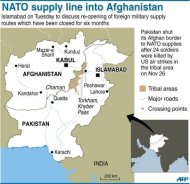
US to pay additional $365m a year for NATO supply
The cost of the US-led war effort in Afghanistan is about to rise by $365 million annually under an agreement that would reopen a key NATO supply route through Pakistan that s been closed for nearly six months, an American magazine has reported.
The accord, which the Pakistani government announced late Tuesday, would revive the transport of vital supplies of food and equipment from Pakistani ports overland to land-locked Afghanistan.
In return, the US-led coalition will pay Pakistan a still-to-be-fixed fee of $1,500 to $1,800 for each truck carrying supplies, a tab that officials familiar with negotiations estimated would run nearly $1 million a day. The officials requested anonymity because they weren t authorized to reveal details of the agreement.
In return, the US is asking Pakistan to provide security for the supplies, which are trucked through the country by private local transport companies, and much speedier clearance of customs and checkpoints.
The NATO traffic in and out of Afghanistan through Pakistan is anticipated to be as many as 600 trucks a day between now and the end of next year.
In a major climb-down, Pakistan dropped its demand that Washington apologize for the deaths due to the November raids. There was also no agreement to end controversial strikes by American drone aircraft against suspected militants in Pakistan s tribal area, as demanded by a cross-party resolution of Pakistan s Parliament.
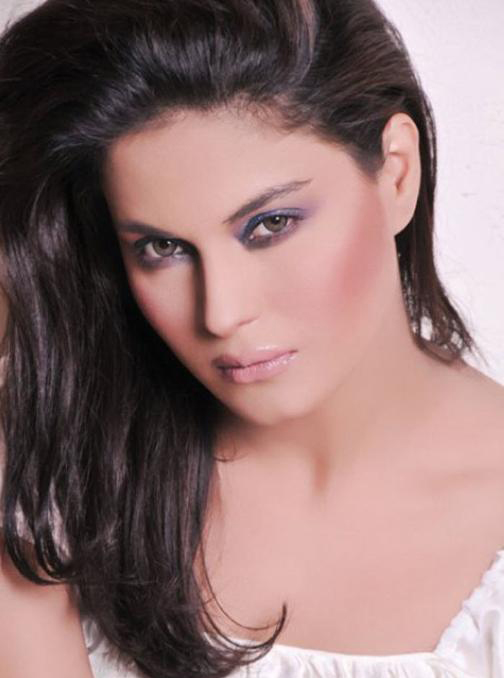
Veena Malik on controversies, “If I sneeze tomorrow, it’s going to be breaking news.”
Veena Malik
is synonymous to “controversy”, “publicity” and “scandal” but there is much more to this well-known Pakistani artist who made her foray into Bollywood with the much hyped item song ‘Channo’ from Gali Gali Main Shor Hai this year.
Veena was born in Rawalpindi, Pakistan and worked as an actress and comedian for the last twelve years in her home country. She has appeared in about nine Pakistani films and many more TV shows but her breakthrough came after the actress was offered to take part in India’s reality TV show Bigg Boss in 2010.
Malik is often involved in controversies and a recent nude FHM India magazine cover made headlines worldwide as the initials of Pakistan’s Inter-Services Intelligence spy agency were written on her upper arm.
In an interview with BollySpice reporter Sunny Malik, the actress talked about Bigg Boss, movies, friends and much more.
How has the trip to London been so far?
It has been busy and hectic. That was not the idea. I wanted to just roam around and shop a little bit. I love the culture and heritage of London. It has been a bit chilly and I don’t like that kind of weather. I ended up giving so many interviews that it has ended up somewhat like a PR tour. It’s okay and going great but I am overwhelmed with the response I have got from the UK media. It was amazing.You were known in Pakistan but got worldwide fame after going to India in 2010. How did it come about?
I got an offer from India and no one would have refused such a huge offer as undoubtedly, Bigg Boss is the biggest reality show in India. I did not really know what the show was all about. I was so busy working that I did not know what these Indian reality shows are all about. But I shared the news with my younger sister, as she is very fond of Indian reality shows, she told me not to miss this opportunity. I watched a bit of it on YouTube and they sent me a contract and after speaking with them for about two to three months, they made me realise that I should go for it. Probably, why I took up this opportunity was because the idea is amazing. You are in this house with fourteen different strangers and you are completely disconnected with the outer world. For me, that was thrilling and nice.Did it hurt you that the criticism was coming from your home country? Even after the FHM issue, Veena Malik was on one side and Pakistan on the other.
I don’t understand a few things. People are always looking at the negative side of things. People have criticised me a lot but at the same time there has been a large group of people in Pakistan who has been supporting me. Girls, boys, bloggers, media groups have been a big support. I have read things like “She is the liberal face of Pakistan”, “She is a Hero” etc. I have fans in Pakistan, especially girls, who keep tweeting me not to change as they look at me as an inspiration. But yes, I had criticism from Pakistan. But people have to understand that there people are either conservative or liberal in Pakistan. I have been living a liberal lifestyle and yes, there are conservatives but they are everywhere in the world. Even in India, people react to things, in the UK, US and everywhere. I don’t mind the criticism but they should be appreciating the things I have done for the country. I promoted my language on the show and I still remember that people there ended up speaking Urdu (laughs). I at least deserve that credit. I was angry and upset but at the same time, I can’t say that I don’t love them because I do.How does it feel now that you and Ali Zafar are promoting Pakistan in a positive way in India and worldwide?
I don’t know about the work that Ali Zafar is doing as he is just doing films. If you ask me, I would never compare my work with Ali Zafar. He is only doing films for himself and nothing else. The first thing I did in India was sponsor a girl child and at the same time, I have been part in so many other various activities in India like PETA. I am also appearing on various talk shows as I believe that love and harmony should be there between these two countries. They should move on about the things that happened in the past. But India has been amazing to me. I am getting so many offers that three films have been completed and two films are on being shot. Three more films will start by the end of this year. The biggest reality shows are being offered to me and at the same time I am a part of the Fashion industry.
You were recently seen in an item song. Do you think doing item songs is important ?
I don’t know if it is important or not. The leading Bollywood actors are doing them. I received an offer and I said okay. I have a great love for item numbers. I like these raunchy, sexy beautiful item numbers. I will be seen doing more item numbers as I have a great love for them. The spice of Bollywood films is item numbers.
Whom would you call your friend from the Indian film industry?
Recently, I have been very busy and initially I used to be a different person. I used to have a shell around me because I am a private person. I don’t easily allow people to penetrate and get to know me. It is very difficult for me to make friends. I have a working relationship with so many people. We have a good understanding but when it comes to personal friendship, I do not have any friends in India. I have many friends because of my work. When my work is over, the friendship is over. (laughs)
You are called controversies’ child. What is it with you and all these controversies?
I don’t know. If I sneeze tomorrow, it’s going to be breaking news.
Which are your upcoming films?
I have three different films coming up and all of them are different. I have chosen to be part of female centric films. I don’t want to be part of a film where I am doing two songs and four scenes. One is Mumbai 125 km which will release soon; I am not sure about the release date yet. This film will be released in English, Hindi, Tamil and Telegu. It’s a 3D horror thriller where I am playing the leading role but there are three other characters in the film. The entire story revolves around my character. I have done a lot of action sequences in the film.
Are you choosy about what films you want to be part of?
Yes, but only films even the shows I do. I have been very selective. It’s not like I will do anything that comes my way. Even if it’s the biggest banner and tomorrow they come to me with two songs and four scenes, I will never go for that. My second film is Zindagi 50/50, a serious social drama where I am playing a sex worker. It’s a very beautiful film and my role is not imaginary. It’s based on a real person who exists in Mumbai. I am also making sure that every film I am signing, I play a different character from the other. My third movie is Daal Main Kuch Kaala Hai which is a comedy. I will star another film soon called Rajni Ki Lag Gayi and another one called Supermodel. I have a few other films but I haven’t signed the contract yet.
Saudi monarchy against democratic reform in Bahrain
Security forces attacked the protesters in several villages on Tuesday night.
They fired teargas and rubber bullets to disperse the protesters in the villages of Sitra and Dair. They also arrested several youngsters in Dar Kulaib.
The latest developments come as the United Nations Human Rights Council (UNHRC) is set to discuss Bahrain’s rights record in the upcoming session of its Universal Periodic Review (UPR) Working Group in Geneva.
We have conducted an interview with Hisham Jaber, director of the Center for Middle East Studies, to hear his opinion on this issue.
The following is a rough transcription of the interview.
Q: Let us start with the regime’s crackdown on the villages and cities in Bahrain. How far are the Al Khalifa willing to go to quell the protest and how long will the Saudis be involved in the persecuting of peaceful demonstrators?
Jaber: First of all we have to remember that Bahrain revolution has more than one year all almost 14-15 months and has been always peaceful and many observers were surprised that how can this kind of revolution stay peaceful that long specially on the other side violence has been used within 15 months against protesters.
Talking about the regime in Bahrain, I am personally confident that the king of Bahrain want deeply inside have a solution for the crisis in his country and want a real reform but he is first king Hamad by inside objection represented by the right wing, the extremist prime minister or other members of the family who do not want any reform because they [fear] for their interest and their power.
On [one hand] an external pressure against any reform in Bahrain made by Saudi Arabia, everybody knows that any democracy or human rights or equality or freedom in Bahrain will move quickly to Saudi Arabia and as everybody knows that democracy is contagious.
On the other hand we have United States of America who did not take any final decision concerning Bahrain yet because Bahrain represents for America a military important platform like aircraft carrier and Bahrain asked the Fifth American Fleet and America is very concerned about its interest in Bahrain because to Bahrain the American operation can go easily and on the whole region.
So the Americans want to be sure that any reform in Bahrain will not threaten their interest.
I think now the problem will be much more complicated in Bahrain if the king or his government will not find a quick solution and make a quick election and respect the democracy also because this peaceful revolution cannot stay like this without violence because the people cannot stay receiving arms from the security forces and from the Saudi forces who came to Bahrain and as we see the human rights organization start now to look after Bahrain and to see there is a human rights violation in Bahrain.
This is [on the] one hand. On the other hand when Saudi Arabia came with the idea to form a union between Saudi Arabia and Bahrain, in my opinion is very dangerous and it is not feasible, it is not logical and it will really complicate the problem in state of solving this problem.
Bahrain activist says charge over tweets 'vindictive'
Prominent Bahraini rights activist Nabeel Rajab
told a court on Wednesday that a charge that he tweeted insults against the government was "vindictive," as dozens of lawyers turned up to defend him.
"The charge against me is vindictive and is due to my rights activism," Rajab told a judge at Manama's Minor Criminal Court, insisting the decision to arrest and try him was political, according to witnesses.
"I only practiced my right to free expression. I did not commit a crime. The decision to arrest me and put me on trial was a political decision," he said.
More than 50 lawyers, both men and women, gathered at the court to defend Rajab, who has been leading protests following a brutal crackdown on Shiite-led demonstrations against the Sunni Al-Khalifa dynasty in March 2011.
The judge adjourned the trial to Sunday, and ordered Rajab to stay behind bars.
Rajab, who heads the Bahrain Centre for Human Rights (BCHR), was detained on May 5 for "insulting a statutory body via Twitter". He also faces a trial for taking part in a Manama demonstration three months ago.
The activist has insisted on demonstrating inside Manama, unlike the main Shiite opposition which now stages its protests in Shiite villages, after last year's clampdown on protesters who occupied the capital's Pearl Square for a month.
Human Rights Watch on Tuesday urged Bahraini authorities to drop charges against Rajab.
"The charges against Nabeel Rajab are nothing more than attempts to silence one of the Bahraini government's most prominent critics," said Joe Stork, deputy Middle East director at the New York-based watchdog.
"Authorities should immediately drop these charges and release him," he said in a statement.
Despite being a veteran critic of authorities in the Gulf kingdom, Rajab has been spared imprisonment in the wide wave of arrests that targeted activists after security forces quelled the Arab Spring-inspired uprising, possibly for his international exposure and links with rights groups.
Another activist, Abdulhadi al-Khawaja, who is the former head of the BCHR, has been on a hunger strike in prison since February 8. He faces a life sentence among other leading opposition activists.
Bahrain has repeatedly come under pressure from rights groups as well as Western governments to release Khawaja, who was arrested in April last year.
London-based rights group Amnesty International says 60 people have been killed since the uprising began in mid-February 2011.
UN must take action on Bahrain
The UN Human Rights Council will discuss Bahrain's human rights record in its upcoming Universal Periodic Review on May 21st in Geneva.
Press TV has interviewed Paul Wolf, human rights and international lawyer from Washington about the authority of the UN Human Rights Council and how the UN can help resolve the Bahrain crisis. What follows is an approximate transcript of the interview.
Press TV: From a legal point of view how significant is any UPR review (Universal Periodic Review) of Bahrain?
And looking at the past as well, another Press TV guest has pointed out that Bahrain's review in the past has always been positive because of US pressure - How much of an influence will that as well have on the proceedings?
Wolf: Of course the UN does not really have much enforcement authority. The only enforcement the UN can do is really through the Security Council or occasionally UN member states can organize some things like that, but essentially the Human rights Council, it has a moral authority and the credibility is what it brings to bear not its ability to enforce any kind of a legal judgment. I think that is actually a good role for the UN.
I think the UN is playing a positive in Syria and I think it also can in Bahrain by being a referee and facilitating negotiations. I think that other states such as the US and Saudi Arabia are trying to support a very unpopular rule in Bahrain and it's really interfering in the internal affairs because Bahrain is a people it's a country - it's not the al-Khalifa government.
So for foreign countries to be seen supporting this very unpopular government is interference and the correct thing to do is to involve a fairly neutral group such as the UN and really I would like to see the UN doing something more like what it's doing in Syria where it's trying to enforce a ceasefire by using observers.
But at least if we have the Human rights Council trying to keep that aspect of the situation under control in Bahrain, I think that's very positive.
Press TV: In the case that the UPR does review Bahrain in an unbiased manner and finds that it is guilty of human rights violations, what can the Council in fact actually do then?
Wolf: No, the Council can't do anything. The UN is often criticized because it doesn't have any ability to enforce its decisions and what we normally see is a situation deteriorates to the point where they have to step in. So, that is obviously a disaster whenever it does occur.
So what we would like see - we like to see observers come and look at things like human rights violation and then try to get a dialogue going in terms of not just stopping the human rights violations, but also a ceasefire between the parties. I think that is the solution in all of these countries including Bahrain, is actually a ceasefire.
So in answer to your question the UN really doesn't have the authority - the Human Rights Council particularly - to do anything. It simply has its credibility and its moral authority and hopefully people will respect the UN and the UN will be able to play that role.
Press TV: You are a human rights and law expert. From your point of view what can be done in a legal sense to hold the Bahraini monarchy accountable?
Wolf: I should have checked, but presuming that Bahrain is a member of the International Criminal Court, you know, anyone that commits war crimes can be held in the International Criminal Court. Most countries are members, the US is not.
The ICC will try to exercise universal jurisdiction. That means if someone who committed war crimes in Bahrain goes into one of those member countries like England or Germany or Belgium where they believe in the ICC and will bring in those kinds of case.
But it's difficult really because Bahrain is a sovereign government, so the officials of the Bahraini government have sovereignty and it's a principle of international law really that you can't put another nation's citizens on trial so we have very limited ways we can do that and the main one is through the International Criminal Court.
But I think if you follow the ICC, they're having difficulty even bringing the most obvious cases, the biggest human rights cases and cases that are really old and well-recognized so I think enforcement is difficult to be honest with you.
Oil extraction in N. Afghanistan to begin in 5 months
Afghanistan’s Ministry of Mines has announced that oil extraction from the northern Amu Darya Basin will begin during the next five months, Press TV reports.
Ministry officials noted that an estimated daily amount of 5,000 barrels of crude will be extracted from the basin in the initial phase of the plan.
The figure will increase to 45,000 barrels per day (bpd) in the later phases of development.
Amu Darya Basin is situated in Faryab and Sar-e Pol provinces in northern Afghanistan and, based on Afghan government’s estimate, contains about 87 million barrels of crude oil.
The Afghan government has signed a contract with China National Petroleum Corporation for oil extraction from Amu Darya Basin and the company has taken preliminary measures in this regard.
The Afghan government has also signed a deal with a Dubai-based Canadian company to start oil exploration in other areas in the northern part of the country.
Despite reports on the abundance of natural resources in Afghanistan, many experts still believe that it is too early to talk about the exact value of those reserves.
G8 and NATO-athon, with Pakistan at the table
It's the diplomatic equivalent of hosting both the World Cup and the World Series in the same country on the same weekend.
On Saturday President Obama welcomes the leaders of the world's most powerful countries to the G8 conference at his country retreat at Camp David in Maryland. And the next day he hosts some two dozen NATO heads of state in Chicago.
The challenges of this Diplopaloozaa include some complicated logistics: How do you get eight world leaders and their delegations comfortably situated in the rustic wood chalets that make up Camp David, and which has never hosted this many heads of state before?
And the challenges, of course, also involve trying to resolve some very knotty problems:
-- In a time of contracting budgets, what kinds of commitments are plausible for NATO countries to make to Afghanistan after the alliance withdraws all its combat troops from the country in 2014?What to do about the civil war in Syria?
In a significant and symbolic development, Pakistan's President Asif Zardari has accepted NATO's offer to attend the Chicago summit, according to Pakistan's ambassador to the U.S., Sherry Rehman. Given that the summit's principal focus will be the future of Afghanistan, a discussion without the participation of Pakistan would have been a bit like trying to stage "Hamlet" without Hamlet appearing on stage.
Right now Pakistan is blocking the transit of critical NATO supplies over Pakistani roads to Afghanistan. Still, the vital air corridor across Pakistani airspace into Afghanistan remains open.
Pakistan closed the ground routes in protest after NATO forces killed about two dozen Pakistani soldiers last November at a post on the Afghan-Pakistan border, in what NATO has termed an accident.
Pakistan's Foreign Minister Hina Rabbani Khar on Monday raised the possibility of reopening those ground supply routes to Afghanistan, saying their closure was "important to make a point. Pakistan has made a point and now we can move on."
In addition to an agreement on reopening the supply routes, the Obama administration hopes to obtain greater Pakistani involvement in peace talks with the Taliban.
A senior administration official says that there is evidence that the "reconciliation" process with the Taliban -- which the United States has been quietly moving forward with for many months -- has split the Taliban movement; some elements of the Taliban are interested in reconciliation, while others are "very upset" about this idea.
The assassination on Sunday of Mullah Arsala Rahmani, a former Taliban minister who was negotiating between the Afghan government and Taliban insurgents -- an attack that has been claimed by a breakaway Taliban faction -- would seem to underline this point.
A key issue that will be discussed in Chicago is who will pay for the Afghan army and police after the NATO drawdown. The expected end strength of the Afghan national security forces will be around 350,000 by 2015, although that is expected to fall to 230,000 by 2017.
The costs to pay for this are estimated to run around $4 billion a year after 2014, and the Afghan government can pay only a small fraction of it.
Although the Obama administration "won't be passing the hat," U.S. officials expect that some NATO countries will announce in Chicago commitments to pay for the Afghan army and police post-2014.
At the Camp David meeting one of the most complex problems that will be discussed is what to do about the conflict in Syria.
Former U.N. Secretary General Kofi Annan reached an agreement with Syrian President Bashir Assad in April that Assad would observe a ceasefire and pull back his soldiers from urban areas where Assad's forces have killed thousands.
The senior administration official says, "We have been very skeptical about the Annan plan. We have not seen Assad fulfill any part of the deal."
At Camp David, the administration plans to discuss measures about how to hold Assad accountable for his violations of the ceasefire and the human rights of his people.
It will be a long weekend for President Obama and his team. There appear to be no good options in Syria and, like most Americans, NATO countries have grown very weary of the long war in Afghanistan.
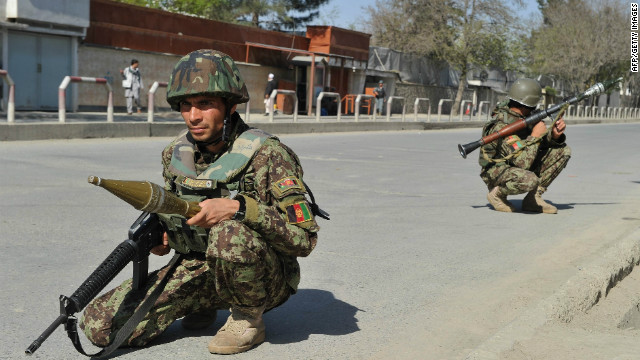
Ready or not, Afghan security transfer accelerating
NATO forces are here until 2014,
but each day the demands on them lessen as Afghan forces take on more responsibility.
Earlier this week, the latest tranche of the security transfer process was announced. A third swathe of Afghanistan will see Afghan national forces take the lead on security, with the NATO-led International Security Assistance Force (ISAF) scaled back into to a supporting role only.
Most taxpayers funding the decade of war in Afghanistan won't have heard of many of the regions affected, but this tranche is particularly significant because three quarters of the country will now be under the control of Afghan security forces.
On Sunday, NATO Secretary General Anders Fogh Rasmussen said once the move is implemented, "transition will have begun in every one of the 34 provinces of Afghanistan, including every provincial capital."But some of the areas involved in this latest handover are surprising.
The most striking is Kandahar City, the former Taliban stronghold that has embodied the brutal struggle of the Afghan conflict for ISAF forces, as progress has been neither universal nor permanent.
There are other small surprises: Half the districts in Nurestan -- a huge mountainous region that straddles the border with Pakistan and has become as close to an insurgent safe haven as Afghanistan has -- were handed over, as were a third of the districts in Paktika, another border enclave for insurgents.
Uruzgan, a volatile region in the center of the country where Australian Prime Minister Julia Gillard said progress has been so pronounced her soldiers can start to come home early, was also handed over.
Afghan officials are in favor of an early transition while there are enough ISAF troops around to step in if the insurgency proves a match for the Afghan military. It's probable they will, as the Taliban have given the NATO-led military machine a run for its money.
Meanwhile, the fight for localized power may overcome any sentiments of nationalism that would enable Afghan soldiers to be comparatively welcome in villages and towns across the country. The risk here is front-loaded, which is as much a reflection of the pressing ISAF timetable as it is of progress in security.
Within a few months -- when this third tranche has passed -- only a quarter of Afghans will have security provided by ISAF. The timetable for withdrawal, although pinned to the distant marker of the end of 2014, is speeding up as the calls for an end to this costly and unpopular war get louder, from Canberra to Washington.
The key fact for the months ahead, and for the NATO summit in Chicago later this month, is that the United States predicts its forces will be in a non-combat role by mid-2013. That means they'll be off the battlefield about 18 months earlier than the end of the NATO mission.
This is a big deal for one simple reason: ISAF anticipates at the end of this year having about 68,000 American troops to play with, and thousands more allies. Next year the numbers will come down further -- at a "steady pace" for the Americans, as President Obama promised. But being in a non-combat role is, you might argue, something you don't need 68,000-plus soldiers for. There are units out there now who already believe much of their job involves packing up and handing over, that their fight is pretty much over already.
The real question still to be answered though is how much does -- or can -- the Taliban want to push ISAF and the Afghan forces this summer? Do they have the unified command or muscle, or have talks about peace talks shattered their unity of purpose? For now we just don't know.
However, the weekend assassination of a senior Afghan official involved in setting up peace talks with the Taliban, as well as the deaths of two ISAF troops in an IED attack, suggests the security situation remains far from stable.
United Nations figures on security incidents judged 2011 the most violent year on record, and ISAF's own count of violence -- attacks against them or their partners -- showed that while incidents dropped nationwide, they rose to record levels in the key areas of the south and east.
It remains unclear whether this summer will be as violent, or, if the Taliban continues its campaign of roadside bombs, assassinations and high-profile attacks on NATO targets in Kabul, whether Afghans will feel safer regardless of what the numbers say.
There have also been some curious casualty figures among international forces in the first three months of this year. According to the U.S. Army and ISAF, insurgents did not cause almost two thirds of American deaths from January to March. They were a result of accidents such as helicopter crashes, natural causes, or the new scourge of the campaign: "Green on blue shootings," when men in Afghan uniform shoot ISAF personnel.
Afghans hurt by Pakistan blockade
Pakistan's president says he will go to Chicago for a NATO summit on Afghanistan, which is an indication that Pakistan may be willing to reopen the coalition's supply routes into Afghanistan.Pakistan blocked the routes in November in protest over a US air raid that killed 24 Pakistani troops.The closures, a consequence of a major dispute between Pakistan and the US, have also affected Afghan citizens' lives for the worse. Jennifer Glass reports from Kabul, where the blockade has prevented some schools from receiving much needed supplies.
Pakistan backs quick deal on NATO supplies
Pakistan said Wednesday it had ordered officials to finalise an agreement as quickly as possible on lifting a six-month blockade on overland NATO supplies into war-torn Afghanistan.
Islamabad has stopped short of announcing when the transit lines will reopen, but has signalled President Asif Ali Zardari will attend key talks on Afghanistan in Chicago on May 20-21, after a last-minute invitation from NATO.
The country shut its Afghan border crossings to NATO supplies on November 26 after US air strikes killed 24 Pakistani soldiers.
As a result, Pakistani-US relations -- already frayed by the US raid that killed Osama bin Laden -- plunged into their worst crisis since Islamabad joined the United States in the war on Al-Qaeda after 9/11.
Now Pakistani and US officials are locked in talks to finalise a deal on again allowing thousands of trucks and oil tankers to carry non-lethal supplies from the southern port city of Karachi to landlocked Afghanistan.
Asked if there was any deadline for the talks, Information Minister Qamar Zaman Kaira said: "There is no deadline. All departments have been asked to conclude their negotiations in the quickest possible time."
The cabinet on Wednesday welcomed NATO's invitation to Zardari, clearing the way for him to travel to the May 20-21 summit, and it is thought unlikely he would be willing to risk the wrath of Western leaders if the supply lines have not been restored.
By going to Chicago, Pakistan hopes to ease its international isolation and boost its leverage over the future of Afghanistan, as Western countries pull out their combat forces by 2014.
But Islamabad has essentially been forced to climb down on demands for an American apology for the air strikes and an end to drone strikes targeting Taliban and Al-Qaeda on its soil.
Sources familiar with the talks say transit fees for the vehicles are the main sticking point and the border will probably reopen by early next week. Islamabad is looking to more than double the payments, which could earn the country up to $1 million a day.
Prime Minister Yousuf Raza Gilani advised against "emotional decisions, which do not augur well for us in the long run".
He told the cabinet that relations with NATO and the United States were at "a delicate phase where we need to take critical decisions" for Pakistan's "strategic importance" in the region and in its national interest.
Analysts say Pakistan had no choice but capitulate to international pressure to reopen the border, with US cash needed to help boost its meagre state coffers as the government prepares to seek re-election.
The State Department said "considerable progress" had been made on ending the blockade.
"We will continue to work on this throughout the week. Obviously, it'll be a wonderful signal if we can get it done by the time of the summit," State Department spokeswoman Victoria Nuland said.
But the Pakistani government is likely to face an angry backlash over the U-turn from opposition, right-wing and religious parties keen to exploit rampant anti-American sentiment in an election year.
Nor is lifting the blockade likely to solve other problems in the relationship between Pakistan and the United States.
American officials remain deeply distrustful of Pakistan, whose territory is used by Taliban and other Afghan insurgents who have been fighting US troops for more than a decade.
Pakistan is still smarting from the American raid that killed bin Laden last year and deeply resents American calls to do more to clamp down on militant safe havens.
The United States has made increasing use of other routes into Afghanistan and the Pakistan supply routes now constitute as little as 25 percent of what NATO needs to sustain itself.
The United States has guaranteed payment of at least $1.1 billion should the borders reopen as compensation for fighting militants, although Pakistan believes it is owed far more, one source said.
Shahbaz instigating masses against federation
Punjab Assembly opposition leader Raja Riaz Ahmed has asked Punjab Chief Minister Shahbaz Sharif to prove his promises made at the second Energy Summit held on April 9th.
Talking to APP, he said the Shahbaz-led Punjab government, instead of fulfilling its promises of working for electricity generation and conservation, is instigating industrialists and other communities on the power issue in an attempt to weaken the federation of Pakistan.
Riaz reminded the chief minister about his commitment of ensuring two public-holidays in a week as well as closing markets and shopping malls at 8 pm daily to support the federal government’s efforts for energy conservation. Contrary to his promises at the Summit, he added, the Punjab CM was yet to implement this decision.
He asserted that instead of taking the energy issue seriously, Shahbaz Sharif is now resorting to instigating the masses against the federation, while encouraging and patronising the mobs and street protests against power outages. “Shahbaz Sharif is doing this to conceal his mismanagement by blaming the federal government for various issues,” he said.
To a question, Riaz said it was also decided in the summit that the provincial governments will initiate small power projects of up to 50 megawatt capacity, but the PML-N led government in Punjab did not implement the decision.
He said Sharif has spent public money on projects such as for distributing laptops to students and the Yellow Cab Scheme, that do not benefited the masses but heavily obliged all his cronies.
All the PML-N initiatives are meant to gain cheap political mileage and a preparation for the next general election, while, shelving public issues like the energy crisis, he added.
The opposition leader observed that the CM’s attitude reflects that the PML-N has no political will to pull the country out of the energy crisis as well as to ensure the provision of relief to the masses. The PML-N leadership is striving only to multiply its own assets, he said.
Raja Riaz said despite the fact that Prime Minister Gilani had emphasised upon the provinces to play their due role in the efforts for power generation, the Punjab government was ignoring its commitment to help the federal government overcome the power shortage.
To another question, the opposition leader said President Zardari had also issued strict directives to the authorities concerned for taking effective measures to enhance hydel-power generation as well as exploring and utilising all other alternative energy means available in the country.
Riaz said that federal government was committed to energy security for the people of Pakistan and its strategy was to ensure sustainable supply of power at competitive prices to all sectors.
He quoted the prime minister as saying at the Energy Summit, that the federal government’s strategy involves exploitation of hydropower to reduce the cost of inputs; developing coal reserves for power generation and also converting plants from oil to coal in the interim, developing and encouraging use of renewable energy resources, increasing emphasis on nuclear energy resources; accelerating exploration and production of oil and gas reserves including off-shore drilling; targeted subsidies for the lowest slab users; encouraging use of LPG (Liquified Petroleum Gas) and import of LNG (Liquified Natural Gas) to meet gas requirement; recognising the role of provinces in power generation, and energy efficiency and conservation.
Riaz said since its inception, the PPP-led federal government has been taking comprehensive measures to bridge the electricity demand and supply gap, citing that investment in the energy sector was not significant before 2008, while the previous regime had not made any effort to cap hydel and coal potential and not a single megawatt of electricity had been added to the national grid. He said the present government has the credit of generating an additional 4000 MW of electricity.
Sectarian violence: Hazara community under attack in Quetta
The Express TribuneAfter an interval of a few weeks, sectarian targeted killings resumed in Quetta on Tuesday morning as two brothers belonging to the Hazara community were gunned down outside the regional passport office near Joint Road. According to a senior police officer, Mohammad Tahir and Mohmmad Qadir had come to the post office to get their passports made and were attacked outside the main gate of the office at 7.15 am. The assailants were on a motorcycle and fled the scene after opening fire at the two brothers. “Both men died on the spot and another man of the Hazara community received bullet wounds,” police said. The bodies and injured were taken to Sandeman hospital where stringent security measures were adopted to thwart another attempted attack. The injured, identified as Manzoor Ali, was referred to the Combined Military Hospital (CMH) for security reasons, sources in the hospital said. “It was sectarian target shooting,” another senior investigating officer said. No group has so far claimed responsibility for the assault. It is pertinent to mention here that around 28 people of Hazara community have been killed in the recent spate of target killings this year. Some police officers investigating sectarian killings, such as SSP Crime Investigation Department Shahnawaz Khan and sub-inspector Sayed Jamal Shah were also gunned down in Quetta in the recent past. On the other hand, some religious scholars of Sunni sect were also victims of targeted attacks in the provincial capital and religious parties believe that some elements are trying to instigate sectarian violence in Balochistan.
ANP to support govt on Nato supply resumption
Khyber Pakhtunkhwa Minister for Information, Mian Iftikhar Hussain, Wednesday said his party (Awami National Party) would support whatever decisions the federal government takes regarding the resumption of Nato supplies.
Speaking to media representatives here, the provincial minister said the decision taken by the federal government with regard to Nato supplies would be in the best interest of the country, however, he hoped that the recommencement of the supplies would come with certain conditions.
“Those who granted permission for Nato supplies through Pakistan are now making hue and cry,” he added.
Replying to a question regarding the fresh wave of terror attacks, the minister said it was a temporary situation and hoped that the government would soon overcome the crisis.
The minister categorically said that stern action would be taken against “terrorists no matter wherever they are”. The security forces have successfully carried out operations against terrorists in different parts of the province, he said, adding that actions against militants would continue.
Thar coal exploration
EDITORIAL:THE FRONTIER POSTFirst Australians, then Japan last year, followed by the United States in January this year and now Germany has shown keenness in investing to the exploration of huge Thar coal reserves, one of the largest in the world, for the production of electricity and gas. China is also said to be not far behind. Nuclear scientist Dr Samar Mubarkmand, chairperson of the governing body of the project, is working on a project to produce 2,300MW from coal-fired power plants and this is said to be in an advanced stage of execution in four to five years. However, he has, of late, been in the firing range of the lobbies which probably don"t want the exploitation of this enormous gift of nature. One of them is the furnace oil lobby which even influenced a member of the Planning Commission of Pakistan to assert that the project is not feasible and that it was begun without a feasibility report. Another example is that Australian authorities had also been planning to shut down the 30MW power generation project because it was also not said to be feasible. One of the major factors for delay is the release of funds by the federal government which made available only $10 million during the last three years although it was committed to release $115 million during the period. What more evidence can be found in the project being feasible than burning of coal about 250 feet underground at Islamkot area of Thar in December last year in addition to successfully finding of gas in this coalfield. Dr Mubarikmand has said that Pakistan has gigantic potential of power generation over decades. Meanwhile, tender for power plant has been floated to generate 100MW electricity and the project is expected to be executed soon after the funds are made available. Estimates about the project in hand say that these limited coal resources will hopefully generate 10,000MW electricity for 30 years and produce 100 million barrel diesel each year. The project is to cost Rs9 billion with a foreign exchange component of Rs6 billion that was approved by the Executive Committee of the National Economic Council last year. Latest reports suggest that four more coal wells were set on fire last week and, as a result, gas production from these will hopefully begin by the end of May. A flame will be lit from gas as emission begins from these wells towards the end of this month. Dr. Samar has said that through underground gasification technology, electricity can be generated at Rs3 to 4 per unit while diesel can be produced at $40 per barrel. The average rate of power production through furnace oil comes to Rs20 per megawatt. How critically vital Thar coal is for the country, needs no emphasis. But the government will have to demonstrate it really feels its importance and take matching measures to complete the project. This emphasis is unfortunately missing so far.
Tuesday, May 15, 2012
Balochistan: the FC and missing persons
Daily Times
BY:Dr Qaisar RashidThe case of the missing Baloch is reverberating throughout the country. The sympathies of all Pakistanis are with the Baloch One wonders if the Frontier Constabulary (FC) deployed in Balochistan is above the law of the state. At least the demeanour of the FC speaks of its haughtiness. It is shocking to note that the Inspector General (IG) of the FC Obaidullah Khattak did not comply with the orders of the Supreme Court (SC) to appear in person and explain the position of the FC on the missing persons’ case until repeated notices. His act is tantamount to ridiculing the court and is a breach of the constitution. The hearing took place at the Quetta Registry of the SC on May 11. After more than 60 years of its formation, Pakistan has entered the phase of mastering the strategy of abducting its citizens to ensure the state’s survival. If this is not decadence, what is? Instead of listening to the voice of citizens, the state is bent on muffling it, and strangulating the necks producing the voice. This attitude falls in the category of a welfare state or a state calling itself an Islamic Republic? By the way, on non-compliance with the court orders, if the prime minister of this country can be convicted, why can’t the IG FC? By his deed of disobedience, the IG FC tries to convince all that the concept of the state’s security is different from the notion of upholding the constitution. That is, he is serving in the khaki uniform to ensure the integrity of the state but not of the constitution. This is the problem with those donning the khaki uniform. The military deems itself a custodian of the integrity of the state but not of the constitution, which actually makes the military a type of the executive supposed to adhere to the court’s orders. What is the meaning of the statement of Major Sohail representing the FC at the court that the IG FC was busy elsewhere? Was he busy in abducting more people? The IG FC deliberately violated the court’s orders and should be held accountable for that. The SC is also relying on the police to implement its orders. It is heartening to note that the DIG Operations Balochistan Police, Hamid Shakeel is ready to obey. He has informed the SC that the police possessed CCTV footage of a private hotel showing an FC vehicle picking up three persons who went missing afterwards. The statement of Hamid Shakeel indicates that the police are handicapped owing to the overbearing role of the FC, which needs be curtailed. Secondly, his point shows that the police are ready to obey the orders of the SC and are capable of maintaining law and order in Balochistan if given a free hand. The police, weaker at the core, can neither comply fully with the orders of the SC nor jettison the FC from the governance equation. If the SC is making the police answerable, it should also issue orders to strengthen the role of the police in Balochistan. The SC has made an apt observation that the Centre is not taking any interest in resolving the Balochistan issue. There are three plausible reasons for that. First, the regime in the Centre is mired in issues of its own survival. Second, the regime in the Centre is annoyed with the SC and would be keen to witness a spate of confrontation taking place between the SC and the FC (or the military). Third, the Centre is reluctant to retrieve Balochistan from the military (which is being controlled through the FC) because the military wants to have its sway over the province. As per the constitution, the FC should be at the beck and call of the chief minister of Balochistan but on the ground, the FC is independent in its actions and dictates its terms to him. Perceivably, the IG FC does not take orders from the chief minister of Balochistan but from GHQ. That is the paradox engulfing Balochistan. The same absurdity is a hindrance to an early resolution of the Balochistan crisis. It seems that the military is not realising the fact that by its actions, it is being demeaned in society. The case of the missing Baloch is reverberating throughout the country. The sympathies of all Pakistanis are with the Baloch. In any developed country, by delivering good governance, the state makes itself noticeable in the sight of its citizens. Unfortunately, in Pakistan, the state makes itself palpable through its coercive arms such as the FC in Balochistan. In this way, the state fails to project its soft image in the eyes of people. Despite the presence of a democratic dispensation at the Centre, Balochistan is still experiencing the problems characteristic of the military era. Across the country, there is not a single Pakistani who does not sympathise with the Baloch and who does not criticise the highhandedness of the military in Balochistan. The Lahore High Court Bar is in the process of passing a resolution on Balochistan to express its solidarity with the Baloch and strengthen the hands of the SC in its decisions on Balochistan. Making the Baloch go missing is not a solution, the military should understand. The Balochistan crisis is in need of a dialogue. The military should leave space open for that. Gagging the media with one PEMRA Ordinance or another may keep the voice of the Baloch dissidents off the air but cannot solve the Balochistan problem. What is missing in Pakistan is that the state does not understand its limits vis-à-vis the rights of people. The state cannot pick up a citizen and make him disappear, notwithstanding the nature of allegations. The citizens abducted by the state have to be produced before a court. The state is a creation of citizens and not vice versa. Thus, a state should stay subservient to its citizens and avoid dictating to them.
Mehdi Hassan in critical condition
Ghazal maestro, playback singer was Tuesday admitted to Karachi hospital in a critical condition.
Renowned Pakistani singer Mehdi Hassan is in a critical condition and has been admitted to ICU of a Karachi hospital.
According to Mehdi Hassan’s son Arif Mehdi, his health deteriorated Tuesday morning and he was taken to the hospital where doctors shifted him to the ICU where he is reported to be in a better condition than in the morning.
The family of the star singer informed that he was to be taken to India for treatment but now it has been postponed.
Hosting Dalai Lama must come at a high price
Britain has claimed that Prime Minister David Cameron's meeting with the Dalai Lama was a private one and that Cameron was free to meet anyone. But one is the British Prime Minister, the other is the "spiritual leader" of "Tibet independence." Does anyone really believe the meeting was "private?" "Private" is becoming a funny word now.
The meeting was deliberately arranged by Britain. The Cameron government clearly knows it could bring damning risks to Sino-British relations. China must take corresponding punitive actions against Britain.
China's stand against foreign leaders meeting the Dalai Lama is clear. German Chancellor Angela Merkel and former French President Nicolas Sarkozy met Dalai respectively in 2007 and 2008, which strongly shocked bilateral relations. US President Barack Obama's Dalai meeting also created a diplomatic storm. Apparently, Cameron deliberately followed in their footsteps.
The Chinese don't care whom foreign leaders meet, but as Dalai is the symbol of "Tibet independence," Cameron knows fully well what China is opposed to.
There is already a routine reaction after foreign leaders' meeting with Dalai. China will protest strongly, putting trade and political ties on hold for a certain time. China has become proficient in dealing with these issues and can handle the damage better.
China should suspend high-level communications with Britain for a certain time and also some cooperative projects that China is in no hurry to carry out. It's not difficult for China to do so. This may not have a great effect on Britain, but could add negative points to Cameron's political reputation, which will overwhelm the positive points earned by his "courage" in meeting Dalai.
Reducing economic cooperation will bring damage to both sides, but for China, it's necessary to safeguard national unification. China has become accustomed to paying the price for safeguarding its core interests. Now it should let Western countries make the choice: pay the price for meeting Dalai or avoid showing off their nobility of freedom.
The emphasis on the fact it was a private meeting appears to be a subtle form of conciliation compared with the German and French leaders' meetings with Dalai in the past. But still, the matter should not be settled by just a verbal protest from China. France has just elected a new president and many other countries are changing leadership. All eyes are on China and how it will react to Cameron's decision to host the Dalai Lama.
Hesitation is not a suitable response. China favors peace, but that does not mean China's national security is cheap. Though it is not involved in military actions like other big powers, it has to spend the money fighting provocations against its security.
Dalai should not overestimate his personal value. He is only a tool in the competition between major powers.
Hollande and Merkel hold euro talks in Berlin
Newly inaugurated French President Francois Hollande has pledged to work with Germany to resolve the EU's economic crisis.
He was speaking in Berlin following talks with German Chancellor Angela Merkel, hours after being sworn in.
Both leaders said they wanted to keep debt-stricken Greece in the euro. They will hold an informal summit on 23 May.
Mr Hollande said "everything must be put on the table by everyone" that could promote growth.
He included the possibility of eurobonds, which would pool the debts of eurozone nations, backed by all 17 member governments.
Germany has always rejected the idea of eurobonds.
'Dimension of growth'
During his election campaign, Mr Hollande said he wanted to renegotiate the EU's fiscal pact, which will require its signatories to balance their budgets. Mrs Merkel has said the terms of the agreement cannot be changed.
"As president of the [French] republic, I want to renegotiate what was accepted at a certain stage to give it the dimension of growth," he said, standing alongside Mrs Merkel at a news conference in the German capital.
For her part, Mrs Merkel said France and Germany were willing to "study the possibility of additional growth measures in Greece".
Greece is struggling to enact the austerity measures required by the EU and International Monetary Fund (IMF) in return for a bailout of 130bn euros ($170bn; £105bn).
Both Mr Hollande and Mrs Merkel said they wanted Greece to stay in the euro.
"We wish to have Greece within the euro and we know that the majority of the Greek population agrees with us," Mrs Merkel said.
As the eurozone's two biggest economies - and biggest contributors to its bailout funds - Germany and France are key decision-makers over the strategy supposed to pull Europe out of crisis.
According to official figures released on Tuesday morning, the French economy showed no growth in the first quarter of 2012. Growth in the final quarter of 2011 was also revised down to 0.1% from 0.2%.
However, Germany's economy grew by a stronger than expected 0.5% in the first three months of the year.
Pakistan: LOCAL JOBS FOR LOCALS ONLY
EditorialIn the recent years, the Ministers had emerged more powerful and they are dictating the terms and order in violation of laws of the land and the constitution. There is no check to the highhandedness of the Ministers misusing official and administrative powers for their personal advantage. There is no institutional check on this administrative anarchy which may lead the Province to a great disaster sooner or later. Even senior most officials were found helpless as the Ministers are enjoying the support from the Chief Executives for the past two decades of more. The Chief Minister had granted complete autonomy to the Ministers to do whatever they want to do or deal with the administration or even with their own electorate. Since the Chief Minister needs the support of the parliamentary groups, all pressure groups of vested interests, they are dictating their terms and playing havoc with the economy and the administration. This trend had started following the partyless elections of General Ziaul Haq who allowed loot and plunder in return for political support to his highly personality rule over Pakistan. During this period, the funds were allocated to the Members of the Parliament and the Provincial Assemblies to win their support in forming the Government at the Centre and also in the provinces. From that period, the politics of PSDP had started and planning had gone to vultures and MPs resorted to day-to-day planning instead of long term planning for development meeting the basic economic needs of the people and the country. To this date, this policy is continuing. Every year Balochistan is wasting Rs 36 billions of its development funds as all the schemes included in the Provincial PSDP are worthless and having no economic impact. There is no intention to increase the revenue of the Provincial Government by spending money on development schemes generating revenue for the state. There is no intention to reduce poverty, hunger, disease, illiteracy in Balochistan. Similarly, the Provincial PSDP has no option to create more jobs for the army of jobless people. Every year, more than 20 graduates and highly qualified people are passing out from the Universities of Balochistan and there is no plan to provide jobs for the qualified educated people by the elected representatives. In recent years, the Ministers were found involved in auctioning or selling Government jobs to the highest bidders or to their political constituents. Even small jobs reserved for local people at the local level had been transferred illegally to their own constituency through a manipulated administrative order and recruitment of their own political constituent is made without any fear that tomorrow they can be made accountable in courts of law when a more responsible Government takes over. In the recent past, a score of Ministers were caught, tried and convicted for such irregularities and massive embezzlement of public money. They remained in jail for long. Two of them were rescued by their party leaders by blackmailing the majority leader at the time of ministry formation. Both the detained and convicted Ministers were released from jail following a bargaining in ministry making. There must be a check on transfer of posts, mainly posts of low paid public servants, from one region to another only for the purpose of illegal recruitment of their own political constituents, close relatives are auctioning the posts to the highest bidders. This practice should be stopped and economic interests of local people and their right on post reserved for lowest paid employees are defended and Ministers are barred from committing any irregularity. Secretaries of the Administrative Departments should take a firm stand for not being part and parcel of the irregularities committed by their concerned Ministers. Let the Ministers take the legal responsibilities as the coming days will be very hard for the Ministers in which they will be made accountable. All the Ministers cannot escape to Dubai or to any safe haven after committing irregularities.
QUETTA: Target killings: 2 Shia Hazaras killed, 1 injured in Quetta attack
The Express Tribune News Network.Target killings continue in Quetta as two Hazaras were killed and another was injured when unidentified gunmen on motorcycles opened fire at them on the Joint Road on Tuesday. According to a senior police officer, Mohammad Tahir and Mohmmad Qadir had come to the office for passport-related work and were attacked outside the main gate of the office at around 7:15am. The assailants immediately fled the scene. “Both the brothers were killed on the spot and another man of the Hazara community received bullet wounds,” the police confirmed. The bodies and injured were taken to the provincial Sandeman Hospital, where stringent security measures were adopted to thwart possible attempt of terrorism. The injured Manzoor Ali was later referred to the Combine Military Hospital (CMH) due to security reasons, sources at the hospital said. “It was a sectarian killing,” another senior investigation officer added. No group has so far claimed responsibility for the killings till the filing of this report. It is pertinent to mention here that around 28 people of Hazara community were killed this year. Some police officers investigating the sectarian killings were also killed in Quetta during the past week. On the other hand, some Sunni religious scholars have also fallen victim to targeted attacks in the provincial capital and religious parties believe that some elements are trying to instigate sectarian violence in Balochistan.
INDIA: The Republic Of Hunger
Al Jazeera World
Every third malnourished child in the world is from India, so what is the government doing to feed its millions?More than 40 per cent of India's 61 million children are malnourished, prompting the prime minister to declare the problem a "national shame". A recent report reveals that levels are twice that of sub-Saharan Africa, making every third malnourished child in the world an Indian.India has one of the fastest-growing economies in the world and runs one of the largest child feeding programmes.But critics say only a fraction of aid reaches the needy. 101 East travels to India and asks what the country is doing to feed its millions.
Obama says JPMorgan loss proves reform needed
US President says even Wall Street's "smartest" need regulating, as bank boss admits $2bn trading loss was "stupid".US President Barack Obama has said that the huge trading loss at JPMorgan Chase, the country's biggest bank, has demonstrated the need for Wall Street reform. "JPMorgan is one of the best managed banks there is. Jamie Dimon, the head of it, is one of the smartest bankers we got and they still lost $2 billion and counting," Obama said on ABC's "The View," according to a transcript released by the US network on Monday. "We don't know all the details. It's going to be investigated, but this is why we passed Wall Street reform," Obama said, adding that the same kind of error at a less stable bank could have required government intervention. Dimon has led US banks in fighting the proposed Volcker Rule, which would ban so-called proprietary trading, when banks trade on their own accounts. Banks are also resisting curbs on their hedging activities. Dimon told US network NBC's "Meet the Press" programme that the big loss incurred by the New York-based bank, which triggered a slide in banking shares on Friday, was "stupid" and damaging, but not bad enough to stop the company from making a profit this quarter. Asked if JPMorgan's losses had given regulators new ammunition to clamp down on Wall Street after the US government spent billions to bail out financial institutions during the 2008 crisis, Dimon replied: "Yes, absolutely. This is a very unfortunate and inopportune time to have had this kind of mistake." Martin Hennecke, associate director at Hong Kong-based financial advisory firm Tyche Group, told Al Jazeera that JPMorgan's loss was another indictment of the US banking system. "We are particularly not fond of the US banking industry, which is like a casino gambling industry, especially since the Glass-Steagall Act was repudiated," he said, referring to the 1933 legislation established to regulate and limit speculation by banks which was repealed in 1999. "The Glass-Steagall Act needs to be implemented again, otherwise it seems the banks pretty much do what they want. "If they mess it up they get a bailout and if they do it right they don't care about what limits were broken, and so they would all be heroes and get huge payouts and bonuses." Hennecke said: "So, we don't think the US banking industry is safe or stable to invest in. The much chastised Chinese banks that everybody loves to hate are much safer to invest in than banks in the US and Europe as well for that matter." Al Jazeera's Kristen Saloomey, reporting from New York, said the JPMorgan's trading loss had reignited the debate in the US on regulating financial instutions. "It [JPMorgan] is the largest bank in the US and it weathered the financial crisis in 2008 better than other financial institutions in the country," she said. "And since then Dimon has been one of the most outspoken critics of efforts to regulate the finance industry, precisely the kind of risky trades that led to this huge loss. He has been quoted as describing efforts to regulate the market as infantile. He ridiculed the notion of banks being too big to fail. "Now we are hearing calls for new congressional hearings on what went wrong with JPMorgan and renewed calls for tougher regulation to prevent it from happening again and putting the US and world economy at risk." Top officer quits Meanwhile, Ina Drew, JPMorgan Chase's chief investment officer, has announced her retirement in the wake of the loss, with two more senior execuitves expected to quit the company. Drew is "retiring" after more than 30 years at the bank, JPMorgan said, but her departure came days after the bank reported a huge "egregious" loss that came under her responsibility at the bank's chief investment officer (CIO). Our correspondent said that Drew's departure was an effort by JPMorgan to limit the fallout ahead of a shareholders' meeting on Tuesday. "This is a woman who was considered one of the most powerful women in Wall Street. Someone who was a top earner for the company," she said. "But these massive losses happened on her watch. So the company in an effort to limit the fallout from these huge losses is now taking steps to cleanhouse. The shares for the company plummeted on Friday by 9.3 per cent. "Clearly this is an effort to stabilise things ahead of a shareholders meeting that is expected on Tuesday." The Wall Street Journal said two other high-ranking executives were set to leave during the week: Achilles Macris, who heads the London-based desk that placed the trades, and trader Javier Martin-Artajo, a managing director on Macris' team. London-based trader Bruno Michel Iksil, nicknamed the "London Whale" for the large positions he took in credit markets, is also likely to leave though it remains uncertain when he will do so, the Journal said.
Bahraini doctor: 'We became automatic witnesses'
A Bahraini doctor arrested and allegedly brutalized for treating an injured protester said he and other medical workers were targeted because of what they saw.
"We became automatic witnesses. That's a problem. When we saw protesters, straightaway we became automatic witnesses. And to take our credibility away, accuse us of a crime," Nabeel Hameed told CNN's Christiane Amanpour.
The doctor was arrested last year amid anti-government protests. He is expected to face trial shorty.Demonstrations in Bahrain failed to gain the traction of other Arab Spring uprisings after a crackdown by authorities in the island state. The crackdown was backed by troops from nearby Saudi Arabia and the United Arab Emirates.
In November, Bahrain's Independent Commission of Inquiry issued a report critical of authorities' reactions to the protests, which began in February 2011, spurred by uprisings in Tunisia and Egypt.
Hameed said he was on call, one of only three neurosurgeons at Salmaniya Hospital, on February 18, 2011, when an injured protester was brought in. The patient had been shot in the head.
"For treating him and then expressing my concerns about the way he was injured, I got labeled as a traitor," he said.
Two months later, Hameed was arrested.
He described what happened next: "They took me into an interrogation center for about four days of torture. I was not alone. I was with other doctors. They made us stand for days together ... without sleep, without toilet privileges, without anything. And in between that you get abused, you get spat at, you got insulted ... and everybody who passes by you just beats you on the head or the back."
"But the worst thing is a room, an electronically locked room ... and when the doors open, all hell breaks loose. Because you start hearing these shouts of torture. Of people inside ... Your turn is next. And my turn was next ... Somebody even took a gun to my head and threatened me with death," said Hameed.
He was later released but as a changed man, he said.
"We're doctors. We're never politicians. But I'm a forced activist maybe now," the doctor said.
Amanpour also spoke to Sheikh Abdul-Aziz bin Mubarak Al Khalifa, a royal family member who speaks for the Bahraini government.
He said the government is working toward reform and to right past wrongs, but he said the process must not be rushed. He acknowledged abuses.
"We can't rush into things -- and we intend to move at a quicker pace and to achieve the goals that we have for a better future in Bahrain," said Al Khalifa.
Last week, the United States said it would resume some arms sales to Bahrain after suspending them amid the country's crackdown on protesters.
The small island kingdom in the Persian Gulf plays a key strategic role in the Middle East and is home to the U.S. Navy's Fifth Fleet.
Saudi woman driver: I was pressured out of my job for my activism
In May 2011,
Manal al-Sharif did something revolutionary: She drove a car.
In most societies this would be far from noteworthy, but in Saudi Arabia, where women are prohibited from getting behind the wheel, it was an act of extraordinary courage. The protest, which she put on YouTube, landed al-Sharif in jail for nine days. It also made her an international figure. In the last year, she has been named one of the “Top 100 Global Thinkers” by Foreign Policy magazine and one of Time magazine’s “100 most influential people of 2012.”
And last week, the 32-year old Saudi was one of three people awarded the first annual Václav Havel Prize for Creative Dissent at the Oslo Freedom Forum.
To attend the conference in Norway, al-Sharif says she was pressured out of her job at the Saudi oil company Aramco. Considering she is a working-class single mother, it couldn’t have been an easy decision to continue her human rights fight in the face of such economic pressures. But, as al-Sharif told The Daily Caller, “if you stand up for your beliefs, there is a price to pay.”
“They pressured me a lot and it was like too much to take,” she said, explaining that while she was not explicitly fired, she was increasingly marginalized at the company for her activism, leading to her exit after coming into conflict again with her bosses over attending the conference.
After first stating that she didn’t “want to talk about” the pressure she has suffered under since her Rosa Parks-like act of defiance, she conceded that the Saudi government does “pressure you a lot, whether directly or indirectly.”
“So they can cause a lot of trouble,” she went on. “They scandalize you, they smear you … they spread all these rumors about you … But it’s up to you how to deal with that pressure. The more pressure it is, the more attacks I get, the more impact I know that I’m making.”
During a presentation at the Oslo Freedom Forum, al-Sharif explained how she sympathized with Islamist radicals growing up in Saudi Arabia until two events helped change her perspective. The first, she said, was gaining access to the Internet in 2000.
“It was our first window to the outside world, and I was very curious,” she said in her speech.
“I started talking to other people, raising questions. I began to realize how very small the box I was living in was. I started losing my phobia of having my pure beliefs polluted.”
The second major turning point in her intellectual evolution was the 9/11 terrorist attacks.
“They said it was God’s punishment to America,” she said. “I was confused, and didn’t know how to feel. Then on the news, I saw this picture. It was of a man, who threw himself from the towers to escape the fire. I couldn’t sleep that night.”
Ultimately, she concluded that “no religion on earth should be like this.”
“When al-Qaida took responsibility for the attacks, I realized my heroes were nothing but bloody terrorists,” she said.
Read more: http://dailycaller.com/2012/05/14/saudi-woman-driver-i-was-pressured-out-of-my-job-for-my-activism/#ixzz1uwst8Jkk
US Ambassador To Kabul Asks Afghan Neighbors Not To Support Terrorism
Bakhtar NewsThe US ambassador to Afghanistan asked the neighbors of Afghanistan not to support terrorism. The ambassador who went to Nangarhar to meet the local authorities there said that support to terrorism would harm the Afghan neighbors. He added that “outside circles at the neighborhood of Afghanistan should not support the extremist groupings, the Taliban and the Haqani network; as such a support undoubtedly will harm themselves.” “Apparently this US diplomat points to the Pakistan, the country that time and again has been accused by the international community for its continued support towards extremists. He also accused the neighbors for their misunderstanding of the provision of strategic cooperation agreement between Afghanistan and the US and asked them so they should precisely study the agreement and then can show reaction. The ambassador did not name any country in his discussion, however, lately the Iranian ambassador in Kabul while showing reaction towards the strategic cooperation agreement asked the Afghan authorities including the chief of the Afghan Senate not to adopt that agreement as on his view the long-term presence of the West harms Afghanistan and the region. The ambassador in an unprecedented manner warned that those who through supporting terrorism want to continue destruction of Afghanistan, should know that the US in the struggle against others interventions in Afghanistan will be on the side of the Afghans. The US ambassador attributed signing of the strategic cooperation agreement between Afghanistan and the US for supporting reconstruction and stability of Afghanistan till 2024 and said that this period can extend on the basis of the will of Afghans. Recalling the years of former Soviet aggression to Afghanistan and the domestic wars in Afghanistan he said that the US does not want to leave Afghanistan alone any more so that once again with the support of the outside circles the terrorism and extremism invade this country.
François Hollande sworn in as French president
François Hollande was officially sworn in as the seventh president of France's Fifth Republic in a low-key ceremony at the Elysée Palace on Tuesday, where he reiterated his vow to turn the page on eurozone austerity.Francois Hollande was sworn in as France's first Socialist president since 1995 on Tuesday at a solemn ceremony overshadowed by the debt crisis threatening to unravel the eurozone. After brief ceremonies in Paris, the 57-year-old career politician was to dash to Berlin to confront Chancellor Angela Merkel over their very different visions as to how to save the single currency bloc. "Power will be exercised at the summit of the state with dignity and simplicity," Hollande declared in an inaugural address to Socialist leaders, trade unionists, military officers, churchmen and officials. "Europe needs plans. It needs solidarity. It needs growth," he said, renewing his vow to turn the page on austerity and invest for the future, and implicitly underlining his differences with Merkel. "To our partners I will propose a new pact that links a necessary reduction in public debt with indispensable economic stimulus," he said. "And I will tell them of our continent's need in such an unstable world to protect not only its values but its interests." Hollande was also to make the much-anticipated announcement of who will lead his government as prime minister, with Jean-Marc Ayrault, the head of the Socialists' parliamentary bloc, tipped as favourite. The new president was welcomed to the Elysee Palace by his predecessor Nicolas Sarkozy, who led him to the presidential office for a private head-to-head and to hand over the codes to France's nuclear arsenal. Then Hollande ushered Sarkozy to his car for a final farewell, outgoing first lady Carla Bruni exchanging kisses with successor Hollande's partner Valerie Trierweiler, elegant in a dark dress and vertiginous heels. Hollande then signed the notice of formal handover of power and headed back in to the palace ballroom. No foreign heads of state were invited to what was a low-key ceremony for a post of such importance, leader of the world's fifth great power. After the swearing in, Hollande rode up the Champs Elysees to the Arc de Triomphe in an open-topped Citroen DS5 hybrid, waving to the crowd. But the real work was to begin later in the afternoon, when Hollande was to fly to Berlin from an airbase north of Paris, for tense talks with Merkel, the leader of Europe's biggest economy and France's key ally. Merkel was a Sarkozy ally and the architect of the European Union's fiscal austerity drive. Hollande opposed the speed and depth of the cutbacks demanded by Berlin, and wants to renegotiate the eurozone fiscal pact. Germany is committed to budgetary discipline, and Merkel has repeatedly insisted since Hollande's election that the pact, signed by 25 of the 27 EU countries and already ratified in some, is not open to renegotiation. But observers say there is room for compromise, with Hollande likely to agree to additional stimulus measures without a rewrite of the pact. And with political paralysis in Greece raising the spectre of the country being forced from the eurozone, the heads of Europe's two largest economies will be keen to reassure worried markets they can work together. New figures released Tuesday showed France's economy still stagnant, with official statistics agency INSEE saying it recorded no growth in the first quarter of 2012. The agency also revised downward the growth figure for the fourth quarter of 2011, to 0.1% from 0.2%, while maintaining that the economy grew by 1.7 percent overall in 2011. Before he heads to Berlin, Hollande's first order of business will be to nominate a prime minister, who will be tasked with forming a government before a first cabinet session likely on Thursday. Ayrault, a 62-year-old longtime Hollande ally, is considered first in line for the job, but other names are circulating. Once the cabinet is named, the focus will move to the Socialists' campaign to win a parliamentary majority in June's legislative elections -- a key test for the party after Hollande's win. After the talks with Merkel, Hollande heads to the United States where he is to meet President Barack Obama at the White House on Friday ahead of back-to-back G8 then NATO summits.
Shahbaz responsible for load shedding in Punjab
Senior Federal Minister Pervaiz Elahi on Sunday said Punjab Chief Minister Shahbaz Sharif was responsible for electricity load shedding in the province, asking him why he did not endorse the formula suggested by Pakistan Muslim League-Quaid (PML-Q) chief Shujaat Hussain to end electricity load shedding in the country.
Elahi said there was not just 'bad governance' but 'mad governance' in Punjab, adding that Sharif had given people nothing but deprivation. He was speaking at a convention in Rawalpindi.
The senior minister said he had made four plans for power production in Punjab but the current rulers had nothing to their credit. He said his party had told the Pakistan People's Party (PPP) that electricity crisis would have to be resolved on priority basis, adding that the PPP had given due assurances in that regard.
Elahi said the present rulers of Punjab should compare their performance with the development work done in every city and district of the province by his government. He said during his tenure one million people were being employed every year and now during the government of the Pakistan Muslim League-Nawaz (PML-N) "12 suicides were being committed every day".
The PML-Q leader said the PML-Q leadership did not make mere claims or promises as their work and facts spoke for themselves. He said the present rulers of Punjab could only hold public rallies with the help of government machinery and would not be able to win elections. Elahi said his party would field candidates in every constituency and the people would support and elect them.
He said that despite hot weather, gathering of thousands of people in the convention had proved that people still remembered the work done by the PML-Q government for development of Rawalpindi and acknowledged the same with open hearts because the PML-Q had spent Rs 34 billion for the development of the city. He said a number of development projects started by his government in Rawalpindi had been stopped by the present rulers of the province out of vengeance, which was causing wastage of billions of rupees of development funds.
Elahi said that through the Rescue 1122 project, his government had provided best treatment facilities to everyone, and as many as 42 colleges were established at a cost of Rs 3.75 billion by the PML-Q government. He regretted that the institutions were not functional now as the present rulers had not provided staff for those colleges. He accused the Punjab chief minister of inciting people to set blaze government properties and political parties' offices.
"Offices of political parties are being burnt and lawlessness is being spread in the province. Crimes have increased by 30 percent and people from all walks of life, including doctors, teachers and farmers, are worried and on roads, protesting for their rights, employment and education, as the system in the province has completely collapsed," he said.
Subscribe to:
Posts (Atom)