Daily TimesSenior Education and Literacy Minister Pir Mazharul Haq has said that Pakistan People’s Party (PPP)’s recently held gathering at Kamoon Shaheed proved that PPP is the largest and most popular political party of country and millions of people were with it. He expressed these views while talking to various delegations at his office here on Monday. Congratulating Sindh Chief Minister Syed Qaim Ali Shah, members of Sindh Cabinet, leaders and workers of PPP on the historic public gathering, he said that it should open Nawaz Sharif’s eyes and he should stop dreaming about conquering Sindh, the stronghold of the PPP. He said, “The present democratic government will complete its tenure. We are not afraid of Nawaz League long march. Masses have rejected Nawaz and its supporters,” adding that the government under the leadership of President Asif Ali Zardari had given many mega projects to the country. “2012-13 budget would be pro-people and they would be given maximum relief in the budget”, he added. The minister said, “It is the need of the hour that all democratic forces strengthen the hands of present government and foil the ulterior motives of undemocratic elements.” On this occasion various delegations informed the minister about their problems to which he assured urgent resolutions.
Tuesday, May 15, 2012
‘Nawaz should stop dreaming about conquering Sindh’
PPP believes in nation-building
THE NEWSPPP Co-chairman Asif Zardari Monday said the PPP is an egalitarian party that believes in nation-building process. He said making South Punjab a separate province is part of its nation-building process and not a move against any specific people or geographical location. This he said during his meeting with the parliamentarians belonging to South Punjab here at Aiwan-e-Sadr Monday. Presidency Spokesperson Farhatullah Babar said the president said that the party will endeavour to honour its commitment made to the people of South Punjab. He said the demand for a separate province was a legitimate one and would provide the people with the needed opportunities for their socio-economic development. The president said giving identity to the people of Khyber-Pakhtunkhwa, implementing Aghaz-e-Haqooq-i-Balochistan Package and giving rights to the people of Gilgit-Baltistan were not just election manifesto. He said with the momentum built by the PPP for a separate province, the people of South Punjab will not allow anyone to play the politics of sloganeering. He said it was now their responsibility to chalk out future of their province and to advise the government regarding setting up Seraiki bank, industrial zones and other economic opportunities in their future province. The participants also spoke on a host of issues. The president also hosted dinner for the participants.
Aitzaz terms PM Gilani conviction as unconstitutional

NATO invites President Zardari to summit in Chicago

Pakistan poised to resume NATO supply lines


Monday, May 14, 2012
Hollande to be sworn in as new French president

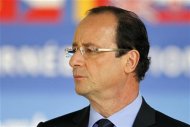
Curtain closes on ‘unpopular’ Sarkozy presidency

France’s outgoing President Nicolas SarkozyOutgoing President Nicolas Sarkozy is leaving office as one of the most unpopular presidents in France’s history and with the unwelcome distinction of being only the second French head of state to fail to win re-election since World War Two. Sarkozy, who has suggested he will quit politics when he steps down on May 15, has kept a low profile and avoided encounters with the media in the last days of his five-year mandate. The subdued finale has contrasted sharply with the boisterous presence that people have grown to expect – and to dislike. “Sarkozy’s approval rating went through several different phases, but it was often under 30% and taken as a whole was the lowest we’ve recorded for any [French] president,” said Eric Bonnet, head of opinion surveys for the French polling firm BVA. Sarkozy’s “bling-bling” style was not the only thing the French loved to loathe. Many disillusioned voters felt Sarkozy had failed to deliver on campaign promises and that several of the reforms he championed, such as pushing the retirement age from 60 to 62 years and offering tax breaks to France’s wealthy, were unjust.The outgoing president also failed to deliver on his twin promises to clean up corruption from government and to get people back to work. “Unemployment has gone up to 10% and the Bettencourt affair eventually blew up in his face,” said RFI journalist Philippe Turle, referring to a sprawling scandal involving allegations of illegal payments by L’Oreal heiress Liliane Bettencourt to members of the French government. Roller coaster ride Sarkozy started his mandate in May 2007 with an approval rating of around 60%, but he took a dive in early 2008 and never fully recovered. “He was elected on his capacity to change things and obtain results,” BVA’s Bonnet said. “It was during a press conference in January 2008 that he made it clear he couldn’t solve every problem. That’s when things changed.” During the two-hour press conference Sarkozy notoriously told hundreds of journalists gathered at the Elysée Palace in Paris that he had other concerns besides raising the minimum wage and “emptying the state’s coffers, which incidentally have already been emptied”. It was at the same meeting that Sarkozy told reporters that his relationship with model and singer Carla Bruni was “serious”. Sarkozy and Bruni were married a month later, but his whirlwind romance with the celebrity failed to impress French voters. France’s “hyper-president” rebounded in opinion polls later that year thanks to his foreign policy, a field he obviously enjoyed more than any other. He earned plaudits for his role in ending a brief war between Russia and Georgia in August 2008, as well as for his activism in dealing with the financial meltdown that followed the collapse of the investment bank Lehman Brothers soon after.However, those successes failed to make up for his failures on the one issue that really mattered to the French: the economy. “French people rediscovered the image of the conquering Sarkozy who wanted to fight on every front,” said Bonnet. “But they progressively found a president who couldn’t do much in response to the country’s problems.” Sarkozy’s approval rating hit rock bottom in October 2010, slumping to an abysmal 28%. A different kind of president Sarkozy helped reinvent certain aspects of French political life, but not in a way that endeared him to voters. His closeness to wealthy French industrialists and a handful of unforgettable outbursts in public were widely perceived as unbecoming of a French president. Perhaps the most infamous moment came at the 2008 agriculture show in Paris, when Sarkozy told a heckling farmer to “get lost, you loser”. Caught on camera, the insult hounded the president throughout his tenure. Three years later, as Socialist rival François Hollande launched his campaign for the presidency with a pledge to restore “normality” to France’s highest office, Sarkozy sought to make amends for past slips. During an increasingly desperate campaign for re-election, the “bling-bling” president expressed regret for the exchange at the agriculture show as well as other unpopular moves. While the eleventh-hour repentance was not enough to win him a second term, analysts say the outgoing president may yet find the popularity he craved for throughout his five years in office. “One year ago we asked people to qualify Sarkozy’s mandate as either good or bad. At the time 63% of people said it was bad. The same survey last week found that only half of all people thought it was negative,” said Bonnet, adding that it was “typical” for outgoing French presidents to rise in popularity after they handed over power. RFI’s Turle agreed: “French people are extremely nostalgic of the past. President [François] Mitterand and [Jacques] Chirac were unpopular when they left office, but then became very popular. Sarkozy is next in line for that phenomenon, but it’s still too early.”came to power in May 2007 on a promise to change French politics, but his approval rating soon sank as the French grew to dislike his brash behaviour and extravagant style.

German voters must break the Merkel mindset that got them into this

BY:
Robin Wells
Greece's euro membership was as much the German elite's fault as anyone's. Can it find the leadership to resolve the crisis?
Sometimes, just sometimes, economics and politics are like physics – one can recognize immutable forces. One of those times is now, as Greece is inexorably pushed out of the euro. It took no particular talent to have seen this coming, just the recognition that it has always been a fantasy to believe that the Greeks would democratically choose to destroy their economy for the better part of a decade in order to pay foreign creditors.
The fact is that Greece never was a suitable member of the eurozone. That the Greek economy was extremely inefficient, that corruption was rife, that the government budgets were perpetually out of control, and that the official statistics were not to be believed were widely known. But, as in many marriages, Greece's entry into the euro was a triumph of sentimentality and wilful blindness over realism.
The pity – in addition to the actual damage already inflicted on millions of Greeks – of this debacle is that it was never clear, and still isn't clear, that other countries, like Spain, will also be inexorably forced out. For the adjustment that Spain needs to make in order to stay in the euro was never as drastic as it was for Greece. While undoubtedly painful, it is probably still do-able.
But what has become unavoidably clear is that Germany, the linchpin of the eurozone, has been hopelessly stuck in an attitude that makes the break-up of the eurozone almost unavoidable. If Germany cannot pull itself together to keep Spain in the euro, then the markets can no longer ignore the fact that the lack of leadership and governance is a fatal flaw in the system.
What accounts for this? I would argue that the heart of the problem lies in the political culture of Germany and the mindset of its political and economic elites, which have never been willing to admit to their own voters the sacrifices that must be undertaken in order to be the leader of Europe. Instead, they have led Germans to believe that they can have it both ways: enjoying the fruits of the eurozone while times were good, and lobbing the burden of adjustment onto others when times got bad.
By doing this, the German elites set a trap for themselves with their own voters from which they cannot easily escape. Greece has been the perfect storm for the flaws of the eurozone and the vacuum of German leadership. Early in the crisis, the best course of action – the one I believe most likely to have preserved the core of the eurozone – would have been to admit the mistake of admitting Greece into the euro. From that recognition, Greece should have been eased out of the euro, while the German and French banks that were on the hook for losses could have been recapitalized. Finally, a massive firewall of monetary and fiscal support for Spain would have been announced.
But to achieve all this would have required a huge loss of face to the German voters – and a willingness to assume the burdens of leadership.
Instead, in the German mindset, Greece became a convenient but bogus template for assigning blame to other periphery countries – particularly, Ireland and Spain. Rather than acknowledging that these countries suffered from the bursting of a property bubble, greatly inflated by German and French lending, German elites pilloried them alike for having out-of-control budgets and inefficient workers. In the end, it was easier to blame and to moralize than to admit the truth.
Now that the elections in Greece, France and the Netherlands have smashed any illusion that all of the adjustment necessary to make the eurozone work can be foisted on other countries, will Germany step up to the plate? Will it advocate for a higher inflation rate, for a common fund for bank recapitalization, and a policy of direct government bond-purchases by the ECB? In other words, will it finally be truthful with its voters about what must be done in order to save the euro?
Sunday's regional German elections offer a small ray of hope. Merkel's party received a thrashing in North Rhine-Westphalia, home to nearly one in five Germans. Rejecting the conservatives' hard-line platform of more austerity and finger-pointing, German voters instead voted for the Social Democrats, for a platform of more spending and, shockingly, for more debt. This caps a series of defeats in state elections for Merkel and makes it increasingly clear that her government is in serious jeopardy.
Perhaps, just perhaps, German voters are waking up. And therein lies the possibility that the euro can be saved.
But it's a race against time at this point. Precious time, credibility and resources have been lost. Lives have been up-ended and shattered, voters are angry and restive, markets are in a hostile and unforgiving mood. It is said that leaders are born of great crises. It is now or never for Germany.
Iranian rapper faces death threats and fatwa for 'blasphemous' song

Shahin Najafi accused of denigrating imams as clerics call him an 'apostate' and religious website puts bounty on his head
An Iranian rapper has become "the Salman Rushdie of music" after clerics in the Islamic republic issued fatwas calling him an apostate, which is considered punishable by death under the country's sharia law.
Shahin Najafi, a Germany-based Iranian singer, recently released a song with references to Ali al-Hadi al-Naqi, the tenth of the 12 Shia Muslim Imams, a religious figure highly respected by millions in Iran.
The controversial clip posted on Youtube, watched by hundreds of thousands online, has divided opinions in the country with many finding it offensive and insulting to their beliefs and others defending the song, saying it broke taboos especially in regards to expressing views about religious personalities.
When asked for a religious ruling on the fate of Najafi and his "blasphemous music", clerics unanimously declared that such a person must be considered an apostate.
According to the semi-official Mehr news agency, Ayatollah Naser Makareme Shirazi, a pro-Iranian regime cleric based in the holy city of Qom with a great deal of influence among Muslims in the country, was the latest person to issue a fatwa in regards to Najafi.
"Any outrage against the infallible imams ... and obvious insult against them would make a Muslim an apostate," he said. Makareme Shirazi has in the past issued other controversial rulings, including those against women attending football matches, keeping pets and the Holocaust.
Najafi's song, called Naqi, is a chronology of events in the past year. Najafi, 31, has rejected claims that he meant to insult people's religious beliefs, though the song criticises Iranian society.
"I thought there would be some ramifications. But I didn't think I would upset the regime that much. Now they are taking advantage of the situation and making it look like I was trying to criticise religion and put down believers," he told the Germany broadcaster Deutsche Welle.
"For me it is more of an excuse to talk about completely different things. I also criticise Iranian society in the song. It seems as though people are just concentrating on the word 'imam'."
Meanwhile, an Iranian religion website which runs on the regime-controlled .ir domain, Shia-Online.ir, has offered a $100,000 (£62,000) reward for anyone who kills Najafi.
"A (website) founder who lives in one of the Gulf Arab states has promised to pay the ($100,000) bounty on behalf of Shia-Online.ir to the killer of this abusive singer," the site said.
The fury surrounding Najafi and his work is reminiscent of the fatwa against Salman Rushdie whose novel, The Satanic Verses, brought him a death sentence by the founder of the Islamic republic, Ayatollah Ruhollah Khomeini in Iran.
Dalai assassination claims mind-boggling

The Dalai Lama recently revealed his fear to the Western media that Chinese agents have trained female devotees to kill him with poison while seeking blessings. He said he was not sure about the claims to assassinate him, since there was no reliable source.
Why did the Dalai Lama decide to openly speak of this unconfirmed information? He spread the information of this kind at his pleasure, even more enthusiastically than the other ordinary Tibetan monks in exile. In fact, some of the rumors related to Tibet originated from the Dalai Lama.
Let's put it simply: If the central government wanted to "eliminate" the Dalai Lama, why has it waited for such a long time? Isn't it foolish to take action against Dalai at such an old age?
The assassination plot told by the Dalai is more like something you would find in a martial arts novel. Revealing such unreliable information, the Dalai appears to have become mixed up in his old age.
But some believe he is playing an insidious trick. He could use his claims as an excuse for any diseases he has in the future. Even if he dies of a normal illness, the speculation would be that he was poisoned.
This claim by the Dalai Lama have no credibility, not only because there is no benefit for Chinese agents to poison him, but also because of the fact that since the establishment of the PRC, the country has never assassinated its political opponents in exile. China won't change its practice and principles for the Dalai.
The Dalai has been rather active after betraying his country. He travels safely around the world and doesn't receive any punishment for instigating violent activities in the Tibetan region. This is a result of China's stable political culture. If his country was the US, Israel, Russia or Turkey, he wouldn't have lived such a stable life.
The Dalai claimed he supports non-violent protest, but he gave his support to riots like the March 14 incident in 2008, which was clearly violent activity. Now the Dalai has accused the Chinese government of plotting to assassinate him, but this time, he seems to be weakening about his lie in a way that reveals his murky psychology. The Dalai is not a noble religious man as he pretends to be in front of the Western public.
Let the Dalai live his life. His existence is not a crisis for China. He is a problem, but one that China can well afford to ignore.
Point-scoring on load shedding: MQM and PML-Q jump on the bandwagon
Daily Times
Protests against load shedding continued on Monday in various cities of Punjab amidst political wrangling between the Punjab and the federal governments and their allies.
Protests demonstrations were organised in Lahore, Multan and Sahiwal. The Pakistan Muslim league-Nawaz leaders led most of the protests.
Last week, the Pakistan Electric Power Company (PEPCO) announced a power shortfall of 3,500 megawatts. The issue took a political turn on Thursday when Punjab Chief Minister (CM) Shahbaz Sharif joined hands with the protesters on Ferozepur Road. The CM spoke against the federal government and announced to continue protest demonstrations. Other PML-N leaders also arranged and led such demonstrations.
Muttahida Qaumi Movement leader Babar Khan Ghauri claimed that the government lacked a political will to resolve the crisis, adding that the government had a capacity to end load shedding from the country within one hour. Ghauri’s statement astonished the PPP leadership. The Pakistan Muslim League-Quaid (PML-Q) also blamed the federal government for its failure to resolve the energy crisis. The PML-Q also threatened to withdraw its support for the government.
PML-Q leader Chaudhry Pervaiz Elahi blamed the Punjab CM for load shedding in Punjab. Elahi, also the federal senior minister, said Shahbaz was responsible for electricity load shedding in the province, as the latter did not endorse the formula suggested by PML-Q chief Chaudhry Shujaat Hussain to end load shedding in the country.
Shabnam: Bidding farewell
The Express Tribune
Shabnam, whose trip to Pakistan came to an end yesterday, had a busy schedule for her last two days in Karachi. From shopping trips, events and dinners, the actor made sure this trip — which she is making after a span of 14 years — was a memorable one.
Meet the Stars.
On Saturday evening, the legendary actor was invited to attend an event organised by the Pakistan Film and TV Journalists Association, ‘Meet the Stars’, held at Zaver Hall, Pearl Continental Hotel. Known for her punctuality, the actor left the audience shocked as she arrived almost two-and-a-half hours late. “I went out for shopping and got stuck in traffic jams, hence the delay. Please accept my apologies,” she said humbly.
Regarding her trip to Pakistan, the actor said, “I left for Bangladesh in 1999 and it’s my first visit to Pakistan since then. I wasn’t expecting such a warm welcome and reception from the public. When I return to Bangladesh, I’ll take with me the love and generosity of the people of Pakistan.”
Farewell dinner
The following day, the veteran was invited to a farewell dinner reception hosted by Sindh Senior Minister Pir Mazharul Haq.
Commending Shabnam’s efforts, Haq said, “The industry requires people like Shabnam and Ghosh for its revival. Your arrival here in Pakistan shows that you are great ambassadors of the country and want to strenghthen ties between Pakistan and Bangladesh.”
Meanwhile, when one of the journalists from the audience asked Shabnam — who has starred in more than 300 movies — whether she would consider acting in a local drama serial, the actor replied, “Why not? An artist knows no boundaries of nation or religion.”
In her brief conversation with The Express Tribune, Shabnam claimed that her stay in Pakistan had been “very nice” and she thoroughly enjoyed the visit. Her husband added that he loved Karachi more than any other place he visited in Pakistan.
Shabnam and Ghosh left for Bangladesh yesterday [Monday] afternoon. The couple came to Pakistan on April 23 on a trip sponsored by state-run television channel PTV.
Pakistan not serious in elimination of Taliban
Khyber fighting uproots hundreds of thousands

PPP rally in Lahore vows to foil‘ conspiracy against democracy’
Thousands of PPP activists from Lahore and other districts of the central Punjab staged a rally on Sunday in support of President Asif Ali Zardari and Prime Minister Gilani besides and vowed to foil any conspiracy against democracy.
The rally started from The Mall, near the Lahore Museum and concluded outside the Data Darbar. It had a massive participation of the PPP workers who chanted slogans in support of the party leadership. The rally was led by PPP Central Punjab President Imtiaz Safdar Warraich
Holding banners, placards and PPP flags, the party workers kept on chanting slogans in favour of President Zardari and against the PML-N leadership.
Sources stated all the allied wings of the PPP were allowed to ensure massive attendance in the rally to give a strong message to the PML-N leadership which had already taken to street and ready to go for a long march against Zardari-Gilani government following the conviction of the PM by the Supreme Court.
Addressing the participants of the rally, PPP Central Punjab President Imtiaz Safdar Warraich said Lahore belonged to Bhutto loyalists in the past and it was still a city of PPP Jiyalas. He said the party Jiyalas, by staging a historic rally, had once again shown the true picture to the PML-N leadership. He said Sharif brothers had no interest in the people of the country which was evident from the fact that they had signed a deal with a dictator and ran away from the country in the hour of need.
Measles kills 12 children in North Waziristan
The Express TribuneAn outbreak of measles in North Waziristan has killed 12 children in three weeks and is spreading due to a shortage of medicines, doctors said Monday. Doctor Mohammad Ali Shah, chief of the main hospital in Miranshah, the biggest town in North Waziristan, told AFP that military operations, power cuts and curfews meant there was a shortage of medicines. “For the past three weeks we are daily receiving five to 10 children suffering from measles,” Shah said, adding that he would normally see only one or two deaths from the disease in a year. “We do not have proper storage for measles vaccination because of long power outages and curfews and most of our stock expires due to these reasons.” He urged the government to send mobile vaccination teams to the area and warned of a possible typhoid outbreak if action was not taken promptly. “Inoculation teams have not visited the area for a long time and that is the reason for the spread of such diseases,” he said. Measles is highly contagious and spread by a virus that is easily prevented by proper immunisation but can be fatal. It caused nearly 140,000 deaths worldwide in 2010, according to the World Health Organisation – 95% in low income countries with poor health infrastructure. Another doctor, Mohammad Sadiq, said 12 children and a man had died from measles, and that there were up to 70 confirmed cases in hospital. Local government officials were not available to comment.
Outstanding debts: FIA dredges up loan case against the Sharif family
The Express TribuneThe Sharif family, including former premier Nawaz Sharif, Punjab Chief Minister Shahbaz Sharif and 13 other relatives have failed to return loans worth over Rs2.3 billion despite a lapse of 18 years, a report prepared by the Federal Investigation Agency (FIA) revealed. The case brief, available with The Express Tribune, revealed that during the year 1994-95, the Ittefaq Group of Industries (one of the Sharifs’ family businesses) obtained loans from various banks amounting to almost Rs3.1 billion in total. In return, the Ittefaq Group pledged the companies’ mortgaged fixed assets, stocks, raw materials, finished goods, stock charges and personal guarantees by the companies’ directors as collateral. The mortgaged assets (including industrial property), according to sources, are now worth far more than the Rs2.3 billion liabilities. A breakdown of the loans obtained shows that Rs1.545 billion was obtained from the National Bank of Pakistan (NBP), Rs340 million from United Bank Limited (UBL), Rs239 million from Muslim Commercial Bank (MCB), Rs110 million from First Punjab Modarba, Rs61 million from the Bank of Punjab, Rs58 million from the Agriculture Development Bank of Pakistan, Rs 17 million from Pakistan Industrial Credit and Investment Corporation (PICIC) and Rs8 million from the Investment Corporation of Pakistan. The outstanding liabilities of the Ittefaq Group of Industries lie at over Rs2.3 billion, including the principal amount, mark-up, and cost of funds. As per the recovery suits, the names of directors of the Ittefaq Industries include Nawaz Sharif, Shahbaz Sharif, Nusrat Shahbaz. In 1998, the directors of the Ittefaq Group voluntarily offered to surrender the assets of the group to the Lahore High Court (LHC), to settle claims of all the creditor banks. Upon this offer, all the banks unanimously agreed to get a court order and as per legal advice, an application was filed by the banks before the LHC. While hearing this application, the LHC constituted a Committee on July 8, 1998 to take possession and to protect, preserve and dispose of the assets of the companies belonging to the Ittefaq Group. Sources familiar with the matter, however, say that one director of the group or another would file a petition every time the court came close to allowing bidding on the assets, thereby delaying the process. The committee has convened a number of meetings since its constitution, and bids were called through the publication of notices in newspapers .The last and highest bidding was received in 2005, amounting to Rs2.48 billion. The bidding was jointly endorsed and submitted to the committee by all creditor banks, after which the committee further submitted it to the LHC for an order to accept the said bid for an auction of the units. However, the court order has not been issued yet due to various legal complications, the FIA report stated.
Pakistan PM Wants Better Relations With US
It is clear that Pakistan is struggling somewhat in its relations with the United States.
Congress is starting to argue about military aid budgets and Democrat Jesse Jackson has recently referred to the lack of harmony between Islamabad and Washington as a bad marriage.
Tensions have intensified since a US Drone strike killed more than 20 people in November last year, followed by Pakistan's boycott of Nato traffic in and out of Afghanistan, and Hillary Clinton's repeated assertion that al Qaeda leader Ayman al Zawahiri is currently in Pakistan.In an interview with Sky News, Prime Minister Yousaf Raza Gilani said he wanted to improve relations with the US following the killing of Osama bin Laden on its soil last year.
"There have been lots of ups and downs in our relationship," said Mr Gilani.
"We know the importance of the United States. We really want to improve our relations. We are in the middle of discussions and I am sure that better things will come out."
He also described the relationship between the CIA and ISI, respectively the US and Pakistani intelligence agencies, as "good".
"All high-value targets of al Qaeda - they have been achieved with the support and with the help of the ISI, with the CIA," he said.
"Therefore, when we are working together so closely, I think there should be no hesitation in sharing information with Pakistan."
What is interesting is Mr Gilani's view on the murdered Red Cross worker Khalil Dale, who was kidnapped at gunpoint in Pakistan in January and found dead last month.He entered I don't know from which country, and his visa was expired. According to the laws and rules of my country, no foreigners can move without the permission of the interior ministry. I heard he entered from Iran, and he did not follow the advice of travelling to Baluchistan," said the PM.
"We condemn this incident... we are sorry for the family. But at the same time, one should follow the rules within the country."
Political tensions in Pakistan of course are a matter of record.
President Asif Ali Zardari's party is under constant attack from the opposition and the judiciary, much of it is said to be well-deserved, but Mr Gilani remains sanguine on the subject of the turbulent Pakistani scene.
He believes his country often feels misunderstood - that America's war on terror is a matter of real choices for the people of Pakistan, and where the US complains and pressurises, his people actually ride the blows.
All that of course is fair enough, but there is still some justification to western fears that the job will always only be half done.
Pakistan is unlikely to have representation at the upcoming Nato summit in Chicago. It is also still vascillating over whether or not to charge Nato per truck when it reopens the roads for Isaf vehicles - the Nato-led International Security Assistance Force (ISAF) - back into Afghanistan.
Imran Khan, the cricket sensation turned politician is expected to challenge Mr Gilani for the premiership at next year's elections.
In Mr Gilani's opinion, Mr Khan is "a good cricketer", but "politics is another ball game".
Troubles for Pakistan if NATO supplies not restored: Khar
Khar favours ending NATO supply route blockade


U.S., Pakistan Negotiate Reopening Of NATO Route
Radio Free EuropeThe United States says it has been holding intense negotiations with Pakistan to get the country to reopen its border to convoys carrying supplies for NATO troops in Afghanistan. Discussions were scheduled to resume this week, U.S. Embassy spokesman Mark Stroh said. Pakistani Cabinet members and senior military officials were expected to meet on May 15 to discuss whether to allow the supplies to resume. On May 13, the commander of NATO-led forces in Afghanistan, U.S. General John Allen, met with Pakistani and Afghan army chiefs General Ashfaq Kayani and General Sher Muhammad Karimi for talks on border security. Those talks were held in Rawalpindi, near Islamabad. It has been almost six months since Pakistan blocked the supply line in retaliation for U.S. air strikes that killed 24 Pakistani soldiers.
Sunday, May 13, 2012
Afghanistan: Militant Attacks on Education As Violence Climbs
http://tolonews.comAfghanistan's United Nations mission condemned "anti-Government elements" in the country for using education as a political platform after a recent spate of violent attacks on education officials and institutions by insurgents. The UN Afghanistan Assistance Mission in Afghanistan (Unama) said Sunday it was seriously concerned over the recent attacks which violated Afghan children and "their right to education". Education is not a new battle ground in Afghanistan, with the Taliban's tactic of threatening harm to girls' schools and sending death notices to school teachers already well documented. Unama also said it has been monitoring "unacceptable levels of violence" over "the past year". However, a series of disconnected attacks across Afghanistan in the past week suggest that militants may be seeking to increase their power through the soft, but effective, target. The attacks include the assassination of education officials, poisoning water sources at girls' schools, the torching of a girls' school, and threatening harm to dozens of other schools if their doors remain open. "Unama condemns these attacks that aim to limit access to education and to intimidate civilians," the UN mission said in a released statement. "Unama also calls on the Government of Afghanistan and international military forces to ensure that effective security measures are in place to protect schools, students and teachers." UNAMA's calls for greater security follow those of Afghan lawmakers from the eastern Afghan province Ghazni. Ghazni MPs said in a Parliamentary session on April 30 that as many as 100 schools of the provinces 633 total had been closed at some point recently because of threats. Once a school reopens, some students do not return out of fear, making it difficult to renew classes and keep the school going, according to Ministry of Education official Attahullah Wahedyar. Afghan President Hamid Karzai made a public statement on May 5 in a radio address about the impact of school closures on the country. He called on militants who threatened schools to recognise they were ultimately harming Afghanistan's future, not their political enemies. A day later, gunmen fired upon a boys' school in Ghazni. Three students were wounded in the attack, the target of which remains unclear. But intimidation may have been the only aim. Insurgents in Afghanistan's far eastern Nangarhar province took intimidation to a new level when they set a girls' school alight in the Khogyani district on May 7. Taking lives was not the intention as the torching took place at around 10pm at night, but the incident, which seriously damaged the school property, followed threats that had closed as many as 10 schools in the district for a few days. The local Taliban had threatened to harm the schools if one of their own was not released from detention. Local officials had just ordered the schools reopen on the Monday. The torching took place Monday night. On May 8, as many as nine education officials were killed in two separate incidents on opposite sides of the country. Five education officials were killed and six others were wounded in a militant ambush on Tuesday afternoon while they were visiting schools in southeast Paktika province, which borders Pakistan. Meanwhile, four provincial education directors and five Afghan police were killed in a remote-controlled bomb blast late Tuesday in the western Farah province, which shares a border with Iran. On May 9, local officials in northern Balkh province told TOLOnews that as many as 100 schoolgirls and eight school teachers were taken to hospital after a suspected poisoning of the school's water source. It came only three weeks after a similar incident in the north-eastern Takhar province which saw 150 schoolgirls fall ill. Investigations into both tainted-water events remain inconclusive. Unama denounced these tactics as a violation of international humanitarian law, and the right to education, but is powerless to stop it.
Shahbaz Sharif’s jugglery
EDITORIAL:THE FRONTIER POST
So hilarious is this jugglery of Shahbaz Sharif. Not a day goes by when he doesn't rail against the "rulers" of doing this or not doing that, debunking them for pushing the country to the brink. But is he the manager of a coffee shop, not the chief minister of Punjab, the nation's most populous province and a formidable entity politically? Or, does he think he is a "ruler" who is exceptional and poles apart from the others in incumbency at the centre and in the provinces?But Punjab is definitely no island of opulence, progress and prosperity. It is echoing with public discontent and despondency as loudly as are the other parts of the land. Indeed, his watch has seen things happening that had earlier happened not. The people are horrified seeing government schools functioning on the streets and even in graveyards and colleges running in such unimaginable premises as vacated jail cells. Terribly, the province's rural landscape stays strewn with state-run schools, having no building, no furniture, no toilets, not even drinking water. And even the urban Punjab has scores of schools with dilapidated buildings. And the province still boasts of hundreds of ghost schools that stay as such even as he has been in office for more than four years.He makes so much of his daanish school contrivance. But where is the wisdom that you let the whole state schooling infrastructure to rot and build a school or two for the talented poor? What kind of a priority indeed is this that you secure the future of a select few and let the budding talent of a huge lot of students enrolled on the vast state schooling system get smothered and snuffed out? What kind of populism is this for which the future of millions of students studying in government schools is ruined and ransacked?He crows deafeningly about his unmistakably politically-motivated populist laptop bonanza. But the people all around are crying foul, smelling too much of rat in the scheme where the lucky awardees are handed over the laptop in a bag bearing his full portrait in big size on the front. And it is either he himself or his family members who award these laptops to the winners at gaudy functions whose bill is paid out from the state exchequer as is the price of laptops. And yet he has the audacity to feign as if he is not from amongst the rulers, whose filching of the state money for personal enrichment and political aggrandisement he is so enamoured of recounting at the drop of a hat. Ironically, he has lately taken to joining and leading the protest marches of demonstrators against the painful power load-shedding that has ruined the nation's economy and is playing havoc with the people's daily lives. But when would he start participating in the demonstrations of Punjab's young doctors who are often on the street in protest against his unfulfilled pledges to review and revise their deplorable service conditions? When would he become part of protest of his domain's police-brutalised nurses and lady health workers lamenting the raw deal being dealt to them by his own administration? And when would he start leading the street marches of district administrations' employees who are sour that his government is not regularly releasing their salaries? There indeed is too much of perfidy to his "rulers" chant. But he surely is failing to deflect the people's attention from his own debacles, foibles and falls. Ask the bereaved families of those felled by the killer dengue fever or the contaminated medication of the Lahore cardiology facility. The people died and he looked on listlessly, only trying to pass the buck on to others for the casualties that fell like autumn leaves on his own domain. He may yelp giddily, Ali Baba and 40 thieves. But the people are least amused. And that generation is still alive and in its prime of life that heard the stunning stories of staggering bank-loans write-offs and devastating bursting of cooperative societies in the mid-1990s when the Sharif Inc. was at its political peak. The people are anyway not impressed by his political rhetoric. They hold him as inept, as incompetent and as incapable as they view Zardari, Gilani, Hoti or Riasani. They see no difference in them all. They hold them all as the chips of the same block. Shahbaz should know this. His "rulers" chant will come of no avail to him. He stands as discredited in the public estimation as do all others.
Zia remnants misguiding people
Urdu another attraction for Pashto writers

Afghanistan: Successful Young People Leaving Kandahar
http://www.surgar.netDozens of talented and successful youths are departing to other areas of Afghanistan or abroad, which has created a wider gap of capable individuals in the southern province of Kandahar. The troubled province is facing lack of capable youths who are able to incur positive changes and play vital role in development. Experts acknowledge if the problem persisted it could literally have bad consequences. They recommend Civil Society and Afghan government for a sustainable solution as soon as possible. Pre- Suar revolution in Afghanistan, graduates mainly worked in their related provinces, or at least inside the country, said Niak Mohammad, a veteran teacher. He says, at that time people had the feeling of love and devotion to the country, but now it has either vanished or decreased considerably. “There was a time when graduates would keenly work either in related provinces or somewhere else in the country, but not abroad,” he added. As education is now provided free of charge in Afghanistan, like so many other regimes, Hence, it is their responsibility to serve for the soil where they are trained and educated. Experts assume if talented and successful people reside and work for their own province it will maximally solve the slow work procedure caused due to lack of creative people. Previously, not only government would fulfill it’s responsibility to provide work opportunities within each province but people were devoted and had love for their residence to serve it honestly, but the feelings have been vanished, say experts. Cultural activist and professor at Kandahar University, Hayatullah Rafiqi says for the previous generations morale factors were more important than materials and youths would spend their energy on development of their own states. “Graduates would go to other parts of Afghanistan from Kandahar, while all positions were filled,” he said. Despite the fact that devotion to country has decreased but a considerable number of people are hopeful for a helpful solution. “When there was security all positions were filled,” he added, “one reason for this was that government would provide job opportunities and this would grow keenness to serve within their related states; and this would prevent them departing to other parts of Afghanistan.” While many move off from Kandahar in quest of work, but some are departing due to promotions, which according to some is rather beneficial. The concern is over that category that could find jobs within their native states but still move off abroad or to other parts of the country. “This could have both good and adverse side effects,” said Abdul Nafi Sana, who is from Kandahar and currently work and reside in Kabul, “Because if they are move due to a promotion it is good.” According to his point of view, many youths are not willingly leaving Kandahar but they are forced due to security problems. “I know many who left Kandahar because of security problems, but have returned back when it got comparatively good,” he added. In general expert say that sending talented individuals out of province or to abroad could cause shortage in the number of creative people that could make shaky the overall progress of the state. They say it’s their responsibility to serve where they are trained and have studied.
Hamid Karzai Announces New Phase of Transition, Peace Process Suffers Another Blow

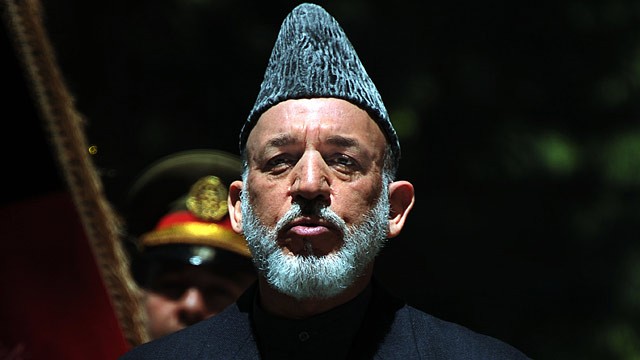
 Phase Three, or Tranche Three as it was announced, will see the transition of 122 more districts across the country to Afghan command.
Included in the transition is the full handover of Kapisa, Uruzgan, and Parwan provinces. The French currently maintain a force of 3,400 soldiers in Kapisa.
Afghan officials said the third phase of transition could take as little as six months. Handing over control to Afghan security will allow French president elect Francois Hollande to make good on his promise to pull his troops out by the end of the year.
Phase three of the transition also includes handing control of provincial capitals across the country to local security.
It's a significant move for Afghanistan's 330,000-member security forces, who have been dogged by a wide range of criticism, including cronyism, ineptitude, and divided loyalties.
NATO and its allies were quick to boast.
"Tranche III! Tranche III! Tranche III!!!" The U.S. Embassy in Kabul tweeted as soon as the announcement was made. Other leaders praised the training and preparedness of the Afghan army.
The transition "is a testament to the capacity and capability of the Afghan National Security Force" said U.S. Gen. John Allen, the commander of all international forces in Afghanistan."Afghanistan continues to move forward in security the sovereign future of their country," he said. "This is another step in bringing the hope of greater prosperity to the Afghan people."
But even as U.S. officials celebrated that new hope, the increasing menace of an insurgency that shows no signs of abating cast its shadow once again, this time, striking at the very heart of Karzai's vision for peace.
A high ranking member of Karzai's hand-picked High Peace Council -- the body charged with spear-heading reconciliation with the Taliban -- was gunned down in broad daylight.
Arsala Rahmani, a former deputy minister under the Taliban regime, was on his way to work when his car was stopped in traffic.
According to Kabul's police chief, an unidentified gunman pulled up in a Toyota Corolla, and fired a single shot from a firearm equipped with a silencer.
The bullet pierced Rahmani's arm, then entered his chest. The attack was so precise -- and so sudden -- that his own driver wasn't sure Rahmani had been hit. He later died in hospital.
Rahmani was seen as a key figure in luring the Taliban to the negotiating table.
In 2011, the Karzai administration arranged for his removal from a U.N. blacklist, allowing him to serve in an official capacity on the High Peace Council.
As a former deputy minister, he maintained contact with several high-level Taliban leaders, and expressed hope that the Taliban could eventually be convinced to end their decade-long insurgency.
Initial speculation about responsibility for the attack fell to the Taliban, who had announced that they would target High Peace Council members as part of their annual "spring offensive."
But in mild surprise, a Taliban spokesman today denied responsibility, saying the insurgent group wasn't responsible for Rahmani's death.
It marks the second time in just the last few months that an influential member of the High Peace Council has been assassinated. Burhanuddin Rabbani, the head of the council, was assassinated last September by a man carrying a bomb in his turban.
Rahmani's killing, carried out in daring fashion with the assailant still unknown, is another setback for Karzai, who has maintained that the only way to a lasting peace in Afghanistan is for the insurgency to end.
President Obama’s tough sales job on the economy

Clinton, Nooyi, Sonia among 'World's most powerful moms'

Shahbaz is a hatemonger

Afghanistan announces security transition

Shahbaz unconstitutional CM
Peshawar blast,Nine hurt
At least nine people including a minor and three policemen were injured as a bomb exploded on Ring Road near Mal Mandi, Geo News reported.
The attack targeting a police check post was planted in bushes. Law enforcement agencies cordoned off the area. The injured were shifted to the Lady Reading Hospital for treatment, where the condition of a policeman was said to be critical.
According to an official of the Bomb Disposal Squad, 5-6 kg of explosives were used in the bomb that completely destroyed the police picket.
Khyber-Pakhtunkhwa: A woman of substance
The Express Tribune

Subscribe to:
Posts (Atom)