Wednesday, April 25, 2012

Bannu jailbreak – part II: We had only five Kalashnikovs, say police

The Express Tribune
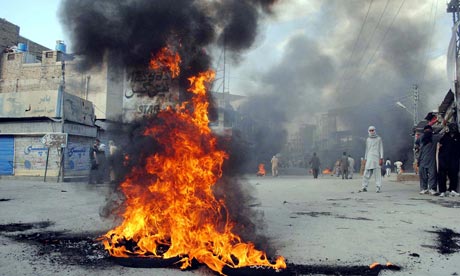
After a successful military operation in Swat in 2009, the public was willing to believe government claims that it had managed to successfully establish its writ in volatile Khyber-Pakhtunkhwa (K-P). However, after a planned Taliban operation in Bannu jail led to hundreds of prisoners breaking out of prison, this claim has come into serious question. It also raises concerns over the jail’s current security set-up – a common sentiment is that if 150 militants can travel down the hills and take command of the jail, they could just as well take control of Bannu city. On paper, the security at the high-profile prison seemed full proof. Surrounded by open fields, the jail is located opposite the posh Bannu township, at a ten-minute drive from the Frontier Region (FR) Peng. It’s also within two kilometres of three police stations. The jail, which has three entry gates, is surrounded by huge cemented walls, the top of which are covered with barbed wire. Each gate is located further inside, so that one must pass through one gate to get to the other. The outermost gate is called the Phatak gate, and is situated on the main road. One person is deployed at each of the four search towers. At the Phatak Gate, two armed men are deployed. In addition, there are three other men at the gate – one with an AK-47, another with a register to enter names of visitors and a third assigned with the duty to frisk visitors. At the last gate to enter the jail, there is only one policeman, armed with just a baton. A total of 151 police personnel are supposed to keep the jail secure – but on the day the militants mounted the assault, only 119 policemen were present and only 21 were performing their duties. Sources told The Express Tribune that eight policemen had been lent to Dera Ismail Khan Jail and four to Karak Jail. In addition, ten others were on leave and six were found absent from their duties. A police official, who wished not to be named, told The Express Tribune that the first target of the Taliban was a search tower located just beside the Phatak gate which was blown up when a rocket was fired at it. Rockets were used to shatter the first and third gates, and hand grenades were used to smash the second. “What could we do, they were above a hundred in strength with the latest weapons and we only had five Kalashnikovs. Tell me honestly, could you face such a situation?” the police official said. The police official then called his brother and told him what was happening. “My brother told me that he has contacted high-ranking police officials. They were changing their uniform and would soon arrive. In all, it took around one hour to break the first and the second gate but we could not respond. We were empty-handed.” “I could clearly see my death. I thought my last moments had arrived and I was going to be slaughtered or shot to death,” he said, adding that two members of the jail police who were deployed at the death cell, climbed up a tree to save their lives. Two other policemen wore prisoners’ uniform as a cover and ran with the prisoners, unarmed and fearing for their lives. “I called them to inquire about them but I started laughing when I came to know they had also escaped with the prisoners,” the official said. He also said one man, who seemed to be leading the militants, was standing at the main gate, telling all those who were escaping: “Go, go, you are free now, just pray for us. Don’t forget to spare your life for Allah.” The official said those who returned to jail informed the authorities that the group , after entering the FR area, asked all the prisoners if they were willing to leave for Miramshah. Those who declined were dropped off in Peng. “Those who returned said suicide bombers and explosive-laden vehicles were also dispatched for the attack but returned as fresh as dispatched”, the official added. Officials have said that all those rearrested or who returned voluntarily, will not be awarded further punishment as they were forced to escape.

Cabinet to accompany Gilani in SC verdict

http://www.brecorder.com
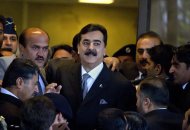
The federal cabinet on Wednesday expressed solidarity with Prime Minister Syed Yousuf Raza Gilani and resolved that all ministers would accompany him to the courtroom on Thursday. This was stated by Minister for Information and Broadcasting Qamar Zaman Kaira while briefing journalists on the cabinet meeting here at the Prime Minister's Secretariat. Flanked by Religious Affairs Minister Syed Khursheed Shah, Secretary Ministry of Religious Affairs Chaudhry Muhammad Azam, Secretary Information Taimur Azmat Osman and others, Kaira said the Prime Minister informed the cabinet that he would not avail any privilege while appearing before the Supreme Court of Pakistan in the contempt of court case and would go to the court on foot. "The leaders and ministers of the coalition partners will also accompany the Prime Minister. We expect justice from the court and hope for justice," he said while responding to the questions raised by reporters. He said the president enjoyed immunity under the local and international laws and writing a letter to the Swiss authorities would tantamount to surrendering immunity. The minister said, "We as a nation say that a foreign country should hand over Dr. Afia Siddiqui to Pakistan and has no right to set head money for Hafiz Saeed. Likewise, we cannot surrender our President before a Swiss magistrate." Asked whether the government would implement the court verdict, the minister said that the government's legal and political teams would take a decision in line with the Constitution and law of land. He said that the Prime Minister also summoned a special federal cabinet meeting to discuss future strategy in the wake of court's order. The meeting to be held after the SC verdict, would be attended by chief ministers of Sindh, Khyber Pakhtunkhwa, Balochistan and Gilgit-Baltistan, and governors of the provinces, besides the Prime Minister and the President of Azad Jammu and Kashmir. "The Prime Minister has no ego problem and he is ready to appear before the court for a third time. He will appear before the court like an ordinary citizen," he added. He said President Asif Ali Zardari and Prime Minister Gilani had set a new precedence by transferring their powers to the Parliament. He said the President surrendered his powers to the Parliament and the federation devolved its powers to empower the provinces, which were now getting Rs 400 billion additional amount as per new NFC Award. To a question she said that Dr. Firdous Ashiq Awan belonged to his party and he was her continuation and there was no question of holding any investigations into appointments made by her.

Mehrangate: Nawaz too took Rs 50 million

AG presents interior ministry report which says Nawaz Sharif took Rs 50 million from Mehran bank. Three-member Supreme Court bench headed by the CJP Iftikhar Mohammed Chaudhry heard the Mehrangate scam case. AG Irfan Qadir informed the court that he had met the interior and law ministry officials but could not get hold of Mehran Bank Commission reports. Asghar Khan’s lawyer Salman Akram Raja said that one of the journalists told him he has got the reports. CJP wondered as to why the government hasn’t got the reports. The AGP presented the interior ministry report which said Yunis Habib misused the money and Nawaz Sharif also got Rs 50 million. The report recommended calling the then additional DG FIA Rehman Malik AG Qazi Jamil and registrar Supreme Court. The report also recommended to hand over ex DG ISI’s original statement to registrar Supreme Court as it also could go missing.

Tuesday, April 24, 2012

Egyptian protesters condemn Riyadh for activist’s arrest

Enraged demonstrators have staged a protest rally outside Saudi Arabia's Embassy in Cairo to condemn the recent arrest of a prominent Egyptian rights lawyer and activist. Rights activists, lawyers as well as students from the University of Cairo and families of imprisoned Egyptians in Saudi Arabia joined the rally outside the Saudi Embassy on Tuesday. The demonstrators chanted slogans against the Saudi king and called for the immediate release of Ahmed Mohammed al-Gizawi. Gizawi was arrested by Saudi security forces on April 17 upon arrival in the Saudi city of Jeddah. The lawyer's detention came without any prior notification and at a time he was in Saudi Arabia for Hajj pilgrimage. On Monday, Egypt's Arabic Network for Human Rights Information issued a statement, saying Gizawi's detention followed a sentence of one year in prison and 20 lashes delivered against him in absentia for criticism of the Saudi rulers. Gizawi is being targeted for his activism in favor of Egyptian detainees in Saudi prisons, the statement added. On Monday, the Egyptian Foreign Ministry also criticized Saudi officials for the activist's arrest and asked Riyadh to explain the move. The protests come as Saudi Arabia has been faced with a continued wave of anti-regime protests at home, especially in its Eastern Province, with the protesters calling for political reform. Anti-government protests intensified last November, after security forces opened fire on protesters in the city of Qatif, killing five people and leaving many more injured.

Saudi Arabia jails Egyptian lawyer for defaming king

Egypt's foreign ministry is trying to secure the release of an Egyptian lawyer detained in Saudi Arabia on charges of defaming King Abdullah. Ahmed al-Gizawi was arrested last week as he arrived in Jeddah to undertake Umra, the lesser pilgrimage to Mecca. Unknown to Mr Gizawi, a Saudi court had earlier sentenced him in absentia to a year in prison and 20 lashes. He is due to receive the lashes on Friday. Mr Gizawi's case has aroused widespread anger in Egypt. Social media have been blazing with attacks on the Saudi authorities and several politicians have demanded action, with one MP describing his detention as kidnapping. The Saudi ambassador to Egypt has tried to calm the situation by phoning into an Egyptian TV station, saying that there would soon be good news on Mr Gizawi. BBC World Service Middle East analyst Sebastian Usher says many Egyptians work in Saudi Arabia and there have often been cases where they say they have been mistreated under Saudi law. Mr Gizawi's case is also reminiscent of that of a Lebanese TV fortune teller who was also arrested while on pilgrimage to Saudi Arabia. He was accused of blasphemy and sentenced to death - but an international outcry helped stop his execution. 'Criticism of Saudis' Mr Gizawi is reported to have filed several lawsuits against the authorities in Saudi Arabia on behalf of Egyptians detained there without trial, who claim to have been tortured or who believe they were unfairly convicted. An Egyptian human rights group, the Arabic Network for Human Rights Information (ANHRI), suggested that the judgement against him followed criticism of the Saudi government. "Gizawi criticised the Saudi repression of Egyptians living in Saudi territory and filed a case... calling for the Saudi authorities to be forced to hand over Egyptians detained in its custody, accusing the Saudi king himself," the group said on Saturday. Egyptian Foreign Minister Mohammed Kamel Amr was "following the case closely" and trying to find out "the reasons for the arrest", his spokesman told the state news agency, Mena. Correspondents say part of the anger felt in Egypt comes from perceptions that the Saudi authorities are abusing their control of the Muslim holy places in Medina and Mecca. "Saudi Arabia should not use its control of the Kaaba in political issues" Emad Arab, an Islamist activist told Egypt's Ahram Online, referring to the ancient cube-shaped shrine in Mecca's Grand Mosque. The Umra is an extra, optional pilgrimage and does not count as the once-in-a-lifetime Hajj. Although it includes some of the rituals of the Hajj, they are shortened and there are fewer of them.

Bahrain Grand Prix exposes kingdom's deep divisions

The Bahrain Grand Prix was an opportunity for the kingdom to demonstrate all is well after last year's uprising, but the weekend race instead highlighted deep divisions between the ruling Sunni dynasty and the Shiite majority. The three-day sporting event that came to a close on Sunday was presented by the authorities as a sign that security and stability had returned to the kingdom after the Shiite-led uprising in February 2011 was brutally crushed, leaving 35 people dead, according to an independent probe. A statement by Bahrain's cabinet on Sunday said the Grand Prix "reflects the confidence the world has in Bahrain's ability to host such a global event." The king and crown prince both portrayed the race as an opportunity to demonstrate the country was on a path to reconciliation. But Bahrain's Shiite opposition, including the largest group Al-Wefaq and the more radical February 14 Youth Movement, used the renewed media attention on the kingdom to highlight their demands, with daily protests alleging abuses, marginalisation, and disenfranchisement by the regime. The weekend demonstrations often spiralled into violent clashes with security forces using tear gas and stun grenades against protesters who shot back with rocks and fire bombs. And as dawn broke on the morning before racing day, the opposition reported the death of a protester, allegedly at the hands of security forces, renewing calls among international rights groups to call off the race. The government quickly issued a statement condemning the violence, pledging to investigate and prosecute those responsible "whoever they may be," but stopping short of admitting any police involvement. The escalation was no accident. In a statement released in the days before race, Al-Wefaq announced a week of demonstrations, while the February 14 movement called for "three days of rage" to coincide with the event. The government meanwhile took preventive measures, making dozens of arrests and barring news reporters from several major news organisations, including AFP, from travelling to the kingdom ahead of the race. "The revolution never stopped... Only the international media coverage stopped," said one prominent Shiite activist, who gave his name as Ali, adding that the decision by the ruling Khalifa family to go ahead with the Grand Prix "was a gift to the revolution." The violence, clashes and slogans calling for the fall of the regime made world headlines far more than the race itself. The unrest even reached the isolated desert circuit, under a total security lockdown, on Sunday when at least three women were hauled off by police for holding up pictures of prominent Shiite activist Abdulhadi al-Khawaja on hunger strike since February 8. Khawaja's deteriorating health has raised fears among rights groups that he may die in prison, potentially triggering yet another wave of mass protests in the kingdom. On Monday, Bahrain's highest appeals court postponed for a second time in a month a final verdict on Khawaja, who is sentenced to life in prison for plotting to overthrow the regime. On race day, King Hamad announced he would attend the event, hoping to reassure increasingly nervous participants that the event was safe. He said he remained committed to reconciliation. But what little faith the moderate members of the Shiite opposition had in the monarch has faded in recent months as reforms proved hollow, a national dialogue has failed to move forward and political prisoners remain jailed. On Sunday evening, as teams, sponsors and government officials sipped non-alcoholic champagne and celebrated with post-race festivities at the track, protesters burned tyres and garbage in the streets, chanting "No to the Formula of blood." Bahrain's Grand Prix was "supposed to be a sign of normalisation...what happened is the complete opposite," said Salman Shaikh, the director of Brookings Doha Centre. "The race ended up polarising people in Bahrain... We ended up with further divisions," he added.

Bahrain hardliners in driving seat after F1 fiasco

Hardliners in Bahrain's Saudi-backed Sunni Muslim ruling family may dig in their heels after a Formula One Grand Prix debacle that spotlighted a frustrated pro-democracy uprising instead of projecting an image of stability. Western leaders joined rights groups and media watchdogs in criticizing Bahrain before Sunday's race, which was cancelled last year due to the unrest. Officials hailed its reinstatement as proof of a return to calm, but billowing smoke from tires set alight by protesters on race day told a different story. "I suspect now that those in the ruling family who argued that this is more trouble than it's worth will be saying 'I told you so'," said Justin Gengler, a Qatar-based researcher on Bahrain, singling out the royal court and defense ministers. Those ministers, full brothers from a family branch often known as the Khawalids, are widely viewed as masterminds of last year's crackdown, which cut short a dialogue Crown Prince Salman had begun with the opposition on democratic reforms. Bahrainis took to the streets in February 2011, inspired by successful revolts in Egypt and Tunisia, but won no concessions. The government broke up the Pearl Roundabout protest camp a month later, imposed martial law and brought in Saudi troops. The Sunni Al Khalifa monarchy branded the protesters as Shi'ite subversives with Iranian backing and Bahrain slipped off the Saudi- and Qatari-dominated pan-Arab news agenda. Western allies such as Britain and the United States, whose Fifth Fleet is moored in Manama, muted criticism of Bahrain for fear of alienating a trusted friend - or its Saudi big brother. Yet turmoil still convulses the tiny Gulf island, where riot police clash daily with demonstrators, mostly from the Shi'ite majority, and opposition parties stage mass marches. Police deploy armored vehicles, teargas, sound bombs and birdshot to lock protesters down and prevent a critical mass from re-forming and winning world attention. As a result, activists say the death toll has risen to 80 from 35, including five security personnel, when martial law was lifted in June. SECTARIAN FEARS Bahrain's government says it remains open to limited reform, but unease at the prospect of any power shift from the Sunni royal family to the Shi'ite majority has stifled progress. The hardline royal court minister, Khaled bin Ahmed, initiated contacts with the leading Shi'ite party Wefaq in January, but pro-government Sunni radicals objected strongly and the chance of renewed dialogue appears to have evaporated. Nevertheless, King Hamad responded to the Grand Prix furore on Sunday by stating his "personal commitment to reform and reconciliation". Sheikh Abdulaziz bin Mubarak al-Khalifa, adviser to the Information Affairs Authority, said many Bahrainis wanted reforms but did not want them dictated by one party or sect. "All the political societies want to fight corruption, efficient government, an empowered parliament," he said. "As long as there are no preconditions, mutual respect and no raising the bar too high, then there is hope." Sheikh Abdulaziz declined to comment on any potential rifts within the government over the question of reform. Crown Prince Salman has long been seen as its keenest royal advocate. He brought Formula One to Manama in 2004 as part of what analysts say was a vision for political and economic change that would reduce reliance on receipts from an oilfield shared with Saudi Arabia - and the influence that the arrangement gives a powerful neighbor with no interest in a democratic Bahrain. The negative publicity the latest race attracted may help to undermine whatever remains of that reform drive. "If anything the race will probably encourage the hardliners in government to say 'we don't need this sort of thing, we don't make money from it and it brings troublesome Westerners'," said Jane Kinninmont, a Chatham House analyst based in London. Prince Salman's reforms had for years been seen as a challenge to the way Sheikh Khalifa bin Salman, prime minister since independence from Britain in 1971, handles the economy. Sheikh Khalifa has become a figurehead for Sunnis who fear Shi'ite empowerment in the event of democratic change. Changes of personnel and remit in key bodies since last year's crackdown suggest the concerns of the security apparatus now dominate. "It appears to be the case across the family and throughout the government that they think they are winning," said Toby Jones, Middle East historian at Rutgers University. "NO URGENCY" "There is no sense of urgency or commitment to creating the kind of space necessary to arrive at a rapprochement," Jones said. "If that's true, then it seems that all this talk of a split - and contradictory agendas - does not really matter." Bahrain, a banking and tourism hub, is a shadow of its former self. Economic growth slowed to 1.3 percent in the last three months of 2011 compared to 2.2 percent the year before and inflation hit a three-year high of 4.7 percent in March. This has increased reliance on Saudi Arabia which has promised, along with other Gulf oil and gas powers, to offer extra financial help, giving extra comfort to the ruling elite. Hotels and office space have low occupancy and fewer Saudi weekend visitors frequent its bars, restaurants and malls. Few foreign media have correspondents based in the country. Wefaq, the main Shi'ite party, says attempts to reach a deal with the authorities are at an impasse. "This government is not serious about having a real dialogue, to listen to the demands of the Bahraini people and implement those demands which cannot be ignored," Wefaq leader Sheikh Ali Salman told Reuters. "Who are you to have a monopoly in power? Who tasked you with the job of appointing the government, controlling all ministries, taking advantage of national wealth?" he asked. Demonized in pro-government media as the "Hezbollah of Bahrain" yet singled out by U.S. President Barack Obama as an interlocutor the government should engage, Wefaq says the country is hostage to discord within the ruling family. The party, whose more radical rivals favor ditching the monarchy altogether, expects the conflict to get more violent. "Petrol bombs only appeared after November and in recent months we have seen some bombings, though it's still not clear who carried them out," Salman said. "It's just logical that political deadlock will result in deeper instability."

Balochistan : ANTI-POLIO DRIVE KICKED OFF IN 27 DISTRICTS

The three-day
anti-polio drive in 27 districts of Balochistan was kicked off on Monday wherein over 1.5 million children below the age of five years would be administered polio vaccine. A control room has been set up at Provincial Secretariat to closely monitor the campaign situation in Quetta where two cases have so far been detected during the past four months. The provincial teams of EPI, WHO and UNICEF will also monitor the campaign. As many as 4, 549 mobile teams, 608 fixed site teams, 70 border teams and 227 Transit teams will take part in the campaign while an in-charge was appointed at each 448 Union councils and 920 areas. These teams are being assisted by area in-charges, Lady Health Workers (LHWs) and officials of Health Department. Balochistan was the worst affected province during the 2011 during which 73 out of 198 cases were reported. Additional Chief Secretary Dr. Umar babar said government in collaboration with other organizations making its utmost efforts to eradicate this virus. Considering the high cases in the province, the government has constituted committee in each district under the leadership of Deputy Commissioner to make the campaign more effective. The anti polio-drive will start in high risk areas that include Quetta, Qila Abdullah and Pishin by May 7, 2012. According to health officials, two cases were reported in Quetta in this year while total 15 children have contracted with polio virus throughout the country.

ZARDARI ACCEPTS INVITATION BY SOCIALIST INTERNATIONAL

Socialist International has invited President Asif Ali Zardari to deliver a keynote address at their Congress in September this year which the President accepted. The invitation was extended Monday during President’s meeting with Luis Ayala, Secretary General of Socialist International who called on him at Bilawal House. Briefing about the meeting Spokesperson to the President Senator Farhatullah Babar said that during meeting, the President called upon the Socialist International which has a large membership among the members of the European Parliament, to stress upon early operationalization of Pakistan-specific EU trade package, the Autonomous Trade Preference, announced by the European Union in response to the economic challenges faced by the country owing to the toll of war on terror and the destruction caused by the unprecedented floods of 2010. The President said that Pakistan greatly appreciates the European Union and its member states for their commitment to help the country reviving and stabilizing its economy through trade. He said that despite immense economic difficulties, we have opted for trade over aid to stabilize our economy from the shocks of ongoing war and that of the natural calamities. He said that economic stability was essential for strengthening of the democracy and the international community needs to assist the democratic dispensation in bringing about socio-economic development of the people of Pakistan. The President said that socio-economic development would help defeat militancy and also advance the goals of freedom, justice and peace. Discussing various steps taken by the present government, the President said that PPP’s Government in line with the vision of its founder Shaheed Zulfikar Ali Bhutto and her great daughter Shaheed Mohtarma Benazir Bhutto has taken a number of steps for real empowerment of the downtrodden people of this country, especially the most vulnerable segments of the society. He said that in line with our manifesto, we have empowered our women not only politically but also economically so as to save them from all kinds of exploitation. He said that the flagship program of the present government, the BISP program, with all its components was serving the poor women of the country and enabling them to support themselves financially besides taking care of their health, work and education issues. He said that besides women, the Party have also focussed on the labour class by empowering them and making them a share holder in state-run enterprises. He said that reinstatement of the sacked workers, regularization of contract labor, giving 12 percent shares in state-run enterprises to the workers, giving state lands free of cost to poor women in the command areas of the new dams were some of the major achievements of the democratic government. The President said that the PPP which also a member of Socialist International is continuing its forward march on the path of empowering people and for their progress and development despite economic and other challenges. Discussing regional situation, the President reiterated Pakistan’s principled stance of support peace efforts in the neighbouring Afghanistan saying that we believe that peace on our side and in the region was invariably linked with the peace in Afghanistan. Therefore, we will continue to support every effort for peace, stability and development in Afghanistan, the President said. Luis Ayala, Secretary General of Socialist International, thanked the President and Co-Chairman PPP for meeting and appreciated the Party’s achievements in empowering the most vulnerable segments of the society. He also lauded Pakistan’s role in war against terror and its efforts to support peace activities in Afghanistan. Mr. Ayala assured the President of continued support of Socialist International in its quest for getting more trade in the European markets.

Allies with PPP on Saraiki province

Prime Minister Yousaf Raza Gilani on Monday claimed that all coalition partners craved for the formation of a new Saraiki province. Talking to a group of journalists from print media, the premier said he had talked to his coalition partners after President Asif Zardari’s announcement to carve out the Saraiki province in Punjab, adding that all of them assured him of support. He pointed out that Awami National Party (ANP) leader Asfandyar Wali Khan and Baloch leader Israrullah Zehri had backed it. He also said that lawmakers from the Federally Administered Tribal Areas had also assured the government of their support on the issue. The PM said that the Pakistan Muslim League-Quaid had tried several times to introduce a resolution in the Punjab Assembly regarding the Saraiki province, but did not have the majority to do so. Gilani said that nothing was impossible in politics and the government would be able to create a consensus in parliament in this regard. He said that there was a consensus among the coalition partners to create the Saraiki province, but the government would like to take all political forces on board. To a question about the Pakistan Muslim League-Nawaz’s (PML-N) demand for early elections, the prime minister said that the government would first consult with the coalition partners, adding that if they were agreed then further discussion would be held with PML-N President Mian Nawaz Sharif. On Balochistan, Gilani said that law and order situation had been overshadowing all the efforts taken by the government through Aghaz-e-Haqooq-e-Balochistan Package to alleviate the grievances of the people of the deprived province. He said that the government would arrest former president Pervez Musharraf on his return for his involvement in the murder of Nawab Akbar Bugti. The PM defended the expansion of the cabinet, saying that a 60-member cabinet was in line with 11 percent of the total strength of parliament as recommended in the 18th Constitutional Amendment, which would be implemented from next general elections. He said that 60 members constituted 11 percent of 446-member parliament. Gilani said that the government was seriously considering for holding local bodies elections in the federal capital so that the city would be administered by a “mayor” as is being done in Bangladesh and other countries. “I have directed my colleagues to work on this and the president has already given his nod,” the PM said. Gilani said that the government wanted friendly relations with the US in line with the recommendations of the Parliamentary Committee on National Security. The cabinet’s committee on defence would receive a presentation and subsequently a US team would be visiting Pakistan for holding discussions on terms of future engagement between the two war partners. He said that he had directed the economic team to prepare proposals to provide relief to the farmers and common people through programmes like the Benazir Income Support Programme.

Pakistan's top court to deliver verdict in PM case

Pakistan's Supreme Court is expected to deliver its verdict later this week in a contempt case against the prime minister that could see him losing his job, the premier's lawyer said Tuesday. A guilty verdict could also result in Prime Minister Yousuf Raza Gilani
serving up to six months in prison for his refusal to reopen an old corruption case against the president, his political ally. That could stoke fresh political turmoil at a time when Pakistan is trying to patch up its relations with the United States and is grappling with a weak economy and a bloody Taliban insurgency. But even if Gilani is forced to step down — a process that could take months — the deeper political impact could be limited since the ruling coalition has the majority in parliament needed to elect a new prime minister. The court has summoned to Gilani to appear before it Thursday when it is expected to deliver its verdict, said his lawyer, Aitzaz Ahsan. "I am hopeful that the prime minister will be acquitted," Ahsan told reporters outside the courthouse in Islamabad. The judges have repeatedly ordered the government to write a letter to Swiss authorities requesting they reopen a graft case against President Asif Ali Zardari that dates back to the late 1990s. Gilani has refused, saying the president enjoys immunity from criminal prosecution while in office. He and other members of the ruling Pakistan People's Party have argued that the Supreme Court has relentlessly pursued the case because of bad blood between Chief Justice Iftikhar Mohammad Chaudry and Zardari.

Dengue, PIC victims: red-tape delays compensation

Compensation for the families of 261 dengue fever victims, who had lost their lives during the worst-ever epidemic of the disease last year, has either been delayed or denied by the Punjab government. Hospital-based mortality review committees, the Dengue Experts Advisory Group (DEAG) and committees constituted at the DG Health and Health Department levels for the verification and confirmation of genuine cases for financial assistance have brought no relief to families of scores of diseased patients. The official figure provided to Dawn by Lahore (EDO) Dr Inamul Haq reveals that the number of deaths of dengue patients was almost double than the figure announced by health authorities shortly after the epidemic. “We have issued so far Rs500,000 cheque each to 255 patients who died of dengue virus”, Dr Inam said. He said the health department had received 311 more cases of those patients who died of dengue virus for financial assistance and of these 261 were still under the verification process. Similarly, families of patients who had died in the drugs reaction scam are also facing the same situation as out of Rs256 million total financial assistance released by the Punjab government, the authorities could dispense only Rs118 million to the families of victims. According to official figures, out of 908 affected patients 183 had died of the drugs reaction in the Punjab Institute of Cardiology (PIC) scam. Health department section officer Dr Nasir told Dawn that the department had released Rs236.3 million to the Lahore district coordination officer for disbursement to families of patients who died in the PIC drugs reaction. He said the financial assistance of Rs20 million was also released to the Punjab Health Director-General to distribute it among those families of PIC patients who died in other districts of the province. “The Health Department has forwarded a summary to the chief minister on April 10 wherein it has been mentioned that the DCO office has dispensed Rs109.8 million among families of PIC victims out of total Rs236.3 million released for the financial assistance while the DG Health has disbursed Rs9.5 million among the legal heirs of patients in connection with the same scam”, Dr Nasir said. As is evident from the official figures provided by the section officer, the legal heirs of scores of dengue virus and PIC scam victims are still struggling to get financial assistance since these two major tragedies had taken a heavy toll of patients, particularly in Lahore. Complicated procedural formalities and hectic schedule of officials concerned designated for the verification of cases have caused the delay in the disbursement of financial assistance to legal heirs. Chief Minister Shahbaz Sharif had announced a financial assistance of Rs500,000 for each patient who either died of dengue fever or the drugs reaction. Families are lamenting over the delay of compensation owing to the apathy of government officials. Elderly woman Safia Bibi, who lost her only son in dengue epidemic, says: “It is too easy to die of a viral disease like dengue but too difficult to get compensation from the government which is responsible for the spread of the virus.” Her 27-year-old son, Muhammad Saad, had died of dengue virus in Wapda Hospital on Oct 10, 2011. Wapda Hospital MS Dr Akmal Faiz Bhatty had confirmed that Saad died of dengue fever and issued a letter on Feb 2012 the copy of which is available with Dawn. The name of Saad was also mentioned in the officially prepared list of dengue victims. Saad’s father Bashir Ahmad of Multan Road suffered leg fracture in September 2011 and remained hospitalized for four months. Since then Safia had been pursuing the case of financial assistance by visiting offices of the EDO, DG health, Civil Secretariat and other officials concerned, but to no avail. Similarly, a job-seeker youth who had lost his parents in the PIC drugs reaction has been visiting the offices of the Health Director-General for two months for financial assistance. His father Saleemullah of Hafizabad and mother Iffat Saleem were cardiac patients and had been taking medicines from the PIC. According to official documents, the PIC administration and hospitals’ concerned where deaths took place had verified their cases by issuing death certificates. The DG office has assured the youth of financial assistance in the case of his mother but it has rejected the case of his father despite the fact that official documents carrying registration (No 2010-070749) of the patient categorically mentioned the cause as ‘death due to medicine reaction’. Legal heirs like Safia Bibi could not meet Services Hospital principal Prof Dr Faisal Masood, who is heading DEAG, during her frequent visits there in pursuance of her case due to his (Dr Masood’s) hectic schedule. Most of them are those whose patients had either died at homes or private health facilities, but there is no transparent mechanism for the verification of their cases.

Monday, April 23, 2012

U.S. Gas prices finally stop their steep climb

http://www.cbsnews.com
Rising gas prices are like a gun aimed at the heart of the economic recovery. You've been paying more and at this time of year; you'd expect them to rise even further. But, all of the sudden, the pressure on the trigger is easing. The average price is $3.86 per gallon. That's down a nickel in just the past week. A year ago today, we were paying that same: $3.86 per gallon. This is the first time prices haven't risen year to year in two-and-a-half years. CBS News correspondent Anthony Mason looked into whether or not gas prices keep dropping, and whether the danger is over for the economy. The price of crude has been slipping in the trading pits; oil fell again Monday. As tensions with Iran have eased, some of the speculators who helped push up the price have been driven away. "There is a little bit of fear in speculators now. They realize there's not just upside potential, but there's downside risk as well," said Tom Kloza, who works with the Oil Price Information Service.Since April 6th, the average price of a gallon of gas has fallen by 8 cents from $3.94 to $3.86. "It's not gonna be enough to buy a boat, but you're gonna save a little bit of money. You're certainly not gonna pay some of those $4.50 and $5 numbers that were talked about awhile ago," Kloza said. That's finally broken a streak of 910 straight days, during which gas was more expensive than it was one year earlier; 17 states have now broken below their year ago average. But Kloza does not see a continuing downward trend, and he warns: be careful what you wish for. "It's kind of like rooting for a recession. If you really want sharply lower prices you need to root for a recession or you need to root for a technological breakthrough, which isn't out there right now," Kloza said. Kloza sees price lingering about where they are now until the summer. The good news: you can forget all those highest-price-ever predictions, at least for awhile. Economists look at gas prices as the biggest threat to the economy; if prices hit $5 per gallon, than a recession will be likely to hit. Higher gas prices are considered a tax taking money out of people's pockets, but these lower prices should mean the recovery is okay for now.

Sick Chavez phones TV show to disprove death rumours

Venezuelan President Hugo Chavez
telephoned state TV on Monday following a nine day silence that triggered rumours he had died while undergoing cancer treatment in Cuba. He attributed the rumours to "dirty war."“It seems we will have to become accustomed to live with these rumors, because it is part of the laboratories of psychological war, of dirty war,” the 57-year-old socialist leader said in the phone call from Havana where he is undergoing radiation therapy.

Pakistan to launch missile; alert forces India to rejig flights to Gulf

Days after India conducted its Agni-V test, Pakistan has informed India it too is conducting a 'long-range missile test in the Indian Ocean' anytime from April 24 to 29 (from 8.30 to 11 am IST), and asked the Indian civil aviation authorities Monday evening to issue a NOTAM (notice to airmen) to warn commercial airlines and pilots to steer clear of the area. Flights heading to the Gulf from India in that specific time-period will have to be rescheduled or rerouted, sources said. Pakistan informed the Indian authorities Monday evening it was waiting for India to issue the NOTAM and asked it to communicate the NOTAM number to the Pakistan civil aviation authority swiftly. Pakistan also said that Oman and Yemen had already issued NOTAMs ahead of the Pakistani long-range missile test. Sources said Pakistan conducts its missile tests over the Indian Ocean in the southern direction due to which flights from India to the Gulf and Africa have to be rescheduled or rerouted. "The communications from Pakistan always come in the last minute, mostly just a day in advance. Airlines have to be informed immediately," sources said. Pakistan is developing its 'Shaheen' long-range missiles that it hopes can eventually clock a range of 4,000-4,500 kms. Pakistan’s entire nuclear-capable missile arsenal is India-specific and is trying to develop long-range missiles that has strike capacity to destruct whole of India.

Afghan-US Pact Will Not Apply Until Parliament Approves

TOLONEWS
The Afghanistan-US long-term strategic agreement will not be upheld if the Afghan Parliament does not approve it, officials said Monday. Afghan Foreign Minister Zalmai Rassoul and National Security Advisor Rangin Dadfar Spanta went before the Afghan Senate and Parliament respectively to discuss the agreement, and both stressed that the country's lawmakers would have the final say. Speaking before the Senate, Rassoul said the agreement will be valid for ten years and is not applicable unless approved by the parliament. "The agreement is valid for ten years and it is extendable for another ten years if we want," Rassoul said. "But it's not applicable unless [Parliament] approve it." Some members of Parliament (MPs) asked the government officials to provide a copy of the draft in order to discuss it within parliament. "We have the right to see the draft - we need two or three months to discuss it," MP Daoud Kalakani said. However, Spanta said the draft will be provided to the MPs only after it is signed by the both presidents, adding that this was also the case in the US. When asked to explain this, he said the signing of the agreement by both countries' presidents was conditional on the agreement of their respective governments. "When its signed by the US President, then we can provide the draft to you," he told the MPs. Officials told TOLOnews that the Afghan-US strategic pact was rewritten 23 times during its 18 month-long negotiation period. Rassoul told the Senate that the agreement acknowledged both countries as independent and equal, and it respected the sovereignty of Afghanistan. "As per the United Nations mandate, Afghanistan and US will be considered as independent and equal countries after signing the agreement," he said. "US will respect the national sovereignty and independence of Afghanistan and is committed to transferring security responsibility to the Afghan forces," he told the senators. The agreement also says that Afghanistan should be named an "important Nato ally" and that the US is committed to training and equipping Afghan security forces for a decade after 2014. It does not contain any dollar amount for how much the US will commit each year, despite earlier calls from President Hamid Karzai for this to be included in the agreement. While the document does not specify what the US will provide in terms of ongoing security support, notably, there will be no permanent military bases, Rassoul said. "The US has once again emphasised that it is not interested in having military bases in Afghanistan which might be seen as a threat to our neighbors," he told the Senate. However, Spanta meanwhile told parliamentarians that talks about US permanent military bases were not off the agenda, and that this issue will be revisited a year after the strategic agreement is signed. "After signing the strategic pact, a separate security agreement which will allow or not allow the existence of US permanent bases in Afghanistan will be signed after one year if agreed," Spanta said. Afghan and US officials finalised the Afghan-US strategic pact on Sunday which is expected to be signed at the Chicago summit in May. The agreement titled "Enduring Strategic Partnership Agreement between Afghanistan and the United States" was initialed "final" by Spanta and the US Ambassador to Afghanistan Ryan Crocker during a ceremony at the National Security Council.

Anti-polio campaign kicks off in KP

THE NEWS
The three days anti-polio campaign kicked off in Khyber Pahtunkhwa and FATA on Monday wherein 6.1 million children under five years of age would be administered Oral Polio Vaccine (OPV). Khyber Pakthunkhwa Minister for Health Syed Zahir Shah and Deputy Director EPI, Khyber Pakhtunkhwa Dr Jan Baz Afridi formally inaugurated the campaign by administering anti polio drops to children during a function here Monday. Speaking on the occasion, the Health Minister said polio is a crippling disease that could only be eradicated by making joint efforts and supporting each other for this national obligation. He said the cases of polio were reducing considerably in the country owing to the government's successful strategies, advocacy and National Immunization Campaigns (NIC). He expressed the hope that polio would soon be eradicated from the country with the support of all segments of society. The Minister lauded the efforts of Health and EPI staff for their improved performance and reaching out to all children in the province. Deputy Director EPI, Dr Jan Baz said that as many as 6.1million children would be given Oral Polio Vaccine (OPV) in Khyber Pakthunkhwa and FATA during this campaign. He said 16,600 teams for Khyber Pakhtunkhwa and 3000 for Fata have been formed for door to door campaign to make Pakistan Polio free country. These teams are being assisted by area in-charges, Lady Health Workers (LHWs) and officials of Health Department . In case of non arrival of the teams, he held an appeal to parents and guardians to bring their children to nearest hospitals and BHUs for vaccination. He informed that Peshawar, Charsadda, Nowshera, Mardan, Lakki Marwat, DI Khan, Tank, Kohat and Fata are still vulnerable and high risk areas. The official said that significantly decrease in refusal cases have been reported in recent past owing to effective advocacy campaigns and holding of vigorous immunization drives. Dr Jan Baz said DCOs and Political Agents have been directed to supervise and monitors the campaigns on grounds and if necessary take strict action against parents refusing to vaccinate children. He held out an appeal to parents to vaccinate their children against polio and protect them from permanent disability and urged media and religious scholars to support the national cause and play its constructive role in raising awareness among the masses about polio that could be protected merely by administering two drops to their children.

Bahraini forces attack mourners

Press TV
Saudi-backed forces in Bahrain have attacked mourners holding a funeral for a protester killed by regime forces. Activists said on Monday that the police quickly attacked the mourners after they started calling for the downfall of the regime. Thousands of Bahrainis took to the streets in the Manama suburb of Bilad al-Qadim for the funeral procession for 36-year-old Salah Abbas Habib, who was found dead on a rooftop in the village of Shakhoura, southwest of Manama, on Saturday shortly after regime forces attacked an anti-government demonstration in the area the day before the Formula One Grand Prix. Hussein Abbas Habib, the victim's brother, said, “We just got the body back now. He had birdshot wounds in his chest and abdomen.” He added that his brother was also badly beaten on his hands, back, and legs. According to the Bahrain Youth Society for Human Rights, Habib was shot while running away from police. Activists say authorities kept Habib's body for two days and handed it over to his family on Monday to prevent the funeral from being held during the Bahrain Grand Prix. Bahrain's main opposition group, al-Wefaq, has confirmed that Saudi-backed forces killed Habib and said that the conflict will grow more violent if the regime does not engage in political reforms. Al-Wefaq Leader Sheikh Ali Salman said the regime refuses to talk or listen to the demands of the people and the situation has reached an impasse because the Saudi-backed regime is not keen on implementing real reforms. The Bahraini revolution began in February 2011. Since then dozens have been killed and thousands more injured and arrested. Anti-regime demonstrators hold King Hamad bin Isa Al Khalifa responsible for the death of protesters during the popular uprising.

Commission formed to probe Bhoja plane crash not to convince PML (N)

Minister for Information and Broadcasting Qamar Zaman Kaira on Monday said the judicial commission has been constituted to probe the Bhoja Airplane crash and not to convince or satisfy the leadership of Pakistan Muslim League (PML)-N. He said the basic objective of announcing the Commission by Prime Minister, Syed Yusuf Raza Gilani was to conduct a thorough probe of Friday's incident and to reach out actual facts of the crash. All passengers including crew members lost their lives in the crash. In an exclusive talk with mediapersons here, the Minister said the government as well as the entire nation felt grieved over the tragic incident in which precious human lives were lost, but it is regrettable that (PML)-N leadership has adopted an inappropriate and irresponsible tone and attitude over the Commission. Qamar Zaman Kaira said, "Basically we want to have a better and comprehensive investigation of Bhoja air crash and to express solidarity with family of the victims." Talking about the investigation process, Kaira said Boeing Company has offered its assistance, the Black Box has been recovered and it would be decoded and some other technical matters would also be thoroughly considered to get better results in the investigation process. The Minister while lamenting attitude and unnecessary criticism of the opposition leader, said the investigation, being conducted by the Commission would be made public. Qamar Zaman Kaira said the Opposition leader in National Assembly should have known that the owner of Air Blue Company is leader of PML (N) whose plane also crashed last year in Margalla Hills, adding that if PML (N) desires the government can re-investigate the incident of air crash. "We condemn their thinking, attitude and unnecessary criticism over the investigation process of Bhoja air crash initiated by the government," he said. The Minister also rejected PML (N)'s criticism over formation of the Judicial Commission and said PCO judges are respectable as we all who had issued reasonable verdicts during their service. "It is really unfair that PCO judges, who have tremendous service record were being defamed. Now they are not part of judiciary but we must give them the due respect. There is no Judge without PCO in Pakistan," he added.

The truth about Arizona's immigration law

With the Supreme Court poised this week to hear arguments in the legal challenge to Arizona's immigration law, it's a good time to explain what this law and the ruckus surrounding it are really about. The left says it's about racism and political extremism; the right claims the issues are border security and public safety. Wrong. In the two years since Gov. Jan Brewer signed SB 1070 into law, it's become clear that this law, and the debate over it, are really about three things: fear, power, and freedom. It's about fear. As someone who lived in Phoenix and wrote for the Arizona Republic in the late 1990s, I can tell you that Arizonans only recently reached the conclusion that they wanted to get rid of illegal immigrants. The 'Zonies I knew couldn't live without them.Not a lot of U.S. citizens were lining up to do the hard and dirty jobs that the undocumented were doing. That includes landscaping or other jobs that require you to work outdoors in 115-degree weather. In 1994, when Californians passed Proposition 187 -- an anti-illegal immigration ballot initiative that intended to deny public services to illegal immigrants but was ultimately struck down by the courts -- and when President Bill Clinton launched "Operation Gatekeeper" to beef up enforcement on the U.S.-Mexico border south of San Diego, hundreds of thousands of illegal immigrants who had been headed to California took a detour through Arizona.Those who crusade against illegal immigration in the Grand Canyon State will say that this is when the "invasion" began. In truth, it was more like a gigantic job fair where employers eagerly gobbled up illegal immigrants to do everything from cleaning houses to raising children to cooking in restaurants. At the time, few people seemed concerned about verifying legal status. I once asked the crew washing my car at a popular Phoenix carwash if they had fake green cards, and one of the young men chuckled and said there was no need, since the employer never asked if they were legally eligible to work. Fueled by illegal immigrant labor, cities like Phoenix boomed, and this was fine by the Phoenicians -- many of whom envisioned their city growing into a desert metropolis with all the amenities. But the problem was that they weren't prepared for the demographic side effect: the fear that they were losing control, and the realization that whites would soon become a statistical minority in Arizona just as they are in California, Texas and New Mexico. Something had to be done to readjust the ethnic balance. And that something was SB 1070, or as local activists have dubbed it: "The Mexican Removal Act." It's about power. One of the main things that makes the law so controversial is also one of the things that the lower federal courts have said makes it unconstitutional -- that it essentially deputizes local and state police, who typically haven't been trained to enforce immigration law, and gives them the power to act as surrogates for Immigration and Customs Enforcement. The Constitution is pretty clear that regulating immigration policy is exclusively a federal responsibility, which is the reason that Proposition 187 was struck down. And the scores of police chiefs who resist enforcing federal immigration law are correct that it erodes the trust between law enforcement and local communities. But perhaps the best argument against giving local and state police this power is that they almost always misuse it. You see, this job is tougher than it looks, if you want to surgically remove illegal immigrants without harassing or disrupting the lives of U.S.-born Latinos, including some whose families have been in the Southwest for nearly 500 years. That is especially true in the place that used to be called the Arizona Territory. For those of us who support the role of federal agents to enforce immigration law, including deporting people when appropriate, the problem isn't that the law is being enforced. By all means, the law should be enforced. The problem is who is doing the enforcing. If the dirty work of asking people for birth certificates and other forms of identification to prove they have a legal right to be in this country is being done by amateurs, it is more likely that there will be mistakes. People will be profiled. Dark skins and accents will take the place of hard evidence and probable cause. Civil rights will be trampled upon. That's the concern in Arizona, where state lawmakers made a power grab and foolishly gave local and state police officers something that most of them never wanted: the authority to enforce federal immigration law. That authority has to be held in check and closely monitored, and that is where the courts come in. This is the role that U.S. District Judge Susan Bolton fulfilled when, in July 2010, she struck down some of the most grotesque parts of the law -- a requirement that local police determine the immigration status of individuals they suspect of being in the country illegally, a mandate that people carry documents that prove they have a legal right to be in the United States, and a provision making it a crime for laborers to solicit work. And it's about freedom, because U.S.-born Latinos should be free from harassment. They shouldn't have to prove they belong in their own country. In this case, they should be spared the additional humiliation of having to prove they have the legal right to be in a region to which they are indigenous. They have the right to be left alone without mischief-making bureaucrats or lawmakers calling their "American-ness" into question. They and their families have earned it the hard way -- by answering this nation's call, enlisting in the military, and often making the ultimate sacrifice dating back to the days of the American Revolution. Conservatives get worked up over perceived threats to freedom all the time. Whether it's a smoking ban or a government mandate to buy health insurance, those on the right know how to raise a fuss over big government. What could be worse that police agencies using the blunt instrument of racial and ethnic profiling to ferret out suspected illegal immigrants? How does government get any "bigger" than that? This debate was never about the rights of illegal immigrants. It's about the rights of those U.S. citizens and legal residents whom the untrained and uninformed might mistake for illegal immigrants. It's about the kind of country we've always been, and the kind that we want to remain. We sometimes forget that personal liberty is the cornerstone of the United States of America. Once again, it's up to the Supreme Court to remind us.

Bollywood Song: Dan Dan Cheeni

Pakistan is in denial over spreading sectarian violence

BY:Mustafa Qadri After decades of turning a blind eye, the government seems helpless in the face of attacks on Shias and other minorities
While banned political groups preach hatred towards religious minorities
in Pakistan's major cities, a conflict along sectarian lines is spreading across the country, even to areas not previously associated with violence. Having spent decades turning a blind eye to the calculated violence of groups with a clear agenda based on hatred and intolerance, Pakistan's government appears helpless in the face of continuous attacks on Shia Muslims and other minorities.
Sectarian attacks are not new in Pakistan, but there has been an upsurge, especially in Balochistan since at least 2010, in the Khurram and Orakzai tribal agencies bordering Afghanistan, the port city of Karachi and across the Punjab. Now the frosty, picturesque mountain ranges of Gilgit-Baltistan, on the northern border with China, are seeing an increasingly violent sectarian conflict pitting Muslim Sunnis against Shias.
On 3 April nine Shia passengers were taken off a bus in Gilgit and executed, after a grenade attack on an anti-Shia rally in the same area killed four and injured close to 50. In the two weeks since these incidents occurred, a string of tit-for-tat attacks by Sunni and Shia groups has led to at least 69 deaths. The army has been called in, phone signals jammed and a curfew ordered which has brought life in the area to a total standstill. Markets became ghost towns, children could not enter their schools, and expectant mothers and patients were told to stay at home. Communities complained that the measures, while well-intentioned, could make things worse by preventing people from receiving urgent supplies and carrying on with much-needed employment. But the measures were a sticking-plaster solution to a much deeper, festering wound on Pakistan society.
In February an armed group boarded a bus in the north-western Kohistan region and asked to see the ID of every passenger. Noting they were Shias, the assailants, picked 25 passengers out and shot them execution-style, killing 18 including three children, and injuring another seven. Similar targeted killings of Shia Muslims have occurred in Balochistan and Gilgit while in years past Christian and Ahmadi communities have also been attacked by angry mobs often on the pretext of alleged blasphemy.
This demonstrates a systematic and deliberate pattern of targeting minority Shia Muslims by militant groups including Lashkar-e-Jhangvi and Ahle Sunnat Wal Jamaat, formerly known as Sipa-e-Sahaba. Both are technically banned, but have been allowed to promote their intolerant, xenophobic views openly in prominent rallies in every major city of Pakistan. Sunni religious leaders and activists, most, if not all, belonging to these and other anti-Shia groups, have also been killed in reprisal attacks implicating Shia religious groups, while many have been caught up in bombings targeting Shia processions, especially in Quetta, capital of Balochistan, and Karachi. Sadly, the Shia community is not the only religious minority facing violence. According to the Human Rights Commission of Pakistan, more than 50 Hindus have been abducted from Balochistan, mostly for ransom, in the past four years. The province's predominantly Shia Hazara community, recognisable by their Asiatic features, have faced a brutal campaign of targeted killings by Lashkar-e-Janghvi, while the government promises greater help but with no on-the-ground impact. The practice of forced conversions and marriages of Hindu girls in Sindh province, typically to justify their kidnap and rape, got rare public attention after the media highlighted the case of Rinkle Kumar. But such abuses show no sign of ending soon because police are easily bought off or the perpetrators have influence within the government.
There are two broad reasons for this violence. First, discrimination has been institutionalised to such an extent that it has become normalised. The syllabus in our public schools and the discourse in our media describes non-Muslims as enemies of Islam, while our passports require us to affirm that members of the Ahmedi religious sect are not Muslim. Groups preaching violence have been allowed to exploit legitimate grievances. The line between religious welfare work and the activities of violent extremists has also been blurred. Many, if not most, religious welfare organisations are not fronts for radicalisation. But so many groups mix their vitriol with legitimate charity, like shelter, food and medical camps for the poor, occupying the space left by government neglect and corruption. Groups that on paper have been banned by the government and the international community brazenly parade on prominent squares, are given air time on television, and even sometimes co-opt the police into preventing minorities from observing their faith. Lawyers and judges involved in blasphemy cases, for example, have told Amnesty International of scenes of extreme intimidation in courts that virtually guarantee they will not get a fair trial. In recent years Pakistan's parliament has made several welcome amendments to the constitution, such as reserving seats for women and religious minorities in the federal and provincial parliaments, a right to a fair trial, freedom of speech, a right to information and freedom of expression. Yet non-Muslims are still forbidden from being elected president or prime minister. And in practice there are severe failings in the implementation of enshrined protections thanks to the impunity enjoyed by powerful state and non-state actors, under-resourcing of the justice system and endemic corruption. People are not inherently intolerant in Pakistan. For generations religious communities generally lived in harmony with each other and intermarriage is still not unheard of. Activists from all walks of life continue to challenge received wisdom on matters of faith, national security and identity too. But when those resisting the challenge are free to use violence without any risks of being brought to justice, exercising basic freedoms, or fighting to uphold the rights of others, becomes a deadly pursuit. Who can blame ordinary citizens from avoiding the debate in such a toxic environment? Amnesty International urges the Pakistan government to challenge the systematic campaign of vilification and attacks on minorities in the country. Violence targeting people on the basis of their religion should be an urgent concern for everyone who cares for Pakistan and the region. The failure to address these abuses will only exacerbate the general breakdown in law and order in the country by sending the signal that there is total impunity for any abuse justified as a protection of religious sentiments.

French vote shows cracks in democracy

The French presidential election will hold a run-off in May to pick its final winner. Socialist Party candidate Francois Hollande and incumbent president Nicolas Sarkozy, leading the first round, received 28.63 and 27.08 percent of votes respectively. The next French president will have to come from these two candidates despite their small shows of support. Policy differences between France's left and right-wing parties are too close to discern today. Instead, candidates' personalities, their wives, and their ability to please the public have become more important. The input of political capital and the following consequences are much more important than any competition. The election of a top leader has become a rivalry between the incumbent and challenger. This zero-sum game is turned on every five years, attracting nearly the entire political resources of the country. Democratic elections, an important part of European politics, used to help screen batches of politicians with vision and courage. The public decided who to elect. And the system contributed to the prosperity of Europe today. But this system is evolving quickly. Policies have gradually lost focus, giving way to campaigns full of gossip. Candidates sling mud at each other. The election season has changed into a lengthy party, paid for by the country's politics. A democratic election system has become party of doctrines. To be elected is the only goal, and every possible means is used to win. There is almost no bottom line for the purpose of beating the opponent. The Western-style democratic system needs reform. It has played a crucial role in preventing autocracy in history. But autocracy is no longer a real threat in Western politics. The democratic system has lost its sense of purpose, swinging toward commercialism. The flaws of the system are worrying. Politics in the West lack focus today. Social reform is mired in different opinions, and the state leaders are haunted by low support rates. Campaign strategy and election results weigh far more importantly than serious policy research. Chinese society is sincere in learning the essence of democracy. But the problems embedded in the system are apparent. A few diehard Chinese followers of the system refuse to admit them, even against rational discussion of these problems. Democracy is not to be worshipped. Meanwhile, collectiveness and cultural unity are vital to political efficiency in a country like China. Those are treasures that should not be denied easily.

Suu Kyi party refuses Myanmar seats over oath row

Democracy icon
Aung San Suu Kyi and the rest of her party’s newly elected lawmakers will not attend Monday’s opening session of parliament because they object to wording in their oath of office which says they must “safeguard” the constitution, party officials said Sunday. Suu Kyi’s National League for Democracy party wants to see the constitution changed because it enshrines military power and came into force in 2008 during an era of iron-fisted army rule. The absence from parliament of Suu Kyi and 42 other elected lawmakers who won historic April 1 by-elections was expected. The party had already said it would not attend the assembly session until the issue is resolved. Suu Kyi’s party wants phrasing in the lawmakers’ oath changed from “safeguard the constitution” to “respect the constitution.” Opposition lawmaker Ohn Kyaing confirmed the opposition’s refusal to attend. But he said he believed the issue would be overcome quickly because there was support within President Thein Sein’s administration to change the oath. Party officials have played down the problem, saying they still expect the lawmakers to attend the assembly, possibly this week or next. The oath is in an appendix to the constitution, and it is unclear whether it can be changed without the approval of 75 percent of parliament. The constitution automatically allocates 25 percent of the parliamentary seats to unelected representatives of the military, and Suu Kyi’s party maintains that is undemocratic. The document also bars people from the nation’s presidency if they or any of their relatives are foreign citizens; that effectively prevents Suu Kyi from ascending to the presidency because she married a British national, Michael Aris, who died in 1999, and their two children were born abroad and do not live in Myanmar. Thein Sein has overseen a wave of political reforms since taking office a year ago, and analysts say his administration needs the opposition in parliament to gain international legitimacy. The by-election’s outcome, in which the opposition won almost all of the 45 seats up for grabs, was considered a major step toward reconciliation after decades of military rule in Myanmar. Wooing Suu Kyi’s party to rejoin politics after it boycotted the 2010 election was a key turning point in the government’s campaign for Western economic sanctions imposed during military rule to be lifted.

US Congressman Dana Rohrabacher denied Afghan entry

Dana Rohrabacher ,A senior US Congressman who is highly critical of the Afghan government has been prevented from entering the country, Afghan officials say. Officials told the BBC that Dana Rohrabacher had been refused a visa and was prevented from boarding a flight to Afghanistan from Dubai. Analysts say the incident highlights the volatility of US-Afghan relations. The BBC's Bilal Sarwary in Kabul says this comes at a particularly sensitive time, ahead of a summit in Chicago next month on the future of the country. He has criticised alleged government corruption and Afghan officials accuse him of undermining national unity.The Congressman was stopped in Dubai on Friday as he was leading a delegation to Kabul. Officials say that while the other members of the delegation had visas for Afghanistan, Mr Rohrabacher did not.US Secretary of State Hillary Clinton was reported to have conveyed a message from President Karzai to the congressman that he would not be welcome in the country. Mr Rohrabacher, who is also the chairman of the House foreign affairs subcommittee, has frequently called for a more decentralised form of government for Afghanistan as well as a US investigation into alleged government corruption. Afghan officials told the BBC that in addition to his criticisms of the president, Mr Rohrabacher was being shunned because of meetings he had held in Berlin with Afghan politicians about the creation of a decentralised form of government. According to our correspondent, Afghan officials view that as tantamount to interference in the country's internal affairs. "Anyone who speaks against the good of Afghanistan and tries to interfere in our internal affairs is ineligible for an Afghan visa," one official told our correspondent. The US embassy in Kabul has been quick to distance the US government from Mr Rohrabacher, whose involvement in Afghanistan goes back to the 1980s during the Soviet invasion of Afghanistan, our correspondent reports. At the time he often accompanied mujahideen forces fighting the Russians. On Sunday US and Afghan negotiators finalised a partnership agreement for the US role in Afghanistan after its forces withdraw at the end of 2014. The draft agreement on their long-term relationship was signed in Kabul after months of talks. No details were released, with the deal to be reviewed by both presidents.

Euro crisis, NATO troops: Why French vote matters

France's presidential campaign has largely focused on pleasing voters at home, not the rest of the world. But whoever wins the May 6 runoff — conservative President Nicolas Sarkozy or Socialist Francois Hollande — will have a major global economy and nuclear-armed nation to run. Here's why the race should matter to people outside French borders: EUROPE'S DEBT CRISIS France has one of the world's top 10 economies and is an engine of the eurozone, which is struggling to climb out of a debt crisis rattling markets worldwide. Sarkozy and German Chancellor Angela Merkel pushed for a pact to tie European economies closer and force them to reduce their debts. Hollande wants to rethink that pact, saying it should focus more on state-sponsored growth. That could set up a collision course with Germany and European partners who have fought hard to restore confidence in the euro. Markets wobbled after Hollande won Sunday's first round of France's elections. FOREIGN AFFAIRS A permanent, veto-wielding member of the U.N. Security Council, France is a player in all major world diplomatic talks. Sarkozy doesn't hesitate to press allies in the West and the Arab world to sign on to French-led causes. Under Sarkozy, France improved relations with the U.S. and Israel, fired the first airstrikes in the international campaign against Libya's Moammar Gadhafi and helped oust Ivory Coast's Laurent Gbagbo last year. Sarkozy also has championed diplomatic efforts to stop the Syrian regime's crackdown on anti-government forces. Hollande has virtually no diplomatic experience and experts predict that, if elected, he would initially focus more on European affairs than on making major commitments farther afield. NATO AND AFGHANISTAN France is a major contributor to the international force in Afghanistan but is eager to get out. After French troops were killed by Afghans they had trained, Sarkozy promised to speed up France's withdrawal of its nearly 4,000 troops by the end of next year. Hollande wants to pull everyone out this year. Hollande is also unhappy with Sarkozy's decision to bring France back into NATO's military command after more than 40 years of a more independent policy, and he wants to cut defense budgets. A Hollande victory could significantly alter military relations with European allies and the U.S. AND EVEN TOURISM France's next president inherits one of the world's top tourist destinations, a capital of world fashion and cuisine and home to premier museums and chateaus. Will more shops be able to open Sundays? Sarkozy says yes, Hollande says maybe — and only if workers remain protected. Will sales taxes be hiked? These, too, are questions that lie in the next president's hands.

Shocking French Election

Either scripts and active content are not permitted to run or Adobe Flash Player version10.0.0 or greater is not installed.

Get Adobe Flash Player

Punjab Doctors on strike, patient sufferings pile up

AAJ TV
The Young Doctors Association of Punjab continued to strike for the eight day adding to the sufferings of patients across the province, Aaj news reported. According to our correspondent, the patients coming from parts of Punjab as well as KP, Balochistan are complaining since doctors are not even attending the emergency patients which come to hospital with the last hope to save their lives. The patients continued to suffer on Thursday, the eight day of the OPD strike in Lahore, with paramedical staff also absent from teaching hospitals. “This is the third day that I am coming to the hospital for the treatment of my daughter,” said Muhammad Irfan, who was waiting outside Services Hospital “She isn’t well and the doctors aren’t admitting her. Who will be responsible if something happens to her?” A senior doctor at Lahore General Hospital said that there should be an inquiry into whether private hospitals were supporting the YDA strike, as they were benefitting from the closure of public hospitals. Meanwhile, YDA leaders said that the strike would continue till the withdrawal of transfer orders of the doctors who were transferred by the health department. Talking to APP, YDA spokesman Dr Nasir Abbas said that the association would stage sit-in in front of public sector hospitals on April 25 for withdrawal of transfer orders of doctors. The YDA leader also demanded to grant autonomy to all the public sector health institutions across the province.

Bannu jail prisoner reaches Aaj news office

AAJ TV
An escaped prisoner from the biggest jail break this country has ever witnessed, When 398 prisoners escaped from Bannu Jail, has produced himself at Aaj News office, in Islamabad. The escapee who calls himself Muhammad Hanif came to Aaj News head office and declared himself to the authorities. He was later, taken under custody by the police amid his interview with our team. In his interview, the escaped prisoner revealed that he fled the prison only in fear of his life. The prisoner said that Taliban forcibly took him out of the jail and he had no choice but to flee the prison. Hanif said that he feared for his life in Bannu Jail and other prisons in the KP province and asked to be moved to Adiala prison instead. He revealed that he was on death row inside Bannu Jail after being convicted in a drug case. The SSP Islamabad told Aaj News that Mohammad Hanif’s security will be ensured by the Police and that he is presented in court too. He further said, that it is a good sign that the prisoners are choosing to return and that in Mohammad Hanif’s case he will urge the court to reconsider the charges pressed against him or revisit his term in jail.

Dempsey Visits Afghanistan

TOLONEWS TV
The US chairman of the Joint Chiefs of Staff General Marin Dempsey arrived late Sunday in Afghanistan to discuss with the Isaf commander General John Allen plans to draw down the number of US troops in the country. "Gen. Martin E. Dempsey arrived April 22, and after a private dinner with a small group of field grade officers, met for about an hour with Marine Corps Gen. John R. Allen, Isaf commander in Afghanistan," Isaf said in a statement on Monday. Dempsey and Allen met to discuss the plan to draw down the US presence in Afghanistan to 68,000 troops by the end of September, Isaf said. There are currently around 90,000 US troops in Afghanistan. "The key for military leaders is to work along with their Afghan partners to ensure Afghanistan's national security forces continue their progress toward full security responsibility and to work together in addressing the challenges that lie ahead in that effort," Dempsey said. Earlier, Dempsey met in Amman with Lieutenant General Mashal al-Zaben, Jordan's defense chief. They discussed the long-standing US-Jordanian partnership and regional security issues, including Jordan's perspective on the situation in neighbouring Syria. The visit comes as the Afghanistan-US long-term strategic agreement was finalised and is ready to be signed by the presidents of both countries. Afghanistan's National Security Advisor Rangin Dadfar Spanta and US Ambassador to Afghanistan Ryan Crocker finalised the agreement in a ceremony on Sunday, and it is expected to be signed at the Nato summit in four weeks.

U.S. troops have fired from base inside Afghanistan at Pakistan 4 times

U.S. troops have fired into Pakistani territory at least four times in the last 10 months in cross-border skirmishes that they say are in response to shelling from inside Pakistan, CNN has learned. The revelation is likely to stoke already tense relations between Pakistan and the United States, which hit a new low after a NATO airstrike last year killed 24 Pakistani soldiers along the volatile border. While the Taliban and Haqqani network, an Afghan militant group operating from Pakistan's Waziristan province, are generally believed responsible for cross-border attacks against troops, an Afghan army commander says Pakistani soldiers opened fire on him and his men as recently as April 14. "When we went near the border, we were attacked with an anti-aircraft gun and mortars by the Pakistani army from their checkpoints. We are not only attacked from the Pakistani soil, but we are also attacked by the Pakistani army," Masoud Karimi, an Afghan army commander, told CNN. "We just saw them with our own eyes that the Pakistani soldiers were firing at us and on the same day we reported to the Americans. But the Americans told us that it was from the other side of the border and they didn't have the permission to conduct operations ... there," he said. Army Lt. Col. Jimmie Cummings, a spokesman for the NATO-led International Security Assistance Force, confirmed Afghan soldiers were involved in a cross-border clash that day. He did not specify who opened fire upon the Afghans. U.S. troops do, however, sometimes fire back into Pakistan, as confirmed during a recent visit by CNN to Forward Operating Base Tillman in Afghanistan's rugged Paktika province. The commander at FOB Tillman, located just a few kilometers from the Pakistan border, said he has fired across the border in response to being shelled from inside Pakistan. Army Capt. Charles Seitz said he did not know the exact number of times he returned fire. But when pressed by CNN, and asked whether it was correct to say that he had fired into Pakistan more than five times, he responded: "That sounds accurate." The outpost is one of a handful along the Afghan-Pakistan border, and the captain's admission may indicate more cross-border violence than previously publicized. Cummings, the ISAF spokesman, said troops at Tillman have fired into Pakistan four times since June 2011. Pakistan is aware of the cross-border skirmishes. Gen. Athar Abbas, a spokesman for the Pakistani military, said he did not know the exact number of times FOB Tillman fired into Pakistan, but that four sounded accurate. A U.S. official, speaking on condition of anonymity because of the sensitivity of the issue, said they try to liaise with Pakistani military forces first. But that communication does not always happen, Abbas said. He said that most of the time U.S. officials or NATO inform Pakistan before firing across the border, but sometimes they do not and Pakistani military checkpoints are hit. Abbas said he was unaware of the April 14 cross-border clash. FOB Tillman is named for fallen Army Spec. Pat Tillman -- the Arizona Cardinals linebacker turned soldier who was killed in a friendly fire incident in 2004 in Afghanistan, near the border. Relations between the United States and Pakistan -- complicated at the best of times -- have become especially tense in the past year. The deaths of 24 Pakistani soldiers in November added to anger already felt by Pakistanis over the U.S. raid that killed Osama bin Laden at a compound in Pakistan in May, and continued American drone strikes on targets in the nation. Former chairman of the Joint Chiefs of Staff, Adm. Mike Mullen, accused Pakistan's intelligence service of protecting the Haqqani network, calling it a "veritable arm" of the Pakistan spy agency. As a result, he said Pakistan bore some responsibility for the attacks. The combined effect was a chilling of Pakistani cooperation with the United States.

Spring snowstorm slams Northeast

A large snowstorm came barreling through the Northeast on Monday, threatening to drop 16 inches in some areas and frustrate commuters. By Monday morning, Newfield, New York, was reporting 10 inches of snow, while Ridgebury, Pennsylvania, had 8 inches. More accumulation was expected, especially in higher elevations. The blustery blast follows a mild winter that saw little snow and the warmest March on record. "The last time we had a big snowstorm across the East Coast was back in October," when fall foliage was still on the trees, said CNN Meteorologist Rob Marciano.