Thursday, March 8, 2012

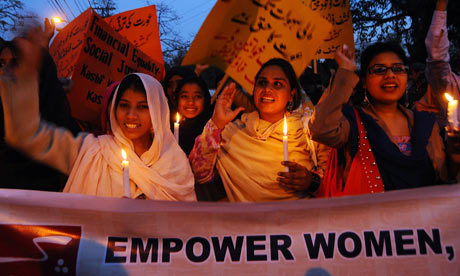
Pakistan: Women and peace-building

BY:Sanaullah Baloch
Daily Times


In historically evolved patriarchal tradition and tribal-based social structures, women’s role has been downplayed in decision making, which naturally resulted in gender disparity and systematic discrimination against women. Exclusion of women from the peace process directly discriminates against half of the population and deprives them of engagement in constructive political change and promotion of peace and love

Despite women’s crucial participation in political movements, their role occupancy in crucial areas of decision-making, regarding war and peace, has been neglected institutionally and by their male counterparts in many countries, and particularly in Pakistan.

The ‘dirty’ war in Balochistan, conflict in FATA, and targeted killings and ethnic unrest in Karachi are massively affecting helpless mothers and sisters — where their loved ones are caught in complex conflicts. Countless fathers, husbands and sons are ‘missing’, and ‘killed and dumped’ on roadsides. However, the women’s perspective and their crucial role in peace, stability and inclusive governance are entirely ignored. Endless military operations, internal displacement, disappearances, killings and insecurity has traumatised Baloch and Pashtun mothers, sisters and wives in conflict-stricken Balochistan, FATA and Khyber Pakhtunkhwa.

In all societies where war has lasted for decades, it is very important to identify the conditions of women and realise the role of women in peace building. No doubt, men and women both suffer from war and have ideas about how to build peace. However, women’s roles, resources, needs and priorities in times of conflict are different from those of men.

In historically evolved patriarchal tradition and tribal-based social structures, women’s role has been downplayed in decision making, which naturally resulted in gender disparity and systematic discrimination against women. Exclusion of women from the peace process directly discriminates against half of the population and deprives them of engagement in constructive political change and promotion of peace and love. In many war-torn societies/countries, women contributed significantly in peace-building. A strong women’s peace movement, The Women in Black, played a momentous role in the former Yugoslavia, rejecting violence and promoting peace. In West Africa, the Women in Peace-building Network played a positive role by promoting and including a peace agenda as the main focus of its work. Included in these great initiatives by women, the Indian-Kashmiri women belonging to different religious groups (Muslim, Hindu and Sikh) initiated plausible missions on development, trauma healing and reconciliation.

Moreover, during recent times, the role of women in making and shaping peace has been widely acknowledged. A number of international commitments outline women’s right to full involvement in political and economic decision-making, including numerous resolutions of the General Assembly, the Economic and Social Council, the Convention on the Elimination of All Forms of Discrimination Against Women (CEDAW), the 1995 Beijing Platform for Action and United Nations Security Council Resolution 1325 (2000) on women, peace and security.

Implementing these commitments would be a first step toward utilising all available resources to establish and sustain peace. Nevertheless, the role of women in peace making and peace building is crucial. Women often build a foundation and catalyse the peace process. They foster reconciliation and set an example for moving society forward. Women build ties among opposing factions and increase the inclusiveness, transparency and sustainability of the peace process. Women’s gender perspective and engagement in the peace process can lead to long-term advances for women’s equality. During times of intense conflict, in many traditional societies, women’s role as a facilitator and communicator has been widely recognised to facilitate in cessation of hostilities and initiate dialogues.

In Bosnia, Rwanda, Sri Lanka, Liberia, Northern Ireland and several other places women played an encouraging role in peace-building and highlighted the importance of moving women beyond the “humanitarian front of the story”. They have and can continue to influence peace building processes so that they go beyond defining peace as the absence of violent conflict and focus on the principles of inclusion, good governance and justice.

Despite the United Nations’ forceful support to the cause of gender mainstreaming including during a peace process, the obstacles to the implementation of Resolution 1325 are enormous. Recent studies on gender and armed conflict portray a very gloomy picture. Women’s efforts to represent themselves and their concerns in official peace negotiations pose significant challenges, despite the passage of 1325 mandating women’s participation. For instance, at the Arusha peace talks to end the civil war in Burundi, only two of the 126 delegates were women. Only two women served on the 15-member National Council of Timorese Resistance in East Timor. Only five women were in leadership positions in the UN mission to Kosovo, although women had forged the way for groups to cross ethnic barriers and rebuild fractured relationships. There were no Bosnian women at the 1995 Dayton peace negotiations to end the war in the former Yugoslavia, even though this conflict had affected women in a most devastating manner. In the last few years, women have held only a small proportion of seats at the peace negotiations in Cote d’Ivore, Liberia, Somalia, Sudan, Afghanistan and Iraq.

The genuine restructuring of society based on justice, equality and lasting peace requires not only the absence of violence or war but also the elimination of unjust social and economic relations, including unequal gender relations.

Putin’s win irks west

EDITORIAL:The Frontier Post

Vladimir Putin has won Russia’s presidential race and the squirming western gang is crying foul. The gang had in fact started screaming that the election would be rigged the moment Putin announced he would contest the poll. And now that he has romped home decisively the gang is shouting that yes it has been rigged. Indeed, US President Barack Obama has gone to the extent of demanding a probe into the poll rigging charges, although no such call was heard from the gang when George W. Bush clinched his first, disputed presidency from the Supreme Court amid charges of a defective ballot paper and the Black- Africans’ widespread complaints that they were prevented from exercising their right to vote in many a place.
But this has always been the way with the western gang that wants elections in foreign lands but only their stooges to be elected, and cry foul if they are not. Even as the international monitors, including the group headed by former US president Jimmy Carter, pronounced the 2006 Palestinian parliamentary election clean, the gang just refused to accept the outcome and its winner Hamas that scored a convincing victory. The gang wanted its rival Fatah to be in place. And so angry was it that in an outright insult to the Palestinian people’s verdict, it just refused to deal with Hamas and took to dirty tricks to prop up Fatah to take on Hamas that has led to an internecine conflict the wretched Palestinians are since struggling staggeringly to patch up.
The gang always wants clowns in foreign capitals playing to its tunes, which it cunningly terms as western values. But since his advent to power in 2000, Putin has demonstrated it conclusively that he is no pushover. While at home he put order and direction on the chaotic conditions prevalent when he took over and pressed his country’s gas and oil wealth to give an economic resurgence to his economically-distressed nation, abroad he asserted a renewed Russia’s clout maximally to the great chagrin of the western gang. Of course, the 12-year-long incumbency, including two presidential spells and one prime ministerial stint, has definitely nibbled into his public backing, as indeed it would in any western democracy, political reputes and public popularities being inherently no permanent fixtures but transient fluctuating phenomena.
His poll ratings that once stood at something like 70 percent have believably tumbled down to 40 percent or so. Still, his all the four challengers were no match to him. They all had very narrow support base, mainly constricted to their own ideological strands. Although the gang would have it believed that they were the only challengers “allowed” in the electoral arena. But the truth is something else. The Russian system is yet to throw up an impressive alternative leadership from within. And no charismatic leadership has still emerged from outside, too. Pluralism is easy to talk about glibly. But for it to happen is not so easy. It cannot be planted on a polity from above; it has to happen on its own dynamism. And it arguably will take Russia quite a time to come out of the shadows of the Soviet Union era’s centralism, and for its people to appreciate, value and practise pluralism.
Nonetheless, by every reckoning, Putin was a shoo-in right from the outset. His win was a forgone conclusion. It was only the gang wishing it otherwise. Indeed, the gang was after him since the December parliamentary contest, in which his United Russia party was a lead winner. Although he has distanced himself latterly from the party, its win drew protests from disgruntled poll contestants and their sympathisers, but which Putin asserts were incited actually by the western gang. His own triumph has sparked protest demonstrations, for which too he is pointing a finger at the gang.
Whatever it is, Putin too has to admit and recognise that in his people’s eye he is now not what he was 12 years ago. There has been a big diminishing in his public approval and he has a lot on his plate to do for refurbishing his public image and to accumulate his people’s goodwill to brighten up his chances for the next race in 2018, if he intends to run again. He had come in with great promises, many of which have gone down the drain, unfulfilled. And his biggest challenge is, ironically, the biggest feat of his incumbency: a burgeoning middle class. It is a huge class of well-educated, most-demanding and ambitiously-aspiring people, mostly young. And it is a fast-expanding class that not only demands opportunities to advance and prosper but civil and political liberties as well. He has to open up and be forthcoming to this budding class which is becoming powerful politically too.
His test will thus be the liberalisation of policies covering political activities, media and civil society, radical economic reforms for equitable distribution of national wealth, elimination of cronyism, favouritism and patronage, purging the administration of widespread corruption and sleaze, disciplining the state agencies and security apparatus, decentralisation of state power concentrated in Kremlin, and devolution of power to the provinces and regions. To be more acceptable to his people, he will have to take off his old hat of a no-nonsensical autocrat and wear new cap of a liberal reformist. The western gang, in any case, will keep going after him.

Masha Gessen Talks About the Reign of Vladimir Putin


By JOHN WILLIAMS

The journalist Masha Gessen is a citizen of both Russia — where she was born and now lives, in Moscow — and the United States. Her newest book, “The Man Without a Face: The Unlikely Rise of Vladimir Putin,” is a scathing account of Mr. Putin’s reign. Shortly after after the Russian elections on March 4, in which Mr. Putin won a contentious six-year term, Ms. Gessen discussed on e-mail his rise to power, the use and abuse of that power and the chances for change. Below are excerpts of the conversation.
“The Man Without a Face” by Masha Gessen
Q.

You write: “Possibly the most bizarre fact about Putin’s ascent to power is that the people who lifted him to the throne knew little more about him than you do.” Given how little they knew, why did so many think he could be the answer to the country’s political prayers?
A.

It is not unusual for humans to see what they want to see. In this case, Russians wanted to see a new, young, energetic, worldly leader. Outgoing president Boris Yeltsin had become an embarrassment to the country and a heartbreak to his former supporters. Putin was definitely not Yeltsin: He was indeed younger, he wore well-cut European suits and he did not have a drinking problem. And the vast majority of Russians, as well as the leaders of the Western world and Western media, chose to overlook everything else — like the fact that he was the K.G.B.’s flesh and blood.
Q.

Putin was born in Leningrad in 1952. What was it about the place and time of his upbringing, and his parents’ lives and beliefs, you think is most important in understanding him today?
A.

Here is a fact that Putin has hidden in plain sight: He was born into the K.G.B. His father had served in the secret police, and the boy was brought up dreaming of becoming a secret agent — which is what he became right out of college. As a result, there was virtually no record of his life before he was appointed prime minister of Russia in August 1999 — so he got to shape his own story. The story he chose to tell is that of a street tough, a scrappy, aggressive, vengeful little boy and, later, a man who has trouble controlling his temper or letting go of a fight.
Q.

You move through a catalog of disastrous events in recent Russian history — the bombings of apartment buildings, the quashing of political dissent, the death of journalists — and lay the blame for much of it at Putin’s feet. How much of this is concretely provable? And why is the conventional Western portrayal of Putin, though negative, not as thoroughly damning as yours?
A.

It’s the Catch-22 of closed systems like the one Putin has built: conclusive evidence should be obtained by law enforcement, but that is the last thing that is going to happen so long as Putin is in power. None of the murders or acts of terror that have occurred in the last 12 years have been properly investigated.

Still, there is at least one smoking gun, in the murder of former F.S.B. [Federal Security Service of the Russian Federation] agent Alexander Litvinenko, who died in London of polonium poisoning. That sort of polonium is produced only in Russia, and its release would have had to be approved at the highest level of the Russian government. And, finally, there is this: Putin has been running the country for the last 12 years, and for this reason alone he should be held personally responsible for the fact that dissenters are menaced, physically attacked and even killed on his watch.
Q.

What do you consider the most brazen thing Putin has done while in power?
A.

It is hard to choose, so I’ll go with the freshest insult: the mass violations during the March 4 presidential elections — the blatant ballot-stuffing, the throngs transported from precinct to precinct so they could vote repeatedly, and, finally, the tens of thousands bused in from the provinces to celebrate Putin’s victory while tens of thousands of armed police stood guard.
Q.

There were several moments when the political tide in recent Russian history threatened to change. Of all the developments there since the fall of the Soviet Union, what do you think was the best opportunity for change that slipped away?
A.

I think the greatest missed opportunity in recent Russian history predates Putin. In 1996, Yeltsin and his people, faced with a strong challenge by the communist Gennadi Zyuganov, panicked and rigged the election. It was child’s play compared with the kind of rigging that goes on now, but it sounded the death knell for Russian democracy. If Zyuganov had won in a fair and open election, Russia would have seen some rollbacks in policy, but nothing like what Putin began doing four years later.
Q.

News broke before the election that there had been a foiled plot to assassinate Putin. How does this fit in with the events chronicled in your book?
A.

The Russian blogs immediately filled with jokes about the plot: No one but no one seems to have believed the news. This is how cynical we as a people have become in the Putin era. Imagine there really was a plot: Putin would be the president who cried wolf.
Svenya GeneralovaMasha Gessen
Q.

The reviews of your book have called you brave and courageous. Do you feel safe living in Moscow? Do you think of leaving?
A.

I have thought of leaving, and I have even made plans to leave. The truth is, I don’t want to. I love my home, my friends, my job, my life. And if Putin doesn’t like me, he can leave.
Q.

“The Man Without a Face” ends with last December’s protests, and there are still peaceful protests continuing, but the picture your book paints is a grim one. How does the era of Putin give way to the world the protesters want? How does the Putin you portray allow for that change?
A.

The regime is in agony. Of course, this is not because Putin would consider giving in to the protesters or even, it seems, negotiating with them. But then, he is not the protests’ intended audience. The protesters address themselves — or, more accurately, we address ourselves — to other Russian citizens, who also want to live in a just and open society.

The Putin regime, like all such regimes, is a pyramid. And what the protests are doing is dismantling the bottom rungs of this pyramid. It happens when journalists on state-controlled TV sneak in accurate and sympathetic coverage of the protests. Or when the editor-in-chief of the Yaroslavl state television station writes an open letter to his boss, saying, “I am taking sick leave until after the election because the election is making me sick.” Or when officials from local election commissions in Samara and St. Petersburg come forward and tell the stories of their own parts in the vote-rigging in the December parliamentary election.

Soon — quite soon, I think — too many bricks will have come out of the bottom of the pyramid, and the whole edifice will collapse. This is not dissimilar to the way the Soviet Union ended, and the feeling in Moscow these days is reminiscent of that time. There is hope and there is fear, and the hope wanes occasionally but ultimately prevails.

Wednesday, March 7, 2012

International Women’s Day: Students highlight gender-based violence through drawings, paintings

The Express Tribune

Like other parts of the country, students in Swat valley also presented a colourful event to mark International Women’s Day to endorse women empowerment and create awareness about their rights.

The programme was held at Khushal School and College, during which students from various schools and colleges in Swat exhibited their talent through paintings and drawings on gender-based violence.

A quiz competition on gender violence was also held, while, ‘I am in journey’, a movie made by USAID, was screened during the event.

While talking to The Express Tribune, Sarwat Saleem, a ninth grade student at The Message School, said, “Our society is male dominating where boys are preferred over girls and resultantly they get better opportunities in education.”

“My painting aims to depict this sense of deprivation among women so the authorities can provide better facilities for girls in Swat,” she added.

Nida Akbar, a student of intermediate part II, said, “Women are subjected to physical and mental abuse both at home and elsewhere. Despite religious injunctions to the contrary, they aren’t given their right of inheritance by parents.

Malala Yousafzai, who excelled in the quiz competition, also highlighted the plight of women in Swat, adding that education is the only way for women to escape the clutches of violence.

“Women can only fight for their rights if they know exactly what their rights are. This is not possible if they remain illiterate,” said the 14-year-old, who has earned international fame and recognition for raising her voice against the Taliban.

The event was organised by Dehi Tariqiyati Social Welfare Council, in collaboration with the Aurat Foundation and Asia Foundation.

No unnecessary stay in Afghanistan


US President Barack Obama on Tuesday said the United States was committed to long-term ties with Afghanistan but did not want to keep troops there longer than needed to disable al Qaeda and ensure a modicum of stability as foreign forces withdraw.
“President (Hamid) Karzai understands we are interested in a strategic partnership with the Afghan people and the Afghan government,” Obama told reporters in a news conference.
“We are not interested in staying there any longer than is necessary to ensure that al Qaeda is not operating there and that there is sufficient stability that it doesn’t end up being a free-for-all after ISAF has left,” he said, referring to the NATO military force led by the US.
Obama spoke as the White House seeks to put behind it the spasm of violence that erupted when US soldiers burned copies of the holy Quran on a NATO military base last month - and the questions it has raised about US strategy.
“Yes, the situation with the Quran burning concerns me,” Obama said. “I think that it is an indication of the challenges in that environment and it’s an indication that now is the time for us to transition.”
NATO forces have begun to gradually put local police and soldiers in the lead for security. While the Afghan military is far larger and better equipped than it was, it will remain heavily reliant on outside help and funding for years to come. Obama said he was confident his plan could be carried out. “But it’s not going to be a smooth path,” he said. “There are going to be bumps along the road just as there were in Iraq.”
On Tuesday, Karzai’s government said it may soon reach an agreement with the Obama administration on US-managed detention centers, one of several sticking points that have held up conclusion of the agreement for months.
The White House has been hoping to wrap up the agreement before NATO leaders gather in Chicago in May. The United States now has around 90,000 soldiers in Afghanistan.

Waheeda Shah disqualified, re-polling ordered


Election Commission has disqualified Waheeda Shah from holding public office for two years.
The Chief Election Commissioner of Pakistan heard the case of Waheeda Shah on Tuesday and had reserved the verdict till today (March 7). On the other hand, Waheeda had sought unconditional apology, but it was turned down the matter being a state matter as declared by the Apex Court.
Waheeda has been declared ineligible for two years. The ECP has also decided to hold fresh elections in her constituency PS 57 Tando Muhammad Khan. Arrangements for re-polling would be made after further orders from the ECP.
EC member from Sindh had given dissenting vote, but the majority decision went against Waheeda Shah who had slapped polling staff.
On Monday, the provincial election commission completed enquiry report against Waheeda Shah and submitted the report to the Chief Election Commissioner of Pakistan.
Waheeda Shah had tortured Presiding Officer Habiba Memon and others during the polling of by-elections on February 25.
It is pertinent to mention here that presiding officer Habiba Memon had pardoned Waheeda Shah.

ANP not in the run for Senate deputy chairman’s office

THE NEWS

The Awami National Party (ANP) isn’t in the run for the position of the Deputy Chairman of the Senate despite being the third biggest party in the Upper House of Parliament, following a decision by the PPP-led ruling coalition that an ethnic Baloch from Balochistan would be given this office.

When approached by The News, ANP’s President for Khyber Pakhtunkhwa Senator Afrasiab Khattak said his party wasn’t pursuing the Senate Deputy Chairman’s position. “Actually, there was a consensus among the allied parties that the Deputy Chairman should be a Baloch from Balochistan. We have accepted this decision and would support it,” he added.

Earlier, there was speculation that the ANP would seek the Deputy Chairman’s office on the basis of its strong representation in the Senate. In the March 2 election for 54 Senate seats in the country, the ANP won six in its stronghold of Khyber Pakhtunkhwa and one in Balochistan.

The ANP now has 12 members in the Senate, placing it in the third position behind the PPP with 41 Senators and the PML-N with 14.The ANP could have made a claim for the Deputy Chairman’s position if its lone Senator from Balochistan was a Baloch. However, the party’s newly-elected Senator Daud Khan Achakzai is a Pashtun and, therefore, cannot be fielded to contest for the Deputy Chairman’s job.

The outgoing Deputy Chairman of the Senate, Jan Mohammad Jamali, is a Baloch. This was the only major elected office held by the Baloch in the federation of Pakistan. The Baloch as well as Balochistan don’t have much representation in the corridors of power, though the Supreme Court’s Chief Justice Iftikhar Mohammad Chaudhry has Balochistan’s domicile. His family was settled in Balochistan like many others from Punjab, Sindh and Khyber Pakhtunkhwa who did well in business, secured many government jobs and made strides in other walks of life.

The decision by the PPP-headed ruling coalition to appoint a Baloch as Deputy Chairman of Senate was motivated by the desire not to reduce the Baloch representation in the existing government set-up. The move was seen as an attempt to check further alienation of the Baloch people. Though it won’t satisfy the Baloch nationalists, the election of a Baloch Senator as the Deputy Chairman of the Upper House of Parliament would at least deny them a chance to blame the powers that be of further disempowering the Baloch.

The PPP as the biggest political party in the ruling coalition could name one of its top leaders from Balochistan and newly elected Senator Sardar Fateh Mohammad Hasni as Deputy Chairman of the Senate. Mohammad Yousaf Baloch and Nawabzada Saifullah Magsi, the two other new PPP Senators elected on general seats, are also ethnic Baloch.

Other newly elected Baloch Senators are Mir Israrullah Zehri of the BNP-Awami, his party colleague Naseema Ihsan and Robina Irfan of the PML-Q. Both the BNP-Awami and PML-Q are allies of the PPP. There are also some Balochs among the old members of the Senate and they too could be considered for the post of Deputy Chairman.

The Best Time For a Single Baloch Party

Editorialwww.thebalochhal.com

The Baloch leaders have demonstrated extraordinary courage, unity and consistency to deal with the over-reaction Islamabad has shown in the aftermath of the historic congressional hearing. While Balochs were a victim of an earlier war waged by the federal government, the episode was further joined by the country’s chauvinist media. Every effort was made to discredit the Baloch leaders and activists to undermine the significance of the hearing.

The lesson one had to learn was that the whole of Pakistan would take only a few minutes to unite against any move that seeks Baloch rights. Resolutions were passed against the hearing not only by the ruling party but also from the Pakistan Muslim League Nawaz which is, ironically, also engaged in a double game on Balochistan. After moving a resolution in the Punjab Assembly against a hearing that demanded an end to atrocities against the Baloch, the PML-N is left with no respect among the Baloch. To the Balochs, Chaudhary Nisar Ali Khan is to PML-N what Rehman Malik is to the PPP.

A recent meetings between Nawabzada Bramdagh Bugti and Hairbayar Marri is a highly positive and commendable move. These leaders should devise a strategy how they can end violence in Balochistan and rescue the rest of the young political activists. During their meeting, the two leaders debated an obscure Freedom Charter. Since we have not reached the point of declaring independence, a more important and urgent step is to stress upon the debate about Baloch unity among all key stakeholders.

During his life time Nawab Akbar Bugti had called for a single political party of the Baloch. His dream did not come true because of his tragic killing. If the whole of Pakistan can unite against the Baloch, why can’t the true leaders of Balochistan also unite on issues over which there is consensus? There has never been a time so good and so important for a single Baloch party than today. More time must not be wasted by the leaders to benefit from the rapidly changing situation in favor of the Baloch.

Seeing the madness and overreaction showed by the Pakistani leaders and journalists, Balochs have to take a deep breath and ask themselves, “Were we not overestimating Islamabad?”. The Pakistan establishment is indeed too weak, too reactive and miraculously apolitical in front of a genuine Baloch demand which is gaining widespread acceptance before the international democratic institutions.

We would urge the Baloch leaders to have mercy over the young men who are getting killed by the Pakistani agencies and security forces on regular basis. Therefore, they should forget most, if not all, personal differences. For the sake of a young generation of Balochs that has offered more sacrifices than what their leaders could ever expect, the older generation of the leaders should respet the wishes of the young generatiton of the Balochs. They should know nations rise only when they stand together.

Two key Baloch leaders, Hairbayar Marri and the Khan of Kalat still do not have political parties of their own. As they seek international support for the Baloch case, they must become more political in their organizational orientation. Mir. Suleman Dawood should stop calling himself His Highness or the King of Balochistan. A full generation of young Balochs did not sacrifice their lives to bring a king of an Islamic regime in Balochistan. There is no king in Balochistan nor does anyone want one. Therefore, the Khan of Kalat has to become more political and participatory with the rest of the leaders.Solo flights rash. Collective flights safely reach their destinations.

At this point, people say they are noticing a significant change in Sardar Akhtar Mengal’s stance who has gotten harsher by the time.

There are two ways forward: Firstly, it is unclear to what extent Hairbayar Marri and Bramdagh Bugti think the BNP has become committed enough to become an equal partner in their journey. If they think, they have reached at a point where they share the same demands and vision, they should go forward and form a single Baloch party. Secondly, if they think they would still wish to retain their individual status, the other option is to revive the Four Party Baloch National Alliance. While we can no longer describe the Jamori Watan Partya nationalist party, the Baloch Republican Party (BRP) can totally fill that vacuum. On his part, Hairbayar Marri can revive the Haq-e-Tawar Party which was the platform used by his late brother Balaach Marri until his death.The National Party still has to take a position whether it wants to join the group comprising of pro-self-determination school of thought or it just wishes to look like the BNP-Awami.

This is the right time and the opportunity to become one to face the tough challenges the current situation offers. We hope Hairbayar Marri, Akhtar Mengal and Bramdagh Bugti will not waste more time and decide what they have got to do about the future of Balochistan.

Pakistan Senate body recommends $500 tax on each NATO container


The Senate Standing Committee for Ports and Shipping on Tuesday recommended Federal Board of Revenue (FBR) to set $ 500 tax over each NATO and ISAF containers that land in Karachi Port.
The Committee advised that containers of NATO should be landed at Gwadar Port in place of Karachi so that Gwadar Port starts its operations.
The meeting of Standing Committee was presided by the Senator Gulshan Saeed in Parliament House in which the committee discussed the monetary loss due to the NATO and ISAF to Pakistan and the rush created due to the containers of NATO at Karachi Port.
The Committee informed that 1657 containers are present at Karachi Port Trust (KPT) since November last year, but their owner haven’t come yet. The committee ordered that there should be strict check over the ports so that no unnecessary items arrive to Pakistan.
The Committee recommended that containers of NATO and ISAF should be landed at Gwadar Port so that the Port becomes operational.
Talking about Gwadar Port, the Federal Minister for Ports and Shipping Babar Ghouri was of the view that the NATO containers supply to Afghanistan is very complicated via Gwadar Port because M8 has not been completed yet between Rato Dero and Gwadar. Because of the uncompleted M8 project, containers return to Karachi.
“If we ensure landing of NATO containers at Gwadar Port then U.S government will be compelled to give loan for the completion of M8 project”, Senator Tariq Azim said.
Representative of FBR Najib Abbas that they do not have any device to check the items inside a container without opening the container. He said that if the owners of 1657 containers that are present at KPT do not contact in three months, then those containers would be sold.

Afghanistan's teen brides who set themselves alight


Flayed by a fire she began herself, Aatifa's childlike frame is painstakingly wrapped in thick bandages -- her shrieks of "Allah" echoing around the hospital ward where surgeons prepare to graft skin back on to her skeletal torso.

Her wide blue eyes alternating between flashes of anger and wells of tears, the 16-year-old Afghan girl struggles to explain what led her to douse her own body in petrol, step outside and light a match.

Married at the age of 14, the young carpet-weaver, who has nine brothers and sisters, said her mother-in-law criticised her housework and encouraged her mechanic husband to beat her for allowing her mother to visit too often.

She complained to authorities but was berated for causing trouble. Later told that her husband hated her and would marry a second woman, she swung between anger and depression before carrying out her masochistic deed.

Aatifa poured petrol over her head and, once outside her home, lit the flames that engulfed two thirds of her body. Her brother found her and smothered her with his clothes before neighbours took her to hospital.

"I just wanted to kill myself, this was my goal," she said, her bone-thin arm etched with flaring purple burn scars. "What can I do? I'm not useful anymore. I want to get a divorce, it's better to stop everything."

Bound by early marriage into a life of domestic disharmony, dozens of girls like Aatifa in Afghanistan's sophisticated but conservative main western city of Herat are choosing a brutal form of escape by setting themselves on fire.

In the past one year alone, doctors at a burns unit at the city hospital have seen 83 cases of self-immolation, with nearly two-thirds proving fatal.

The disturbing phenomenon is considered to be a cultural import from neighbouring Iran. But feuding between poor and uneducated families who marry off their daughters as young teens is usually at the heart of the problem.

"Sometimes it's for very small reason they burn themselves, and most of them complain about the in-law's family," said chief of plastic and reconstructive surgery at the burns unit, Ghafar Khan Bawa.

"There's an accumulation of depression, stress and domestic violation and then the woman just seeks a way of getting out of the situation. A way of expressing their anger, a way of expressing their depression."

Police, tribal elders, Mullahs and courts all exist to resolve family disputes which are common within Afghanistan's impoverished and illiterate societies. But it is considered culturally taboo for a woman to complain.

"There's a defect in the system because a woman cannot complain here. And if they were not accepted before burning themselves, then how will they be accepted with disfigurement and deformities and disabilities?" added Bawa.

Sitting propped up on a pillow at home across town, 18-year-old Zarkhuna's occasional smile is largely concealed by an enveloping neck brace, while her body scarred by 65 percent burns is clothed in a black burqa and red blanket.

She said the family of her husband, a rickshaw driver, had seemed nice before marriage, but when his mother and sister moved into their family compound fighting erupted.

Now banned from seeing their 10-month-old baby since she set herself on fire four months ago, she said she hopes not to divorce, but for her near-fatal action to provoke a peace settlement between the families.

"My husband wasn't cruel to me. But my mother and sister-in-law were complaining all the time about my job -- they became jealous," she said.

"The mother and sister wanted me to be under their control not under my husband's. If he behaves nicely with me I will continue with him."

Her father has said she must not take the case to the authorities, but leave their fate to God's will.

"I leave those people to God. I just want them to pray for my daughter because they're also poor people and I didn't do anything against them because they're also poor," said her father, Khor Mohammad, moving prayer beads and wearing a thick white turban. "I don't think the government can help us."

Herati women's rights advocate Suraya Pakzad said that early marriage and family feuds commonly caused dangerous levels of stress for women in the home, with many too young to cope with the wifely roles expected of them.

"Maybe not all of them decide to die, it's just a warning for their family to stop, and they never thought fire would immediately go to all of their body," said the head of the Voice of Women's Organisation in Herat.

The organisation operates two shelters for women, although all cases must be referred through the government. Once they realise there could be other options for escape she said the self-harming teens all wish things could be different.

"Whenever we meet them and talk to them they say they really regret what they did."

Afghan president backs strict guidelines for women

www.cbsnews.com
Taliban horror against women
Afghanistan's president on Tuesday endorsed a "code of conduct" issued by an influential council of clerics that activists say represents a giant step backward for women's rights in the country.

President Hamid Karzai's Tuesday remarks backing the Ulema Council's document, which allows husbands to beat wives under certain circumstances and encourages segregation of the sexes, is seen as part of his outreach to insurgents like the Taliban.

Both the U.S. and Karzai hope that the Taliban can be brought into negotiations to end the country's decade-long war. But activists say they're worried that gains made by women since 2001 may be lost in the process.


When the Taliban ruled Afghanistan prior to the 2001 U.S. invasion, girls were banned from going to school and women had to wear burqas that covered them from head to toe. Women were not allowed to leave their homes without a male relative as an escort.

The "code of conduct" issued Friday by the Ulema Council as part of a longer statement on national political issues is cast as a set of guidelines that religious women should obey voluntarily, but activists are concerned it will herald a reversal of the trend in Afghanistan since 2001 to pass laws aimed at expanding women's rights.

Among the rules: Women should not travel without a male guardian and women should not mingle with strange men in places like schools, markets or offices. Beating one's wife is prohibited only if there is no "Shariah-compliant reason," it said, referring to the principles of Islamic law.

Asked about the code of conduct at a press conference in the capital, Karzai said it was in line with Islamic law and was written in consultation with Afghan women's groups. He did not name the groups that were consulted.

"The clerics' council of Afghanistan did not put any limitations on women," Karzai said, adding: "It is the Shariah law of all Muslims and all Afghans."

Karzai's public backing of the council's guidelines may be intended to make his own government more palatable to the Taliban, or he may simply be trying to keep on the good side of the Ulema Council, who could be valuable intermediaries in speaking to the insurgents.

But either way, women's activists say that Karzai's endorsement means that existing or planned laws aimed at protecting women's rights may be sacrificed for peace negotiations.

"It sends a really frightening message that women can expect to get sold out in this process," said Heather Barr, an Afghanistan researcher for New York-based Human Rights Watch.

Shukria Barikzai, a parliamentarian from the capital Kabul who has been active in women's issues, said she was worried that Karzai and the clerics' council appeared to be ignoring their country's own laws.

"When it comes to civil rights in Afghanistan, Karzai should respect the constitution," Barikzai said. The Afghan constitution provides equal rights for men and women.

The exception for certain types of beatings also appears to contradict Afghan law that prohibits spousal abuse. And the guidelines also promote rules on divorce that give women few rights, a real turnaround from pledges by Karzai to reform Afghan family law to make divorces more equitable, Barr said.

"This represents a significant change in his message on women's rights," she said.

Afghan women's rights activist Fatana Ishaq Gailani, founder of the Afghanistan Women's Council, said she feels like women's rights are being used as part of a political game.

"We want the correct Islam, not the Islam of politics," Gailani said. She said she supported negotiations with the Taliban, but that Afghanistan's women should not be sacrificed for that end.

Hadi Marifat of the Afghanistan Human Rights and Democracy Organization, which surveyed 5,000 Afghan women for a recent report on the state of women's rights in Afghanistan, argued that the statements show Karzai is shifting more toward the strictest interpretations of Shariah law.

"In the post-Taliban Afghanistan, the guiding principle of President Karzai regarding women's rights has been attracting funding from the international community on one hand, balanced against the need to get the support of the Ulema Council and other traditionalists on the other," Marifat said.

"The concerning thing is that now this balance is shifting toward the conservative element, and that was obvious in his statement."

Suspicion rises between Western advisers, Afghans


"Shoulder to shoulder" is the mantra of the NATO-Afghan military partnership. Now, after Afghan soldiers and police turned their guns on their foreign partners during outrage over the Quran burnings, even Western advisers — not just combat troops — are looking over their shoulders.

The deepening distrust is jeopardizing the U.S.-led coalition's strategy of training Afghan security forces and helping government workers so that international troops can go home.

The advisers do a variety of jobs. While some focus on the battlefield, others pore over geological surveys, lure outside investors or make sure that key mountain passes are clear of snow. They work closely with their Afghan counterparts to build a government strong enough to fend off threats and attacks from the Taliban and other militants trying to destabilize their country.

There has been lingering distrust for years. Afghan soldiers and police, or militants dressed in their uniforms, have shot and killed more than 75 U.S. and other coalition forces in Afghanistan since 2007.

But tensions soared Feb. 25 when two U.S. military advisers were found dead with gunshots to the back of the head inside the Afghan Ministry of Interior, one of the most heavily guarded buildings in the capital, Kabul.

The two were among six U.S. troops killed by Afghan security forces during a week of demonstrations over the burning of Islamic books and Qurans at a U.S. military base in eastern Afghanistan. President Barack Obama and U.S. military officials say the burnings were a mistake and not intentional.

Hours after the military advisers' bodies were found on the floor of their office, Gen. John Allen, the top commander of U.S. and NATO forces in Afghanistan, took the unprecedented step of recalling hundreds of coalition personnel working in more than two dozen government ministries in Kabul. He said the decision was made "for obvious force protection reasons." Britain, France, Germany and Canada quickly followed suit, putting much of the West's mentoring and advising work on hold.

"It's a declining relationship. It has been for years," said Martine van Bijlert, co-founder of the Afghan Analyst Network in Kabul. "You won't be able to fix that. The big question is 'Will it remain a workable relationship?' I think it's possible. It could settle down, but it won't fully settle down to the old level."

"These advisers are crucial, especially in the security sector when we're talking about transition," said Haroun Mir, director of Afghanistan's Center for Research and Policy Studies in Kabul. "Certainly the Afghan government can function without them, but if they don't return, it will take a toll on the financial situation of the government. Many of these projects financed by donors require the presence of these advisers."

Allen is determined to get the advisers back into the ministries as soon as possible — when he deems it is safe enough to do so, said U.S. Army Lt. Col. Jimmie Cummings, a coalition spokesman. The coalition has not disclosed the total number of advisers who work in the ministries.

Their work has not completely stopped, he said.

"Though they are not physically standing beside them, the advisers are still in daily communication with their Afghan counterparts, as Gen. Allen directed to keep the lines of communication open," Cummings said. "We are committed to our partnership with the government of Afghanistan. ... Tens of thousands of Afghan and coalition troops continue to effectively work together on significant missions every day."

A few dozen advisers critical to the mission have trickled back to work, but with additional security, Cummings said.

A senior Western adviser who oversees advisers in several ministries said that when they go back they probably will be required to wear body armor and travel in groups with armed escorts. The adviser said they also might have to get permission to visit the ministries, reducing day-to-day contact with their Afghan partners.

Some advisers, such as the ones involved in the Afghanistan-Pakistan Hands program, will balk at increased security, the adviser said. The U.S. established the program in September 2009 to create a team of military and civilian experts who could develop close working relationships with their Afghan and Pakistani counterparts.

Contractors who serve as advisers generally are not so eager to rush back to the ministries, and some told the adviser they are ready to head home.

The adviser and all others who spoke on condition of anonymity for this article did so because of increasing tensions in the NATO-Afghan relationship.

Restoring trust between Western advisers and their Afghan counterparts will be challenging.

"If an adviser gets killed and you're an adviser, it's going to be difficult," said Nadia Gerspacher, a senior program adviser for the United States Institute of Peace in Washington.

"Is it going to make people less trusting and feeling more insecure in the ministry? Probably," said Gerspacher, who has been in contact with advisers in Kabul since the killings.

An international security contractor said he could feel the tension when he visited an Interior Ministry office the day after the U.S. advisers were killed. Usually Afghan police there greet him with "Salamou Aleikom," meaning "Peace be with you." This time, 14 or 15 armed policemen standing in a hallway outside the office were silent, he said. The policemen asked an interpreter whether the Western contractor was American or British. He and a colleague soon left.

An Afghan National Police general at the Interior Ministry said he felt ashamed by the killings and would welcome the advisers back.

They are the teachers for Afghanistan's new system of providing security and if they don't return, the work being done to reform the unprofessional and corrupt policemen will collapse, said the general. A lot of work has been suspended since the killings, the general said.

Another official at the Interior Ministry said the Western advisers' morale had been shattered.

When two Western advisers visited his unit a few days ago, he tried to break the tension. Jokingly, he shook his finger at them, smiled and said: "You've been absent for four or five days. Your pay will be docked." He said that he has developed strong bonds with a few of the Western advisers and will consider them good friends forever.

Some ministries aren't so dependent on the advisers, according to an official at the Finance Ministry. He said the advisers were badly needed three or four years ago, but that the ministry was now staffed with talented, well-trained Afghan employees who no longer need the 20 to 25 well-paid Westerners who currently work there. The ministry could hire five Afghans with the salary paid to one Westerner, he said.

Avalanche blankets Afghan village, kills at least 37


At least 37 people died and hundreds were still trapped in northern Afghanistan on Tuesday when a snow avalanche covered an entire village near the northern border with Tajikistan, local officials said. Afghan army helicopters descended on the remote village in the north of Badakhshan province to try rescue families, the latest victims to Afghanistan's worse winter in 30 years. "The way to the village is closed, it is covered in snow," provincial governor spokesman Abdul Marof Rasikh said of the village of around 300 people, located in the Shikai district. Though avalanches are fairly common in the mountainous north, Tuesday's deaths were seen as particularly painful for a country that has experienced its worse winter in decades, killing dozens in the capital Kabul and creating further food shortages in one of the world's poorest countries. Before Tuesday, freezing cold and avalanches had claimed the lives of 60 people in Badakhshan province this winter, officials said.

Civil society in Peshawar demands ban on Difa-e-Pakistan Council

www.newspakistan.pk


Enough of senseless hate harboring; civil society in Peshawar demands ban on Difa-e-Pakistan Council
Fed up of listening baseless claims of defending Pakistan from those very people who have been supporting terrorism and suicide attacks in the country, the civil society in Peshawar took to
the street to demand a ban on the Difa-e-Pakistan Council.

Holding the stalwarts of the Council responsible for killings of over three million people, particularly Pashtuns, Idrees Kamal, the convener of the Aman Tehreek (Peace Movement) said, “Hamid Gul and his partners are responsible
for the massacre of three million people, in particular the Pashtuns.”

The next Difa-e-Pakistan rally has been announced on March 18 in Peshawar.

Condemning the Council’s history of always promoting chaos in the country, the speakers in the rally said, “Previously the council gathered under the name of Difa-e-Afghanistan and Islam, killing thousands of innocent people. Now
they have once again gathered to do so.”

Protestors were of the view that Chief Justice Iftikhar Muhammad Chaudhary, taking a suo moto notice, should impose a ban on the rally of the council. They also demanded the Chief Minister of Khyber Pakhtunkhwa to intervene and
not to allow the rally to happen in Peshawar.

Despite stringent security measures, a large number of people hailing from all walks of life participated in the rally.

China official sees militant links in Pakistan


China is facing a network of militants entrenched in neighbouring states, but authorities, especially in Pakistan, are trying to stamp out violence and protect China's interests, the governor of China's Xinjiang region said on Wednesday.
China has blamed incidents of violence in Xinjiang on Islamic separatists who want to establish an independent state called East Turkestan.
Some Chinese officials have blamed attacks on Muslim militants trained in Pakistan, though China's Foreign Ministry has refrained from public criticism of Pakistan.
Xinjiang's governor, however, was more explicit.
"We have certainly discovered that East Turkestan activists and terrorists in our neighbouring states have a thousand and one links," Nur Bekri said on the sidelines of China's annual meeting of parliament, when asked about a Pakistan connection with attacks in Xinjiang.
"But officials, especially in Pakistan, have said over and over again they oppose any violent activities directed against China and will maintain China's national sovereignty and core interests," he said.
Both Chinese and Pakistani officials have in the past said that the militants based in western China have ties to the Pakistani Taliban and other militants in northwestern Pakistani regions along the Afghan border.
Officials in Kashgar, a city in south Xinjiang, said a stabbing attack there in late July was orchestrated by members of the separatist East Turkestan Islamic Movement who trained in Pakistan before returning to China.
Bekri said he was assured of Pakistani support in the campaign against militancy.
"China and Pakistan are indeed all-weather friends. This is the basis founded by the previous generations of leaders," Bekri said.
Pakistan and China have long been allies but Pakistan has leaned closer to China after its tense relationship with the United States, its major donor, was strained in May when US forces killed Osama bin Laden in Pakistan where he appears to have hidden for several years.
China sees Xinjiang as a bulwark against the predominantly Muslim countries of central Asia. The region, with a sixth of the country's land mass, is also rich in natural resources, including oil, coal and gas.
The Muslim Uighur people account for just over 40 percent of the region's 21 million population. Many chafe at government controls on their culture and religion.
Last week, the government said attackers wielding knives killed 13 people in a remote southern part of Xinjiang before police shot seven of them dead.
Exiled Uighur groups and human rights activists say China overstates the threat posed by militants in Xinjiang, which sits astride south and central Asia.

Sharif Brothers of Raiwind and the Chaudhrys of Gujarat :Their comedy show


Interestingly, the Sharif Brothers of Raiwind and the Chaudhrys of Gujarat are nowadays enacting a ludicrous comedy show, which is quite funny not just for its hilarity but no lesser for its absurdity. Scripted on their pasts that are no splendid but more or less ugly, they are accusing one another of being hypocrites and the military rulers’ erstwhile sidekicks. And while the Sharifs are debunking the Chaudhrys for snuggling up in Pervez Musharraf’s praetorian lap, the Chaudhrys in turn are reminding the Sharifs not to forget that they themselves were the garrison hatcheries’ cloned babies and dictator Ziaul Haq’s blue-eyed boys. Both may be thinking with their tirades they are making a mark with the street against one another.
But in reality their matinee comedy show is highlighting yet more poignantly this nation’s colossal tragedy. It needs leaders. Instead, it has petty operators and manipulators. At this point in time of its dire predicament, it essentially requires giant statesmen of tremendous vision, farsightedness, wisdom and maturity. Instead, in the field are dwarfs who are no politicians either and intellectually so barren that they cannot see even beyond their noses. Mediocre they are congenitally, but great pretenders they are compulsively. They are just incapable of seeing through the thickness of stupendous problems confronting the nation and coming to grips with their enormities. No wonder, they throw in populist recipes where hard-thought measures are needed necessarily.
What else could it be that the Sharif Brothers are shouting noisily in these days that by gifting laptops to hundreds of thousands “lucky” students they are spawning an educational revolution in their domain of Punjab? What lunacy of thought could be greater than this when they will be blowing away tens of billions of rupees of the taxpayer’s precious money on this foolish pork barrel? This huge dough they could have spent well by giving science teachers and science laboratories to government schools, a huge lot of which is bereft of this indispensable facility even in urban centres, leave alone the countryside where the state-run schools by and large know of no science teaching at all.
Indeed, the two brothers, who seem to have given themselves to the exulting belief that they are innately administrators par excellence with no peers among the present crop of politicos to rival them in this skill, have not the foggiest of idea what a gigantic mess of education has become on their domain and how much of innovative and creative ideas and painstaking labours are needed to clear this up?
Not that the Chaudhrys are any better. On their watch, they too had burnt away billions of rupees just on an image-building media campaign under the cover of a spurious literacy motivation drive. They had promised a para likha punjab. They departed leaving it as uneducated and illiterate as it was when they had walked in. And if for an inherently political errand the Sharifs are remorselessly playing shifty with the taxpayer’s money, the Chaudhrys did the same to the same end with no compunctions to the Work Bank’s money it had loaned out to improve the schooling in Punjab.
The people are least pushed about if the Chaudhrys were a dictator’s buddies or the Sharifs the praetorian generals’ chums. Whatever masks the present crop of the politicos may don, they can’t deceive our people, who know for a fact that most of these luminaries have been the generals’ sidekicks in one way or the other and the net beneficiaries of the garrisons’ generosities. The people know they all are chips of the same block. But they expect them to at least do something to ameliorate their miserable conditions a little bit to make their miserable lives a bit livable.
Certainly, the Chaudhrys will be cutting a very cruel joke with the denizens of Punjab if they insist on their watch they had transformed it into a model of progress and prosperity, although, candidly speaking, they did undertake quite a lot of development work. And the Sharifs only grate on the Punjab residents’ minds unbearably with their shrill incessant chiming that they are working feats on their domain in the service of the public. Works speak for themselves; they need no media whiz kids or media managements to tell of them. People feel them in their daily lives and need no media managers to know of this.
And if the people’s own experiences are any tellers, they feel no betterment in their lots. It is the same, even worse, than what it was when the Chaudhrys were at the helm in Punjab. It is not just the monumental mess on the education plateau that mocks scornfully at the Sharifs’ tall claims. Everything there is in a mess, be it healthcare, public services, administration, development or law and order. People see only a change, not for the better, but for the worse.
Perhaps, the Sharifs would do well to change their discourse, and talk less of praetorian loyalties, where they stand on a very weak wicket, and talk more why are they failing to deliver where they should have to show themselves better than the Chaudhrys. The Chaudhrys can afford to talk loose as they are not in rule, not even in the centre where they not in a lead role. The Sharifs have a lot of explaining to do for their nonperformance. The Chaudhrys are not so pathetically placed.

Pakistan: Post-Senate elections scenario

EDITORIAL:Daily Times

In its first meeting after success in the Senate elections, the PPP’s core committee first had in-house discussions on a host of political issues, but its main concentration was on the candidates for Chairman and Deputy Chairman Senate. The PPP leadership then had consultations with its allies. The media carried a report yesterday that PPP Senator and Leader of the House Nayyar Bokhari had been named as Chairman Senate to replace Farooq Naik. The latter will, as part of an anticipated cabinet reshuffle, probably be reappointed Law Minister. The Deputy Chairman slot will likely go to one of the PPP’s coalition partners. It has been a tradition that the Deputy Chairman is usually taken from Balochistan, but after outgoing Deputy Chairman Jan Jamali opted to return to his home base, possibly in anticipation of running for a seat in the general elections, it remains to be seen whether the tradition will remain intact. The negotiations and consultations over the Senate Chairman and Deputy Chairman and a possible reshuffle of the cabinet that might see changes in faces as well as portfolios reflect an attempt to take account of the changes that have occurred after the recent by-polls and the Senate elections, in both of which the PPP and its allies feel electorally vindicated. The air of uncertainty that had dogged the footsteps of this government since it came to power four years ago seems to have dissipated and this boost is reflected in the reports yesterday that President Asif Ali Zardari has suggested to the PPP and its coalition allies that the general elections should be scheduled for March 2013. The coalition allies did not seem to have any objection and reiterated their solidarity with the PPP. The move makes sense from the ruling coalition’s point of view since it ensures that their five year tenure is completed and garners for them the advantages (and some might argue disadvantages) of incumbency.

The fact that the present dispensation has managed the second Senate elections since it came to power goes to the credit of the government and is an indicator that however haltingly and contradictorily, the democratic system restored in 2008 is consolidating itself. The wisdom seems to have sunk in generally, but most importantly in the minds of our security establishment, that the advantages of democracy far outweigh its blemishes and certainly trump any extra-constitutional praetorian dispensation. Our history is witness to that. Every military regime in our chequered history has proved a disaster waiting to happen, a disaster that subsequent elected governments then have to deal with as a legacy. The fifth presidential address to parliament is now also on the cards after the Senate is reconstituted by March 12.

The only remaining anomalies in an otherwise smooth Senate electoral process are the loss of what was considered a sure shot seat by the PPP in Punjab and the controversy over the Balochistan Senate elections. The party has set up a committee headed by Faryal Talpur to investigate the Punjab seat loss issue and report back within a day or two. As far as the Balochistan Senate elections are concerned, the suspended result that emanated from complaints about the procedural aspects of the election has yet to find resolution. The result of the election was withheld by the Balochistan election commission pending a recount in Islamabad. The provincial election commission announced the upholding of the original results, according to it after a recount. However, this is disputed by the aggrieved party, the PML-N, whose case is that a wrong tick on one of the ballot papers by one of its members was rejected while a similar mistake by a PPP member was accepted. They have vowed to appeal the decision to the Election Commissioner first and if they do not find satisfaction there, the Supreme Court. These anomalies do need to be sorted out in the interests of fairness and justice, but they will not have any material effect on the shape and configuration of the new upper house.

Over half of Americans back Obama’s apology to Afghans

DAILY TIMES

More than half of Americans support US President Barack Obama’s apology for NATO troops burning copies of the holy Quran, an incident that triggered a spate of bloody protests and attacks on US soldiers in Afghanistan. In a Reuters/Ipsos poll released on Monday, 56 percent of those surveyed backed Obama, who has been criticised by US Republican presidential candidates for apologising to Afghan President Hamid Karzai, while 23 percent disagreed. While the spasm of violence that erupted following the incident on a NATO base in Afghanistan does not appear to have significantly altered Americans’ perspective on the war, 66 percent of those polled also said Washington should bring its troops home immediately. The poll, conducted from March 2 to March 5, showed that far more Democrats supported Obama’s apology, with 76 percent of them saying he made the right decision. Only 37 percent of Republicans backed the apology, and almost half said Obama was not right to do so. Some 53 percent of independents supported the apology. The poll included 1,143 Americans interviewed online. The poll had a credibility interval of 3.4 percentage points. reuters

Obama: 'Window of opportunity' with Iran

Books of revelation: From old textbooks, we learn how much we didn’t know

The Washington Post

Last week, history geeks drooled over a news break — inasmuch as 20,000-year-old “news” can “break” — claiming that the Americas’ first inhabitants were not Siberians who wandered across a land bridge to Alaska, but rather Solutreans who paddled across the Atlantic Ocean. A number of archaeologists say that stone tools found near the Chesapeake Bay suggest a westward, rather than southward and eastward, expansion.

It’s just one theory, and a contested one — in the news mostly because of a new book by its proponents. Still. Couldn’t this completely bung things up?

For decades, grade-school students have prepared for tests by reminding themselves that early peoples migrated straight across the Bering Strait. It was nearly as useful a mnemonic device as the one used to remember the nine planets: My Very Eager Mother Just Served Us Nine Pizzas. Except, of course, scientists have taken away Pluto. And My Very Eager Mother Just Served Us Noodles does not have the same appeal.

“When [Pluto] happened, it was really hot news to our science team,” says Lisa Carmona, a vice president in editorial at McGraw-Hill. “A lot of people were really whipped up about that. . . . This is what gets them up in the morning.”

Ever since the common school movement of the early 19th century began encouraging set curricula and standard readings, textbooks have been considered symbols of absolute knowledge. But science marches onward, social analysis moves forward and textbooks end up being not definitive records, but rather historical artifacts. Years after editions have expired, the biggest thing we learn from old books is exactly how much we didn’t know.

The typical human temperature is not 98.6 degrees. Continental drift is not hogwash — although the theory has been refined as plate tectonics. Almost everything Freud said is hooey, and until 30 years ago, no one knew that a large rock from outer space took out the dinosaurs (some people still debate it).

“There’s so much knowledge, and it’s growing all the time,” says Joy Hakim, whose science and history books have won educational awards. “We’re in the information age, and you can’t keep up with all the information.”

When she was researching “The Story of Science: Einstein Adds a New Dimension,” first published in 2007, “there were a few dozen planets that we were talking about,” Hakim says. “Now every 10 minutes, we’re discovering a new planet.”

“Or take the Human Genome Project,” says Sam Kean, a science writer whose coming book chronicles the exploration of humans’ genetic code. “If you go to any textbook up until the project got going, it will say that humans have 100,000 genes — even up to 150,000. That was an overestimate.” A big one. We have about 22,000. Pre-Human Genome Project, scientists had estimated our genetic code based on what we knew about other species’ genes. Because humans were vastly intellectually superior to other organisms, it stood to reason that we’d have more genes. But we have fewer. Fewer even than grapes.

Scientific revelation and a blow to the collective human ego.

There’s the added complication that, in researching material for textbooks, authors often turn to previous textbooks. This is how, for example, celebrators in 1992 preparing for the 500th anniversary of Christopher Columbus’s voyage came to be grappling with the Columbus-as-discoverer narrative assembled for the 400th anniversary in 1892. Historians now often cite the explorer for launching “the Columbian exchange” — a swapping of flora, fauna, people and communicable diseases between the Eastern and Western hemispheres — rather than “discovering” America.

The pesky trouble with official records is that sorting out history is a historically messy business. Books can have only so many pages — and while supplemental information can appear online, print real estate is prime. Should the Pluto formerly known as a planet receive the same consideration it did when it was one of the nine? Should the Columbus formerly known as the discoverer have a prominent place in modern teachings? And should we teach that we used to teach those things?

“Traditionally, textbooks are uncomfortable with not knowing the right answer,” says Jim Loewen, who pored over more than a dozen history textbooks to write “Lies My Teacher Told Me.” “But history is alive with controversy. It might be about dead things, but it’s alive with controversy.”

If debates occur even over facts that seem cut and dried — either Pluto is a planet or it’s not — then other subjects get even messier. Last year, the Virginia Board of Education had to review and reissue a state history textbookbecause it controversially asserted that thousands of black soldiers had fought for the Confederacy in the Civil War. Most historians disputed that.

“It starts out as a conversation,” says Luess Sampson-Lizotte, who oversees product development for K-12 students at Pearson, about how her editorial staff adjusts content to reflect new discoveries. Pearson’s current textbooks lay out the Bering Strait scenarios, although its high school texts mention that there are other theories afloat. Scholars and educators are constantly monitoring revelations, debating which ones are worth putting on the page.

After all, for a long time, “we thought the Earth was the center of the universe,” Hakim says. “Very serious thinkers believed that. And they were wrong.”

Super Tuesday !

EDITORIAL


Long before Super Tuesday, the Republican Party had cemented itself on the distant right of American politics, with a primary campaign that has been relentlessly nasty, divisive and vapid. Barbara Bush, the former first lady, was so repelled that on Tuesday she called it the worst she’d ever seen. We feel the same way.

This country has serious economic problems and profound national security challenges. But the Republican candidates are so deep in the trenches of cultural and religious warfare that they aren’t offering any solutions.

The results Tuesday night did not settle the race. Republican voters will have to go on for some time choosing between a candidate, Mitt Romney, who stands for nothing except country-club capitalism, and a candidate, Rick Santorum, so blinkered by his ideology that it’s hard to imagine him considering any alternative ideas or listening to any dissenting voice.

There are differences. Mr. Santorum is usually more extreme in his statements than Mr. Romney, especially in his intolerance of gay and lesbian Americans and his belief that religion — his religion — should define policy and politics. Mr. Santorum’s remark about wanting to vomit when he reread John F. Kennedy’s remarkable speech in 1960 about the separation of church and state is one of the lowest points of modern-day electoral politics.

Mr. Romney has been slightly more temperate. But, in his desperation to prove himself to the ultraright, he has joined in the attacks on same-sex marriage, abortion and even birth control. He has never called Mr. Santorum on his more bigoted rants. Neither politician is offering hard-hit American workers anything beyond long discredited trickle-down economics, more tax cuts for the rich, a weakening of the social safety net and more of the deregulation that nearly crashed the system in 2008.

There is also no space between Mr. Romney and Mr. Santorum in the way they distort reality to attack Mr. Obama for everything he says, no matter how sensible, and oppose everything he wants, no matter how necessary. Rising gas prices? Blame the president’s sound environmental policies. Never mind that oil prices are set on world markets and driven up by soaring demand in China and Middle East unrest.

They also have peddled the canard that the president is weak on foreign policy. Mr. Romney on Tuesday called President Obama “America’s most feckless president since Carter.” Never mind that Mr. Obama ordered the successful raid to kill Osama bin Laden and has pummeled Taliban and Al Qaeda leaders, all without the Republicans’ noxious dead-or-alive swagger. Now, for the sake of scoring political points, Mr. Romney, Mr. Santorum and Newt Gingrich, who is hanging on only thanks to one backer’s millions, seem determined to push Israel toward a reckless attack on Iran.

Republican politicians have pursued their assault on Mr. Obama, the left and any American who disagrees with them for years now. There are finally signs that they may pay a price for the casual cruelty with which they attack whole segments of society. Senator Lisa Murkowski, a Republican of Alaska, said on Tuesday that the Republicans have left people thinking they are at war with women. Women are right to think that.

A new Pew Research poll shows that 3 in 10 voters say their opinion of the Republicans has worsened during the primaries. Among Democrats, 49 percent said watching the primaries have made them more likely to vote for Mr. Obama. That is up from 36 percent in December, which shows that Mr. Obama has risen as the Republicans have fallen.

But the president, who can be frustratingly inert at times, still has a long way to go.

I'm the president.....Obama demands his say on GOP's big day

With that stance, President Barack Obama did more than try to inject himself into Super Tuesday, the biggest Republican voting day so far. He tried to own it.

Putting the power of incumbency on display, Obama used his first news conference of the year to admonish his Republican rivals, most bitingly by accusing them of being casual about war and American lives.

While the candidates are "popping off" about war with Iran, Obama said he is the one who absorbs the costs of troops wounded or killed in battle.

"Those folks don't have a lot of responsibilities," Obama said of the Republicans campaigning for his job. "They're not commander in chief."

And so it went, topic by topic, throughout a scene that the White House tried to suggest was not about stealing some attention from Republicans. Obama officials insisted it was just a good day to get the president out for a full questioning for the first time since a sunset news conference in Hawaii back in November.

Eager to remain the president and not the candidate, Obama often says there will be a time for politics this year. Yes, like now.

It came up right away, of course, that voters in 10 states were going to the polls to help pick his November competitor.

Because Obama brought it up.

"I understand there are some political contests going on tonight," he said with a wry grin upon entering the White House briefing room.

There are days when Obama waves off re-election questions as premature. This was not one of them.

Consider:

_ Obama led off by offering ideas to help struggling homeowners, and finished his thought by saying: "I'm not one of those people who believe that we should sit by and wait for the housing market to hit bottom." That was a direct shot at presidential candidate Mitt Romney and his comments on the foreclosure crisis.

_ Obama, in fielding questions about keeping Iran from getting a nuclear bomb, hardened his position in intensely domestic political terms. He called out Republicans for making big threats and "beating the drums of war." He scoffed at them for ultimately, in his view, spelling out a playbook for Iran that mirrors his.

"If some of these folks think that it's time to launch a war, they should say so, and they should explain to the American people exactly why they would do that and what the consequences would be," Obama said. "Everything else is just talk."

He offered himself as the one who thinks through war, not the one who rushes the nation into a mistake. The implication about his competitors was clear.

_ Obama was pressed on whether he actually wants higher gasoline prices as a way to promote alternative fuels, a charge made by Newt Gingrich, one of the Republican presidential candidates. Obama jumped in to offer his political analysis on that one.

"Do you think the president of the United States, going into re-election, wants gas prices to go up higher?" Obama said. "Is there anybody who thinks that makes a lot of sense? I want gas prices lower because they hurt families."

_ Obama positioned himself as a voice of civility and — to a nation of voting parents — maturity in the debate over whether health insurance plans should cover contraception. He said he called Sandra Fluke, the woman called a "slut" by radio host Rush Limbaugh, with his own two young daughters in mind. There's a way to debate, Obama said, that doesn't involve being demeaned.

It wasn't long before another reporter had him talking about the race for the women's vote in general.

"I believe that Democrats have a better story to tell women," Obama said. He then repeated his re-election pitch about fairness for the middle class.

_ Obama, confident all the while, looked like the guy who cannot wait to get into a one-on-one fight with a Republican nominee. He has expected it to be Romney all along.

When asked what he had to say to Romney, who has accused him of being feckless, a smiling Obama said: "Good luck tonight."

The president ended the news conference on his terms, with more reminders of his incumbent powers.

Yes, he's eager to bring the leaders of the G-8 nations to the presidential retreat at Camp David in Maryland. And, yes, as commander in chief, he knows there will be troubles as the American-led war in Afghanistan winds down, just as there were in Iraq.

"None of this stuff is ever easy," Obama said. "It never has been."

Before long, the attention shifted back to the Republicans and their big night. But Obama had succeeded in dominating much of the news cycle.

On Wednesday, he's off to promote his agenda in Charlotte, N.C. That just happens to be the site of this summer's Democratic National Convention.

Super Tuesday’s ‘super calm’: Obama quelling ‘drums of war’


US President Barack Obama has dismissed calls from a senior Republican senator to start bombing Syria, saying that President Assad will leave anyway. He also called for a sober approach to dealing with Tehran's nuclear program.Talking at a "Super Tuesday" press conference in the White House, Obama has basically acknowledged that not every issue can be resolved by deploying the military – as one only has to look at the consequences of such actions.

Tuesday, March 6, 2012

Veena Malik gets 71,000 entries on ‘Swayamvar’

www.newspakistan.pk


The Pakistani controversial queen, Veena Malik, is gearing up for ‘Swayamvar’ Season 4 – Veena Ka Vivaah and the actress has already set a record of sorts by garnering the maximum number of entries on the reality show, which comes on Imagine TV.

Previously India’s very own item girl, Rakhi Sawant, was also brought on the show but she could only attract 30,000 males whereas the likes Rahul Mahajan and Ratan Rajput gathered 43,000 and 54,000 entries respectively. However, Veena, who rose to fame during her stint in the Bigg Boss Season 4, has shocked everyone including the show makers by collecting 71,240 entries.


The Pakistani beauty believes the main reason behind so many entries is that people like Pakistani girls because of their tradition and culture.

Veena Malik is one of the most controversial actresses in the country, as she has always locked headlines for wrong reasons. Perhaps this is a reason why she is especially excited to see the Indian applications.


Veena said, “I am overwhelmed by the response, but was thrilled that the maximum number of entries were from India.”

“I knew that guys serious about getting married would send in their profiles, but over 71,000 is a number beyond my expectations. And though I was expecting entries from the UK, US, India and Pakistan, I found it surprising to see a large number of entries from Poland,” Veena said.

“I think Pakistani and Indian girls are famous for their beauty, family values and tradition, which is why even guys from Poland are interested,” she added.

Veena Malik will get Rs. 3 crore for being on the show and she will receive another 1.5 crore, if she gets married and when asked the actress revealed that she is seriously looking forward to the candidates.

She remarked, “I want to grow old with my husband. I want a soul mate.”

Veena will also be seen on the big screen in India on May, 2012 in Hemant Madhukar’s much-anticipated upcoming 3D horror film ‘Mumbai 125 Km’. She is participating in three more movies as well, ‘Zindagi 50-50’, ‘All U Need… LOVE’ and ‘Mr. Money’.

Asma warns agencies to mend ways

PAKISTAN TODAY

Former Supreme Court Bar Association (SCBA) president and renowned human rights activist Asma Jahangir on Tuesday warned that if the armed forces and its secret agencies failed to mend their ways, then nobody could avoid breaking away of Balochistan. Discussing the Balochistan issue, she said that if missing persons were involved in terrorist activities, they should be presented in courts. She expressed concerns over the missing persons’ cases saying that after the Musharraf regime, such cases had decreased but the situation was still worse in the province.

Afghan, Pakistani Among U.S. 'Women Of Courage' Award Winners

Radio Free Europe/Radio Liberty

The U.S. State Department has included an Afghan provincial council member and a Pakistani rights activist among the honorees for 2012 International Women Of Courage Awards.

Maryam Durani, described as "a leader and a role model for women throughout Afghanistan" and a member of Kandahar’s Provincial Council, directs a nonprofit women's cultural organization and owns and manages a local radio station focusing on women's issues.

Pakistan's Shad Begum founded the Union of Women’s Welfare, which provides political training, microcredit, education, and health services to women in the ultraconservative district of Dir, in Khyber Pakhtunkhwa Province.

Begum has been elected to local posts and continues to work despite calls for suicide attacks against her by extremists.

Other recipients of this year's award include women from Burma, Libya, and Saudi Arabia.

Two rockets fired at a house in Peshawar

The Express Tribune

Security in and around Peshawar continues to have cracks after a house was damaged by two rocket.

Locals told The Express Tribune that two rockets had struck a house of Hashim Ali in Mohalla Cheena, Hazarkhwani village, within the jurisdiction of Yakatot Police Station.

“The rockets exploded after hitting the building, creating widespread panic in the area but luckily there was no loss of life and the damage to the building is also very nominal,” eye witnesses added.

Police said that they were investigating the attack, however, they believed that this was a case of personal enmity rather than a terrorist attack.

Pakistani Hindus seek safety in India

DAWN.COM

Preetam Das is a good doctor with a hospital job and a thriving private clinic, yet all he thinks about is leaving Pakistan, terrified about a rise in killings and kidnappings targeting Hindus.

A successful professional, he lives in mega city Karachi with his wife and two children, but comes from Kashmore, a district in the north of Pakistan’s southern province of Sindh.

His family has lived there for centuries and in 1947 when the sub-continent split between India, a majority Hindu state, and Pakistan, a homeland for Muslims, Das’ grandparents chose to stay with the Muslims.

They fervently believed the promise of Pakistan’s founder Muhammad Ali Jinnah that religious minorities would be protected. Sixty years later, their grandson says life in Kashmore has become unbearable.

“The situation is getting worse every day,” he says.

Two of his uncles have been kidnapped and affluent Hindus are at particular risk from abduction gangs looking for ransom, he says.

Rights activists say the climate is indicative of progressive Islamisation over the last 30 years that has fuelled an increasing lack of tolerance to religious minorities, too often considered second class citizens.

Das says the only thing keeping him in Pakistan is his mother.

“She has flatly refused to migrate, which hinders my plans. I can’t go without her,” he said.

Hindus make up 2.5 per cent of the 174 million people living in the nuclear-armed Muslim nation. Over 90 per cent live in Sindh, where they are generally wealthy and enterprising, making them easy prey for criminal gangs.

An official at the ministry of external affairs in New Delhi who declined to be named said: “Every month about eight to 10 Hindu families migrate from Pakistan. Most of them are well-off.”

He had no comment on whether the number was on the rise, but Hindu community groups in Pakistan say more people are leaving because of kidnappings, killings and even forced conversions of girls to Islam.

“Two of my brothers have migrated to India and an uncle to the UAE,” said Jay Ram, a farmer in Sindh’s northern district of Ghotki.

“It’s becoming too difficult to live here. Sindhis are the most tolerant community in the country vis-a-vis religious harmony, but deteriorating law and order is forcing them to move unwillingly,” he added.

Ramesh Kumar Vankwani, chief of the Pakistan Hindu Council and a former lawmaker for Sindh province, said Hindus are picked on by kidnappers and that their daughters are subject to forced conversions to Islam.

“Every now and then we get reports of families migrating. It’s getting worse now. People are extremely harassed and are forced to leave their homeland but our rulers are shamelessly idle,” he told AFP.

Rights activists also say Hindus in Sindh are discriminated against.

“Recently 37 members of five Hindu families migrated to India from Thul town owing to discrimination while three Hindus, including a doctor, were murdered in Shikarpur district,” said Rubab Jafri, who heads Sindh’s Human Rights Forum.

“Lots of violent incidents are happening daily. Most go unreported, which shows vested interests are trying to force Hindus to leave Pakistan.”

According to the Pakistan Hindu Seva, a community welfare organisation, at least 10 families have migrated from Sindh every month since 2008, mostly to India, but in the last 10 months, 400 families have left.

Another survey last year by the local Scheduled Caste Rights Movement said more than 80 percent of Hindu families complained that Muslims discriminated against them by using different utensils when serving them at food stalls.

“Hindu migration is a brain-drain for Pakistan as most of them are doctors, engineers, agriculturists, businessmen and intellectuals,” Jafri said.

But the provincial authorities are reluctant to recognise a problem.

“I do admit that law and order in some districts of Sindh is quite bad, but it is bad for everyone and not just my community, the Hindus,” Mukesh Kumar Chawla, provincial minister for excise and taxation, told AFP.

“Hindus do not migrate in flocks as has been claimed and those who migrate are going abroad for a better fortune,” he said.

Muzaffargarh horror: Pakistani woman being disrobed and paraded in public


EDITORIAL

YET another story of a Pakistani woman being disrobed and paraded in public in retaliation for what was perceived as a slight to someone else’s honour is a reminder about two facts of life here. One, that women are used as pawns and victims in disputes that have nothing to do with them. And second, that political influence and police negligence, often related, enable attackers to carry out these acts of sexual abuse and violence. Tortured, robbed, stripped, paraded and kidnapped, the woman was victimised in order to seek revenge for the actions of her nephew, who carried out a free-will marriage with a girl from a clan not his own.

Some action has been taken in this case; over 20 of the dozens of attackers have been detained, the SHO of the relevant police station has been arrested for negligence and the woman was recovered yesterday. But the fact that the incident took place at all indicates that sections of Pakistani society still think they can get away with public acts of violence in the name of honour. Part of the problem, again not surprising, is that the girl’s family is reportedly an influential one with a political background, and one central figure involved in the kidnapping is apparently a former councillor who has not even been named in the FIR. And while the kidnapped woman has come home, the couple’s lives remain in danger wherever in the country they might hide despite the fact that their marriage was sanctioned in a court of law.

The incident is a reminder that while strides have been made in enacting legislation to protect women’s rights, it will still take years, if not decades, for that mentality to filter down and change actions on the ground. Pakistan now has laws against, among other things, sexual harassment, domestic violence, forced marriage and acid throwing, all of which seek to establish loud and clear that discrimination and violence against women are illegal even if they are sometimes sanctioned by tradition and social attitudes. But this episode makes clear that while laws can be changed, it will take much longer to change these attitudes.

Two PML-N MPs face action over fake degrees

Dunya Tv

ECP declared fake degree of PML-N MPA . Case has been registered against another MP for fake degree.
Election Commission (EC) Tuesday declared BA degree held by PML-N member of Punjab Assembly from Bahawalpur, Zulfiqar Ali as fake and sent his case to sessions judge Bahawalpur for initiation of action against him.
EC heard the case under chief election commissioner Justice (Retd) Hamid Ali Mirza and declared the degree held by Zulfiqar Ali MPA as fake.
The EC while sending the case to session’s judge Bahawalpur recommended for prosecution of Zulfiqar Ali.
Separately, a sessions judge in Kasur has declared as fake the degree of another PML-N MP Rao Mazhar. Dunya News had broken the news about his degree being fake, and later in the day the court ordered the DCO Kasur to register a case against the MP. The ECP has also been written to in order to initiate further legal proceedings against Rao Mazhar.
Rao claimed having a degree from a US institution, but checks there found that his degree is fake.

Afghan army training faces challenges

Al Jazeera

Increased attacks on NATO allies by Afghan colleagues and worries of Taliban infiltration call plan into question.As fears of Taliban infiltration mount, there is increasing pressure to get 195,000 Afghan soldiers through NATO-led training before the end of the year.
But increased attacks by Afghan soldiers on NATO allies raise more questions about the eight-week training and the quality of recruits.
Al Jazeera's Bernard Smith reports from Kabul.