Tuesday, February 7, 2012

Military comeback a distant dream for Afghan Taliban


A secret NATO report showing the strength of confidence among the Afghan Taliban is raising concerns from Kabul to Washington that the militant group might overrun the country again when foreign combat forces finally leave.

But analysts doubt the militants, who rose from the ashes of Afghanistan's civil war, will be able to again race into the capital in pick-up trucks, hang their opponents in public and once more impose their austere brand of Islam on the country.

Although still much feared, experts say they don't have the military capability to seize control of the whole country when NATO combat troops withdraw in 2014.

Despite the bold predictions of Taliban detainees whose opinions formed the basis of the NATO report, which was leaked last week, circumstances have changed substantially. A partial comeback appears to be the best the Taliban can hope for.

"When they ruled before, many people had fled Afghanistan. There was no young generation. Without much fighting, they captured 90 percent of Afghanistan. But now the situation has completely changed," said Waheed Mujhda, Kabul-based expert on the Taliban.

"They accept that the time has changed. They accept that it's impossible for one party to capture all Afghanistan and rule all over Afghanistan."

The Taliban, ousted after a U.S. invasion in 2001, was able to sweep to power in 1996 partly because it was able to exploit the chaos gripping Afghanistan in the years following the end of the failed Soviet occupation.

DIFFICULT TO TOPPLE GOVERNMENT

The Afghan army and security forces may still be deeply flawed, but their mere size would make it difficult for the Taliban to simply topple the government when NATO troops go.

With an estimated 25,000 fighters at the most, the Taliban is hugely outnumbered by NATO and Afghan forces.

Its budget too is minuscule, put at just $150 million a year. By contrast, the United States has spent some $500 billion on its 10-year war there.

"The government is very fragile but we have to keep in mind it is supported by a 250,000 strong security apparatus ... which is also supported by the international community and these two big elements were missing when the Taliban seized the country in the mid-90s," said Pakistani security analyst Imtiaz Gul.

Without tanks and fighter planes, the Taliban could find itself battling government forces -- and remaining Western special forces - for years.

And a survey by The Asia Foundation showed that the proportion of respondents who say they had some level of sympathy with the motives of armed opposition groups reached its lowest level last year.

Also standing in the way would be the threat of a renewed civil war from the Taliban's old ethnic foes, a small army of Western advisers likely to remain after 2014, and the opposition of many ordinary Afghans.

A surge in U.S. and NATO troop numbers that began in 2010 has suppressed the Taliban on the open battlefield, forcing the insurgency last year to turn to assassinations and audacious attacks in Kabul to regain a psychological advantage.

Taliban commanders still speak of waging jihad until Islamic rule is restored. But some militants are starting to long for a peaceful end to Afghanistan's years of conflict.

"There are fighters who had suffered losses, lost their family members in fighting and became homeless who want a peaceful solution to the long war," said a Taliban commander who identified himself by his codename, Qari Baryal.

Afghanistan's fate after 2014 may depend on how neighboring Pakistan views the Taliban, with which it has historical ties.

The NATO report said Pakistani intelligence was supporting the Taliban, an allegation Islamabad denied.

However, analysts say Pakistan does not want to see the Taliban in power again because that could embolden militants fighting the Pakistani state, though the regional power still wants a say in Afghanistan.

A senior Western diplomat involved in Afghan reconciliation efforts said he detected caution among Pakistani officials.

"I got the strong impression that Pakistan does not see a Taliban takeover to be in its interests," he told Reuters.

In a surprise announcement last month, the Afghan Taliban announced it would open a political office in Qatar, suggesting the group may be willing to negotiate -- for government positions or official control over much of its historical southern heartland.

That also suggests it thinks the odds of a complete takeover are slim and is instead looking for major gains in the political arena.

Taliban spokesman Zabihullah Mujahid said it was too soon to say how political maneuvers towards peace negotiations could unfold, although the Taliban was open to conciliation.

But there are questions over how cohesive the Taliban can remain.

Ghulam Jelani Zwak, director of Afghan Analytical and Advisory Centre, said he believed peace talks and the NATO withdrawal would lead to the break-up of the Taliban between more extreme insurgents and those willing to accept a peace deal.

"But there is no open sign of disaffection in the Taliban, and so we can only guess at that," he said.

MEDIEVAL JUSTICE

The Taliban's medieval justice and punishment system -- including hangings, oppression of women and amputating the limbs of thieves -- was initially accepted by Afghans because it brought security and an end to a period of chaotic warlord rule.

Today, many Afghans have grown accustomed to improved access for women to education and work, and an economy in which growth has averaged 9.1 percent. Foreign investment has climbed sharply from zero in Taliban days to a peak of $300 million in 2008.

Social networks like Facebook and Twitter are catching on among young Afghans, providing a forum for users to criticize the government and the Taliban.

Kamran Bokhari, a South Asia expert at global intelligence firm STRATFOR, said the Taliban had become interested in a political solution over fighting because it needed both a withdrawal of foreign troops and international acceptance of a more moderate face to take part in eventual power sharing.

For those still fighting against Taliban militants, they remain a formidable foe. They have proven resilient in the face of American-led NATO firepower during the war, outsmarting the best U.S. military minds through the use of homemade bombs, sophisticated high-profile attacks and political savvy.

At remote Afghan army posts, soldiers like Nassem Gul doubt their own ability to repel the Taliban that has kept NATO at bay for over a decade.

"When the Taliban try to overrun our post, we think first to call NATO air support. If there is no air support it is very difficult to fight and even hold this post," said Gul, complaining he needs heavier weapons than his AK-47 rifle.


Khyber Club’s bartender had front-row seat to history in Pakistan


As U.S.-funded Afghan jihadists battled the Soviets in the late 1980s, the unassuming American-run bar in this ancient frontier city bulged with gossiping foreigners. Today, with another Afghan conflict winding down, the watering hole practically echoes with emptiness.

Through it all, Khan Afsar, the Khyber Club’s unlikely bartender, had a front-row seat.

But Afsar did not actually have a seat in his spot behind the bar, and all the standing recently became too much to bear. So Afsar has stepped down after nearly 25 years of six-day workweeks that he says left him with admiration for Americans, a rare sentiment in Peshawar and in Pakistan at large.

“They are good people” — not to mention good tippers, Afsar said. “They are helping us.”

As a recent Saturday evening shift began, a lone Canadian patron sipped beer at the bar and predicted that the crowd was unlikely to improve. The scene seemed a metaphor for U.S.-Pakistan relations, which boomed with cooperation during the Afghan resistance but now gape with mistrust.

Yet Afsar himself is a symbol of the ground-level relations between Americans and Pakistanis, which, despite the diplomatic tensions, are typically far more amiable than sour. Over the decades, Afsar — a devout Muslim who never tried alcohol — served as a steadfast and good-natured ambassador for Pakistan, building a trail of admirers now scattered around the globe.

“For a modest fellow from a mountain village . . . he supervised and served the foreign lunatics with kindness, merriment and unflappable aplomb,” Stephen Masty, who managed the bar in the early 1990s, wrote in an e-mail.

The club, then called the American Club, was launched in 1985 as a guesthouse for visiting U.S. officials. Peshawar swirled then with aid workers, missionaries, journalists, spies and diplomats working the sidelines of the Afghan war. One of the club’s neighbors was Osama bin Laden — a wealthy young Saudi who was funding mujaheddin fighters.

According to one American official there at the time, the club’s founders decided it needed a “discreet” bar, because then, as now, alcohol was mostly prohibited in Pakistan. Foreigners soon flocked to the club for drinks, cheeseburgers, music and aerobics on the terrace. But the big draws were tales from “inside,” as Afghanistan was known, said Robert D. Kaplan, a former patron who is now a national correspondent for the Atlantic magazine.

Afsar donned his bartender’s waistcoat in 1987, after a few years waiting on Americans working at a dam project in northern Pakistan. It was a solid gig, he said, for a man whose growing family lived a few hours away near Abbottabad, the city where bin Laden would be killed by Navy SEALs 24 years later. For safety’s sake, though, Afsar told only relatives where he worked.

He memorized the ingredients for B-52s and Manhattans from a book, and as Afghan fighters downed Soviet aircraft with CIA-funded Stinger missiles, Afsar’s stinger cocktail — creme de menthe and brandy — became famous from western Pakistan to the Chinese border, Masty said. The man behind those missiles, the late U.S. Rep. Charlie Wilson, preferred Johnnie Walker on the rocks, Afsar said.

“If I see a face, I remember it,” said Afsar, explaining that he no longer recalls all the notables he served. “Here, every customer is famous.”

Though U.S.-Pakistan relations ebbed after 1990, the club kept up, and so did Afsar, always adhering to his daily prayer schedule. The bar expanded. The tennis court was replaced by a swimming pool.

Things began changing about five years ago, as Islamist militants expanded their reach and launched attacks in northwest Pakistan. Hostility toward Americans rose, and many international organizations withdrew foreign workers to Islamabad, the capital. The club’s security walls multiplied, and more American customers sported beards and tattoos, said Yusuf Ghaznavi, a Pakistani American who has been a fixture at the club for two decades.

“I presume they were contractors,” Ghaznavi said. “Their main concern was A, how soon they are going to get out, and B, how much money they are making.”

As bilateral tensions soared, Pakistan ordered the departure of most U.S. military representatives, many of whom had been based in Peshawar. The American mission in Peshawar now has a skeleton staff whose security guidelines prohibit much movement in the city.

Against that backdrop, the club has become more of a lifeline, recent patrons said. Three U.S. troops who were killed in a roadside bombing in northwest Pakistan in 2010 were mourned at the Khyber Club, said one U.S. diplomat stationed there then. Afsar also served as a lifeline, the diplomat said — a historian and a middleman who could always fulfill orders for the perfect Pakistani carpet or shawl.

When patrons learned two years ago that Afsar’s wife was ill, they held a fundraiser at the club.

“It’s the only time I saw his tears,” the diplomat said.

Afsar dismisses the plaudits, saying he just did his job. He insists the work never brought him threats from militants or hounding from Pakistani intelligence.

A few months ago, a motorcyclist accidentally struck Afsar while he walked to work. The injuries were not severe, but Afsar said they made him too weak to tend bar. He misses it, he said, sitting at a round table near stacks of board games and DVDs while his replacement slid open the liquor cabinet.

“It’s a little boring now that I am retired,” said the father of eight and grandfather of six.

Afsar, a witness to decades of globe-shaking history, would hazard no guess about the future of the club or Afghanistan. U.S.-Pakistan relations, he thinks, will soldier on.

“This is government policy,” he said. “This is not my job. We are poor people. We are just looking for work.”

Russia's FM arrives in Syria for talks with Assad


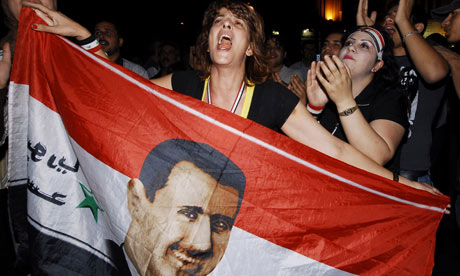
Russia says its foreign minister has arrived in Syria for talks with President Bashar Assad.
The foreign ministry said Tuesday that Sergei Lavrov is joined by Russia's foreign intelligence chief Mikhail Fradkov.
The Kremlin has been a staunch ally of President Assad although Moscow has also hosted talks with Syrian opposition leaders.
Russia and China vetoed on Saturday a Western- and Arab-backed resolution at the United Nations condemning the Assad regime's crackdown on dissent and calling on him to transfer some of his powers to his deputy. The Syrian government had earlier rejected the Arab plan as intervention in Syria's internal affairs.

President Assad’s wife ‘defends Syria crackdown’

Al Arabiya News

The British-born wife of Syria’s president has spoken in support of her husband for the first time since the 11-month uprising against his regime began, a British newspaper reported Tuesday.

“The President is the President of Syria, not a faction of Syrians, and the First Lady supports him in that role,” The Times quoted Asma al-Assad as saying in an email sent via an intermediary from her office.

The email is her first communication with the international media since the uprising against Bashar al-Assad’s regime began, The Times said.

“The First Lady’s very busy agenda is still focused on supporting the various charities she has long been involved with and rural development as well as supporting the President as needed,” the email reportedly continued.

“These days she is equally involved in bridging gaps and encouraging dialogue. She listens to and comforts the families of the victims of the violence.” it added.

The statement came after Syrian forces pounded protest hubs with rockets and shells, killing 79 civilians on Monday, according to activists, and as Britain recalled its ambassador to Syria “for consultations”.

Unlike her husband, a minority Alawite, the 36-year-old First Lady is a Sunni Muslim who originally hails from Homs -- the central Syrian city rocked by some of the worst carnage since the revolt began in March last year.

Stylish and charismatic and with a degree from King’s College in London where she was raised, the former investment banker had helped promote the soft side of an iron-fisted regime.

But she has virtually disappeared from the public eye since the revolt broke out and had drawn criticism for her silence on a crisis that has left more than 5,000 people dead in her country.

Last month she appeared with two of her children to support her husband of 12 years as he spoke at a pro-regime rally, but did not speak herself.

Pakistan & Resolution on Syria


It comes as a surprise that Pakistan has favoured a US-backed resolution proposing the ouster of Syrian President Bashar al-Asad, for his role in violently cracking down on protestors. The resolution was, however, vetoed by China and Russia. The Chinese Ambassador’s statement briefed that the resolution would have been counter-productive. Putting more pressure on the country would, indeed, further complicate the situation.

Islamabad, as well as all middle-Eastern countries, also teamed up with the US against a brotherly Muslim country. Being responsible and influential players within the world spectrum, Muslim countries are expected to recommend a path of moderation and patience. We hold a non-permanent seat at the UN Security Council, which puts additional responsibility on our shoulders to protect the interests of our fellow UN member countries. These interests are best served by negotiations and debate - not open war. Has the world not seen enough of war in the last ten years? First Iraq, now Afghanistan. Can anyone really say that these adventures have been succesful? Granted that Syria's chaotic situation and President Asad's violent clampdown on protesters is worrying, yet is military action the oil to smooth these troubled waters? There is evidence of US and Western help to the opponents of the Syrian President. We have seen the limitless death and destruction wrought by military interference in countries such as Libya, Iraq, and Afghanistan. Libya is now embroiled in civil strife. A stable and economically prosperous state has been turned into a war-ravaged country, overnight. There is a thin line dividing a terrorist from a genuine freedom fighter when it comes to the international definition of terrorism. A sympathetic Syria would be useful as a vantage point to contain Iran.


If the US and other Arab countries that supported the resolution are so eager to help Syria, they must extend a friendly hand, not one holding a detonater. It is for the Syrians themselves to decide which course suits them best.

First polio case of year in Kohat confirmed


The first polio case of the year in Kohat has been confirmed, raising questions about the performance of health department, polio teams and the district administration.


“The polio disease in three and a half years old Shazia has been confirmed on Monday by the National Institute of Health (NIH), Islamabad, to the local administration in a letter Polio-PRL/1-12-554,” said an official.

Dawn learnt officially from the World Health Organisation’s Kohat office that the girl had been affected with polio and the result of her younger brother Adil’s test report would be received soon.

Last year, a case was detected in Bostikhel area of Darra Adamkhel, a nearby semi-tribal area, and now the first case of 2012 had been confirmed in area of Kohat, hardly a kilometre away from the city centre.

Father of Shazia, Wazir Khan, who belonged to Kurram Agency and is residing with his family from last one decade in Mangal Bibi area, Urban-5 Kohat, claimed that no polio team had visited their area during last several years.

It was learnt that Mr Wazir had told the authorities concerned that his son’s test had also been sent to the NIH laboratory and the result was awaited.

The WHO official, requesting anonymity, also said that the administration of a government school in Cantt area had not allowed the teams to administer polio drops to the children during last four campaigns. He said that the matter had been brought to the notice of district administration, which was in contact with the school administration on the issue.

A former WHO official said that the detection of a case in Kohat reflected the lack of seriousness of the health department, polio teams and the administration, which had been spending millions of rupees on holding workshops, seminars, campaigns etc.

Human Rights Commission of Pakistan expresses concern at killing of protesters in Sibbi

he Human Rights Commission of Pakistan (HRCP) has expressed its concerns over the killings of two of the protesters in Sibbi, Baluchistan on Saturday. Condemning the act, Zohra Yusuf, the chairperson
of the HRCP stated, “HRCP regrets very much the deaths and injuries among demonstrators in sibbi when FC personnel opened fire on them.”

According to the news, the protestors were demonstrating against the brutal killing of Nawab Akbar Bugti’s kin in Karachi last week.

The Commission said in a statement: “HRCP regrets very much the deaths and injuries among demonstrators in Sibi when FC personnel opened fire on them. Media reports suggest that around 300 people had blocked the National Highway to
protest the killings and had prevented an FC convoy from passing through.

“Such use of force plays into the hands of those who want the situation to aggravate in the province, if further aggravation is possible. HRCP reiterates the people’s right to peaceful protest and emphasises that the authorities
must exhaust all possible options before resorting to the use of lethal force and only do that to prevent violence and bloodshed that cannot be prevented otherwise. Furthermore, in view of the charged environment in the province these things must not be seen
as mere law and order issues.

HRCP, through a press release, also welcomed the government’s decision to hold a judicial probe and very much hopes that unlike earlier probes the findings of this one would be made public.”

Congressional Baluchistan Witness Prepares for Pakistan Policy Firestorm

http://www.examiner.com/

In an election year, anything is possible. But, when anything includes the U.S. policy approach to Pakistan, Congress must remain a responsible stakeholder. Members of Congress must clearly convey their intentions when taking on potentially contentious issues that risk undermining one of the Barack Obama Administration's and the U.S. military’s most important strategic partnerships. Baluchistan is clearly one of those issues. However, the Congressmen who have scheduled a hearing on Baluchistan for this week have failed to properly set expectations as to what they are trying to accomplish. This could raise fears that some in Congress are recklessly engaged in a high stakes gamble to undermine the Administration's policy approach on Pakistan under the guise of Baloch human rights concerns.

Regardless of whether or not this is true, the scheduling of the hearing has increased expectations among some in the Baloch diaspora that the U.S. will support their cause. It also has forced Pakistan to question how committed the U.S. is to Pakistan's territorial integrity. Such consequences pose great risks for the Administration's ongoing efforts in South and Southwest Asia. Mr. Ali Dayan Hasan, the Pakistan Director of Human Rights Watch and one of the hearing's scheduled witnesses, is well aware of the serious risks posed by the hearing. However, he also sees the hearing as an opportunity to educate members of Congress and the American public on the very real human rights violations being prosecuted against civilians on both sides in Baluchistan. His objective therefore will be to remain on point on human rights issues and not be drawn into the crosshairs of whether or not to support the Balkanization of Pakistan.

Bilawal Bhutto for modern techniques to deal with disasters


PPP Chairman

Bilawal Bhutto Zardari directed the Sindh government to pursue a comprehensive strategy and adopt modern techniques to deal with disasters.
A briefing was given to PPP chairman at Bilawal House Tuesday on development projects in Sindh focusing on supply of clean drinking water, construction of roads and steps taken for alleviation of poverty.
Speaking on the occasion, he said the government took all possible measures for rehabilitation of flood affectees.
Sindh Finance Minister Syed Murad Ali Shah gave a briefing to him on Benazir Income Support Program.
Moreover, Sindh Chief Minister Syed Qaim Ali Shah told Bilawal that thousands of ghost employees had been identified in the province.

Shahbaz Sharif (LOHARE) failed to appear in the assembly

The Punjab Assembly session on Monday was prorogued for an indefinite period after Chief Minister Shahbaz Sharif failed to appear in the assembly and conclude the debate on the deaths from drugs provided by the Punjab Institute of Cardiology (PIC). The opposition strongly condemned the absence of the chief minister and walked out from the House.
The Punjab Assembly session began an hour and a half behind its scheduled time at 3pm under the chairmanship of Deputy Speaker Rana Mashhood Ahmad Khan. The chairman tried to start Question Hour but the opposition raised the issue of PIC and demanded the presence of the chief minister in the House.
House Opposition Leader Raja Riaz said on a point of order that the law minister had made a commitment with the House that Chief Minister Shahbaz Sharif would come to the Assembly and conclude the debate on the PIC issue which had started last Wednesday.
He said that Monday was the last day of the session but the CM had not come to the House to take it into confidence on the matter, which was disrespectful towards the assembly, the nation and the chairman of the House. He said that chief minister was not taking the PIC issue or the assembly seriously, so he had the right to bring a privilege motion against him.

Law Minister Rana Sanaullah responded by saying that the chief minister would conclude the debate once the opposition leader had delivered his speech on the issue. He also suggested to suspend the rules of procedure and to start debate in the House without any delay.

The opposition leader said that the law minister was using delay tactics, adding that he was ready to deliver his speech in the House if the law minister could assure that the chief minister would conclude the debate, and that the House would not be prorogued.

However, Sanaullah did not give such an assurance, and the chair clarified that the House would prorogue on Monday as per its schedule. The chair also informed that the session would be called again within the next four days, so the chief minister could conclude the debate.

SYRIA: Irresistible force meets immovable object

EDITORIAL: Daily Times

What is being seen as a clash between historic opponents, Syria on the one side and the US and its western allies on the other, is being fought out at the UN amphitheatre with Russia and China seriously in Syria’s corner. After last October, the second attempt in the United Nations Security Council (UNSC) on Saturday failed once again to pass a resolution against Syrian President Bashar al-Assad, asking him to abandon power as Russia and China saw through the vaguely amended resolution and vetoed it for being an unbalanced solution. Despite facing the anger and displeasure of the west for their decision, Russia and China’s step is to resist a so-called humanitarian intervention of the western powers in Syria under the UN mandate of Right to Protect (R2P), which they abused to force a change of regime in Libya last year. The African oil-rich country has been pushed into a factional civil war among rebel militias struggling with each other to occupy the throne since its so-called liberation. Given this experience, Russia and China it seems have deciphered the now-almost-evident US plan of Middle East domination by refusing to approve of the Arab-western backed resolution against Syria. Being the only staunch opponent in the region of the appeasement policy of important Arab countries including Egypt, Jordan and even the Palestinian late leader Yasser Arafat towards Israel, Syria has been a thorn in the side of imperialist interests. The Syrian crisis, if settled in their favour, might be followed by a similar intrigue against Iran, completing the expansionist plans of the west in the Middle East.

The Syrian authorities have been facing an armed resistance from their opponents for the last 11 months and have hit back, using force to crush the rebellion against the regime of President Bashar al-Assad. Despite his efforts, the opposition, allegedly supported by the West, has refused all reconciliation offers. Their tactic reflects a similar desire for action in Syria supported by air and sea strikes of the NATO forces as in Libya. Now that Russia and China have woken up to the sinister designs hidden behind the camouflage of R2P, the UNSC and the world need to revisit the concept so as not to allow its well intentioned thrust to be hitched to old-style imperialist military interventions a la Libya.

Faulty data blamed for lack of govt policy on cancer

daily statesman pk

Minister for Finance Engineer Muhammad Humayun Khan has said that in Pakistan every year more than three lakh cases of deadly disease cancer are reported.

He observed coping with the same number of cancer patients within the existing 20 cancer hospitals throughout the country, is a big challenge for the government. However, he expressed the hope that efforts were underway on war footing to cope with the disease.

He was addressing as chief guest the World Cancer Day function arranged at the Khyber Girls Medical College, Peshawar in collaboration with the Bank of Khyber on Saturday. Principal of KGMC Dr. Muhammad Zuber, Vice Principal Samina Zahid, doctors and a large number of medical students attended the function.

The finance minister said unluckily there were no official statistics available on cancer patients in Pakistan due to absence of a national cancer registry.

He said due to lack of correct data, the government had not been able to formulate policies to fight cancer which threatened public life on a large scale.

The minister said cancer patients were showing an alarmingly increasing trend of risk factors and it was the need of the hour to develop a strategy to control the disease.

He disclosed that a cancer plan was initiated in 2002 together with all the other non-communicable diseases (NCDs) as a national action plan for the prevention and control of NCDs and health promotion but that was not enough. He said they needed to do more and devise a multi-pronged strategy to combat cancer.

The minister said the government had taken certain measures for fighting cancer but due to legislation procedure and other matters the same could not yet be properly enforced and implemented.

He said despite ban on publicity of tobacco and its allied products, there were no follow-up practical steps to ensure its enforcement.

He said a clampdown on the epidemic levels of tobacco and areca nut, use of the same products could reduce cancer to 43.7% in males and 17.8% in females.

The minister stressed the need for urgent action against cancer because of its huge impact on humans. He said the number of cancer cases seemed to be doubling by 2030.

He said the study around the globe indicated that one-third of all cancer cases could be prevented and urged the health experts to divert mostly on the preventive measure to reduce cancer.

We do not deal with Pakistan through lobbyists

The United States has said that it is not engaged in business with Pakistan through lobbyists and is looking forward to talking to Islamabad after the latter completes internal review of its ties with Washington.

"I don't have any knowledge of the letter one way or the other. But I will tell you that we don't do our business with Pakistan through its lobbyists," State Department spokesperson Victoria Nuland said when asked about a letter written by a lobbyist urging the US to tender an apology to Pakistan for the November 26 NATO raid that killed 24 soldiers.

"We do our business with Pakistan through our representatives in Islamabad and throughout the country, as well as through the Pakistani embassy here," she said.

"I think you know where we are with Pakistan, which is that we are trying to be respectful of the time that Pakistan has asked for to complete its internal review, and then we look forward to talking to the government about where it wants to go on those aspects of our relationship that have been put on hold for the period," Nuland said.

But, there is an ongoing level of communication between the two countries.

"So we maintain very strong communication on other issues. All of our civilian programs are going forward. So it is simply this issue of where we go on some of our security and counterterrorism issues that are pending the internal review on the Pakistani side," she sa

U.S. Sending Commander to Repair Ties With Pakistan


A senior American military commander is expected to travel to Pakistan this month in what Obama administration officials say is the first step toward thawing a strategic relationship that has been in effect frozen for more than two months.

Gen. James N. Mattis

the head of the military’s Central Command, will meet Gen. Ashfaq Parvez Kayani, the Pakistani Army chief of staff, to discuss the investigations of an exchange of fire at the Afghan border that killed 24 Pakistani soldiers, as well as new border coordination procedures to prevent a recurrence of the episode.

General Mattis’s visit, the first by a high-ranking American official since the cross-border confrontation in November, was to have begun Thursday, but has been postponed by at least a week pending what is expected to be a spirited debate in the Pakistani Parliament over a new security policy toward the United States.

Pakistani and American officials are quietly optimistic that both events will trigger a chain of public engagement and private negotiations that will reboot the two nations’ frayed strategic relationship, although along more narrowly defined lines than before.

Pakistani officials say they will probably reopen NATO supply lines running through their territory, which have been closed for more than two months. The State Department is supporting a proposal circulating in the administration for the United States to issue a formal apology for the deaths of the Pakistani soldiers in the Nov. 26 airstrike by American gunships.

“We’ve felt an apology would be helpful in creating some space,” said an American official who has been briefed on the State Department’s view and who spoke on the condition of anonymity as internal discussions continued.

Soon after the lethal airstrike, the White House decided that President Obama would not offer formal condolences to Pakistan, overruling State Department officials who argued for such a show of remorse to help salvage relations. Pentagon officials had balked, saying the statements from other American officials had been sufficient. Some administration aides said at the time that they worried that if Mr. Obama decided to overrule the military and apologize to Pakistan, it could become ammunition for his Republican opponents in the presidential campaign.

A State Department spokeswoman, Victoria Nuland, would not comment on the proposal on Monday.

American election politics are also on the mind of Pakistani strategists. A senior security official in Islamabad, speaking on the condition of anonymity because he is not authorized to speak publicly on the issue, said the military was cognizant of Mr. Obama’s domestic political constraints, and noted that Pakistan may also have elections this year, probably in the fall.

“Unfortunately there is election fever on both sides of the divide this year,” the official said. “That limits the room for maneuver.”

The director of the State Department’s policy planning office, Jake Sullivan, signaled last month that relations could improve soon.

Speaking to foreign journalists in Washington on Jan. 25, Mr. Sullivan said, “We will see over the course of the next several weeks an intensive period of work to deal with the very real issues that continue to exist between the United States and Pakistan in our relationship.”

American officials in Washington said the thaw had already started, unofficially. Relations between the C.I.A. and Pakistan’s Inter-Services Intelligence Directorate, or ISI, had slowly improved since the nadir after the raid that killed Osama bin Laden last May, they said.

Intelligence officials from the two countries have resumed discussions about “joint targeting,” officials here added — probably a reference to C.I.A.-directed drone strikes in Pakistan’s tribal belt. On the military side, Pakistan’s generals had started discussions over border coordination and the resumption of Coalition Support Funds, the main United States subsidy to Pakistani military operations.

A senior Pakistani security official also struck a cautiously positive note. “We have to meet, we have to talk, we have to bring this relationship back on track,” he said. “Both of us need each other. But from now on there will be no free rides, no carte blanche — things need to be institutionalized.”

The starting point for the new relationship is expected to be General Mattis’s visit, the stated purpose of which is to formally present to Pakistan the Central Command’s findings in the Nov. 26 episode. Pakistan’s military last month issued a withering rejection of the American report: it stated the report was “factually not correct”; accused the United States of failing to share information “at any level”; and denied any responsibility for the bloody debacle.

Behind the scenes, however, General Mattis will try to learn what is possible in the relationship regarding training, arms sales and improving border coordination centers. Depending on how the visit goes, other American officials, including Marc Grossman, the State Department’s special representative for Afghanistan and Pakistan, could follow.

The timing of those visits, though, is hostage to the vagaries of Pakistan’s turbulent political scene. Government leaders, judges and generals have been at loggerheads for most of the past month, engaged in media and judicial confrontations that, at one point, produced rumors of a coup, and more broadly distracted attention from efforts to repair the American relationship.

Pakistani and American officials now say the parliamentary debate on American policy — a critical step in starting negotiations — was unlikely to start before Feb. 14. The debate, which is likely to last several days, will focus on the findings of a cross-party committee set up to re-evaluate the relationship with the United States.

Once the policy document has been debated in Parliament, Pakistani officials will sit down with American diplomats to hammer out the contours of the new relationship, a process that diplomats say is likely to last many months. But some things are expected to be resolved immediately.

Pakistani officials say they will soon reopen the NATO supply route to Afghanistan, although they will seek an unspecified tariff on all goods passing through. American officials say they are open to paying, but point out that the alternative northern supply route into Afghanistan, through Central Asia, has picked up much of the slack in recent months.

Analysts say this points to a potential loss for Pakistan’s military, which courted popularity by closing the route in November but may have ceded a source of leverage with the United States.

The crisis has also altered the C.I.A.-led drone program. In December, Pakistan expelled all Americans from Shamsi base, in western Pakistan, which had been used by the C.I.A. to launch drone strikes against militant targets in the tribal belt along the Afghan border. But the drone strikes have continued, from bases in southern Afghanistan.

Pakistani minister urges reopening border to NATO

The Associated Press

Pakistan's defense minister says the country should reopen its Afghan border crossings to NATO troop supplies after negotiating a better deal with the coalition.

Pakistan closed the crossings over two months ago in response to American airstrikes that accidentally killed 24 Pakistani soldiers.

Defense Minister Ahmad Mukhtar said on Tuesday that the government should negotiate new "terms and conditions" with NATO and then reopen the border.

He did not provide details. But other Pakistani officials have said the government should levy additional fees on NATO for using the route through the country.

About 30 percent of non-lethal supplies for U.S. and coalition troops in Afghanistan traveled through Pakistan before the border closed.

Syria needs diplomacy, not intervention


If anything, the pursuit of regime change is hurting the international community's ability to end the crisis.

President Bashar al-Assad's government has used brute force to crush a genuine popular upheaval against his regime. The death toll is nearly 6,000. Human rights have been systematically violated. But the crucial question is how and what steps can international society lawfully take to bring an end to the crisis.

Libya is not a model for emulation but a warning to heed; more so, Iraq. Each was a split polity surviving on fragile unity. The Syrian regime, however unpopular, is supported by a significant section of people. Regime change through outside intervention wreaks havoc, violates the United Nations Charter, the rules of international law, and undermines the stability of the world order. These fundamentals must not be overlooked.

At the root of Russia and China's veto of the resolution on Syria in the Security Council on February 4, lies distrust, deep and justified. The world was taken for a ride twice by the Council's resolutions which did not authorise the use of force, but came in handy as fig leaves to cover the nudity of illegal recourse to war.

Obama's fatwa

Statements made in the Council as well as their texts establish that Resolution 1441 of November 8, 2002, did not authorise an attack on Iraq. Nor did Resolution 1973, adopted on March 17, 2011, authorise the use of force against Libya. However, on February 26, President Barack Obama delivered a fatwa on Col. Muammar Qadhafi: “He should go.” Now, on February 4, the very day the UNSC was to vote on the resolution on Syria, he peremptorily declared apropos President al-Assad: “He must step aside and allow a democratic transition to proceed immediately.” Few would believe Hillary Clinton when she said, on January 31, “there is no intention to seek any authority or to pursue any kind of military intervention”.

Suspicions of plans for regime change are justified. “Then you will start telling what King needs to resign and what Prime Minister needs to step down. This is not the business of the Security Council,” Russia's Ambassador to the U.N. Vitaly Churkin remarked on January 31.

Textually, the resolution is misleading. It “calls for an inclusive Syrian led political process” but adds it “fully supports in this regard the League of Arab States' 22 January 2012 decision to facilitate a Syrian-led political transition to a democratic, plural political system, … including through commencing a serious political dialogue between the Syrian government and the whole spectrum of the Syrian opposition under the League of Arab States' auspices, in accordance with the timetable set out by the League of Arab States; Encourages the League of Arab States to continue its efforts in cooperation with all Syrian stakeholders.”

As Neil Macfarquhar of The New York Times reported: “Three clauses that endorsed specific aspects of the Plan — including that Mr. Assad delegate his authority to his vice-president to speed a transition to democracy — were removed. But Arab and Western diplomats said the essential idea remained, even if it was not spelled out.”

‘Demands, does not recommend'

The Resolution, obviously adopted under Chapter VII, “demands,” does not “recommend.” It says: “Demands that the Syrian government, in accordance with the Plan of Action of the League of Arab States of 2 November 2011 and its decision of 22 January 2012, without delay.” Six steps are listed. Finally, the Council “Requests the Secretary General to report on the implementation of this resolution, in consultation with the League of Arab States, within 21 days after its adoption and to report every 30 days thereafter. Decides to review implementation of this resolution within 21 days and, in the event of non-compliance, to consider further measures.” Of what avail the disavowal “Nothing in this resolution authorizes measures under Article 42 of the Charter” when the threat is implicit in the text itself? The League's Plan which is endorsed provides for Mr. al-Assad to step down.

Bashar al-Assad is no pushover. Diplomacy should seek his consent to a plan which leaves him in office but ensures a democratic transition. The resolution is not an aid to diplomacy but an instrument of duress. The Arab League and its Western backers were impatient on regime change.

Regime change has furtively acquired certain respectability. Time there was when Gladstone told the House of Commons on April 2, 1880 that “the rights of a Power, the rights of a nation, ought not to be invaded because it happens to have the misfortune of a despotic government.”

The law was laid down by the International Court of Justice on April 9, 1949, in the Corfu Channel case: “The Court can only regard the alleged right of intervention as the manifestation of a policy of force, such as has, in the past, given rise to most serious abuses and such as cannot, whatever the present defects of international organization, find a place in international law. … from the nature of things it would be reserved for the most powerful States; …” These words are more relevant now than they were in 1949. This was reaffirmed in the Nicaragua case in 1986. The Court rejected intervention at a “request for assistance made by an opposition group in another state.”

The collapse of the USSR in 1991 opened new vistas of the play of power. In 1986, a British Foreign Office Policy Paper noted that “the overwhelming majority of contemporary legal opinion comes down against the existence of a right of humanitarian intervention”. In 1992, the Foreign Office held: “international law develops to meet new situations; we believe that international intervention without the invitation of the country concerned can be justified in cases of extreme humanitarian need.”

In this clime came R2P. In an inspired moment in 2000, the Canadian movement picked on the egregious Gareth Evans of Australia, with Mohamed Sahuom of Algeria, doubtless both of undying reason, to co-chair an independent International Commission on Intervention and State sovereignty. They coined the phrase “responsibility to protect”.

The doctrine was not accepted by the U.N. General Assembly on September 14, 2009, after a long debate. On September 24, 1999, Foreign Ministers of the Group of 77 “rejected the so-called right of humanitarian intervention, which has no basis in the UN Charter or international law”. This represents the opinion of 132 states; 33 Asian, 51 African, 22 Latin American, and 13 Arab states.

Crisis of legitimacy

Such an intervention inevitably entails regime change. One suspects that change is the main objective; human rights violations are a pretext for it. Witness the deafening silence on outrages by the favourites. Beneath the crisis in the U.N. system lies a deeper crisis of the legitimacy of an order which is devoid of an international consensus. That can be restored only by a wide consensus. We face a genuine humanitarian problem. Remember Biafra, Cambodia, Rwanda and Darfur.

Russia's Foreign Minister said on February 4 that the resolution on Syria was not “hopeless” and that “we support the call of the Syrian people for change.” There was ample room for compromise. There is still time for that — a U.N. Mission comprising members of high credentials can go to Syria to bring about a settlement which leaves Mr. al-Assad in office but ensures democratic transition.

India's Permanent Representative to the U.N., Hardip Singh Puri, said “the main role of the international community, including this Council, is to facilitate engagement of the Syrian government with all sections of Syrian society.” Nominating its adversary, the Arab League, to accomplish tasks set by the Resolution is no way to secure that “engagement.”

NATO has failed Libya’s stricken civilians

By Charles Gray

The current events in Libya, including reports of ethnic cleansing, the use of torture by the current government, and most recently the decision by the NGO Doctors Without Borders to suspend operations in the nation, stand as a stark condemnation of the NATO-led effort to expel former leader Muammar el-Gaddafi. This is especially true given that the justification for the effort was the protection of civilian lives, a duty that seems to have been forgotten today, even by those who were most vocal during the conflict.

While some may argue that there are always winners and losers in any civil conflict, the decision to intervene and, in direct defiance of UN Security Council Resolution 1973, to become active participants on the side of the rebels, was supposedly motivated by the need to enforce the UN resolutions mandating the protection of Libyan civilians. By defining the overriding goal of the mission as protection, rather than a simple military objective, NATO's goals became far more than a simple military victory.

However, it is also plain that NATO's responsibility to protect (R2P) Libyan civilians did not end after the fall of Gaddafi. By setting up the conditions for his fall, since it was NATO airpower that ultimately defeated Gaddafi, not the rebels, NATO and the nations advocating intervention bore full responsibility for the consequences. Most importantly, they bore responsibility for the safety and well-being of all civilians, not just those on the side of the rebels.

And this is where the true scope of NATO's failure to adhere to the R2P doctrine becomes plain. After all, if the threatened attacks on Northwest Libya's Misrata were enough to declare that action was required, what about the ethnic cleansing of the Northwestern town of Tawergha?

It cannot be said that such events were unpredictable, as many Libyan specialists warned from the start that this conflict was far more complex than the version that France, Britain, and the US were describing.

Even without their warnings, civil wars always leave one side at the mercy of often-vengeful victors. Given Libya's fraught history of ethnic and tribal tensions, it is inconceivable that NATO did not realize what was happening. Rather, it is likely that NATO and those backing them simply did not wish to present their citizens with the specter of yet another long-term and open-ended troop deployment.

Interventions into civil wars are always dangerous and unpredictable. At best, they require long-term involvement by peacekeeping forces, while at worst they can devolve into a savage ethnic conflict with no easy resolution. The simple fact that even today, peacekeepers remain in the nations of the former Yugoslavia should make that lesson plain enough.

The fact that NATO was willing to enter into the conflict, and yet unwilling to carry on its longer-term responsibilities to secure the peace and protect the civilians, winners and losers alike, largely discredits the doctrine of R2P. The opposition to similar intervention in the Syrian crisis is a sign of just how badly the doctrine of R2P has been discredited by the West's Libyan adventure.

The abandonment of the citizens of Northwest Libya's Bani Walid and Tawergha strengthens the argument that the R2P doctrine was nothing more than a convenient casus belli, allowing France, Britain, and the US to remove a leader seen as untrustworthy, rather than for any higher reason of morality or civic duty.

The implications of the radical expansion of the "just causes" for war represented by the Libyan interpretation of R2P are grave in their import. The fact that nations that pose no threat to their neighbors might face military action by other powers under the cover of protecting their civilian populations essentially rewrites the traditional understanding of both warfare and national sovereignty.

More importantly, we have seen in Afghanistan, Somalia, and even in post-war Iraq the bitter consequences that can rise from the creation of a power vacuum. By making R2P the justification for overthrowing a government, but failing to engage in the far more difficult and long-term process of helping give rise to a legitimate replacement, NATO has largely discredited the doctrine it sought to justify.

The author currently holds a Master's Degree in history, specializing in the social and political movements surrounding the Abolition of the British Slave Trade.

Monday, February 6, 2012

Hina Khar leaves for Russia

Foreign Minister Hina Rabbani Khar

will leave for Russia today (Tuesday). She is paying an official visit to Russia on the invitation of her Russian counterpart Sergey Viktorovich Lavrov. In Moscow, Foreign Minister Khar will hold talks with her Russian counterpart on expanding and diversifying Pakistan-Russia relations. They will exchange views on regional and global issues of mutual interests. Khar will also meet Russian parliamentarians and address the Institute of Oriental Studies.

Pakistan’s economic performance has weakened


The International Monetary Fund (IMF) on Monday said that while external pressures are mounting, Pakistan’s economic performance has weakened and the country continues to fall short of its economic potential.
The fund also projected Pakistan’s dollar reserves to deplete to $ 12.1 billion from the current $ 16.8 billion by the end of the fiscal year. “The beginning of repayments to the IMF will likely put further pressure on the balance of payments this year,” the IMF said. SBP is accommodative: The international lending agency was also critical of the State Bank of Pakistan (SBP) for its “more accommodative” monetary policies saying the central bank was directly or indirectly financing the fiscal deficits. In its February 3 Executive Board’s assessment, the Fund called upon Islamabad to reorient macroeconomic and structural policies to stem near-term risks to macroeconomic stability, and to lay the foundation for durable and inclusive growth over the medium term. Welcoming the Pakistani authorities’ intention to reduce the fiscal deficit, the IMF directors encouraged them to take more resolute action to mobilise revenues and rationalise public expenditure. In particular, the directors saw merit in broadening the tax base, restructuring public enterprises, eliminating poorly targeted subsidies, and phasing out commodity procurement operations. They recommended strengthening the framework for fiscal devolution and the incentives for provincial governments to raise revenue. “Monetary policy is now too accommodative, and should be tightened if inflation or external pressures increase,” they said. The bank asked Pakistan to take immediate measures to stabilise growing budget pressures and raise interest rates to contain rising inflation. The IMF projected a widening of Pakistan’s budget deficit in fiscal 2011/12 to 7 percent of gross domestic product, much higher than the government’s revised budget target of 4.7 percent. It said central bank financing of the budget needs to be curtailed. Improve India relations: Separately, noting that investment climate in Pakistan is not good, the IMF said improving relations with India and the recent WTO tariff exemptions for 75 items should help the country to overcome its current economic crisis.
The IMF mission chief for Pakistan Adnan Mazarei in a conference call with reporters after concluding its consultation with Pakistan said the country’s security scenario and general economic health are a problem, even though its leaders have taken some steps to address the situation. Mazarei said it is correct to say that Pakistan economy is facing huge vulnerabilities and risks. It is because of growing global economic pressures and it needs to build buffers, he added. He said the investment climate in Pakistan is not very good, and steps need to be taken to attract it. “Improving relations with India and WTO tariff exemptions for 75 items recently should help Pakistan,” the IMF official said in response to a question.

Veena Malik says she has signed a British film

www.newspakistan.pk

The controversial queen of Pakistan,

Veena Malik, is yet to make her Bollywood debut, but she is already considering joining the International cinema.

Veena Malik, who is currently in Dubai, didn’t reveal much but she informed BT that she has recently signed a British film in which she is going to play a powerful role.

“I am getting many offers from across the globe. Recently, a UK film team was in Dubai and I was short listing a few offers that would suit me. I have zeroed in on a few fashion projects and a film. I can’t reveal more at the moment,” said Veena.

Malik is currently participating in Hemant Madhukar’s upcoming 3D horror film ‘Mumbai 125 Km’ and the actress assured the media she will not let anyone down.

“All my producers and directors are well aware of my schedule and I will not let anyone down. I am the leading lady and I am sure there are crores and crores riding on me,” she laughs.

The Pakistani actress, model and comedienne, in the meantime stressed she wants to make a switch from women-oriented roles to comedy. Malik stated making someone laugh is the most difficult thing to do but still she would love to do the job.

“I believe it is very tough to make someone laugh and after the spoofs in my item number in my last release, I am hoping I will get some comedy roles soon,” she signs off.

Apart from ‘Mumbai 125 Km’, Veena Malik is also participating in ‘Zindagi 50-50’ but as per the reports she is having some issues with Riya Sen, who will be seen in the movie as well. If reports are to be believed, then the director of the film ‘Rajeev Ruia, wants to cast both actors in an item song and had been canning their scenes separately for the film.

Nevertheless, Veena has denied all the rumours since she said Riya Sen is a wonderful actor and she would love to do an item song with her, if she gets a chance.

Saudi Arabian women accelerate anti-driving ban campaign

THE TIMES/www.theaustralian.com

WOMEN in Saudi Arabia are stepping up their campaign for equality with a legal challenge to the ban on female drivers.

After a string of protests last year in which women took to the roads, a group of activists and lawyers are preparing to take their cases to court.
The new campaign, called My Right to Dignity, aims to force the government to defend publicly the restrictions imposed on women by the religious establishment.
The activists will also challenge the kingdom's strict rules on guardianship that require women to get permission from a male guardian to work, study, travel, marry and receive some forms of surgery.
"The Arab Spring for women is on. Momentum is picking up and the world is watching us. There is no going back," said Madeeha al-Ajroosh, a campaigner for women's rights and part of the first concerted challenge to the driving ban in 1990.
Saudi Arabia remains the only country in the world to bar women from driving. The ban is not enshrined in law but imposed through fatwas handed down by senior clerics who regulate the observance of Wahhabism, the kingdom's ultraconservative brand of Sunni Islam.
Several lawyers specialising in Sharia have volunteered to challenge the legal and religious basis of these fatwas on the women's behalf. The campaign has also gathered widespread male support. Several women applied for driving licences over recent weeks and were turned down without an explanation. By challenging the ban through official channels, the activists plan to force the debate about religious fatwas into the open.
"We want the government to come out and say, once and for all, if there is a law [against women driving]. If there is a law we can challenge it," said Eman al-Nafjan, a prominent women's rights activist and blogger in Riyadh.
Saudi officials have claimed that the government intends to repeal the ban but needs time to persuade the religious elite and the wider population. They argue that a public campaign for the right to drive is counter-productive, angering the clerics and setting back the opportunity for progress.
"But they always say that. They said that in 1990 and nothing happened," Ms al-Nafjan said.
The new campaign comes as the demand for women's rights in Saudi Arabia is showing signs of increased momentum. King Abdullah has forced the pace of reform, facing down criticism from the clerics in the process. In a surprise announcement last year, the elderly monarch granted women the right to vote and hold political office for the first time.
Restrictions on women entering the job market have also been quietly dropped. A royal decree last year gave women the right to work in lingerie shops. Almost 30,000 women applied for these jobs, and Saudi shopping centres have been transformed by the sight of female sales staff. But women are dependent on male relatives to drive them to work or must pay for a driver, which devours most of their salary.
The problem is reinforced by the guardianship system, which strips women of many basic rights. The sexes are strictly segregated in many aspects of social life and women may not travel without permission from a male guardian. Some hospitals will not perform emergency surgery on women without written approval from a male guardian.
"The situation is unsustainable," said Ms al-Nafjan. "Women are working everywhere. They are not getting married as young as they used to. In the past, you were on the market as soon as you left school. Now women are going to college and starting jobs."
Despite their growing numbers, the activists remain a minority within Saudi Arabia. In the Wahhabi heartlands, the campaign is opposed by many women.
"The Government needs to face up to its part in educating and changing the minds of the public," Ms al-Ajroosh said.

Playing with fire in Balochistan


The killing of Balochistan MPA Bakhtiar Domki’s wife and daughter in Karachi was a highly sensitive issue. Domki’s wife was Nawab Akbar Bugti’s grand daughter and the sister of the Baloch insurgent leader Brahmdagh Bugti. This required an immediate high level probe and an action against those responsible. What the police did instead was to try to hush up the matter by hastily declaring that the killings were a probable outcome of tribal feuds or personal enmity. The incident led to a three-day strike in Balochistan. The Provincial Assembly passed a resolution condemning it. A prominent tribal MPA complained that even the women of the Bugti family were not being spared. A provincial minister said the killings were part of the ongoing “Baloch genocide and ethnic cleansing”. Another provincial minister resigned in protest. Belatedly, Interior Minister Rehman Malik declared the killings were masterminded by the yet to be identified “third force” and promised the formation of a high level investigation committee which still remains dormant. Within a few days the killings turned into a burning issue in Balochistan.

The firing by FC personnel on a demonstration of the Domki tribesmen on Friday led to the death of two. This would add further to the tensions and may even lead to reprisals. What is happening is against the government’s policy and the sense of the parliamentary consensus requiring the initiation of peace dialogue with the militant leadership. What appears to be the case is that hidden hands are creating conditions to abort the peace moves. Hopes have been aroused by the orders given by the CJP to arrest those behind the killings by Friday. The CJP has also declared the incident as “one of the most sensitive cases in the country”.

Repressive methods to control insurgency have turned what was only a spark into a flame. During the last few weeks, five incidents of attacks on FC have led to the killing of about 50 security personnel and several insurgents. There is a need to conduct a thorough probe into Karachi killings and punish those behind them. The government has to urgently undertake talks with the nationalist parties and the militant leadership to bring peace to the province. This has to be done before the flame is turned into a conflagration.

Pakistan PM in Qatar to discuss Afghan peace


Pakistani Prime Minister Yousuf Raza Gilani arrived in Qatar on Monday to discuss Afghan peace efforts in the ultra-rich Gulf state where the Taliban and US officials have begun preliminary contacts.

Gilani has "arrived in Doha for a three-day official visit to the country," the Gulf state's state news agency QNA reported.

"The prime minister reiterated stance of his government to support Afghan-led and Afghan-owned initiatives for a stable Afghanistan," his office quoted him as saying before his departure.

Pakistan, which last week sought to reach out to Afghanistan following a period of particularly bad relations over violence plaguing both countries, insists that any process to end the 10-year war be Afghan-led.

Both countries are reported to have felt sidelined by contacts between the United States and the Taliban, who are leading an increasingly deadly insurgency against his government and 130,000 US-led foreign troops.

Islamabad has officially billed Gilani's visit to Qatar as an opportunity to boost ties and maximise trade.

"He will meet among others the Emir of Qatar, Sheikh Hamad bin Khalifa al-Thani and Prime Minister Sheikh Hamad bin Jassem bin Jabr al-Thani," foreign ministry spokesman Abdul Basit said.

"The prime minister's visit is aimed at opening new vistas for enhanced mutual cooperation and activating the existing structured mechanisms and institutional linkages," he added.

The Taliban confirmed last month that they planned to set up a political office in Qatar ahead of possible talks with the United States. Contacts between both sides have already begun, focused on a possible prisoner exchange.

"There are certain ideas and suggestions on Afghan reconciliation and when Prime Minister Gilani meets Qatar's leadership, these will certainly come under discussion," a senior Pakistani official told AFP on condition of anonymity.

"The Americans have been briefing us on all developments aimed at pushing forward the peace process in Afghanistan and we have clearly told them that Islamabad strictly adheres to a policy of non-interference," he added.

Pakistan's role in Afghanistan is regarded with deep suspicion in Western capitals, given its long-standing ties to the Taliban, Haqqani network and other Islamist fighters, whose leaders are based in Pakistan.

But for the same reason, no peace in Afghanistan will be considered lasting without Pakistan's support and involvement.

Foreign Minister Hina Rabbani Khar said last week that Pakistan was willing to do whatever the Afghans wanted to end the war, but insisted the process should not be led by the Americans or any other foreign power.

The senior official said it was "important to engage all Afghan factions including Taliban in the process to achieve a lasting peace."

Khar met Afghan President Hamid Karzai last week and sought to refute perceptions that Islamabad was an obstacle to peace, and denied accusations in a leaked NATO report that her country was secretly supporting the Taliban.

Kabul has given its blessing to the Taliban office in Qatar, but has insisted on a central role in any negotiations.

The militia has denied any plans to hold separate talks with the Afghan government in Saudi Arabia, which Pakistan had reportedly offered to assist.

Asked how Pakistan viewed the Taliban's office in Qatar, the official said: "Now they have an address and all those wanting peace can have a contact."

Obama holds edge over Romney in general election matchup, poll finds

Boosted by improved public confidence in his economic stewardship, President Obama for the first time holds a clear edge over Republican presidential candidate Mitt Romney in a hypothetical general-election matchup, according to a new Washington Post-ABC News poll.

Romney, who notched his second consecutive victory Saturday by easily winning the Nevada caucuses, continues to solidify his position as the front-runner in the race for the GOP nomination. But as the contest has grown more negative, public impressions of the top Republican contenders have soured, as has the former Massachusetts governor’s standing as a general-election candidate.Obama remains a polarizing figure, with Americans closely divided on whether he deserves reelection as well as on many aspects of his performance in office. Although better than they were a few months ago, his ratings on handling the economy and job creation remain negative, with intensity continuing to run against him.

The poll results underscore how important framing the contest could be to the outcome. If the fall campaign becomes largely a referendum on Obama’s tenure in office, as Republicans hope it will, he could struggle to win a second term — barring an economic recovery that vastly outperforms expectations. If, however, it becomes a choice between the incumbent and the challenger, as Obama advisers predict it will, the president’s prospects would be brighter.


The survey was conducted Wednesday through Saturday. During that time, the president and the Republican candidates were in the spotlight: Obama had just completed his State of the Union address and held campaign-style rallies in battleground states, and the Republicans were in the middle of a series of primaries and caucuses.

Overall, 55 percent of those who are closely following the campaign say they disapprove of what the GOP candidates have been saying. By better than 2 to 1, Americans say the more they learn about Romney, the less they like him. Even among Republicans, as many offer negative as positive assessments of him on this question. Judgments about former House speaker Newt Gingrich, who denounced Romney on Saturday night in Nevada, are about 3 to 1 negative.

Meanwhile, the president’s recent remarks are better reviewed. Among the roughly 6 in 10 Americans who heard or read about the president’s State of the Union address, 57 percent say they approve of most of what he laid out.

Obama’s overall approval rating stands at 50 percent, the highest in a Post-ABC News poll since a brief run above 50 percent immediately after Osama bin Laden was killed in early May. Still, nearly as many — 46 percent — disapprove. Among registered voters, 49 percent say Obama’s performance warrants a second term; exactly as many say it doesn’t.

Among political independents, who are likely to determine the outcome of the election, 47 percent approve and 50 percent disapprove of the way he is handling his job. The president’s approval rating among independents had dipped as low as 34 percent in the fall, and just a month ago, he faced a 10-point deficit here.
The 50 percent mark is widely considered a critical threshold for an incumbent seeking reelection, with a president’s chances greatly diminished at levels below that mark.

In a general-election test, Obama leads Romney 52 to 43 percent among all Americans; more narrowly, 51 to 45 percent, among registered voters. Among all adults, it’s Obama’s first time topping 50 percent in a head-to-head matchup with Romney since July; it’s his first time ever above that point among registered voters.Obama’s momentum since mid-January has evened the score with Romney among political independents. Among independent voters in the last Post-ABC poll, Romney held a 12-point edge; now these voters split 48 percent for Obama, 47 percent for Romney.

The new survey also tested Obama against Gingrich. In that matchup, the president is ahead by 15 points overall and 11 among registered voters, both similar to the numbers from January.

The fault lines in the coming election, should Obama be pitted against Romney, are clear from the survey.

Romney has argued throughout his campaign that his business background gives him superior experience to turn around the economy and boost job creation. His pedigree is widely considered a positive and, among registered voters, he has a narrow edge over Obama on handling the economy in general. The former governor also leads on handling the federal deficit, an area where the president’s ratings remain stuck in solidly negative territory.

But when it comes to job creation — which has been the subject of fierce debate in the GOP contest — Romney and Obama are dead even in voters’ minds. They are also closely matched when it comes to handling taxes — another likely flash point in the coming campaign.

And in other areas, Obama has big leads, including on the question of who would better protect the middle class, handle foreign policy and fight terrorism.

Romney has been criticized as being out of touch with average Americans, a view that has been reinforced by several verbal gaffes he made on the campaign trail, including remarks about “the very poor” that were perceived as dismissive. At this point, the impression has stuck: Fifty-two percent of voters say Obama better understands the economic problems people are having, while 37 percent say Romney does.

The latest employment report, which showed 243,000 new jobs created in January and the unemployment rate ticking down to 8.3 percent, gave Obama a psychological boost, but he is far from out of the woods on the issue that continues to dominate the contest.

About nine in 10 people still rate the economy negatively, and among independents, 50 percent view this as a big strike against Obama’s reelection bid; far fewer, 33 percent, say it is a good reason to back his candidacy.

In contrast, by nearly 5 to 1, independents are more apt to view Romney’s business experience as a reason to support rather than oppose him.

However, his private-equity experience is a mixed blessing for him. The poll suggests that he has considerable work left to do to turn his business biography into a clear asset. One indicator: Thirty-three percent of all independents say Romney’s work in private business helped create jobs, 34 percent say it did more to eliminate jobs and 33 percent expressed no opinion.

Romney’s wealth also divides the public. Among all Americans, 43 percent see his fortune — estimated at $250 million — as a “positive” because it suggests that he has achieved the American dream. But just as many, 44 percent, consider his wealth a “negative” because it suggests that he benefited from opportunities that are not available to most people.

Romney is vulnerable on the issue of personal taxes. The former governor released his tax returns two weeks ago, showing that he paid an effective tax rate of about 14 percent. Two-thirds of all Americans say they do not think he is paying his fair share.

Romney has fought back, arguing that attacks on his or anyone’s financial success represent class warfare and criticism of the capitalist system that he said has made the United States the strongest and most innovative economy in the world. He has said repeatedly that Obama has a poor record on the economy because he doesn’t understand what makes the free-enterprise system tick.

Obama has sought to make economic fairness, particularly for the middle class, a centerpiece of his economic message. The poll underscores that Obama has remained on the high ground here. Fully 68 percent view the federal tax system as stacked in favor of the wealthy, not the middle class. More than seven in 10 support increasing the taxes of those earning more than $1 million a year — an idea the president has long pushed.

The poll was conducted by telephone Wednesday to Saturday among a random national sample of 1,000 adults. Results from the full survey have a margin of error of plus or minus four percentage points.

PIC tragedy137Death Toll: Two more women die of drug reaction


Deaths due to contaminated drugs reaction are continuing as 2 more women lost their lives in Lahore.
In Lahore, 75-year-old Balqees of Arifwala in Jinnah Hospital and 59-yaer-old Rehana of Baghbanpura in Services Hospital died due to reaction of ‘killer’ medicines provided by Punjab Institute of cardiology.
The overall death toll because of PIC drugs reaction has reached 137.
However, the PIC management said that a large number of affected patients are under treatment and they are fast recovering.

Protesters Hurl Jeers and a Shoe at the Yemeni President


A man was arrested on Sunday after a protest at which at least one shoe was thrown at the Yemeni president, Ali Abdullah Saleh, outside a hotel on Central Park South.
When Mr. Saleh emerged from the Ritz-Carlton hotel about 2:30 p.m., a small crowd of demonstrators began shouting at the president. One man charged toward him, crossing a street against police orders, then took off his shoe and “attempted to throw” it, a police spokeswoman said. The man was arrested for disorderly conduct.

Another man got off a cleaner throw of his shoe and nearly hit the president, said Ibraham Qatabi, a spokesman for the Yemeni American Coalition for Change, a group of opponents of Mr. Saleh’s who were at the demonstration.

“People got emotional,” Mr. Qatabi said in a telephone interview Sunday night.

The police said about 20 people attended the protest.

Several Yemeni-Americans have criticized Mr. Saleh’s presence in the United States since he arrived on Jan. 28, to be treated for injuries he suffered when a bomb exploded in the mosque of the presidential palace last June.

During the Arab Spring uprisings, many Yemenis protesting Mr. Saleh’s rule were killed, injured or imprisoned. In November, Mr. Saleh, who ruled Yemen for more than three decades, agreed to transfer power to his vice president. Elections have been set for Feb. 21.

By the time Mr. Saleh returned to the hotel around 4:15 p.m., police officers had assembled barricades to corral protesters. Gatherers chanted “I.C.C., not N.Y.C.!” — to voice their hope that Mr. Saleh is investigated by the International Criminal Court. Demonstrators have also expressed frustration with the United States for allowing Mr. Saleh to receive medical care here.

“We were chanting in Arabic that we would not relax and we would not stop until Saleh is on trial, until the murderer is being prosecuted,” Mr. Qatabi said.

At another rally on Thursday morning, organized by the Yemeni American Coalition for Change, protesters had waved Yemeni flags and held signs calling for Mr. Saleh’s prosecution. On Sunday, Mr. Saleh appeared unfazed by the demonstration, even acknowledging the crowd, Mr. Qatabi said.

“He waved,” Mr. Qatabi added. “People thought maybe the officials around him told him we were supporters.”

Shahbaz Sharif (LOHAR) should resign

Central leader Pakistan Tehreek-e-Insaf (PTI) Mukhdoom Javed Hashmi said that Chief Minister Punjab Mian Muhammad Shahbaz Sharif should accept responsibility of deaths of patients due to sub-standard medicines. Mukhdoom Javed Hashmi said that CM Punjab who was also Health Minister Punjab should resign as Health Minister.
He said that CM Punjab Mian Muhammad Shahbaz sharif have dictatorial thinking. He also criticized that CM Punjab did not like to gave response to the assembly on any issue.Hashmi also said that its not possible to ignore the political power of Muthida Qaumi Movement (MQM) and added that they want dialogue with MQM.

Pakistan: Senate elections

Editorial
SO it seems that the old conspiracy theory is being trotted out again. Talking to reporters in Lahore on Friday, Prime Minister Gilani claimed, “Six months ago, I had pointed out that conspiracies were being hatched to delay Senate elections. Be patient and wait for some days, all these conspiracies will be exposed.” The prime minister didn’t elaborate on these conspiracies but presumably he had his recent travails with the Supreme Court in mind. After all, ‘memogate’ has receded and the PML-N is negotiating with the government to cooperate in the passage of a constitutional amendment in parliament, leaving little else by way of crisis in the country at the moment.

Let’s examine the prime minister’s claim a bit. Six months is a lifetime in politics and back then there were murmurs that the run-up to the Senate elections would prove decisive to this government’s fortunes. At stake is a PPP near-majority in the Upper House, giving it a virtual veto over non-budgetary legislation until 2015. In addition, there is the psychological victory of being a civilian government presiding over elections to both halves of the Senate. For a government committed to constitutional milestones like the completion of tenures, the March Senate election represents a significant victory.

At stake, then, from the PPP’s point of view is a victory that the forces arrayed against it, real and perceived, will not countenance. ‘Memogate’ and the rash of political rallies in the country suggested that there was a real attempt to unseat the government. However, with only weeks left until the Senate elections, the political temperature was seen as subsiding and the government was exuding a renewed sense of confidence. Then came the SC and its threat to charge and convict the prime minister for contempt of court. But is this necessarily part of a grand conspiracy against the PPP or the result of an ill-advised government strategy of responding politically to the president’s legal problems? Even at this stage, the PPP has
simply not presented a cogent legal reason for why the NRO judgment of December 2009 cannot be implemented in its totality. As for the Swiss letter, legal experts here are near unanimous in their opinion that it will not have immediate consequences for the president. Not everything must necessarily be a conspiracy; if the government writes the letter that the SC has demanded it will probably be able to get on with its political agenda.

Malik asks Nisar to withdraw remarks against Army

Interior Minister Rehman Malik on Saturday asked Leader of the Opposition in the National Assembly Chaudhry Nisar Ali Khan to withdraw the ‘un-parliamentary remarks’ that he had used against the Army and security agencies.In a statement issued on Saturday, Malik said that Chaudhry Nisar should apologize to the country for “insulting the whole nation and the Army” by passing derogatory remarks.
The interior minister also said that he would take up the matter in the NA session on Monday requesting to expunge these remarks from proceeding of the house.

Gang rape victim: Strengthening resolve to seek justice in Karak

The Express Tribune

Uzma Ayub does not have one story to tell. She has a story for each day of the 13 months she was allegedly in custody of her rapists.

“Nobody can understand what happened to me during the past two years,” said Uzma, 17, speaking through her bedroom window as she is not allowed to directly interact with journalists. Holding her newborn girl, Zeba, she vowed to fight for justice till she breathes her last.

“I was raped and my brother was killed for supporting me. I will fight until I bring all the culprits behind bars,” she said. Thirteen people, including three policemen and an army soldier, are accused of keeping the girl for more than a year and gang raping her.

In the courtyard of their house, Uzma’s mother, draped in an old chadar, talked about the abduction of her daughter in July 2010. “Uzma was crying and begging them for mercy, but they dragged her outside the house and threw her into a vehicle. There was nothing I could do. The people who were dragging her were uniformed men,” she said.

Bilqisam Jana, 50, is a mother who has lost too much in a short time. Not only was her daughter allegedly gang raped, her son, Alamzeb Khattak, who was actively fighting for his sister’s rights, was killed last month. Ironically, the murder outside a district court in Karak happened on December 9, on the eve of World Human Rights Day.

Wiping her tears, Bilqisam said the abduction happened in less than fifteen minutes, but scarred their lives forever. After the kidnapping, we were unable to face the community and our blood relatives turned away, she said.

Despite all that has happened, Bilqisam keeps her composure in front of Uzma. She makes sure Uzma does not see her crying for it may weaken her resolve to fight for justice. “Uzma was missing for more than a year and we did not know whether she was dead or alive. We could only pray,” she said sitting on her charpoy.

Uzma is reported to have been kept by one group of men for nine months, which later handed her over to another group who kept her for four months. Then finally in September last year, Uzma called from a PCO and told her family where she was. Her brother, Alamzeb, rushed to bring her home.

“She was pregnant when she came,” said Bilqisam, stopping in the middle of her sentence and taking a deep breath, “In Pakhtun society abortion is a must in such a situation, but Alamzeb stood by his sister and said he would support her.”

Alamzeb would say that the child was a proof of Uzma’s innocence and would play a vital role in bringing her justice. “His assurances helped Uzma stand firm and record her statement in a court in Karak against the rapists,” said Bilqisam Jana.

But Zeba’s birth on January 20 was another trial for the family. The child went missing for more than 15 hours after she was born. The blood samples of both Uzma and Zeba have been sent for DNA tests in Rawalpindi, but after Zeba went missing, Uzma doubts if the child is hers.

After Alamzeb was gunned down and Uzma’s family threatened to withdraw their case, Bilqisam Jana, her four sons and two daughters shifted to Peshawar, while Uzma’s father stayed behind in Karak. The Peshawar High Court took suo motu notice of the murder last month and ordered that all cases in Karak’s courts be shifted to the provincial capital.

Alongside Bilqisam was her 18-year-old son Zafran, wearing a black waistcoat and white shalwar qameez. “Police is meant to protect you, but my brother was killed in the presence of police. Alamzeb said he was being threatened, but no one paid any attention to him and ultimately he was killed. Now I am saying that I am being threatened and soon my fate may be like my brother’s,” Zafran said.

Then the young man said something that took everyone by surprise: “Sometimes when I try to sleep at night and I can’t, I go to my sister’s room, stand beside her bed and consider killing her. It was because of Uzma that my family was humiliated and my brother killed.”

Zafran said he would have killed his sister a long time ago, but his hope in justice stops him. “We are alive but our souls are dead,” he said, adding, “Every night before I go to sleep, I think someone will come and kill all of us like they killed my brother.”

“We have been receiving death threats and you know how easy it is to hurl a hand grenade at a person or throw it inside someone’s house or even gun down some one,” Zafran said.

“It’s like living in a bad movie.”

PESHAWAR: The daughter of alleged rape survivor Uzma Ayub has been hospitalised in terrible condition after she was found seriously ill, according to family members.

The baby girl, Zeba, was born on January 20 and is key evidence in the rape case. She is admitted to the children’s B ward in Peshawar’s Lady Reading Hospital, Uzma’s brother Zafran said.

Meanwhile, doctors present at the ward spoke on condition of anonymity and said that Zeba had fallen ill because of the cold, harsh winter in the region but her condition was not critical.

Balochistan minister resigns to protest Domki killings

The Express Tribune

Provincial Minister Nasreen Khetran announced her resignation from the ministry on Monday to protest the murder of MPA Mir Bakhtiar Domki’s wife and daughter, reported Express News.

During a press conference at the Quetta Press Club, Khetran said that the incident was deplorable and that according to the Baloch culture, women were never killed in cases of personal enmity.

She added that no outcome had emerged in the case even after several protests and a walk-out from the Balochistan Assembly. Khetran had walked out of the assembly earlier in protest against the killings.

Khetran belongs to Pakistan Muslim League – Quaid (PML-Q).

Domki’s wife, daughter and driver were gunned down early morning on January 31 near the Gizri Bridge in Clifton.

The victims were travelling in their black Toyota Mark II car (ANR-353) when the killers reportedly intercepted them and shot them dead at point-blank range.

The Supreme Court has taken suo moto notice of the murders and ordered today that the culprits be arrested by February 10.

Prime Minister Gilani leaves for 3-day Qatar visit


Gilani heads to Qatar to discuss Afghan peace efforts in the ultra-rich Gulf state where the Taliban and US officials have begun preliminary contacts.
Pakistan, which last week sought to reach out to Afghanistan following a period of particularly bad relations over violence plaguing both countries, insists that any process to end the 10-year war in Afghanistan be Afghan-led.
President Hamid Karzai is believed to have felt sidelined by contacts between the United States and the Taliban, who are leading an increasingly deadly insurgency against his government and 130,000 US-led foreign troops.
Islamabad has officially billed Gilani s three-day visit to Qatar as an opportunity to boost ties and maximise trade.
"He will meet among others the Emir of Qatar, Sheikh Hamad Bin Khalifa Al-Thani and Prime Minister Sheikh Hamad Bin Jassim Bin Jabr Al-Thani," foreign ministry spokesman Abdul Basit said."The prime minister s visit is aimed at opening new vistas for enhanced mutual cooperation and activating the existing structured mechanisms and institutional linkages," he added.