M WAQAR..... "A man's ethical behavior should be based effectually on sympathy, education, and social ties; no religious basis is necessary.Man would indeed be in a poor way if he had to be restrained by fear of punishment and hope of reward after death." --Albert Einstein !!! NEWS,ARTICLES,EDITORIALS,MUSIC... Ze chi pe mayeen yum da agha pukhtunistan de.....(Liberal,Progressive,Secular World.)''Secularism is not against religion; it is the message of humanity.'' تل ده وی پثتونستآن
Tuesday, December 6, 2011
In Pakistan, the US continues to make errors
ONE CAN only watch in horror as relations between the United States and Pakistan continue to deteriorate, for there will be no chaos-free exit from Afghanistan without Pakistan. We have become accustomed to the loud accusations of perfidy leveled at Islamabad — it is playing a double game, Americans say, protecting terrorists who are attacking our troops in Afghanistan. But to make an enemy out of Pakistan is to lose sight of the fact that Pakistan is far more important to US interests than Afghanistan ever was.
Republican contenders for Barack Obama’s job fall over each other suggesting ways to be tough on Pakistan. But it was Jon Huntsman who put his finger on the problem.
“I would recognize exactly what the US-Pakistani relationship has become, which is merely a transactional relationship,’’ Huntsman said. American aid should be contingent on Pakistan’s keeping up the fight on terrorism and on keeping American supply lines to Afghanistan open, he said. nd that’s the trouble. For although the Obama administration still talks about a strategic relationship with Pakistan, it has long since become a transactional one. Here’s your money, the United States seems to say, so now do what we say and do it now!
Pakistan, on the other hand, would have liked a true strategic relationship in which the United States would take cognizance of Pakistan’s strategic fears, needs, and national interests. Instead, US officials keep scolding Pakistan for not subordinating its strategic interests to America’s.
For example, is it reasonable to demand that Pakistan attack the militant Haqqani network within its borders while at the same time Americans have been trying to negotiate with Haqqani leaders? Since the United States is planning to leave Afghanistan, Pakistan sees a need to maintain relationships with some of the players, especially among the ethnic Pashtuns, who will continue to be involved in the Afghan drama long after the United States has left the stage.
And what a curious doctrine is this “fight, talk, and build’’ that Secretary of State Hillary Clinton keeps talking about. Wasn’t that what we tried to do in Vietnam - bomb Hanoi to make the North Vietnamese come to their senses and do what we wanted? From Pakistan’s point of view, what would Americans say if a Pakistani intelligence officer stepped out of his car in an American city and shot two Americans dead; took their photographs and sped away, as CIA contractor Raymond Davis did to two Pakistanis did in Lahore in January?
Obama was correct to go after Osama bin Laden without telling the Pakistanis, because someone in the Pakistani hierarchy might have tipped off the world’s most wanted man. But we could have included some Pakistani commandos in the attack. We could have asked Pakistan to send us some soldiers to train with ours, and then put a few in the helicopters without them even knowing where they were headed, which would have preserved security. Hypocrisy? Yes, but a little hypocrisy to get bin Laden and still save Pakistan face would have been worth it in order to soften Pakistan’s humiliation about an obvious violation of Pakistani sovereignty.
And now NATO has killed 24 Pakistani soldiers along the Afghanistan border. What actually happened last week is in dispute. Both sides may have thought they were being attacked by the Taliban. But one thing is clear. Pakistani soldiers were killed inside Pakistan by American planes and helicopters inside Pakistani airspace.
What was the US-led coalition doing so close to Pakistan? It would have made more sense not to operate so close to the frontier, even if it meant that some Taliban might escape. After all, they can find sanctuary deeper in Pakistan. Limited wars always include restraints. America’s war in Afghanistan is not going to end with a Taliban surrender on the deck of a battleship, as World War II ended. There will be compromises, and one of them needs to be that the United States doesn’t violate Pakistani sovereignty.
America seems oblivious to how unpopular its drone strikes are, or that Pakistan has lost many more soldiers fighting Islamist extremists than has NATO. The average Pakistani views the whole Afghan campaign as America’s war that has brought them only misfortune and death.
It is said that Pakistan has a weak civilian government and that its military and intelligence services are running the show. But can something similar be said of the United States? The US military out-maneuvered an inexperienced president into a deeper Afghanistan commitment than even the Bush administration was willing to make. Is the military-intelligence complex striving to keep the United States involved in Afghanistan longer than it might otherwise be, and getting into heedless and unnecessary confrontations with Pakistan?
US urged to change Pakistan strategy
The United States must shift to a strategy of engaging Pakistan while containing the worst “excesses” of its army, an expert who helped develop the current US approach to Islamabad said Monday.
After coming to power in January 2009, President Barack Obama tasked Bruce Riedel, a former CIA officer, to chair an interagency review of policy toward Afghanistan and Pakistan for the White House.
The review urged close dialogue with Pakistan and an intensification of drone attacks against extremist militants in the lawless tribal frontier in northwestern Pakistan.
“That strategy made sense at the time but I think in the light of developments, it’s time to shift to a policy of engagement and containment,” said Riedel, now a senior fellow at The Brookings Institution think-tank.
“That is to say to continue to engage Pakistan to try to support the development of civilian democracy, to try to help Pakistani economic development but at the same time trying to contain the worst ambitions and excesses of the Pakistani army.”
Speaking at a panel discussion, he said that for now, Washington was “not doing enough on the containment part. We’re slipping and sliding into it, but I think without a coherent framework.”
US officials, speaking on condition of anonymity, said the Obama administration had no plans to adopt such a policy at this time.
Ties between Washington and Islamabad took a turn for the worse after a US special operations raid killed al Qaeda leader Osama bin Laden in the sleepy Pakistani garrison town of Abbottabad in May.
Relations slid to a new low last month when Nato air strikes killed 24 Pakistani soldiers on the Afghan border, prompting Pakistan to boycott the Bonn Conference on Afghanistan’s future.
According to Riedel, the Pakistani army is gradually installing a new military dictatorship, without even needing to resort to a coup.
“The new military dictatorship that is emerging in Pakistan will be very different from its predecessors,” he said.
“The facade of civilian government is likely to continue to go on … with very little real power. The media will continue to be very active and alive, except when they criticize the military.”
Comments Share this article Print this page Email a friend
Related Stories
Afghanistan's allies pledge to stay for long haul
Foreign governments pledged on Monday to support Afghanistan long after allied troops go home, with or without a political settlement with insurgents once seen as the best way to prevent a new civil war.
At a conference of more than 80 countries but boycotted by Pakistan, they said even after most foreign combat troops leave in 2014, the Afghan government will not be allowed to meet the fate of its Soviet-era predecessor, which collapsed in 1992.
"The United States intends to stay the course with our friends in Afghanistan," U.S. Secretary of State Hillary Clinton said. "We will be there with you as you make the hard decisions that are necessary for your future."
Hosts Germany sought to signal Western staying power in the country, where al Qaeda sheltered under Taliban protection before the September 11 attacks, at the gathering in Bonn.
"We send a clear message to the people of Afghanistan: We will not leave you on your own. We will not leave you in the lurch," said German Foreign Minister Guido Westerwelle.
Ten years after a similar conference held to rebuild Afghanistan, the Afghan war is becoming increasingly unpopular in Western public opinion -- especially since U.S. forces found and killed al Qaeda leader Osama bin Laden in Pakistan on May 2 in a raid that removed a central pretext of the 2001 invasion.
Western countries are under pressure to spend money reviving flagging economies at home rather than propping up a government in Kabul widely criticised for being corrupt and ineffective.
And as expected, delegates at the Bonn conference steered clear of making specific pledges to make up a shortfall in funding for Afghanistan estimated by the World Bank at some $7 billion a year from the end of 2014.
For now, nobody wants to show their hand too clearly in the hope that someone else -- from the United States to Europe, the Gulf to Asia -- will come forward to foot a share of the bill.
Brewing confrontations pitting Washington against Pakistan and Iran, two of Afghanistan's most influential neighbours, have also added to despondency over the outlook for the war.
Pakistan boycotted the meeting after NATO aircraft killed 24 of its soldiers on the border with Afghanistan in a November 26 attack the alliance called a "tragic" accident.
But delegates from Russia to Iran to China, all uneasy about the U.S. military presence in their neighbourhood, were nonetheless able to agree with Western powers "the main threat to Afghanistan's security and stability is terrorism."
"In this regard, we recognise the regional dimensions of terrorism and extremism, including terrorist safe havens, and emphasise the need for sincere and result-oriented regional cooperation..." a conference statement.
Pakistan is accused by Washington and Kabul of providing "safe havens" to insurgents to use to counter the influence of rival India. Pakistan says it being used as a scapegoat for the U.S. failure to bring stability to Afghanistan.
SCALING BACK OBJECTIVES
The mood at the Bonn conference was a far cry from the early days of the Afghan war when, fresh from toppling the Taliban, Western powers hoped to bring permanent peace to a country which has now been at war for more than three decades.
But with problems of insecurity, governance, corruption and narcotics inside Afghanistan, compounded by insurgent sanctuaries in Pakistan, objectives have been scaled back.
By the time of a conference in London on Afghanistan in January 2010, Western governments had agreed insurgents could be brought into peace talks if they were willing to cut ties with al Qaeda, give up violence and respect the Afghan constitution.
But even that goal has proved elusive. Embroynic contacts with the Taliban have yielded little, and foreign governments have been preparing increasingly for a scenario in which there is no peace settlement with the Taliban even before the before most foreign combat troops leave in 2014.
The aim now is to leave behind a government which is just about good enough to survive, even if fighting persists in parts of the country and the Taliban insurgency remains active.
Some are still hoping Pakistan will use its influence to deliver the Afghan Taliban into a political settlement.
Afghan President Hamid Karzai told reporters Pakistan had missed a good opportunity to discuss its own issues and the future of Afghanistan by not attending the Bonn conference. "But it will not stop us from cooperating together," he said.
Asked what he wanted Pakistan to do to help bring peace in Afghanistan, he said: "Close the sanctuaries, arrange a purposeful dialogue with those Taliban who are in Pakistan."
Clinton said she expected Pakistan to play a constructive role in Afghanistan, even as she voiced disappointment that Islamabad chose not to attend the conference.
But British Foreign Secretary William Hague said that Afghanistan could still have a bright future even if the Taliban were not brought into a political settlement.
"It may take a longer time to bring about our objectives but we should not be deterred at all by Taliban reluctance to come to the table..." he told the BBC.
Foreign governments were also determined to try to dispel at least some of the pessimism seeping into the Afghan project.
Indian Foreign Minister S.M. Krishna, whose country became the first to sign a strategic partnership agreement with Afghanistan -- much to the irritation of Pakistan -- pledged India would keep up its heavy investment in a country whose mineral wealth and trade routes made it "a land of opportunity."
In a rare positive development, Clinton said the United States would resume paying into a World Bank-administered Reconstruction Trust Fund for Afghanistan, a decision that U.S. officials said would allow for the disbursement of roughly $650 million to $700 million in suspended U.S. aid.
The United States and other big donors stopped paying into the fund in June, when the International Monetary Fund suspended its programme with Afghanistan because of concerns about Afghanistan's troubled Kabul Bank.
IRAN ROW OVERSHADOWS CONFERENCE
In a sign of quite how difficult it will be to bring peace to Afghanistan, the conference was nearly overshadowed before it started by a row with Iran -- increasingly at odds with the United States and European powers over its nuclear programme.
Tehran said on Sunday it shot down a U.S. spy drone in its airspace and threatened to respond. International forces in Kabul said the drone may have been one lost last week while flying over western Afghanistan.
Iran has been accused in the past of providing low-level backing to the Taliban insurgency, and diplomats and analysts have suggested Tehran could ratchet up this support if it wanted to put serious pressure on U.S. forces in Afghanistan.
Foreign Minister Ali Akbar Salehi on Monday also reiterated Iran's opposition to the United States keeping some forces in Afghanistan after 2014.
Simon Gass, NATO's senior civilian representative in Kabul and former British ambassador to Tehran, downplayed the prospect of Tehran acting as a spoiler in any Afghan settlement.
He recalled Iran was a historic foe of the Taliban, which has a record of hostility to Afghan Shi'ites, Iran's co-religionists.
Despite its dislike of the Taliban "Iran has a history in Afghanistan of supporting some Taliban groups in different ways. That could continue. We shall have to see," he said.
"But what I would say is that my quite long experience of Iran is that Iranians are realists, and once the international agreements are in place which define the security architecture for Afghanistan after 2014, my belief is that Iran will begin to adjust to those new realities," he told Reuters.
Monday, December 5, 2011
Russian communists win support as Putin party fades
Just 20 years ago, they seemed consigned to the dustbin of history. At Sunday's parliamentary polls, Russia's communists drew students, intellectuals, even some businessmen in forging an opposition to Vladimir Putin's wounded United Russia party.
The Communist Party for most Russians evokes images of bemedalled war veterans and the elderly poor deprived of pensions and left behind in a "New Russia" of glitzy indulgence. Large swathes of society have appeared beyond the reach of the red flag and hammer and sickle.
Until Sunday.
Not that the Communist Party's doubling of its vote to about 20 percent presages any imminent assault on power. The memories of repression in the old communist Soviet Union, the labour camps and the "Red Terror" are still too fresh for many. But vote they did, if perhaps with gritted teeth.
"With sadness I remember how I passionately vowed to my grandfather I would never vote for the Communists," Yulia Serpikova, 27, a freelance location manager in the film industry, told Reuters. "It's sad that with the ballot in hand I had to tick the box for them to vote against it all."
For many Russians disillusioned by rampant corruption and a widening gap between rich and poor, the communists represented the only credible opposition to Putin's United Russia.
Through all the turmoil of the early 1990s when the Soviet Union collapsed, the party retained a strong national organisation based on regions and workplace.
With access to official media limited for the opposition, this has been a huge advantage.
"The Communists are the only real party out there," said one Western banker in Moscow. "United Russia is a joke, Just Russia is a joke and the LDPR is a joke and many people know it. So they vote communist because they realize it is a real vote for the opposition and against United Russia.
"This is as ironic as you get."
ANGER AT THE RULING PARTY
United Russia was founded largely as a vehicle for Putin, whose authority suffered a blow with the party's fall in support from 64 percent in 2007 around 50 percent, according to exit polls and early official results.
The nationalist LDPR is built around one man, the colourful and somewhat eccentric Vladimir Zhirinovsky. Other parties lack national structure.
"United Russia has angered everybody, so people are looking for an alternative," said Alexander Kurov, 19, one of a long line of students in slippers and T-shirts queuing to vote inside the marble halls of Moscow's mammoth Soviet-built state university dormitory.
"I don't particularly like the communists but there is no one else (to vote for) and I don't want my vote to be stolen," Kurov, a student of physics, told Reuters.
At the Communist Party headquarters hung with portraits of Lenin and heavy gold-on-red velvet hammer-and-sickle banners, party leader Gennady Zyuganov complained of fraud and described the election as "theft on an especially grand scale".
"Despite their efforts to break public opinion, the country has refused to support United Russia," he said.
He said police had barred Communist monitors from several polling stations across the country, adding that "some ended up in hospital with broken bones". Some ballot boxes, he said, had been stuffed with ballots before voting began.
In a bizarre flip, today's communists have benefited from satire on Russia's vibrant blogosphere comparing Putin's party to the all powerful Communist Party of Soviet times.
One popular image shows Putin's face aged and superimposed on a portrait of doddering Soviet leader Leonid Brezhnev, mocking the prime minister's plan to return to the presidency in March for two possible terms until 2024.
Voters wary of United Russia said their decision was purely a matter of cold electoral arithmetic, backing the party most likely to cross a seven percent threshold and win enough seats to act as a counterweight to Putin's party.
"I am voting against Putin, to weaken his party, so it makes sense to vote for a party that will make it in," Sergei Yemilianov, 46, a mathematics professor, said.
Analyst Masha Lipman of the Moscow Carnegie Center described votes gained by the Communist Party as "similar to writing a four letter word on the ballot."
"It's a sign of defiance," she told Reuters. "The government has turned this election into a farce and in response people are turning their electoral choice into a travesty."
A NEW REALITY
Preceptions among some Russians that the nationalist LDPR party and Just Russia are in the Kremlin's pocket and will vote with United Russia in parliament also helped the communists.
"We are losing votes to the Communist Party, who people think of as more of an opposition party because it doesn't have a history of cooperation with the authorities like we sadly do," Gennady Gudkov, a senior lawmaker with Just Russia, said.
Russia's lower house is largely considered a rubber stamp body for the Kremlin, but if United Russia loses its majority experts say the new balance of power may see the return of some real political debate.
One communist lawmaker hailed the victory as "a new political reality" on Sunday evening.
"They are a different party than in Soviet times," Anna, 21, a student of mechanics at the Moscow State University, said. "I have a lot of friends who are activists for the Communists Party. It's become popular."
Young Communist Party deputy Yuri Afonov, 34, told Reuters by telephone from Tambov that people were upset with the political order and many saw the Internet as the only place in which real opinions were voiced.
The Communist Party may be a long way from fundamentally changing its image. Its success may reflect disenchantment with Putin and his party far more than a new yen for communist order.
But one contributor to the Communist Party's chat forum offered a new genre of 'communist cool' with a rap composition.
"Want to get back what they took from me
Free schooling ain't no free lunch
Free medicine is my right, you see
What matters to you? Whose side you on?
Want to help your country
So it's our choice and it's our rap
So we go vote for the CPRF"
Putin's party suffers losses
CNN
While Russian police arrested 170 opposition protesters in two cities, voters in the country's parliamentary election appeared to eat away at Prime Minister Vladimir Putin's support in Sunday's elections, slimming down his party's parliamentary majority.
With more than 70% of the total vote counted, Putin's United Russia party is far and away the winner of Sunday's elections with 49.9%, followed by 19.4% for the runner-up Communist Party, according to the All-Russia Center for Public Opinion. The Fair Russia party has 12.9% and the Liberal Democratic party has 11.9%.
But the poll numbers add up to a significant loss. If they are an accurate reflection of the election results, United Russia stands to lose many of the 300 seats it currently holds in the 450-seat Duma -- Russia's parliament.
President Dmitry Medvedev, who headed the United Russia ticket, said the party made a "decent showing," and that "the result of these parliament elections reflects people's attitudes"
"United Russia remains the leader and the largest political force elected to the parliament," Medvedev said in remarks at his party's headquarters. "The party has proven it has a moral right to continue the chosen course."
Putin, who spoke after Medvedev, thanked those who voted for his party "despite the difficulties, despite the economic crisis."
"Based on this result, we will manage to ensure the stable development of our state," Putin said. "I would like to thank everybody who facilitated this result."
Analysts had anticipated Putin's party would win less support than four years ago -- but would maintain a majority. With three parties not receiving enough votes to take a seat in parliament, as the opinion poll indicates, then United Russia could still hold on to majority.
Around 100 opposition protesters were arrested in Moscow according to official news agency RIA Novosti, which sourced police. Authorities detained 70 more in St. Petersburg. Police had warned protesters earlier in the day not to hold "unsanctioned rallies" in Moscow, the Interfax news agency reported.
Opposition websites, radio stations and an election monitoring group claimed they had come under online attack.
The Golos election watchdog organization said callers reported about 1,000 elections violations on a telephone hotline while its website was under cyber attack. Russia's Interfax news agency reported that several other radio and newspaper websites had reported attacks.
The allegations came as voters cast their ballots in polls for the State Duma, the lower house of Russia's parliament.
"It's a very important test for the ruling party," Dmitry Babich, a political analyst with RIA Novosti, told CNN.
Prime Minister Vladimir Putin, recently tapped by his United Russia Party to be its presidential candidate next year, has accused the West of trying to influence the elections.
In campaigning ahead of the vote, opponents accused the ruling party of corruption and nepotism, RIA Novosti reported.
Putin said last week that his party had earned the support of "every thoughtful, objective, serious person who wants a better lot for himself, for his children and for Russia," the news agency said.
Russia's Interior Ministry opened three criminal cases and reported hundreds of other "electoral breaches," RIA Novosti said, citing the ministry's press office.
Moscow police said they detained about 12 people who were distributing political leaflets -- a practice banned on election day.
Golos said there was increasing pressure at the local level to block observers from accessing polls.
"It is clear that these actions are taken by authorities to undermine the achievement of our long-term goal -- to make the elections in Russia free and fair by impartial and independent monitoring," the organization said in a statement.
Maria Lipman, an analyst at the Carnegie Moscow Center, told CNN Sunday that elections had become "increasingly farcical during Putin's leadership."
"The last time we had an election at the federal level without a pre-ordained result was '99," she said. "Since then all elections have pre-ordained results and were to maintain the political monopoly of the ruling elite."
In a taped interview with Russia's national TV networks in September, President Medvedev criticized allegations that Russia's elections had a predetermined outcome.
"I consider such statements absolutely irresponsible, deceitful, and even provocative," he said.
In September Medvedev called on the United Russia party to endorse Putin for president in 2012. Putin in turn suggested that Medvedev should take over the role of prime minister if the party wins elections, in what would be a straight swap of their roles.
The announcement ended more than two years of speculation about whether Putin or Medvedev -- Putin's hand-picked successor -- would seek to run for a second term.
Putin stepped down as president in 2008 because the Russian constitution at that time limited the office to two consecutive four-year terms.
Under amendments to the constitution that came into force on December 31, 2008, the presidential term was extended to six years.
This means that if Putin is elected in March 2012 for six years, he would be eligible to run for another six-year term after that, potentially keeping him in charge until 2024.
While Russian police arrested 170 opposition protesters in two cities, voters in the country's parliamentary election appeared to eat away at Prime Minister Vladimir Putin's support in Sunday's elections, slimming down his party's parliamentary majority.
With more than 70% of the total vote counted, Putin's United Russia party is far and away the winner of Sunday's elections with 49.9%, followed by 19.4% for the runner-up Communist Party, according to the All-Russia Center for Public Opinion. The Fair Russia party has 12.9% and the Liberal Democratic party has 11.9%.
But the poll numbers add up to a significant loss. If they are an accurate reflection of the election results, United Russia stands to lose many of the 300 seats it currently holds in the 450-seat Duma -- Russia's parliament.
President Dmitry Medvedev, who headed the United Russia ticket, said the party made a "decent showing," and that "the result of these parliament elections reflects people's attitudes"
"United Russia remains the leader and the largest political force elected to the parliament," Medvedev said in remarks at his party's headquarters. "The party has proven it has a moral right to continue the chosen course."
Putin, who spoke after Medvedev, thanked those who voted for his party "despite the difficulties, despite the economic crisis."
"Based on this result, we will manage to ensure the stable development of our state," Putin said. "I would like to thank everybody who facilitated this result."
Analysts had anticipated Putin's party would win less support than four years ago -- but would maintain a majority. With three parties not receiving enough votes to take a seat in parliament, as the opinion poll indicates, then United Russia could still hold on to majority.
Around 100 opposition protesters were arrested in Moscow according to official news agency RIA Novosti, which sourced police. Authorities detained 70 more in St. Petersburg. Police had warned protesters earlier in the day not to hold "unsanctioned rallies" in Moscow, the Interfax news agency reported.
Opposition websites, radio stations and an election monitoring group claimed they had come under online attack.
The Golos election watchdog organization said callers reported about 1,000 elections violations on a telephone hotline while its website was under cyber attack. Russia's Interfax news agency reported that several other radio and newspaper websites had reported attacks.
The allegations came as voters cast their ballots in polls for the State Duma, the lower house of Russia's parliament.
"It's a very important test for the ruling party," Dmitry Babich, a political analyst with RIA Novosti, told CNN.
Prime Minister Vladimir Putin, recently tapped by his United Russia Party to be its presidential candidate next year, has accused the West of trying to influence the elections.
In campaigning ahead of the vote, opponents accused the ruling party of corruption and nepotism, RIA Novosti reported.
Putin said last week that his party had earned the support of "every thoughtful, objective, serious person who wants a better lot for himself, for his children and for Russia," the news agency said.
Russia's Interior Ministry opened three criminal cases and reported hundreds of other "electoral breaches," RIA Novosti said, citing the ministry's press office.
Moscow police said they detained about 12 people who were distributing political leaflets -- a practice banned on election day.
Golos said there was increasing pressure at the local level to block observers from accessing polls.
"It is clear that these actions are taken by authorities to undermine the achievement of our long-term goal -- to make the elections in Russia free and fair by impartial and independent monitoring," the organization said in a statement.
Maria Lipman, an analyst at the Carnegie Moscow Center, told CNN Sunday that elections had become "increasingly farcical during Putin's leadership."
"The last time we had an election at the federal level without a pre-ordained result was '99," she said. "Since then all elections have pre-ordained results and were to maintain the political monopoly of the ruling elite."
In a taped interview with Russia's national TV networks in September, President Medvedev criticized allegations that Russia's elections had a predetermined outcome.
"I consider such statements absolutely irresponsible, deceitful, and even provocative," he said.
In September Medvedev called on the United Russia party to endorse Putin for president in 2012. Putin in turn suggested that Medvedev should take over the role of prime minister if the party wins elections, in what would be a straight swap of their roles.
The announcement ended more than two years of speculation about whether Putin or Medvedev -- Putin's hand-picked successor -- would seek to run for a second term.
Putin stepped down as president in 2008 because the Russian constitution at that time limited the office to two consecutive four-year terms.
Under amendments to the constitution that came into force on December 31, 2008, the presidential term was extended to six years.
This means that if Putin is elected in March 2012 for six years, he would be eligible to run for another six-year term after that, potentially keeping him in charge until 2024.
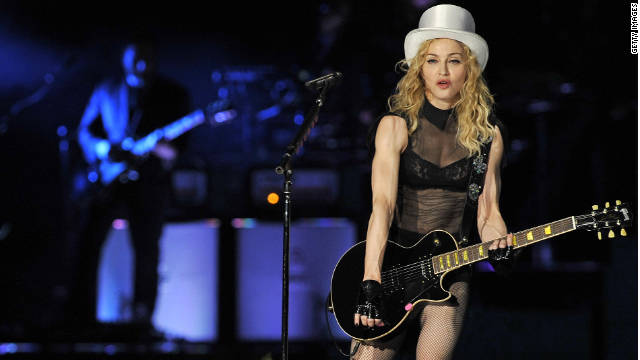
Madonna to headline Super Bowl halftime show
Madonna will take center stage at halftime of Super Bowl XLVI, flanked by Cirque du Soleil performers in what traditionally is one of the year's most watched shows.
The NFL announced Sunday night, in a press release, that the Michigan-born singer would headline the halftime show on February 5, 2012, at Lucas Oil Stadium in Indianapolis.
She follows other high-profile acts in recent years, including the Black Eyed Peas and Usher during the most recent edition of pro football's championship game at Cowboys Stadium in Texas.
Other past performers including Bruce Springsteen, Prince, The Rolling Stones and Paul McCartney. The halftime show has also been the subject of controversy, specifically in 2004 during Janet Jackson's infamous "wardrobe malfunction" while singing alongside Justin Timberlake.
The league calls the show "the most-watched musical event of the year," with more than 162 million people tuning in last year in the United States alone.
A 2008 Rock and Roll Hall of Fame inductee, Madonna is ranked by the Guinness Book of World Records as the top-selling female recording artist of all time.
She erupted on the scene in the '80s, selling 60 million records that decade and scoring several No. 1 hits including "Like a Virgin," "Papa Don't Preach" and "Crazy for You."
She continued her momentum in the 1990s with her Blonde Ambition Tour and also made headlines as a provocateur for her album "Erotica" and X-rated picture book "Sex."
Even with a growing family, Madonna has continued working -- including releasing several more albums and books. She has also acted in several films over the course of her career such as "Evita," "Desperately Seeking Susan" and "Dick Tracy."
Khan Academy:Online Learning, Personalized
Jesse Roe, a ninth-grade math teacher at a charter school here called Summit, has a peephole into the brains of each of his 38 students.
He can see that a girl sitting against the wall is zipping through geometry exercises; that a boy with long curls over his eyes is stuck on a lesson on long equations; and that another boy in the front row is getting a handle on probability.
Each student’s math journey shows up instantly on the laptop Mr. Roe carries as he wanders the room. He stops at each desk, cajoles, offers tips, reassures. For an hour, this crowded, dimly lighted classroom in the hardscrabble shadow of Silicon Valley hums with the sound of fingers clicking on keyboards, pencils scratching on paper and an occasional whoop when a student scores a streak of right answers.
The software program unleashed in this classroom is the brainchild of Salman Khan
, an Ivy League-trained math whiz and the son of an immigrant single mother. Mr. Khan, 35, has become something of an online sensation with his Khan Academy math and science lessons on YouTube, which has attracted up to 3.5 million viewers a month.
Now he wants to weave those digital lessons into the fabric of the school curriculum — a more ambitious and as yet untested proposition.
This semester, at least 36 schools nationwide are trying out Mr. Khan’s experiment: splitting up the work of teaching between man and machine, and combining teacher-led lessons with computer-based lectures and exercises.
As schools try to sort out confusing claims about the benefits of using technology in the classroom, and companies ponder the profits from big education contracts, Khan Academy may seem like just another product vying for attention.
But what makes Mr. Khan’s venture stand out is that the lessons and software tools are entirely free — available to anyone with access to a reasonably fast Internet connection.
“The core of our mission is to give material to people who need it,” Mr. Khan said. “You could ask, ‘Why should it be free?’ But why shouldn’t it be free?”
For now, Mr. Khan’s small team is subsidized by more than $16.5 million from technology donors, including Bill Gates, Google, the Silicon Valley Community Foundation and the O’Sullivan Foundation. He intends to raise an endowment. And this summer, starting in the Bay Area, where he is based, he plans to hold an educational summer camp.
It is too early to know whether the Khan Academy software makes a real difference in learning. A limited study with students in Oakland, Calif., this year found that children who had fallen behind in math caught up equally well if they used the software or were tutored in small groups. The research firm SRI International is working on an evaluation of the software in the classroom.
Mr. Khan’s critics say that his model is really a return to rote learning under a high-tech facade, and that it would be far better to help children puzzle through a concept than drill it into their heads.
“Instead of showing our students a better lecture, let’s get them doing something better than lecture,” Frank Noschese, a high school physics teacher in Cross River, N.Y., wrote on his blog in June.
But in education circles, Mr. Khan’s efforts have captured imaginations and spawned imitators. Two Stanford professors have drawn on his model to offer a free online artificial intelligence class. Thirty-four thousand people are now taking the course, and many more have signed up. Stanford Medical School, which allows its students to take lectures online if they want, summoned Mr. Khan to help its faculty spice up their presentations.
And a New York-based luxury real estate company credited Mr. Khan with inspiring its profit-making venture: the Floating University, a set of online courses taught by academic superstars, repackaged and sold to Ivy League colleges and eventually to anyone who wants to pay for them.
“What Khan represents is a model that’s tapped into the desire that everyone has to personalize the learning experience and get it cheap and quick,” said Jim Shelton, assistant deputy secretary for innovation and improvement at the Education Department.
Mr. Shelton predicted that there would be “a bunch of knockoffs” that would take the Khan approach and try to expand on it. “This is going to spread like wildfire,” he said.
Mr. Khan grew up in a suburb of New Orleans, where his mother, who is from Bangladesh, raised him on her own by cobbling together a series of jobs and businesses. He went to public schools, where, as he recalls, a few classmates were fresh out of jail and others were bound for top universities.
Math became his passion. He pored over textbooks and joined the math club. He came to see math as storytelling. “Math is a language for thinking,” he said, “as opposed to voodoo magical incantations where you have no idea where they’re coming from.”
The YouTube lectures got their start six years ago when Mr. Khan needed a way to help a cousin catch up on high school math. They are startlingly simple. Each one covers a single topic, like long division or the debt crisis, usually in a bite-size 10-minute segment. The viewer hears Mr. Khan talking, in his typically chatty, older brother sort of way. But his face is never seen, just his scribbles on the screen. More recently he has included two outside specialists to give lectures on art history topics like the Rosetta Stone and Caravaggio.
Today, the Khan Academy site offers 2,700 instructional videos and a constellation of practice exercises. Master one concept, move on to the next. Earn rewards for a streak of correct answers. For teachers, there is an analytics dashboard that shows both an aggregate picture of how the class is doing and a detailed map of each student’s math comprehension. In other words, a peephole.
Diane Tavenner, chief of the Summit chain of four charter schools, said that at first she was ambivalent about using Mr. Khan’s software. It would require buying laptops for every student and investing in more Internet capacity. And she found the Khan Academy model of instructor and blackboard — albeit a digital one — to be a bit too traditional.
In the past, math class at the Summit schools was always hands-on: the class worked on a problem, usually in small groups, sometimes for days at a time. But getting an entire class of ninth graders to master the fundamentals of math was never easy. Without those, the higher-level conceptual exercises were impossible.
That is where the machine came in handy. The Khan software offered students a new, engaging way to learn the basics.
Ms. Tavenner says she believes that computers cannot replace teachers. But the computer, she recognizes, can do some things a teacher cannot. It can offer personal feedback to a whole room of students as they work. And it can give the teacher additional class time to do more creative and customized teaching.
“Combining Khan with that kind of teaching will produce the best kind of math,” she argued. “Teachers are more effective because they have a window into the student’s mind.”
Ms. Tavenner’s students here inhabit a world that seems distant from the dazzle and wealth of adjacent Silicon Valley. Nearly half come from families where English is a second language. Forty percent qualify for free lunches. So pervasive is gang violence in the area that school uniforms have been mandated as a safeguard against the display of gang colors. Not all students have a computer at home, or parents who can help with homework.
Math class at Summit on one afternoon this fall began like many around the country. Mr. Roe was at the whiteboard at the head of the room, explaining order of operations — the math concept that dictates the sequence in which calculations should be performed in a long equation. Handouts were passed out, and there was a series of questions and answers.
In the second hour, the students were huddled over laptops, each working on a different set of exercises. Nicole Bermudez, 14, was on geometry. She had trouble with math in middle school. Her teacher, she said, had no time to help her, and her mother did not have the patience. “She would just yell at me. She would say, ‘You can’t get it? This is simple math.’ ”
The Khan Academy software, she pointed out, offers hints and instructional videos to nudge her ahead. It waits until she has mastered one concept before she can move on to the next. She can ask Mr. Roe when she is really stuck.
In the back of the class, two girls wearing headphones watched one of Mr. Khan’s videos. Moses Rodriguez plodded slowly through some exercises, his attention occasionally wandering until Mr. Roe came around and prodded him. The classroom was quiet, apart from the occasional eruptions of victory.
“Is your brain hurting yet?” one girl asked her neighbor.
Polio Continues To Afflict Pakistan's Baluchistan Region
http://www.rferl.org
Health officials in the southern Pakistani province of Baluchistan say new polio cases have been reported across the region despite repeated antipolio campaigns, RFE/RL's Radio Mashaal reports.
Provincial Health Secretary Asmatullah Kakar told RFE/RL the United Nations Children Fund (UNICEF) is asking Pakistani officials why polio cases are on the rise despite the huge amount of money that has been spent on vaccinations.
Kakar said there were now 62 cases there of the viral disease, also known as infantile paralysis, which can affect nerves and lead to partial or full paralysis.
"One reason is [parents'] refusal [to have their children vaccinated], and, secondly, some areas are not accessible," Kakar said. "This is the responsibility of every individual, each religious and tribal elder, and only then can we control it."
Kakar said his department has demoted several district health officers for poor performance and deployed new officers in an effort to control polio's spread.
Antipolio campaigner Abdul Wahab Atal says people are not heeding the call to ensure that their children are administered the vaccine drops.
"Some people are not cooperating for religious reasons, because they are exposed to propaganda about the drops, while others have doubts about the effectiveness of the drops," Atal said. "In their view: How can a few drops of liquid help eradicate a serious disease?"
Villagers in remote areas say they don't know about the campaign, but some parents appear to be resisting the effort.
"When the polio teams visit our house, my parents tell them there are no children in the house," 5-year-old Saifullah, who says his parents refused to give him polio drops the last time a health team visited their house, told RFE/RL.
Health officials in the southern Pakistani province of Baluchistan say new polio cases have been reported across the region despite repeated antipolio campaigns, RFE/RL's Radio Mashaal reports.
Provincial Health Secretary Asmatullah Kakar told RFE/RL the United Nations Children Fund (UNICEF) is asking Pakistani officials why polio cases are on the rise despite the huge amount of money that has been spent on vaccinations.
Kakar said there were now 62 cases there of the viral disease, also known as infantile paralysis, which can affect nerves and lead to partial or full paralysis.
"One reason is [parents'] refusal [to have their children vaccinated], and, secondly, some areas are not accessible," Kakar said. "This is the responsibility of every individual, each religious and tribal elder, and only then can we control it."
Kakar said his department has demoted several district health officers for poor performance and deployed new officers in an effort to control polio's spread.
Antipolio campaigner Abdul Wahab Atal says people are not heeding the call to ensure that their children are administered the vaccine drops.
"Some people are not cooperating for religious reasons, because they are exposed to propaganda about the drops, while others have doubts about the effectiveness of the drops," Atal said. "In their view: How can a few drops of liquid help eradicate a serious disease?"
Villagers in remote areas say they don't know about the campaign, but some parents appear to be resisting the effort.
"When the polio teams visit our house, my parents tell them there are no children in the house," 5-year-old Saifullah, who says his parents refused to give him polio drops the last time a health team visited their house, told RFE/RL.
Obama condolences for Pakistan airstrike deaths
President Barack Obama
on Sunday expressed condolences to Pakistan's President Asif Ali Zardari for the deaths last month of 24 Pakistani troops, saying the NATO airstrikes that killed them were not a "deliberate attack."
A White House statement said Obama placed a call early Sunday to Zardari expressing his regrets over the "tragic loss" and promising a "full investigation" into the incident, which has plunged the two uneasy allies into a diplomatic crisis.
Obama "made clear that this regrettable incident was not a deliberate attack on Pakistan and reiterated the United States' strong commitment to a full investigation," the statement said.
Islamabad has so far refused to take part in a US investigation into the November 26 air strikes on the Afghan border.
But the White House said Obama and Zardari nonetheless "reaffirmed their commitment to the US-Pakistan bilateral relationship, which is critical to the security of both nations, and they agreed to stay in close touch."
In the wake of the strikes, Pakistan decided not to take part in the Bonn Conference on the future of Afghanistan that opens Monday -- a decision which, together with the Taliban's boycott, has cast the event's usefulness into doubt.
Pakistan has also shut down NATO's vital supply line into Afghanistan and ordered American personnel to leave Shamsi air base.
The base is widely understood to have been a hub for the covert CIA drone war on Taliban and Al-Qaeda commanders in Pakistan's troubled border areas with Afghanistan.
Egypt's ElBaradei: Liberals 'decimated' in vote
Egypt's top reformist leader said Sunday the liberal youth behind the country's uprising have been "decimated" in parliamentary elections dominated by Islamists and expressed concern about the rise of hard-line religious elements advocating extremist ideas such as banning women from driving.
Mohamed ElBaradei, a Nobel Prize laureate and possible presidential candidate, said he hopes moderate Islamists will rein in the extremists and send a reassuring message to the world that Egypt will not go down an ultraconservative religious path.
"The youth feel let down. They don't feel that any of the revolution's goals have been achieved," ElBaradei told The Associated Press in an interview on the same day electoral authorities announced that Islamist parties captured an overwhelming majority of votes in the first round of elections last week. "They got decimated," he said, adding the youth failed to unify and form "one essential critical mass."
The High Election Commission announced that the Islamic fundamentalist Muslim Brotherhood's Freedom and Justice Party garnered 36.6 percent of the 9.7 million valid ballots cast last week for party lists. The Nour Party, representing the more hard-line Salafi Islamists, captured 24.4 percent.
The tallies offer only a partial indication of how the new parliament will look. There are still two more rounds of voting in 18 of the country's 27 provinces over the coming month and runoff elections on Monday and Tuesday to determine almost all of the seats allocated for individuals in the first round. But the grip of the Islamists over the next parliament appears set, particularly considering their popularity in provinces voting in the next rounds.
ElBaradei said he thought the combined strength of the two top-placed Islamist blocs surprised everyone, probably even the winning parties themselves.
"The outcome so far is not the greatest one," he said, summing up the mood of the country's educated elite as well as average Egyptians as "angst."
The new parliament will be tasked, in theory, with selecting a 100-member panel to draft the new constitution. If Islamist parties dominate, more liberal forces worry the constitution will be greatly influenced by the religious perspective.
In a move that angered the Islamist groups, the Supreme Council of the Armed Forces, which took control of the country after Mubarak's fall in February, has suggested that it will choose 80 of those members.
ElBaradei said writing the constitution that respects human rights, dignity and freedom of expression should be based on a consensus among all the players, and not on a parliamentary majority.
"In my view, it is all in the hands of SCAF right now," he said, hoping the ruling generals will help promote the consensus.
However, ElBaradei was highly critical of the military rulers, saying they have "royally mismanaged" the transition period.
He also raised concerns about statements by some Salafi elements questioning whether women should be banned from driving, as they are in Saudi Arabia, or branding the novels of Egypt's Nobel laureate Naguib Mahfouz, as "prostitution."
"I worry of course that some of the extreme stuff coming out from some of the Salafis ... when you hear that literature of somebody like Mahfouz is equal to prostitution, if you hear that we are still debating whether women are going to drive their cars, if we are still discussing whether democracy is against Shariah," or Islamic law, ElBaradei said.
"These are of course sending shockwaves, statements like that. I think the Brotherhood in particular, and some of the Salafis, should send quickly messages of assurance both inside the country and outside the country to make sure that society continues to be cohesive to make sure that investment will come in."
He said the statements "will have tremendous economic and political implications." Moderate Islamists need to "make clear that some of these voices ... are on the extreme fringes and they will not be the mainstream."
The focus on safeguarding religious principles should be mindful of rampant poverty and illiteracy, not "about what people are going to dress, to drink," he said.
Salafis are newcomers on Egypt's political scene. They long shunned the concept of democracy, saying it allows man's law to override God's. But they formed parties and entered politics after Hosni Mubarak's ouster in February, seeking to enshrine Islamic law in Egypt's new constitution.
By contrast, the Muslim Brotherhood, Egypt's largest and best organized political group, was officially banned under Mubarak but established a nationwide network of activists. After Mubarak's fall, the group's Freedom and Justice Party campaigned fiercely, their organization and name-recognition giving them a big advantage over newly formed liberal parties.
ElBaradei said the Muslim Brotherhood's strong showing was not unexpected, given that Egypt is emerging from decades of brutal dictatorship that smothered civil society. He said one in every three Egyptians is illiterate and nearly half subsist in deep poverty.
"It should not be a surprise people are voting with their gut. People lost their sense of identity with the state. They identify with religion," ElBaradei said.
He said the Brotherhood has been working for many years providing basic needs for health care and other social services the government failed to deliver and they were well known throughout the country.
In contrast, the liberal youth groups behind the uprising failed to form a cohesive, unified front. He said they only formed political parties two months ago.
He predicted the Muslim Brotherhood will prefer to form an alliance with the liberals rather than the Salafis to get a majority in parliament. The liberal Egyptian Bloc — which came in third with 13.4 percent of the votes — could counterbalance hard-line elements.
Nevertheless, ElBaradei agreed the first elections since Mubarak's fall were free and fair and said the massive turnout of about 60 percent lent it legitimacy.
However, he said it will not produce a parliament that represents Egyptian society. ElBaradei said he expects few women, youths or Coptic Christians, a minority that constitutes about 10 percent of Egypt's 85 million citizens.
The rise of the Islamists has also caused concern in the U.S. and Israel, which has a long-standing peace treaty with Egypt it fears might be in jeopardy. But ElBaradei said he does not foresee any radical changes in Egypt's foreign policy because the country still depends heavily on foreign assistance and cannot afford to isolate itself. Egypt is one of the largest recipients of U.S. foreign aid.
He said Egyptians are looking more to Turkey as a model for a moderate Islamist state rather than Saudi Arabia and its strict imposition of Islamic law.
ElBaradei said Egypt has progressed since the revolution but the economy and law and order have deteriorated sharply.
"We are now a freer country," he said. "People lost their sense of fear. ...We are empowered as a people."
He said he is advising the liberal youth groups not to give up and to view this as a "long haul" process and to start preparing for the next elections, overcome their ideological differences and work together.
"We'll have to keep fighting," he said, adding that "the revolution is still a work in progress."
He predicted protesters will return to Cairo's Tahrir Square to keep pressing their demands.
"If you have the second wave of the revolution, it will be an angry one," he said.
Sunday, December 4, 2011
Khyber Pakhtunkhwa Patients suffering from blood cancer
The provincial government of Khyber Pakhtunkhwa on Thursday launched Rs 7.2 billion free treatment project for the patients of blood cancer in the province.
The project was launched in a ceremony at a local hotel.
Khyber Pakhtunkhwa Minister for Finance, Engineer Mohammad Hamayun Khan was the chief guest on the occasion.
The project will be carried out under public-private partnership and the provincial government for this purpose has signed a Memorandum of Understanding (MoU) with Novartis, a multi-national pharmaceutical company.
Under the project all the deserving patients of chronic myeloid leukemia (CML) in the province will be registered with a specially established focal point in Medical Oncology unit at Hayatabad Medical Complex (HMC) from where they will be provided free medicines.
Pakistan has about 12000 blood cancer patients and about 1000 of them belong to Khyber Pakhtunkhwa.
Blood cancer is a deadly disease and its treatment is very costly and poor patients could not afford it.
Therefore, the provincial government in collaboration with Novartis launched this free treatment and medicine scheme in the province Addressing the ceremony, the minister said that despite financial constraints the provincial government allocated maximum funds for treatment of patients of blood cancer.
He said that last year the provincial government launched Bacha Khan Khpal Rozgar Scheme and allocated funds for the provision of free treatment of hepatitis and promotion of technical and vocational education.
He said that the provincial government also agreed with the proposal of the Novartis for provision of free medicines for the cancer patients.
Briefing the participants of the ceremony, Dr Abid Jameel, of the Department of Oncology, HMC said that CML used to attack people aged between 45 to 50 years in Europe and American continents, but in Pakistan it attacks in the prime age of 35 to 40 years.
He said that the medicines produced by Novartis for the treatment of blood cancer is a revolution in the medical history and successful treatment of 80 percent patients is a breakthrough in the field of medical sciences.
He said that the cost of one month dosage of the medicine was Rs 1,20,000 and annual cost of over Rs 1.4 million, which was not affordable by the poor patients and the provincial government was also lacking resources.
Therefore, it signed an MoU with Novartis under which the medicine to be provided free of cost to the patients.
The provincial government will now pay only Rs 8000/- per month for medicines of the patient.
Later, the minister formally inaugurated the scheme with distribution of free medicines among the patients.
Occupy Wall Street protesters launch hunger strike
http://www.news.com.au
OCCUPY Wall Street protesters have launched a hunger strike Saturday to demand a new occupation campsite in an unused lot.
Protesters in New York were evicted from Zuccotti Park in Lower Manhattan on November 15 after almost two months of camping in the small square to protest income inequality and the influence of corporate money in US politics.
Hunger strikers planned to gather Saturday in Duarte Square, about a mile north of Zuccotti Park, protest organisers said in a press release. They hope to be allowed to camp in a vacant lot owned by Trinity Church.
Protesters who are arrested plan to continue their hunger strikes in jail, the press release said.
The Occupy protests, spearheaded by the activist magazine Adbusters, began in Zuccotti Park on September 17 and have spread to other cities throughout the US and the world.
Yesterday's press release called on protesters in other cities to join the hunger strike.
"This is a call for escalation in response to the escalated levels of government-enacted violence and repression," it said.
"In cities across the nation, mayors chose to stifle freedom of speech and the right to assemble by evicting peaceful occupations using illegal and unconstitutional force."
Occupy encampments in Philadelphia, Los Angeles and Seattle have also been shut down.
OCCUPY Wall Street protesters have launched a hunger strike Saturday to demand a new occupation campsite in an unused lot.
Protesters in New York were evicted from Zuccotti Park in Lower Manhattan on November 15 after almost two months of camping in the small square to protest income inequality and the influence of corporate money in US politics.
Hunger strikers planned to gather Saturday in Duarte Square, about a mile north of Zuccotti Park, protest organisers said in a press release. They hope to be allowed to camp in a vacant lot owned by Trinity Church.
Protesters who are arrested plan to continue their hunger strikes in jail, the press release said.
The Occupy protests, spearheaded by the activist magazine Adbusters, began in Zuccotti Park on September 17 and have spread to other cities throughout the US and the world.
Yesterday's press release called on protesters in other cities to join the hunger strike.
"This is a call for escalation in response to the escalated levels of government-enacted violence and repression," it said.
"In cities across the nation, mayors chose to stifle freedom of speech and the right to assemble by evicting peaceful occupations using illegal and unconstitutional force."
Occupy encampments in Philadelphia, Los Angeles and Seattle have also been shut down.
Afghanistan's future beyond 2014
ANNE GEARAN and JUERGEN BAETZ | AP
A global conference in Germany to discuss Afghanistan's future beyond 2014 comes as the country faces political instability, an enduring Taliban-led insurgency and possible financial collapse following the planned drawdown of international troops and foreign aid.
About 100 countries and international organizations will be represented at the Monday gathering, with some 60 foreign ministers in attendance, among them U.S. Secretary of State Hillary Rodham Clinton.
But one of the most important countries for Afghanistan's future, its eastern nuclear-armed neighbor Pakistan, said it will boycott the conference to protest last month's NATO air assault carried out from Afghan territory that killed 24 Pakistani soldiers.
Pakistan is seen as crucial player in the region because of its links and influence on insurgent groups that are battling Afghan government and foreign troops and that sometimes use Pakistan as a base for their operations.
The Bonn conference is expected to address the transfer of security responsibility from international forces to Afghan security forces over the next three years, long-term prospects for international aid and a possible political settlement with the Taliban.
"Our objective is a peaceful Afghanistan that will never again become a safe haven for international terrorism," German Foreign Minister Guido Westerwelle said.
The U.S. had once hoped to use the Bonn gathering to announce news about the prospect for peace talks with the Taliban, but neither an Afghan nor a U.S. outreach effort has borne fruit.
The reconciliation efforts suffered a major setback after the September assassination of former Afghan President Burhanuddin Rabbani, who was leading the Afghan government's effort to broker peace with the insurgents.
But Washington and other partners are still trying to arrange an interim step toward talks — the opening of a Taliban diplomatic office where its representatives could conduct international business without fear of being arrested or killed. Such a deal would be a minor accomplishment for the Bonn gathering.
"Right now we don't know their address. We don't have a door," to knock on, said Afghanistan's ambassador to the U.S., Eklil Hakimi.
The final declaration of the Bonn conference is expected to outline broad principles and red lines for the political reconciliation with the Taliban, a project that several leading participants in the conference increasingly predict will outlast the NATO timeline for withdrawal in 2014.
The Bonn conference also seeks to agree on a set of "mutual binding commitments" under which Afghanistan would promise reforms and policy goals such as good governance, with donors and international organizations pledging long-term assistance in return to ensure the country's viability beyond 2014, a senior German diplomat said.
"It's about not repeating the mistakes of 1989, when the Soviet troops left and the West also forgot about Afghanistan," he said, referring to the bitter civil war that unfolded soon after the sudden withdrawal that was followed by the collapse of the Soviet Union.
Afghan President Hamid Karzai, German Chancellor Angela Merkel and U.N. Secretary-General Ban Ki-moon will formally open the one-day conference of about 1,000 delegates. Afghanistan's western neighbor Iran also joins the conference, represented by Foreign Minister Ali Akbar Salehi.
Afghan civil society groups are meeting on the sidelines, and some 5,000 protesters were out in Bonn's streets Saturday, urging an end to the Afghan war.
While the conference is nominally run by the Afghans and organized by Germany, the United States is the key participant because it's the country that has by far invested the most blood and treasure in Afghanistan since 2001.
The NATO coalition of 49 countries currently has 130,000 troops in the country, including about 72,000 Americans. The U.S. military footprint in Afghanistan, however, totals more than 101,600 because other American forces operate under a separate command. The vast majority are set to withdraw from Afghanistan over the next three years, leaving only a small force focused on training and counterterrorism missions beginning in 2015.
President Barack Obama announced this summer that 10,000 U.S. troops will come home by the end of the year. Another 23,000 will be pulled out by the end of September 2012. Those troops represent the 33,000 reinforcements that Obama sent in to help reverse the Taliban's momentum, leaving a force of about 68,000 U.S. forces, which will gradually shrink as the deadline for withdrawal approaches.
That deadline was set a year ago, by agreement between NATO and Afghanistan. There is little chance it will be extended.
The U.S. had also hoped to use this opportunity to unveil an agreement with the Afghan government establishing operating rules for the small number of remaining U.S. forces and other issues after international forces withdraw. But talks on the deal have bogged down over the past several months.
Although the Bonn gathering is not a donors' conference where specific pledges are expected, the U.S. is seeking agreement among other nations that they will not rush to the exits and commit to long-term financial assistance to avoid seeing Afghanistan slip back into chaos.
The international troops' withdrawal could indeed cause the Afghan economy to collapse, the World Bank warned last month, stressing that the war-ravaged nation will need billions of dollars in aid for another decade or more.
Afghanistan this year received $15.7 billion in aid, representing more than 90 percent of its public spending, it said.
In a report published ahead of the conference, the Afghan government said that despite expected revenue increases from a growing mining industry, customs and taxes, foreign donors will have to finance about half of the country's economic output in 2015, equivalent to aid worth $10 billion.
Despite the international troops' presence for more than a decade, Afghanistan still ranks among the world's poorest and most corrupt nations.
Without foreign help, Afghanistan won't be able to pay for basic services needed by its security forces which are slated to increase to 352,000 personnel by the end of 2014. Those expenses will have grown to twice the size of revenues and will result in a shortfall of about $7.8 billion annually, or about 25 percent of the country's gross domestic product in 2021.
"There will be a gap from when international forces withdraw, and we want to see a plan," for filling it, Hakimi said.
Although the United States has spent $444 billion in Afghanistan since it invaded the country in late 2001 after the Sept. 11 terrorist attacks, and plans to spend $101 billion in fiscal 2011, most of that money "does not reach Afghanistan because it primarily funds salaries of international soldiers, purchases of military hardware, and the like," the World Bank said.
Despite improvements to security in Afghanistan, militants operating from safe havens in Pakistan and chronic problems with the Kabul government pose significant risks to a "durable, stable Afghanistan," according to a recent Pentagon progress report on the country.
A global conference in Germany to discuss Afghanistan's future beyond 2014 comes as the country faces political instability, an enduring Taliban-led insurgency and possible financial collapse following the planned drawdown of international troops and foreign aid.
About 100 countries and international organizations will be represented at the Monday gathering, with some 60 foreign ministers in attendance, among them U.S. Secretary of State Hillary Rodham Clinton.
But one of the most important countries for Afghanistan's future, its eastern nuclear-armed neighbor Pakistan, said it will boycott the conference to protest last month's NATO air assault carried out from Afghan territory that killed 24 Pakistani soldiers.
Pakistan is seen as crucial player in the region because of its links and influence on insurgent groups that are battling Afghan government and foreign troops and that sometimes use Pakistan as a base for their operations.
The Bonn conference is expected to address the transfer of security responsibility from international forces to Afghan security forces over the next three years, long-term prospects for international aid and a possible political settlement with the Taliban.
"Our objective is a peaceful Afghanistan that will never again become a safe haven for international terrorism," German Foreign Minister Guido Westerwelle said.
The U.S. had once hoped to use the Bonn gathering to announce news about the prospect for peace talks with the Taliban, but neither an Afghan nor a U.S. outreach effort has borne fruit.
The reconciliation efforts suffered a major setback after the September assassination of former Afghan President Burhanuddin Rabbani, who was leading the Afghan government's effort to broker peace with the insurgents.
But Washington and other partners are still trying to arrange an interim step toward talks — the opening of a Taliban diplomatic office where its representatives could conduct international business without fear of being arrested or killed. Such a deal would be a minor accomplishment for the Bonn gathering.
"Right now we don't know their address. We don't have a door," to knock on, said Afghanistan's ambassador to the U.S., Eklil Hakimi.
The final declaration of the Bonn conference is expected to outline broad principles and red lines for the political reconciliation with the Taliban, a project that several leading participants in the conference increasingly predict will outlast the NATO timeline for withdrawal in 2014.
The Bonn conference also seeks to agree on a set of "mutual binding commitments" under which Afghanistan would promise reforms and policy goals such as good governance, with donors and international organizations pledging long-term assistance in return to ensure the country's viability beyond 2014, a senior German diplomat said.
"It's about not repeating the mistakes of 1989, when the Soviet troops left and the West also forgot about Afghanistan," he said, referring to the bitter civil war that unfolded soon after the sudden withdrawal that was followed by the collapse of the Soviet Union.
Afghan President Hamid Karzai, German Chancellor Angela Merkel and U.N. Secretary-General Ban Ki-moon will formally open the one-day conference of about 1,000 delegates. Afghanistan's western neighbor Iran also joins the conference, represented by Foreign Minister Ali Akbar Salehi.
Afghan civil society groups are meeting on the sidelines, and some 5,000 protesters were out in Bonn's streets Saturday, urging an end to the Afghan war.
While the conference is nominally run by the Afghans and organized by Germany, the United States is the key participant because it's the country that has by far invested the most blood and treasure in Afghanistan since 2001.
The NATO coalition of 49 countries currently has 130,000 troops in the country, including about 72,000 Americans. The U.S. military footprint in Afghanistan, however, totals more than 101,600 because other American forces operate under a separate command. The vast majority are set to withdraw from Afghanistan over the next three years, leaving only a small force focused on training and counterterrorism missions beginning in 2015.
President Barack Obama announced this summer that 10,000 U.S. troops will come home by the end of the year. Another 23,000 will be pulled out by the end of September 2012. Those troops represent the 33,000 reinforcements that Obama sent in to help reverse the Taliban's momentum, leaving a force of about 68,000 U.S. forces, which will gradually shrink as the deadline for withdrawal approaches.
That deadline was set a year ago, by agreement between NATO and Afghanistan. There is little chance it will be extended.
The U.S. had also hoped to use this opportunity to unveil an agreement with the Afghan government establishing operating rules for the small number of remaining U.S. forces and other issues after international forces withdraw. But talks on the deal have bogged down over the past several months.
Although the Bonn gathering is not a donors' conference where specific pledges are expected, the U.S. is seeking agreement among other nations that they will not rush to the exits and commit to long-term financial assistance to avoid seeing Afghanistan slip back into chaos.
The international troops' withdrawal could indeed cause the Afghan economy to collapse, the World Bank warned last month, stressing that the war-ravaged nation will need billions of dollars in aid for another decade or more.
Afghanistan this year received $15.7 billion in aid, representing more than 90 percent of its public spending, it said.
In a report published ahead of the conference, the Afghan government said that despite expected revenue increases from a growing mining industry, customs and taxes, foreign donors will have to finance about half of the country's economic output in 2015, equivalent to aid worth $10 billion.
Despite the international troops' presence for more than a decade, Afghanistan still ranks among the world's poorest and most corrupt nations.
Without foreign help, Afghanistan won't be able to pay for basic services needed by its security forces which are slated to increase to 352,000 personnel by the end of 2014. Those expenses will have grown to twice the size of revenues and will result in a shortfall of about $7.8 billion annually, or about 25 percent of the country's gross domestic product in 2021.
"There will be a gap from when international forces withdraw, and we want to see a plan," for filling it, Hakimi said.
Although the United States has spent $444 billion in Afghanistan since it invaded the country in late 2001 after the Sept. 11 terrorist attacks, and plans to spend $101 billion in fiscal 2011, most of that money "does not reach Afghanistan because it primarily funds salaries of international soldiers, purchases of military hardware, and the like," the World Bank said.
Despite improvements to security in Afghanistan, militants operating from safe havens in Pakistan and chronic problems with the Kabul government pose significant risks to a "durable, stable Afghanistan," according to a recent Pentagon progress report on the country.
Saturday, December 3, 2011
What Happened on the Border?
It’s not clear what led to NATO strikes on two Pakistani border posts this weekend, but there can be no dispute that the loss of lives is tragic. At least 24 Pakistani troops were killed. We regret those deaths, as we do those of all American, NATO and Afghan troops and Pakistani and Afghan civilians killed by extremists.
Washington and Islamabad need to work together, urgently, to ensure that this incident does not destroy their deeply troubled relationship. The United States needs Pakistan’s cooperation — as grudging as it is — to pursue the fight against the Taliban. And without American support, Pakistan’s fragile government will be even more vulnerable to extremist attacks.
So far, Pakistan’s leaders seem most interested in fanning popular anger. The Obama administration and NATO have wasted precious time, allowing the crisis to escalate.
On Saturday, after the first reports, Secretary of State Hillary Rodham Clinton and Defense Secretary Leon Panetta issued a statement offering their “deepest condolences for the loss of life.” We’re not sure why President Obama waited until Monday to add his voice.
We are also puzzled, and concerned, by the delay in opening a full and transparent inquiry. On Saturday, the top American commander in Afghanistan, Gen. John Allen, said he would “thoroughly” investigate the incident. But that was never going to be enough.
It took until Monday for Gen. James Mattis, leader of the Pentagon’s Central Command, to announce a more formal investigation and to name Brig. Gen. Stephen Clark to lead it. The inquiry will include representatives of NATO and General Allen’s team. Significantly, Central Command said Pakistan and Afghanistan would be invited to participate. Islamabad and Kabul should both agree. The panel needs to move ahead quickly and credibly, with full disclosure no matter what it finds.
Pakistan’s leaders, as ever, are playing a very dangerous game. On Monday, Prime Minister Yousaf Raza Gilani vowed in an interview on CNN, that “business as usual will not be there.” His government has already shut down NATO supply routes to Afghanistan, ordered a base used for drone strikes evacuated and threatened to boycott a conference on Afghanistan’s security and development. Some news reports are also quoting ordinary Pakistanis demanding that their government retaliate militarily against American forces across the border.
Before things get out of control, Pakistan’s leaders need to lower their rhetoric and make clear that it is in their country’s interest to work with the Americans to find out what happened and ensure it will not happen again.
There are many questions that need to be answered. Who first fired on the American-Afghan force? Pakistan’s army is far too cozy with the Taliban. Were fighters sheltering near the Pakistani outposts? What about Pakistan’s claim that the NATO strikes continued for two hours even after Pakistan alerted allied officials? What needs to be done differently going forward?
The two sides need answers if there is any hope of finding a way back from the brink.
Pakistan actress defends ISI tattoo for photo shoot
Pakistani actress Veena Malik
defended on Saturday her front cover photos for men's magazine FHM, where she appeared with ISI tattooed on her arm, but denied the photo shoot involved any nudity.
"In India every thing is referred to ISI (Pakistan's top spy agency Inter Services Intelligence)", she told Pakistan's Geo TV. "Even if a very small thing happens, they say ISI is behind it. Everybody blames ISI for everything."
The actress said the original idea had been Kabeer Sharma's, editor of FHM's Indian edition, but that the photos had been "morphed".
"He told me that (the tattoo) will be very bold and will cover the upper portion of the body, which it did not.
"I agreed to a photo shoot and having an ISI tattoo in a humorous way but I did not have any nude photos. My pictures have been morphed," said Malik, who shot to fame in Indian TV show "Big Boss 4".
"They have the videos of the shoot but it would be in clothes and not without clothes", the actress said.
Also speaking to Pakistan's private Geo channel, Sharma said Malik had been "very excited for this shoot" and the tattoo by the makeup artist had been "in very thin font, but (Malik) asked to make a bold tattoo of ISI".
Reacting to the controversy, Pakistan's Interior minister Rehman Malik said that the government would verify the nudity matter.
"If she has done so, she did wrong. But, these pictures are tempered many times and we will look into this issue," he told reporters.
defended on Saturday her front cover photos for men's magazine FHM, where she appeared with ISI tattooed on her arm, but denied the photo shoot involved any nudity.
"In India every thing is referred to ISI (Pakistan's top spy agency Inter Services Intelligence)", she told Pakistan's Geo TV. "Even if a very small thing happens, they say ISI is behind it. Everybody blames ISI for everything."
The actress said the original idea had been Kabeer Sharma's, editor of FHM's Indian edition, but that the photos had been "morphed".
"He told me that (the tattoo) will be very bold and will cover the upper portion of the body, which it did not.
"I agreed to a photo shoot and having an ISI tattoo in a humorous way but I did not have any nude photos. My pictures have been morphed," said Malik, who shot to fame in Indian TV show "Big Boss 4".
"They have the videos of the shoot but it would be in clothes and not without clothes", the actress said.
Also speaking to Pakistan's private Geo channel, Sharma said Malik had been "very excited for this shoot" and the tattoo by the makeup artist had been "in very thin font, but (Malik) asked to make a bold tattoo of ISI".
Reacting to the controversy, Pakistan's Interior minister Rehman Malik said that the government would verify the nudity matter.
"If she has done so, she did wrong. But, these pictures are tempered many times and we will look into this issue," he told reporters.
Friday, October 21, 2011
Hillary Clinton says US officials have met with Haqqanis
Secretary of State Hillary Clinton said Friday that the United States had held a preliminary meeting with representatives of the Haqqani network, a group of militants Washington has blamed for a series of attacks in Afghanistan.
The revelation came soon after Clinton, in Islamabad with a heavyweight team of U.S. military and intelligence leaders, warned that tough action would have to be taken against Afghan and Pakistani militants if they did not cooperate in efforts to stabilize Afghanistan and pursue peace.
Clinton was asked at a roundtable with journalists about reports that U.S. officials had met with Haqqani representatives directly, even as Washington demanded that Pakistan take a tougher line on the group.
"We have reached out to the Taliban, we have reached out to the Haqqani network to test their willingness and their sincerity, and we are now working among us -- Afghanistan, Pakistan and the United States -- to try to put together a process that would sequence us toward an actual negotiation," Clinton said.
No negotiations are underway, she said.
A senior US official said later the meeting took place in the summer, before September's attack on the U.S. embassy in Kabul that US officials have linked to the Haqqanis.
They said the meeting had been organized by Pakistan's powerful spy agency, the Directorate of Inter-Services Intelligence (ISI), which US officials have repeatedly charged with playing a "double game" with Islamist militants and working with the Haqqanis.
"Pakistani government officials helped to facilitate such a meeting," Clinton said.
Pakistan is seen as critical to the US drive to end the conflict in Afghanistan. Clinton, CIA director David Petraeus and Chairman of the Joint Chiefs of Staff General Martin Dempsey went to Islamabad to deliver a strong demand for more cooperation on cracking down on militants finding safe havens in Pakistan's mountainous west and northwest.
"We had a very in-depth conversation with specifics," Clinton said at an earlier media conference with Pakistani Foreign Minister Hina Rabbani Khar. "And we are looking forward to taking that conversation and operationalizing it over the next days and weeks. Not months and years, days and weeks."
Later, in her comments to journalists, she added an unspecified warning to the U.S. demand for action.
"I'm warning if we don't handle these safe havens together, the consequences could be drastic for us both," she said.
Friday's media appearances came a day after what had been described as "extremely frank" discussions Clinton and her team held with their Pakistani counterparts.
Pressure on Islamabad has been mounting since U.S. special forces found and killed Osama bin Laden in May in a Pakistani garrison town, where he had apparently been living for years.
The secret bin Laden raid was the biggest blow to U.S.-Pakistan relations since Islamabad joined the U.S. "war on terror" after the September 11, 2001, attacks on the United States.
Pakistan's military said the raid was a flagrant violation of sovereignty. U.S. officials wondered whether an ally that receives billions of dollars in American aid had been sheltering the world's most wanted man, which Pakistan denies.
"SNAKES"
The United States had not publicly spelled out exactly how it wanted Pakistan to handle the Haqqanis but Clinton urged them to persuade militants to join peace talks.
"We think that Pakistan for a variety of reasons has the capacity to encourage, to push, to squeeze ... terrorists, including the Haqqanis and the Afghan Taliban, to be willing to engage in the peace process," she said.
Pakistan argues that it can't go after the Haqqanis because the army has its hands full with homegrown militants, like Maulvi Fazlullah, an Afghanistan-based Taliban leader who was driven out by an army offensive in 2009 but who has vowed to return to fight.
Analysts, too, say the Pakistani military could suffer heavy casualties if it attacked the Haqqanis. Sirajuddin Haqqani, head of the network, recently told Reuters he had more than 10,000 fighters under his command.
Clinton said Pakistan would suffer if it took no action.
"You can't keep snakes in your backyard and expect them only to bite your neighbors," she said.
Pakistani leaders, however, must tread cautiously because anti-U.S. sentiments run high. In a rare light-hearted moment, one woman in a town hall meeting compared the United States to a nagging mother-in-law, drawing laughter from Clinton and others.
"And you know, once a mother-in-law, always a mother-in-law, but perhaps mother-in-laws can learn new ways also," she said.
Many Pakistanis are angered by US drone strikes against militants in the northwest, and say the country's army is fighting a war based on American interests.
About 90 people staged a protest in the eastern town of Multan against Clinton's visit. In Quetta, capital of the southwestern Baluchistan province, around 150 people burned American flags and hit Clinton's picture with shoes.
Pak woman call US a mother-in-law; leaves Clinton in splits
The often tough talking American Secretary of State Hillary Clinton was today left in peals of laughter after a Pakistani woman today compared the US to a nagging mother-in-law."We all know that the whole of Pakistan is facing the brunt of whatever is happening and trying to cooperate with the US, and somehow the US is like a mother-in-law which is just not satisfied with us," said Shamama, who identified herself as working with a women's group in restive northwest Khyber Pakhtunkhwa province near the Afghan border.Her comment not only elicited a huge round of applause from those seated in the town hall here but also from Clinton who answered back in the same wit.Clinton, whose daughter Chelsea is married to an investment banker, said she could personally relate to the woman's perspective because she too was a mother-in-law."I think that's a great analogy I have never heard before," said Clinton adding "Now that I am a mother-in-law, I totally understand what you're saying and hope to do better privately and publicly." She said "I personally believe this relationship is critical, important to us both, and therefore we cannot give it up," and added, "Once a mother-in-law always a mother-in-law, but perhaps mothers-in-law can learn new ways also." Clinton, who was at the town hall for a meeting, is on two-day visit to Pakistan, alongside CIA chief David Petraeus and Chairman of the Joint Chiefs of Staff Gen Martin Dempsey in an attempt to improve frayed relationship and nudge the Pakistanis to act against the Haqqani network.
Unemployment rates fall in half of US states
Unemployment rates fell in half of U.S. states last month, a sign that September's pickup in hiring was felt around the country.
The Labor Department said Friday that unemployment rates dropped in 25 states, rose in 14 and stayed the same in 11. That's an improvement from August, when unemployment rose in 26 states.
Nevada reported the highest unemployment rate for the 16th straight month. It stayed at 13.4 percent for the second consecutive month. California was next. The rate there fell from 12.1 in August to 11.9 percent. Michigan had the third-highest rate, at 11.1 percent.
North Dakota had the lowest unemployment rate, staying at 3.5 percent for the second straight month. Nebraska had the second lowest rate; it fell from 4.3 percent in August to 4.2 percent.
Nationwide, employers added 103,000 net jobs in September, nearly double the number created in August. And the number of people applying for unemployment benefits fell last week to a six-month low, according to a four-week average calculated by the government. That has helped calm fears that the economy was sliding into another recession, as have other recent data.
Still, hiring remains sluggish. The national unemployment rate has been stuck near 9 percent for more than two years. Employers pulled back on hiring this spring after seeing less demand from consumers. Higher food and gas prices forced consumers to rein in spending.
Employers have added an average of only 72,000 jobs per month in the past five months. That's down from an average of 180,000 in the first four months of this year and far from what is needed to lower the unemployment rate.
In September, 24 states added jobs and one state saw no net change in hiring. The other half of U.S. states lost jobs. That's better than August, when 30 states lost jobs.
Florida, which has had one of the highest unemployment rates in the nation since the recession ended, added 23,300 jobs last month, the biggest gain. The Sunshine State added jobs in education and health care, at hotels and restaurants and in recreation.
Texas created 15,400 jobs, second most among states in September. New positions included jobs in construction and professional and business services, which include accounting, engineering and temporary jobs, among others.
Louisiana added 14,100 jobs, third best.
North Carolina led the nation in jobs lost. It shed 22,200 positions. Most were in government, particularly public education.
Americans are pessimistic about the economy, according to a new Associated Press-GfK poll. And more than half say President Barack Obama does not inspire confidence about a recovery.
A sizable majority — more than 7 in 10 — believe the country is headed in the wrong direction, the poll found. And 43 percent describe the nation's economy as "very poor," a new high. Among those surveyed, less than 40 percent say Obama's proposed remedies for high unemployment would increase jobs significantly.
Obama signs 3 trade deals, biggest since NAFTA
President Barack Obama signed off Friday on the first three — and possibly last — free trade agreements of his administration, deals with South Korea, Colombia, and Panama that could be worth billions to American exporters and create tens of thousands of jobs.
The three deals were years in the making, and the difficulty of bringing them to fruition make it unlikely there will be another bilateral trade agreement during Obama's current term.
Obama signed them with none of the ceremonial fanfare that normally accompanies such triumphs. Republicans, while supportive of the deals, continue to find fault with Obama's trade policies. And nearly three-fourths of House Democrats voted against the trade measures.
The agreements will bring to 20 those countries that have free trade relations with the United States.
Trade will not go away as an issue, as the administration pushes ahead with a major Pacific rim trade pact, Congress and the White House scuffle over China, and Republicans take aim at Obama's policies during the presidential campaign.
But, "I don't see this administration coming up with new free trade agreements," said National Foreign Trade Council president Bill Reinsch. "For the next six months we ought to go after trade liberalization in manageable pieces."
Republicans accuse the administration of moving too slowly to find new free trade partners, resulting in U.S. exporters losing out to foreign rivals. The administration says it is promoting free trade, but wants to assure that the other side is playing by the rules, that basic worker and environmental rights are observed, and that deals promote U.S. job growth.
"From day one," U.S. Trade Representative Ron Kirk told The Associated Press, the guiding principle has been not just to complete the three trade agreements but "to develop a new paradigm for trade, and rebuild and restore America's confidence in our trading policy."
He added that the administration was on track of reaching Obama's goal, set early last year, of doubling U.S. exports over a five-year period.
Trade officials, in justifying their approach, point to the 83 Senate votes for the South Korean deal, which was renegotiated by Obama to expand access for U.S. vehicles in Korea. That was the highest total ever for a free trade vote.
The accord with South Korea, America's seventh-largest trading partner, is estimated to support 70,000 jobs, and the signing capped a singular moment of triumph for a president who over the past year has seen his jobs agenda blocked on every front by unified Republican opposition. This time Republicans were his eager partners, urging him to move even faster to complete the long-delayed trade deals and move on to new ones.
Obama also signed legislation extending a program, a Democratic favorite, to help workers hurt by foreign trade. Yet the quiet signing ceremony and a low-key reception at the White House for those who might benefit from the agreements reflected the unpopularity of free trade pacts among Obama's core labor supporters — and the uncertainty of his future trade policy.
Supporters say the three deals are a winning proposition for American businessmen and farmers who now face high tariffs in those three countries, while those countries can ship goods to the United States with few or no duties. The deal with Korea could boost exports by $10 billion, erasing the current trade gap. Exports could go up another $1 billion a year to Colombia, one of the U.S.'s strongest allies in Latin America.
The three deals were initially signed in the George W. Bush administration but were slowed down as the Obama White House renegotiated changes and haggled with Republicans over the worker aid program. Democratic opposition was strongest against the Colombia deal because of that country's record of violence against labor leaders.
The U.S. Trade Representative Office is now shifting its attention to the Trans-Pacific Partnership, an economic alliance that would link the United States with Brunei, Malaysia, New Zealand, Vietnam and four countries that are already free trade partners — Australia, Chile, Peru and Singapore. Going beyond cutting tariffs, the alliance would tackle such areas as financial services, intellectual property rights, government procurement, investment and conservation.
Kirk said negotiators had been "making really good progress" and they hoped to have the broad outline of an agreement when leaders meet in Honolulu next month for the annual Asia-Pacific Economic Cooperation forum.
"TPP is the one game in town and there is going to be a lot of focus on that," said John Murphy, vice president for international affairs at the U.S. Chamber of Commerce.
Kirk also emphasized the importance of getting other countries to abide by existing trade rules. "Enforcement has been paramount to the work we have done on market access," he said, adding that "if we could get China to a better place where they were really opening up their markets," it would be a major windfall to U.S. exporters.
Mitt Romney, currently viewed as the strongest contender for the Republican presidential nomination, said in a trade policy speech this month that he would work to reestablish TPA and promote more free trade agreements. He also singled out China, saying that as president he would take punitive actions if China continues to unfairly subsidize its domestic products and manipulate its currency.
The Obama administration was cool to legislation passed by the Senate last month that would make it easier to impose higher tariffs on China if it continues to keep its currency undervalued as a way to make its exports cheaper.
Lori Wallach, director of Public Citizen's Global Trade Watch, a group that has strongly opposed past trade agreements, said Obama may have to get tougher on China if he is to defend Ohio and other states where workers hit by foreign trade don't agree with his promotion of free trade.
She said Obama has already lost ground among Democrats, noting that a greater percentage of House Democrats, 71.4 percent, voted against Obama on the trade deals than on any other legislation since he took office.
Among other prickly subjects in the coming year, Russia is close to being accepted into the World Trade Organization, but U.S. businesses would not benefit from lower Russian tariffs unless Congress repeals the Cold War Jackson-Vanik law that barred normal trade relations with the Soviet Union because of its policies on Jewish emigration. And the U.S. still has to make sure that South Korea, Colombia and Panama are ready to carry out their trade agreement commitments, a process that could take months.
But the Chamber's Murphy said they are for now putting aside their frustrations over trade. "This isn't the moment for that. This is a week for sunny optimism."
Chocolate fashion show in Paris
On the stiletto heels of Paris Fashion Week, models will sashay down the catwalk enrobed in garb of an entirely different kind this week: cocoa.
Chocolate-covered ladies will model haute couture designs at the annual Salon de Chocolat show in Paris where chocolatiers and designers will illustrate chocolate trends against a baroque-burlesque backdrop.
Collaborations include chocolate house Cacao Barry, and visual designer Willy G, whose strapless dress is studded with macarons and profiteroles. The dress, says the designer, was inspired by the Aztec god Quetzalcoatl who, legend has it, brought cocoa to mankind. The Aztecs also traded cacao beans as currency.
French singer Juliette Katz will model the dress of tulle, taffeta and Aztec jewelry at the gala fashion show October 19. The dress will also be displayed every day at 5 pm beginning October 20 in a nightly fashion show for the public.
Other chocolatier and designer collaborations include Jean-Paul Hévin and designer Caroline Chuu for Aya, and Jacques Bellanger and Audrey Biarnais.
The Salon de Chocolat takes place in Paris between October 20 and 24.
Chocolate-covered ladies will model haute couture designs at the annual Salon de Chocolat show in Paris where chocolatiers and designers will illustrate chocolate trends against a baroque-burlesque backdrop.
Collaborations include chocolate house Cacao Barry, and visual designer Willy G, whose strapless dress is studded with macarons and profiteroles. The dress, says the designer, was inspired by the Aztec god Quetzalcoatl who, legend has it, brought cocoa to mankind. The Aztecs also traded cacao beans as currency.
French singer Juliette Katz will model the dress of tulle, taffeta and Aztec jewelry at the gala fashion show October 19. The dress will also be displayed every day at 5 pm beginning October 20 in a nightly fashion show for the public.
Other chocolatier and designer collaborations include Jean-Paul Hévin and designer Caroline Chuu for Aya, and Jacques Bellanger and Audrey Biarnais.
The Salon de Chocolat takes place in Paris between October 20 and 24.
Hilary Clinton met with President Asif Ali Zardari
US Secretary of State Hilary Clinton met with President Asif Ali Zardari at the Presidency and discussed bilateral ties with special focus on war on terror, Afghanistan situation and regional security issues, Geo News reported Friday.
According to sources, President Zardari emphasized on the fact that both the countries need to focus on serious dialogue process. He said that criticism on Pakistan’s role is affecting war on terror and the bilateral ties should be based on mutual respect and partnership as Pakistan has already sacrificed a lot in the ongoing war.
On the other hand, Clinton said that the US appreciates Pakistan’s role in the peace process. However, she urged Pakistan to take "strong steps" to deny Afghan militants’ safe havens.
She further said that the US wants long-term partnership with Pakistan but it has to ensure that the US interests are protected in the region.
In the meeting, Clinton was accompanied by US envoy for Pakistan and Afghanistan Mark Grossman, US Ambassador Cameron Munter and other US officials.
Pakistan delegation consisted of Foreign Minister Hina Rabbani Khar, Defence Minister Chaudhry Ahmed Mukhtar, Finance Minister Abdul Hafeez Sheikh and Interior Mnister Rehman Malik.
Subscribe to:
Posts (Atom)