Source:
Call him the billion-dollar man. One billion for one dictator.
According to the Pentagon, that was the cost to U.S. taxpayers for Muammar el-Qaddafi's head: $1.1 billion through September, the latest figure just out of the Defense Department.And that's just for the Americans.
The final totals will take some time to add up, and still do not include the State Department, CIA, and other agencies involved or other NATO and participating countries. Vice President Joe Biden said that the U.S. "spent $2 billion total and didn't lose a single life." NATO does not track the operational costs to each member country, but the funds directly taken from a common NATO account for Libya operations have totaled about $7.4 million per month for electronic warfare capabilities and $1.1 million per month for headquarters and command staff, a NATO spokesman said.
From the beginning of Operation Unified Protector in March, critics have questioned whether the U.S. could afford to open a third front. The Congressional Research Services estimate the Afghanistan war has cost nearly $500 billion so far. With Iraq, the figure easily tops $1 trillion.
In the first week of Libya operations, bombs were dropped from B-2 stealth planes flown from Missouri and roughly 200 missiles launched from submarines in the Mediterranean, causing alarm that any extended campaign would quickly cost billions more.
But after the U.S. military ramped up the operation, other NATO countries shouldered most of the air burden. Americans took a supporting role: aerial refueling tankers, electronic jamming, and surveillance.
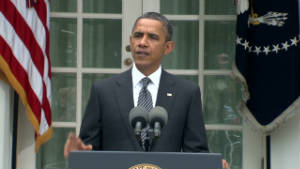
The behind-the-scenes role was something President Obama celebrated in remarks in the Rose Garden on Thursday.
"Without putting a single U.S. service member on the ground, we achieved our objectives and our NATO mission will soon come to an end," Obama said.
As to when that mission would end, NATO Secretary General Anders Fogh Rasmussen said in a statement NATO issued from Brussels, "We will terminate our mission in coordination with the United Nations and the National Transitional Council."
U.S. and NATO officials steadily maintained their mission was never to hunt, capture or kill the Libyan leader. The mission, they said, was to enforce the arms embargo, establish and hold a no-fly zone, and take actions to protect civilians from attack or the threat of attack.
That last directive seemed to give plenty of reason to target Libya's top commander. But Pentagon officials said for months that if Qaddafi should happen to be at one of those locations when NATO missiles strike, so be it.
Since the operation began on March 31, getting to Qaddafi's final stand required 7,725 air sorties and 1,845 strike sorties, 397 of which dropped ordnance, and 145 Predator drone strikes.
NATO aircraft, including those supplied by the U.S., totaled 26,089 sorties and 9,618 strike sorties through Wednesday.
More than 70 U.S. aircraft have supported the operation, including Predator drones.
NATO flew 67 sorties and 16 strikes sorties over Libya one day before Qaddafi was killed.
The NATO mission also employed submarines, aircraft carriers, amphibious assault ships, destroyers, frigates, and supply ships—as many as 21 vessels at one time.
Additionally, as of one week ago, the U.S. had sold participating countries in the operation roughly $250 million in ammunition, parts, fuel, technical assistance, and other support, according to the Pentagon.
Several members of Congress put out statements celebrating Qaddafi's downfall but did not comment on the cost. Several offices contacted did not provide additional reaction to the monetary figures.
But presidential candidate Ambassador Jon Huntsman did question the cost of the Libya operation. His statement on Thursday said, "I remain firm in my belief that America can best serve our interests and that transition through non-military assistance and rebuilding our own economic core here at home."
M WAQAR..... "A man's ethical behavior should be based effectually on sympathy, education, and social ties; no religious basis is necessary.Man would indeed be in a poor way if he had to be restrained by fear of punishment and hope of reward after death." --Albert Einstein !!! NEWS,ARTICLES,EDITORIALS,MUSIC... Ze chi pe mayeen yum da agha pukhtunistan de.....(Liberal,Progressive,Secular World.)''Secularism is not against religion; it is the message of humanity.'' تل ده وی پثتونستآن
Friday, October 21, 2011
Sarkozy calls for forgiveness in Libya
French President Nicolas Sarkozy called for forgiveness and reconciliation in Libya on Friday, adding that Muammar Gaddafi's death is not a cause for celebration despite his crimes.
Libya has found “its freedom and democratic hope. ... Now it is up to the Libyans to turn the page on the terrible years of Gaddafi and to build this future. The Libyans have a duty of forgiveness, reconciliation and unity,” Sarkozy said on the sidelines of a development conference held as part France's chairmanship of the G20.
“Obviously as long as there was fighting, threats existed,” Sarkozy said, “(but) we should never rejoice at the death of a man no matter what he did.”
“The threat posed by Gaddafi and the group of mercenaries that was with him was a real threat to the future of Libya. Now it is time to turn the page and move toward the future.”
Asked if NATO's operations in Libya were now over, Sarkozy said: “We will decide it with our allies and also listening to the NTC (Libya's National Transitional Council).” But he added that “the operation is coming to its end.”
French, US and British forces spearheaded the air campaign against Gaddafi's military by the NATO military alliance, which has carried out nearly 1 000 strike sorties since March 31.
France was even involved in the ex-strongman's capture when one of its aircraft fired a warning shot at a convoy of vehicles to stop Gaddafi's escape attempt.
Will the end of Gadhafi sway U.S. politics?
cnn.com
With Libyan dictator Moammar Gadhafi's dramatic demise this Thursday morning, the world is rid of a tyrant, and a free Libya has jumped a mile forward to stability (though, as CNN's Ben Wedeman reports, there are still many more miles to go).
Yet in America, we are speeding toward the 2012 presidential elections, and talk quickly turns to the political considerations here. President Obama appeared Thursday afternoon in the White House Rose Garden to celebrate this "momentous day in the history of Libya" and to declare that "one of the world's longest dictators is no more."
As Obama pledged his support to Libya's future, many in the crowd and watching at home surely began to wonder about the president's own future. It is a much-discussed irony that a president elected largely around domestic concerns has gone on to amass some sterling foreign policy bona fides, while his approval on matters stateside sinks deeper and deeper. But what impact, if any, will his string of overseas successes have on his standing -- and re-election prospects -- here at home?The first, most obvious answer is: not much. While you might expect a president who has bagged Osama bin Laden, Anwar al-Awlaki, and now Moammar Gadhafi in just under six months to be riding high in the public's estimation, foreign policy concerns simply don't register much on the public's radar these days. With the economy sputtering -- and veering dangerously toward the edge of another downturn -- voters are homed in there. An October Gallup poll found 32% mentioning "unemployment/jobs" as the most important issue facing the nation, with another 31% mentioning "the economy in general." Where did "wars/fear of war" and "terrorism" stack up? Two percent each.
Nor does it help that Libya was never a particularly popular war in the first place. A March Gallup poll taken just one day after our Air Force began helping enforce the no-fly zone over Libya showed Americans approving of our involvement, 47% to 37% -- a majority, yes, but lower than every other foreign military action since Vietnam (including Grenada and Kosovo). Critics may likewise downplay how much credit the president deserves for Gadhafi's demise -- after all, there's no indication American forces took him out, the way they got al-Awlaki and, unforgettably, bin Laden.Nevertheless, there may be some political benefits in this string of successes for Obama: Even if they don't lift his approval up to dazzling heights, they fortify him against criticism on the foreign policy flank and give courage to his remaining supporters. The victories may also help firm up the president's standing as a decisive leader, a contrast that may prove helpful if he faces former Massachusetts Gov. Mitt Romney -- whom rivals on both sides of the aisle like to portray as changing with the wind -- in the general election.
Defense Secretary Bob Gates said in September that Obama's decision to go after bin Laden with Navy SEALs was one of the most courageous ever made by any of the eight presidents he has served -- and Obama's gamble on Libya (derided by critics quoting the characterization of "leading from behind") certainly seems to be paying off as well. His approach (later redubbed by the publication that first reported it, "leading from behind the scenes") will also bolster a campaign argument that may resonate not only with his base, but also with swing voters increasingly wary of foreign engagements: that Obama wields force much more prudently and surgically than the reckless GOP -- that he has wound down Iraq and helped win back international respect, all while delivering strong results.
Still, domestic issues reign supreme, and so it's hard to say that the credit Obama will get for these successes abroad will be enough to turn back the tide of his sinking poll numbers. An August NBC/Wall Street Journal poll found Obama's approval on foreign policy a positive 50% to 45%, but the same poll gave him horrendous 37% to 59% marks on the economy and a 44% to 51% disapproval overall. Since then, he's only slipped, with the latest Gallup tracking poll putting his total approval at 39% to 54%.
Obama may yet get a bump from the Gadhafi news, but it's hard to imagine it overshadowing the bin Laden spike, which itself proved extraordinarily fleeting. In the meantime, if he wants to bring the numbers back up for the long haul, the president will have to find a way to transfer some of that daring success of his War Room into his domestic Cabinet.
In their second terms, presidents often find themselves drifting into more and more foreign policy initiatives, both as a way to bolster their legacies and because they find that, with their domestic political capital usually spent, it's the only arena left where they can make a big impact. Obama has gone through that cycle a bit quicker than most, and it leaves one questioning what his second term would look like.
Whether or not that comes to pass, he will at the very least be able to console himself that even if the voters aren't rushing to record these international victories, the history books one day will.
With Libyan dictator Moammar Gadhafi's dramatic demise this Thursday morning, the world is rid of a tyrant, and a free Libya has jumped a mile forward to stability (though, as CNN's Ben Wedeman reports, there are still many more miles to go).
Yet in America, we are speeding toward the 2012 presidential elections, and talk quickly turns to the political considerations here. President Obama appeared Thursday afternoon in the White House Rose Garden to celebrate this "momentous day in the history of Libya" and to declare that "one of the world's longest dictators is no more."
As Obama pledged his support to Libya's future, many in the crowd and watching at home surely began to wonder about the president's own future. It is a much-discussed irony that a president elected largely around domestic concerns has gone on to amass some sterling foreign policy bona fides, while his approval on matters stateside sinks deeper and deeper. But what impact, if any, will his string of overseas successes have on his standing -- and re-election prospects -- here at home?The first, most obvious answer is: not much. While you might expect a president who has bagged Osama bin Laden, Anwar al-Awlaki, and now Moammar Gadhafi in just under six months to be riding high in the public's estimation, foreign policy concerns simply don't register much on the public's radar these days. With the economy sputtering -- and veering dangerously toward the edge of another downturn -- voters are homed in there. An October Gallup poll found 32% mentioning "unemployment/jobs" as the most important issue facing the nation, with another 31% mentioning "the economy in general." Where did "wars/fear of war" and "terrorism" stack up? Two percent each.
Nor does it help that Libya was never a particularly popular war in the first place. A March Gallup poll taken just one day after our Air Force began helping enforce the no-fly zone over Libya showed Americans approving of our involvement, 47% to 37% -- a majority, yes, but lower than every other foreign military action since Vietnam (including Grenada and Kosovo). Critics may likewise downplay how much credit the president deserves for Gadhafi's demise -- after all, there's no indication American forces took him out, the way they got al-Awlaki and, unforgettably, bin Laden.Nevertheless, there may be some political benefits in this string of successes for Obama: Even if they don't lift his approval up to dazzling heights, they fortify him against criticism on the foreign policy flank and give courage to his remaining supporters. The victories may also help firm up the president's standing as a decisive leader, a contrast that may prove helpful if he faces former Massachusetts Gov. Mitt Romney -- whom rivals on both sides of the aisle like to portray as changing with the wind -- in the general election.
Defense Secretary Bob Gates said in September that Obama's decision to go after bin Laden with Navy SEALs was one of the most courageous ever made by any of the eight presidents he has served -- and Obama's gamble on Libya (derided by critics quoting the characterization of "leading from behind") certainly seems to be paying off as well. His approach (later redubbed by the publication that first reported it, "leading from behind the scenes") will also bolster a campaign argument that may resonate not only with his base, but also with swing voters increasingly wary of foreign engagements: that Obama wields force much more prudently and surgically than the reckless GOP -- that he has wound down Iraq and helped win back international respect, all while delivering strong results.
Still, domestic issues reign supreme, and so it's hard to say that the credit Obama will get for these successes abroad will be enough to turn back the tide of his sinking poll numbers. An August NBC/Wall Street Journal poll found Obama's approval on foreign policy a positive 50% to 45%, but the same poll gave him horrendous 37% to 59% marks on the economy and a 44% to 51% disapproval overall. Since then, he's only slipped, with the latest Gallup tracking poll putting his total approval at 39% to 54%.
Obama may yet get a bump from the Gadhafi news, but it's hard to imagine it overshadowing the bin Laden spike, which itself proved extraordinarily fleeting. In the meantime, if he wants to bring the numbers back up for the long haul, the president will have to find a way to transfer some of that daring success of his War Room into his domestic Cabinet.
In their second terms, presidents often find themselves drifting into more and more foreign policy initiatives, both as a way to bolster their legacies and because they find that, with their domestic political capital usually spent, it's the only arena left where they can make a big impact. Obama has gone through that cycle a bit quicker than most, and it leaves one questioning what his second term would look like.
Whether or not that comes to pass, he will at the very least be able to console himself that even if the voters aren't rushing to record these international victories, the history books one day will.
US boosts pressure on Pakistan over terrorism
The Obama administration on Friday intensified pressure on Pakistan to do more to crack down on Islamist militants destabilizing Afghanistan, as U.S. Secretary of State Hillary Rodham Clinton delivered a tough public message that extremists have been able to operate in and from Pakistan for too long.
For the second time in two days, Clinton pressed Pakistani authorities to step up efforts against the Haqqani militant network, which is based in the country's rugged tribal region, and is blamed for attacks both inside Pakistan and neighboring Afghanistan.
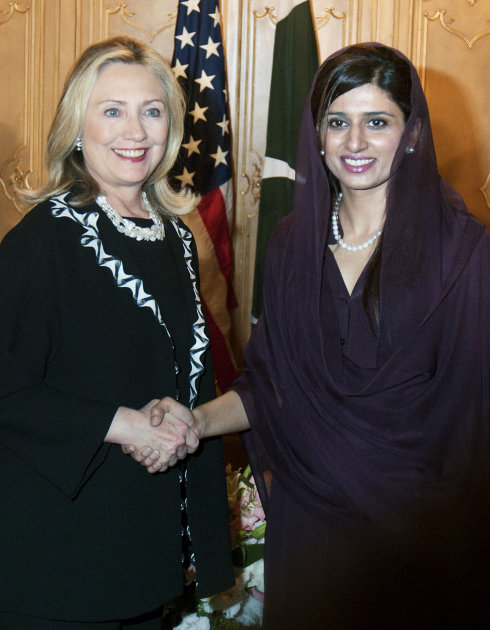
After leading an unusually large and powerful U.S. delegation, including CIA director David Petraeus and Chairman of the Joint Chiefs of Staff Gen. Martin Dempsey, for four hours of talks with Pakistani officials late Thursday, Clinton met Friday with Pakistan's president and foreign minister to make the case.
"We should be able to agree that for too long extremists have been able to operate here in Pakistan and from Pakistani soil," she said. "No one who targets innocent civilians, whether they be Pakistanis, Afghans, Americans or anyone else should be tolerated or protected."
The U.S. has grown increasingly impatient with Pakistan's refusal to take military action against the Taliban-linked Haqqani network and its ambivalence, if not hostility, to supporting Afghan attempts to reconcile Taliban fighters into society.
Clinton made clear that that was no longer acceptable while American officials warned that if Pakistan continued to balk, the U.S. would act unilaterally to end the militant threat.
"Pakistan has a critical role to play in supporting Afghan reconciliation and ending the conflict," Clinton told reporters at a joint press conference with Pakistani Foreign Minister Hina Rabbani Khar. "We look to Pakistan to take strong steps to deny Afghan insurgents safe havens and to encourage the Taliban to enter negotiations in good faith."
The Haqqani group is considered the greatest threat to American troops in Afghanistan, and U.S. officials have accused Pakistan's military spy agency, the ISI, of providing it with support — an allegation denied by Islamabad. Clinton noted that U.S. and Afghan forces had recently launched a successful operation against Haqqani safe havens in Afghanistan and that Pakistan must do the same. On Thursday in the Afghan capital, she said those who allow such safe havens to remain would pay "a very big price."
After the lengthy meeting with Pakistan's prime minister and army and intelligence chiefs on Thursday and Friday's talks with Kahr, Clinton said the U.S. delegation had asked "very specifically for greater cooperation from the Pakistan side to squeeze the Haqqani network and other terrorists because we know that trying to eliminate terrorists and safe havens from one side of the border is not going to work."
"It's like that old story: you can't keep snakes in your backyard and expect them only to bite your neighbors," she said.
Clinton made the same argument later in a town hall meeting with civic leaders.
"No policy that draws distinctions between good terrorists and bad terrorists can provide long-term security," she said.
She also acknowledged that U.S.-Pakistani ties were now badly strained. "Our relationship of late has not been an easy one," she said. "We have seen common interests give way to mutual suspicion."
For her part, Kahr repeated Pakistani denials of any government connection to the Haqqanis.
"There is no question of any support by any Pakistani institution to safe havens in Pakistan," she said.
And, she insisted that Pakistan and the U.S. shared the same goal.
"Pakistan takes the threat of terrorism seriously," she said, noting that thousands of Pakistanis had been killed by extremists over the past decade. "We are committed to this process, we would be willing to do whatever we can to be able to make this a success."
What is needed now, she said, is to try to agree on how to "operationalize" efforts to end the threat.
Clinton said the urgency of the situation required that that the operationalization take place "over the next days and weeks, not months and years."
Earlier this week, Pakistan's powerful army chief Gen. Ashfaq Kayani said in a rare briefing to two parliamentary defense committees that the country has been getting mixed signals from the United States, with the Pentagon urging the military to focus on fighting militants and the State Department requesting help in negotiating with the insurgents, said a parliament member who attended the meeting.
Kayani said Washington needs to make up its mind because it won't work to attack them and try to negotiate with them at the same time, according to the lawmaker.
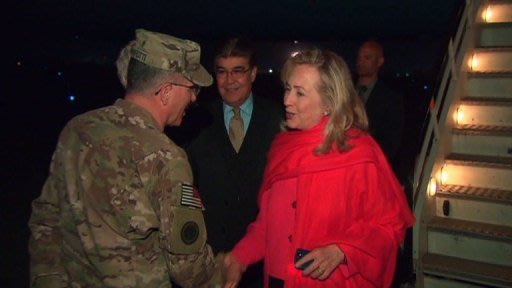
The large U.S. contingent was meant to display unity among the various U.S. agencies with an interest in Pakistan, including the CIA, Pentagon and State Department. Clinton arrived in Islamabad after saying In Kabul that she and the team would "push Pakistan very hard."
The Pakistani military has said it can't launch an offensive against the Haqqani network in its safe haven in the North Waziristan tribal area because its troops are stretched too thin by other operations against insurgents at war with the state.
But many analysts suspect the military is reluctant to target a group that is seen as an important potential ally in Afghanistan once foreign troops withdraw. Both the U.S. and Pakistani governments had close relations with the founder of the Haqqani network, Jalaluddin Haqqani, during the war against the Soviets in Afghanistan in the 1980s.
Syria is not another Libya
The Western media have been sensationalizing China's stance on Syria, with one of them saying: "China demanded that Syria's leader President Bashar al-Assad move toward faster political reform, a rare change of policy and a deviation from its usual refusal to intervene in the affairs of strategic allies."
That is a wrong analysis, for China's actions are aimed at restoring normalcy in the lives of the Syrian people as soon as possible and bringing back peace and stability in the Middle East.
After the change of governments in Egypt and Libya, Syria has been in the eye of the storm sweeping the Middle East. Thanks to the intervention of Western powers, especially the United States, violent conflicts between different groups in Syria have intensified, greatly raising the risk of civil war in the country.
With a population of 22.25 million and a territory of 185,000 square kilometers, Syria is a middle-sized country in the Middle East but plays a big role in the region because of its geographic importance. Since it shares its borders with countries like Turkey, Iraq, Jordan, Lebanon and Israel, it has had to bear the brunt of Arab-Israeli conflicts and even lose its territory, the Golan Heights, to Israel.
Given these factors, it is impossible to restore peace in the region without the active participation of Syria. Besides, its cooperation with Iran, influence on Lebanon's Hezbollah party and the presence of 2 million Kurdish people within its territory make its stability especially important.
No wonder, it has become a target of the West's selective intervention policy in the "democratization" wave that is sweeping across the Arab world. As soon as anti-government protests started in Syria in March this year, Western countries began supporting opposition forces through every possible means - imposing economic sanctions, limiting senior officials' travels abroad, and even directly telling Bashar al-Assad to resign.
The West has tried to treat Syria in the same way that it treated Libya. It tried to propel the UN Security Council to impose further sanctions and even launch an attack on Syria.
The US and its Western allies are dreaming of turning the Mediterranean Sea into "NATO's internal lake". If the Western powers can topple Bashar al-Assad, they can isolate Iran further and take forward their plan to establish a "Great Middle East".
By intervening selectively in the Middle East, Western countries are in fact fulfilling their own interests instead of promoting their avowed universal values. They identify a country where they want to intervene not because it is undemocratic but because it threatens or is deemed to threaten their interests. And the Western media never hesitate in advocating mass protests in the countries that hinder or are deemed to hinder Western interests.
Syria and Libya (during Muammar Gadhafi's rule) have both been thorns in America's side for opposing its wider "democracy" plan in the Middle East and NATO's ambition to include the whole of the Mediterranean region in its orbit. Now that Gadhafi has been ousted from power in Libya, the Western alliance has turned to Syria.
But Syria is not Libya. Although armed conflicts have occurred between different groups in the country, Qadri Jamil, leader of the Popular Front for Change, has declared openly that he and his party reject all forms of foreign intervention and the Syrian people should decide the country's future. On Oct 12, thousands of people demonstrated in support of Bashar al-Assad in Syria and expressed opposition to foreign intervention.
As a responsible country which believes in non-intervention in the internal affairs of a country, China on Oct 5 vetoed a move in the United Nations Security Council to intervene in Syria. For long, China has advocated political dialogue between different groups to maintain peace and stability in the Middle East. It expects the Syrian government to make good its promises on reform and start the process of inclusive politics, and supports the negotiation efforts of all.
China's actions best illustrate its principle of peaceful diplomacy and pursuit of a harmonious world.
China does have interests in the region, but they are in accordance with those of Middle East countries. Peace and stability mean lower risks and less threat to the lives of people in the Middle East.
China and the Middle East countries have to continue promoting economic cooperation and oil trade, which will not only secure China's oil supply, but also help oil-producing countries stabilize oil prices. Moreover, peace and stability will help eliminate terrorism, separatism and extremism, which is the common pursuit of most countries.
If the UN had passed the proposal to intervene in Syria, not only Syria, but also the entire Middle East would have soon become mired in chaos and people of the region would have been subjected to even greater suffering.
That is a wrong analysis, for China's actions are aimed at restoring normalcy in the lives of the Syrian people as soon as possible and bringing back peace and stability in the Middle East.
After the change of governments in Egypt and Libya, Syria has been in the eye of the storm sweeping the Middle East. Thanks to the intervention of Western powers, especially the United States, violent conflicts between different groups in Syria have intensified, greatly raising the risk of civil war in the country.
With a population of 22.25 million and a territory of 185,000 square kilometers, Syria is a middle-sized country in the Middle East but plays a big role in the region because of its geographic importance. Since it shares its borders with countries like Turkey, Iraq, Jordan, Lebanon and Israel, it has had to bear the brunt of Arab-Israeli conflicts and even lose its territory, the Golan Heights, to Israel.
Given these factors, it is impossible to restore peace in the region without the active participation of Syria. Besides, its cooperation with Iran, influence on Lebanon's Hezbollah party and the presence of 2 million Kurdish people within its territory make its stability especially important.
No wonder, it has become a target of the West's selective intervention policy in the "democratization" wave that is sweeping across the Arab world. As soon as anti-government protests started in Syria in March this year, Western countries began supporting opposition forces through every possible means - imposing economic sanctions, limiting senior officials' travels abroad, and even directly telling Bashar al-Assad to resign.
The West has tried to treat Syria in the same way that it treated Libya. It tried to propel the UN Security Council to impose further sanctions and even launch an attack on Syria.
The US and its Western allies are dreaming of turning the Mediterranean Sea into "NATO's internal lake". If the Western powers can topple Bashar al-Assad, they can isolate Iran further and take forward their plan to establish a "Great Middle East".
By intervening selectively in the Middle East, Western countries are in fact fulfilling their own interests instead of promoting their avowed universal values. They identify a country where they want to intervene not because it is undemocratic but because it threatens or is deemed to threaten their interests. And the Western media never hesitate in advocating mass protests in the countries that hinder or are deemed to hinder Western interests.
Syria and Libya (during Muammar Gadhafi's rule) have both been thorns in America's side for opposing its wider "democracy" plan in the Middle East and NATO's ambition to include the whole of the Mediterranean region in its orbit. Now that Gadhafi has been ousted from power in Libya, the Western alliance has turned to Syria.
But Syria is not Libya. Although armed conflicts have occurred between different groups in the country, Qadri Jamil, leader of the Popular Front for Change, has declared openly that he and his party reject all forms of foreign intervention and the Syrian people should decide the country's future. On Oct 12, thousands of people demonstrated in support of Bashar al-Assad in Syria and expressed opposition to foreign intervention.
As a responsible country which believes in non-intervention in the internal affairs of a country, China on Oct 5 vetoed a move in the United Nations Security Council to intervene in Syria. For long, China has advocated political dialogue between different groups to maintain peace and stability in the Middle East. It expects the Syrian government to make good its promises on reform and start the process of inclusive politics, and supports the negotiation efforts of all.
China's actions best illustrate its principle of peaceful diplomacy and pursuit of a harmonious world.
China does have interests in the region, but they are in accordance with those of Middle East countries. Peace and stability mean lower risks and less threat to the lives of people in the Middle East.
China and the Middle East countries have to continue promoting economic cooperation and oil trade, which will not only secure China's oil supply, but also help oil-producing countries stabilize oil prices. Moreover, peace and stability will help eliminate terrorism, separatism and extremism, which is the common pursuit of most countries.
If the UN had passed the proposal to intervene in Syria, not only Syria, but also the entire Middle East would have soon become mired in chaos and people of the region would have been subjected to even greater suffering.
Clinton to continue 'frank' talks with Pakistani officials
Secretary of State Hillary Clinton will continue "frank" talks with Pakistani officials Friday, a day after urging the nation's prime minister to strengthen efforts to combat terrorism, senior State Department officials said.
CIA chief David Petraeus and other military officials were part of the meeting with Prime Minister Syed Yusuf Raza Gilani on Thursday night.
Gilani characterized the meeting as "cordial and frank."
"Disagreements between the coalition partners in the war on terror should not undermine the strategic relationship which is so vital for the promotion of mutual interests of the two countries," Gilani said in a statement.
Before going to Pakistan, Clinton had said she planned to urge Pakistani leaders to step up efforts to target terror groups."We intend to push the Pakistanis very hard," Clinton said Thursday, calling it a "time for clarity."
The United States, she said, knows the Haqqani terrorist network operates out of havens in Pakistan.
"Our message is very clear: We're going to be fighting, we're going to be talking, we're going to be building," she said. "And they can either be helping or hindering. But we are not going to stop our efforts to create a strong foundation for an Afghanistan free from interference, violent conflict and one that has a chance to chart its own future."
Clinton is scheduled to meet with President Asif Ali Zardari and others Friday
NATO and U.S. officials have said recently that they are seeing a marked increase in infiltration into Afghanistan from Pakistan by the militant Haqqani network.
Before going to Pakistan, Clinton stopped in Afghanistan to meet with President Hamid Karzai. Her visit to Afghanistan followed a stop in Libya.
CIA chief David Petraeus and other military officials were part of the meeting with Prime Minister Syed Yusuf Raza Gilani on Thursday night.
Gilani characterized the meeting as "cordial and frank."
"Disagreements between the coalition partners in the war on terror should not undermine the strategic relationship which is so vital for the promotion of mutual interests of the two countries," Gilani said in a statement.
Before going to Pakistan, Clinton had said she planned to urge Pakistani leaders to step up efforts to target terror groups."We intend to push the Pakistanis very hard," Clinton said Thursday, calling it a "time for clarity."
The United States, she said, knows the Haqqani terrorist network operates out of havens in Pakistan.
"Our message is very clear: We're going to be fighting, we're going to be talking, we're going to be building," she said. "And they can either be helping or hindering. But we are not going to stop our efforts to create a strong foundation for an Afghanistan free from interference, violent conflict and one that has a chance to chart its own future."
Clinton is scheduled to meet with President Asif Ali Zardari and others Friday
NATO and U.S. officials have said recently that they are seeing a marked increase in infiltration into Afghanistan from Pakistan by the militant Haqqani network.
Before going to Pakistan, Clinton stopped in Afghanistan to meet with President Hamid Karzai. Her visit to Afghanistan followed a stop in Libya.
Lessons from Libya: What lies ahead for Arab uprisings?
After a grueling and eight-month bloody battle that resulted in the death of Muammar Qaddafi on Thursday, Libyans face a host of challenges as they begin to build their country.
Qaddafi became the first leader of a nation belonging to the Arab Spring fraternity to die at the hands of his own people. There were no deals of immunity and no long-winded trials that may have exposed some ugly truths, much to the collective sigh of relief of western nations that once supported Qaddafi.
Pundits have been scurrying since his death to list the challenges the new rulers of the National Transitional Council face but arguably, their greatest priority will be to secure law and order.
The very thing that secured Libyans their victory ─ arms ─ could pose the greatest challenge for the NTC. Fighters in Misrata, Tripoli, Benghazi and now Sirte each claim responsibility for “freeing Libya”, and feel a sense of entitlement to the spoils of war – be that roles in the new government or continuing to play the role of law enforcement. Herein lies the danger as the past few weeks have shown that revenge attacks have been common and despite NTC’s attempts to de-weaponize its fighters, it has not wielded in the results they hoped for. These fears have been expressed by various human rights organizations too.
However, for protestors in other Arab nations witnessing bloody uprisings, the Libyan victory – unique because its fighters were armed and it had international military intervention ─ will provide a great deal of succor, namely that victory is possible.
For the Syrian opposition, this is an opportunity to band together and begin a concerted effort to push for international intervention against President Bashar al-Assad’s regime. This is ultimately what the NTC did when months ago it began to canvas for international support that saw the enforcement of no-fly zones in Libya, shipment of arms and ultimately recognition of their legitimacy as the new leaders.
For Yemenis determined to put to end the 33 years of rule of President Ali Abdullah Saleh, the challenges lie in remaining a peaceful protest in the face of gross brutality. Yemen is already a heavily weaponized and tribal society with factions already pitted against one another which have served Saleh well as he’s used this, along with the al-Qaeda threat, to perpetuate his own rule. Yemenis want to stay committed to peaceful resistance, as exemplified by its courageous Nobel Peace Prize winner Tawwakul Karman, but that runs the risk of changing if and when Yemenis turn to the Libyan model to bring about change.
The year will undoubtedly be remembered for the Arab Spring and the fate its leaders met: Tunisia’s President Zine ElAbedine Ben Ali went into self-exile in Saudi Arabia, Egypt’s President Hosni Mubarak Ali faces trial on charges of corruption and Qaddafi has been killed. The victors remain the same: the people who called for, and achieved, democracy. How the end plays out for other Arab nations remains to be seen but it is safe (and tragic) to assume two things: remaining leaders won’t go quietly and democracy is no longer a pipe dream, but a reality just waiting to give birth.
Gaddafi was 'killed in crossfire'
BBC.COM
Libya's Col Muammar Gaddafi was killed in crossfire after being captured in his birthplace of Sirte, officials say.
Acting Prime Minister Mahmoud Jibril said he had been shot in the head in an exchange between Gaddafi loyalists and National Transitional Council fighters.
He confirmed that Col Gaddafi, who had been taken alive, had died before reaching hospital.
Nato's governing body, meeting in the coming hours, is expected to declare an end to its Libyan bombing campaign.
Nato Secretary-General Anders Fogh Rasmussen said that with the death of Col Gaddafi "that moment has now moved much closer".
"After 42 years, Col Gaddafi's rule of fear has finally come to an end," he said. "I call on all Libyans to put aside their differences and work together to build a brighter future."
Wild scenes of celebration continued late into the night in towns and cities across Libya at news of the colonel's death.
Groups of young men fired guns in the air, and drivers honked their horns in celebration.
In the capital, Tripoli, cars clogged the city centre.
Golden gun
Mr Jibril, number two in the National Transitional Council (NTC), held a news conference in Tripoli to confirm the colonel's death.
"We have been waiting for this moment for a long time. Muammar Gaddafi has been killed," he said.
Video footage suggests Col Gaddafi was dragged through the streets.
It is unclear from the footage, broadcast by al-Jazeera TV, whether he was alive or dead at the time.
Later, Mr Jibril told journalists that a "forensic report" had concluded that the colonel had died from bullet wounds after he had been captured and driven away.
"When the car was moving it was caught in crossfire between the revolutionaries and Gaddafi forces in which he was hit by a bullet in the head," he said, quoting from the report.
"The forensic doctor could not tell if it came from the revolutionaries or from Gaddafi's forces."
Earlier, some NTC fighters gave a different account of the colonel's death, saying he had been shot by his captors when he tried to escape.
One NTC fighter told the BBC that he found Col Gaddafi hiding in a hole, and the former leader had begged him not to shoot.
The fighter showed reporters a golden pistol he said he had taken from Col Gaddafi.
Arabic TV channels showed images of troops surrounding two large drainage pipes where the reporters said Col Gaddafi was found.
US President Barack Obama said it was a "momentous day" for Libya.
He said the country had a "long and winding road towards full democracy", but the US and other countries would stand behind Tripoli.
Col Gaddafi was toppled from power in August after 42 years in charge of the country.
He was making his last stand in Sirte alongside two of his sons, Mutassim and Saif al-Islam, according to reports.
Nato air strike
A body that officials identified as that of Mutassim has been shown on Libyan TV.
A reporter with Reuters news agency described how the body of Mutassim - the former national security adviser - had been laid out on blankets on the floor of a house in the city of Misrata, while people jostled to take pictures of the corpse with their mobile phones.
The body of Col Gaddafi was also taken to Misrata.
There are conflicting reports as to the whereabouts of Saif al-Islam.
Acting Justice Minister Mohammad al-Alagi told AP news agency that Saif al-Islam had been captured and taken to hospital with a leg wound.
But another NTC official said his whereabouts were unknown.
Nato, which has been running a bombing campaign in Libya for months, said it had carried out an air strike earlier on Thursday.
French Defence Minister Gerard Longuet said French jets had fired warning shots to halt a convoy carrying Col Gaddafi as it tried to flee Sirte.
He said Libyan fighters had then descended and taken the colonel.
Proof of Col Gaddafi's fate came in grainy pieces of video, first circulated among fighters, and then broadcast by international news channels.
The first images showed a bloodied figure presumed to be Col Gaddafi.
Later, video emerged of the colonel being bundled on to the back of a pick-up truck after being captured alive.
None of the video footage has been independently verified.Col Gaddafi's death came after weeks of fierce fighting for Sirte, one of the last remaining pockets of resistance.
A senior official, Mahmoud Shammam, told the BBC that fighting throughout Libya was over.
World leaders urged the NTC to carry through its promise to reform the country.
UK Prime Minister David Cameron, who had taken a leading role in Nato's intervention, said it was "a day to remember all of Col Gaddafi's victims".
UN Secretary General Ban Ki-moon called it a "historic" moment, but warned: "The road ahead for Libya and its people will be difficult and full of challenges."
China said the death of Col Gaddafi marked the turning of a page in Libya's history. It called for an inclusive political transition in Libya as soon as possible, to protect the unity of the country and restore social stability.
Russia's President Dimitry Medvedev said he hoped Libya could achieve a peaceful transition to a modern democratic state.
Officials said the NTC intended to announce the "liberation of the country" in the coming days, allowing them to begin pushing through democratic reforms that will lead to elections.
Libya's Col Muammar Gaddafi was killed in crossfire after being captured in his birthplace of Sirte, officials say.
Acting Prime Minister Mahmoud Jibril said he had been shot in the head in an exchange between Gaddafi loyalists and National Transitional Council fighters.
He confirmed that Col Gaddafi, who had been taken alive, had died before reaching hospital.
Nato's governing body, meeting in the coming hours, is expected to declare an end to its Libyan bombing campaign.
Nato Secretary-General Anders Fogh Rasmussen said that with the death of Col Gaddafi "that moment has now moved much closer".
"After 42 years, Col Gaddafi's rule of fear has finally come to an end," he said. "I call on all Libyans to put aside their differences and work together to build a brighter future."
Wild scenes of celebration continued late into the night in towns and cities across Libya at news of the colonel's death.
Groups of young men fired guns in the air, and drivers honked their horns in celebration.
In the capital, Tripoli, cars clogged the city centre.
Golden gun
Mr Jibril, number two in the National Transitional Council (NTC), held a news conference in Tripoli to confirm the colonel's death.
"We have been waiting for this moment for a long time. Muammar Gaddafi has been killed," he said.
Video footage suggests Col Gaddafi was dragged through the streets.
It is unclear from the footage, broadcast by al-Jazeera TV, whether he was alive or dead at the time.
Later, Mr Jibril told journalists that a "forensic report" had concluded that the colonel had died from bullet wounds after he had been captured and driven away.
"When the car was moving it was caught in crossfire between the revolutionaries and Gaddafi forces in which he was hit by a bullet in the head," he said, quoting from the report.
"The forensic doctor could not tell if it came from the revolutionaries or from Gaddafi's forces."
Earlier, some NTC fighters gave a different account of the colonel's death, saying he had been shot by his captors when he tried to escape.
One NTC fighter told the BBC that he found Col Gaddafi hiding in a hole, and the former leader had begged him not to shoot.
The fighter showed reporters a golden pistol he said he had taken from Col Gaddafi.
Arabic TV channels showed images of troops surrounding two large drainage pipes where the reporters said Col Gaddafi was found.
US President Barack Obama said it was a "momentous day" for Libya.
He said the country had a "long and winding road towards full democracy", but the US and other countries would stand behind Tripoli.
Col Gaddafi was toppled from power in August after 42 years in charge of the country.
He was making his last stand in Sirte alongside two of his sons, Mutassim and Saif al-Islam, according to reports.
Nato air strike
A body that officials identified as that of Mutassim has been shown on Libyan TV.
A reporter with Reuters news agency described how the body of Mutassim - the former national security adviser - had been laid out on blankets on the floor of a house in the city of Misrata, while people jostled to take pictures of the corpse with their mobile phones.
The body of Col Gaddafi was also taken to Misrata.
There are conflicting reports as to the whereabouts of Saif al-Islam.
Acting Justice Minister Mohammad al-Alagi told AP news agency that Saif al-Islam had been captured and taken to hospital with a leg wound.
But another NTC official said his whereabouts were unknown.
Nato, which has been running a bombing campaign in Libya for months, said it had carried out an air strike earlier on Thursday.
French Defence Minister Gerard Longuet said French jets had fired warning shots to halt a convoy carrying Col Gaddafi as it tried to flee Sirte.
He said Libyan fighters had then descended and taken the colonel.
Proof of Col Gaddafi's fate came in grainy pieces of video, first circulated among fighters, and then broadcast by international news channels.
The first images showed a bloodied figure presumed to be Col Gaddafi.
Later, video emerged of the colonel being bundled on to the back of a pick-up truck after being captured alive.
None of the video footage has been independently verified.Col Gaddafi's death came after weeks of fierce fighting for Sirte, one of the last remaining pockets of resistance.
A senior official, Mahmoud Shammam, told the BBC that fighting throughout Libya was over.
World leaders urged the NTC to carry through its promise to reform the country.
UK Prime Minister David Cameron, who had taken a leading role in Nato's intervention, said it was "a day to remember all of Col Gaddafi's victims".
UN Secretary General Ban Ki-moon called it a "historic" moment, but warned: "The road ahead for Libya and its people will be difficult and full of challenges."
China said the death of Col Gaddafi marked the turning of a page in Libya's history. It called for an inclusive political transition in Libya as soon as possible, to protect the unity of the country and restore social stability.
Russia's President Dimitry Medvedev said he hoped Libya could achieve a peaceful transition to a modern democratic state.
Officials said the NTC intended to announce the "liberation of the country" in the coming days, allowing them to begin pushing through democratic reforms that will lead to elections.
Red alert against dengue and congo fever in Fata, FRs
Like other parts of the country, the health facilities in FATA and frontier regions have been put on high alert to stop the epidemics of fatal diseases caused by spread of dengue and Congo viruses.For people awareness, FATA Secretariat has started a campaign in the tribal regions against the spread of epidemics. As per details health and social welfare institutes dealing with research revealed that Congo virus was more dangerous than dengue virus. The farmers associated with livestock and cattle head business and the adjacent communities are more vulnerable to the Congo virus.Similarly, on Eid ul Azha, the Congo virus could grow after slaughter of sacrificial animals; therefore they advised to take appropriate measures to avoid getting affected by the disease.
Nawaz Lohar : What has he on offer?
EDITORIAL:THE FRONTIER POST
What has he on offer?
With much ado has the PML (N) supremo, Mian Nawaz Sharif, launched a campaign to oust the Zardari regime. Definitely, no mountains will weep and no streets will wail if this regime goes, such an unprecedented grand failure has it been in administering the state and in giving an alleviating deal to the country’s masses. But the guru must tell the people what has he on offer for them, as certainly they wouldn’t want to be out of the frying-pan to fall into the fire. It is not their painful adversities he has to dwell upon. They need no telling of this. Living in the splendours of Raiwind palaces and luxurious abodes here and abroad, mixing with the rich and supping with the wealthy, and moving around in the select company of the nation’s fat bellies, he couldn’t imaginably have even the foggiest idea of the burning grill they are being roasted on. They want to hear of recipes, if he has any in his bag, to address their tragic lot. And it is not just corruption in high places they want to hear from him when his own credentials on this score stand devastatingly besmirched in the popular eye. He may be thinking, mistakenly, that with this chant he is scoring points with the public, which in fact he is not. On the street, his postures of piety have no takers. He and his siblings too are facing corruption cases, pending before the courts. His contention of the cases being politically motivated carries no conviction with the people, either. The Zardari crowd too takes the same stand, asserting they had been framed up by him vindictively. So long as the courts do not exonerate him, he too stands accused of corruption charges as they do. Both are thus sailing in the same boat in the popular perception. In fact, the people’s woes go much beyond corruption in high places, when this evil phenomenon is so ubiquitously entrenched that it confronts them at every official level to have even their most legitimate works done by greasing some palms. For decades on end, they have craved for clean, lean and efficient administration firmly hinged on merit and quality, which they have got not. Not even he himself fulfilled their wish in his own two stints in power. He too stuffed up the administrative machinery with favourites in key positions and political appointees all around. Still, if he is to come any credible on this plane, he must tell the masses what has he in plans to give them a reformed and delivering administration, with merit the sole criterion of recruitment and no political interference and patronage in postings and transfers. Now for a change he must stop lamenting the Zardari regime’s collapse in tackling the people’s economic woes and start speaking of what cures has he in mind to alleviate their economic predicament. He must tell how he intends to revive the nation’s sagging economy to produce national wealth and bring about progress and prosperity to the country and the people. Instead of deploring the raging unemployment, he must unveil his job creation plans. Enough of crocodile tears has he shed on the disastrous energy shortage on the Zardari sinecures’ watch. He should now turn to speaking out the remedies he has thought out, if at all, to wipe out this destructive shortage playing havoc with our people’s lives and the nation’s industries and businesses. The people’s needs are urgent and he must tell what quick fixes has he charted out to meet their pressing demand.Further, he should start telling what has he planned for the emancipation of haris and tenants from the land barons’ serfdom, the salvation of enslaved bonded labour living in the debt trap generations after generations, equitable redistribution of farming land, spread of social networks for the downtrodden, and expansion of speakable family healthcare and children educational facilities for the poor. The point is now that he has launched into a regime change venture, the people must know what on offer is a deal for which they should storm out on the streets and brave by the police lathies. After all, what could be the sense if one pack of clueless rulers is dispatched to be replaced by another clueless pack?And he would better stop rubbing too much his democracy crap, a big hoax. No democracy are we, but only a plutocracy actually. The people know this, and also that we will stay a plutocracy so long as the fat bellies hold the monopoly of the nation’s politics, which they certainly would in ages to come. The guru himself has famously hungered once unquenchably to be the nation’s Amirul Momineen, a law unto himself, answerable to none, and an unchallengeable ruler for lifetime
What has he on offer?
With much ado has the PML (N) supremo, Mian Nawaz Sharif, launched a campaign to oust the Zardari regime. Definitely, no mountains will weep and no streets will wail if this regime goes, such an unprecedented grand failure has it been in administering the state and in giving an alleviating deal to the country’s masses. But the guru must tell the people what has he on offer for them, as certainly they wouldn’t want to be out of the frying-pan to fall into the fire. It is not their painful adversities he has to dwell upon. They need no telling of this. Living in the splendours of Raiwind palaces and luxurious abodes here and abroad, mixing with the rich and supping with the wealthy, and moving around in the select company of the nation’s fat bellies, he couldn’t imaginably have even the foggiest idea of the burning grill they are being roasted on. They want to hear of recipes, if he has any in his bag, to address their tragic lot. And it is not just corruption in high places they want to hear from him when his own credentials on this score stand devastatingly besmirched in the popular eye. He may be thinking, mistakenly, that with this chant he is scoring points with the public, which in fact he is not. On the street, his postures of piety have no takers. He and his siblings too are facing corruption cases, pending before the courts. His contention of the cases being politically motivated carries no conviction with the people, either. The Zardari crowd too takes the same stand, asserting they had been framed up by him vindictively. So long as the courts do not exonerate him, he too stands accused of corruption charges as they do. Both are thus sailing in the same boat in the popular perception. In fact, the people’s woes go much beyond corruption in high places, when this evil phenomenon is so ubiquitously entrenched that it confronts them at every official level to have even their most legitimate works done by greasing some palms. For decades on end, they have craved for clean, lean and efficient administration firmly hinged on merit and quality, which they have got not. Not even he himself fulfilled their wish in his own two stints in power. He too stuffed up the administrative machinery with favourites in key positions and political appointees all around. Still, if he is to come any credible on this plane, he must tell the masses what has he in plans to give them a reformed and delivering administration, with merit the sole criterion of recruitment and no political interference and patronage in postings and transfers. Now for a change he must stop lamenting the Zardari regime’s collapse in tackling the people’s economic woes and start speaking of what cures has he in mind to alleviate their economic predicament. He must tell how he intends to revive the nation’s sagging economy to produce national wealth and bring about progress and prosperity to the country and the people. Instead of deploring the raging unemployment, he must unveil his job creation plans. Enough of crocodile tears has he shed on the disastrous energy shortage on the Zardari sinecures’ watch. He should now turn to speaking out the remedies he has thought out, if at all, to wipe out this destructive shortage playing havoc with our people’s lives and the nation’s industries and businesses. The people’s needs are urgent and he must tell what quick fixes has he charted out to meet their pressing demand.Further, he should start telling what has he planned for the emancipation of haris and tenants from the land barons’ serfdom, the salvation of enslaved bonded labour living in the debt trap generations after generations, equitable redistribution of farming land, spread of social networks for the downtrodden, and expansion of speakable family healthcare and children educational facilities for the poor. The point is now that he has launched into a regime change venture, the people must know what on offer is a deal for which they should storm out on the streets and brave by the police lathies. After all, what could be the sense if one pack of clueless rulers is dispatched to be replaced by another clueless pack?And he would better stop rubbing too much his democracy crap, a big hoax. No democracy are we, but only a plutocracy actually. The people know this, and also that we will stay a plutocracy so long as the fat bellies hold the monopoly of the nation’s politics, which they certainly would in ages to come. The guru himself has famously hungered once unquenchably to be the nation’s Amirul Momineen, a law unto himself, answerable to none, and an unchallengeable ruler for lifetime
Punjab under SHARIF LOHARS experiences worst dictatorship in the name of democracy: Governor
Punjab Governor Sardar Latif Khan Khosa has said that corruption of Sharif brothers would be exposed through an independent commission and those creating hurdles in Accountability bill would not escape from prosecution.Speaking at a Seminar “Fight against violence in Pakistan” here on Thursday, the Governor said worst type of dictatorship was in place in Punjab in the name of democracy.He said the PML-N was free to hold as much marches and dharnas but President Zardari and the government would complete their constitutional term. He said he would seek the explanations of DCOs for utilizing government resources for the meetings of Nawaz Sharif. He said government offices were damaged and motorcycles of the poor were set ablaze under the supervision of PML-N during protests against loadshedding.He questioned the utilization of government machinery by Nawaz Sharif and pointed out that in what capacity he was using it as he was neither Governor nor the Chief Minister. He said after the expiry of ten year period, Nawaz Sharif has started taking part in active politics.The Governor said that those objecting over the appointment of NAB chairman were afraid of reopening of cases against them. He said if every case is to be handled by the Supreme Court then what the subordinate judiciary would do?Sardar Latif Khosa blamed that Raiwind palace, Ittefaq foundary, fake accounts in London and other assets and properties were made through corruption. He said corruption in politics is the hallmark of Sharifs and they have made politics a business.He said if their hands were clean, they would be happy over the appointment of NAB chairman.The Governor said during the past three years there has not been a single charge of corruption against President Zardari while Rs 45 billion were plundered in Punjab in the name of Sasti roti, Danish Schools, Yellow Cab scheme, Dengue spray.He questioned as to why the Provincial Government was not implementing the report prepared on the instruction s of the Supreme Court about devastations caused by floods last year.To a question, the Governor said all the proofs are there about the marriage of son of Chief Minister Punjab with Aisha Ahad. If he wants separation, it should be done through legal way.
PPP to hold Protect Democracy Rally on 26th
Pakistan Peoples’ Party (PPP) Karachi Division announced on Thursday to carry out ‘protect democracy rally’ on October 26 in a riposte against PML-N for spearheading the ‘go-Zardari-go’ campaign and described it as an attempt to derail democracy.”Pakistan Muslim League-Nawaz Chief Nawaz Sharif is waging war against the long-awaited democracy through his bigoted policies and now making foul attempts to assume power,” said Najmi Alam, President PPP Karachi Division at a press conference at Karachi Press Club.He told that Peoples Youth Karachi Division would lead the rally from Peoples Secretariat near Mazar-e-Quaid to Karachi Press Club to show the strength of party. He warned the PPP won’t tolerate any attempt to disrupt democratic process in the country. “We will show PML-N our strength the same day they are holding protest against PPP and the democracy,” he added.He recalled that PML-Chief, being a part of Alliance for Restoration of Democracy (ARD), formed All Party Democratic Alliance (APDM) in 2007 and decided to contest General Elections of 2008, reneging its earlier pledge to boycott the election.He said Nawaz Sharif had backtracked on his promises many a times including non-allotment of party ticket to fake degree holders, refraining from horse trading and struggle against anti-democratic forces. “All such statements later proved to be no more than a word of mouth,” he criticized.He said PML-N Chief returned to the country after observing that the then President General Pervaiz Musharraf had lost all his powers.He said Shaheed Benazir Bhutto welcomed Sharif into ARD but he flew off to Jeddah, leaving country in serious political crisis.
Security forces to conduct operation in Khyber Agency
Security forces have decided to conduct an operation in Tehsil Bara of Khyber Agency, following attacks on forces by the militants, Geo News reported Friday.
According to security forces, 13 personnel lost their lives in two days when they were ambushed by the militants. Therefore, a decision has been made to conduct a vigorous operation against militants starting from today.
The forces have asked the residents to shift to safer places by noon today to avoid any damage to the civilian community.
Forty-eight militants were killed and seven compounds were destroyed in the ongoing clashes. while curfew was imposed in Tehsil Bara two years back which is still continuing.
Pakistani PM demands end to US threats
Pakistan's Premier Yousuf Raza Gilani has urged US officials to stop accusing Islamabad and threatening it with unilateral military action.
Gilani raised the objection during a meeting with US Secretary of State Hillary Clinton in Islamabad Thursday evening, Pakistani sources said.
The Pakistani premier reiterated that the United States must use the bilateral forum to raise any complaints.
Reports of US troops massing in Afghanistan along the Pakistani border have raised concerns in the South Asian country about a potential US plan to wage a military offensive on its North Waziristan region.
Leading a high-level delegation, Clinton arrived in Islamabad Thursday on a two-day official tour, following her earlier visit to Afghanistan, Xinhua reported.
Top US officials have alleged that the Pakistani intelligence agency assisted the Haqqani network in attacks against the US Embassy in Afghanistan last month, a charge firmly disputed by Pakistan.
The Haqqani group has been accused of attacking the US Embassy in Kabul and carrying out a truck bombing against a NATO outpost that wounded more than 70 American soldiers in September.
Relations between Islamabad and Washington have already been strained over high civilian casualties caused by the non-UN-sanctioned US drone attacks, which Pakistan has repeatedly condemned as violations of its sovereignty.
Tensions between the two allies further increased following a secret US raid into Pakistan that allegedly led to the killing of al-Qaeda leader Osama bin Laden in May.
Gilani raised the objection during a meeting with US Secretary of State Hillary Clinton in Islamabad Thursday evening, Pakistani sources said.
The Pakistani premier reiterated that the United States must use the bilateral forum to raise any complaints.
Reports of US troops massing in Afghanistan along the Pakistani border have raised concerns in the South Asian country about a potential US plan to wage a military offensive on its North Waziristan region.
Leading a high-level delegation, Clinton arrived in Islamabad Thursday on a two-day official tour, following her earlier visit to Afghanistan, Xinhua reported.
Top US officials have alleged that the Pakistani intelligence agency assisted the Haqqani network in attacks against the US Embassy in Afghanistan last month, a charge firmly disputed by Pakistan.
The Haqqani group has been accused of attacking the US Embassy in Kabul and carrying out a truck bombing against a NATO outpost that wounded more than 70 American soldiers in September.
Relations between Islamabad and Washington have already been strained over high civilian casualties caused by the non-UN-sanctioned US drone attacks, which Pakistan has repeatedly condemned as violations of its sovereignty.
Tensions between the two allies further increased following a secret US raid into Pakistan that allegedly led to the killing of al-Qaeda leader Osama bin Laden in May.
Pak-Afghan border clashes must end: US
A deeply concerned U.S. Secretary of State Hillary Clinton has demanded an end to cross border exchange of fire between Nato troops in Afghanistan and Pakistan army, Geo News reported.
Talking to an American TV channel,she said General John Allen during his meeting with Pakistan’s Chief of Army Staff General Ashfaq Parvez Kayani brought this issue up with special emphasis. Both generals were on the same page in this regard, she added.
She gave full vent to US worries over such incidents.
She said, “We were trying to dig into what sparked these cross-border skirmishes between the two neighbouring nations”.
Secretary Clinton endorsed Admiral Mike Mullen’s allegations regarding ISI-Haqqani covert connections, adding back in the day Americans were not the target set in the ‘cross hair’ of Haqqanis’ but now they are, which gives us a strong reason to do something about it.
Sending a tough message to Pakistan she said we couldn’t stomach today what we had somehow put up with yesterday.
"They must be part of the solution and that means ridding their own country of terrorists who kill their own people and cross the border to kill in Afghanistan," Clinton said.
"We're going to be fighting, we're going to be talking and we're going to be building. And they can either be helping or hindering, but we are not going to stop our efforts."
Talking to an American TV channel,she said General John Allen during his meeting with Pakistan’s Chief of Army Staff General Ashfaq Parvez Kayani brought this issue up with special emphasis. Both generals were on the same page in this regard, she added.
She gave full vent to US worries over such incidents.
She said, “We were trying to dig into what sparked these cross-border skirmishes between the two neighbouring nations”.
Secretary Clinton endorsed Admiral Mike Mullen’s allegations regarding ISI-Haqqani covert connections, adding back in the day Americans were not the target set in the ‘cross hair’ of Haqqanis’ but now they are, which gives us a strong reason to do something about it.
Sending a tough message to Pakistan she said we couldn’t stomach today what we had somehow put up with yesterday.
"They must be part of the solution and that means ridding their own country of terrorists who kill their own people and cross the border to kill in Afghanistan," Clinton said.
"We're going to be fighting, we're going to be talking and we're going to be building. And they can either be helping or hindering, but we are not going to stop our efforts."
Thursday, October 20, 2011
Women applying makeup while driving to be fined in Dubai
"Women drivers in Dubai beware!
Applying makeup while driving can now get you pulled over and fined. If texting, speaking on mobiles phones and reading newspapers while driving is dangerous, so is applying make-up, said a top traffic official."
Nawaz, Musharraf responsible for energy crises
Commerce Minister Makhdoom Amin Faheem has said that Pervez Musharraf and Nawaz Sharif are responsible for the energy crises as they failed to produce even one megawatt of electricity during their tenures.
While speaking to journalists after inaugurating the 6th Expo 2011 here on Thursday, he said that PPP was in the power and PML-N was strolling in the streets.
The country was facing acute energy crisis, he said further adding that it was also expected fact that most of the business community was shifting its investment to foreign countries.
He said the government was working on the projects of power generation besides huge dams and small water reservoirs. Pak Iran gas pipeline and start of Diamir Bhasha Dam was the important developments in this regard, he said and added that the condition of law and order in the country was also getting improving slowly.
Earlier while speaking to the inaugural ceremony of the Expo 2011, the minister said the federal cabinet would give approval regarding trade policy soon. He said the expo would not only promote the business related activates in the country but would al
While speaking to journalists after inaugurating the 6th Expo 2011 here on Thursday, he said that PPP was in the power and PML-N was strolling in the streets.
The country was facing acute energy crisis, he said further adding that it was also expected fact that most of the business community was shifting its investment to foreign countries.
He said the government was working on the projects of power generation besides huge dams and small water reservoirs. Pak Iran gas pipeline and start of Diamir Bhasha Dam was the important developments in this regard, he said and added that the condition of law and order in the country was also getting improving slowly.
Earlier while speaking to the inaugural ceremony of the Expo 2011, the minister said the federal cabinet would give approval regarding trade policy soon. He said the expo would not only promote the business related activates in the country but would al
Celebrations erupt in Libya
CNN/REUTERS
Even before confirmation of ousted Libyan leader Moammar Gadhafi's death came from the nation's interim government Thursday, Libyans erupted in jubilation after early reports said he had been captured or killed.
A "cacophony of celebration" could be heard in Tripoli as ships and cars blasted their horns and shots were fired into the air, said CNN's Dan Rivers.
"It is very, very loud -- a lot of excitement," Rivers said.
"It's a great moment," said Mahmoud Shammam, information minister for Libya's National Transitional Council. "I've been waiting for this moment for decades, and I'm thanking God that I'm alive to see this moment."
Muammar Gaddafi called the rebels who rose up against his 42-years of one-man rule "rats," but in the end it was he who was captured cowering in a drainage pipe full of rubbish and filth.
"He called us rats, but look where we found him," said Ahmed Al Sahati, a 27-year-old government fighter, standing next to two stinking drainage pipes under a six-lane highway.
Government fighters, video evidence and the scenes of sheer carnage nearby told the story of the dictator's final hours.
Shortly before dawn prayers on Thursday, Gaddafi surrounded by a few dozen loyal bodyguards and accompanied by the head of his now non-existent army Abu Bakr Younis Jabr broke out of the two-month siege of Sirte and made a break for the west.
But they did not get far.
NATO said its aircraft struck military vehicles belonging to pro-Gaddafi forces near Sirte at about 8:30 a.m. (0630 GMT) on Thursday, but the alliance said it was unsure whether the strikes had killed Gaddafi.
Fifteen pick-up trucks mounted with heavy machine guns lay burned out, smashed and smoldering next to an electricity sub station some 20 meters from the main road, about two miles west of Sirte.
They had clearly been hit by a force far beyond anything the motley army the former rebels have assembled during eight months of revolt to overthrow the once feared leader.
But there was no bomb crater, indicating the strike may have been carried out by a helicopter gunship, or had been strafed by a fighter jet.
Inside the trucks still in their seats sat the charred skeletal remains of drivers and passengers killed instantly by the strike. Other bodies lay mutilated and contorted strewn in the grass. Some 50 bodies in all.
Gaddafi himself and a handful of his men escaped death and appeared to have ran through a stand of trees toward the main road and hid in the two drainage pipes.
But a group of government fighters were on their tail.
"At first we fired at them with anti-aircraft guns, but it was no use," said Salem Bakeer, while being feted by his comrades near the road. "Then we went in on foot.
"One of Gaddafi's men came out waving his rifle in the air and shouting surrender, but as soon as he saw my face he started shooting at me," he told Reuters.
"Then I think Gaddafi must have told them to stop. 'My master is here, my master is here', he said, 'Muammar Gaddafi is here and he is wounded'," said Bakeer.
"We went in and brought Gaddafi out. He was saying 'what's wrong? What's wrong? What's going on?'. Then we took him and put him in the car," Bakeer said.
At the time of capture, Gaddafi was already wounded with gunshots to his leg and to his back, Bakeer said.
Other government fighters who said they took part in Gaddafi's capture, separately confirmed Bakeer's version of events, though one said the man who ruled Libya for 42 years was shot and wounded at the last minute by one of his own men.
"One of Muammar Gaddafi's guards shot him in the chest," said Omran Jouma Shawan.
Army chief Jabr was also captured alive, Bakeer said. NTC officials later announced he was dead.
Fallen electricity cables partially covered the entrance to the pipes and the bodies of three men, apparently Gaddafi bodyguards lay at the entrance to one end, one in shorts probably due to a bandaged wound on his leg.
Four more bodies lay at the other end of the pipes. All black men, one had his brains blown out, another man had been decapitated, his dreadlocked head lying beside his torso.
Joyous government fighters fired their weapons in the air, shouted "Allahu Akbar" and posed for pictures. Others wrote graffiti on the concrete parapets of the highway.
"Gaddafi was captured here," said one simply.
From there Gaddafi was taken to the nearby city of Sirte where he and his dwindling band of die-hard supporters had made a last stand under a rain of missile and artillery fire in a desperate two-month siege.
Video footage showed Gaddafi, dazed and wounded, but still clearly alive and gesturing with his hands as he was dragged from a pick-up truck by a crowd of angry jostling group of government soldiers who hit him and pulled his hair.
He then appeared to fall to the ground and was enveloped by the crowd. NTC officials later announced Gaddafi had died of his wounds after capture.
Even before confirmation of ousted Libyan leader Moammar Gadhafi's death came from the nation's interim government Thursday, Libyans erupted in jubilation after early reports said he had been captured or killed.
A "cacophony of celebration" could be heard in Tripoli as ships and cars blasted their horns and shots were fired into the air, said CNN's Dan Rivers.
"It is very, very loud -- a lot of excitement," Rivers said.
"It's a great moment," said Mahmoud Shammam, information minister for Libya's National Transitional Council. "I've been waiting for this moment for decades, and I'm thanking God that I'm alive to see this moment."
Muammar Gaddafi called the rebels who rose up against his 42-years of one-man rule "rats," but in the end it was he who was captured cowering in a drainage pipe full of rubbish and filth.
"He called us rats, but look where we found him," said Ahmed Al Sahati, a 27-year-old government fighter, standing next to two stinking drainage pipes under a six-lane highway.
Government fighters, video evidence and the scenes of sheer carnage nearby told the story of the dictator's final hours.
Shortly before dawn prayers on Thursday, Gaddafi surrounded by a few dozen loyal bodyguards and accompanied by the head of his now non-existent army Abu Bakr Younis Jabr broke out of the two-month siege of Sirte and made a break for the west.
But they did not get far.
NATO said its aircraft struck military vehicles belonging to pro-Gaddafi forces near Sirte at about 8:30 a.m. (0630 GMT) on Thursday, but the alliance said it was unsure whether the strikes had killed Gaddafi.
Fifteen pick-up trucks mounted with heavy machine guns lay burned out, smashed and smoldering next to an electricity sub station some 20 meters from the main road, about two miles west of Sirte.
They had clearly been hit by a force far beyond anything the motley army the former rebels have assembled during eight months of revolt to overthrow the once feared leader.
But there was no bomb crater, indicating the strike may have been carried out by a helicopter gunship, or had been strafed by a fighter jet.
Inside the trucks still in their seats sat the charred skeletal remains of drivers and passengers killed instantly by the strike. Other bodies lay mutilated and contorted strewn in the grass. Some 50 bodies in all.
Gaddafi himself and a handful of his men escaped death and appeared to have ran through a stand of trees toward the main road and hid in the two drainage pipes.
But a group of government fighters were on their tail.
"At first we fired at them with anti-aircraft guns, but it was no use," said Salem Bakeer, while being feted by his comrades near the road. "Then we went in on foot.
"One of Gaddafi's men came out waving his rifle in the air and shouting surrender, but as soon as he saw my face he started shooting at me," he told Reuters.
"Then I think Gaddafi must have told them to stop. 'My master is here, my master is here', he said, 'Muammar Gaddafi is here and he is wounded'," said Bakeer.
"We went in and brought Gaddafi out. He was saying 'what's wrong? What's wrong? What's going on?'. Then we took him and put him in the car," Bakeer said.
At the time of capture, Gaddafi was already wounded with gunshots to his leg and to his back, Bakeer said.
Other government fighters who said they took part in Gaddafi's capture, separately confirmed Bakeer's version of events, though one said the man who ruled Libya for 42 years was shot and wounded at the last minute by one of his own men.
"One of Muammar Gaddafi's guards shot him in the chest," said Omran Jouma Shawan.
Army chief Jabr was also captured alive, Bakeer said. NTC officials later announced he was dead.
Fallen electricity cables partially covered the entrance to the pipes and the bodies of three men, apparently Gaddafi bodyguards lay at the entrance to one end, one in shorts probably due to a bandaged wound on his leg.
Four more bodies lay at the other end of the pipes. All black men, one had his brains blown out, another man had been decapitated, his dreadlocked head lying beside his torso.
Joyous government fighters fired their weapons in the air, shouted "Allahu Akbar" and posed for pictures. Others wrote graffiti on the concrete parapets of the highway.
"Gaddafi was captured here," said one simply.
From there Gaddafi was taken to the nearby city of Sirte where he and his dwindling band of die-hard supporters had made a last stand under a rain of missile and artillery fire in a desperate two-month siege.
Video footage showed Gaddafi, dazed and wounded, but still clearly alive and gesturing with his hands as he was dragged from a pick-up truck by a crowd of angry jostling group of government soldiers who hit him and pulled his hair.
He then appeared to fall to the ground and was enveloped by the crowd. NTC officials later announced Gaddafi had died of his wounds after capture.
Clinton arrives in Pakistan for talks
www.pakistantoday.com.pk
US Secretary of State Hillary Clinton
on Thursday flew into Pakistan for crunch talks with the leadership after calling on Islamabad to "do more".
She touched down at the Chaklala military airbase shortly after 7:00pm (1400 GMT) and was expected to head straight into a first round of meetings, said a correspondent travelling with her.
Earlier Hillary Clinton demanded that Pakistan dismantle Taliban safe havens, stepping up the pressure on Islamabad as American troops pressed a major offensive along the border.
She warned the Taliban to be part of a peaceful future or face a continuing assault, but urged Islamabad to play a "constructive" role in bringing militants to negotiations aimed at ending the 10-year war in Afghanistan.
"And now it's a question as to how much cooperation Pakistanis will provide in going after those safe havens," she said.
"We intend to push the Pakistanis very hard as to what they are willing and able to do with us... to remove the safe havens and the continuing threats across the border to Afghans," said Clinton.
She warned militants that "we are going to seek you in your safe havens" on both sides of the Afghan-Pakistani border and confirmed a US operation against the hardline Haqqani network it blames for some of the worst war attacks.
"There was a major military operation inside Afghanistan in recent days that has been rounding up and eliminating Haqqani operatives on this side of the border," Clinton told reporters in a leafy plaza of Karzai's palace.
She later flew into Pakistan, where she was to be joined by CIA chief David Petraeus and top US military officer Martin Dempsey for her talks.
But policy makers in Islamabad fundamentally disagree with US strategy in Afghanistan, believing military options are limited and that now is the time to press for a comprehensive reconciliation ahead of a NATO withdrawal in 2014.
It is Clinton's first visit to the region since a siege of the US embassy in Kabul and a truck bombing on a NATO outpost that wounded 77 Americans last month.
Washington blamed the attacks on the Haqqanis, who have a haven in Pakistan.
Dempsey's predecessor Admiral Mike Mullen called the Haqqani network the "veritable arm" of Pakistan's Inter-Services Intelligence and accused Pakistani spies of being involved in the embassy siege, dramatically worsening ties.
US commanders say the Haqqanis are their most potent enemy in eastern Afghanistan and increasingly capable of launching high-profile attacks in Kabul. It is an Afghan Taliban faction, loyal to Taliban leader Mullah Omar.
In what Pakistanis are likely to interpret as a contradiction, Clinton said her talks will focus on "how to increase pressure on the safe havens" while urging Pakistan to support efforts at negotiations.
"We believe that they can play either a constructive or a destructive role in helping to bring into talks those with whom the Afghans themselves must sit across the table and hammer out a negotiated settlement," she said.
"We will be looking to the Pakistanis to take the lead because the terrorists operating outside of Pakistan pose a threat to Pakistanis, as well as to Afghans and others," she said.
Karzai spoke of "shifting the focus" of the peace effort to Pakistan, saying that establishments there control to a "very, very great extent" the Taliban.
Pakistani security officials say privately that contacts are maintained with insurgent groups to facilitate any eventual settlement in Afghanistan -- a possibility that would be squandered if it launched any new offensive.
Islamabad argues that it has already made tremendous sacrifices, losing 3,000 soldiers and thousands of civilians in bomb attacks on its soil, and that it cannot do what the Americans demand when the relationship is so unpopular.
Minutes before Clinton arrived, the paramilitary announced that at least three soldiers and up to 34 militants were killed in a gun battle in the tribal district of Khyber, a key route for NATO supplies into Afghanistan.
"When the Americans ask us to do more, why don't they try to understand our problems and address our reservations and concerns?" one Pakistani security official told AFP on condition of anonymity.
"Pakistan will tell the Americans that the military options are getting limited in Afghanistan and there is a need to promote a genuine Afghan-led peace process," he added.
US Secretary of State Hillary Clinton
on Thursday flew into Pakistan for crunch talks with the leadership after calling on Islamabad to "do more".
She touched down at the Chaklala military airbase shortly after 7:00pm (1400 GMT) and was expected to head straight into a first round of meetings, said a correspondent travelling with her.
Earlier Hillary Clinton demanded that Pakistan dismantle Taliban safe havens, stepping up the pressure on Islamabad as American troops pressed a major offensive along the border.
She warned the Taliban to be part of a peaceful future or face a continuing assault, but urged Islamabad to play a "constructive" role in bringing militants to negotiations aimed at ending the 10-year war in Afghanistan.
"And now it's a question as to how much cooperation Pakistanis will provide in going after those safe havens," she said.
"We intend to push the Pakistanis very hard as to what they are willing and able to do with us... to remove the safe havens and the continuing threats across the border to Afghans," said Clinton.
She warned militants that "we are going to seek you in your safe havens" on both sides of the Afghan-Pakistani border and confirmed a US operation against the hardline Haqqani network it blames for some of the worst war attacks.
"There was a major military operation inside Afghanistan in recent days that has been rounding up and eliminating Haqqani operatives on this side of the border," Clinton told reporters in a leafy plaza of Karzai's palace.
She later flew into Pakistan, where she was to be joined by CIA chief David Petraeus and top US military officer Martin Dempsey for her talks.
But policy makers in Islamabad fundamentally disagree with US strategy in Afghanistan, believing military options are limited and that now is the time to press for a comprehensive reconciliation ahead of a NATO withdrawal in 2014.
It is Clinton's first visit to the region since a siege of the US embassy in Kabul and a truck bombing on a NATO outpost that wounded 77 Americans last month.
Washington blamed the attacks on the Haqqanis, who have a haven in Pakistan.
Dempsey's predecessor Admiral Mike Mullen called the Haqqani network the "veritable arm" of Pakistan's Inter-Services Intelligence and accused Pakistani spies of being involved in the embassy siege, dramatically worsening ties.
US commanders say the Haqqanis are their most potent enemy in eastern Afghanistan and increasingly capable of launching high-profile attacks in Kabul. It is an Afghan Taliban faction, loyal to Taliban leader Mullah Omar.
In what Pakistanis are likely to interpret as a contradiction, Clinton said her talks will focus on "how to increase pressure on the safe havens" while urging Pakistan to support efforts at negotiations.
"We believe that they can play either a constructive or a destructive role in helping to bring into talks those with whom the Afghans themselves must sit across the table and hammer out a negotiated settlement," she said.
"We will be looking to the Pakistanis to take the lead because the terrorists operating outside of Pakistan pose a threat to Pakistanis, as well as to Afghans and others," she said.
Karzai spoke of "shifting the focus" of the peace effort to Pakistan, saying that establishments there control to a "very, very great extent" the Taliban.
Pakistani security officials say privately that contacts are maintained with insurgent groups to facilitate any eventual settlement in Afghanistan -- a possibility that would be squandered if it launched any new offensive.
Islamabad argues that it has already made tremendous sacrifices, losing 3,000 soldiers and thousands of civilians in bomb attacks on its soil, and that it cannot do what the Americans demand when the relationship is so unpopular.
Minutes before Clinton arrived, the paramilitary announced that at least three soldiers and up to 34 militants were killed in a gun battle in the tribal district of Khyber, a key route for NATO supplies into Afghanistan.
"When the Americans ask us to do more, why don't they try to understand our problems and address our reservations and concerns?" one Pakistani security official told AFP on condition of anonymity.
"Pakistan will tell the Americans that the military options are getting limited in Afghanistan and there is a need to promote a genuine Afghan-led peace process," he added.
Sharif brothers involve in Rs. 50m corruption
Pakistan Today
Secretary Information Pakistan People’s Party Punjab chapter, Dr. Fakhar ud Din Chaudhry has said that Sharif brothers were involved in Rs. 50 million corruptions in purchasing medicines for flood affected people.
Addressing a press conference at National Press Club here on Thursday Dr Fakhar Uddin Chaudhry said that sharif brothers purchased medicines worth of Rs. 80 million for the flood affected people without releasing any tender. The actual amount spent for the medicines is Rs 50 million, he claimed.
He said that Punjab government purchased all the medicines from fake pharmaceutical companies. He said that the provincial government spent Rs 19.80 on a blister pack of tablets, however, the real prices of this pack in open market is Rs. 3.30 while syrup of Rs 10.95 has been purchased at Rs 39.00.
The Information Secretary further said that sharif brothers used national exchequer for their personal benefits, as they spent Rs 80 billion of PWB for their accommodations and Rs 70 million of Sui gas used for their residence. He said that sharif brothers used Rs 300 million for the construction of a road which goes to their house while 180 million used for construction of a canal for the renovation of the house.
He said that telephone cable worth of Rs 220 million has been stretched and Rs 50 million has been spent to lay down electric cable to facilitate the sharif brothers.
Dr Fakhar uddin further said that sharif brothers are also involved transferring money to the other countries though different currencies but no action has been seen so far against them. He alleged that sharif brothers have close links with banned outfits and Punjab government is providing “chanda” to these banned outfits.
Talking about the mismanagement of Board Of Intermediate & Secondary Education he said that provincial government is will fully destroying the educational system of the province as they hired services of Dr Majid who is close relative of Ishaq Dar and is right hand of the provincial government.
He demanded that Chief Justice of Pakistan should take suo moto against the corruption of Punjab government and all the details should be disclosed to the masses.
Answering to question Provincial secretary information that their party respects the verdicts of Supreme Court however; it is our opinion that justice should be implemented equally in all provinces. Supreme Court’s verdict should be implemented with its true spirit, he added.
He said that Chief Justice should take notice of corruption of Punjab government.
To another question, he said that his party jointly worked with PML-N in the great interest of the country and initially Nawaz sharif assured them that with combined efforts we would succeed to control the problems of our country.
He said that law enforcement agencies are providing protocol services to sharif brothers and their blue eyed personalities.
He said that chief minister Shahbaz sharif visited flood affected areas on motorcycle and mocked with the affected people.
Secretary Information Pakistan People’s Party Punjab chapter, Dr. Fakhar ud Din Chaudhry has said that Sharif brothers were involved in Rs. 50 million corruptions in purchasing medicines for flood affected people.
Addressing a press conference at National Press Club here on Thursday Dr Fakhar Uddin Chaudhry said that sharif brothers purchased medicines worth of Rs. 80 million for the flood affected people without releasing any tender. The actual amount spent for the medicines is Rs 50 million, he claimed.
He said that Punjab government purchased all the medicines from fake pharmaceutical companies. He said that the provincial government spent Rs 19.80 on a blister pack of tablets, however, the real prices of this pack in open market is Rs. 3.30 while syrup of Rs 10.95 has been purchased at Rs 39.00.
The Information Secretary further said that sharif brothers used national exchequer for their personal benefits, as they spent Rs 80 billion of PWB for their accommodations and Rs 70 million of Sui gas used for their residence. He said that sharif brothers used Rs 300 million for the construction of a road which goes to their house while 180 million used for construction of a canal for the renovation of the house.
He said that telephone cable worth of Rs 220 million has been stretched and Rs 50 million has been spent to lay down electric cable to facilitate the sharif brothers.
Dr Fakhar uddin further said that sharif brothers are also involved transferring money to the other countries though different currencies but no action has been seen so far against them. He alleged that sharif brothers have close links with banned outfits and Punjab government is providing “chanda” to these banned outfits.
Talking about the mismanagement of Board Of Intermediate & Secondary Education he said that provincial government is will fully destroying the educational system of the province as they hired services of Dr Majid who is close relative of Ishaq Dar and is right hand of the provincial government.
He demanded that Chief Justice of Pakistan should take suo moto against the corruption of Punjab government and all the details should be disclosed to the masses.
Answering to question Provincial secretary information that their party respects the verdicts of Supreme Court however; it is our opinion that justice should be implemented equally in all provinces. Supreme Court’s verdict should be implemented with its true spirit, he added.
He said that Chief Justice should take notice of corruption of Punjab government.
To another question, he said that his party jointly worked with PML-N in the great interest of the country and initially Nawaz sharif assured them that with combined efforts we would succeed to control the problems of our country.
He said that law enforcement agencies are providing protocol services to sharif brothers and their blue eyed personalities.
He said that chief minister Shahbaz sharif visited flood affected areas on motorcycle and mocked with the affected people.
GADHAFI IS DEAD
Former Libyan leader Moammar Gadhafi has been killed, interim Prime Minister Mahmoud Jibril said in Tripoli today.
Gadhafi reportedly shot on the run
Fighters attacked the house where Moammar Gadhafi was hiding and shot him when he tried to flee, a spokesman for Libya's new government says.
REPORTS: GADHAFI IS DEAD
Gadhafi reportedly shot on the run
Fighters attacked the house where Moammar Gadhafi was hiding and shot him when he tried to flee, a spokesman for Libya's new government says.
Gaddafi dies of injuries after capture
Former Libyan ruler Muammar Gaddafi has been reported killed due to injuries after an earlier capture in the town of Sirte.
Bahrain sentences 20 protesters to jail
A Bahraini military court has given six-month jail terms to 20 more people arrested during anti-regime protests in the tiny Persian Gulf country.
Thursday's verdicts came as the court issued more than 130 convictions related to anti-government demonstrations against the ruling monarchy.
The harsh sentences have drawn international criticism. UN Secretary-General Ban Ki-moon has expressed “deep concern” over the sentences and called for the release of all political detainees in Bahrain.
The Saudi-backed Al Khalifa regime of Bahrain has been dealing with protesters harshly since the popular uprising began in the Persian Gulf sheikhdom in mid-February.
Dozens of people have been killed and hundreds of others, including physicians and academics, have been jailed.
Some of them say they were tortured while in custody. International lawyers have filed suit against the Bahraini regime at the International Criminal Court at The Hague.
Thursday's verdicts came as the court issued more than 130 convictions related to anti-government demonstrations against the ruling monarchy.
The harsh sentences have drawn international criticism. UN Secretary-General Ban Ki-moon has expressed “deep concern” over the sentences and called for the release of all political detainees in Bahrain.
The Saudi-backed Al Khalifa regime of Bahrain has been dealing with protesters harshly since the popular uprising began in the Persian Gulf sheikhdom in mid-February.
Dozens of people have been killed and hundreds of others, including physicians and academics, have been jailed.
Some of them say they were tortured while in custody. International lawyers have filed suit against the Bahraini regime at the International Criminal Court at The Hague.
Detained US protesters demand jury trial
Two dozen Occupy Wall Street (OWS) protesters that had been arrested for trespassing on state property have appeared in a US court, pleading not guilty and asking for jury trials.Some of the detained protesters were released while others were charged and fined. Yet, several more protesters that refused to plead guilty have demanded a jury trial.Some of the protesters had previously warned that they would demand a jury trial and pursue charges against arresting officers if the charges against them weren't dropped, Bloomberg reported.In an apparent attempt to bring an end to the steadily growing protest rallies, the New York police had previously arrested hundreds of anti-Wall Street protesters for joining a demonstration on the Brooklyn Bridge on October 1.
The OWS protest began September 17 in the US in opposition to the corporatism that overshadows the country. It has now become a popular widespread movement against capitalism and corporatism throughout the US. The people of Britain, France, Germany, Greece, Italy and others are also protesting along similar lines. According to a Press TV survey, many believe that the American Awakening -- represented by the OWS movement -- is in direct response to the misguided financial policies of the US establishment, thought to be behind the country's current economic crisis.
Global anti-capitalism protesters also demand an end to widespread corruption and inequality that accompany capitalism. European demonstrators have expressed solidarity with the OWS movement by often using the keyword occupy for their mottos and slogans in protest rallies.
The OWS protest began September 17 in the US in opposition to the corporatism that overshadows the country. It has now become a popular widespread movement against capitalism and corporatism throughout the US. The people of Britain, France, Germany, Greece, Italy and others are also protesting along similar lines. According to a Press TV survey, many believe that the American Awakening -- represented by the OWS movement -- is in direct response to the misguided financial policies of the US establishment, thought to be behind the country's current economic crisis.
Global anti-capitalism protesters also demand an end to widespread corruption and inequality that accompany capitalism. European demonstrators have expressed solidarity with the OWS movement by often using the keyword occupy for their mottos and slogans in protest rallies.
Muammar Gaddafi killed in gun battle
aljazeera.net
Abdul Hakim Belhaj, a NTC military chief, has confirmed that Muammar Gaddafi has died of his wounds after being captured near Sirte.
Another NTC commander said that Moussa Ibrahim, former spokesman for Muammar Gaddafi's fallen government, was captured near the Sirte.
Abdul Hakim Al Jalil, commander of the 11th brigade, also said he had seen the body of the chief of Gaddafi's armed forces, Abu Bakr Younus Jabr.
"I've seen him with my own eyes," he said and showed Reuters a picture of Jabr's body.
"Moussa Ibrahim was also captured and both of them were transferred to (our) operations room."
Earlier, Jamal abu-Shaalah, a field commander of NTC, told Al Jazeera that the toppled leader had been seized, but it was not clear whether he was dead or alive.
"He's captured. He's wounded in both legs ... He's been taken away by ambulance," Abdel Majid, a senior NTC military official said.
The news came shortly after NTC claimed capturing Sirte, Gaddafi's hometown, after weeks of fighting.
NATO and the US state department said it cannot confirm any reports. Meanwhile in Benghazi, crowds gathered in the streets to start celebrating the reports of Gaddafi's death.
Abdul Hakim Belhaj, a NTC military chief, has confirmed that Muammar Gaddafi has died of his wounds after being captured near Sirte.
Another NTC commander said that Moussa Ibrahim, former spokesman for Muammar Gaddafi's fallen government, was captured near the Sirte.
Abdul Hakim Al Jalil, commander of the 11th brigade, also said he had seen the body of the chief of Gaddafi's armed forces, Abu Bakr Younus Jabr.
"I've seen him with my own eyes," he said and showed Reuters a picture of Jabr's body.
"Moussa Ibrahim was also captured and both of them were transferred to (our) operations room."
Earlier, Jamal abu-Shaalah, a field commander of NTC, told Al Jazeera that the toppled leader had been seized, but it was not clear whether he was dead or alive.
"He's captured. He's wounded in both legs ... He's been taken away by ambulance," Abdel Majid, a senior NTC military official said.
The news came shortly after NTC claimed capturing Sirte, Gaddafi's hometown, after weeks of fighting.
NATO and the US state department said it cannot confirm any reports. Meanwhile in Benghazi, crowds gathered in the streets to start celebrating the reports of Gaddafi's death.
REPORTS: GADHAFI DEAD
Former Libyan leader Moammar Gadhafi is dead, reported Al-Ahrar, a National Transitional Council TV station. It didn't cite a source and the news couldn't be independently confirmed.
Clinton Issues Blunt Warning to Pakistan
YEW YORK TIMES
Setting the stage for a high-level diplomatic showdown, Secretary of State Hillary Rodham Clinton bluntly warned Pakistan’s leaders on Thursday that they would face serious consequences if they continued to tolerate safe havens for extremist organizations that have crossed the border to attack Americans and Afghans. “There’s no place to go any longer,” Mrs. Clinton said, referring to Pakistan’s leadership, in some of the Obama administration’s most pointed language to date. “The terrorists are on both sides” of the border between Afghanistan and Pakistan. “They are killing both peoples,” she said.
“No one should be in any way mistaken about allowing this to continue without paying a very big price,” Mrs. Clinton said before leaving for Pakistan for what is certain to be a tense visit by an unusually powerful American delegation sent to demand greater Pakistani cooperation in fighting Al Qaeda and other extremists groups.
Mrs. Clinton will be joined by the new chairman of the Joint Chiefs of Staff, Gen. Martin E. Dempsey, and the new director of the Central Intelligence Agency, David H. Petraeus, who stepped down as the senior military commander in Afghanistan this year.
Senior administration officials have described the delegation as an attempt by the administration to display a united front to a Pakistani government that appears increasingly suspicious toward — if not openly hostile to — American policies in Afghanistan and Pakistan. While those officials suggested they hoped to persuade the Pakistanis to cooperate, Mrs. Clinton’s remarks here in Afghanistan’s capital suggested the delegation would deliver a much sharper warning as well.
Her remarks underscored the fact that the war in Afghanistan — along with the hopes for a smooth American withdrawal by 2014 — has become fully intertwined with Pakistan’s own insurgents, some of whom have the support of the country’s security services.
That has brought the relationship with Pakistan to a new low following a year of tensions — from the arrest of a C.I.A. officer , to the secret raid that killed Osama bin Laden in Pakistan in May, to the attack on the United States Embassy here last month, which General Dempsey’s predecessor, Adm. Mike Mullen, blamed on elements within Pakistan’s top spy agency, Inter-Services Intelligence.
Mrs. Clinton, appearing with Afghanistan’s president, Hamid Kazai, said that Pakistan could “either be helping or hindering” efforts to find both a military and a political resolution to the war here. It is now, she said, “a time for clarity.”
“We will be delivering a very clear message to the government of Pakistan and to the people of Pakistan because they too have suffered,” she said, beneath a canopy of trees at the presidential palace here. “They have suffered at the hand of the same kind of terrorists. So there should be no support and no safe haven anywhere for people who kill innocent, men women and children.”
Mr. Karzai, who has repeatedly accused Pakistan of interference in Afghanistan, echoed her remarks, saying that Pakistan has long harbored enemies of his government, including the Taliban, whose leadership fled there after the American invasion in 2001.
While the Obama administration has pressed Afghanistan to seek reconciliation with some elements of the Taliban, Mr. Karzai said on Thursday that that would not be possible without the positive involvement of Pakistan.
“We believe that the Tabilan to a very, very great extent — to a very, very great extent — are controlled by establishments in Pakistan, stay in Pakistan, have their headquarters in Pakistan, launch attacks from Pakistan,” he said.
Tentative and still-fruitless efforts to lure the Taliban into a peace process were dealt a severe setback when a man purporting to be a peace envoy killed Burhanuddin Rabbani, the leader of Afghanistan’s High Peace Council and a former president, using a bomb hidden in his turban.
His assassination, shortly after a carefully planned attack on the American Embassy last month, raised doubts about how many, if any, members of the Taliban are interested in a peace agreement.
Mrs. Clinton met Mr. Rabbani’s son, Salahuddin, at a meeting with Afghan lawmakers, officials and advocates at the American Embassy here on Thursday morning, expressing her condolences even as she encouraged a continuation of the efforts he began. “He was a brave man, trying to do the right thing,” she told him.
“We will make sure we continue his vision,” Mr. Rabbani replied.
Setting the stage for a high-level diplomatic showdown, Secretary of State Hillary Rodham Clinton bluntly warned Pakistan’s leaders on Thursday that they would face serious consequences if they continued to tolerate safe havens for extremist organizations that have crossed the border to attack Americans and Afghans. “There’s no place to go any longer,” Mrs. Clinton said, referring to Pakistan’s leadership, in some of the Obama administration’s most pointed language to date. “The terrorists are on both sides” of the border between Afghanistan and Pakistan. “They are killing both peoples,” she said.
“No one should be in any way mistaken about allowing this to continue without paying a very big price,” Mrs. Clinton said before leaving for Pakistan for what is certain to be a tense visit by an unusually powerful American delegation sent to demand greater Pakistani cooperation in fighting Al Qaeda and other extremists groups.
Mrs. Clinton will be joined by the new chairman of the Joint Chiefs of Staff, Gen. Martin E. Dempsey, and the new director of the Central Intelligence Agency, David H. Petraeus, who stepped down as the senior military commander in Afghanistan this year.
Senior administration officials have described the delegation as an attempt by the administration to display a united front to a Pakistani government that appears increasingly suspicious toward — if not openly hostile to — American policies in Afghanistan and Pakistan. While those officials suggested they hoped to persuade the Pakistanis to cooperate, Mrs. Clinton’s remarks here in Afghanistan’s capital suggested the delegation would deliver a much sharper warning as well.
Her remarks underscored the fact that the war in Afghanistan — along with the hopes for a smooth American withdrawal by 2014 — has become fully intertwined with Pakistan’s own insurgents, some of whom have the support of the country’s security services.
That has brought the relationship with Pakistan to a new low following a year of tensions — from the arrest of a C.I.A. officer , to the secret raid that killed Osama bin Laden in Pakistan in May, to the attack on the United States Embassy here last month, which General Dempsey’s predecessor, Adm. Mike Mullen, blamed on elements within Pakistan’s top spy agency, Inter-Services Intelligence.
Mrs. Clinton, appearing with Afghanistan’s president, Hamid Kazai, said that Pakistan could “either be helping or hindering” efforts to find both a military and a political resolution to the war here. It is now, she said, “a time for clarity.”
“We will be delivering a very clear message to the government of Pakistan and to the people of Pakistan because they too have suffered,” she said, beneath a canopy of trees at the presidential palace here. “They have suffered at the hand of the same kind of terrorists. So there should be no support and no safe haven anywhere for people who kill innocent, men women and children.”
Mr. Karzai, who has repeatedly accused Pakistan of interference in Afghanistan, echoed her remarks, saying that Pakistan has long harbored enemies of his government, including the Taliban, whose leadership fled there after the American invasion in 2001.
While the Obama administration has pressed Afghanistan to seek reconciliation with some elements of the Taliban, Mr. Karzai said on Thursday that that would not be possible without the positive involvement of Pakistan.
“We believe that the Tabilan to a very, very great extent — to a very, very great extent — are controlled by establishments in Pakistan, stay in Pakistan, have their headquarters in Pakistan, launch attacks from Pakistan,” he said.
Tentative and still-fruitless efforts to lure the Taliban into a peace process were dealt a severe setback when a man purporting to be a peace envoy killed Burhanuddin Rabbani, the leader of Afghanistan’s High Peace Council and a former president, using a bomb hidden in his turban.
His assassination, shortly after a carefully planned attack on the American Embassy last month, raised doubts about how many, if any, members of the Taliban are interested in a peace agreement.
Mrs. Clinton met Mr. Rabbani’s son, Salahuddin, at a meeting with Afghan lawmakers, officials and advocates at the American Embassy here on Thursday morning, expressing her condolences even as she encouraged a continuation of the efforts he began. “He was a brave man, trying to do the right thing,” she told him.
“We will make sure we continue his vision,” Mr. Rabbani replied.
Gadhafi captured
Revolutionary fighters have captured deposed Libyan leader Moammar Gadhafi, Libyan television said Thursday, citing the Misrata Military Council.
That report, however, could not be independently confirmed.
Horns blared and celebratory gunfire burst into the air in Tripoli.
"It's a great victory for the Libyan people," said Libyan Information Minister Mahmoud Shammam.
Gadhafi ruled Libya with an iron fist for 42 years. The mercurial leader came to power in a bloodless coup against King Idris in 1969, when he was just an army captain.
By the end of his rule, he claimed to be "King of Kings," a title he had a gathering of tribal leaders grant him in 2008.
But a February uprising evolved into civil war that resulted in ousting the strongman from power.
But whether Thursday turns out to be the biggest day in recent Libyan history was still uncertain. Statements made by representatives of Libya's new leadership in the past have not always turned out to be true.
Many were waiting for photographs as proof of Gadhafi's capture.
Earlier, anti-Gadhafi fighters said they had wrested control of the last holdout of loyalists in Gadhafi's hometown of Sirte. They said they were still battling pockets of resistance, but they were in control of the district.
Sirte has been the big prize for Libya's National Transitional Council, waiting for the coastal city to fall to officially declare liberation.
Most residents abandoned Sirte in the many weeks of fierce battles that raged there. Revolutionary forces have fought Gadhafi's men street by street, cornering the last vestiges of the old regime to that last district.
Gadhafi, wanted by the International Criminal Court in The Hague, Netherlands, for alleged crimes against humanity has not been seen in public in months. Many believed he was hiding out in Sirte after rebel forces marched into Tripoli in August.
Hillary Clinton seeks political exit to Afghan war
US Secretary of State Hillary Clinton was to hold talks with the Afghan president in Kabul Thursday, pushing diplomatic moves ahead of international conferences aimed at ending the 10-year war.
The top US diplomat was expected to meet President Hamid Karzai for talks before lunch, as she seeks to build on the "diplomatic surge" she announced earlier this year, a senior state department official told travelling media.
Ten years after the US-led invasion, Karzai's reconciliation efforts were derailed by the September assassination of peace broker Burhanuddin Rabbani and the Taliban are perceived to pose an increasingly wide threat in Afghanistan.
Concern is also growing among Afghans about the prospect of a return to civil strife after 2014, when the US-led NATO mission is scheduled to withdraw combat troops and hand over responsibility to Afghan security forces.
"She will want to emphasise that the United States remains committed to Afghan reconciliation," a senior US official said, particularly in the wake of the September 20 assassination of Rabbani, a former president of Afghanistan.
Rabbani headed a government council seeking a political settlement with the insurgents. A powerful Tajik, he was a leader in the Northern Alliance that fought the former Taliban regime and assisted US troops in the 2001 invasion.
Before seeing Karzai, Clinton met civil society leaders in the capital, including Rabbani's son Salahuddin Rabbani, who now heads his father's political party, Jamiat-e-Islami.
A conference of regional powers to be held in Istanbul in early November, and an international meeting of foreign ministers in Bonn, Germany, in early December, would be part of discussions.
"She'll want to talk to President Karzai about the importance of Afghanistan being linked to the region... so she'll want to talk about our diplomatic efforts coming up in Istanbul," said the senior official.
After 10 years of military conflict in Afghanistan that has cost thousands of lives and hundreds of billions of dollars, Washington is grappling for a negotiated exit to the war ahead of the 2012 US presidential elections.
Tentative discussions with the Taliban aimed at full peace talks have so far come to nothing, officials acknowledge, and Western powers have been attempting to draw in the help of Afghanistan's neighbours, with little success so far.
Many Afghans hold Pakistan responsible for the war's long course, given that senior Taliban and Al-Qaeda-linked militants have strongholds along the restive border that separates the two countries.
Clinton is due in Pakistan after her talks in Kabul, where she is expected to step up pressure on Islamabad to take action against Taliban havens.
Nevertheless, the United States needs to tread a careful line, knowing that the nuclear-armed nation will be a key stakeholder in any eventual political settlement in Afghanistan.
"(Clinton) agrees with President Karzai that Pakistani cooperation is critical on the issues in Afghanistan, so she'll consult with him," the senior official added.
Nearly two years ago, the United States sent an extra 33,000 troops into Afghanistan in a bid to break the back of the Taliban insurgency.
Despite touted successes in the Taliban heartland in the south, violence has spread to previously peaceful parts in the west and north, and the perception of security in Kabul has deteriorated after some high-profile attacks there.
The first tranche of those troops returned home this summer, while the remaining 23,000 troops are set to return by the end of summer 2012, with all NATO-led combat forces scheduled to leave by the end of 2014.
There are currently 98,000 US troops out of a total NATO-led force of 130,000 deployed to Afghanistan, fighting an insurgency that remains virulent across the country, with the war now focused on the eastern border with Pakistan.
But experts doubt the ability of the Afghan army and police to fight the Taliban alone, and US officials and officers have suggested that a smaller US military contingent could remain beyond the 2014 deadline in a combat role.
Long-term strategic arrangements between the two countries would also be discussed during Clinton's visit, the senior official said.
PPP warns PML-N of tit for a tat
Federal Minister for Information and Broadcasting Dr Firdaus Ashiq Awan said on Wednesday that PML-N President Nawaz Sharif had backstabbed PPP leadership by forgetting that he owed to Benazir Bhutto for returning to the country. Speaking at a hurriedly convened press conference, Firdaus lashed out at the PML-N for targeting President Asif Ali Zardari by carrying out character assassination of the ‘symbol of federation’. The minister urged Nawaz not to unleash a covert war in Sindh under the guise of sympathising with the flood-affected people and rather urged him to adopt a political discourse in order to politically counter the PPP. “Rather than making covert political attacks in Sindh disguised as sympathising with the flood victims, Nawaz should make a political move and we will welcome him,” she said, adding that Sharif was shedding crocodile tears to win the support of flood victims but was doing nothing for them.
Immigration system at Pak-Afghan border soon
Interior Minister Rehman Malik has said the government is going to implement immigration system along Pak-Afghan border in Chaman and Torkham from November.
Addressing a news conference at Chief Minister’s Secretariat on Wednesday, Malik said the government would revive the biometric computerised system by November 30 to screen all people travelling across the Pak-Afghan border.
The move has been made after frequent terror attacks and increase in sectarian violence in Balochistan.
The interior minister said he had come to Quetta with the task to discuss three issues, including illegal cross border activities, target killings of Hazara community and negotiations with those angry Baloch nationalists who had taken to hills. He was accompanied by Home Minister Zafarullah Zehri on the occasion. Malik visited the Chaman border and also held meetings with members of the Hazara community and Sunni leaders in Quetta.
Speaking about biometric computerised system, he said, “It will be most modern system aimed at preventing illegal immigrants from crossing into Pakistan, and keep a check on cross-border activities.” He added, “I have talked to officials and tribesmen on either side of the border and they have expressed their willingness to extend their cooperation to curb the activities of illegal immigrants.”
He said people would not be allowed to enter or exit through Pak-Afghan border without screening by November 30. He disclosed that he had intelligence reports that terrorists, including those behind sectarian violence in Balochistan, were operating from prisons in the province and had contacts with banned organisations in Punjab.
He said massive crackdown had been launched in different jails following the intelligence reports. “Officials have recovered mobile phones and other things, which indicate involvement of terrorists in sectarian attacks,” he added.
He said that terrorists had contacts with Punjab based banned outfits.
He announced that the government intended to convene a ‘Peace Conference’ in Quetta in November, which will be attended by all the Islamic scholars, intellectuals and religious leaders, including Imam-e-Kaaba.
“It is meant to give a clear message of peace,” he said. He said efforts were underway to supplement the Evidence Act after suggestions made by the provincial home minister and home secretary that the Act needed to be supplemented in order to improve the process.
About reconciliation process in Balochistan, the interior minister reiterated that the government was serious in addressing the grievances of people of Balochistan.
“I again offer to those Baloch angry people who took to hills: For God sake lay down your arms and join the negotiation process,” he asserted.
Addressing a news conference at Chief Minister’s Secretariat on Wednesday, Malik said the government would revive the biometric computerised system by November 30 to screen all people travelling across the Pak-Afghan border.
The move has been made after frequent terror attacks and increase in sectarian violence in Balochistan.
The interior minister said he had come to Quetta with the task to discuss three issues, including illegal cross border activities, target killings of Hazara community and negotiations with those angry Baloch nationalists who had taken to hills. He was accompanied by Home Minister Zafarullah Zehri on the occasion. Malik visited the Chaman border and also held meetings with members of the Hazara community and Sunni leaders in Quetta.
Speaking about biometric computerised system, he said, “It will be most modern system aimed at preventing illegal immigrants from crossing into Pakistan, and keep a check on cross-border activities.” He added, “I have talked to officials and tribesmen on either side of the border and they have expressed their willingness to extend their cooperation to curb the activities of illegal immigrants.”
He said people would not be allowed to enter or exit through Pak-Afghan border without screening by November 30. He disclosed that he had intelligence reports that terrorists, including those behind sectarian violence in Balochistan, were operating from prisons in the province and had contacts with banned organisations in Punjab.
He said massive crackdown had been launched in different jails following the intelligence reports. “Officials have recovered mobile phones and other things, which indicate involvement of terrorists in sectarian attacks,” he added.
He said that terrorists had contacts with Punjab based banned outfits.
He announced that the government intended to convene a ‘Peace Conference’ in Quetta in November, which will be attended by all the Islamic scholars, intellectuals and religious leaders, including Imam-e-Kaaba.
“It is meant to give a clear message of peace,” he said. He said efforts were underway to supplement the Evidence Act after suggestions made by the provincial home minister and home secretary that the Act needed to be supplemented in order to improve the process.
About reconciliation process in Balochistan, the interior minister reiterated that the government was serious in addressing the grievances of people of Balochistan.
“I again offer to those Baloch angry people who took to hills: For God sake lay down your arms and join the negotiation process,” he asserted.
Afghan exhibition concludes on positive note
The three-day Afghan Cultural and Industrial Exhibition concluded at the Nishtar Hall here on Wednesday with a positive note that more such events would be held in future to strengthen the cultural bonds between Pakistan and Afghanistan.
The exhibition, arranged by the culture wing of the Afghan Consulate General in Peshawar, was visited by a large number of people, including Khyber Pakhtunkhwa ministers Mian Iftikhar Hussain, Syed Aqil Shah and Sardar Hussain Babak, students from various public and private schools, colleges and universities, artisans and people from various walks of life.
About 20 stalls of handmade carpets, handicrafts, Afghan jewellery, paintings, garments and footwear were set up at the Nishtar Hall gallery. The portraits of Afghan heroes and former rulers including Ahmad Shah Abdali, Ghazi Amanullah Khan, Mahmud Ghaznavi, Mirwais Neeka and legends in literature, art and culture were also displayed.
Parveen Malal, cultural attaché at the Afghan Consulate General, told The News that such events would strengthen the bonds between the two brotherly countries and promote cultural activities.
Expressing satisfaction over the provincial government’s cooperation, she said the event provided an opportunity to Afghan traders to showcase their products and attract customers. She said it also provided an opportunity to the younger generation to know about their heroes, forefathers’ dresses, customs and traditions and the way of life.
“The television channels in Afghanistan will show the event. It will help promote our centuries-old culture and trade activities,” she said, adding that such exhibitions should be held in Kabul and Jalalabad and also in Islamabad.
The Afghan Students Union, Peshawar took an active part in the event. President Riaz, Vice-President Najeeb Nangyal and External Affairs In-Charge Waheedullah of the union were present to receive and guide the guests.
Haji Khan and Qari Zareef were among those manning their stalls of hand-woven carpets. They said they have been doing carpet business at Khyber Bazaar since 1980s, though they complained about decline in their trade due to various reasons. They said business was lucrative in the 1980s and even till the late 1990s but the wave of militancy affected it to a great extent.
“Eight out of the 15 carpet markets in Khyber Bazaar have been closed due to the decline in the business. The militancy and insecurity in the region affected our business while the electricity loadshedding and economic crisis aggravated the situation,” argued Qari Zareef.
He said about 70 percent carpets were imported from Afghanistan and 30 percent were made locally. He and the other carpet makers complained that traders from Punjab and other cities were also contributing to the decline of the carpet business in Khyber Pakhtunkhwa by running a propaganda campaign about the law and order situation and thus discouraging customers to come to the province.
They also complained that Afghan nationals having refugee cards were not allowed to open bank accounts and get driving licence in Pakistan. They asked the government to facilitate them by resolving these issues. They also demanded that the police should be directed not to harass the traders while shifting their carpets and other products legally and ease custom duty on the carpets imported from Afghanistan.
The exhibition, arranged by the culture wing of the Afghan Consulate General in Peshawar, was visited by a large number of people, including Khyber Pakhtunkhwa ministers Mian Iftikhar Hussain, Syed Aqil Shah and Sardar Hussain Babak, students from various public and private schools, colleges and universities, artisans and people from various walks of life.
About 20 stalls of handmade carpets, handicrafts, Afghan jewellery, paintings, garments and footwear were set up at the Nishtar Hall gallery. The portraits of Afghan heroes and former rulers including Ahmad Shah Abdali, Ghazi Amanullah Khan, Mahmud Ghaznavi, Mirwais Neeka and legends in literature, art and culture were also displayed.
Parveen Malal, cultural attaché at the Afghan Consulate General, told The News that such events would strengthen the bonds between the two brotherly countries and promote cultural activities.
Expressing satisfaction over the provincial government’s cooperation, she said the event provided an opportunity to Afghan traders to showcase their products and attract customers. She said it also provided an opportunity to the younger generation to know about their heroes, forefathers’ dresses, customs and traditions and the way of life.
“The television channels in Afghanistan will show the event. It will help promote our centuries-old culture and trade activities,” she said, adding that such exhibitions should be held in Kabul and Jalalabad and also in Islamabad.
The Afghan Students Union, Peshawar took an active part in the event. President Riaz, Vice-President Najeeb Nangyal and External Affairs In-Charge Waheedullah of the union were present to receive and guide the guests.
Haji Khan and Qari Zareef were among those manning their stalls of hand-woven carpets. They said they have been doing carpet business at Khyber Bazaar since 1980s, though they complained about decline in their trade due to various reasons. They said business was lucrative in the 1980s and even till the late 1990s but the wave of militancy affected it to a great extent.
“Eight out of the 15 carpet markets in Khyber Bazaar have been closed due to the decline in the business. The militancy and insecurity in the region affected our business while the electricity loadshedding and economic crisis aggravated the situation,” argued Qari Zareef.
He said about 70 percent carpets were imported from Afghanistan and 30 percent were made locally. He and the other carpet makers complained that traders from Punjab and other cities were also contributing to the decline of the carpet business in Khyber Pakhtunkhwa by running a propaganda campaign about the law and order situation and thus discouraging customers to come to the province.
They also complained that Afghan nationals having refugee cards were not allowed to open bank accounts and get driving licence in Pakistan. They asked the government to facilitate them by resolving these issues. They also demanded that the police should be directed not to harass the traders while shifting their carpets and other products legally and ease custom duty on the carpets imported from Afghanistan.
Clinton arriving today in Pakistan
US Secretary of State Hillary Clinton arrives in Islamabad on Thursday for talks with Pakistani leaders aimed at jump-starting a troubled relationship.
Secretary Clinton, who was in Kabul on Wednesday, and her team are expected to meet Pakistan’s civil and military leadership, including President Asif Ali Zardari, Prime Minister Yousuf Raza Gilani and army chief Gen Ashfaq Parvez Kayani.
The visit is her own initiative and has been portrayed in the US media as “a list-ditch effort” to salvage America’s partnership with Pakistan.
She is coming at a time when US-Pakistan relations have plunged to a new low following accusations by senior American officials that the Inter-Services Intelligence agency is using the Haqqani network to wage a proxy war in Afghanistan and to attack US and foreign forces. It also takes place against the backdrop of a reported US and Afghan troop build-up along the Afghanistan-Pakistan border.
On Wednesday, State Department’s spokesman Mark Toner told a briefing in Washington that the US wanted to engage Pakistan constructively and was also seeking to improve relations between Pakistan and India and Pakistan and Afghanistan.
“We need good relations between Pakistan and India. We need good, constructive relations between India and Afghanistan, between Afghanistan and Pakistan so that all three countries can prosper and increase stability and peace in the area,” he said.
“Certainly, an important element of that in Pakistan and elsewhere is strengthening democratic institutions and democratic governance.”
CIA Director David Petraeus, Chairman of the Joint Chiefs Gen Martin Dempsey and Under-Secretary of Defence for Policy Michele Flournoy will join Secretary Clinton in Islamabad.
Secretary Clinton, who was in Kabul on Wednesday, and her team are expected to meet Pakistan’s civil and military leadership, including President Asif Ali Zardari, Prime Minister Yousuf Raza Gilani and army chief Gen Ashfaq Parvez Kayani.
The visit is her own initiative and has been portrayed in the US media as “a list-ditch effort” to salvage America’s partnership with Pakistan.
She is coming at a time when US-Pakistan relations have plunged to a new low following accusations by senior American officials that the Inter-Services Intelligence agency is using the Haqqani network to wage a proxy war in Afghanistan and to attack US and foreign forces. It also takes place against the backdrop of a reported US and Afghan troop build-up along the Afghanistan-Pakistan border.
On Wednesday, State Department’s spokesman Mark Toner told a briefing in Washington that the US wanted to engage Pakistan constructively and was also seeking to improve relations between Pakistan and India and Pakistan and Afghanistan.
“We need good relations between Pakistan and India. We need good, constructive relations between India and Afghanistan, between Afghanistan and Pakistan so that all three countries can prosper and increase stability and peace in the area,” he said.
“Certainly, an important element of that in Pakistan and elsewhere is strengthening democratic institutions and democratic governance.”
CIA Director David Petraeus, Chairman of the Joint Chiefs Gen Martin Dempsey and Under-Secretary of Defence for Policy Michele Flournoy will join Secretary Clinton in Islamabad.
Did a slap start a revolution?
CNN's Ivan Watson meets the woman whose confrontation with a vendor helped launch Tunisia's revolution.
Subscribe to:
Posts (Atom)