
Sunday, August 21, 2011

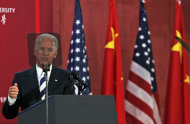
Biden says China, US share global responsibilities


U.S.Vice President Joe Biden reassured China on Sunday on the safety of its U.S. debt holdings and said the United States and China need to recognize their mutual global responsibilities and ensure greater fairness in trade and investment conditions.
Biden brought a strong message of mutual interdependence on his visit to the southwestern Chinese city of Chengdu on the final day of a five-day visit to the world's second-largest economy and key U.S. trading partner.
And, as he did earlier in his visit, Biden endeavored to ease China's concerns over its $1.2 trillion in U.S. Treasury holdings despite the massive U.S. deficit and downgrading of America's credit rating, saying, "You're safe."
"We could not afford not to make good" on U.S. commitments, Biden told students in a question-and-answer session following a speech at Sichuan University.
Biden noted that the interest rate on Treasurys fell following the downgrade, making them more sought-after than ever.
"If the world thought, my God, they've been downgraded and they're not going to make good on their debt, it would not have been viewed as the safest haven in all the world to invest. We are still the single-best bet in the world in terms of where to invest," he said.
Since Americans own 85 percent of the national debt, any politician that defaults would have to disappoint them, and "no politician wants to do that," he said.
Biden emphasized the frequent exchanges between President Barack Obama and Chinese President Hu Jintao along with government officials in the political and economic field. He said there needed to be more exchanges between their civilian and military leaders over security issues, especially on cybersecurity and maritime issues where the sides view matters from different perspectives.
"The fact is, China and the United States face many of the same threats and share many of the same objectives and responsibilities," Biden said. "Our generals should be talking to each other as frequently as our diplomats."
Military-to-military exchanges have a troubled history, with China suspending them to register its anger at U.S. actions on the political front or toward Taiwan, the U.S. ally Beijing claims as its own territory. Though revived last year, they face a new threat when the U.S. announces on Oct. 1 whether it will provide new F-16 warplanes to the island.
Biden said the U.S. and China both need global stability, including preventing Iran and North Korea from obtaining nuclear weapons. He also reasserted that the U.S. will remain a Pacific nation in the future, saying that the American presence had benefited regional stability and allowed China to focus on economic development.
"Asia and the United States are not separated by this great ocean. We are bound by it," he said.
Biden said he recognized frustrations among many Chinese businessmen and officials at the time needed to obtain visas to visit the U.S. and said Washington was working on improvements.
But he said U.S. companies continue to face major investment barriers in China, a frequent complaint among the business community here. He said U.S. businesses were locked out of entire fields and face "restrictions that no other major economy imposes on us or so broadly."
Chinese and U.S. prosperity is key to reviving the global economy and no serious problems can be resolved without Beijing and Washington at the table, Biden said.
"We're the two biggest engines in the world to be able to do that," he said.
The U.S. relishes competition from China and hopes for continued Chinese prosperity, with the $110 billion in U.S. exports to China last year generating hundreds of thousands of jobs, Biden said.
Biden was to spend the rest of the day Sunday visiting sites with his Chinese counterpart, Xi Jinping, who is expected to become the country's next leader.


AJK cabinet condemns Nawaz remarks

The AJK cabinet in its meeting here on Saturday under the chairmanship of Prime Minister Abdul Majeed Chaudhry unanimously condemned PML–N President Mian Nawaz Sharif’s alleged objectionable remarks vis-a-vis “Two Nation Theory” in a recent Lahore SAFMA event that drew criticism from other public quarters as well. An official handout issued after the cabinet meeting termed the alleged Mian remarks “a conspiracy against democracy and democratic norms” describing it “against the constitution of Pakistan, charter of democracy and a betrayal of Kashmir cause.”

Via another resolution the cabinet asked Mian Nawaz Sharif to respect the mandate of the people of Pakistan and wait for the elections till the completion of the tenure (of the present Pakistan government) in accordance with the dictates of the constitution. However it was appreciative of a reported statement by Editor-in-Chief of Daily Nawa-e-waqt, Mr Majeed Nizami “condemning” Mian Nawaz Sharif remarks to SAFMA on “Two Nation’s Theory”.

A bloody Ramzan

EDITORIAL:Daily Times

In what has to be the deadliest attack to target Pakistani Muslims in the holy month of Ramzan, a teenage suicide bomber blew himself up in Jamia Madina mosque in Jamrud, Khyber Agency, where more than 500 people were offering their Friday prayers. The official death toll has reached 51 with over a hundred badly injured. Blood stained mosque walls, Muslims killed during their mandatory weekly prayers and the holiest month in the Islamic calendar — one would have liked to believe that the militants, who claim to be the ‘true torchbearers’ of Islam, would not be up to their old tricks at this time. However, it seems that Ramzan has given them a warped licence to up the ante on their killing sprees.
The Tehrik-i-Taliban Pakistan (TTP) has claimed responsibility for this bloody attack, which has left even helpless women and children dead. The suicide bomber was no more than 16 years of age, again verifying that these militant monsters will go to any lengths — including the recruiting of children for deadly bombings — to achieve their nefarious goals. But why this mosque? And why now?
To understand the tactics employed by the terrorists, one has to first understand the tactics used by the state (or lack thereof) in its ‘counter-terrorism’ methods. FATA is teeming with militant sanctuaries and pockets of their safe havens. The state has, so far, proved to be as competent as a sitting duck in eliminating the threat they represent. Frequently, the TTP targets mosques and other areas in FATA and Khyber Pakhtunkhwa to let the state and its citizenry know of their malicious presence. It is because of the lack of government presence and a military offensive against these elements that many of the tribal groups in FATA have armed themselves and formed lashkars (armed militias) to ward off the militants. In some cases, the Pakistan Army seems fine with this arrangement as these lashkars, they hope, will do the job for them. However, how effective pockets of lashkars can be against a well armed guerrilla enemy is anyone’s guess.
The Kukikhel tribe belongs to the Jamrud region in Khyber Agency, and it is here that this tribe has formed an armed lashkar that has shown stiff resistance to Taliban pressure. It is believed that the mosque was targeted to strike at the Kukikhel tribe to debilitate its counter-terrorism efforts. With over 50 people dead, the attack is a seething blow to anyone and any group trying to beat back the militants.
The TTP is a vile enemy. It cares not for religion, people or culture. It laughs in the face of religious ritual and obligation by blowing to smithereens houses and worshippers of God. Ironically, it slaughters Muslims in the name of Allah. While this bloody attack will definitely demoralise any individual efforts to stave off the terrorists, it is hoped that this tragic bloodshed will only serve to reinvigorate anti-terrorism efforts in this war.
It is imperative that the state becomes an equal party in beating back the terrorists. The government and the military/intelligence establishment need to renew their efforts. Whilst the lashkars have proven to be enough of a threat to the TTP to make them attack their mosques and lands in these cruel ways, it is the responsibility of the state to launch a full throttle offensive against the militants. This will mean reinvigorating and increasing intelligence and not only relying on tribal folk to look after their own. All the same, lashkars such as those belonging to the Kukikhel tribe must be fully supported by the state so that they keep playing their role to ward off the terror threat. Countering this monster requires determined efforts from all sides.

ANP calls for decisive action against criminals in Karachi


The Awami National Party (ANP) expressing its reservation on the law and order situation in Karachi has called for a decisive operation against the criminals.
ANP spokesman Senator Zahid Khan said that his party’s demand of an army operation against the terrorists is now being supported by all segments of society, including the business community.
“We support a decisive operation against criminals irrespective of caste, creed and political affiliation,” he said.
Khan said all political parties whether inside the Sindh Assembly or outside should be taken on board for evolving a strategy to stop the killing of innocent people.
He said that ANP President Asfandyar Wali Khan had convened a meeting of the party on August 28 to discuss the fragile security situation in Karachi and put forward its recommendations before the government.
“We will also discuss the ANP Sindh chapter’s recommendation to part away from the Sindh coalition government,” Khan added.
“There is an urgent need to devise a sincere policy and make efforts to save Karachi from the current situation. Bodies of innocent people are found from the streets of the city on a daily basis, which needs to be stopped immediately,” he said.

Eve teasers to get 3-year jail or rupees half million fine: Iftikhar Says Bacha Khan raised voice for woman rights in 1930

THE FRONTIER POST
Khyber Pakhtunkhwa Minister for Information Mian Iftikhar Hussain Saturday assured strict action against the people involved in women harassment under relevant section of the law.Women harassment is an offence under section 509 of Pakistan Penal Code and the violators could be fined to the tune of half a million rupees or three years imprisonment, said the Information Minister while talking to a delegation of “Asha”, an organization working for the rights of women. Councilor Khurshid Bano led the delegation.The Minister maintained harassment of the women at the work places, public spots and any other place has been declared as a legal offence and the law came in to action whenever such matter was reported to police.He said not only the women but every person of the society has to be protected against harassment and added that the problem of the women is very delicate and sensitive and has to be dealt with extreme caution and care.The Info Minister said that only illiterate and narrow-minded people in the society were against educating women. .He said that women are part of our society and we do not consider them as an unequal part of humanity but rather our religion Islam accords highest respect and regard to mother, daughter, sister and wife, which has no precedence in other religion of the world.The ANP has a very consistent stance on the rights of the women and recalled the Fakhr-e-Afghan Bacha Khan had raised voice for the rights of women at a time when nobody could think of it.There was a separate space in the Pakhtun magazine in 1930 about the rights of women wherein the women used to express their point of view very explicitly.He further recalled that Fakhar­e-Afghan Bacha Khan gave equal status to women in education, politics, inherited property and other social sectors.Mian Iftikhar further assured that campaign would be launched through media about the rights of women and their respective law so that its implementation was made effective.

Saturday, August 20, 2011

Afghan shelter plan stokes controversy

By David Ariosto and Joe Sterling

Under the cover of darkness, a 9-year-old girl and her mother ran from their stone and mud home on the outskirts of Kabul. They feared the wrath of her stepfather.
"My father was beating me and my mother," said the girl, who to protect her identity will be referred to as simply Zarina. "He would insult my mother and sometimes wouldn't bring us food."
The last straw was an unwanted advance. Zarina, now age 10, said the man tried to rape her. She managed to slip past him and escape.
Zarina and her mother bounced from shelter to shelter before landing in a U.S.-funded women's home back in Kabul, the nation's capital.
Zarina's tale, however, is not unusual in Afghanistan, where women were persecuted under the Taliban regime from the mid-1990s until it was toppled in a U.S. invasion a couple of months after the al Qaeda terror network attacked the United States on September 11, 2001.
Observers of Afghanistan noted that abuse of women remains common in the post-Taliban era and often is accepted in conservative and traditional families, in which women who flee domestic violence and sexual attacks can risk severe punishment often at the hands of their relatives.
Since the fall of the Taliban, a scattering of women's shelters have cropped up in and around the Afghan capital, operating independently and commonly funded by international donors.
But, advocates say, a controversial proposal working its way through the Afghan government could jeopardize these safe havens.
The measure, if passed, would nationalize the shelters, placing them under control of Afghanistan's Ministry of Women's Affairs.
"It's better to bring it under Afghan law," said Afghan Deputy Minister of Justice Mohammad Qasim Hashimzai. "Because the shelters will be more organized, legal and better controlled."
Women's rights advocates say doing so could strip these shelters of the very independent qualities that make them effective, particularly their ability to decline family requests to return the women.
Human Rights Watch published a report on shelters this year and believes the government should "support, rather than control, the work of shelter providers." That would ensure "safe and secure refuge" for women fleeing violence.
"The Afghan government claims that taking over the shelters would lead to sustainable funding and better management, but the real agenda is clear," Rachel Reid, Afghanistan researcher at Human Rights Watch said in the report.
"The government is increasingly dominated by hard-line conservatives who are hostile to the very idea of shelters, since they allow women some autonomy from abusive husbands and family members."
She points out that the government is packed with "misogynist warlords and wide open to corruption. A government shelter is far more likely to cave in to pressure from families and tribes to hand back the victims, which will put women's lives at risk."
The rights group's report cited some some positive measures about the shelter proposal, such as implementing "minimum standards of food and heating, requiring shelters to provide education and literacy services, and requiring that any police interviews with women or girls in shelters must be carried out by female officers."
But the group said the plan would result "in the closure of some shelters, restrictions on women's freedom of movement, compulsory forensic examinations, a likely reduction in protection of shelter residents from abusers, and the possible expulsion of women still in need of safety."
Selay Ghaffar, executive director of Humanitarian Assistance for Women and Children of Afghanistan which runs a shelter, told Human Rights Watch that conservatives in government simply "want to control women, to push women back into their houses, like under the Taliban regime."
But Zarina envisions a future of freedom, not Taliban-style domestic enslavement.
"When I grow up, I would like to continue my education and become a teacher, because when I was at home my father was not allowing me to go to school."

Why Afghanistan is no Iraq - envoy


The new U.S. envoy in Afghanistan Ryan Crocker tells CNN in an exclusive interview Afghanistan has a tougher road ahead than Iraq in its path to stability due to the country's 30 years of war.

Karachi:‘Failure to stop violence leaves question mark on govt’

Dawn.com
Violence in Karachi has continued with the deaths of seven more people today. The four day death toll has now reached 79. At the same time MQM leader Raza Haroon has said that 48 hours have gone by without those responsible being arrested, which has left a question mark on the government.

Raza Haroon said that if the government is unable to arrest those involved in kidnappings in the city, then it is a failure on the part of the government.

He also emphasised that the MQM will not leave the people of Karachi alone. MQM Chief Altaf Hussain and the Rabita Committee in Karachi have also called for a meeting on the situation in Karachi.

Syrian opposition to launch 'national council'

http://www.vancouversun.com
Opponents of Syrian President Bashar al-Assad were meeting Saturday in Istanbul to launch a "national council" to co-ordinate the fight against the Damascus regime, organizers said.

Participants in two days of meetings in an Istanbul hotel, from both inside and outside Syria, planned to set up working groups and draft measures aimed at ousting Assad, who was targeted by new international sanctions on Friday.

"The Syrian national council will have between 115 and 150 members, more than half of whom are in Syria, with the reminder in exile," dissident Obeida al-Nahhas told AFP.

Energing from more than eight weeks of talks between oppposition groups, the council's objective was to "make the voice of the Syrian revolution and its demands heard by the international community," he said.

"It must incarnate the aspirations of the Syrian revolution and establish its political aims."

Nahhas said the council would have seven or eight committees to handle such issues as foreign affairs, political planning, economic matters and the media.

A Turkish source said security measures would be taken to ensure the meeting passed off without problems.

On Friday a group of "revolutionary blocs" announced the formation of a coalition called the Syrian Revolution General Commission, vowing to bring down the regime.

It said the coalition was set up due to "the dire need to unite the field, media and political efforts" of the pro-democracy movement.

A total of 44 groups had signed up to join the SRGC as part of "merging all visions of all revolutionaries from all coalitions and coordinators mutually focusing primarily on toppling the oppressive and abusive regime."

The long-term aim of the coalition is also to build "a democratic and civil state of institutions that grants freedom, equality, dignity and respect of human rights to all citizens," a statement said.

The SRGC was "the result of merging all the signatory Syrian Revolution blocs both inside and outside Syria and those who are invited to join as well in order to have through this commission a representation of the revolutionaries all over our beloved Syria," it said.

The coalition urged all groups involved in the pro-democracy movement to close ranks and join them "to achieve the goals of the revolution and bring out its voice to all corners of the world."

Signatories included protest committees from across Syria, including flashpoint cities and towns, as well as The Syrian Revolution 2011 Facebook page, one of the drivers of the protests.

Syrian dissidents have held several meetings in Istanbul and elsewhere in Turkey in recent weeks as Assad's regime stepped up its crackdown on protesters across the country.

The civilian death toll has now passed 2,000, UN Under Secretary General B. Lynn Pascoe told the Security Council on Thursday.


Read more: http://www.vancouversun.com/news/Syrian+opposition+launch+national+council/5283510/story.html#ixzz1VbzXIA4Q

Ban on Afghan TV channels hits cable operators in Peshawar

Local cable operators in Pakistan’s north-western city of Peshawar are rapidly losing their clientele due to restrictions by the Pakistan Media Regulatory Authority (Pemra) on the screening of programmes of the Afghanistan-based satellite channels.

Shakib and Laili - Zang-e Eshq


“Dozens of local subscribers are switching over to dish antennas because of the non-availability of the Afghan Pashto channels in Peshawar,” said Mushtaq Khan, managing director of the National Cable TV, in Board area of Peshawar.

He said that it was becoming difficult for them to continue their business as majority of the people wanted Pashto music, dramas and political programmes aired by Afghan Pashto channels that were not available on the Pakistan-based TV channels.

The Supreme Court had placed ban on screening of the Indian TV channels in August last year after which the Pemra asked the cable operators to stop these programmes or face penalties.

Khan said that the court had banned showing about 32 Indian channels such as Star Plus, Sony, Zee TV, and Zee Cinema.

But, the Pemra also placed a ban on the Afghanistan-based Pashto channels that were popular among the Afghan refugees as well as the local population, he said.

“We have been receiving requests from the people to restart Afghan channels but we cannot do this due to the Pemra directives,” Wazir Shah, assistant manager of the Afghan TV Network in old city, told Dawn.

He claimed that the Pemra had allowed the Pakistan-based satellite channels to air the Indian movies, soap opera, talk shows and entertainment programmes on which no action was taken.

China Confident In Strong US, Leaders Tell Biden


Standard & Poor's and the Tea Party might have lost faith in the U.S. economy, but China hasn't. During the opening remarks at a roundtable discussion with vice president Joe Biden and Chinese political leaders on Friday, China's vice-president Xi Jinping said his country thinks the U.S. will still come out on top, despite ongoing fiscal problems and weak economic fundamentals.
"We believe the U.S. is highly resilient, and has a strong capacity to repair itself," Xi told Xinhua news reporters. "We believe that the U.S. economy will achieve even better development as it rises to its challenges."
Xi is expected to become the new president of China in March 2013.
China is the largest foreign holder of U.S. debt, accounting for roughly 10% of the more than $14.3 trillion in outstanding government issues. So the world's No. 2 economy pays careful attention to U.S. fiscal balances. However, despite the fact that China's most recent purchases of U.S. government bonds are yielding below 3%, there are very few fixed income markets in the world where China could park a few hundred billion dollars.
During the meet, Biden reportedly said the U.S. was interested in seeing Chinese direct investment in American businesses. Xinhua also reported of a possible $1 billion's worth of commercial deals between companies in the two countries. No details were available by press time.
President Hu Jintao and Premier Wen Jiabao both met with Biden, who arrived in China on Wednesday. Hu said China will push for mutually beneficial economic cooperation with the U.S. to enhance market confidence and stabilize the international financial system. Wen mimicked the vice president when he reportedly said that he, too, was "fully confident" that the U.S. could overcome economic hardship and return to growth. Wen noted the U.S. economy's force as a center of global innovation, high-quality business talent and strong economic and financial institutions.
Biden flies to southwest China's Sichuan province on Saturday, where he will deliver a speech at Sichuan University.

Syria condemns Obama's call for Assad to step down

Supporters of Syrian President Bashar Assad shout slogans and wave their national flag, as they protest to show their solidarity to their president, in Damascus, Syria, on Friday Aug. 19, 2011.

A government owned Syrian newspaper on Saturday rejected U.S. and European calls for President Bashar Assad to step down, saying they revealed the "face of the conspiracy" against Damascus.
Despite the regime's promises this week that it had wrapped up a military offensive against protesters, activists said that security forces killed 29 people on Friday, most of them in the central province of Homs.
The Syrian leader has come under mounting criticism for his assault on the 5-month-old uprising. The U.S. and its European allies on Thursday demanded Assad step down because of the crackdown, which rights groups say has killed more than 2,000 people.
The regime, however, has pushed ahead with its offensive despite the criticism.
Reinforcements were being sent Saturday to Homs, Syria's third-largest city and the site of intense anti-regime protests, according to the Rami Abdul-Rahman, head of the London-based Syrian Observatory for Human Rights, and The Local Coordination Committees, an activist group.
"Shooting has not stopped since last night," Abdul-Rahman said, quoting residents.
The military offensive has focused on Homs, the coastal city of Latakia, the eastern city of Deir el-Zour, and the central flashpoint city of Hama.
In an amateur video posted online and said to have been taken in Hama, Syrian soldiers kick and slap four male detainees sitting handcuffed next to a desert road.
One of the men could be heard telling the officers beating him "if you have a picture of me or if anyone says I took part in a demonstration then slaughter me. Cut me to pieces."
The soldiers then kick the men in the face and on their heads as they beg for mercy.
The Associated Press could not verify the video. Syria has banned most foreign media and restricted local coverage, making it impossible to get independent confirmation of the events on the ground.
The continuation of the crackdown, despite Assad's assurances that it had ended, suggests he is either unwilling to stop the violence — or not fully in control of his own regime.
On Saturday, the government issued its first official response to the U.S. and European demands for Assad to step down.
The daily Al-Thawra newspaper, which speaks for the Syrian regime, rejected the calls and any kind of foreign intervention in Syria's internal affairs, saying Damascus "will never permit anyone to do that."
It also accused the West of trying to sideline Damascus from the Israeli-Palestinians conflict, which it said is a strategic aim for Israel, Washington and Europe.
Syria is a major player in the Arab-Israeli conflict and is in a state of war with the Jewish state. Syria is also Iran's strongest ally in the Arab world and supports Islamic militant groups like Hezbollah in neighboring Lebanon and Hamas in the Gaza Strip.
A high-level U.N. team recommended Thursday that the violence in Syria be referred to the International Criminal Court over possible crimes against humanity.
On Friday, the U.N. released the full text of its report on the crackdown.
It said Syrian government forces may have committed crimes against humanity by conducting summary executions, torturing prisoners and targeting children. The release includes rebuttals from the Syrian Foreign Ministry, offering a rare firsthand look into the regime's justifications for the crackdown.
___


Jamrud mosque bomb death toll hits 51: Officials

The death toll from a suicide bomb at a crowded mosque in Khyber Agency, the country’s deadliest attack for three months, rose to 51 on Saturday, officials said.

A suicide bomber detonated himself as more than 500 people had packed into a mosque for Friday prayers in Jamrud, killing many instantly and wounding scores more.

“The death toll has risen to 51 and 121 people were wounded,” local government official Khalid Mumtaz Kundi told AFP.

“Sixty-one of the wounded are still in hospital,” Kundi said.

Blood was splattered across the mosque’s main hall and walls, while the building’s doors and windows were destroyed and its ceiling fans mangled by the blast, according to an AFP reporter at the scene.

Ball bearings used in the suicide vest were also scattered across the mosque.

Friday’s bomb was the deadliest since May 13 when two suicide bombers blew themselves up outside a police training centre in a town about 30 kilometres north of Peshawar, killing 98 people.

A little known militant spokesman who identified himself as Mohammad Talha claimed responsibility by telephone on behalf of the Tehreek-i-Taliban Pakistan (TTP).

“We, the Taliban claim responsibility for this attack. This mosque belonged to KukiKhel tribe and we are fighting against them and anyone fighting with us will have the same fate,” Talha told AFP.

The authenticity of the claim could not be verified but bombings blamed on the Taliban and al Qaeda-linked networks have killed more than 4,550 people since 2007.

A Drink or Two a Day May Lower the Risk of Alzheimer's


A new review finds that moderate drinking is associated with a lower risk of memory problems and Alzheimer's disease or other forms of dementia.

The authors analyzed results from 143 studies, dating back to 1977, which included 365,000 participants in 19 countries. The studies compared non-drinkers to drinkers: 74 of the studies looked at the risk of dementia, while the other 69 focused on memory problems.

The review found that moderate drinkers were 23% less likely than teetotalers to develop signs of memory problems or Alzheimer's. That effect was significant in 14 of the 19 countries, including the U.S.

Heavy drinkers, on the other hand, tended to have a higher risk of memory problems and dementia than non-drinkers, but that association was not statistically significant, researchers said.


If you're keeping score, moderate drinking means one drink a day for women and two drinks a day for men. Heavy drinking means three to five drinks or more a day. One drink is defined as 1.5 oz. of spirits, 5 oz. of wine, or 12 oz. of beer.


Wine appeared to have more of a protective effect than beer or spirits, but that finding was based on a small number of studies, so there's not enough data to make a distinction between types of alcohol, the authors said.

While the analysis didn't offer an explanation for why drinking may lower the risk of cognitive decline, the researchers theorized that alcohol may have anti-inflammatory properties. Inflammation is thought to play a role in Alzheimer's disease (along with other conditions like heart disease and stroke), and moderate amounts of alcohol may suppress inflammation in the brain; too much alcohol could stimulate it, the authors suggested,alcohol might improve blood flow in the brain and thus brain metabolism, the researchers said. And they offered up another theory, that small amounts of alcohol may make brain cells more fit by slightly stressing them and increasing their ability to cope with major levels of stress that can eventually cause dementia.
The findings don't suggest that nondrinkers start chugging alcohol to stave off Alzheimer's. The study showed only an association, not cause and effect. It's possible, for example, that moderate alcohol consumption was a marker for an overall healthier lifestyle — like eating a heart-healthy diet, exercising and maintaining positive social relationships — all of which may also help lower the risk of dementia.

But for those who do consume alcohol, the authors say moderation is key. "Social drinking can be a very positive thing as long as it is not excessive and doesn't exceed a drink per day for women or two drinks for men," Christy Tangney, an associate professor of clinical nutrition at Rush University Medical Center in Chicago, told WebMD. "Light-to-moderate drinking appears to benefit cognitive performance."

The analysis was published in the journal Neuropsychiatric Disease and Treatment.

Read more: http://healthland.time.com/2011/08/19/a-drink-or-two-a-day-may-lower-the-risk-of-alzheimers/#ixzz1VZ8vRIkk


Five killed in Karachi, toll reaches 77 in four days

Five people were killed in the metropolis on Saturday as violence continued unabated, Geo News reported Saturday. In four days of violence at least 77 people lost their lives.

Violence erupted in Karachi after the kidnapping and killing of five people belonging to Lyari. Violence was reported in North Karachi, F.B. Area, Orangi, Pak Colony and other areas of the city. An Edhi ambulance was attacked in Orangi, and three including the driver were injured. Mini buses were also attacked in Korangi and Sorhab Goth. The car of DIG East was also targeted in Korangi but no loss of life was reported.

The wave of violence began on August 17 and firing, hand grenade and rocket attacks took place in Tariq Road, Saddar, Soldier Bazaar, Kharadar and the Old City areas of the city. Sixteen including a former PPP MNA, Waja Karim Dad were killed while 20 others were injured.

On August 18, terrorists kidnapped and killed 30 people belonging to different areas of the city. Their bodies were recovered from the Old City area, Lyari, Pak Colony, Sher Shah and other areas of the city. Many of the victims had been decapitated.

Violence continued on August 19, and despite the presence of Interior Minister Rehman Malik in the city, 26 people were killed and 46 were injured.

US troops may stay in Afghanistan until 2024

http://www.telegraph.co.uk


The agreement would allow not only military trainers to stay to build up the Afghan army and police, but also American special forces soldiers and air power to remain.
The prospect of such a deal has already been met with anger among Afghanistan’s neighbours including, publicly, Iran and, privately, Pakistan.
It also risks being rejected by the Taliban and derailing any attempt to coax them to the negotiating table, according to one senior member of Hamid Karzai’s peace council.
A withdrawal of American troops has already begun following an agreement to hand over security for the country to Kabul by the end of 2014.
But Afghans wary of being abandoned are keen to lock America into a longer partnership after the deadline. Many analysts also believe the American military would like to retain a presence close to Pakistan, Iran and China.
Both Afghan and American officials said that they hoped to sign the pact before the Bonn Conference on Afghanistan in December. Barack Obama and Hamid Karzai agreed last week to escalate the negotiations and their national security advisers will meet in Washington in September.
Rangin Dadfar Spanta, Mr Karzai’s top security adviser, told The Daily Telegraph that “remarkable progress” had been made. US officials have said they would be disappointed if a deal could not be reached by December and that the majority of small print had been agreed.
Dr Spanta said a longer-term presence was crucial not only to build Afghan forces, but also to fight terrorism.
“If [the Americans] provide us weapons and equipment, they need facilities to bring that equipment,” he said. “If they train our police and soldiers, then those trainers will not be 10 or 20, they will be thousands.
“We know we will be confronted with international terrorists. 2014, is not the end of international terrorist networks and we have a common commitment to fight them. For this purpose also, the US needs facilities.”
Afghan forces would still need support from US fighter aircraft and helicopters, he predicted. In the past, Washington officials have estimated a total of 25,000 troops may be needed.
Dr Spanta added: “In the Afghan proposal we are talking about 10 years from 2014, but this is under discussion.” America would not be granted its own bases, and would be a guest on Afghan bases, he said. Pakistan and Iran were also deeply opposed to the deal.
Andrey Avetisyan, Russian ambassador to Kabul, said: “Afghanistan needs many other things apart from the permanent military presence of some countries. It needs economic help and it needs peace. Military bases are not a tool for peace.
“I don’t understand why such bases are needed. If the job is done, if terrorism is defeated and peace and stability is brought back, then why would you need bases?
“If the job is not done, then several thousand troops, even special forces, will not be able to do the job that 150,000 troops couldn’t do. It is not possible.”
A complete withdrawal of foreign troops has been a precondition for any Taliban negotiations with Mr Karzai’s government and the deal would wreck the currently distant prospect of a negotiated peace, Mr Avetisyan said.
Abdul Hakim Mujahid, deputy leader of the peace council set up by Mr Karzai to seek a settlement, said he suspected the Taliban had intensified their insurgency in response to the prospect of the pact. “They want to put pressure on the world community and Afghan government,” he said.
http://www.blogger.com/post-create.g?blogID=6906155786122195046

Bill Clinton: 'I was lucky I didn't die'


North Korea's Kim Jong-il in rare Russia visit

North Korea's reclusive leader, Kim Jong-il, has begun his first trip to Russia since 2002.

His train arrived in the border town of Khasan in the Russian Far East, where he is to hold talks with President Dmitry Medvedev in the coming days.

They are likely to discuss the possible resumption of international talks over North Korea's nuclear programme.

North Korea is in talks with Russian gas monopoly Gazprom about a pipeline through its territory to South Korea.

A delegation from the company visited North Korea last month.

The BBC's Lucy Williamson in Seoul says the pipeline would have a far-reaching political and economic impact, and potentially allow North Korea to control a key energy supply to the South.

South Korea's Yonhap news agency says the North Korean leader is expected to visit a dam north of Vladivostock, before holding summit talks with President Medvedev in Siberia on Tuesday.

The agency quotes an unnamed official as saying Mr Kim may also meet Russian Prime Minister Vladimir Putin.

The leader's visit comes amid severe economic hardship and food shortages in North Korea.

On Friday, Moscow announced it was providing 50,000 tons of wheat to Pyongyang.

Afrasiab for deliberations over new provinces


Provincial President of the Awami National Party (ANP) Senator Afrasiab Khattak has said the demand for the new provinces must be based on solid reasons, logic and rationale.

“The issue should be deliberated as was done by the political parties on the question of the provincial autonomy. No decision should be taken in haste and all the stakeholders must be taken on board to develop a consensus on creation of new provinces,” he said while talking to The News.

The ANP senator said gone were the days when people demanding provincial autonomy or separate province were dubbed as traitors. “People are witness to the fact that 14 political parties agreed to the 18th Amendment and the federating units achieved their rights with consensus,” he reminded.

He opined that administrative, cultural and linguistic factors should be taken into account while creating new provinces. “Only administrative factor is not enough as there must be some rallying point for creation of new provinces,” he maintained.

The ANP leader advocated the merger of the Federally Administered Tribal Areas (Fata) with Khyber Pakhtunkhwa. “People of Fata and Khyber Pakhtunkhwa share the same history, culture, language and geography. They are the same people and the inclusion of Fata into Khyber Pakhtunkhwa is a natural and pragmatic approach,” he argued.

Afrasiab Khattak said initially Fata should be given representation in the Khyber Pakhtunkhwa Assembly and then gradually with the consent of tribespeople it should be merged into Khyber Pakhtunkhwa. “The British separated Pakhtuns by dividing them in different administrative setups, which is not divine law and can be amended keeping in mind the needs of the time,” the Senator said.

Defending his point, he argued that in last 150 years the tribesmen and people of districts adjoining the tribal agencies had developed a strong bond. “Who can separate Bajaur from Jandool, Thall from Parachinar, Mohmand from Shabqadar, Hangu from Orakzai, Bannu from Miramshah, Tank from Waziristan,” he added.

Afrasiab Khattak said that geographical location of tribal agencies also supports their merger into Khyber Pakhtunkhwa. He added that many provincial government departments were also active in Fata.

The ANP provincial chief said it was quite strange that under One Unit the provincial assembly of West Pakistan in Lahore had representation of Fata while the provincial assembly that sits in Peshawar has no representation of tribal areas.

To a question, he said they were in contact with public representatives of Fata over the issue. However, he added, many of them don’t know the benefits of merger of Fata into Khyber Pakhtunkhwa. Besides, the bureaucracy that ruled Fata since the formation of Pakistan was also not in favour of its merger with Khyber Pakhtunkhwa as such a move would deprive them of their fiefdom.

“After the extension of Political Parties Act, we have the legal right to access the Fata people and put the question of its merger with Khyber Pakhtunkhwa to the tribesmen,” the Senator said.

He said the ANP was the only political party that has been demanding new provinces on the basis of culture, nationality and history. Since 1986, he said, the ANP had treated the Seraiki belt as separate unit and not as part of Punjab. Similarly, he added, the ANP had a clear stand on the Pakhtuns living in Balochistan.

“The Pakhtuns of Balochistan should be given chance to merge with Khyber Pakhtunkhwa or have their own province. In the constitutional committee, the Pakhtunkhwa Milli Awami Party presented the same options and the ANP supported its stance,” the ANP leader said.

About the demand to merge Dera Ismail Khan and Tank districts of KP with the proposed Seraiki province, Afrasiab Khattak said before demanding merger with a province the cultural and administrative realities should be assessed in depth.

“If political parties continue sloganeering and referring to history, then we can also demand merger of Mianwali and Attock districts with Khyber Pakhtunkhwa because both were part of the then NWFP before the One Unit,” he stressed.

He said politicians must exhibit maturity as such statements further complicate issues, he said without naming National Assembly Deputy Speaker Faisal Karim Kundi who has been vociferously calling for inclusion of Dera Ismail Khan and Tank districts of the KP in the proposed Seriakistan province.

About the Hazara province, he said while in principle one can agree with this demand as it was the right of the people, but in reality the case for Hazara province is very weak.

“They haven’t done homework and have no rationale. It is an emotional outburst expressed after renaming of the North West Frontier Province,” he said, adding that the supporters of Hazara province also failed to point out the issues they faced after renaming of the province.

“The people of the proposed Abaseen division in present-day Hazara are not in favour of a separate province. How can a province comprise just two or three districts? It is not a feasible idea,” he claimed.

Bomb attacks take toll on Peshawar


Peshawar has seen more bomb attacks than any other city in the country in the last year. It's taken a severe strain on the residents, particularly poor families who are often the victims. Al Jazeera's Kamal Hyder reports on the plight of one such household in Peshawar

Rebels close in on Libyan capital

US funding dams in Pakistan

DAWN.COM
The United States has provided support to complete the final phases of two hydroelectric dams in Pakistan: Satpara in Gilgit-Baltistan and Gomal Zam in South Waziristan, the State Department has said.


“We are considering doing more in the sector,” said the department’s spokesperson Victoria Nuland, as media reports suggested that the US would also support the giant $12 billion Diamer-Bhasha dam project.

Ms Nuland noted that Pakistan had requested international community’s support for development of the Diamer-Bhasha project.

“We recognise that such a hydroelectric project would help meet many of Pakistan’s long-term energy and water needs, as well as advance social and economic development,” she said.

“We are considering how we can best support Pakistan’s request, as are other bilateral donors and multilateral financial institutions.”

The US, she said, had not yet made a final decision on this giant project but noted that providing support to such projects was part of a broader signature energy programme in Pakistan that the US announced in 2009.

“We continue to work with the government of Pakistan to determine how best to use US civilian assistance,” Ms Nuland said.

If the US agreed to support the Diamer-Bhasha dam, it would be the largest civilian aid project the US has undertaken in Pakistan in decades.

Asked if the US was concerned how its support for these projects would affect its ties with India, Ms Nuland said the United States had long supported development projects that enhance the daily lives of people throughout the region. “In doing so, we always take into account a project’s potential regional impact,” she added.

Pakistan critical front in war against terror, says US


While drawing a list of states sponsoring terrorism, the US State Department has resisted calls to place Pakistan on the list and instead depicted it as “a critical front” in the war against terror.

Since the May 2 raid on Osama bin Laden’s compound, some US lawmakers and a strong Indian lobby in Washington have been campaigning hard to place Pakistan among the states that sponsor terrorism.

But the State Department’s latest report on terrorism, issued on Thursday evening, only listed Cuba, Iran, Sudan and Syria among such states.

But it noted that “portions of Pakistani territory remained a safe haven for extremists, including high-level Al Qaeda leaders”.

The department also claimed that groups such as the Taliban’s Quetta Shura and the Haqqani Network “used western Pakistan to plan attacks against American interests” in Afghanistan.

Tehrik-i-Taliban Pakistan continued using Pakistan’s tribal belt to plan attacks against the government of Pakistan and its citizens.

TTP has also diversified its target set by seeking to attack the US directly, as demonstrated by its support for the attempted Times Square bombing in May 2010, the report added.

The State Department also described Lashkar-i-Taiba and its affiliates as “a threat to the stability of the region and beyond”.

According to the State Department, Pakistan continued to experience high levels of terrorism in 2010 and Pakistan-based terrorist organisations continued to “threaten internal, regional, and global security”.

Violence resulted from both political and sectarian conflicts throughout the country, with terrorist incidents occurring in every province. While government authorities arrested many alleged perpetrators of terrorist violence, few convictions resulted.

The Pakistani military continued to conduct operations in areas with known terrorist activity but was unable to expand its operations to all areas of concern.

Increased sectarian violence between the Sunni and Shia communities and against religious minority communities also resulted in numerous attacks with high casualties. These attacks continued the trend of employing suicide bombers and remotely detonated explosives to perpetrate violence. Attacks using similar methods were also carried out against government and police facilities.

Pakistan, particularly Fata and Khyber Pakhtunkhwa, continued to be used as a base for terrorist organisations operating in Pakistan and Afghanistan, and Pakistani security forces undertook substantial efforts to counter these threats.

These organisations recruited, trained, and conducted fund-raising for terrorist operations in Pakistan, and used Pakistan as a transit point for cross-border movement to Afghanistan and abroad.

Pakistan’s Frontier Corps and military initiated large-scale counter-insurgency operations in Mohmand and Orakzai, and added one battalion in Khyber Pakhtunkhwa.

Pakistan’s ability to continue robust operations was negatively impacted by the need to divert resources to provide relief from the 2010 floods, which caused severe, long-term damage in Pakistan.

The ability to establish and maintain security in densely populated urban areas or areas with a historically poor security presence also remained a major challenge for Pakistan.

“Pakistan’s civilian government and military departments cooperated and collaborated with US efforts to identify and counter terrorist activity in Pakistan, and the United States continued to engage Pakistan to ensure it had the will and capacity to confront all extremist elements within its borders,” the report concluded.

Karachi red with blood again


Violence in Karachi seems to be spiralling out of control as 22 more people, including five policemen, were gunned down in the country’s financial hub since Thursday midnight, bringing the death toll in the last three days to 72. The killings contradicted Interior Minister Rehman Malik’s claim that not a single incident of targeted killing had taken place in the city since Thursday midnight.
The Karachi Chamber of Commerce and Industry (KCCI), meanwhile, demanded the government deploy the army to restore order in the city but Malik and Sindh Home Minister Manzoor Wasan said the police and paramilitary personnel would be able to bring peace to the violence-stricken city.
According to details, five Elite Force personnel were killed and 40 others injured when unidentified gunmen opened fire on their bus in the Korangi area late on Friday night. A deputy superintendent of police was among those injured. According to a private TV channel, the policemen were in plain clothes and were to be deployed A man was gunned down in Orangi Town while police found two trussed up bodies in the Lyari stream near the Khamosh Colony area. Another two bodies were found in the Bakra Peeri area while six people were killed in North Nazimabad, Kharadar, Gulshan-e-Iqbal, Mobina Town, Liaquatabad and Kemari Town areas.
According to police, another body was found in a gunny bag near Kharadar Jamaat Khana, while a man was gunned down and another sustained bullet injuries in Kemari. Another man was shot dead in Mobina Town. The deceased was said to be a worker of a political party. Unidentified armed men shot a person in the C area of Liaquatabad, killing him instantly while another was killed and one injured in Block 5, Gulshan-e-Iqbal area. Armed men cordoned off the Chakra Goth area of Korangi and opened indiscriminate firing on houses. They later broke into the houses and tortured the residents, killing two and injuring several others. Most of the residents of the area were Sindhi. There were also reports of a rocket being fired in the Agra Tag area of Lyari. No casualty was reported in the attack. However, two shops and a warehouse were damaged.
Meeting: Meanwhile, Malik and Sindh Chief Minister Qaim Ali Shah presided over a meeting to review the ongoing situation in the metropolis and decided that stern action would be taken against killers, hooligans and extortionists. Malik said every state force would be used to maintain law and order in Karachi, adding that the perpetrators would not be spared. Later, addressing a press conference, Malik said targeted killings in Karachi had come to an end. “Not a single killing was reported since midnight of Thursday,” he claimed. “As many as 52 people have been arrested and would be presented to the media soon,” he said. In a statement, Sindh Home Minister Manzor Wasan said the army was not required to control the law and order in the city. “Police can control the situation… demands of army deployment in the city is a political tactics,” he said.

Complacency of the ruling elite

EDITORIAL:Daily Times


PML-N chief Mian Nawaz Sharif recently gave a call for fresh elections. He asked the nation to stand up to the government and not allow anyone to play with their mandate. Mr Sharif was of the view that the problems being faced by Pakistan could only be resolved if elections were held immediately. Prime Minister Gilani rejected Mr Sharif’s call for early elections and said that the next elections would be held on time. The timing of Mr Sharif’s demand is interesting. For quite some time, members of the PML-N had been demanding mid-term polls but Mian sahib kept ignoring these demands and was quite content with letting this government complete its term. So why has Nawaz Sharif changed his mind now? There could be a few factors. One of them is that the PML-N’s popularity in Punjab has suffered greatly due to its mismanagement and misgovernance. If Mr Sharif thinks this is a good a time to go back to the electorate, he is in for a surprise. Chief Minister Shahbaz Sharif’s government has not performed well ever since it came to power in Punjab. Their so-called pro-people projects like Sasti Roti Scheme have proved to be anything but helpful for the public. Instead, these projects only led to more corruption and became a burden on the provincial exchequer. If the PML-N wants to go for an election again, it may not turn out to be an advantageous move because the party hardly has an organisation outside central Punjab. Mian sahib’s call thus seems more like a pressure tactic. Whether this will put the government under any pressure seems unlikely given Prime Minister Gilani’s nonchalant attitude.

Mr Gilani said that all the state institutions were working within the ambit of the constitution and were following democratic norms and processes, so he was unaware of what Mr Sharif was pointing at. The PPP-led coalition government should complete its tenure but that does not mean it can afford to be complacent. The PPP keeps trotting out its achievements, i.e. the 18th Amendment and NFC Award, which are great achievements indeed, but the government should not sit sanguine and pretend that everything is hunky-dory. Nobody wishes to tilt against democracy but a democratic dispensation also has to deliver. In a country like Pakistan, people lose patience with democratic governments when they fail to deliver. The government needs a wakeup call. Unemployment has risen considerably under this regime while inflation has broken the back of the masses. The global recession and terrorism have contributed to many of these problems but the government has not done much to address the issues of concern to the masses. This reflects poorly on the PPP and its ability to deliver.

As far as institutions are concerned, the ongoing tussle between the executive and the judiciary is cause for concern. The government might be on good terms with the military since it is doing its bidding in virtually all matters, but this can hardly be taken to mean that every institution is working within its parameters. By not challenging the military’s control over the country’s foreign and security policies, especially when the civilian politicians had a chance post-Osama bin Laden’s death, the government has not done the country or itself any favour. By trying only to safeguard its interests, taken to mean mere completion of its term, the PPP is increasingly disappointing the electorate. Thus the prime minister’s complacency is certainly misplaced. In order to restore the faith of the masses in democracy, the PPP must work harder towards reforms and good governance. Pakistan needs stability, not another uniformed ‘saviour’ who might take advantage of the current malaise.

11,604 terrorist attacks in 72 countries in 2010

There were 11,604 terrorist attacks in 72 countries in 2010, which resulted in 49,901 victims, according to the annual US report on terrorism. “Although the number of attacks rose by almost five percent over the previous year, the number of deaths declined for a third consecutive year, dropping 12 percent from 2009,” the report said. The US State Department released its Reports on Terrorism on August 18. The annual report, which breaks down global terrorist attacks and terrorist group activity by region and country, includes a statistical annex that is prepared by the National Counterterrorism Center (NCTC). The report includes a list of 47 foreign terrorist organisations designated by the United States, and it lists four nations designated as state sponsors of terrorism: Cuba, Iran, Sudan and Syria. Based on a yearlong collection of reports from every nation, of the 49,901 victims of terrorist acts, there were 13,186 people killed in 2010.

In the grip of holocaust... ''Jamrud Mosque Blast''

Editorial:THE FRONTIER POST

50 killed in Jamrud mosque blast
More than 50 persons, including men and children, were killed and over 100 others injured when a suicide bomber struck a mosque in Jamrud during Friday congregation in Khyber Agency, officials said. The blast took place at Jamia Masjid Madina in Sherabaz Madokhel in Ghundai area of Tehsil Jamrud, Khyber Agency. Hundreds of people were offering Friday praye


How many a Jamrud is this hapless unfortunate nation fated to undergo grievously? Where is the administration? And what the leadership is doing? Don’t they both know that the nation all over the country is in the grip of a vicious holocaust and that they both must be on their toes to stop this horrific carnage? As some 50 innocent worshippers were blown up into pieces and over 100 lay critically gored in pools of blood in the Jamrud mosque, weren’t both the administration and the leadership hibernating blissfully in some secure niche? Why the mosque had not been secured by tight security shield when it obviously was a potential target of terrorism? Jamrud is well within the range of the militancy-blighted region. And just a modicum of common sense could tell the state security apparatus and its political masters that the vile thugs could possibly target the mosque lethally on a Friday as it would draw the faithful in larger numbers than the normal on this august day during the holy month of Ramadan. Who doesn’t know that the unconscionable vile thugs who though feign their thuggery to be religiously motivated have no qualms in sinning against the believers? The inhuman savages rather gloat over the heartless killing and maiming of the faithful in the places of worship and pridefully claim responsibility for the holocaust. So why had the guardians of law left the Jamrud mosque so insecure that the wicked suicide bomber walked into it unobstructed and blew himself up to soak it with human blood and limbs so horrifically?For how long are the security echelons and the political bosses to keep lulling a distressed and anguished citizenry that a thug bent upon killing himself is hard to stop? Why is the vile character not disabled in his very lair before he crawls out for his sinful mission to inflict death, injury and destruction on the innocent citizenry? Why no orchestrated, coordinated and sustained counter-terrorism campaign has been put in place as yet to prostrate and behead the monstrosity of terrorism stalking all over the land so freely and so bloodily? What for is that huge money-guzzling security apparatus? Only for hibernating and for coming into action with lame excuses and preposterous explanations after the terrorists have struck? And what for is the political leadership? To issue trite customary condemnations and condolences only? Why no heads roll; no questions are asked; and no explanations are demanded? For how long are the political bosses to keep so fiddling and the security flanks remain so asleep while the country is so dangerously caught up in terrorism and criminality?

Karachi is aflame, with the dreadful sight of mutilated bodies in gunny bags staging a return to the beleaguered port city. To salvage the nation’s key economic hub, not kid gloves but an iron fist is essentially called-for to trounce and demolish the merchants of death and mayhem prowling in the city so fearlessly. Yet the leadership has set up just a committee to deal with the situation. For heaven’s sake, what will this committee do where the security apparatus indispensably must be put to the task that it must do but is not doing? Will the committee oversee the burial of the bodies received in gunny bags?Has indeed the leadership lost all its marbles that it is bringing forth loathsome childishness and child-like immaturity where wisdom of the highest order is required so necessarily? If it is not up to the job, which it shows conclusively it is not, shouldn’t it activate the inter-agency consultative and decision-making processes to cope with a very perilous situation the country is in indisputably? Why should just a bunch of politicos of mediocrity huddle up together in a high official mansion and take some expedient decisions about a colossal situation which is palpably beyond their depth and comprehension? The country is precariously adrift to chaos and anarchy. It can afford no more of a bloodied Jamrud and a flaming Karachi. The dreadful drift has to be reversed in any event, an effort which has no room at all for dirty politicking, petty politics and obscene expediencies. Already, it is too late; there is no more time left to fritter away in launching a comprehensive campaign to bring back the country to sanity, peace and normality. If the political leadership fails to do this, the nation will of course be hurt irreparably but it itself will never be forgiven by the posterity for this sin of its against a hapless people who had had the misfortune of having it at the helms at this point in time.

Egypt decides to withdraw ambassador from Israel


The Egyptian Cabinet says it has decided to withdraw its ambassador from Israel over the deaths of Egyptian security forces in fighting after an ambush targeting Israelis near the border between the two countries.
The Cabinet statement issued early Saturday says the ambassador will be withdrawn until Israel investigates the shooting deaths of five Egyptian security forces.
The decision comes after Egypt's official news agency blamed the Israelis for shooting and killing the five while chasing militants who killed eight Israelis in Thursday's ambush across the border in southern Israel.
The Israeli military promised to investigate.

Friday, August 19, 2011

Jamrud mosque bombing


A bomb rips through the side of a mosque in northwest Pakistan.

UN urges Pakistan to probe journalist killings


The office of the UN’s human rights commissioner urged Pakistan on Friday to investigate a recent spate of killings and disappearances of journalists.


“In the past eight days alone, we have received reports on the killing of one journalist, Munir Shakir, in Balochistan on 14 August, 2011, and the disappearance of another journalist, Rehmatullah Darpakhel, three days earlier in North Waziristan on 11 August,” OHCHR spokesman Rupert Coleville said.

“We call on all responsible parties to immediately stop such violations of human rights, and we urge the government to take immediate steps to independently investigate these cases,” he said.

Coleville explained that these were far from being isolated incidents.

“Pakistan is cited by various journalist groups as one of the most dangerous if not the most dangerous place for journalists” in the world, he said.

Citing figures from the non-profit Committee to Protect Journalists, Coleville said that 16 reporters were killed in 2010 and nine journalists had died so far in 2011.

“But two journalists in eight days is quite intense,” he said.

“We’ve already raised it this year…and we wanted to highlight that nothing has changed since then, and if anything it is getting worse,” he warned.

“None of the cases have been fully or satisfactorily investigated,” Coleville added.

U.S. VP Biden visits world's fastest-growing economy


Thousands protest against violence in Karachi, Pakistan

Thousands of people gathered in front of the Governor House in Karachi Friday afternoon to protest against the recent violence and target killings in the city, which have claimed dozens of lives over the last couple of days, reported local Urdu TV channel Geo.

Local watchers believed that the angry protesters including the victims of the target killings in the city could turn violent as local residents have almost lost the confidence in the government's ability to check the rampant violence going on in the city for months.

The Karachi-based Federation of Chamber of Commerce demanded the army to take control of the city.

Since Wednesday over 45 people were reportedly killed in different firing incidents in various parts of the city. In July alone, over 300 people lost their lives in different political and ethnic violent in Karachi, bring to over 1,000 the total number of people killed in bloody violence in the city this year.

Located on the southern tip of Pakistan along the Arabian sea, Karachi is the country's largest economic center which contributes more than 60 percent of the country's tax revenues.

However, the rampant violence in the city has constantly put the businesses of the city to a standstill. Daily loss resulting from violence at its peak time in the city reportedly stands at about 100 million U.S. dollars.

The deteriorating law and order situation has caused a big concern in the country. Even the Pakistani army, in a very rare gesture, has recently expressed concerns over the growing violence in the city.

The main cause of the incessant violence and target killings in the city is the conflict between two groups, namely Muttahida Qaumi Movement (MQM) and Awami National Party. They are the two old rivals in Karachi.

MQM represents the powerful Urdu-speaking population immigrating from India in 1947 when Pakistan got independence. ANP represents the Pashtun-speaking people from the country's northwest and southwest.

The two groups are in constant clashes with each other over political issues and business interests. The latest conflict between the two groups in the city is due to the restoration of the elected local government system introduced by the then Pakistani President Musharraf in 2001, which is believed to benefit MQM and hurt the interests of ANP in Sindh province, of which Karachi is the capital.

Karachi in flames

Editorial:THE NEWS


Karachi is reaching a state of complete anarchy. At least thirty-four people have been killed in the last 24 hours with violence escalating following the death of former PPP MNA Waja Karim Daad. Rival groups used rockets and bombs to launch attacks against each other on Wednesday, plunging the city into mayhem. There are no signs that the havoc has ended or that security forces will be able to get the situation under control anytime soon. In fact, things seem to be deteriorating as more killings are being reported from various parts of the city. The murderous tide has branched out of Lyari and enveloped other parts of the city. At least eight more bodies in bags were found on Thursday. Some 15 others had been discovered the previous day – many of them dumped by unidentified persons even as terrified residents looked on helplessly. The worst aspect of the killings is that no one seems to be able to get matters under control. In fact, the government at both the provincial and central levels has not even been able to articulate precisely what it is planning to do.

The bottom line is that such mayhem simply cannot be allowed to continue. For a long time Karachi has barely seen a day of peace. Things have continued along a path which spells disaster for the people. It is obvious that the killings are a result of growing political tensions in the city and of the schism that has divided people on the basis of both their ethnic background and political affiliation. The absurd statements made in the past by members of the ruling party have only added to the tensions and exacerbated things – much like the vines and creepers of a forest taking over a garden within which people had for some time enjoyed at least relative harmony. It is clear that, whatever security plans exist for Karachi, they are not working. Rangers and police personnel have reportedly stood by and watched as the killers fired volleys of bullets and bodies fell to the ground. Normal life has been shattered and, as has been noted on more than one occasion, the ongoing instability means a devastating blow to an economy which already stands on very shaky ground. Worse still is the formidable human cost of the unrest in a city torn apart by bloodshed.

40 dead in Pakistan mosque bombing


A bomb exploded in a mosque in a Pakistani tribal region as hundreds were gathered for prayers Friday, killing at least 40 people and wounding 85 others in the first major attack in the country during the Muslim holy month of Ramadan.
The attack came despite a period of relative calm in Pakistan, which has suffered numerous Taliban-led insurgent attacks in recent years. No group immediately claimed responsibility, but the Taliban and other Islamist militants have previously attacked mosques.
The bomb went off in Ghundi, a village in the Khyber tribal region, a part of Pakistan's tribal belt. Khyber has long been a base for Islamist militants, and the Pakistani army has waged multiple operations aimed at pacifying the region but with limited success.
Khyber also is a key region for the U.S. and NATO, because a large portion of non-lethal supplies heading to U.S. forces in Afghanistan passes through it.
Some 300 people had gathered for prayers Friday afternoon in the Sunni mosque, and many were on their way out when the bomb exploded, local administrator Iqbal Khan said. Officials said there was some evidence a suicide attacker was involved.
Saleem Khan, 21, said people panicked after the blast, and that amid the smoke, cries and blood, several ran over him when he fell.
"Whoever did it in the holy month of Ramadan cannot be a Muslim," he said from a hospital bed in the main northwest city of Peshawar. "It is the cruelest thing any Muslim would do."
TV footage from the scene showed a heavily damaged building. Prayer caps, shoes and green prayer mats were scattered across a blood-splattered floor, while ceiling fans were twisted and walls blackened. Men comforted a young boy who wept as he held his hand to his heart.
At least 40 people were killed, and 85 wounded, local administrator Fazal Khan said.
Islamist militants such as the Pakistani Taliban have targeted mosques before, especially if they believe alleged enemies — such as army soldiers — are using the facility.
The Pakistani Taliban and affiliated groups are staging attacks in Pakistan because they oppose Islamabad's alliance with the United States.
Also Friday, two U.S. missiles struck a house in a tribal region that was once a Pakistani Taliban stronghold, killing four people, intelligence officials said.
The missile strike came as Pakistani-U.S. relations are seriously strained after the unilateral American raid that killed al-Qaida leader Osama bin Laden in northwest Pakistan. The continued missile strikes, which Pakistan officially opposes, suggests Washington considers the tactic too valuable to give up.
Though Pakistan objects to the covert, CIA-run missile program, it is believed to have aided it in the past. The U.S. rarely acknowledges the program.
The two missiles hit a house Friday in Sheen Warsak village in the South Waziristan tribal area, according to two Pakistani intelligence officials who spoke on condition of anonymity because they were not authorized to speak to reporters.
The identities of the dead were not immediately clear. Although U.S. officials insist the vast majority of victims in the strikes are militants, Pakistanis and some human rights activists have said civilians are often caught up in the attacks.
South Waziristan is a lawless stretch of rugged territory that was largely under the control of the Pakistani Taliban until October 2009, when the country's army launched an operation against the insurgents. However, militant activity is still occasionally reported in the region.
It is nearly impossible to independently verify the information from the region because access is heavily restricted.
__

Jamrud mosque explosion

At least 30 people have been killed as a result of a blast targeting a mosque located in the Jamrud Tehsil of the Khyber Agency Friday while more than 100 are injured, Geo News reported. The roof of the mosque collapsed following the blast.

The blast took place after Friday prayers and according to the local administration, the bomb was planted in the mosque.

The intensity of the blast is not yet known but major damage has been caused to the mosque. Rescue efforts are underway to recover those trapped underneath the rubble.

Pakistani Veterans Beef Up Bahrain Security Forces

voanews.com

Pakistan’s president, Asif Ali Zardari, made a one-day visit to the Middle East kingdom of Bahrain this week. Substantive details of his meetings with King Hamad bin Isa al-Khalifa were not made public. But Bahrain has been gripped by anti-government protests, part of the “Arab Spring” sweeping across the region. The Bahraini government has been soliciting help from Pakistan to put down demonstrations.


According to analysts and Bahraini human rights activists, Bahrain's government has been recruiting former soldiers and policemen from Pakistan at a steady rate to bolster the security forces.

Former CIA officer Bruce Riedel, who has extensive experience in South Asia, says Bahrain has been recruiting Pakistani veterans for decades. But he says the eruption of the pro-democracy demonstrations in the Gulf state in March has sparked a sharp increase in the recruiting.

"This winter, when the very serious demonstrations began and it looked like the regime might even be toppled at a certain point, their hiring of mercenaries went up substantially," said Riedel. "And they began sending out basically want ads in major Pakistani newspapers advertising well-paying jobs in the Bahraini police and the Bahraini National Guard for any experienced soldier or policeman in Pakistan."

The ads placed in Pakistani newspapers call for ex-riot police and riot control instructors, military police, non-commissioned officers, and other military and security specialists - as well as cooks and mess hall waiters - for the Bahrain National Guard. The ads were placed by the Fauji Foundation, an organization set up to help veterans and their families. Calls to the foundation seeking comment were not returned.

A senior Pakistani source says President Zardari and King Hamad discussed the issue of recruitment during the Pakistani leader’s visit to Bahrain Wednesday. But asked to comment on the matter, a Pakistani embassy spokesman said the recruitment of veterans is done through private channels and has nothing to do with the Pakistani government.

Riedel says hundreds, if not thousands, of unemployed Pakistani military and police veterans were hired. Most have come from the province of Baluchistan in southwest Pakistan.

Nabeel Rajab, president of the Bahrain Center for Human Rights, says the Pakistani recruits have behaved with a heavy hand toward demonstrators.

"They’re uneducated," he said. "They’re told they are going to go to a holy war in Bahrain to kill some non-Muslims or kafir [infidel] or Shias. They are paid well, maybe. They are staying in isolation in Bahrain. They have their own settlement, away from local citizens. And those are maybe responsible for a lot of killing and a lot of systematic torture and human rights violations committed in the past months and years."

Asked how he knew they were Pakistanis, he said the recruits speak Urdu instead of Arabic. In fact, he says, demonstrators would insult the policemen and guardsmen in Urdu.

Rajab says that although the government has lifted the state of emergency and instituted a commission of inquiry into the human rights abuses, the anti-government protests have continued.

Bahrain is a monarchy ruled by Sunni Muslims, a minority in the kingdom. Shi’ite Muslims make up the majority of the population and have been in the forefront of the pro-democracy protests, calling for reforms and more equitable treatment.

Nabeel Rajab, who also serves as deputy secretary-general for the International Federation for Human Rights, says Bahrain's government is wary of Shi’ites serving in security positions.

"Because of their Shia religious background, the government or ruling family, they don’t employ them in the army," he said. "So always they have a gap in the army or the police. They need to employ somebody. The second thing is that to deal with the protesters, to deal with those democracy and human rights protests, the government of Bahrain imports or brings in mercenaries from several countries, mainly from Pakistan."

Bruce Riedel, now a senior fellow at the Brookings Institution’s Saban Center for Middle East Policy, says the Bahraini policy has aggravated the Shia-Sunni sectarian divide.

"The fact that the [ruling] Khalifa family is importing Sunni Pakistani mercenaries to repress the Shia majority only underscores the perception of the Shia majority that the regime is not interested in genuine reforms, not interested in building a constitutional monarchy, but interested in repressing the majority simply because they are Shias," he said.

Repeated calls and e-mails to the Bahrain Embassy in Washington seeking comment got no response.

Riedel adds that for Bahrain's rulers, there is a side agenda to the recruitment.

"Many of these Sunni Pakistani troops, if they’ve served well and served long enough, will also be offered Bahraini citizenship at the end of their career - an offer that is intended to try to increase the demographic size of the Sunni minority on the island. And that only intensifies Shia frustration with the way things are governed in Bahrain," he said.

The issue also has diplomatic repercussions. Iran, a Shi’ite nation, has voiced concern about the Bahraini government’s response to the demonstrations. In March, a 1,600-man Gulf Cooperation Council force, led by another Sunni monarchy, Saudi Arabia, went into Bahrain. In April, Iran summoned the Pakistani ambassador to hear official concern about Bahrain's recruitment of Pakistani mercenaries to help put down the protests. According to Iranian press reports, Iranian officials warned of “serious ramifications” for Pakistani-Iranian relations if the recruitment continued.

Who is Anna Hazare? ...What is Lokpal Bill?

Very few social activists have captured the attention of Indians across the globe as Anna Hazare did during his "fast unto death" over the issue of the Lokpal Bill in New Delhi in April 2011.

Hazare, a Gandhian by belief, outlook and practice, has become the face of India's fight against corruption. During his fast over the Lokpal Bill, Hazare, a quintessential traditional Indian by looks and mannerism, managed to inspire and mobilize the support of even the ultra-modern Indians - Indians for whom the word "social" only means having a profile on social networking sites.

The "Anna Hazare fast" can be described as the first real "social networking movement" in India. Hazare, a former Army man, began his social activism from Ralegan Siddhi, a village in Ahmednagar district in Maharashtra, where he successfully led a movement against alcoholism and made Ralegan Siddhi a "model village".

From a soldier to a social reformer, and a right to information crusader, Anna Hazare's journey of four decades has been unprecedented in terms of a non-violent yet effective campaign of resurrecting a barren village into an 'ideal village' model and empowering the faceless citizen through pioneering work on Right to Information. His efforts to empower grampanchayats, protect efficient government officeWhat is Lokpal Bill?
rs from frequent transfers and fight against the red tapism in government offices have also received accolades.

Hazare's campaign was instrumental in the implementation of the Right to Information Act in Maharashtra, which is considered one of the best RTI Acts in India.

A Ramon Magsaysay award winner, Anna Hazare, like his idol, Mahatma Gandhi, has triggered a debate over the use of fast as a means of protest in India. By sheer commitment and simplicity, he has demonstrated that Gandhian principles are relevant even in the 21st-century India.

What is Lokpal Bill?

The Lokpal is a body with a chairperson who is or was a Chief Justice of India and eight other members.

The Lokpal Bill, an effort to rein in the pervasive corruption in public life, was first floated in the late 60s, but failed to become law despite successive attempts.

Implementation of the Lokpal bill will hopefully reduce corruption in India.

The basic idea of the Lokpal is borrowed from the office of the ombudsman in other countries.

It provides for filing complaints of corruption against ministers and members of parliament with the ombudsman.

The government's Lokpal Bill has kept the Prime Minister and the judiciary as well as conduct of MPs in Parliament out of the ambit of the anti-corruption watchdog. The PM, however, will come under the purview of Lokpal after he demits office.

The bill gives permission to Lokpal to probe any Union minister or officials of Group 'A' and above rank without any sanction.

According to the government's draft, the body will have a chairperson and eight members, including four judicial members - who will be former or sitting judges of Supreme Court or chief justices of the high court.

The Lok Ayuktas in the states does not come under the purview of this bill as the Centre cannot intervene in the powers of the state.

The Lokpal will have its own prosecution and investigation wing with officers and staff necessary to carry out its functions.