Suspected U.S. drones fired missiles at a vehicle and a house in northwest Pakistan, killing at least seven people Monday in a rare attack in an area where some of NATO's fiercest enemies have reportedly traveled, Pakistani officials said.
The first attack in the Kurram tribal area hit a vehicle, killing five suspected militants, said Noor Alam, a local government official. As tribesmen rushed to the scene, the vehicle was again struck, killing two more people, he said.
Minutes later, a suspected U.S. drone attacked a nearby house, but it is not yet clear whether that strike caused any casualties, Alam said.
The identities of the suspected militants killed in the strikes Monday in Kurram were not yet known. The attacks were confirmed by two Pakistani intelligence officials, who spoke on condition of anonymity because they were not authorized to talk to the media.
The Obama administration has dramatically stepped up covert CIA drone attacks against militants in Pakistan, but there have only been a handful of strikes in the Kurram tribal area.
Most of the recent drone strikes have taken place in North Waziristan, an important sanctuary for the Haqqani network, which U.S. military officials have said is the most dangerous militant group battling foreign forces in Afghanistan.
The U.S. has repeatedly asked Pakistan to launch an offensive against the network in North Waziristan, but the military has said that its forces are stretched too thin by other operations in the tribal areas.
Local tribesmen said late last year that the Haqqani network cut a deal with Shiite Muslim militias in Kurram to allow the militants to cross through the area on their way to fighting in Afghanistan. The route would help them avoid the drone attacks that have rained down on North Waziristan.
Drone attacks are extremely unpopular in Pakistan and have generated tension between Washington and Islamabad, which increased following the U.S. raid that killed Osama bin Laden last month and humiliated the Pakistani government.
Around 1,000 tribesmen held a protest against drone strikes Monday in Miram Shah, one of the main towns in North Waziristan. The rally was organized by a pro-Taliban political party, Jamiat Ulema Islam. The crowd shouted "Down with America" and threatened to block NATO supplies to Afghanistan if the drone attacks don't stop.
The U.S. refuses to publicly acknowledge drone attacks in Pakistan, but officials have said privately that they have killed senior Taliban and al-Qaida commanders.
Pakistani officials regularly criticize the drone strikes in public, but some are believed to support them in private depending on which militants they target. At least some of the drones are also widely believed to take off from bases inside Pakistan.
Analysts have said that Pakistani officials likely support drone strikes that target the Pakistani Taliban, which has declared war on the state and carried out scores of deadly attacks across the country.
But officials are likely less inclined to support strikes against the Haqqani network, which has historical ties to the Pakistani government and has focused its attacks against foreign forces in Afghanistan. Many analysts believe the Pakistani government views the Haqqani network as a key ally in Afghanistan once foreign forces withdraw.
Also Monday, dozens of militants attacked the homes of two prominent anti-Taliban tribal elders in the Mohmand tribal area with grenades and machine gunfire, killing four people and wounding six others, said Zabit Khan, a local government official. One of the tribal elders was critically wounded in the attacks, which took place shortly after midnight.
Elsewhere in the northwest, a 9-year-old school girl wearing a suicide vest was detained at a paramilitary checkpoint in Lower Dir district, said local police chief Salim Marwat. She was kidnapped from the city of Peshawar on Saturday and was forced to wear the vest, he said.
____
Associated Press
Monday, June 20, 2011
US missile attacks hit northwest Pakistan
Suspected U.S. drones fired missiles at a vehicle and a house in northwest Pakistan, killing at least seven people Monday in a rare attack in an area where some of NATO's fiercest enemies have reportedly traveled, Pakistani officials said.
The first attack in the Kurram tribal area hit a vehicle, killing five suspected militants, said Noor Alam, a local government official. As tribesmen rushed to the scene, the vehicle was again struck, killing two more people, he said.
Minutes later, a suspected U.S. drone attacked a nearby house, but it is not yet clear whether that strike caused any casualties, Alam said.
The identities of the suspected militants killed in the strikes Monday in Kurram were not yet known. The attacks were confirmed by two Pakistani intelligence officials, who spoke on condition of anonymity because they were not authorized to talk to the media.
The Obama administration has dramatically stepped up covert CIA drone attacks against militants in Pakistan, but there have only been a handful of strikes in the Kurram tribal area.
Most of the recent drone strikes have taken place in North Waziristan, an important sanctuary for the Haqqani network, which U.S. military officials have said is the most dangerous militant group battling foreign forces in Afghanistan.
The U.S. has repeatedly asked Pakistan to launch an offensive against the network in North Waziristan, but the military has said that its forces are stretched too thin by other operations in the tribal areas.
Local tribesmen said late last year that the Haqqani network cut a deal with Shiite Muslim militias in Kurram to allow the militants to cross through the area on their way to fighting in Afghanistan. The route would help them avoid the drone attacks that have rained down on North Waziristan.
Drone attacks are extremely unpopular in Pakistan and have generated tension between Washington and Islamabad, which increased following the U.S. raid that killed Osama bin Laden last month and humiliated the Pakistani government.
Around 1,000 tribesmen held a protest against drone strikes Monday in Miram Shah, one of the main towns in North Waziristan. The rally was organized by a pro-Taliban political party, Jamiat Ulema Islam. The crowd shouted "Down with America" and threatened to block NATO supplies to Afghanistan if the drone attacks don't stop.
The U.S. refuses to publicly acknowledge drone attacks in Pakistan, but officials have said privately that they have killed senior Taliban and al-Qaida commanders.
Pakistani officials regularly criticize the drone strikes in public, but some are believed to support them in private depending on which militants they target. At least some of the drones are also widely believed to take off from bases inside Pakistan.
Analysts have said that Pakistani officials likely support drone strikes that target the Pakistani Taliban, which has declared war on the state and carried out scores of deadly attacks across the country.
But officials are likely less inclined to support strikes against the Haqqani network, which has historical ties to the Pakistani government and has focused its attacks against foreign forces in Afghanistan. Many analysts believe the Pakistani government views the Haqqani network as a key ally in Afghanistan once foreign forces withdraw.
Also Monday, dozens of militants attacked the homes of two prominent anti-Taliban tribal elders in the Mohmand tribal area with grenades and machine gunfire, killing four people and wounding six others, said Zabit Khan, a local government official. One of the tribal elders was critically wounded in the attacks, which took place shortly after midnight.
Elsewhere in the northwest, a 9-year-old school girl wearing a suicide vest was detained at a paramilitary checkpoint in Lower Dir district, said local police chief Salim Marwat. She was kidnapped from the city of Peshawar on Saturday and was forced to wear the vest, he said.
____
Associated Press
The first attack in the Kurram tribal area hit a vehicle, killing five suspected militants, said Noor Alam, a local government official. As tribesmen rushed to the scene, the vehicle was again struck, killing two more people, he said.
Minutes later, a suspected U.S. drone attacked a nearby house, but it is not yet clear whether that strike caused any casualties, Alam said.
The identities of the suspected militants killed in the strikes Monday in Kurram were not yet known. The attacks were confirmed by two Pakistani intelligence officials, who spoke on condition of anonymity because they were not authorized to talk to the media.
The Obama administration has dramatically stepped up covert CIA drone attacks against militants in Pakistan, but there have only been a handful of strikes in the Kurram tribal area.
Most of the recent drone strikes have taken place in North Waziristan, an important sanctuary for the Haqqani network, which U.S. military officials have said is the most dangerous militant group battling foreign forces in Afghanistan.
The U.S. has repeatedly asked Pakistan to launch an offensive against the network in North Waziristan, but the military has said that its forces are stretched too thin by other operations in the tribal areas.
Local tribesmen said late last year that the Haqqani network cut a deal with Shiite Muslim militias in Kurram to allow the militants to cross through the area on their way to fighting in Afghanistan. The route would help them avoid the drone attacks that have rained down on North Waziristan.
Drone attacks are extremely unpopular in Pakistan and have generated tension between Washington and Islamabad, which increased following the U.S. raid that killed Osama bin Laden last month and humiliated the Pakistani government.
Around 1,000 tribesmen held a protest against drone strikes Monday in Miram Shah, one of the main towns in North Waziristan. The rally was organized by a pro-Taliban political party, Jamiat Ulema Islam. The crowd shouted "Down with America" and threatened to block NATO supplies to Afghanistan if the drone attacks don't stop.
The U.S. refuses to publicly acknowledge drone attacks in Pakistan, but officials have said privately that they have killed senior Taliban and al-Qaida commanders.
Pakistani officials regularly criticize the drone strikes in public, but some are believed to support them in private depending on which militants they target. At least some of the drones are also widely believed to take off from bases inside Pakistan.
Analysts have said that Pakistani officials likely support drone strikes that target the Pakistani Taliban, which has declared war on the state and carried out scores of deadly attacks across the country.
But officials are likely less inclined to support strikes against the Haqqani network, which has historical ties to the Pakistani government and has focused its attacks against foreign forces in Afghanistan. Many analysts believe the Pakistani government views the Haqqani network as a key ally in Afghanistan once foreign forces withdraw.
Also Monday, dozens of militants attacked the homes of two prominent anti-Taliban tribal elders in the Mohmand tribal area with grenades and machine gunfire, killing four people and wounding six others, said Zabit Khan, a local government official. One of the tribal elders was critically wounded in the attacks, which took place shortly after midnight.
Elsewhere in the northwest, a 9-year-old school girl wearing a suicide vest was detained at a paramilitary checkpoint in Lower Dir district, said local police chief Salim Marwat. She was kidnapped from the city of Peshawar on Saturday and was forced to wear the vest, he said.
____
Associated Press
U.S. Ambassador warns Karzai over criticism of West
The U.S. ambassador to Kabul has issued a thinly veiled warning to Afghan President Hamid Karzai that harsh criticisms of the West could jeopardize the troops and funding critical to the Afghan government's survival.
Ambassador Karl Eikenberry said he found comments from "some" Afghan leaders "hurtful and inappropriate," according to a transcript of a speech released late on Sunday.
Although Eikenberry did not mention Karzai by name, the speech appeared to be a direct response to a string of verbal broadsides against Western troops serving in Afghanistan and the diplomatic and aid programs that accompany them.
In one recent fiery speech Karzai warned that foreign soldiers risked being seen as occupiers because of civilian casualties they caused. Last week he said the West was polluting the country with weapons containing toxic chemicals.
Eikenberry said those comments left him ashamed and speechless in front of the relatives of U.S. war dead."When I hear some of your leaders call us occupiers, I cannot look at these mourning parents, spouses, and children in the eye and give them a comforting reply," Eikenberry told an audience of students and academics at Herat University in western Afghanistan.
"When we hear ourselves being called occupiers and worse, our pride is offended and we begin to lose our inspiration to carry on," he added, in a personal addendum to a speech on education and transition.
Karzai's office declined to comment immediately comment on Eikenberry's statement.
He was speaking as U.S. President Barack Obama mulls how steep a U.S. troop drawdown pledged to start in July should be.
That will coincide with the first phase of a gradual handover of security control to the Afghan police and army, who are due to take responsibility for all of Afghanistan by the end of 2014, though critics warn this date is premature.
At present NATO is rushing to expand and train up security forces that have long struggled with problems ranging from widespread illiteracy, drug abuse and corruption to a dearth of leaders and equipment and a damaging rate of attrition.
Although the training team say progress is impressive, it will still be years before they have a real hope of holding off disciplined and battle-hardened insurgents across the country.
Even when they can fight alone, the size of the security forces and Afghanistan's sickly economy means they will need help paying salaries and buying equipment for years to come.
Eikenberry warned that patience to help Afghanistan seek security would not be infinite if Afghan partners were dismissive of U.S. sacrifices of lives and money.
"At the point your leaders believe that we are doing more harm than good ... especially at a time our economy is suffering and our needs are not being met, the American people will ask for our forces to come home," Eikenberry said.
"I would ask, as the outgoing Ambassador, that your leaders please bear this in mind when they speak of my nation, my armed forces, and my people, as well as those others who also are making contributions to and sacrifices for your country."
Ambassador Karl Eikenberry said he found comments from "some" Afghan leaders "hurtful and inappropriate," according to a transcript of a speech released late on Sunday.
Although Eikenberry did not mention Karzai by name, the speech appeared to be a direct response to a string of verbal broadsides against Western troops serving in Afghanistan and the diplomatic and aid programs that accompany them.
In one recent fiery speech Karzai warned that foreign soldiers risked being seen as occupiers because of civilian casualties they caused. Last week he said the West was polluting the country with weapons containing toxic chemicals.
Eikenberry said those comments left him ashamed and speechless in front of the relatives of U.S. war dead."When I hear some of your leaders call us occupiers, I cannot look at these mourning parents, spouses, and children in the eye and give them a comforting reply," Eikenberry told an audience of students and academics at Herat University in western Afghanistan.
"When we hear ourselves being called occupiers and worse, our pride is offended and we begin to lose our inspiration to carry on," he added, in a personal addendum to a speech on education and transition.
Karzai's office declined to comment immediately comment on Eikenberry's statement.
He was speaking as U.S. President Barack Obama mulls how steep a U.S. troop drawdown pledged to start in July should be.
That will coincide with the first phase of a gradual handover of security control to the Afghan police and army, who are due to take responsibility for all of Afghanistan by the end of 2014, though critics warn this date is premature.
At present NATO is rushing to expand and train up security forces that have long struggled with problems ranging from widespread illiteracy, drug abuse and corruption to a dearth of leaders and equipment and a damaging rate of attrition.
Although the training team say progress is impressive, it will still be years before they have a real hope of holding off disciplined and battle-hardened insurgents across the country.
Even when they can fight alone, the size of the security forces and Afghanistan's sickly economy means they will need help paying salaries and buying equipment for years to come.
Eikenberry warned that patience to help Afghanistan seek security would not be infinite if Afghan partners were dismissive of U.S. sacrifices of lives and money.
"At the point your leaders believe that we are doing more harm than good ... especially at a time our economy is suffering and our needs are not being met, the American people will ask for our forces to come home," Eikenberry said.
"I would ask, as the outgoing Ambassador, that your leaders please bear this in mind when they speak of my nation, my armed forces, and my people, as well as those others who also are making contributions to and sacrifices for your country."
journalist Shafiullah:From North Waziristan to Peshawar and back
Young Shafiullah was on way to becoming a journalist but the barbaric suicide bombing at the Khyber Super Market here on June 11 took his life and destroyed the hopes that his family in North Waziristan had attached with him.
One would have thought that there were more chances of Shafiullah getting killed by the US drones or the roadside bombs in his native North Waziristan. Instead, he lost his life as a result of the bombing of a small restaurant in Peshawar Cantonment. This was evidence that Peshawar has become so dangerous that people of Waziristan and Swat feel safer in their own areas than in the capital of Khyber Pakhtunkhwa and Federally Administered Tribal Areas (Fata).
Before the June 11 twin bomb blasts in Peshawar, 10 journalists from Fata had been killed in the line of duty. The Tribal Union of Journalists has added Shafiullah to the list and declared him the 11th tribal journalist to die in acts of violence linked to militancy and military operations. He was honoured posthumously and his wish to become a journalist was granted.
Shafiullah was keen to pursue a career in journalism. After obtaining a master’s degree in journalism from the Gomal University, Dera Ismail Khan, he joined the Peshawar office of The News International to train as journalist. As luck would have it, he had barely spent a week when tragedy struck just outside his workplace and close to his rented room. The bomb explosion caused him severe burn injuries and only a miracle could have brought him back to health. The absence of burn injury centre in Peshawar and the province meant that precious time was wasted in putting him to a proper treatment regimen.
When his elder brother Azizullah, who is an officer at the Higher Education Commission in Islamabad, shifted him to the Pakistan Ordnance Factories (POF) Hospital in Wah Cantonment where a specialized burn care centre existed, doctors were surprised to find metal shrapnel in his right shoulder. It was obvious that the overworked doctors at the Khyber Teaching Hospital, Peshawar where Shafiullah and other victims of the bombing with burn injuries were taken had missed the shrapnel embedded in his shoulder. Gradually the other patients with burn injuries were also shifted to Wah, but all had to pay for the costly treatment and none were wealthy enough to bear the expenses. The government high-ups as usual gave statements directing the administration of the public hospitals in Peshawar to take care of the bomb blast victims and then forgot about it as no effort was made to find out as to how the injured poor were coping with the situation.
Shafiullah had suffered over 50 per cent severe burn injuries. Another 20 per cent of his bruised body had sustained superficial burn injuries. The doctors at Wah had told his brothers that his fate would become known in a week’s time. Exactly five days after the June 11 bombing, Shafiullah breathed his last almost at the same time at which he had been caught in the explosion. The young man had fought hard and long for life. Like all burn injury patients, he was able to talk and showed signs of improvement. He even spoke on the phone to freelance journalist Arshad Yusufzai the day he died and said that he wanted to get up from his hospital bed, walk and go to the toilet on his own. His doctors and brothers knew better and before long their worst fears came true when Shafiullah expired.
On June 17, his body was brought to the family home in Palangzai village near Miramshah, headquarters of North Waziristan, for burial. His family had sent Shafiullah to Peshawar to become a journalist but here he was in a coffin, a burned out corpse, due to a senseless bombing that killed 42 innocent civilians.
One would have thought that there were more chances of Shafiullah getting killed by the US drones or the roadside bombs in his native North Waziristan. Instead, he lost his life as a result of the bombing of a small restaurant in Peshawar Cantonment. This was evidence that Peshawar has become so dangerous that people of Waziristan and Swat feel safer in their own areas than in the capital of Khyber Pakhtunkhwa and Federally Administered Tribal Areas (Fata).
Before the June 11 twin bomb blasts in Peshawar, 10 journalists from Fata had been killed in the line of duty. The Tribal Union of Journalists has added Shafiullah to the list and declared him the 11th tribal journalist to die in acts of violence linked to militancy and military operations. He was honoured posthumously and his wish to become a journalist was granted.
Shafiullah was keen to pursue a career in journalism. After obtaining a master’s degree in journalism from the Gomal University, Dera Ismail Khan, he joined the Peshawar office of The News International to train as journalist. As luck would have it, he had barely spent a week when tragedy struck just outside his workplace and close to his rented room. The bomb explosion caused him severe burn injuries and only a miracle could have brought him back to health. The absence of burn injury centre in Peshawar and the province meant that precious time was wasted in putting him to a proper treatment regimen.
When his elder brother Azizullah, who is an officer at the Higher Education Commission in Islamabad, shifted him to the Pakistan Ordnance Factories (POF) Hospital in Wah Cantonment where a specialized burn care centre existed, doctors were surprised to find metal shrapnel in his right shoulder. It was obvious that the overworked doctors at the Khyber Teaching Hospital, Peshawar where Shafiullah and other victims of the bombing with burn injuries were taken had missed the shrapnel embedded in his shoulder. Gradually the other patients with burn injuries were also shifted to Wah, but all had to pay for the costly treatment and none were wealthy enough to bear the expenses. The government high-ups as usual gave statements directing the administration of the public hospitals in Peshawar to take care of the bomb blast victims and then forgot about it as no effort was made to find out as to how the injured poor were coping with the situation.
Shafiullah had suffered over 50 per cent severe burn injuries. Another 20 per cent of his bruised body had sustained superficial burn injuries. The doctors at Wah had told his brothers that his fate would become known in a week’s time. Exactly five days after the June 11 bombing, Shafiullah breathed his last almost at the same time at which he had been caught in the explosion. The young man had fought hard and long for life. Like all burn injury patients, he was able to talk and showed signs of improvement. He even spoke on the phone to freelance journalist Arshad Yusufzai the day he died and said that he wanted to get up from his hospital bed, walk and go to the toilet on his own. His doctors and brothers knew better and before long their worst fears came true when Shafiullah expired.
On June 17, his body was brought to the family home in Palangzai village near Miramshah, headquarters of North Waziristan, for burial. His family had sent Shafiullah to Peshawar to become a journalist but here he was in a coffin, a burned out corpse, due to a senseless bombing that killed 42 innocent civilians.
Saturday, June 18, 2011
Afghan cash crunch looms, millions withheld over bank
The International Monetary Fund has rejected Afghanistan's plan to deal with a failed bank at the center of a corruption crisis, a step that has blocked tens of millions of dollars in aid and may put development projects worth billions more at risk.
Three diplomats involved in negotiations between the aid-reliant Afghan government, donor nations and the IMF said Kabul had failed to address the fund's concerns over the scandal-hit Kabulbank by a deadline last Saturday.
That meant a scheduled payment of $70 million from the World Bank-administered Afghan Reconstruction Trust Fund (ARTF) was automatically withheld.
"It seems the IMF has rejected the Afghan government's latest proposal to solve the bank crisis," said one of the diplomats, who asked not to be identified.
Corruption, bad loans and mismanagement cost the politically well-connected Kabulbank, Afghanistan's biggest private lender, hundreds of millions of dollars in what Western officials in Afghanistan now openly call a classic Ponzi scheme.
An IMF spokesman in Washington, Raphael Anspach, said donor countries, and not the IMF, decide when to make payments from the trust fund. "The IMF does not make those decisions nor does it prompt donor countries to disburse" funds, Anspach said.
Donors, however, look to the IMF and the World Bank as a seal of approval in their funding decisions. The IMF has failed to sign off on a new financing program for Afghanistan since the last one expired in September until the government begins to address fund concerns over Kabulbank.
One Western diplomat in Kabul, speaking on condition of anonymity, described the bank stalemate as "the IMF's second biggest problem after the Greek bailout."
U.S. President Barack Obama voiced concern over the crisis during a video conference with Afghan leader Hamid Karzai last week, directly linking it to negotiations for the long-term relationship between the two countries, the Kabul-based diplomats told Reuters.
Ties between Washington and Kabul have been strained for years, with the Kabulbank crisis adding extra pressure just as the United States prepares to begin a gradual drawdown of its forces from next month in a transition process that will end with the withdrawal of all foreign troops by the end of 2014.
"There is a bigger political process at stake here. The political pressure here is that we've got to get this solved so we can go ahead with transition," one diplomat said.
The IMF told Reuters in Washington Tuesday that it was ready to move quickly to disburse loans to Afghanistan once Karzai's government begins to fix financial and corruption issues that led to the collapse of Kabulbank last year.
Karzai's cabinet met to discuss the Kabulbank crisis last Thursday, and Finance Minister Omar Zakhilwal then sent a letter to the IMF at the weekend containing compromise proposals, one regarding the future auditing of banks, the diplomats said.
The IMF rejected the finance ministry's proposal as insufficient to guard against future abuses, they added.
Finance Ministry spokesman Aziz Shams, however, said he was not aware of any letter sent to the IMF. He said the ministry was cooperating with the fund and "there hasn't been any problem."
"WE WILL HOLD BACK MONEY"
Kabulbank, which has close ties to the Afghan leadership and their families, has about $926 million in outstanding loans, of which around $900 million is considered to be at risk. Afghan officials say about $347 million will be recovered, but donors want more aggressive work done on asset recovery.
The bank doled out nearly half a billion dollars in unsecured, undocumented loans to a roster of Kabul's elite, including cabinet ministers and a powerful former warlord, anti-corruption officials have said.
No payments have been made by the ARTF for the past three months, diplomats said, because of the IMF's failure to renew its support program over the stalemate. An IMF support package is a seal of approval most donors need before pledging aid.
The fund has been reviewing its support for Afghanistan since last September, when news of the Kabulbank scandal broke.
"On our side we are just waiting for resolution of the IMF issue. In the meantime, we will hold back money to the ARTF," another European diplomat said.
Western officials now fear a "cash crunch" will hit the Afghan government by late summer, risking even further political instability if wages for hundreds of thousands of civil servants funded by the ARTF go unpaid.
Representatives of donor nations voiced concern in a letter sent to the IMF earlier this month. The letter, a copy of which was seen by Reuters, said the government's operating budget was likely to be hit by the continued absence of IMF support.
The Afghan government has also expressed frustration with the senior IMF official leading negotiations.
An IMF team visited Afghanistan in February but the fund is represented in Afghanistan by only one official. "With a crisis this significant, one would expect the IMF to deploy a team of people to Afghanistan," one diplomat said.
Karzai has accused foreign donors of contributing to the corruption scandal, saying they failed to act quickly enough to stem losses at Kabulbank and that they had given bad advice.
The Finance Ministry has also said the crisis was exacerbated by a flawed audit of the bank done by a Pakistan-based member of accounting firm PricewaterhouseCoopers.
FINANCE MINISTER TURNS TO RUSSIA
The withholding of aid began with a warning shot when the British government refused to pay 85 million pounds ($137.6 million) in promised aid in March.
On top of the delayed payment of $70 million, the ARTF was also expected to funnel about $200 million to support the Afghan government's recurrent costs this year. That represents about 25 percent of Afghanistan's non-security wages bill, most of it in teachers' salaries.
In the longer term, development projects worth billions of dollars are now at risk unless the IMF and the Afghan government are able to agree on a plan to liquidate Kabulbank and rehabilitate Afghanistan's fractured financial sector.
Those projects are needed to help rebuild infrastructure shattered by three decades of conflict, including everything from roads and schools to power, water and other basic services.
Finance Minister Zakhilwal is in Russia on a 12-day visit, holding talks with officials including Russian Economy Minister Elvira Nabiullina and President Dmitry Medvedev. In July 2010, Russia scrapped almost all of Afghanistan's $12 billion debt.
A Russian official in Kabul told Reuters that around $470 million in debt remained. He said Zakhilwal was "in Russia for one goal only: debt relief." Russia has been tentatively flexing its muscles again in the region recently after the Soviet Union's disastrous occupation of Afghanistan in the 1980s.
Three diplomats involved in negotiations between the aid-reliant Afghan government, donor nations and the IMF said Kabul had failed to address the fund's concerns over the scandal-hit Kabulbank by a deadline last Saturday.
That meant a scheduled payment of $70 million from the World Bank-administered Afghan Reconstruction Trust Fund (ARTF) was automatically withheld.
"It seems the IMF has rejected the Afghan government's latest proposal to solve the bank crisis," said one of the diplomats, who asked not to be identified.
Corruption, bad loans and mismanagement cost the politically well-connected Kabulbank, Afghanistan's biggest private lender, hundreds of millions of dollars in what Western officials in Afghanistan now openly call a classic Ponzi scheme.
An IMF spokesman in Washington, Raphael Anspach, said donor countries, and not the IMF, decide when to make payments from the trust fund. "The IMF does not make those decisions nor does it prompt donor countries to disburse" funds, Anspach said.
Donors, however, look to the IMF and the World Bank as a seal of approval in their funding decisions. The IMF has failed to sign off on a new financing program for Afghanistan since the last one expired in September until the government begins to address fund concerns over Kabulbank.
One Western diplomat in Kabul, speaking on condition of anonymity, described the bank stalemate as "the IMF's second biggest problem after the Greek bailout."
U.S. President Barack Obama voiced concern over the crisis during a video conference with Afghan leader Hamid Karzai last week, directly linking it to negotiations for the long-term relationship between the two countries, the Kabul-based diplomats told Reuters.
Ties between Washington and Kabul have been strained for years, with the Kabulbank crisis adding extra pressure just as the United States prepares to begin a gradual drawdown of its forces from next month in a transition process that will end with the withdrawal of all foreign troops by the end of 2014.
"There is a bigger political process at stake here. The political pressure here is that we've got to get this solved so we can go ahead with transition," one diplomat said.
The IMF told Reuters in Washington Tuesday that it was ready to move quickly to disburse loans to Afghanistan once Karzai's government begins to fix financial and corruption issues that led to the collapse of Kabulbank last year.
Karzai's cabinet met to discuss the Kabulbank crisis last Thursday, and Finance Minister Omar Zakhilwal then sent a letter to the IMF at the weekend containing compromise proposals, one regarding the future auditing of banks, the diplomats said.
The IMF rejected the finance ministry's proposal as insufficient to guard against future abuses, they added.
Finance Ministry spokesman Aziz Shams, however, said he was not aware of any letter sent to the IMF. He said the ministry was cooperating with the fund and "there hasn't been any problem."
"WE WILL HOLD BACK MONEY"
Kabulbank, which has close ties to the Afghan leadership and their families, has about $926 million in outstanding loans, of which around $900 million is considered to be at risk. Afghan officials say about $347 million will be recovered, but donors want more aggressive work done on asset recovery.
The bank doled out nearly half a billion dollars in unsecured, undocumented loans to a roster of Kabul's elite, including cabinet ministers and a powerful former warlord, anti-corruption officials have said.
No payments have been made by the ARTF for the past three months, diplomats said, because of the IMF's failure to renew its support program over the stalemate. An IMF support package is a seal of approval most donors need before pledging aid.
The fund has been reviewing its support for Afghanistan since last September, when news of the Kabulbank scandal broke.
"On our side we are just waiting for resolution of the IMF issue. In the meantime, we will hold back money to the ARTF," another European diplomat said.
Western officials now fear a "cash crunch" will hit the Afghan government by late summer, risking even further political instability if wages for hundreds of thousands of civil servants funded by the ARTF go unpaid.
Representatives of donor nations voiced concern in a letter sent to the IMF earlier this month. The letter, a copy of which was seen by Reuters, said the government's operating budget was likely to be hit by the continued absence of IMF support.
The Afghan government has also expressed frustration with the senior IMF official leading negotiations.
An IMF team visited Afghanistan in February but the fund is represented in Afghanistan by only one official. "With a crisis this significant, one would expect the IMF to deploy a team of people to Afghanistan," one diplomat said.
Karzai has accused foreign donors of contributing to the corruption scandal, saying they failed to act quickly enough to stem losses at Kabulbank and that they had given bad advice.
The Finance Ministry has also said the crisis was exacerbated by a flawed audit of the bank done by a Pakistan-based member of accounting firm PricewaterhouseCoopers.
FINANCE MINISTER TURNS TO RUSSIA
The withholding of aid began with a warning shot when the British government refused to pay 85 million pounds ($137.6 million) in promised aid in March.
On top of the delayed payment of $70 million, the ARTF was also expected to funnel about $200 million to support the Afghan government's recurrent costs this year. That represents about 25 percent of Afghanistan's non-security wages bill, most of it in teachers' salaries.
In the longer term, development projects worth billions of dollars are now at risk unless the IMF and the Afghan government are able to agree on a plan to liquidate Kabulbank and rehabilitate Afghanistan's fractured financial sector.
Those projects are needed to help rebuild infrastructure shattered by three decades of conflict, including everything from roads and schools to power, water and other basic services.
Finance Minister Zakhilwal is in Russia on a 12-day visit, holding talks with officials including Russian Economy Minister Elvira Nabiullina and President Dmitry Medvedev. In July 2010, Russia scrapped almost all of Afghanistan's $12 billion debt.
A Russian official in Kabul told Reuters that around $470 million in debt remained. He said Zakhilwal was "in Russia for one goal only: debt relief." Russia has been tentatively flexing its muscles again in the region recently after the Soviet Union's disastrous occupation of Afghanistan in the 1980s.
U.S. Hospitals Performed Needless Double CT Scans, Records Show

Long after questions were first raised about the overuse of powerful CT scans, hundreds of hospitals across the country needlessly exposed patients to radiation by scanning their chests twice on the same day, according to federal records and interviews with researchers.
Performing two scans in succession is rarely necessary, radiologists say, yet some hospitals were doing that more than 80 percent of the time for their Medicare chest patients, according to Medicare outpatient claims from 2008, the most recent year available. The rate is typically less than 1 percent, or in some cases zero, at major university teaching hospitals.
Next month, the Center for Medicare and Medicaid Services is expected to release figures for 2009, but according to people who have seen the numbers, the practice of double scanning chest patients has continued.
“When I saw the 2009 numbers, they were the same essentially, and I was disquieted by that,” said Dr. Michael J. Pentecost, a radiologist and Medicare consultant who also reviews claims for commercial clients.
The overuse of scans has been the subject of growing concern in recent years, but a review of the federal data, focusing on a common procedure performed millions of times a year, offers a rare and detailed snapshot of the problem state by state, hospital by hospital.
In 2008, about 75,000 patients received double scans, one using iodine contrast to check blood flow, and one that did not. “If you do both, you bill for both,” Dr. Pentecost said.
Radiologists say one scan or the other is needed depending on the patient’s condition, but rarely both. Double scanning is also common among privately insured patients who tend to be younger.
Double scans expose patients to extra radiation while heaping millions of dollars in extra costs on an already overburdened Medicare program. A single CT scan of the chest is equal to about 350 standard chest X-rays, so two scans are twice that amount.
“The primary concern relates to radiation exposure,” said Dr. James A. Brink, chief of diagnostic radiology at Yale-New Haven Hospital, where double scans accounted for only a fraction of 1 percent of cases. He added: “It is incumbent upon all of us to limit it to the amount needed to make a diagnosis.”
Officials at hospitals with high scan rates said radiologists ordered the extra chest scan figuring that more information is better. In rare instances, the two scans might help a doctor distinguish between tangled blood vessels and a tumor, Dr. Pentecost said.
The Medicare agency distributed the data to hospitals last year to show how they performed relative to each other and to encourage more efficient, safer practices. The review of that data found more than 200 hospitals that administered double scans on more than 30 percent of their Medicare outpatients — a percentage that the federal agency and radiology experts considers far too high. The national average is 5.4 percent.
The figures show wide variation among states as well, from 1 percent in Massachusetts to 13 percent in Oklahoma. Overall, Medicare paid hospitals roughly $25 million for double scans in 2008.
Double scanning is more likely to occur at smaller, community hospitals such as Memorial Medical Center of West Michigan in Ludington. It gave two scans to 89 percent of its Medicare chest patients..
“We aren’t radiologists, but as we understand the practice, it was strictly a matter of physicians, independent practitioners who were doing their best to get to the bottom of what was ailing their patients,” said Bill Kerans, a spokesman for that hospital.
Since 2008, Memorial Medical Center lowered its rate to 42.4 percent in 2010 and to 3 percent in the first part of 2011. “We have made some dramatic changes in protocols and practices,” Mr. Kerans said.
A few large hospitals have had problems as well. St. John Health System in Tulsa double-scanned 80 percent — or 800 of its Medicare outpatients in 2008. “We recognized in late 2008 and early 2009 those numbers were higher than we needed to be,” said Charles Anderson, the hospital’s president and chief executive.
By changing protocols, the percentage of double scans is now “hovering around 5 percent,” Mr. Anderson said. “What that means for us is when a physician orders a scan from a radiology department, the radiologist begins to engage in a conversation with those physicians, talking about what might be a more reasonable and acceptable approach.”
Medicare paid St. John roughly a quarter of a million dollars for the double scans in 2008, but Mr. Anderson said money was not a factor in why they were done. “We are an organization that last year did $75 million in costs of uncompensated care, so we are hardly in it for the money,” he said.
UNC Healthcare in Chapel Hill, N.C., performed nearly 2,000 scans in 2008 and none were doubles. “I would be very surprised as to why that would occur,” said Dr. Paul L. Molina, the hospital’s executive vice chairman of radiology. “Someone’s got to educate me as to why they see the need to do both.”
Carroll Rogé, a spokesman for ETMC hospitals in Texas, three of which had dual scan rates over 60 percent, said independent doctors at those hospitals “hold varying opinions” on the value of the federal data.
“Combining these tests expedites the diagnosis and the care to the patient,” said Dr. Harold Smitson, who helps to oversee radiology at ETMC hospitals in Athens and Fairfield. “These are small and rural hospitals, without a complete range of medical services, which are mandated to evaluate patients quickly and efficiently to determine the need for transfer to a higher level of care.”
The Medicare agency believes hospitals can and should do more to change physician behavior. “Hospitals will say, ‘Wait, we don’t order tests, why are you measuring us?’ ” said Dr. Michael Rapp, who directs the Quality Measurement and Health Assessment Group for the federal agency. But, he added, “Hospitals certainly have the ability to put in policies and to monitor what’s happening.”
Added revenue may not be the reason dual scans are ordered.
“It is because no one has looked at it before,” said Dr. Rebecca Smith-Bindman, professor of radiology, epidemiology and biostatistics at University of California, San Francisco. “This is a brand new quality measure. There are very few of them out there.”
The federal agency plans to use other, similar measurements to rein in what it considers to be unjustified — and potentially dangerous — medical procedures.
“Modifying physician behavior is a hard thing to do,” said Dr. Pentecost, the claims consultant. “And we are doing it. This is a very powerful tool.”
Russia eyes bigger role in Afghanistan, wants to rebuild
Russia
wants to enlarge its presence in Afghanistan and rebuild the country where Soviet troops fought a disastrous decade-long war, Russia’s envoy to Kabul said, describing ties between the two former foes as the best in 20 years.
Although Russia has refused to send troops to join the NATO-led war in Afghanistan, Moscow has been flexing its muscles in the region bordering much of ex-Soviet Central Asia, which Russia views as its traditional sphere of influence.
“Relations, I think, are at their highest in the past 20 years, and they are moving and expanding ... But I would like them even wider,” Russian ambassador Andrey Avetisyan told Reuters in an interview in Russia’s vast, opulent Kabul embassy on Thursday night.
Russia has embarked on a series of infrastructure and hydroelectric projects in Afghanistan, where the Soviet Union lost 15,000 troops fighting insurgents before trudging away from the country in 1989. Strengthening this relationship, Afghan Finance Minister Omar Zakhilwal is currently in Russia on a 12-day trip, where he is holding meetings with President Dmitry Medvedev and other high-ranking officials. His trip follows Russia’s scrapping a year ago of almost $12 billion of debt owed by Afghanistan to Russia.
Afghan President Hamid Karzai, in the Kazakh capital Astana this week, praised a June 14 agreement between Moscow and Kabul to boost trade and economic ties. Karzai spoke to Medvedev at the Shanghai Cooperation Organisation (SCO) summit this week. “A country with a functioning economy, with people having jobs, is less dangerous,” said Avetisyan, who worked in the Soviet embassy in Kabul in the 1980s, becoming fluent in Afghanistan’s two main languages Dari and Pashto. Avetisyan said Russia’s quest for stability in Afghanistan stems from its fear of what he described as Afghanistan’s two main threats: terrorism and drugs.
Escalating violence across Afghanistan in the 10th year of an increasingly unpopular war has sent tremors of worry across Russia, which borders mainly Muslim former Soviet republics in Central Asia, and which is battling a growing insurgency in its own North Caucasus. Avetisyan said Russia hopes this year to embark on constructing affordable housing, reminiscent of the Soviet occupation when Moscow built infrastructure across the country.
Each year, Russia hopes to build about 1 million square metres of housing, starting with Kabul and with an eye to expanding to other cities. Russia also wants to be involved in hydroelectric dam projects and a proposed gas pipeline stretching from ex-Soviet Turkmenistan to India via Afghanistan and Pakistan.
Though Afghanistan was devastated by the Soviet Union’s war here, which by some estimates killed millions and destroyed its once-thriving agriculture, both sides are looking through ‘rose-tinted glasses’, Avetisyan said. “The recollection (of the Soviet era) is better than I expected when I came here. The feeling among the Afghans from people on the street to the ministers is very friendly. And it is mutual,” he said. He said Russia is “not to ever be involved in any military activities here... We are ready to come and help” on the development side.
Under a gradual transition process beginning next month, US and NATO troops plan to hand security for all of Afghanistan by the end of 2014. Avetisyan however criticised that date as premature. “In the three years that are left before 2014, I have doubt that it is indeed possible to build a strong army and police,” he said, adding such training requires at least five years.
NATO is racing against the clock to train Afghanistan’s ill-equipped and illiterate army and police. Critics have warned progress is slow and that security gains cannot be upheld. “We support the transition as we want everything in Afghanistan to be Afghan-led ... But the situation in the country today makes us worried about the reparedness,” he said. reuters
wants to enlarge its presence in Afghanistan and rebuild the country where Soviet troops fought a disastrous decade-long war, Russia’s envoy to Kabul said, describing ties between the two former foes as the best in 20 years.
Although Russia has refused to send troops to join the NATO-led war in Afghanistan, Moscow has been flexing its muscles in the region bordering much of ex-Soviet Central Asia, which Russia views as its traditional sphere of influence.
“Relations, I think, are at their highest in the past 20 years, and they are moving and expanding ... But I would like them even wider,” Russian ambassador Andrey Avetisyan told Reuters in an interview in Russia’s vast, opulent Kabul embassy on Thursday night.
Russia has embarked on a series of infrastructure and hydroelectric projects in Afghanistan, where the Soviet Union lost 15,000 troops fighting insurgents before trudging away from the country in 1989. Strengthening this relationship, Afghan Finance Minister Omar Zakhilwal is currently in Russia on a 12-day trip, where he is holding meetings with President Dmitry Medvedev and other high-ranking officials. His trip follows Russia’s scrapping a year ago of almost $12 billion of debt owed by Afghanistan to Russia.
Afghan President Hamid Karzai, in the Kazakh capital Astana this week, praised a June 14 agreement between Moscow and Kabul to boost trade and economic ties. Karzai spoke to Medvedev at the Shanghai Cooperation Organisation (SCO) summit this week. “A country with a functioning economy, with people having jobs, is less dangerous,” said Avetisyan, who worked in the Soviet embassy in Kabul in the 1980s, becoming fluent in Afghanistan’s two main languages Dari and Pashto. Avetisyan said Russia’s quest for stability in Afghanistan stems from its fear of what he described as Afghanistan’s two main threats: terrorism and drugs.
Escalating violence across Afghanistan in the 10th year of an increasingly unpopular war has sent tremors of worry across Russia, which borders mainly Muslim former Soviet republics in Central Asia, and which is battling a growing insurgency in its own North Caucasus. Avetisyan said Russia hopes this year to embark on constructing affordable housing, reminiscent of the Soviet occupation when Moscow built infrastructure across the country.
Each year, Russia hopes to build about 1 million square metres of housing, starting with Kabul and with an eye to expanding to other cities. Russia also wants to be involved in hydroelectric dam projects and a proposed gas pipeline stretching from ex-Soviet Turkmenistan to India via Afghanistan and Pakistan.
Though Afghanistan was devastated by the Soviet Union’s war here, which by some estimates killed millions and destroyed its once-thriving agriculture, both sides are looking through ‘rose-tinted glasses’, Avetisyan said. “The recollection (of the Soviet era) is better than I expected when I came here. The feeling among the Afghans from people on the street to the ministers is very friendly. And it is mutual,” he said. He said Russia is “not to ever be involved in any military activities here... We are ready to come and help” on the development side.
Under a gradual transition process beginning next month, US and NATO troops plan to hand security for all of Afghanistan by the end of 2014. Avetisyan however criticised that date as premature. “In the three years that are left before 2014, I have doubt that it is indeed possible to build a strong army and police,” he said, adding such training requires at least five years.
NATO is racing against the clock to train Afghanistan’s ill-equipped and illiterate army and police. Critics have warned progress is slow and that security gains cannot be upheld. “We support the transition as we want everything in Afghanistan to be Afghan-led ... But the situation in the country today makes us worried about the reparedness,” he said. reuters
Saudi Women Take the Wheel
Several dozen women drove in defiance of the law in major cities of Saudi Arabia on Friday, according to reports on social media and by an informal network of activists in the country. There appeared to be few confrontations reported with either the traffic or morals police, and at least half a dozen women who were stopped were escorted home and admonished not to drive again, said activists reached by telephone.
From its inception in April, the protest against the longstanding ban was far smaller than initially anticipated, but it was not meant to be a mass driving effort. Rather, women with legal driver’s licenses from other countries were urged to run mundane errands — going to the grocery store, perhaps — in order to underscore the fact that it should be normal for women to drive.
Maha al-Qahtani, an information technology specialist for the government, drove around the capital, Riyadh, for 45 minutes with her husband, Mohamed, a human rights activist, in the car. She braced for a siren after passing each of about five police cars, she said, but they ignored her.
“I woke up today believing with every part of me that this is my right, I woke up believing this is my duty, and I was no longer afraid,” said Mrs. Qahtani, adding that she had brought a change of clothes and a prayer rug with her in case she was detained.
Manal al-Sharif, a 32-year-old single mother, started the call for the June 17 protest in April with a Facebook page. But after posting videos of herself driving around Al Khobar in the Eastern Province, she was arrested in late May and jailed for nine days — a punishment that was stricter than expected. Many supporters were disappointed, feeling that she had jumped the gun and jeopardized them all by taking a confrontational approach.
Women driving remains a sensitive issue in Saudi Arabia. For religious conservatives, it is a kind of Alamo, with the ban a sign that the kingdom still holds to its traditions and has not caved to Western pressure.
The ruling family has been especially dependent on this base of supporters in recent months as protests erupted across the region and has been mute as the mufti, the highest religious figure in the kingdom, rolled out a fatwa banning protests.
Many Saudi activists considered the treatment meted out to Ms. Sharif a warning from the monarchy against trying to organize any kind of movement via social media. The initiative for women to drive was the strongest effort so far in the kingdom inspired by the regional climate.
“Women in Saudi Arabia see other women in the Middle East making revolutions, women in Yemen and Egypt at the forefront of revolutions, being so bold, toppling entire governments,” said Waleed Abu Alkhair, whose wife drove around Jidda. “The women of Saudi Arabia looked at themselves and they realized, ‘Wow! We can’t even drive!’ ”
Mr. Abu Alkhair said he knew about many women who drove, and aside from one being questioned by the police for two hours, none were bothered. Once the campaign had been announced there were frequent threats by opponents to punish female drivers either by beating them or by smashing their cars.
“We want women to keep fighting this fight and to be free,” he said. “It will help to liberate the entire society.”
In the weeks after Ms. Sharif’s arrest, a debate erupted between conservative clerics and their followers and the kingdom’s increasingly outspoken women. Opponents largely argued that Saudi society was not ready, that a woman should not be thrown into the wilds of Saudi driving habits or be held responsible for any accidents.
Worse, opponents argued, it would lead to the public mingling of the sexes. Supporters mocked the clerics for putting everything in a sexual context and asked why it was O.K. for Saudi women to be driven around by an army of some 800,000 male drivers imported from Southeast Asia.
Although the arrest of Ms. Sharif discouraged women from driving, the fact that it enlivened the debate was in contrast to the first (and last) such protest in November 1990. Clerics branded the 47 women amoral and the royal family confiscated their passports, firing those working for the government. Many went into isolation for their own safety.
In addition to religious opposition there is widespread suspicion in the country that those who control the visa process — and in Saudi Arabia that means the princes of the ruling family — have made a business out of controlling the black market in visas for drivers, which can cost more than $3,000 apiece.
Many young married women decry the fact that they cannot afford that, not to mention the driver’s salary, about $600 a month.
The more liberal princes support allowing women to drive.
Prince Talal bin Abdul-Aziz al-Saud, 79 years old and long among the most outspoken members of the royal family, argues that such reforms lag because the leading members of the family have failed to yield any power or influence to younger generations.
“Bravo to the women!” the prince said in an interview. “Why should women drive in the countryside and not in the cities?” (Women have long driven in rural areas.)
King Abdullah and other royals have said in interviews with foreign reporters that they expected Saudi women to drive one day soon but have done little lately.
“Saudi Arabian women are going to have to fight for our rights, men are not going to just hand them over to us,” said Amira Kashgary, a professor who drove through Jidda on Friday for 45 minutes with her 21-year-old daughter. Women are tired of being stranded or missing appointments because their drivers disappear for the day, Professor Kashgary said. “We want to drive today, tomorrow, and every day — it’s not a one-day show. We want to make it a norm.”
Friday, June 17, 2011
Peshawar needs modern scanner to help avert terror incidents
Despite allocation of Rs 18.4 billion for law and order, the much-awaited explosive detectors have still not been provided to the militancy-plagued Khyber Pakhtunkhwa though the Chinese government has already provided it through soft loan of $ 2.96 million in July 2009.
These modern gadgets have already been installed in Islamabad and also in Swat during military operation of 2009 but it is not known yet that why these scanners have not been installed at important entry points of Peshawar especially the routes from Darra Adam Khail and Khyber Agency.
In the wake of frequent terror attacks in the provincial capital, comprehensive security measures are the need of the hour as the residents of Peshawar are no more ready to see their nears and dears in this blood bath.
To tackle the menace of terrorism, both the provincial and Federal government should take preventive measures and identify the roots through which the high quality explosives are being supplied to the heart of the city.
Rs 18.4 billion is a huge amount to restore law and order situation in the province but proper utilisation of this budget would need due consideration. Two year back in July, 2009, full road modern scanners provided by the Chinese government under soft loan of 2.96 million dollars but these scanners could not installed in the areas which were badly suffered in militancy. At that time Chinese Ambassador Luo Zhaohui who inked agreement with Interior Ministry had said that the scanners have no side effects and these are effective tool to foil the sabotaging bids of the terrorisms. However, the Pakistani Radiologist said that, these high resolution scanners have also some negative impacts of radiation if people passing again and again through it. They said that the scanners are suitable for border areas where people infrequently passing through these security gadgets.
These modern gadgets have already been installed in Islamabad and also in Swat during military operation of 2009 but it is not known yet that why these scanners have not been installed at important entry points of Peshawar especially the routes from Darra Adam Khail and Khyber Agency.
In the wake of frequent terror attacks in the provincial capital, comprehensive security measures are the need of the hour as the residents of Peshawar are no more ready to see their nears and dears in this blood bath.
To tackle the menace of terrorism, both the provincial and Federal government should take preventive measures and identify the roots through which the high quality explosives are being supplied to the heart of the city.
Rs 18.4 billion is a huge amount to restore law and order situation in the province but proper utilisation of this budget would need due consideration. Two year back in July, 2009, full road modern scanners provided by the Chinese government under soft loan of 2.96 million dollars but these scanners could not installed in the areas which were badly suffered in militancy. At that time Chinese Ambassador Luo Zhaohui who inked agreement with Interior Ministry had said that the scanners have no side effects and these are effective tool to foil the sabotaging bids of the terrorisms. However, the Pakistani Radiologist said that, these high resolution scanners have also some negative impacts of radiation if people passing again and again through it. They said that the scanners are suitable for border areas where people infrequently passing through these security gadgets.
Saudi Facebook campaign sees women drive cars
Daily Telegraph
A Saudi Arabian Facebook and Twitter campaign saw a number of Saudi women drive cars on Friday in response to calls for nationwide action to break a traditional ban.
The call to defy the ban that spread through the social networking sites is the largest en masse action since November 1990, when a group of 47 Saudi women were arrested and severely punished after demonstrating in cars.
"We've just returned from the supermarket. My wife decided to start the day by driving to the store and back," said columnist Tawfiq Alsaif on his Twitter page.
"I took King Fahd Road (Riyadh artery) and then Olaya Street, along with my husband, I decided that the car for today is mine," Maha al-Qahtani tweeted.
Her husband Mohammed al-Qahtani tweeted that she carried her necessary belongings "ready to go to prison without fear."
Another woman posted online a video of her driving after midnight Thursday as the first woman to answer the call for protest. The veiled woman drove along nearly-empty main roads until she parked at a supermarket. "All that we need is to run our errands without depending on drivers," said the unnamed woman in the video. "I believe that the society is ready to welcome us."
Police patrols were at normal levels on the streets of Riyadh on the first day of the weekend, according to witnesses.
Many Saudi women had pledged on Facebook and Twitter to answer the call to defy the deeply entrenched ban.
But instead of staging demonstrations, which are strictly banned in the absolute monarchy, women with driving licences obtained abroad were encouraged to take individual action.
Veteran women's rights activist Wajiha al-Huwaidar said on Friday that she did not expect a huge turnout as hoped for by sympathisers abroad because of the severe response by officials to women who have taken the lead in recent weeks.
"I do not expect something big as people abroad imagine," she said, adding that jailing activist Manal al-Sherif and others has scared some women off.
Sharif, a 32-year-old computer scientist, found herself behind bars for two weeks last month after driving in the Eastern Province and posting footage of her actions on the Internet.
Six other women were also briefly detained after being caught learning to drive on an empty plot of land in north Riyadh.
Women in Saudi Arabia face an array of constraints, ranging from having to cover from head to toe in public and needing a male guardian's permission to travel, to having restricted access to jobs because of strict segregation rules.
The protests are the climax of a two-month online campaign riding the winds of the so-called Arab spring which has spread mass revolts across the region and toppled two regimes.
The main Facebook page campaign, dubbed Women2Drive, says the action will start on Friday and keep going "until a royal decree allowing women to drive is issued."
"Saudi Arabian authorities must stop treating women as second-class citizens and open the kingdom&£8217;s roads to women drivers," London-based Amnesty International said on Thursday.
"Not allowing women behind the wheel in Saudi Arabia is an immense barrier to their freedom of movement, and severely limits their ability to carry out everyday activities as they see fit, such as going to work or the supermarket, or picking up their children from school," said Philip Luther, Amnesty International's Deputy Director for the Middle East and North Africa.
There is no law banning women from driving in the oil-rich kingdom, but the interior ministry imposes regulations based on a fatwa, or religious edict, stipulating women should not be permitted to drive.
The last en masse protest against the ban was held in November 1990 when a group of women stunned Saudi men by driving around Riyadh in 15 cars before being arrested.
The women were provoked at the time by the sight of US female soldiers who were taking part in the first Gulf War driving military vehicles freely in their own country while they are banned.
Some of them reportedly said then that as their country was in war after Iraqi troops invaded neighbouring Kuwait, they felt like "sitting ducks" as they could not drive in case they needed to save their families.
The 47 women who took part in that protest were severely punished, with authorities suspending many from public sector jobs and reprimanding their male guardians.
They also faced a defamatory campaign with pamphlets calling them whores.
"If you get arrested, do not be scared. You will only be asked to sign a pledge" not to drive, read one of several recommendations posted on the campaign's Facebook page.
A Saudi Arabian Facebook and Twitter campaign saw a number of Saudi women drive cars on Friday in response to calls for nationwide action to break a traditional ban.
The call to defy the ban that spread through the social networking sites is the largest en masse action since November 1990, when a group of 47 Saudi women were arrested and severely punished after demonstrating in cars.
"We've just returned from the supermarket. My wife decided to start the day by driving to the store and back," said columnist Tawfiq Alsaif on his Twitter page.
"I took King Fahd Road (Riyadh artery) and then Olaya Street, along with my husband, I decided that the car for today is mine," Maha al-Qahtani tweeted.
Her husband Mohammed al-Qahtani tweeted that she carried her necessary belongings "ready to go to prison without fear."
Another woman posted online a video of her driving after midnight Thursday as the first woman to answer the call for protest. The veiled woman drove along nearly-empty main roads until she parked at a supermarket. "All that we need is to run our errands without depending on drivers," said the unnamed woman in the video. "I believe that the society is ready to welcome us."
Police patrols were at normal levels on the streets of Riyadh on the first day of the weekend, according to witnesses.
Many Saudi women had pledged on Facebook and Twitter to answer the call to defy the deeply entrenched ban.
But instead of staging demonstrations, which are strictly banned in the absolute monarchy, women with driving licences obtained abroad were encouraged to take individual action.
Veteran women's rights activist Wajiha al-Huwaidar said on Friday that she did not expect a huge turnout as hoped for by sympathisers abroad because of the severe response by officials to women who have taken the lead in recent weeks.
"I do not expect something big as people abroad imagine," she said, adding that jailing activist Manal al-Sherif and others has scared some women off.
Sharif, a 32-year-old computer scientist, found herself behind bars for two weeks last month after driving in the Eastern Province and posting footage of her actions on the Internet.
Six other women were also briefly detained after being caught learning to drive on an empty plot of land in north Riyadh.
Women in Saudi Arabia face an array of constraints, ranging from having to cover from head to toe in public and needing a male guardian's permission to travel, to having restricted access to jobs because of strict segregation rules.
The protests are the climax of a two-month online campaign riding the winds of the so-called Arab spring which has spread mass revolts across the region and toppled two regimes.
The main Facebook page campaign, dubbed Women2Drive, says the action will start on Friday and keep going "until a royal decree allowing women to drive is issued."
"Saudi Arabian authorities must stop treating women as second-class citizens and open the kingdom&£8217;s roads to women drivers," London-based Amnesty International said on Thursday.
"Not allowing women behind the wheel in Saudi Arabia is an immense barrier to their freedom of movement, and severely limits their ability to carry out everyday activities as they see fit, such as going to work or the supermarket, or picking up their children from school," said Philip Luther, Amnesty International's Deputy Director for the Middle East and North Africa.
There is no law banning women from driving in the oil-rich kingdom, but the interior ministry imposes regulations based on a fatwa, or religious edict, stipulating women should not be permitted to drive.
The last en masse protest against the ban was held in November 1990 when a group of women stunned Saudi men by driving around Riyadh in 15 cars before being arrested.
The women were provoked at the time by the sight of US female soldiers who were taking part in the first Gulf War driving military vehicles freely in their own country while they are banned.
Some of them reportedly said then that as their country was in war after Iraqi troops invaded neighbouring Kuwait, they felt like "sitting ducks" as they could not drive in case they needed to save their families.
The 47 women who took part in that protest were severely punished, with authorities suspending many from public sector jobs and reprimanding their male guardians.
They also faced a defamatory campaign with pamphlets calling them whores.
"If you get arrested, do not be scared. You will only be asked to sign a pledge" not to drive, read one of several recommendations posted on the campaign's Facebook page.
Thursday, June 16, 2011
Terror leader lives freely near Pakistani capital

On the outskirts of the Pakistani capital lives a militant considered so powerful that Osama bin Laden consulted with him before issuing a fatwa to attack American interests.
Fazle-ur-Rahman Khalil heads Harakat-ul-Mujahedeen, a terrorist group closely aligned with al-Qaida and a signatory to bin Laden's anti-U.S. fatwa in 1998. Khalil has also dispatched fighters to India, Afghanistan, Somalia, Chechnya and Bosnia, was a confidante of bin Laden and hung out with 9/11 mastermind Khalid Sheikh Mohammed.
Pakistani authorities are clearly aware of Khalil's whereabouts. But they leave him alone, just as they tolerate other Kashmiri militant groups nurtured by the military and its intelligence agency to use against India.
Khalil is also useful to the authorities because of his unusually wide contacts among Pakistan's many militant groups, said a senior government official who is familiar with the security agencies and who spoke on condition he not be identified fearing repercussions.
Khalil's presence in an Islamabad suburb, confirmed to The Associated Press by Western officials in the region, underscores accusations that Pakistan is still playing a double game — fighting some militant groups while tolerating or supporting others — even after the solo U.S. raid that killed bin Laden on May 2.
The U.S. Congress, enraged that bin Laden found refuge for at least five years down the street from Pakistan's equivalent of West Point, has threatened to cut off the billions of dollars in aid being spent here.
Obama administration officials and U.S. Army officers are trying to rebuild the relationship, considered vital to American hopes of negotiating an end to the Afghan war, but if anything the two sides appear to have drifted further apart in recent weeks.
Pakistan's intelligence service has arrested five Pakistanis who fed information to the CIA before the American raid that killed bin Laden, according to a Western official in Pakistan.
The group of detained Pakistanis included the owner of a safe house rented to the CIA to observe bin Laden's compound in the military town of Abbottabad, a U.S. official said. The owner was detained along with a "handful" of other Pakistanis, said the official.
Also, CIA Director Leon Panetta confronted Pakistan's intelligence service about tipping off militants running bomb factories aimed at killing U.S. soldiers in Afghanistan. Pakistan denied tipping them off. The militants belong to the Haqqani network, an Afghan Taliban faction that has ties to al-Qaida.
Khalil's Harakat-ul-Mujahedeen, blamed for a deadly attack on the American Consulate in Karachi in 2002, has links to the Haqqanis and is considered a terrorist organization by the U.S. Hundreds of militants are thought to belong to his organization, though the strength of these groups are the links they share with each other, say analysts.
Khalil himself is not on any U.S. wanted list. In the Islamabad suburb of Golra Sharif, he lives in a nondescript two-story compound that includes a seminary or religious school, hidden behind a traditional high wall protected by barbed wire.
Reached by the AP on his cell phone last month, Khalil dismissed suggestions that he may have been in touch with bin Laden while the al-Qaida leader was hiding in Abbottabad.
"It is 100 percent wrong, it's rubbish," Khalil said. "Osama did not have contact with anybody." The AP obtained Khalil's phone number from a former aide who has since left the terror organization.
The Pakistani senior government official who spoke with AP said Khalil has been arrested twice but each time was released on orders from Pakistan's intelligence agency.
"He was significant for Osama bin Laden," the official said. "He has connections with all these groups in Waziristan but he is living here and we don't go after him. He is the one you go to when you need to get to these groups," tracking kidnap victims for example.
Khalil was once the boss of terror leader Ilyas Kashmiri, believed killed in a drone strike on June 3.
Like most of the militant groups that get a wink and a nod from Pakistan's security agencies, Harakat-ul-Mujahedeen's primary focus is Kashmir, a picturesque region divided between India and Pakistan and claimed by each in its entirety. Kashmir has been the cause of two of three wars between the South Asian neighbors and brought them perilously close to a nuclear confrontation in 2000.
Khalil's group has kidnapped foreigners in Indian Kashmir, killing one. His group also helped in the 1999 hijacking of an Indian airlines plane that resulted in the release of three militants, including Ahmed Omar Saeed Sheikh, who is now on death row for his part in the 2002 killing of Wall Street Journal reporter Daniel Pearl.
Khalil's militant ties include the anti-Indian Lashkar-e-Taiba group, blamed for masterminding the November 2008 assault on Mumbai that killed 166 people. The AP learned from the same official that seven training camps are operating in Pakistani Kashmir and most of them are run by Jamaat-ud-Dawwa, the name Lashkar-e-Taiba took after being banned.
"There are seven jihadi camps working in Kashmir right now, giving them explosives training," the official said. He said military and intelligence agencies say the camps provide Pakistan with "strategic depth."
"They say we need them, otherwise India will treat us like the rest of South Asia, like they can dictate," he said. "It is only the military and intelligence. The government has no say."
Pakistan has said it has severed its links with these Kashmiri militant groups, though many suspect that is not the case. But it does recognize the dangers posed by some militant groups in another corner of Pakistan — near the Afghan border.
Since deploying troops in 2004 to the region near the Afghan border, Pakistan has lost 3,000 soldiers to militant attacks, more casualties than NATO has suffered over 10 years in Afghanistan.
"Our concern at this point in time is our involvement with northwest Pakistan. We cannot manage to open a new front in central Punjab and in south Punjab," where these groups are headquartered, said a senior military official on condition of anonymity. "Our army is not well trained for counterterrorism in urban centers and we do not have the capacity in our civil law enforcement agencies" to go after these groups.
But many Pakistanis wonder how they got to this place, besieged by militants who bomb them daily while suffering a litany of criticisms and perceived humiliations from their U.S. allies for not doing enough.
Dr. Pervez Hoodbhoy, a physicist, columnist and peace activist, recently dubbed his homeland "Jihadistan," saying it wasn't always this way. He laid the blame on an array of players for the current state of affairs in Pakistan.
In a recent column, he first pointed the finger at former military dictator Gen. Mohammed Zia ul Haq. Zia made Islamic radicalism the centerpiece of his military and political strategy, launching the country and the security forces on a path of religious extremism.
Hoodbhoy then blamed Washington's Cold War doctrine that partnered the United States with Saudi Arabia, Egypt and Zia's Pakistan in the 1980s to embrace Islamic radicalism to defeat Soviet forces in Afghanistan. The partnership brought Islamic radicals from across the Middle East to Pakistan.
The strategy worked, and the Russians left Afghanistan. But the cost of victory was a toxic mix of Islamic radicals.
"Jihadistan is a messy place these days, a far cry from the simple bastion of anti-communism in the 1980s," he wrote. "Today the military must kill some of its former proteges and some radicals even as it secretly supports others."
A former U.S. ambassador to Islamabad says throwing money at Pakistan won't wean it off jihadi groups so long as its fear of India dictates its security policies.
"It is the perception of India as the primary threat to the Pakistani state that colors its perceptions of the conflict in Afghanistan and Pakistan's security needs," Anne Patterson said in a 2009 cable made public by WikiLeaks.
She said the United States should discourage India from excessive involvement in Afghanistan, and scale back American military sales to New Delhi.
"We need to reassess Indian involvement in Afghanistan and our own policies toward India, including the growing military relationship through sizable conventional arms sales, as all of this feeds Pakistani establishment paranoia and pushes them closer to both Afghan and Kashmir-focused terrorist groups while reinforcing doubts about U.S. intentions," Patterson said in the memo.
___
TRUSTLAW POLL-Afghanistan is most dangerous country for women

Afghanistan tops expert poll of dangers to women

* Congo plagued by rape as weapon of war
* Pakistan blighted by acid attacks and 'honour killings'
* India cited for trafficking and sexual slavery
* Somalia seen as having full gamut of risks
(Corrects attribution of quotation in paragraphs 3-4)
LONDON (TrustLaw) - Violence, dismal healthcare and brutal poverty make Afghanistan the world's most dangerous country for women, with Congo a close second due to horrific levels of rape, a Thomson Reuters Foundation expert poll said on Wednesday.
Pakistan, India and Somalia ranked third, fourth and fifth, respectively, in the global survey of perceptions of threats ranging from domestic abuse and economic discrimination to female foeticide, genital mutilation and acid attacks.
"Ongoing conflict, NATO airstrikes and cultural practices combined make Afghanistan a very dangerous place for women," said Clementina Cantoni, a Pakistan-based aid worker with ECHO, the European Commission's humanitarian aid department.
"In addition, women who do attempt to speak out or take on public roles that challenge ingrained gender stereotypes of what's acceptable for women to do or not, such as working as policewomen or news broadcasters, are often intimidated or killed."
The poll by TrustLaw, a legal news service run by Thomson Reuters Foundation, marked the launch of its new TrustLaw Women section, a global hub of news and information on women's legal rights.
TrustLaw asked 213 gender experts from five continents to rank countries by overall perceptions of danger as well as by six risks. The risks were health threats, sexual violence, non-sexual violence, cultural or religious factors, lack of access to resources and trafficking.
Some experts said the poll showed that subtle dangers such as discrimination that don't grab headlines are sometimes just as significant risks for women as bombs, bullets, stonings and systematic rape in conflict zones.
"I think you have to look at all the dangers to women, all the risks women and girls face," said Elisabeth Roesch, who works on gender-based violence for the International Rescue Committee in Washington.
"If a woman can't access healthcare because her healthcare isn't prioritised, that can be a very dangerous situation as well."
LITANY OF PERILS
Afghanistan emerged as the most dangerous country for women overall and worst in three of the six risk categories: health, non-sexual violence and lack of access to economic resources.
Respondents cited sky-high maternal mortality rates, limited access to doctors and a near total lack of economic rights. Afghan women have a one in 11 chance of dying in childbirth, according to UNICEF.
Democratic Republic of Congo (DRC), still reeling from a 1998-2003 war and accompanying humanitarian disaster that killed 5.4 million people, came second mainly due to staggering levels of sexual violence in the lawless east.
More than 400,000 women are raped in the country each year, according to a recent study by U.S. researchers. The United Nations has called Congo the rape capital of the world.
"Statistics from DRC are very revealing on this: ongoing war, use of rape as a weapon, recruitment of females as soldiers who are also used as sex slaves," ECHO's Cantoni said.
The fact that the government is corrupt and that female rights are very low on the agenda means that there is little or no recourse to justice."
Rights activists say militia groups and soldiers target all ages, including girls as young as three and elderly women. They are gang-raped, raped with bayonets and have guns shot into their vaginas.
Pakistan ranked third largely on the basis of cultural, tribal and religious practices harmful to women. These include acid attacks, child and forced marriage and punishment or retribution by stoning or other physical abuse.
"Pakistan has some of the highest rates of dowry murder, so-called honour killings and early marriage," said Divya Bajpai, reproductive health advisor at the International HIV/AIDS Alliance.
Some 1,000 women and girls die in honour killings annually, according to Pakistan's Human Rights Commission.
TRAFFICKING
India ranked fourth primarily due to female foeticide, infanticide and human trafficking.
In 2009, India's then-Home Secretary Madhukar Gupta estimated that 100 million people, mostly women and girls, were involved in trafficking in India that year.
"The practice is common but lucrative so it goes untouched by government and police," said Cristi Hegranes, founder of the Global Press institute, which trains women in developing countries to be journalists.
India's Central Bureau of Investigation estimated that in 2009 about 90 percent of trafficking took place within the country and that there were some 3 million prostitutes, of which about 40 percent were children.
In addition to sex slavery, other forms of trafficking include forced labour and forced marriage, according to a U.S. State Department report on trafficking in 2010. The report also found slow progress in criminal prosecutions of traffickers.
Up to 50 million girls are thought to be "missing" over the past century due to female infanticide and foeticide, the U.N. Population Fund says.
Some experts said the world's largest democracy was relatively forthcoming about describing its problems, possibly casting it in a darker light than if other countries were equally transparent about trafficking.
Somalia ranked fifth due to a catalogue of dangers including high maternal mortality, rape and female genital mutilation, along with limited access to education, healthcare and economic
resources.
"I'm completely surprised because I thought Somalia would be first on the list, not fifth," Somali women's minister Maryan Qasim told TrustLaw.
"The most dangerous thing a woman in Somalia can do is to become pregnant. When a woman becomes pregnant her life is 50-50 because there is no antenatal care at all. There are no hospitals, no healthcare, no nothing.
"Add to that the rape cases that happen on a daily basis, the female genital mutilation that is being done to every single girl in Somalia. Add to that the famine and the drought. Add to that the fighting (which means) you can die any minute, any day."
Poll respondents included aid professionals, academics, health workers, policymakers, journalists and development specialists.
Monday, June 13, 2011
Female Afghan journalist: 'I have no plans to stop'


Mina Habib is doing what would have been unthinkable during the Taliban era. She is one of the few working female Afghan journalists.
For Habib, journalism is a passion, but it also helps support her family. Her father is unemployed, and her mother is partially paralyzed by a stroke.
From Kabul, Habib talked to CNN's Asieh Namdar about the challenges for women in Afghanistan and the inspiration, fears and risks associated with being a female journalist.
Q: Why did you want to be a journalist? Weren't you scared by the obvious risks?
A: I was aware of all the risks involved. Being a female journalist is not socially accepted. But I wanted to highlight the problems of women and children in Afghanistan. I felt I had a responsibility to tell their stories. I knew it would be a huge challenge and there would be many obstacles along the way, but I felt I had to do it, because my country needs Afghan journalists to tell the stories of their own people, to convey the problems that still exist.
Q: Were you inspired by anyone in particular? What are your favorite stories to cover?
A: It was my childhood dream to be a journalist, but no one [person] really inspired me. I like covering politics, exposing corruption and doing stories that involve children. My proudest story was exposing people who use sick children as beggars. A government commission banned the practice after my story.
Q: Were you ever threatened while covering these types of stories?
A: Yes. One of my reports had to do with child labor/child smuggling and children being used for suicide attacks. It was a story that had to be told. I came home that evening and found a letter on my door. I don't know who wrote it. It said my life would be in danger if continued my work as a journalist. I continued! I was also wounded last year while covering a suicide bombing in Kabul. My family blamed all this on my work. But I have no plans to stop.
Q: What's been the reaction, in your family and otherwise, to you wanting to be a journalist?
A: Like many Afghan families, they were totally against it. They wanted me to be a teacher or doctor. My family was worried about how I would be viewed and my safety. They thought it would be a tough job for a woman. They never supported me in this area.
Others are skeptical as well. They consider journalism "immoral work." I can hear them asking, "What is a girl doing outside the home, being a journalist?"
Q: How has life changed for you since the fall of the Taliban?
A: During the Taliban era, women could not work or get an education. They lived in fear. I'm working now, doing something I love. In Kabul, things are better, but in provinces, women are still afraid to work or study. Women can't appear in the media, work or study outside the home.
Q: How do you want to see yourself 10 years from now?
A: I want to be a successful and respected journalist -- to do my job, with freedom, without being threatened or harassed.
Q: What is your biggest fear today?
A: People standing in the way of me doing my work. Those who want to stop me from being a journalist. ... I blame cultural and social barriers that don't see women as equal to men. Even Islam says men and women are equal. But many still don't want to believe that. These are the same people who think it is inappropriate for women to even appear in public. I also blame government officials for not doing enough to ensure laws are balanced and fair for women.
Q: What do you do on your day off?
A: I live with my family, so I try to spend time with them. I help my mother and sisters. Sometimes, I bring my work home, writing my reports. My family gets upset. They want me to help with things around house more, instead of on my work.
Q: Do you think you yourself face greater dangers than international journalists who come to Afghanistan to report?
A: I think all journalists who are here to report the truth face danger.
Q: What do you want the world to know about you?
A: I want them to know that despite the obstacles before me, I will continue to work hard and be the best journalist I can be. I'm doing this for the children of Afghanistan because they are the future of this country.
Mina Habib writes for the daily Chiragh newspaper and the Institute for War & Peace Reporting. She received her journalism degree at Kabul University.
Islamabad Suicide bomber kills 1 in rare attack
A suicide bomber blew himself up at a busy market in the Pakistani capital on Monday, killing at least one person in the first bombing in Islamabad in over a year and a half, police said.
No group immediately claimed responsibility for the bombing but the Pakistani Taliban have pledged to carry out attacks in retaliation for the U.S. raid that killed Osama bin Laden last month in an army town not far from Islamabad.
The suicide bomber tried to enter the bank building at the market but was stopped by a security guard, said Islamabad police chief Wajid Durrani. The bomber then detonated his explosives, killing the guard and wounding four others, Durrani said.
The blast ripped through the ground floor of the bank, scattering body parts and pieces of broken glass on the pavement outside. Police worked to keep people from gathering at the scene for fear that there might be a second blast.
No group immediately claimed responsibility for the bombing but the Pakistani Taliban have pledged to carry out attacks in retaliation for the U.S. raid that killed Osama bin Laden last month in an army town not far from Islamabad.
The suicide bomber tried to enter the bank building at the market but was stopped by a security guard, said Islamabad police chief Wajid Durrani. The bomber then detonated his explosives, killing the guard and wounding four others, Durrani said.
The blast ripped through the ground floor of the bank, scattering body parts and pieces of broken glass on the pavement outside. Police worked to keep people from gathering at the scene for fear that there might be a second blast.
Bahrain tries ex-lawmakers, imprisons poet

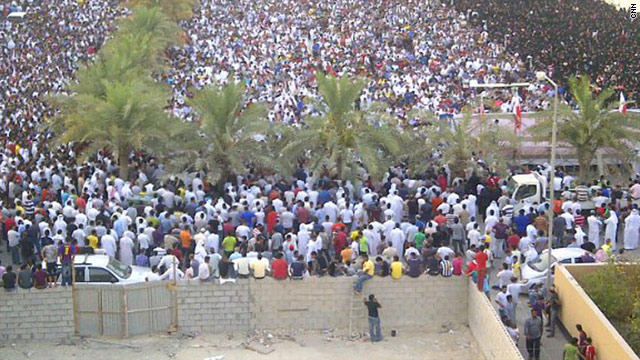
At least two former Bahraini opposition lawmakers went on trial Sunday, as a military court sentenced a 20-year-old poet to a year in prison.
Matar Matar and Jawad Fairooz were charged with "spreading malicious lies in an attempt to overthrow the government," an official in the Information Affairs Authority told CNN.
Both men pleaded not guilty and will remain in custody until their next hearing, said the official, Sheikh Abdul-Aziz bin Mubarak. He said their lawyers have been given more time to prepare their cases.
Both men were seized May 2, family members said.
The trials come after the small, strategically important Gulf kingdom was swept by protests earlier this year as part of the Arab Spring demonstrations.
The legal proceedings began Sunday without prior notice, according to a Matar family member who asked not to be named for security reasons.
Fairooz's lawyer only found out the charges once he appeared in court Sunday, the defendant's brother Jamsheer Fairooz said.
Jawad Fairooz said he was being treated well and looked to be in physically good condition but had "aged 10 years -- his beard and hair have both gone white," his brother said.
Matar, 35, was taken from his car by armed men in masks on May 2, according to a relative. He represented the biggest constituency in Bahrain, with approximately 16,000 people.
Elected to the lower house of Parliament in October 2010, Matar resigned along with other Wefaq lawmakers earlier this year to protest the government crackdown on demonstrators. Wefaq is a Shiite party, the predominant religion in the kingdom whose rulers are Sunni.
Bahraini human rights activist Nabeel Rajab said the trials are "not (of) an international standard," saying the defendants had "not only (had) no access to lawyer but even their families (were) not informed they were being taken court."
Meanwhile, poet Ayat al-Qormozi, 20, was found guilty of assembling at Pearl Roundabout, the epicenter of anti-government demonstrations in the kingdom earlier this year. Additional charges included speaking out against Bahrain and the king.
The Bahrain Youth Society for Human Rights said she read a poem criticizing government policy at the Roundabout.
Mubarak, the government official, said Bahrain had freedom of speech, but that there were limits.
"Freedom of speech in this country has its boundaries and cannot touch on the leadership, and cannot call for the overthrow of the government," he said.
Her poem, he said, "caused incitement and hatred to his majesty the king and to the prime minister" with lines such as "we are people who kill humiliation" and "assassinate misery."
Amnesty International called the charges "unfair" in a statement after the sentence.
"By locking up a female poet merely for expressing her views in public, Bahrain's authorities are demonstrating how free speech and assembly are brutally denied to ordinary Bahrainis," said Malcolm Smart, Amnesty International's Director for the Middle East and North Africa.
Al-Qormozi had been detained since March 30, after her father led security forces to her in the face of threats to his other children's lives, a family member said.
She alleges that she received electrical shocks to her face and was beaten with a hose while in detention, according to the relative, who asked not to be named for security reasons.
Her mother and father were the only family members allowed in court, the relative said, adding that a lawyer was present with her.
Bahraini security forces went to her house around midnight a few days before she was detained, but she was not home, the relative said.
The security forces broke things in the house and told the family they would return the following day for her. They returned the next night but she was still in hiding, the relative said.
The family member said security forces then took two of the poet's four brothers and threatened them with guns in their faces. The father, fearing for his family's lives, took the security forces to her. The family was assured that she would not be harmed, the family member said.
Bahrain's government declined to comment on the specifics of al-Qormozi's case, but said: "All detention centers conform to the conditions set down under international human rights regulations and the detainees are treated as innocent until proven guilty."
Thousands of Bahrainis protested their government Saturday in a rally organized by the Wefaq party.
Unafraid, pro-reform demonstrators hit the streets with their faces uncovered, said a journalist at the scene who was not identified for security reasons.
Rajab, the human rights activist, put the turnout at "no less than 10,000," while police put it at 4,000, the national news agency said.
Rajab said the march went off peacefully, with no security forces present.
It was the second such protest since the government last week lifted emergency laws that were imposed in mid-March, allowing a crackdown on political leaders and journalists.
Bahrain's ruling royal family -- Sunnis in a majority-Shiite nation -- accuses protesters of being motivated by sectarian differences and supported by Iran.
Ali Salman, the secretary general of al Wefaq, told the large crowds that he supports the government's offer of dialogue but said he could not endorse it fully until the conditions for such talks were clear.
Bahraini Prime Minister Prince Khalifa bin Salman Al Khalifa pledged cooperation from the government "to reach national consensus so as to ensure a better future for the kingdom," the state-run Bahrain News Agency said.
Crown Prince Salman, who met with U.S. officials in Washington Wednesday, thanked President Barack Obama for his backing of a national dialogue in Bahrain.
Bahrain is home to the U.S. Navy's Fifth Fleet, and the United States has been concerned about the instability in the Persian Gulf island state.
CNN's Jenifer Fenton contributed to this report.
Afghan Police Recruits Impose ‘Islamic Tax’
Ghulam Hazrat should be a poster boy for the peaceful reintegration of insurgents who want to switch sides. Six months ago he was a Taliban commander in the troubled Imam Sahib district of northern Kunduz Province. Now he and 10 of his followers are in the process of becoming police officers, at which point the government will start paying them salaries.
In the meantime, however, Mr. Hazrat is raising money the same way he did as a Taliban commander, by imposing an “Islamic tax” on people in his district.
“The government is telling me to fight the Taliban and protect your area so we must ask people for help in order to take care of myself and my friends,” he said in an interview. He and other militiamen who have declared for the government and hope to join the local police, a group known as arbakai, insist that people give the money voluntarily.
Judging by the public outcry, however, the donors see things differently. They are often forced to hand over a tenth of their earnings, just as they were when the Taliban ran things. In Kunduz, where the police training program has been operating since late last year, radio talk shows have been flooded by angry callers complaining about the arbakai militias, meetings of elders have denounced their behavior, and even provincial government officials have expressed concern.
The American-financed program aims to convert insurgents into village self-defense forces called Afghan Local Police, distinct from the existing national police force. It is a favorite initiative of the NATO commander in Afghanistan, Gen. David H. Petraeus, who considers it a key part of his counterinsurgency strategy.
Afghan police officials see it as an inexpensive way to beef up their forces, particularly in remote areas. The Afghan Local Police are organized and trained by American Special Forces units in cooperation with the Afghan authorities and, working at the village level, are paid half of what national police officers earn.
So far the program has trained 6,200 officers in 41 districts, and aims to recruit 30,000 in 100 districts in 14 provinces by the end of the year.
But it has aroused concern among aid workers and United Nations officials, who say it risks empowering local warlords who have little regard for human rights or proper behavior.
Many Afghans fear a return to the warlord days of the civil war years, from the late 1980s to the early 1990s, even more than they fear the Taliban, who came to power in large measure because people were fed up with feuding local militias. A recent study by Oxfam and three other nongovernment groups concluded that the program had “in all cases failed to provide effective community policing,” and has instead produced forces that have “generally been feared by the communities they are supposed to protect.”
A United Nations report in March noted that while the program was still too new to render hard judgments, “Concerns have been raised regarding weak oversight, recruitment, vetting and command-and-control mechanisms.”
The controversy in Kunduz arose just as farmers began harvesting their crops, only to find that many of the new arbakai groups, armed and acting as a de facto police force before they had begun the training program, were demanding their tithe.
“We have many times said through local television that no one should give anything to anyone, and arbakai have no right to collect Islamic tax,” said Sarwar Hussaini, the spokesman for the Kunduz Province police chief.
But refusing to pay can have consequences.
The headmaster and assistant headmaster of the Haji Mir Alam girls’ school in the provincial capital, Kunduz city, refused. Two arbakai commanders with 30 armed men stormed the school on Wednesday, beating both men with rifle butts in front of the students until they fell unconscious, according to Muhammad Zahir Nazam, head of the provincial education department.
“The education department strongly condemns this attack, which was a clear attack on education,” he said. Both school officials were hospitalized and are in comas, he said, and the school has been closed.
A group of 100 tribal elders gathered afterward and denounced the attack. “The government should arrest and bring these people to justice,” said a spokesman for the group, Haji Nesar Ahmad. Mr. Hussaini, the police spokesman, said no official complaints had been filed over arbakai abuses.
But Mr. Nazam, the education official, said he reported the attack to security officials several times, and “no steps have been taken and no one arrested.”
A spokeswoman for the NATO-led military coalition referred questions about the episodes to Afghan officials. The Afghan Local Police “is an Afghan-led program where we’re in a supporting role,” said the spokeswoman, Lt. Cmdr. Kathleen D. Sweetser. She said it helped provide security in “contested areas that are important to the campaign but beyond the reach” of available coalition and Afghan forces.
Kunduz, where there are 1,500 arbakai militiamen and 1,200 slots authorized for Local Police officers, has one of the largest programs. So far, though, only 105 arbakai have graduated to become officers, Mr. Hussaini said. NATO officials say 220 Local Police officers have been trained in Kunduz.
The arbakai militias who have drawn so many complaints are in the early stages of the process. Many have not yet been accepted into the training program.
“If the government gave us food and paid us, then there would be no reason to collect tax from people,” said Mr. Hazrat, the arbakai commander.
Afghan and international officials acknowledge the program has flaws. An international official with knowledge of the program who spoke on the condition of anonymity said the training program had not geared up fast enough to accommodate the numbers of arbakai.
“There’s more demand than there is capacity,” the official said. “Whatever we are doing, we have to do it correctly.”
Mohammad Ayoub Haqyaar, governor of the Imam Sahib district, where Mr. Hazrat’s forces range, said, “The best way to prevent them from taking tax from people will be to hire them as Local Police and start paying them.”
But American rules do not allow the recruits to be paid until they have been trained and vetted by the Special Forces, as well as local elders and Afghan officials. And while the Americans also object to giving them guns and ID cards before then, local governments have handed them out anyway.
Yaar Mohammad, a 40-year-old farmer in the Imam Sahib district, has just harvested 4,600 pounds of wheat from his six acres of land, and the local arbakai asked for 460 pounds of that. “I refused, and they threatened me, and I finally had to give it to them,” he said. In the Khan Abad district, also in Kunduz Province, a farmer named Faizullah has not yet harvested his 12 acres of wheat, but plans to hand over a tenth after the local commander announced in the mosque that everyone had to do so.
“We must give it to them,” he said. “If we don’t then they’ll create problems.”
“People are complaining that arbakai are taking their money and their cellphones and sometimes beating them up,” said Col. Abdul Rahman Aqtash, the deputy police chief in Kunduz. “We’ve cleared Kunduz of the armed opposition, but if the situation continues like this then people will keep their distance from the government and it will prepare the ground for armed opposition.”
Saudi Arabia’s Freedom Riders


On the surface, when a group of Saudi women used Facebook, Twitter and YouTube to organize a mass mobile protest defying the kingdom’s ban on women driving, it may have seemed less dramatic than demonstrators facing bullets and batons while demanding regime change in nearby countries. But underneath, the same core principles — self-determination and freedom of movement — have motivated both groups. The Saudi regime understands the gravity of the situation, and it is moving decisively to contain it by stopping the protest scheduled for June 17.
The driving ban stems from universal anxiety over women’s unrestrained mobility. In Saudi Arabia that anxiety is acute: the streets — and the right to enter and leave them at will — belong to men. A woman who trespasses is either regarded as a sinful “street-walker” or expected to cover herself in her abaya, a portable house. Should she need to get around town, she can do so in a taxi, with a chauffeur (there are 750,000 of them) or with a man related to her by marriage or blood behind the wheel.
Although the Islamic Republic of Iran could not implement similarly draconian driving laws after the 1979 revolution, given that women had driven cars there for decades, the theocratic regime did denounce women riding bikes or motorcycles as un-Islamic and sexually provocative. Iran’s supreme leader, Ayatollah Ali Khamenei, proclaimed in 1999 that “women must avoid anything that attracts strangers, so riding bicycles or motorcycles by women in public places involves corruption and is forbidden.”
The Saudi regime, like the Islamic Republic of Iran, the Taliban in Afghanistan, the military junta in Sudan and the Islamic Salvation Front in Algeria, ordains the exclusion of women from the public sphere. It expects women to remain in their “proper place.”
Indeed, the rulers in Saudi Arabia are the most gender-segregated in the world today. In official ceremonies, and in countless photographs, posters and billboards, the royal family seems to be composed solely of men.
This desire to deny women entrance into the public arena is inaccurately presented as a religious mandate. Yet there is no basis for such exclusion in the Koran. On the contrary, in the early years of Islam, women were a vital presence in Muslim communities. They attended mosques, engaged in public debates and got involved in decision-making processes. Aisha, one of the wives of the Prophet Muhammad, commanded an army of men while riding on a camel. If Muslim women could ride camels 14 centuries ago, why shouldn’t they drive cars today? Which Koranic injunction prohibits them from driving?
Gender apartheid is not about piety. It is about dominating, excluding and subordinating women. It is about barring them from political activities, preventing their active participation in the public sector, and making it difficult for them to fully exercise the rights Islam grants them to own and manage their own property. It is about denying women the basic human right to move about freely.
That is why the women defying the ban on motorized mobility are in fact demanding an eventual overhaul of the entire Saudi political system. They want not just to drive but to remap the political geography of their country.
These women know the value of a car key. Like the man who faced down tanks in Tiananmen Square, like the unprecedented number of women participating in protests across the Middle East and North Africa, the Saudi women’s campaign for the right to drive is a harbinger of a new era in the region.
It may require decades to see an end to the Middle East’s gender apartheid and the political reconfigurations that would necessarily follow. One thing is certain though: the presence of women and men demonstrating side by side in the streets of Iran, Tunisia, Egypt, Bahrain, Yemen and Syria is a sign of more seismic upheavals ahead. Old categories have broken down and the traditional distribution of power and space is no longer viable.
The women demonstrating for the right to drive in Riyadh are seasoned negotiators of confined spaces and veteran trespassers of closed doors and iron gates. They are a moderating, modernizing force to be reckoned with — and an antidote to extremism.
Their refusal to remain silent and invisible or to relinquish their rights as citizens is an act of civil disobedience and moral courage. Their protest, and those of their sisters across the Middle East, represent a revolution within revolutions — and a turning point in the contemporary history of Islam.
Farzaneh Milani, chairwoman of the Department of Middle Eastern and South Asian Languages and Cultures at the University of Virginia, is the author of “Words, Not Swords: Iranian Women Writers and the Freedom of Movement.”
Sunday, June 12, 2011
Lawmakers push for new Afghan strategy

Democratic leaders on Capitol Hill are applying fresh pressure on the Obama administration to draw down U.S. troops in Afghanistan faster than many military leaders say is responsible, forcing the president to balance his party’s demands with his generals’ on-the-ground assessment as he nears another milestone in the war.
When he announced his war strategy 18 months ago, President Obama set July as the point when he would begin bringing home the approximately 100,000 U.S. service members in Afghanistan. Administration officials have portrayed the reduction as just another planned step in the president’s strategy.
But Sen. John F. Kerry, chairman of the Senate Foreign Relations Committee, is among a growing number of congressional leaders urging Obama to take full advantage of progress achieved over the past 18 months by narrowing the mission’s focus.
These lawmakers argue that, at a time of fiscal stress at home, the administration should concentrate on targeting al-Qaeda and protecting other U.S. security interests in the region, rather than on maintaining the broad military deployments across much of southern and eastern Afghanistan and the costly nation-building elements of the counter-insurgency strategy.
This political push could force the White House to revisit a contentious internal debate that unfolded in fall 2009, when Obama’s civilian advisers challenged the uniformed military over how best to change the course of a flagging war effort. But Obama is now making his decision amid a difficult reelection effort and when the killing of Osama bin Laden has made some lawmakers argue that the time is ripe to dramatically scale back the U.S. war effort.
“The president ought to take advantage of that success and push us in a direction that accelerates the ability of the Afghans” to take over operations, said Kerry (D-Mass.).
Obama is awaiting a set of recommendations from his military commanders on how many troops to bring home in July and the pace of withdrawal over the months ahead. Defense Secretary Robert M. Gates, who on Friday concluded an 11-day trip that took him to Afghanistan, could deliver Gen. David H. Petraeus’s proposed options to Obama in the next week.
“The president obviously is very mindful of how we use our resources and setting priorities for how we use our resources,” White House spokesman Jay Carney told reporters Thursday. “The fact is that we believe we are making progress. . . . And when he announces the decision he makes in terms of the drawdown, I’m sure he will also put it in the context of the implementation of the strategy he put in place in December 2009.”
That month Obama announced his decision to send an additional 30,000 troops to Afghanistan, largely adopting a surge strategy recommended by the military leadership.
For his civilian advisers worried about the scope of the escalation, Obama also set next month as the beginning of the end of the surge. As that deadline approaches, the argument over how quickly or slowly to leave a nearly decade-old war is intensifying.
When he adopted the strategy in 2009, Obama was a relatively new commander in chief still working out his relationship with his commanders. Obama has more experience as a wartime leader today, and his risky decision to authorize the raid deep inside Pakistan that killed bin Laden last month has burnished his reputation as a president who has faith in his military. Outside analysts say he may feel more able to turn down his generals’ advice.
The debate over how many troops to pull out next month has been far more muted than that months-long, leak-filled 2009 strategy review. White House officials say Obama, who receives a weekly Afghanistan update from the State Department and runs a monthly session on the war with his senior national security team, does not need an extensive internal debate or review to make this decision.
“The debates are going to be about the specifics of implementing the strategy we have embarked on. I don’t really see why we’d be focusing on revising it,” said a senior administration official who, like others interviewed, spoke on the condition of anonymity to describe internal White House discussions.
The official said that there is “huge pressure on the Taliban” and that an “Afghan-led political process that didn’t exist before is taking some shape. Al-Qaeda is on its heels; bin Laden is dead.”
“Right now, when we do these discussions, we’re looking at how do you sustain these gains and do the transition in a way that maximizes the chances of keeping the American people safe,” the official said.
But in recent weeks, a pair of high-profile proxies have emerged representing the two sides of the administration’s internal discussion over the pace of the troop withdrawal — Kerry and Gates.
Kerry has called the war’s $10 billion-a-month cost “unsustainable,” and on Wednesday, his committee issued a report critical of the economic assistance program that is a key part of the counterinsurgency strategy’s goal of bringing stability and government to parts of the country once controlled by the Taliban.
Kerry is a longtime friend and former Senate colleague of Vice President Biden, who in the 2009 war strategy review argued for a smaller U.S. military mission in Afghanistan that would focus on weakening a-Qaeda, rather than on defeating the indigenous Taliban insurgency.
With bin Laden’s death, the civilian advisers who favor that approach, led by national security adviser Thomas E. Donilon, have a fresh argument for a more targeted — and less expensive — military mission at a time of severe fiscal strain at home. A second senior administration official said, “Kerry is obviously someone who is respected here, and he would be heard,” adding that others would be as well.
In an interview, Kerry said that “part of the struggle here is to get people here, my colleagues included,” to focus on “what is the objective.”
“What I would urge, and what the president needs to think about here, is what is the best way now to take advantage of that so that you don’t go backwards, but that you also don’t necessarily stick with the kind of reach that you had because you don’t need to,” he said. “I don’t see this as changing the current strategy because it’s somehow not working.”
But Gates has said that Obama should move cautiously in removing troops from a battlefield where the gains, in the White House’s own assessment, remain “fragile and reversible.” Obama has relied on Gates as a trusted liaison to the uniformed military, and he ends his five-year tenure this month.
“I can tell you there will be no rush to the exits,” Gates said Friday in a speech in Brussels.
He went on to say that “the vast majority of the surge forces that arrived over the past two years will remain through the summer fighting season.”
“Far too much has been accomplished, at far too great a cost, to let the momentum slip away just as the enemy is on its back foot,” he said.
While White House officials say electoral politics is not a factor in the decision, Obama is campaigning for reelection next year at the head of a party deeply opposed to the Afghanistan war.
Bringing home the surge troops by the end of the year would allow Obama to demonstrate to his party, particularly its liberal grass roots, that he is winding down the war in Afghanistan, just as he has in Iraq.
Advisers say he will probably use his commanders’ recommendations as a base line to draw from, adopting some elements and coming up with others of his own, as he did in 2009. They say there is no timeline for the decision or for his speech outlining the path ahead, other than his commitment to withdraw the first surge troops before the end of July.
“He knows this is the longest war we’ve been in and there’s war weariness in the country,” the second senior administration official said. “This isn’t about people getting his ear and persuading him. He understands. And he wants the strategy he put in place to succeed.”
Subscribe to:
Posts (Atom)