Thursday, June 2, 2011

'Pakistan a deadly place for journalists'


Pakistan is a "deadly country for journalists", said a leading daily as it noted that just hours before journalist Syed Saleem Shahzad was abducted, he was warned that his work was ruffling feathers in certain quarters. Shahzad's body, bearing torture marks, was found two days later.

Shahzad, 40, went missing Sunday from outside his residence in Islamabad and he was said to have been picked up by Pakistan's Inter-Services Intelligence . His body was found near a canal Tuesday.

A correspondent of Asia Times Online, Shahzad wrote extensively on Islamist groups. He had authored an article for Asia Times that said that Al Qaeda's operational arm attacked Karachi's Mehran naval base after the navy did not free sailors arrested for suspected Islamist links.

An editorial in the Dawn Thursday said: "If the world labels Pakistan a deadly country for journalists, it is hardly off the mark."

The discovery on Shahzad's body and "the circumstances under which he appears to have been killed, reflects the degree of impunity with which elements seeking to silence journalistic voices can operate".

"Extracts from his recently published book (`Inside Al Qaeda and the Taliban') indicates that he was in possession of facts that could prove unsettling for elements within the security establishment. Given this, there are suspicions that some sections of the latter may have been involved in his murder," the editorial said.

It added that for the journalistic community, Shahzad's brutal killing is "another grim reminder of its helplessness. Journalists are under attack from not just the terrorists, but also potentially (from) sections of the state`s security apparatus".

"Yet never is any such case investigated; no persecutor is brought to book. Pakistan is a deadly place for journalists not just because they are killed - that happens elsewhere too - but because the state refuses to pursue the cases. The message is that journalists can be silenced with impunity."

The editorial went on to say that just hours before his abduction, Shahzad "was reportedly warned by a friend that his work was ruffling feathers in certain quarters `and these people are not benign'."

"Shahzad paid with his life for this lack of accountability; so too may many more until the state stops shielding those who deal in death in the name of opaque security paradigms. The onus is on the security agencies to prove they had no role in his murder."

Wednesday, June 1, 2011

Journalist Syed Saleem Shahzad: Why is he not alive?

Asia Times
What is truth? According to Merriam-Webster, truth is defined as: fact, the body of real things, an idea that is true or accepted as true, and reality. What then is a journalist? A journalist is a writer who aims at a mass audience through the medium of journalism. Journalism is writing characterized by a direct presentation of facts or a description of events without an attempt at interpretation. This means a journalism is a writer who writes truth without personal opinion based upon fact and reality.

Journalist Syed Saleem Shahzad was the Pakistan Bureau Chief of Asia Times Online, covering issues of global security, focusing on al-Qaeda and the Taliban. Shahzad has reported on Islamist movements, taking him to Iraq, Lebanon, Jordan, Iran, Syria and the United Arab Emirates.

Saleem introduced the world to al-Qaeda and Sheikh Essa. His interviews included: Taliban commanders Sirajuddin Haqqani and


Qari Ziaur Rahman, and Ilyas Kashmiri, who leads 313 Brigade, the operational arm of al-Qaeda.

On May 20, 2011, 11 days before his untimely death, Saleem's new book was released: Inside Al-Qaeda and the Taliban: Beyond Bin Laden and 9/11 through Pluto Press in the UK. On May 4, Shahzad wrote of the death of Osama bin Laden.

In November of 2007, Saleem constructed a brief on Pakistan Security Research Unit (PSRU) entitled: The Gathering Strength of Taliban and Tribal Militants in Pakistan. The brief focused on extremism, terrorism, nuclear weapons, internal stability and cohesion, and was a useful resource for anyone interested in the security of Pakistan.

To quote Saleem: "The unending Pakistan/NATO/US military operations in the tribal areas, which are seen by Taliban and tribal groups as being fought for a complete victory and without a will for political reconciliation, have radicalized Pakistan's North West Frontier Province."

"After 9/11, a very rustic religious zeal and the Taliban's affinity with Pakistani tribal groups was the reason behind providing shelter to the Arab-Afghan Diaspora in South Waziristan and North Waziristan, but Washington-sponsored Pakistan's half-hearted military operations in 2002-03 united some of the force in a shared war of retribution."

STOP.

What Saleem is presenting is an investigative document based on historical fact and research without imbuing it with his own opinion. What then again is truth? The body of real things. A journalist? A writer who aims at an audience with a direct presentation of fact without adding his own opinion.

On May 31, 2011, Saleem Shahzad was found dead. Syed Saleem Shahzad went missing on Sunday, after he left his home in the capital to take part in a talk show, but never arrived. He disappeared two days after writing an investigative report in Asia Times Online that Al-Qaeda carried out last month's attack on a naval air base to avenge the arrest of naval officials arrested on suspicion of al-Qaeda links (see Al-Qaeda had warned of Pakistan strike, Asia Times Online, May 26).

Human Rights Watch, Amnesty International, Committee to Protect Journalists and Democracy Now have issued public statements regarding the abject horror over one man's death. In 2006, Saleem was captured by the Taliban in Afghanistan, yet he remained alive.

Refer to Saleem's 2007 brief: "As Western-backed military operations continue, Taliban numbers are rising steeply and their confidence is growing. They have even been joined by some Pakistan Army officers who have resigned from the Pakistan Army."

He continued with: "The Taliban are planning to take the war to Pakistan and Afghanistan's major cities and to build an Islamic Emirate. The more the US-backed war is prolonged, the more sophisticated the Taliban will be in their strategic development."

Read the above sentence again.

And again.

That was 2007.

The Associated Press of Pakistan reports: "President Asif Ali Zardari expressed his deep grief and sorrow ... The President expressed his determination to bring the culprits to justice. He said the present government firmly believes in freedom of media and promotion of democratic values."

The constitution of Pakistan states in the preamble: "Therein shall be guaranteed fundamental rights, including equality of status, of opportunity and before law, social, economic and political justice, and freedom of thought, expression, belief, faith, worship and association, subject to law and public morality."

In Part II: Chapter 1: Fundamental Rights: Article 19: "Every citizen shall have the right to freedom of speech and expression, and there shall be freedom of the press, subject to any reasonable restrictions imposed by law in the interest of the glory of Islam or the integrity, security or defence of Pakistan or any part thereof, friendly relations with foreign states, public order, decency or morality, or in relation to contempt of court, commission of, or incitement to an offence."

Read that again.

After Saleem's body was found some six miles (10 kilometers) from his car, an initial exam found signs of torture, but autopsy results were pending.

Article 5: The Universal Declaration of Human Rights: "No one shall be subjected to torture or to cruel, inhuman or degrading treatment or punishment."

Saleem Shahzad was a journalist in the truest sense. He presented fact without his own opinion. Why then is he not alive?

Article 19: The Universal Declaration of Human Rights: "Everyone has the right to freedom of opinion and expression; this right includes freedom to hold opinions without interference and to seek, receive and impart information and ideas through any media and regardless of frontiers."

Saleem Shahzad is survived by his wife Anita and three children. Purchase his book Inside Al-Qaeda and the Taliban. Beyond Bin Laden and 9/11 through Pluto Press to further his work in journalism and assist his family in their time of such unnecessary loss.

Explosions and street fighting grip Yemen capital


Renewed fighting in Yemen's capital between a powerful tribal group and President Ali Abdullah Saleh forces this week has killed at least 19 people and rocked Sanaa with explosions, officials said on Wednesday.

Global powers have been pressing Saleh to sign a Gulf-led deal to end his three-decade rule and stem spreading chaos in unstable Yemen, a haven for al Qaeda militants and neighbor to the world's biggest oil exporter, Saudi Arabia.

Kuwait, a member of the Gulf Cooperation Council that tried unsuccessfully to broker a power transfer deal, said it had evacuated its diplomatic staff from Yemen. Qatar, another GCC member, has also suspended most operations there.

Witnesses said they heard several blasts but were not sure of the cause or the damage near the Hasaba district -- the focal point of fighting last week that killed at least 115 people and pushed the country closer to civil war.

"There are very powerful explosions. Sounds like missiles or mortars. May God protect us," a Hasaba resident said.

This week, there have been three main flashpoints in the country -- the fighting in the capital, government troops gunning down protesters in Taiz in the south and a battle with al Qaeda and Islamic militants in the coastal city of Zinjibar.

Residents also reported overnight fighting near Sanaa airport, which was closed briefly last week during skirmishes between Saleh's forces and opponents within the powerful Hashed tribal confederation, who are led by Sadeq al-Ahmar.

Fourteen soldiers were killed in overnight fighting with the tribesmen, the Defense Ministry website said.

Medical officials told Reuters at least five other people had been killed in the recent fighting, which may have entered a new phase with some troops in armored vehicles joining the opposition, suggesting more military defections from Saleh.

"UNLIKELY TO SURVIVE"

Some military leaders broke away from Saleh in March after his troops fired on protesters calling for an end to his 33-year-old rule. Yemen is on the brink of financial ruin, with about a third of its 23 million people facing chronic hunger.

The political risk consultancy Eurasia Group said in a report the most likely outcome is that Saleh leaves through a political deal he brokers from a position of weakness, or is ousted by force by breakaway military units and tribal leaders.

"Saleh is unlikely to survive 2011 as president of Yemen; however the likelihood of a managed transition is decreasing, and an attempt to forcibly oust Saleh from power is becoming more likely," the report said.

"Saleh leaving power early does not result in a functional Yemeni state that can reassert control over the country in the short term," it added.

The president's close relatives, who control Yemen's most lucrative sources of revenue and state assets, are pressuring him not to give up power, a diplomatic source told Reuters.

Omani authorities were trying to tighten a long and porous border between Yemen and Oman to halt any refugee inflow, an Omani Foreign Ministry official told Reuters.

SALEH EXASPERATES NEIGHBOURS

Yemen is awash with weaponry and corruption and racked by a secessionist movement in the south, a Shi'ite insurrection in the north and a growing al Qaeda presence in the center. About 40 percent of its people live on less than $2 a day.

Saleh has exasperated his rich Gulf Arab neighbors by three times agreeing to step down, only to renege at the last minute.

He drew the ire of U.N. Secretary-General Ban Ki-moon after his troops fired on protesters in the city of Taiz, about 200 kms (120 miles) south of the capital. The chief U.N. human rights envoy said her office was investigating reports that at least 50 people have been killed there since Sunday.

Analysts are worried that instability in Yemen, sitting on a shipping lane that carries about 3 million barrels of oil a day, could embolden a local al Qaeda wing which has attempted attacks on the United States and Saudi Arabia.

Locals and Yemeni troops have been fighting to recapture the coastal city of Zinjibar, which was taken over by several hundred al Qaeda and Islamist militants at the weekend.

Six soldiers and four gunmen were killed in clashes in two areas near Zinjibar, a local security official said.

Residents said parts of the city were hit by artillery and missiles as troops tried to push out militants.

ISI faces more heat after reporter's killing


Speculation that Pakistan's military spy agency had a hand in the death of a prominent journalist has further discredited the organization already facing one of its worst crises after the killing of Osama bin Laden on Pakistani soil.

Saleem Shahzad, who worked for Hong-Kong based Asia Times Online and Italian news agency Adnkronos International, disappeared from Islamabad on Sunday and his body was found in a

canal with what police said were torture marks.

Suspicion immediately fell on the Inter-Services Intelligence (ISI) agency, bringing more bad publicity after the killing of bin Laden by U.S. special forces near the capital.

The U.S. raid opened the agency up to international suspicion it was complicit in hiding bin Laden, and to domestic criticism for failing to detect or stop the U.S. team.

"The ISI's image had already been tarnished and it is under so much pressure," said a former ISI officer. "It's never been as bad as this before."

Shahzad was investigating suspected links between the military and al Qaeda, a highly sensitive subject at a time when Washington is wondering how bin Laden was able to live for years in a town about a two-hour drive from ISI headquarters.

The military denies any collusion with al Qaeda.

Human Rights Watch said Shahzad, a 40-year-old father of three, had voiced concern about his safety after receiving threatening telephone calls from the ISI and was under surveillance since 2010.

The ISI rejected suggestions of its involvement and criticized the media for jumping to that conclusion.

"Baseless accusations against the country's sensitive agencies for their alleged involvement in Shahzad's murder are totally unfounded," the ISI said in a statement.

"In the absence of any evidence and when an investigation is still pending, such allegations tantamount to unprofessional conduct on the part of the media."

Analysts have not ruled out the possibility that he may have been killed by militants. Shahzad often wrote about al Qaeda and other groups.

"PUSHED TO THE WALL"

He was buried on Wednesday in his hometown of Karachi, where suicide bombings have killed hundreds and security forces face some of their toughest battles against militancy.

Shahzad's wooden coffin was lowered in a graveyard as relatives, journalists and politicians looked on.

"It's cruel. My brother is gone. How will I live without my brother?," asked his sister, Maryam, after prayers were said.

Pakistan has a vibrant press which often attacks the government over everything from corruption to poor services and economic stagnation.

But criticism of the ISI or military is rare.

Reporters say Shahzad's death raises troubling questions about freedoms in Pakistan, which receives billions in aid from ally Washington and describes itself is a democracy.

"It means we are being pushed to the wall and losing space to tyranny if the ISI carried this out," said Umar Cheema, a journalist who knows all about the risks of investigating Pakistan's security establishment.

Last year, he was picked up by suspected intelligence agents, driven to an unknown location, stripped naked and whipped with leather and a wooden rod, he said.

"Pakistan is my beloved country but nobody is safe in Pakistan. I live in what I call self-imposed house arrest because I am scared to go out," said Cheema.

Shahzad was killed after he wrote a story that claimed al Qaeda attacked a naval base in Karachi last month after negotiations with the military to release two naval officials accused of militant links broke down.

That assault further humiliated the Pakistani military.

Some believe that with its loss of credibility after the bin Laden fiasco, and the naval base siege, the ISI may come under more public scrutiny for its apparent failure to tackle militancy and ease suicide bombings.

"Fewer people believe that the ISI is this powerful agency. People will start asking tougher questions," said Rifaat Hussain, head of the Department of Defense and Strategic Studies at Quaid-i-Azam University in Islamabad.

"They may be more willing to ask why the ISI is tapping the telephones of the opposition when it should be providing more security for the country."

But equally likely is that journalists will think twice about writing hard-hitting stories after Shahzad's death.

Others have died in similar circumstances in Pakistan, the world's most dangerous country for journalists, according to Reporters Without Borders.

"It is a death. The death of expression," said Matiullah Jan, a correspondent with Dawn News television.

"There is an apprehension in certain quarters that it's meant to send a shut-up message."

Pakistani journalists defiant at reporter's burial


A Pakistani reporter who investigated terrorism and was found slain after telling a rights activist he'd been threatened by intelligence agents was buried Wednesday. Fellow journalists vowed his killing would not silence them.

Syed Saleem Shahzad wrote for the Asia Times Online and other publications. He delved into topics that were often sensitive in Pakistan, where journalists face threats from insurgents as well as a security establishment that operates largely outside the law.

"We will not shut our voices down," said Azhar Abbas, a prominent Pakistani journalist. "The journalist community is united on this. We will not stop "

Pakistan was the deadliest country for journalists in 2010, with at least eight killed in the line of duty, according to the New York-based Committee to Protect Journalists. Six died in suicide attacks, the group said in a report late last year.

Despite the dangers, the media establishment in Pakistan has expanded rapidly over the past decade, and reporters here operate with tremendous freedom compared with many other developing countries.

In recent weeks, the media have carried unusually scathing coverage about the security establishment after it was caught unawares by the May 2 U.S. raid that killed al-Qaida chief Osama bin Laden in a garrison city in Pakistan's northwest.

Shahzad's death could heighten the criticism, though commentators are being careful about how they discuss the alleged link to spy agencies.

After disappearing Sunday from Islamabad, Shahzad's body was found dozens of miles outside the capital on Tuesday, bearing signs of torture, police said. His death drew numerous condemnations, including from U.S. Secretary of State Hillary Rodham Clinton.

The 40-year-old was buried in his hometown, Karachi, as hundreds of friends, relatives, political figures and fellow journalists mourned.

Sindh province Information Minister Sharjeel Memon called the killing a "cowardly act" and promised that those responsible would be brought to justice. But it's unclear how much the weak civilian government can do if, as some suspect, Pakistani security agencies played a role.

A spokesman for Pakistan's premier spy agency, Inter-Services Intelligence, called the allegations "absurd." He spoke on condition of anonymity because he was not authorized to speak to media on the record.

However, Ali Dayan Hasan, a researcher with Human Rights Watch, said Shahzad had told him that he feared Pakistani intelligence agents were after him.

The agencies pressured him to reveal his sources in October after he wrote a story about Pakistan allegedly freeing a detained Afghan Taliban commander, according to an email Shahzad sent Hasan. Hasan said Shahzad was still worried in recent weeks, but kept up his reporting.

Just last week, Shahzad wrote a story about alleged al-Qaida infiltration of the navy. The report came after a 17-hour insurgent siege of a naval base in Pakistan's south added to the recent humiliations suffered by security agencies.

Within days, Shahzad vanished, and his wife contacted Hasan as her husband had instructed in case he disappeared.

In a statement, Clinton said Shahzad's reporting "brought to light the troubles extremism poses to Pakistan's stability," and said the U.S. supports the "Pakistani government's investigation into the circumstances surrounding his death."

Frequent bombings in Peshawar

THE NEWS

The terror incidents, especially bombings, are fast becoming a routine and causing many children to believe that they are fated to it.

A powerful suicide car bombing at the Criminal Investigation Department police station on the Jamrud Road rocked the provincial capital at almost 4:40 a.m. on Wednesday last when most of the population was asleep. Seven police commandoes and a Pakistan Army soldier were killed and 46 others injured in the terror act. This was not the first time when the people of this terror-stricken city were awakened by the thunder; they have become used to such practices.

Most of the parents told The News that while they remained worried about the state of affairs prevailing in the provincial metropolis due to rising incidence of terror, it was strange and matter of concern for them that their children had started taking such terrorist activities as a routine.

“It seems my children have taking these bombings and blasts as their fate,” said Ali Nasir, a banker who lived in Gulberg area of the Peshawar Cantt where the sound of the devastating car bombing at the CID Police Station was heard far and wide.

Four to five-year-old children got up with the wake up bell, said a mother while referring to the sound of the blast. “Unlike in the past, this time I was astonished to see the reaction of my children as most of them did not show any fearful expression,” said Mrs Samina Ali, while narrating that despite being asleep the children behaved fairly normal and their inert behaviour makes me worried.

Paghunda Khan, 13, a student of grade 8, told The News: “It has now become a routine for us. We go to bed hearing about bombings and wake up with the same news. We have got used to with it but the only factor that upsets me is missing my classes, as it becomes a load for the next day. I asked my daughter not to go to school and she started crying.”

She added that she was to make a presentation which she missed. Mother of Behram Khan, 10, a grade 3 student, said: “My son is very much attached with me and he didn’t even go to sleep until I tender him but this morning his strange behaviour and words surprised me as I turned on the television he insisted to switch it off.”

Behram in a lisping tone said, “Mama, you already know what the news would say now, so and so dead, that many injured and then condemnation from some minister,” his mother said. And what was most surprising to the mother when he did not even insist to have leave from school today.

The concerned parent said the frequent terrorist activities taking place throughout the country had not only made us restless but also alarmed us about the behaviour of our children. Mudassar Ali, an employee of a non-governmental organisation, said: “We grew up seeing Kashmiri people embracing martyrdom, blood shed in Palestine by Israeli troops and Iraq-Kuwait conflict, but all the conflicts and violence had a solid background. But how will we justify this ongoing state of conflict in the name of ‘war against terror’ to our coming generation?”

Clinton condemns killing of Pakistani journalist

US today strongly condemned the abduction and killing of investigative Pakistani journalist Syed Saleem Shehzad as international media labelled his death as "payback not from militants but country's fearsome spy agency". Supporting Pakistan Government's investigations into the circumstances surrounding his death, the Secretary of State Hillary Clinton said, "His work reporting on terrorism and intelligence issues in Pakistan brought to light the troubles extremism poses to Pakistan's stability". "We support the Pakistani government's investigation into the circumstances surrounding his death," she said in a statement. "We remain committed to helping the government and people of Pakistan as they work to bring peace and stability to the country," Clinton said. "Syed Saleem Shahzad's killing was payback, other journalists and human rights activists said they believed not from militants, but from Pakistan's fearsome spy agencies", 'The New York Times' and 'Washington Post' reported as the papers gave prominence to his killing. According to the Post, Shahzad's killing also renewed attention on the alleged crossover between militants and Pakistan's security forces, some of which he outlined in his recent article for the Hong Kong-based 'Asia Times Online', for which he was the Pakistan bureau chief.

Saleem Shahzad: the price of truth

EDITORIAL:


The body of Syed Saleem Shahzad, one of Pakistan’s best investigative journalists, was found yesterday from Mandi Bahauddin. Mr Shahzad was Pakistan bureau chief of Asia Times Online. He went missing on May 29, 2011 from Islamabad when he was on his way to a local television channel to participate in a talk show but he never made it. Reports suggest that he disappeared between 5:30-6:00 pm from a high security area in Islamabad. According to Human Rights Watch (HRW), Mr Shahzad had voiced his concerns that a sensitive intelligence agency could harm him. In an interview with TIME magazine, HRW’s Ali Dayan Hasan said: “To date, no intelligence personnel have been held accountable for frequently perpetrated abuses against journalists. Tolerance for these practices has to end, now.” Saleem Shahzad’s last story for Asia Times Online revealed how al Qaeda had penetrated the Pakistan Navy. The attack on PNS Mehran took place “after talks failed between the Navy and al Qaeda over the release of naval officials arrested on suspicion of al Qaeda links,” wrote Mr Shahzad in his report on May 27. This was the first part of his report but he was abducted before the second part could be published.

It is a sad day, nay black day, for journalism in Pakistan that a journalist was picked up from the capital and his tortured body dumped in another town while the perpetrators of this gory crime roam free. This is not the first time that a journalist has lost his life for honest reporting. In the past we have been witness to the deaths of many brave journalists in Pakistan, especially in Balochistan, FATA and Khyber Pakhtunkhwa. It is not without reason that Pakistan has been dubbed as the most dangerous place for journalists by Reporters without Borders. Journalists in Pakistan are between a rock and a hard place: they face threats both from the militants and our intelligence agencies. When journalists write or speak against terrorists, they receive threats. When they expose our military’s links with terrorists, they are harassed. Threats, harassment, abduction and even murder is what journalists in Pakistan are victims of all too frequently.

Syed Saleem Shahzad’s brutal murder seems like a warning to Pakistan’s journalist community that if they continue to report honestly, they can be killed. If the people of Pakistan, especially the media community, does not wake up and speak out against such brutalities, every sane voice in the country will die a silent death. If we remain quiet, this will be our own self-inflicted Holocaust. Prime Minister Gilani has ordered an inquiry into Mr Shahzad’s murder. The question is, will this be like any other inquiry that takes place here, with no results? We must urge the government to probe into this matter and make the results of the investigation public.

This should also serve as an eye-opener for those who have been apologising for the military and the Taliban alike. How many more innocents have to die before we realise that our country is a war zone where no one is safe from either our so-called saviours or the terrorists. Mr Shahzad and many others like him paid the price for reporting the truth. We must stop blaming external forces for what we are facing right now. In a country where terrorists, murderers, rapists and criminals roam free, deaths of innocents are all but inevitable. How many more people will have to sacrifice their lives before we finally call a spade a spade? Pakistan is in a deep mess right now and it is all our own doing. Let’s wake up to this reality before our soil turns completely red (if it has not already) with the blood of our citizens. RIP Saleem Shahzad; we cannot condemn or mourn your death adequately in words. Our only salvation now lies in bringing Mr Shahzad’s murderers to book. *

Tuesday, May 31, 2011

Missing Pakistan journalist Saleem Shahzad found dead near Islamabad


Shahzad's body was discovered less than two days after he was allegedly abducted by ISI, Pakistan's intelligence service
The journalist Saleem Shahzad was found dead with torture marks on his face and a gunshot wound to his stomach, according to Pakistani media. Photograph: Cristiano Camera/AFP/Getty Images

A prominent Pakistani journalist has been found dead on the roadside outside Islamabad, less than two days after he was allegedly abducted by the country's powerful military intelligence service.

Saleem Shahzad disappeared on his way to a television interview on Sunday evening. Human Rights Watch said it learned he been abducted by the Inter-Services Intelligence directorate (ISI).

Shahzad's body was found six miles from his car in a small hamlet on the edge of Islamabad. Local media reported that he had torture marks on his face and a gunshot wound to the stomach.

"This killing bears all the hallmarks of previous killings perpetrated by Pakistani intelligence agencies," said Ali Dayan Hasan of Human Rights Watch, noting that Shahzad had previously warned that his life was in danger from the ISI.

Hasan called for a "transparent investigation and court proceedings". Other journalists reacted angrily, directly accusing the ISI of responsibility.

"Any journalist here who doesn't believe that it's our intelligence agencies?" tweeted Mohammed Hanif, a bestselling author and BBC correspondent.

Shahzad, the Pakistan correspondent for the Hong Kong-based news service Asia Times Online, vanished two days after publishing a story alleging negotiations between Pakistan military officials and al-Qaida.

The story claimed that al-Qaida attacked the Mehran naval base in Karachi on 22 May in retaliation for the arrest of two naval officials with militant links. Al-Qaida had been secretly pressing the military to release the men, Shahzad said.

Pakistani security forces battled for 17 hours to contain the assault, during which at least four heavily armed men slipped into the base, blew up two American-built surveillance planes and killed 10 soldiers.

On Tuesday Pakistani media reported that military intelligence had picked up a retired navy commando and his brother in Lahore in connection with the raid. The detained men, who allegedly have militant links, were previously questioned in connection to an earlier militant assault.

Shahzad was abducted from central Islamabad on Sunday evening as he travelled to the studios of Dunya television to discuss his report on the naval base attack. The following day, after being alerted by Shahzad's wife, Hasan said he had been informed through "reliable interlocutors" that Shahzad was being held by the ISI.

Last October Shahzad sent Human Rights Watch an email saying he was afraid he would be killed by the ISI, Hasan claimed. In the email, intended to be released in the event of his death, Shahzad said he had been summoned to ISI headquarters in Islamabad to discuss an article about Mullah Brader, a Taliban commander captured in Pakistan with American help months earlier.

The two ISI officials Shahzad said were present at the meeting, Rear Admiral Adnan Nawaz and Commodore Khalid Pervaiz, were both naval officers. Last week Pervaiz was made commander of the Karachi naval base that was attacked.

"We believed [Shahzad's] claim that he was being threatened by the ISI is credible, and any investigation into his murder has to factor this in," Hasan said.

Cricketer-turned-politician Imran Khan called for a government inquiry into the "heinous crime", but avoided mention of the ISI, focusing blame on the "servile policies [of] a corrupt and inept government".

As a reporter, Shahzad was known for delving deep into the murky underworld of Islamist militancy. He had interviewed some of the most notorious leaders including Sirajuddin Haqqani, a major player in the Taliban insurgency in Afghanistan, and Ilyas Kashmiri, a Pakistani militant who works for al-Qaida.

His new book, Inside Al-Qaeda and the Taliban: Beyond Bin Laden and 9/11, had just been published.

Pakistan is the world's most dangerous country for journalists, according to Reporters without Borders, which says that 16 journalists have been killed in the past 14 months.

Last September Umar Cheema, another investigative reporter, was abducted from Islamabad for six hours and tortured before being released. He said he suspected that his kidnappers belonged to the ISI.

Al-Qaeda had warned of Pakistan strike


By Syed Saleem Shahzad

Al-Qaeda carried out the brazen attack on PNS Mehran naval air station in Karachi on May 22 after talks failed between the navy and al-Qaeda over the release of naval officials arrested on suspicion of al-Qaeda links, an Asia Times Online investigation reveals.

Pakistani security forces battled for 15 hours to clear the naval base after it had been stormed by a handful of well-armed militants.

At least 10 people were killed and two United States-made P3-C Orion surveillance and anti-submarine aircraft worth US$36 million each were destroyed before some of the attackers escaped through a cordon of thousands of armed forces.

An official statement placed the number of militants at six, with four killed and two escaping. Unofficial sources, though, claim there were 10 militants with six getting free. Asia Times Online contacts confirm that the attackers were from Ilyas Kashmiri's 313 Brigade, the operational arm of al-Qaeda.

Three attacks on navy buses in which at least nine people were killed last month were warning shots for navy officials to accept al-Qaeda's demands over the detained suspects.

The May 2 killing in Pakistan of Osama bin Laden spurred al-Qaeda groups into developing a consensus for the attack in Karachi, in part as revenge for the death of their leader and also to deal a blow to Pakistan's surveillance capacity against the Indian navy.

The deeper underlying motive, though, was a reaction to massive internal crackdowns on al-Qaeda affiliates within the navy.

Volcano of militancy
Several weeks ago, naval intelligence traced an al-Qaeda cell operating inside several navy bases in Karachi, the country's largest city and key port.

"Islamic sentiments are common in the armed forces," a senior navy official told Asia Times Online on the condition of anonymity as he is not authorized to speak to the media.

"We never felt threatened by that. All armed forces around the world, whether American, British or Indian, take some inspiration from religion to motivate their cadre against the enemy. Pakistan came into existence on the two-nation theory that Hindus and Muslims are two separate nations and therefore no one can separate Islam and Islamic sentiment from the armed forces of Pakistan," the official said.

"Nonetheless, we observed an uneasy grouping on different naval bases in Karachi. While nobody can obstruct armed forces personnel for rendering religious rituals or studying Islam, the grouping [we observed] was against the discipline of the armed forces. That was the beginning of an intelligence operation in the navy to check for unscrupulous activities."

The official explained the grouping was against the leadership of the armed forces and opposed to its nexus with the United States against Islamic militancy. When some messages were intercepted hinting at attacks on visiting American officials, intelligence had good reason to take action and after careful evaluation at least 10 people - mostly from the lower cadre - were arrested in a series of operations.

"That was the beginning of huge trouble," the official said.

Those arrested were held in a naval intelligence office behind the chief minister's residence in Karachi, but before proper interrogation could begin, the in-charge of the investigation received direct threats from militants who made it clear they knew where the men were being detained.

The detainees were promptly moved to a safer location, but the threats continued. Officials involved in the case believe the militants feared interrogation would lead to the arrest of more of their loyalists in the navy. The militants therefore made it clear that if those detained were not released, naval installations would be attacked.

It was clear the militants were receiving good inside information as they always knew where the suspects were being detained, indicating sizeable al-Qaeda infiltration within the navy's ranks. A senior-level naval conference was called at which an intelligence official insisted that the matter be handled with great care, otherwise the consequences could be disastrous. Everybody present agreed, and it was decided to open a line of communication with al-Qaeda.

Abdul Samad Mansoori, a former student union activist and now part of 313 brigade, who originally hailed from Karachi but now lives in the North Waziristan tribal area was approached and talks begun. Al-Qaeda demanded the immediate release of the officials without further interrogation. This was rejected.

The detainees were allowed to speak to their families and were well treated, but officials were desperate to interrogate them fully to get an idea of the strength of al-Qaeda's penetration. The militants were told that once interrogation was completed, the men would be discharged from the service and freed.

Al-Qaeda rejected these terms and expressed its displeasure with the attacks on the navy buses in April.

These incidents pointed to more than the one al-Qaeda cell intelligence had tracked in the navy. The fear now was that if the problem was not addressed, North Atlantic Treaty Organization (NATO) supply lines could face a new threat. NATO convoys are routinely attacked once they begin the journey from Karachi to Afghanistan; now they could be at risk in Karachi port. Americans who often visit naval facilities in the city would also be in danger.

Therefore, another crackdown was conducted and more people were arrested. Those seized had different ethnic backgrounds. One naval commando came from South Waziristan's Mehsud tribe and was believed to have received direct instructions from Hakeemullah Mehsud, the chief of the Tehrik-e-Taliban Pakistan (Pakistan Taliban). Others were from Punjab province and Karachi, the capital of Sindh province.

After Bin Laden was killed by American Navy Seals in Abbottabad, 60 kilometers north of Islamabad, militants decided the time was ripe for major action.

Within a week, insiders at PNS Mehran provided maps, pictures of different exit and entry routes taken in daylight and at night, the location of hangers and details of likely reaction from external security forces.

As a result, the militants were able to enter the heavily guarded facility where one group targeted the aircraft, a second group took on the first strike force and a third finally escaped with the others providing covering fire. Those who stayed behind were killed.

Asia Times Online journalist feared dead


Syed Saleem Shahzad, the Pakistan Bureau Chief for Asia Times Online who went missing on Sunday evening, has been killed, according to police.

Shahzad, who has been writing for Hong Kong-based Asia Times Online for nearly 10 years, failed to show up for a scheduled appearance on a television talk show in the capital Islamabad.

Police reported that his body was found in a canal in Mandi Bahauddin in Punjab province about 150 kilometers southeast of Islamabad and about 10 kilometers from where his car was found. They said that his body bore marks of torture.

Earlier, the International Federation of Journalists released a statement saying it "urgently appeals to the Government of Pakistan to order its security and police agencies to respond immediately to find a senior journalist who disappeared in Islamabad on May 29".
Prime Minister Syed Yusuf Raza Gilani expressed his "deep grief and sorrow" over Shahzad's death and ordered an immediate inquiry into his kidnapping and murder, according to Associated Press of Pakistan.

Shahzad, 40, had on several occasions been warned by officials of the Inter-Services Intelligence (ISI) over articles they deemed to be detrimental to Pakistan's national interests or image. He leaves a wife, two sons aged 14 and seven, and a daughter aged 12.

Human Rights Watch researcher Ali Dayan Hasan earlier said he suspected ISI officials abducted Shahzad, possibly because of a recent story he wrote on al-Qaeda infiltration in the Pakistani navy. Authorities haven't commented. (Al-Qaeda had warned of Pakistan strike.)

Tony Allison, the Editor of Asia Times Online, expressed his deep concern for one of the most fearless journalists with whom he had ever worked. "We will bring the utmost pressure to bear on the authorities over this case. We at Asia Times Online express our deepest sympathies for Saleem's family."

Asia Times Online journalist missing

International organizations including the International Federation of Journalists, Reporters Without Borders and Human Rights Watch have called on Pakistani authorities to immediately release any information they have on Syed Saleem Shahzad, the Pakistan Bureau Chief for Asia Times Online, who went missing on Sunday evening.

Shahzad, who has been writing for Asia Times Online for nearly 10 years, failed to show up for a scheduled appearance on a television talk show in the capital Islamabad.

The International Federation of Journalists released a statement saying it "urgently appeals to the Government of Pakistan to order its security and police agencies to respond immediately to find a Asia Times Online journalist missing.

journalist in ISI custody; ISI , a major human rights abuser in Pakistan

The Human Rights Watch (HRW) has, through credible sources, learnt that journalist Saleem Shahzad is in custody of the Inter-Services Intelligence (ISI), HRW’s Pakistan representative Ali Dayan Hasan told Daily Times on Monday.

Dayan remarked that the ISI remained a major human rights abuser in Pakistan and it frequently kept abusing and torturing those journalists it disagreed with. He further said the HRW had previously documented similar cases of abduction and torture on journalists by security agencies.

People close to Shahzad told Daily Times that he was picked up by officers of an intelligence agency who have promised through anonymous calls to release him soon. Shahzad, who was working as bureau chief of the Asia Times Online in Islamabad, was whisked away by unidentified people on Sunday evening when he left his F-8 Sector residence to participate in a television talk show. His mobile phone remained switched off and his car could not be traced.

People close to Shahzad stated that he had received numerous warnings from security agencies for his reporting in the past, adding that his recent reporting on the issue of terrorist attack on PNS Mehran might have become the reason of his abduction.

Meanwhile, a case has been registered against the unidentified kidnappers in the F-8 Sector Police Station.

Pakistani jets attack Taliban hideouts

Pakistani warplanes attacked Taliban positions in the northwestern Orakzai region on Tuesday, killing 17 militants, a senior regional government official said.
Orakzai is one of seven ethnic Pashtun tribal areas where the Pakistani army has tried to root out militants with offensives against their strongholds.
The strike came a day after a local newspaper reported that Pakistan will launch an offensive in North Waziristan, a known sanctuary for al Qaeda and Taliban militants also located in Pakistan's tribal belt.
Pakistan's performance in fighting militancy has come under close scrutiny again after it was discovered that al Qaeda chief Osama bin Laden had been living in the country.
Army operations in areas like Orakzai have failed to break the back of militant groups such as the Pakistani Taliban, who have stepped up suicide bombings since U.S. special forces killed bin Laden near Islamabad on May 2.
"We had information that militants gathered there and were planning attacks so we launched the attack," a local senior government official told Reuters. He said 17 militants were killed and six wounded in the Orakzai operation.
U.S. PRESSURE
Residents in the town of Mamoozai, where the air strike took place, said several helicopter gunships were hovering overhead hours after the attack.
After the bin Laden raid, the United States told Pakistan it needs to step up the fight against militants, and government officials said Mamoozai has become a hub for militants who fled military operations elsewhere in the tribal belt, a strategy that has enabled them to survive army assaults.
The Pakistani Taliban, which has strong ties to al Qaeda, has attacked army recruits, a naval base, and trucks carrying fuel to U.S.-led NATO troops in Afghanistan to avenge the death of bin Laden.
On Tuesday, gunmen on a motorcycle attacked and torched two NATO trucks in southwestern Baluchistan province, a provincial government official said.

Shahbaz Sharif should be replaced

Demanding replacement of Shahbaz Sharif as the Chief Minister with some other suitable person from the PML-N, Punjab Opposition Leader Raja Riaz on Monday alleged Shahbaz was not releasing the report of the judicial commission on illegal breaches of dykes made during last year’s floods on behest of PML-N leaders.
While addressing a news conference at Lahore Press Club, Raja said that report of the said commission was gathering dust in CM Secretariat for the last over three months, but Punjab CM was not making it public to save the skin of his blue-eyed bureaucrats and PML-N leaders who have been held responsible for the crime. The PPP leader said that judicial commission in its inquiry report has held Secretary Irrigation, Malik Rabnawaz responsible for the illegal breaches which caused massive devastation. He further said that secretary irrigation had already stated that he was acting on the advice of chief minister’s Principal Secretary, Dr. Tauqeer Shah who enjoyed backing of his boss.
He said Punjab CM had himself ordered constitution of a judicial commission on controversial breaches, and now when the report has been submitted to him, it was not being made public for the said reason.

Afghan president warns NATO against airstrikes that kill civilians


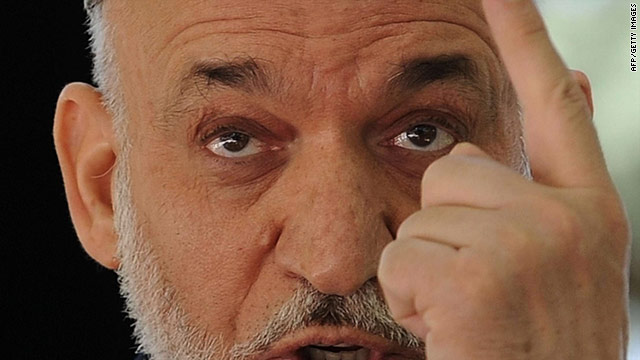
Afghan President Hamid Karzai warned Tuesday that any future NATO airstrikes that kill civilians will be considered attacks against the Afghan people.
The statement came three days after an airstrike killed 14 civilians in southern Afghanistan, according to Afghan officials.
"This is my last warning to the NATO forces: No more attacks on the homes of Afghans will be allowed," Karzai told reporters.
"If they continue such operations to kill civilians, international forces will change to a force who is not fighting against terrorists but fighting against Afghan people."
Army Gen. David Petraeus, commander of NATO-led troops in Afghanistan, joined two other generals in offering "sincere apologies" Monday for the airstrike that killed nine civilians in Helmand province. There was no immediate explanation for the disparity between this figure and Karzai's account of 14 killed: 10 children, two women and two men.
Maj. Gen. John Toolan, head of NATO's International Security Assistance Force command in southwest Afghanistan, pleaded with Afghans to not only forgive, but to also work with coalition forces in hopes of bolstering their security.
"I offer our heartfelt apologies to the families and friends of those killed," Toolan said in a statement. "I ask that the Afghan people continue to trust and assist their security forces, so that together we can stop the senseless killing brought upon us by an enemy who wants to exploit the Afghan people through fear and violence."
Karzai said Tuesday that the international community has turned the war against terrorism into political objectives.
"They seek their own interest and played politics," Karzai said. "... If they were fighting against terrorism as the Afghans were honestly advising them, if they were focusing (on) the terrorism sanctuaries ... this war would have been more successful."

Monday, May 30, 2011

Doctors in Khyber Pakthunkhwa announces end of strike

The Provincial Doctors Association (PDA) here on Monday announced end of strike in Khyber Pakthunkhwa public sector hospitals while medical practitioners and young doctors joined their duties.

President PDA Dr Shah Sawaar in presence of doctors and Special Health Secretary0020Noorul Eman announced the end of strike during a press conference here at Press Club.

The announcement was made after PDA office bearers held successful talks with KPK Health Department officials regarding implementation of their six point agenda.

Saudi Arabia thinks Pakistan controls Taliban: WikiLeaks


A cable sent by the American ambassador in Riyadh said that the Saudi officials made it clear to the United States that Pakistan would only accept the Afghan leadership which would accept Durand Line as an international border.

In January 2010, Saudi Interior Minister General Masoodi and special US envoy Barnett R Rubin met in Riyadh. Saudi officials were of the view that most of the warriors were grown up in Pakistan due to which Pakistan had control over them. However, most of Afghan Taliban want to end this control. Masoodi said that the Afghan Taliban group was weak at the moment and America should help it to make it strong because Pakistan and Iran were using most of the Taliban for their own benefit.

The Saudi general also told the US representative that there was a need to remove Pakistan’s reservations on Afghanistan, otherwise there would be grave consequences. He said that the presence of India in Afghanistan extremely displeased Pakistan. The Saudi general also said that there was no benefit of talks with Pakistani Taliban because they were dominated by Al Qaeda.

Britain trained Saudi troops used in Bahrain crackdown

Britain sends 20 military training teams a year to Saudi Arabia to train the kingdom’s national guard, the forces deployed in the recent crackdown on protests in neighbouring Bahrain, it was reported Sunday.

The country’s Ministry of Defence (MoD) admitted military personnel run courses in “weapons, fieldcraft and general military skills training, as well as incident handling, bomb disposal, search, public order and sniper training,” the UK’s Observer reported.

The courses are organised through the British Military Mission to the Saudi Arabian National Guard, a unit that consists of eleven British army personnel, the paper said. Saudi Arabia covers “all BMM personnel, as well as support costs such as accommodation and transport,” the MoD. “By providing training for countries to the same high standards used by UK armed forces we help to save lives and raise awareness of human rights.”

Bahrain, home of the US Fifth Fleet, faced a wave of Shi’ite-led protests in February and March that left at least 29 people dead, including four policemen, and dozens more injured.

Bahrain's rulers imposed emergency law and called in troops from neighbouring Gulf countries in March to quash the protests, including 1,200 Saudi soldiers.

Britain revoked dozens of licences for the export of weapons to Bahrain in February, amid fears weapons would be used to repress anti-government protests. In March, the country said it was “deeply concerned” over reports of human rights abuses in the Gulf island kingdom.

Human rights groups and opposition parties have spoken out over the news, questioning Britain’s military support for revolts in Libya and elsewhere, while indirectly aiding the suppression of protests in the Gulf.

“It is intensely hypocritical of our leadership in the UK – Labour or Conservative – to talk of supporting freedoms in the Middle East and elsewhere while at the same time training crack troops of dictatorships,” said British MP Jonathan Edwards. US-based New York-based Human Rights Watch this weekend asked the ruling body for Formula One to consider alleged human rights abuses in Bahrain when deciding whether to reinstate its Grand Prix this year.

Pakistan army more anti-American than radical


Dr. Stephen Philip Cohen, a senior fellow at the Brookings Institute, Washington DC, is a respected authority on the Pakistani army and the country’s politics. His book The Pakistan Army was published in 1998 and was translated into Urdu and Chinese. In 2004, he published another book The Idea of Pakistan. In an exclusive interview with Dawn.com, Dr. Cohen speaks about the Pakistan-US relationship and the future of South Asia after the Osama bin Laden crisis.

Q: Who do the Americans hold responsible for harbouring Osama bin Laden: The Pakistani civilian government or the army?

A: The US military respects the Pakistan army for its professionalism but they are angry with the Pakistani military for playing both sides against the middle. They are aware that if you’re an American soldier and the Afghan Taliban who are shooting at you are actually the ones being supported and trained in Pakistan. So, there is real anger with the Pakistan army over this double game. I can understand why they are playing this double game as the Taliban are an asset for Pakistan but the Americans do not like this. There is also deep resentment over some of the policies the army has imposed on the civilian government.

Q: How old is the history of collaboration in the Pakistan army with the Islamic radicals?

A: It dates back to the Bangladesh separatist movement when the army recruited people for al Badar and its death squads. It became more systematic during Zia’s government both in Kashmir and Afghanistan. Now, it is a full-fledged strategic alliance for the Pakistan military.

Q: The Pakistanis complain that dictatorship and Islamic radicalisation were actually gifted to them by the United States. What has compelled the US to support military rulers in Pakistan?

A: The US has needed Pakistan for strategic purposes. Our policies have done as much harm to Pakistan as they have helped the country. We could have supported them but put more pressure to liberalise and democratise the society. The Bush administration made a strategic mistake by supporting Pervez Musharraf and excluding the other politicians. We should have supported Benazir Bhutto or Nawaz Sharif. The US did support a deal between Musharraf and Bhutto but excluded Sharif. We should have come out and said publicly that we support all the legitimate politicians in Pakistan.

Q: Do you think the Pakistan army can ever overcome its obsession with India? How can the US help both the countries resolve this conflict?

A: I am writing a book about the India-Pakistan rivalry and calling it the “hundred-year old war”. My prediction is that the India-Pakistan conflict, which includes Kashmir besides many other problems, will last for one hundred years or even more.

I am very pessimistic about a solution between the two countries. They should cooperate over trade, for instance. Kashmir will eventually find its way. The United States should have only a silent role which should be limited to providing ideas and suggestions as we often do in the Middle East peace process.

Q: Does Osama bin Laden’s killing formally end the war on terror?

A: I don’t know if it was a murder or not but maybe it was an extrajudicial killing. Yet, it does not bring the war on terror to an end. Al Qaeda is a large global movement and it will continue to operate. It has diminished not only in terms of its organisational capability but also in terms of its symbolism. There will be major terrorist attacks on Pakistan, United States, India and other countries.

The notion of having a global Khalifat, where the whole world is united under one Khalifa is fanciful. That was not popular in Pakistan some years back. The anti-Americanism popular in Pakistan is based on the misunderstanding of American policies and some of the things that we have done in the past.

Q: Is it anti-Americanism or anti-Indianism that motivates radical elements in the Pakistan army?

A: I don’t have evidence of Pakistan army as radical in the extreme sense. However, it has become more anti-American. Some sections of the army are more anti-American than they are anti-India. The obsession with India, on the other hand, is weakening Pakistan rather than strengthening it. Pakistan has a huge list of reforms that it should have made.

In a talk at Quetta’s Staff College, I said Pakistan should take a lesson from South Korea and Japan which had their own way of taking revenge through economic productivity. Pakistan should struggle to beat India in the software industry, modern agriculture and exports.

Pakistan has had natural advantages over India in many areas but it has failed to capitalise on those advantages. I do not know if it is too late to reverse that process but if Pakistan continues to make India the center of its foreign policy, the country will go nowhere.

Q: There is a lot of resentment inside Pakistan over the drone strikes which many view as a violation of the country’s sovereignty. Can anti-Americanism subside if these attacks stop?

A: We know from the WikiLeaks that the Pakistanis themselves are helping us with the targets. It’s astonishing that the Pakistan government has not said this publicly. The government is too much of a coward to openly admit that some of the drone strikes have killed the enemies of Pakistan. If the Pakistani army and police had taken action against the terrorists, the drone strikes would probably not take place. Every state in the world has an obligation not to allow its territory to be used for terrorist attacks on other states. Pakistan has allowed groups to operate from its territory to launch attacks against the US, Afghanistan and of course India.

Q: How serious is the crisis in Pakistan and how can the world help Pakistan overcome this?

A: There are two things requiring attention: The State of Pakistan, which is mostly bureaucratic, and the idea of Pakistan. The United States can help the State of Pakistan in many ways by developing its organisational and budgetary procedures but we can’t do much about the idea of Pakistan. Pakistanis themselves have to discuss and debate what it means to be a Pakistani. If being anti-India is being a Pakistani then you are taking the crisis deeper but if you are looking for a modern Islamic state that rest of the world should look upon then that is a different definition of Pakistan.

Q: Do you think the Pakistan army will eventually move with another coup?

A: I don’t see a coup coming in Pakistan. There is this joke in America that when Obama got elected, some newspapers wrote: “Black man gets worst job in the US”. Who wants to be the president of Pakistan? Zardari is doing a mediocre job. I doubt if General Kayani can do a better job as the president. Pakistan is currently pressed and embarrassed with many issues. Another military coup will simply make things worse for that country.

Q: How do you predict the scenario once the US withdraws from Afghanistan?

A: The US will stay in Afghanistan to a limited degree to make sure that al Qaeda does not show up again. A significant development program is going on in Afghanistan which is more effective than our development work in Pakistan. There is no economic and strategic interest for the US in Afghanistan. It is important because it is having a contaminating effect on Pakistan.

Q: How serious is the tug of war between Pakistan and India to gain political and economic influence in Afghanistan?

A: The good news I have heard is that both the countries are going to talk about Afghanistan. If both the countries can work on an agreement as to what role they should play in Afghanistan to help the Afghan people then that will be a role model for the United States and Iran. The four countries — United States, Pakistan, Iran and India — are critical for the future of Afghanistan. They should agree to have a non-aligned democratic, but certainly not a radicalised, Afghanistan. I am optimistic that the Indians and Pakistanis will work together in Afghanistan.

Q: The right-wing opposition leaders are suggesting that Pakistan should stop getting aid from the United States. Is that going to help Pakistan attain more prosperity and self-reliance?

A: Pakistan should develop its own strategy to develop its industry and agriculture. It has to work out with India on the agreements over Indus waters and also work among its provinces. I want to see a business-like transactional relationship between the United States and Pakistan. The Pakistanis should tell the US what and why they need assistance in certain areas. Once we commit our aid, the US should work as if we are under a contract and if the Pakistanis perform effectively, we should provide them further aid on time.

Afghan Bank Commission Absolves President’s Brother in Fraud Case


A commission appointed by President Hamid Karzai to assess responsibility for the massive fraud at Kabul Bank issued its report on Sunday, absolving the president’s brother of any blame. The brother, Mahmoud Karzai, was among the bank’s politically connected shareholders and insiders who took out a total of $925 million in loans, often with no collateral or even documentation, the commission’s chairman, Azizullah Ludin, announced at a news conference here. Only $347 million of that amount is so far expected to be repaid, he said.

At the same time, the report suggested that loans to politically connected figures were even more widespread than previously known. Mr. Ludin said that 207 borrowers took out undocumented loans, including many members of Parliament and government ministers.

Mr. Ludin said “three or four” sitting cabinet members had received dubious loans. He did not identify them, but he did name Gen. Abdul Rashid Dostum, the military chief of staff to the president and a leading Northern Alliance member, as taking out about $100,000 in unsecured loans.

He said the president’s brother had paid off his loans, news welcomed by Mr. Karzai although the case remained murky. Abdul Qadir Fitrat, a Central Bank governor, recently told Parliament that Mahmoud Karzai still owed the bank $22 million, which Mr. Karzai denied.

Differences between the Central Bank and the presidential commission underpinned the report, which tried to shift the blame for the fiasco to the Central Bank, as well as to international auditors paid for by American aid programs, for what often amounted to looting of the bank’s deposits.

Mr. Ludin was particularly critical of Mr. Fitrat, the Central Bank governor.

“It’s very easy to be national hero in Afghanistan,” Mr. Ludin said Sunday, clearly referring to Mr. Fitrat. “Some officials of the Central Bank are involved in this issue, and those who were guilty in this case are now in charge of the affairs in Kabul Bank.”

After news of the scandal threatened to destroy the bank, Afghanistan’s largest, destabilize the country’s financial system and drive away foreign aid, President Karzai vowed last year that the government would stand by the bank and prevent it from failing. Last month, the government announced its plan to overhaul the bank, splitting it in two. One entity, the New Kabul Bank, would take over the bank’s branches, deposits and good loans, and the other would be a receivership office set up to try to collect on the bad loans.

Mr. Ludin did not release the text of the report, which he said was the president’s prerogative. He said the president would decide whether any criminal or other action would be taken based on its recommendations.

He did, however, quote liberally from the report, and took care to absolve the bank’s two most politically prominent borrowers, Mahmoud Karzai and Abdul Hassin Fahim, the brother of the powerful first vice president. Officials had previously said that Mr. Fahim’s loans totaled as much as $100 million, but Mr. Ludin said that his commission had been assured by him that he had agreed to pledge enough property to cover his obligations.

On Mr. Karzai, a businessman with dual Afghan-American nationality, the commission accepted his view that he had paid off all of his obligations to the bank, $4.2 million. “He is not guilty,” Mr. Ludin said. “He has no problem.” The other $18 million charged to Mr. Karzai comprised an $8 million loan to buy a villa on Palm Island in Dubai, a $6 million loan to buy shares in the bank, and accumulated interest of about $4 million.

Mr. Karzai maintains that the deed to that villa was in the name of the bank’s chairman, Sherkhan Farnood, and that he was only a tenant there. And he says that since the bank has been in effect taken over by the government, his obligations to pay for shares in the bank have been erased.

Reached by telephone, he reiterated his claim that he had paid off his Kabul Bank loans, and said the report had exonerated him. He said Mr. Fitrat, the Central Bank governor, had apologized to him for publicly saying he owed $22 million, and that Mr. Fitrat had accepted Mr. Karzai’s accounting. “He told me I’m clean,” Mr. Karzai said. But a spokesman for Mr. Fitrat denied that he had apologized. “It’s not true and we reject this allegation,” said the spokesman, Emal Ashur. As to whether Mr. Karzai still owed the bank money, Mr. Ashur referred questions to the bank’s Receivership Office.

A spokesman for that office, Nesar Ahmad Yousefzai, said the receivers were not yet able to divulge how much any individuals owed the bank.

Informed of Mr. Fitrat’s denial, Mahmoud Karzai lashed out. “The incompetency in this government is beyond comprehension, from my brother on down,” he said. “Basically my brother has licensed 600,000 people to rob the rest of the population,” he added, referring to the estimated number of government employees.

Mr. Ludin said the commission discovered that Kabul Bank had $925 million in questionable loans, including $338 million in accumulated interest. Of those loans, $467 million were made without any guarantees or even paperwork or documentation. Only $49 million of the bank’s loans were considered good loans that were properly performing.

The scandal, which led to a brief run on the bank last year, threatened to damage the entire economy and scared off the foreign aid that keeps the government running. Without that aid, Afghanistan has only $1 billion in annual revenues, so it was unclear how its government could cover the bank’s obligations.

International donors made it clear they were unwilling to bail out the bank, and the International Monetary Fund made addressing the bank’s problems a condition before foreign aid money could resume. No one has been charged or prosecuted in connection with the bank so far.

The State Department has canceled a contract with Deloitte, the international accounting firm, in Afghanistan, after the department’s inspector general reported that it had ignored signals of trouble at the bank for two years.

Mr. Ludin said the bank’s problems were caused by inadequacies in international accounting practices, as well as by the Central Bank’s failure to heed warnings made to it a year ago by Afghanistan’s intelligence service.

Mr. Ludin was previously appointed by Mr. Karzai to head the Independent Electoral Commission during the 2009 presidential race. Mr. Ludin was widely criticized for claiming that the race was free and fair, despite condemnation from the international community.

New details emerge in Abbottabad

Poverty survey in FATA to start in June

The government will start poverty survey in FATA from 1st week of June this year, for which tribal areas have been divided on seven parts to make it more authentic and productive, a senior official said on Sunday.


Talking to APP, Director General Benazir Income Support Program (BISP) for KPK and FATA Ikram Ghani said that arrangements in this regard have been completed and the poverty survey will start in FATA from 1st week of next month. The survey will start from Bajaur Agency because of its better security environment and later on it would kick off simultaneously throughout the six agencies.

Three-day training and capacity building programs for officials would be responsible for collecting data about poverty in FATA will start next week and officials showing good performance would be awarded. To a question, he said that delay in starting of the survey in FATA was due to security, law and order situation saying that it would be completed in two months and its contract has been awarded to two firms.

World Bank will provide technical and financial assistance to make the survey transparent; he said and added that local people have been hired for the task.

He informed that 68, 7196 persons have been registered in 20 districts of KPK while work on seven lakhs forms earns progress. Ghani informed that poverty survey continued in Shangla, Kohistan, Bannu and Upper Dir. He said that poverty has been increased due to devastated floods.

He informed that 43,625 deserved families of district Charsada affected by floods have been registered with BISP and it is assumed that it would jumped to 60,000 while in Peshawar 94,000 families have been registered. Likewise, 80,000 in Mardan and 24,000 families were registered in Nowshera. In FATA, tribal elders, elected representatives and Ulama to make the program transparent, he said.

Under Waseela Haq Program, the official said 520 persons were trained and 996 persons were paid, while 140 people would be given to 1st Installment of Rs. 3 lakh next week.

Musharraf declared PO in Benazir murder case

The Rawalpindi Anti-Terrorist Court (ATC) on Monday declared former military ruler Pervez Musharraf a Proclaimed Offender (PO) in the Benazir assassination case, DawnNews reported.

Taking notice of Federal Investigation Agency’s special public prosecutor Chaudhry Zulfiqar’ request, Judge Rana Nisar Ahmed declared the former president a PO.

Earlier in April, Mr Zulfiqar had requested the court to start the process of declaring Musharraf proclaimed offender because his arrest warrants could not be served on him and that he was wilfully avoiding them.

According to legal experts, declaring the former army chief a proclaimed offender would enable the court to attach his immovable property in Pakistan and proceed with the trial of other accused in the case, leaving the authorities to seek other means for his arrest.

Mr Musharraf has been accused of failing to provide adequate security to Benazir Bhutto and conspiring to kill her.

Ex-navy commando, brother detained after Pakistan base attack

Pakistani security officials have detained a former navy commando and his brother in connection with the militant attack on a naval air base this month, intelligence officials and relatives said on Monday.
Last week's attack on the PNS Mehran base in Karachi, the headquarters of Pakistan's naval air wing, embarrassed the military and raised fresh doubts about its ability to protect its bases after a similar raid on the army headquarters in the city of Rawalpindi in 2009.
Kamran Ahmed, who was sacked from the navy about 10 years ago, and his younger brother, Zaman, were picked up from the eastern city of Lahore on Friday, five days after the attack that killed at least 10 military personnel.
"They have been detained in connection with the naval base attack and are under interrogation," one intelligence official said, without giving details. It was not immediately clear why Kamran Ahmed had been sacked.
Imran Ahmed, another brother who was not arrested, told Reuters the two were taken away by intelligence officials on Friday. He gave no details.
The Pakistani Taliban, which is allied to al Qaeda, claimed responsibility for the attack on the Mehran base, but many analysts believe they had inside help.
A group of between four and six militants besieged the base for 16 hours and destroyed two P-3C Orion aircraft from the Unites States, crucial for Pakistan's maritime surveillance capabilities.
Pakistan has faced a wave of assaults over the last few years, many of them claimed by the Pakistani Taliban and other al Qaeda-linked militant groups.
In October 2009, a small group of militants attacked the Army's General Headquarters in Rawalpindi, taking 42 people hostage, including several officers. By the end of the day-long siege, nine gunmen, 11 soldiers and three hostages were dead.
The Taliban have stepped up attacks since the killing of Osama bin Laden in a U.S. raid in a Pakistani garrison town earlier this month.
The raid embarrassed the military, which has been unable to explain how the al Qaeda chief hid in the country for years or how the Americans could launch the attack deep inside their territory.

Memorial Day comes as troops fight in Afghanistan


U.S. troops fighting in Afghanistan paused Monday to remember the fallen in Memorial Day services, as a war nearly a decade old trudges on.
Some prayed and held flag-raising ceremonies at dawn to recognize the more than 1,400 killed in combat here since the Sept. 11, 2001 attacks that triggered the war.
"We reflect on those who have gone before us. We reflect on their service and their sacrifice on behalf of our great nation," said Brig. Gen. Lewis A. Craparotta, who commands a Marine division in Afghanistan's southern Helmand province. "We should also remember those serving today who embody that same commitment of service and sacrifice. They are committed to something greater than themselves and they muster the physical and moral courage to accomplish extraordinary feats in battle."
In Iraq, an estimated 46,000 U.S. troops remain stationed there though officials say combat operations are over in a nation that saw more than 4,400 American troops die in combat. Under an agreement between Washington and Baghdad, the troops still in Iraq must leave by Dec. 31.
Black Hawk helicopters churned through the night sky Sunday as a strong wind coming over Kabul's surrounding mountains blew against the flickering candles that cast an orange glow on those gathered for a remembrance ceremony at the U.S. Army Corps of Engineers' headquarters.
Earlier in the day, those working there enjoyed one of their five days off a year from building police stations, dams and other projects in a nation torn by decades of war. Col. Thomas Magness, 47, of Los Angeles, California urged the more than 100 corps employees and U.S. troops gathered there to remember the meaning of Memorial Day — advice that could carry home to America.
"While we were playing volleyball today, no doubt some soldier gave the ultimate sacrifice," the corps commander said.
Memorial Day, instituted to honor America's war dead, will be observed Monday with a public holiday. This Memorial Day comes before the 10-year anniversary of the Sept. 11 terror attacks, which ultimately brought U.S. troops into Afghanistan to unseat the Taliban government and hunt terrorist leader Osama bin Laden.
"Our country got attacked, and we're here to fight the war on it," said Roger Nowicki of the corps.
While Navy SEALs shot and killed bin Laden earlier this month in neighboring Pakistan, the U.S.-led war here continues. President Barack Obama plans to draw down U.S. troops beginning in July, while NATO has committed to handing over control of security in the country to Afghans by 2014.
In the meantime, the war grinds on toward its 10th year. The sharp pangs of loss are visible on some attending the event, like Maj. Erica Iverson, 33, of Vermillion, South Dakota. She spoke of serving as a casualty assistance officer after the 2010 death of Staff Sgt. Adam Dickmyer of Winston-Salem, North Carolina, who once served as a sentinel at the Tomb of the Unknown Soldier at Arlington Cemetery.
Iverson's voice choked as she recounted how Dickmyer's mother fell off her chair in grief when her son's body returned to the U.S. His widow chased after the casket, screaming: "Don't leave me!"
"His wife has an empty house," Iverson said. "His entire unit came home today, and he didn't come with them."
Iverson said speechwriters for Obama called her in recent days, saying the president may honor Dickmyer in remarks on Memorial Day.
Increasingly skeptical American and Afghan publics question why U.S. and NATO forces remain there. The Taliban recently begun its spring offensive, as suicide bombings, roadside explosions and attacks in remote posts have returned with a frightening regularity.
"You don't get used to it because you're in a war zone," said civilian corps worker George S. Triggs, 54, of Louisville, Kentucky. "You learn to tolerate it and do the best you can."
Yet the worst stress, some acknowledged, is that of family members waiting at home for their loved ones to return. Lt. Col. Jon Chytka, 44, of Tabor, South Dakota recounted having to explain to his 5-year-old daughter why he had to leave.
He gave this answer: "I told her that before she was born, there were 19 people who killed 3,000."
___

Pakistan to launch offensive in N. Waziristan - report

Pakistan will launch a military offensive in North Waziristan, a newspaper reported on Monday, days after U.S. Secretary of State Hillary Clinton reiterated a U.S. demand to tackle sanctuaries for al Qaeda and the Taliban on the Afghan border.

An understanding for an offensive in North Waziristan, the main sanctuary in Pakistan for militants fighting in Afghanistan, was reached when Clinton and Chairman of the Joints Chief of Staff Admiral Mike Mullen visited Pakistan last week, Pakistan's the News newspaper reported.

The United States has long demanded that Pakistan attack the region to eliminate the Haqqani network, one of the deadliest Afghan militant factions fighting U.S. troops in Afghanistan.

Pakistan has been reluctant to do so, but it has come under more pressure and its performance in fighting militancy is under scrutiny again after it was discovered that Osama bin Laden had been living in the country.

The News quoted unidentified "highly placed sources" as saying Pakistan's air force would soften up militant targets under the "targeted military offensive" before ground operations were launched. There was no timetable given.

The newspaper cited the sources as saying that a strategy for action in North Waziristan had been drawn up some time ago and an "understanding for carrying out the operation was developed" during the Clinton visit.

The target of any North Waziristan operation would be the most violent factions of the Pakistani Taliban, which has strong ties to al Qaeda.

But the United States would almost certainly push for a move against Haqqani, too.

Pakistani officials were not immediately available for comment. A U.S. embassy official had no immediate comment.

The newspaper said a "joint operation" with allies had been discussed but no decision had been taken because of sensitivities.

"In case the two sides agreed to go for a joint action, it would be the first time in the present war (on militancy) that foreign boots will get a chance to be on Pakistani soil with the consent of the host country."


That could be highly risky for Pakistan's generals.

SENSITIVITIES OF U.S.-PAKISTAN COOPERATION

The military, long regarded as the most effective institution in a country with a history of corrupt, inept civilian governments, suffered a major blow to its image when U.S. special forces killed bin Laden deep inside Pakistan.

Some analysts say any joint U.S.-Pakistani operation would subject the army to even more public criticism in a country where anti-U.S. feeling runs deep.

"The reaction could be even more vociferous, just because everybody is so suspicious -- as well as dismissive -- of American interference," said Imtiaz Gul, author of "The Most Dangerous Place," a book about Pakistan's militant strongholds.

"People already feel so humiliated because of this Osama bin Laden thing and now they will have another reason to react."


But the South Asian nation, dependent on billions of dollars in U.S. aid, is under more pressure than ever to show it is serious about tackling militancy.

Attacking U.S. enemies in North Waziristan may be one way of repairing ties with Washington which were badly damaged by the bin Laden affair.

Pakistan maintains about 140,000 troops in the northwest, including about 34,000 in North Waziristan, but says they are too stretched fighting Pakistani Taliban insurgents in other parts of the region to tackle North Waziristan.

But analysts say Pakistan sees the Haqqani network as an asset to counter the growing influence of rival India in Afghanistan.

Aside from strategic concerns, an attack on the Haqqani network could further threaten Pakistan's security as it faces a new wave of attacks by the Pakistani Taliban to avenge the killing of bin Laden by U.S. special forces on May 2.

Pakistan could pay a heavy price if Haqqani's formidable fighters, believed to number in the thousands, and their militant allies, turn on Pakistani security forces.

Highlighting the dangers in North Waziristan, a blast at a restaurant in its main town Miranshah wounded 12 people on Monday, government officials and residents said.

Yemeni forces fire at protesters in Taiz

Yemeni forces loyal to President Ali Abdullah Saleh opened fire on protesters in the southern city of Taiz on Sunday, killing at least six people and wounding 120, hospital sources said.
A Reuters photographer at the scene said police fired live ammunition, tear gas and used water cannons to disperse demonstrators protesting outside a municipal building to demand the release of a fellow protester who was arrested on Saturday.
The clashes took place near Freedom Square where thousands of anti-government protesters have been camping since January to demand Saleh's overthrow. Police set two tents on fire in the square. Protesters hurled Molotov bombs and rocks at police.
In the capital Sanaa, seven explosions were heard on Sunday night in the district of Hasaba, the scene of week-long fighting between Saleh's forces and a rival tribe in which 115 people were killed, residents said.
There were no immediate details on the explosions, which appeared to have partially breached a truce between Saleh's forces and the powerful Hashed tribe led by Sadeq al-Ahmar in the bloodiest fighting since unrest erupted in January.
Ahmar condemned what he described as "Saleh's new massacre" against civilians in Taiz. Earlier on Sunday, his men handed back control of a government building to mediators as part of a ceasefire deal.
PILING PRESSURE
A breakaway military group called for other army units to join them in the fight to bring down Saleh, piling pressure on him to end his three-decade rule over the destitute country.
Despite global and regional powers demanding he step down, Saleh has refused to sign a deal, mediated by Gulf states, to start a transition of power aimed at averting civil war that could shake the region that supplies the world with oil.
"We call on you not to follow orders to confront other army units or the people," the breakaway units said in a statement read by General Abdullah Ali Aleiwa, a former defense minister.
Opposition leaders separately accused Saleh of allowing the city of Zinjibar, on the Gulf of Aden, to fall to al Qaeda and Islamists militants in order to raise alarm in the region that would in turn translate to support for the president.
Residents in Zinjibar, about 270 km (170 miles) southeast of the capital, said armed men likely from al Qaeda had control of the city in the flashpoint province of Abyan.
"About 300 Islamic militants and al Qaeda men came into Zinjibar and took over everything on Friday," a resident said.
Three militant gunmen and three civilians have been killed in fighting against locals, who have been joined by a few government soldiers, trying to take the city back from the al Qaeda group and Islamists, medical sources said.
Nearly 300 Yemenis have been killed over the past few months as the president has tried to stop pro-reform protests by force.
Generals and government officials began to abandon Saleh after deadly crackdowns on protesters started in force in March. There have been no major clashes yet between the breakaway military units and troops loyal to Saleh.
Opposition groups and diplomats have accused Saleh of using the al Qaeda threat to win aid and support from regional powers seeking his government's help in battling the militants.
Fears are growing that Yemen-based al Qaeda in the Arabian Peninsula (AQAP) will exploit such instability, analysts said. The United States and Saudi Arabia, both targets of attacks by AQAP, are worried that growing chaos is emboldening the group.
Yemen borders Saudi Arabia, the world's biggest oil exporter, and sits along a shipping lane through which about 3 million barrels of oil pass daily.

Sunday, May 29, 2011

Nawaz wants to derail democracy

Pakistan Muslim League-Nawaz (PML-N) chief Nawaz Sharif wants to derail the democratic system by implementing the agenda of national enemies, Pakistan People’s Party (PPP) said on Sunday.

Reacting to the statement of Nawaz in which he levelled serious allegations of corruption on the PPP-led government, and declared that he was ready to support any anti-government movement in the country, PPP Punjab Information Secretary Dr Fakharuddin Chaudhry, upon contact, said that the PML-N leaders were busy in disturbing the democratic government following the plan of ‘others’.

He said that the PML-N chief had no political plan to attract the people, so he was busy in criticising the system and important institutions of the country that was why he was levelling allegations against the army, the Inter-Services Intelligence and the government.

Although the army and the intelligence agencies were sacrificing their lives for the sake of the country in the war against terror and the government was trying to deal with terrorism with an “iron hand” and was making policies for boosting the economic system, he said. However, some ‘simple minded politicians’ who had no idea about the situation, and just wanted to attain popularity that was why they were giving anti-democracy statements, Chaudhry added.

The PPP leader said that Nawaz had been left alone at the front of politics, and now wanted to please some ‘elements’ without thinking that these elements or powers had no influence in the current situation.

Nawaz Sharif should show political maturity: Babar

Senator Dr Babar Awan of Pakistan Peoples Party said on Sunday that the Pakistan Muslim League-Nawaz should show political maturity as the country was passing through difficult times. Addressing a press conference here, Babar said that PML-N Chief Nawaz Sharif should not adopt “a non-serious attitude and mislead the nation asking it to revolt against the government”.

Babar Awan said that Nawaz Sharif had not mentioned that what kind of revolt he was demanding from the people.”Whether it is against the parliament, constitution, democracy or law and order?”, he said.
He alleged that Nawaz Sharif preferred to leave the country instead of confronting the dictator. “ Why did he not announce rebellion at that time?” he asked.
He said that the PPP had always played the politics of federation and reconciliation while Nawaz Sharif, he claimed, was doing the politics of division and separation.

ANP govt criticized for stalled health delivery

The Awami National Party-led provincial government has been under tremendous criticism from the masses for failing to resume the health services suspended for the past 10 days due to continuous strike by the doctors across the Khyber Pakhtunkhwa.

The doctors continued the strike for 10th consecutive day on Saturday, which paralysed the health delivery in major hospitals of the province, particularly in Peshawar where doors of the three tertiary care hospitals Lady Reading Hospital (LRH), Khyber Teaching Hospital (KTH), and Hayatabad Medical Complex (HMC) had been closed for the patients for the past couple of days.

Hundreds of poor patients and their hapless attendants, after sensing that there was no hope for end to strike by the doctors had started leaving hospitals for homes.

Most of the wards, laboratories and operation theatres in the three teaching hospitals in Peshawar have been wearing a deserted look by persistent strike by the doctors.

The doctors want increase in salaries and went on a strike on the call of Provincial Doctors Association (PDA), representative body of the serving doctors. The provincial government has not been able to take note of patients suffering caused by doctors strike.

Majority of the patients and their exhausted attendants criticised the ANP-led government for the miseries they were facing at the public sector hospitals. Instead of strengthening these so-called hospitals, the ANP government closed its doors for the poor patients and left them at the mercy of doctors to suffer, a disappointed attendant, Ikhtiar Gul, who had taken his ailing brother to the Lady Reading Hospital (LRH), remarked.

Some senior doctors affiliated with the Pakistan People s Party were making individual efforts to bring the protesting doctors and the government to the negotiating table, but in vain.

The PDA, on the other hand, has vowed to continue strike till acceptance of their lone demand, raise in salaries.

The authorities at the LRH and KTH Saturday made some alternative arrangements for the patients coming to the two teaching hospitals.