EDITORIAL:Daily Times
Much noise and fury has been expended regarding the perceived ‘dissolution’ of the Higher Education Commission (HEC). Vice Chancellors, academics and students have all given voice (and in some cases rallies) to the apprehension that the HEC’s ‘demise’ would sound the death knell for higher education and in the process undo all the good work the HEC has achieved since it was set up under the Musharraf regime in 2002. The whole hullaballoo was punctured by the chairman of the Implementation Commission on the 18th Amendment, Mian Raza Rabbani, when he informed the Senate that a new commission is being evolved at the federal level to maintain higher education standards. Some of the erstwhile functions of the HEC, especially curriculum, syllabus, policy and planning are being devolved to the provinces. Perhaps some of the fears of the move’s critics are rooted in the fact that it is not yet clear how the provinces will handle these new responsibilities, through what administrative means, etc. The undeniable fact is that after the 18th Amendment, education has been devolved to the provinces. If the provinces at present lack the capacity to manage the new arrangements, this is not an argument for not proceeding along the perfectly desirable path of provincial autonomy, but cause for caution, thought and a systematic approach to the creation of the new structures and means to be put in place at the provincial level.
The HEC replaced its predecessor, the University Grants Commission, and because its first chairman, Dr Atta-ur-Rahman was the blue-eyed boy of Musharraf, the HEC incrementally expanded its role in the growth of universities and funding for postgraduate studies and research. But it also began to invite criticism from academics for micro-managing the universities, arguably going beyond its mandate and in the process eroding the autonomy of the universities. The pell-mell rush towards mushrooming quantitative growth of new universities (including in the private sector) and increased postgraduate studies (PhDs, etc) and research took no account of how the academic requirements of these new institutions and programmes would be met in the absence of a pool of qualified academic manpower and whether the sudden spurt could come up to the desired standard. In other words, the HEC concentrated more on quantity than quality, to the detriment, arguably, of higher education standards in the country. As to the doomsday scenarios being painted of the collapse of all the postgraduate programmes of the HEC because of funding cut-offs, Raza Rabbani has pointed out that all ongoing programmes will continue, funding from federal sources (the Finance Ministry has just released the Rs 7.7 billion allegedly ‘held back’ from the HEC) and foreign donors would be available (confirmed by USAID), and the new Commission for Standard Higher Education would oversee standards and act as a coordinating centre for the functions devolved to the provincial level.
While the caution to proceed step by step down the devolution path to ensure as little disruption as possible is well taken, the devolution thrust of the 18th Amendment must be seen as a historic turn for the country. Those predicting the death of ‘national unity’ because of the perceived threat from the provinces ‘going their own way’ in curriculum, etc, seems premature and exaggerated. In any case, this bemoaned ‘national unity’ has been a false, imposed one in our short history, one that attempted to steamroller over the historically evolved ethnic, linguistic and cultural identities in a multi-national state. No, Dr Atta-ur-Rahman, national integrity will not be “crushed” by devolution; what has been crushed so far has been precisely the identities highlighted above. National integration from above, in the name of a spurious national oneness has not worked. Arguably, it is time to allow the evolution of a real national integrity through the voluntary efforts of the federating units, an effort helped by the recognition of their ancient identities that predate the emergence of Pakistan. Does that mean each unit will become a ‘universe unto itself’? Not if the experience of democratic federations (and their opposite) is taken into account. A Pakistan of federating units confident in their (finally) established identities that binds the peoples of the disparate provinces through free and voluntary association, shared history, culture and interests will be a far more stable state than anything we have so far seen in the last 64 years. *

M WAQAR..... "A man's ethical behavior should be based effectually on sympathy, education, and social ties; no religious basis is necessary.Man would indeed be in a poor way if he had to be restrained by fear of punishment and hope of reward after death." --Albert Einstein !!! NEWS,ARTICLES,EDITORIALS,MUSIC... Ze chi pe mayeen yum da agha pukhtunistan de.....(Liberal,Progressive,Secular World.)''Secularism is not against religion; it is the message of humanity.'' تل ده وی پثتونستآن
Saturday, April 9, 2011
More rich should contribute for welfare work:
Khyber Pakhtunkhwa Minister for Information Mian Iftikhar Hussein said that the province was in dire need of the welfare organizations like Tanzeem Lissail-e-Wal Mahroom (TLWM) adding that support of the private sector and resourceful people in this regard would be welcomed. Speaking in a meeting on presentation regarding the activities of TLWM at Peshawar Saturday, he said, that keeping in view the importance of TLWM, its activities should be extended to other social sectors also so as maximum needy and poorest of the poor of the society could be benefited of it. The presentation besides others was also attended by the Minister for Social Welfare Sitara Ayaz, MPAs Yasmin Zia and Mussrat Shafi Advocate, Chairman TLWM Mohammad Humayun, Secretary Social Welfare Sahibzada Fazle Amin and other authorities concerned. He further directed to prepare proposals and recommendations to make the TLWM more effective and beneficial for the society. Earlier, the chairman of TLWM while briefing the Minister, informed that the TLWM was established in 2007 for the indigent and dispossessed with the aim to protect the poor and vulnerable segments of the society by providing them facilities in the health, education and other social welfare sectors. In the health sector, he told that so far 1591 free medical camps have been set up in different parts of the province where 562139 patients were treated, similarly free dialysis of 17883 patients was done besides treating 555 cancer patients and cataract surgeries of 6440 patients. The TLWM also arranged free medical check-up of 423278 school children through mobile screening. In education sector the TLWM was granting scholarships of Rs.1,000/- upto Matric and Rs.2,000/- per month to post-matric talented orphan students. Likewise in social welfare sector the TLWM was also arranging 6 months courses for the poor people particularly women folk in different fields to make them self reliant. It was also providing supportive equipments to the disabled persons. Mian Iftikhar while eulogizing the activities of TLWM maintained that the Khyber Pakhtunkhwa was very poor and neglected province of the country and poverty ratio was also high as compared to the other provinces, therefore existence of such useful organization was need of the hour. He added, as our resources were meager, therefore the private sector should extend its help in this regard. The Minister asked the authorities concerned to provide monthly progress report to the government on regular basis so as it could be given vide publicity through media for welfare of the society and the people should also know about the steps taken by the government to ameliorate their lot.
Egyptians turn anger on army in Cairo protest
Thousands of protesters turned their anger on the army on Saturday demanding that Egypt's ruling military council hand power to civilians and pressing for former President Hosni Mubarak to be put on trial.
The army, which has ruled Egypt since Mubarak was forced out of office on February 11, has become a growing target for a hardcore of protesters who say the generals are colluding with remnants of Mubarak's network and thwarting calls for a deeper purge.
"The military council is part and parcel of the corrupt regime. It is made up of heads of the army that have benefited from Mubarak and his 30 years of robbing the Egyptian people," said Abdullah Ahmed, 45, a protester in Cairo's Tahrir Square.
The army dismisses such charges and says it is guarding against any attempt by former officials to undermine reforms.
Protester ire was fueled on Saturday after the army tried to clear demonstrators from Tahrir during curfew hours from 2 a.m. to 5 a.m. Troops and police used tasers and batons. Sounds of gunshots rang out across the square overnight.
Medical sources said two men died out of 15 wounded by gunshots. The army said it only fired blanks and its operation caused no deaths. State television said one person was killed and 71 were wounded in acts of rioting, without giving details.
It was not clear if there were any other armed people in the square when the shots were fired.
Hundreds of thousands of Egyptians had packed into Tahrir on Friday in the biggest protests since February 18, when millions turned out across Egypt to celebrate Mubarak's downfall.
CHANTS AGAINST ARMY COUNCIL
The army met opposition when it tried to rid the square of a few thousand hardy protesters who stayed late into Friday night.
"Thank God, we resisted them (the army), and we are still here," said one protester in Tahrir, which was the epicenter of demonstrations that pushed Mubarak out on February 11.
Hundreds were still in Tahrir by early on Saturday morning. Those numbers rose to several thousand later in the day. "Why is the army beating us? Why is the army firing at us?" protesters chanted overnight when the army moved in, a witness reported.
Some protesters want the ruling Supreme Council of the Armed Forces to hand power to a civilian council and have called for the resignation of Field Marshal Mohamed Hussein Tantawi, who heads the army council. He has stayed on as defense minister after serving for two decades in that post under Mubarak.
"Either Field Marshal Tantawi puts these people -- Mubarak, Gamal (his son), and the others -- on trial, or he leaves his post and lets someone else do it. The slowness of the process makes people suspicious that the army (leadership) might be implicated," said Ashraf Abdel-Aziz, 36, a shop owner.
In scenes reminiscent of the height of protests against Mubarak, three burned-out army vehicles were left in the square. Some protesters, angry at the army's tactics, hurled rocks at the smoldering hulk of one of the army trucks.
"The army is in a tough position. What happened Friday was a result of the army's mismanagement of how to steer the revolution forward, but not complicity with the old Mubarak regime," said Hasan Nafaa, a political science professor who was active in mobilizing the protest movement.
"The army is trying to make a balance between carrying out reforms, purging the old system and maintaining economic and political stability. The army knows well that many key people from Mubarak's era control the economy and have deep roots in society. It is therefore taking measured steps," Nafaa said.
Many ordinary Egyptians are tired of the protests that have hurt the economy and want an end to the disruption.
COMPLAINTS GROW
The ruling military council said police and soldiers had "confronted acts of rioting and implemented a curfew" without causing any loss of life and blamed disturbances on "elements outside the law in Tahrir," the state news agency reported.
The council also said on its Facebook page it had ordered the detention of Ibrahim Kamel, a senior member in Mubarak's party, for "incitement and thuggery by some of his associates that stirred up the people in Tahrir Square" on Friday.
The council said it would "continue with firmness to seek out remnants of the previous regime and National Democratic Party" involved in such acts in order to maintain security.
The military has enjoyed broad support since it took control, but complaints against its rule have grown.
"We condemn the intentional slowness of the military council in meeting demands of the revolution and call on Egyptians to return to Tahrir Square and stay until Mubarak and his followers are arrested and tried," the coalition of youth groups, which drove the initial anti-Mubarak protests, said in a statement.
"We want the army and the system to be purged of all corrupt complicitous officials who want to stop the revolution in its tracks," said Mohamed Noubi, 23, a protester in Tahrir.
Some protesters took barbed wire that had been left unused by the army on Saturday and dragged it across roads leading to the square. As they had done during protests to oust Mubarak, demonstrators started checking IDs of those entering Tahrir.
"We will not leave here again until they take tangible steps to put Mubarak and high officials on trial," said Mohamed Abdul-Karim, 31, a lawyer. He said he was a member of a committee to protect the rights of people injured in protests.
Mubarak and his family are banned from leaving Egypt. The former president, 82, is living in internal exile in the Red Sea resort of Sharm el-Sheikh.
The military had forcibly dispersed protesters before from Tahrir Square. In that case, the military apologized the next day, saying there had been no order to assault the protesters and called the incident unintentional.
US criticizes Saudi Arabia for internet restrictions
The United States criticized Saudi Arabia on Friday for internet restrictions that blocked access to religious websites considered incompatible with Islamic law.
Saudi Arabia was one of numerous countries faulted in the State Department's annual report on human rights that emphasized the growing role of communications technology as a tool for promoting human rights.
The report also highlighted restrictions on the internet in China, Sudan and Vietnam, among other countries.
US Secretary of State Hillary Rodham Clinton said as many as 40 governments around the world block citizens from freely browsing the internet.
Bloggers have been subject to arrest and in some cases torture has been used to force individuals to provide passwords and other information about their internet activities, she said.
The report accused Saudi Arabia's official Communications and Information Technology Commission of improperly monitoring email and internet chatrooms and of blocking internet sites devoted to information about Hinduism, Judaism, Christianity and forms of Islam that do not comply with Sharia law.
The State Department blasted China for restricting internet access and content and for detaining individuals who express views online that were critical of the government.
Sudan was accused of monitoring internet communications. The report accused Vietnam of using the internet to spy on dissidents and seizing computers and cell phones.
The internet has increasingly become a major instrument for advancing human rights, as social networking sites were seen as playing a key role in the democratic movements in the Middle East, particularly in Egypt and Tunisia.
Saudis hold second day of protests
In Saudi Arabia, hundreds of people have demonstrated to denounce the presence of Saudi forces in Bahrain, where they help the Al Khalifa monarchy to crack down on anti-government protesters.
Videos emerging from Saudi Arabia show protest rallies held in Qatif and Awamya cities in Eastern province for the second consecutive day on Saturday.
Protesters condemn the use of 1,000 Saudi forces to suppress the popular uprising in Bahrain, calling for the immediate withdrawal of Saudi troops from the country. They also demand the promotion of human rights, freedom of expression and constitutional reforms.
There was no report of clashes or arrests on Friday, although both cities were reportedly surrounded by Saudi troops.
The oil rich Eastern province has been the scene of anti-government protests in recent months.
On March 25, hundreds of protesters hit the streets in the eastern city of Qatif and surrounding villages, demanding the immediate release of what they called forgotten political prisoners. The protesters said the prisoners were being held without trial, some as long as 16 years.
Last month, a Saudi-based human rights group said that authorities had arrested one hundred protesters for taking part or organizing anti-government demonstrations.
Human Rights First Society also revealed that some of the detainees were subject to both physical and mental torture.
UAE blogger who called for reform taken from apartment, says wife
A blogger and political activist who has called for reform in the United Arab Emirates has not been heard from since he was taken from his Dubai apartment Friday, his wife said.
About 10 men, including two wearing police uniforms, picked up Ahmed Mansoor from his apartment Friday afternoon, said his wife, Nadia.
The men also took Mansoor's passport and laptop and left without telling his wife where they were taking him or why.
Lt. General Dhahi Khalfan Tamim, the commander-in-chief of Dubai police, said he was not aware whether Mansoor had been arrested, but promised to look into it.
CNN has also sent queries to other Emirati officials inquiring about Mansoor but have not heard back.
Earlier Friday, three men identifying themselves as police officers were at his apartment building, Mansoor wrote in an email. When he called police asking about the men, he said he was told they had come for his car.
"I told him if they want to take the car, they can do that in the morning, not 2:50 a.m.," he wrote.
The men left. That afternoon, the second group came and took him away.
Mansoor was part of a group of 133 nationals who petitioned the president on March 9 for direct elections.
The group included academics, former government officials, journalists and activists.
The petition was addressed to President Sheikh Khalifa bin Zayed Al Nahyan and the members of the Supreme Council of the seven Emirates that form the UAE.
In addition to elections, the group asked that the Federal National Council be granted legislative powers. The body only works in an advisory capacity and has no regulatory powers.
In March, the UAE announced that Federal National Council elections will be held in September.
Analysis: Budget battle tests Obama's leadership
President Barack Obama
promised to change Washington's ways. Yet he is as caught up in them as ever.
It was just at the start of this week that Obama launched his re-election bid with a sunny video of real people talking about their hopes and needs. It was the very image of life outside Washington politics.
By week's end, Obama was mired in budget negotiations, canceling trips and scrambling to hold off a government shutdown that would surely erode the public's faith in his leadership.
That's the messy business of governing. And this is how it is going to be this time around for incumbent Obama.
Beyond the vision for economic competitiveness he wants to talk about, Obama is seeking a second term while having to engage in the gritty, frustrating process of governing a deeply divided government. He got bogged down in legislative tactics in his first two years, even when he won fights like health care, and is now trying to avoid all that.
Then came this test of leadership. The White House says Obama ultimately got the compromise he wanted — a bill of spending cuts that he supported without having to gut his priorities or swallow policy changes he could not accept. When it all finally came together, the administration offered it up as an example of cooperation under the highest stress.
But it was an exhausting process that left people wondering why the government was somehow on the brink of debacle.
This is change?
The showdown serves as a reminder that for all the powers that come with the presidency, one of the perils is an agenda you cannot control. Crises like Libya, Egypt, Japan's earthquake, Iraq and Afghanistan all demand his attention.
In this case, the new House Republican majority, led by Speaker John Boehner, turned a must-pass budget bill into a political chance to give voice to frustrated voters and tea party conservatives who demanded spending cuts. And suddenly Washington was back in brinksmanship mode again, where nothing gets done until deadline. And sometimes not even then.
In public, Obama tried to keep it at arm's length.
"I shouldn't have to oversee a process in which Congress deals with last year's budget," Obama said as the time got short this week.
But in fact he was involved up to his neck.
It was Obama's veto threat that made clear he would not accept the scope of spending cuts Republicans wanted. It was Obama who said he would accept no more short-term bills to keep the government afloat for a couple weeks at a time unless there was a broader deal in hand. And it was Obama who kept saying it was time for leaders to act like grown-ups.
The White House said his strategy was to stay behind the scenes, work the phones and let his senior aides do the negotiating. That hard-to-see engagement provided a huge opening for Republicans to question his leadership. And it led to rumblings from frustrated lawmakers in his own Democratic Party who wanted Obama to openly attack the cuts Republicans wanted.
The White House figured it would take those hits. In the midst of this conflict and other challenges, a Gallup poll in late March found that an eroding number of people said Obama was a strong and decisive leader: A little more than half of those polled, down from 60 percent one year ago and 73 percent two years ago.
The West Wing thinking was that a better result would come if Obama not try to overheat the issue. They also believed that people across the nation were worried about gas prices, not a messy political squabble over a spending bill and that the voters didn't hire Obama to be a legislator. Obama would go public when it meant the most.
The vocal version of the president emerged on Tuesday.
He said Americans don't want games but rather results, the pragmatic approach. That's the style White House strategists believe will bring back the election-turning independents to Obama. He spoke like a leader who had world troubles on his mind and demanded feuding lawmakers to keep working.
"There are some things we can't control," he said. "We can't control earthquakes; we can't control tsunamis; we can't control uprisings on the other side of the world. What we can control is our capacity to have a reasoned, fair conversation between the parties and get the business of the American people done."
But it wasn't getting done, and his voice was not the only one setting the tone.
"The president isn't leading," Boehner said Wednesday. "He didn't lead on last year's budget, and he clearly is not leading on this year's budget."
Obama met with Boehner and Reid four times in the White House across the week. He kept his plans to travel to the Philadelphia area on Wednesday to talk about energy, looking comfortable and almost carefree as he laughed with workers at a wind-turbine company about their families and their cars.
Yet by Friday, Washington had sucked him back in. He canceled a trip to Indianapolis, scrapping the attention he wanted to give to clean energy.
And then he jettisoned a scheduled weekend getaway with his family to Colonial Williamsburg in Virginia while he kept in touch with Boehner and Reid.
While striving to avoid a shutdown, Obama's team privately thought they would come out OK in the public's mind if it came to that.
The thinking was that the president had presented a reasonable case of agreeing to spending cuts without going too far, and that people would frown upon Republicans if the government stopped fully running over an unrelated policy conflict like abortion.
One Gallup poll found that 58 percent of adults, and 60 percent of independents, favored a budget compromise over a shutdown.
But another reality lurked for Obama.
The politics-saturated budget battle graphically demonstrates how government is not supposed to operate. No matter who is to blame, all will be blamed.
The everyday Americans Obama talks about so often just want a Washington that works. That means staying open for business.
And for incumbents with opponents who run the House, it
Shutdown avoided, White House, Congress cheer deal
A last minute budget deal, forged amid bluster and tough bargaining, averted an embarrassing federal shutdown and cut billions in spending — the first major test of the divided government voters ushered in five months ago.
Working late into the evening Friday, congressional and White House negotiators struck an agreement to pay for government operations through the end of September while trimming $38.5 billion in spending. Lawmakers then approved a days-long stopgap measure to keep the government running while the details of the new spending plan were written into legislation.
Actual approval of the deal would come in mid-week.
"Today Americans of different beliefs came together again," President Barack Obama said from the White House Blue Room, a setting chosen to offer a clear view of the Washington Monument over his right shoulder.
The agreement — negotiated by the new Republican speaker of the House, John Boehner, the president and the Senate Democratic leader, Harry Reid — came as the administration was poised to shutter federal services, from national parks to tax-season help centers, and to send furlough notices to hundreds of thousands of federal workers. It was a prospect that all sides insisted they wanted to avoid but that at times seemed all but inevitable.
Shortly after midnight, White House budget director Jacob Lew issued a memo instructing the government's departments and agencies to continue their normal operations.
Boehner said the agreement came after "a lot of discussion and a long fight," and he won an ovation from his rank and file, including the new tea party adherents whose victories last November shifted control of the House to the GOP.The deal marked the end of a three-way clash of wills, but it also set the tone for coming confrontations over raising the government's borrowing limit, the 2012 budget and long-term deficit reduction.
At the end of the day, all sides claimed victory — Republicans for the sheer size of the spending cuts and Obama and Reid for jettisoning Republican policy initiatives that would have blocked certain environmental regulations and made changes in a federal program that provides family planning services.
Not all policy "riders" were struck. One provision in the final deal would ban the use of federal or local government funds to pay for abortions in the District of Columbia. A program dear to Boehner that lets District of Columbia students use federally funded vouchers to attend private schools also survived.
Republicans had also included language to deny federal funding to implement the year-old health care law. The deal only requires such a proposal to be voted on by the Senate where it is certain to fall short of the required 60 votes.
The deal came together after six grueling weeks as negotiators virtually dared each other to shut the government down. Boehner faced pressure from his rank and file to hew as closely to the $61 billion in cuts and the conservative policy positions that the House had approved earlier in the year.
At one point, Democrats announced negotiators had locked into a spending cut figure — $33 billion. But Boehner pushed back, publicly declaring there was no agreement. This week, during a meeting at the White House, Boehner said he wanted $40 billion. The final number fell just short of that.
In one dramatic moment, Obama called Boehner on Friday morning after learning that the outline of a deal they had reached with Reid in the Oval Office the night before was not reflected in the pre-dawn staff negotiations. The whole package was in peril.
According to a senior administration official, Obama told Boehner that they were the two most consequential leaders in the United States government and that if they had any hope of keeping the government open, their bargain had to be honored and could not be altered by staff. The official described the scene on condition of anonymity to reveal behind-the-scenes negotiations.
The accomplishment set the stage for even tougher confrontations. Republicans intend to pass a 2012 budget through the House next week that calls for sweeping changes in Medicare and Medicaid and would cut domestic programs deeply in an attempt to gain control over soaring deficits.
In the Saturday Republican radio address, House Budget Committee Chairman Paul Ryan, R-Wis., warns of a coming crisis. "Unless we act soon, government spending on health and retirement programs will crowd out spending on everything else, including national security. It will literally take every cent of every federal tax dollar just to pay for these programs."
That debate could come soon. The Treasury has told Congress it must vote to raise the debt limit by summer — a request that Republicans hope to use to force Obama to accept long-term deficit-reduction measures.
____
Friday, April 8, 2011
Pakistan:Raise more tax from the rich
British PM tells Pakistan elite: 'Many of your richest people are getting away without paying much tax at all – and that's not fair'
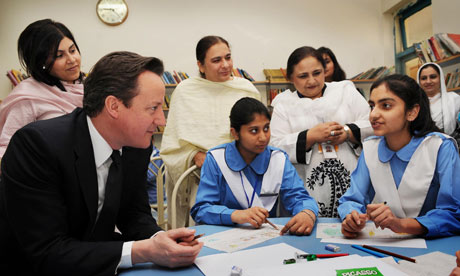
David Cameron has told the Pakistan elite that they have to start paying more tax and cut out government waste and weakness if the British public are to back his plans to pour £650m in UK aid into Pakistani schools.
Pakistan is now to become the single largest recipient of UK aid, but Cameron issued his warning in a wide-ranging speech in Islamabad, setting out his plans for a fresh start with the Pakistan government after a turbulent year in which he criticised them for "facing both ways" on terrorism.
The prime minister is keen to put the relationship on a more even footing and move away from the previous stance encapsulated in the phrase "Pakistan must do more".
He said the British people would need convincing that every penny of the aid designed to help recruit 90,000 extra teachers and put 4 million children into education was going to the right places.
He added: "My job is made more difficult when people in Britain look at Pakistan, a country that receives millions of pounds of our aid money, and see weaknesses in terms of government capacity and waste."
He pointed out that Pakistan "currently spends only 1.5% of its GDP on education and, what's more, you have one of the lowest tax to GDP ratios in the world".
He said the Pakistan was simply "not raising the resources necessary to pay for things that a modern state and people require".
The Pakistani fiscal position was a serious one because "too few people pay tax. Too many of your richest people are getting away without paying much tax at all – and that's not fair", he said.
He said this tax avoidance was neither fair "on ordinary Pakistanis, who suffer at the sharpest end of this weak governance, or on British taxpayers, who are contributing to Pakistan's future".
Cameron is acutely aware that he is taking a risk in increasing aid to a country that is seen as both corrupt and the source of the biggest terrorist threat to the UK. Pakistan is also buying six submarines from China.
But he claimed the 17 million Pakistanis of school age not in education represented an emergency, adding that it cost the country more per year than a flood such as the one that hit last year. He also said such an education gap represented a breeding ground for extremism.
He also defended the war in Libya, saying it was not an attack on Islam and pointing out that, as in Afghanistan, Britain was there as part of a coalition and under a UN mandate.
Although he praised Pakistan for having fought hard against terrorism, he urged a wider crackdown in North Waziristan, saying: "It's right that neither the Pakistan army nor Nato forces must ever tolerate sanctuaries for people plotting violence."
His remarks masked Pakistan's anger over the use of US drones to bomb terrorist cells in North Waziristan, on the border with Afghanistan, and the lack of action by the army to send troops in.
Britain's imperial past
Cameron later sparked controversy about Britain's imperial past by claiming it was responsible for many of the world's problems.
He made his remark as a semi-jocular aside at the end of a question and answer session at a university in Islamabad.
Asked what Britain might be able to do settle the war in Kashmir, he replied: "I don't want to try to insert Britain in some leading role where, as with so many of the world's problems, we are responsible for the issue in the first place."
The left has normally been associated with the cringe about Britain's past, and Cameron wrote two years ago that the last Conservative government "gave the country a new confidence that we weren't the sick man of Europe".
Cameron has been one of many British prime ministers that has felt forced to apologise for historic misdemeanours including Bloody Sunday and, as Conservative opposition leader, for Britain's role in apartheid in South Africa.
Tony Blair, worried by the prospect of compensation claims, apologised for the potato famine and expressed his deep sorrow over slavery.
Revival of Red-pass to cross Pak-Afghan border Asks donor agencies to provide for refugees, compensate locals
The Khyber Pakhtunkhwa Minister for Information and Public Relations Mian Iftikhar Hussain said that the people in Afghanistan and Khyber Pakhtunkhwa had common culture, therefore, there is need for more simplifying the process of traveling and suggested that if possible the old system of Red -pass should be re-introduced. He urged international donor agencies to consider Afghan refugees as refugees and provide them the facilities of health, education and other basic amenities of life in accordance with international standards so that they did not burden the local economy. He expressed these views on Thursday while presiding over a meeting regarding the management and repatriation strategy of Afghan. He also urged the international donor agencies to mobilize additional support for the local communities in Pakistan, especially in Khyer Pakhtunkhwa, who had been generously hosting millions of Afghan refugees for the last three decades. This would help minimize the problems of illiteracy and militancy in this region. The Provincial Ministers; Arshad Abdullah, Sitara Ayaz, United Nations High Commission for Refugees (UNHCR) Country Head, Mengesha Kebede, Joint Secretary SAFRON, Provincial Secretaries Information, Home, FATA and representatives of police, Frontier Corp and FIA were also present on this occasion. The Minister said that restoration of peace and tranquility in Peshawar was linked with peace in Afghanistan and until peace was restored in Afghanistan, the complete repatriation of Afghan refugees was practically impossible. He said that the people in Afghanistan and Khyber Pakhtunkhwa had common culture, therefore, there is need for more simplifying the process of traveling and if possible the old system of Red -pass should be re-introduced. Arshad Abdullah while addressing on the occasion said that if the Afghan refugees wanted to live here, we should think about a law to give them legal status and accept them with open heart. Ms. Sitara Ayaz said that the provincial government would extend full cooperation to UNHCR in the process of repatriation and data collection of refuges. Mengesha Kebede thanked Pakistani government for hosting millions of Afghan refugees on their soil and extending all kinds of basic facilities to them. He said that UNHCR has mobilized additional support for local communities in Pakistan that generously host millions of Afghan refugees for the last three decades. He said in this regard, during this year, projects worth nearly 8.5 million USD of infrastructural development, water and sanitation, health and education, had been initiated through the refugee affected and hosting areas. He added the voluntary return operation resumed this March after the winter break. So far, 2,500 individuals have gone back home to Afghanistan. At least 3.7 million Afghans have returned home from Pakistan with UNHCR's help since 2002.
Gwadar: Pakistan's new Great Game
Rina Saeed Khan
Miles away from the war on terror being fought in Pakistan's north on the border with Afghanistan is another insurgency whose hub is the port city of Gwadar,
located near Iran on the Makran coast. Unlike the battle against the Taliban, this uprising receives little international attention, although it is set against the backdrop of competing superpower interests, reminiscent of the Great Game when Russia and the British empire fought for control over this region.
Eight years ago, the dream was for the small fishing port of Gwadar in Pakistan's Balochistan province to be transformed into a duty-free port and a free economic zone. The hope was that Gwadar would become a regional hub of shipping, commercial and industrial activities, providing a link between Pakistan and the vast oil and gas reserves of central Asia.
A real estate frenzy followed as land was bought from locals at exorbitant prices. Billboards proclaiming future housing estates and resorts were put up overnight and work began on the port with Chinese help. A two-lane highway linking Gwadar with Karachi was completed in record time. Today, the port has been finished and is ready for ships but Gwadar looks more like a ghost town than a gold-rush town. Empty plots of land still await the buildings that were promised but never built. Oddly enough, instead of handing the port over to the Chinese government, it was leased out to the Singapore government three years ago. It is only used at half its capacity and the cranes are already getting rusty from lack of use.
Located near an important shipping lane, the deep seaport was built by the China Harbour Engineering Company Group. The Chinese government invested heavily in this project, up to $200m some say, so that landlocked western China could benefit from access to the sea. As an emerging superpower hungry for energy, China needs access to the oil and gas rich Central Asian states. The Chinese have also been keen to assist Pakistan in building other roads to acquire a 3,500km link between Kashgar (near the border with Pakistan) and Gwadar.
They are currently helping the Pakistan government to widen the Karakoram highway that connects Islamabad to China through Pakistan's high mountain ranges. It appears that there is a long-term plan to eventually connect the Karakoram highway with Gwadar. This is upsetting the other emerging superpower of the region, India, who does not want China's security establishment to have safe passage to the Arabian Sea. The fear they have been articulating is that Gwadar might become a naval outpost for the Chinese.
The local people, who hoped to benefit from the construction of the port, are crushed by the disappointing turn of events. "We were expecting change to come," says Asghar Shah, a local resident who works for an NGO. "But it was a big let down – we are victims of the new Great Game." The government of Pakistan was allegedly pressured not to hand the port over to the Chinese. In fact, the Americans eye Gwadar as a potential military base, given the proximity of Iran. The locals are reluctant to criticise their government's handling of Gwadar, though. "People disappear in Gwadar – their bodies are found dumped in a remote area a few days or weeks later. No one knows who is behind it," says Asghar Shah, refusing to speculate further.
There is a more immediate problem at present. The Baloch nationalists are opposed to any development in Gwadar because they say these mega projects will marginalise the local Baloch population. Balochistan's development record is dismal. Covering nearly 350,000 square kilometres, it is by far the largest province in the country but houses less than 7% of Pakistan's population. The basic quality of life indicators are abysmal. On-tap drinking water is available to less than 5% of the population. The female literacy rate is under 15%.
The Baloch people are demanding more autonomy for the province. For decades, Pakistan's Balochistan province has been the scene of sporadic clashes between government troops and guerrillas who are fighting for autonomy. In the past few years, the rebels have again stepped up their attacks. Government troops and installations across the province have come under rocket attack and bombings, especially Gwadar town. Last month, seven army personnel and three labourers building a road near the Iranian border were killed by unidentified gunmen. The Baloch nationalists fear that if Gwadar grows into a modern city, the Baloch people will become a minority in their own province. No one is quite sure who is funding them, but there are rumours that they get support from India.
Gwadar is today a deserted town where outsiders are looked upon with suspicion. Most of the educated young people have moved out to look for jobs in the other big towns and cities of Pakistan. The new and luxurious Pearl Continental Hotel built on a cliff overlooking the port and the town below is empty – it has been closed down for "renovations". The road leading to the small airport outside the town is heavily guarded by security forces. There are no tourists now – most have been scared off by the attacks. Foreigners do not dare to venture here either.
For centuries, Gwadar has also been a smuggler's paradise – it was once infamous for its human trafficking in slaves and it is still a place where illegal immigrants are smuggled into the Middle East and beyond. The idea had been to capitalise on its location, but the dream of Gwadar remains just that. Pakistan's strategic location as a gateway to the oil and gas riches of central Asia means that it will remain a battleground for competing interests for the foreseeable future. The Great Game continues well into the 21st century.
Jimmy Carter on Women's Rights
Jimmy Carter discusses the unrest in Ivory Coast and the impact of the Arab Spring on women's rights.
Will Indian protests end corruption?
It is being called India's version of Tahrir Square after Egypt's protests that toppled the president. Jantar mantar, the country's historic stretch, is flooded with thousands of Indians. They're singing, chanting, dancing, painting, holding up placards in 45 degrees heat - all for one cause: corruption.
"Politicians are getting richer and we're paying the price for it. We don't have jobs and while we're suffering they're living it up," says 22-year-old Swati, a university graduate. She's supposed to be the face of 'shining India', where opportunities are available in plenty, but her presence in these protests is defying that image.
In the last few months, ordinary Indians have had enough. A barrage of corruption scandals revealed how billions, not millions, of dollars were pocketed by politicians in collusion with businessmen and beauracrats. From favouring contractors in the Commonwealth games to selling under-priced telecommunication licences to favoured companies - Indians have seen it all. Until now, people had no outlet to vent their anger or frustration.
Then came Anna Hazare, a 72-year-old former army soldier. He turned to social activism after seeing firsthand how corrupt officials exploited people in his village in the 1960s. Since then he's been seen as one of those activists who actually walk the talk. Now he's become the face of this rising anger.
He's pledged to 'fast until death' (this is the land of Gandhi, after all) until the government accepts a new anti-graft piece of legislation. And his resolve seems to be working. An entire nation's collective conscience seems to have been pricked with this man's actions.
"Anna is an inspiration for all of us. We need less talk and more action before our country is completely ruined. This is not the freedom we fought for," 52-year-old Raj Shekhar tells me.
He's travelled all the way from Lucknow in India's northern state of Uttar Pradesh to join Anna's growing caravan of soldiers. And he says he's not going to give up.
Others are joining as well. From Mumbai to Chennai, from New Delhi to Ahemdabad thousands are finally speaking out.
The root of this issue remains corruption. It's endemic in every indian institution. From the police to the state hospitals people need to pay up or remain deprived.
So while people clearly have had enough of this and much of India seems to have woken up, the question remains whether it's enough to bring about a real revolution. And whether the establishment is really listening. Else, Anna's resolve may just go to a waste.
U.S. report slams Bahrain for repressing Shi'ites
Sunni-ruled Bahrain was guilty of human rights abuses including arbitrary detentions, censorship and discrimation against majority Shi'ites before its violent crackdown on street protests, the United States said on Friday.Bahrain last month saw the worst sectarian clashes since the 1990s after protesters, inspired by uprisings in Tunisia and Egypt, took to the streets, prompting the government to impose martial law and invite in troops from Sunni-ruled neighbors.
"Discrimination on the basis of gender, religion, nationality, and sect, especially against the Shia (Shi'ite) majority population, persisted," the U.S. State Department said in its Human Rights Report for 2010.
"Authorities arbitrarily arrested activists, journalists, and other citizens and detained some individuals incommunicado... The government restricted civil liberties, including freedoms of speech, press, assembly, association, and some religious practices," it said.
The report cited allegations of mistreatment and torture, especially of activists and said Shi'ites were under-represented in the civil service, police and security forces.
The government censored stories especially those related to sectarianism, national security, or criticism of the royal family, the Saudi royal family, or the judiciary, it said.
"According to some members of the media, government officials contacted editors directly and asked them to stop writing about certain subjects or asked them not to publish a press release or a story," the U.S. report said.
Shi'ites, who make up at least 60 percent of the population, have long complained of discrimination when competing for jobs and services. They are demanding better representation and a constitutional monarchy, but radicals calling for an overthrow of the monarchy alarmed the Sunni minority.
On Friday, Human Rights Watch denounced what it called arbitrary detentions and said freed detainees interviewed reported incidents of beatings and abuse. The U.S.-based rights group called on Bahrain to give a reason for all detentions.
Afghan refugees suffer, thanks to world apathy
Khyber Pakhtunkhwa Information Minister Mian Iftikhar Hussain on Thursday said that sufferings of the Afghan refugees in Pakistan had increased for the last many years owing to apathy of the international community, which would have a negative impact on social, economic and law and order situation in the province.
Speaking at a roundtable conference held at a hotel on the ‘Management and Repatriation Strategy of Afghan Refugees in Pakistan (AMRS)’, the minister said the government wanted repatriation of Afghan refugees in a honourable way but at the same time there should also be a proper mechanism under which the peoples of Pakistan and Afghanistan should continue their trade and business.
“The Afghans living under proper legal documents pose no threats to our economy and the security,” he said, adding that the under-privileged and illegal Afghan national could become a threat to the law and order. He said that the Khyber Pakhtunkhwa and tribal areas, bordering Afghanistan, had been adversely affected during the Afghan war due to the influx of refugees.
In his speech, Minister for Law and Parliamentary Affairs Barrister Arshad Abdullah said that there should be a proper law for providing permanent settlement to those Afghans who had been living in Pakistan for decades. He said the volunteer repatriation processes till near past had proved to be a futile exercise as the Afghan families were either reluctant to go back to their homeland or manage to come back to Pakistan soon after entertaining the UNHCR-sponsored repatriation.
Provincial Minister for Social Welfare and Women Development Sitara Ayaz also addressed the conference. The conference was told that about 40 to 50 per cent Afghans living in Pakistan did not want to go back for unstable security situation, etc.
About 70 per cent of the Afghans living in Pakistan belonged to five bordering provinces of Afghanistan including Nangarhar, Kunar, Khost, Paktia and Paktika. As AMRS initiative, the UNHCR has mobilised additional support for local communities in Pakistan that generously host millions of Afghan refugees for the last three decades.
In this regard, during this year, projects worth nearly $8.5 million of infrastructure development, water and sanitation, health and education, have been initiated through the Refugee-Affected and Hosting Areas (RAHA).
The voluntary return operation resumed this March after the winter break. So far, 2,500 individuals have gone back home to Afghanistan. At least 3.7 million Afghans have returned home from Pakistan with the help of the UNHCR since 2002.
Over 300 suicide bombers being trained in Waziristan
The arrested bomber of the Sakhi Sarwar shrine in Dera Ghazi Khan, apologised to the Pakistani nation on Friday and said that he had been told to bomb the areas of non-Muslims.
During investigations, Omar told officials that there were 350 people receiving suicide bombing training in the militant hideouts of Waziristan. He said that these included Uzbeks, Tajiks, Arabs and Punjabis.
Omar said that he used to be blindfolded and taken for training. He said that the in-charge of the camp was Sangeen Khan who used to constantly be away on travel.
He also disclosed that the second bombing was supposed to take place between the rescue and media teams.
Protesters shot dead in southern Yemen
Two people have been killed after Yemeni security forces fired at protesters in the southern Yemeni city of Taiz, leaving more than two dozen others wounded.
Hospital sources said about 200 people were hurt after inhaling tear gas during Friday's protests..
Witnesses reported gunshots near the site of an anti-government sit-in in the flashpoint city to the south of Sanaa, while dozens of others suffered from bullet wounds or tear gas inhalation.
The protesters had been carrying the bodies of five people killed earlier in the week to their gravesites when they ran into security forces.
The fresh clashes on Friday between anti-government protesters and the police came as Ali Abdullah Saleh, the Yemeni president, rejected a new deal for him to leave after 32 years in power.
Some 21 people have died in clashes this week in Taiz and the Red Sea port of Hudaida.
In the port city of Aden, once the capital of an independent south, thousands of anti-government protesters gathered peacefully and in Hudaida, some 15,000 gathered to mourn protester deaths and demand Saleh step down.
Al Jazeera's special correspondent in Sanaa who is not being named for security reasons said scenes of Friday's pro-Saleh demonstrations in front of the presidential palace was very similar to those seen in recent weeks.
"It is very difficult for Al Jazeera to go anywhere near those protests, we have to rely on what we're seeing on Yemen state television … we can see the mass crowds turning out week after week.
"But according to some people in Change Square, where the rival protests are, those people are not there because they genuinely support Saleh but because they are either government forces dressed in civilian clothes or are being paid by the ruling party."
Our special correspondent says such accusations have been going around for weeks, with pro-democracy protesters saying that the more Saleh loses control the more he is seen firing on anti-government protesters to make sure his own supporters continue to attract a large crowds.
Protesters have been calling since January for the departure of Saleh, who has been in power since 1978.
Offer rejected
Saleh initially accepted an offer by Saudi Arabia and other Gulf Arab states trying to broker an end to bloody protests and hold talks with the opposition.
But he later rejected the plan for his exit in a speech broadcast on state television on Friday.
"We were born free, and we have free will, and they have to respect our wishes. We reject any coup against democracy, the constitution and our freedom," he told supporters in the capital.Saleh said: "Our power comes from the power of our great people, not from Qatar, not from anyone else. This is blatant interference in Yemeni affairs."
Sheikh Hamad bin Jassem Al-Thani, Qatar's prime minister, said on Thursday that members of the Gulf Co-operation Council "hope to reach a deal with the Yemeni president to step down."
However, Abu Bakr al-Kurbi, Yemen's foreign minister, said Yemen's government is studying an initiative by Gulf Arab states to end a months-long confrontation with anti-regime protesters, in a statement published on Friday.
Opposition groups had welcomed the Gulf countries' mediation offer.
Meanwhile, tens of thousands of Yemenis have converged in the capital for rival demonstrations - with some demanding the president's ouster and others showing their support.
Police and army units were deployed to prevent any friction between the two sides.
More than 120 people have been killed since Yemen's protests calling for an end to Saleh's rule began on February 11, inspired by popular uprisings in Tunisia and Egypt.
The six-nation Gulf Co-operation Council has invited Saleh and the opposition to a mediation session in Saudi Arabia. But Saleh's government described the proposal as unconstitutional.
Thursday, April 7, 2011
Bahrain hospital abuse
An international humanitarian organization said Thursday that Bahraini authorities turned hospitals into "places to be feared" during a deadly crackdown on anti-government protesters in the Gulf country.
Doctors Without Borders condemned the arrest of injured opposition supporters being treated at medical facilities. In a statement, the organization said Bahrain's security forces used hospitals and health centers as "bait to identify and arrest those (protesters) who dare seek treatment."
The capital's Salmaniya medical complex, in particular, was at the center of the country's turmoil, treating hundreds of injured demonstrators. The military took control of the facility, and doctors and patients there said soldiers and policemen interrogated and detained them.
Bahrain declared emergency rule last month and cracked down on protests by the country's Shiite majority against the Sunni monarchy. The protests have called for sweeping political reforms and equal rights for Shiites. At least 27 people were killed.
Hundreds have been injured in clashes with riot police and security sweeps.
On Thursday, Bahrain's Crown Prince Salman bin Hamad Al Khalifa warned the government's opponents against trying to restart their demonstrations, saying they were a small group and accusing them of trying to create sectarian divisions on the island.
"Those who seek to cleave our society into two will not be dealt with easily," Al Khalifa said in a short televised speech. "The story of (Bahrain's) success that we are living cannot be corrupted by a small group that seek its fall."
The crown prince also said the monarchy would press on with reforms, but did not provide specific examples.
Syrian president attempts to appease minority Kurds
aljazeera.net
Bashar al Assad,
the Syrian president, has issued a decree granting nationality to thousands of Kurds living in the eastern al-Hasaka region as part of efforts to ease resentment over nearly five decades of strict Baathist rule.
It was not immediately clear how many would get nationality, but the announcment on Thursday is due to affect around 150,000 Kurds currently registered as foreigners as a result of a 1962 census in the region.
But Kurdish leader Habib Ibrahim said that Kurds would press their non-violent struggle for civil rights and democracy to replace autocratic rule despite Assad's decision.
"Our cause is democracy for the whole of Syria. Citizenship is the right of every Syrian. It is not a favour. It is not the right of anyone to grant," Ibrahim, who heads the Democratic Unity Kurdish Party, told the Reuters news agency.
Governor sacked
State television also said that Assad had fired the governor of Homs province, one of the areas affected by recent protests calling for greater freedoms. Replacing the governor was one of the main demands of protesters last week.
In another move to appease the ethnic Kurds, Syrian Observatory for Human Rights said 48 Kurds were released on Tuesday, more than a year after they were arrested in the eastern city of Raqqa.
The Syrian leader also met provincial leaders from the Kurdish east of the country earlier in the week to listen to their demands, the official news agency reported.
Assad cracked down on ethnic Kurds, who make up about 10-15 per cent of Syria's 20 million people, after they launched violent demonstrations against the state in 2004.
Recent popular protests have shaken mainly Sunni Muslim Syria for nearly three weeks, with demonstrators demanding an end to emergency law and one-party rule by the Baath Party.
The pro-democracy protests first erupted in the southern city of Deraa, where many Sunni Muslim tribes resent the power and wealth accumulated by the Alawites, an offshoot sect of Shia Islam.
Syria's ruling hierarchy has not tolerated any dissent and has used emergency laws to justify arbitrary arrests, including those of other minorities such as Kurds who say they are discriminated against.
In a move to mollify conservative Muslims, Syria also lifted on Wednesday a ban on teachers wearing the full face veil and ordered the closure of the country's only casino.
Blame Hamid Karzai for massacre in Mazar
www.surgar.net
The Koran protests in Afghanistan began with an Iranian propaganda initiative that was set in motion on March 24, a full week before the Massacre in Mazar. Afghan president Hamid Karzai
played a central role in the affair. The bloody skirmishing that has left at least two dozen people dead across Afghanistan has gone so far as to cast a shadow over the future of the UN’s operations in the country. In other words, it’s working.
Of all places in Afghanistan for a UN compound to be turned into a human abattoir, we’re supposed to be shocked that it would be in the contented little metropolis of Mazar-i-Sharif, the capital of the peaceful northern province of Balkh. We’re supposed to be astonished that the murderers of those seven UN workers arose from a frenzied mob at the head of a procession that started out at the city’s famous Blue Mosque.
We should not be surprised at all.
On March 24, the Iranian foreign ministry, Iran’s Lebanese proxy Hezbollah, and Karzai’s office issued simultaneous alarms about Jones’ Koran-burning. Iranian foreign ministry spokesman Ramin Mehman-Parast said the incident was part of American “hegemonic plots.” Karzai called for Jones’ arrest and prosecution.
Karzai’s statement was widely reported in Iran’s government-controlled press but got limited play even in the Afghan news media. Then the Netherlands-based BNO News got involved. After making its mark in 2007 when it sold Reuters a videotaped speech by Osama Bin Laden, BNO went on to become a popular Twitter feed and is now a low budget social-media hybrid, part press-release clearinghouse and part amateur-journalism vector. When BNO began circulating a report headlined “Afghanistan, Iran condemn Koran burning in U.S.,” the story went viral.
The first Afghan protests about the Koran-burning were staged by the Shura-e Olama-e Shiia, the Kabul-based Shiite religious council dominated by Asif Mohseni, the leading Khomeinist ayatollah in Afghanistan. Mohseni is best known for having persuaded Karzai to sign off on the incendiary Afghan “rape law” in 2009 (which effectively legalized marital rape), an event that prompted protests by Afghan women and howls of international indignation.
The Khomeinist-led Koran demonstrations in Kabul were the first that most Afghans had even heard about Jones’ vulgar escapade. (You always know it’s a Khomeinist event by the tell-tale slogan, Marg Bar Yahood—Death to the Jews). This brings us back to Mazar, to the Tomb of the Exalted where most Afghans prefer to believe that the son-in-law of the Prophet Mohammed is buried, and to the famous Blue Mosque.
From accounts of last Friday’s massacre that I’ve received from several Afghan human rights activists and journalists, what emerges is a picture of an opportunity that was just waiting for a pretext. What happened did not simply result from a protest march that began at the Blue Mosque and got terribly out of hand. . .
That’s from my piece today in Dissent.
The Washington Post provides some useful and rare insight into the distance Karzai has moved from his American benefactors, although nothing about the Khomeinist orbit within which Karzai has allowed himself to be drawn. For insight into that, all you need to do is follow the money.
There is a lot of money to follow. The Iranian payments, which officials say total millions of dollars, form what amounts to an off-the-books “presidential slush fund” that Iran fills up regularly so that Karzai can buy Afghan legislators, tribal elders and Taliban commanders. It’s quite the racket, and it has been happening under the Americans’ noses for quite some while.
Briefcases full of it. Bakshish by the barge load. And that just scratches the surface.
For an Afghan view from the front lines of the Koran-burn frenzies, here’s a report from Ehsanullah Ehsan in Kandahar. And I see that Christopher Hitchens, running on instinct alone, gets it dead to rights anyway, as usual. Karzai went out of his way to intensify mob feeling. “This caps a long period where his behavior has come to seem like a conscious collusion with warlordism, organized crime, and even with elements of the Taliban.”
Why would Karzai behave this way? Start asking that kind of question and nowhere will the discomfort be felt more acutely than in and around the White House. Well, too bad. It’s time to start asking these awkward questions, before it’s too late.
Music In The Time Of Extremism
In Pakistan, radical clerics have unleashed a religious fervor that is chilling secular voices and diminishing free speech.
Two high profile murders — the governor of the Punjab, Salman Taseer, in January, and the only Christian Cabinet minister, Shahbaz Bhatti, in March — have people from the political class to the artistic community feeling the pressure of the religious right.
We sat down with two flourishing female musicians from Lahore for their insights into making music in the time of extremism.
Singer Zeb Bangash and guitarist Haniya Aslam have chosen to write songs that are the antithesis of turmoil: Now working on their second album, the 32-year-old cousins have written a piece simply titled, "The Happy Song."
"Despite everything, there are beautiful things happening in this country," Zeb says, "there are moments of happiness, there's happiness all around, so we thought it might actually be nice to bring that together into a song."
The two women have won critical acclaim in a country where female musicians face challenges simply because they're women.
Their origins have also helped distinguish them. They are Pashtuns from the heart of the Northwest Frontier Province renamed Khyber-Pakhtunkhwa, where tradition and custom have kept women largely out of the public eye. Pursuing a career in entertainment goes against the grain of the conservative Pashtu culture.
Haniya, a graduate of Smith College, however, says she doesn't necessarily see herself as "secular.""I don't see myself as religious or secular," she says. "I think we all inhabit a space which really straddles both of them. I don't think anyone here is entirely this or that or the other."
Zeb and Haniya performed one evening this week at a U.S. Embassy event in Islamabad. They are vying for the chance to tour the United States as part of a State Department cultural exchange.
The U.S. is spending millions of dollars on public diplomacy in Pakistan.
There is alarm from Islamabad to Washington that tolerance for secular life in Pakistan is fast retreating as evidenced by the shocking murders of the governor of the Punjab and the Minority Affairs Minister.
The space for artistic expression is narrowing. Zeb says the obligation for artists like her is to keep "reclaiming" the space. Haniya says their work reflects the growing instability around them, but in an unexpected way.
"The more violence that starts taking place outside, the more sort of serene and calm our music begins to get. I think because it's a way of creating an alternate universe, right? You create work that would reflect the world that you want to be in rather than the one you are in," she says.
The two were educated in the United States — Zeb attended Mount Holyoke and Haniya went to Smith College in Massachusetts. They are of a generation of Pakistanis that is comfortable connecting with many worlds.Their musical roots lie in a city where cultures have collided and merged over a millennium — Peshawar, a portal to Central Asia. Zeb says the intricacy of their culture gets lost in today's projection of Pakistan as "the most dangerous place in the world."
She rejects the perception of a Pakistan mired in backwardness and conflict. Zeb says it's a misperception that many Americans hold. And she says that makes it difficult to engage with Americans.
"Because they have their own idea, and then I think what's also happening is that the religion has come under attack," Zeb says. "And that is not something that we are completely comfortable with because no matter now progressive we might be, we have roots which are Islamic and we believe in those, at least a large part of us do."
Haniya chimes in that "you don't have the good Pakistanis and the bad evil Pakistanis divided in half, and one wears black and one wears white. It's just not that simple."
Haniya says she is optimistic about what lies ahead for Pakistan. "I have to be. It's something I've worked at for about three years now," she says with a laugh. "It will absolutely get better."
They live comfortably in a leafy neighborhood of Lahore with Zeb's mother and father, a retired general. But the two musicians have gained a following with their fluid ability to incorporate traditional songs from Afghanistan and beyond with their own modern composition.
They continue to make discoveries about their own work. The hit "Paimana Bitte," or "Bring the Chalice (and Let Me Be Intoxicated)," was not the folk song they thought it was when they sang it as children in their grandmother's parlor. The daughter of the composer for the Afghan King Zahir Shah heard them perform the song and told them it was one her father had written for the Court 40 years ago.
Despite all of the turmoil in their country, Zeb and Haniya have no interest in living anywhere but Pakistan, exploring their vast musical heritage and interpreting it for a new turbulent time.
US, UK to stop aid if corruption continues
The US and Britain will stop helping Afghanistan if corruption is not rooted out,
the High Office of Oversight and Anti-Corruption said. Head of the High Office of Oversight and Anti-Corruption, Azizullah Ludin, expressed grave concern that the US and Britain will not be willing to continue helping Afghanistan if no serious action is taken to root out corruption. Mr Ludin urges international community and the Afghan government to join hands in fighting against corruption. "We have to work together to eradicate corruption and reassure the US and Britain that their aid is not wasted in Afghanistan," Mr Ludin said. The High Office of Oversight and Anti-corruption has also urged Britain to freeze all bank accounts of the former Afghan cabinet minister Sediq Chakari and extradite him to Afghanistan. The issue has been raise with British officials who have pledged to cooperate with the Afghan government. According to Mr Ludin, Chakri has many cases of embezzlement filed against him and in addition he has around $800,000m in his Dubai bank account. Mr Ludin also hinted to the disappearance of 42 million dollars of donation to the Afghan National Army Hospital in Kabul. "It is clear that 42 million dollars has been donated to the hospital and disappeared. This case should be addressed seriously," said Mr Ludin. He believes not only Afghans but also "some others" are involved in this misappropriation. Corruption in Afghanistan is one of the biggest concerns of donor countries. Some of the high ranking officials have been accused of corruption, but it is believed that the Afghan government, in the last 9 years, has not been able to bring a single corrupt official to justice.
Wednesday, April 6, 2011
Education should be Pakistan's top priority
http://www.guardian.co.uk
Pakistan's government has failed to provide its people with primary education, but for the country's long-term stability it's more important than spending on defence and security
A few months after the earthquake hit Pakistan in 2005, I toured the devastated town of Batal in the north where a community owned primary school had been rebuilt with donations from overseas. Inside the only functioning classroom located on a hillside, girls and boys of varying ages were seated together behind tiny desks. The boys all wanted to grow up to be doctors, the girls all wanted to be teachers.
A community elder, Ghulam Jan, who had donated his land for the building of the school, told me: "Our time is over ... We want our children to study so that they can become something when they grow up."
This plea has been echoed by communities in struggling coastal towns in the south to remote mountain valleys in the north of Pakistan. Wherever I have gone to cover stories from sea intrusion to glacier melt, I have heard the same demand – we want schools for our children; we want them to have better lives. But the community in Batal is just one of the lucky few to have a functioning primary school for its children.
For more than 60 years now, the government of Pakistan has failed abysmally to provide its people with primary education; a basic right enshrined in article 25A of its constitution which assigns the state with providing free and compulsory education to all children aged between five and 16 years. A recent report written by the Pakistan Education Task Force, a non-partisan body that includes representatives from the federal and provincial governments and NGOs, paints a dismal picture of the state of education in the world's sixth most populous country.
The report, Education Emergency Pakistan, was published in March, before David Cameron's recent visit to Pakistan where he announced £650m in aid for education. The report says that about 10% of the world's primary school-age children who do not attend school live in Pakistan. In the global ranking of out-of-school children, Pakistan is in second place.
"Pakistan is crippled by an education emergency that threatens tens of millions of children," the report says. "The economic impact of the education emergency is as expensive as a flood every year," according to the report. Last summer's extensive floods caused about $10bn worth of damage, including destroying or damaging a thousand schools.
To make matters worse, the Pakistani government is yet to announce its reconstruction strategy. The delay has meant that urgent rebuilding and recovery work has barely started eight months after the flooding, according to Oxfam.
Given such a bleak situation, any money that will go towards education is more than welcome, and Cameron's promise of aid, which is to be spent on 4m primary school places and 90,000 teachers will go a long way in improving the situation, provided the money is channelled through trustworthy organisations such as the community based organisation that built the school in Batal. At the moment, however, it appears that the funds are to be allocated to the provincial governments where the fear is the money might just slip through the cracks of poor governance.
The report also notes the striking gender disparity in schooling in Pakistan. Fewer than half of Pakistani women have had any formal education. The figure is even worse in rural areas, where just one in three women has ever attended school. For most families, the archaic thinking is that girls must marry and look after their husbands and in-laws, so why bother wasting precious money on their education? According to the report, there is "zero chance" that Pakistan will reach the millennium development goal for education by 2015.
"This is not just another emergency declared, this is a matter of Pakistan's survival," said Shenaz Wazir Ali, a member of the national assembly and co-chair of the Education Task Force, who also served as the head of the Higher Education Commission of Pakistan.
The government has allocated less than 1.5% of the country's GDP for education. Cameron made it a point to criticise Islamabad for spending only 1.5% of its national income on education and asked it to improve its tax revenues.
Perhaps more important, the Pakistani government has to get its priorities right. Pakistan spends almost all its resources on defence and state security, leaving aside little for education. If it really wants improve its long-term security it should be pouring money into education, which – as David Cameron pointed out – is actually the best antidote to terror.
‘British responsible for Kashmir’
British Prime Minister David Cameron has held his own country responsible for many of the world’s historic problems, including the Kashmir conflict between India and Pakistan. Cameron’s remarks came during his one-day visit to Pakistan on Tuesday, when he was asked at a university in Islamabad as to how Britain could help to end the row over Kashmir.
“I don’t want to try to insert Britain in some leading role where, as with so many of the world’s problems, we are responsible for the issue in the first place,” The Telegraph quoted Cameron, as replying.
His remarks about Kashmir were greeted warmly by the Pakistani audience, but drew accusations from historians that the premier was wrongly apologising for Britain’s past.
Daisy Cooper, the director of the Commonwealth Policy Studies Unit, said: “This is typical of the UK’s schizophrenic relationship with former colonies where it is both proud and embarrassed about its past.
Scientists find superbugs in Delhi drinking water
A gene that makes bugs highly resistant to almost all known antibiotics has been found in bacteria in water supplies in New Delhi used by local people for drinking, washing and cooking, scientists said on Thursday.
The NDM 1 gene, which creates what some experts describe as "super superbugs," has spread to germs that cause cholera and dysentery, and is circulating freely in other bacteria in the Indian city capital of 14 million people, the researchers said.
"The inhabitants of New Delhi are continually being exposed to multidrug-resistant and NDM 1-positive bacteria," said Mark Toleman of Britain's Cardiff University School of Medicine, who published the findings in a study on Thursday.
A "substantial number" of them are consuming such bacteria on a daily basis, he told a briefing in London. "We believe we have discovered a very significant underlying source of NDM 1 in the capital city of India," he said.
NDM 1, or New Delhi metallo-beta-lactamase 1, makes bacteria resistant to almost all antibiotics, including the most powerful class, called carbapenems.
It first emerged in India three years ago and has now spread across the world. It has been found in a wide variety of bugs, including familiar pathogens like Escherichia coli, or E. coli.
No new drugs are on the horizon for at least 5-6 years to tackle it and experts are concerned that only a few major drug companies, such as GlaxoSmithKline and AstraZeneca, still have strong antibiotic development programmes.
Toleman's study, carried out with Cardiff University's Timothy Walsh and published in The Lancet Infectious Diseases journal, investigated how common NDM 1-producing bacteria are in community waste seepage -- such as water pools or rivulets in streets -- and tap water in urban New Delhi.
The researchers collected 171 swabs from seepage water and 50 public tap water samples from sites within a 12 kilometer radius of central New Delhi between September and October 2010.
The NDM 1 gene was found in two of the drinking-water samples and 51 of seepage samples, the researchers said, and bacteria positive for NDM 1 were grown from two drinking-water samples and 12 seepage samples.
"We would expect that perhaps as many as half a million people are carrying NDM 1-producing bacteria as normal (gut) flora in New Dehli alone," Toleman said.
Experts say the spread of superbugs threatens whole swathes of modern medicine, which cannot be practiced if doctors have no effective antibiotics to ward off infections during surgery, intensive care or cancer treatments like chemotherapy.
In a commentary about Walsh and Toleman's findings, Mohd Shahid from Jawaharlal Nehru Medical College and Hospital in Uttar Pradesh, India, said global action was needed.
"The potential for wider international spread of ... NDM 1 is real and should not be ignored," he wrote.
The World Health Organization (WHO) has designated April 7 as World Health Day and under the slogan "No action today, no cure tomorrow" it is campaigning about the risks of life-saving antibiotics losing their healing power.
"We are at a critical point in time where antibiotic resistance is reaching unprecedented levels," said Zsuzsanna Jakab, the WHO's regional director for Europe.
"Given the growth of travel and trade in Europe and across the world, people should be aware that until all countries tackle this, no country alone can be safe."
Stop flirting with extremism, Dhaka daily tells politicians
A prominent Dhaka daily newspaper has urged political parties to take note of ‘what has happened in Pakistan’ and ‘stop flirting with religious extremism’ as had happened during Monday’s strike.
The Daily Star Wednesday took serious note of some Islamist activists wearing ‘the Holy Quran around their necks or under their loosely fitted outer garments’, while being part of the strike called by a conglomerate of Islamist organisations. The strike was ‘tacitly’ supported by main opposition Bangladesh Nationalist Party (BNP).
‘Knowing full well what happens when there is a street fight with the police, bringing the holy book on to the streets is a clear indication that these people wanted the Holy Quran to be exposed to situations when it might be unwittingly and unintentionally desecrated,’ the daily said.
‘The aim appears to have been to show on TV screen and in newspaper photographs that our holy book was desecrated by police. This then could be used to fan anti-government sentiment,’ the newspaper wrote.
‘Such blatant, shameless, and cynical use of religion and of our Quran had never been seen in the past, and must be condemned by all,’ it said.
‘To us nothing exposes the moral bankruptcy of these agitators as the sight that they stooped to using our Holy Quran for their narrow political purpose.’
The newspaper said: ‘Pakistan serves as a good example as to what happens if extremism is not tackled with a firm hand…’
Supporting the government in fighting religious extremism, the newspaper said: ‘We must also acknowledge, other than Sheikh Hasina’s government none dared to take the bull by the horn, and fight extremism with courage, determination, and a lot of political and personal risk.’
‘The opposition must study what has happened in Pakistan, and stop flirting with religious extremism just because it gives an additional number of cadres to harass the government,’ the newspaper said.
Bangladesh was East Pakistan between 1947 and 1971.
‘During our time with Pakistan, the oft-used propaganda against Awami League was that it was a party against Islam. It is ironic that the slogans and propaganda tactics that we heard and saw in the late fifties, sixties, and in the freedom fighting days of the early seventies — are now being repeated,’ the newspaper noted.
‘We must remember that extremism has done no good to any people any where in the world,’ the newspaper’s editor in chief Mahfuz Anam wrote.
Pakistan lacks plan to defeat Taliban: US
situation in FATA deteriorating
Operation against Taliban in Mohmand Agency and Bajaur Agency hampered by terrorist resistance, poor weather, need to settle IDPs and discovery of caches of IEDsg Report says Pak-US military cooperation survived outcry caused by Raymond Davis shooting incident
WASHINGTON: Pakistan lacks a robust plan to defeat the Taliban and its security forces struggle to hold areas cleared of the al Qaeda-linked fighters at great cost, says a critical US report which came just three months before US President Barack Obama is scheduled to announce the pace at which American troops will be withdrawn from Afghanistan.
The semi-annual White House report to Congress is designed to judge progress or otherwise towards key objectives of the war in Afghanistan and operations against al Qaeda in Pakistan.
The report notes a deterioration of the situation in the Federally Administered Tribal Areas (FATA) in the country’s northwest alongside the Afghan border between January and March this year. It details an operation in Mohmand Agency and Bajaur Agency that started in January to clear insurgent strongholds – the third time in two years that the Pakistani army has attempted to complete the task. It says the operation had been hampered by terrorist resistance, poor weather, the need to settle internally displaced people and the discovery of several caches of improvised explosive devices.
The report acknowledges that “tremendous human sacrifices” were made by Pakistani forces in the region, but concludes “what remains vexing is the lack of any indication of ‘hold’ and ‘build’ planning or staging efforts to complement ongoing clearing operations”.
“There remains no clear path toward defeating the insurgency in Pakistan, despite the unprecedented and sustained deployment of over 147,000 forces,” the Obama administration says in the report.
The critical assessment, however, emphasises that the US “must strengthen our dialogue with both Pakistan and Afghanistan on regional stability”. It also hints at the Obama administration plans to hold next round of trilateral talks with the two countries in Washington.
On a more encouraging note, the report says US-Pakistan military cooperation had survived the outcry caused by a deadly shooting incident involving a CIA operative, Raymond Davis. It also touches on strains in relations and refers to incidents involving NATO and ISAF incursions and closure of Torkham border.
The survey, portions of which remained classified, also reflects rising recent bloodshed in Afghanistan, particularly among civilians. It also warns that Pakistan still had no clear path to triumph over insurgents and that Afghanistan’s Taliban were turning more and more to soft civilian targets.
According to declassified portions of the report, Pakistan is central to US efforts to defeat al Qaeda. The report determines that “progress in our relationship with Pakisttan over the last years has been substantial, but also uneven”. It shows slight progress in the last six months in involving the international community to help stabilise Pakistan, and overall, modest progress in the US surge strategy to subdue the Taliban. But, it says that absenteeism and attrition continued to pose a risk to the quality of the Afghan national security forces that are vital to Washington’s goal of eventually drawing down its troop presence in Afghanistan. The report issued on Tuesday was not accompanied by any public statement by Obama. But, the report states clearly what many administration and Pentagon officials have long said in private: Without pressure from the Pakistani side of the border, it is virtually impossible to wipe out terrorism.
Obama holds urgent budget talks with lawmakers
President Barack Obama held an urgent round of budget talks with U.S. congressional leaders on Wednesday evening to try to avert a government shutdown.
With the clock ticking toward a midnight Friday deadline, Obama met at the White House with Republican House of Representatives Speaker John Boehner, and Senate Majority Leader Harry Reid, a Democrat.
Republicans and Democrats have said negotiators were making progress on a compromise that would fund government operations past Friday's deadline and keep more than 800,000 workers in their jobs.
The two parties remain at odds over about $10 billion in spending cuts, according to a Democratic aide.
The final size of the cuts for the rest of this fiscal year will likely end up closer to the $33 billion Democrats have agreed on than the Republicans' $40 billion target, the aide said.
A government shutdown, the first in 15 years, would ripple through an economy still recovering from the worst recession since the 1930s. Obama urged both parties to compromise and said failure to reach agreement would hurt the economy just as it was gaining momentum.
"Companies don't like uncertainty, and if they start seeing that suddenly we may have a shutdown of our government, that could halt momentum, right when we need to build it up," he said at a town-hall style event in Pennsylvania earlier.
A FAILURE OF LEADERSHIP
Boehner criticized Obama for a failure of leadership in the budget showdown and said the House on Thursday would consider a short-term bill to cut an additional $12 billion in spending and fund the government for another week while negotiations continued.
Obama and many of his fellow Democrats oppose another short-term extension. Some Republicans said it could serve as a legislative vehicle for a final budget deal.
"That's not just bad policy, that's a fantasy," Reid said of the temporary extension. He said it would only put off the tough choices needed to reach a deal on the budget.
The White House painted a bleak picture of the potential impact of a government shutdown, saying it could hurt recovery in the housing market and spark reactions ranging from the closure of national parks to the suspension of the weekend cherry blossom parade in the capital.
A senior administration official told reporters the processing of some tax refunds and audits, as well as small business loans would be halted, and operations of the Federal Housing Administration would be curbed.
"Having the FHA not be able to guarantee loans during this period will have a significant impact if we shut down on the housing market, which is very fragile," the official said.
The investment firm Goldman Sachs estimated a government shutdown lasting more than a week could cost the economy $8 billion in missed federal spending, dragging down growth.
Both parties blamed each other for the political showdown, which will set the stage for more budget battles ahead and also promises to echo through the 2012 election campaign.
Reid said the budget talks were "constantly evolving" and accused Republicans of changing the terms of the debate before the midnight Friday deadline.
'MOVING THE MIDDLE'
"Every time we agree to meet in the middle they move where the middle is," Reid said. "We stand here with fewer than 72 hours on the clock. ... It's time to get the job done."
Negotiators had tentatively agreed on a figure of $33 billion in spending cuts earlier this week, but Boehner is now pushing for a target of $40 billion.
The budget showdown is the biggest political test for both parties since Republicans swept to power in the House and made big Senate gains in last year's elections on promises to slash government spending and reduce the federal government.
Boehner is under pressure to push for deeper cuts from fiscal conservatives aligned with the Tea Party movement who oppose any compromise. Democrats said the Tea Party was the driving force in the showdown.
Boehner told ABC News in an interview that there was "no daylight" between him and the Tea Party. "What they want is they want us to cut spending," he said.
A new Gallup poll showed that most Americans favored a compromise. Fifty-eight percent of those surveyed wanted government leaders who share their views to back a compromise. Just 33 percent said it would be better to hold out for a budget they agree with, even if that forced a shutdown.
Subscribe to:
Posts (Atom)