M WAQAR.....
"A man's ethical behavior should be based effectually on sympathy, education, and social ties; no religious basis is necessary.Man would indeed be in a poor way if he had to be restrained by fear of punishment and hope of reward after death."
--Albert Einstein !!!
NEWS,ARTICLES,EDITORIALS,MUSIC... Ze chi pe mayeen yum da agha pukhtunistan de.....(Liberal,Progressive,Secular World.)''Secularism is not against religion; it is the message of humanity.''
تل ده وی پثتونستآن
It's categorically demonstrable by facts and figures that Bahrain has one of the blackest human rights records among the Arab countries surrounding the Persian Gulf.
Bahrain has a population of less than 800,000, 70 percent of them practicing Shias; however, this tiny Arab country is renowned for its longstanding tradition of suppressing the Shia majority, exercising inhumane methods of torturing, imprisoning the political activists, putting restrictions on the mass media and exploiting foreign workers for various purposes.
When Hamad Bin Isa Al Khalifa assumed the throne as the king of Bahrain in 2001, the situation of human rights in this country was quite deplorable and alarming. According to a report by the Bahrain Center for Human Rights, several people were incarcerated during anti-government demonstrations or public gatherings and sent to prisons for lengthy periods of time, tortured by loathsome methods such as sleep deprivation or sexual assault. “On 17 December, 2007 on Martyrs' Day aimed at paying tribute to past victims of torture, members of the Special Security Forces began a wave of arrests targeting more than 60 individuals, among them over 10 activists. Within the month of February 2009, several key human rights defenders in Bahrain were arbitrarily arrested and detained including Abbas Abdul Aziz Al-Umran, Sayed Sharaf Ahmed, Ali Hassan Salman, and Jaafar Kadhim Ebrahim," the report says.
In a flagrant and indefensible movement, King Hamad issued Bahrain's Royal Decree 56 in 2002 which entrusted legal and judicial impunity to the government officials, state police forces and all of those who were involved in the cases of human rights abuse in Bahrain. The UN Committee against Torture condemned this decision; however, the Bahraini monarch was quite satisfied with the result of his "royal decision" and even paved the ground for the promotion of a number of those officials and state police forces who had committed human rights abuses during the 1990s.
The UN Committee against Torture explicitly asked the Bahraini government to dissolve the royal Decree 56 and allow the federal courts to investigate the possible crimes against humanity which the Bahraini police officers and other security forces had perpetrated, but the government of King Hamad refused to heed the international calls and impeded the prosecution of wrongdoers who had mercilessly tortured political dissidents and human rights activists in the jails of Manama.
According to the statistics released by the Bahrain Center for Human Rights, there are currently 514 political prisoners in Bahrain, 116 of them are children. Some of the Bahraini political activists who were imprisoned for speaking out against the injustice administered by the government retold heartrending accounts of the torture and persecution they were subject to while in the underground prisons of Bahraini monarchy.
"Since my arrest when I was taken to an underground prison, I have been severely tortured. They used electric shocks, my eyes were blindfolded and my hands tied behind my back. I was not allowed to sleep for the first 5-6 days," said one of the prisoners upon his release, asking to remain anonymous.
"Due to the severity of the beatings on my head and ears, both my ear drums have torn. Some nights I bled due to the severity of the beatings as well as the electric shocks," said another prisoner in an article posted on the website of Bahrain Center for Human Rights.
But the persecution of political dissidents and activists in Bahrain has been so all-encompassing and broad that even the international organizations in the countries with which Bahrain has developed close diplomatic ties couldn't remain silent in the face of the grave violation of human rights in this Persian Gulf country.
Dr. Abdul Jalil Al-Singace, the Chairman of the Human Rights Committee of the Haq Movement was arrested on August 13, 2010, only one day after King Hamad demagogically appealed to the critics of the government and opposition leaders in exile to return to their country and enjoy freedom of expression and action.
Dr. Abdul Jalil and his family members were arrested on the morning of August 13 in the Manama Airport, simply one day after the King of Bahrain promised increased freedoms for the government critics and opposition leaders.
Several other political activists were also arrested following the imprisonment of Dr. Abdul Jalil, who was residing in London and had attended a session of the House of Lords on August 5 and briefed the Parliament Members about the situation of human rights in Bahrain.
According to a report by the UK-based Islamic Human Rights Commission, Abdul Ghani Al-Khanjar, the spokesman of the Committee of Martyrs and Victims of Torture, Sheikh Saeed Al-Nouri and Sheikh Mohammad Habib Al-Miqdad, who have campaigned against political repression in the country, were arrested in early morning raids on their homes on August 16.
Three weeks after the widespread imprisonments which encompassed the whole Bahrain such a striking thunderstorm, the Human Rights Watch called on the Bahraini government to release the arrested opposition leaders and make sure about their physical and mental health; however, reports leaked out from the prisons in which they were kept incommunicado showed that the government of Bahrain had treated Dr. Abdul Jalil and his fellow activists in the most aggressive and cruel way.
Upon his release from the prison, Dr. Abdul Jalil told the Bahrain's Attorney General that he was handcuffed and blindfolded the entire time he spent in jail. He said that his captors beat him on his fingers with a hard instrument, slapped him around, and pulled and twisted his nipples and ears with tongs.
Interestingly, Bahrain is a member state to the International Covenant on Civil and Political Rights. According to the Article 9 of this convention, "anyone who is arrested shall be informed, at the time of arrest, of the reasons for his arrest and shall be promptly informed of any charges against him," and "shall be brought promptly before a judge or other officer authorized by law to exercise judicial power." However, Bahrain has never clung to this rules and abused the human rights in the most brutal ways.
Bahrain Youth Society For Human Rights is an active organization which reports the cases of human rights violations in this Arab country. According to reports published by this organization, the three opposition groups of Bahrain Freedom Movement, the Haq Movement and the Al-Wafa Islamic Movement are constantly harassed by the government and many of their members are imprisoned without any trial and tortured without any warrant, justification or explication.
The website of Bahrain Youth Society For Human Rights has published tear-jerking pictures and photos of the Bahrainis who were subject to the brutal torturing of the country's police and security forces. These pictures depict the severe physical damages which are inflicted on the Bahraini youths who were imprisoned during the demonstrations and public gatherings and the political activists who were jailed while they were in their homes.
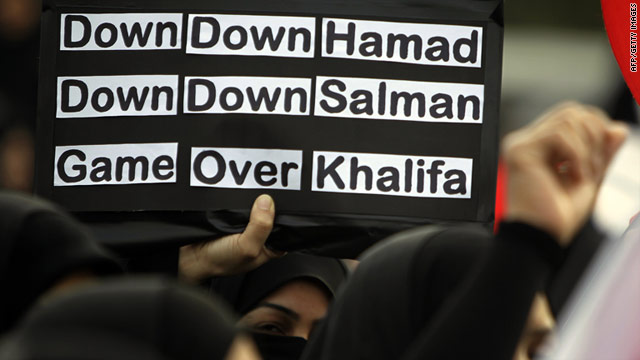
Overall, Bahrain in which an all-out revolution against the 40-year uncontested monarchy is looming doesn't have a healthy and pure human rights record. What people in this Arab country want is freedom, improved living conditions and an end to the discriminatory treatment with the Shias. Will the Bahraini dictators finally heed the calls of their people?
A Bahraini opposition leader says the Saudi government is manifestly waging war on the people of Bahrain by sending troops to help suppress the popular uprising in the country.
“What we see today is a declaration of war [against] unarmed civilians, whose only crime is to engage in a peaceful revolution, to determine their own destiny,” Saeed al-Shehabi told Press TV on Monday.
“If they (Saudi Arabia) continue their presence then that is, according to all opposition groups within Bahrain and outside, nothing but a declaration of war against the country,” the opposition leader added.
Shehabi deplored, “This is a sad day, not only for Bahrain, but for the [Persian] Gulf Cooperation Council ([P]GCC), because that alliance is supposed to be looking after the affairs of the people of that region, not to wage wars against the other countries.”
“It is astonishing to see the biggest country in this alliance invading a small country and other countries are joining in,” he noted.
Shehabi argued, “According to the charter of ([P]GCC), one country can ask for the support of another country within that alliance only in case of an external aggression against it.
“In the case of Bahrain, we have no external aggression; we have only internal problems that should be settled within the country itself, not by invasions.”
On Monday, Bahrain's fellow members of the [Persian] Gulf Cooperation Council -- Saudi Arabia, Kuwait, the United Arab Emirates, Oman and Qatar -- dispatched their armed forces to the Persian Gulf island at Manama's request to quell countrywide protests at the Sunni-led monarchy's suppression of the Shia majority.
Inspired by the Tunisian and Egyptian revolutions, tens of thousands of Bahrainis have poured into the streets in the capital Manama since mid-February, calling for an end to Al-Khalifa dynasty, which has ruled the country for almost two centuries.
Demonstrators are keeping vigil in hundreds of tents in Manama's Pearl Square, which has become the epicenter of anti-government protests.
At least 7 people have been killed so far during the government clampdown on the peaceful demonstrations in Bahrain.
Hours after the king of Bahrain declared a three-month state of emergency, doctors at a central hospital on Tuesday said two protesters had been killed and some 200 wounded and injured in clashes with riot police in the suburban village of Sitra.
One man, Ahmed Farhan, 24, had dozens of shotgun pellet wounds on his back and a gaping head injury, while a second man had tire marks from having been run over by security forces, the doctors said. Grisly video from the hospital, including of Mr. Farhan, appeared online shortly after.
“The signs are that this is a coordinated attack,” said Dr. Ali al-Aradi, an administrator at Suleimaniya Hospital. “These were not skirmishes. This was an attack on the protesters. These are the kinds of wounds we are seeing — shotgun and head injuries.”
The Ministry of Information said a security officer had been also been killed in the nearby village of Ma’ameer.
The violence around Sitra, a stronghold of antigovernment activists six miles south of the capital, contrasted starkly with a large protest in downtown Manama, where more than 10,000 protesters marched peacefully on the Saudi Arabian Embassy to denounce a military intervention by Persian Gulf countries the day before.
The entrance of foreign forces, including Saudi troops and those from other Gulf nations, threatened to escalate a local political conflict into a regional showdown; on Tuesday, Tehran, which has long claimed that Bahrain is historically part of Iran, branded the move “unacceptable.”
The foreign troops did not appear to take up positions in the capital early on Tuesday, heading instead for the palace neighborhood of Riffa.
Nevertheless, the city took on the feel of a ghost town: businesses were shuttered, malls closed and the streets largely deserted as residents watched apprehensively to see what role the foreign military would play to quell widespread demonstrations.
Since a violent effort to clear central Manama on Sunday failed, the authorities have appeared to hand over whole sections of the capital and surrounding villages to the protesters, who have blocked roads with rubble and trash bins.
Bahrain’s Ministry of Information, which has recently used its Twitter account to announce road closures, posted two messages in close succession claiming that protesters had attacked police and security forces in villages around the capital. One message suggested that a security officer had died: “A member of security force passed away in Maameer this evening when deliberately run over by one of the rioters.” Another said: “Police patrols exposed to shooting by automatic weapons by a group of vandals in Buri. No injuries.”
While there were no reports of fighting between protesters and foreign troops so far, The Associated Press, citing an unnamed Saudi security official, said that one soldier had been shot and killed by a protester on Tuesday. No details were given and the report could not be immediately confirmed. Bahrain state television denied the report, Reuters said.
The decision by Saudi Arabia to send in troops on Monday threatened to further inflame the conflict and transform this teardrop of a nation in the Persian Gulf into the Middle East’s next proxy battle between regional and global powers. On Monday, Iranian state-run media went so far as to call the troop movement an invasion.
“The presence of foreign forces and interference in Bahrain’s internal affairs is unacceptable and will further complicate the issue,” Ramin Mehmanparast, the Iranian Foreign Ministry spokesman, said at a news conference in Tehran, according to state-run media.
Even as predominantly Shiite Muslim Iran pursues a determined crackdown against dissent at home, Tehran has supported the protests led by the Shiite majority in Bahrain.
“People have some legitimate demands, and they are expressing them peacefully,” Mr. Memanparast said. “It should not be responded to violently.”
He added, “We expect their demands be fulfilled through correct means.”
Iran’s response — while anticipated — showed the depth of the rivalry across the Persian Gulf in a contest that has far-reaching consequences in many parts of the Middle East.
Saudi Arabia has been watching uneasily as Bahrain’s Shiite majority has staged weeks of protests against a Sunni monarchy, fearing that if the protesters prevailed, Iran, Saudi Arabia’s bitter regional rival, could expand its influence and inspire unrest elsewhere.
On Monday, about 2,000 troops — 1,200 from Saudi Arabia and 800 from the United Arab Emirates — entered Bahrain as part of a force operating under the aegis of the Gulf Cooperation Council, a six-nation regional coalition of Sunni rulers that has grown increasingly anxious over the sustained challenge to Bahrain’s king, Hamad bin Isa al-Khalifa. “This is the initial phase,” a Saudi official said. “Bahrain will get whatever assistance it needs. It’s open-ended.”
The decision is the first time the council has used collective military action to help suppress a popular revolt — in this case a Shiite popular revolt. It was rejected by the opposition, and by Iran, as an “occupation.” The troops entered Bahrain at an especially combustible moment in the standoff between protesters and the monarchy. In recent days protesters have begun to move from the encampment in Pearl Square, the symbolic center of the nation, to the actual seat of power and influence, the Royal Court and the financial district. As the troops moved in, protesters controlled the main highway and said they were determined not to leave.
“We don’t know what is going to happen,” Jassim Hussein Ali, a member of the opposition Wefaq party and a former member of Parliament, said in a phone interview. “Bahrain is heading toward major problems, anarchy. This is an occupation, and this is not welcome.”
Rasool Nafisi, an academic and Iran expert based in Virginia, said: “Now that the Saudis have gone in, they may spur a similar reaction from Iran, and Bahrain becomes a battleground between Saudi and Iran. This may prolong the conflict rather than put an end to it, and make it an international event rather than a local uprising.”
An adviser to the United States government, who spoke on the condition of anonymity because he was not authorized to talk to the news media, agreed. “Iran’s preference was not to get engaged because the flow of events was in their direction,” he said. “If the Saudi intervention changes the calculus, they will be more aggressive.”
Though Bahrain said it had invited the force, the Saudi presence highlights the degree to which the kingdom has become concerned over Iran’s growing regional influence, and demonstrates that the Saudi monarchy has drawn the line at its back door. Oil-rich Saudi Arabia, a close ally of Washington, has traditionally preferred to operate in the shadows through checkbook diplomacy. It has long provided an economic lifeline to Bahrain.
But it now finds itself largely standing alone to face Iran since its most important ally in that fight, Hosni Mubarak of Egypt, has been ousted in a popular uprising. Iran’s ally, Hezbollah, recently toppled the Saudi-backed government of Lebanon — a symbol of its regional might and Saudi Arabia’s diminishing clout.
But Bahrain is right at Saudi Arabia’s eastern border, where the kingdoms are connected by a causeway.
The Gulf Cooperation Council was clearly alarmed at the prospect of a Shiite political victory in Bahrain, fearing that it would inspire restive Shiite populations in Saudi Arabia and Kuwait to protest as well. The majority of the population in Saudi Arabia’s oil-rich eastern provinces is Shiite, and there have already been small protests there.
“If the opposition in Bahrain wins, then Saudi loses,” said Mustafa el-Labbad, director of Al Sharq Center for Regional and Strategic Studies in Cairo. “In this regional context, the decision to move troops into Bahrain is not to help the monarchy of Bahrain, but to help Saudi Arabia itself .”
The Bahrain government said that it had invited the force in to help restore and preserve public order. The United States — which has continued to back the monarchy — said Monday that the move was not an occupation. The United States has long been allied with Bahrain’s royal family and has based the Navy’s Fifth Fleet in Bahrain for many years.
Though the United States eventually sided with the demonstrators in Egypt, in Bahrain it has instead supported the leadership while calling for restraint and democratic change. The Saudi official said the United States was informed Sunday that the Saudi troops would enter Bahrain on Monday.
Saudi and council officials said the military forces would not engage with the demonstrators, but would protect infrastructure, government offices and industries, even though the protests had largely been peaceful. The mobilization would allow Bahrain to free up its own police and military forces to deal with the demonstrators, the officials said.
The Gulf Cooperation Council “forces are not there to kill people,” said a Saudi official, speaking on the condition of anonymity because he was not authorized to talk to the press. “This is a G.C.C. decision; we do not violate international law.”
But the officials also acknowledged that it was a message to Iran. “There is no doubt Iran is involved,” said the official, though no proof has been offered that Iran has had anything to do with the political unrest.
Political analysts said that it was likely that the United States did not object to the deployment in part because it, too, saw a weakened monarchy as a net benefit to Iran at a time when the United States wants to move troops out of Iraq, where Iran has already established an influence.
The White House issued a statement calling on “the government of Bahrain to pursue a peaceful and meaningful dialogue with the opposition” and for the “G.C.C. partners to show restraint.”
The assistant secretary of state for Near Eastern Affairs, Jeffrey D. Feltman, traveled to Bahrain on Tuesday to meet with “government and nongovernmental leaders,” according to a statement from the American Embassy, “in order to support a made-in-Bahrain approach to the political, social and economic challenges that Bahrain faces.”
The military force is one part of a Gulf Cooperation Council effort to try to contain the crisis in Bahrain that broke out Feb. 14, when young people called for a Day of Rage, fashioned after events in Egypt and Tunisia. The police and then the army killed seven demonstrators, leading Washington to press Bahrain to remove its forces from the street.
The royal family allowed thousands of demonstrators to camp at Pearl Square. It freed some political prisoners, allowed an exiled opposition leader to return and reshuffled the cabinet. And it called for a national dialogue.
But the concessions — after the killings — seemed to embolden a movement that went from calling for a true constitutional monarchy to demanding the downfall of the monarchy. The monarchy has said it will consider instituting a fairly elected Parliament, but it insisted that the first step would be opening a national dialogue — a position the opposition has rejected, though it was unclear whether the protesters were speaking with one voice.
The council moved troops in after deciding earlier to help prop up the king with a contribution of $10 billion over 10 years, and said that it might increase that figure. But if the goal was to intimidate Iran, or the protesters, that clearly was not the first response.
Bahrain’s opposition groups issued a statement: “We consider the entry of any soldier or military machinery into the Kingdom of Bahrain’s air, sea or land territories a blatant occupation.”
A nuclear crisis in Japan, civil war in Libya, and budget battles on Capitol Hill -- a busy time for President Obama.
And, now, a new major headache that's not yet getting much attention because of all the others: Saudi Arabian troops in neighboring Bahrain, seeking to protect the Sunni monarchy there.
Iran criticized what it termed "an invasion," and called the Saudi move "unacceptable" -- basically, in the words of The New York Times, "threatening to escalate a local political conflict into a regional showdown with Iran."
The Obama administration, of course, is also already battling with Iran over its nuclear program.
In the latest twist of Middle East unrest, Iran is a Shiite sect government backing the Shiite majority in Bahrain against its Sunni sect rulers.
Saudi Arabia, which is Sunni, has made it clear it will not accepted a Shiite government next door in Bahrain.
Saudi Arabia, you'll recall, is a large supplied of U.S. oil.
The king in Bahrain has declared a three month state of emergency as anti-government protests continue in the Emirate.
Troops from Saudi Arabia and the United Arab Emirates have arrived in Bahrain to help the country's ruling monarchy restore law and order.
The neighbouring Gulf states say it's not an invasion but Bahrain's opposition groups have described the arrival of foreign forces as an occupation.
The ABC's Middle East correspondent Anne Barker reports.
ANNE BARKER: Saudi armed forces rolled into Bahrain, across the causeway which links the two Gulf kingdoms.
One thousand Saudi troops and 500 police from the United Arab Emirates arrived as clashes between anti-government protesters and Bahrain's security forces intensified.
Yesterday dozens of protesters were injured as security forces loyal to the Sunni royal family battled thousands of Shiite demonstrators, calling for democratic reforms.
At a meeting in Paris with the US Secretary of State, Hillary Clinton, the Emirates foreign minister said his country was simply answering a call for help.
ABDULLAH BIN ZAYED, UNITED ARAB EMIRATES FOREIGN MINISTER: The Bahrain government asked us yesterday to look at ways to help them to diffuse the tension in Bahrain.
ANNE BARKER: But Bahrain's opposition says the arrival of foreign forces amounts to an occupation.
AL-WAAD IBRAHIM SHERIF AL SAYD, OPPOSITION LEADER (translated): We say to our brothers in the Gulf, your army is welcome when our country faces danger from the outside, but we will consider you part of an occupation, when you come to oppress the people.
ANNE BARKER: Bahrain is home to the United States fifth fleet, despite a close relationship with the Bahrain Government, the US has been caught off guard.
The White House was only advised at the last minute about the deployment of foreign troops, leaving an awkward moment for the US Secretary of State.
HILLARY CLINTON, US SECRETARY OF STATE: The UAE is currently the head of the Gulf co-operation council and he is here representing the GSC so we will have a very comprehensive discussion.
ANNE BARKER: The White House stopped short of calling for the foreign troops to leave.
JAY CARNEY, WHITEHOUSE SPOKESMAN: We are calling on the Saudis to show restraint and we believe political dialogue is the way to address the unrest that has occurred in the region.
ANNE BARKER: Shiites in Bahrain account for 70 per cent of the population and have long complained of discrimination by the Sunni Dynasty.
Some opposition groups are calling for the Sunni rulers to give up their powers in the partially-elected parliament. But as the violence increases many protesters are now calling for the entire royal family to go.
The arrival of foreign forces suggests Bahrain's royal family can no longer hold onto power without their support.
Japan is facing the world's biggest nuclear crisis for decades as engineers struggle to regain control of the Fukushima plant following another explosion and a fire that caused a spike in radiation to harmful levels
By DAVID E. SANGER and ERIC SCHMITT
WASHINGTON — Even before Saudi Arabia sent troops into Bahrain on Monday to quell an uprising it fears might spill across its own borders, American officials were increasingly concerned that the kingdom’s stability could ultimately be threatened by regional unrest, succession politics and its resistance to reform.
So far, oil-rich Saudi Arabia has successfully stifled public protests with a combination of billions of dollars in new jobs programs and an overwhelming police presence, backed by warnings last week from the foreign minister to “cut any finger that crosses into the kingdom.”
Monday’s action, in which more than 2,000 Saudi-led troops from gulf states crossed the narrow causeway into Bahrain, demonstrated that the Saudis were willing to back their threats with firepower.
The move created another quandary for the Obama administration, which obliquely criticized the Saudi action without explicitly condemning the kingdom, its most important Arab ally. The criticism was another sign of strains in the historically close relationship with Riyadh, as the United States pushes the country to make greater reforms to avert unrest.
Other symptoms of stress seem to be cropping up everywhere.
Saudi officials have made no secret of their deep displeasure with how President Obama handled the ouster of the Egyptian president, Hosni Mubarak, charging Washington with abandoning a longtime ally. They show little patience with American messages about embracing what Mr. Obama calls “universal values,” including peaceful protests.
When Secretary of Defense Robert M. Gates and Secretary of State Hillary Rodham Clinton were forced to cancel visits to the kingdom in recent days, American officials were left wondering whether the cause was King Abdullah’s frail health — or his pique at the United States.
“They’re not in a mode for listening,” said one senior administration official, referring to the American exchanges with Saudi officials over the past two months about the need to get ahead of the protests that have engulfed other Arab states, including two of Saudi Arabia’s neighbors, Bahrain and Yemen. In recent days, Washington has tried to focus on the areas where its strategic interests and those of Saudi Arabia intersect most crucially: counterterrorism, containing Iran and keeping oil flowing.
The Americans fear that the unrest sweeping the Middle East is coming at a bad time for the Saudis, and their concerns have increased in recent weeks, partly because of the continued tumult in Bahrain. Many of the issues driving the protests elsewhere are similar to those in Riyadh: an autocratic ruling family resistant to sharing power, surrounded by countries in the midst of upheaval. At the same time, Saudi Arabia’s leadership is in question. King Abdullah, 87, is, by all accounts, quite ill, as is the crown prince.
The latest tensions between Washington and Riyadh began early in the crisis when King Abdullah told President Obama that it was vital for the United States to support Mr. Mubarak, even if he began shooting protesters. Mr. Obama ignored that counsel. “They’ve taken it personally,” said one senior American familiar with the conversations, “because they question what we’d do if they are next.”
Since then, the American message to the Saudis, the official said, is that “no one can be immune,” and that the glacial pace of reforms that Saudi Arabia has been engaged in since 2003 must speed up.
But the Saudi effort to defuse serious protests appears to take a different approach: a huge police presence, which smothered relatively small demonstrations in Riyadh and the Eastern Province last Friday; an appeal to the innate religious conservatism of the country; and an effort to throw more cash at Saudi citizens, who have become accustomed to the ultimate welfare state.
This month, Prince Nayef bin Abdel Aziz, the interior minister and No. 2 in the line of succession, publicly underscored the kingdom’s ban on demonstrations. The government called in top Saudi newspaper editors to dictate how to report on protests foreign and domestic. The country’s senior religious clerics condemned public protests for not conforming with Islamic law. These steps built on $36 billion in pay raises, housing support, unemployment benefits and other subsidies that King Abdullah promised to keep the peace.
“All this is about social control in Saudi Arabia,” said Christopher Boucek, who studies the Middle East at the Carnegie Endowment for International Peace. “People have been forecasting the fall of Saudi for a long time, and they’ve always been proved wrong. It’s a pretty resilient place.”
One of President Obama’s top advisers described the moves as more in a series of “safety valves” the Saudis open when pressure builds; another called the subsidies “stimulus funds motivated by self-preservation.”
Saudi officials, who declined to comment for this article to avoid fueling talk of divisions between the allies, said that the tensions had been exaggerated and that Americans who criticized the pace of reforms did not fully appreciate the challenges of working in the kingdom’s ultraconservative society.
Even as Libya has occupied much of the public debate, White House officials have said they have been focused most intently on the two Arab allies whose fates are most tied to American strategic interests: Egypt and Saudi Arabia. In a briefing for reporters last Thursday, Thomas E. Donilon, the national security adviser, said that “the success of the democratic transformation under way in Egypt is absolutely critical,” and described his own conversations with its interim leadership. Mrs. Clinton will be visiting Cairo this week.
But Mr. Donilon, like other administration officials, said very little about the conversations they have held with Saudi leaders. Those have been strained in part by the slow-motion transition of power: King Abdullah, a popular monarch who just returned to the country after months of medical treatment in New York and Morocco, has been described by Saudi specialists as reform-minded but constrained by more conservative family members; the country’s next in line, Crown Prince Sultan, is also severely ill.
“We’ve focused on Nayef and a next generation, who seem to understand a lot better what’s got to happen,” said one American official, referring to the Saudi interior minister, whom some Saudi experts view as a conservative who would take the kingdom backward, while others say that is a misreading and that he is more aligned with members of the next generation of Saudi princes who favor reforms.
In a relationship where the United States hardly has the upper hand, so far the discussions have largely steered clear of democratization and focused on safer subjects : energy and foreign threats.
Saudi Arabia has helped stabilize world energy prices by increasing its crude-oil production to make up for the loss of Libya’s oil.
In the case of Bahrain, the senior official said, the administration’s goal has been to enlist the Saudis’ help to open up the Bahraini political system without overthrowing the government. Instead, the arrival of the Saudi-led troops underscored the approach advocated by Riyadh: Crack down and allow no room for dissent.
At a press briefing on Monday, the White House spokesman, Jay Carney, carefully avoided direct criticism of the Saudi-led entry of gulf forces into Bahrain, telling reporters that, in the view of the White House, “this is not an invasion of the a country.” But he added: “We’re calling on the Saudis, the other members of the G.C.C. countries, as well as the Bahraini government, to show restraint. And we believe that political dialogue is the way to address the unrest that has occurred in the region in Bahrain and in other countries, and not to, in any way, suppress it.”
Some officials say that in some ways the relationship between the United States and Saudi Arabia may grow closer, particularly on security and counterterrorism issues, where there has been increased cooperation in the months before the protests began in the Middle East.
John O. Brennan, President Obama’s counterterrorism adviser, speaks regularly with Prince Muhammad bin Nayef, his Saudi counterpart and the son of the interior minister, most recently last week about the political tumult in Yemen and the threat from Al Qaeda, an administration official said.
In the past several months, the Saudis have played a pivotal role in helping to thwart several terrorist plots. Prince Nayef alerted the Obama administration last October that bombs might be on cargo flights bound for the United States. A frantic search turned up two shipments containing printer cartridges packed with explosives, sent from Yemen by the Qaeda affiliate, and addressed to synagogues in Chicago.
The American military’s longstanding ties to the Saudi armed forces have also weathered the recent diplomatic tempest. More than 4,100 Saudi and American soldiers conducted a training exercise in northwestern Saudi Arabia last week.
Demonstrating to Iran that the Saudi-American alliance remains strong has emerged as a critical objective of the Obama administration. King Abdullah, who was widely quoted in the State Department cables released by WikiLeaks as warning that the United States had to “cut off the head of the snake” in Iran, has led the effort to contain Iran’s ambitions to become a major regional power. In the view of White House officials, any weakness or chaos inside Saudi Arabia would be exploited by Iran.
For that reason, several current and former senior American intelligence and regional experts warned that in the months ahead, the administration must proceed delicately when confronting the Saudis about social and political reforms.
”Over the years, the U.S.-Saudi relationship has been fraught with periods of tension over the strategic partnership,” said Ellen Laipson, president of the Stimson Center, a public policy organization. “Post-September 11 was one period, and the departure of Mubarak may be another, when they question whether we are fair-weather friends.”
CNN In the 65 years after the end of World War II, this is the toughest and the most difficult crisis for Japan.
--Japan Prime Minister Naoto Kan
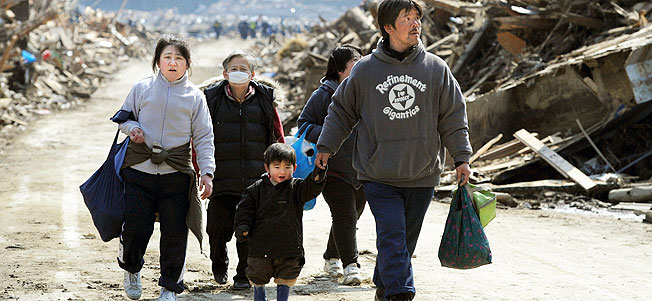
Rescue workers scoured tangled and displaced piles of debris Tuesday, searching for survivors, as crews struggled to keep control at a damaged nuclear plant on what is now the fifth day of the developing disaster in Japan.
Friday's 9.0-magnitude earthquake and the ensuing tsunami killed thousands, based on official and Japanese media reports, but an exact accounting of the disaster remains hidden beneath widespread damage that rescuers are only beginning to unearth.
The confirmed death toll, growing every few hours, reached 1,897 on Monday. But that didn't account for the thousands of bodies Japan's Kyodo News Agency said had been found in the Miyagi Prefecture on Japan's northeast coast. The number of dead is expected to rise as rescuers reach more hard-hit areas.
At least 3,002 people were still missing Monday, the National Police Agency said. Public broadcaster NHK reported that 450,000 people were living in shelters.At the same time, officials are fighting to contain a nuclear emergency. The earthquake and tsunami led to problems at three of the country's nuclear power plants.
An "explosive impact" occurred Tuesday morning at the No. 2 reactor at the Fukushima Daiichi nuclear power plant in northeastern Japan, a day after a hydrogen explosion rocked another reactor, the plant's owner said.
An explosion in a building housing the No. 3 reactor at the Fukushima Daiichi plant injured 11 workers Monday. A similar explosion over the weekend occurred in the No. 1 reactor.
Yukio Edano, Japan's chief Cabinet secretary, said he could not rule out the possibility of a meltdown at all three troubled reactors. While sea water was being pumped into the reactors in an effort to prevent further damage, "It cannot necessarily be called a stable situation," Edano said early Tuesday.
In Tokyo, where many trains were not running or were severely delayed because of power outages, residents worried about the threat of more aftershocks as they started their workweek Monday.
"It didn't really feel safe going to an empty office," said Tokyo resident Mia Moore, citing the ongoing tremors that continue to rattle the city every few hours. "People want to stay with their families at this time to recover, really. It's quite exhausting feeling so nervous all the time. I think people want to get back to normality as soon as they can."
But normalcy seems a distant memory across the hardest-hit region of Japan. NHK, citing police and disaster management officials, reported that 63,000 buildings had been damaged, more than 6,000 of them obliterated.
In Miyagi Prefecture, rescue workers sifted through mountains of debris, and hope for survivors appeared to dim.
In the Sendai area, where buildings were disintegrated by rushing water within seconds during the tsunami, a bizarre mix of sport-utility vehicles, cabinets, sofas, a taxi and a doll were heaped in a pile outside the remnants of a house.
Solemn residents waited in lines that stretched blocks for food, water and gas. Despite the devastation surrounding them, the crowds appeared calm and orderly, even as stores rationed what they would sell to individual people.
At a shelter in Sendai, a shell-shocked man who fled the tsunami would not let go of his 3-week-old infant. "I have to protect my children. I have to protect my children," he said.
Another survivor wiped away tears after someone she barely knew gave her food and water.
Cold weather has increased the hardship for disaster victims and rescuers. Rescuers report that some victims have been exposed to cold weather and water, in some cases for days. Conditions are expected to worsen, with temperatures forecast to drop below freezing by Wednesday across portions of the earthquake zone, accompanied by snow, heavy rain and the threat of mudslides.
About 15,000 people have been rescued, Kyodo News reported Monday, citing Japanese Prime Minister Naoto Kan. On Sunday, he called on people to pull together and face sacrifices during what he called the "toughest and most difficult crisis for Japan" since the end of World War II.
Among the residents rescued was a woman carried into a shelter by a civil defense solider, NHK reported. After he gingerly set her down, the woman rose to her feet with some difficulty and bowed to the soldier, told him she was all right, bowed again and then collected herself to briefly tell her story, paraphrased by an NHK interpreter:
"She had been waiting for help all night, outside. She had been washed away by the wave. ... The moment she opened the door of the house, the water flooded in. ... She grabbed hold of a tree and hung on, hung on for dear life with the water all around her. A ... floor mat floated by, and she grabbed it and held on to that."
As the woman spoke in Japanese, the interpreter's voice trembled in English: "Her daughter was washed away. She was washed away, and she has not found her."
The problem of trying to keep Japan's large, modern industrial economy running added to the difficulties facing the nation.
With the imperiled Fukushima plant offline, Tokyo Electric Power said it was expecting a shortfall of about 25 percent capacity, which necessitated blackouts. Up to 45 million people will be affected by the rolling outages, which will last until April 8.
Experts predict that the earthquake and tsunami will rank among the costliest natural disasters on record.
Japan's central bank announced plans Monday to inject 15 trillion yen ($186 billion) into the economy to reassure global investors of the stability of Japanese financial markets and banks.
Still, Japanese markets dropped sharply Monday, the first trading day since the disaster. The benchmark Nikkei 225 fell 6.18 percent, marking the largest single-day fall since September 2008 after the collapse of Lehman Brothers during the financial crisis.
A massive emergency response operation is under way in northern Japan, with world governments and international aid groups coming together to bring relief to the beleaguered island nation. Ninety-one countries and regions and six international organizations have offered assistance, according to the Japanese Foreign Affairs Ministry.
Friday's quake was the strongest in recorded history to hit Japan, according to U.S. Geological Survey records that date to 1900. The USGS revised the magnitude of the quake upward to 9.0 on Monday, from 8.9. The world's largest recorded quake took place in Chile on May 22, 1960, with a magnitude of 9.5, the agency said.
KARACHI: The Sindh Assembly (SA) has passed a unanimous resolution tabled by the lawmaker of Pakistan People’s Party (PPP) from minority Salim Khurshid Khokhar recommending the name of the deceased federal minister for minority affairs Shahbaz Bhatti for Nobel Prize. According to the resolution the federal government should recommend the name of Shahbaz Bhatti for the Nobel Prize.
The PPP lawmaker said Bhatti worked for the equality of rights in the country and promotes religious harmony and democracy. He said Bhatti promoted the vision of Quaid-e-Azam Muhammad Ali Jinnah, Shaheed Zulfikar Ali Bhutto and Benazir Bhutto.
PPP minority lawmaker Pitamber Sewani also signed the resolution. Khokhar said security of minorities is the guarantee of bright future of the country. He said all minorities would fight terrorism under leadership of President Zardari.
Speaker Nisar Ahmed Khuhro has put the resolution in the House and it was unanimously passed. Pakistan Muslim League-Functional lawmaker Marvi Rashdi objected over the usage of word ‘Shaheed’ for Bhatti and said that only Muslims can be called Shaheed. PPP minister for Katchi Abadis Rafiq Engineer replied that they can use word of martyrs for everyone and its translation in Urdu is ‘Shaheed’.
A resolution was earlier tabled in the Sindh Assembly session by the PPP’s Power Minister Shazia Marri for expressing solidarity with the people of Japan over the devastating tsunami, which hit the country.
She said the SA is deeply affected by the devastating tsunami that caused massive destruction in Japan and extends its deepest sympathies to the Japanese people since World War II. She appreciated the support extended to Japan by the international community, including the president of Pakistan. Marri said Pakistani nation during these tough times would continue its support to the Japanese people. Later, the House unanimously passed the resolution.
A government primary school for boys was blown up in Changai area of Landikotal.
Unidentified terrorists blew up one more government primary school for boys at Rehmatullah village in Changai in Khyber Landikotal in the wee hours of Monday. Administration and local sources, while confirming the two blasts inside the primary school building, said that four rooms of the old primary school were blown up completely whereas the boundary walls and the veranda suffered slight damages. Khasadar Force officials arrested the watchmen of the school, Hayatullah and Wajid.
The total number of schools destroyed in Landikotal has reached thirteen as the figure of the destroyed schools in the far-flung areas of Bazaar Zakha Khel is yet to be confirmed.
By MIRA SETHI
Wall Street Journal
Two months after Salman Taseer, the governor of Pakistan's Punjab province, was assassinated by his own bodyguard for criticizing the country's blasphemy law, the only Christian member of the Pakistani cabinet, Minorities Minister Shahbaz Bhatti, was killed for doing his job—advocating protection of the country's two million Christians.
Taseer's assassination prompted a debate: Was the blasphemy law, introduced by Gen. Zia ul-Haq in the 1980s in his bid to "Islamize" Pakistan, being exploited for mundane interests? Was it leading to witch hunts? Bhatti's death should prompt Pakistanis to ask themselves an equally disquieting question: Does Pakistan have a future as a successful nation state, at peace with itself and the world?
The civilian government's reaction to Bhatti's death has outraged many Muslim and Christian Pakistanis. As after Taseer's murder, it retreated into vague bromides. At Bhatti's funeral in Islamabad, Prime Minister Yousaf Raza Gillani vowed to "do the utmost to bring the culprits to justice." There was no mention of who these culprits were (the Tehreek-e-Taliban of Punjab has claimed responsibility), no mention of the ideologies, religious parties and jihadi organizations fueling their actions, and no mention of the blasphemy laws that Bhatti had campaigned against.
But the deaths of Taseer and Bhatti are the outcome not just of the Pakistan People's Party abandonment of the principles that once made it an appealing, popular force. They are the result of a decades-long imbalance in governance and power, which now has the PPP and other liberal and centrist civilians cowering in fear.
The failure of the political classes to initiate democratic, constitutional reform after Pakistan's separation from India in 1947 enabled the military to quickly define "national interest" as an anti-India ideology. This ideology, a type of Islamic nationalism, is one from which the Pakistan military has reaped rich dividends. It has kept civilian politicians on the defensive and the people numbed.
With the onset of the Cold War the U.S. armed Pakistan for its own strategic purposes. When the Pakistani army undertook adventures creating instability in the region—wars with India and attempts, eventually successful, to build nuclear weapons—the U.S. suspended military and economic aid.
But the Soviet invasion of Afghanistan in 1979 put the Pentagon and the Pakistani army on good terms again. This time, Gen. Zia extracted huge sums from Washington: Pakistan's army was paid billions of dollars in direct correlation to its usefulness in organizing an anti-Soviet Islamic jihad. The '90s saw a nasty separation—aid was suspended again—and a reunion followed after 9/11, when the U.S. needed Pakistan's help in Afghanistan.
Now Zia's "children" have come of age. Extremists of all stripes—the Taliban and the mujahedeen—roam the streets of Lahore and Karachi unchecked by the security agencies who once thought it would be a good idea to arm them. Anger and frustration fueled by inequality are making young Pakistanis turn to religion for answers.
As in Egypt, over 60% of the population of Pakistan is under 25. Unlike Egypt, they want an Islamic revolution, not a democratic one. Salman Taseer's police bodyguard—all of 26 years old—killed him for "insulting" the Prophet Muhammad. (The governor had criticized a manmade blasphemy law, not the Prophet, but his assassin didn't know the difference).
Slowly, the U.S. is beginning to understand that Pakistan's existential confusion is the result of the grand strategic designs of the Pakistani military, an army that has carried out three coups to thwart the development of a democratic political system. In the process, Pakistan's civilian leadership has been eliminated—Zulfiqar Ali Bhutto hanged, Benazir Bhutto, Taseer and Bhatti assassinated—the country dismembered, ethnic subnationalism, regional tension and inequalities aggravated.
The U.S. must support civilian supremacy and recognize the Pakistani army's game for what it is. Alarmed by the idea that if America leaves Afghanistan its U.S. funds will dwindle, the military is loath to crush the Islamist warriors who can be "calibrated" to deliver strategic value to it. Until the U.S. recognizes this, Pakistan's military will continue to hold the world to ransom
The boundaries of expression have shrunk in Pakistan, Shehrbano Taseer, daughter of slain former Punjab Governor Salmaan Taseer, has said.
Both Taseer and Minorities Affairs Minister Shahbaz Bhatti were assassinated within a gap of two months for their vocal support for reforms of Pakistan's draconian blasphemy laws.
"In a country that calls itself a democracy, the frontiers of expression have shrunk," The Express Tribune quoted Shehrbano, as saying on an Express 24/7 show, commenting on the murders.
She said that everyone is to be blamed collectively for the assassinations of Taseer and Bhatti, adding that if it were not for the current or the previous government appeasing terrorists, these shocking incidents would not have taken place.
Shehrbano said that she felt the media was also responsible for Taseer's assassination because it acted irresponsibly by giving undue space to "hot-headed right wingers, screaming bloody murder," instead of starting a debate on the controversial blasphemy laws.
Shehrbano revealed that her family had received several threatening letters after her father's assassination, and vowed to continue living in Pakistan despite requests from friends, urging her family to leave the country.
"We are Pakistanis; we will build our lives in Pakistan; we will live to better the lives of Pakistanis. We will not go anywhere," she maintained.
The slain governor's daughter said that she does not live in fear because that is what the terrorists capitalise on.
"I am not going to give my country to them on a silver platter," she said.
On a positive note, Shehrbano said she sees "unwavering hope in Pakistan," and if everyone was to work for a better Pakistan, they would see the fruits in the next 20 years or so.
Gulf Issues center mentioned on Monday that outgoing Prime Minister Saad Hariri was reproached by Saudi King Abdallah ben Abdel Aziz during their secret meeting in Riyadh on March 6.
The Saudi King expressed his discontent regarding Hariri's campaign against Hezbollah's weapons and voiced concern regarding Hezbollah's reaction to the campaign, and its repercussions on Prime Minister Designate Najib Mikati and the Saudi-Syrian relations.
The center quoted a report published by "Gulf" newspaper as saying that the Saudi King criticized the unjustified campaign Hariri launched against Hezbollah, and said the Saudi Kingdom may not be able to handle its repercussions.
The sources denied the oil-rich Kingdom was supporting the campaign and said Jeffrey Feltman, Assistant Secretary of State for Near Eastern Affairs, was playing a negative role in this regard.
The sources added that the GCC's position regarding Premier Designate Mikati, announced last week, was a message that the Saudi Kingdom was not behind Hariri's campaign and the Gulf countries are committed to the Lebanese sovereignty. Moreover, the sources reported that the campaign against Hariri's owned company "Saudi Oger" is a message to the outgoing PM to keep the situation in control without endangering the Saudi interests.
It should come as no surprise that Saudi Arabia has come to the aid of Bahrain's royal family with about one thousand troops crossing the causeway between the two countries. If more troops are needed to ensure that the al-Khalifa regime does not fall, the Saudis will oblige. Put simply, Riyadh cannot tolerate Sh'ia domination of its offshore island, whether or not the al-Khalifas remain in power.
A Bahrain that is ruled by its Sh'ia majority is one-third of the ultimate nightmare for the Sunni rulers of the desert kingdom. The other two-thirds are a revolt by the Sh'ia majority in Saudi Arabia's oil-rich Eastern Province, which could spill over from the troubles in neighboring Bahrain and a massive influx of Yemenis, many of whom are adherents of the Zaidi branch of Islam, and have little in common with Saudi Wahhabisim.
Stability in Bahrain is therefore crucial for the long-term future of the al-Saud family as rulers of their eponymous kingdom. Indeed, Saudi Arabia's rulers fully recognize that because memories in the Middle East are very long, the fact that the Hejaz was a separate Arabian kingdom as recently as the 1920s until it was conquered by Ibn Saud and merged with his kingdom of the Nejd means that the break-up of their country is hardly impossibility.
Other Gulf States, notably Kuwait, whose rulers are close to the al-Khalifa, may join the Saudi effort to stabilize Bahrain. So might the UAE, which shares Saudi fears of Iranian domination of the island, which was once an Iranian province, and which continues to smart over the Iranian seizure of its islands of Abu Musa and the Tunbs in 1971.
Washington cannot sit idly by as these events take place. The Fifth Fleet is headquartered in Bahrain, as is the naval component of Central Command. The departure of the Navy from Bahrain would mark a signal victory for Iran, even, as is likely, the fleet were to find a new home elsewhere in the Gulf. Washington has no choice but to support the Saudi intervention.
Unfortunately, Washington appears to be willing to offer little more than words, and its words no longer carry much weight. The administration's vacillation over Libya, coupled with the imminent withdrawal of combat troops in Iraq -- where Prime Minister Nouri al-Maliki is becoming ever more authoritarian -- has underscored a growing perception of America's declining influence in the region.
Whatever happens in Bahrain will hardly change that perception. If, as is likely, the Saudis shore up the Bahraini regime, many will view the outcome as a victory for repression, and, given Qaddafi's recent successes against the rebels, a sign of the hollowness of American pronouncements about democracy. On the other hand, if some outside chance, the Bahraini regime falls to the Sh'ia opposition, the fruits of victory will be reaped by Tehran, not Washington, since one of the new government's first acts would be to expel the U.S. Navy.
One can therefore only conclude that, regardless of the outcome in Bahrain, the United States may be headed for even tougher times in the Middle East than those it has experienced in the past few years.
Foreign troops have begun to arrive in the strategically and financially important Persian Gulf kingdom of Bahrain, following a month of citizen protests, the Bahrain News Agency reported Monday.
Saudi Arabia, Bahrain's giant neighbor, appears to have provided at least some of the troops, who come under the banner of the Gulf Cooperation Council.
The Saudi state news agency said the government had responded to Bahrain's request for help in view of the importance of security there.
According to the state news agency of the United Arab Emirates, it "decided to send a security force to keep the peace in the Kingdom of Bahrain," at that country's request.Dr. Anwar Mohammed Qerqash, UAE minister for foreign affairs, said that this is a part of his country's responsibility within the Gulf Cooperation Council in order to bring "security and stability to the region."
The mission is being called Operation Desert Shield -- the same name the United States used after Saddam Hussein's forces invaded Kuwait in 1990.
The arrival of the troops follows a day of clashes between protesters and security forces that resulted in more than 1,000 people hospitalized, human rights activists said.
Protests have swept the Arab world this year, toppling the leaders of Tunisia and Egypt, but it's not clear that any country had called in foreign troops for help before the GCC forces arrived in Bahrain on Monday.
It is not clear exactly how many foreign security troops have entered Bahrain or where they are from. Various parts of the Bahraini government referred CNN questions to other government offices on Monday.
An eyewitness told CNN that dozens of armored vehicles and buses full of soldiers crossed from Saudi Arabia into Bahrain on Monday afternoon via the causeway linking the two countries.
The Gulf Cooperation Council is a group of six Gulf states -- Bahrain, Saudi Arabia, Kuwait, the United Arab Emirates, Oman, and Qatar -- that encourages cooperation among members in a number of areas, including the economy and security.
Also on Monday, a key part of the capital was taken over by protesters, a Human Rights Watch official told CNN.
About 100 demonstrators blocked access to the Bahrain Financial Harbour with barricades such as trash cans and cinder blocks, in effect shutting down the commercial district, Faraz Sanei said.
There was no police presence, he added.
Bahrain's Foreign Minister Khalid al-Khalifa said the demonstrations are not peaceful.
"What we are witnessing in Manama is no peaceful protest. ... It's (a) wanton, gangster style takeover of people's lives," he said on Twitter.
A pro-government group of lawmakers is urging the king of Bahrain to impose martial law for three months in the wake of the protests.
Protests on Sunday appeared to have been among the most violent since police tried to clear the capital's Pearl Roundabout in February, leaving seven people dead, according to demonstrators.
Most of Sunday's injured suffered gas-related injuries, including burns and breathing problems, according to Nabeel Rajab, president of the Bahrain Center for Human Rights.
Doctors and nurses were among the injured. At least five people were in critical condition and at least two people lost their eyes because of bullet injuries, he said.
Manama, the capital, was in effect sealed off Monday, journalists there told CNN. The highway stretching from the Pearl Roundabout to the Bahrain Financial Harbour was blocked by trees and other debris.
The government Sunday denied accusations that unjustified force was used against protesters at the harbor, along a key highway and at Bahrain University.
Britain's Foreign Office warned against all travel to the Gulf kingdom Sunday until further notice, saying, "The risk of further outbreaks of violence has increased."
The nation's Independent Bloc of lawmakers called on Bahrain security forces to intervene to protect national security and stability, the Bahrain News Agency reported later Sunday. The bloc is made up of the 22 pro-government members of the lower house of the legislature.
"Extremist movements are resorting to escalation and sectarian mobilization, which led to an unprecedented disruption of security and hostile sectarian polarization at health and educational institutions," the group said in a statement.
The members of parliament asked King Hamad to enforce a curfew and deploy security forces across the country.
During protests in the tiny island nation, moderates have been demanding a constitutional monarchy and hardliners have called for the abolition of the royal family altogether.
The country has a Shiite Muslim majority population, but its rulers are Sunni Muslims.
Afghan President Hamid Karzai is urging international troops to leave Afghanistan and take their fight across the border to Pakistan.
Mr. Karzai delivered his latest criticism of NATO efforts Saturday in Asadabad, the capital of eastern Kunar province, where he was visiting the relatives of civilians killed in a raid by international forces.
The Afghan leader said his government has shown NATO that the terrorists and militants are not in Afghanistan, but instead are hiding in neighboring Pakistan.
The French news agency quoted Mr. Karzai as saying that Afghans are a tolerant people but now "our tolerance has run out."
The topic of civilian casualties has been a sensitive one for Afghanistan and its Western allies.
Earlier this month, NATO's top commander in Afghanistan, General David Petraeus, apologized for an air strike that killed nine children in Kunar province.
The coalition blamed miscommunication for the deaths, but Afghan President Karzai warned NATO could face "huge problems" if the accidental killing of civilians does not stop.
Earlier this week, a report by the U.N. mission in Afghanistan and the Afghanistan Independent Human Rights Commission said there had been nearly 3,000 war-related civilian deaths in 2010, an increase of 15 percent compared to 2009.
The reports said insurgents and militants were responsible for about 75 percent of the deaths.
The Agriculture department is feeling stressed over transfer of agriculture affairs to the province as some new and ongoing schemes may suffer due to lack of resources.
Sources informed that new and ongoing schemes, which were otherwise to be completed with the help of the federal government, amount to hundreds of millions in rupees in the sector.
The sources said that only new schemes in agriculture sector for the province cost over Rs. 2 billion though in few cases donors like Asian Development Bank support the provinces in Pakistan.
Agribusiness development and diversification project, commercialisation of tea production are among the ongoing projects in the province while projects like rehabilitation and strengthening of summer agriculture research station of Pakistan Agriculture Research Council (PARC) is among the new projects. Only the one new scheme cost over 11 million in rupees, the sources informed.
KP was already reportedly disturbed over the financial and human losses in face of last year’s devastating flood and the violence that has been paralysing normal functions in parts of the province that not only increased the government expenditures but also affected the tax collection.
The KP government has recently cut funds to its several development schemes as rehabilitation of the affectees and several other issues are limiting resources for progressive activities, an official who was not authorized to speak to media said.
Situation in other provinces may be different as the province like Punjab has enough resources to continue its developmental activities but the affected and a small and violence hit province like KP is in a difficult situation, the officials maintained.
The sources also informed that the provincial government is not ready to accept the employees of the federal ministries, which are going to transfer to the provinces as a part of the devolution plan under 18th amendment.
However, the province attitude is not without reason. According to the data of finance department and some reports, 68 per cent of the provincial non-development budget goes to salaries and pensions of the employees in KP.
The staff strength of the provincial government has risen from 288,203 to 375,935 posts over five years between 2005-06 and 2010-11.
When contacted DG Agriculture Extension in KP Muhammad Tasleem confirmed that the province lacks funds to continue the new as well as the ongoing schemes in the sector if responsibility was shifted to the calamities-devastated province.
He told Online that funds for the ongoing schemes in agriculture are expected to be provided by the federal government for the current year but after that, the KP government would have to run the expenses within the limits of its resources.
On the other side officials in revenue department on condition of anonymity said they cannot say something certain about the future finances in KP, however, keeping in view the on-going situation and history of tax collection in the province, high expectation of future would be unrealistic.
Nevertheless, it could be verified that transferring of the agriculture subject to the province like Punjab creates no problems of funds to the projects.
In an exclusive chat with Online the Agriculture Secretary of Punjab Arif Nadeem confirmed that at least agriculture department in Punjab is not feeling any stress over transfer of the subject.
He said that transfer of the subjects are beneficial and is in interest of the people in Pakistan.
On finances, he said that there is no limitations of the resources as private sector investors are ready to invest in the sector.
The estimated death toll from Japan's disasters climbed past 10,000 Sunday as authorities raced to combat the threat of multiple nuclear reactor meltdowns and hundreds of thousands of people struggled to find food and water. The prime minister said it was the nation's worst crisis since World War II.
Nuclear plant operators worked frantically to try to keep temperatures down in several reactors crippled by the earthquake and tsunami, wrecking at least two by dumping sea water into them in last-ditch efforts to avoid meltdowns. Officials warned of a second explosion but said it would not pose a health threat.Near-freezing temperatures compounded the misery of survivors along hundreds of miles (kilometers) of the northeastern coast battered by the tsunami that smashed inland with breathtaking fury. Rescuers pulled bodies from mud-covered jumbles of wrecked houses, shattered tree trunks, twisted cars and tangled power lines while survivors examined the ruined remains.
One rare bit of good news was the rescue of a 60-year-old man swept away by the tsunami who clung to the roof of his house for two days until a military vessel spotted him waving a red cloth about 10 miles (15 kilometers) offshore.
The death toll surged because of a report from Miyagi, one of the three hardest hit states. The police chief told disaster relief officials more than 10,000 people were killed, police spokesman Go Sugawara told The Associated Press. That was an estimate — only 400 people have been confirmed dead in Miyagi, which has a population of 2.3 million.
According to officials, more than 1,400 people were confirmed dead — including 200 people whose bodies were found Sunday along the coast — and more than 1,000 were missing in Friday's disasters. Another 1,700 were injured.
For Japan, one of the world's leading economies with ultramodern infrastructure, the disasters plunged ordinary life into nearly unimaginable deprivation.
Hundreds of thousands of hungry survivors huddled in darkened emergency centers that were cut off from rescuers, aid and electricity. At least 1.4 million households had gone without water since the quake struck and some 1.9 million households were without electricity.
While the government doubled the number of soldiers deployed in the aid effort to 100,000 and sent 120,000 blankets, 120,000 bottles of water and 29,000 gallons (110,000 liters) of gasoline plus food to the affected areas, Prime Minister Naoto Kan said electricity would take days to restore. In the meantime, he said, electricity would be rationed with rolling blackouts to several cities, including Tokyo.
"This is Japan's most severe crisis since the war ended 65 years ago," Kan told reporters, adding that Japan's future would be decided by its response.In Rikuzentakata, a port city of over 20,000 virtually wiped out by the tsunami, Etsuko Koyama escaped the water rushing through the third floor of her home but lost her grip on her daughter's hand and has not found her.
"I haven't given up hope yet," Koyama told public broadcaster NHK, wiping tears from her eyes. "I saved myself, but I couldn't save my daughter."
A young man described what ran through his mind before he escaped in a separate rescue. "I thought to myself, ah, this is how I will die," Tatsuro Ishikawa, his face bruised and cut, told NHK as he sat in striped hospital pajamas.
Japanese officials raised their estimate Sunday of the quake's magnitude to 9.0, a notch above the U.S. Geological Survey's reading of 8.9. Either way, it was the strongest quake ever recorded in Japan, which lies on a seismically active arc. A volcano on the southern island of Kyushu — hundreds of miles (kilometers) from the quake' epicenter — also resumed spewing ash and rock Sunday after a couple of quiet weeks, Japan's weather agency said.
Dozens of countries have offered assistance. Two U.S. aircraft carrier groups were off Japan's coast and ready to help. Helicopters were flying from one of the carriers, the USS Ronald Reagan, delivering food and water in Miyagi.
Two other U.S. rescue teams of 72 personnel each and rescue dogs arrived Sunday, as did a five-dog team from Singapore.
Still, large areas of the countryside remained surrounded by water and unreachable. Fuel stations were closed, though at some, cars waited in lines hundreds of vehicles long.
The United States and a several countries in Europe urged their citizens to avoid travel to Japan. France took the added step of suggesting people leave Tokyo in case radiation reached the city.
Community after community traced the vast extent of the devastation.
In the town of Minamisanrikucho, 10,000 people — nearly two-thirds of the population — have not been heard from since the tsunami wiped it out, a government spokesman said. NHK showed only a couple concrete structures still standing, and the bottom three floors of those buildings gutted. One of the few standing was a hospital, and a worker told NHK that hospital staff rescued about a third of the patients.
In the hard-hit port city of Sendai, firefighters with wooden picks dug through a devastated neighborhood. One of them yelled: "A corpse." Inside a house, he had found the body of a gray-haired woman under a blanket.
A few minutes later, the firefighters spotted another — that of a man in black fleece jacket and pants, crumpled in a partial fetal position at the bottom of a wooden stairwell. From outside, while the top of the house seemed almost untouched, the first floor where the body was had been inundated. A minivan lay embedded in one outer wall, which had been ripped away, pulverized beside a mangled bicycle.
The man's neighbor, 24-year-old Ayumi Osuga, dug through the remains of her own house, her white mittens covered by dark mud.
Osuga said she had been practicing origami, the Japanese art of folding paper into figures, with her three children when the quake stuck. She recalled her husband's shouted warning from outside: "'GET OUT OF THERE NOW!'"
She gathered her children — aged 2 to 6 — and fled in her car to higher ground with her husband. They spent the night in a hilltop home belonging to her husband's family about 12 miles (20 kilometers) away.
"My family, my children. We are lucky to be alive," she said.
"I have come to realize what is important in life," Osuga said, nervously flicking ashes from a cigarette onto the rubble at her feet as a giant column of black smoke billowed in the distance.
As night fell and temperatures dropped to freezing in Sendai, people who had slept in underpasses or offices the past two nights gathered for warmth in community centers, schools and City Hall.
At a large refinery on the outskirts of the city, 100-foot (30-meter) -high bright orange flames rose in the air, spitting out dark plumes of smoke. The facility has been burning since Friday. The fire's roar could be heard from afar. Smoke burned the eyes and throat, and a gaseous stench hung in the air.
In the small town of Tagajo, also near Sendai, dazed residents roamed streets cluttered with smashed cars, broken homes and twisted metal.
Residents said the water surged in and quickly rose higher than the first floor of buildings. At Sengen General Hospital, the staff worked feverishly to haul bedridden patients up the stairs one at a time. With the halls now dark, those who can leave have gone to the local community center.
"There is still no water or power, and we've got some very sick people in here," said hospital official Ikuro Matsumoto.
Police cars drove slowly through the town and warned residents through loudspeakers to seek higher ground, but most simply stood by and watched them pass.
In the town of Iwaki, there was no electricity, stores were closed and residents left as food and fuel supplies dwindled. Local police took in about 90 people and gave them blankets and rice balls, but there was no sign of government or military aid trucks.
The rapid increase in population and ill-planned construction of new buildings in and around the provincial capital are main sources of plethora of civic and health problems.
If this unbridled and ill-planned construction of houses and other buildings was not controlled immediately, the sanitation would be out of control, experts feared.
They said that former chief minister Sardar Mehtab Ahmed Khan during his tenure, from 1997 to 1999, had planned dividing Peshawar into four zones to control civic problems, which emerged owing to haphazard expansion of the provincial capital.
A lot of work had done on the project but it was shelved with the end of his government, they said.
In the NWFP Local Government Ordinance, 2001, the subjects of master planning, land use, zoning, classification and re-classification are mentioned in section III (i) of Part D in the 1st Schedule of the ordinance.
Under section 35 of the Ordinance, the city district government is empowered to deal with the issues mentioned in part D of Schedule I.
“Under this law, it is the prime responsibility of the city district government to divide the city into four zones including agricultural, commercial, residential and industrial zones,” they said. Unfortunately, the city district government didn`t bother to fulfil its responsibility during the last 10 years since local government ordinance had been introduced, they added.
Under the Local Government Ordinance 2001, planning officers were also appointed at town and tehsil levels for building control and dividing their territory into zones but to no avail.
The non-implementation of the relevant law regarding zoning and building control and no master planning, the civic problems and water-borne diseases couldn`t be controlled, the experts said.
An official of the local government department said that it was obligatory for the owner to approve the map of house before constructing it. “Often the building inspectors don`t bother to visit their respective areas to inspect new construction of houses,” he added.
He said that even if they located new houses then they didn`t ask for the map rather received bribe from the owners.
He said that irrigation channels were being used for sewer, which was a source of many water-borne diseases. As there was no water treatment plant in the capital city, some of the drain water fell into the rivers, which polluted them and posed a threat to aquatic life.
Similarly, the owners of the houses also don`t care for the street, leaving it narrow wherein neither drain can be constructed nor pipes for gas can be installed.“We cannot stop such practices because the authorities concerned have not framed any rules in this regard,” claimed a Tehsil Municipal Officer.
Planning is the first step of any developmental activities. Without planning, the desired results are greatly reduced if not lost at all. This is why that more time is spent on planning in most of the developed countries. Resources, time and even the positive effects of developmental activities on the environment are carefully planned.
The master plan has all developmental activities including roads, water supply, sewerage, treatment plants, residential areas, commercial areas, parks, greenbelts, schools, hospitals, industrial areas, slaughter houses, etc. and also its future extension.
The master plan is implemented in letter and spirit and violation is strictly prohibited. This way a proper city and urban areas are developed and population is bestowed with healthy living and pleasant environment. All the resource is efficiently and effectively utilised.
Hayatabad Township in Peshawar was developed with all the essential facilities, having master plan and building control agency under Peshawar Development Authority. Under the same policy, more authorities were established in all divisions of the province.
Mardan Development Authority, Malakand Development Authority, Hazara Development Authority etc built townships in Mardan, Sawabi, Kanju, Swat, Kohat, Banu and D.I. Khan.
These townships are properly planned and have all the essential services and the developmental activities are executed as per master plan. “A visit to these towns will reveal that more towns should be developed on this pattern and the existing urban area should be improved on the guidelines established for these townships,” an official of Peshawar Development Authority said.
Under this policy, poor of the countries most benefited as three marala and five marala plots were developed at subsidised rates and the burden was shifted to the plots developed for rich, he said.
White House statement calles on both countries to show restraint and pursue dialogue; at least 100 people injured in Yemen protests."
The White House chided U.S. allies Yemen and Bahrain on Sunday for violence used by their governments against protesters and urged both to
exercise restraint.
"We urge the governments of these countries to show restraint, and to respect the universal rights of their people," the White House said in a statement.
Riot police in Bahrain have used tear gas and rubber bullets in an attempt to force a group of hundreds of anti-government protesters from blocking the capital's financial district.
A large number of officers reportedly fired "dozens" of tear gas canisters in an attempt to clear the area in front of the Bahrain Financial Harbour on Sunday, but protesters refused to fall back.
Footage of the scene on the video-sharing website Youtube showed one protester apparently being shot with a teargas canister at close range.
A number of people injured in the crackdown were taken away in ambulances.
Demonstrators have been camped out in front of the Financial Harbour site for more than a week, and on Sunday had threatened to form a human chain to block access to the facility.
Riot police also encircled demonstrators at Pearl Roundabout, the focal point of protests in Bahrain for nearly a month, firing tear gas canisters, according to witnesses.
"They are using tear gas in Lulu [Pearl Roundabout], and the riot police have circled the roundabout," a witness told Al Jazeera. "There were [also] many injured because of the rubber bullets that they used in BFH [Bahrain Financial Harbour]."
Hundreds of protesters are now reportedly moving towards Pearl Roundabout to join the group already there.
Mohammed Al Maskati, the president of the Bahraini Youth Society for Human Rights who was participating in the protests, told Al Jazeera that police used batons, tear gas and rubber bullets despite being told it was a peaceful protest.
Al-Maskati said police continued to fire tear gas on people who came to help the protesters following the initial crackdown.
Also on Sunday, a protest at the main university in Bahrain descended into violence with security forces and government supporters clashing with students, according to an Associated Press report.
Police injured
Manama has been paralysed by protests for weeks, with thousands of people, frustrated by unemployment and economic inequality, camped in the main roundabout since mid-February.
The protesters have also staged a number of marches on symbolic targets – the prime minister's office, the foreign ministry, and the state television building, among others.
But the decision to occupy Bahrain Financial Harbour was controversial within Bahrain's increasingly fractious opposition.
The sit-in outside the harbour was organised by a loose coalition of "youth protesters". The country's six formal opposition parties did not endorse the move.
Bahrain's interior ministry said eight police were injured during Sunday's operation to disperse protesters, including removing tents.
There were "eight injuries among policemen ... all were transferred to hospital," the ministry said on its Twitter page after announcing that police had fired tear gas to disperse some 350 protesters.
The ministry urged protesters to "remain in the [Pearl] roundabout for their safety", insisting the operation was aimed at reopening King Faisal Highway next to the financial centre.
Security forces had avoided the area after six protesters were shot dead in a pre-dawn assaulton February 17. A seventh died later of his wounds.
Three hard-line groups in the Gulf kingdom of Bahrain have united and called for the ruling family to step aside, they announced.
The Haq, Wafa and Bahrain Freedom Movement parties have formed a "Coalition for a (Bahraini) Republic," the groups said late Tuesday.
"The people want to overthrow the regime," said Hassan Mushaima, secretary general of Haq movement, at a news conference. Video of the event was posted on YouTube.
He said the coalition was "motivated by the rules of our Islamic religion and international charters on human rights to freely decide their faith, and expressing our gratitude to the Bahraini community who suffered from the rule of the corrupt family of Al-Khalifah."
Anti-government protesters have been camped out in the Pearl Roundabout in the capital city, Manama, for nearly a monthThe new coalition is calling for a democratic republic with no ruling family -- a step further than other opposition groups, which are calling for a constitutional monarchy.
It appeared the hard-line groups represented a minority of the protesters at the roundabout, with more moderate protesters in the majority.
The government has promised to build 50,000 new housing units and hire an additional 20,000 police officers, roughly doubling the size of the force, amid protests.
Members of Bahrain's majority Shiite Muslim community are not allowed to join the force. Sunni Muslims -- a majority worldwide, but a minority in the kingdom -- dominate the government of Bahrain.
A large number of people protested outside the palace where Bahrain's cabinet was meeting Sunday, the first time a protest had been allowed at the site.
Protesters chanted slogans calling for the downfall of Prime Minister Sheikh Khalifa Bin Salman Al-Khalifa.
The protest, which lasted about 2 1/2 hours, was peaceful and broke up before the Cabinet meeting ended.
Anti-government demonstrators remain at the Pearl Roundabout, where seven people died when security tried to clear the area in mid-February.
More than 500 people have been injured in Bahrain since the protest began as part of a wave of popular unrest crashing through the Arab world, according to human rights activists.
A few dozen of those injured remain in the hospital. Four of them are in serious condition, said Nabeel Rajab, president of the Bahrain Center for Human Rights.
Protesters initially took to the streets of Manama to demand reform and the introduction of a constitutional monarchy.
The royal family has led the Persian Gulf state since the 18th century.
Sunday, Crown Prince Salman bin Hamad Al Khalifa addressed the nation on television, saying that a consensus has emerged around 70% to 80% of the people's demands, according to a release from the government.
"Everybody wants better services. Everybody wants dignity. Everybody wants to be heard," he said.
"Instead of having winners and losers, let's have victory for all, security and stability for all, and respect for all."
Bahrain's king reshuffled his cabinet last month as protesters continued to call for reforms. He has also touted a "national dialogue" and urged Bahrainis "to engage in this new process" and "move away from polarization."
"Today we are drawing the future of a country," the crown prince said. "I can assure you that Bahrain will not go back to its former state because the one thing that is certain in life is change."
The young Shiite Muslim majority has staged protests in recent years to complain about discrimination, unemployment and corruption, issues they say the country's Sunni rulers have done little to address.
The Bahrain Center for Human Rights said authorities launched a clampdown on dissent in 2010. It accused the government of torturing some human rights activists.