Friday, January 21, 2011

Afghan Political Crisis Grows as Legislators Vow to Defy Karzai and Open Parliament


By RAY RIVERA
KABUL, Afghanistan — Afghanistan’s political crisis worsened on Thursday, as the winning candidates in September’s elections vowed to take their seats in the new Parliament on Sunday in defiance of a delay announced by President Hamid Karzai.

The declaration set up a potentially volatile showdown with the president, who announced on Wednesday that he would postpone the Parliament’s inauguration while a special court he appointed investigated allegations of fraud by losing candidates. Many of them are from Mr. Karzai’s political base in the heavily Pashtun south.

The winning candidates and several Afghan and international officials say the court has no jurisdiction, and Mr. Karzai’s opponents charge that the president is trying to engineer a more favorable outcome for himself.

There are growing concerns among diplomats, Afghan officials and candidates on all sides that the standoff could lead to violent protests and even open war between Afghanistan’s rival ethnic groups.

At a meeting at the Intercontinental Hotel here, more than 200 newly elected members of Parliament agreed in a public display of unity to open the new session on Sunday, with or without the president’s approval. If the government stopped them from entering the Parliament headquarters, they said, they would meet in the street or in a mosque.

“We don’t care about President Karzai’s decree about delaying the new Parliament, because this is totally against our national Constitution and against the election laws,” said the interim speaker of the new Parliament, Hajji Mohammad Sarwar Osmani, who is from Farah Province.

“Even if the government forces oppose us from going to the Parliament building,” he added, “those soldiers are also our sons, and we won’t arm wrestle with them. We will go to one of the big mosques in Kabul City or come to this hotel if the owner of the hotel lets us and start work of our new Parliament here.”

Naheed Farid, of Herat Province, the interim secretary of the body, said, “Maybe we’ll start in the street if we have to.”

The show of defiance by the incoming legislators not only heightened the prospect of a constitutional crisis, but also showed signs of ethnic fractures within the Parliament. Although 213 of the 249 elected members were at the meeting, it was not clear the extent to which the Pashtuns in the group would support the move. Some interviewed afterward said they would not attend the opening Sunday.

The members had already gathered at the hotel for a weeklong training session in preparation for what had been the expected inauguration on Sunday.

Mr. Osmani, who was named interim speaker by the members until a new speaker could be chosen after Parliament opened, said all of the attending members agreed. And throughout the two-and-a-half hour meeting, the only strong signal of dissent came when one member walked out near the end, later telling a reporter that he was too disturbed to talk.

Another member, Hajji Obaidullah, a new Pashtun member of Parliament from Oruzgan Province, said in an interview after the meeting that the winning candidates should wait for the special court to finish its work.

“Me, personally, I will not go to the Parliament on Sunday,” he said. “I will wait for the court’s decision.”

He said he thought 60 to 70 members, mainly Pashtuns, also believed that they should wait for Mr. Karzai to open the session.

“The reason why most of them said yes was because they were kind of under pressure or didn’t want to make any of their friends mad,” he said. “But the facts are something else, and you’ll see something different in one or two days.”

The uncertainty about what may happen on Sunday — whether the candidates’ efforts prompt riots or worse — is causing concern. One losing candidate who hopes for a new election predicted violence if the Parliament did not defer to Mr. Karzai.

“Warlordism will start again in this country,” said the former candidate, Abdul Hadi Safi, 49, a former Parliament member from Kapisa Province who lost his seat in September. “Because if these people do not believe in the president, in the courts and in Islam, then it’s better to start jihad against them.”

The question of whether Mr. Karzai will inaugurate the new Parliament has been brewing since election results were certified by separate commissions set up to run the elections and investigate complaints.

The commissions have the backing of the international community. But the Karzai administration, led by the attorney general, has appeared intent on overturning the results and forcing a new election, as well as indicting several members of the Independent Elections Commission, which ran the election, and the Elections Complaint Commission, which investigated voter irregularities.

The appointment of the special court last month added new fuel to the crisis.

The dispute is proving especially difficult for the international community in behind-the-scenes efforts to broker a deal. Establishing a stable, democratic government able to provide services across the country is a crucial steppingstone in the plan by the United States-led coalition forces to turn over responsibility for security of the country in 2014.

But for a government overrun by corruption and barely visible in many parts of the country, the electoral crisis is proving to be another step backward after the fraud-tainted presidential election in 2009, with no easy way to reverse course.

“Nobody wants to be on the wrong side,” meaning the losing side, said a Western diplomat in Kabul, who spoke on the condition of anonymity to avoid offending Afghan politicians. “There has to be an outcome so nobody loses face.”

According to this diplomat, the most likely outcome will be some form of a limited recount, rather than an outright annulment.

“A general recount is unrealistic,” the diplomat said. “Karzai now talks about changing 30 seats. That will not give him the Parliament he hoped for, but it is enough to say he did not lose.”

But any form of recount is likely to cause more discord, particularly from those forced to give up their seats.

President Karzai, meanwhile, left for Russia on Thursday for talks on trade and counternarcotics efforts with President Dmitri A. Medvedev and Prime Minister Vladimir V. Putin. His office issued no statements and did not return calls about the Parliament issue on Thursday.

Pashtuns, who make up more than 40 percent of the population, are not alone among the aggrieved parties but have been the most outspoken in complaining about the results. They lost 26 members, giving them only 94 out of 249 seats.

Before lunch on Thursday, the winning candidates formed three committees: one to deal with the media; one to negotiate with the government to provide security for Sunday when they begin their work; and one to urge the international community to pressure Mr. Karzai into accepting the election results.

“In this regard, we want America, the United Nations, human rights groups and the international community to rescue our country from this crisis,” Mr. Osmani, the interim speaker, said. “Otherwise no one will be able to prevent this from leading to a bigger crisis and violence.”

Thursday, January 20, 2011

Ali Baba gone, but what about the 40 thieves?


The flight of Tunisia’s longtime president leaves the small country he ruled and robbed in upheaval. Its Arab neighbours wonder whether it’s the start of a trend.

“TUNISIA now lives in fear,” Libya’s ruler, Muammar Qaddafi, told his people. “Families could be raided and slaughtered in their bedrooms and the citizens in the street killed as if it was the Bolshevik or the American revolution.”

Others seem less sure what caused Tunisia’s upheaval, where it will go or even what to call it. Some have labelled it the jasmine revolution. Close at hand, however, the continuing unrest in Tunisia, for long the most politically neutered of Arab countries, does not bring to mind the sweet-smelling flowers that men here tuck jauntily behind an ear. What’s happening reeks more of sweat, tear gas and burning rubber, and has brought Tunisians as much anguish as pride or pleasure.

It cannot quite be termed a revolution, at least yet. The main instruments of control for the past 50 years, the police and the ever-ruling RCD party (a French abbreviation of Constitutional Democratic Rally) are battered and wobbly but still standing. They face no strong, cohesive opposition, no charismatic leader waiting in the wings, armed with a mission or an ideology. Yet with 78 civilians dead by official count and with street protests continuing into a sixth week, it is certainly bigger than a revolt.

Everyone knows what started it: the self-immolation on December 17th of a despairing, jobless youth named Muhammad Bouazizi in the main square of Sidi Bouzid, a town in Tunisia’s hardscrabble interior. Yet there is a fierce dispute about what has sustained the revolt, encouraging furious protesters to the streets of prosperous coastal cities, galvanising near-moribund trade unions and opposition groups into action, and bringing about the dramatic scuttle into exile on January 14th of Zine el-Abidine Ben Ali, president for the past 23 years. And nobody is sure what Tunisia’s troubles will lead to: a transition to multiparty democracy, a military coup or a prolonged period of turmoil.

What is sure is that the Tunisian uprising has not only put an end to one of the more insidiously oppressive and comically rapacious strongman regimes in a region inured to them. It has also put Mr Ben Ali’s fellow rulers-for-life on notice that they, too, may suddenly find themselves without friends or a country. Mr Bouazizi’s public suicide has spread a grisly rash of copycat self-torchings across north Africa, from Mauritania to Egypt. Their acts of self-sacrifice hope to incite a spiral of events similar to Tunisia’s.

Perhaps they will. Given the extreme social stresses shared by many Arab societies, and particularly the anger of soaring numbers of jobless, jeans-clad youths against the ageing cynics in suits and uniforms that have for so long denied them a role or a voice, it is not too far-fetched to conjure a sweeping wave of change, much as in Europe in 1989.

Yet Tunisia’s circumstances are in some respects unique. With a population that is ethnically and religiously homogenous, recognised borders that are centuries old, and a tradition of centralised government that predates colonisation by France in 1881, Tunisia has more solid foundations than many Arab states. Despite the country’s paucity of natural resources, its 10.6m people enjoy relatively good standards of health, education and other public services. It has a high level of home ownership and reasonably solid national accounts. Its economy, integrated with the outside world as a magnet for investment in manufacturing, offshore services and tourism, has grown at an annual average of 5% for the past two decades.

That modest record of success, contrasting starkly with the messy dysfunction of Algeria and Libya, the oil-rich countries Tunisia is squeezed between, goes a long way to explaining why Tunisians have put up with their stifling political order. Mr Ben Ali did not invent this system. His predecessor, Habib Bourguiba, a passionately Francophone lawyer who led Tunisia to independence in 1956, created a paternalistic, monopolistic ruling party and a cult of personality during three decades of rule. Like Turkey’s Kemal Ataturk, Mr Bourguiba tried single-handedly to yank his country out of old ways, championing women’s rights and enforcing strict secularism.

When Mr Ben Ali, newly installed as interior minister, ousted the ageing but respected president in a palace coup in 1987, he was greeted as a needed breath of fresh air. Secularists and even liberals at first applauded his hounding of the Ennahda party, a mild Islamist movement, linked to the Muslim Brotherhood, that had flowered in the chaotic waning years of Mr Bourguiba’s rule. On largely spurious charges of terrorism its leaders were either jailed or forced into exile, and the movement essentially eradicated.

Sadly, rather than subsequently broadening freedoms, the ex-policeman crushed them, infiltrating watchful RCD party hacks into trade unions, university faculties and other once-independent institutions. Benalisme, as Tunisians sometimes dubbed his style of rule, brought with it increasingly farcical elections, an absurdly adulatory press and dread of the pervasive, petty and vindictive security services. During Algeria’s bloody civil strife in the 1990s, Tunisians joked of a plump, sleek Tunisian dog fleeing across the border and meeting a ragged, starving Algerian one. “What on earth are you doing here?” asked the Algerian dog. “I came here to bark,” was the forlorn reply.

Tunisia came to have more police than France, a country with six times more people. With few real threats to the state to combat, Mr Ben Ali’s bloated security service specialised in such tactics as planting evidence in order to blackmail suspects. Taxi drivers commonly sought protection by joining the RCD or working as police informants. “Going too often to the mosque could mean a summons to State Security,” says one. “They could lift your licence, and put you through hell to get it back.”

Those hungry relatives
Benalisme also brought corruption, particularly at the level of the president’s own family. With time the web of influence extended both to the husbands of Mr Ben Ali’s four adult daughters and to the many relatives of his second wife, Leila Trabelsi, a former hairdresser whom he married in 1992. Between them, the Trabelsis and Mr Ben Ali’s sons-in-law came to control a huge slice of the economy (see diagram). In recent years their tentacles penetrated deep into Tunisia’s financial system, extracting sweetheart loans from once-respectable banks.

For a society that remains mostly poor or tenuously middle class it was not the possession of big assets that rankled so much as the flaunting of baubles, such as the flashy cars and villas in Tunisia’s most exclusive districts. What grated most with Tunisia’s small elite was the upstart first family’s habit of elbowing out competitors and flaunting of power. Giving a cut to one of the favoured circle came to be seen as de rigueur in order to gain a licence or agency quickly. “Of course I brought in a Trabelsi, without his even asking,” a Tunisian economist recalls a business acquaintance declaring defensively. “Its just a tax, so I don’t have to pay other taxes.”

Mr Ben Ali himself feigned ignorance of such things despite the rising smell, and the rising cost to the country of such shenanigans. An American diplomatic cable from 2008, revealed in early December by WikiLeaks, described the ruling family as the nexus of corruption and a quasi-mafia. Tunisian investors wary of getting caught in this web preferred to forgo business ventures and instead bought property or stashed funds abroad, continued the cable, so dampening growth and helping to sustain high unemployment.

A report this month by Global Financial Integrity, a watchdog group, corroborates this assessment. “The amount of illegal money lost from Tunisia due to corruption, bribery, kickbacks, trade mispricing and criminal activity between 2000 and 2008 was, on average, over $1 billion a year,” it estimates. That is a substantial sum for a country whose GNP barely reaches $80 billion at purchasing-power parity.

The sprouting of fancy shopping centres, yacht marinas and housing developments along Tunisia’s breezy coast provided a shiny veneer of prosperity. Even bleak provincial towns and the slums around prosperous cities look tidy by the standards of other developing countries. But the exterior sheen conceals a growing sense of anomie, compounded by swelling unemployment and material expectations fed by rising educational standards.

Ezzeddine Larbi, a former World Bank economist who left the country to live abroad, found that unflattering economic statistics were routinely suppressed or massaged. He reckons that unemployment, officially put at 14%, is closer to 20% for university graduates, and 27% overall for the 20-29 age group. Such numbers are not unusual for the region, but other factors exacerbate the problem in Tunisia. Its economic model, based on undercutting European labour costs, means that many of the jobs on offer are unskilled and unrewarding. University graduates do not aspire to be waiters, call-centre operators or garment stitchers. At the same time, Tunisia’s tidiness and success at building a middle class mean that a black economy cannot absorb legions of street vendors and house servants, as in Egypt and Morocco.

This partly explains why Mr Bouazizi poured petrol on himself. A university graduate, he had tried to scrape a living selling vegetables from a stall which was confiscated by the police. When a few young men rioted in protest at his action, poorly trained policemen responded violently. Protests spread to nearby towns, and several youths were killed by police gunfire, further raising public anger.

Mr Ben Ali was not insensitive to the brewing trouble. He visited Mr Bouazizi in the hospital where he lay dying, offered compensation to his family and sacked the provincial governor as well as a government minister. The unrest might have petered out but for an unexplained escalation. On January 8th the toll of deaths from police gunfire suddenly surged, from fewer than ten to more than 30.

Many assumed an order had been given to stamp out the unrest with terror. The fury spread to Tunisia’s coastal cities, growing as gory imagery relayed by cell phones and the internet clashed with the sanitised blandness of state television. Actors that had previously stayed on the sidelines, such as student groups, the remaining, puny opposition parties and the once-powerful trade-unions organisation, joined the fray. But the focus had changed: people were calling for Mr Ben Ali’s head.

In a rambling television address, the president blamed foreign agitators for the troubles. Sacking his feared interior minister, he promised a huge jobs programme, and inquiries into corruption and excessive police force. But this was too little, too late—and it also showed weakness. Rioters were now fighting the police in pitched battles, torching police stations and sacking banks and shops, particularly those thought to belong to RCD members.

In some cases the police themselves were accused of looting, either as part of a plan to tarnish the protesters and frighten the middle class, or simply to profit from the collapse of order. So tarnished was the reputation of the police that Mr Ben Ali belatedly asked Tunisia’s army to intervene. Some units did enter the capital, but refused to use force against protesters, who greeted them with cheers.

Still, few Tunisians expected the president to go, even when as many as 40,000 people gathered on January 14th at the headquarters of the Interior Ministry on Tunis’s stately Avenue Bourguiba, braving torrents of tear gas and live fire. That evening, with a curfew in place and army tanks sealing Tunis’s main airport, Mr Ben Ali and his immediate family slipped out of the country on an aircraft that eventually, having been rebuffed by France, took them to Saudi Arabia. “What an irony that a guy who banned veils should end up with the Wahhabis,” was the Twitter comment of one Tunisian writer.

The following day witnessed a near-complete breakdown of order, with the once ubiquitous police vanishing from streets across the country. Near the port of La Goulette on Tunis’s outskirts, youths raided a lot filled with cars imported by Mr Ben Ali’s son-in-law, Sakhr Materi. Surrounding streets were soon filled with flaming, overturned Porsches, Volkswagens and Kias. In the coastal resort of Hammamet, looters trashed Mr Materi’s villa and slaughtered his pet tiger.

More disturbingly, reports emerged of attacks by suspected saboteurs and snipers, with gun battles erupting in the capital. Many Tunisians assumed the culprits to be members of shadowy, rearguard units loyal to the ousted president. Amid a swirl of rumour, some detect a plan to foment chaos and so pave the way for Mr Ben Ali’s return as the restorer of order, perhaps backed by his friend Colonel Qaddafi. Frightened by such talk, groups of civilians across the capital have set up voluntary guard units, manning checkpoints and searching cars for weapons. Special army and police units are also said to have arrested suspected saboteurs.

As a result, by January 19th a measure of calm had returned to Tunis, with many shops and businesses reopening, and no sound of gunfire during the (now shorter) nightly curfew. Elsewhere, there were no reports of violent unrest or looting, except for vandalism against some local RCD offices, indicating that the party has emerged as a new focus of pressure.

The political situation remains foggy. After Mr Ben Ali’s departure, his prime minister since 1999, Mohammed Ghannouchi, a veteran RCD leader, announced he would form a government of national unity, with the speaker of parliament, Foued Mebazaa, temporarily filling the presidency. Seeking to assuage public anger, Mr Ghannouchi announced the lifting of all censorship, the institution of three independent commissions to investigate corruption, human-rights abuses and political reform, the release of all political prisoners and preparations to hold free elections within six months.

The new cabinet he announced included several opposition figures, but kept the main ministries for RCD members. Before the new cabinet could meet, four of its ministers had resigned in protest at lingering RCD influence. It is not yet clear whether palliatory measures by the party, which has expelled Mr Ben Ali and senior cronies, and accepted the resignation of Mr Ghannouchi and Mr Mebazaa, were enough to lure the ministers back.

The Tunisian public appears divided in response. Many among the educated middle class would prefer to give the new government a chance, fearing a slide towards military rule, or worse. But smaller demonstrations continue across the country calling for the sacking of all RCD ministers and the inclusion of exiled opposition leaders. In any event, patching up the political system will not be easy. With a constitution tailored to bolster Mr Ben Ali, a sitting parliament packed by the RCD, and institutions such as the police and courts deeply compromised, the mechanism for the kinds of sweeping change demanded by many Tunisians is not there.

Opposition forces, fractured by years of repression and manipulation, are not much help, and lack figures with popular authority. The potential role of Islamists, so far markedly muted, remains an unknown. For the time being the shadowy supporters of the banned Ennahda party are backing the provisional government, for fear of a military takeover that could see their hoped-for revival further postponed. Their leader, 69-year-old Rashid Ghannouchi, remains in exile in London, awaiting an amnesty since he formally faces a sentence of life in prison.
Repercussions in the wider Arab world hinge on the outcome in Tunisia. Signs of unrest have already emerged in Egypt, Algeria, Jordan, Yemen, Libya and Sudan. “The Tunisian model is very similar to its Egyptian counterpart, and the extremely happy response to events there on Egyptian streets shows that Egypt might witness solutions like the Tunisian one soon,” noted Ayman Nour, an Egyptian politician who was thrown in jail after challenging Hosni Mubarak in an election in 2005.

Governments have also taken note, intervening recently to keep down the rising cost of basic staples in several countries, and showing unwonted compassion for the unemployed. But some, such as Colonel Qaddafi, have drawn opposite conclusions, and may prove more determined to face down pressures than Mr Ben Ali was.

Many of the region’s countries look, on the surface, to be far more fragile than Tunisia, with equal volumes of anger and far deeper social woes. But different factors serve to bolster even unpopular governments. In Syria the ever-present danger of war with Israel mutes dissent. The Egyptian state, despite its appalling record in running other things, wields a large force of riot police that is well equipped, highly trained and very experienced, and so less likely to provoke outrage by excessive violence. Egypt also has a relatively free press. This not only gives healthy air to protest, but acts as the sort of early-warning system that Mr Ben Ali, due to his own repressive tactics, sorely lacked.

There is another way in which Tunisia’s experience could prove subtly inspiring. “The one constant in revolutions is the primordial role played by the army,” said Jean Tulard, a French historian of revolutions, in an interview in Le Monde. So far Tunisia’s army, kept small to forestall coup attempts, has won kudos for holding the fort, and not playing politics. Yet it is the army which is believed to have persuaded Mr Ben Ali to leave. Perhaps a few generals elsewhere in the Arab world are thinking that they, too, might better serve their countries by doing something similar.

Japan's illusionary sense of fear


Source: Global Times
The successful flight of the J-20 stealth fighter has sparked concern among China's neighboring countries. Japan seems to be the most worried. It is reported that Japan is discussing importing the American F-35 jet fighter, as well as buying Russian fifth-generation jets. This build-up is aimed at the J-20.

Every step of China's military growth seems to unnerve Japan more than it does the US. This is understandable given the geographic proximity of China and Japan. But does Japan's fear of China's rise make sense?

That China remains less powerful than Japan seems to be the endgame here. Otherwise, Japan would not feel any unease. It cannot accept China's military spending growth, it is unwilling to see China's fleet breaking through neighboring island chains. China's plans to build aircraft carriers and to fly the J-20 compounds this unhappiness.

But will China adjust its long-chosen military plan because of this worry? China has a population 10 times larger than Japan's. China's growth cannot be decided by the will of Japan. Japan has to gradually accept a stronger China and ponder the future of northeast Asia based on that reality.

The "China threat" is imaginary: Japan has benefited from China's rise. Japan is clear that the way China is dealing with Asian countries is different from its own militaristic past. Japan had invaded other countries when it was a rising power. Does the fact give it reason to infer China will follow the same route? China's military growth is not targeting Japan. Japanese society must understand this. The competition between the two countries has to be rational and pragmatic.

China, aiming at having more open land and sea territory, is encouraged by the J-20. Japan's worry demonstrates that it is overly guarding against China.

The illusionary sense of crisis will not make Japan feel any better. Perhaps it should take a look at the cultural relics looted from China now on display in the Tokyo museums. China didn't harm Japan in history. Why would it do so in future?

Bulgaria, Pakistan support Afghan reconciliation process

Bulgaria and Pakistan Wednesday announced support for the Afghan-driven reconciliation efforts to restore peace in the war-shattered Afghanistan.

Visiting Bulgarian Foreign Minister Nickolay Evtimov Mladenov and his Pakistani counterpart Shah Mehmood Qureshi told a joint press conference here that Pakistan and Bulgaria are supportive of reconciliation process in Afghanistan to bring normalcy there but it should be led by Afghans themselves.

Pakistan and Bulgaria will sign an agreement on Thursday to promote economic ties and expand bilateral trade and investment, foreign ministers of the two countries said on Wednesday after bilateral talks.

They said they have decided to expand bilateral relations in various fields including defense, economy, trade and culture.

Qureshi said both the countries also decided to expand political consultations and their next round will be held this year. He said both the countries have also decided to establish linkages between their universities.

The Bulgarian foreign minister said that his country appreciates Pakistan's role in the fight against radicalism and terrorism.

He said that the international community must take collective stand against radicalism and there should be religious harmony all over the world to fight these elements.

He said Bulgaria has rich experience in generating coal energy and it can share its experience with Pakistan to overcome energy crisis.

Mladenov said his country fully supports Pakistan in European Union to get trade concessions and improve its economy.

Qureshi said while replying to a question that Pakistan and Afghanistan are developing their relations at all levels and there is a qualitative change at official military and political level during the past few years.

Shackleton's Whisky Heads Home After 100 Years On Ice


Several bottles of key expedition kit are making their way back home to Scotland more than 100 years after being abandoned in Antarctica by Sir Ernest Shackleton.

The British explorer's unsuccessful South Pole expedition of 1907 left quite a few bottles of alcohol buried beneath a hut in Antarctica, including Mackinlay's whisky. The stash was discovered last year.

The whisky — dating from 1896 or 1897 — stayed liquid despite temperatures in the range of minus 22 Fahrenheit. Now a few bottles have been flown back to Scotland aboard a private jet for analysis.


Whyte & Mackay's, which now owns the Mackinlay's brand, will use syringes to extract small samples of the precious liquid. They want to see how it compares to modern recipes, and to see if it can be recreated.

The FT, however, reports that rules governing historic sites in Antarctica mean that the whisky will not be drunk or sold:

Vietnam’s Communist Party Picks New Leaders


Vietnam’s ruling Communist Party has picked new leaders at a meeting in the capital Hanoi. Analysts say despite concerns about economic instability there were no surprises and the current Prime Minister, Nguyen Tan Dung, looks set to retain his job. But the leaders will need to rein in inflation or risk future growth.Vietnam’s Communist Party Congress ended Wednesday with the announcement of its top leaders.

The party’s central committee re-elected Prime Minister Nguyen Tan Dung to the Politburo. Despite the country’s economic problems, he is widely expected to be re-appointed to another term as prime minister later this year.

However, the central committee placed two of his rivals for the top spot high up in the Politburo membership, an indication, some political analysts say, of the party’s attempt to balance the prime minister’s power.

Carl Thayer, an expert on Vietnam at Australia’s Defense Force Academy, says the reshuffling went largely as expected.

"It’s a system that always seeks out the middle ground and doesn’t move to extremes,” Thayer said. “It always moves gradually and cautiously. So, I think that’s what we’re seeing here. It’s business as usual and it’s people that we know. And it will take a while for even the newcomers on the Politburo to really assert themselves. It’s a culture where seniority matters so that will carry on in importance."

Thayer says once re-appointed, Prime Minister Dung is likely to continue his policy of funding big state projects such as a high-speed train.

He came under criticism last year when a heavily indebted state-owned ship builder defaulted on an international loan, driving down Vietnam’s credit rating.

Vietnam is a one-party state and the party congress, aside from choosing leaders, sets out a five-year plan for the country. About 1,400 delegates gathered in Hanoi over the past week for the party. The congress met as Vietnam, despite its fast growth, faces serious macroeconomic problems, including a growing trade deficit and rapid inflation.

Jonathan Pincus is an economist with the Harvard-Vietnam Program in Hanoi. He says global pressure on consumer prices is expected to grow this year making it all the more important for Vietnam to control its fiscal and monetary policy.

"I don’t think that requires a massive change in policy,” said Pincus. “I think to re-establish stability simply would require a more conservative fiscal policy, in other words, reducing the government’s fiscal deficit. And, very close attention to monetary policy to make sure that credit growth stays within the limits set by government so that prices don’t get out of control."

After two decades of central control, Vietnam’s economy has been gradually liberalized. But some large state companies still depend on government hand-outs.

When Vietnam opened up to market forces and the global economy, private businesses became the driving force of annual growth that has averaged about 7 percent over the past 20 years.

At the congress, the Communist Party for first time voted to admit private business owners as members, a recognition of their importance to the economy.

But state-owned enterprises are still at the core of major industries, such as energy and telecommunications. Some economists say they are inefficient monopolies that drain state funds.

Le Dang Doanh is a retired advisor to the government on economic issues. He says the big state companies’ inefficiency is the overwhelming problem with Vietnam’s economy.

"Vietnam needs to reform strongly in order to overcome the macroeconomic instability and also to mobilize the potential resources,” Le Dang said. “If Vietnam could implement needed reform the economy will continue to grow. If not, Vietnam will face multiple challenges."

The party congress expressed concerns about the economy but also optimism that the imbalances can be brought under control.

Le Dang Doanh says the delegates are overly optimistic about the situation and that Vietnam needs to balance experienced leaders with younger, reform-minded ones to better face new challenges as it expands in the global market.

7.3 million Afghans are 'food insecure'


International partners teamed up with Afghan leaders to discuss the seriousness of food security issues in the country, the World Food Program said.Louis Imbleau, the WFP representative in Afghanistan, met with Afghan leaders in Kabul to discuss bilateral measures needed to address food shortages in the war-torn country.
"This groundbreaking meeting is a sign of how serious all parties are about the need to improve Afghanistan's food security," said Imbleau.
WFP launched a three-year relief and recovery operation in Afghanistan in April. The agency said it was working on addressing immediate humanitarian needs for those affected by conflict in Afghanistan. By working with the government in Kabul, meanwhile, WFP is addressing long-term rehabilitation strategies in the country.
WFP said its aim is to provide food assistance to the nearly 7.3 million Afghans suffering from a shortage of food.
About 31 percent of the Afghan population was identified as "food-insecure" by a 2007 report on national risks.
WFP during its Kabul meeting established a network of working groups to find common approaches to agricultural and nutritional development in the country.

16th Tour de Pakistan to begin March 8

The 16th Tour de Pakistan Cycling Race, also known as the ‘longest race in Asia’, will be staged this year from March 8 in Karachi, and will culminate on March 20 at the hilly summer resort of Abbottabad, President of Khyber Pakhtunkhwa Cycling Association Syed Azhar Ali Shah stated on Thursday.

Shah claimed that preparations for the event were in full swing and that cyclists from Afghanistan, Sri Lanka, Bangladesh, Iran, South Africa, Qatar, UAE and Saudi Arabia were expected to make up the foreign teams for the 1,620 kilometers race.

The race, modeled after the Tour de France, used to be 22 stages long and 2,200 kilometers in length, but was reduced in 2007 to 1,648 kilometers and 11 stages.
.
“Pakistan Cycling Federation (PCF) wants to promote such events because right now most of the focus was on track cycling,” Shah said.

The grueling race has become one of the longest and toughest in Asia which has seen international teams compete alongside Pakistani teams. The current prize money is $10,000 which will be shared between the top six teams.

The 15th Tour de Pakistan started on March 1, 2010 and cyclists from different parts of Pakistan and Afghanistan participated in it. Zahid Gulfam of Wapda, now suspended for doping, won the race by covering distance of 1,655 km in 46 hours 13 minutes and 9 seconds and received US$ 2,500. Nisar Ahmed got second position and won US$ 1,500, while third position holder Hashmatullah of Afghanistan received US$ 1,000.

Fourth to sixth position winners received US$ 750 each.

Haroon Rashid of Pakistan Wapda won the Tour in 2001, followed by Zahid Gulfam of Pakistan Wapda in 2003, Thomas Lodburaey of Germany in 2005, Robin Reid of New Zealand in 2007, Naimat Ali of Pakistan SSCG in 2008 and Zahid Gulfam of Pakistan Wapda in 2010.

The race in stages:
March 8: Karachi to Hyderabad 150km
March 9: Hyderabad to Moro 163km
March 10: Moro to Sukkur 150km
March 11: Sukkur-Rahim Yar Khan 178km
March 12: Rest Day at Rahim Yar Khan
March 13: Rahim Yar Khan-Bahawalpur 200km
March 14: Bahawalpur to Multan 90km
March 15: Multan to Sahiwal 154km
March 16: Sahiwal-Lahore 160km
March 17: Rest Day at Lahore
March 18: Lahore to Gujrat 115km
March 19: Gujrat to Rawalpindi 150km
March 20: Rawalpindi to Abbottabad 110km

The business of buying Fata MNAs, senators

A Pandora's box has opened but behind the tight walls of secrecy in a tribal jirga on the question of how the money changed hands in the Senate election last year when four Fata senators allegedly purchased eight votes in return of Rs600 million, a vote-for-sale scandal involving two cabinet members. Each senator had to pay Rs150 million to a tribal MNA negotiating on behalf of his eight colleagues but full payment has not been made by any senator. For example, one senator is said to have paid Rs140.88 million and another Rs140.55 million. Two other senators paid Rs70 million and another Rs125 million.

The issue would have remained buried under the carpet had a jirga not convened after a dispute emerged between Federal Minister for Environment Hameedullah Jan Afridi and Senator Haji Khan, in the aftermath of the non-payment of pledged amount intended for the Fata MNAs.

The jirga has met more than six times but in vain. It called the minister and the senator in person on Sunday to resolve their dispute in a separate sitting and in case of their failure, the jirga members would issue their verdict. Both sides have also paid Rs600,000 to jirga members for their services hired for resolving this dispute. Another issue being settled by the jirga is the utilisation of development funds of Senator Haji Khan by the elder brother of Hameedullah Afridi. The utilisation of funds was part of condition for supporting Haji in Senate election, a fact confirmed by Hameedullah's elder brother, Jehanzeb.

The jirga members, among others, have travelled from Peshawar to Islamabad on a fact-finding mission to meet Munir Orakzai, a Fata MNA and an alleged leader of those tribal lawmakers voted in return of money. Though Orakzai vehemently denied his involvement in such dirty deal while talking to The News, it has been confirmed from jirga members and others.

Another federal minister from Fata, Noor-ul-Haq Qadri is also being alleged during jirga conversation as an important player in vote-for-sale scandal. He couldn't be reached for comments despite repeated calls.

Arifullah Khan, a local ANP leader and jirga member, confirmed their delegation met with Orakzai but said he couldn't participate in it because of some other engagement. Arifullah, who represents Senator Haji Khan in the jirga, said that the senator had paid Rs125 million as the cost of votes that earned him the Senate seat and is being pressed by federal minister Hameedullah Jan Afridi for the remaining Rs25 million, a demand Haji Khan is not ready to oblige.

Haji Khan is said to have paid Rs125 million through a middleman for disbursement among the lawmakers that voted for a minister and asserts that Rs100 million was the cost of vote and the remaining Rs25 million was a loan to the minister, a fact confirmed by Arifullah.

Haji Khan is said to have further argued before the jirga that he can only be forced to deposit the sum of Rs150 million for buying the vote after full recovery is made from other senators falling in this category.

Senator Haji Khan further told the jirga that Senator Idrees Safi had an outstanding amount of Rs80 million as he had so far paid only Rs70 million to the lawmakers who sold their votes, but nobody had pressurised him for the recovery. Even the money paid by Senator Safi, Rs30 million was a loan he had to pay to Malik Bilal, his cousin and an MNA from Mohmand Agency.

Likewise, another Rs35 million paid was a loan he had taken from Duran Shah, a close relative of federal minister Hameedullah Jan Afridi. The News couldn't reach Senator Safi. However, MNA Malik Bilal, denied the assertion of supporting Safi in return of money. "I had proposed and supported him but didn't get money."

As regards Senator Haji Khan, he didn't pick the call despite repeated attempts to reach him. The details relating to him were confirmed by three people close to him including one representative in the jirga, Arifullah Khan, who also confirmed Haji Khan's assertion regarding the Senator Safi's outstanding payable amount to the lawmakers who voted him to power.

Arifullah lamented this malpractice on part of the lawmakers, saying "it is a matter of shame for us. Common folks think their representatives are in Islamabad to resolve the problems of their voters but the lawmakers are involved in dirty deals."

Another jirga member Mujeeb Khan confirmed that discussion took place on vote-for-sale issue but said he could not divulge inside details. Nazir Khan, another jirga member who represents Hameedullah Afridi, said the jirga had called Hameedullah and Senator Haji Khan for a meeting on Sunday to have meeting in isolation. In case they fail to resolve their dispute, the jirga will give its own decision.

Hameedullah Afridi confirmed that there was a dispute between him and Senator Haji Khan as the latter, under an agreement, had surrendered the development funds to the former. Now in breach of this agreement, that has no legal value otherwise, he is not only exercising his discretion in use of funds but also allegedly selling these funds.

Regarding the money used for buying MNAs and Haji Khan's claim of disbursing the amount through the minister, Hameedullah Afridi said that money has not been distributed through him. "He (Haji Khan) should contact the man who dealt with such matters," the minister said in an oblique reference towards Munir Orakzai, without naming him.

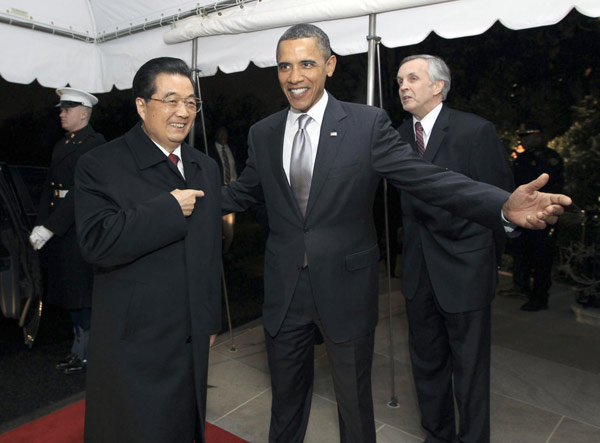
Obama’s State Dinner for Hu


President Hu Jintao of China was honored Wednesday night with a state dinner at the White House
was given by President Obama and his wife, Michelle.

Wednesday, January 19, 2011

Tunisians speaking out as shackles of silence fall


How does it feel to speak your mind in public for the first time — and make a difference?
Tunisians silenced for the last 23 years are wasting no time finding out, now that the strongman who muzzled the nation has fled.
There is no letup in street protests, partly spurred by Facebook and cell phone mobilization, that helped push President Zine El Abidine Ben Ali into exile. Journalists at a major state-run newspaper have staged a mutiny. Everywhere, people vow to guard their newfound freedom of expression whatever the price.
"The people decided to speak and the people have spoken," said a well-known cartoonist at La Presse, a major state-run daily. Lotfi Ben Sassi helped lead the charge to push the old guard executive editor out the door this week. "I've never lived in a democracy and I'm 51 years old."
There is a pervading sense among Tunisians that they are, at last, on the doorstep of democracy and this opportunity to get it right must not be missed. Street demonstrations small and large, often dispersed in chaos by police firing tear gas, funnel the joy, anger and fear of Tunisians trying to ensure that their "people's revolution" doesn't stop.
Tunisia is a nation of contradictions. With few natural resources and only 10 million people, it has made its population its main resource, developing an educated middle class and strong tourism economy. Few visitors would recognize the repression that kept the nation silent.
Beneath that veneer of stability and modernity, journalists or others who challenged the authorities under Ben Ali faced intimidation, arrest, or worse. Less than two weeks ago, reporters who wrote about police shooting at protesters in the provinces were summoned by communications authorities to answer for their actions.This North African country, a former French colony where tourists come to soak up the Mediterranean sun, has been turning the pages of history at blinding speed since Friday when Ben Ali fled to Saudi Arabia.
In the four days that followed, an interim president was named after some stumbling, the nation's first modestly multi-party government was appointed and less than 24 hours later, four ministers resigned amid cries from the street to dismantle the entire system of the former ruling party.
"We don't believe this," said Saida Ferjani, 56, chatting Tuesday at a table in a sidewalk cafe about politics — impossible under Ben Ali's reign. "We think it's a movie. We feel like we're dreaming .... Before, when we talked, it was quietly at home. We were afraid to express ourselves."
Ferjani, like many others, credits online media and social networks for breaking the barrier of silence.
"It's thanks to the Internet and Facebook that we could topple this government. It's the young who did it," she said.
For weeks, mainstream newspapers and the state-controlled TV and radio paid virtually no attention to riots around the country that preceded Ben Ali's downfall. The protest movement began in a provincial town where a young university graduate set himself on fire Dec. 17 in despair over bleak job prospects.
It spread to other towns as Tunisians were constantly updated via blogs and Facebookers like one called the "Tunisian Girl," photos shot on cell phones and posted online, and satellite TV — particularly Al-Jazeera. Twitter has made less of an impact and video-sharing YouTube and Daily Motion were censored until last week.
A testimony to the power of bloggers was the appointment Monday of a just-released jailed blogger to the government, Slim Amamou, now minister of youth and sports. He was briefly imprisoned, then freed, in the final days of Ben Ali's regime.
Only a day before fleeing to Saudi Arabia did Ben Ali commit himself to freedom of the press, Internet and expression in general. Too late.
The press watchdog Reports Without Borders has repeatedly listed Ben Ali among the world's 40 top "predators" of the media.
"Journalists and human rights activists are the target of constant bureaucratic harassment, police violence and surveillance by the intelligence services," the group says in its 2010 report. Independent journalists suffered reprisals, and foreign journalists are assigned minders by a regime "almost obsessive about control of news and information."
Such pressures were a daily reality for journalists at the state-run paper La Presse. Inspired by the new climate, they revolted and dismissed their boss, Gawhar Chatty, and set up their own interim committee to run the paper.
When Chatty showed up at the office Monday after a call advising him to stay home, cartoonist Lotfi marched into his office for the final farewell.
"We informed him (by phone) that we're taking charge of the paper and if he comes in we'll break his face, excuse the expression," managing editor Faouzie Mezzi told AP Television News.
The other leading French language paper, Le Temps, tried to save its honor in its Friday edition, out before news of Ben Ali's quick exit — conceding that there has been a "system within a system ... a hidden lock" that kept journalists from doing their job.
The transition from silent fear to speaking out isn't automatic for everyone, and some Tunisians still prefer the shadow of anonymity or whispers.
"We made a revolution in a month and in six days we can't all demonstrate," said a woman calling herself only Malika, worried about the repercussions of having her full name published.
Facebook sites remain mostly anonymous, often using a version of the red and white Tunisian flag as a profile picture. But they have friends: 380,742 on Tuesday for a page calling itself "RCD Get Out," a reference to Ben Ali's party. Other Tunisian Facebook sites attract similar numbers.
Yes, says Ferjani, the housewife, "We're happy and we're free."

Terrorism puts future of 3.6m students at stake: Report

PESHAWAR: The fresh wave of terrorism in the province has put the future of around 3.6 million students of government schools at stake, according to a report of Education Department.
The state-run schools remain the main target of the miscreants in fresh strings of terrorism incidents in the province, report added.
It further said that more than 350 public sector schools were affected in terrorism acts in the province putting the future of thousands of students in jeopardy.
Insurgents have been targeting schools in Peshawar, Swat, Bajaur, Malakand and Khyber agency and are not sparing any opportunity to hit schools especially government educational institutes.
The security guards deployed at government schools are not properly trained and equipped to counter terrorist attacks, the report observed, adding that the rising incidents of terrorism have increased the need for initiating such trainings for the security staff.
It is worth mentioning here that at least 20 schools, most of them for girls, were blown up alone in provincial metropolis in the year 2010.
Though government claims to have taken steps for protecting educational institutions, yet it has failed to prove the claim.
No doubt, the number of subversive activities in urban areas has decreased as compared to the previous year but it seems that militants have focused on destruction of educational institutions.
A group of Taliban has claimed responsibility for attacks on schools and warned that they would continue to destroy educational institutions.

Turning beer into alcohol is a delicate brew in Russia

Washington Post


MOSCOW - Russia's Duma deputies might find it easier to turn lead into gold than make beer into alcohol.

Creating gold requires only the magic of alchemy, but the fate of a proposal to legally define beer as an alcoholic drink will depend on the even more challenging art of politics.

Russian law treats beer as a food - it could just as well be a package of pasta - and anyone who makes and sells it only has to prove that conditions are sanitary. This lack of regulation and attendant attitude, critics say, has contributed to young people starting to drink as early as age 13, paving the way to the nation's unbridled alcoholism.

Even so, approval looked far from certain when the government last week asked the Duma to pass a law defining beer as alcohol, so it could be banned at children's events and limited at the ubiquitous street kiosks where it's now practically interchangeable with soda.

Duma deputies are up for election in December, deputy Anton Belyakov pointed out, and too many of them depend on the well-off beer industry for financing.

"It's billions and billions of dollars a year," said Belyakov, a member of the minority Fair Russia party. "I want to repeat: A significant part of that financial flow goes into the building where I work."

The proposed law is relatively mild - beer could still be made without a license - and it was cast as furthering a goal set by Prime Minister Vladimir Putin and President Dmitry Medvedev to cut the nation's alcohol consumption in half by 2020.

"There are a lot of public statements about anti-alcohol measures," said Belyakov, who said he has unsuccessfully introduced about 15 such measures over the last two years, "but nothing really happens to decrease alcohol consumption."

Russian officials frequently offer horrifying statistics about the damage from alcohol: The number of children aged 10 to 14 who drink rose 15.4 percent in 2008, to 10.8 million; the population of 140 million has 2 million alcoholics; more than 23,000 people die of alcohol poisoning annually; and 500,000 die from crimes, accidents and illnesses related to alcohol.

"Frankly speaking," Medvedev has said, "alcoholism in our country has become a national tragedy."

Beer, which is usually less than 5 percent alcohol, does not rank in the public imagination with "real" alcohol, such as vodka, at 40 percent. But Belyakov said marketing beer toward young people starts a habit that is deeply ingrained by the time they turn 30 or so and begin consuming stronger drinks.

Vadim Drobiz, director of the Research Center for Federal and Regional Alcohol Markets, said that as the beer market was developing here in the 1990s, officials hoped it would prove a healthier alternative to hard liquor.

But instead, without dropping the ubiquitous vodka toast, Russians also developed a thirst for beer that required considerable slaking, contributing to a prodigious consumption of alcohol. The World Health Organization calculated that in 2005, Russians over 15 were drinking the equivalent of 15.7 liters of alcohol per capita per year. The U.S. figure for that year was 8.4 liters, according to the National Institutes of Health.

Those figures are determined by the amount of alcohol in each type of beverage: drinking 2.5 liters of vodka, for example, would amount to 1 liter of alcohol consumed.

"If you convert this into bottles of vodka," Medvedev said at a 2009 forum, "it torments the soul."

Converting it into beer, Drobiz said that Russians consume about 81 liters per capita per year, and that beer consumption in 2007 was 51/2 times greater than in 1995.

Members of the Union of Russian beer producers, who say they do not market to teenagers, say beer should not be blamed for alcoholism when it makes up only a quarter of the alcohol being consumed. They suggest that officials fix social problems first.

The drinking age is 18, but Pavel Shapkin, head of the Center for Development of a National Alcohol Policy, says even that is not strictly enforced.

"Of course beer is sold to minors," he said. "Nothing is monitored, nothing is controlled. Beer is very accessible. So if we are talking about the government trying to decrease consumption at least twice by 2020, how can you do this without restricting the consumption of beer?"

Whether the Duma will find a way to turn beer into alcohol remains unclear, but everyone agrees that lobbyists will find much to occupy them.

Jordan protesters inspired by Tunisian ripple


Nearly everyone you talk to in this little desert kingdom reacts the same way. They break into a broad smile at the mention of Tunisia.
"Everybody is happy," said one young Jordanian man huddling under his sweatshirt hood for warmth. "Because [deposed Tunisian president] Bin Ali was a bad man."
"When we saw what was happening in Tunisia it was contagious!" exclaimed Adel Shamayleh, a real estate broker who lived for years in California. "People start to go "hey, why don't we do like what the Tunisians do?""
Long before Tunisians took to the streets, Jordan was already mired in a deep economic downturn that prompted a series of protests.
But when several hundred demonstrators peacefully gathered outside the parliament in Amman last Sunday, they added a new slogan to their often-repeated complaints about government corruption and the soaring cost of living. "A salute," they shouted, "from Amman to proud Tunis."
Businessman and political commentator Labib Kamhawi said many Jordanians identify with the hardships that led Tunisians to rise up against their president.
"The Tunisians revolted against problems that exist in Jordan, exist in Egypt, exist everywhere.

Dalbandin: Two-hundred houses damaged by quake

The earthquake of 7.2 magnitude which rocked large parts of Balochistan after Tuesday midnight damaged at least 200 mud-houses in Dalbandin but caused no casualties.

“Only a woman patient suffered a heart attack when the quake struck Quetta and later died. Four people suffered light injuries in Dalbandin when roofs of their houses collapsed, an official said.

“Most of the mud-wall houses were damaged in and on the outskirts of Dalbandin town,” Deputy Commissioner of Chaghai district Dr Saeed Jamali told Dawn by phone. He said the villages of Killi Qasim Khan, Killi Khuda Bakhsh, Killi Baz Mohammad, Killi Daudabad, Chater and Yakmach were affected. A number of government offices were damaged.

“Walls of the deputy commissioner’s house, tehsil office, Levies police station and other offices were damaged,” Mr Jamali said.

He said that many people did not want to return to their damaged homes because of fears of aftershocks. “We have requested the departments concerned to send tents, blankets, food packets and other items of daily use for the affected families,” Mr Jamali said, adding that the local administration was providing maximum help to the people.

“I feel bad that my home has been damaged, but I am happy that we did not suffer any loss of life,” said Ali Dost, a resident of Dalbandin.

Some houses in Kalat and Surab were also damaged.

However, the situation in Kharan, which is close to the epicentre of the quake, was different and no damage was reported from any part of the town, except some cracks in walls.

In Quetta, people aware of the devastation caused by the 1935 earthquake in the area, spent the entire night outside their homes in freezing minus-seven degree cold.

“We cannot put our lives at risk as aftershocks are shaking the earth,” 50-year-old Mohammad Amaz told this correspondent.

Prime Minister Yousuf Raza Gilani held a meeting with the chairman of the National Disaster Management Authority in Islamabad on Wednesday and asked him to arrange relief goods for affected areas of Balochistan and remain on alert to meet any emergency.

An NDMA spokesman said that necessary relief goods, including food, tents, medicines and blankets, had been rushed to affected areas through two C-130 aircraft of PAF.

The Pakistan Air Force and Pakistan Army are on high alert and two air missions are assessing needs in quake-hit areas. In addition, a Bell and MI-17 helicopters of the Pakistan Army and a Cessna aircraft are in Quetta with three medical teams to be deployed on short notice.

Balochistan Chief Minister Nawab Aslam Raisani, who was in Islamabad, directed the Provincial Disaster Management Authority to immediately dispatch relief goods for the affected people in Dalbandin.

He directed all deputy commissioners of Balochistan to conduct a survey to assess losses caused by the quake.

The Governor of Tabuk province of Saudi Arabia, Prince Fahad Bin Sultan Bin Abdul Aziz Al-Saud, who was in a desert area of Dalbandin when the earthquake hit the region, is safe. The prince is in the area for hunting houbara bustard.

“Prince Fahad Bin Sultan and people of his entourage are safe, Chaghai Deputy Commissioner Dr Saeed Jamali told Dawn, adding that the Saudi prince was in his saloon when the earthquake jolted the area.He said the Saudi governor and his entourage had now moved to Nokundi area.

Karzai Delays Afghan Parliament as Vote Crisis Deepens

New York Times

KABUL, Afghanistan — President Hamid Karzai ordered a month’s delay in seating a new Parliament on Wednesday, heightening a constitutional crisis that threatens to fuel bitter infighting and potentially even violence among the country’s rival factions.

The move leaves Afghanistan without a Parliament five months after its September election, with the prospect of even further delays. It also puts Mr. Karzai squarely at odds with his international backers, who insist the elections were valid after investing heavily in them as a way to promote Afghanistan’s fledgling democracy.

Mr. Karzai made his decision at the request of a special court he personally appointed to hear complaints from losing candidates, who say fraud and insecurity left large parts of the population excluded from the vote. Many are from the heavily Pashtun south, where the insurgency is most intense and Mr. Karzai maintains his main political base.

Their reduced representation in the new Parliament, which was scheduled to be inaugurated Sunday, threatens to drive more Pashtun regions into the arms of the Taliban insurgency, some have warned. But Mr. Karzai’s decision — which moved the country one step closer to undoing the election — contained real risks of its own and underscored the paucity of good options since the disputed vote.

While the losing candidates say the skewed results could lead to a new dimension of violence in Afghanistan, the winning candidates are unlikely to accept any reworking of the results and threaten violent protests of their own if they are deprived of their seats.

In addition, the Karzai administration’s effort to redress the complaints have precipitated a crisis of its own and drawn charges that the president is trying to engineer a more favorable outcome for himself.

A range of Afghan and international officials consider the special court he appointed to be unconstitutional, insisting that Afghanistan’s election commission has final say over the election. The commission, which has certified the results as legitimate, has refused to cooperate with the court.

The former Parliament adjourned before the balloting last September, and as the dispute lingers Mr. Karzai has ruled by decree, further worrying his international backers.

Furious efforts had been underway on Wednesday by Western diplomats to persuade Mr. Karzai to ignore the court’s demands and inaugurate the Parliament as scheduled on Sunday, but the president rebuffed their pleas.

“We cannot afford a country without a Parliament,” said a Western diplomat in Kabul, who spoke on condition of anonymity to avoid offending Afghan politicians.

“I see a two-fold danger, a constitutional crisis and how it will affect stability in the country,” the diplomat said. “For Western taxpayers who are hungry for good news — this looks awful.”

In a news conference on Wednesday attended by scores of losing candidates who have been pressing for new elections, Sediqullah Haqiq, the chief judge of the special court, said that the elections were tainted by “huge fraud,” and that he needed at least another month — possibly longer — to rule on the elections. He suggested the court might have to order recounts in some provinces.

While the losers were jubilant at Judge Haqiq’s declaration, winning candidates, who expected to take their seats at Parliament’s inauguration Sunday, were indignant.

“The instability and insecurity you see now will grow ten times over and it will not be like regular violence, it will be worse,” said Qazi Nazir Ahmad, a newly reelected member of Parliament from Herat Province.

Western officials speaking on condition of anonymity, said that delaying the inauguration of Parliament or, even worse, annulling the election, would unravel the country’s nascent democracy. “Is a delay the endgame, or is it no parliament for another year that’s the endgame, or is it a throw-out of the Parliament altogether?” said a Western official in Kabul.

Judge Haqiq complained that when his court wrote to Afghanistan’s Independent Election Commission asking for information to help its inquiries, it was rebuffed. The commission’s reply was short and to the point:

“No other organization can question anything about the elections. If you or anyone else wants to know anything else about this, you can go to our website, www.iec.org.af.com.”

The Electoral Complaints Commission, which has already reviewed 6,000 formal complaints from the polling, similarly rejected the ad hoc court’s attempted intervention, also inviting it to view its own Web site, www.ecc.org.af, where the results of its work were published, according to Ahmad Zia Raffat, the commission’s spokesman. “According to the country’s laws and constitution, the special court is totally illegal,” he said.

Judge Haqiq said he viewed “with great sadness” the election commissions’ refusal to cooperate with the court.

“In the whole country, there was no province from which we did not receive any complaints,” said Judge Haqiq. “The whole world should know that there was a huge, enormous fraud in these elections.”

No one disputes that the parliamentary elections were badly tarnished. The election commission threw out nearly a fourth of the total votes recorded as fraudulent or tainted, which invalidated the election of many candidates — particularly members of the most numerous ethnic group, the Pashtuns.

The commissions, however, supported by the international community, ruled that their certification of the results was valid once they removed the problem voting districts and candidates in a process that was legal and transparent.

“Unfortunately losers in Afghanistan will never accept that they are losers,” said one of the winning candidates, Abdul Zuhair Qadir, who was attending orientation sessions for the new Parliament.

The special court’s actions appeared to be just the latest in moves by Mr. Karzai’s government to discredit the work of the two election commissions.

In December, 10 members of the election commission, including all seven of its commissioners and three high-ranking staffers, were indicted by the attorney general on unspecified electoral fraud and abuse of authority charges, according to Abdullah Ahmadzai, the election commission’s chief electoral officer and one of the indictees.

In addition, the attorney general indicted four prominent members of the complaints commission on the same charges, including all three of its Afghan commissioners, Mr. Ahmadzai said.

President Karzai appointed all of the election commissioners and the three Afghan complaints commissioners; the other two complaint commission members were foreigners appointed in consultation with the United Nations. They have not been charged.

“This is all happening because they feel the results need to be changed and they can’t change them,” Mr. Ahmadzai said. The election commission’s certification of the results is final and there is no legal mechanism for changing that, he said.

Obama says 'positive' U.S.-Chinese ties good for U.S.


Pakistan, Afghanistan Promote Stronger Ties in Effort to End Violence


Pakistan and Afghanistan have recently concluded high-level talks aimed at accelerating the process of reconciliation and reintegration with Taliban insurgents to try to bring an end to the near decade-long Afghan conflict. The United Sates, which plans a phased withdrawal of its combat troops this summer, has welcomed the increased interaction between Kabul and Islamabad, which it believes is crucial for bringing peace to Afghanistan.

Karzai Efforting Peace with Taliban

Afghan President Hamid Karzai is trying to make peace with Taliban insurgents who are ready to denounce violence and cut ties to terrorist groups. He recently created a 70-member High Peace Council in which almost all sections and ethnic groups in Afghan society are represented.

A 25-member delegation headed by council leader Burhanuddin Rabbani travelled to neighboring Pakistan this month for the first time to seek Islamabad’s cooperation for the Afghan reconciliation process.

Members of the Afghan peace delegation held extensive discussions with top Pakistani civilian and military leaders for almost four days. Both sides have agreed to promote the Afghan reconciliation process at a people-to-people level by holding a traditional jirga meeting.
Pakistan Commits Support to Effort

But a major outcome of the delegation’s visit is an agreement to create a joint governmental commission to promote the Afghan reconciliation process.

Pakistani Foreign Minister Shah Mehmood Qureshi says his country will support the process as long as it is led and owned by Afghans themselves.

"They have to determine what they want from Pakistan, and Pakistan will facilitate. They wanted a bilateral [joint commission] to oversee the whole process and Pakistan has given a nod of approval to that. So Pakistan is serious because Pakistan feels that you need more than military operations to achieve peace, you need political engagement, you need governance, you need capacity building, and Pakistan will support Afghanistan."

Building Mutual Trust

Pakistani and Afghan officials say their primary objective is to build mutual trust and make joint efforts to try to assure insurgent groups that U.S.-led international forces are not occupying Afghanistan.

Afghan delegation member Mohammad Masoom Stanekzai says Afghanistan and Pakistan have stopped blaming each other for the security problems facing the two countries. Stanekzai says that in the past two years bilateral political and economic ties have improved, leading to the formation of the joint reconciliation mechanism.

The Afghan delegate says Pakistan’s role is important because insurgent groups fighting on both sides of the border are interlinked.

"[Pakistan] can play a role because they are sharing a long border with Afghanistan. Those who were with Taliban they mostly had spent time in Pakistan. They (Pakistan) have their political and religious leaders, who have contact with them (insurgents). Our jihadi leaders have contact with them. I do not think that their (Pakistan) contacting them (insurgent groups) will be a difficulty, but the difficulty will that how we can build confidence to overcome the misunderstandings (among Taliban groups) that Afghanistan is not occupied."

The insurgents' Pakistan connection

U.S. and Afghan officials widely believe some key leaders of Afghan insurgent groups are hiding in Pakistan and have links to Pakistani militant groups and elements within the country’s intelligence network. Analysts like international relations professor Hassan Askari believe that despite pressure from the United States and other Western allies, Pakistan may not want to cut ties to some Afghan insurgent groups.

"These ties are going to be helpful. I think the U.S. will have to reconsider its emphasis on severing all connections. Pakistan will pursue a policy that would serve its interest and on this point I think the divergence between Pakistan and the U.S will continue. It is not practical (for Pakistan) to pick up confrontation with each and every Taliban group if reconciliation is to be promoted."
US welcomes interaction

Coinciding with the Afghan High Peace Council’s visit was the arrival in Islamabad of the acting U.S. special envoy to Afghanistan and Pakistan, Frank Ruggiero. After meeting with leaders of the Afghan delegation and Pakistani officials, Ruggiero said Washington welcomes the increased interaction between Kabul and Islamabad to tackle the insurgency.

"The United States has encouraged the government of Pakistan, the government of Afghanistan to increase their interactions and to improve their relationship. And from all that we have been able to ascertain from this visit and from what we are hearing back in Washington is that there has been progress in the bilateral relations."

Despite recent violent attacks in southern Afghanistan, Ambassador Ruggiero reported progress in the military campaign against Taliban insurgents, but he acknowledged the international effort to bring peace to the country faces serious challenges.

"As you see the increase of American forces go into these places, and southern Afghanistan has been the primary area where American forces have gone, I think overall you have seen an increased improvement in the security situation. You have started to see some enhanced levels of governance that remains, frankly, a very critical challenge for us. I mean Afghanistan is a society that suffered through 30-years of civil war, so trying to find that governance structure that can work with the Afghan security forces, the American security forces, is just a challenge."

While the U.S special envoy and members of the Afghan peace delegation sounded optimistic about recent talks in Islamabad, it is still not clear how Pakistan will position itself to use its influence with some of the Afghan insurgent groups to bring them to the negotiating table. But Pakistani officials have indicated behind-the-scenes work is already underway.

No Major Damage Reported After Powerful Pakistan Quake


A magnitude 7.2 earthquake shook southwestern Pakistan early Wednesday, jolting residents of cities as far away as the country's largest city of Karachi and the Indian capital, New Delhi.

The U.S. Geological Survey said the earthquake was centered 55 kilometers west of the town of Dalbandin in Baluchistan province, which is the country's most sparsely populated area.

Local officials said the earthquake damaged some homes in Dalbandin, but there were no reports of any injuries or casualties.

The Pentagon said U.S. troops in southwestern Afghanistan felt the tremor, but there were no injuries or impact on U.S. military operations in Afghanistan or Pakistan.

U.S. officials also said Pakistan has not asked for assistance with quake relief.

Earthquakes are common in the region. A magnitude 7.6 quake on October 8, 2005 killed more than 70,000 people in northwestern Pakistan and Pakistani-administered Kashmir, and left more than 3 million people homeless.

President Hu kicks off landmark US visit


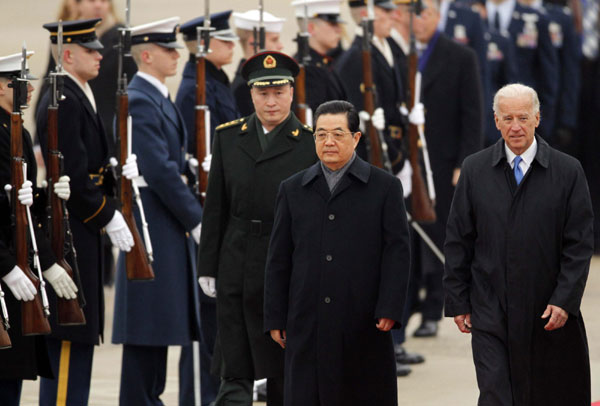
President Hu Jintao arrived in Washington Tuesday afternoon (local time) for his four-day highly-exposed state visit to the United States.

Hu is expected to lay out his blueprint on US policy during his three days in Washington, where he'll meet with President Barack Obama, top legislators and business executives, followed by a stop in Chicago.

The US has made grandeous reception for Hu, with the White House busy preparing for a State banquet on Wednesday night, prior to a private dinner given by Obama to Hu on Tuesday night.
Chicago mayor Richard Daley also said it is a "big big big deal" for Hu to come to his city for a visit, where Chinese-funded enterprises have played a considerable role in the revival of the local economy through the financial crisis.
On arriving at Andres Air Force Base, Hu said in a written speech that "vast as it is, the Pacific Ocean has not stood in the way of the friendship between the Chinese and American people."

The international situation is undergoing profound and complex changes, and China and the US have growing common interests and responsibilities and enjoy broader prospects for cooperation, according to Hu.

"The purpose of my visit is to enhance mutual trust, promote friendship, deepen cooperation and move forward the positive, cooperative and comprehensive China-US relationship for the 21st century," said Hu.

Hu said he looks forward to have in-depth discussions with President Obama on bilateral relations and major international and regional issues of shared interest.

"The long-term, sound and steady growth of China-US relations is conducive to the fundamental interests of the Chinese and American people and to world peace and development," said Hu.

"China stands ready to work with the United States to actively develop China-US relations on the basis of mutual respect and mutual benefit and join all other countries in a common effort to build a harmonious world of lasting peace and common prosperity," said Hu.

US experts have also voiced their optimism for a constructive leadership summit.

President Emeritus of Asia Society Nicholas Platt said strategic trust is something both sides should be striving for.

"We should also look below the surface to what Chinese and Americans are actually doing together before making judgment of whether we have trust or not," said Platt.

According to Douglas Spelman, deputy director of Kissinger Institute on China and the United States (Woodrow Wilson International Center for Scholars), both sides now have to give priority to the underlining common interests and not let the differences override common interests.

"One other thing I think the visit is a good opportunity not just for the leaders and other officials to get together, but for people in China and the United States to feel that this is an important relationship. It has a public aspect as well as talk among themselves," said Spelman.

According to Knneth Lieberthal, director of John L. Thornton China Center, Brookings Institution, inevitably economic and trade issues will loom very large in the leadership talks.

According to Lieberthal, China is beginning a period of economic reconstruction at home, and Americans are doing exactly the same thing. And frankly, China and the US have enormous interest in the success of the other one in their reconstruction effort.

"So I think understanding those efforts better, figuring out how we can coordinate and be mutually helpful, those efforts are very important," said Lieberthal.

Lieberthal also reminded that the two countries share some security interests, especially the issue of nuclear proliferation.

In order to solve some existing issues between two militaries, Lieberthal suggested the two countries need to string out rules and have more effective communication between the two militaries.

Hu, Obama vow to deepen China-US ties


Obama held a 3+3 highly private dinner on the very night of Hu's arrival in Washington, with State Secretary Hillary Clinton and Assistant National Security Donilon on the US side, and State Councilor Dai Bingguo and Foreign Minister Yang Jiechi on the Chinese side attending the dinner.

Obama and Hu made positive evaluation on the progress made on bilateral ties, and said they are ready to further advance the existing positive, cooperative and comprehensive relationship, according to a Chinese foreign ministry press release after the dinner.

Hu said he comes to the US for the goals of enhancing bilateral understanding and mutual trust, and enlarging exchanges and cooperation, according to the press release.

Hu also comes for the goals of strengthening effective coordination between the two countries on major regional and international issues, and to embark on new era in China-US relation.

"I look forwards to exchanging in-depth views with Mr President Obama tomorrow, and jointly discuss blueprint of China-US cooperation," said Hu.

President Hu's visits U.S.

Visit msnbc.com for breaking news, world news, and news about the economy

Tuesday, January 18, 2011

Pakistan earthquake.


According to the U.S. Geological Survey, a strong 7.2 magnitude tremblor struck a remote area in southwest Pakistan at 8:23pm GMT January 18, 2011, (1:23am 1/19/2011 local time). The earthquake occurred 640 miles west-southwest of Islamabad, near the borders of Iran and Afghanistan, and was felt as far away as New Delhi, Jaipur and Dehradun in India, and in Dubai reports CNN.com.
The earthquake occurred on Wednesday, January 19, 2011 at 01:23:26 AM at the epicenter, or Tuesday, January 18, 2011 at 20:23:26 UTC. The epicenter is located at 320 km (about 200 miles) southwest of Quetta near Kharan, Balochistan.
Buildings in Karachi - about 400 km west of the epicenter - show signs of cracks. No word of fatalities have been reported.
CNN.com quotes Kurt Frankel of the Georgia Institute of Technology as saying, "It's not uncommon for this region to have earthquakes. It is where two tectonic plates come together, he said."
Pakistan Earthquake Details
Location: 28.838°N, 63.947°E
Depth: 84 km (52.2 miles)
45 km (30 miles) W of Dalbandin, Pakistan
260 km (160 miles) W of Kalat, Pakistan
310 km (190 miles) ESE of Zahedan, Iran
1035 km (640 miles) WSW of ISLAMABAD, Pakistan
Past Pakistan Earthquakes with Fatalities:
1935 05 30 - Quetta, Pakistan - Magnitude 7.5 Fatalities 30,000
1945 11 27 - Makran Coast, Pakistan - Magnitude 8.0 Fatalities 4,000
1974 12 28 - Northern Pakistan - Magnitude 6.2 Fatalities 5,300
2005 10 08 - Pakistan - Magnitude 7.6 Fatalities 86,000
2008 10 28 - Pakistan - Magnitude 6.4 Fatalities 166


Continue reading on Examiner.com: Pakistan earthquake: Major 7.2 quake near Afghanistan felt in Dubai, New Delhi - National World News | Examiner.com http://www.examiner.com/world-news-in-national/pakistan-earthquake-major-7-2-quake-near-afghanistan-felt-dubai-new-delhi#ixzz1BRxlUfyC

Pakistan earthquake felt in India


A powerful earthquake struck Pakistan early Wednesday morning, causing people to run from their homes reciting verses of the Koran. Strong tremors from the earthquake, which hit about 50 kilometers west of Dalbandin, could be felt as far away as India and the Gulf.

The earthquake, which measured 7.2 magnitude, hit at 1:23 am in a remote and sparsely populated area in Baluchistan province, near the border with Afghanistan and Iran. It struck about 50 kilometers from Dalbandin, a town so remote Pakistan used the nearby Chagai hills for nuclear tests in 1998.

There were no initial reports of casualties, AFP reports.

"I was watching TV when suddenly the TV screen began shaking. Then I realized it was a very strong earthquake," Saeeda Jehan, a mother of six in Karachi told CBS News. "Everyone said doomsday has arrived. But I was concerned about my children. It took me 10 minutes to wake them all up before we could all step out."

Tremors were felt as far away as New Delhi, about 1,3000 kilometers away, other cities in northwestern India, Abu Dhabi and Dubai, according to the US Geological Survey (USGS).


The earthquake comes as Pakistan struggles not to collapse in the face of deep divides within the country and pressure from the United States to extend its cooperation in the fight against militants in Afghanistan. The assassination of Salmaan Taseer, the governor of Punjab province, two weeks ago raised further fears about the fragility of the country. The troubled nation is also still recovering from floods that left more than 10 million people homeless last year.

"A humanitarian crisis in Pakistan caused by the earthquake will only undermine U.S. interests," a western diplomat in Islamabad told CBS News. "As it is, we must all worry about instability in a country armed with nuclear weapons and with political and economic problems," he added.

A 2005 earthquake devastated Pakistan, killing more than 70,000 people, leaving 3 million homeless and becoming one of the world's worst humanitarian crises.

Major earthquake strikes southwestern Pakistan

CNN.COM
An earthquake with a magnitude of 7.2 struck Wednesday morning in a remote area of southwestern Pakistan, but initial reports revealed no major damage.

The earthquake occurred at 1:23 a.m. (3:23 p.m. Tuesday ET) at a depth of 84 kilometers (52 miles), the U.S. Geological Survey said. It was centered 45 kilometers (30 miles) west of Dalbandin, and 1,035 kilometers (640 miles) west-southwest of Islamabad, the USGS said on its website.

Arif Mahmood, director of the Pakistan Meteorological Department, put the epicenter at 320 kilometers (about 200 miles) southwest of Quetta near Kharan, Balochistan, and said it had been felt in Punjab, Sindh, and Balochistan provinces in Pakistan, as well as parts of Iran and India.
Mahmood predicted major aftershocks. "Earthquakes with such magnitudes in the past have brought on aftershocks," he told CNN from Islamabad.
Residents near the epicenter in the districts of Kalat, Dalbadin and Kharan told CNN some mud-walled homes were damaged but no one was hurt.
An official at Quetta's Civil Hospital said a female cardiac patient suffered a fatal heart attack during the earthquake. He said two residents raced to the hospital but they proved not to have been injured, just scared.Malik Muhammad Iqbal, the police chief of Balochistan province, said he was aware of no injuries.
"Things in the headquarters started shaking and books fell off the desks," Balochistan Police Inspector Sultan Mehmood told CNN in a telephone interview. "We left the headquarters running into the streets -- scared for our lives."
In Karachi, Faraz Leghari, director general police, said he had heard no immediate reports of casualties or building damage.
USGS initially reported the quake at 7.4. Quakes of 7.0 to 7.9 are classified as major; anything over 8.0 is classified as great.
In Dubai, about 500 miles southwest of the epicenter, a reporter said he felt a moderate shaking that lasted for about 30 seconds.
Usman Zahid, a night manager at Serina Hotel in Quetta, Pakistan, felt the quake. He said it was "frightening" and estimated that it lasted about 20 seconds. It left "broken glass in the kitchen" and made a chandelier swing, but caused no major damage, he said.
People with Twitter accounts in New Delhi, Jaipur and Dehradun -- all in India -- felt the quake. People with Twitter accounts in Bahrain said they felt the quake.
In Dubai, "I was just getting ready to go to bed," said Leone Lakhani in Dubai. She said she texted her friends in Abu Dhabi and Bahrain.
"It's not uncommon for this region to have earthquakes," said Kurt Frankel of the Georgia Institute of Technology. It is where two tectonic plates come together, he said.

Pakistan Braces for Worst in Quake Aftershocks


Panic-stricken people rushed out of their homes in Pakistan late on Tuesday night after a strong earthquake shook parts of the country, underlining another dimension of the challenges faced by Washington's key south Asia ally.
Pakistan's government officials said the earthquake emanated from a remote part of Pakistan's southwestern Baluchistan province which borders Iran and Afghanistan. It measured approximately 7.4 on the Richter scale, the international yardstick to measure earthquakes, and was powerful enough that its tremors were felt as far as Dubai in the Middle East.

Massive 7.4 Earthquake Hits SW Pakistan

The earthquake's intensity was just below that of another earthquake measuring 7.6 that struck parts of northern Pakistan in 2005 and killed more than 70,000 people. Early reports suggest that the extent of damage to property and human casualties may have been limited, as the earthquake's epicenter was near Dalbandin, a remote and sparsely populated town in the western Baluchistan province.

Government officials warned Pakistan will live with the danger of possible aftershocks in coming days. In some instances such aftershocks have come within a week of previous earthquakes.

In Karachi, Saeeda Jehan, a middle aged woman and mother of six children, quietly read religious verses from an Islamic prayer book she carried as she waited for the building with her apartment to be declared safe for her return.

"I was watching TV when suddenly the TV screen began shaking. Then I realized it was a very strong earthquake," Jehan told CBS News while standing in a crowd at Karachi's Stargate neighborhood near the city's main airport.

Forced to leave her apartment after the earthquake, which shook the country around 1:26 a.m. local time, Jehan recounted her ordeal. "Everyone said doomsday has arrived. But I was concerned about my children. It took me 10 minutes to wake them all up before we could all step out."

Jameel Harris, an ambulance driver in Karachi, also forced to leave his flat with his five children and his wife, said there were no reports of heavy damage, though signs of panic were all around. "I have heard of cracks in some buildings but that is not across the board. The damage seems to have been done mostly to older buildings," he said.

In Pakistan's capital Islamabad a western diplomat warned that further damage from the earthquake, notably any of its aftershocks, could seriously undermine Pakistan's future, right at a time when the U.S. is urging the country to extend more cooperation in its campaign to fight militants.

"A humanitarian crisis in Pakistan caused by the earthquake will only undermine U.S. interests," the western diplomat told CBS News on condition of anonymity. "As it is, we must all worry about instability in a country armed with nuclear weapons and with political and economic problems," he added.

Tuesday's earthquake was a powerful reminder of the 2005 earthquake when the death toll of more than 70,000 turned it in to one of the world's biggest humanitarian tragedies.