Tuesday, January 18, 2011

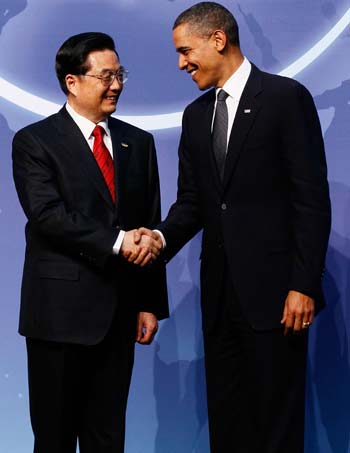
President Hu Jintao landmark trip looks to the future

China Daily


President Hu Jintao embarks on his long-expected four-day state visit to the United States on Tuesday, with the number of bilateral and global issues on the agenda putting it firmly in the international spotlight.

Observers said the visit will not only help reset bilateral ties after a rocky year, but will also help set the direction for Sino-US ties in a transformational era.

Hu's four-day visit includes stays in Washington and Chicago. It will be the first time that Hu has paid a state visit to the US since Barack Obama took office two years ago, yet it will be the eighth time that the two leaders have met for talks over the past two years, a frequency that some White House officials have described as "rare in modern US diplomacy".The Hu-Obama meeting will mainly focus on thorny bilateral issues including US arms sales to Taiwan and the bilateral trade imbalance, regional issues including the Korean Peninsula, and international issues including global economic governance and climate change.
Hu is also expected to meet local students and businesspeople in Chicago, Obama's hometown.

The Associated Press reported that Hu is to be feted in Washington with a lavish state banquet at the White House and other pomp usually reserved for close friends and allies - all of which, as the agency interprets, are intended to improve the tone of relations between a rising and prosperous China and a US superpower in a tenuous economic recovery.

Besides normal procedures involved for a state visit, the White House is also making extra efforts to ensure the success of the visit.

These arrangements include a small-scale private dinner for Obama and Hu on the day of Hu's arrival to allow for a frank and private discussion, which will help test the waters for the following day's talks.

First Lady Michelle Obama will also talk with US youngsters to encourage them to study in China, part of the plan announced by her husband during his state visit to China in November 2009 when he promised to increase the number of US youngsters learning in China to 100,000 by 2015.

Sources said Hu's visit will yield a number of agreements on bilateral trade, energy, environmental protection, infrastructure building, and cultural and personnel exchanges.

Purchases of Boeing aircraft and the building of a high-speed railway may be on the list of agreements, said sources. Diplomats from both countries have been negotiating a formal joint statement, but it remains to be seen whether Obama and Hu will issue a communiqu.

Chinese Vice-Foreign Minister Cui Tiankai said that the two sides are still discussing the content of the statement.

According to Wang Fan, an international studies expert at China Foreign Affairs University, the US is now looking at China in the context of historic shifts in the balance of power, as it figures out a strategy for its China policy, and is therefore giving China unprecedented attention.
Analysts said the significance Washington is attaching to the visit also derives from the fact that it increasingly needs Beijing's help in managing global issues, such as piracy off the African coast, Iran's nuclear program and reinvigorating the world economy.

Also, given the background of the Democrats' poor showing in the mid-term election, Obama now faces huge domestic pressure, and is hoping to reap dividends from a successful visit by Hu. That means business contracts that bring jobs to the sluggish US economy, progress on some issues that has affected bilateral ties, including trade and the Korean Peninsula issue.

China is also keen to take the opportunity to win trust and dispel suspicion in the US, which leads the developed countries. China wants to foster a favorable environment for its development.

Meanwhile, as the two are now each other's second-largest trade partner, China views the US market as crucial to its sustainable economic development.

Hu, during his four-day trip, is expected to promote China's peaceful development in a speech to business leaders and opinion-makers in Washington on Thursday and to highlight the benefits of China's market and investment when visiting Chicago.

Before Hu's departure from Beijing, high-ranking officials from each side changed the harsh tone they adopted in 2010 and became more positive regarding bilateral cooperation.

A flurry of diplomatic efforts, either visits made or speeches given by keynote officials from each country, had already been arranged prior to the visit, shedding light on the importance each side attaches to it.

Three major figures in Obama's administration - Secretary of State Hillary Clinton, Treasury Secretary Timothy Geithner and Commerce Secretary Gary Locke - have successively delivered speeches on Hu's visit, a rare occurrence in US politics.

In a speech on Friday, Clinton dismissed calls for a Cold War-style containment policy and instead described the relationship as an increasingly complex global "entanglement".

"This is not a relationship that fits neatly into the black and white categories like 'friend' or 'rival'.

"It is clear that we cannot paper over the difference between our countries; nor should we try to do so," she said. "But the future of our relationship can be strong if we each meet our responsibilities as great nations."

Chinese officials have emphasized what they see as common concerns while acknowledging the complexity of the relationship.

"When the relationship is strained, we need to bear in mind the bigger picture and not allow any individual issue to disrupt our overall cooperation," Cui said in a speech on Friday.

And for Chinese Ambassador to the US Zhang Yesui, it is not strange to see China and the US hold different views on some issues due to the different political systems, culture, history and social development.

"The key is to respect and take care of each other's core interests and major concerns, and we must solve the problems through dialogue and consultation on an equal footing."

Analysts believe it is a state visit meant to reset relations after a rocky year, and moreover it might help lay the foundations for bilateral ties in a transformational era in the near future.

Others also hold that the visit will benefit regional and international relations on the whole.
China and the US have experienced an eventful 2010, with an array of issues affecting bilateral ties, including US arms sales to Taiwan at the beginning of the year and the continuous pressure from the US on China's trade and currency rate.
"It is absolutely critical for the two sides to be setting a tone that says 'hang on a second, we are committed to an effective, positive relationship'," Center for Strategic and International Studies scholar Charles Freeman, a former trade negotiator in the George W. Bush administration, told The Associated Press.

According to Jin Canrong, deputy director of the School of International Studies at Renmin University of China in Beijing, it is unrealistic to expect that a single visit by a leader will solve all major problems between the two countries, yet more communication between the two sides will certainly help to improve mutual trust.

According to Jin, the old issues between the two countries, including Taiwan and Tibet, will continue to feature in bilateral ties, while some new issues will keep emerging, including economic competition and friction in military ties.

However, "as it is unlikely that the US will manage to confront or contain China, the only way left is to try to get China engaged in its global agenda", Jin said.

"The two will have a functional partnership by cooperating on an issue-by-issue base. Yet to achieve this, they need a mechanism to deal with their differences."

According to Wang Fan from China Foreign Affairs University, the two countries are both at a transformational stage, and, given China's growing role in global affairs, the two sides need to rebalance their relationship

According to Wang, how the two countries manage to influence and change each other in the future will influence their policies toward each other.

"There has been not so much strategic misunderstanding by the US as some assume. Instead, the US is caught in several strategic choices as it is not sure of where a growing China is heading. And China needs to work harder to dispel suspicion on the US side and increase mutual trust," Wang said.

In a signed article in The New York Times, Zbigniew Brzezinski, who served as former US president Jimmy Carter's national security adviser, said that Hu's visit to Washington will be the most important top-level encounter between the US and China since Deng Xiaoping's historic trip more than 30 years ago.

"It should therefore yield more than the usual boilerplate professions of mutual esteem. It should aim for a definition of the relationship between the two countries that does justice to the global promise of constructive cooperation between them," he wrote.

In a recent interview with Xinhua News Agency, former US secretary of state Henry Kissinger also proposed establishing "permanent consultative institutions" between the two countries. "If we have a permanent contact, then even (when) there is an occasion of difficulty, it will fit into a continuing dialogue, and I expect this to be a result of this visit," Kissinger said.

Fu Mengzi, a researcher with the Beijing-based China Institutes of Contemporary International Relations, said China-US cooperation will benefit not only both countries but also the Asia-Pacific region and the world at large.

That is due to the increasing interdependency between countries and regions in this era of globalization, he said.

Rana Mitter, a professor with the Institute for Chinese Studies at the University of Oxford, said the Hu-Obama meeting will "need to address the fact that both countries have a duty to the wider global community to solve problems that go beyond the nation-state".

Europe will be pleased that the US and China are holding such a high-level meeting. Bad relations between the US and China are not good for Europe, according to Mitter. But Europe and its large economies, such as the United Kingdom, will also want to remind China that they remain major trading partners and players in the international community, Mitter said.

Tunisia: A democratic roadmap


The road ahead for Tunisia is unknown, however with a cautious approach a durable decmocratic order can be established.

In the wake of an Arab world-shattering political development, the government of Tunisia has been effectively overthrown via an amalgamation of civil unrest, grassroots mobilization and what one could call a coup d'esprit.

Tunisia's new political masters must proceed by distancing themselves from self-congratulatory triumphalism. They will have to muster courage, display political imagination and modesty, and exercise tolerance of difference in order to fashion a durable democratic order in a post-Ben Ali Tunisia.

The question is always, of course, 'how'? Historically, whether it is the new republican order after the absolute monarchy in France more than 200 years ago, post-Franco Spain or post-Marcos Philippines, trepidation is inevitable. Skills of compromise, clear vision and purpose are needed to tread the unchartered waters of post-authoritarian construction.

Lessons from the 29 days that shook Tunisia

If anything, the bread riots that produced the Arab World's first people's power movement has served notice to the country's political class - past and present - in several ways.

One, Tunisia's people alone own the historical moment of victory against dictatorship. I think Tunisia's people have earned the right to be sovereign and treated accordingly. Any resulting political system must enshrine this moment as theirs alone. Institutionally, political reconstruction must entrust all sovereign mechanisms of checks and balances with the people.

Two, not the Western backers of the regime and not the expatriate politics of exile won the day against Ben Ali. This was a home-grown spontaneous movement.

Three, no single political movement, leader or ideology can fake political history and claim victory for a political current they neither precipitated, controlled or delivered. There is a poetic justice in this: all political actors enter the new political fray humbled and on equal footing. The Tunisian people are now handing them on a silver platter a rare chance to right many wrongs of the deposed president.

Four, spin politics and sugar-coating political performance are futile. Ben Ali's hiring spin trade and expertise from the US did not succeed to conceal the rot. No political spin could camouflage the visible political decay and loss of the last days of Ben Ali's rule. Deploying the classic technique of misdirection through the rhetoric of 'terrorism', Ben Ali failed to blind Tunisians and the Western machines of political patronage, unable to impress or stem the tide of rejection.

So spin politics must be condemned to the proverbial dustbin of history to join Ben Ali and co.

Fifth, the WikiLeaks moment means that the state can no longer withstand being 'Assanged', 'Twittered', 'Facebooked' and, consequently, denuded. Of course, Al Jazeera's own role in all of this must not be forgotten. It is about time Max Weber's template of statism is revised. Perhaps information, on which Weber says little or nothing, more so than monopoly over the technology of violence plays a decisive factor in the fate of states in the modern era.

Long live Ben Ali-ism?

Challenges remain ahead. People's power victories can be lost.

Ben Ali is gone but the vestiges of 'Ben Ali-ism' may still linger. Flushing them out will take time. Not so much in terms of personalities, political language and symbolisms, but most importantly in terms of political amorality or even immorality. Politics must be restored as a moral project with ends that transcend leaders, parties and ideologies.

The critical mass that eventually produced the flow of determination to defeat the authoritarian system, with a tipping-point provided by the national army, must now prove its fungibility in the reconstruction and transitional phase.

That is, it must be exchanged for new brand of political know-how after Ben Ali's removal in order to overthrow the system he has left behind.

But this is a political tightrope for all concerned. The endeavour to transform the system swiftly must be checked by the risk of total political vacuum. The ruling party's historical stature must be restored and it must therefore be maintained. Plus, not all Ben Ali's associates must be subjected to blanket witch-hunt or purge.

The struggle in the months ahead to maintain credibility with the Tunisian people and the world must be balanced with one conspicuous reality. Existing civil society and opposition are still fledgling. They need time to recover from the erasure of the past 54 years as well as partnership with those forces that worked for Ben Ali but are not necessarily 'Ben Ali-ist'.

The caretaker order, a remnant of the ancient regime, must therefore be allowed to act as a facilitator in the transition period. For this, the interim president and even whomever is elected after him must assume the role of an honest broker between the various political actors in the transition period.

The Islamists and the third republic

The Islamists have eaten humble pie after more than twenty years of political wilderness. This force is still to be reckoned with and must be given full rights of representation in the new political order. External considerations or reservations about a role for the Nahda party do not in the transitional period warrant its exclusion.

But the Nahda party of 2011 is not the Nahda party of 1989. Nor is Tunisia. New legitimate forces that have struggled from within Tunisia have earned the right to exist and contest power.

The Nahda party and whatever leadership is going to emerge now must absorb a few lessons of its own.

Firstly, it must get over its obsession with unity. Today's Nahda has at least two currents or factions within it. This must be viewed as enriching and pluralising and not a divisive dynamic. Secondly, it must engage with open politics away from secrecy or ideological rigidity. Thirdly, it must not return to the debates of the 1980s about the 'identity' question and its simplistic 'moralism'. Fourthly, it must act modestly and contest power with restraint, sharing the political scene with others instead of seeking domination. Lastly, it must favour political presence over absenteeism.

Nahda is a party which still has wide appeal but perhaps with a diluted following and even more political maturity. A sign of this is the tendency amongst many of its leaders today to even separate religion and politics. Nahda is not the Taliban.

No other single political entity in Tunisia can claim today to speak on behalf of all Tunisians. Let thousands of 'jasmines' of the unfolding Tunisian 'Democratic Spring' bloom on the basis of shared values of mutuality, respect, equality and modesty.

Fundamental Pact II: Learning Democracy

A new democratic order or 'workshop' will not moulded easily, irreversibly or quickly to succumb to new values of equal citizenship, continuously popularly mandated and contested power, inalienable rights for all Tunisians of all creeds and ideologies, and continuous tradition of political renewal and self-criticism.

Historically, Tunisia does not begin with a clean slate. Democratic learning should be inspired by the spirit of the 1857 Fundamental Pact ('Ahd Al-Aman), which amongst other things, sought to limit Beylical power. What begins now is akin to a 'Fundamental Pact' version II.

But Some of Tunisia's new players have just become apprentices in the politics of the state. Some have had no parliamentary experience; some not even participation at municipality level. So democratic learning begins now.

The path of democratic learning must keep in mind a threefold reality check: After the 14th of January 2011, no return to possession of the state or longevity in power will be possible; the state Tunisians have known is a state which practiced 'total politics' and learning self-government will involve trials and errors; Tunisians have rebelled for political freedoms but also for socio-economic equal opportunity and distribution, and this latter quest must not be forgotten.

Towards a transitional period

En route to democracy building and learning, short-term and long-term agendas must be clarified.

In the short-run, elections in two months must aim at producing only a transitional order. The 'rush' into elections may be premature in a society with weak political parties and until recently a heavily shackled civil society. But in this case it must proceed to organise the rules of political engagement and participation.

In the long run, the transitional order will have to work towards dismantling the presidential system. Excessive executive power must be terminated by preparing the legal and institutional grid and resources of switching into a parliamentary system. A new constitution will be needed for the new era and a transitional parliament and special commission aided by committees can be assigned this task.

The switch to a proportional electoral system can be planned in tandem with a switch to a parliamentary system.

The new order will need a free press to act as the unofficial opposition, and the security apparatus consisting of nearly quarter-of-a-million-strong force must be dismantled.

Tunisia is no island. A Truth and Reconciliation Committee, such as those of South Africa or Morocco, can institute a transitional justice system so that no blood is spilled or injustice committed in chasing after ghosts from the past.

Spain began its transition without any prior democratic experience. Its transition through a pact can serve to inform Tunisia's.

The socio-economic agenda will be challenging. But sustainable and even development along with mechanisms for governance must be allocated special resources and departments.

The 'Tunisia effect'

All Arabs feel emboldened and inspired by the overthrow of Ben Ali Baba's dictatorship. Tunisia now leads the way and others are closely watching. The Tunisia effect must be a democratic effect.

The 14th of January will go down in Tunisia's history as a milestone as significant as 1857 and 1861 when Tunisia reform produced, respectively, the Arab and Muslim world's first 'bill of rights' and constitution. Its significance equals that of March 20, 1956, Day of Independence from colonialism.

The stigma has been that the Arab societies are indefinitely confused with absence of civic cultures and self-governance potential. Tunisians have won the first battle in demolishing some condescending constructions of Arab societies. The battle ahead, to bring to fruition a sustainable 'democratic spring' has just begun. Winning it will require time, political stamina, and the will to think, act and be free.

The downfall of Ben Ali is metaphor for the storming of the 'Bastille' of political singularity. This is the 'disease' against which immunization of the new system is needed.

One of the new shared political values needed is the dynamic of difference and contradiction as a positive force in the political process and in any durable substantive democratisation. Purging, excluding or killing political difference is never possible. If it were, Ben Ali would have triumphed over the will of the Tunisian people long ago.

Tunisia's Revolt: U.S. Dilemma over Arab Democracy


By Tony Karon
"Yes We Can!" read a placard carried by one Tunisian protester last week, hours before he and his peers scored an improbable victory by forcing the autocratic President Zine el Abidine Ben Ali to flee the country. The demonstrator's confidence that standing up to sclerotic authority could bring political change carries a chilling message for the leaders of Egypt, Libya, Jordan, Syria and other Arab governments also ruled by decades-old autocracies. Like all of those regimes, Tunisia had long relied on its security services to terrify would-be challengers into submission, and its collapse has provided the world with an electrifying first contemporary example of a successful Arab rebellion, prompting speculation over a domino effect across the region.

Even before the lightning-fast collapse of Ben Ali — although not necessarily of his regime — there had been demonstrations over rising food prices in Egypt, Jordan and Algeria. The Tunisian events were hailed by small but enthusiastic demonstrations in Egypt. And there were even reports of men setting fire to themselves in Algeria, Mauritania and Egypt in protest against their governments, mimicking the action of Mohamed Bouazizi, an unemployed Tunisian whose self-immolation last month triggered his country's uprising. Still, as much as many citizens elsewhere might seek it, a domino collapse of Arab autocracy remains unlikely. (See pictures of protesters in Tunisia.)

The fall of authoritarian regimes tends to come as a surprise — a miscalculation by those in power of the scale of popular outrage; of the willingness of the citizenry to defy traditional methods of control; and, most importantly, of the willingness of the security forces to kill their compatriots in defense of the regime. Tunisia, if anything, will have put the likes of Egypt, Jordan and Syria on heightened alert over the dangers posed by widespread economic grievances, making them more likely to act early to defuse such tensions. Egyptian officials over the weekend reportedly spoke of raising subsidies on food prices to ease the burden on the poor, mindful of the danger it posed. And the security forces of Egypt, Jordan and Syria are perhaps more aware than their Tunisian counterparts were that they're sitting atop a powder keg.

Indeed, this week would be an opportune moment for key men in the security forces of the Arab autocracies to seek a pay raise. The key ingredient of last week's turnabout in Tunisia was the security forces, or a significant part of them, who refused to fire on their fellow citizens to protect the ruling family. Authoritarian regimes are innately vulnerable once economic despair strips citizens of their fear of challenging those in power. When soldiers are sent onto the streets to fire on people they recognize as their neighbors, their loyalty is far from certain. And it was clear that in Tunisia, the officer class was ready to seek a new governing arrangement once the cronyism of the rulers had ignited a popular revolt. That scenario ought to give Egypt's President Hosni Mubarak pause if, as is widely assumed, the 82-year-old autocrat plans to install his son Gamal as his successor — a move that would break the authoritarian regime's tradition of picking its leaders from within the senior ranks of the military. (Read "Why the U.S. Should Cheer Tunisia's Risky Revolution.")

Still, Tunisia is unlikely to set off copycat insurrections, for a variety of reasons that could be grouped under the principle that each country's political situation, despite similarities, has its own unique conditions that facilitate or preclude a successful rebellion. But even before the Tunisian uprising, the omens were grim for the existing authoritarian political order in the Arab world — both for regimes closely tied to the U.S., such as Egypt and Jordan, as well as those, such as Syria and Libya, traditionally hostile.

Warning that it would be premature to see Tunisia as a Berlin Wall moment for the Arab world, Beirut-based analyst Rami Khouri compares it to the uprising against Polish communism led by the Solidarity trade-union movement in 1980. While the Polish regime survived, shaken, for another nine years, the Solidarity uprising started the countdown on the final years of the Soviet satellite regimes of Eastern Europe. "As happened with an unknown electricians' union in a Gdansk shipyard in 1980 that required years more to transform an entire political universe a decade later," Khouri wrote in the Financial Times on Monday, "I suspect Tunisia's impact on the Arab world will similarly play itself out in stages ... The transformation of much of the rest of the Arab world is likely to follow in a less dramatic manner — but it will follow for sure." (Will Tunisia's "hunger revolution" spread?)

And that certainty represents a crisis for U.S. policy toward the Arab world. While President Obama saluted the courage of the Tunisian people, U.S. national-security strategy in the Middle East continues to rest heavily on autocrats lacking in popular legitimacy. Despite urging reform, Washington has shown a pronounced hesitation over the question of Arab democracy, which in most Arab countries would produce governments less closely aligned with Washington than many of the autocrats. In 2006, the Bush Administration pushed the Palestinian Authority to hold democratic elections, but when those were won convincingly by Hamas, Washington reversed itself, insisting that President Mahmoud Abbas ignore the verdict of the electorate and adopt many of the authoritarian practices for which the U.S. had chastised Yasser Arafat.

Many analysts have argued that the absence of an overt Islamist element in the Tunisian events have made them seem less threatening to the U.S. Perhaps, but the idea that Tunisian democracy would be free of an Islamist current is also premature; it remains to be seen what will happen when a more open system allows Islamists the political space that Ben Ali denied them. But in countries like Egypt and Jordan, deemed pivotal to U.S. security interests in the region, any popular rebellion — or genuinely democratic electoral challenge — would be led by Islamists, and the U.S. would likely play a more proactive role in seeking to ensure those regimes do what is necessary to survive. (Comment on this story.)

Secretary of State Hillary Clinton last week chided U.S. autocratic allies over the need for urgent reforms, warning that "in too many places, in too many ways, the region's foundations are sinking into the sand." But those leaders are banking on continued U.S. backing based on their support for U.S. national-security strategy in the region. After all, even in Iraq, where thousands of American lives and many hundreds of billions of American dollars have been invested in regime change, the resulting democratically elected government is closer to Iran than it is to Washington. What Tunisia highlights, more than anything, is the deep structural weakness of an authoritarian Arab order that has proved politically reliable in U.S. regional strategy for decades, leaving Washington caught between the democratic impulse and fear of its consequences.

Tunisia's Revolution

Over the last few days we have seen some of the bravest people facing down some of the worst. Armed with nothing more than a revolutionary heart and hopes of a better future they gathered and protested as government forces aimed their weapons and fired live rounds in to the crowds. But the ammunition and the underlying threats of arrest and torture meant absolutely nothing to the masses – for they had simply lost their fear.

It was the final testament to the brutality of a dictator who has had the support of European leaders and various presidents of the United States.

And that the Tunisian President Zine El-Abedine Ben Ali fled from his country like a rat up a drainpipe after 23 brutal years spoke volumes about the character of the man himself.

If he had one ounce of the courage his own people displayed, he too would have stayed but most of these tyrants are gutless with the moral fibre of a dung beetle. The demise of Ben Ali came when police prevented an unemployed 26-year-old graduate from selling fruit without a licence. Mohammad Bouazizi turned himself in to a human torch on December 17 and died of the horrific burns in Sidi Bouzid, in central Tunisia. It was the final straw, a defining moment which ignited rallies, marches and demonstrations across Tunisia.

And revelations from Wikileaks cables exposing the corrupt and extravagant lifestyle of Ben Ali and his grasping wife fanned the flames of unbridled anger from a people who were also in the grip of poverty.

Our convoy witnessed the menacing secret police intimidate the crowds to stop them from gathering to cheer us on. This vast army of spies, thugs and enforcers even tried to stop us from praying in a local mosque.

That they stood their ground to cheer us on prompted me to leave my vehicle and hug all the women who had turned out. We exchanged cards and small gifts and then, to my horror, I discovered 24 hours later that every woman I had embraced in the streets of Gafsa had been taken away and questioned.

Human rights organisations have constantly condemned and exposed the brutality of the Ben Ali regime but that has not stopped America and European leaders from intervening or putting on pressure to stop the brutality. Sadly, it serves western interests to have a people brutalised and subjugated.

Now Tunisia is minus one dictator but it is still in a state of emergency. The next few days and weeks are going to be crucial for the Tunisian people who deserve freedom and liberty. My God, they’ve paid for it with their own blood and we must always remember their martyrs.

None of the politicians, secret police or other odious government forces will emerge from this period with any honour and quite a few are already cowering in the shadows.

Not one word of condemnation, not one word of criticism, not one word urging restraint came from Barak Obama or Hillary Clinton as live ammunition was fired into crowds of unarmed men, women and children in recent weeks.

But, as the injustices and atrocities continued there was not one squeak from the most powerful nation on earth … until America’s dear friend, Ben Ali had scuttled from the country.

US has made a comment on the situation in Tunisia ... but only when Ben Ali was 30,000 feet in the air did White House spokesman Mike Hammer issue a statement which read: “We condemn the ongoing violence against civilians in Tunisia, and call on the Tunisian authorities to fulfil the important commitments … including respect for basic human rights and a process of much-needed political reform.”

When US condemnation finally came though the tyrant had fled leaving behind more than 60 civilian martyrs and countless more injured.


Courtesy: counterpunch.com

The writer is a British journalist and a patron of the London-based NGO Cageprisoners. Email: yvonne@yvonneridley. org

Arab world Tyrants


Tunisians have sent a message to the Arab world, warning leaders they are no longer immune to popular anger.
The Tunisian uprising, which succeeded in toppling Zine El Abidine Ben Ali, the Tunisian president, has brought down the walls of fear, erected by repression and marginalisation, thus restoring the Arab peoples' faith in their ability to demand social justice and end tyranny.

It is a warning to all leaders, whether supported by international or regional powers, that they are no longer immune to popular outcries of fury.

It is true that Ben Ali's flight from the country is just the beginning of an arduous path towards freedom. It is equally true that the achievements of the Tunisian people could still be contained or confiscated by the country's ruling elite, which is desperately clinging to power.

But the Tunisian intifada has placed the Arab world at a crossroads. If it fully succeeds in bringing real change to Tunis it will push the door wide open to freedom in Arab word. If it suffers a setback we shall witness unprecedented repression by rulers struggling to maintain their absolute grip on power.

Either way, a system that combined a starkly unequal distribution of wealth with the denial of freedoms has collapsed.

A model of tyranny

Tunis may have been an extreme example, but all Arab regimes are variations on the same model, which obediently follows Western-instructed economic 'liberalisation' while strangling human rights and civil liberties.

The West has long admired the Tunisian system, praising its "secularism" and "liberal economic policies", and, in its quest to open world markets and maximise profit, has turned a blind eye to human rights violations and the gagging of the media - two functions at which the Ben Ali regime excelled.

But Tunis, under Ben Ali, was not a model of secularism but a shameless model of tyranny. It turned "secularism" into an ideology of terror - not merely in the name of countering Islamic extremism but in an attempt to crush the spirit of opposition - Islamic, secular, liberal and socialist alike.

As with previous examples of countries it deemed to have embraced 'successful economic models', like Chile under the late dictator Augusto Pinochet, the West, particularly the US and France, backed the Ben Ali regime - prioritising forced stability over democracy.

But even when such governments remain in power for decades, thanks to Western support and a security apparatus that suppresses the people with immunity, it is only a matter of time before they come to a humiliating end.

The West, and the US in particular, has always abandoned its allies - a memorable example is the way in which Washington dropped Mohammad Reza Pahlavi, the late shah of Iran, when popular anger threatened the country's stability.

The Arabs are listening

The people of Tunisia have spoken and, most significantly, the Arab people are listening.

The Tunisian protests have already triggered peaceful demonstrations in Jordan, where people have protested over inflation and government efforts to undermine political liberties and press freedoms and have demanded the departure of Samir al-Rifai, the prime minister.

The government, seemingly concerned by the unfolding developments, sought to appease popular discontent by reversing what had been the ninth increase in fuel prices since 1989. But it was too little, too late, particularly as food prices continue to rise, and Jordanians are expected to continue their demonstrations over the coming weeks.

The government would do well to learn from Tunis that repression by the security forces can no longer solve its problems and guarantee the consent of its citizens.

In Egypt, the opposition Movement for Change appears to have been reinvigorated by the events in Tunisia. And in Arab capitals, from Sana'a to Cairo, the people are sending a message to their own governments, as well as expressing their support for the Tunisian people, by organising sit-ins in front of Tunisian embassies.

Arabs of all generations are also expressing their sentiments online - not only congratulating Tunisians but also calling for similar movements in their own countries. And on Facebook, many have replaced their profile pictures with images of the Tunisian flag, as though draping themselves in the colours of an Arab revolution.

Fear and jubilation

The failure of one of the Arab world's most repressive security forces to quell people power has been met with jubilation. Bloggers have compared the event to the fall of the Berlin wall, suggesting that it will usher in a new era in which the Arab people will have a greater say in determining their future.

Mohamed Bouazizi, the young Tunisian who set himself on fire in protest against unemployment and poverty, has become a symbol of Tunisian sacrifices for freedom.

Activists across the region have called for the "Tunisation" of the Arab street - taking Tunis as a model for the assertion of people power and aspirations for social justice, the eradication of corruption and democratisation.

But the celebratory atmosphere dominating the blogosphere and wide sectors of Arab society is tainted by a prevailing sense of caution and fear: Caution because the situation in Tunis remains unclear and fear that there may be a coup d'état, which would impose security but stifle popular aspirations.

Whether the Tunisian uprising will succeed in bringing about radical reforms or be partially aborted by the ruling elite remains to be seen. But it has already empowered people across the Arab world to expose the fallacy of regimes that believe adopting a pro-Western agenda will enable them to fool their people and guarantee their longevity.

History has shown that security forces can silence people but can never crush the simmering revolt that lies beneath the ashes. Or in the words of the beloved Tunisian poet Abul-Qasim al-Shabi in his poem To the Tyrants of the World:

Wait, don't let the spring, the clearness of the sky and the shine of the morning light fool you ...
Because the darkness, the thunder's rumble and the blowing of the wind are coming toward you
from the horizon
Beware because there is a fire underneath the ash

Tunisia riots: Reform or be overthrown, US tells Arab states amid fresh riots

Riots by youths protesting against Tunisia's 50-year dictatorship clashed with police in the country's capital as the United States warned its Middle Eastern allies to reform or be overthrown.

Hillary Clinton ended a tour of the Gulf with a warning that leaders who failed to carry out political and economic reform risked being cast aside.
"In too many places, in too many ways, the region's foundations are sinking into the sand," she said.
"Those who cling to the status quo may be able to hold back the full impact of their countries' problems for a little while, but not forever.
"If leaders don't offer a positive vision and give young people meaningful ways to contribute, others will fill the vacuum."
Protests over unemployment and food prices have also broken out in Algeria, Jordan and even Saudi Arabia in recent weeks, all countries with a high proportion of young people, many well-educated but jobless.
Egypt, the most populous Arab country, has been hit by sectarian violence while also facing a growing Islamist opposition.
While Mr Ben Ali has not only supported the United States and implemented free market reforms, opposition activists complain that the only people to benefit have been Mr Ben Ali's family and cronies.
Diplomatic cables released by Wikileaks gave an American assessment that corruption was getting worse.
"Whether it's cash, services, land, property, or yes, even your yacht, President Ben Ali's family is rumoured to covet it and reportedly gets what it wants," said Robert Godec, the ambassador.
Recent violence began after a young graduate, Mohamed Bouazizi, killed himself by setting himself alight in the town of Sidi Bouzid last month. He had been forced to become a fruit and vegetable seller through lack of work, but his stall was confiscated as he did not have a licence.
After another young man killed himself by touching an electric cable while shouting "no for misery, no for unemployment", youths took to the streets, smashing shops and setting fire to cars. The protests spread across the country encouraged by Facebook sites and Twitter accounts dedicated to the men's memory.
Youtube videos show young men tearing down some of the huge posters of Mr Ben Ali that adorn public buildings and setting light to them.
Egypt, where President Hosni Mubarak has ruled for 30 years, Jordan and Saudi Arabia, governed by monarchies, and Yemen, whose president has been in power since 1978, are all central to US policies in the Middle East. But they have also faced recent protests from overwhelmingly young populations.
Lahcen Achy, an economist with the Carnegie Endowment, said Tunisia was a special case because the high level of education it had given its young was at such odds with the lack of political and economic opportunity.
But he said neighbours faced their own problems. "The risk for Egypt and other countries might come from rising food prices," he said. "I think that all the governments in the region are thinking about what kind of announcements to make. They will try to make concessions before it is too late."

Tunisian former president's wife 'fled country with £38 million in gold'

Tunisian protesters were goaded to new pinnacles of indignation on Monday as it emerged that the former president's wife, Leila Trabelsi, spirited 1.5 tonnes of the central bank's gold onto the aircraft that flew her and her family to Dubai.Intelligence officials in Paris told Le Monde, the French newspaper, that Mrs Trabelsi visited the bank last month, when protests were gathering momentum, and instructed the governor to hand over gold ingots worth £38 million.
Although he initially refused to comply, the personal intervention of the former president ensured that the gold was handed over.

The disclosure of Mrs Trabelsi's final act of avarice has enraged Tunisians, but not surprised them. The first lady's love of showy opulence and reputation for grasping corruption made her and her equally unpopular nephews the country's principle hate figures.
Three days after they ousted their president, Tunisian protesters returned to the battle-scarred streets of Tunis yesterday to demand the complete purge of former regime loyalists from government positions.
Demonstrators massed in the capital city's Independence Square, defying emergency laws forbidding public gatherings in an effort to complete the job begun last Friday when they forced Zine al-Abidine Ben Ali, their president for 23 years, to flee the country.Over the past few days, Tunisians have vented their anger by looting and burning Trabelsi villas across the country. Imed Trabelsi, one of the most notorious members of what Tunisians called "The Family" was stabbed to death over the weekend.
Desperate to quell the people's anger, Mohammed Ghannounchi, the prime minister and an unquestioning servant of Mr Ben Ali for over a decade, announced he was bringing three opposition figures into a new government of national unity.
He also promised to release all political prisoners, give "total freedom" to the media and lift a ban on the main human rights group.
But with the new cabinet, particularly the senior positions, still dominated by members of Mr Ben Ali's ruling party, the RCD, many Tunisians remained unconvinced.
Moncef Marzouki, one of Tunisia's best known opposition leaders, denounced the unity government as a "masquerade".
"Tunisia deserved much more" he said. "Ninety dead, four weeks of real revolution, only for it to come to this? A unity government in name only because, in reality, it is made up of members of the party of dictatorship, the RCD." As exultation at the fall of the dictator has given way to worries about the future, many Tunisians fear that, although they have removed a hated leader, his lieutenants will ensure that the tyrannical system he created will remain in place.
The demonstrators in Independence Square said they would not be satisfied until every RCD official, from the prime minister and acting president down, are stripped of their posts.
"Liberty, democracy and justice: these are the three main principles we want," said Tuoufi Towil, a mergers & acquisitions manager. "We do not think that the government chosen by the prime minister will apply these principles."
Tunis has experienced days of near anarchy as looters burned shops and members of the presidential guard still loyal to Mr Ben Ali opened fire on civilians and soldiers alike from passing cars and rooftops in the city. A night-time curfew remains in place across the capital.
Yet the danger to the demonstrators ultimately came not from snipers, as many had feared, but from the riot police, whose loyalties remain ambiguous.
As the marchers, who numbered under 1,000, peacefully chanted slogans and sang the national anthem the police fired tear gas and smoke bombs.
One officer fired a rubber bullet at the backs of fleeing protesters, a vivid example of how much Tunisia has to learn in the ways of democracy.
That fact is readily acknowledged by many Tunisians who welcome the departure of Mr Ben Ali but worry that a purge of his supporters will only cause greater instability and play into the hands of the outlawed Islamist party.
"This is not the time for demonstrations," said Amele Bejayou, a woman jostled by angry protesters after she tried to remonstrate with them.
"After 34 years of dictatorship, you cannot build a democracy in 38 hours. What we need now is consensus."

Egyptian sets himself on fire

An Egyptian man apparently inspired by events in Tunisia set himself on fire Tuesday outside the prime minister's office in central Cairo — the second such incident in the capital in as many days and the latest in a series of self-immolations across three nations, security officials said.
They said the fire engulfing the man, identified as lawyer Mohammed Farouq Mohammed el-Sayed, was quickly extinguished. Initial reports said he was protesting what he claimed to be the failure of police to find his long missing teenage daughter, the officials, speaking on condition of anonymity because they were not authorized to brief the media.
Tuesday's incident comes one day after protesters in Mauritania and Algeria set themselves alight in apparent attempts to copycat the fatal self-immolation of a Tunisian man. That event helped inspire the protests that toppled Tunisia's authoritarian president.
It also follows the self-immolation of an Egyptian man on Monday, who set himself on fire outside Egypt's parliament to protest the authorities' denying him cheap subsidized bread to resell to patrons of his small restaurant east of Cairo. The typical Egyptian flatbread sells for the equivalent of 1 US cent apiece, but restaurant owners must pay five times that much. The man survived with burns to his neck, face and legs.
While isolated, the incidents in Egypt, Mauritania and Algeria reflect the growing despair among the public of many Arab regimes resisting reform. They are deeply symbolic means of protest in a region that has little or no tolerance for dissent.
It was the self-immolation of a 26-year-old unemployed man in Tunisia last month that sparked the tidal wave of protests that toppled President Zine El Abidine Ben Ali on Friday.
Ben Ali ruled with an iron fist for 23 years. Similarly authoritarian rulers across much of the Arab world have been in power as long or longer than Ben Ali, like Libya's Moammar Gadhafi, in power since 1969; Egypt's Hosni Mubarak, in office since 1981; and Yemen's Ali Abdullah Saleh, who has ruled that impoverished nation since he seized power more than 30 years ago.
The stunning collapse of the Tunisian leader drew a litany of calls for change elsewhere in the Arab world, but activists faced the reality of vast security forces heavily vested in the status quo and hard-line regimes that crack down on dissent.
The men who have set themselves alight in recent days appeared to be inspired by the self-immolation of Tunisian Mohamed Bouazizi, a university graduate whose fruits and vegetables stand was confiscated by police because he had no permit. His death touched a nerve with educated, unemployed youths in the North African country, prompting the mass protests that toppled Ben Ali.
Self-immolation as a method of protest is uncommon in the Arab world, where many associate it with protesters in the Far East or the Indian subcontinent. But Egyptian women in rural or poor urban areas have been known to set themselves on fire to protest violent husbands, abusive parents or an unwanted suitor.
"It is clear that Tunisia and its events had an impact on Egypt as well as Algeria," said veteran Egyptian columnist Salama Ahmed Salama. The attempted self-immolation in Cairo on Monday, he added, will be a "worrying element to the government."
But Egyptian Foreign Minister Ahmed Aboul Gheit ruled out the possibility that Tunisia's political uprising will spread.
"This is pure nonsense," he told reporters over the weekend. "Those who are promoting fantasies and trying to ignite the situation will not achieve their goals and will only harm themselves."

Monday, January 17, 2011

Afghan president announces visit to Moscow to hold talks with Russian president

Afghanistan President Hamid Karzai will travel to Russia this week to bolster relations with his nation's former enemy, the government announced Monday.
During the two-day trip, being made at the invitation of Russia President Dmitry Medvedev, the two leaders will discuss economic issues, the statement said. They also will likely discuss Moscow's concern about the flow of drugs into Russia and an uptick in Taliban activity in northern Afghanistan.
Separately, NATO reported that a service member died Monday in a roadside bomb attack in southern Afghanistan, raising the number killed so far this month to 19, including at least 14 Americans.
Last month, drug-control agencies from Russia, Afghanistan, Pakistan and Tajikistan agreed to step up co-operation to stop the flow of drugs through Afghan borders. The signing of the deal came a few months after Karzai expressed anger for not being given advance notice of a drug raid jointly conducted by U.S., Afghan and Russian agents on the Pakistani border in October.
Afghanistan produces 90 per cent of the world's opium, the raw ingredient used to make heroin.
Russia has urged the U.S. military to take stronger action against Afghan drug labs. The bulk of drugs produced in Afghanistan flows through ex-Soviet Central Asia and Russia, which has around 2 million opium and heroin addicts.
Russia has promised to do more to help NATO in Afghanistan, but up to now, Moscow has offered only lukewarm support for the U.S.-led war and has limited itself to letting NATO take military supplies across its territory. Last month, Russia's U.N. Ambassador Vitaly Churkin complained to the U.N. Security Council about increasing Taliban activity in previously calm areas in north and northeast Afghanistan.
The two nations have friendly relations, but tensions linger over the Soviet Union's invasion of Afghanistan in 1979.
The Soviet Union was forced to withdraw after nine years by U.S.-backed anti-communist fighters, who took power in 1992. A few years later, the Taliban seized Kabul after a violent civil war and ruled with a strict interpretation of Islamic law until they were ousted by the U.S.-led invasion in 2001.

After Tunisia, the start of an Arab awakening?

www.globalpost.com
An unemployed Algerian committed suicide by lighting himself on fire outside a government building in his North African country last week.

A few days later, and over a thousand miles away, thousands of Jordanians took to their streets to protest rising food prices.

Discontent among members of Egypt’s typically weak opposition led to chanting in Cairo this weekend, calling for President Hosni Mubarak – one of the longest serving leaders in the Middle East – to take the next flight out of the country.

And on Monday, an Egyptian also attempted, but reportedly failed, to kill himself by self-immolation near the parliament building in Cairo.

Events like these have become more common across the Arab world since the ouster of Tunisia’s former president, Zine al-Abidine Ben Ali, on Friday, following a month-long surge of unrest that intensified into a popular uprising across the tiny North African nation. Shock waves, albeit small in comparison, are still resonating in capital cities from Rabat to Cairo.

Anger and frustration over economic woes, from unemployment to the price of commodities such as sugar and bread, seems to be energizing opposition groups eager to promote financial and political reform across the Arab world.

In a region where some autocrats have remained in power for decades, often through the suppression of dissent by threat of force, there is no expectation of a domino-like toppling of power any time soon.

But the leaders of some Arab autocracies might be beginning to show signs of compromise. In the wake of Ben Ali’s surprise departure from Tunisia after 23 years of rule, they are more acutely aware, analysts said, that stability within their own regimes is no longer a guarantee.

“It’s clear that [discontent from Tunisia] is spreading. Opposition activists in the Arab world are trying to extend this into their own domestic contexts to take advantage of it, and use it in their own struggles,” said Shadi Hamid, director of research at Brookings Doha Center in Qatar. “Autocratic leaders in this region are probably pacing in their palaces, frightened. And they should be.”

Across North Africa, and as far into the Middle East as Jordan, governments have been scrambling to find solutions to economies plagued by stagnation, from unemployment to subsidies, to the cost of basic food items.

A January report issued by the United Nations Food and Agriculture Organization said that international costs of food staples like sugar and oil were now higher than pre-2008 levels – when rioting broke out in countries like Egypt over the cost of bread.

Algeria’s government intervened to lower food prices last week, after rioting led to at least two deaths during clashes with security forces.

A local Algerian leader was dismissed this weekend following the self-immolation death of unemployed Mohsen Bouterfif in the eastern region of the country, according to the Reuters news agency.

Bouterfif’s suicide, as well as the attempted suicide in Egypt on Monday, was an apparent imitation of the death of Mohammed Bouazizi, the 26-year-old Tunisian fruit vendor whose act served as the catalyst for the recent uprising.

Egypt, perhaps eager to appease its own citizens, issued a statement supporting the will of the Tunisian people after Ben Ali’s departure.

“Egypt affirms its respect for the choices of the people in brotherly Tunisia as it trusts in the wisdom of its Tunisian brothers in fixing the situation and avoiding the collapse of Tunisia into chaos," responded Egypt’s Foreign Ministry in a statement on Saturday.

Only the Libyan leader, Muammar Gaddafi, who has held power since leading a coup there in 1969, condemned the Tunisian protesters for inciting violence.

“What is this for? To change Zine al-Abidine? Hasn't he told you he would step down after three years? Be patient for three years and your son stays alive," said Gaddafi in a speech on Sunday, according to a Reuters report that cited Libya's state media.

Still, Gaddafi’s government lowered import duties on basic foodstuffs last week, after rioting and looting in his own country took place in protest of the lack of adequate state-subsidized housing in some districts.

“I think we may be seeing an opening in the Arab world, economically at least. Many in the government circles are racing around, trying to fix this. There is definitely a fear in the air,” said Magdy Sobhy, an economist at the Egyptian state-funded Al-Ahram Center think tank. “Especially since many of Tunisia’s neighbors are worse off. Egypt is in many ways worse than Tunisia, at least economically speaking.”

The minimum wage in Egypt, the most populous nation in the Arab world with about 80 million people, is roughly $70 per month. Around a fifth of Egypt’s population lives on less than $2 per day, according to the United Nations.

Unemployment among youth in Egypt, many of whom have higher education degrees, is around 22 percent, according to 2009 government statistics.

Still, members of Mubarak’s ruling National Democratic Party wholeheartedly reject the idea that Egypt would ever experience widespread upheaval similar to that in Tunisia.

“The only danger of unrest spreading is if there is a strong linkage between economic and political crises occurring at the same time. Tunisia was a model of these two kinds of crises,” said Mostafa Elwi Saif, an National Democratic Party lawmaker. “Here, there has been much political reform in the past decade. Though we may need more, Tunisia cannot compare to Egypt at all.”


Political reform, though, moves slowly in Egypt.

Opposition groups frequently criticize Egypt’s stringent electoral laws – many of which preserve the status quo by hampering competition before challengers even enter the ring.
An election for Egypt’s lower house of parliament late last year was marred by numerous allegations of vote-tampering and by widespread violence at the polls – including intimidation by the country’s vast security services.

Years of relative peace and stability in Egypt – what Mubarak’s regime often showcases as its success – comes partially at the cost of basic civil liberties, say local human rights groups.
Egyptians have been living under a draconian emergency law almost continuously since 1981, when Mubarak took office.

Presidential elections in Egypt are scheduled for this September, amid growing speculation over the health of 82-year-old Mubarak, who has never named a successor in his three decades of rule.

Many in Egypt believe Mubarak’s son Gamal is being groomed for the top post.

But with a reinvigorated opposition movement, in light of what some are already calling the ‘Jasmine Revolution’ in Tunisia, analysts say that Egypt will have to introduce at least some basic reforms before the country’s upcoming election.

“The main lesson here is that you can’t always anticipate revolutions. Autocracies may seem stable, but they aren’t,” said Hamid, the Brookings researcher. “If you talked to any Middle East analyst five weeks ago and told them that Tunisia would fall in a month, they would have laughed. Though a similar scenario may seem unlikely now in countries like Algeria and Egypt, it’s no longer unlikely.”

Afghan singer enthrals audience in Peshawar

Popular Afghan singer Ustad Shah Wali enthralled the entertainment-starved audience here Saturday night.

Based in Canada for the last many years, senior Afghan singer Shah Wali is widely known for his velvety voice and command over Pashto folk, light, semi-classical and classical ghazal singing.

The sexagenarian singer kept mesmerising the select gathering for more than six hours with his 10-member orchestra.Shah Wali migrated to Pakistan in the early 1980s after the Soviet invasion of Afghanistan and settled in Jamrud in Khyber Agency. After receiving good response from Pashto music lovers, he shifted his family to Tehkal Bala in Peshawar and began living there in a rented home.

Shaukat Ali, a former producer of sate-run television in Peshawar, introduced Shah Wali on television while the local radio station also began airing his folk songs, which gained widespread popularity among the listeners across the Khyber Pakhtunkhwa and Fata.

During his stay in Pakistan, he received training from music maestros including Mehdi Hassan, Ghulam Ali and Rafiq Shinwari. In late 1990s, financial constraints forced him to settle in Canada. He opened a music school there and began teaching traditional and classical South Asian music along with Urdu, Persian and Pashto architectonic of music.

“I have 200 students at my art school. They are from different countries and like traditional music more than any other music genre. Pashto traditional music is matchless and everlasting while pop music has no bright future,” said Shah Wali while talking to this scribe.

Recipient of 400 awards from various literary and cultural organisations, he has 2,000 audio and videocassettes and CDs to his credit. Shah Wali visited Peshawar in 2005 after a decade and pledged that he would visit his fans every winter both in Kabul and Peshawar. He, however, could not keep his promise last year because of the poor law and order situation in Peshawar.

His two singer sons, Zar Wali and Mumtaz Wali, are residing in Peshawar. The former recently started work as a music director with the Afghan state-run TV, RTA, in Kabul. Shah Wali this time recorded new and unsung poetry of Rahman Baba, Abdul Hameed Baba, Khushal Khan Khattak, Amir Hamza Shinwari, Qalandar Momand, Rahmat Shah Sail, Abaseen Yousafzai, Khatir Afridi, Khyber Afridi and Murad Shinwari. He also sang popular numbers of two Afghan poets Said Murad Baacha and Malang Jan that he had sung 30 years ago in Afghanistan. Nisar Khalil produced and Prof Abaseen Yousafzai performed as compere of the show in Peshawar while Mas Khan composed the music.

Khyber Pakhtunkhwa suffered heavily from militancy: Hoti

Chief Minister Ameer Haider Hoti Sunday said that people of Khyber Pakhtunkhwa, particularly the Peshawarites, have immensely suffered material and human losses owing to militancy and terrorism in the province.

Hoti was addressing a gathering arranged for the distribution of compensation cheques among the members of traders whose businesses were damaged in terror incidents. Senior Minister Bashir Ahmad Bilour, Health Minister Syed Zahir Ali Shah, Sarhad Chamber of Commerce President Usman Bilour and Urban Sub-committee Chairman Shaukat Ali Khan also addressed the gathering.

Chief minister said, “The people of Peshawar had faced challenges due to terrorism with remarkable courage, patience and bravery and I pay gratitude to their greatness. Terrorism had greatly affected business activity in the province and the business community had a big share than the government in curbing the terrorism.”

He praised the business community for extending support and cooperation to the government and administration on the occasions of Eidul Azha, Muharram and 31st National games and that was the reason why terrorists failed to accomplish their evil agenda.

The chief minister expressed satisfaction over inclusion of 16 pending cases of Peepal Mandi blast. He said that keeping in view problems and needs of Peshawar city, the government has decided to start work on Gulbahar flyover. He said heavy traffic from Hayatabad would be linked to Khyber Road through Expressway while work on Northern Bypass project will also launched shortly.

Saturday, January 15, 2011

Pakistan faces challenging 2011


Pakistan has been in the headlines throughout 2010, and seems likely to remain in the spotlight this year. The devastating floods of 2010 continue to affect millions, and many who escaped that tragedy still live in fear of Taliban attacks, sectarian bombings and US drone strikes.

Tunisia Riots: The Youth Revolution


Demographic shifts fomenting the Arab world's hunger for change.

Power change

17 Dec: A graduate sets himself on fire in Sidi Bouzid over lack of jobs, sparking protests
24 Dec: Protester shot dead in central Tunisia
28 Dec: Protests spread to Tunis
8-10 Jan: Dozens of deaths reported in crackdown on protests
12 Jan: Interior minister sacked
13 Jan: President Ben Ali promises to step down in 2014
14 Jan: Mr Ben Ali dissolves parliament after new mass rally, then steps down and flees

He was the minor dictator of a minor nation in North Africa that’s best known for exporting workers and courting low-rent tourists. But when Tunisia’s President Zine al Abidine Ben Ali fled his country on Friday after more than 23 years with a ruthless grip on power, the Arab world was swept by the kind of excitement that augurs epochal change.


From Morocco to Egypt to Jordan and beyond, the news racing across the Internet and on cell phones hit these long-oppressed societies the way word of the fall of the Berlin Wall impacted the shaky dictatorships of the decrepit Soviet Empire in 1989. Indeed, Ben Ali and his wife had come to be known in their own country as “the Ceaucescus,” a reference to the brutal couple who ruled Romania for decades, then faced summary execution when they fell.

What was especially shocking to Arab regimes was the way Ben Ali’s overthrow began: a young fruit and vegetable vendor who had his cart confiscated by police in the town of Sidi Bouzid set himself on fire last month to protest against job shortages and low wages. As news of the self-immolation spread, so did riots. At first, the head of the military, Chief of Staff Rachid Ammar, refused to put his troops into the streets to stop the protests. Ben Ali replaced him. Then last weekend the soldiers began shooting in earnest. The death toll mounted. But the riots continued, moving from outlying cities into the heart of the capital. And at that point the military, it appears, decided to replace Ben Ali. A state of emergency and curfew have been declared and the ineffectual prime minister, Mohammed Ghannouchi, has appeared on television to say he is running a self-described “temporary” government.

These events are resonating so widely because the core problems of Tunisia are common to just about every country in the region: a growing population of young people who are at once educated and ambitious, unemployed and frustrated, muzzled and resentful.

In a speech on Thursday, just one day before Ben Ali fell, U.S. Secretary of State Hillary Clinton told an audience in Qatar that “a growing majority” of the people in the region are under 30, and in some countries, like Yemen, the population is expected to double in the next three decades. “People have grown tired of corrupt institutions and a stagnant political order,” said Clinton, who called special attention to a member of the audience “whose work on human rights and democracy in Tunisia I admire.” Then with unusual vehemence, Clinton warned that “in too many places, in too many ways, the region’s foundations are sinking into the sand.” Whether Clinton was aware how fast Ben Ali was sinking at that point is not clear.

Yet for all the talk about human rights, the United States and Europe have grown so accustomed to the same set of strongmen running the Arab world year after year that there’s going to be some pretty frantic scrambling to sort out new relationships with new leaders as the old ones disappear.

In Egypt, the octogenarian President Hosni Mubarak will have held power for three decades this year, and is getting set to install himself for another term. In Algeria, the shadowy military regime survived a brutal civil war against radical Islamists in the 1990s, but now faces new unrest. In Jordan, the authority of the Hashemite dynasty has been undermined by dissent among influential retired generals and protests among the tribes that were its traditional base of support. Yet all these regimes are considered important allies of the West just the way they are, and no one has any idea how they might be replaced, or when, or by whom.

Ben Ali was Tunisia’s intelligence chief, with notoriously close ties to the CIA, before he moved to overthrow the increasingly senile Habib Bourguiba in 1987. Even back then, Ben Ali presented himself as a key player in the fight against extremism. By crushing dissent, courting tourists and playing along with international financial institutions, Ben Ali created an image of his country as a bastion of prosperous stability that Western governments appeared ready to embrace—at least in public.

In recent years, however, even the U.S. embassy in Tunis found Ben Ali’s regime hard to stomach. As Ambassador Robert Godec wrote in a July 2009 cable that surfaced through WikiLeaks, Ben Ali and his regime had “lost touch with the Tunisian people.” Corruption was on the rise, and popular resentment growing. “Tunisians intensely dislike, even hate, first Lady Leila Trabelsi and her family,” wrote Godec. It’s probably too much to say that WikiLeaks helped inspire the overthrow of Ben Ali, but the content of the cable was considered so damaging to the regime that it tried to block the websites where it was displayed.

France, which has a large population of Tunisian workers and longstanding historical ties to the country, remained keen to downplay Ben Ali’s faults until the very end. Even as the rioting gained momentum in recent weeks, top French officials suggested they would help Ben Ali’s forces restore order. Yet once Ben Ali cut and ran, the authorities in Paris let it be known he wouldn’t be welcome in France.

As Ben Ali’s plane is reported in different locations around the world, the traffic on Twitter suggests the emotions that have been aroused:

“Breaking: An earthquake just hit Egypt, ooops sorry that was Mubarak shaking!!”

“Ben Ali's plane stopping over in Cairo before final destination in the Gulf? A couple of seats free for Mubarak.”

“If Ben Ali plane ran out fuel, let it be above Mubarak mansion, then we'll live victory.”

As of this writing, it’s still not clear where Ben Ali and his family will end up. The same can now be said for their country and for the region.

Tunisia:The Un-Islamic Revolution

A secular, grassroots movement in Tunisia has sent the president packing. Protesters say this is not a religious revolution.
Tunisian demonstrators standing above the Interior ministry's main door in Tunis wave their national country flag during a rally demanding President Zine El Abidine Ben Ali's resignation.

Hisham Ben Khamsa arrived early for this morning’s demonstration on Habib Bourguiba, Tunis’s Champs-Élysées, to find the street filled with people from all walks of life—from poor mothers with children to denizens of the city’s upper class, all singing the national anthem and chanting, “Ben Ali, get lost.”

But around midday Ben Khamsa noticed a small group of people nearby who stood out for their religious attire—women behind veils and men with long beards and taqiyah, the caps worn by the devout. They were chanting a different slogan: “There is no God but Allah, and all the martyrs are loved by Allah.”

The word for martyr used by the men—shohada—has a special resonance in North Africa; it’s what they call the people who died in the independence wars. But Ben Khamsa worried the group was trying to portray those who have died since the unrest broke out in December as Muslim martyrs. Ben Khamsa went over to the men and told them to focus on the message of throwing Ben Ali out—and the people around him chimed in. The men put their heads down and joined in with the rest of the crowd.

“This has nothing to do with Islamists,” Ben Khamsa, a film producer, tells NEWSWEEK. “This Muslim fundamentalist thing in North Africa is a scarecrow.”

The uprising, which on Friday sent President Ben Ali fleeing abroad, casting the country into further turmoil, appears largely to be a secular, grassroots movement. And autocrats throughout the region should take note, says Shadi Hamid, director of research at the Brookings Institution’s Doha Center.

“Today there is no doubt. This is going to be everywhere. There will be no way for Arab leaders to escape from this,” Hamid tells NEWSWEEK. “Tunisia’s reputation was of being the most stable in the Arab regimes. If it can happen in Tunisia, it can happen anywhere.”

Until last month, Tunisia’s government was seen as having the firmest grip on control. People in the region are watching the situation in Tunisia closely; last night millions of people watched Ben Ali’s speech as it was broadcast on two Middle East–based satellite channels, Hamid says. Protests have also been taking place lately in Algeria, Egypt, Jordan, and Kuwait.

As Ben Khamsa puts it: “We proved in this country that we’re worthy of having a democracy ... The proof is here. We threw that son of a bitch out just by taking to the streets.”

Arab activists hope Tunisia events inspire change


Celebrations over the Tunisian president's ouster spread Saturday as the popular uprising raised hopes throughout the Arab world that it could inspire pressures for reforms across a region dominated by authoritative regimes.

But while Middle East leaders may face bolder calls for change - such as chants against Egypt's Hosni Mubarak - the chances for other ruling systems to crumble quickly in domino-style fashion appear slim.

Many states with deep political rifts, such as Egypt and Iran, maintain vast security forces heavily vested in the status quo and have shown no signs of breaking ranks to join protesters. Still, the stunning rebellion in Tunisia against the 23-year rule of President Zine El Abidine Ben Ali sent an unmistakable message to other leaders that no hold on power is guaranteed.

"Now the bell is ringing and it should be a reminder to other leaders that people are fed up," said political analyst Labib Kamhawi in Jordan, where more than 5,000 people joined rallies on Friday to protest rising prices and demand the prime minister's ouster.

"They need political freedoms and serious economic reforms, that there must be an end to corruption and nepotism," he added.

Dozens of demonstrators rallied outside the Tunisian embassies Saturday in Cairo and Amman, Jordan.

Meanwhile, thousands of messages congratulating the Tunisian people flooded the Internet on Twitter, Facebook and blogs, and many people replaced their profile pictures with red Tunisian flags.

Egyptian activists opposed to President Hosni Mubarak's three-decade regime danced outside the Tunisian Embassy in Cairo as the news broke on Friday, chanting "Ben Ali, tell Mubarak a plane is waiting for him too!"

Mubarak, 82, faces mounting dissatisfaction over the lack of democratic reform and frequent protests over economic woes in the country, a key U.S. ally.

Egyptian human rights activist Hossam Bahgat said he was glued to the news watching the fall of the Tunisian government and hoped that his countrymen could do the same someday.

"I feel like we are a giant step closer to our own liberation," he told The Associated Press. "What's significant about Tunisia is that literally days ago the regime seemed unshakable, and then eventually democracy prevailed without a single Western state lifting a finger."

Bahgat said the events in Tunisia would boost the confidence of opposition members in a region where leaders often rule for life.

"What happened in Tunisia ... will give unimaginable momentum to the cause for change in Egypt," he said.

News of Ben Ali's flight to Saudi Arabia was splashed on the front pages of all Cairo dailies on Saturday without editorial comment, while the mass-circulation Akhbar al-Youm tried to promote the government's performance on the economy with a dose of patriotism.

"Egypt is on the ascent," declared the paper's banner headline of a new story praising the government's policies on servicing foreign debt and the growth of money held in social insurance and pension funds.

In Iran, government-run media also reported the Tunisian uprising without any analysis or references to the massive protests after disputed elections last year.

Sudanese opposition leader Mariam al-Sadek said she had mixed feelings about the Tunisian riots: excitement the president was overthrown but sadness that her people haven't done the same.

Sudan's President Omar al-Bashir, who is wanted on an international indictment for war crimes in the western region of Darfur, faces the division of his country after a vote for southern independence, a rebellion in the west and east, and internal opposition.

"What caused this in Tunisia is so little compared to what we are going through," al-Sadek said. "Our country is being divided; our sovereignty is lost and we are humiliated, and this is happening in Tunisia ... I feel ashamed."

Jordanians also held separate protests Friday in several cities over rising prices for fuel and foodstuffs, although King Abdullah II slashed some prices and taxes earlier this week to try to stanch the public anger and ease the burden on the poor.

About 200 people, some wearing Tunisian flags as capes, huddled together on Paris' Place des Invalides after being directed away from the nearby Tunisian Embassy.

French police closed off the street where the embassy was located to foot and car traffic.

Haitham Nasri, a 21-year-old university student from the southern city of Sfax in Tunisia who has lived in Paris for two years, said Friday was a day of celebration but warned the mobilization could continue.

"It's like halftime in an important football match, when the home team is up 1-0. We're happy with our performance so far but are regrouping for the second half. We've won the battle but not the war yet," said Nasri, who was wrapped in the red-and-white Tunisian flag.

Mohammed Abdel-Qudous, a veteran Egyptian opposition activist, predicted the ripples from Tunisia to be felt soon in Egypt.

"Egypt is a candidate to be the next Tunisia because conditions in the two countries are very similar," he said. "It is a question of time, nothing more."

Tunisia and the New Arab Media Space


An interesting discussion has already broken out over whether Tunisia should be considered a "Twitter Revolution" -- a far more interesting and relevant discussion than whether it was a "Wikileaks Revolution" (it wasn't). I've seen some great points already by Ethan Zuckerman, Evgeny Morozov, Luke Allnut, Jillian York, and others. I'm looking forward to being one of the social scientists digging into the data, where I suspect that both enthusiasts and skeptics will find support for their arguments. For now, I would just argue that it would be more productive to focus more broadly on the evolution of the Arab media over the last decade, in which new media such as Twitter, Facebook, YouTube, forums and blogs work together with satellite television stations such as al-Jazeera to collectively transform the Arab information environment and shatter the ability of authoritarian regimes to control the flow of information, images, ideas and opinions. That feels like a sentence which I've written a hundred times over the last decade.... and one which has never felt more true than the last month in Tunisia.

Calling Tunisia a "Twitter Revolution" is simplistic, but even skeptics have to recognize that the new media environment mattered. I would suggest that analysts not think about the effects of the new media as an either/or proposition ("Twitter vs. al-Jazeera"), but instead think about new media (Twitter, Facebook, YouTube, SMS, etc) and satellite television as collectively transforming an complex and potent evolving media space. Without the new social media, the amazing images of Tunisian protestors might never have escaped the blanket repression of the Ben Ali regime --- but it was the airing of these videos on al-Jazeera, even after its office had been shuttered, which brought those images to the mass Arab public and even to many Tunisians who might otherwise not have realized what was happening around their country. This is similar to how the new media empowered Egyptian "Kefaya" protestors in the early 2000s and Lebanese protestors in 2005, but in a significantly changed media space.

Al-Jazeera may be so 2005, but it is still by far the most watched and most influential single media outlet in the Arab world. It has also embraced the new media environment, creatively and rapidly adopting user generated content to overcome official crackdowns on its coverage of various countries -- a practice perfected in Iraq, where it had to rely on locally-generated content after its office was closed down in 2004. Other satellite television stations have followed suit, leading to genuine and highly significant integration among new and slightly-less-new Arab media. All of these media platforms and individual contributors layer together to collectively challenge the ability of states to control the flow of information, images, and opinion. This is the latest stage in the new media revolution in the Arab world about which I've been writing since the early 2000s, and it's profoundly exciting to watch.

I'd point to one other aspect of this which often gets overlooked. Al-Jazeera and the new media ecosystem did not only spread information -- they facilitated the framing of the events and a robust public debate about their meaning. Events do not speak for themselves. For them to have political meaning they need to be interpreted, placed into a particular context and imbued with significance. Arabs collectively understood these events quite quickly as part of a broader Arab narrative of reform and popular protest ---the "al-Jazeera narrative" of an Arab public challenging authoritarian Arab regimes and U.S. foreign policy alike. Events in Tunisia had meaning for Jordan, for Lebanon, for Yemen, for Egypt because they were framed and understood within this collective Arab narrative. From al-Jazeera's talk shows to internet forums to the cafes where people talked them out face to face, Tunisia became common focal point for the Arab political debate and identity.

Al-Jazeera's role may not fit the current passion for the internet, but overlooking it will lead to some serious misunderstandings of how the media works in today's Arab world and how the Tunisian events might matter outside of that country over the longer term.

President Ben Ali flees as chaos hits country

President Zine al-Abedine Ben Ali, the pro-American leader of Tunisia, fell to a wave of student protest on Friday, fleeing into exile from a country that had descended into blood-soaked chaos.
Mohammed Ghannouchi, the prime minister, announced he was taking over as acting president as the army moved in to seize control of the main airport in the capital Tunis.

The collapse of the 23-year dictatorship, the first ever collapse of an Arab leader to a "people power" uprising, was met nervously by Tunisia's allies.

Mr Ben Ali was first thought to have flown to France but was reportedly refused permission to enter by President Nicolas Sarkozy. A plane carrying Mr Ben Ali landed early on Saturday morning in the Saudi Red Sea city of Jeddah, a Saudi source said.

The US was keen to demonstrate it was open to a peaceful transistion in the North African state.

"We believe the Tunisian people have the right to choose their leaders, and will monitor this latest development closely," said Mike Hammer, a spokesman for the National Security Council.
The White House will, however, be monitoring the stability of Tunisia's Arab neighbours.

Like Tunisia, many have been led for decades by repressive regimes that depend on the support of America and fear the discontent of young, underemployed populations.

But while the protests in Tunisia were led by an educated young population eager to expand their freedoms, in its neighbours much of the opposition is demanding the replacement of pro-western regimes with Islamic rule.

The final moments of Mr Ben Ali's long dominance of his country will be remembered for the drama on the streets as protests that have raged across the country for four weeks, finally reached the capital on Thursday.

Demonstrators ignored a curfew, and took no notice of a promise by Mr Ben Ali that night not to seek a sixth term of office in 2014. Instead of returning home, they took to the streets and the roof-tops, even of government buildings and the interior ministry, hurling stones at symbols of authority.

The police struck back. According to one report another 13 people were shot dead, bringing the total killed to almost 80 by one count by human rights groups. Tear gas floated over the city.

Television pictures showed plain clothes police firing rounds, and hauling individual students to the ground, where they would then be kicked and beaten by riot squads.

Thousands of British and other western tourists were told to stay indoors.

Many were evacuated. Holiday-makers described rampaging mobs breaking windows along the street outside their hotels.

"I was scared I was going to get hurt and I felt sorry for the people," said Cynthia Rigby, 55, from Liverpool. "It is horrible out there."

The initial trigger for the riots was unemployment. They started after a young graduate, Mohamed Bouazizi, set himself alight on December 17 in protest at having the vegetable barrow that was his only means of earning a living taken from him for not having a licence.

He died on January 5.

But students also objected to the heavy censorship of information, including the internet, and to the corruption in the president's family. A US dipomatic cable released by Wikileaks described their ally as a "police state".

Another described the luxurious beachside villa, complete with pet tiger, occupied by the president's son-in-law.

On Thursday night Mr Ben Ali also admitted that he had failed to listen to the people. But this only served to encourage the protesters.

He tried a final act of conciliation yesterday afternoon, sacking his government and saying he would call fresh elections. But not long after, state television said an "important announcement" was imminent, and Mr Ghannouchi appeared to address the nation.

"I call on Tunisians of all political persuasions and from all regions to demonstrate patriotism and unity," he said.

Earlier, a government statement had imposed a state of emergency. "The police and the army are authorised to fire on any suspect person who has not obeyed orders or fled without the possibility of being stopped," it said.

One opposition leader, Najib Chebbi, said change now had to be made permanent.

"This is a crucial moment. There is a change of regime under way. Now it's the succession," he told French television. "It must lead to profound reforms, to reform the law and let the people choose."

Officials in Afghanistan Begin Investigation Into Possible Fraud at Troubled Bank

New York Times
KABUL, Afghanistan — Afghan officials have begun an investigation into possible fraud at Kabul Bank, four months after irregularities there led to a weeklong run on the bank by depositors.

The investigation was confirmed Friday by Amanullah Eman, the spokesman for the attorney general, who he said ordered the inquiry, which began a week ago. Mr. Eman said that if the investigation showed evidence of fraud by any people connected with the bank, they would be prosecuted.

In early September, the Central Bank replaced the management at Kabul Bank, Afghanistan’s largest, with its own officials after revelations that it had made $300 million in questionable loans to its own shareholders, more than allowed by law. Several of its shareholders were politically influential, including Mahmoud Karzai, a brother of President Hamid Karzai, and Haseen Fahim, the brother of the first vice president, Gen. Muhammad Qasim Fahim.

The investigation comes against a backdrop of an increasingly troubled Afghan banking industry, which has drawn the attention of the International Monetary Fund. It is seeking an overhaul of the entire Afghan banking system and has delayed its renewal of its main credit program for Afghanistan until the financial system’s problems are addressed.

Among the I.M.F.’s demands are that Kabul Bank, as well as other Afghan banks, undergo an outside audit, and that steps be taken to tighten banking sector supervision. It also wants the government to come up with a plan for ensuring that the losses from Kabul Bank do not continue to mount, according to Western officials and diplomats in Kabul who follow financial institutions. The monetary fund declined to comment on Friday.

It is necessary to recapitalize the bank, the officials said, but it is not clear where the money to do so would come from. The Central Bank’s chairman, Abdul Qadir Fitrat, had been urged by American and other Afghan officials to act on Kabul Bank as long ago as last June. He stepped in when the revelations of the bank’s bad loans in the real estate market in Dubai, among others, threatened a potentially catastrophic run on the bank.

After Mr. Fitrat publicly declared the bank sound, the run on it eased, and the Central Bank began notifying the shareholders that they would have to repay their loans.

It was unclear, however, if all of them would be able to do so, according to bankers and businessmen in Kabul familiar with the bank’s finances. Little if any of the money has been recouped, they said. Since last fall Western officials and the I.M.F. have been pushing for the Afghan government to commission an audit of Kabul Bank by an outside accounting firm, but they have met resistance from the government. One point of contention is who would pay for the audit: the Afghan government or Western donors.

The Afghan government wants to ensure that the results are not necessarily shared with outsiders, but if donors pay for the audit, then they would have a right to see the results. Another point of contention is whether the audit would be forensic, meaning that the results could be used in a subsequent prosecution of wrongdoers.

So far there has been no agreement.

“There are lots of contentious issues,” said a Western official in Kabul familiar with Afghan banking.

“And there’s not a lot of incentive for an accounting firm to want to do this,” the official said, adding that a couple had been approached but that they had decided for one reason or another not to pursue the contract.

Meanwhile, many Western diplomats and Afghan bankers fear the banking system remains ill-equipped to make lending decisions and move quickly if loans appear to be going bad, especially when the loans have been made to people with powerful government connections, as was the case with Kabul Bank.

In addition to being politically well connected, the bank has been Afghanistan’s most successful, with an extensive network of branches nationwide and innovative promotions, like a popular lottery for depositors. It also handles a large portion of the Afghan government’s payroll, including salaries for police officers, soldiers and teachers.

It was unclear if the recent move by the attorney general was part of a larger effort to focus on the banking system’s problems or merely an effort to deflect pressure by finding someone to blame.

“When it comes to Kabul Bank and the Afghan government, a lot of people in the government are upset with the principals in the bank and seem to be needing to find a scapegoat,” said a Western diplomat in Kabul.

Mr. Eman of the attorney general’s office refused to give any details of the investigation, and would not say which officials it was focusing on.

Calling 295-C as ‘black-law’ is not blasphemy, lawyer

Daily Times

LAHORE: Waheed Anjum, counsel for Mumtaz Qadri, has said calling section 295-C, as the ‘black law’ was not blasphemy, a private TV channel reported on Friday.

Speaking in a programme, Rawalpindi Bar Association President Waheed Anjum said that 302 and 295-C are man-made laws and calling such laws, as ‘black-laws’ didn’t fall into the category of blasphemy. The Pakistan Penal Code section doesn’t have any provision which can implicate a person, who threatens others to kill over the blasphemy issue, he said.

He said there was no law to kill or threaten a person for blasphemy. He said section 506 could be applicable on a person who hurls death threat on others.

He added that section 302 would be imposed on the person who kills somebody over the blasphemy issue, for which there is capital punishment or life imprisonment. Anjum said article 302-C would be imposed on Qadri, who killed former Punjab governor Salmaan Taseer for terming the blasphemy law as ‘black law. He said Qadri didn’t have any enmity with Taseer. He said that the court would decide about the case after considering the evidences, the channel reported.