 By JONATHAN WEISMAN and JEREMY W. PETERS
The federal government on Saturday barreled toward its first shutdown in 17 years after House Republicans, choosing a hard line, demanded a one-year delay of President Obama’s health care law and the repeal of a tax to pay for the law before approving any funds to keep the government running.
Republicans emerged from a closed-door meeting Saturday unified and confident that they had the votes to delay the health care law and eliminate a tax on medical devices that partly pays for it. But before the House had even voted, Senator Harry Reid of Nevada, the majority leader, declared the House bill dead. Senate Democrats are planning to table the Republican measures when they convene on Monday, leaving it up to the House to pass a stand-alone spending bill free of any measures that undermine the health care law.
The House’s action all but assured that large parts of the government would be shuttered as of 12:01 a.m. on Tuesday. More than 800,000 federal workers deemed nonessential faced furloughs; millions more could be working without paychecks.
A separate House Republican bill would also ensure that military personnel continued to be paid in the event of a government shutdown, an acknowledgment that a shutdown was likely. The health law delay and the troop financing bill were set for House passage Saturday.
“The American people don’t want a government shutdown, and they don’t want Obamacare,” House Republican leaders said in a statement. “We will do our job and send this bill over, and then it’s up to the Senate to pass it and stop a government shutdown.”
Representative Darrell Issa, a powerful Republican committee chairman who is close to the leadership but has sided with those who want to gut the health care law, flashed anger when asked what would happen when the Senate rejected the House’s offer.
“How dare you presume a failure?” he snapped. “We continue to believe there’s an opportunity for sensible compromise, and I will not accept from anybody the assumption of failure.”
But Mr. Reid made it clear that failure was inevitable. “After weeks of futile political games from Republicans, we are still at Square 1,” he said. “We continue to be willing to debate these issues in a calm and rational atmosphere. But the American people will not be extorted by Tea Party anarchists.”
The White House was just as blunt. “Any member of the Republican Party who votes for this bill is voting for a shutdown,” the press secretary, Jay Carney, said in a written statement. The White House also said that the president would veto the House bill if approved by the Senate.
In fact, many House Republicans acknowledged that they expected the Senate to reject the House’s provisions, making a shutdown all but assured. House Republicans were warned repeatedly that Senate Democrats would not accept any changes to the health care law.
Speaker John A. Boehner of Ohio faced a critical decision this weekend: Accept a bill passed by the Senate on Friday to keep the government financed and the health care law intact and risk a conservative revolt that could threaten his speakership, or make one more effort to undermine the president’s signature domestic initiative and hope that a shutdown would not do serious political harm to his party.
With no guarantee that Democrats would help him, he chose the shutdown option. The House’s unruly conservatives had more than enough votes to defeat a spending bill that would not do significant damage to the health care law, unless Democrats were willing to bail out the speaker. And Democrats showed little inclination to alleviate the Republicans’ intraparty warfare.
“The federal government has shut down 17 times before, sometimes when the Democrats were in control, sometimes with divided government,” said Representative Virginia Foxx, Republican of North Carolina. “What are we doing on our side of the aisle? We’re fighting for the American people.”
Veteran House Republicans say there is still one plausible way to avoid a shutdown. The Senate could take up the House spending bill, strip out the one-year health care delay and accept the medical device tax repeal as a face-saving victory for Republicans. The tax, worth $30 billion over 10 years, has ardent opponents among Democrats as well. Its repeal would not prevent the law from going into effect. Consumers can begin signing up for insurance plans under the law beginning on Tuesday.
Mr. Reid has already said he would not accept even that measure as a condition to keep the government operating. Special parliamentary language in the House measure provided for rapid action Monday in the Senate that would once again most likely leave House Republican leaders with the option of approving a spending bill without policy prescriptions. But there was little indication they would accept it.
“By pandering to the Tea Party minority and trying to delay the benefits of health care reform for millions of seniors and families, House Republicans are now actively pushing for a completely unnecessary government shutdown,” said Senator Patty Murray of Washington, the Democrat who leads the Budget Committee.
As provocative as it was, the move by House Republicans was an expression of their most basic political goal since they took control in 2010: doing what they can to derail the biggest legislative achievement of Mr. Obama’s presidency.
As a debate inside the party raged over whether it was politically wise to demand delay or defunding of the act, many Republicans argued that they should fight as hard as they could because that is what their constituents were expecting. “This is exactly what the public wants,” Representative Michele Bachmann of Minnesota said.
The mood in the Capitol on Saturday, at least among Republicans, was downright giddy. When Republican leaders presented their plan in a closed-door meeting on Saturday, cheers and chants of “Vote, vote, vote!” went up. As members left the meeting, many wore beaming grins.
Representative John Culberson of Texas said that as he and his colleagues were clamoring for a vote, he shouted out his own encouragement. “I said, like 9/11, ‘Let’s roll!’ ” That the Senate would almost certainly reject the health care delay, he added, was not a concern. “Ulysses S. Grant used to say, ‘Boys, quit worrying about what Bobby Lee is doing. I want to know what we are doing.’ And that’s what the House is doing today, thank God.”
After the shutdowns of 1995 and 1996, Republicans were roundly blamed. Their approval ratings plunged, and President Bill Clinton sailed to re-election. This time they say they have a strategy that will shield them from political fallout, especially with the bill to keep money flowing to members of the military.
“If Harry Reid and the Senate Democrats would stop being so stubborn then no, of course the government won’t get shut down,” said Representative Tom Cotton, Republican of Arkansas.
But some Republicans acknowledged that Senate colleagues like Mr. Cruz hurt their message by turning policy dispute into a personal crusade.
“I think that the rhetoric coming out of the Senate was a bit of a sideshow and a circus and distracted people from what the real goal here was,” said Representative Michael Grimm of New York. “The goal was to stop a really onerous law from hurting a lot more families.”
If the Senate sends back a bill, it will most likely not have a yearlong delay. Then Mr. Boehner must decide whether to put that measure on the floor, which would anger his conservative members.
By JONATHAN WEISMAN and JEREMY W. PETERS
The federal government on Saturday barreled toward its first shutdown in 17 years after House Republicans, choosing a hard line, demanded a one-year delay of President Obama’s health care law and the repeal of a tax to pay for the law before approving any funds to keep the government running.
Republicans emerged from a closed-door meeting Saturday unified and confident that they had the votes to delay the health care law and eliminate a tax on medical devices that partly pays for it. But before the House had even voted, Senator Harry Reid of Nevada, the majority leader, declared the House bill dead. Senate Democrats are planning to table the Republican measures when they convene on Monday, leaving it up to the House to pass a stand-alone spending bill free of any measures that undermine the health care law.
The House’s action all but assured that large parts of the government would be shuttered as of 12:01 a.m. on Tuesday. More than 800,000 federal workers deemed nonessential faced furloughs; millions more could be working without paychecks.
A separate House Republican bill would also ensure that military personnel continued to be paid in the event of a government shutdown, an acknowledgment that a shutdown was likely. The health law delay and the troop financing bill were set for House passage Saturday.
“The American people don’t want a government shutdown, and they don’t want Obamacare,” House Republican leaders said in a statement. “We will do our job and send this bill over, and then it’s up to the Senate to pass it and stop a government shutdown.”
Representative Darrell Issa, a powerful Republican committee chairman who is close to the leadership but has sided with those who want to gut the health care law, flashed anger when asked what would happen when the Senate rejected the House’s offer.
“How dare you presume a failure?” he snapped. “We continue to believe there’s an opportunity for sensible compromise, and I will not accept from anybody the assumption of failure.”
But Mr. Reid made it clear that failure was inevitable. “After weeks of futile political games from Republicans, we are still at Square 1,” he said. “We continue to be willing to debate these issues in a calm and rational atmosphere. But the American people will not be extorted by Tea Party anarchists.”
The White House was just as blunt. “Any member of the Republican Party who votes for this bill is voting for a shutdown,” the press secretary, Jay Carney, said in a written statement. The White House also said that the president would veto the House bill if approved by the Senate.
In fact, many House Republicans acknowledged that they expected the Senate to reject the House’s provisions, making a shutdown all but assured. House Republicans were warned repeatedly that Senate Democrats would not accept any changes to the health care law.
Speaker John A. Boehner of Ohio faced a critical decision this weekend: Accept a bill passed by the Senate on Friday to keep the government financed and the health care law intact and risk a conservative revolt that could threaten his speakership, or make one more effort to undermine the president’s signature domestic initiative and hope that a shutdown would not do serious political harm to his party.
With no guarantee that Democrats would help him, he chose the shutdown option. The House’s unruly conservatives had more than enough votes to defeat a spending bill that would not do significant damage to the health care law, unless Democrats were willing to bail out the speaker. And Democrats showed little inclination to alleviate the Republicans’ intraparty warfare.
“The federal government has shut down 17 times before, sometimes when the Democrats were in control, sometimes with divided government,” said Representative Virginia Foxx, Republican of North Carolina. “What are we doing on our side of the aisle? We’re fighting for the American people.”
Veteran House Republicans say there is still one plausible way to avoid a shutdown. The Senate could take up the House spending bill, strip out the one-year health care delay and accept the medical device tax repeal as a face-saving victory for Republicans. The tax, worth $30 billion over 10 years, has ardent opponents among Democrats as well. Its repeal would not prevent the law from going into effect. Consumers can begin signing up for insurance plans under the law beginning on Tuesday.
Mr. Reid has already said he would not accept even that measure as a condition to keep the government operating. Special parliamentary language in the House measure provided for rapid action Monday in the Senate that would once again most likely leave House Republican leaders with the option of approving a spending bill without policy prescriptions. But there was little indication they would accept it.
“By pandering to the Tea Party minority and trying to delay the benefits of health care reform for millions of seniors and families, House Republicans are now actively pushing for a completely unnecessary government shutdown,” said Senator Patty Murray of Washington, the Democrat who leads the Budget Committee.
As provocative as it was, the move by House Republicans was an expression of their most basic political goal since they took control in 2010: doing what they can to derail the biggest legislative achievement of Mr. Obama’s presidency.
As a debate inside the party raged over whether it was politically wise to demand delay or defunding of the act, many Republicans argued that they should fight as hard as they could because that is what their constituents were expecting. “This is exactly what the public wants,” Representative Michele Bachmann of Minnesota said.
The mood in the Capitol on Saturday, at least among Republicans, was downright giddy. When Republican leaders presented their plan in a closed-door meeting on Saturday, cheers and chants of “Vote, vote, vote!” went up. As members left the meeting, many wore beaming grins.
Representative John Culberson of Texas said that as he and his colleagues were clamoring for a vote, he shouted out his own encouragement. “I said, like 9/11, ‘Let’s roll!’ ” That the Senate would almost certainly reject the health care delay, he added, was not a concern. “Ulysses S. Grant used to say, ‘Boys, quit worrying about what Bobby Lee is doing. I want to know what we are doing.’ And that’s what the House is doing today, thank God.”
After the shutdowns of 1995 and 1996, Republicans were roundly blamed. Their approval ratings plunged, and President Bill Clinton sailed to re-election. This time they say they have a strategy that will shield them from political fallout, especially with the bill to keep money flowing to members of the military.
“If Harry Reid and the Senate Democrats would stop being so stubborn then no, of course the government won’t get shut down,” said Representative Tom Cotton, Republican of Arkansas.
But some Republicans acknowledged that Senate colleagues like Mr. Cruz hurt their message by turning policy dispute into a personal crusade.
“I think that the rhetoric coming out of the Senate was a bit of a sideshow and a circus and distracted people from what the real goal here was,” said Representative Michael Grimm of New York. “The goal was to stop a really onerous law from hurting a lot more families.”
If the Senate sends back a bill, it will most likely not have a yearlong delay. Then Mr. Boehner must decide whether to put that measure on the floor, which would anger his conservative members.
Saturday, September 28, 2013
U.S. Shutdown Nears as House Pushes Delay in Health Law
By JONATHAN WEISMAN and JEREMY W. PETERS
The federal government on Saturday barreled toward its first shutdown in 17 years after House Republicans, choosing a hard line, demanded a one-year delay of President Obama’s health care law and the repeal of a tax to pay for the law before approving any funds to keep the government running.
Republicans emerged from a closed-door meeting Saturday unified and confident that they had the votes to delay the health care law and eliminate a tax on medical devices that partly pays for it. But before the House had even voted, Senator Harry Reid of Nevada, the majority leader, declared the House bill dead. Senate Democrats are planning to table the Republican measures when they convene on Monday, leaving it up to the House to pass a stand-alone spending bill free of any measures that undermine the health care law.
The House’s action all but assured that large parts of the government would be shuttered as of 12:01 a.m. on Tuesday. More than 800,000 federal workers deemed nonessential faced furloughs; millions more could be working without paychecks.
A separate House Republican bill would also ensure that military personnel continued to be paid in the event of a government shutdown, an acknowledgment that a shutdown was likely. The health law delay and the troop financing bill were set for House passage Saturday.
“The American people don’t want a government shutdown, and they don’t want Obamacare,” House Republican leaders said in a statement. “We will do our job and send this bill over, and then it’s up to the Senate to pass it and stop a government shutdown.”
Representative Darrell Issa, a powerful Republican committee chairman who is close to the leadership but has sided with those who want to gut the health care law, flashed anger when asked what would happen when the Senate rejected the House’s offer.
“How dare you presume a failure?” he snapped. “We continue to believe there’s an opportunity for sensible compromise, and I will not accept from anybody the assumption of failure.”
But Mr. Reid made it clear that failure was inevitable. “After weeks of futile political games from Republicans, we are still at Square 1,” he said. “We continue to be willing to debate these issues in a calm and rational atmosphere. But the American people will not be extorted by Tea Party anarchists.”
The White House was just as blunt. “Any member of the Republican Party who votes for this bill is voting for a shutdown,” the press secretary, Jay Carney, said in a written statement. The White House also said that the president would veto the House bill if approved by the Senate.
In fact, many House Republicans acknowledged that they expected the Senate to reject the House’s provisions, making a shutdown all but assured. House Republicans were warned repeatedly that Senate Democrats would not accept any changes to the health care law.
Speaker John A. Boehner of Ohio faced a critical decision this weekend: Accept a bill passed by the Senate on Friday to keep the government financed and the health care law intact and risk a conservative revolt that could threaten his speakership, or make one more effort to undermine the president’s signature domestic initiative and hope that a shutdown would not do serious political harm to his party.
With no guarantee that Democrats would help him, he chose the shutdown option. The House’s unruly conservatives had more than enough votes to defeat a spending bill that would not do significant damage to the health care law, unless Democrats were willing to bail out the speaker. And Democrats showed little inclination to alleviate the Republicans’ intraparty warfare.
“The federal government has shut down 17 times before, sometimes when the Democrats were in control, sometimes with divided government,” said Representative Virginia Foxx, Republican of North Carolina. “What are we doing on our side of the aisle? We’re fighting for the American people.”
Veteran House Republicans say there is still one plausible way to avoid a shutdown. The Senate could take up the House spending bill, strip out the one-year health care delay and accept the medical device tax repeal as a face-saving victory for Republicans. The tax, worth $30 billion over 10 years, has ardent opponents among Democrats as well. Its repeal would not prevent the law from going into effect. Consumers can begin signing up for insurance plans under the law beginning on Tuesday.
Mr. Reid has already said he would not accept even that measure as a condition to keep the government operating. Special parliamentary language in the House measure provided for rapid action Monday in the Senate that would once again most likely leave House Republican leaders with the option of approving a spending bill without policy prescriptions. But there was little indication they would accept it.
“By pandering to the Tea Party minority and trying to delay the benefits of health care reform for millions of seniors and families, House Republicans are now actively pushing for a completely unnecessary government shutdown,” said Senator Patty Murray of Washington, the Democrat who leads the Budget Committee.
As provocative as it was, the move by House Republicans was an expression of their most basic political goal since they took control in 2010: doing what they can to derail the biggest legislative achievement of Mr. Obama’s presidency.
As a debate inside the party raged over whether it was politically wise to demand delay or defunding of the act, many Republicans argued that they should fight as hard as they could because that is what their constituents were expecting. “This is exactly what the public wants,” Representative Michele Bachmann of Minnesota said.
The mood in the Capitol on Saturday, at least among Republicans, was downright giddy. When Republican leaders presented their plan in a closed-door meeting on Saturday, cheers and chants of “Vote, vote, vote!” went up. As members left the meeting, many wore beaming grins.
Representative John Culberson of Texas said that as he and his colleagues were clamoring for a vote, he shouted out his own encouragement. “I said, like 9/11, ‘Let’s roll!’ ” That the Senate would almost certainly reject the health care delay, he added, was not a concern. “Ulysses S. Grant used to say, ‘Boys, quit worrying about what Bobby Lee is doing. I want to know what we are doing.’ And that’s what the House is doing today, thank God.”
After the shutdowns of 1995 and 1996, Republicans were roundly blamed. Their approval ratings plunged, and President Bill Clinton sailed to re-election. This time they say they have a strategy that will shield them from political fallout, especially with the bill to keep money flowing to members of the military.
“If Harry Reid and the Senate Democrats would stop being so stubborn then no, of course the government won’t get shut down,” said Representative Tom Cotton, Republican of Arkansas.
But some Republicans acknowledged that Senate colleagues like Mr. Cruz hurt their message by turning policy dispute into a personal crusade.
“I think that the rhetoric coming out of the Senate was a bit of a sideshow and a circus and distracted people from what the real goal here was,” said Representative Michael Grimm of New York. “The goal was to stop a really onerous law from hurting a lot more families.”
If the Senate sends back a bill, it will most likely not have a yearlong delay. Then Mr. Boehner must decide whether to put that measure on the floor, which would anger his conservative members.
Women's rights supporters condemn Saudi Arabia as activists ordered to jail
 Two prominent female rights activists who went to the aid of a woman they believed to be in distress are expected to go to jail in Saudi Arabia on Sunday after the failure of their appeal against a 10-month prison sentence and a two-year travel ban.
Wajeha al-Huwaider, a writer who has repeatedly defied Saudi laws by driving a car, and Fawzia al-Oyouni were arrested for taking a food parcel to the house of someone they thought was in an abusive relationship. In June they were found guilty on a sharia law charge of takhbib – incitement of a wife to defy the authority of her husband, thus undermining the marriage.
Campaigners say they are "heroes" who have been given heavy sentences to punish them for speaking out against Saudi restrictions on women's rights, which include limited access to education and child marriage as well as not being able to drive or even travel in a car without a male relative being present.
In 2007 a Saudi appeal court doubled a sentence of 90 lashes to be given to a teenager because she had been in a car with a male friend when they were abducted and gang-raped by seven men.
Suad Abu-Dayyeh, an activist for the group Equality Now , said the authorities had been trying to silence the two women for years and their sentence "is unfortunate and scandalous". It marked a dangerous escalation of how far Saudi authorities were willing to go.
"These women are extremely brave and active in fighting for women's rights in Saudi Arabia, and this is a way for the Saudi authorities to silence them," she said. "If they are sent to jail, it sends a very clear message to defenders of human rights that they should be silent and stop their activities – not just in Saudi Arabia, but across Arab countries. These women are innocent – they should be praised for trying to help a woman in need, not imprisoned. They now find themselves at the mercy of the system they have fought so tirelessly to change."
According to reports, this is also the first time in Saudi legal history that a travel ban has been imposed in a case involving domestic issues.
"This case and the system of lifelong male guardianship of women in Saudi Arabia shows that protecting a husband's dominant, even abusive, position in the family is far more important than his wife's wellbeing," said Suad Abu-Dayyeh.
The women themselves believe they may have been set up, that they were contacted by text message by a woman claiming to be the mother of Natalie Morin, a Canadian national married to a Saudi who has herself been campaigning for several years to be allowed to leave the country with her three young children – something she says the authorities will not allow her to do.
The text, in June 2011, said she had been abused by her husband, an unemployed former Saudi intelligence officer, who had then left for a wedding and left her and her children locked in their apartment in the eastern city of Dammam for a week and that they were running out of food and water. When the two women arrived in Morin's street they were immediately arrested.
"Actually when we went to there, the minute we arrived a police car arrived," said Wajeha al-Huwaider. "I'm sure the judge knows that it was a trap and they meant to catch us at that time in order to make a case against us."
At first they were charged with trying to aid Morin escape to the Canadian embassy in Riyadh, but the intervention of a local member of the Saudi royal family led to those charges being dropped, because, said Huwaider, even he was embarrassed at the obvious nature of the set-up.
Morin was also arrested and held for several hours. It was not until a year later that the two women were told they were to face the new charge of takhbib, a law that effectively puts all aid workers and activists helping Saudi women in need of protection from domestic violence, at risk.
Morin was not permitted to testify at their trial earlier this year that she had never met Huwaider and Oyouni. She has declared support for them on her blog writing: "I am sorry for what's happening to madam Wajeha al-Huwaider and her friend." She said the "two Saudi women find themselves in a serious legal problem with jail just for trying to help me … there is no evidence for the charges that are against her and her friend."
Huwaider and Oyouni's conviction has been condemned by numerous human rights organisations, including the Gulf Centre for Human Rights, Human Rights Watch, Equality Now and Pen International.
Two prominent female rights activists who went to the aid of a woman they believed to be in distress are expected to go to jail in Saudi Arabia on Sunday after the failure of their appeal against a 10-month prison sentence and a two-year travel ban.
Wajeha al-Huwaider, a writer who has repeatedly defied Saudi laws by driving a car, and Fawzia al-Oyouni were arrested for taking a food parcel to the house of someone they thought was in an abusive relationship. In June they were found guilty on a sharia law charge of takhbib – incitement of a wife to defy the authority of her husband, thus undermining the marriage.
Campaigners say they are "heroes" who have been given heavy sentences to punish them for speaking out against Saudi restrictions on women's rights, which include limited access to education and child marriage as well as not being able to drive or even travel in a car without a male relative being present.
In 2007 a Saudi appeal court doubled a sentence of 90 lashes to be given to a teenager because she had been in a car with a male friend when they were abducted and gang-raped by seven men.
Suad Abu-Dayyeh, an activist for the group Equality Now , said the authorities had been trying to silence the two women for years and their sentence "is unfortunate and scandalous". It marked a dangerous escalation of how far Saudi authorities were willing to go.
"These women are extremely brave and active in fighting for women's rights in Saudi Arabia, and this is a way for the Saudi authorities to silence them," she said. "If they are sent to jail, it sends a very clear message to defenders of human rights that they should be silent and stop their activities – not just in Saudi Arabia, but across Arab countries. These women are innocent – they should be praised for trying to help a woman in need, not imprisoned. They now find themselves at the mercy of the system they have fought so tirelessly to change."
According to reports, this is also the first time in Saudi legal history that a travel ban has been imposed in a case involving domestic issues.
"This case and the system of lifelong male guardianship of women in Saudi Arabia shows that protecting a husband's dominant, even abusive, position in the family is far more important than his wife's wellbeing," said Suad Abu-Dayyeh.
The women themselves believe they may have been set up, that they were contacted by text message by a woman claiming to be the mother of Natalie Morin, a Canadian national married to a Saudi who has herself been campaigning for several years to be allowed to leave the country with her three young children – something she says the authorities will not allow her to do.
The text, in June 2011, said she had been abused by her husband, an unemployed former Saudi intelligence officer, who had then left for a wedding and left her and her children locked in their apartment in the eastern city of Dammam for a week and that they were running out of food and water. When the two women arrived in Morin's street they were immediately arrested.
"Actually when we went to there, the minute we arrived a police car arrived," said Wajeha al-Huwaider. "I'm sure the judge knows that it was a trap and they meant to catch us at that time in order to make a case against us."
At first they were charged with trying to aid Morin escape to the Canadian embassy in Riyadh, but the intervention of a local member of the Saudi royal family led to those charges being dropped, because, said Huwaider, even he was embarrassed at the obvious nature of the set-up.
Morin was also arrested and held for several hours. It was not until a year later that the two women were told they were to face the new charge of takhbib, a law that effectively puts all aid workers and activists helping Saudi women in need of protection from domestic violence, at risk.
Morin was not permitted to testify at their trial earlier this year that she had never met Huwaider and Oyouni. She has declared support for them on her blog writing: "I am sorry for what's happening to madam Wajeha al-Huwaider and her friend." She said the "two Saudi women find themselves in a serious legal problem with jail just for trying to help me … there is no evidence for the charges that are against her and her friend."
Huwaider and Oyouni's conviction has been condemned by numerous human rights organisations, including the Gulf Centre for Human Rights, Human Rights Watch, Equality Now and Pen International.
Hassan Rouhani greeted with cheers and protests on return to Iran
 Hassan Rouhani returned to Tehran from New York on Saturday after his historic phone call with Barack Obama to a mixture of cheers from supporters and protests from hardliners who threw eggs and shoes at his car.
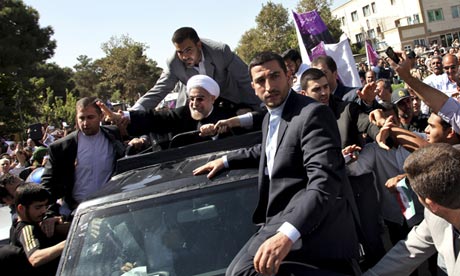 The reception greeting the Iranian president at Tehran airport reflected the precarious tightrope he will have to walk to do a deal with the west. Ultra-conservative protesters chanted: "Death to America" and hurled invective and missiles at Rouhani's car. But his supporters outnumbered his opponents – estimated about 50-strong – and more importantly, the supreme leader, Ayatollah Ali Khamenei, sent his closest foreign policy adviser to greet Rouhani.
The presence of Ali Akbar Velayati gave weight to Rouhani's insistence that he had the highest authority to pursue his diplomatic initiative at the UN general assembly, which culminated in a groundbreaking 15-minute phone conversation with Obama on Friday, conducted on a mobile phone while Rouhani was on the way to John F Kennedy airport.
Iranian state television did not broadcast the hardliner protests at the airport, and the state news agency, Irna, instead played up the fact that the US had presented Rouhani with a 2,700 year-old Persian silver drinking vessel, shaped like a gryphon. It had been seized from an art dealer who had smuggled it out of Iran in 2003 and the state department had been waiting for a thaw in relations in order to return it.
The majority of the official and semi-official Iranian press reports on Rouhani's trip have been supportive or neutral. Even Qassem Suleimani, the head of the Revolutionary Guards' external operations wing, the Quds Force, a powerful figure in the security apparatus, had positive things to say about the visit. Suleimani acknowledged the respect the world had shown to Rouhani, attributing it to the "resistance and endurance" of the nation.
However, the delicate nature of Rouhani's position was also evident in the careful managing of the coverage of the New York trip. Rouhani contradicted the White House account of his phone call with Obama stressing that the conversation had been an American idea.
"Yesterday, at the moment we were preparing for moving towards the airport, the White House contacted us and expressed the willingness of the US president to have a phone conversation for some minutes," Rouhani told reporters at Tehran's Mehrabad airport according to the Fars News Agency.
A number of tweets put out just after Friday's phonecall by Rouhani's official English-language Twitter account, reflecting the friendly and bantering tone of the conversation, were deleted a few hours later and replaced with a more formal, less detailed version.
Iranian officials have also sought to deny that Rouhani described the Holocaust as reprehensible in a CNN interview, even though the translation was provided by an official Iranian interpreter. A senior member of parliament has even called for the news channel to be sued over the issue.
At a press conference before leaving New York, Rouhani had said the visit had exceeded his expectations, but his team is well aware of the resistance in Tehran that will have to be overcome in order to make the necessary compromises over the nuclear programme on secure an enduring settlement with the west.
A senior official in the Iranian delegation pointed out that hopes of detente with the west had been dashed before during the term of the last moderate president, Mohammad Khatami, as a result of ideological resistance in Tehran and the failure of the Bush administration to response positively to Iranian overtures in 2003.
"We have followed this path before and we know it does not necessarily end well," the official told the Guardian. When it was suggested that there was more chance of a breakthrough now there were presidents in both Washington and Tehran who favoured diplomacy, the official replied: "You need more than for the stars to be in alignment. You need luck too."
The reception greeting the Iranian president at Tehran airport reflected the precarious tightrope he will have to walk to do a deal with the west. Ultra-conservative protesters chanted: "Death to America" and hurled invective and missiles at Rouhani's car. But his supporters outnumbered his opponents – estimated about 50-strong – and more importantly, the supreme leader, Ayatollah Ali Khamenei, sent his closest foreign policy adviser to greet Rouhani.
The presence of Ali Akbar Velayati gave weight to Rouhani's insistence that he had the highest authority to pursue his diplomatic initiative at the UN general assembly, which culminated in a groundbreaking 15-minute phone conversation with Obama on Friday, conducted on a mobile phone while Rouhani was on the way to John F Kennedy airport.
Iranian state television did not broadcast the hardliner protests at the airport, and the state news agency, Irna, instead played up the fact that the US had presented Rouhani with a 2,700 year-old Persian silver drinking vessel, shaped like a gryphon. It had been seized from an art dealer who had smuggled it out of Iran in 2003 and the state department had been waiting for a thaw in relations in order to return it.
The majority of the official and semi-official Iranian press reports on Rouhani's trip have been supportive or neutral. Even Qassem Suleimani, the head of the Revolutionary Guards' external operations wing, the Quds Force, a powerful figure in the security apparatus, had positive things to say about the visit. Suleimani acknowledged the respect the world had shown to Rouhani, attributing it to the "resistance and endurance" of the nation.
However, the delicate nature of Rouhani's position was also evident in the careful managing of the coverage of the New York trip. Rouhani contradicted the White House account of his phone call with Obama stressing that the conversation had been an American idea.
"Yesterday, at the moment we were preparing for moving towards the airport, the White House contacted us and expressed the willingness of the US president to have a phone conversation for some minutes," Rouhani told reporters at Tehran's Mehrabad airport according to the Fars News Agency.
A number of tweets put out just after Friday's phonecall by Rouhani's official English-language Twitter account, reflecting the friendly and bantering tone of the conversation, were deleted a few hours later and replaced with a more formal, less detailed version.
Iranian officials have also sought to deny that Rouhani described the Holocaust as reprehensible in a CNN interview, even though the translation was provided by an official Iranian interpreter. A senior member of parliament has even called for the news channel to be sued over the issue.
At a press conference before leaving New York, Rouhani had said the visit had exceeded his expectations, but his team is well aware of the resistance in Tehran that will have to be overcome in order to make the necessary compromises over the nuclear programme on secure an enduring settlement with the west.
A senior official in the Iranian delegation pointed out that hopes of detente with the west had been dashed before during the term of the last moderate president, Mohammad Khatami, as a result of ideological resistance in Tehran and the failure of the Bush administration to response positively to Iranian overtures in 2003.
"We have followed this path before and we know it does not necessarily end well," the official told the Guardian. When it was suggested that there was more chance of a breakthrough now there were presidents in both Washington and Tehran who favoured diplomacy, the official replied: "You need more than for the stars to be in alignment. You need luck too."
US-Iran rapport will be a twisting road
 Both Washington and Tehran declared that US President Barack Obama is unlikely to meet with his Iranian counterpart Hassan Rouhani at the UN General Assembly this year. The US media had hyped the possibility that the two heads would hold historic meetings but such ecstasy lasted only a couple of days.
Nevertheless, it is indeed possible that the US and Iran are considering improving their relations and it is worth our attention.
Iran serves as a pillar in Middle East geopolitics. Since its confrontation with the US plays a decisive role in regional politics, the White House has formulated most of its Middle East policies to contain Iran. The possible military strike against Syria is viewed by many as a measure to prevent Iran from interfering more in the Palestinian-Israeli conflict.
Therefore, the whole geopolitical situation will witness an interesting adaptation if the US and Iran can compromise.
There is no denying that they once enjoyed a honeymoon relationship but have been in an abyss of hostility for so long that both of them are desperate to improve their bilateral ties. Tehran will probably be able to get rid of international sanctions only if it improves relations with the US, which, on the other hand, is desperate to remove its attention and strength from the Middle East given its thorny domestic problems and "pivot to Asia" strategy.
Nonetheless, US-Iranian confrontation has exerted a negative influence on a whole generation in both nations. Thus, even if the state heads find common interests of reconciliation and are determined to put ahead the process, there will be enormous twists and turns in their diplomatic efforts.
It is nearly impossible that the US and Iran will become friends in the foreseeable future due to a series of problems including ideological differences and the latter's conflict with Israel. Washington will never become an intimate friend of major Islamic countries because turmoil and instability within the region help maintain its presence there.
Some hold that many countries will prevent US-Iran relations from getting better. China is one of those. However, China will be happy to see their ties improved. Despite the fact that Iran has restrained US power to a certain degree, its nuclear issue and the risk of war with the US have sabotaged China's interests. Besides, the Chinese government does not regard its economic cooperation with Tehran as a zero-sum game.
With a high degree of independence and self-respect, Iran is irreplaceable in the Middle East and therefore no country possesses the power to contain it.
On the road to becoming a global power, China should take its strength and common interests as key instruments of diplomacy, separate from traditional friendship, and have confidence in its bilateral ties with Iran.
Both Washington and Tehran declared that US President Barack Obama is unlikely to meet with his Iranian counterpart Hassan Rouhani at the UN General Assembly this year. The US media had hyped the possibility that the two heads would hold historic meetings but such ecstasy lasted only a couple of days.
Nevertheless, it is indeed possible that the US and Iran are considering improving their relations and it is worth our attention.
Iran serves as a pillar in Middle East geopolitics. Since its confrontation with the US plays a decisive role in regional politics, the White House has formulated most of its Middle East policies to contain Iran. The possible military strike against Syria is viewed by many as a measure to prevent Iran from interfering more in the Palestinian-Israeli conflict.
Therefore, the whole geopolitical situation will witness an interesting adaptation if the US and Iran can compromise.
There is no denying that they once enjoyed a honeymoon relationship but have been in an abyss of hostility for so long that both of them are desperate to improve their bilateral ties. Tehran will probably be able to get rid of international sanctions only if it improves relations with the US, which, on the other hand, is desperate to remove its attention and strength from the Middle East given its thorny domestic problems and "pivot to Asia" strategy.
Nonetheless, US-Iranian confrontation has exerted a negative influence on a whole generation in both nations. Thus, even if the state heads find common interests of reconciliation and are determined to put ahead the process, there will be enormous twists and turns in their diplomatic efforts.
It is nearly impossible that the US and Iran will become friends in the foreseeable future due to a series of problems including ideological differences and the latter's conflict with Israel. Washington will never become an intimate friend of major Islamic countries because turmoil and instability within the region help maintain its presence there.
Some hold that many countries will prevent US-Iran relations from getting better. China is one of those. However, China will be happy to see their ties improved. Despite the fact that Iran has restrained US power to a certain degree, its nuclear issue and the risk of war with the US have sabotaged China's interests. Besides, the Chinese government does not regard its economic cooperation with Tehran as a zero-sum game.
With a high degree of independence and self-respect, Iran is irreplaceable in the Middle East and therefore no country possesses the power to contain it.
On the road to becoming a global power, China should take its strength and common interests as key instruments of diplomacy, separate from traditional friendship, and have confidence in its bilateral ties with Iran.
New resolution puts Syria on level playing field
Both Washington and Tehran declared that US President Barack Obama is unlikely to meet with his Iranian counterpart Hassan Rouhani at the UN General Assembly this year. The US media had hyped the possibility that the two heads would hold historic meetings but such ecstasy lasted only a couple of days.
Nevertheless, it is indeed possible that the US and Iran are considering improving their relations and it is worth our attention.
Iran serves as a pillar in Middle East geopolitics. Since its confrontation with the US plays a decisive role in regional politics, the White House has formulated most of its Middle East policies to contain Iran. The possible military strike against Syria is viewed by many as a measure to prevent Iran from interfering more in the Palestinian-Israeli conflict.
Therefore, the whole geopolitical situation will witness an interesting adaptation if the US and Iran can compromise.
There is no denying that they once enjoyed a honeymoon relationship but have been in an abyss of hostility for so long that both of them are desperate to improve their bilateral ties. Tehran will probably be able to get rid of international sanctions only if it improves relations with the US, which, on the other hand, is desperate to remove its attention and strength from the Middle East given its thorny domestic problems and "pivot to Asia" strategy.
Nonetheless, US-Iranian confrontation has exerted a negative influence on a whole generation in both nations. Thus, even if the state heads find common interests of reconciliation and are determined to put ahead the process, there will be enormous twists and turns in their diplomatic efforts.
It is nearly impossible that the US and Iran will become friends in the foreseeable future due to a series of problems including ideological differences and the latter's conflict with Israel. Washington will never become an intimate friend of major Islamic countries because turmoil and instability within the region help maintain its presence there.
Some hold that many countries will prevent US-Iran relations from getting better. China is one of those. However, China will be happy to see their ties improved. Despite the fact that Iran has restrained US power to a certain degree, its nuclear issue and the risk of war with the US have sabotaged China's interests. Besides, the Chinese government does not regard its economic cooperation with Tehran as a zero-sum game.
With a high degree of independence and self-respect, Iran is irreplaceable in the Middle East and therefore no country possesses the power to contain it.
On the road to becoming a global power, China should take its strength and common interests as key instruments of diplomacy, separate from traditional friendship, and have confidence in its bilateral ties with Iran.
Syria Wants to Prevent Rebels from Holding Chemical Weapons – FM
 The Syrian leadership’s fears that some chemical weapons could end up in the hands of rebels pushed Damascus to agree to place the weapons under international control, Syria’s foreign minister has told a UAE-based Arabic news channel.
“After militants used chemical weapons a few months ago in Khan al-Assal [near Aleppo], [President Bashar] Assad started thinking about the danger of that problem from the viewpoint of protecting the Syrian people,” Walid Muallem told Sky News Arabia.
Muallem was apparently referring to the March 19 incident in the city of Aleppo that reportedly left 26 civilians and soldiers dead and another 86 people injured. Russia – a key ally of Syria – investigated the alleged chemical weapons use in Aleppo in March and said the type of sarin used in that incident was homemade, Russian Foreign Minister Sergei Lavrov said earlier this week.
Muallem also told Sky News Arabia that some chemical weapons storage sites are hard to reach as rebels control roads leading to them.
“This was one of the reasons why Syria agreed to put its chemical weapons under international control,” he said.
The diplomat expressed regret that the UN had failed to take into account Russia-submitted proof of chemical weapons use by rebels.
Russia remains one of the staunchest supporters of the ruling regime in Syria, where over two years of fighting between government and opposition forces have claimed the lives of more than 100,000 people, according to UN estimates.
The UN Security Council unanimously passed a draft resolution on Friday, imposing binding obligations on the Syrian government to eliminate its chemical weapons program for the first time since unrest began there in March 2011.
The resolution rules out any use of force, Lavrov said Friday, adding that any possible use of force in the future under the UN Charter's Chapter VII would require a new resolution, if there is “conclusive and unequivocal proof” of noncompliance.
Experts from the world's chemical weapons watchdog, the Organization for the Prohibition of Chemical Weapons (OPCW), will depart for Syria soon to inspect the country’s chemical weapon stockpiles, Russia’s foreign minister said Friday in an interview with Russia's Channel One.The administration of US President Barack Obama has accused Syrian President Assad’s government of being responsible for an August 21 chemical weapons attack outside Damascus that Washington claims left more than 1,400 dead.
Russian officials, including President Vladimir Putin, have repeatedly suggested in recent weeks that they have evidence showing that the attack was likely carried out by Syrian rebels seeking to frame Assad in order to secure outside military intervention against government forces.
After weeks of intense diplomacy and an almost three-day marathon of talks in Geneva between Lavrov and US Secretary of State John Kerry, Moscow and Washington reached a breakthrough agreement earlier this month to place Syria’s chemical weapons under international control for eventual destruction.
The Syrian leadership’s fears that some chemical weapons could end up in the hands of rebels pushed Damascus to agree to place the weapons under international control, Syria’s foreign minister has told a UAE-based Arabic news channel.
“After militants used chemical weapons a few months ago in Khan al-Assal [near Aleppo], [President Bashar] Assad started thinking about the danger of that problem from the viewpoint of protecting the Syrian people,” Walid Muallem told Sky News Arabia.
Muallem was apparently referring to the March 19 incident in the city of Aleppo that reportedly left 26 civilians and soldiers dead and another 86 people injured. Russia – a key ally of Syria – investigated the alleged chemical weapons use in Aleppo in March and said the type of sarin used in that incident was homemade, Russian Foreign Minister Sergei Lavrov said earlier this week.
Muallem also told Sky News Arabia that some chemical weapons storage sites are hard to reach as rebels control roads leading to them.
“This was one of the reasons why Syria agreed to put its chemical weapons under international control,” he said.
The diplomat expressed regret that the UN had failed to take into account Russia-submitted proof of chemical weapons use by rebels.
Russia remains one of the staunchest supporters of the ruling regime in Syria, where over two years of fighting between government and opposition forces have claimed the lives of more than 100,000 people, according to UN estimates.
The UN Security Council unanimously passed a draft resolution on Friday, imposing binding obligations on the Syrian government to eliminate its chemical weapons program for the first time since unrest began there in March 2011.
The resolution rules out any use of force, Lavrov said Friday, adding that any possible use of force in the future under the UN Charter's Chapter VII would require a new resolution, if there is “conclusive and unequivocal proof” of noncompliance.
Experts from the world's chemical weapons watchdog, the Organization for the Prohibition of Chemical Weapons (OPCW), will depart for Syria soon to inspect the country’s chemical weapon stockpiles, Russia’s foreign minister said Friday in an interview with Russia's Channel One.The administration of US President Barack Obama has accused Syrian President Assad’s government of being responsible for an August 21 chemical weapons attack outside Damascus that Washington claims left more than 1,400 dead.
Russian officials, including President Vladimir Putin, have repeatedly suggested in recent weeks that they have evidence showing that the attack was likely carried out by Syrian rebels seeking to frame Assad in order to secure outside military intervention against government forces.
After weeks of intense diplomacy and an almost three-day marathon of talks in Geneva between Lavrov and US Secretary of State John Kerry, Moscow and Washington reached a breakthrough agreement earlier this month to place Syria’s chemical weapons under international control for eventual destruction.
Council of Europe urges Turkey to implement ECHR judgments on excessive police force
 The Council of Europe has urged Turkish authorities to quickly implement European Court of Human Rights (ECHR) judgments regarding police’s use of excessive force against demonstrators, noting the flood of new applications on such violence.
The council released a statement after a Sept. 27 meeting to review and assess the implementation of the sentence in the Oya Ataman case.
The case, which dates back to 2007, was opened after a complaint against police officers’ use of tear gas on a small group of demonstrators protesting against plans for an “F-type,” solitary-confinement prison in Istanbul’s Sultanahmet Square.
The council said in its statement that despite new regulations and directives since the ruling in the case, the measures have not been adequately implemented.
“The [European Court of Human Rights] continues receiving new, similar applications and delivering judgments finding violations of the convention on account of unjustified interferences with the right to freedom of peaceful assembly and of the excessive use of force during demonstrations, as well as the lack of an effective remedy in this respect,” the statement of the council said, while calling for additional measures.
“The deputies further invited Turkish authorities to consider amending the Turkish legislation with a view to ensuring that the domestic authorities are under an obligation to assess the necessity of interfering with the right to freedom of assembly, in particular in situations where demonstrations are held peacefully,” it said.
The council also said Turkish courts should act “promptly and diligently” on reports of ill-treatment in conducting investigations launched against law enforcement officers who have failed to comply with measures.
It also called on Turkey to provide information on whether fresh investigations have been launched,
adding that the council would carefully watch progress on the matter.
Turkish police were repeatedly accused of using disproportionate force against demonstrators since the beginning of the nationwide Gezi Park protests in late May. Successive raids on Gezi Park, located in Istanbul’s central Taksim area, stirred a huge outcry inside and outside Turkey.
The government has defended itself, arguing that police reacted to attacks by “marginal” and violent groups while defending its right to use tear gas in such instances.
Six protesters and a police officer have been killed in the demonstrations, while dozens were seriously injured, including a 14-year-old bystander Berkin Elvan, who has been in a coma for months since being struck by a tear gas capsule fired by police.
The Council of Europe has urged Turkish authorities to quickly implement European Court of Human Rights (ECHR) judgments regarding police’s use of excessive force against demonstrators, noting the flood of new applications on such violence.
The council released a statement after a Sept. 27 meeting to review and assess the implementation of the sentence in the Oya Ataman case.
The case, which dates back to 2007, was opened after a complaint against police officers’ use of tear gas on a small group of demonstrators protesting against plans for an “F-type,” solitary-confinement prison in Istanbul’s Sultanahmet Square.
The council said in its statement that despite new regulations and directives since the ruling in the case, the measures have not been adequately implemented.
“The [European Court of Human Rights] continues receiving new, similar applications and delivering judgments finding violations of the convention on account of unjustified interferences with the right to freedom of peaceful assembly and of the excessive use of force during demonstrations, as well as the lack of an effective remedy in this respect,” the statement of the council said, while calling for additional measures.
“The deputies further invited Turkish authorities to consider amending the Turkish legislation with a view to ensuring that the domestic authorities are under an obligation to assess the necessity of interfering with the right to freedom of assembly, in particular in situations where demonstrations are held peacefully,” it said.
The council also said Turkish courts should act “promptly and diligently” on reports of ill-treatment in conducting investigations launched against law enforcement officers who have failed to comply with measures.
It also called on Turkey to provide information on whether fresh investigations have been launched,
adding that the council would carefully watch progress on the matter.
Turkish police were repeatedly accused of using disproportionate force against demonstrators since the beginning of the nationwide Gezi Park protests in late May. Successive raids on Gezi Park, located in Istanbul’s central Taksim area, stirred a huge outcry inside and outside Turkey.
The government has defended itself, arguing that police reacted to attacks by “marginal” and violent groups while defending its right to use tear gas in such instances.
Six protesters and a police officer have been killed in the demonstrations, while dozens were seriously injured, including a 14-year-old bystander Berkin Elvan, who has been in a coma for months since being struck by a tear gas capsule fired by police.
Melody queen Lata Mangeshkar celebrates her 85th birthday
The nightingale of India, Lata Mangeshkar, turns 84 today. The Sandalwood community wished the singer on the occasion. Singer Sonu Nigam, who has crooned n- number of songs for Kannada films tweeted, "It's our Goddess' birthday. Happy Birthday @mangeshkarlata ji.. Thank u 4 gracing this planet wth your voice, demeanor and grace. Love u." Lataji, who had sung the song Bellane Belagayithu for the 1967, Krantiveera Sangolli Rayanna, is not going to celebrate her birthday with fanfare. It has been reported that the veteran singer said that since her elder sister Meena lost her husband recently and also younger sister Asha is grieving the loss of her daughter, Lataji is not keen on celebrating her birthday. Though, it has also been reported that Hridayanath Mangeshkar, Lataji's brother, has planned a marathon eight-hour concert in Pune which is titled Didi Aur Main as a special homage. We wish the melody queen a very happy birthday!
Manmohan Singh: Terror machinery in Pakistan soil should stop
 In a hard-hitting speech,Prime Minister Manmohan Singh today asked Pakistan to shut down "terrorist machinery" on its soil while making it clear that there can "never, ever" be a compromise on the territorial integrity of India of which Jammu and Kashmir is an integral part. In his address to the UN General Assembly, he virtually rejected Pakistan Prime Minister Nawaz Sharif's demand for resolution of the Kashmir issue on the basis of UN Security Council resolutions, saying India favoured settlement of all issues on the basis of the Simla Agreement.
Yesterday, Sharif had made the demand when he raked up the Kashmir issue in his speech.
"India is committed sincerely in resolving all issues with Pakistan, including the issue of Jammu and Kashmir, through bilateral dialogue on the basis of Simla Agreement," he said. India considers the UN resolutions as outdated.
Singh said terrorism remained a grave threat to security and stability everywhere and extracts a heavy toll of innocent lives around the world.
"From Africa to Asia, we have seen several manifestations of this menace in the last few days alone," he said in an apparent reference to the twin terror attacks near Jammu on Thursday that claimed 10 lives and the Kenyan mall attack.
"State-sponsored cross-border terrorism is of particular concern to India, also on account of the fact that the epicentre of terrorism in our region is located in our neighbourhood in Pakistan."
While expressing readiness to solve issues including Jammu and Kashmir through bilateral dialogue, the Prime Minister said, "However, for progress to be made, it is imperative that the territory of Pakistan and the areas under its control are not utilised for aiding and abetting terrorism directed against India.
"It is equally important that the terrorist machinery that draws its sustenance from Pakistan be shut down. There must be a clear understanding of the fact that Jammu and Kashmir is integral part of India and that there can never, ever, be a compromise with the unity and territorial integrity of India." Singh, who arrived here last night from Washington, will hold his first one-on-one meeting with Sharif since the latter assumed office in June.
The India-Pakistan dialogue process was put on hold after an Indian soldier was beheaded on the Line of Control (LoC) in January. Ties hit a new low when five more soldiers were killed by Pakistani troops along the LoC last month. The terror attacks near Jammu virtually threatened to derail the New York meeting, with main opposition BJP demanding that Singh call off his meeting with Sharif.
But Singh decided to go ahead with the meeting, saying such attacks will not succeed in derailing the dialogue process. Expectations from the high-profile meeting will be toned down, as the Prime Minister himself put it in the media briefing after his talks with President Barack Obama, "given the terror arm which is still active in our subcontinent".
In a hard-hitting speech,Prime Minister Manmohan Singh today asked Pakistan to shut down "terrorist machinery" on its soil while making it clear that there can "never, ever" be a compromise on the territorial integrity of India of which Jammu and Kashmir is an integral part. In his address to the UN General Assembly, he virtually rejected Pakistan Prime Minister Nawaz Sharif's demand for resolution of the Kashmir issue on the basis of UN Security Council resolutions, saying India favoured settlement of all issues on the basis of the Simla Agreement.
Yesterday, Sharif had made the demand when he raked up the Kashmir issue in his speech.
"India is committed sincerely in resolving all issues with Pakistan, including the issue of Jammu and Kashmir, through bilateral dialogue on the basis of Simla Agreement," he said. India considers the UN resolutions as outdated.
Singh said terrorism remained a grave threat to security and stability everywhere and extracts a heavy toll of innocent lives around the world.
"From Africa to Asia, we have seen several manifestations of this menace in the last few days alone," he said in an apparent reference to the twin terror attacks near Jammu on Thursday that claimed 10 lives and the Kenyan mall attack.
"State-sponsored cross-border terrorism is of particular concern to India, also on account of the fact that the epicentre of terrorism in our region is located in our neighbourhood in Pakistan."
While expressing readiness to solve issues including Jammu and Kashmir through bilateral dialogue, the Prime Minister said, "However, for progress to be made, it is imperative that the territory of Pakistan and the areas under its control are not utilised for aiding and abetting terrorism directed against India.
"It is equally important that the terrorist machinery that draws its sustenance from Pakistan be shut down. There must be a clear understanding of the fact that Jammu and Kashmir is integral part of India and that there can never, ever, be a compromise with the unity and territorial integrity of India." Singh, who arrived here last night from Washington, will hold his first one-on-one meeting with Sharif since the latter assumed office in June.
The India-Pakistan dialogue process was put on hold after an Indian soldier was beheaded on the Line of Control (LoC) in January. Ties hit a new low when five more soldiers were killed by Pakistani troops along the LoC last month. The terror attacks near Jammu virtually threatened to derail the New York meeting, with main opposition BJP demanding that Singh call off his meeting with Sharif.
But Singh decided to go ahead with the meeting, saying such attacks will not succeed in derailing the dialogue process. Expectations from the high-profile meeting will be toned down, as the Prime Minister himself put it in the media briefing after his talks with President Barack Obama, "given the terror arm which is still active in our subcontinent".
Pakistan: Khursheed Shah demands Govt to take immediate decision for or against talks with Taliban
Leader of the Opposition in the National Assembly Syed Khursheed Shah Friday condemned the attack on bus in Peshawar and asked the government to immediately take a decision for or against dialogue with the Taliban. In a statement here the opposition leader said that it was the foremost duty of the state to protect life and property of the citizens. He expressed his grave concern over continued acts of terrorism in Peshawar. He said no religion allows killings of people and the state must fulfill its responsibility. He said there should be no delay in implementation of the decisions taken at the All Parties Conference, as the nation cannot afford terrorism for an indefinite period. He demanded compensation and adequate treatment for the deceased and injured and action against those involved in the heinous act.http://mediacellppp.wordpress.com/

Balochistan: Aftershock kills 15 in quake-hit Pakistan province
At least 15 people were killed on Saturday when an aftershock hit a Pakistani province where hundreds were killed in an major earthquake earlier this week. Saturday's 6.8 magnitude aftershock destroyed most of the town of Nokjo in the western province of Baluchistan, police said. The town is home to at least 15,000 people. At least 515 people were killed in Tuesday's earthquake in the same province, officials said on Friday. The death toll from Saturday's aftershock may rise, said Khan Wasey, the spokesman for the paramilitary Frontier Corps. Aid deliveries have been complicated by the fact the remote region is home to separatist insurgents who fear the army, which is overseeing aid operations, may take advantage of the crisis to move more forces into the area. The insurgents have twice fired on helicopters carrying aid workers or supplies and have also attacked an aid convoy being escorted by government forces. The Baluch insurgents accuse military forces of human rights abuses and Pakistan of exploiting Baluchistan's mineral wealth while local people live in poverty. Human rights groups say the military frequently abducts and kills ethnic Baluch. The rebels frequently attack the Pakistani armed forces and have also been responsible for executing civilians like teachers and doctors from other ethnic groups.
The forgotten hero: Mohammad Zafrullah Khan
Mr Khan is the only person ever to become both president of the UN General Assembly and president of the International Court of JusticeBy Mohammad Ahmad
 Today is the death anniversary of one of Pakistan’s greatest heroes. One can safely assume that there will be no mention of his services to Pakistan. It would be rare to find any expression of appreciation from a nation for whom he did so much. His memory has been wiped out from the minds of most Pakistanis because of his faith. His doctrinal difference as an Ahmadi makes him an outcast to the timid leaders of today despite his glorious contributions to Pakistan and its cause. The treatment of this hero by the leaders of today makes a mockery of the leadership and wisdom of Quaid-e-Azam Mohammad Ali Jinnah who held him in the highest regard.
Sir Mohammad Zafrullah Khan’s contribution for the betterment of the Muslims of India and Pakistan as a jurist, a diplomat and a patriot are exceeded by only that of our revered leader Mohammad Ali Jinnah. By all counts Zafrullah Khan stands much above men who have made a mockery of our nation.
Born in Sialkot in 1893, Mr Khan rose to be one of the most astute legal minds of British India. His early education was in his town of birth from where he proceeded to Lahore for his graduation. He received his law degree from King’s College London in 1914, where he excelled and topped his class. He was the first from the Indian subcontinent to do so. He was called to the Bar at Lincoln’s Inn, the same place where Mr Jinnah went earlier.
As a practising lawyer, Mr Khan proved his abilities quickly and had many reported cases to his credit. Starting his career in his early 30s as a member of the Punjab legislative Council, he rose to prominence as an untiring campaigner for the Muslims of Punjab. Later, he represented the Muslims at the Round Table Conference. In 1931, he became the president of the All India Muslim League. At the Round Table Conference, he forced a committee to accept his point of view over someone no less than Churchill.
Later, Mr Khan was offered a seat on the Viceroy’s permanent Council. He also served at varying times as the minister of railways, labour, law and public works under the Viceroy. For a brief period, he became British India’s representative to the League of Nations, just before it was dissolved. From 1942 onwards, he served as a federal judge of India. He took leave from this position to serve Pakistan’s cause before the Radcliffe Commission on Quaid-e-Azam’s personal request.
Mr Khan’s greatest contribution to the cause of Indian Muslims is his drafting of the Lahore Resolution, which is the rallying point of our nationalism as our founding document. The Lahore Resolution was a broad-based solution leaving room for several solutions, all of which were meant to safeguard the interests of the Muslims of India.
The 1946 elections failed to dislodge the Unionists from a position of dominance in the Punjab Legislative Assembly. This made Mr Khan come to Muslim League’s assistance. He induced Sardar Khizar Hayat Khan to dissolve his powerful Unionist Ministry and hand over the reins of government in Punjab to the League leaders. For this he came to Lahore and within 48 hours, the League was restored to its rightful place in the Punjab. History would bear testimony that this was the final act that made Pakistan possible and also avoided a dangerous division among Muslims on the eve of Independence.
On December 25, 1947, Mr Jinnah appointed Zafrullah Khan the Foreign Minister of Pakistan. At the UN, Sir Zafrullah emerged as the most eloquent advocate of the Arabs, Africans, the Third World and Islamic issues. His efforts materialised into the UN Resolutions on Kashmir, which are the basis of the Pakistani stance on the issue.
Mr Khan’s speech to the UN on the issue of Palestine is perhaps one of the immortal speeches delivered at the UN. The passion with which he advocated the Palestinian cause and the arguments that he laid against the partition of Palestine made him a hero in the eyes of the Arabs. In the context of the repatriation of the Jews to Palestine and the creation of Israel he says:
“...Shall they be repatriated to their own countries? Australia says no; Canada says no; the United States says no. This was very encouraging from one point of view. Let these people, after their terrible experiences, even if they are willing to go back, not be asked to go back to their own countries. In this way, one would be sure that the second proposal would be adopted and that we should all give shelter to these people. Shall they be distributed among the Member States according to the capacity of the latter to receive them? Australia, an over-populated small country with congested areas, says no, no, no; Canada, equally congested and over-populated, says no; the United States, a great humanitarian country, a small area, with small resources, says no. That is their contribution to the humanitarian principle. But they state: let them go into Palestine, where there are vast areas, a large economy and no trouble; they can easily be taken in there. That is the contribution made by this august body to the settlement of the humanitarian principle involved...In the hearts of the populations of all the countries from the North African Atlantic Coast to the steppes of Central Asia, you sow doubt and mistrust of the designs and motives of the Western Powers. You take the gravest risk of impairing, beyond the possibility of repair, any chance of real cooperation between East and West, by thus forcibly driving what in effect amounts to a Western wedge into the heart of the Middle East.”
Mr Khan’s selfless efforts to win freedom for Palestine, Libya, Morocco, Tunisia and Algeria were unmatched. King Hussein of Jordan awarded him the Star of Jordan, the highest civil award of the country. The rulers of Morocco, Libya, Tunisia and Algeria followed suit and honoured Sir Zafrullah Khan with the highest civil awards of their countries.
The communist victory on mainland China produced a distinct division among the member countries of the UN on the representation of China in the Security Council. In the debate on the issue, the US-led western countries openly opposed the People’s Republic of China’s seat. Representing Pakistan, Mr Khan opposed this western stance and demanded the seating of the Communists in place of the Nationalists. This laid the foundation of Sino-Pak friendship.
Serving briefly as the president of the UN General Assembly, Zafrullah Khan later became the first Asian to be appointed the president of the International Court of Justice. This was a unique honour for anyone, as Mr Khan is the only person ever to become both president of the UN General Assembly and president of the International Court of Justice. Mr Khan was a great writer and he authored books and tracts on the history of Pakistan and religion. His famous book that is about the sad betrayal that took away the country from the hands of the patriots into the hands of those who were its ideological enemies and who had worked to the hilt to hinder its creation is aptly titled Agony of Pakistan.
Although his adherence to the Ahmadi faith was known to all, in March 1958, Zafrullah Khan performed Umrah and visited the Prophet’s (PBUH) mausoleum. During the visit he met the King of Saudi Arabia Ibn Saud, and stayed at the Royal Palace as a personal guest of the king. In 1967, he returned to Saudi Arabia to perform Hajj.
Having served his motherland to the best of his abilities this able son of the country and comrade of the Quaid passed away in September 1983 in Lahore. His death was condoled by eminent personalities from within the country and abroad. The text of the condolence telegram sent by the King of Jordan at his death sums up the deep gratitude and respect the Arabs had for the champion of their cause:
“I was deeply grieved to learn of the passing away of my dear friend the late Sir Zafrullah Khan. He shall always be remembered for his great contributions to humanity and to just causes everywhere, especially the Palestinian cause. He was indeed a champion of the Arab cause and his ceaseless efforts whether among the Muslim and aligned countries or at the international court of justice will remain for ever a shining example of a great man truly dedicated to the noble principles of our faith and civilisation. Please accept my sincere condolences. May Almighty God bless his soul and may he rest in peace. Hussain — His Majesty King Hussain of Jordan.”
The idea of Jinnah’s Pakistan lives as long as the memory of people like Zafrullah Khan is alive. The people of Pakistan yearn to reclaim their country as the progressive state envisioned by the Quaid-e-Azam. Being gracious, they are thankful to those who worked for the creation of their homeland and served it well. That Zafrullah Khan is not paid due homage is only because most of them are unaware of his services to the Arab cause and Pakistan The reason being that successive governments have deliberately fed them an incomplete history of Pakistan, telling them the story with Zafrullah Khan’s name wiped out. The day this distortion of history is corrected he would claim his rightful place in their memories as one of Pakistan’s founding heroes.
Today is the death anniversary of one of Pakistan’s greatest heroes. One can safely assume that there will be no mention of his services to Pakistan. It would be rare to find any expression of appreciation from a nation for whom he did so much. His memory has been wiped out from the minds of most Pakistanis because of his faith. His doctrinal difference as an Ahmadi makes him an outcast to the timid leaders of today despite his glorious contributions to Pakistan and its cause. The treatment of this hero by the leaders of today makes a mockery of the leadership and wisdom of Quaid-e-Azam Mohammad Ali Jinnah who held him in the highest regard.
Sir Mohammad Zafrullah Khan’s contribution for the betterment of the Muslims of India and Pakistan as a jurist, a diplomat and a patriot are exceeded by only that of our revered leader Mohammad Ali Jinnah. By all counts Zafrullah Khan stands much above men who have made a mockery of our nation.
Born in Sialkot in 1893, Mr Khan rose to be one of the most astute legal minds of British India. His early education was in his town of birth from where he proceeded to Lahore for his graduation. He received his law degree from King’s College London in 1914, where he excelled and topped his class. He was the first from the Indian subcontinent to do so. He was called to the Bar at Lincoln’s Inn, the same place where Mr Jinnah went earlier.
As a practising lawyer, Mr Khan proved his abilities quickly and had many reported cases to his credit. Starting his career in his early 30s as a member of the Punjab legislative Council, he rose to prominence as an untiring campaigner for the Muslims of Punjab. Later, he represented the Muslims at the Round Table Conference. In 1931, he became the president of the All India Muslim League. At the Round Table Conference, he forced a committee to accept his point of view over someone no less than Churchill.
Later, Mr Khan was offered a seat on the Viceroy’s permanent Council. He also served at varying times as the minister of railways, labour, law and public works under the Viceroy. For a brief period, he became British India’s representative to the League of Nations, just before it was dissolved. From 1942 onwards, he served as a federal judge of India. He took leave from this position to serve Pakistan’s cause before the Radcliffe Commission on Quaid-e-Azam’s personal request.
Mr Khan’s greatest contribution to the cause of Indian Muslims is his drafting of the Lahore Resolution, which is the rallying point of our nationalism as our founding document. The Lahore Resolution was a broad-based solution leaving room for several solutions, all of which were meant to safeguard the interests of the Muslims of India.
The 1946 elections failed to dislodge the Unionists from a position of dominance in the Punjab Legislative Assembly. This made Mr Khan come to Muslim League’s assistance. He induced Sardar Khizar Hayat Khan to dissolve his powerful Unionist Ministry and hand over the reins of government in Punjab to the League leaders. For this he came to Lahore and within 48 hours, the League was restored to its rightful place in the Punjab. History would bear testimony that this was the final act that made Pakistan possible and also avoided a dangerous division among Muslims on the eve of Independence.
On December 25, 1947, Mr Jinnah appointed Zafrullah Khan the Foreign Minister of Pakistan. At the UN, Sir Zafrullah emerged as the most eloquent advocate of the Arabs, Africans, the Third World and Islamic issues. His efforts materialised into the UN Resolutions on Kashmir, which are the basis of the Pakistani stance on the issue.
Mr Khan’s speech to the UN on the issue of Palestine is perhaps one of the immortal speeches delivered at the UN. The passion with which he advocated the Palestinian cause and the arguments that he laid against the partition of Palestine made him a hero in the eyes of the Arabs. In the context of the repatriation of the Jews to Palestine and the creation of Israel he says:
“...Shall they be repatriated to their own countries? Australia says no; Canada says no; the United States says no. This was very encouraging from one point of view. Let these people, after their terrible experiences, even if they are willing to go back, not be asked to go back to their own countries. In this way, one would be sure that the second proposal would be adopted and that we should all give shelter to these people. Shall they be distributed among the Member States according to the capacity of the latter to receive them? Australia, an over-populated small country with congested areas, says no, no, no; Canada, equally congested and over-populated, says no; the United States, a great humanitarian country, a small area, with small resources, says no. That is their contribution to the humanitarian principle. But they state: let them go into Palestine, where there are vast areas, a large economy and no trouble; they can easily be taken in there. That is the contribution made by this august body to the settlement of the humanitarian principle involved...In the hearts of the populations of all the countries from the North African Atlantic Coast to the steppes of Central Asia, you sow doubt and mistrust of the designs and motives of the Western Powers. You take the gravest risk of impairing, beyond the possibility of repair, any chance of real cooperation between East and West, by thus forcibly driving what in effect amounts to a Western wedge into the heart of the Middle East.”
Mr Khan’s selfless efforts to win freedom for Palestine, Libya, Morocco, Tunisia and Algeria were unmatched. King Hussein of Jordan awarded him the Star of Jordan, the highest civil award of the country. The rulers of Morocco, Libya, Tunisia and Algeria followed suit and honoured Sir Zafrullah Khan with the highest civil awards of their countries.
The communist victory on mainland China produced a distinct division among the member countries of the UN on the representation of China in the Security Council. In the debate on the issue, the US-led western countries openly opposed the People’s Republic of China’s seat. Representing Pakistan, Mr Khan opposed this western stance and demanded the seating of the Communists in place of the Nationalists. This laid the foundation of Sino-Pak friendship.
Serving briefly as the president of the UN General Assembly, Zafrullah Khan later became the first Asian to be appointed the president of the International Court of Justice. This was a unique honour for anyone, as Mr Khan is the only person ever to become both president of the UN General Assembly and president of the International Court of Justice. Mr Khan was a great writer and he authored books and tracts on the history of Pakistan and religion. His famous book that is about the sad betrayal that took away the country from the hands of the patriots into the hands of those who were its ideological enemies and who had worked to the hilt to hinder its creation is aptly titled Agony of Pakistan.
Although his adherence to the Ahmadi faith was known to all, in March 1958, Zafrullah Khan performed Umrah and visited the Prophet’s (PBUH) mausoleum. During the visit he met the King of Saudi Arabia Ibn Saud, and stayed at the Royal Palace as a personal guest of the king. In 1967, he returned to Saudi Arabia to perform Hajj.
Having served his motherland to the best of his abilities this able son of the country and comrade of the Quaid passed away in September 1983 in Lahore. His death was condoled by eminent personalities from within the country and abroad. The text of the condolence telegram sent by the King of Jordan at his death sums up the deep gratitude and respect the Arabs had for the champion of their cause:
“I was deeply grieved to learn of the passing away of my dear friend the late Sir Zafrullah Khan. He shall always be remembered for his great contributions to humanity and to just causes everywhere, especially the Palestinian cause. He was indeed a champion of the Arab cause and his ceaseless efforts whether among the Muslim and aligned countries or at the international court of justice will remain for ever a shining example of a great man truly dedicated to the noble principles of our faith and civilisation. Please accept my sincere condolences. May Almighty God bless his soul and may he rest in peace. Hussain — His Majesty King Hussain of Jordan.”
The idea of Jinnah’s Pakistan lives as long as the memory of people like Zafrullah Khan is alive. The people of Pakistan yearn to reclaim their country as the progressive state envisioned by the Quaid-e-Azam. Being gracious, they are thankful to those who worked for the creation of their homeland and served it well. That Zafrullah Khan is not paid due homage is only because most of them are unaware of his services to the Arab cause and Pakistan The reason being that successive governments have deliberately fed them an incomplete history of Pakistan, telling them the story with Zafrullah Khan’s name wiped out. The day this distortion of history is corrected he would claim his rightful place in their memories as one of Pakistan’s founding heroes.
In Tehran, Phone Call Between Presidents Is as Good as a Handshake
By THOMAS ERDBRINK
Night had fallen here in the Iranian capital as Hassan Rouhani, the new president of Iran, sent a message via his now-famous Twitter account: He had just gotten off the phone with President Obama, who had called him.
“Wow, this is fantastic,” said Armin Kay, an engineer reacting to the news. “The most important thing is that Obama took the initiative. This will go down really well with our leadership.”
It was the first direct conversation between leaders of Iran and the United States since the Islamic Revolution in 1979.
In Iran, many had been disappointed when Mr. Rouhani failed to show up Tuesday at a United Nations luncheon, where he had been expected to shake hands with Mr. Obama. But the Friday call as Mr. Rouhani was heading to the airport to fly home to Iran, after four days of frenetic diplomacy in the United States, was almost as good as a handshake.
“After the positive meeting between the foreign ministers of Iran and the United States on Thursday, we could see this coming,” Amir Mohebbian, a political adviser close to Iran’s supreme leader, Ayatollah Ali Khamenei, said in an interview after the phone call, referring to Foreign Minister Mohammad Javad Zarif and Secretary of State John Kerry. “This was a polite farewell, a thank you for all the positivity from Iran.”
If talks on Iran’s nuclear program next month go well, he said, “we could witness a meeting after that.”
Another analyst close to Mr. Rouhani praised the phone call by Mr. Obama as “the best thing he could have done.” The analyst, Nader Karimi Joni, who works as a journalist and has been jailed for opposing the interests of hard-liners, said the call was a “verbal farewell for a V.I.P. guest, similar to seeing Mr. Rouhani off personally.”
The official Islamic Republic of Iran News Network, a 24-hour television channel, showed news of the meeting between Mr. Zarif and Mr. Kerry, but as of midnight Friday had not mentioned the phone conversation between the presidents.
The government’s Islamic Republic News Agency, however, prominently displayed the news on its Web site. “While President Rouhani was leaving New York for Tehran, President Obama called him, and both sides emphasized a quick solution for the nuclear problem,” it said. “They also considered the background for finding solutions for other issues and cooperation in regional issues. Both presidents asked their foreign ministers to pave the way for cooperation.”
Some Iranians said the immediate practical impact of the phone call could be a surge in the value of Iran’s currency, the rial, which has weakened to historic lows against the dollar in recent months because of the accumulated economic sanctions on Iran, imposed by the United States and European Union in response to the nuclear standoff.
“To be sure, the dollar will drop tomorrow against the rial,” Mr. Kay said.
Mr. Rouhani’s visit to the United Nations and his outreach to the United States government have not been greeted with universal approval or even acceptance in Iran, where suspicion toward Washington’s motives can always be found and Ayatollah Khamenei harbors a deep hostility toward America.
During the weekly Friday prayers in Tehran, one of the most important political platforms in the country, Ayatollah Mahmoud Emami Kashani repeated Mr. Obama’s words that the United States did not want to change the Iranian government. “Everybody knows it is impossible to topple the Islamic system. These are only rants,” said the ayatollah, who was appointed by Ayatollah Khamenei.
Before the prayers the official chanter referred to the “double standards of Obama,” which drew a familiar refrain from the crowd: “Death to America!”
The seemingly breathless momentum of the diplomacy, after decades of hostility and suspicion, was clearly taking some Iranians by surprise.
“Things are going really, really fast — faster than expected,” said Mostafa Afzalzadeh, a journalist for several conservative outlets. “It is shocking. I am really curious what people will say tomorrow.”
Others have been more philosophical, even a bit irreverent, about the possibility of reconciliation. Some Iranians have joked that a conversation between the two presidents would be between Hassan and Hussein, a reference to Mr. Rouhani’s given name and Mr. Obama’s middle name.
Both names are revered saints in the Shiite Muslim faith.
Protest Calls on Women to Defy Law, Drive in Saudi Arabia
http://www.slate.com/blogsSaudi activists have launched a campaign calling for the lifting of Saudi Arabia’s ban on women driving. The protest, Reuters reports, urges women to defy Saudi law and get behind the wheel and drive on October 26th. As part of the campaign, an online petition, Oct 26 Driving, was started on Saturday and has collected some 11,000 signatures, according to CNN. “[T]here is no justification for the Saudi government to prohibit adult women citizens who are capable of driving cars from doing so,” the petition reads. “We as a Saudi people are diverse and accepting of all views that are not prohibited in the Quran or by the Prophet.” There are no explicit laws in the country banning women drivers, but the government does not issue driving licenses to women, making it, in effect, illegal for them to drive. The protest comes after two recent attempts to overturn the de facto ban on women drivers that proved unsuccessful, after authorities detained several women, who were made to sign pledges not to drive again, according to Reuters.
FASCIST SAUDI ARABIA: Rape victim sentenced 200 lashes by Saudi court

 "The victim's sentence was increased because her lawyer had spoken out..."
When the defense attorney for a raped Saudi Arabian woman appealed a Sharia Court decision that the 90-lash sentence against his client was unjust, all that was succeeded was the more than doubling of the punishment meted out to the woman who was raped and beaten by seven men, as reported by the women’s rights-centered news portal The Clarion Project on Sept. 22, 2013.
A yet to be publiclly identified female gang rape victim was initially found guilty and sentenced to 90 lashes for violating the Kingdom of Saudi Arabia's (KSA) rigid Islamic law on segregation of the sexes.
The Kingdom’s General Court determined the woman sat in an automobile with an old school chum to whom she was no blood relation, hence, she violated Islamic Sharia Law of gender segregation.
The victim’s lawyer Abdul Rahman al-Lahem had plead to the international community for help in freeing his client or at least pressuring the Saudi government to grant an appeal.
From Bad To Worse…
And an appeal he got -- along with an increase in sentence from 90 lashes to 200 along with a six month prison sentence tacked on for good measure.
The KSA Ministry of Justice implied the victim's sentence was increased because her lawyer had spoken out to the world’s news outlets.
As carried by the government’s official Saudi Press Agency:
For whoever has an objection on verdicts issued, the system allows to appeal without resorting to the media.
The statement also said that the "charges were proven" against the woman for having been in a car with a strange male, and repeated criticism of her lawyer for talking "defiantly" about the judicial system, saying "it has shown ignorance."
The Lead Up…
The victim was attacked in 2006 while she was attempting to retrieve a photograph from a male high school student she knew.
While in her acquaintance’s vehicle, two other men got in the car and drove the woman and her friend to a secluded area where five other men met them.
It was in this remote area where all seven men raped the woman.
The Clarion Project also cited that the woman’s friend was in turn “attacked” by the assailants, but it is unclear if he was beaten, raped or both.
The Price of Questioning Saudi Law...
Abdul Rahman al-Lahem has since banned him from further defending the woman, the KSA has confiscated his law license and summoning him to a disciplinary hearing later this month.
"The victim's sentence was increased because her lawyer had spoken out..."
When the defense attorney for a raped Saudi Arabian woman appealed a Sharia Court decision that the 90-lash sentence against his client was unjust, all that was succeeded was the more than doubling of the punishment meted out to the woman who was raped and beaten by seven men, as reported by the women’s rights-centered news portal The Clarion Project on Sept. 22, 2013.
A yet to be publiclly identified female gang rape victim was initially found guilty and sentenced to 90 lashes for violating the Kingdom of Saudi Arabia's (KSA) rigid Islamic law on segregation of the sexes.
The Kingdom’s General Court determined the woman sat in an automobile with an old school chum to whom she was no blood relation, hence, she violated Islamic Sharia Law of gender segregation.
The victim’s lawyer Abdul Rahman al-Lahem had plead to the international community for help in freeing his client or at least pressuring the Saudi government to grant an appeal.
From Bad To Worse…
And an appeal he got -- along with an increase in sentence from 90 lashes to 200 along with a six month prison sentence tacked on for good measure.
The KSA Ministry of Justice implied the victim's sentence was increased because her lawyer had spoken out to the world’s news outlets.
As carried by the government’s official Saudi Press Agency:
For whoever has an objection on verdicts issued, the system allows to appeal without resorting to the media.
The statement also said that the "charges were proven" against the woman for having been in a car with a strange male, and repeated criticism of her lawyer for talking "defiantly" about the judicial system, saying "it has shown ignorance."
The Lead Up…
The victim was attacked in 2006 while she was attempting to retrieve a photograph from a male high school student she knew.
While in her acquaintance’s vehicle, two other men got in the car and drove the woman and her friend to a secluded area where five other men met them.
It was in this remote area where all seven men raped the woman.
The Clarion Project also cited that the woman’s friend was in turn “attacked” by the assailants, but it is unclear if he was beaten, raped or both.
The Price of Questioning Saudi Law...
Abdul Rahman al-Lahem has since banned him from further defending the woman, the KSA has confiscated his law license and summoning him to a disciplinary hearing later this month.
Pakistan still epicentre of terror
Malala honoured at Harvard
http://www.thehindu.com/A Pakistani girl who survived an assassination attempt by the Taliban is being honoured as Harvard University’s humanitarian of the year.
 Malala Yousafzai is an outspoken proponent for girls’ education. She was at Harvard on Friday to accept the 2013 Peter J. Gomes Humanitarian Award.
Harvard president Drew Gilpin Faust said she was pleased to welcome Ms. Malala because of their shared interest in education.
The 16-year-old Malala said she’s hoping to become a politician because politicians can have influence on a broad scale. Speaking nostalgically about her home region, the Swat Valley, she said she hopes to return someday.
Ms. Malala was shot in the head by Taliban militants last October.
Malala Yousafzai is an outspoken proponent for girls’ education. She was at Harvard on Friday to accept the 2013 Peter J. Gomes Humanitarian Award.
Harvard president Drew Gilpin Faust said she was pleased to welcome Ms. Malala because of their shared interest in education.
The 16-year-old Malala said she’s hoping to become a politician because politicians can have influence on a broad scale. Speaking nostalgically about her home region, the Swat Valley, she said she hopes to return someday.
Ms. Malala was shot in the head by Taliban militants last October.
New earthquake strikes Pakistan's Balochistan

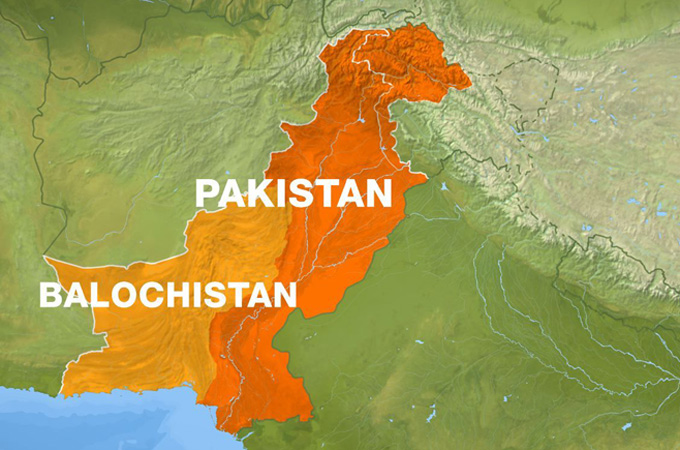 A new earthquake has struck the southwestern Pakistani province of Balochistan, where hundreds of people have already died and thousands more been affected by a previous tremor, the US Geological Survey reports.
The latest earthquake measured 6.8 in magnitude, and occurred about 96km northeast of the city of Awaran, the USGS said on Saturday.
The quake occurred at a depth of 14.8km, which was similar to Tuesday's 7.7 magnitude earthquake. The epicentres of the two tremors were about 30km apart, according to USGS data.
"It was not an aftershock it was an independent earthquake," Zahid Rafi, director of the National Seismic Centre of Pakistan, told local news television station Geo TV.
At least 359 people were killed, and another 765 injured, when Tuesday's earthquake struck the impoverished region of southwestern Pakistan, according to the Provincial Disaster Management Authority's official figures.
Unofficial estimates put the number of dead at more than 500.
The government says that more than 185,000 people have been affected by the tremor, and that rescue and relief activities are being undertaken by the civil administration in conjunction with the army.
The population of Awaran district is scattered over more than 21,000 square kilometres of remote and rugged terrain, where infrastructure is limited, with few medical facilities or even roads.
Conditions are desperate among the survivors and many are going without food, water and shelter, having lost everything in the quake, Al Jazeera's Kamal Hyder reported from Awaran district.
The government says that it has delivered more than 11,800 tents to survivors, and that several medical teams are now operating in the area. Other items to be distributed included blankets, food packets, water, mosquito nets and other essentials.
Rescue efforts have been hampered both by the remoteness of the area, and by attacks carried out by separatist Baloch rebels against army convoys carrying the aid.
Rebels have been fighting the Pakistani state in Balochistan for decades, demanding greater rights for ethnic Baloch and alleging that the federal government does not adequately recompense Balochistan for its natural resources. The campaign has intensified in recent years in the wake of a campaign of enforced disappearances of Baloch activists, allegedly carried out by Pakistani government and intelligence agencies.
A new earthquake has struck the southwestern Pakistani province of Balochistan, where hundreds of people have already died and thousands more been affected by a previous tremor, the US Geological Survey reports.
The latest earthquake measured 6.8 in magnitude, and occurred about 96km northeast of the city of Awaran, the USGS said on Saturday.
The quake occurred at a depth of 14.8km, which was similar to Tuesday's 7.7 magnitude earthquake. The epicentres of the two tremors were about 30km apart, according to USGS data.
"It was not an aftershock it was an independent earthquake," Zahid Rafi, director of the National Seismic Centre of Pakistan, told local news television station Geo TV.
At least 359 people were killed, and another 765 injured, when Tuesday's earthquake struck the impoverished region of southwestern Pakistan, according to the Provincial Disaster Management Authority's official figures.
Unofficial estimates put the number of dead at more than 500.
The government says that more than 185,000 people have been affected by the tremor, and that rescue and relief activities are being undertaken by the civil administration in conjunction with the army.
The population of Awaran district is scattered over more than 21,000 square kilometres of remote and rugged terrain, where infrastructure is limited, with few medical facilities or even roads.
Conditions are desperate among the survivors and many are going without food, water and shelter, having lost everything in the quake, Al Jazeera's Kamal Hyder reported from Awaran district.
The government says that it has delivered more than 11,800 tents to survivors, and that several medical teams are now operating in the area. Other items to be distributed included blankets, food packets, water, mosquito nets and other essentials.
Rescue efforts have been hampered both by the remoteness of the area, and by attacks carried out by separatist Baloch rebels against army convoys carrying the aid.
Rebels have been fighting the Pakistani state in Balochistan for decades, demanding greater rights for ethnic Baloch and alleging that the federal government does not adequately recompense Balochistan for its natural resources. The campaign has intensified in recent years in the wake of a campaign of enforced disappearances of Baloch activists, allegedly carried out by Pakistani government and intelligence agencies.
Another major earthquake jolts Balochistan
 A 6.8 magnitude earthquake struck Pakistan's Balochistan province on Friday, the US Geological Survey survey.
The epicentre of the quake was recorded at 96 kilometres northeast of Balochistan's Awaran district and 14 kilometres deep, the USGS added.
In Balochistan, the tremors were felt as far as Jaffarabad, Sibi, Naseerabad and Quetta.
A 6.8 magnitude earthquake struck Pakistan's Balochistan province on Friday, the US Geological Survey survey.
The epicentre of the quake was recorded at 96 kilometres northeast of Balochistan's Awaran district and 14 kilometres deep, the USGS added.
In Balochistan, the tremors were felt as far as Jaffarabad, Sibi, Naseerabad and Quetta.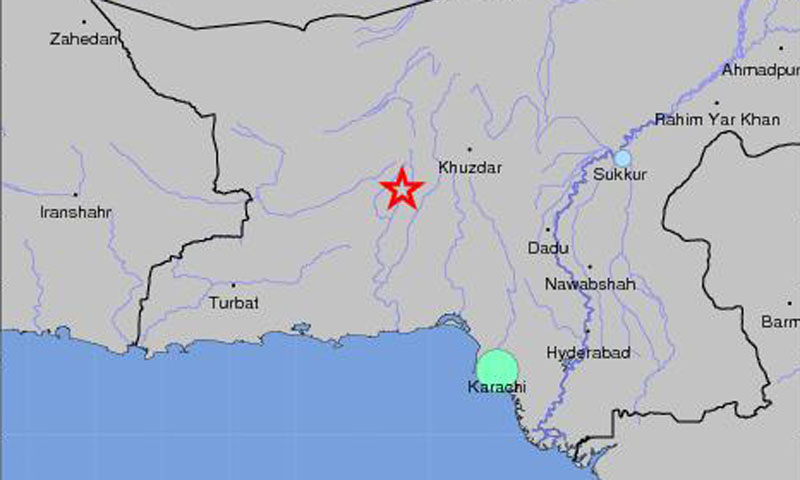
Peshwar Chruch Bombing: The bombing of my childhood haunt in Peshawar

 The deadly suicide bombing of a church in the Pakistani city of Peshawar last weekend shocked the nation. When BBC Urdu journalist Haroon Rashid, who has reported on many bombings, arrived at the scene, he found himself overwhelmed by the tragedy that struck at the very doorstep of a childhood haunt.
Last Sunday dozens of people were killed in an instant when two suicide bombers detonated themselves in the grounds of the beautiful whitewashed All Saints church in the city of my birth, Peshawar. The final death toll was 81.
I arrived at the scene a few hours later. I thought I had to go and see what had happened to my old haunt. I was not prepared for the feelings that would overcome me.
This church tragedy - after all the tragedies I have witnessed in 25 years of reporting - became an emotional watershed - perhaps because it felt as if my childhood had been bombed that day.
Horrifying and surreal
Across the road from the white church was my missionary-run Edwardes High School. I studied there from the age of five to 15, and for a decade of my school life I played in front of this church.
It was part of my daily landscape. As we usually arrived 10 to 15 minutes early and did not want to go straight into school, we would play hide-and-seek on that road until the bell rang.
The road had barely changed but I did not recognise the scene that greeted me.
As soon as I entered the vast playground of nearby St John's Church and School, where the bodies were kept, I felt I had suddenly shifted to another universe - a horrifying and surreal place.
There were wailing relatives, crying children and men trying unsuccessfully to stop tears rolling down their cheeks. Coffins, some decorated with colourful sheets, were being moved around in different directions.
The blaring ambulance sirens added to the strange, depressing environment.
When the bombers struck, Sunday Mass had finished and about 60% of the congregation had already left. Those who remained had stayed back for the free food that was being distributed on the premises.
I am told the atmosphere was relaxed, and even some of the security guards joined in to get food - the service was over and they did not feel vigilance was needed at that point.
Now dozens of coffins were lined up, surrounded by wailing mothers and sisters. My mind just froze. I had a microphone in one hand and a camera in another, but I wasn't able to focus.
It was the first time in my career that I went back empty-handed.
Everyday brutality
I gave up trying to gather material and just stood in the middle of it all. For a moment I felt as if I was no longer in the world of the living. I was of no help to anybody, I was not even gathering the material to tell the world what had happened. I almost wept there.
Of my 25 years of journalism, 15 have been spent covering death and destruction in Pakistan and Afghanistan. This event is not unique in terms of the brutality meted out to ordinary people in this part of the world.
From counting charred bodies in Peshawar's busy Lady Reading Hospital in a December 1995 market blast to the massive earthquake that hit Pakistan's northern areas in 2005 and the unthinkable Red Mosque siege in 2007, I have seen a lot of horror - but so have the people of this city and country.
I can vividly recall the burnt body of a woman clinging to her dead baby. And the sobs of a man bombed in a US attack in Kandahar. A cameraman once fell right in front of me from a gunshot wound.
I also remember some of my dearest journalist friends like Hayatullah Khan, killed in the troubled North Waziristan tribal region.
Peshawar is on the frontline of Pakistani terror, as it is frequently targeted by militants.
I asked one ambulance driver at the scene how he coped with the daily diet of transporting bodies. He said that initially it was hard but one gets used to it.
A group of teenage boys seemed uncertain about what to do. They were carrying a coffin carelessly, probably looking for a relative of the body inside.
They held it slanted and put it to the ground head-down to take a rest. It might have been a friend of theirs. They looked stunned too.
Assault on innocence
In the early 1980s, the city maintained an exemplary peace. I don't recall any religious tensions.
In 1992, when the old city of Peshawar was placed under curfew, it was sectarian Sunni-Shia tensions that divided society then.
The passive Christian community lived on menial municipal jobs or as teachers in missionary schools. They did not pose any economic or religious challenge to dominant Muslim society.
But back at the scene of the old church, I realised that I could not even remember if I had ever been inside it. I know things have changed: the church used to be much more visible and feel much more part of the fabric of the city because there were lower boundary walls and gates you could see through.
These days, security has made it more inaccessible.
I still do not know why this particular incident set off a response which rendered me unable to function - perhaps it was because it hit the site of my childhood, and seemed an assault on innocence.
A woman crying passed me by and she wailed: "My son has gone. My daughter has gone. Please take me as well. I don't want to live as well."
I may have been overcome with the situation, but she - like all the other Pakistani victims of terror - have to live with this loss until they too die.
The deadly suicide bombing of a church in the Pakistani city of Peshawar last weekend shocked the nation. When BBC Urdu journalist Haroon Rashid, who has reported on many bombings, arrived at the scene, he found himself overwhelmed by the tragedy that struck at the very doorstep of a childhood haunt.
Last Sunday dozens of people were killed in an instant when two suicide bombers detonated themselves in the grounds of the beautiful whitewashed All Saints church in the city of my birth, Peshawar. The final death toll was 81.
I arrived at the scene a few hours later. I thought I had to go and see what had happened to my old haunt. I was not prepared for the feelings that would overcome me.
This church tragedy - after all the tragedies I have witnessed in 25 years of reporting - became an emotional watershed - perhaps because it felt as if my childhood had been bombed that day.
Horrifying and surreal
Across the road from the white church was my missionary-run Edwardes High School. I studied there from the age of five to 15, and for a decade of my school life I played in front of this church.
It was part of my daily landscape. As we usually arrived 10 to 15 minutes early and did not want to go straight into school, we would play hide-and-seek on that road until the bell rang.
The road had barely changed but I did not recognise the scene that greeted me.
As soon as I entered the vast playground of nearby St John's Church and School, where the bodies were kept, I felt I had suddenly shifted to another universe - a horrifying and surreal place.
There were wailing relatives, crying children and men trying unsuccessfully to stop tears rolling down their cheeks. Coffins, some decorated with colourful sheets, were being moved around in different directions.
The blaring ambulance sirens added to the strange, depressing environment.
When the bombers struck, Sunday Mass had finished and about 60% of the congregation had already left. Those who remained had stayed back for the free food that was being distributed on the premises.
I am told the atmosphere was relaxed, and even some of the security guards joined in to get food - the service was over and they did not feel vigilance was needed at that point.
Now dozens of coffins were lined up, surrounded by wailing mothers and sisters. My mind just froze. I had a microphone in one hand and a camera in another, but I wasn't able to focus.
It was the first time in my career that I went back empty-handed.
Everyday brutality
I gave up trying to gather material and just stood in the middle of it all. For a moment I felt as if I was no longer in the world of the living. I was of no help to anybody, I was not even gathering the material to tell the world what had happened. I almost wept there.
Of my 25 years of journalism, 15 have been spent covering death and destruction in Pakistan and Afghanistan. This event is not unique in terms of the brutality meted out to ordinary people in this part of the world.
From counting charred bodies in Peshawar's busy Lady Reading Hospital in a December 1995 market blast to the massive earthquake that hit Pakistan's northern areas in 2005 and the unthinkable Red Mosque siege in 2007, I have seen a lot of horror - but so have the people of this city and country.
I can vividly recall the burnt body of a woman clinging to her dead baby. And the sobs of a man bombed in a US attack in Kandahar. A cameraman once fell right in front of me from a gunshot wound.
I also remember some of my dearest journalist friends like Hayatullah Khan, killed in the troubled North Waziristan tribal region.
Peshawar is on the frontline of Pakistani terror, as it is frequently targeted by militants.
I asked one ambulance driver at the scene how he coped with the daily diet of transporting bodies. He said that initially it was hard but one gets used to it.
A group of teenage boys seemed uncertain about what to do. They were carrying a coffin carelessly, probably looking for a relative of the body inside.
They held it slanted and put it to the ground head-down to take a rest. It might have been a friend of theirs. They looked stunned too.
Assault on innocence
In the early 1980s, the city maintained an exemplary peace. I don't recall any religious tensions.
In 1992, when the old city of Peshawar was placed under curfew, it was sectarian Sunni-Shia tensions that divided society then.
The passive Christian community lived on menial municipal jobs or as teachers in missionary schools. They did not pose any economic or religious challenge to dominant Muslim society.
But back at the scene of the old church, I realised that I could not even remember if I had ever been inside it. I know things have changed: the church used to be much more visible and feel much more part of the fabric of the city because there were lower boundary walls and gates you could see through.
These days, security has made it more inaccessible.
I still do not know why this particular incident set off a response which rendered me unable to function - perhaps it was because it hit the site of my childhood, and seemed an assault on innocence.
A woman crying passed me by and she wailed: "My son has gone. My daughter has gone. Please take me as well. I don't want to live as well."
I may have been overcome with the situation, but she - like all the other Pakistani victims of terror - have to live with this loss until they too die.
Pakistan's Christians fear for their lives
By Dean Nelson
It was at 11.44am that time stood still at All Saints' Church. The clock on the wall is frozen at the very minute seven-year-old Shyam Emmanuel lost his parents. In that same moment, seven children were sent to their deaths along with 78 adults who had congregated outside the gleaming white walls of Peshawar's main Christian place of worship. The carnage inflicted here was dealt by two young men, dressed in security uniforms, who, under instruction from the Taliban, detonated suicide vests and turned a warm community celebration into the biggest massacre of Christians in Pakistan's history. Six days after the devastating bombing in this North Western city of three and a half million people, the paediatric ward of Peshawar's Lady Reading hospital is still full. Shyam is one of more than a dozen bandaged, maimed and burnt children being treated all of whom had lost parents, brothers, sisters, cousins and friends.Looking forlorn in thick spectacles, with a bandaged nose and arm, he said he could not remember much of the blast. What he does know is that he was one of about 50 children singing The Good Shepherd in the Sunday school opposite the colonial church when their teacher told them to run out and get rice and sweets being offered in memory of a popular parishioner who had died. As he rushed down the steps with his two brothers and friends into the common courtyard, the two uniformed bombers in their mid twenties struck and the clock on the wall of All Saints' stopped.Arif Latif, a male nurse at a local clinic, heard the blast, saw the destruction and immediately thought that his 12-year-old son Norman was dead. He and his wife had been inside the church. "We were confused. We have two children. I went looking for them," recalls Mr Latif. "He was under a dead body, unconscious. I thought he was dead. I picked him up and he shouted about his leg. It was broken, he was crying in pain, but I was happy because my child was alive." Although Norman and his sister survived, burns on one side of the young boy's face have turned his skin white, the ball bearings from the suicide vests had punctured his chest and some of the shrapnel remains stuck inside. His arm is seriously burnt and there is a tube in his chest to ease his breathing. Doctors are worried about his liver. Like the rest of his fearful minority community, Mr Latif believes Christians face a bleak future. "We are not safe in Pakistan. This was the first time we suffered, but it was huge," he said from his son's bedside. "I just can't explain how I feel. We have lost many friends, I've lost cousins, uncles, aunties. We're confused and we just don't know what to do." According to their bishop, Humphrey Peters, who visited the hospital ward on Thursday, Peshawar's Christians are right to be fearful. "This has shaken the whole community," he told The Daily Telegraph as he relayed a shocking story of one little girl's ordeal. "There was one little girl in big trauma and one of our people was trying to make the sign of the cross on her forehead. She said, 'Don't do it, because they will come and kill me'. She is nine or ten years old." Bishop Peters points out the realities of Christian life in this corner of Pakistan. All of the children in Lady Reading hospital's wards, if they retain their faith, will at some point lose out on jobs because of their religion. They may be accused under Pakistan's discriminatory blasphemy laws under which Christians can be jailed, or like Aasiya Bibi, a farm worker, sentenced to death after co-workers said she had insulted the Prophet Mohammad. Punjab's governor, Salman Taseer, and minorities minister, Shahbaz Bhatti, believed she had been falsely accused and were later murdered for supporting her. Much of the discrimination they face is rooted in an old Hindu caste system that lingers in Pakistan several centuries after most of its people converted to Islam, Bishop Peters explained. Christians do Pakistan's lowest status and lowest paid jobs. Shyam Emmanuel's father was a janitor at an air force base and many Christians work as cleaners, sweepers and domestic servants – jobs done by so-called "untouchables". "Christian children in government schools are not treated well. They call them sweepers and tell them they can't eat with them or drink with them. Because we are marginalised and the poorest of the poor, the old Hindu caste system prevails," Bishop Peters said. "Many of our people were once low caste [Hindus] so they're treated as nothing at all. There is a psychological problem with the Christians, they become so timid and scared. They're supposed to be very brave. But we are refugees in our own country ... like flies on the wall." In 2009, nine Christians were burnt alive in Gojra in Punjab after claims that a Koran had been desecrated. Muslim mobs rioted and attacked Christians in Lahore earlier this year as police looked on, while one of Bishop Peters's own churches, in Mardan, was set on fire in September last year amid national protests against a film that defamed the Prophet. "They burnt the church, the Christian library, the priest's house, almost the entire community. The police tried to stop them but there were 10,000 people. They were about to throw the priest's son on to the fire but somehow he was rescued. They said they were throwing Obama into the fire. He was 16 or 17." At All Saints' Church, where the relatives were praying for those they had lost, priests voiced their anger at the impunity those who attack them. One, who asked not to be named, said Pakistan's political leaders, including Nawaz Sharif, the prime minister, had voiced dismay and support after the massacre, but attackers were never brought to justice. "All the people are coming to say sorry but something should be done. . something more than that. No one has ever been prosecuted for attacking Christians in Pakistan," he said. Gazing up at the shrapnel-pocked walls of the church in which she and her family had grown up, Sunita Iqbal, 25, a teacher, said she had come to pray for her two older sisters who had died in explosions and cry for the one new life created from the tragedy. Her youngest sister had been six months pregnant and doctors safely delivered her baby three hours before she died. "The baby was born alive during her treatment and I've not stopped crying since," she said.Pakistan's Christians now fear for their lives after a bomb ripped through the All Saints' Church in the biggest ever suicide attack on their community. Dean Nelson reports.

Pakistan: kicking the can down the road
Three months after he came to power, Nawaz Sharif's counter-terrorism policy is in tatters. He was elected on a promise to hold peace talks with the Pakistani Taliban. An all-parties conference called on the prime minister to initiate a dialogue with all "stakeholders". The response of some of those with an interest and concern in the outcome (the dictionary definition) was to blow up 81 Christian worshippers outside a church in Peshawar on Sunday and follow that up yesterday by bombing a bus carrying government employees in the same province, killing at least 17 people. Although Tehreek-e-Taliban (TTP) denied involvement in one of the worst attacks ever made on the Christian minority in the country, a previously unknown group, going under the Taliban umbrella, did claim responsibility. Although Christians are frequently targeted – in March, a mob swarmed through Lahore's Joseph Colony, setting 150 houses ablaze over alleged blasphemy charges against one resident – they are by no means the only minority to reap the full force of fundamentalist fury. Since last year, over 750 Shia Muslims have been killed in targeted attacks across Pakistan, many from the Hazaras in Balochistan. Figures like these have by now lost all meaning. Since 2001, well over 40,000 Pakistanis have perished in this maelstrom. It is the responsibility of any government, let alone a popularly elected civilian one, to attempt to halt this weekly carnage. Mr Sharif's decision to release Abdul Ghani Baradar, the Taliban's former second-in-command, to initiate a peace process between Kabul and the Afghan Taliban, was rightly welcomed. That war, as we have said many times, can only be solved at the negotiating table, and Pakistan's involvement is essential. The drone attacks, which account for up to 3,000 deaths (although these figures are disputed, too), only prolong the agony. But there is a big distance to be travelled from that position to pretending that the Pakistani state can accommodate the agenda of the TTP, al-Qaida and other militant groups. It is also Mr Sharif's responsibility to protect religious minorities and uphold basic rights, as Human Rights Watch said in its recent letter to him. The assumption that buying space for the Afghan Taliban is going to help with the TTP is erroneous. The public discourse in Pakistan suffers from a false binary that the TTP is a function of the drone strikes. The challenge it poses the state is more fundamental than that. Fundamentalism is a product of decades of official complicity, cowardice and appeasement. Sooner or later, Mr Sharif will be forced to realise that. Until then, he is merely kicking the can down the road.40,000 Pakistanis have perished in targeted attacks since 2001. It is the government's responsibility to halt this weekly carnage

Peshawar under attack yet again
 Peshawar city was subjected to yet another devastating bomb blast on Friday that killed 19 people and injured dozens of others. The blast occurred in a bus carrying employees of the secretariat going home after work.
Peshawar Bomb Blast: A dream that didn’t come true.. SO SAD...
 With a cheque for Rs100,000 in his pocket, Haroon Rashid, a schoolteacher, was visibly happy, recalls his friend. Rashid received the money in compensation for the wounds he suffered in a bombing over a year ago. He was dreaming of repaying his debts and getting his wife and two children new pairs of shoes and clothes.
Tragically, the dream didn’t come true. The 45-year-old took the dream to his grave. He died with 19 others in Friday’s bomb explosion onboard the bus carrying government employees on Charsadda Road.
Rashid was a teacher at the Government High School City No. 4 Kakshal, in Peshawar. He had suffered serious injuries to his spinal cord when the same route bus was bombed on June 8, 2012.
He spent all his savings on the treatment of his wounds and ran into financial troubles.
“Today he had received a cheque for Rs100,000 in compensation. He was very happy. He said he would repay his debts,” his friend and colleague Jamal Nasir told The Express Tribune.
“Before boarding the bus, he ranged up his wife and told her that he would return home after depositing the money in a local bank.”
After running into financial troubles, Rashid had shifted his family to his native village of Umar Zai, in Charsadda, as he could not afford to keep them in Peshawar. He commuted between Charsadda and Peshawar daily, even though doctors had advised him against too much travelling.
Friday’s blast left his and many other families shattered.
Horrific scenes were witnessed at Peshawar’s main medical facility, the Lady Reading Hospital, where most of the causalities were brought. Friends and families of the victims were seen wailing and crying at the Accident and Emergency Department of the hospital.
With a cheque for Rs100,000 in his pocket, Haroon Rashid, a schoolteacher, was visibly happy, recalls his friend. Rashid received the money in compensation for the wounds he suffered in a bombing over a year ago. He was dreaming of repaying his debts and getting his wife and two children new pairs of shoes and clothes.
Tragically, the dream didn’t come true. The 45-year-old took the dream to his grave. He died with 19 others in Friday’s bomb explosion onboard the bus carrying government employees on Charsadda Road.
Rashid was a teacher at the Government High School City No. 4 Kakshal, in Peshawar. He had suffered serious injuries to his spinal cord when the same route bus was bombed on June 8, 2012.
He spent all his savings on the treatment of his wounds and ran into financial troubles.
“Today he had received a cheque for Rs100,000 in compensation. He was very happy. He said he would repay his debts,” his friend and colleague Jamal Nasir told The Express Tribune.
“Before boarding the bus, he ranged up his wife and told her that he would return home after depositing the money in a local bank.”
After running into financial troubles, Rashid had shifted his family to his native village of Umar Zai, in Charsadda, as he could not afford to keep them in Peshawar. He commuted between Charsadda and Peshawar daily, even though doctors had advised him against too much travelling.
Friday’s blast left his and many other families shattered.
Horrific scenes were witnessed at Peshawar’s main medical facility, the Lady Reading Hospital, where most of the causalities were brought. Friends and families of the victims were seen wailing and crying at the Accident and Emergency Department of the hospital.
Pakistan: Women forced to have unsafe abortions: study
Nearly 700,000 women in Pakistan last year went to health facilities for treatment of complications resulting from spontaneous or induced abortions using unsafe methods or with the assistance of an unskilled healthcare provider, according to a report launched at a programme on Friday.
The report titled “Post-Abortion Care in Pakistan: A National Study,” released by the Population Council was launched at a hotel. It points out gaps in the quality of post-abortion care following unsafe abortion procedures, societal stigmas and inequities in the healthcare system, the burden of post-abortion complications and the significant role of private and public sector hospitals in ensuring access to healthcare.
As an update to a study completed in 2002, this report provides recommendations for promoting safer post-abortion care, expanding access to high-quality and affordable family planning services and contraception, and building capacity among healthcare providers to help achieve these goals.
It said while safe procedures for post-abortion care were found to be more widely used in 2012 than they were in 2002, health facilities still relied on unnecessarily invasive procedures such as dilation and curettage (D&C).
Furthermore, many facilities did not have adequate equipment and supplies to provide quality care for complications and a majority of them were not equipped to provide round-the-clock services to manage severe complications.
Besides, the private sector played an important role in the provision of care, as more than 60pc of all cases were treated by private sector hospitals. The report said in Pakistan, 25pc of women liked to avoid or delay pregnancy, but were not using contraception, and therefore were at the risk for unintended pregnancy.
“As a result, many women resort to induced abortion to end unintended pregnancies. The current law in Pakistan permits abortion to save a woman’s life and provide necessary treatment,” said the report.
It said that due to legal restrictions and lack of clarity among women and healthcare providers in interpreting the law, women might be forced to seek abortion by untrained healthcare providers. “The resulting morbidity and mortality places a heavy burden on women, their families, communities and the national health system,” it said.
The study was funded by the UK Department for International Development (DFID) and the Australian Agency for International Development (AusAID) and was conducted by the Population Council in collaboration with the Guttmacher Institute and the National Committee for Maternal and Neonatal Health.
Dr Zeba A. Sathar, Country Director of Population Council, and report co-author presented the study findings, along with Dr Susheela Singh, vice president, Guttmacher Institute and report co-author, who participated via videoconference.
The report authors reached consensus on some key recommendations and called for improving quality of post-abortion care and expanding the use of safer, World Health Organisation-recommended treatment methods, such as manual vacuum aspiration and medication abortion.
Besides, to ensure that health facilities in the public and private sectors were equipped with technologies they needed to provide full range of post-abortion care.
The speakers called for reaching a national consensus on healthcare provider training and capacity-building and promoting continued advocacy and guaranteeing facilities that provided post-abortion care and prepared to offer a full range of contraceptive services onsite, or in their immediate vicinity, 24 hours a day and seven days a week.
Experts said the post-abortion care protocols that were in accordance with the latest scientific developments should be developed and distributed widely to service providers.
The participants were informed that the Population Council and the Guttmacher Institute collected data through two quantitative surveys and several qualitative methods, including surveys of 266 health facilities and 102 healthcare professionals; in-depth interviews of 44 women who had an induced abortion in the past six months; and 10 focus groups involving women with at least three children to gain an understanding of community norms regarding abortion and post-abortion care.
Aitzaaz Ahsan: Massive rigging took place in elections; have enough proof
 Pakistan People’s Party (PPP) on Friday presented what it claimed a fact-finding report against polling results of NA-139, and alleged that Pakistan Muslim League-Nawaz (PML-N) has got a fake mandate in May 11 general elections. “A large scale rigging took place in May 11 general elections; we are not levelling allegations against PML-N but have enough proof, which we are presenting,” Senator Aitzaz Ahsan and Chaudhry Manzoor Ahmed stated at a press conference.
PPP senior leaders, former Information Minister Qamar Zaman Kaira, Senator Farhatullah Babar and Amer Fida Paracha were also present on the occasion. Presenting the report about the results of NA-139, Aitzaz said that out of 272 polling stations, differences are found in 159 polling stations. Votes for NA (National Assembly) were more than votes for Punjab assembly in 84 polling stations and votes for provincial assembly were more than votes of NA in 75 polling stations. He further said that extreme turnout was 100.77 percent in Polling Station (PS)-261 boys P/S Budga Singh, where total 781 votes were cast for PA while 787 votes were cast for NA-139 and 784 votes were cast for PP-178.
The PPP leader said, “Bags of votes were not found in as many as 10 polling stations while a total of 6721 votes were cast. Similarly, bags were filled with rough papers and no record was found in 12 polling stations but 7643 votes were cast. Counterfoils were less than total of votes in 27 polling stations while counterfoils were more than total votes in three polling stations. In five polling stations, where all the counterfoils were missing but the Presiding Officer sent temporary result to the Retuning Officer.He said counterfoils were out of series in as many as 49 polling stations. Un-used counterfoils were not found in four polling stations. Not only that but all counterfoils were without signature and stamp in another three polling stations. Farm-14 and farm-15 were incomplete or without signature in 877 polling stations.
Like wise, Aitzaz said, “Blank electoral list were found in 32 polling stations and no electoral list was found in 103 polling stations while electoral list was not checked in 117 polling stations.” Answering to a question, Aitzaz said the PPP would also check other constituencies for investigation. He also requested Election Commission of Pakistan (ECP) to secure the records of all constituencies because, he feared, some elements could try to remove the proof of rigging.
Chaudhry Manzoor Ahmed said these are complete proofs of rigging in general elections 2013. He said that the proofs would also be presented before the Election Commission. Qamar Zaman Kaira said the PPP is not levelling e allegations against the PML-N but these are solid proofs which we are presenting before the nation and election commission.
Pakistan People’s Party (PPP) on Friday presented what it claimed a fact-finding report against polling results of NA-139, and alleged that Pakistan Muslim League-Nawaz (PML-N) has got a fake mandate in May 11 general elections. “A large scale rigging took place in May 11 general elections; we are not levelling allegations against PML-N but have enough proof, which we are presenting,” Senator Aitzaz Ahsan and Chaudhry Manzoor Ahmed stated at a press conference.
PPP senior leaders, former Information Minister Qamar Zaman Kaira, Senator Farhatullah Babar and Amer Fida Paracha were also present on the occasion. Presenting the report about the results of NA-139, Aitzaz said that out of 272 polling stations, differences are found in 159 polling stations. Votes for NA (National Assembly) were more than votes for Punjab assembly in 84 polling stations and votes for provincial assembly were more than votes of NA in 75 polling stations. He further said that extreme turnout was 100.77 percent in Polling Station (PS)-261 boys P/S Budga Singh, where total 781 votes were cast for PA while 787 votes were cast for NA-139 and 784 votes were cast for PP-178.
The PPP leader said, “Bags of votes were not found in as many as 10 polling stations while a total of 6721 votes were cast. Similarly, bags were filled with rough papers and no record was found in 12 polling stations but 7643 votes were cast. Counterfoils were less than total of votes in 27 polling stations while counterfoils were more than total votes in three polling stations. In five polling stations, where all the counterfoils were missing but the Presiding Officer sent temporary result to the Retuning Officer.He said counterfoils were out of series in as many as 49 polling stations. Un-used counterfoils were not found in four polling stations. Not only that but all counterfoils were without signature and stamp in another three polling stations. Farm-14 and farm-15 were incomplete or without signature in 877 polling stations.
Like wise, Aitzaz said, “Blank electoral list were found in 32 polling stations and no electoral list was found in 103 polling stations while electoral list was not checked in 117 polling stations.” Answering to a question, Aitzaz said the PPP would also check other constituencies for investigation. He also requested Election Commission of Pakistan (ECP) to secure the records of all constituencies because, he feared, some elements could try to remove the proof of rigging.
Chaudhry Manzoor Ahmed said these are complete proofs of rigging in general elections 2013. He said that the proofs would also be presented before the Election Commission. Qamar Zaman Kaira said the PPP is not levelling e allegations against the PML-N but these are solid proofs which we are presenting before the nation and election commission.
Pakistan: Death penalty for rapists
 Just a few days after the reported rape of a minor girl in Lahore who was abandoned in front of the Emergency Ward of a local hospital. Despite hectic efforts, police is yet to resolve the mystery of the rape of a five-year old minor. In the meanwhile on September 26, two more young girls of 14-15 years had been found dead near Madan Chak on the outskirts of a village in Gujranwala—an industrial city just 63 kilometers away from the provincial capital of the Punjab. The findings of the preliminary medical examination carried out by the District Headquarters Hospital Gujranwala suggest that the victims had been subjected to sexual abuse. On the same day, a body of a teenaged schoolgirl was also found on Karachi’s Seaview beach. The autopsy report of the girl revealed that she was “sodomized”. In a strong religious society that Pakistan has been, frequent occurrences of such heinous crimes against minor girls depict a sad and worrisome picture of the deteriorating morale of the youth across Pakistan. Reasons for the moral decline may be many but the prime factor that drives youth crazy to execute their cowardice act of molesting children is the general belief that playing with honour of a minor is an easiest way to take revenge from their strong and powerful rivals. Secondly, in Pakistan we all know that it is relatively ease to exploit the existing loopholes in the judicial and police investigations systems to escape punishment of this crime. Without going into any controversial debate on existing flaws in the evidence collection in the rape cases—be it is unleashed on minors, young girls and the dead women-- the Pakistan government should undertake changes in the existing justice procedure. Secondly, parents and heir of the rape victims often fail to go through the cumbersome judicial procedure to seek justice for the innocent victims. Thus to curb this menace, all such cases should be registered the state versus the accused and police and courts should be given time stipulation to dispose of the rape cases failing which a strict action against the two should also be incorporated in the law so that no one can dare to hush up such crimes in future. The Islamic laws suggest stone to death punishment for Zina. Hence the courts must not hesitate for a second to award the same to the rapists. Of late in India has set this precedent of awarding death sentence to the rapists. To save total disgrace of the entire society, Pakistan too should follow the suit to nip this evil. These beasts deserve no right to go escort-free after committing such crimes.
Subscribe to:
Posts (Atom)