Warnings of Al-Qaeda's strength in Syria have gone unheeded.
Though the hardline Islamist group is gaining a foothold there, Washington neocons will not allow it to form a state in Northern Syria, award-winning blogger Neil Clark tells RT.
His concern that the unity of Syria is under threat from Al-Qaeda is shared by Fahad Almarsi, a spokesman for the Free Syrian Army, who told RT that the Islamists will only divide Syria and that the majority of Syrians do not want them there.
RT:
It’s not just about logistics here, but also some profit as well, as I guess Al-Qaeda is looking for profitable oil-smuggling routes and weapons supply routes as well?
Neil Clark:
Absolutely. It's interesting, isn’t it, that when President Assad was warning about Al-Qaeda in Syria from 2011 onwards, but the west said he was scaremongering etc. He said that Al-Qaeda had a foothold in Syria, and now we’re hearing this from the FSA, so it’s interesting. Those of us who did warn that this would happen were dismissed as apologists for Assad, apologists for the Syrian government, and now the west has got to wake up to what’s really going on. And having said that, I think it’s very important to understand the FSA strategy here - the Free Syrian Army is very keen to get Western intervention; they have now changed their strategy and they are saying look, Al-Qaeda are going to take control here unless you intervene and help us.
RT:
Who’s going to buy oil at the end of the day from Al-Qaeda?
NC:
I think it’s very important to understand that one of the biggest myths in international relations of the last 30 years is that the Western powers are implacably opposed to Al-Qaeda. They are not. They will support Al-Qaeda in certain areas of the world, Libya for example, in the Balkans in the 1990’s there were Al-Qaeda linked groups etc., if they want to topple a secular regime. And so it’s a myth to think they’re a big enemy. The biggest aim of Western foreign policy in this region is to counter Iran and Hezbollah. So I don’t actually think the West will allow an Al-Qaeda state to exist. However, they’re very happy for Al-Qaeda to work to topple President Assad.
RT:
Regarding the oil again, if they got more control of it, a hold of it in Syria, how much could it effect world prices - or would that not be a significant problem?
NC:
I don’t think it would be a massive problem, but having said that I think their strategy has been to use Al-Qaeda to help topple secular regimes. If it looks if Al-Qaeda might actually get into power with a state of their own with oil supplies etc., then I think they would intervene. And I think it’s interesting that the neocons who actually want intervention in Syria are actually changing their tune here and saying we’ve got to intervene to help the FSA because otherwise Al-Qaeda will get control and so-called chemical weapons will end up in Al-Qaeda’s hands, so I think that the neocons who are looking for any excuse to intervene in Syria will now use this Al-Qaeda threat to try and get their way.
RT:
And of course we started this by talking about logistics as one of the key things here. Of course the FSA could find itself trapped on both fronts?
NC:
It could, and I think the FSA is in a very weak position here. The FSA has lost the war basically, and I think now their last gambit is to say 'look, you’ve got to help us,' and to try to portray themselves as the good guys, the moderate rebels. But they are not at all - they have committed some terrible crimes in Syria, terrible terrorist atrocities, so I think it’s a kind of a false division to say there are bad rebels and good rebels. The fact is that elections are due in Syria in 2014 and there’s no excuse for anyone to be using violence now for achieving political change.
RT:
If they lose their foothold, if a terrorist state is established in the country, surely that’s a cue for foreign intervention of some kind, no?
NC:
Well, absolutely - and this could be the end game because now, the Western powers hope, obviously because they thought that by now President Assad would have been toppled, he hasn’t because he’s got too much support in the country, so I think the neocon strategy now is to use Al-Qaeda as they have done for years to justify intervention, and I think this is the danger now. If it looks like an Al-Qaeda state will be established, the neocons will be putting pressure on president Obama to say 'look, you’ve got now to invade Syria to stop Al-Qaeda,' when all the time it’s actually been Western policy which has helped Al-Qaeda to get into this position in the first place.
Fahad Almarsi, a spokesman and manager of communications for the Free Syrian Army (FSA), told RT that he believes the warning of an Al-Qaeda state is credible and that the unity of Syria is under threat as never before. While criticizing Russia for supporting the Assad regime, he also pointed the finger at other world powers, who he didn’t mention by name, for supporting the Islamist extremists operating in Syria.
“It only helps the regime [of President Assad] to divide Syria. These Islamists and terrorists are supported by some regional and major states in the world. We are asking why financial and military support has reached those Islamists, but the FSA doesn’t get those arms.”
“The Russians have the key to the solution - if Moscow wants to keep the unity of Syria, it cooperates with other states there will be a solution.” he added.
He also said that the FSA wants to keep Syria united and was only interested in a victory for the Syrian people.
 By Gordon Brown, special to CNN

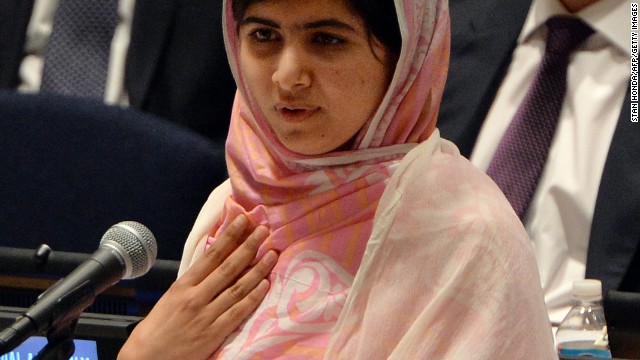 It is a remarkable twist of history that it has taken the courage of a wounded 16-year-old girl to force an entire army of terrorists -- with all their guns, bombs and grenades -- onto the back foot.Reeling from adverse comment worldwide, Adnan Rasheed, the Taliban commander who spoke out on Wednesday, tried to suggest that all that the Taliban opposes is western education. But in trying to extricate the Taliban from the charge that they oppose girls' schooling full stop, his comments reveal that the only education they favour is indoctrination and the only form of government they embrace theocratic.
Rasheed's protestations are at odds with the reality of 1,000 closed schools in Pakistan and Afghanistan because of arson attacks - and threats of the same. Indeed schools have been shut hundreds of miles from any Pakistani army presence, undermining the claim that only schools used as army bases are attacked.
In the last few weeks alone, 14 young women were blown up when the bus carrying them from college was firebombed; a school principal was shot dead and his pupils maimed in broad daylight at a prize giving ceremony held in the playground of an all-girls school in Karachi; and a teacher was gunned down in front of her son as she drove to teach at another female college.
These atrocities testify to the continued war against education. Not a word the Taliban utter about the right of girls like Malala to go to school will be believed until they stop bombing schools, killing teachers and massacring girls.But Malala has shown it is possible to stand up to Taliban intimidation and, emboldened by her courage, two million Pakistanis have signed petitions supporting the right of girls to go to school, part of four million signatures worldwide. This includes a million signatures from out-of-school girls and boys in Pakistan, who supported -- in some cases by putting thumb marks on the petition -- a plea for universal education delivered to the Pakistani President and Secretary-General of the UN.
As I found when I visited Pakistan only a few months ago, the silent majority is prepared to be silent no more. With girls openly wearing 'I am Malala' headbands and t-shirts and identifying with Malala's demands, they are defying Taliban threats - and Pakistan cannot ever be the same again.
A modern civil rights struggle is now underway, led by young people and influenced by online information about what is happening in other countries. Young people are insistent that education is a universal right, demanding that all the barriers that stand in the way -- child labour, child marriage, child trafficking and blanket discrimination against girls -- are pushed aside.
The recent revelations of both Taliban weakness and the strength of public opinion for education should signal much more than a set of petitions: it should be the start of a determined Pakistani effort to speed up the delivery of education to every girl and every boy. Pakistan cannot achieve its full potential until girls and boys are educated, for employment and for citizenship.
Today there are at least seven million girls and boys out of school in Pakistan -- and most girls will never complete their education. Even in 2050, only one in five young adults will have had the chance of college or university on current trends.
Illiteracy, especially among girls, will hold Pakistan's development back for decades unless something is done. China, Singapore, Taiwan, Korea and even Bangladesh will enrol millions of students at college and university -- but while Pakistan's population will grow to 300 or perhaps 400 million, making it one of the world's most populated countries, it will remain in the dark ages for education.
We also know that young people denied opportunity fall prey to extremist propaganda. This is yet another reason why a new Pakistani national education plan is required, involving all NGOs, and, while recognising that education is a devolved not federal matter in Pakistan, a national consensus on doubling investment in schools is now urgently needed.
In the last few months, we have been working with the government, civil society organisations, UN sister organisations and donor governments to draw up proposals to expand education, to get girls in particular to school, and to help the provinces where education attendance is lowest. This includes Malala's home of KPK, where 700,000 children are not at school, 600,000 of them girls.
We will discuss these proposals at a summit meeting between the UN Secretary-General Ban Ki-moon and Nawaz Sharif in September when the new Pakistani Prime Minister visits New York. And I will visit Pakistan to meet civil society organisations to assess the role they can play in improving educational opportunities for the left-out millions.
The good news is that we need no scientific invention or technological breakthrough to deliver education for all: we need instead the same willpower to move mountains that Malala showed when she stood up to the Taliban and lit the fuse that could inspire a modern educational revolution.
It is a remarkable twist of history that it has taken the courage of a wounded 16-year-old girl to force an entire army of terrorists -- with all their guns, bombs and grenades -- onto the back foot.Reeling from adverse comment worldwide, Adnan Rasheed, the Taliban commander who spoke out on Wednesday, tried to suggest that all that the Taliban opposes is western education. But in trying to extricate the Taliban from the charge that they oppose girls' schooling full stop, his comments reveal that the only education they favour is indoctrination and the only form of government they embrace theocratic.
Rasheed's protestations are at odds with the reality of 1,000 closed schools in Pakistan and Afghanistan because of arson attacks - and threats of the same. Indeed schools have been shut hundreds of miles from any Pakistani army presence, undermining the claim that only schools used as army bases are attacked.
In the last few weeks alone, 14 young women were blown up when the bus carrying them from college was firebombed; a school principal was shot dead and his pupils maimed in broad daylight at a prize giving ceremony held in the playground of an all-girls school in Karachi; and a teacher was gunned down in front of her son as she drove to teach at another female college.
These atrocities testify to the continued war against education. Not a word the Taliban utter about the right of girls like Malala to go to school will be believed until they stop bombing schools, killing teachers and massacring girls.But Malala has shown it is possible to stand up to Taliban intimidation and, emboldened by her courage, two million Pakistanis have signed petitions supporting the right of girls to go to school, part of four million signatures worldwide. This includes a million signatures from out-of-school girls and boys in Pakistan, who supported -- in some cases by putting thumb marks on the petition -- a plea for universal education delivered to the Pakistani President and Secretary-General of the UN.
As I found when I visited Pakistan only a few months ago, the silent majority is prepared to be silent no more. With girls openly wearing 'I am Malala' headbands and t-shirts and identifying with Malala's demands, they are defying Taliban threats - and Pakistan cannot ever be the same again.
A modern civil rights struggle is now underway, led by young people and influenced by online information about what is happening in other countries. Young people are insistent that education is a universal right, demanding that all the barriers that stand in the way -- child labour, child marriage, child trafficking and blanket discrimination against girls -- are pushed aside.
The recent revelations of both Taliban weakness and the strength of public opinion for education should signal much more than a set of petitions: it should be the start of a determined Pakistani effort to speed up the delivery of education to every girl and every boy. Pakistan cannot achieve its full potential until girls and boys are educated, for employment and for citizenship.
Today there are at least seven million girls and boys out of school in Pakistan -- and most girls will never complete their education. Even in 2050, only one in five young adults will have had the chance of college or university on current trends.
Illiteracy, especially among girls, will hold Pakistan's development back for decades unless something is done. China, Singapore, Taiwan, Korea and even Bangladesh will enrol millions of students at college and university -- but while Pakistan's population will grow to 300 or perhaps 400 million, making it one of the world's most populated countries, it will remain in the dark ages for education.
We also know that young people denied opportunity fall prey to extremist propaganda. This is yet another reason why a new Pakistani national education plan is required, involving all NGOs, and, while recognising that education is a devolved not federal matter in Pakistan, a national consensus on doubling investment in schools is now urgently needed.
In the last few months, we have been working with the government, civil society organisations, UN sister organisations and donor governments to draw up proposals to expand education, to get girls in particular to school, and to help the provinces where education attendance is lowest. This includes Malala's home of KPK, where 700,000 children are not at school, 600,000 of them girls.
We will discuss these proposals at a summit meeting between the UN Secretary-General Ban Ki-moon and Nawaz Sharif in September when the new Pakistani Prime Minister visits New York. And I will visit Pakistan to meet civil society organisations to assess the role they can play in improving educational opportunities for the left-out millions.
The good news is that we need no scientific invention or technological breakthrough to deliver education for all: we need instead the same willpower to move mountains that Malala showed when she stood up to the Taliban and lit the fuse that could inspire a modern educational revolution.