Saturday, October 4, 2014
China : Hong Kongers' free will shall not be held hostage to protestors
 Hong Kong's prosperity and stability are hard-won and should be treasured, while Hong Kongers' free will shall not be held hostage to those organizers of the Occupy Central movement who have ulterior motives, critics appealed.
Yin Haoliu, a Chinese American freelancer, wrote in an open letter to three initiators of the illegal movement: "Democracy is a step-by-step process that can not be approached in haste, otherwise it will bring about troubles."
"What's wrong with the Communist Party of China which hopes to see a person who loves China and loves Hong Kong elected as Hong Kong's chief executive? Are you willing to choose a chief executive that sells Hong Kong and the whole country?" Yin asked in the letter.
"You should know that on your opposite side are the silent majority... if Hong Kong falls into chaos, you could flee to foreign countries, but how about the ordinary Hong Kongers that are left behind?" he said.
"Christopher Francis Patten said the decision by the Standing Committee of the National People's Congress on Aug. 31 that granted universal suffrage in Hong Kong was false...then was he himself as the governor of Hong Kong elected by the Hong Kong people?" the retired doctor said.
Yin said Hong Kong had tided through numerous difficulties with full support of the Chinese mainland since the Basic Law was put into practice, so the initiators of Occupy Central should treasure the city's current prosperity and stability.
On Friday, the Russian Foreign Ministry said Moscow hopes that stability will resume as soon as possible in Hong Kong.
"Events in Hong Kong belong to China's internal affairs. Russia hopes the stability of the Hong Kong Special Administrative Region (HKSAR) would be resumed as soon as possible," the ministry's information and press department told Xinhua.
Singapore's Foreign Minister Kasiviswanathan Shanmugam said in an interview with Lianhe Zaobao that many reports on Hong Kong made by the Western media were untrue and biased to China.
They intentionally ignored a fact that Hong Kong had never implemented a democratic system under the British rule for some 150 years, he said, adding that Beijing's plan has granted Hong Kong much more democratic space than what Hong Kongers got in the times of British-ruled Hong Kong.
"Everyone shall be clear about one point, that is, what the central government did conforms with Hong Kong's Basic Law," the foreign minister said.
He said Hong Kong is deeply dependent on the Mainland, including employment and livelihood.
Even though a little anti-Mainland sentiment appeared in Hong Kong, the central government is still generous to Hong Kong, he added.
Jeff Bader, who ran Obama's first term White House East Asia policy, told the Washington Post that for Beijing, there is no room for compromise on issues such as Chinese stability and the leadership of the Communist Party of China.
He also mentioned that millions of Hong Kongers will not support or tolerate the protest that grinds the city to halt for days.
The negative impact of Occupy Central includes a bit of a brain drain, Bader predicted.
Hong Kong has been partially paralysed by the large-scale protests that started on Sept. 28.
A large number of Occupy protesters have taken over major streets in Mong Kok, one of the city's most bustling areas, for at least four days, which has seriously affected businesses of local shops, restaurants and vendors, and forced schools and banks to be closed.
Friday afternoon, some anti-Occupy people clashed with Occupy protesters in Mong Kok and Causeway Bay, Hong Kong's two major commercial areas. Several people were injured during the clashes.
Hong Kong Chief Executive Leung Chun-ying gave an urgent TV broadcast Friday evening, calling on all citizens, no matter what attitude they may have toward the Occupy movement, to keep calm and not to use violence or disrupt public order under any circumstances.
Hong Kong's prosperity and stability are hard-won and should be treasured, while Hong Kongers' free will shall not be held hostage to those organizers of the Occupy Central movement who have ulterior motives, critics appealed.
Yin Haoliu, a Chinese American freelancer, wrote in an open letter to three initiators of the illegal movement: "Democracy is a step-by-step process that can not be approached in haste, otherwise it will bring about troubles."
"What's wrong with the Communist Party of China which hopes to see a person who loves China and loves Hong Kong elected as Hong Kong's chief executive? Are you willing to choose a chief executive that sells Hong Kong and the whole country?" Yin asked in the letter.
"You should know that on your opposite side are the silent majority... if Hong Kong falls into chaos, you could flee to foreign countries, but how about the ordinary Hong Kongers that are left behind?" he said.
"Christopher Francis Patten said the decision by the Standing Committee of the National People's Congress on Aug. 31 that granted universal suffrage in Hong Kong was false...then was he himself as the governor of Hong Kong elected by the Hong Kong people?" the retired doctor said.
Yin said Hong Kong had tided through numerous difficulties with full support of the Chinese mainland since the Basic Law was put into practice, so the initiators of Occupy Central should treasure the city's current prosperity and stability.
On Friday, the Russian Foreign Ministry said Moscow hopes that stability will resume as soon as possible in Hong Kong.
"Events in Hong Kong belong to China's internal affairs. Russia hopes the stability of the Hong Kong Special Administrative Region (HKSAR) would be resumed as soon as possible," the ministry's information and press department told Xinhua.
Singapore's Foreign Minister Kasiviswanathan Shanmugam said in an interview with Lianhe Zaobao that many reports on Hong Kong made by the Western media were untrue and biased to China.
They intentionally ignored a fact that Hong Kong had never implemented a democratic system under the British rule for some 150 years, he said, adding that Beijing's plan has granted Hong Kong much more democratic space than what Hong Kongers got in the times of British-ruled Hong Kong.
"Everyone shall be clear about one point, that is, what the central government did conforms with Hong Kong's Basic Law," the foreign minister said.
He said Hong Kong is deeply dependent on the Mainland, including employment and livelihood.
Even though a little anti-Mainland sentiment appeared in Hong Kong, the central government is still generous to Hong Kong, he added.
Jeff Bader, who ran Obama's first term White House East Asia policy, told the Washington Post that for Beijing, there is no room for compromise on issues such as Chinese stability and the leadership of the Communist Party of China.
He also mentioned that millions of Hong Kongers will not support or tolerate the protest that grinds the city to halt for days.
The negative impact of Occupy Central includes a bit of a brain drain, Bader predicted.
Hong Kong has been partially paralysed by the large-scale protests that started on Sept. 28.
A large number of Occupy protesters have taken over major streets in Mong Kok, one of the city's most bustling areas, for at least four days, which has seriously affected businesses of local shops, restaurants and vendors, and forced schools and banks to be closed.
Friday afternoon, some anti-Occupy people clashed with Occupy protesters in Mong Kok and Causeway Bay, Hong Kong's two major commercial areas. Several people were injured during the clashes.
Hong Kong Chief Executive Leung Chun-ying gave an urgent TV broadcast Friday evening, calling on all citizens, no matter what attitude they may have toward the Occupy movement, to keep calm and not to use violence or disrupt public order under any circumstances.
China - Firmly safeguard rule of law in :Hong Kong People's Daily
 Democracy and the rule of law are interdependent, and a democracy without the rule of law will only bring havoc, says a commentary to be carried by Saturday's People's Daily.
In recent days, protests have been staged in Hong Kong in the name of seeking "real universal suffrage," causing traffic jams, less tourists, the stock market plunging and the suspension of schools and stores.
"All these chaotic scenes have caused worries and irritation among Hong Kong citizens," says the commentary on the flagship newspaper of the Communist Party of China Central Committee.
According to the article, the so-called "Occupy Central" protests are aiming to realize political intentions that violate Hong Kong's Basic Law through unlawful means, and however the organizers and instigators labeled such acts as "peaceful" or "nonviolent," they cannot change the illegal nature of the protests.
"These acts will undoubtedly end up with the rule of law violated, severely disrupted social orders, huge economic losses and possible casualties," says the opinion piece.
The protests attempt to force the central authorities to change the decision made by the Standing Committee of the National People's Congress (NPC), China's top legislature, on Hong Kong's electoral system. The decision made on Aug. 31 granted universal suffrage in the selection of the Hong Kong Special Administrative Region (HKSAR)'s chief executive on the basis of nomination by a "broadly representative" committee.
Noting that one essence of the rule of law is absolute abidance by the law and the punishments on violators, the article says nobody is able to disregard the law or take exception to it. "Young students should also abide by the law."
It also says that the measures of Hong Kong police to cope with the protests are necessary to ensure the rule of law, and they only used teargas when left without choices against protesters who bumped police defences and even poked police with umbrella.
"Hong Kong police are very professional, and the actions they took were necessary, appropriate and moderate. There are no reasons to criticize their law enforcement acts," it says. "A democratic society should respect the opinions of the minorities, but it doesn't mean those minorities have the right to resort to illegal means.
"Democracy can only be prosperous and the rule of law developed when we express opinions and seek consensus under the framework of law," the article says, urging protesters to return to reason and the rule of law as the common responsibilities of all Hong Kong residents who truly love Hong Kong.
Democracy and the rule of law are interdependent, and a democracy without the rule of law will only bring havoc, says a commentary to be carried by Saturday's People's Daily.
In recent days, protests have been staged in Hong Kong in the name of seeking "real universal suffrage," causing traffic jams, less tourists, the stock market plunging and the suspension of schools and stores.
"All these chaotic scenes have caused worries and irritation among Hong Kong citizens," says the commentary on the flagship newspaper of the Communist Party of China Central Committee.
According to the article, the so-called "Occupy Central" protests are aiming to realize political intentions that violate Hong Kong's Basic Law through unlawful means, and however the organizers and instigators labeled such acts as "peaceful" or "nonviolent," they cannot change the illegal nature of the protests.
"These acts will undoubtedly end up with the rule of law violated, severely disrupted social orders, huge economic losses and possible casualties," says the opinion piece.
The protests attempt to force the central authorities to change the decision made by the Standing Committee of the National People's Congress (NPC), China's top legislature, on Hong Kong's electoral system. The decision made on Aug. 31 granted universal suffrage in the selection of the Hong Kong Special Administrative Region (HKSAR)'s chief executive on the basis of nomination by a "broadly representative" committee.
Noting that one essence of the rule of law is absolute abidance by the law and the punishments on violators, the article says nobody is able to disregard the law or take exception to it. "Young students should also abide by the law."
It also says that the measures of Hong Kong police to cope with the protests are necessary to ensure the rule of law, and they only used teargas when left without choices against protesters who bumped police defences and even poked police with umbrella.
"Hong Kong police are very professional, and the actions they took were necessary, appropriate and moderate. There are no reasons to criticize their law enforcement acts," it says. "A democratic society should respect the opinions of the minorities, but it doesn't mean those minorities have the right to resort to illegal means.
"Democracy can only be prosperous and the rule of law developed when we express opinions and seek consensus under the framework of law," the article says, urging protesters to return to reason and the rule of law as the common responsibilities of all Hong Kong residents who truly love Hong Kong.
Anti-corruption drive to boost Afghan president's credibility
In a bid to keep his promise of tackling corruption, President Ghani has reopened a probe into a massive banking fraud scandal. Experts say the new leader is seeking to prove himself to Afghans and the global community.President Ashraf Ghani Ahmadzai, who has promised a fight against rampant graft, reopened an inquiry into the notorious Kabul Bank case on Wednesday, October 1. The commercial bank collapsed in 2010 after media reports exposed massive high-level corruption and the misappropriation of more than 900 million USD - most of which was deposited by international donors. In a presidential decree, Ghani ordered Afghanistan's Supreme Court to launch a new investigation into the case within 45 days. He also ordered the Attorney General's Office to arrest all the suspects within three days and keep them in detention until the court investigation is fully concluded. "We promised to combat corruption comprehensively, on a full scale and in a principled manner and it is time for action," Ghani said after signing the decree. The new president wants to prove himself to Afghans and the international community by taking on what is known as the biggest corruption scandal in the country, said Said Massud, economics lecturer at Kabul University, who was present during the signing of the decree. "It is a very interesting move by the president and a test for the new government. If the administration can solve this case and track the missing money, it will gain credibility and international prestige," Massud told DW. Lingering doubts Many of those who are suspected to be involved in the scandal are related to former or current high-ranking Afghan officials, including brothers of former President Hamid Karzai and his then first vice-President Mohammad Qasim Fahim. In total, 21 people were convicted in the case, including the bank's founder Sher Khan Fernod and chief executive Haji Khalil Ferozi, who were sentenced to five years in jail. However, Karzai's brothers and one of his vice-presidents were not sent to jail due to a presidential decree that granted immunity to shareholders who returned stolen funds. Massud expresses concern over the 45-day deadline set for the Supreme Court to carry out an investigation into the case, as he doubts the capacity of institutions that will execute President Ghani's decree. The analyst believes the powerful people behind the scandal will be another big challenge for the new president. "It is to be seen if the Afghan government is powerful enough to put the people involved in the Kabul Bank case behind bars because many of them belong to very powerful families," Massud stressed.
 Seeking attention
International community, which has been funding Afghanistan since 2001, has demanded Afghan officials to tackle widespread corruption.
Many countries including Afghanistan's biggest donor, the United States, have warned they will cut their financial aid to the war-torn nation if it does not take concrete actions against graft.
Kabul Bank scandal was described as "one of the largest banking failures in the world" by the country's anti-corruption watchdog.
The case triggered a financial crisis and shook Afghans' confidence in banking, which was a booming economic sector until 2010. Experts believe the country's new government needs to do more to eliminate the practice of corruption, which would go a long way in retaining international financial support.
There were three immediate priorities for Ghani after taking over the reins, Massud noted. These included: a security pact with the US, agreement on NATO's new training mission in Afghanistan and tracking Kabul Bank's stolen money, the lecturer underlined. "President Ghani has already completed the first two. He will gain international credibility if he can achieve the third goal," he added.
Seeking attention
International community, which has been funding Afghanistan since 2001, has demanded Afghan officials to tackle widespread corruption.
Many countries including Afghanistan's biggest donor, the United States, have warned they will cut their financial aid to the war-torn nation if it does not take concrete actions against graft.
Kabul Bank scandal was described as "one of the largest banking failures in the world" by the country's anti-corruption watchdog.
The case triggered a financial crisis and shook Afghans' confidence in banking, which was a booming economic sector until 2010. Experts believe the country's new government needs to do more to eliminate the practice of corruption, which would go a long way in retaining international financial support.
There were three immediate priorities for Ghani after taking over the reins, Massud noted. These included: a security pact with the US, agreement on NATO's new training mission in Afghanistan and tracking Kabul Bank's stolen money, the lecturer underlined. "President Ghani has already completed the first two. He will gain international credibility if he can achieve the third goal," he added.
Decisive move
Many experts believe success in the fight against corruption will give Ghani's new government the support and the credibility it needs from the people, particularly after the country's disputed presidential election and a controversial political agreement between Ghani and his former electoral rival Abdullah Abdullah. Abdullah is now the Afghanistan's Chief Executive.Massud says the new president should deliver results as a failure to do so would put his future plans at risk. He is of the view that Abdullah's support will be crucial to achieve success.
"If Ghani wants to govern well in the coming five years, he should make sure that the probe into Kabul Bank scandal succeeds. Otherwise, he will face huge problems as people will question his authority," Massud said.
Afghan Watchdog Says Ex-Leaders' Brothers Owe In Bank Scandal
 A corruption watchdog in Afghanistan says the brothers of former President Hamid Karzai and one of his vice presidents are among 19 people and companies that still owe a total of $663 million from a 2010 loan fraud scandal at Afghanistan's biggest commercial bank.
The Independent Joint Anticorruption Monitoring and Evaluation Committee announced the figures released on October 2 -- a day after newly inaugurated President Ashraf Ghani relaunched investigations into the Kabul Bank scandal.
Mahmud Karzai, the brother of the former president, was listed as owing $22.2 million on loans from Kabul Bank and having paid back only $13.4 million.
But he denied he still owed money, saying he paid back all his loans with interest.
The watchdog says Abdul Haseen Fahim, brother of former First Vice President Mohammad Qasim Fahim, still owes $4.4 million after paying back nearly $36 million.
Fahim could not be immediately reached for comment.
Rashed Behroz, executive director of the Monitoring and Evaluation Committee, said the government's new inquiry should consider new prosecutions in the case.
"Regardless of the political and personal affiliations of the people who have been involved in this matter, these people should be prosecuted and we hope that we will soon be able to see the results of this," he said.
The two brothers of the former Afghan leaders are both shareholders of Kabul Bank.
They were spared prosecution under a decree by former President Karzai that granted immunity to those who returned the funds.
The $935 million fraud case nearly brought about the collapse of the country's largest commercial bank in 2010.
The two former heads of the bank, founder Sher Khan Fernod and former chief executive Haji Khalil Ferozi, were convicted of taking $810 million out of the $935 million that was stolen.
Both received five-year prison sentences.
Much of the missing money has yet to be recovered.
Ten other Kabul Bank insiders were also convicted in the case and received sentences ranging from six months to five years.
Ghani, who was inaugurated on September 29, ordered Afghanistan's Supreme Court on October 1 to reopen the Kabul Bank case, saying, "The time for action has come, and as we had pledged, the fight against corruption will be done in a thorough and systematic way."
Afghanistan's courts were criticized for imposing light sentences against those convicted in the case and for allegedly failing to bring to justice the masterminds of a scheme that diverted hundreds of millions of dollars in fraudulent loans to bank insiders.
Kabul Bank had handled about one-third of Afghanistan's banking and most of the government payroll -- including salaries for the army and security forces.
It was renamed New Kabul Bank after a government bailout.
A corruption watchdog in Afghanistan says the brothers of former President Hamid Karzai and one of his vice presidents are among 19 people and companies that still owe a total of $663 million from a 2010 loan fraud scandal at Afghanistan's biggest commercial bank.
The Independent Joint Anticorruption Monitoring and Evaluation Committee announced the figures released on October 2 -- a day after newly inaugurated President Ashraf Ghani relaunched investigations into the Kabul Bank scandal.
Mahmud Karzai, the brother of the former president, was listed as owing $22.2 million on loans from Kabul Bank and having paid back only $13.4 million.
But he denied he still owed money, saying he paid back all his loans with interest.
The watchdog says Abdul Haseen Fahim, brother of former First Vice President Mohammad Qasim Fahim, still owes $4.4 million after paying back nearly $36 million.
Fahim could not be immediately reached for comment.
Rashed Behroz, executive director of the Monitoring and Evaluation Committee, said the government's new inquiry should consider new prosecutions in the case.
"Regardless of the political and personal affiliations of the people who have been involved in this matter, these people should be prosecuted and we hope that we will soon be able to see the results of this," he said.
The two brothers of the former Afghan leaders are both shareholders of Kabul Bank.
They were spared prosecution under a decree by former President Karzai that granted immunity to those who returned the funds.
The $935 million fraud case nearly brought about the collapse of the country's largest commercial bank in 2010.
The two former heads of the bank, founder Sher Khan Fernod and former chief executive Haji Khalil Ferozi, were convicted of taking $810 million out of the $935 million that was stolen.
Both received five-year prison sentences.
Much of the missing money has yet to be recovered.
Ten other Kabul Bank insiders were also convicted in the case and received sentences ranging from six months to five years.
Ghani, who was inaugurated on September 29, ordered Afghanistan's Supreme Court on October 1 to reopen the Kabul Bank case, saying, "The time for action has come, and as we had pledged, the fight against corruption will be done in a thorough and systematic way."
Afghanistan's courts were criticized for imposing light sentences against those convicted in the case and for allegedly failing to bring to justice the masterminds of a scheme that diverted hundreds of millions of dollars in fraudulent loans to bank insiders.
Kabul Bank had handled about one-third of Afghanistan's banking and most of the government payroll -- including salaries for the army and security forces.
It was renamed New Kabul Bank after a government bailout.
Pakistani Taliban Declares Allegiance To Islamic State
The Pakistani Taliban has announced that it has declared allegiance to Islamic State militants and has ordered its fighters to help the militant extremist group try to set up a global Islamic caliphate.
The announcement by Taliban spokesman Shahidullah Shahid on October 4 comes after Al-Qaeda leader Ayman al-Zawahri said in September that he had named former Taliban commander Asim Umar as the "emir" of Al-Qaeda’s new South Asia branch.
Shahid’s statement came despite recent speculation that the leadership of Pakistan’s Taliban is wary of IS fighters, who are driven by different ambitions that have little to do with South Asia.
Although there has been little evidence of a firm alliance between IS militants and Al-Qaeda-linked Taliban commanders, IS activists have been spotted recently in Pakistan’s northwestern city of Peshawar distributing pamphlets that praise the group.
http://www.rferl.org/content/pakistani-taliban-islamic-state-allegiance/26620750.html
Pakistan : Developing a counter-narrative
Pakistan: More blood in Balochistan
Pakistan: Blast in Quetta Hazara town; several reported injured

A large explosion occurred in Quetta's Hazara Town area on Saturday, with initial reports suggesting several people were injured in the blast. According to DawnNews, the blast took place near a girls' school in the Aliabad area of Hazara Town, a locality populated mainly by the ethnic Hazara Shia minority which has been targeted by extremist militant groups in the past. Initial reports suggested several people were wounded in the blast. Emergency was imposed at all hospitals in Quetta following the blast. Police and rescue teams were on their way to the site of the explosion.
Pakistan - Terrorists Strike Back

Bilawal Bhutto is a reflection of ZA Bhutto and Benazir Bhutto

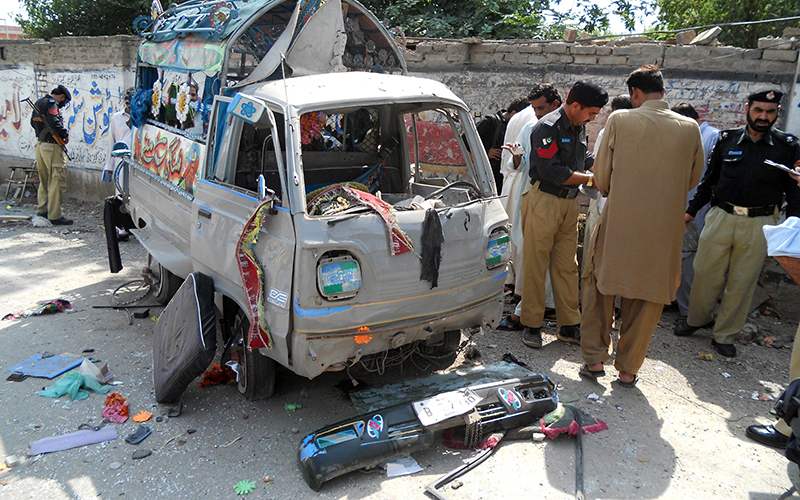
Pakistan _ Explosion in passenger van kills six in Kohat
Pakistan: Thousands of govt schools in KP without electricity, potable water, washrooms

