http://mediacellppp.wordpress.com/

http://mediacellppp.wordpress.com/
The President encourages Americans to support organizations assisting with typhoon recovery.
President Obama bowed to political pressure from his fellow Democrats and announced a plan to let insurers renew for one year the health plans for Americans whose policies would be otherwise canceled due to Obamacare.
 The United States will knock off Saudi Arabia as the world's top energy producer by 2015, but its power as a global energy force will fade over the next decade, according to a report from the International Energy Agency.
Massive investment in the production of shale gas has driven the U.S. supply boom, thanks in large part to new technologies such as hydraulic fracking, which has made the extraction of oil and gas from shale rock commercially viable. But limited reserves will cap the surge in shale oil output within the next 10 years.
"Shale oil is good news for the U.S, but we do not expect this trend will continue after the 2020s," IEA chief economist Fatih Birol told reporters Tuesday, at the launch of the 2013 World Energy Outlook in London.
That will translate into an increase in OPEC producers' share of global output since those nations would remain the only large source of relatively low cost oil.
"Middle East oil is crucial to the global oil industry today, and also tomorrow," Birol said.The OPEC oil cartel, which includes Saudi Arabia, the United Arab Emirates and Qatar, controls the vast majority of world oil reserves.
As a major exporter, top producer Saudi Arabia is critical to future energy supplies. By contrast, the United States relies on its newfound energy wealth to power domestic consumption.
Birol said despite the growth in U.S. energy supplies, the new era isn't one of "oil abundance," due to demand pressures and declining production from existing crude fields.
The IEA also noted that power-hungry Asia will continue to re-shape the global energy landscape. About two-thirds of future world energy demand will come from the region.
India will take over from China as the biggest energy demand center around 2020.
The Middle East will also have a rising impact on demand. By 2035 the Middle East will consume the same amount of oil as China does today, according to the IEA. To top of page
The United States will knock off Saudi Arabia as the world's top energy producer by 2015, but its power as a global energy force will fade over the next decade, according to a report from the International Energy Agency.
Massive investment in the production of shale gas has driven the U.S. supply boom, thanks in large part to new technologies such as hydraulic fracking, which has made the extraction of oil and gas from shale rock commercially viable. But limited reserves will cap the surge in shale oil output within the next 10 years.
"Shale oil is good news for the U.S, but we do not expect this trend will continue after the 2020s," IEA chief economist Fatih Birol told reporters Tuesday, at the launch of the 2013 World Energy Outlook in London.
That will translate into an increase in OPEC producers' share of global output since those nations would remain the only large source of relatively low cost oil.
"Middle East oil is crucial to the global oil industry today, and also tomorrow," Birol said.The OPEC oil cartel, which includes Saudi Arabia, the United Arab Emirates and Qatar, controls the vast majority of world oil reserves.
As a major exporter, top producer Saudi Arabia is critical to future energy supplies. By contrast, the United States relies on its newfound energy wealth to power domestic consumption.
Birol said despite the growth in U.S. energy supplies, the new era isn't one of "oil abundance," due to demand pressures and declining production from existing crude fields.
The IEA also noted that power-hungry Asia will continue to re-shape the global energy landscape. About two-thirds of future world energy demand will come from the region.
India will take over from China as the biggest energy demand center around 2020.
The Middle East will also have a rising impact on demand. By 2035 the Middle East will consume the same amount of oil as China does today, according to the IEA. To top of page

 For the first time since 2011, the Russian and Syrian presidents spoke on the phone to discuss developments in the Syria crisis. Vladimir Putin called Bashar Assad about the Geneva-2 peace talks and the destruction of Syria’s chemical stockpile.
President Putin called President Assad to talk about the preparations for the Syria peace talks, and to share Russia’s concerns over the reports of a surge in extremist persecution of religious minorities in Syria, the Kremlin press service said on Thursday.
The Russian President said he hopes that major Syrian opposition groups will take “a constructive approach” and participate in the peace conference in Geneva.
Putin told Assad he was “satisfied” with Syria’s cooperation with the UN and the OPCW (International Chemical Weapons Watchdog).
The presidents discussed the procedure for bringing the Syrian chemical arsenal under international control and its ultimate destruction.
Putin said he was concerned with “purposeful persecution of Christians and other religious minorities” by extremist groups in Syria. He said Russia hopes the Syrian government “will do everything possible to relieve the suffering of the civilian population and to restore the peace.”
Assad thanked the Russian government for “aiding the Syrian people,” and the two presidents confirmed they intend to foster bilateral relations further.
The Geneva-2 peace talks, brokered by the US and Russia, have not yet been scheduled officially, although they were tentatively planned for November 23. Syrian official media recently said the date has been set for December 12, but this has not been officially confirmed.
While Russia has been pushing the international community for months to start the talks, and the Syrian government has repeatedly said it is ready to participate without preconditions, Western powers are still struggling to bring the opposition groups to the negotiation table.
Recently, the leader of the National Coalition for Syrian Revolutionary and Opposition Forces, Ahmad Jarba, told the Sunday Telegraph the group will agree to take part in talks on condition that the West ensures humanitarian corridors to the opposition strongholds in Syria. Previously, Jarba rejected the possibility of attending the Geneva-2, demanding that President Bashar Assad must go.
For the first time since 2011, the Russian and Syrian presidents spoke on the phone to discuss developments in the Syria crisis. Vladimir Putin called Bashar Assad about the Geneva-2 peace talks and the destruction of Syria’s chemical stockpile.
President Putin called President Assad to talk about the preparations for the Syria peace talks, and to share Russia’s concerns over the reports of a surge in extremist persecution of religious minorities in Syria, the Kremlin press service said on Thursday.
The Russian President said he hopes that major Syrian opposition groups will take “a constructive approach” and participate in the peace conference in Geneva.
Putin told Assad he was “satisfied” with Syria’s cooperation with the UN and the OPCW (International Chemical Weapons Watchdog).
The presidents discussed the procedure for bringing the Syrian chemical arsenal under international control and its ultimate destruction.
Putin said he was concerned with “purposeful persecution of Christians and other religious minorities” by extremist groups in Syria. He said Russia hopes the Syrian government “will do everything possible to relieve the suffering of the civilian population and to restore the peace.”
Assad thanked the Russian government for “aiding the Syrian people,” and the two presidents confirmed they intend to foster bilateral relations further.
The Geneva-2 peace talks, brokered by the US and Russia, have not yet been scheduled officially, although they were tentatively planned for November 23. Syrian official media recently said the date has been set for December 12, but this has not been officially confirmed.
While Russia has been pushing the international community for months to start the talks, and the Syrian government has repeatedly said it is ready to participate without preconditions, Western powers are still struggling to bring the opposition groups to the negotiation table.
Recently, the leader of the National Coalition for Syrian Revolutionary and Opposition Forces, Ahmad Jarba, told the Sunday Telegraph the group will agree to take part in talks on condition that the West ensures humanitarian corridors to the opposition strongholds in Syria. Previously, Jarba rejected the possibility of attending the Geneva-2, demanding that President Bashar Assad must go.
Musician and writer Daniyal Noorani created animated cartoons that took on Islamic extremism in Pakistan. But even though their message was peaceful, TV stations there would not run them.
By Aryn Baker

Viruses cross borders invisibly and dangerously. The fighting in Syria has made that especially easy for polioThe polio virus that crippled at least 13 Syrian children last month originated in Pakistan, according to the World Health Organization (WHO). It does not look as if the disease came into the country with Pakistani militants aligned with rebels fighting the regime of President Bashar Assad, as was alleged last week by a government official. Instead, it appears it has been lurking in the Middle East region for at least a year, seeking any opportunity to infect a vulnerable population. It finally got its chance in Syria, where the ongoing conflict has obstructed the vaccination campaigns that are the only way to ensure the virus stops in its tracks. Before this most recent outbreak, Syria had been polio-free since 1999. It is conflict in Pakistan’s tribal areas that has allowed the virus to flourish and hitch a ride west, demonstrating that as long as polio has a foothold in one country, no other country is safe. Genetic sequencing of the virus that spread through Deir ez-Zor in eastern Syria, threatening tens of thousands of unvaccinated children, indicates that this particular strain is closely related to samples discovered in the sewage systems of Egypt, the Gaza Strip, Israel and the West Bank late last year. “With large-scale population movements ongoing within and between Syria and surrounding countries, it is very unlikely that it will ever be possible to state definitively how the virus came into the country,” says the WHO’s polio-eradication spokesman Oliver Rosenbauer. “This is the big danger with this disease, in that it can travel across wide geographic areas with population movements.” In response, the WHO has mounted a massive, region-wide campaign that aims to vaccinate some 20 million children under the age of 5 in the next six months. It will be an expensive and arduous undertaking, with no guarantees that vaccination teams will reach the most vulnerable children before the virus does. The only way to protect every single child from a crippling disease that has no cure is to eradicate the virus entirely. The world is tantalizingly close to that goal: after a 28-year campaign, polio is endemic in only three countries: Pakistan, Afghanistan and Nigeria. Even those outliers are on their way toward complete eradication. But a recent antivaccine movement spearheaded by the Pakistani Taliban has threatened Pakistan’s progress. Taliban leaders have banned polio vaccinations in their areas as long as U.S. drones continue to attack militants. Several health workers who defied the ban have since been shot or killed. The result: 56 children have been paralyzed in Pakistan so far this year, up from 48 last year. “Taliban leaders are essentially holding their own children hostage, just to stop drones,” says Aziz Memon, Rotary International’s PolioPlus chairman for Pakistan, by telephone. By doing so, he says, they are threatening the rest of the world’s children. “This virus is vicious. It is going to travel, and it will seek out the vulnerable. The only way to prevent outbreaks like the one we are seeing in Syria is to stop it here in Pakistan. And the sooner the better.” Read more: Pakistan Infects Syria With Polio, Says the WHO | TIME.com http://world.time.com/2013/11/13/pakistani-polio-hits-syria-proving-no-country-is-safe-until-all-are/#ixzz2kdROlmtC
 The Jamaat-e-Islami never misses an opportunity to be on the wrong side of history. Since its inception, it has acted against the interests of the very people it pretends to serve.
Last week Syed Munawar Hassan, who heads Pakistan’s Jamaat-i-Islami (Jamaat), declared the former head of the Pakistani Taliban, Hakeemullah Mehsud, a martyr. Mehsud reportedly died of a missile fired from an unmanned drone in North Waziristan. The Pakistan Army took serious offense to the statement by Mr. Hassan and found it insulting to the memory of thousands of soldiers who have died fighting militants.
The Jamaat-e-Islami never misses an opportunity to be on the wrong side of history. Since its inception, it has acted against the interests of the very people it pretends to serve.
Last week Syed Munawar Hassan, who heads Pakistan’s Jamaat-i-Islami (Jamaat), declared the former head of the Pakistani Taliban, Hakeemullah Mehsud, a martyr. Mehsud reportedly died of a missile fired from an unmanned drone in North Waziristan. The Pakistan Army took serious offense to the statement by Mr. Hassan and found it insulting to the memory of thousands of soldiers who have died fighting militants.

 Qaumi Wattan Party (QWP) has announced to quit Pakistan Tehreek-e-Insaf (PTI) led coalition government in Khyber Pakhtunkhwa (KPK), SAMAA reports on Thursday.
Addressing a press conference here‚ QWP Chairman Sikandar Sherpao leveled series of allegations against PTI leaders.
He said a new drama was started to befool the people.
Sherpao told media that his party’s reservations were not being addressed. He further added that PTI never consulted the QWP leadership over decision-making when it came to matters relating to politics and governance.
“PTI does not look serious in closing NATO supply routes” he added.
Qaumi Wattan Party (QWP) has announced to quit Pakistan Tehreek-e-Insaf (PTI) led coalition government in Khyber Pakhtunkhwa (KPK), SAMAA reports on Thursday.
Addressing a press conference here‚ QWP Chairman Sikandar Sherpao leveled series of allegations against PTI leaders.
He said a new drama was started to befool the people.
Sherpao told media that his party’s reservations were not being addressed. He further added that PTI never consulted the QWP leadership over decision-making when it came to matters relating to politics and governance.
“PTI does not look serious in closing NATO supply routes” he added.
Patron-in-Chief of Pakistan Peoples Party (PPP), Bilawal Bhutto Zardari, has urged Muslims to learn from the supreme sacrifice of Hazrat Imam Hussain (AS) and Ahle Bait and continue struggle for higher values and triumph of goodness over evil.http://mediacellppp.wordpress.com/
 The incident of Karbala is remembered as historical event which established the lasting example of rendering sacrifice for upholding truth and principles. The Jihad fought by Hazrat Imam Hussain along with his companions is a shining minaret of courage, patience perseverance and determination, said PPP Patron in his message on Yom-i-Ashur falling on November 15, 2013.
He said that today nation was passing through difficult phase as tyranny at the hands of militants continues to stark the country. “Islam is a religion of peace and forbids killing in the name of religion,” he said.
“At this juncture of our country’s history, we reiterate our resolve that no matter what the odds, we shall not submit before the tyranny of militants who want to impose their distorted ideology upon us and continue the struggle for a just, plural, moderate and enlightened Pakistan,” he further said.
PPP Patron appealed to people to rise above sectarianism and forge unity amongst them and to fight the forces that want to surrender Pakistan at the altar of narrow-mindedness and evil.
Bilawal Bhutto Zardari said the best way to pay tribute to Hazrat Imam Hussain, the leader of all martyrs, is to adopt his character and face difficulties with courage. “In this way we can not only overcome all difficulties but we can also adopt the real teachings of Islam and succeed in this life and hereafter,” he added.
The incident of Karbala is remembered as historical event which established the lasting example of rendering sacrifice for upholding truth and principles. The Jihad fought by Hazrat Imam Hussain along with his companions is a shining minaret of courage, patience perseverance and determination, said PPP Patron in his message on Yom-i-Ashur falling on November 15, 2013.
He said that today nation was passing through difficult phase as tyranny at the hands of militants continues to stark the country. “Islam is a religion of peace and forbids killing in the name of religion,” he said.
“At this juncture of our country’s history, we reiterate our resolve that no matter what the odds, we shall not submit before the tyranny of militants who want to impose their distorted ideology upon us and continue the struggle for a just, plural, moderate and enlightened Pakistan,” he further said.
PPP Patron appealed to people to rise above sectarianism and forge unity amongst them and to fight the forces that want to surrender Pakistan at the altar of narrow-mindedness and evil.
Bilawal Bhutto Zardari said the best way to pay tribute to Hazrat Imam Hussain, the leader of all martyrs, is to adopt his character and face difficulties with courage. “In this way we can not only overcome all difficulties but we can also adopt the real teachings of Islam and succeed in this life and hereafter,” he added.
Former President Asif Ali Zardari has asked the nation to forge unity and harmony on the solemn occasion of Yom-e-Ashura and urged people to be cautious of those who want to destroy sectarian harmony in the country.http://mediacellppp.wordpress.com/

Dr Mohammad Taqi


Saudi Arabia has not established any nuclear reactor on its soil but it has invested in Pakistan’s nuclear programme Other countries’ investment in Pakistan’s nuclear programme and its weapons of mass destruction raised serious questions across the world that these weapons might fall into the wrong hands. The huge investment of the Saudi government in Pakistan’s nuclear weapons is not a new thing; Libya, United Arab Emirates, China contributed their share. Saudi Arabia, in the past, has been the subject of speculation regarding its nuclear weapons ambitions. Among the charges levelled against it is the possession of undeclared nuclear facilities. Saudi Arabia’s link with Pakistan’s nuclear and missile programme has long been the source of speculation that Pakistan might either station its nuclear forces on Saudi soil or provide a nuclear umbrella to the Wahabi state in return for oil supplies, or that the Saudis would purchase nuclear weapons from Pakistan. Saudi Arabia has stationed two brigades of the Pakistan military on its soil to prevent an Iranian invasion, while some 30,000 ex-soldiers of Pakistan are fighting in Bahrain and Yemen. Saudi Arabia invested in Pakistan’s nuclear bomb and now it seems it wants to obtain the bomb. While the Saudis’ quest for these weapons has also been set in the context of countering Iran, it is now possible for the Sheikhs to obtain these weapons quicker than Iran. Iran wants to establish hegemony in the region and Saudi Arabia views Iran’s influence in the Middle East and Persian Gulf as a big threat. The Saudi investment in Pakistan’s nuclear bomb raised many questions. Facilities and capabilities that Saudi Arabia is known to possess would be insufficient for any military nuclear programme. Saudi Arabia has not established any nuclear reactor on its soil but it has invested in Pakistan’s nuclear programme. Experts fear that Saudi Arabia may possibly provide these weapons to the Pakistani Taliban based in Syria or it may deploy these weapons on its borders because Saudi Arabia’s recent diplomatic ruction with the United States has been over the demand for stern military action against the Assad regime. The Saudis will not want to wait more to receive the Pakistani nuclear bomb because they have already paid for it. Libya and North Korea have already received their share. Afghanistan could also demand its share as its uranium was used in building Pakistan’s nuclear bomb. Pakistan used Afghan uranium, brought secretly from the mountains of Kunar and Paktia province in the 1980s. Afghanistan can also demand its share in the ‘Muslim ummah’ bomb, because when Pakistan exploded its nuclear bomb in the Chaghai region in Balochistan in 1998, it dumped nuclear waste inside Afghanistan, which caused dangerous diseases. Since the 1980s, we read about the danger of Pakistan’s nuclear weapons and its security in print and electronic media worldwide. Speculations about the recent terror attacks on Pakistan’s nuclear installations confused the international community about the safety and security of the country’s nuclear assets. No doubt, Pakistan has deployed more than 25,000 forces personnel on its 15 nuclear sites. However, recent terror attacks in various cities of Pakistan triggered concerns in the international community about the security of the country’s nuclear weapons. This perception has wide ranging strategic, diplomatic, political and economic implications for Pakistan. Today’s precarious situation in Pakistan comes in a world where terror groups are actively seeking nuclear weapons. The Uighur Islamic Front has its eyes on Pakistan. The Taliban, al Qaeda and other sectarian groups want nuclear weapons. The Syrian rebels need weapons of mass destruction; Haqqani and Mullah Omar also need these weapons to be used in Afghanistan. The continued ties of Deobandi, Barelvi, Ahle Hadith, Salafi groups and their sympathisers in the civilian and military leadership pose a considerable threat to the nuclear installations of the country. According to the recent report of the National Crisis Management Cell of the Interior Ministry, more than 400 sectarian and extremist groups operate alongside the Punjabi Taliban in southern Punjab. The Punjabi Taliban control dozens of villages in southern Punjab, and allegedly receive funds from the Punjab government. The Punjabi Taliban have established a strong network in the army and police forces. As we have already discussed, the networks of extremist and terror groups in the country, the globalization of world industry and transport, containerisation of trade, diffusion of nuclear weapon technology and the availability of weapons of mass destruction present a big threat to world peace. Terrorist groups and, specifically, al Qaeda are planning to acquire these weapons and, with their ability and financial resources, they have designs to purchase, steal and make these weapons from fissile material. The report, “Weapons of Mass Destruction Commission”, compiled by the Swedish government on a proposal from the United Nations, warns: “Acquiring weapons of mass destruction and usable materials directly from a sympathetic government would significantly simplify the requirement for the terrorists, obviating the need to defeat security systems protecting such materials. During the civil wars, violence or instability in a country like Pakistan, terror groups can gain control of fissile materials. Insurgent groups, like the Taliban, or sectarian groups can make a safe penetration with the cooperation of inside contacts. Even if such an insurrection were unsuccessful, however, nuclear sites could fall behind “enemy” lines, before fissile materials could be removed, permitting their transfer to terrorists or their allies.”By Musa Khan Jalalzai
 Talking to the senators from the tribal areas in a meeting, President Mamnoon Hussein assured of efforts to bring Fata into the mainstream. Every president and prime minister since the creation of this country has stated his intention to bring Fata at par with the rest of Pakistan; it is easier said than done, as even after over six decades; Fata is centuries behind the rest of Pakistan.
Such statements by presidents and prime minister regarding Fata are usual and traditional; it, however, is also traditional and tragic that the Fata MPs only promote their personal agendas during these meetings. These MPs are not even embarrassed and do not object when Gilgit-Baltistan, a much smaller entity and with not even half the population, gets double the funds compared to Fata.
Regardless of the apathy of the Fata MPs towards their people, the current president and prime minister cannot be so naïve and lacking in knowledge and commonsense that unless peace and progress comes to the tribal areas there never will be peace in the country; also, the progress and prosperity in the rest of Pakistan will be impeded by the lack of law and order in the tribal areas.
It is not necessary that the selfishness of the Fata MPs should blind the president and prime minister to what is in the national interest. It is in the national interest to create conditions in Fata conducive to make the lifestyle of the tribal people compatible with the rest of the country.
But that is not all; because the conditions in the tribal areas are wild and unstable, the government has been unable to tap the vast underground resources there, said to be more in abundance than in any area in the country; Khyber Agency alone is said to have more oil reserves than the rest of Pakistan. In fact, all the seven agencies comprising Fata are extremely rich in underground mineral resources; but, because there is no proper civil administration to make things orderly, especially law and order there, these resources can not be manipulated.
It is a shame that no prime minister and president has been bold enough to make revolutionary decisions regarding the tribal areas that can not only turn around the situation in Fata but the rest of the country as well.
Basically, Fata and Pakistan cannot hold together unless sincere and speedy steps are taken to bring the tribes at par with the rest of the nation and make their lifestyle compatible with the people living in other parts of the country. Incompatibility among people in itself is a recipe for separation and making the areas comprising of Fata and Pata into a single province is the only remedy to remove the incompatibility in attitudes and lifestyle between the settled and tribal areas.
However, the talk of merging Fata and Pata with the province of Khyber Pakhtunkhwa will only cause heartburns to the tribes in these areas. The people of Fata and Pata consider themselves, their coming from the same stock notwithstanding, as socially different and geographically separate from the people of Khyber Pakhtunkhwa.
Because the tribes don\'t have a province of their own, the elections taking place in these areas are hardly credible. In the absence of regular law enforcement agencies, individuals with most guns at their disposal, not votes, win elections. In fact, the people of the tribal areas don\'t think their so-called elected representatives different from the \'yes men\' as tribal elders\' appointed by the political agents inside Fata. Nor do they expect anything from the Fata MPs other than the advancement of their personal interests in their meetings in Islamabad.
Creating a province out of the areas comprising Fata and Pata will revolutionise the tribal areas. Right now the twenty-million tribesmen don\'t even have one university. The reason of such and many other omissions is that their fates have been left to the whims of the so-called MPs and bureaucrats appointed either by Islamabad or the Islamabad-appointed governor in Peshawar.
The Frontier Post strongly urges both the president and the prime minister to initiate steps for the creation of a province comprising of Fata and Pata.
A full fledged province with its own provincial assembly; it own high court and lower judiciary; its own local government system; its own regular police force will bring the affairs there in order. The seven agencies of Fata, and the area of Pata can be declared as districts of the proposed province.
Things will become normal once there is a modern civil administration placed there.
The terrorists, in such a case, will find that the space for them in Fata and Pata is fast shrivelling. Also, the country will be able to bring into use the enormous underground riches there. The proposed province will prosper and so will the nation. What is more the federal government will have increased ability to act against militants.
The presence of regular law enforcement forces is the main reason that Taliban have to stealthily sneak in the provinces instead of roaming in big gangs as they do in Fata. It is hoped that the president and the prime minister will see the light in this regard.
Police defused a 20 kilogram remote-controlled bomb in the Achini Bala area on the outskirts of Peshawar on Thursday, foiling a major terrorist attack in the capital of Khyber Pakhtunkhwa, DawnNews reported.
Police sources said the bomb was planted in the middle of the patch of Ring Road that comes in the Achini Bala area.
Upon receiving information, police called the Bomb Disposal Squad (BDS) to defuse the bomb.
The BDS through water charges defused the 20 kilogram remote controlled-bomb.
Peshawar, the capital of Khyber Pakhtunkhwa, lies on the edge of Pakistan's tribal areas which have been labelled by Washington as the main sanctuary for Al Qaeda and Taliban militants in the country.
The city has seen frequent attacks by militants in the past few years, with targets ranging from civilians to policemen and other law enforcement personnel.
Talking to the senators from the tribal areas in a meeting, President Mamnoon Hussein assured of efforts to bring Fata into the mainstream. Every president and prime minister since the creation of this country has stated his intention to bring Fata at par with the rest of Pakistan; it is easier said than done, as even after over six decades; Fata is centuries behind the rest of Pakistan.
Such statements by presidents and prime minister regarding Fata are usual and traditional; it, however, is also traditional and tragic that the Fata MPs only promote their personal agendas during these meetings. These MPs are not even embarrassed and do not object when Gilgit-Baltistan, a much smaller entity and with not even half the population, gets double the funds compared to Fata.
Regardless of the apathy of the Fata MPs towards their people, the current president and prime minister cannot be so naïve and lacking in knowledge and commonsense that unless peace and progress comes to the tribal areas there never will be peace in the country; also, the progress and prosperity in the rest of Pakistan will be impeded by the lack of law and order in the tribal areas.
It is not necessary that the selfishness of the Fata MPs should blind the president and prime minister to what is in the national interest. It is in the national interest to create conditions in Fata conducive to make the lifestyle of the tribal people compatible with the rest of the country.
But that is not all; because the conditions in the tribal areas are wild and unstable, the government has been unable to tap the vast underground resources there, said to be more in abundance than in any area in the country; Khyber Agency alone is said to have more oil reserves than the rest of Pakistan. In fact, all the seven agencies comprising Fata are extremely rich in underground mineral resources; but, because there is no proper civil administration to make things orderly, especially law and order there, these resources can not be manipulated.
It is a shame that no prime minister and president has been bold enough to make revolutionary decisions regarding the tribal areas that can not only turn around the situation in Fata but the rest of the country as well.
Basically, Fata and Pakistan cannot hold together unless sincere and speedy steps are taken to bring the tribes at par with the rest of the nation and make their lifestyle compatible with the people living in other parts of the country. Incompatibility among people in itself is a recipe for separation and making the areas comprising of Fata and Pata into a single province is the only remedy to remove the incompatibility in attitudes and lifestyle between the settled and tribal areas.
However, the talk of merging Fata and Pata with the province of Khyber Pakhtunkhwa will only cause heartburns to the tribes in these areas. The people of Fata and Pata consider themselves, their coming from the same stock notwithstanding, as socially different and geographically separate from the people of Khyber Pakhtunkhwa.
Because the tribes don\'t have a province of their own, the elections taking place in these areas are hardly credible. In the absence of regular law enforcement agencies, individuals with most guns at their disposal, not votes, win elections. In fact, the people of the tribal areas don\'t think their so-called elected representatives different from the \'yes men\' as tribal elders\' appointed by the political agents inside Fata. Nor do they expect anything from the Fata MPs other than the advancement of their personal interests in their meetings in Islamabad.
Creating a province out of the areas comprising Fata and Pata will revolutionise the tribal areas. Right now the twenty-million tribesmen don\'t even have one university. The reason of such and many other omissions is that their fates have been left to the whims of the so-called MPs and bureaucrats appointed either by Islamabad or the Islamabad-appointed governor in Peshawar.
The Frontier Post strongly urges both the president and the prime minister to initiate steps for the creation of a province comprising of Fata and Pata.
A full fledged province with its own provincial assembly; it own high court and lower judiciary; its own local government system; its own regular police force will bring the affairs there in order. The seven agencies of Fata, and the area of Pata can be declared as districts of the proposed province.
Things will become normal once there is a modern civil administration placed there.
The terrorists, in such a case, will find that the space for them in Fata and Pata is fast shrivelling. Also, the country will be able to bring into use the enormous underground riches there. The proposed province will prosper and so will the nation. What is more the federal government will have increased ability to act against militants.
The presence of regular law enforcement forces is the main reason that Taliban have to stealthily sneak in the provinces instead of roaming in big gangs as they do in Fata. It is hoped that the president and the prime minister will see the light in this regard.
Police defused a 20 kilogram remote-controlled bomb in the Achini Bala area on the outskirts of Peshawar on Thursday, foiling a major terrorist attack in the capital of Khyber Pakhtunkhwa, DawnNews reported.
Police sources said the bomb was planted in the middle of the patch of Ring Road that comes in the Achini Bala area.
Upon receiving information, police called the Bomb Disposal Squad (BDS) to defuse the bomb.
The BDS through water charges defused the 20 kilogram remote controlled-bomb.
Peshawar, the capital of Khyber Pakhtunkhwa, lies on the edge of Pakistan's tribal areas which have been labelled by Washington as the main sanctuary for Al Qaeda and Taliban militants in the country.
The city has seen frequent attacks by militants in the past few years, with targets ranging from civilians to policemen and other law enforcement personnel.
 A suicide bombing attempt was foiled in Islamabad and the alleged suicide bomber and mastermind were arrested, Express News reported on Thursday.
According to initial reports, they were planning to attack the Imambargah in Sector G-6, Islamabad on Muharram 9, but security forces foiled the attack by arresting them the night before.
Police also seized suicide jackets and other equipment from them.
The alleged suicide bomber and the mastermind behind the attack were identified as Muhammad Saeed Abdullah and Matiullah.
Karachi Raid
On November 13, three alleged militants of the banned Tehreek-e-Taliban Pakistan (TTP) were killed during a raid by Rangers personnel in the Gulshan-e-Buner area of Landhi, Karachi.
The security officers raided TTP hideouts after receiving a tip off that the militants were planning an attack on the 10th of Muharram.
The militants reportedly retaliated and during the exchange of fire, one Rangers official also lost his life.
Hand grenades and weapons were also seized during the operation.
A suicide bombing attempt was foiled in Islamabad and the alleged suicide bomber and mastermind were arrested, Express News reported on Thursday.
According to initial reports, they were planning to attack the Imambargah in Sector G-6, Islamabad on Muharram 9, but security forces foiled the attack by arresting them the night before.
Police also seized suicide jackets and other equipment from them.
The alleged suicide bomber and the mastermind behind the attack were identified as Muhammad Saeed Abdullah and Matiullah.
Karachi Raid
On November 13, three alleged militants of the banned Tehreek-e-Taliban Pakistan (TTP) were killed during a raid by Rangers personnel in the Gulshan-e-Buner area of Landhi, Karachi.
The security officers raided TTP hideouts after receiving a tip off that the militants were planning an attack on the 10th of Muharram.
The militants reportedly retaliated and during the exchange of fire, one Rangers official also lost his life.
Hand grenades and weapons were also seized during the operation.
Expressing serious concerns over steep the increase in the prices of essential commodities, the Leader of the Opposition in the National Assembly Syed Khursheed Ahmad Shah on Tuesday lashed out at the government saying it had crushed the masses to please the IMF. Speaking on a point of order, the opposition leader said a surge in the prices of flour, electricity and petroleum products had added to the miseries of the common man. Khursheed Shah said potatoes were being sold for Rs90 per kg, tomatoes for Rs200 per kg while the price of flour had increased to Rs50 per kg. He said the leaders of the ruling party, when in the opposition, used to dub the petroleum levy as ‘Jagga Tax’ but now their own government is continuously increasing the petroleum prices. He also criticised the government for suppressing the voice of those who were protesting against the hike in the power tariffs. Khursheed Shah said we would not accept the privatisation of major state institutions including Pakistan Railways and Pakistan Steel Mills at throwaway prices. He said National Savings and National Bank of Pakistan are profit-earning entities and they should not be privatised. He said the overseas Pakistanis are contributing greatly to the national economy by sending 16 billion dollars in remittances annually.http://mediacellppp.wordpress.com/
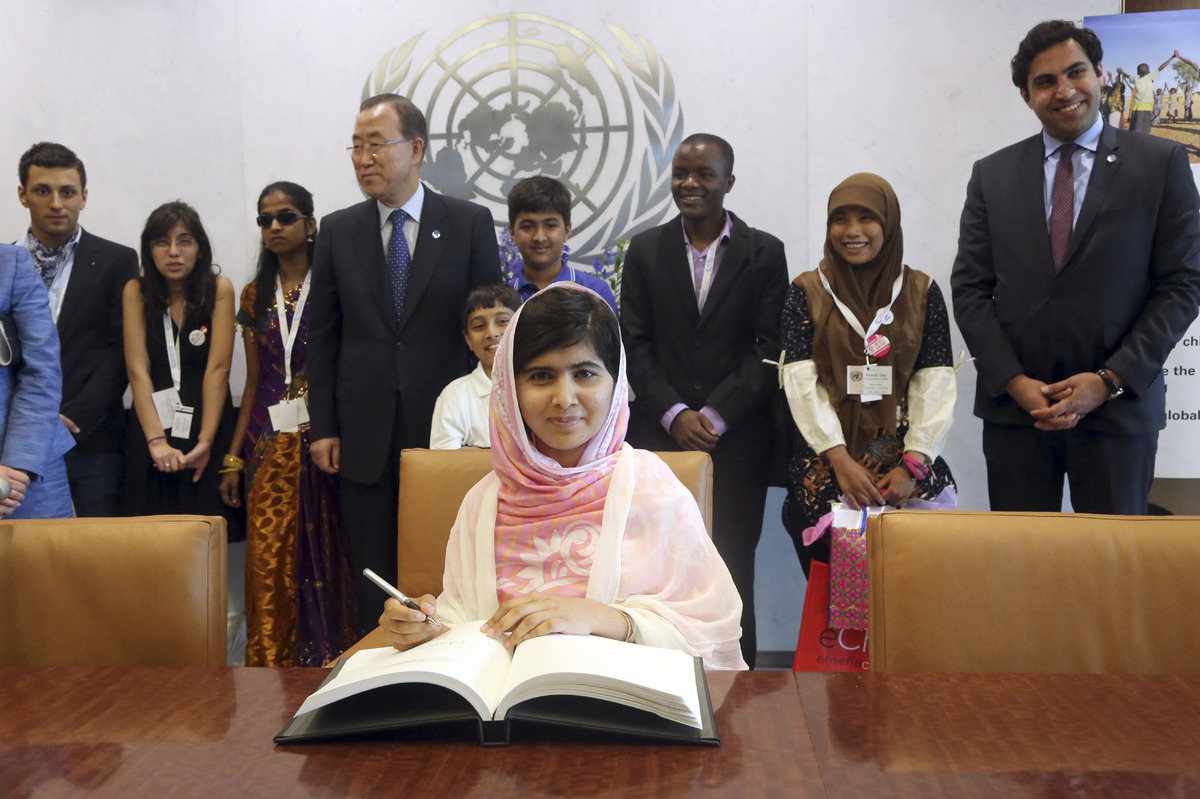
http://www.financialexpress.com/US President Barack Obama's elder daughter Malia and Pakistani girls' education activist Malala Yousafzai have been named among the 16 most influential teens of 2013 by Time magazine.